EP0698462A2 - Verfahren zur Wiederverwendung der P.E.T.-Abfällen, und Anlage zur Durchführing des Verfahrens - Google Patents
Verfahren zur Wiederverwendung der P.E.T.-Abfällen, und Anlage zur Durchführing des Verfahrens Download PDFInfo
- Publication number
- EP0698462A2 EP0698462A2 EP95630095A EP95630095A EP0698462A2 EP 0698462 A2 EP0698462 A2 EP 0698462A2 EP 95630095 A EP95630095 A EP 95630095A EP 95630095 A EP95630095 A EP 95630095A EP 0698462 A2 EP0698462 A2 EP 0698462A2
- Authority
- EP
- European Patent Office
- Prior art keywords
- thermoplastic polymer
- phase
- temperature
- chips
- deaeration
- Prior art date
- Legal status (The legal status is an assumption and is not a legal conclusion. Google has not performed a legal analysis and makes no representation as to the accuracy of the status listed.)
- Granted
Links
Images

Classifications
-
- B—PERFORMING OPERATIONS; TRANSPORTING
- B29—WORKING OF PLASTICS; WORKING OF SUBSTANCES IN A PLASTIC STATE IN GENERAL
- B29B—PREPARATION OR PRETREATMENT OF THE MATERIAL TO BE SHAPED; MAKING GRANULES OR PREFORMS; RECOVERY OF PLASTICS OR OTHER CONSTITUENTS OF WASTE MATERIAL CONTAINING PLASTICS
- B29B17/00—Recovery of plastics or other constituents of waste material containing plastics
- B29B17/02—Separating plastics from other materials
-
- B—PERFORMING OPERATIONS; TRANSPORTING
- B29—WORKING OF PLASTICS; WORKING OF SUBSTANCES IN A PLASTIC STATE IN GENERAL
- B29B—PREPARATION OR PRETREATMENT OF THE MATERIAL TO BE SHAPED; MAKING GRANULES OR PREFORMS; RECOVERY OF PLASTICS OR OTHER CONSTITUENTS OF WASTE MATERIAL CONTAINING PLASTICS
- B29B13/00—Conditioning or physical treatment of the material to be shaped
- B29B13/06—Conditioning or physical treatment of the material to be shaped by drying
-
- B—PERFORMING OPERATIONS; TRANSPORTING
- B29—WORKING OF PLASTICS; WORKING OF SUBSTANCES IN A PLASTIC STATE IN GENERAL
- B29K—INDEXING SCHEME ASSOCIATED WITH SUBCLASSES B29B, B29C OR B29D, RELATING TO MOULDING MATERIALS OR TO MATERIALS FOR MOULDS, REINFORCEMENTS, FILLERS OR PREFORMED PARTS, e.g. INSERTS
- B29K2067/00—Use of polyesters or derivatives thereof, as moulding material
-
- B—PERFORMING OPERATIONS; TRANSPORTING
- B29—WORKING OF PLASTICS; WORKING OF SUBSTANCES IN A PLASTIC STATE IN GENERAL
- B29K—INDEXING SCHEME ASSOCIATED WITH SUBCLASSES B29B, B29C OR B29D, RELATING TO MOULDING MATERIALS OR TO MATERIALS FOR MOULDS, REINFORCEMENTS, FILLERS OR PREFORMED PARTS, e.g. INSERTS
- B29K2105/00—Condition, form or state of moulded material or of the material to be shaped
- B29K2105/0097—Glues or adhesives, e.g. hot melts or thermofusible adhesives
-
- B—PERFORMING OPERATIONS; TRANSPORTING
- B29—WORKING OF PLASTICS; WORKING OF SUBSTANCES IN A PLASTIC STATE IN GENERAL
- B29K—INDEXING SCHEME ASSOCIATED WITH SUBCLASSES B29B, B29C OR B29D, RELATING TO MOULDING MATERIALS OR TO MATERIALS FOR MOULDS, REINFORCEMENTS, FILLERS OR PREFORMED PARTS, e.g. INSERTS
- B29K2711/00—Use of natural products or their composites, not provided for in groups B29K2601/00 - B29K2709/00, for preformed parts, e.g. for inserts
- B29K2711/12—Paper, e.g. cardboard
-
- Y—GENERAL TAGGING OF NEW TECHNOLOGICAL DEVELOPMENTS; GENERAL TAGGING OF CROSS-SECTIONAL TECHNOLOGIES SPANNING OVER SEVERAL SECTIONS OF THE IPC; TECHNICAL SUBJECTS COVERED BY FORMER USPC CROSS-REFERENCE ART COLLECTIONS [XRACs] AND DIGESTS
- Y02—TECHNOLOGIES OR APPLICATIONS FOR MITIGATION OR ADAPTATION AGAINST CLIMATE CHANGE
- Y02W—CLIMATE CHANGE MITIGATION TECHNOLOGIES RELATED TO WASTEWATER TREATMENT OR WASTE MANAGEMENT
- Y02W30/00—Technologies for solid waste management
- Y02W30/50—Reuse, recycling or recovery technologies
- Y02W30/62—Plastics recycling; Rubber recycling
Definitions
- the present invention relates to a method and an installation for recycling objects composed of a thermoplastic polymer.
- thermoplastic polymers for example with a saturated polyester resin, which can be polyethylene terephthalate (PET)
- PET polyethylene terephthalate
- the chips thus obtained can be reused if they are added, in greater or lesser proportions, depending on the requirements, to a virgin product (for example PET) for the production of new objects.
- a virgin product for example PET
- an important objective of the present invention consists in providing a method and an installation for the recycling of objects composed of a thermoplastic polymer, in which the recycled thermoplastic polymer (for example PET) is reused almost completely for the production of new objects.
- a thermoplastic polymer for example PET
- Another objective of the invention consists in carrying out a method and an installation for the recycling of objects composed of a thermoplastic polymer, making it possible to produce the same objects as those produced with a virgin non-recycled material.
- An additional objective of the invention consists in carrying out a method and an installation for the recycling of objects composed of a thermoplastic polymer, making it possible to produce a product having chemical and physical characteristics really superior to those of the virgin product by the fact that 'It underwent, during the recycling process, a better crystallization, having resulted in an improvement of its processing capacities thanks to the improvement of the flexibility and the resistance of the material.
- a final important objective of the invention consists in providing a process and an installation for recycling objects made of a thermoplastic polymer, having a high ecological value and allowing, in addition, a significant reduction in the costs of manufacturing recycled industrial products for consumption. current.
- thermoplastic polymer comprising several stages of preparation of the thermoplastic polymer being recycled, to transform it into a compound basic product.
- chips free of pollutants characterized in that it comprises the elimination of said chips the aqueous microparticles which they contain, the exposure of said dehydrated chips to an optimal fluidization temperature Tf to form a homogeneous product, the deaeration of said fluidized product, the extrusion of said fluidized and deaerated product and its cooling after extrusion, to a predetermined temperature, to achieve optimal crystallization.
- Said method can be carried out with an installation for recycling an object composed of a thermoplastic polymer, comprising at least one machine for performing a heat treatment and at least one machine for extruding the thermoplastic polymer, comprising an inlet orifice and an outlet for said thermoplastic polymer, heating means for melting said thermoplastic polymer to a predetermined degree of fluidity, means for mixing and conveying said thermoplastic polymer from said inlet to said outlet proximity of which a die is arranged, and means for deaerating said polymer, arranged between said inlet orifice and said outlet orifice, characterized in that said mixing and conveying means are defined by an extrusion screw with pitch variable, for the variation of the conveying speed and the pressure of said thermoplastic polymer between said o inlet port and said deaeration means and between said deaeration means and said outlet port.
- thermoplastic polymer first undergoes a series of treatments to rid it of the polluting agents which it may contain, for example cardboard, glues and other similar agents, until obtaining 'A product composed of a thermoplastic polymer, for example a saturated polyester resin, more specifically polyethylene terephthalate or its derivatives (PET), in the form of chips and powder.
- polluting agents which it may contain, for example cardboard, glues and other similar agents
- 'A product composed of a thermoplastic polymer, for example a saturated polyester resin, more specifically polyethylene terephthalate or its derivatives (PET), in the form of chips and powder.
- PET polyethylene terephthalate or its derivatives
- the chips are subjected to a dehydration treatment with dry air, in order to remove from them any aqueous microparticles which they contain, and they are simultaneously subjected to a pre-crystallization treatment.
- the latter are agitated continuously in order to prevent their aggregation, risking constituting a mass which cannot be treated simultaneously with the two above treatments.
- the dehydration and pre-crystallization of the chips are carried out by insufflation against the flow of dry air having a predetermined degree of humidity, temperature and flow rate.
- the relative humidity of the dry air allowing the best results to be obtained has a dew point value of between -35 ° and -65 ° C.
- the optimum dew point value is preferably -50 ° C.
- the dry air temperature is between 90 ° and 160 ° C, and preferably corresponds to about 130 ° C, while the flow of dry air is between 3 and 12 cubic meters per hour for each kilogram of chips to be dehydrated and pre-crystallized, with an average height of 250 to 300 millimeters of water column.
- the prior heat treatment will be carried out at a temperature between 35 ° and 75 ° C, preferably at a temperature of 60 ° C.
- the chips having been dehydrated and precrystallized during a simultaneous treatment, are then transferred in a predetermined metered quantity to the feed orifice of an extruder where they are subjected to a fluidization temperature Tf.
- the chips are preferably always exposed to a flow of dry air having a predetermined temperature, degree of humidity and flow rate.
- the homogeneous product is preferably subjected to a practically continuous mixing operation, in the presence of a predetermined temperature and pressure, as described in more detail below. .
- the homogeneous product must have a degree of fluidity which remains practically constant over time.
- the homogeneous product composed for example of PET
- a pressure P1 and to a theoretical temperature established T1 the value P1 being practically between 20 and 80 bars, and being preferably practically equal to 50 bars, the temperature T1 being between 265 and 285 ° C, preferably practically equal to 275 ° C.
- the second phase of mixing the homogeneous product it is exposed to a pressure P2 of between 30 and 50 bars, preferably practically equal to 40 bars, and to an established temperature T2 of between 255 and 275 ° C, preferably practically equal to 265 ° C.
- the homogeneous product is exposed to a pressure P3 of between 60 and 150 bars and to a temperature T3 of between 260 and 280 ° C, preferably practically equal to 270 ° C.
- the deaeration phase of the product is carried out in the presence of temperature T2 and pressure P2.
- the extrusion phase of the fluidized and deaerated product is carried out on the other hand in the presence of a pressure P4 of between 150 and 250 bars, on average equal to 200 bars, and at an established temperature T4 of between 265 ° and 285 ° C, preferably practically equal to 275 ° C.
- the conveying speed of the thermoplastic polymer, in particular PET, is also preferably lower when the product is transferred to the deaeration phase, while it increases after this last phase, when the product is transferred to the phase extrusion.
- 100 kg of chips mixed with powder are used, for example of the type PET 07333 from the company RETECH, P.O.B. 191 61 90 AD BEEK, Netherlands, for example from containers of polyethylene terephthalate or its derivatives (PET).
- PET 07333 from the company RETECH, P.O.B. 191 61 90 AD BEEK, Netherlands
- PET polyethylene terephthalate or its derivatives
- the PET fragments are introduced for at least 5 minutes into a dust collector of the mechanical type with an oscillating vacuum screen, with a high counter-current.
- the shavings thus separated from the powder are then transported by conventional means to an apparatus capable of simultaneously performing dehydration and pre-crystallization of said shavings for a time between 4 and 6 hours, at a temperature between 90 and 160 ° C, with an air flow of 7 cubic meters per hour per kilogram, with a dew point value of -55 ° C.
- the dehydrated chips are then automatically introduced into an airtight circuit defined by a metering device, type DTM 200, produced by TECNOTRADING srl, of S. Maria du Sala (VE), in order to produce a quantity of chips of 1,670 grams ( with reference to the 100 kg of the example) per minute, with maximum linearity, in an extrusion machine, the special extrusion screw of which rotates at a speed of 80 revolutions per minute.
- a metering device type DTM 200, produced by TECNOTRADING srl, of S. Maria du Sala (VE)
- TECNOTRADING srl of S. Maria du Sala
- the product then passes through a die, for example with 12 holes, before being immediately cooled by immersion in a fluid of a set temperature for about 4 seconds.
- 100 kg of chips mixed with powder are used, for example of the type PET 07333 from the company RETECH, P.O.B. 191 61 90 AD BEEK, Netherlands, for example from containers of polyethylene terephthalate or its derivatives (PET).
- PET 07333 from the company RETECH, P.O.B. 191 61 90 AD BEEK, Netherlands
- PET polyethylene terephthalate or its derivatives
- the PET fragments are introduced for 5 minutes inside a mechanical type dust collector with an oscillating vacuum screen.
- the chips are then preheated and transported by traditional means to a deaeration and pre-crystallization device for said chips, according to the phases already described in Example 1.
- the chips are then introduced via a hermetically closed circuit into a metering device, type DTM 200, produced by TECNOTRADING srl di S. Maria di Sala (VE), in order to produce a quantity of chips of 1.670 grams (with reference to the 100 kg of the example) per minute in an extrusion machine, the extrusion screw of which rotates at a speed of 80 revolutions per minute.
- a metering device type DTM 200, produced by TECNOTRADING srl di S. Maria di Sala (VE)
- the product then passes through a die, for example with 12 holes, before being immediately cooled by immersion in a fluid of a set temperature for about 4 seconds.
- the product will then be cut with a cutting machine, type T 150, produced by MECCANOPLASTICA di Mazza & C. s.a.s. of Castiglione Olona (VA), for final storage.
- a cutting machine type T 150, produced by MECCANOPLASTICA di Mazza & C. s.a.s. of Castiglione Olona (VA), for final storage.
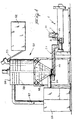
- thermoplastic polymer comprising at least one machine 54 defined by a dehydration device for carrying out a heat treatment and at least one machine 1 for extruding the thermoplastic polymer.
- the two machines 54 and 1 are connected in leaktight manner in the installation, by means of a metering device 51, allowing a predetermined supply of the machine to be extruded.
- the machine for heat treatment 54, the extruder 1 and the metering device 51 form practically a single body, in which the thermoplastic polymer and in particular the PET chips are continuously exposed to a flow. dry air with a predetermined humidity, temperature and flow rate.
- the installation 50 comprises a mechanical dust collector 52, in which the powder is removed from the shavings by means of a vibrating vacuum screen, preferably against the current.
- the chips pass from the dust collector 52, for example by means of an endless screw 53, in the upper part of the dewatering device 54.
- the dehydrating device 54 simultaneously performs a precristallization and dehydration operation of the chips by exposing them to a counter-current, with a flow of dry air coming from a drying device 55.
- the drying device 55 is tightly connected to the dehydration device 54 via a channel 56 for transferring dry air, having the characteristics indicated above, and a channel 57 for returning the humid air.
- the dehydrated and pre-crystallized chips pass to the metering device 51, together with a fraction of the flow of dry air coming from the channel 56.
- the metering device 51 provides for the regulated transport of the chips a screw conveyor 60 or a similar conveyor. From the metering device 51, the chips, which are always isolated from the surrounding atmosphere, pass directly to the extruder 1, together with the fraction of the dry air flow constantly present in the metering device.
- the deaeration members are preferably equipped with a pump 65. which, by creating a vacuum, discharges said air in a closed circuit 66 cooled with water at a set temperature.
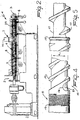
- the extrusion machine generally designated by the reference number 1, has an inlet port 2 and an outlet port 3, near which is arranged a die 4 through which the thermoplastic polymer is passed.
- the extrusion machine has in particular heating means 5 for melting the thermoplastic polymer to a predetermined degree of fluidity, means for mixing and conveying 6 of the polymer thermoplastic from the inlet to the outlet, and deaeration means 7 of the thermoplastic polymer, arranged between the inlet and the outlet.
- the mixing and conveying means are preferably defined by an extrusion screw, designated by the reference number 8, designed so as to allow the variation of the conveying speed and of the pressure of the thermoplastic polymer between the inlet port and the deaeration means 7 and between the latter and the outlet port 3.
- the extrusion screw actually has a first zone "A” comprising members for controlled supply of the thermoplastic polymer, generally indicated by the reference number 9, a second zone “B”, comprising depositing members and first members for transporting the thermoplastic polymer, generally designated by the reference number 10, a third zone “C”, comprising members for deaerating the thermoplastic polymer, generally designated by the reference 11 and a fourth zone “D”, comprising second transport members 12 of the deaerated thermoplastic polymer towards the die 4.
- a first zone "A” comprising members for controlled supply of the thermoplastic polymer, generally indicated by the reference number 9, a second zone “B”, comprising depositing members and first members for transporting the thermoplastic polymer, generally designated by the reference number 10, a third zone “C”, comprising members for deaerating the thermoplastic polymer, generally designated by the reference 11 and a fourth zone “D”, comprising second transport members 12 of the deaerated thermoplastic polymer towards the die 4.
- the controlled supply members are in particular defined by a channel 13 extending helically in the first zone "A" of the extrusion screw and communicating with the inlet orifice 2.
- the depositing members include an arcuate wall 14 defining a pocket 25. arranged near the helical channel 13, in order to be able to take the thermoplastic polymer leaving it in a predetermined quantity and to transport it, via the first transport elements, to deaeration elements 11.
- the transport members are in particular defined by a thread 15 defining a pitch of the screw equal to P1.
- the channel of the cylinder (that is to say the channel determined by the distance of the diameter Dv of the extrusion screw and the diameter Dc of the cylinder 26 in which it moves ) also gradually decreases with the approach of the deaeration organs.
- the pressure to which the thermoplastic polymer is exposed thus increases from the inlet orifice 2 until it reaches maximum levels near the deaeration devices 11.
- the deaeration members include an annular projection 16, followed by an expansion chamber 17, in which an expansion of the thermoplastic polymer takes place, with exhaust of the gases which it contains as well as dry air coming from, via from the metering device 51. from the dehydration device 54, these being expelled by means of a degassing device 18 with vacuum, defined by the pump 65, towards the outside of the extrusion machine, in the closed circuit 66 cooled by water, during the transport of the thermoplastic polymer.
- the second transport members comprising a thread 19 with a pitch P2 of the extrusion screw greater than the pitch P1 described above, come into action from the expansion chamber 17.
- step P1 determines a conveying speed of the thermoplastic polymer in front of the expansion chamber 17 lower than the conveying speed behind the expanding chamber 17.
- the depth of the cylinder channel also progressively decreases towards the die 4.
- Maintaining a constant fluidity of the thermoplastic polymer inside the extrusion machine is achieved by means of the heating means establishing a different temperature between the first and the fourth zone of the extrusion screw.
- These heating means can be constituted by incandescent resistors or, according to the invention, by high frequency magnetic inductors, so as to allow considerable energy savings.
- the invention thus meets the defined objectives and has many important advantages, as indicated above.
- the materials used, the shapes and the dimensions can be of any type. adapted to requirements.
Landscapes
- Engineering & Computer Science (AREA)
- Mechanical Engineering (AREA)
- Environmental & Geological Engineering (AREA)
- Processing And Handling Of Plastics And Other Materials For Molding In General (AREA)
- Processing Of Solid Wastes (AREA)
Applications Claiming Priority (4)
| Application Number | Priority Date | Filing Date | Title |
|---|---|---|---|
| LU88522 | 1994-08-23 | ||
| LU88522A LU88522A1 (fr) | 1994-08-23 | 1994-08-23 | Procèdé et installation pour le recyclage d'objets composés d'un polymère thermoplastique |
| LU88597 | 1995-03-30 | ||
| LU88597A LU88597A1 (fr) | 1995-03-30 | 1995-03-30 | Procédé et installation pour le recyclage d'objets composés d'un polymère thermoplastique |
Publications (3)
| Publication Number | Publication Date |
|---|---|
| EP0698462A2 true EP0698462A2 (de) | 1996-02-28 |
| EP0698462A3 EP0698462A3 (de) | 1996-09-18 |
| EP0698462B1 EP0698462B1 (de) | 2001-05-23 |
Family
ID=26640357
Family Applications (1)
| Application Number | Title | Priority Date | Filing Date |
|---|---|---|---|
| EP19950630095 Expired - Lifetime EP0698462B1 (de) | 1994-08-23 | 1995-08-11 | Verfahren zur Wiederverwendung der P.E.T.-Abfällen, und Anlage zur Durchführung des Verfahrens |
Country Status (3)
| Country | Link |
|---|---|
| EP (1) | EP0698462B1 (de) |
| AT (1) | ATE201352T1 (de) |
| DE (1) | DE69520989D1 (de) |
Cited By (7)
| Publication number | Priority date | Publication date | Assignee | Title |
|---|---|---|---|---|
| EP0899071A1 (de) * | 1997-08-29 | 1999-03-03 | Ykk Corporation | Verfahren zur Herstellung von Produkten aus wiederverwendetem Kunststoff |
| WO2001021373A1 (en) * | 1999-09-17 | 2001-03-29 | Visy Plastics Pty Ltd | Process for preparing food contact grade polyethylene terephthalate resin from waste pet containers |
| WO2001021372A1 (de) * | 1999-09-22 | 2001-03-29 | Helmut Bacher | Verfahren und vorrichtung zum recyclieren von pet-gut |
| WO2008058303A1 (de) * | 2006-11-13 | 2008-05-22 | Erema Engineering Recycling Maschinen Und Anlagen Gesellschaft M.B.H. | Verfahren zur vorbehandlung, aufarbeitung bzw. recyclierung von thermoplastischem kunststoffmaterial |
| KR100926606B1 (ko) * | 2005-01-28 | 2009-11-11 | 에레마 엔지니어링 리싸이클링 마쉬넨 운트 안라겐 게젤샤프트 엠. 베.하. | 사전처리된 열가소성 플라스틱 물질로 압출기를 채우기 위한 장치 |
| WO2010089173A3 (de) * | 2009-02-03 | 2011-03-03 | Starlinger & Co Gesellschaft M.B.H. | Kunststoff-extruder |
| EP2439044B1 (de) * | 2010-10-06 | 2017-09-13 | Diamat Maschinenbau GmbH | Extrudieranlage und Verfahren zur Reinigung von Kunststoffschmelzen |
Family Cites Families (6)
| Publication number | Priority date | Publication date | Assignee | Title |
|---|---|---|---|---|
| CA1089616A (en) * | 1975-05-15 | 1980-11-18 | Frank E. Hoffman | Porous laminar pellets of waste poly (ethylene terephthalate) film, and processes for drying and polymerization |
| DD216723A1 (de) * | 1983-07-18 | 1984-12-19 | Guben Chemiefaserwerk | Verfahren zur wiederverwendung fadenfoermiger, thermisch beanspruchter polyesterabfaelle |
| JPS62201205A (ja) * | 1986-03-01 | 1987-09-04 | Konishiroku Photo Ind Co Ltd | 熱可塑性樹脂製シ−トの製造方法および装置 |
| JPH0790550B2 (ja) * | 1987-02-18 | 1995-10-04 | 東芝機械株式会社 | Pet樹脂フイルム等の屑の再生ペレツト製造装置 |
| FR2622833B1 (fr) * | 1987-11-06 | 1990-04-27 | Omnium Traitement Valorisa | Procede et installation pour la fabrication d'objets moules ou extrudes a partir de dechets contenant des matieres plastiques |
| NL8800904A (nl) * | 1988-04-08 | 1989-11-01 | Reko Bv | Werkwijze voor het verwerken van een thermoplastisch polycondensatie-polymeer. |
-
1995
- 1995-08-11 DE DE69520989T patent/DE69520989D1/de not_active Expired - Lifetime
- 1995-08-11 AT AT95630095T patent/ATE201352T1/de not_active IP Right Cessation
- 1995-08-11 EP EP19950630095 patent/EP0698462B1/de not_active Expired - Lifetime
Cited By (13)
| Publication number | Priority date | Publication date | Assignee | Title |
|---|---|---|---|---|
| US6056901A (en) * | 1997-08-29 | 2000-05-02 | Ykk Corporation | Method for manufacture of regenerated synthetic resin product |
| EP0899071A1 (de) * | 1997-08-29 | 1999-03-03 | Ykk Corporation | Verfahren zur Herstellung von Produkten aus wiederverwendetem Kunststoff |
| WO2001021373A1 (en) * | 1999-09-17 | 2001-03-29 | Visy Plastics Pty Ltd | Process for preparing food contact grade polyethylene terephthalate resin from waste pet containers |
| WO2001021372A1 (de) * | 1999-09-22 | 2001-03-29 | Helmut Bacher | Verfahren und vorrichtung zum recyclieren von pet-gut |
| US6784214B1 (en) | 1999-09-22 | 2004-08-31 | Helmut Bacher | Method and device for recycling pet materials |
| US7108500B2 (en) | 1999-09-22 | 2006-09-19 | Helmut Bacher | Process and apparatus for recycling of PET-material |
| CN101111360B (zh) * | 2005-01-28 | 2010-06-16 | 奥地利埃瑞玛再生工程机械设备有限公司 | 用于使用预处理热塑性塑料材料填充挤压机的设备 |
| KR100926606B1 (ko) * | 2005-01-28 | 2009-11-11 | 에레마 엔지니어링 리싸이클링 마쉬넨 운트 안라겐 게젤샤프트 엠. 베.하. | 사전처리된 열가소성 플라스틱 물질로 압출기를 채우기 위한 장치 |
| WO2008058303A1 (de) * | 2006-11-13 | 2008-05-22 | Erema Engineering Recycling Maschinen Und Anlagen Gesellschaft M.B.H. | Verfahren zur vorbehandlung, aufarbeitung bzw. recyclierung von thermoplastischem kunststoffmaterial |
| EP2295218A1 (de) * | 2006-11-13 | 2011-03-16 | EREMA Engineering Recycling Maschinen und Anlagen Gesellschaft m.b.H. | Verfahren und Aufarbeitung von Polymilchsäure-Kunststoffen |
| WO2010089173A3 (de) * | 2009-02-03 | 2011-03-03 | Starlinger & Co Gesellschaft M.B.H. | Kunststoff-extruder |
| US8672662B2 (en) | 2009-02-03 | 2014-03-18 | Starlinger & Co Gesellschaft M.B.H. | Plastic extruder |
| EP2439044B1 (de) * | 2010-10-06 | 2017-09-13 | Diamat Maschinenbau GmbH | Extrudieranlage und Verfahren zur Reinigung von Kunststoffschmelzen |
Also Published As
| Publication number | Publication date |
|---|---|
| ATE201352T1 (de) | 2001-06-15 |
| EP0698462B1 (de) | 2001-05-23 |
| EP0698462A3 (de) | 1996-09-18 |
| DE69520989D1 (de) | 2001-06-28 |
Similar Documents
| Publication | Publication Date | Title |
|---|---|---|
| EP1156914B1 (de) | Verfahren zur zustandsverbesserung von zum recycling bestimmtem kunststoff-material | |
| RU2467873C2 (ru) | Способ и устройство для литья полимеров под давлением | |
| RU2709447C1 (ru) | Устройство для производства заготовок | |
| EP2091338B1 (de) | Verfahren für die kontinuierliche herstellung eines porösen pulverprodukts | |
| JP2017531703A (ja) | ペレットおよび他の物質を乾燥させるシステムおよび方法 | |
| EP0698462B1 (de) | Verfahren zur Wiederverwendung der P.E.T.-Abfällen, und Anlage zur Durchführung des Verfahrens | |
| CH677637A5 (de) | ||
| JP6328148B2 (ja) | 溶融物処理プラント | |
| KR20020055580A (ko) | 폐기된 페트 용기로부터 식품 접촉 등급의 폴리에틸렌테레프탈레이트 수지를 제조하는 방법 | |
| JPH0615639A (ja) | 熱可塑性の重縮合物から重合体を製造するための方法および装置 | |
| FR2791296A1 (fr) | Granulateur immerge et procede pour granuler des matieres synthetiques thermoplastiques | |
| WO2007133435A2 (en) | Use of a vibratory spiral elevator for crystallizing and/or drying of plastic pellets | |
| US20220126481A1 (en) | Extruder | |
| RU2401702C1 (ru) | Способ и устройство для обработки емкостей из полимерного материала | |
| JPS6347481B2 (de) | ||
| TWI711521B (zh) | 處理橡膠球粒的方法 | |
| CN109715357A (zh) | 用于基于葵花籽壳/葵花籽外皮材料制造生物塑料颗粒的方法 | |
| LU88597A1 (fr) | Procédé et installation pour le recyclage d'objets composés d'un polymère thermoplastique | |
| US4130901A (en) | Plastication arrangement in a machine for processing polymeric materials | |
| LU88522A1 (fr) | Procèdé et installation pour le recyclage d'objets composés d'un polymère thermoplastique | |
| JPS62151317A (ja) | プラスチツク樹脂の溶融押出方法及びその装置 | |
| EP0216653B1 (de) | Granulierungsvorrichtung | |
| US12390975B2 (en) | Extruder | |
| JP2002529271A (ja) | ポリマー材料から粒状材料を製造する方法及び装置 | |
| US5465503A (en) | Dryer densifier |
Legal Events
| Date | Code | Title | Description |
|---|---|---|---|
| PUAI | Public reference made under article 153(3) epc to a published international application that has entered the european phase |
Free format text: ORIGINAL CODE: 0009012 |
|
| AK | Designated contracting states |
Kind code of ref document: A2 Designated state(s): AT BE CH DE DK ES FR GB GR IE IT LI LU NL PT SE |
|
| PUAL | Search report despatched |
Free format text: ORIGINAL CODE: 0009013 |
|
| AK | Designated contracting states |
Kind code of ref document: A3 Designated state(s): AT BE CH DE DK ES FR GB GR IE IT LI LU NL PT SE |
|
| 17P | Request for examination filed |
Effective date: 19970311 |
|
| RAP1 | Party data changed (applicant data changed or rights of an application transferred) |
Owner name: ECO SELECTA ITALIA S.R.L. |
|
| 17Q | First examination report despatched |
Effective date: 19980827 |
|
| GRAG | Despatch of communication of intention to grant |
Free format text: ORIGINAL CODE: EPIDOS AGRA |
|
| GRAG | Despatch of communication of intention to grant |
Free format text: ORIGINAL CODE: EPIDOS AGRA |
|
| GRAH | Despatch of communication of intention to grant a patent |
Free format text: ORIGINAL CODE: EPIDOS IGRA |
|
| GRAH | Despatch of communication of intention to grant a patent |
Free format text: ORIGINAL CODE: EPIDOS IGRA |
|
| GRAA | (expected) grant |
Free format text: ORIGINAL CODE: 0009210 |
|
| AK | Designated contracting states |
Kind code of ref document: B1 Designated state(s): AT BE CH DE DK ES FR GB GR IE IT LI LU NL PT SE |
|
| PG25 | Lapsed in a contracting state [announced via postgrant information from national office to epo] |
Ref country code: NL Free format text: LAPSE BECAUSE OF FAILURE TO SUBMIT A TRANSLATION OF THE DESCRIPTION OR TO PAY THE FEE WITHIN THE PRESCRIBED TIME-LIMIT Effective date: 20010523 Ref country code: IT Free format text: LAPSE BECAUSE OF FAILURE TO SUBMIT A TRANSLATION OF THE DESCRIPTION OR TO PAY THE FEE WITHIN THE PRESCRIBED TIME-LIMIT;WARNING: LAPSES OF ITALIAN PATENTS WITH EFFECTIVE DATE BEFORE 2007 MAY HAVE OCCURRED AT ANY TIME BEFORE 2007. THE CORRECT EFFECTIVE DATE MAY BE DIFFERENT FROM THE ONE RECORDED. Effective date: 20010523 Ref country code: IE Free format text: LAPSE BECAUSE OF FAILURE TO SUBMIT A TRANSLATION OF THE DESCRIPTION OR TO PAY THE FEE WITHIN THE PRESCRIBED TIME-LIMIT Effective date: 20010523 Ref country code: GR Free format text: LAPSE BECAUSE OF NON-PAYMENT OF DUE FEES Effective date: 20010523 Ref country code: GB Free format text: LAPSE BECAUSE OF FAILURE TO SUBMIT A TRANSLATION OF THE DESCRIPTION OR TO PAY THE FEE WITHIN THE PRESCRIBED TIME-LIMIT Effective date: 20010523 Ref country code: AT Free format text: LAPSE BECAUSE OF FAILURE TO SUBMIT A TRANSLATION OF THE DESCRIPTION OR TO PAY THE FEE WITHIN THE PRESCRIBED TIME-LIMIT Effective date: 20010523 |
|
| REF | Corresponds to: |
Ref document number: 201352 Country of ref document: AT Date of ref document: 20010615 Kind code of ref document: T |
|
| REG | Reference to a national code |
Ref country code: CH Ref legal event code: EP |
|
| REF | Corresponds to: |
Ref document number: 69520989 Country of ref document: DE Date of ref document: 20010628 |
|
| REG | Reference to a national code |
Ref country code: IE Ref legal event code: FG4D Free format text: FRENCH |
|
| PG25 | Lapsed in a contracting state [announced via postgrant information from national office to epo] |
Ref country code: LU Free format text: LAPSE BECAUSE OF NON-PAYMENT OF DUE FEES Effective date: 20010811 |
|
| PG25 | Lapsed in a contracting state [announced via postgrant information from national office to epo] |
Ref country code: SE Free format text: LAPSE BECAUSE OF FAILURE TO SUBMIT A TRANSLATION OF THE DESCRIPTION OR TO PAY THE FEE WITHIN THE PRESCRIBED TIME-LIMIT Effective date: 20010823 Ref country code: PT Free format text: LAPSE BECAUSE OF FAILURE TO SUBMIT A TRANSLATION OF THE DESCRIPTION OR TO PAY THE FEE WITHIN THE PRESCRIBED TIME-LIMIT Effective date: 20010823 Ref country code: DK Free format text: LAPSE BECAUSE OF FAILURE TO SUBMIT A TRANSLATION OF THE DESCRIPTION OR TO PAY THE FEE WITHIN THE PRESCRIBED TIME-LIMIT Effective date: 20010823 |
|
| PG25 | Lapsed in a contracting state [announced via postgrant information from national office to epo] |
Ref country code: DE Free format text: LAPSE BECAUSE OF FAILURE TO SUBMIT A TRANSLATION OF THE DESCRIPTION OR TO PAY THE FEE WITHIN THE PRESCRIBED TIME-LIMIT Effective date: 20010824 |
|
| PG25 | Lapsed in a contracting state [announced via postgrant information from national office to epo] |
Ref country code: LI Free format text: LAPSE BECAUSE OF NON-PAYMENT OF DUE FEES Effective date: 20010831 Ref country code: CH Free format text: LAPSE BECAUSE OF NON-PAYMENT OF DUE FEES Effective date: 20010831 Ref country code: BE Free format text: LAPSE BECAUSE OF NON-PAYMENT OF DUE FEES Effective date: 20010831 |
|
| NLV1 | Nl: lapsed or annulled due to failure to fulfill the requirements of art. 29p and 29m of the patents act | ||
| GBV | Gb: ep patent (uk) treated as always having been void in accordance with gb section 77(7)/1977 [no translation filed] |
Effective date: 20010523 |
|
| PG25 | Lapsed in a contracting state [announced via postgrant information from national office to epo] |
Ref country code: ES Free format text: LAPSE BECAUSE OF FAILURE TO SUBMIT A TRANSLATION OF THE DESCRIPTION OR TO PAY THE FEE WITHIN THE PRESCRIBED TIME-LIMIT Effective date: 20011130 |
|
| REG | Reference to a national code |
Ref country code: IE Ref legal event code: FD4D |
|
| BERE | Be: lapsed |
Owner name: ECO SELECTA ITALIA S.R.L. Effective date: 20010831 |
|
| PLBE | No opposition filed within time limit |
Free format text: ORIGINAL CODE: 0009261 |
|
| STAA | Information on the status of an ep patent application or granted ep patent |
Free format text: STATUS: NO OPPOSITION FILED WITHIN TIME LIMIT |
|
| REG | Reference to a national code |
Ref country code: CH Ref legal event code: PL |
|
| PG25 | Lapsed in a contracting state [announced via postgrant information from national office to epo] |
Ref country code: FR Free format text: LAPSE BECAUSE OF NON-PAYMENT OF DUE FEES Effective date: 20020430 |
|
| 26N | No opposition filed | ||
| REG | Reference to a national code |
Ref country code: FR Ref legal event code: ST |