EP0700183B1 - Procédé de génération d'information de fiabilité pour chaque bit dans un système de transmission de données utilisant une modulation orthogonale à plusieurs niveaux - Google Patents
Procédé de génération d'information de fiabilité pour chaque bit dans un système de transmission de données utilisant une modulation orthogonale à plusieurs niveaux Download PDFInfo
- Publication number
- EP0700183B1 EP0700183B1 EP95112841A EP95112841A EP0700183B1 EP 0700183 B1 EP0700183 B1 EP 0700183B1 EP 95112841 A EP95112841 A EP 95112841A EP 95112841 A EP95112841 A EP 95112841A EP 0700183 B1 EP0700183 B1 EP 0700183B1
- Authority
- EP
- European Patent Office
- Prior art keywords
- data bit
- reliability information
- determined
- signal
- modulated
- Prior art date
- Legal status (The legal status is an assumption and is not a legal conclusion. Google has not performed a legal analysis and makes no representation as to the accuracy of the status listed.)
- Expired - Lifetime
Links
- 238000000034 method Methods 0.000 title claims description 24
- 230000005540 biological transmission Effects 0.000 title description 10
- 238000004364 calculation method Methods 0.000 description 5
- 238000004891 communication Methods 0.000 description 4
- 230000008569 process Effects 0.000 description 3
- 239000000654 additive Substances 0.000 description 2
- 230000000996 additive effect Effects 0.000 description 2
- 230000008901 benefit Effects 0.000 description 2
- 238000011161 development Methods 0.000 description 2
- 230000018109 developmental process Effects 0.000 description 2
- 230000006870 function Effects 0.000 description 2
- 230000009466 transformation Effects 0.000 description 2
- 230000001419 dependent effect Effects 0.000 description 1
- 238000011156 evaluation Methods 0.000 description 1
- 239000000203 mixture Substances 0.000 description 1
- 238000012545 processing Methods 0.000 description 1
- 238000000844 transformation Methods 0.000 description 1
Images

Classifications
-
- H—ELECTRICITY
- H04—ELECTRIC COMMUNICATION TECHNIQUE
- H04L—TRANSMISSION OF DIGITAL INFORMATION, e.g. TELEGRAPHIC COMMUNICATION
- H04L1/00—Arrangements for detecting or preventing errors in the information received
- H04L1/20—Arrangements for detecting or preventing errors in the information received using signal quality detector
Definitions
- the invention is based on a method for obtaining Reliability information for M-stage modulation the genus of the main claim. It is a process for Obtaining reliability information at M-level Modulation by A.J. Viterbi, "Performance of power-controlled wideband terrestrial digital communication ", IEEE Transactions on Communications, Vol. 41, No. 4, April 1993, page 559 ff only reliability information about a symbol, i.e. is calculated via a data group and all data one Data group with the same reliability information be rated. This means that in the individual bits information in a data group is not completely available Determination of the decided data evaluated. Thus Information that is available is not used.
- GB-A-2 185 367 describes a method for obtaining bit-specific Reliability information when demodulating M-level modulated data are transmitted by means of modulated signals.
- the modulated Receive signal demodulated and compared with stored signals.
- the modulated data bits are evaluated in their reliability to the received Evaluate the codeword using the added redundancy before the actual decoding takes place.
- the type of modulation used is so assumed that the channel state is separate for each bit transmitted can be measured. With higher-level modulation forms, the channel state is not directly assign the transferred bits individually.
- the measures listed in the dependent claims are advantageous Developments and improvements to the method specified in claim 1 possible. It is particularly advantageous to determine the reliability information current noise power and the current useful energy of the received signal use. As a result, the calculation of the reliability information is high Accuracy possible.
- the noise power and the useful energy are preferably in fixed intervals are estimated.
- a preferred calculation of the reliability information is the concrete one Distribution densities of the observed received signal under the assumptions of the M possible transmission signals to be used, whereby a particularly accurate calculation of the Reliability information is possible.
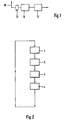
- FIG. 1 shows an arrangement for execution of the method
- Figure 2 shows a program flow
- Figure 3 shows a table of values.
- FIG. 1 shows a receiving antenna 10 connected to the input of a receiving unit 13 connected.
- An output of the receiving unit 13 is connected to an input one Demodulator 11 connected.
- An output of the demodulator 11 is connected to the input a computing unit 12 connected to memory. That from the receiving antenna 10 received signal is passed on to the receiving unit 13.
- the receiving unit 13 amplifies the received signal. Then that will amplified signal from the carrier frequency by means of a frequency mix into a Intermediate frequency shifted.
- the frequency shifted signal is amplified and the Demodulator 11 supplied.
- the demodulator 11 carries out carrier demodulation and forwards the demodulated signal to the computing unit 12.
- FIG. 2 schematically shows the program sequence for operating the computing unit 12
- Program point 1 the demodulated signal is fed to the computing unit 12.
- the demodulated signal represents a signal using an M-stage modulation was modulated.
- the number M of stages is greater than two.
- Each of the M signals used for Modulation used represents an icon that represents a specified group of Represents data bits.
- In the memory of the computing unit 12 are those for modulation used M signals stored.
- For each of the M used for modulation Signals is in a table that is stored in the memory of the computing unit 12 corresponding group of data bits filed.
- the computing unit 12 compares the demodulated signal with the stored signals.
- the comparison is carried out via a cross correlation, such as in Proakis, "Digital Communications", McGraw-Hill Int. Book Company, 1983, ISBN 0-07-Y 66490-0, Chapter 4, page 139 ff.
- other comparison methods such as that of the adapted filter demodulator can also be used.
- the terms Q (V j ) and q (V j ) represent distribution densities. They describe the occurrence probabilities for the value V j of a determined match size.
- the density Q (V j ) contains the assumption that the jth symbol was actually transmitted, while q (V j ) on the contrary is based on the assumption that the current symbol is not the jth symbol but one of the others is. Due to the generally fulfilled symmetry conditions of the transmission symbols (orthogonality, same symbol energy etc.) the formulas of the densities Q (x) and q (x) themselves are independent of the symbol under consideration; the relation to the transmission symbol is established only by the argument V j .
- the formula-based definition of the densities Q (V j ) and q (V j ) depends on the recipient's implementation or on the education law that is used to determine the match sizes and may differ from the described definition depending on the recipient or education law.
- the noise power 2 ⁇ 2 and the useful energy ⁇ 2 must be known. Both sizes are to be estimated continuously during operation.
- an individual a posteriori probability is then determined for each data bit in a group and reliability information for each data bit is calculated therefrom.
- the table shows the bit groups (b 0 , b 1 ) assigned to the symbols of two data bits each, the decision variables V i of the symbols and the probability values P i of the symbol decision.
- the decision variables (match values) with the values 0.9, 0.8, 0.1 and 0.05 are shown under V i .
- M 4 symbols are used, which are represented by two data bits b 0 and b 1 , wherein each data bit can have the value -1 or +1.
- the bit combinations assigned to the four symbols S o , S 1 , S 2 , S 3 are shown line by line.
- the concrete shape of the symbols themselves is irrelevant in the current considerations; orthogonal Walsh symbols can be used, for example.
- the data bit b 0 has a greater total probability for the value -1 than for the value +1. It is therefore more likely that the value -1 for the data bit b 0 is correct.
- L b0 log P b0 1-P b0
- L b1 log P b1 1-P b1
- Reliability information for the values -1 or +1 of the data bit b 0 and b 1 can be calculated from the sum probabilities using the formula (7) and the formula (8).
- the reliability information is used to give a statement as to how likely the decision of the data bits b 0 and b 1 in the values +1 or -1 is.
- the reliability information is multiplied by the value of the data bits b 0 or b 1 in accordance with the following formulas (9) and (10):
- program point 4 the reliability information or the soft data bit is output .
- program point 4 the program branches to program point 1 and processes a new received and demodulated signal.
- the soft data bits become the final data bits b ⁇ decided hard.
- the term hard decision means that one of two fixed values, for example +1 or -1, is decided.
- the soft data bits can also have values unequal to +1 or -1.
- a decision maker issues +1 for each data bit b ⁇ if the sign of the soft data bit is positive. If the soft data bit has a negative sign, decided to -1.
- a channel or source decoder can be used as the decoder, for example in the form of a Viterbi decoder.
- a decoder When using the soft data bits for deciding information bits, a decoder assumes the information bit to be -1 if the soft data bit is negative and the information bit to be +1 if the soft data bit is positive.
- the amount of soft data bit is called Reliability information interpreted and e.g. to Evaluation of the path metrics when decoding with the Viterbi algorithm used.
- Reliability information By extracting and using the Reliability information or the soft data bits is it is possible with M-stage modulation during demodulation additional information bit by bit (Reliability information, soft data bit), which indicates a probability of how safe one is Decision of a data bit is.
- Reliability information soft data bit
- M-level Transmission methods efficient in systems with use downstream decoders.
- the additional information is advantageous from subsequent signal processing units such as channel or source decoders to improve the Decision security used.
- the comparison of the received demodulated signal with the stored signals are e.g. in form of a Walsh-Hadamard transformation if to M-level Modulation orthogonal Walsh functions can be used. On this way a simple, incoherent recipient be used.
- the decision variables are the Amount squares of the Walsh-Hadamard transformations used.
- the decision variables of the individual transmission paths are added to an overall decision variable Vg j . This is done using the following formula, for example:
Landscapes
- Engineering & Computer Science (AREA)
- Quality & Reliability (AREA)
- Computer Networks & Wireless Communication (AREA)
- Signal Processing (AREA)
- Error Detection And Correction (AREA)
- Detection And Prevention Of Errors In Transmission (AREA)
- Detection And Correction Of Errors (AREA)
- Digital Transmission Methods That Use Modulated Carrier Waves (AREA)
Claims (10)
- Procédé pour obtenir une information de fiabilité spécifique à un bit lors de la démodulation de données modulées transmises par des signaux modulés selon lequel
on reçoit le signal modulé et on le compare à des signaux mis en mémoire,
chaque signal mis en mémoire et chaque signal modulé représentant un groupe fixe de bits de données,
on enregistre en mémoire les groupes fixes et à partir de la comparaison du signal modulé et des signaux mis en mémoire, pour chaque signal mis en mémoire on calcule une probabilité pour la concordance entre le signal modulé et le signal mis en mémoire et à partir des probabilités calculées pour chaque bit de données d'un groupe, on détermine une information de fiabilité ou un bit de données souple obtenu à partir de l'information de fiabilité,
caractérisé en ce que
les données sont des données à modulation de niveau M, M étant supérieur à 2 et M utilisant différents symboles de signaux d'émission. - Procédé selon la revendication 1,
caractérisé en ce que
pour déterminer l'information de fiabilité on utilise une puissance de bruit moyenne, supposée connue et une énergie utile supposée connue du signal de réception. - Procédé selon la revendication 1,
caractérisé en ce que
la puissance de bruit et l'énergie utile sont évaluées à des intervalles de temps déterminés. - Procédé selon l'une des revendications 2 et 3,
caractérisé en ce que
pour chaque signal reçu modulé on calcule la probabilité Pj selon les formules suivantes :- Q(Vj)
- fonction de densité de distribution d'une grandeur de concordance obtenue Vj dans l'hypothèse que le symbole effectivement émis est le symbole d'ordre j et
- q(Vj)
- représente une fonction de distribution de densité de la grandeur de concordance obtenue Vj dans l'hypothèse que le symbole effectivement émis n'est pas le symbole d'ordre j et
dans laquelle M est le nombre de niveaux de modulation.
- Procédé selon l'une des revendications 1 à 4,
caractérisé en ce que
la probabilité que le bit de données pour la position ν est dans le groupe de données +1 ou -1, P(bν = +1/-1), résulte de la sommation des probabilités obtenues de la comparaison du signal modulé et des signaux enregistrés en mémoire, en utilisant seulement les probabilités pour lesquelles le bit de données des signaux enregistrés à la position d'ordre ν du groupe représente également une valeur +1 ou -1. - Procédé selon l'une des revendications 1 à 5,
caractérisé en ce que
pour le bit de données bν on prend une valeur +1 et une information de fiabilité L (+1) / υ donnée par la relation suivante : - Procédé selon la revendication 6,
caractérisé en ce qu'
à partir de l'information de fiabilité Lν (+1) on détermine un bit de données souple(+1) selon la relation suivante

- Procédé selon l'une des revendications 1 à 5,
caractérisé en ce que
pour un bit de données bν on prend la valeur -1 et une information de fiabilité L (-1) / υ selon la formule suivante : - Procédé selon la revendication 8,
caractérisé en ce qu'
on détermine bit de données soupleselon la formule suivante :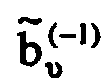

- Application du procédé selon l'une des revendications 1 à 9 pour le décodage de canal ou le décodage de source.
Applications Claiming Priority (2)
| Application Number | Priority Date | Filing Date | Title |
|---|---|---|---|
| DE4431237A DE4431237A1 (de) | 1994-09-02 | 1994-09-02 | Verfahren zur Gewinnung von bitspezifischen Zuverlässigkeitsinformationen |
| DE4431237 | 1994-09-02 |
Publications (3)
| Publication Number | Publication Date |
|---|---|
| EP0700183A2 EP0700183A2 (fr) | 1996-03-06 |
| EP0700183A3 EP0700183A3 (fr) | 1997-11-05 |
| EP0700183B1 true EP0700183B1 (fr) | 2003-10-29 |
Family
ID=6527225
Family Applications (1)
| Application Number | Title | Priority Date | Filing Date |
|---|---|---|---|
| EP95112841A Expired - Lifetime EP0700183B1 (fr) | 1994-09-02 | 1995-08-16 | Procédé de génération d'information de fiabilité pour chaque bit dans un système de transmission de données utilisant une modulation orthogonale à plusieurs niveaux |
Country Status (4)
| Country | Link |
|---|---|
| US (1) | US5790595A (fr) |
| EP (1) | EP0700183B1 (fr) |
| JP (1) | JP4124496B2 (fr) |
| DE (2) | DE4431237A1 (fr) |
Families Citing this family (30)
| Publication number | Priority date | Publication date | Assignee | Title |
|---|---|---|---|---|
| FI944739A7 (fi) * | 1994-10-07 | 1996-04-08 | Nokia Corp | Häiriönpoistomenetelmä ja vastaanotin |
| KR100498752B1 (ko) * | 1996-09-02 | 2005-11-08 | 소니 가부시끼 가이샤 | 비트메트릭스를 사용한 데이터 수신장치 및 방법 |
| JP3862111B2 (ja) * | 1997-08-05 | 2006-12-27 | ソニー株式会社 | 受信装置及び無線通信システム並びに通信方法 |
| WO1999046884A1 (fr) * | 1998-03-12 | 1999-09-16 | British Telecommunications Public Limited Company | Procede et appareil de mesure de la degradation du signal |
| DE19902100C2 (de) * | 1999-01-20 | 2003-05-22 | Infineon Technologies Ag | Verfahren und Vorrichtung zur Decodierung von Faltungscodes |
| JP4449108B2 (ja) * | 1999-08-05 | 2010-04-14 | パナソニック株式会社 | 音声復号装置 |
| JP4161487B2 (ja) * | 1999-11-01 | 2008-10-08 | ソニー株式会社 | データ復号装置及び方法 |
| KR20010054370A (ko) * | 1999-12-06 | 2001-07-02 | 박종섭 | 다이버시티가 3인 패스트 에프에이치 시스템의 오류정정회로 |
| DE10009443A1 (de) * | 2000-02-29 | 2001-08-30 | Philips Corp Intellectual Pty | Empfänger und Verfahren zum Detektieren und Dekodieren eines DQPSK-modulierten und kanalkodierten Empfangssignals |
| US6757859B1 (en) * | 2000-05-01 | 2004-06-29 | Zarlink Semiconductor Inc. | Parallel turbo trellis-coded modulation |
| WO2001093488A1 (fr) * | 2000-05-29 | 2001-12-06 | Telefonaktiebolaget Lm Ericsson (Publ) | Detection et masquage d'erreurs pour donnees vocales codees |
| US7173551B2 (en) | 2000-12-21 | 2007-02-06 | Quellan, Inc. | Increasing data throughput in optical fiber transmission systems |
| US7149256B2 (en) | 2001-03-29 | 2006-12-12 | Quellan, Inc. | Multilevel pulse position modulation for efficient fiber optic communication |
| US7307569B2 (en) | 2001-03-29 | 2007-12-11 | Quellan, Inc. | Increasing data throughput in optical fiber transmission systems |
| CA2442922A1 (fr) | 2001-04-04 | 2002-10-17 | Quellan, Inc. | Procede et systeme permettant de decoder des signaux multiniveau |
| US7412294B1 (en) * | 2001-12-21 | 2008-08-12 | Woolfork C Earl | Wireless digital audio system |
| AU2003211094A1 (en) | 2002-02-15 | 2003-09-09 | Quellan, Inc. | Multi-level signal clock recovery technique |
| US7657822B2 (en) * | 2002-05-31 | 2010-02-02 | Broadcom Corporation | True bit level decoding of TTCM (turbo trellis code modulation) of variable rates and signal constellations |
| US7035361B2 (en) * | 2002-07-15 | 2006-04-25 | Quellan, Inc. | Adaptive noise filtering and equalization for optimal high speed multilevel signal decoding |
| DE10240444A1 (de) * | 2002-09-02 | 2004-03-11 | Siemens Ag | Bitweises Berechnen der Wahrscheinlichkeit einer richtigen Übertragung von Bits eines Symbols über einen Übertragungskanal |
| AU2003287628A1 (en) * | 2002-11-12 | 2004-06-03 | Quellan, Inc. | High-speed analog-to-digital conversion with improved robustness to timing uncertainty |
| US20040190661A1 (en) * | 2003-03-26 | 2004-09-30 | Quellan, Inc. | Method and system for equalizing communication signals |
| WO2005018134A2 (fr) | 2003-08-07 | 2005-02-24 | Quellan, Inc. | Procede et systeme pour supprimer la diaphonie |
| US7804760B2 (en) | 2003-08-07 | 2010-09-28 | Quellan, Inc. | Method and system for signal emulation |
| ATE488068T1 (de) | 2003-11-17 | 2010-11-15 | Quellan Inc | Verfahren und system zur löschung von antennenstörungen |
| US7616700B2 (en) | 2003-12-22 | 2009-11-10 | Quellan, Inc. | Method and system for slicing a communication signal |
| US7725079B2 (en) | 2004-12-14 | 2010-05-25 | Quellan, Inc. | Method and system for automatic control in an interference cancellation device |
| US7522883B2 (en) | 2004-12-14 | 2009-04-21 | Quellan, Inc. | Method and system for reducing signal interference |
| US7693884B2 (en) * | 2006-01-02 | 2010-04-06 | International Business Machines Corporation | Managing storage systems based on policy-specific proability |
| KR101372361B1 (ko) | 2006-04-26 | 2014-03-12 | 인터실 아메리카스 엘엘씨 | 통신 채널로부터 복사성 방출을 감소시키기 위한 방법 및 시스템 |
Family Cites Families (11)
| Publication number | Priority date | Publication date | Assignee | Title |
|---|---|---|---|---|
| SE433998B (sv) * | 1977-10-11 | 1984-06-25 | Carl Erik Wilhelm Sundberg | Anordning vid signalmottagare for att kompensera digitala fel i overford digital signal |
| CA1296065C (fr) * | 1985-12-11 | 1992-02-18 | Tadashi Matsumoto | Methode de decodage de codes complets de correction d'erreurs |
| DE3910739C3 (de) * | 1989-04-03 | 1996-11-21 | Deutsche Forsch Luft Raumfahrt | Verfahren zum Verallgemeinern des Viterbi-Algorithmus und Einrichtungen zur Durchführung des Verfahrens |
| DE3911999A1 (de) * | 1989-04-12 | 1990-10-18 | Philips Patentverwaltung | Uebertragungssystem |
| US5222101A (en) * | 1991-05-03 | 1993-06-22 | Bell Communications Research | Phase equalizer for TDMA portable radio systems |
| DE4116614A1 (de) * | 1991-05-22 | 1992-11-26 | Bosch Gmbh Robert | Verfahren zur demodulation und synchronisation fuer digital modulierte signale |
| DE4224214C2 (de) * | 1992-07-22 | 1995-02-09 | Deutsche Forsch Luft Raumfahrt | Verfahren zur quellengesteuerten Kanaldecodierung durch Erweiterung des Viterbi-Algorithmus |
| US5335250A (en) * | 1992-10-22 | 1994-08-02 | Ericsson Ge Mobile Communications Inc. | Method and apparatus for bidirectional demodulation of digitally modulated signals |
| US5432821A (en) * | 1992-12-02 | 1995-07-11 | University Of Southern California | System and method for estimating data sequences in digital transmissions |
| US5537444A (en) * | 1993-01-14 | 1996-07-16 | At&T Corp. | Extended list output and soft symbol output viterbi algorithms |
| US5414738A (en) * | 1993-11-09 | 1995-05-09 | Motorola, Inc. | Maximum likelihood paths comparison decoder |
-
1994
- 1994-09-02 DE DE4431237A patent/DE4431237A1/de not_active Ceased
-
1995
- 1995-08-16 DE DE59510814T patent/DE59510814D1/de not_active Expired - Lifetime
- 1995-08-16 EP EP95112841A patent/EP0700183B1/fr not_active Expired - Lifetime
- 1995-09-04 JP JP22665595A patent/JP4124496B2/ja not_active Expired - Fee Related
- 1995-09-05 US US08/523,699 patent/US5790595A/en not_active Expired - Lifetime
Also Published As
| Publication number | Publication date |
|---|---|
| JP4124496B2 (ja) | 2008-07-23 |
| EP0700183A2 (fr) | 1996-03-06 |
| EP0700183A3 (fr) | 1997-11-05 |
| US5790595A (en) | 1998-08-04 |
| JPH08163185A (ja) | 1996-06-21 |
| DE4431237A1 (de) | 1996-03-07 |
| DE59510814D1 (de) | 2003-12-04 |
Similar Documents
| Publication | Publication Date | Title |
|---|---|---|
| EP0700183B1 (fr) | Procédé de génération d'information de fiabilité pour chaque bit dans un système de transmission de données utilisant une modulation orthogonale à plusieurs niveaux | |
| DE69712492T2 (de) | Zuverlässigkeitsinformation benutzender dekoder zur verringerung der fehlerhäufigkeit | |
| DE69710746T2 (de) | Verfahren und vorrichtung zur dekodierung von blockcodes | |
| DE69027018T2 (de) | Maximalwahrscheinlichkeitsdekodierung mit Störungsdetektion für Frequenzsprungsysteme mit kodierter Modulation | |
| DE69429037T2 (de) | Nichtlineare Kodierung für Kanälen mit Intersymbolstörungen | |
| DE69424706T2 (de) | Empfänger für differenziel kodierte PSK Signale | |
| EP0755122B1 (fr) | Méthode et dispositif pour déterminer un critère d'interrupteur adaptatif lors du décodage itératif d'information codée de façon multidimensionnelle | |
| DE69722571T2 (de) | System und Verfahren zur digitalen Übertragung mit einem Produktkode kombiniert mit multidimensionaler Modulation | |
| DE60001804T2 (de) | Verfahren zum Aufbau einer Raum-Zeit-Konstellation | |
| DE3751039T2 (de) | Modem und verfahren zur verwendung mehrdimensionaler kodierter modulierung. | |
| DE69817103T2 (de) | Verfahren und Vorrichtung zur Folgeschätzung | |
| EP2735991B1 (fr) | Procédé implémenté par ordinateur pour le remplacement d'une chaîne de données | |
| DE69730990T2 (de) | Einrichtung und verfahren für die sequentielle bewertung von kommunikationssignalen nach der maximalen wahrscheinlichkeit durch verwendung von weissesrauschen pfadmetriken | |
| DE19607207B4 (de) | Verfahren zum Aufteilen der Gesamtrate und der Gesamtsendeleistung eines Datenstroms auf mehrere Kanäle einer Kanalgruppe | |
| DE60118346T2 (de) | Verfahren, empfänger und entzerrer, mit erhöhter recheneffizienz | |
| DE3750152T2 (de) | Datenübertragungssystem mit Korrelationsempfänger. | |
| DE19808993C2 (de) | Verfahren zur Spitzenwertreduktion bei Einträger-modulierten oder Mehrträger-modulierten, digitalen Sendesignalen | |
| DE19717546B4 (de) | Verfahren und Vorrichtung zur Decodierung bei einem CDMA-Übertragungssystem zum Demodulieren eines Empfangssignals, das in serieller Codeverkettung vorliegt | |
| DE68927020T2 (de) | Kodierungs- und Dekodierungsverfahren und Gerät | |
| DE69628357T2 (de) | Verfahren zur Bestimmung des Phasenfehlers in einem digitalen Datenempfänger | |
| DE3735514A1 (de) | Gold-code-erzeugungssystem | |
| DE3852569T2 (de) | Verfahren und Gerät zur Dekodierung von blockkodierten Daten, beeinträchtigt durch Ersatz, Einfügungen und Verlust von Symbolen. | |
| EP1252716B1 (fr) | Procede et systeme pour le decodage d'informations | |
| DE60211847T2 (de) | Berechnung von weichen Entscheidungswerten für Mehrstufensignale | |
| EP1430614B1 (fr) | Procede et dispositif pour determiner des etats d'initialisation dans des sequences de pseudo-bruit |
Legal Events
| Date | Code | Title | Description |
|---|---|---|---|
| PUAI | Public reference made under article 153(3) epc to a published international application that has entered the european phase |
Free format text: ORIGINAL CODE: 0009012 |
|
| AK | Designated contracting states |
Kind code of ref document: A2 Designated state(s): DE FR GB IT |
|
| PUAL | Search report despatched |
Free format text: ORIGINAL CODE: 0009013 |
|
| AK | Designated contracting states |
Kind code of ref document: A3 Designated state(s): DE FR GB IT |
|
| 17P | Request for examination filed |
Effective date: 19980506 |
|
| 17Q | First examination report despatched |
Effective date: 20010703 |
|
| GRAH | Despatch of communication of intention to grant a patent |
Free format text: ORIGINAL CODE: EPIDOS IGRA |
|
| GRAS | Grant fee paid |
Free format text: ORIGINAL CODE: EPIDOSNIGR3 |
|
| GRAA | (expected) grant |
Free format text: ORIGINAL CODE: 0009210 |
|
| AK | Designated contracting states |
Kind code of ref document: B1 Designated state(s): DE FR GB IT |
|
| REG | Reference to a national code |
Ref country code: GB Ref legal event code: FG4D Free format text: NOT ENGLISH |
|
| REF | Corresponds to: |
Ref document number: 59510814 Country of ref document: DE Date of ref document: 20031204 Kind code of ref document: P |
|
| GBT | Gb: translation of ep patent filed (gb section 77(6)(a)/1977) |
Effective date: 20040209 |
|
| ET | Fr: translation filed | ||
| PLBE | No opposition filed within time limit |
Free format text: ORIGINAL CODE: 0009261 |
|
| STAA | Information on the status of an ep patent application or granted ep patent |
Free format text: STATUS: NO OPPOSITION FILED WITHIN TIME LIMIT |
|
| 26N | No opposition filed |
Effective date: 20040730 |
|
| PGFP | Annual fee paid to national office [announced via postgrant information from national office to epo] |
Ref country code: GB Payment date: 20120823 Year of fee payment: 18 |
|
| PGFP | Annual fee paid to national office [announced via postgrant information from national office to epo] |
Ref country code: FR Payment date: 20120831 Year of fee payment: 18 Ref country code: IT Payment date: 20120828 Year of fee payment: 18 |
|
| PGFP | Annual fee paid to national office [announced via postgrant information from national office to epo] |
Ref country code: DE Payment date: 20121024 Year of fee payment: 18 |
|
| GBPC | Gb: european patent ceased through non-payment of renewal fee |
Effective date: 20130816 |
|
| PG25 | Lapsed in a contracting state [announced via postgrant information from national office to epo] |
Ref country code: DE Free format text: LAPSE BECAUSE OF NON-PAYMENT OF DUE FEES Effective date: 20140301 |
|
| REG | Reference to a national code |
Ref country code: DE Ref legal event code: R119 Ref document number: 59510814 Country of ref document: DE Effective date: 20140301 |
|
| REG | Reference to a national code |
Ref country code: FR Ref legal event code: ST Effective date: 20140430 |
|
| PG25 | Lapsed in a contracting state [announced via postgrant information from national office to epo] |
Ref country code: IT Free format text: LAPSE BECAUSE OF NON-PAYMENT OF DUE FEES Effective date: 20130816 |
|
| PG25 | Lapsed in a contracting state [announced via postgrant information from national office to epo] |
Ref country code: GB Free format text: LAPSE BECAUSE OF NON-PAYMENT OF DUE FEES Effective date: 20130816 |
|
| PG25 | Lapsed in a contracting state [announced via postgrant information from national office to epo] |
Ref country code: FR Free format text: LAPSE BECAUSE OF NON-PAYMENT OF DUE FEES Effective date: 20130902 |