EP0700540B1 - Systeme de classement de donnees par traitement pipeline - Google Patents
Systeme de classement de donnees par traitement pipeline Download PDFInfo
- Publication number
- EP0700540B1 EP0700540B1 EP94902400A EP94902400A EP0700540B1 EP 0700540 B1 EP0700540 B1 EP 0700540B1 EP 94902400 A EP94902400 A EP 94902400A EP 94902400 A EP94902400 A EP 94902400A EP 0700540 B1 EP0700540 B1 EP 0700540B1
- Authority
- EP
- European Patent Office
- Prior art keywords
- data
- fsm
- active
- state
- request
- Prior art date
- Legal status (The legal status is an assumption and is not a legal conclusion. Google has not performed a legal analysis and makes no representation as to the accuracy of the status listed.)
- Expired - Lifetime
Links
Images


Classifications
-
- G—PHYSICS
- G06—COMPUTING OR CALCULATING; COUNTING
- G06F—ELECTRIC DIGITAL DATA PROCESSING
- G06F13/00—Interconnection of, or transfer of information or other signals between, memories, input/output devices or central processing units
-
- G—PHYSICS
- G06—COMPUTING OR CALCULATING; COUNTING
- G06F—ELECTRIC DIGITAL DATA PROCESSING
- G06F13/00—Interconnection of, or transfer of information or other signals between, memories, input/output devices or central processing units
- G06F13/10—Program control for peripheral devices
- G06F13/12—Program control for peripheral devices using hardware independent of the central processor, e.g. channel or peripheral processor
- G06F13/124—Program control for peripheral devices using hardware independent of the central processor, e.g. channel or peripheral processor where hardware is a sequential transfer control unit, e.g. microprocessor, peripheral processor or state-machine
- G06F13/126—Program control for peripheral devices using hardware independent of the central processor, e.g. channel or peripheral processor where hardware is a sequential transfer control unit, e.g. microprocessor, peripheral processor or state-machine and has means for transferring I/O instructions and statuses between control unit and main processor
-
- G—PHYSICS
- G06—COMPUTING OR CALCULATING; COUNTING
- G06F—ELECTRIC DIGITAL DATA PROCESSING
- G06F13/00—Interconnection of, or transfer of information or other signals between, memories, input/output devices or central processing units
- G06F13/14—Handling requests for interconnection or transfer
- G06F13/16—Handling requests for interconnection or transfer for access to memory bus
- G06F13/1605—Handling requests for interconnection or transfer for access to memory bus based on arbitration
- G06F13/161—Handling requests for interconnection or transfer for access to memory bus based on arbitration with latency improvement
- G06F13/1621—Handling requests for interconnection or transfer for access to memory bus based on arbitration with latency improvement by maintaining request order
Definitions
- the present invention relates to devices which order cycled data in pipeline data systems, and, more particularly to devices which order cycled data in PC's having data pipeline capacity.
- CPU central processing unit
- other system components e.g., memory storage devices, input/output units, etc.
- the CPU issues a single command, or request, to one of the system components, for example, the memory, and waits for the component to respond to this command.
- the CPU is free to issue another command which may go to the same component or to another system component.
- only a single command is pending at any one time so that the CPU must wait while the designated system component generates a response to the issued command.
- One problem associated with data pipelining in personal computers is the managing of data requests and responses. For example, if the CPU issues a first command to a relatively slow memory unit and the CPU then issues a second command to a faster memory unit before a response is received from the first memory unit. then it is possible that the second, faster memory unit will issue a response before the first memory unit issues a response. The CPU will therefore receive the responses in a reverse order so that the second response will be given to the first command, while the first response will be given to the second command.
- US 4 733 344 discloses a pipeline mode system in which a processor reads from two buffer storages simultaneously.
- the invention provides a data management system as defined in Claim 1.
- the data management system manages data in a personal computer data pipelining system.
- the pipelining system includes a central processing unit (CPU), a data communications bus, and a plurality of data generation devices.
- CPU central processing unit
- the pipelining system explained below is configured so that at most two data requests may be issued by the CPU prior to the reception of a response from a data generation device; however, the present invention may be expanded to handle a larger number of requests.
- the data management system comprises select circuitry associated with each data generation device.
- the select circuitry receives data requests from the CPU and outputs a select signal when a data request is directed to the data generation device.
- a state machine is associated with each data generation device.
- the state machine receives the select signal from the select circuitry associated with its associated data generation device and receives a select signals from select circuitry associated with other data generation devices.
- the state machine activates its associated data generation device to output data to the data communications bus when an active select signal from the select circuitry associated with its associated data generation device occurs prior to an active select signal from the select circuitry in another data generation device.
- the system comprises a first data generating device, a second data generating device, and a first device that issues requests for data from the first and second data generating devices.
- the first device issues a first request for data and issues a second request for data without waiting for a response to the first request for data.
- the system includes a first decoder and a first controller associated with the first data generating device, and further includes a second decoder and a second controller associated with the second data generating device.
- the first decoder determines when either of the first and second requests are intended for the first data generating device and generates a first active select signal for each request intended for the first data generating device.
- the second decoder determines when either of the first and second requests are intended for the second data generating device and generates a second active select signal for each request intended for the second data generating device.
- the first controller responds to the active select signals from the first and second decoders to cause the first data generating device to provide data to the pipelined data system when the first active select signal occurs before any second active select signal to which the second data generating device has not responded.
- the second controller responds to the active select signals from the first and second decoders to cause the second data generating device to provide data to the pipelined data system when the second active select signal occurs before any first active select signal to which the first data generating device has not responded.
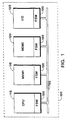
- Figure 1 is a schematic block diagram which shows major internal functional elements of a personal computer system.
- Figure 2 is a simplified schematic block diagram showing each of the main internal functional elements of the memory unit of Figure 1.
- Figure 3A is a state diagram which shows the states of the finite state machine (FSM), and the effects of the various inputs to cause the FSM to transition to another state.
- FSM finite state machine
- Figure 3B shows an exemplary state bubble and transition path having generalized bubble output states and transition path input bits.
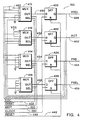
- FIG. 4 is a schematic block diagram showing one preferred implementation of the FSMs.
- FIG. 1 is a schematic block diagram which shows major internal functional elements of a personal computer system 100 (generally designated by the dashed lines).
- the personal computer system 100 includes data pipelining capability and, in one embodiment, is advantageously an AST PENTIUM-based computer.
- the computer system 100 has a number of internal data generation units including a central processing unit (CPU) 110, a first memory unit (MEM1) 115 and a second memory unit (MEM2) 120, and an input/output (I/O) unit 125.
- the CPU 110 may, for example, be an INTEL® PENTIUM microprocessor chip.
- the first and second memory units 115, 120 may be a memory array based upon DRAM Model No. MT18D236 available from MICRON, and the I/O unit 125 may be a magnetic disc memory '(i.e., hard disc drive), for example.
- the CPU 110, the memory units 115, 120, and the Input/Output unit 125 all include finite state machines (FSM's) 130.
- the CPU 110, the memory units 115, 120, and the I/O unit 125 communicate via a bus 140 which may include address, data, and control busses (shown more clearly in Figure 2).
- FIG 2 is a simplified schematic block diagram showing each of the main internal functional elements of the memory unit 115 of Figure 1. It should be understood that the depiction of the memory unit 115 is exemplary and is primarily included to illustrate the structure and operation of the pipelined data ordering system of the present invention. Thus, although the structure and operation of the data ordering system will only be described with reference to the memory unit 115, it will be appreciated by one of ordinary skill in the art that the implementation of the data ordering system as described with reference to the memory unit 115 may be effected in essentially the same manner for any of the other components which exchange data (e.g., the CPU 110, the I/O unit 125, etc.).
- the memory unit 115 includes a memory controller 200 which communicates with a random access memory (RAM) array 210 via buses 204, 206.
- the RAM 210 further connects to a set of transceivers 220 via a bus 215.
- the transceivers 215 are also connected to the memory controller 200 via a line 225.
- the memory controller 200 includes an address decoder 230 which communicates with the FSM 130 via an OMHIT line 233.
- the FSM 130 communicates with a finite state machine controller 240 via a communication line 238.
- the FSM controller 240 and the decoder 230 also communicate via a bidirectional bus 245.
- the decoder communicates an address to the RAM array 210 via the bus 204, while the FSM controller 240 communicates with the RAM array 210 and the transceiver 220 via the bus 206 and the line 225, respectively.
- the decoder 230, the FSM 130, and the FSM controller 240, as well as other support circuitry (not shown), are preferably implemented within a single integrated circuit.
- a control bus 250 communicates with the decoder 230, the FSM 130, and the FSM controller 240 so as to provide control signal inputs.
- An address bus 260 communicates with the decoder 230 to provide an input data address.
- the RAM array 210 outputs data to a data bus 270 via the bus 215 and the transceivers 220.
- the memory unit 115 operates by receiving address and control signals via the address bus 260 and the control bus 250, and outputting data on the bus 270 in response to these address and control signals. Initially, a data address is transmitted via the address bus 260 and is applied to the input of the decoder 230. The decoder 230 determines if the applied address corresponds to a data memory location within the RAM array 210. If the applied address does not correspond to a memory location within the RAM 210, then the decoder 230 ignores the applied address and the memory unit 115 remains inactive. However, if the applied address corresponds to a data memory location within the RAM array 210, then the decoder 230 generates a local "mine" signal, OMHIT.
- OMHIT is a local signal which indicates that the address on the address bus 260 belongs to the memory unit 115 and not to any other data exchange devices.
- the decoder 230 transmits the OMHIT signal to the FSM 130 via the line 233.
- the FSM 130 responds by selectively generating a signal to the FSM controller 240 via the line 238, as discussed below.
- the FSM controller 240 responds by initiating access to the RAM array 210 if the local memory associated with the FSM controller is addressed and the current oldest request is directed to the local memory.
- the decoder 230 also provides the "mine” signal as an output to the control bus 250 via a line 282 where it is ORed with "mine” signals from the decoders in the other data generation units to generate a global “mine” signal "MHIT.”
- the MHIT signal from the decoder 230 and from the decoders in the other data generation units is provided as an input to the FSM 130.
- the FSM controller 240 instructs the decoder 230 to transmit the row address input first and the column address input next via the bus 204.
- the decoder 230 includes storing and multiplexing capabilities (not shown) for storing an incoming address and routing the proper address to the RAM array 210 when the RAM array is activated.
- the FSM controller 240 also transmits signals to the RAM array 210 via the bus 206 to indicate whether the incoming address is a column or a row address.
- the data is applied to the inputs of the transceivers 220 and subsequently passes to the data bus 270 when the transceiver 220 is enabled.
- the data from the RAM array 210 then passes to the CPU 110 for processing.
- the FSM controller 240 generates an active end of cycle (EOC) signal on a line 284 when the cycle is completed.
- the EOC signal is ORed with the EOC signals from the FSM controllers in the other data generation units via the control bus 250.
- the FSM controller 240 enables or disables the transceiver 220 via the line 225.
- the FSM controller 240 enables the transceivers 220 when the FSM 130 provides the appropriate enable signal to the FSM controller 240.
- the FSM 130, the FSM controller 240, and the transceivers 220 effectively act as a selective delay circuit which prevents the misordering of data in a data pipelining system such as described herein. That is, the FSM 130, the FSM controller 240, and the transceivers 220 prevent the transmission of data from the memory unit 115 until any previous data requests from the CPU have been responded to.
- the method of ordering pipelined data requests as will be discussed in greater detail below with reference to the state diagram of Figures 3A and 3B.
- Figure 3A is a state diagram of one of the FSM's 130 which, in conjunction with Figure 3B, shows the states of the FSM 130, and the effects of the various inputs to cause the FSM 130 to transition to another state.
- the primary function of the FSM's 130 is to prevent the misordering of pipelined data.
- the conditions which correspond to each of the states constitute a procedure for preventing the misordering of pipelined data.
- the FSM 130 receives control inputs from the CPU 110 and the other data exchange units (e.g., the memory unit 120, the I/O unit 125, etc.).
- the input signals indicate the status of the CPU data requests and responses by the other data exchange units.
- the FSM 130 receives three input bits, I 0 , I 1 , and I 2 , ( Figure 3B) which indicate the status of the CPU data requests and the responses by the other data exchange units.
- the input bit I 0 represents the value of the end-of-cycle (EOC) signal (that is, the system-wide signal which indicates that a data cycle has completed by the currently active unit).
- the input bit I 1 represents the value of the local "mine" signal OMHIT (i.e., the local signal within a data exchange unit which indicates that a given data request belongs to that unit).
- the bit I 1 represents the value of the local OMHIT signal generated by the decoder 230 on the line 233.
- the input bit I 2 represents the value of a global "mine" signal MHIT which indicates that any one of the data exchange units has received a data request.
- the MHIT signal may, for example, be generated by taking the output of an OR gate (not shown) having OMHIT signals from each of the data exchange units as inputs.
- the value of the bit I 2 will be the same within all of the FSM's (i.e., the FSM in the CPU 110, the FSM in the memory unit 115, etc.). It should be noted that, in the embodiment described herein, the input bits I 1 and I 2 are active low.
- the input bits I 2 , I 1 , and I 0 indicate to each FSM 130 whether a data request has been received by any of the data exchange units, whether a data request has been directed to that particular unit, and whether a data cycle has completed.
- state outputs O 0 , O 1 , O 2 , and O 3 of the FSM 130 change as indicated in the state diagram of Figure 3A.
- the state output bits represent the state of active and pending requests within the system 100.
- An active request is a data request for which the CPU 110 is currently awaiting a response, while a pending request is the data request issued by the CPU 110 subsequent to issuance of the active request and prior to the response to the active request.
- Figure 3B provides a summary of each of the state variables of the FSM 130.
- the state output bit O 0 represents the value of the variable PSEL.
- the variable PSEL is a local variable within each memory exchange unit which indicates whether or not that memory exchange unit is the owner of a pending request.
- the state output bit O 1 represents the value of the variable PND.
- the variable PND is a global variable common to all of the FSM's 130 which indicates whether or not a pending data request has been initiated within any one of the data exchange units.
- the state output bit O 2 represents the value of a variable ACT.
- the variable ACT is also a global variable common to all of the data exchange units and indicates whether or not an active data request has been initiated in any one of the data exchange units.
- the state output bit O 3 represents the value of a variable ASEL.
- the variable ASEL is a local variable within each data exchange unit's FSM 130 that indicates whether or not that data request unit is the owner of the active data request.
- These four state output bits (O 0 , O 1 , O 2 , and O 3 ) constitute the state of each FSM 130, and are represented within the state bubbles, while the input bits (I 0 , I 1 , and I 2 ) are represented along the paths between state bubbles in the state diagram 3A.
- states 0001, 0101, 1000, 1001, 1010, 1011, and 1101 are likewise invalid because a local request automatically generates a global request.
- states 100 and 101 are invalid since these states would indicate that a local data request has been made but no global request was indicated.
- the system 100 generally begins operation in the state 0000.
- the system 100 may arrive at the state 0000 by means of a system reset, or by transition from another state.
- the state '0000 indicates the condition where there are no outstanding data requests from the CPU 110. This state generally indicates that the CPU 110 is processing data or the system 100 is inactive.
- certain input bit combinations are impossible during normal operation of the system 100. Namely, the input state 111, indicating an EOC but no data requests, is impossible since there are no active data requests, and, consequently, there can be no end-of-cycle.
- the FSM 130 will remain in the state 0 000 until the input bits to the FSM 130 indicate that a data request without an EOC has been issued from the CPU 110.
- the FSM 130 will remain in the state 0000 for inputs of 001 (local data request simultaneous with EOC), 011 (global data request simultaneous with EOC), and 110 (no data requests and no EOC). However, an input of 010 (global data request with no EOC) or an input of 000 (local and global data request without an EOC) will cause the FSM 130 to change state.
- An input of 000 causes the FSM 130 to transition to the state 1100.
- the state 1100 indicates that a data request to the local data exchange unit (i.e., the unit which includes the FSM 130 whose states are depicted in the state diagram of Figure 3A) is active and that there are no pending data requests within the, system.
- An input of 010 causes the FSM 130 to transition to state 0100.
- the state 0100 indicates that a data request to another data exchange unit is active and that there are no pending data requests within the system 100.
- the FSM 130 may transition to any one of four different states, or may remain in the same state depending upon the input bit combination. For example, if the input bits are 110 (no new data requests from the CPU 110 and no EOC) or 011 (global data request simultaneous with an EOC), then the FSM 130 remains in the state 0100.
- the reason the FSM 130 remains in the state 0100 when a global request is issued simultaneously with an EOC is that as soon as the old active data request is cleared by the EOC, it is replaced by a new global active request immediately thereafter so that the FSM 130 never actually leaves the state 0100.
- An input bit combination of 111 (no new data requests with an EOC) while the FSM 130 is in the state 0100 indicates the absence of any active data requests, and the FSM 130 transitions back to the state 0000.
- the state 0110 indicates that an active and a pending data request have been made to other data exchange units. Thus, the CPU 110 is currently waiting for two responses. Since, in the embodiment described herein, the system 100 is only able to handle two outstanding requests at once, all input bit combinations which indicate that a new data request has been issued by the CPU 110 (i.e., input bit combinations 000, 001, 010, 011) are invalid while the FSM 130 is in the state 0110.
- the FSM 130 will remain in the state 0110, but if the input bit combination is 111 (no new data requests and an EOC) then this input causes the FSM to transition back to the state 0100.
- An input bit combination of 001 (local data request simultaneous with an EOC) while the FSM 130 is in the state 0100 indicates that the global active request has been cleared and replaced by a new local data request.
- the FSM 130 transitions to state 1100 which indicates that the active data request has been issued to the local data exchange unit.
- the state 1100 will be discussed in more detail below.
- An input bit combination of 000 (local data request without an EOC) while the FSM 130 is in the state 0100 causes the FSM 130 to transition to a state 0111.
- the state 0111 indicates that the active data request belongs to some other data exchange unit while the pending request belongs to the local data exchange unit.
- the inputs which indicate the issuance of new data requests from the CPU 110 are invalid while the FSM 130 remains in the state 0111 because two data requests are already pending and the processor will not issue a third data request.
- the input bits are 110 (no new data and no EOC)
- the FSM 130 remains in the state 0111.
- an input bit combination of 111 indicates that the active request is cleared. The pending request therefore becomes active so that the FSM 130 transitions to the state 1100.
- the FSM 130 While the FSM 130 is in the state 1100 (indicating that the active data request belongs to the local data exchange unit while there is no pending request), the FSM 130 may transition to one of four different states, or remain in the state 1100 as determined by the input bit combination. If the input bits are 110 (no new data requests and no EOC), then the FSM 130 remains in the state 1100. Similarly, if the input bits are 001 (a local data request simultaneous with an EOC) the FSM 130 will likewise remain in the state 1100 since the EOC will clear the old, local active data request and a new, local active data request will immediately replace the previous request.
- the FSM 130 will transition to the state 0100 because the EOC clears the previous local active data request, and the new global data request issued by the CPU 110 replaces the previous request. Thus, the FSM 130 enters a state which indicates that a global, active request is outstanding (i.e., the state 0100).
- An input bit combination of 111 (no new data requests and an EOC) while the FSM is in the state 1100 indicates that the active request is cleared and that no new request has replaced the active request. Thus, the FSM 130 enters the state 0000 indicating that no data requests are outstanding.
- the FSM 130 transitions to the state 1111.
- the state 1111 indicates that an active and a pending data request are outstanding and that both the active and pending data requests belong to the local data exchange unit. Because there is an active and a pending data request outstanding at the same time, the input combinations which indicate that a new data request has been issued by the CPU 110 are invalid while the FSM 130 is in the state 1111. Thus, the input bits may only assume two combination, 110 and 111. If the input bits are 110 (no new data requests and no EOC), the FSM will remain in the same state (i.e., the state 1111).
- the FSM 130 transitions back to the state 1100 (indicating an active local data request but no pending data request).
- the FSM 130 transitions to a state 1110.
- the state 1110 indicates that there is an active local data request and a pending global data request.
- the state 1110 excludes the possibility of any inputs which indicate that a new data request has been issued by the CPU 110. Therefore, if the input bit combination is 110 (no new data requests with no EOC), then the FSM remains in the state 1110, however, if the input bit combination is 111 (no new data requests with an EOC), then the active local request is cleared and the pending global request becomes an active global request.
- the FSM 130 transitions to the state 0100, indicating that a global active data request is outstanding within the system 100.
- each of the FSM's 130 transition from state to state in response to given inputs.
- the output state of each of the FSM's 130 is therefore indicative of the status of data requests throughout the system 100. Because each FSM 130 has an output state that is indicative of the status of data requests throughout the system 100, signals provided by the FSM's 130 are able to insure the proper ordering of data within the system 100 as will be made more clear below.
- FIG 4 is a schematic block diagram showing one preferred implementation of the FSM's 130. It should be noted that, although the implementation of the FSM 130 is shown in Figure 4 as though the FSM 130 comprises a plurality of separate components, the FSM 130 may be implemented within a single integrated circuit chip. As shown in Figure 4, the FSM 130 comprises four 8 ⁇ 1 multiplexers (MUX) 410, 412, 414, and 416 which receive the input bits I 0 (EOC), I 1 (OMHIT), I 2 (MHIT) as select inputs along the lines 402, 233, 282 respectively.
- MUX 8 ⁇ 1 multiplexers
- the multiplexers 410-416 pass signals to four D Flip-Flops (DFF) 420-426, respectively, along the lines 430-436.
- the signals passed by the multiplexers 410-416 are determined by the value of the input bits applied along the lines 402, 233, 282. For example, if the input bits I 0 -I 2 are 011, then the signal applied to the "3" input of each multiplexer 410-416 will be passed to the output of that multiplexer, and is therefore applied to the input of the corresponding D Flip-Flop 420-426. It will be appreciated that the "4" and "5" inputs to the multiplexers 410-416 are not connected since these inputs are never selected (i.e., because the inputs 100 and 101 are not valid input combinations).
- the D Flip-Flops 420-426 pass data applied at their inputs to their outputs on the occurrence of a clock cycle on a line 440.
- Each D Flip-Flop 420-426 also includes an active low reset input connected to a line 442.
- the output of each of the Flip-Flops 420-426 will reset to low upon the application of a logical "0" to the line 442.
- the outputs of the Flip-Flops 420-426 are applied to output lines 238, 452, 454, 456 respectively.
- the signals present on the lines 238, 452, 454, 456 constitute the state outputs of the FSM 130.
- the signal on the line 238 is the variable ASEL
- the signal on the line 452 is the variable ACT
- the signal on the line 454 is the variable PND
- the signal on the line 456 is the variable PSEL.
- Each of these signals is fed back to one or more of the inputs to the multiplexers 410-416.
- the signal ASEL (indicating that there is an active data request which belongs to the local data exchange unit) on the line 238 is fed back to inputs 2 and 6 of the multiplexer 410, as well as to the first input of an exclusive-NOR (XNOR) gate 460.
- the signal ACT (indicating that there is an active data request which belongs to a data exchange unit other than the local data exchange unit) on the line 452 is fed back to inputs 1, 3, and 6 of the multiplexer 412, inputs 0 and 2 of the multiplexer 414, and input 0 of the multiplexer 416.
- the signal ACT is also applied to the second input of the XNOR gate 460.
- the output of the XNOR gate 460 is applied to input 0 of the multiplexer 410.
- the signal PND (indicating a pending data request which does not belong to the local data exchange unit) on the line 454 is fed back to input 7 of the multiplexer 412 and input 6 of the multiplexer 414.
- the signal PSEL (indicating that there is a pending data request which belongs to the local data exchange unit) on the line 456 is fed back to input 7 of the multiplexer 410 and input 6 of the multiplexer 416.
- Input 3 of multiplexer 410, inputs 1, 3, and 7 of multiplexer 414, and inputs 1, 2, 3, and 7 of multiplexer 416 are connected directly to ground (i.e., a logical zero or low voltage level). Inputs 0 and 2 of multiplexer 412 are connected directly to Vcc (high). Thus, each of the selectable (i.e., valid) multiplexer inputs is connected to a feedback input, ground, or Vcc.
- a FSM circuit constructed as shown in Figure 4 will provide a set of four state outputs in response to three input bits.
- An input/output example will be given below to manifest the operation of the FSM circuit shown in Figure 4.
- the signal applied to the line 434 at the output of the multiplexer 414 will be equal to the signal applied to the line 454 (in this case a logical 0 since ACT is given as 0).
- the signal applied to the line 436 at the output of the multiplexer 416 will be equal to ground (i.e., logical 0).
- Each of the outputs of the multiplexers 410-416 are applied to the inputs of the corresponding D Flip-Flops 420-426 so that these signals are passed to the output lines 238, 452, 454, 456 respectively upon the occurrence of a clock pulse.
- the FSM 130 along with the FSM controller 240 and the transceiver 220 ( Figure 2), act as a selective delay circuit which delays the transmission of data from the RAM array 210 to the data bus 270 until the pending data request to the memory unit 115 has become active.
- This delay is accomplished by means of an enable signal provided by the FSM 130 to the FSM controller 240 along the line 238.
- the signal on the line 238 is low, this indicates to the FSM controller 240 that data should not be transmitted.
- the FSM controller 240 therefore sends a disable signal to the transceiver 220 along the line 225 which prevents the transmission of data from the RAM 210 to the data bus 270.
- the FSM 130 therefore generates an enable signal along the line 238 which tells the FSM controller 240 to enable the transceiver 220.
- the enable signal along the line 238 is generated at the output of the D Flip-Flop 420 as the signal ASEL.
- the ASEL signal is only high when the data request is active and local so that the use of ASEL as an enable signal insures that the memory unit 115 will not output data until the a response has been made to the prior data request from the CPU 110.
- the FSM 130 may be implemented within several different circuit elements or within a single integrated circuit chip. Furthermore, the FSM 130 may be implemented using different circuit components such as shift registers. In addition, the construction of the FSM 130 may be expanded and modified to accommodate data pipelining where 3 or more CPU data requests are outstanding at once. Therefore, the foregoing description should be considered as illustrative and not restrictive.
Landscapes
- Engineering & Computer Science (AREA)
- Theoretical Computer Science (AREA)
- Physics & Mathematics (AREA)
- General Engineering & Computer Science (AREA)
- General Physics & Mathematics (AREA)
- Microelectronics & Electronic Packaging (AREA)
- Computer Hardware Design (AREA)
- Multi Processors (AREA)
- Management, Administration, Business Operations System, And Electronic Commerce (AREA)
- Pipeline Systems (AREA)
- Bus Control (AREA)
- Advance Control (AREA)
- Supply Devices, Intensifiers, Converters, And Telemotors (AREA)
- Measurement And Recording Of Electrical Phenomena And Electrical Characteristics Of The Living Body (AREA)
Claims (6)
- Système de gestion de données qui gère des données dans un système de traitement pipeline de données d'ordinateur personnel (100), ledit système de traitement pipeline incluant une unité centrale de traitement (CPU) (110), un bus de communication de données (140) et une pluralité de dispositifs de génération de données (115, 120), caractérisé par:un circuit de sélection (230) associé à chaque dispositif de génération de données (115, 120), ledit circuit de sélection (230) recevant des requêtes de données en provenance de ladite CPU (110) et émettant en sortie un signal de sélection lorsqu'une requête de données est dirigée sur ledit dispositif de génération de données (115, 120); etune machine d'état (130) associée à chaque dispositif de génération de données (115, 120), ladite machine d'état (130) recevant ledit signal de sélection en provenance dudit circuit de sélection (230) associé à son dispositif de génération de données associé (115, 120) et recevant un signal de sélection en provenance d'un circuit de sélection associé à un autre desdits dispositifs de génération de données, ladite machine d'état (130) activant son dispositif de génération de données associé (115, 120) afin d'émettre en sortie des données sur le bus de communication de données (140) lorsqu'un signal de sélection actif en provenance dudit circuit de sélection (230) associé à son dispositif de génération de données associé (115, 120) survient avant un signal de sélection actif en provenance dudit circuit de sélection dans ledit autre dispositif de génération de données (115, 120), ledit système étant configuré de telle sorte qu'au moins deux requêtes de données puissent être délivrées par ladite CPU (110) avant la réception d'une réponse en provenance d'un dispositif de génération de données (115, 120).
- Système selon la revendication 1, dans lequel le circuit de sélection (230) comprend un décodeur qui génère un signal de décodage actif en tant que dit signal de sélection lorsque ladite requête de données courante est destinée à son dispositif de génération de données associé (115, 120).
- Système selon la revendication 2, dans lequel ladite machine d'état (130) reçoit en outre un signal de fin de cycle qui indique l'achèvement de requêtes de données antérieures.
- Système selon l'une quelconque des revendications précédentes, dans lequel ladite machine d'état (130) pour ledit dispositif de génération de données associé (115, 120) génère un premier signal d'état qui est actif lorsque ledit dispositif de génération de données associé dispose d'une requête active qui est survenue avant une quelconque autre requête active, un second signal d'état qui est actif lorsque ledit dispositif de génération de données associé dispose d'une requête active qui est survenue après une autre requête active, un troisième signal d'état qui est actif lorsqu'un quelconque dispositif de génération de données dispose d'une requête active et un quatrième signal d'état qui est actif lorsque deux requêtes quelconques sont actives.
- Système selon l'une quelconque des revendications précédentes, dans lequel les dispositifs de ladite pluralité de dispositifs de génération de données (115, 120) incluent un premier dispositif de génération de données (115) et un second dispositif de génération de données (120).
- Système selon la revendication 5, dans lequel ledit circuit de sélection (230) inclut un premier décodeur et un premier contrôleur qui sont associés audit premier dispositif de génération de données (115) ainsi qu'un second décodeur et un second contrôleur qui sont associés audit second dispositif de génération de données (120).
Applications Claiming Priority (3)
| Application Number | Priority Date | Filing Date | Title |
|---|---|---|---|
| US98180692A | 1992-11-25 | 1992-11-25 | |
| US981806 | 1992-11-25 | ||
| PCT/US1993/011460 WO1994012935A1 (fr) | 1992-11-25 | 1993-11-24 | Systeme de classement de donnees par traitement pipeline |
Publications (3)
| Publication Number | Publication Date |
|---|---|
| EP0700540A1 EP0700540A1 (fr) | 1996-03-13 |
| EP0700540A4 EP0700540A4 (fr) | 1998-06-03 |
| EP0700540B1 true EP0700540B1 (fr) | 2001-08-22 |
Family
ID=25528665
Family Applications (1)
| Application Number | Title | Priority Date | Filing Date |
|---|---|---|---|
| EP94902400A Expired - Lifetime EP0700540B1 (fr) | 1992-11-25 | 1993-11-24 | Systeme de classement de donnees par traitement pipeline |
Country Status (9)
| Country | Link |
|---|---|
| US (2) | US5603042A (fr) |
| EP (1) | EP0700540B1 (fr) |
| JP (1) | JP3425443B2 (fr) |
| KR (1) | KR100296517B1 (fr) |
| AT (1) | ATE204660T1 (fr) |
| AU (1) | AU666999B2 (fr) |
| CA (1) | CA2150024C (fr) |
| DE (1) | DE69330646D1 (fr) |
| WO (1) | WO1994012935A1 (fr) |
Families Citing this family (10)
| Publication number | Priority date | Publication date | Assignee | Title |
|---|---|---|---|---|
| US5666494A (en) * | 1995-03-31 | 1997-09-09 | Samsung Electronics Co., Ltd. | Queue management mechanism which allows entries to be processed in any order |
| US5638534A (en) * | 1995-03-31 | 1997-06-10 | Samsung Electronics Co., Ltd. | Memory controller which executes read and write commands out of order |
| WO1999019875A2 (fr) * | 1997-10-10 | 1999-04-22 | Rambus Incorporated | Systeme et procede pour effectuer des operations pipeline en memoire |
| EP1327991A3 (fr) * | 1997-10-10 | 2005-05-11 | Rambus Inc. | Dispositif et procédé pour opérations mémoire pipeline |
| US7325064B2 (en) * | 2001-07-17 | 2008-01-29 | International Business Machines Corporation | Distributed locking protocol with asynchronous token prefetch and relinquish |
| US20050144409A1 (en) * | 2002-09-11 | 2005-06-30 | Fujitsu Limited | Data processing device and method utilizing latency difference between memory blocks |
| WO2004025478A1 (fr) * | 2002-09-11 | 2004-03-25 | Fujitsu Limited | Processeur de donnees et procede de traitement utilisant la difference de latence entre des blocs de memoire |
| US7412574B2 (en) * | 2004-02-05 | 2008-08-12 | Micron Technology, Inc. | System and method for arbitration of memory responses in a hub-based memory system |
| JP4982778B2 (ja) * | 2008-07-04 | 2012-07-25 | 学校法人慶應義塾 | 電子回路装置 |
| KR102193682B1 (ko) | 2014-08-01 | 2020-12-21 | 삼성전자주식회사 | 선택적 ecc 기능을 갖는 반도체 메모리 장치 |
Family Cites Families (10)
| Publication number | Priority date | Publication date | Assignee | Title |
|---|---|---|---|---|
| US4181974A (en) * | 1978-01-05 | 1980-01-01 | Honeywell Information Systems, Inc. | System providing multiple outstanding information requests |
| US4661905A (en) * | 1983-09-22 | 1987-04-28 | Digital Equipment Corporation | Bus-control mechanism |
| JPS61160142A (ja) * | 1984-12-29 | 1986-07-19 | Hitachi Ltd | デ−タ処理装置 |
| US4937733A (en) * | 1987-05-01 | 1990-06-26 | Digital Equipment Corporation | Method and apparatus for assuring adequate access to system resources by processors in a multiprocessor computer system |
| US4864496A (en) * | 1987-09-04 | 1989-09-05 | Digital Equipment Corporation | Bus adapter module for interconnecting busses in a multibus computer system |
| US4858234A (en) * | 1987-09-04 | 1989-08-15 | Digital Equipment Corporation | Method and apparatus for error recovery in a multibus computer system |
| US4987529A (en) * | 1988-08-11 | 1991-01-22 | Ast Research, Inc. | Shared memory bus system for arbitrating access control among contending memory refresh circuits, peripheral controllers, and bus masters |
| US5239661A (en) * | 1989-08-18 | 1993-08-24 | Mitsubishi Denki Kabushiki Kaisha | Hierarchical bus circuit having decoder generating local buses and devices select signals enabling switching elements to perform data transfer operations |
| US5289584A (en) * | 1991-06-21 | 1994-02-22 | Compaq Computer Corp. | Memory system with FIFO data input |
| US5471638A (en) * | 1991-10-04 | 1995-11-28 | Bull Hn Inforamtion Systems Inc. | Bus interface state machines with independent access to memory, processor and registers for concurrent processing of different types of requests |
-
1993
- 1993-11-24 DE DE69330646T patent/DE69330646D1/de not_active Expired - Lifetime
- 1993-11-24 KR KR1019950702098A patent/KR100296517B1/ko not_active Expired - Fee Related
- 1993-11-24 AU AU56787/94A patent/AU666999B2/en not_active Ceased
- 1993-11-24 AT AT94902400T patent/ATE204660T1/de not_active IP Right Cessation
- 1993-11-24 CA CA002150024A patent/CA2150024C/fr not_active Expired - Fee Related
- 1993-11-24 EP EP94902400A patent/EP0700540B1/fr not_active Expired - Lifetime
- 1993-11-24 WO PCT/US1993/011460 patent/WO1994012935A1/fr not_active Ceased
- 1993-11-24 JP JP51338394A patent/JP3425443B2/ja not_active Expired - Fee Related
-
1994
- 1994-12-15 US US08/357,132 patent/US5603042A/en not_active Expired - Lifetime
-
1997
- 1997-02-07 US US08/796,343 patent/US5737627A/en not_active Expired - Lifetime
Also Published As
| Publication number | Publication date |
|---|---|
| WO1994012935A1 (fr) | 1994-06-09 |
| JPH08503800A (ja) | 1996-04-23 |
| US5737627A (en) | 1998-04-07 |
| AU5678794A (en) | 1994-06-22 |
| CA2150024C (fr) | 2001-06-12 |
| ATE204660T1 (de) | 2001-09-15 |
| CA2150024A1 (fr) | 1994-06-09 |
| KR950704742A (ko) | 1995-11-20 |
| US5603042A (en) | 1997-02-11 |
| EP0700540A1 (fr) | 1996-03-13 |
| EP0700540A4 (fr) | 1998-06-03 |
| DE69330646D1 (de) | 2001-09-27 |
| KR100296517B1 (ko) | 2001-10-24 |
| JP3425443B2 (ja) | 2003-07-14 |
| AU666999B2 (en) | 1996-02-29 |
Similar Documents
| Publication | Publication Date | Title |
|---|---|---|
| US6026464A (en) | Memory control system and method utilizing distributed memory controllers for multibank memory | |
| US7421548B2 (en) | Memory system and method for two step memory write operations | |
| JP5752686B2 (ja) | 原子メモリ装置 | |
| US6895482B1 (en) | Reordering and flushing commands in a computer memory subsystem | |
| US6496906B1 (en) | Queue based memory controller | |
| US7126863B2 (en) | Active termination control | |
| US5574868A (en) | Bus grant prediction technique for a split transaction bus in a multiprocessor computer system | |
| US5555209A (en) | Circuit for latching data signals from DRAM memory | |
| EP0700540B1 (fr) | Systeme de classement de donnees par traitement pipeline | |
| US20050177674A1 (en) | Configurable embedded processor | |
| US20080046620A1 (en) | Handling of the Transmit Enable Signal in a Dynamic Random Access Memory Controller | |
| US5185879A (en) | Cache system and control method therefor | |
| US5737566A (en) | Data processing system having a memory with both a high speed operating mode and a low power operating mode and method therefor | |
| US6170041B1 (en) | Integrated circuit memory with a bus transceiver | |
| KR920010977B1 (ko) | 개선된 성능의 메모리 버스 아키텍쳐(memory bus architecture) | |
| JPH04280347A (ja) | 高速バス装置 | |
| JPH06208537A (ja) | 通信システム | |
| US5483645A (en) | Cache access system for multiple requestors providing independent access to the cache arrays | |
| US7076676B2 (en) | Sequence alignment logic for generating output representing the slowest from group write slaves response inputs | |
| US6839820B1 (en) | Method and system for controlling data access between at least two memory arrangements | |
| JPH0512185A (ja) | バーストサイクルデータ読み出しのためのアドレス予測および検証回路 | |
| JPS63261451A (ja) | マルチポ−トメモリコントロ−ラ | |
| JPH06103231A (ja) | 共用メモリアクセス回路のアクセス均等化装置 | |
| JPH0756860A (ja) | マルチcpuシステム |
Legal Events
| Date | Code | Title | Description |
|---|---|---|---|
| PUAI | Public reference made under article 153(3) epc to a published international application that has entered the european phase |
Free format text: ORIGINAL CODE: 0009012 |
|
| 17P | Request for examination filed |
Effective date: 19950602 |
|
| AK | Designated contracting states |
Kind code of ref document: A1 Designated state(s): AT BE CH DE DK ES FR GB GR IE IT LI LU MC NL PT SE |
|
| A4 | Supplementary search report drawn up and despatched |
Effective date: 19980417 |
|
| AK | Designated contracting states |
Kind code of ref document: A4 Designated state(s): AT BE CH DE DK ES FR GB GR IE IT LI LU MC NL PT SE |
|
| RHK1 | Main classification (correction) |
Ipc: G06F 13/16 |
|
| RAP1 | Party data changed (applicant data changed or rights of an application transferred) |
Owner name: SAMSUNG ELECTRONICS CO., LTD. |
|
| 17Q | First examination report despatched |
Effective date: 19991116 |
|
| GRAG | Despatch of communication of intention to grant |
Free format text: ORIGINAL CODE: EPIDOS AGRA |
|
| GRAG | Despatch of communication of intention to grant |
Free format text: ORIGINAL CODE: EPIDOS AGRA |
|
| GRAH | Despatch of communication of intention to grant a patent |
Free format text: ORIGINAL CODE: EPIDOS IGRA |
|
| GRAH | Despatch of communication of intention to grant a patent |
Free format text: ORIGINAL CODE: EPIDOS IGRA |
|
| GRAA | (expected) grant |
Free format text: ORIGINAL CODE: 0009210 |
|
| AK | Designated contracting states |
Kind code of ref document: B1 Designated state(s): AT BE CH DE DK ES FR GB GR IE IT LI LU MC NL PT SE |
|
| PG25 | Lapsed in a contracting state [announced via postgrant information from national office to epo] |
Ref country code: LI Free format text: LAPSE BECAUSE OF FAILURE TO SUBMIT A TRANSLATION OF THE DESCRIPTION OR TO PAY THE FEE WITHIN THE PRESCRIBED TIME-LIMIT Effective date: 20010822 Ref country code: IT Free format text: LAPSE BECAUSE OF FAILURE TO SUBMIT A TRANSLATION OF THE DESCRIPTION OR TO PAY THE FEE WITHIN THE PRE;WARNING: LAPSES OF ITALIAN PATENTS WITH EFFECTIVE DATE BEFORE 2007 MAY HAVE OCCURRED AT ANY TIME BEFORE 2007. THE CORRECT EFFECTIVE DATE MAY BE DIFFERENT FROM THE ONE RECORDED.SCRIBED TIME-LIMIT Effective date: 20010822 Ref country code: GR Free format text: LAPSE BECAUSE OF NON-PAYMENT OF DUE FEES Effective date: 20010822 Ref country code: FR Free format text: LAPSE BECAUSE OF FAILURE TO SUBMIT A TRANSLATION OF THE DESCRIPTION OR TO PAY THE FEE WITHIN THE PRESCRIBED TIME-LIMIT Effective date: 20010822 Ref country code: CH Free format text: LAPSE BECAUSE OF FAILURE TO SUBMIT A TRANSLATION OF THE DESCRIPTION OR TO PAY THE FEE WITHIN THE PRESCRIBED TIME-LIMIT Effective date: 20010822 Ref country code: BE Free format text: LAPSE BECAUSE OF FAILURE TO SUBMIT A TRANSLATION OF THE DESCRIPTION OR TO PAY THE FEE WITHIN THE PRESCRIBED TIME-LIMIT Effective date: 20010822 Ref country code: AT Free format text: LAPSE BECAUSE OF FAILURE TO SUBMIT A TRANSLATION OF THE DESCRIPTION OR TO PAY THE FEE WITHIN THE PRESCRIBED TIME-LIMIT Effective date: 20010822 |
|
| REF | Corresponds to: |
Ref document number: 204660 Country of ref document: AT Date of ref document: 20010915 Kind code of ref document: T |
|
| REG | Reference to a national code |
Ref country code: CH Ref legal event code: EP |
|
| REF | Corresponds to: |
Ref document number: 69330646 Country of ref document: DE Date of ref document: 20010927 |
|
| REG | Reference to a national code |
Ref country code: IE Ref legal event code: FG4D |
|
| PG25 | Lapsed in a contracting state [announced via postgrant information from national office to epo] |
Ref country code: SE Free format text: LAPSE BECAUSE OF FAILURE TO SUBMIT A TRANSLATION OF THE DESCRIPTION OR TO PAY THE FEE WITHIN THE PRESCRIBED TIME-LIMIT Effective date: 20011122 Ref country code: PT Free format text: LAPSE BECAUSE OF FAILURE TO SUBMIT A TRANSLATION OF THE DESCRIPTION OR TO PAY THE FEE WITHIN THE PRESCRIBED TIME-LIMIT Effective date: 20011122 Ref country code: DK Free format text: LAPSE BECAUSE OF FAILURE TO SUBMIT A TRANSLATION OF THE DESCRIPTION OR TO PAY THE FEE WITHIN THE PRESCRIBED TIME-LIMIT Effective date: 20011122 |
|
| PG25 | Lapsed in a contracting state [announced via postgrant information from national office to epo] |
Ref country code: DE Free format text: LAPSE BECAUSE OF FAILURE TO SUBMIT A TRANSLATION OF THE DESCRIPTION OR TO PAY THE FEE WITHIN THE PRESCRIBED TIME-LIMIT Effective date: 20011123 |
|
| PG25 | Lapsed in a contracting state [announced via postgrant information from national office to epo] |
Ref country code: MC Free format text: LAPSE BECAUSE OF NON-PAYMENT OF DUE FEES Effective date: 20011124 Ref country code: LU Free format text: LAPSE BECAUSE OF NON-PAYMENT OF DUE FEES Effective date: 20011124 |
|
| PG25 | Lapsed in a contracting state [announced via postgrant information from national office to epo] |
Ref country code: IE Free format text: LAPSE BECAUSE OF FAILURE TO SUBMIT A TRANSLATION OF THE DESCRIPTION OR TO PAY THE FEE WITHIN THE PRESCRIBED TIME-LIMIT Effective date: 20011126 |
|
| REG | Reference to a national code |
Ref country code: GB Ref legal event code: IF02 |
|
| EN | Fr: translation not filed | ||
| PG25 | Lapsed in a contracting state [announced via postgrant information from national office to epo] |
Ref country code: ES Free format text: LAPSE BECAUSE OF FAILURE TO SUBMIT A TRANSLATION OF THE DESCRIPTION OR TO PAY THE FEE WITHIN THE PRESCRIBED TIME-LIMIT Effective date: 20020228 |
|
| REG | Reference to a national code |
Ref country code: CH Ref legal event code: PL |
|
| PLBE | No opposition filed within time limit |
Free format text: ORIGINAL CODE: 0009261 |
|
| STAA | Information on the status of an ep patent application or granted ep patent |
Free format text: STATUS: NO OPPOSITION FILED WITHIN TIME LIMIT |
|
| 26N | No opposition filed | ||
| REG | Reference to a national code |
Ref country code: IE Ref legal event code: MM4A |
|
| PGFP | Annual fee paid to national office [announced via postgrant information from national office to epo] |
Ref country code: GB Payment date: 20101026 Year of fee payment: 18 |
|
| PGFP | Annual fee paid to national office [announced via postgrant information from national office to epo] |
Ref country code: NL Payment date: 20111027 Year of fee payment: 19 |
|
| REG | Reference to a national code |
Ref country code: NL Ref legal event code: V1 Effective date: 20130601 |
|
| GBPC | Gb: european patent ceased through non-payment of renewal fee |
Effective date: 20121124 |
|
| PG25 | Lapsed in a contracting state [announced via postgrant information from national office to epo] |
Ref country code: NL Free format text: LAPSE BECAUSE OF NON-PAYMENT OF DUE FEES Effective date: 20130601 |
|
| PG25 | Lapsed in a contracting state [announced via postgrant information from national office to epo] |
Ref country code: GB Free format text: LAPSE BECAUSE OF NON-PAYMENT OF DUE FEES Effective date: 20121124 |