EP0700954A1 - Particules préexpansées de résine polyoléfinique - Google Patents
Particules préexpansées de résine polyoléfinique Download PDFInfo
- Publication number
- EP0700954A1 EP0700954A1 EP95112167A EP95112167A EP0700954A1 EP 0700954 A1 EP0700954 A1 EP 0700954A1 EP 95112167 A EP95112167 A EP 95112167A EP 95112167 A EP95112167 A EP 95112167A EP 0700954 A1 EP0700954 A1 EP 0700954A1
- Authority
- EP
- European Patent Office
- Prior art keywords
- blowing agent
- expanded articles
- resin
- expansion
- articles
- Prior art date
- Legal status (The legal status is an assumption and is not a legal conclusion. Google has not performed a legal analysis and makes no representation as to the accuracy of the status listed.)
- Withdrawn
Links
- 229920005672 polyolefin resin Polymers 0.000 title claims abstract description 16
- 239000004604 Blowing Agent Substances 0.000 claims abstract description 52
- 238000000034 method Methods 0.000 claims abstract description 40
- 229920005989 resin Polymers 0.000 claims abstract description 29
- 239000011347 resin Substances 0.000 claims abstract description 29
- 238000004519 manufacturing process Methods 0.000 claims abstract description 13
- 239000013043 chemical agent Substances 0.000 claims description 14
- 239000007789 gas Substances 0.000 claims description 12
- 239000002245 particle Substances 0.000 claims description 11
- OFBQJSOFQDEBGM-UHFFFAOYSA-N Pentane Chemical compound CCCCC OFBQJSOFQDEBGM-UHFFFAOYSA-N 0.000 claims description 10
- IJDNQMDRQITEOD-UHFFFAOYSA-N n-butane Chemical compound CCCC IJDNQMDRQITEOD-UHFFFAOYSA-N 0.000 claims description 9
- 239000004094 surface-active agent Substances 0.000 claims description 9
- IJGRMHOSHXDMSA-UHFFFAOYSA-N Atomic nitrogen Chemical compound N#N IJGRMHOSHXDMSA-UHFFFAOYSA-N 0.000 claims description 6
- NNPPMTNAJDCUHE-UHFFFAOYSA-N isobutane Chemical compound CC(C)C NNPPMTNAJDCUHE-UHFFFAOYSA-N 0.000 claims description 6
- VLKZOEOYAKHREP-UHFFFAOYSA-N n-Hexane Chemical compound CCCCCC VLKZOEOYAKHREP-UHFFFAOYSA-N 0.000 claims description 6
- 238000010348 incorporation Methods 0.000 claims description 5
- ATUOYWHBWRKTHZ-UHFFFAOYSA-N Propane Chemical compound CCC ATUOYWHBWRKTHZ-UHFFFAOYSA-N 0.000 claims description 4
- 229920005674 ethylene-propylene random copolymer Polymers 0.000 claims description 4
- VNWKTOKETHGBQD-UHFFFAOYSA-N methane Chemical compound C VNWKTOKETHGBQD-UHFFFAOYSA-N 0.000 claims description 4
- 239000003570 air Substances 0.000 claims description 3
- 239000001282 iso-butane Substances 0.000 claims description 3
- 229910052757 nitrogen Inorganic materials 0.000 claims description 3
- 150000001338 aliphatic hydrocarbons Chemical class 0.000 claims description 2
- 239000001294 propane Substances 0.000 claims description 2
- CURLTUGMZLYLDI-UHFFFAOYSA-N Carbon dioxide Chemical compound O=C=O CURLTUGMZLYLDI-UHFFFAOYSA-N 0.000 claims 2
- 239000001569 carbon dioxide Substances 0.000 claims 1
- 229910002092 carbon dioxide Inorganic materials 0.000 claims 1
- 238000005470 impregnation Methods 0.000 abstract description 11
- 238000002844 melting Methods 0.000 description 20
- 230000008018 melting Effects 0.000 description 20
- 230000004927 fusion Effects 0.000 description 19
- 238000000465 moulding Methods 0.000 description 9
- XLYOFNOQVPJJNP-UHFFFAOYSA-N water Substances O XLYOFNOQVPJJNP-UHFFFAOYSA-N 0.000 description 7
- 239000001273 butane Substances 0.000 description 6
- 239000003795 chemical substances by application Substances 0.000 description 6
- 230000000694 effects Effects 0.000 description 5
- 230000000052 comparative effect Effects 0.000 description 4
- 238000000635 electron micrograph Methods 0.000 description 4
- 230000000704 physical effect Effects 0.000 description 4
- 238000002360 preparation method Methods 0.000 description 4
- 229920001577 copolymer Polymers 0.000 description 3
- 229930195733 hydrocarbon Natural products 0.000 description 3
- 150000002430 hydrocarbons Chemical class 0.000 description 3
- 238000001757 thermogravimetry curve Methods 0.000 description 3
- QORWJWZARLRLPR-UHFFFAOYSA-H tricalcium bis(phosphate) Chemical compound [Ca+2].[Ca+2].[Ca+2].[O-]P([O-])([O-])=O.[O-]P([O-])([O-])=O QORWJWZARLRLPR-UHFFFAOYSA-H 0.000 description 3
- 238000005406 washing Methods 0.000 description 3
- VTYYLEPIZMXCLO-UHFFFAOYSA-L Calcium carbonate Chemical compound [Ca+2].[O-]C([O-])=O VTYYLEPIZMXCLO-UHFFFAOYSA-L 0.000 description 2
- 239000004215 Carbon black (E152) Substances 0.000 description 2
- VGGSQFUCUMXWEO-UHFFFAOYSA-N Ethene Chemical compound C=C VGGSQFUCUMXWEO-UHFFFAOYSA-N 0.000 description 2
- 239000005977 Ethylene Substances 0.000 description 2
- QAOWNCQODCNURD-UHFFFAOYSA-N Sulfuric acid Chemical compound OS(O)(=O)=O QAOWNCQODCNURD-UHFFFAOYSA-N 0.000 description 2
- 238000001816 cooling Methods 0.000 description 2
- 238000005520 cutting process Methods 0.000 description 2
- 238000001938 differential scanning calorimetry curve Methods 0.000 description 2
- 238000006073 displacement reaction Methods 0.000 description 2
- 238000003912 environmental pollution Methods 0.000 description 2
- 238000011156 evaluation Methods 0.000 description 2
- 238000010438 heat treatment Methods 0.000 description 2
- 229910010272 inorganic material Inorganic materials 0.000 description 2
- 239000000203 mixture Substances 0.000 description 2
- 229920000642 polymer Polymers 0.000 description 2
- 230000001737 promoting effect Effects 0.000 description 2
- 239000000126 substance Substances 0.000 description 2
- 238000012360 testing method Methods 0.000 description 2
- 239000002351 wastewater Substances 0.000 description 2
- GRYLNZFGIOXLOG-UHFFFAOYSA-N Nitric acid Chemical compound O[N+]([O-])=O GRYLNZFGIOXLOG-UHFFFAOYSA-N 0.000 description 1
- 239000004698 Polyethylene Substances 0.000 description 1
- 239000002253 acid Substances 0.000 description 1
- 230000009286 beneficial effect Effects 0.000 description 1
- 230000015572 biosynthetic process Effects 0.000 description 1
- 229910000019 calcium carbonate Inorganic materials 0.000 description 1
- UBAZGMLMVVQSCD-UHFFFAOYSA-N carbon dioxide;molecular oxygen Chemical compound O=O.O=C=O UBAZGMLMVVQSCD-UHFFFAOYSA-N 0.000 description 1
- 238000010276 construction Methods 0.000 description 1
- 230000006866 deterioration Effects 0.000 description 1
- 238000009826 distribution Methods 0.000 description 1
- 150000008282 halocarbons Chemical class 0.000 description 1
- 150000002484 inorganic compounds Chemical class 0.000 description 1
- 239000011147 inorganic material Substances 0.000 description 1
- 230000001788 irregular Effects 0.000 description 1
- 238000005259 measurement Methods 0.000 description 1
- 230000003472 neutralizing effect Effects 0.000 description 1
- 229910017604 nitric acid Inorganic materials 0.000 description 1
- 239000002667 nucleating agent Substances 0.000 description 1
- UOURRHZRLGCVDA-UHFFFAOYSA-D pentazinc;dicarbonate;hexahydroxide Chemical compound [OH-].[OH-].[OH-].[OH-].[OH-].[OH-].[Zn+2].[Zn+2].[Zn+2].[Zn+2].[Zn+2].[O-]C([O-])=O.[O-]C([O-])=O UOURRHZRLGCVDA-UHFFFAOYSA-D 0.000 description 1
- 239000003208 petroleum Substances 0.000 description 1
- 239000004014 plasticizer Substances 0.000 description 1
- -1 polyethylene Polymers 0.000 description 1
- 229920000573 polyethylene Polymers 0.000 description 1
- 230000002265 prevention Effects 0.000 description 1
- 229920001384 propylene homopolymer Polymers 0.000 description 1
- 239000011541 reaction mixture Substances 0.000 description 1
- 238000011084 recovery Methods 0.000 description 1
- 230000000630 rising effect Effects 0.000 description 1
- 238000000926 separation method Methods 0.000 description 1
- 230000006641 stabilisation Effects 0.000 description 1
- 238000011105 stabilization Methods 0.000 description 1
- 238000004065 wastewater treatment Methods 0.000 description 1
Images


Classifications
-
- C—CHEMISTRY; METALLURGY
- C08—ORGANIC MACROMOLECULAR COMPOUNDS; THEIR PREPARATION OR CHEMICAL WORKING-UP; COMPOSITIONS BASED THEREON
- C08J—WORKING-UP; GENERAL PROCESSES OF COMPOUNDING; AFTER-TREATMENT NOT COVERED BY SUBCLASSES C08B, C08C, C08F, C08G or C08H
- C08J9/00—Working-up of macromolecular substances to porous or cellular articles or materials; After-treatment thereof
- C08J9/16—Making expandable particles
- C08J9/18—Making expandable particles by impregnating polymer particles with the blowing agent
-
- C—CHEMISTRY; METALLURGY
- C08—ORGANIC MACROMOLECULAR COMPOUNDS; THEIR PREPARATION OR CHEMICAL WORKING-UP; COMPOSITIONS BASED THEREON
- C08J—WORKING-UP; GENERAL PROCESSES OF COMPOUNDING; AFTER-TREATMENT NOT COVERED BY SUBCLASSES C08B, C08C, C08F, C08G or C08H
- C08J2323/00—Characterised by the use of homopolymers or copolymers of unsaturated aliphatic hydrocarbons having only one carbon-to-carbon double bond; Derivatives of such polymers
- C08J2323/02—Characterised by the use of homopolymers or copolymers of unsaturated aliphatic hydrocarbons having only one carbon-to-carbon double bond; Derivatives of such polymers not modified by chemical after treatment
- C08J2323/16—Ethene-propene or ethene-propene-diene copolymers
Definitions
- the present invention relates to a process for preparing pre-expanded articles of a polyolefin resin having microcell and the pre-expanded articles prepared by the process.
- the present invention relates to a process for preparing pre-expanded articles in which a hydrocarbon blowing agent such as butane or an inorganic blowing agent is used as a substitute for the freon which has been used until recently as a conventional blowing agent, and furthermore, an impregnating condition of the blowing agent is maintained constantly during the pre-expansion at a certain low temperature range, thereby the pre-expansion being carried out without any anti-adhesion chemical agents or dispersing surfactants.
- a hydrocarbon blowing agent such as butane or an inorganic blowing agent
- the present invention also relates to the pre-expanded articles prepared by the process as above mentioned.
- the pre-expanded articles thus obtained has microcell structure and shows excellent properties in compressive strength and relaxation capability, etc.
- Japanese Patent Publication No. 107516/1988 describes that the pre-expanded articles can be prepared at a temperature in the range of from Tm +1°C to Tm +7°C of the resin used and that when a heat of fusion Q H for the higher melting peak corresponds to 0.5 to 2.3 cal/g, it is possible to prepare expanded articles without any additional internal pre-pressurization during molding.
- These pre-expanded articles having not only two distinct melting peaks as determined by DSC but also specific ranges of Q H for the higher melting peak were claimed to exhibit particular efficiencies in molding.
- the substitute blowing agents have been recognized as having problems such as a lowering of expansion force of the pre-expanded articles (that is, a falling off in expansion ratio) or a lowering of cooling capacity for cell stabilization in contrast to the prior ones.
- a lowering of expansion force of the pre-expanded articles that is, a falling off in expansion ratio
- a lowering of cooling capacity for cell stabilization in contrast to the prior ones.
- the cell size of the pre-expanded articles and the cell distribution are substantially irregular when substitute blowing agents instead of freon based blowing agents are used, and the irregularities cause a deterioration in some physical properties.
- the present inventors have focussed their attention on this point and studied for a long time, and consequently found that the impregnated amount of the blowing agent can be increased and uniformed through the resin by incorporating an excessive amount (parts by volume) of the blowing agent with respect to the resin used or further introducing a second external pressured gas which facilitates the impregnation efficiency of the blowing agent into the resin simultaneously with incorporation of the blowing agent.
- the inventors have completed the present invention which provides a process for preparing the desired pre-expanded articles in which pre-expansion is carried out at a low temperature in order to produce pre-expanded articles having microcells, and several effects such as cost reduction or promoting productivity have been accomplished.
- an inorganic compound based anti-adhesion agent need not be used.
- the anti-adhesion chemical agent has been used for the prevention of adhesions between the resin particles contained in a reactor during the impregnation of a blowing agent.
- large amount of water, neutralizing agent and an equipment for treating the discharged waste water should be used.
- the pre-expanded articles can be produced with a minimum usage of water and other chemical agents.
- the present invention relates to a process for preparing pre-expanded articles of a polyolefin resin.
- This process can reduce the manufacturing costs and does not induce any environmental pollutions caused by chemicals such as anti-adhesion agents and dispersing surfactants.
- this process can produce pre-expanded articles having a good moldability without using anti-adhesion chemical agents or dispersing surfactants which have been recognized as indispensable one in the previously used processes.
- the process according to the present invention comprises adding a resin to be expanded and water serving as a carrier into a pressure vessel in an amount of occupying 70% of the vessel, incorporating a blowing agent in an amount of 45 to 90 parts by volume, preferably 50 to 70 parts by volume with respect to 100 parts by volume of the used resin and pre-expanding the resin at a temperature in the range of from Tm -35°C to Tm -20°C.
- the process can further comprise introducing a second external pressured gas which facilitates the impregnation efficiency of the blowing agent to the vessel in an amount of expressing an additional pressure more than 10 kg/cm2 upon incorporation of the blowing agent.
- polystyrene resin As the polyolefin resin used in the present invention, propylene homopolymer, ethylene-propylene random copolymer, ethylene-butadiene copolymer, ethylene-propylene-butene copolymer, propylene-butene copolymer, polyethylene and other conventional polymers, and a mixture thereof can be mentioned. These polymers can be used in a particle form of sphere, cylinder, square or rectangle and possibly the sphere like form is most preferable among them. For preparing the pre-expanded articles, strand cutting or under-water cutting method can be applied and it is preferable to use particles having a size of 0.5 to 1.5 mm.
- the blowing agent incorporated into the resin can be selected from a group consisting of an aliphatic hydrocarbon such as propane, butane, isobutane, pentane, hexane, etc., and an inorganic blowing agent.
- an aliphatic hydrocarbon such as propane, butane, isobutane, pentane, hexane, etc.
- an inorganic blowing agent such as propane, butane, isobutane, pentane, hexane, etc.
- an inorganic blowing agent such as propane, butane, isobutane, pentane, hexane, etc.
- an inorganic blowing agent such as propane, butane, isobutane, pentane, hexane, etc.
- an inorganic blowing agent such as propane, butane, isobutane, pentane, hexane, etc.
- an inorganic blowing agent such as
- the second external pressured gas is introduced to facilitate the impregnation of the blowing agent into the resin and improve the uniformity of impregnation by increasing the pre-expansion pressure;
- the gas which may be used includes one or more selected from a group consisting of methane, nitrogen, oxygen, carbon dioxide and air; and among them, a gas having a critical temperature below 35°C can be preferably used.
- the present inventors have identified that according to the process of the present invention, larger quantities of the blowing agent than those in the prior high temperature based pre-expanding method are impregnated into the particles and thus the impregnation uniformity of the blowing agent is improved without any dispersing surfactants. And, these phenomena effect several advantages as mentioned in the following.
- an unexpected effect that the pre-expanding process can be carried out at a lower temperature than that applied in the past, is achieved by droping the overall viscosity of the resin due to the increased amount of the blowing agent impregnated into the resin.
- the impregnated blowing agent acts as a plasticizer for the resin so that the softening temperature of the resin could be lowered.
- pre-expansion temperature is a very important element.
- the pre-expansion is practiced at a higher temperature than the softening point of the used resin with a small amount of blowing agent.
- the present invention it is possible to lower the pre-expansion temperature below the softening point of the used resin, that is, to a temperature in the range of from Tm -35°C to Tm -20°C by keeping the content of the blowing agent among the resin up highly. This pre-expansion temperature is still lower than that applied in the prior pre-expansion.
- the following several effects are achieved.
- the cell of the pre-expanded articles is stabilized due to the improvement in cooling efficiency during the cell formation and the time required for the process is shortened by lowering the pre-expansion temperature in an amount of 15 to 20°C in comparison with the prior processes.
- the anti-adhesion chemical agent causing several problems need not be used in the present invention and thus economical advantages including the unnecessariness of a waste water treatment facility required for washing out the anti-adhesion chemical agent and dispersing surfactant before molding and the reduction of manufacturing costs can be accomplished.
- an anti-adhesion chemical agent such as calcium tertiary phosphate, calcium carbonate or basic zinc carbonate
- these anti-adhesion chemical agents should be removed by an additional equipment before the pre-expanded articles are molded.
- an anti-adhesion chemical agent such as calcium tertiary phosphate, calcium carbonate or basic zinc carbonate
- these anti-adhesion chemical agents should be removed by an additional equipment before the pre-expanded articles are molded.
- the calcium tertiary phosphate is used as an anti-adhesion chemical agent
- this can be removed by washing the pre-expanded articles with large quantities of acid and water since the anti-adhesion chemical agent can easily be dissolved in a nitric acid solution or a sulfuric acid solution.
- large amount of waste water is generated, so that a large-scale equipment is required to seperate and neutralize it.
- pre-expanded articles of good quality can be obtained in the present invention without any dispersing surfactants which are conventionally used in the earlier processes for improving the impregnation efficiency and uniformity.
- the incorporation of large quantities of the blowing agent or the introduction of the second external pressured gas therewith plays a role as a dispersing surfactant.
- the pre-expanded articles having microcell in which the cell size is smaller and more uniform than that of the existing product can be obtained without any nucleating agents due to the improvement in impregnation uniformity and low temperature based pre-expansion.
- the pre-expanded articles having microcell have been improved in their physical properties such as compressive strength, etc. compared with those having large cell.
- the cell size of the pre-expanded articles according to the present invention is in the range of 5 to 150 ⁇ m, which is smaller in the ratio of one fifth to a half than the cell size of 170 to 250 ⁇ m of the pre-expanded articles produced by a prior method using butane as a blowing agent.
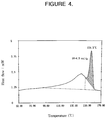
- the obtained pre-expanded articles have a higher DSC melting peak having various size and shape.
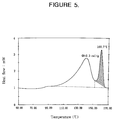
- the pre-expanded articles prepared by the present invention show larger heat of fusion for the higher melting peak than those of the pre-expanded articles prepared by the previous practice.
- some samples show unclear peak separation between high and low melting peaks on DSC curve.
- Figure 4 also shows similar trends.
- overall size of the higher melting peak of the pre-expanded articles in this invention is larger than that prepared by previous practice, which is shown in Figure 5 as an example.
- Figures 3, 4, 5 and Table 3 all indicate that values of the heat of fusion of the articles prepared by this invention is larger than those obtained by previous practice.
- pre-expanded articles having high heat of fusion.
- the present invention also relates to pre-expanded articles of a polyolefin resin which have the aforementioned properties.
- the higher molding pressure is known to be required for the pre-expanded articles having higher heat of fusion Q H for the higher melting.
- the pre-expanded articles of the present invention having a microcell structure show sufficient stability during the high temperature based molding process.
- Table 3 when the expansion ratio from a pre-expanded article to a molded article is less than 20, an article having microcell, which shows larger heat of fusion for the higher melting peak (see Examples 1 and 3), exhibits better compressive strength and is more stable in terms of shrinkage after molding than an article in which the heat of fusion is low (see comparative Example 1). This result is caused by the microcell structure and the heat of fusion for the higher melting peak related characteristics.
- an article produced via the low temperature based pre-expansion process of the present invention wherein the cell size is less than 130 ⁇ m and the heat of fusion for the higher melting peak as determined by DSC is larger than 3.4 cal/g has identified as having 10 to 20% improved compressive strength when compared with an article produced via the earlier used high temperature based pre-expansion process wherein the cell size is more than 170 ⁇ m, the heat of fusion for the higher melting peak as determined by DSC is less than 2.3 cal/g. Therefore, it can be concluded that the uniform microcell structure and the crystalline structure newly developed by larger high melting peak have influence upon the improvement of the compressive strength in an article.
- Test results relating to the characteristics of the pre-expanded articles and molded articles such as apparent density, expansion ratio, cell size, heat of fusion as determined by DSC, etc. including compressive strength are shown in the following Table 3.
- expanded articles in-mold expanded articles
- the expansion ratio of the pre-expanded artcles was evaluated based on the apparent density of the used resin (0.6g/cm3) and that of the expanded articles was evaluated based on the actual density of the used resin (0.9g/cm3).
- the cell size of the pre-expanded articles was calculated from the electron micrograph of 75 magnification.
- B Nitrogen pressure (kg/cm2)
- C Neopelex F-65 (KAO chemicals) as a dispersing surfactant (parts by weight)
- D Calcium tertiary phosphate as an anti-adhesion agent (parts by weight)
- E Pre-expansion temperature (°C)
- F Pre-expansion pressure (kg/cm2)
- G Washing step of anti-adhesion agent Table 3 Pre-expanded articles Molded articles Ex.No.
- pre-expanded articles with various magnifications can be prepared at a lower temperature range at which the earlier used pre-expansion method should not be practiced. Further, the pre-expanded articles expanded at a lower temperature have not only a higher melting peak having larger heat of fusion as determined by DSC but also uniform microcell structure. Thus, the molded articles obtained from the pre-expanded articles of the present invention have 10 to 20% improved compressive strength with respect to the prior known molded articles of the same magnification.
- the pre-expansion process was carried out at a low temperature below the softening point, the adhesion phenomena between the resin particles in the reactor is not observed in the present process. Therefore, anti-adhesion chemical agent need not be used in the present process for preparing the pre-expanded articles, and thereby the step of removing the anti-adhesion agent may be omitted and also the time for the process can be shortened.
- the present invention can provide excellent pre-expanded articles by which various effects such as preparing lighter product, cost reduction and promoting productivity, etc. can be achieved when molded articles are prepared therefrom, and process for preparing the pre-expanded articles.
Landscapes
- Chemical & Material Sciences (AREA)
- Engineering & Computer Science (AREA)
- Materials Engineering (AREA)
- Health & Medical Sciences (AREA)
- Chemical Kinetics & Catalysis (AREA)
- Medicinal Chemistry (AREA)
- Polymers & Plastics (AREA)
- Organic Chemistry (AREA)
- Manufacture Of Porous Articles, And Recovery And Treatment Of Waste Products (AREA)
Applications Claiming Priority (2)
| Application Number | Priority Date | Filing Date | Title |
|---|---|---|---|
| KR1019940019437A KR0159801B1 (ko) | 1994-08-06 | 1994-08-06 | 폴리올레핀계 수지의 미세 셀 예비 발포체 및 그의 제조 방법 |
| KR9419437 | 1994-08-06 |
Publications (1)
| Publication Number | Publication Date |
|---|---|
| EP0700954A1 true EP0700954A1 (fr) | 1996-03-13 |
Family
ID=19389922
Family Applications (1)
| Application Number | Title | Priority Date | Filing Date |
|---|---|---|---|
| EP95112167A Withdrawn EP0700954A1 (fr) | 1994-08-06 | 1995-08-02 | Particules préexpansées de résine polyoléfinique |
Country Status (3)
| Country | Link |
|---|---|
| US (1) | US5599850A (fr) |
| EP (1) | EP0700954A1 (fr) |
| KR (1) | KR0159801B1 (fr) |
Families Citing this family (1)
| Publication number | Priority date | Publication date | Assignee | Title |
|---|---|---|---|---|
| KR0159801B1 (ko) * | 1994-08-06 | 1999-01-15 | 박원배 | 폴리올레핀계 수지의 미세 셀 예비 발포체 및 그의 제조 방법 |
Citations (7)
| Publication number | Priority date | Publication date | Assignee | Title |
|---|---|---|---|---|
| DE2107683A1 (en) * | 1971-02-18 | 1972-08-31 | Basf Ag | Particulate foamed polyolefin prodn - by expansion with opt halogenated hydrocarbons in presence of water |
| EP0095109A1 (fr) * | 1982-05-13 | 1983-11-30 | Kanegafuchi Kagaku Kogyo Kabushiki Kaisha | Procédé pour préparer des particules expansées en résine de polyoléfine |
| EP0123144A1 (fr) * | 1983-03-25 | 1984-10-31 | Japan Styrene Paper Corporation | Perles prémoussées en résine de polypropylène |
| JPS6049040A (ja) | 1983-08-29 | 1985-03-18 | Japan Styrene Paper Co Ltd | ポリプロピレン系樹脂発泡粒子 |
| EP0155558A2 (fr) * | 1984-03-08 | 1985-09-25 | Japan Styrene Paper Corporation | Noyau d'un pare-choc d'une automobile |
| EP0550862A1 (fr) * | 1992-01-09 | 1993-07-14 | BASF Aktiengesellschaft | Feuille-mousse de polyoléfine avec une structure cellulaire homogène |
| US5599850A (en) * | 1994-08-06 | 1997-02-04 | Hanwha Chemical Corporation | Pre-expanded articles of a polyolefin resin having microcell and process for preparing thereof |
Family Cites Families (7)
| Publication number | Priority date | Publication date | Assignee | Title |
|---|---|---|---|---|
| AU560618B2 (en) * | 1983-04-05 | 1987-04-09 | Kanegafuchi Kagaku Kogyo K.K. | Pre-expanded polyolefin particle |
| US4704239A (en) * | 1984-04-28 | 1987-11-03 | Japan Styrene Paper Corp. | Process for the production of expanded particles of a polymeric material |
| JPH0660258B2 (ja) * | 1986-06-26 | 1994-08-10 | 鐘淵化学工業株式会社 | 熱可塑性樹脂粒子の予備発泡方法 |
| CA1280549C (fr) * | 1986-05-27 | 1991-02-19 | Kyoichi Nakamura | Particules pre-expansees de resine propylene |
| JPH0629334B2 (ja) * | 1987-02-20 | 1994-04-20 | 鐘淵化学工業株式会社 | 直鎖低密度ポリエチレン樹脂型内発泡成形体の製造方法 |
| JPH0739503B2 (ja) * | 1987-12-11 | 1995-05-01 | 鐘淵化学工業株式会社 | ポリプロピレン系樹脂予備発泡粒子及びその製造方法 |
| JP3279382B2 (ja) * | 1993-03-17 | 2002-04-30 | 株式会社ジエイエスピー | 無架橋ポリエチレン系樹脂発泡粒子及びその製造方法 |
-
1994
- 1994-08-06 KR KR1019940019437A patent/KR0159801B1/ko not_active Expired - Fee Related
-
1995
- 1995-08-02 EP EP95112167A patent/EP0700954A1/fr not_active Withdrawn
- 1995-08-03 US US08/510,844 patent/US5599850A/en not_active Expired - Fee Related
Patent Citations (7)
| Publication number | Priority date | Publication date | Assignee | Title |
|---|---|---|---|---|
| DE2107683A1 (en) * | 1971-02-18 | 1972-08-31 | Basf Ag | Particulate foamed polyolefin prodn - by expansion with opt halogenated hydrocarbons in presence of water |
| EP0095109A1 (fr) * | 1982-05-13 | 1983-11-30 | Kanegafuchi Kagaku Kogyo Kabushiki Kaisha | Procédé pour préparer des particules expansées en résine de polyoléfine |
| EP0123144A1 (fr) * | 1983-03-25 | 1984-10-31 | Japan Styrene Paper Corporation | Perles prémoussées en résine de polypropylène |
| JPS6049040A (ja) | 1983-08-29 | 1985-03-18 | Japan Styrene Paper Co Ltd | ポリプロピレン系樹脂発泡粒子 |
| EP0155558A2 (fr) * | 1984-03-08 | 1985-09-25 | Japan Styrene Paper Corporation | Noyau d'un pare-choc d'une automobile |
| EP0550862A1 (fr) * | 1992-01-09 | 1993-07-14 | BASF Aktiengesellschaft | Feuille-mousse de polyoléfine avec une structure cellulaire homogène |
| US5599850A (en) * | 1994-08-06 | 1997-02-04 | Hanwha Chemical Corporation | Pre-expanded articles of a polyolefin resin having microcell and process for preparing thereof |
Non-Patent Citations (2)
| Title |
|---|
| ASTM D-3418-82, pages 380-383; Standard Test Method for Transition Temperatures of Polymers by Thermal Analysis * |
| Polymer Handbook; Fourth Edition; J. Brandrup et al. editors; John Wiley & Sons, Inc. publishers; New York; 1999; pages V/10, V/17, V27 * |
Also Published As
| Publication number | Publication date |
|---|---|
| US5599850A (en) | 1997-02-04 |
| KR0159801B1 (ko) | 1999-01-15 |
Similar Documents
| Publication | Publication Date | Title |
|---|---|---|
| US5026736A (en) | Moldable shrunken thermoplastic polymer foam beads | |
| EP0415744B1 (fr) | Procédé de préparation de particules expansibles de polyoléfines | |
| JPH0686544B2 (ja) | 無架橋直鎖状低密度ポリエチレン予備発泡粒子およびその成形法 | |
| DE60224372T2 (de) | Ethenpolymermischungen mit verbessertem modulus und schmelzfestigkeit und aus diesen mischungen hergestellte gegenstände | |
| US4331777A (en) | Foaming synthetic resin compositions stabilized with certain naphthyl amine compounds | |
| EP0334313A2 (fr) | Particules mousse en résine de propylène et article en mousse formée | |
| DE69931138T2 (de) | Vorexpandierte Polypropylenharzteilchen und Verfahren zur Herstellung eines Formkörpers daraus durch Schäumen in der Form | |
| JPH0417977B2 (fr) | ||
| EP0700954A1 (fr) | Particules préexpansées de résine polyoléfinique | |
| JPH0239367B2 (fr) | ||
| JP2000129028A (ja) | ポリプロピレン系樹脂発泡粒子及びポリプロピレン系樹脂発泡粒子成形体 | |
| DE69307953T2 (de) | Vorgeschäumte Teilchen aus LLDPE | |
| JPH03254930A (ja) | ポリプロピレン系樹脂発泡粒子の型内成形方法 | |
| JP2709395B2 (ja) | 発泡用無架橋直鎖状低密度ポリエチレン樹脂粒子及び無架橋直鎖状低密度ポリエチレン発泡粒子の製造方法 | |
| JP2002167460A (ja) | ポリプロピレン系樹脂発泡粒子の製造方法、ポリプロピレン系樹脂発泡粒子及びポリプロピレン系樹脂型内発泡成形体 | |
| JP3436816B2 (ja) | 発泡性ゴム変性スチレン系樹脂粒子及びそれからなる発泡樹脂粒子及び発泡成形体 | |
| JPH05163381A (ja) | 重合体発泡粒子の製造方法 | |
| JP2892210B2 (ja) | 軽度に架橋した直鎖状低密度ポリエチレン予備発泡粒子およびその製法 | |
| JP3459454B2 (ja) | ポリアリーレンスルフィド発泡体およびその製造方法 | |
| CN113956631B (zh) | 一种pet发泡材料及其制备方法和应用 | |
| JP2603858B2 (ja) | 球状ポリエチレン発泡粒子の製造法 | |
| EP2113006B1 (fr) | Procédé de fabrication de particules moussées de polyoléfine | |
| US5045256A (en) | Expansion of shrunk foam particles of propylene polymers | |
| JP2001341151A (ja) | ポリプロピレン系樹脂発泡成形体およびその製造方法 | |
| EP0337584B1 (fr) | Procédé pour préparer des perles expansées de résine de polypropylène |
Legal Events
| Date | Code | Title | Description |
|---|---|---|---|
| PUAI | Public reference made under article 153(3) epc to a published international application that has entered the european phase |
Free format text: ORIGINAL CODE: 0009012 |
|
| AK | Designated contracting states |
Kind code of ref document: A1 Designated state(s): BE DE FR GB IT |
|
| 17P | Request for examination filed |
Effective date: 19960829 |
|
| 17Q | First examination report despatched |
Effective date: 19970204 |
|
| RAP1 | Party data changed (applicant data changed or rights of an application transferred) |
Owner name: HANWHA L & C CORPORATION |
|
| STAA | Information on the status of an ep patent application or granted ep patent |
Free format text: STATUS: THE APPLICATION HAS BEEN WITHDRAWN |
|
| 18W | Application withdrawn |
Withdrawal date: 20000804 |