EP0701006A1 - Outil coupant composite revêtu de diamant et procédé pour sa fabrication - Google Patents
Outil coupant composite revêtu de diamant et procédé pour sa fabrication Download PDFInfo
- Publication number
- EP0701006A1 EP0701006A1 EP95202161A EP95202161A EP0701006A1 EP 0701006 A1 EP0701006 A1 EP 0701006A1 EP 95202161 A EP95202161 A EP 95202161A EP 95202161 A EP95202161 A EP 95202161A EP 0701006 A1 EP0701006 A1 EP 0701006A1
- Authority
- EP
- European Patent Office
- Prior art keywords
- diamond
- methane
- substrate
- passivating
- cobalt
- Prior art date
- Legal status (The legal status is an assumption and is not a legal conclusion. Google has not performed a legal analysis and makes no representation as to the accuracy of the status listed.)
- Withdrawn
Links
- 229910003460 diamond Inorganic materials 0.000 title claims abstract description 67
- 239000010432 diamond Substances 0.000 title claims abstract description 67
- 238000005520 cutting process Methods 0.000 title claims abstract description 28
- 239000002131 composite material Substances 0.000 title claims description 6
- 238000004519 manufacturing process Methods 0.000 title description 3
- 239000000758 substrate Substances 0.000 claims abstract description 47
- 239000010941 cobalt Substances 0.000 claims abstract description 24
- 229910017052 cobalt Inorganic materials 0.000 claims abstract description 24
- GUTLYIVDDKVIGB-UHFFFAOYSA-N cobalt atom Chemical compound [Co] GUTLYIVDDKVIGB-UHFFFAOYSA-N 0.000 claims abstract description 24
- UONOETXJSWQNOL-UHFFFAOYSA-N tungsten carbide Chemical compound [W+]#[C-] UONOETXJSWQNOL-UHFFFAOYSA-N 0.000 claims abstract description 18
- 239000011159 matrix material Substances 0.000 claims abstract description 15
- 238000006243 chemical reaction Methods 0.000 claims abstract description 5
- VNWKTOKETHGBQD-UHFFFAOYSA-N methane Chemical compound C VNWKTOKETHGBQD-UHFFFAOYSA-N 0.000 claims description 32
- 239000000463 material Substances 0.000 claims description 31
- 238000000034 method Methods 0.000 claims description 23
- 239000011230 binding agent Substances 0.000 claims description 13
- 238000005229 chemical vapour deposition Methods 0.000 claims description 11
- OKTJSMMVPCPJKN-UHFFFAOYSA-N Carbon Chemical compound [C] OKTJSMMVPCPJKN-UHFFFAOYSA-N 0.000 claims description 5
- 229910052799 carbon Inorganic materials 0.000 claims description 5
- 229910052751 metal Inorganic materials 0.000 claims description 5
- 239000002184 metal Substances 0.000 claims description 5
- 239000002245 particle Substances 0.000 claims description 5
- 239000000919 ceramic Substances 0.000 claims description 3
- 230000015556 catabolic process Effects 0.000 claims description 2
- 238000006731 degradation reaction Methods 0.000 claims description 2
- 238000002144 chemical decomposition reaction Methods 0.000 claims 1
- 230000008021 deposition Effects 0.000 abstract description 26
- 238000005137 deposition process Methods 0.000 abstract description 2
- 238000002161 passivation Methods 0.000 abstract 1
- 238000000151 deposition Methods 0.000 description 25
- 238000010899 nucleation Methods 0.000 description 12
- 230000006911 nucleation Effects 0.000 description 9
- 239000011248 coating agent Substances 0.000 description 8
- 238000000576 coating method Methods 0.000 description 8
- 238000005530 etching Methods 0.000 description 7
- 239000008367 deionised water Substances 0.000 description 6
- 230000000694 effects Effects 0.000 description 6
- 229910009043 WC-Co Inorganic materials 0.000 description 5
- 238000005238 degreasing Methods 0.000 description 5
- IJGRMHOSHXDMSA-UHFFFAOYSA-N Atomic nitrogen Chemical compound N#N IJGRMHOSHXDMSA-UHFFFAOYSA-N 0.000 description 4
- 230000003247 decreasing effect Effects 0.000 description 4
- 230000001419 dependent effect Effects 0.000 description 4
- 239000010410 layer Substances 0.000 description 4
- 230000008569 process Effects 0.000 description 4
- 239000000126 substance Substances 0.000 description 4
- UFHFLCQGNIYNRP-UHFFFAOYSA-N Hydrogen Chemical compound [H][H] UFHFLCQGNIYNRP-UHFFFAOYSA-N 0.000 description 3
- KFZMGEQAYNKOFK-UHFFFAOYSA-N Isopropanol Chemical compound CC(C)O KFZMGEQAYNKOFK-UHFFFAOYSA-N 0.000 description 3
- 238000005299 abrasion Methods 0.000 description 3
- 230000008901 benefit Effects 0.000 description 3
- 239000013078 crystal Substances 0.000 description 3
- 229910021641 deionized water Inorganic materials 0.000 description 3
- 239000001257 hydrogen Substances 0.000 description 3
- 229910052739 hydrogen Inorganic materials 0.000 description 3
- 229910052710 silicon Inorganic materials 0.000 description 3
- 230000003746 surface roughness Effects 0.000 description 3
- XLYOFNOQVPJJNP-UHFFFAOYSA-N water Chemical compound O XLYOFNOQVPJJNP-UHFFFAOYSA-N 0.000 description 3
- 239000004138 Stearyl citrate Substances 0.000 description 2
- 239000002253 acid Substances 0.000 description 2
- 230000009471 action Effects 0.000 description 2
- 230000001464 adherent effect Effects 0.000 description 2
- 238000000137 annealing Methods 0.000 description 2
- 239000000356 contaminant Substances 0.000 description 2
- 239000002826 coolant Substances 0.000 description 2
- 239000012634 fragment Substances 0.000 description 2
- 239000007789 gas Substances 0.000 description 2
- 238000010438 heat treatment Methods 0.000 description 2
- 239000011229 interlayer Substances 0.000 description 2
- 239000013081 microcrystal Substances 0.000 description 2
- 229910052757 nitrogen Inorganic materials 0.000 description 2
- 238000002360 preparation method Methods 0.000 description 2
- 238000004901 spalling Methods 0.000 description 2
- 238000012360 testing method Methods 0.000 description 2
- 238000001039 wet etching Methods 0.000 description 2
- 239000004215 Carbon black (E152) Substances 0.000 description 1
- 229920000742 Cotton Polymers 0.000 description 1
- YZCKVEUIGOORGS-UHFFFAOYSA-N Hydrogen atom Chemical compound [H] YZCKVEUIGOORGS-UHFFFAOYSA-N 0.000 description 1
- GRYLNZFGIOXLOG-UHFFFAOYSA-N Nitric acid Chemical compound O[N+]([O-])=O GRYLNZFGIOXLOG-UHFFFAOYSA-N 0.000 description 1
- RTAQQCXQSZGOHL-UHFFFAOYSA-N Titanium Chemical compound [Ti] RTAQQCXQSZGOHL-UHFFFAOYSA-N 0.000 description 1
- CSDREXVUYHZDNP-UHFFFAOYSA-N alumanylidynesilicon Chemical compound [Al].[Si] CSDREXVUYHZDNP-UHFFFAOYSA-N 0.000 description 1
- 229910052782 aluminium Inorganic materials 0.000 description 1
- XAGFODPZIPBFFR-UHFFFAOYSA-N aluminium Chemical compound [Al] XAGFODPZIPBFFR-UHFFFAOYSA-N 0.000 description 1
- 230000004888 barrier function Effects 0.000 description 1
- 230000009286 beneficial effect Effects 0.000 description 1
- 238000005255 carburizing Methods 0.000 description 1
- 239000003054 catalyst Substances 0.000 description 1
- 150000001875 compounds Chemical class 0.000 description 1
- 230000007547 defect Effects 0.000 description 1
- 230000002939 deleterious effect Effects 0.000 description 1
- 238000009792 diffusion process Methods 0.000 description 1
- 238000002845 discoloration Methods 0.000 description 1
- 230000005484 gravity Effects 0.000 description 1
- 229930195733 hydrocarbon Natural products 0.000 description 1
- 150000002430 hydrocarbons Chemical class 0.000 description 1
- 150000002431 hydrogen Chemical class 0.000 description 1
- 238000011835 investigation Methods 0.000 description 1
- 239000007788 liquid Substances 0.000 description 1
- 238000000259 microwave plasma-assisted chemical vapour deposition Methods 0.000 description 1
- 238000003801 milling Methods 0.000 description 1
- 239000000203 mixture Substances 0.000 description 1
- 229910017604 nitric acid Inorganic materials 0.000 description 1
- 238000005268 plasma chemical vapour deposition Methods 0.000 description 1
- 238000009832 plasma treatment Methods 0.000 description 1
- 239000000843 powder Substances 0.000 description 1
- 230000009257 reactivity Effects 0.000 description 1
- 229920006395 saturated elastomer Polymers 0.000 description 1
- 239000010936 titanium Substances 0.000 description 1
- 229910052719 titanium Inorganic materials 0.000 description 1
- 230000007704 transition Effects 0.000 description 1
Images
Classifications
-
- C—CHEMISTRY; METALLURGY
- C23—COATING METALLIC MATERIAL; COATING MATERIAL WITH METALLIC MATERIAL; CHEMICAL SURFACE TREATMENT; DIFFUSION TREATMENT OF METALLIC MATERIAL; COATING BY VACUUM EVAPORATION, BY SPUTTERING, BY ION IMPLANTATION OR BY CHEMICAL VAPOUR DEPOSITION, IN GENERAL; INHIBITING CORROSION OF METALLIC MATERIAL OR INCRUSTATION IN GENERAL
- C23C—COATING METALLIC MATERIAL; COATING MATERIAL WITH METALLIC MATERIAL; SURFACE TREATMENT OF METALLIC MATERIAL BY DIFFUSION INTO THE SURFACE, BY CHEMICAL CONVERSION OR SUBSTITUTION; COATING BY VACUUM EVAPORATION, BY SPUTTERING, BY ION IMPLANTATION OR BY CHEMICAL VAPOUR DEPOSITION, IN GENERAL
- C23C16/00—Chemical coating by decomposition of gaseous compounds, without leaving reaction products of surface material in the coating, i.e. chemical vapour deposition [CVD] processes
- C23C16/22—Chemical coating by decomposition of gaseous compounds, without leaving reaction products of surface material in the coating, i.e. chemical vapour deposition [CVD] processes characterised by the deposition of inorganic material, other than metallic material
- C23C16/26—Deposition of carbon only
- C23C16/27—Diamond only
- C23C16/274—Diamond only using microwave discharges
-
- C—CHEMISTRY; METALLURGY
- C23—COATING METALLIC MATERIAL; COATING MATERIAL WITH METALLIC MATERIAL; CHEMICAL SURFACE TREATMENT; DIFFUSION TREATMENT OF METALLIC MATERIAL; COATING BY VACUUM EVAPORATION, BY SPUTTERING, BY ION IMPLANTATION OR BY CHEMICAL VAPOUR DEPOSITION, IN GENERAL; INHIBITING CORROSION OF METALLIC MATERIAL OR INCRUSTATION IN GENERAL
- C23C—COATING METALLIC MATERIAL; COATING MATERIAL WITH METALLIC MATERIAL; SURFACE TREATMENT OF METALLIC MATERIAL BY DIFFUSION INTO THE SURFACE, BY CHEMICAL CONVERSION OR SUBSTITUTION; COATING BY VACUUM EVAPORATION, BY SPUTTERING, BY ION IMPLANTATION OR BY CHEMICAL VAPOUR DEPOSITION, IN GENERAL
- C23C16/00—Chemical coating by decomposition of gaseous compounds, without leaving reaction products of surface material in the coating, i.e. chemical vapour deposition [CVD] processes
- C23C16/02—Pretreatment of the material to be coated
-
- C—CHEMISTRY; METALLURGY
- C23—COATING METALLIC MATERIAL; COATING MATERIAL WITH METALLIC MATERIAL; CHEMICAL SURFACE TREATMENT; DIFFUSION TREATMENT OF METALLIC MATERIAL; COATING BY VACUUM EVAPORATION, BY SPUTTERING, BY ION IMPLANTATION OR BY CHEMICAL VAPOUR DEPOSITION, IN GENERAL; INHIBITING CORROSION OF METALLIC MATERIAL OR INCRUSTATION IN GENERAL
- C23C—COATING METALLIC MATERIAL; COATING MATERIAL WITH METALLIC MATERIAL; SURFACE TREATMENT OF METALLIC MATERIAL BY DIFFUSION INTO THE SURFACE, BY CHEMICAL CONVERSION OR SUBSTITUTION; COATING BY VACUUM EVAPORATION, BY SPUTTERING, BY ION IMPLANTATION OR BY CHEMICAL VAPOUR DEPOSITION, IN GENERAL
- C23C16/00—Chemical coating by decomposition of gaseous compounds, without leaving reaction products of surface material in the coating, i.e. chemical vapour deposition [CVD] processes
- C23C16/02—Pretreatment of the material to be coated
- C23C16/0209—Pretreatment of the material to be coated by heating
-
- C—CHEMISTRY; METALLURGY
- C23—COATING METALLIC MATERIAL; COATING MATERIAL WITH METALLIC MATERIAL; CHEMICAL SURFACE TREATMENT; DIFFUSION TREATMENT OF METALLIC MATERIAL; COATING BY VACUUM EVAPORATION, BY SPUTTERING, BY ION IMPLANTATION OR BY CHEMICAL VAPOUR DEPOSITION, IN GENERAL; INHIBITING CORROSION OF METALLIC MATERIAL OR INCRUSTATION IN GENERAL
- C23C—COATING METALLIC MATERIAL; COATING MATERIAL WITH METALLIC MATERIAL; SURFACE TREATMENT OF METALLIC MATERIAL BY DIFFUSION INTO THE SURFACE, BY CHEMICAL CONVERSION OR SUBSTITUTION; COATING BY VACUUM EVAPORATION, BY SPUTTERING, BY ION IMPLANTATION OR BY CHEMICAL VAPOUR DEPOSITION, IN GENERAL
- C23C16/00—Chemical coating by decomposition of gaseous compounds, without leaving reaction products of surface material in the coating, i.e. chemical vapour deposition [CVD] processes
- C23C16/02—Pretreatment of the material to be coated
- C23C16/0227—Pretreatment of the material to be coated by cleaning or etching
-
- C—CHEMISTRY; METALLURGY
- C23—COATING METALLIC MATERIAL; COATING MATERIAL WITH METALLIC MATERIAL; CHEMICAL SURFACE TREATMENT; DIFFUSION TREATMENT OF METALLIC MATERIAL; COATING BY VACUUM EVAPORATION, BY SPUTTERING, BY ION IMPLANTATION OR BY CHEMICAL VAPOUR DEPOSITION, IN GENERAL; INHIBITING CORROSION OF METALLIC MATERIAL OR INCRUSTATION IN GENERAL
- C23C—COATING METALLIC MATERIAL; COATING MATERIAL WITH METALLIC MATERIAL; SURFACE TREATMENT OF METALLIC MATERIAL BY DIFFUSION INTO THE SURFACE, BY CHEMICAL CONVERSION OR SUBSTITUTION; COATING BY VACUUM EVAPORATION, BY SPUTTERING, BY ION IMPLANTATION OR BY CHEMICAL VAPOUR DEPOSITION, IN GENERAL
- C23C16/00—Chemical coating by decomposition of gaseous compounds, without leaving reaction products of surface material in the coating, i.e. chemical vapour deposition [CVD] processes
- C23C16/02—Pretreatment of the material to be coated
- C23C16/0227—Pretreatment of the material to be coated by cleaning or etching
- C23C16/0236—Pretreatment of the material to be coated by cleaning or etching by etching with a reactive gas
-
- C—CHEMISTRY; METALLURGY
- C23—COATING METALLIC MATERIAL; COATING MATERIAL WITH METALLIC MATERIAL; CHEMICAL SURFACE TREATMENT; DIFFUSION TREATMENT OF METALLIC MATERIAL; COATING BY VACUUM EVAPORATION, BY SPUTTERING, BY ION IMPLANTATION OR BY CHEMICAL VAPOUR DEPOSITION, IN GENERAL; INHIBITING CORROSION OF METALLIC MATERIAL OR INCRUSTATION IN GENERAL
- C23C—COATING METALLIC MATERIAL; COATING MATERIAL WITH METALLIC MATERIAL; SURFACE TREATMENT OF METALLIC MATERIAL BY DIFFUSION INTO THE SURFACE, BY CHEMICAL CONVERSION OR SUBSTITUTION; COATING BY VACUUM EVAPORATION, BY SPUTTERING, BY ION IMPLANTATION OR BY CHEMICAL VAPOUR DEPOSITION, IN GENERAL
- C23C16/00—Chemical coating by decomposition of gaseous compounds, without leaving reaction products of surface material in the coating, i.e. chemical vapour deposition [CVD] processes
- C23C16/02—Pretreatment of the material to be coated
- C23C16/0227—Pretreatment of the material to be coated by cleaning or etching
- C23C16/0245—Pretreatment of the material to be coated by cleaning or etching by etching with a plasma
-
- C—CHEMISTRY; METALLURGY
- C23—COATING METALLIC MATERIAL; COATING MATERIAL WITH METALLIC MATERIAL; CHEMICAL SURFACE TREATMENT; DIFFUSION TREATMENT OF METALLIC MATERIAL; COATING BY VACUUM EVAPORATION, BY SPUTTERING, BY ION IMPLANTATION OR BY CHEMICAL VAPOUR DEPOSITION, IN GENERAL; INHIBITING CORROSION OF METALLIC MATERIAL OR INCRUSTATION IN GENERAL
- C23C—COATING METALLIC MATERIAL; COATING MATERIAL WITH METALLIC MATERIAL; SURFACE TREATMENT OF METALLIC MATERIAL BY DIFFUSION INTO THE SURFACE, BY CHEMICAL CONVERSION OR SUBSTITUTION; COATING BY VACUUM EVAPORATION, BY SPUTTERING, BY ION IMPLANTATION OR BY CHEMICAL VAPOUR DEPOSITION, IN GENERAL
- C23C16/00—Chemical coating by decomposition of gaseous compounds, without leaving reaction products of surface material in the coating, i.e. chemical vapour deposition [CVD] processes
- C23C16/02—Pretreatment of the material to be coated
- C23C16/0272—Deposition of sub-layers, e.g. to promote the adhesion of the main coating
-
- C—CHEMISTRY; METALLURGY
- C23—COATING METALLIC MATERIAL; COATING MATERIAL WITH METALLIC MATERIAL; CHEMICAL SURFACE TREATMENT; DIFFUSION TREATMENT OF METALLIC MATERIAL; COATING BY VACUUM EVAPORATION, BY SPUTTERING, BY ION IMPLANTATION OR BY CHEMICAL VAPOUR DEPOSITION, IN GENERAL; INHIBITING CORROSION OF METALLIC MATERIAL OR INCRUSTATION IN GENERAL
- C23C—COATING METALLIC MATERIAL; COATING MATERIAL WITH METALLIC MATERIAL; SURFACE TREATMENT OF METALLIC MATERIAL BY DIFFUSION INTO THE SURFACE, BY CHEMICAL CONVERSION OR SUBSTITUTION; COATING BY VACUUM EVAPORATION, BY SPUTTERING, BY ION IMPLANTATION OR BY CHEMICAL VAPOUR DEPOSITION, IN GENERAL
- C23C16/00—Chemical coating by decomposition of gaseous compounds, without leaving reaction products of surface material in the coating, i.e. chemical vapour deposition [CVD] processes
- C23C16/22—Chemical coating by decomposition of gaseous compounds, without leaving reaction products of surface material in the coating, i.e. chemical vapour deposition [CVD] processes characterised by the deposition of inorganic material, other than metallic material
- C23C16/26—Deposition of carbon only
- C23C16/27—Diamond only
-
- Y—GENERAL TAGGING OF NEW TECHNOLOGICAL DEVELOPMENTS; GENERAL TAGGING OF CROSS-SECTIONAL TECHNOLOGIES SPANNING OVER SEVERAL SECTIONS OF THE IPC; TECHNICAL SUBJECTS COVERED BY FORMER USPC CROSS-REFERENCE ART COLLECTIONS [XRACs] AND DIGESTS
- Y10—TECHNICAL SUBJECTS COVERED BY FORMER USPC
- Y10S—TECHNICAL SUBJECTS COVERED BY FORMER USPC CROSS-REFERENCE ART COLLECTIONS [XRACs] AND DIGESTS
- Y10S427/00—Coating processes
- Y10S427/103—Diamond-like carbon coating, i.e. DLC
- Y10S427/106—Utilizing plasma, e.g. corona, glow discharge, cold plasma
-
- Y—GENERAL TAGGING OF NEW TECHNOLOGICAL DEVELOPMENTS; GENERAL TAGGING OF CROSS-SECTIONAL TECHNOLOGIES SPANNING OVER SEVERAL SECTIONS OF THE IPC; TECHNICAL SUBJECTS COVERED BY FORMER USPC CROSS-REFERENCE ART COLLECTIONS [XRACs] AND DIGESTS
- Y10—TECHNICAL SUBJECTS COVERED BY FORMER USPC
- Y10T—TECHNICAL SUBJECTS COVERED BY FORMER US CLASSIFICATION
- Y10T428/00—Stock material or miscellaneous articles
- Y10T428/26—Web or sheet containing structurally defined element or component, the element or component having a specified physical dimension
-
- Y—GENERAL TAGGING OF NEW TECHNOLOGICAL DEVELOPMENTS; GENERAL TAGGING OF CROSS-SECTIONAL TECHNOLOGIES SPANNING OVER SEVERAL SECTIONS OF THE IPC; TECHNICAL SUBJECTS COVERED BY FORMER USPC CROSS-REFERENCE ART COLLECTIONS [XRACs] AND DIGESTS
- Y10—TECHNICAL SUBJECTS COVERED BY FORMER USPC
- Y10T—TECHNICAL SUBJECTS COVERED BY FORMER US CLASSIFICATION
- Y10T428/00—Stock material or miscellaneous articles
- Y10T428/30—Self-sustaining carbon mass or layer with impregnant or other layer
Definitions
- the invention relates to articles which are coated with diamond and more specifically to cutting tools made of cemented carbide which are coated with diamond by chemical vapor deposition (CVD).
- CVD chemical vapor deposition
- diamond is a highly desirable material as a coating on a substrate base material.
- the coating is subjected to severe mechanical loads, its adherence to the base material may fail and result in spalling away of the coating. This is particularly true for cutting tools which are coated with a thin layer of CVD diamond to improve resistance to wear.
- Tungsten carbide is a composite of tungsten carbide particles embedded in a binder matrix of cobalt. This material is particularly useful for cutting tools because of its toughness.
- the provision of a thin coating of diamond on it would be very advantageous because it would in effect combine the benefits of the much harder diamond with the superior toughness of the tungsten carbide substrate to result in a tool which is both very tough and very hard.
- Deleterious reaction of the binder material with the deposited diamond may be reduced or completely eliminated by altering the chemical composition of the binder material in at least a surface region of the substrate prior to deposition of the diamond on it.
- the cobalt matrix material in at least a surface region of the substrate is preferably passivated with added carbon by plasma treatment, mechanical abrasion, or other forms of carburization to reduce or eliminate its undesirable reactivity with diamond or diamond growth species in the deposition gases and the resulting degradation of the diamond during the deposition process.
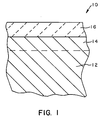
- FIGURE 1 is a schematic cross-sectional view of a fragment of a substrate of base material which has been coated with CVD diamond in accordance with one embodiment of the present invention.
- a cutting tool insert 10 of which a fragment is shown in FIG. 1, consisting of a base material substrate 12 of commercially-available tungsten carbide with up to 6% Co by weight binder material is first treated so that a surface region 14 of the insert 10 becomes substantially saturated with carbon. Thereafter, the insert 10 is coated with a thin layer of diamond film 16 to improve its cutting tool performance.
- the substrate 12 material has an initial surface roughness of greater than 0.2 microns (micro-meters).
- the substrate 12 may or may not be honed prior to its pre-deposition preparation.
- the primary purpose of honing would be to increase the radius of any cutting edges of the tool in advance of the deposition of diamond on it in order to distribute the cutting load at that edge.
- honing treatment may also serve to remove surface contaminants from the substrate surface, remove loosely bound WC material and/or remove defects or chips at the cutting edge and tips of the tools in order to provide a suitable foundation for the diamond coating.
- the geometrical result of the honing process may or may not be beneficial, whereas the mechanical abrasion of the process may be advantageous to the adhesion of the diamond film for reasons which will be discussed below.
- the substrate 12 is next cleaned by immersing it in an ultrasonic cleansing tank in a degreasing solution bath which is ultrasonically agitated for about 15 minutes.
- a suitable degreasing solution is one part by volume of ESMA E484, a commercially-available degreasing compound marketed by Esma Chemicals Inc., of Highland Park, Ill. in 1994, in two parts deionized water.
- the substrate material is removed and mechanically cleaned with a cotton swab using one part of the degreasing solution diluted with 2 parts deionized water until no more contaminants are removed by this action as indicated by lack of further discoloration of the swab.
- the substrate material is then again placed in a clean ultrasonic bath of degreasing solution, cleaned for an additional 15 minutes, removed from the ESMA E484 solution, thoroughly rinsed in an ultrasonic bath of pure de-ionized water, and then blown dry with nitrogen.
- the substrate material With the substrate material now clean, it is immersed in a room temperature solution of 10% by volume of concentrated nitric acid (69-71% purity; specific gravity 1.423 grams per cc) in deionized water and ultrasonically agitated for about 1 to about 15 minutes in order to remove some cobalt binder from the surface region 14 to a depth of about 4 to about 15 microns, respectively. It is critical to the performance of the insert 10 that the etching action not be too aggressive. Similarly, it is important that enough cobalt is removed from the surface region 14 to ensure that the adhesion of the deposited diamond is not critically affected. Specific details of the effect of the etch depth on performance are given below in the "Examples" section. Defining the optimum amount of cobalt to be removed from the near surface region may be dependent upon the particular application.
- the free surface of the substrate material will contain free or loosely bonded WC grains which result in a weak interface between the diamond film and the substrate.
- aggressive etching is known to decrease the fracture toughness of the free surface of the tool such that the edges and tips of the substrate are embrittled and may not be able to support more intense cutting loads of some specific applications.
- the substrate material is then rinsed for 3-5 minutes in pure de-ionized water, again in an ultrasonic bath.
- the substrate material is placed in a seed solution of 0.35 grams of ⁇ 0.1 micron diameter diamond powder in 100 ml (milliliters) of isopropyl alcohol and ultrasonically vibrated for 20 minutes. It is then again rinsed in de-ionized water in order to remove excess seed solution and blown dry with nitrogen.
- Diamond deposition is performed in a 2.45 GHz or 915 MHz microwave plasma CVD reactor of the type described, for example in U.S. patent 4,777,336 at a temperature of 750 degrees C to 950 degrees C using various concentrations of methane in hydrogen from 0.5% to 2.0% by volume as measured by mass flow rates.
- the substrate material may or may not be annealed in activated molecular hydrogen plasma while heating up to deposition temperature.
- the annealing time, as well as the temperature at which methane is introduced into the reaction chamber, directly affect the nucleation density. Deposition at steady state continues for a period sufficient to result in a diamond film with a thickness of between 10 and 50 microns.
- a smoother cutting surface would be likely to bring with it the benefit of decreased thermal heating by friction, decreased material build-up during cutting, and also, perhaps, a superior finish to the work-piece in some applications.
- the smoother cutting surface may be achieved by increasing the methane concentration during deposition in order to deposit a diamond layer with smaller micro-crystals over a base of larger, well-faceted crystals. This may result in a high quality/high strength, stress-supporting foundation at the diamond/substrate interface and a smoother, micro-crystalline cutting surface.
- the methane concentration is increased during deposition from low (less than 1%) to high (2% or higher) in gradations. This is done in order to ensure that the transition from the well-faceted, larger crystals to the micro-crystals will result in a smooth cutting surface. Also, low methane concentration results in slower growing, but better quality diamond with greater tensile strength at the interface and probably leads to a stronger adhesion for this reason. The low methane conditions also encourage carburization of the cobalt in the surface region of the substrate before effective nucleation of diamond takes place.
- the substrate is annealed at the deposition temperature for about one-half hour in a hydrogen plasma. Thereafter it is slowly cooled by about 500 degrees C over a period of about 40 minutes by decreasing the chamber pressure to lower the power density of the plasma. At that time, power to the plasma is shut down and the substrate is allowed to cool to room temperature.
- the annealing step may alternatively be done in part by gradually decreasing the microwave power or the deposition chamber pressure or both. Alternatively, an active heater may be used to slowly decrease the temperature of the substrate.
- a tungsten carbide (6% by weight of cobalt) cutting tool insert of type TPG321 VC2 WC-Co manufactured by GTE-Valenite Corporation was honed to an edge radius of about 35 microns, cleaned with the procedure described above, and etched for 10 minutes using the procedure described above. Cobalt was removed to a depth of about 9 microns into the WC-Co substrate and the substrate then seeded using the procedure described above.
- the substrate was coated with diamond film to a thickness of approximately 19 microns using microwave plasma-enhanced CVD (chemical vapor deposition) at a power of about 700 watts as described above and using the following methane concentrations: 0.5% for the first 15 hours, 1.0% for the next 15 hours and 2.0% for last 15 hours.
- the average deposition substrate temperature was about 860 degrees C.
- the resulting coated insert was then tested in a turning application on A390 grade high silicon aluminum (18% Si) under the following conditions: 680 m/min, 0.2 mm/rev, 1.0 mm depth of cut using liquid coolant.
- the performance of the coated insert was compared to that of a similar insert which had not had its surface treated and coated with diamond. Each sample was tested for 5 minutes and the resulting wear measured.
- the failure criterion was a measured flank wear of about 0.015 in. (0.38 mm).
- the uncoated WC-Co lasted less than 5 seconds with a wear of about .016 in. (0.41 mm).
- the insert which had been coated with diamond in accordance with the invention showed a measured flank wear of only about 0.0056 in. (0.0142 cm) and had not yet been worn through the diamond film to the substrate.
- a cutting tool insert of configuration type TPG321 (sample A) and another of type TPG 322 (sample B) of the same tungsten carbide material as the insert of example 1 were prepared using the same procedure described in Example 1 above.
- the sample A was coated with a film thickness of about 20 microns while sample B was coated with a diamond film thickness of about 25 microns.
- Both samples were tested in a turning operation using A390 aluminum (18% Si) in an interrupted facing operation with the following characteristics: a 14 cm diameter log with two 1.2 cm wide, axially-extending, opposing slots in the perimeter and an outer diameter velocity of about 1000 m/min, an inner diameter velocity of about 180 m/min, a feed rate of about 0.2 mm/rev, and a depth of Cut of about 1.0 mm.
- Sample (B) was tested for 150 passes and removed about 130 cubic inches of material. The flank wear following this test was about 0.0034 in. (0.0086 cm). Neither Sample (A) nor (B) was worn through the diamond film as a result of the testing.
- the diamond-coated WC-Co insert may have a range of acceptable values.
- the optimal value for particular characteristics may be solely dependent on the particular application in which the diamond coated tool is to be used.
- the following is a summary of acceptable ranges of some critical parameters and description of the effect of the variation of the value within the range.
- the substrate must have a pre-deposition surface roughness greater than about 0.064 microns.
- the pre-deposition surface roughness used for the above examples is between 0.2 and 0.4 microns. The increased roughness results in improved adherence of the diamond.
- the honing did not appear to affect the adhesion strength of the diamond film.
- the honing radius does affect the surface finish of the workpiece, however.
- the methane concentration directly affects the nucleation of the diamond film.
- a coupled effect seems to exist between the methane concentration, seeding procedure, substrate deposition temperature and pre-deposition ramp procedure. In general, high nucleation is favored for abrasive applications. In the turning application described in Example A above, no difference in performance was seen between samples whose diamond films were grown under conditions which yield low nucleation density (about 104 per square cm) and samples whose diamond films were grown under conditions which yielded higher nucleation densities (about 109 per square cm).
- the substrate temperature during deposition is important. For substrate temperatures in excess of about 950 degrees C, nucleation density is critically affected and a discontinuous film results. For temperatures less than about 760 degrees C, the deposition rate is extremely low.
- the diamond layer should be at least about 6 microns thick. Typically, the thickness is in the range of 10-25 microns. Tool life in general increases with increasing thickness of the film.
- the present invention is particularly useful for cobalt-bonded tungsten carbide substrates coated with diamond
- other composites such as tungsten carbide in a different metal matrix or a different ceramic in a cobalt matrix may also present similar tendencies to degrade the diamond and could therefore benefit from the invention.
- the carburizing could also be accomplished by means bother than a plasma.
- the substrate could be annealed in the presence of atomic hydrogen and a hydrocarbon source gas.
- the substrate could be placed in a bed of carbon particulates at elevated temperature for an extended time.
Landscapes
- Chemical & Material Sciences (AREA)
- Engineering & Computer Science (AREA)
- Metallurgy (AREA)
- Chemical Kinetics & Catalysis (AREA)
- Materials Engineering (AREA)
- Mechanical Engineering (AREA)
- General Chemical & Material Sciences (AREA)
- Organic Chemistry (AREA)
- Inorganic Chemistry (AREA)
- Physics & Mathematics (AREA)
- Plasma & Fusion (AREA)
- Chemical Vapour Deposition (AREA)
- Cutting Tools, Boring Holders, And Turrets (AREA)
- Crystals, And After-Treatments Of Crystals (AREA)
Applications Claiming Priority (2)
| Application Number | Priority Date | Filing Date | Title |
|---|---|---|---|
| US289356 | 1981-08-03 | ||
| US28935694A | 1994-08-11 | 1994-08-11 |
Publications (1)
| Publication Number | Publication Date |
|---|---|
| EP0701006A1 true EP0701006A1 (fr) | 1996-03-13 |
Family
ID=23111190
Family Applications (1)
| Application Number | Title | Priority Date | Filing Date |
|---|---|---|---|
| EP95202161A Withdrawn EP0701006A1 (fr) | 1994-08-11 | 1995-08-08 | Outil coupant composite revêtu de diamant et procédé pour sa fabrication |
Country Status (4)
| Country | Link |
|---|---|
| US (2) | US5674620A (fr) |
| EP (1) | EP0701006A1 (fr) |
| JP (1) | JPH0892742A (fr) |
| CA (1) | CA2155144C (fr) |
Cited By (3)
| Publication number | Priority date | Publication date | Assignee | Title |
|---|---|---|---|---|
| EP0802265A1 (fr) * | 1996-04-17 | 1997-10-22 | Saint-Gobain/Norton Industrial Ceramics Corporation | Méthode pour la fabrication d'un corps composite revêtu de diamant |
| WO1998035071A1 (fr) * | 1997-02-05 | 1998-08-13 | Cemecon-Ceramic Metal Coatings-Dr.-Ing. Antonius Leyendecker Gmbh | Revetement de matiere dure d'un substrat en carbure fritte ou en cermet contenant du carbure |
| WO1999031292A1 (fr) * | 1997-12-18 | 1999-06-24 | Sandvik Ab (Publ) | Outil de coupe en carbure fritte muni d'un revetement et procede de formation d'un revetement en diamants pour cet outil |
Families Citing this family (18)
| Publication number | Priority date | Publication date | Assignee | Title |
|---|---|---|---|---|
| US5277477A (en) * | 1991-07-08 | 1994-01-11 | Sharff Harold M | Transporter for the physically impaired |
| US6214247B1 (en) * | 1998-06-10 | 2001-04-10 | Tdy Industries, Inc. | Substrate treatment method |
| US6220117B1 (en) | 1998-08-18 | 2001-04-24 | Baker Hughes Incorporated | Methods of high temperature infiltration of drill bits and infiltrating binder |
| US6344149B1 (en) | 1998-11-10 | 2002-02-05 | Kennametal Pc Inc. | Polycrystalline diamond member and method of making the same |
| KR100305315B1 (ko) | 1999-04-09 | 2001-09-13 | 박호군 | 다이아몬드 막이 코팅된 절삭공구 및 그 제조방법 |
| JP4860834B2 (ja) * | 2001-05-10 | 2012-01-25 | 株式会社熊防メタル | WC−Co基体へのダイヤモンド合成方法 |
| JP2003251503A (ja) * | 2001-12-26 | 2003-09-09 | Sumitomo Electric Ind Ltd | 表面被覆切削工具 |
| DE10209924A1 (de) * | 2002-03-07 | 2003-09-25 | Beck August Gmbh Co | Führungsleiste für leistengeführte spanabhebende Werkzeuge |
| US7581906B2 (en) * | 2004-05-19 | 2009-09-01 | Tdy Industries, Inc. | Al2O3 ceramic tools with diffusion bonding enhanced layer |
| US20060147631A1 (en) * | 2005-01-04 | 2006-07-06 | Lev Leonid C | Method for making diamond coated substrates, articles made therefrom, and method of drilling |
| US20060159848A1 (en) * | 2005-01-20 | 2006-07-20 | Yucong Wang | Method of making wear-resistant components |
| JP4723302B2 (ja) * | 2005-07-25 | 2011-07-13 | ユニタック株式会社 | マシンリーマー |
| US10279454B2 (en) | 2013-03-15 | 2019-05-07 | Baker Hughes Incorporated | Polycrystalline compacts including diamond nanoparticles, cutting elements and earth- boring tools including such compacts, and methods of forming same |
| US9879511B2 (en) | 2013-11-22 | 2018-01-30 | Baker Hughes Incorporated | Methods of obtaining a hydrocarbon material contained within a subterranean formation |
| US10060237B2 (en) | 2013-11-22 | 2018-08-28 | Baker Hughes, A Ge Company, Llc | Methods of extracting hydrocarbons from a subterranean formation, and methods of treating a hydrocarbon material within a subterranean formation |
| RU2634098C2 (ru) * | 2015-12-09 | 2017-10-23 | федеральное государственное бюджетное образовательное учреждение высшего образования "Пермский национальный исследовательский политехнический университет" | Способ получения алмазной плёнки на твердосплавных изделиях из карбида вольфрама |
| CN108098282B (zh) * | 2017-09-30 | 2019-10-22 | 鼎胜刀具(东莞)有限公司 | 一种铣刀的制作方法 |
| CN113699588A (zh) * | 2021-10-21 | 2021-11-26 | 天津本钻科技有限公司 | 一种微波cvd法控制多晶金刚石晶粒尺寸的生长方法 |
Citations (5)
| Publication number | Priority date | Publication date | Assignee | Title |
|---|---|---|---|---|
| US4777336A (en) | 1987-04-22 | 1988-10-11 | Michigan State University | Method for treating a material using radiofrequency waves |
| EP0374923A2 (fr) * | 1988-12-21 | 1990-06-27 | Mitsubishi Materials Corporation | Outil recouvert de diamant, substrat correspondant et méthode pour le fabriquer |
| US5100703A (en) * | 1989-02-23 | 1992-03-31 | Toshiba Tungaloy Co., Ltd. | Diamond-coated sintered body excellent in adhesion and process for preparing the same |
| EP0500119A1 (fr) * | 1991-02-21 | 1992-08-26 | Mitsubishi Materials Corporation | Outils coupants revêtus, en phase vapeur, de diamant et procédé de fabrication |
| WO1994013852A1 (fr) * | 1992-12-08 | 1994-06-23 | Osaka Diamond Industrial Co., Ltd. | Materiau recouvert d'un film ultra-dure et son procede de production |
Family Cites Families (5)
| Publication number | Priority date | Publication date | Assignee | Title |
|---|---|---|---|---|
| US4648119A (en) * | 1985-03-18 | 1987-03-03 | Tektronix, Inc. | Method and apparatus for forming 3×3 pixel arrays and for performing programmable pattern contingent modifications of those arrays |
| US4731296A (en) * | 1986-07-03 | 1988-03-15 | Mitsubishi Kinzoku Kabushiki Kaisha | Diamond-coated tungsten carbide-base sintered hard alloy material for insert of a cutting tool |
| US4900628A (en) * | 1986-07-23 | 1990-02-13 | Sumitomo Electric Industries, Ltd. | Gaseous phase synthesized diamond and method for synthesizing same |
| US5204167A (en) * | 1989-02-23 | 1993-04-20 | Toshiba Tungaloy Co., Ltd. | Diamond-coated sintered body excellent in adhesion and process for preparing the same |
| US5236740A (en) * | 1991-04-26 | 1993-08-17 | National Center For Manufacturing Sciences | Methods for coating adherent diamond films on cemented tungsten carbide substrates |
-
1995
- 1995-05-24 US US08/449,831 patent/US5674620A/en not_active Expired - Fee Related
- 1995-08-01 CA CA002155144A patent/CA2155144C/fr not_active Expired - Fee Related
- 1995-08-08 EP EP95202161A patent/EP0701006A1/fr not_active Withdrawn
- 1995-08-11 JP JP7206038A patent/JPH0892742A/ja active Pending
-
1997
- 1997-03-14 US US08/819,557 patent/US5912053A/en not_active Expired - Fee Related
Patent Citations (5)
| Publication number | Priority date | Publication date | Assignee | Title |
|---|---|---|---|---|
| US4777336A (en) | 1987-04-22 | 1988-10-11 | Michigan State University | Method for treating a material using radiofrequency waves |
| EP0374923A2 (fr) * | 1988-12-21 | 1990-06-27 | Mitsubishi Materials Corporation | Outil recouvert de diamant, substrat correspondant et méthode pour le fabriquer |
| US5100703A (en) * | 1989-02-23 | 1992-03-31 | Toshiba Tungaloy Co., Ltd. | Diamond-coated sintered body excellent in adhesion and process for preparing the same |
| EP0500119A1 (fr) * | 1991-02-21 | 1992-08-26 | Mitsubishi Materials Corporation | Outils coupants revêtus, en phase vapeur, de diamant et procédé de fabrication |
| WO1994013852A1 (fr) * | 1992-12-08 | 1994-06-23 | Osaka Diamond Industrial Co., Ltd. | Materiau recouvert d'un film ultra-dure et son procede de production |
Cited By (5)
| Publication number | Priority date | Publication date | Assignee | Title |
|---|---|---|---|---|
| EP0802265A1 (fr) * | 1996-04-17 | 1997-10-22 | Saint-Gobain/Norton Industrial Ceramics Corporation | Méthode pour la fabrication d'un corps composite revêtu de diamant |
| WO1998035071A1 (fr) * | 1997-02-05 | 1998-08-13 | Cemecon-Ceramic Metal Coatings-Dr.-Ing. Antonius Leyendecker Gmbh | Revetement de matiere dure d'un substrat en carbure fritte ou en cermet contenant du carbure |
| US6268045B1 (en) | 1997-02-05 | 2001-07-31 | Cemecon-Ceramic Metal Coatings-Dr.-Ing. Antonius Leyendecker Gmbh | Hard material coating of a cemented carbide or carbide containing cermet substrate |
| WO1999031292A1 (fr) * | 1997-12-18 | 1999-06-24 | Sandvik Ab (Publ) | Outil de coupe en carbure fritte muni d'un revetement et procede de formation d'un revetement en diamants pour cet outil |
| US6447912B1 (en) | 1997-12-18 | 2002-09-10 | Sandvik Ab | Coated cemented carbide cutting tool and method of coating it with diamond |
Also Published As
| Publication number | Publication date |
|---|---|
| CA2155144C (fr) | 1999-05-04 |
| US5912053A (en) | 1999-06-15 |
| JPH0892742A (ja) | 1996-04-09 |
| US5674620A (en) | 1997-10-07 |
| CA2155144A1 (fr) | 1996-02-12 |
Similar Documents
| Publication | Publication Date | Title |
|---|---|---|
| US5674620A (en) | Diamond-coated composite cutting tool and method of making | |
| US5635256A (en) | Method of making a diamond-coated composite body | |
| US5236740A (en) | Methods for coating adherent diamond films on cemented tungsten carbide substrates | |
| KR100832899B1 (ko) | 산화물로 코팅된 절삭공구 | |
| US5618625A (en) | CVD diamond coated cutting tools and method of manufacture | |
| CA2007561C (fr) | Procede pour le durcissement des outils diamantes | |
| US5713133A (en) | Methods of preparing cemented metal carbide substrates for deposition of adherent diamond coatings and products made therefrom | |
| US4919974A (en) | Making diamond composite coated cutting tools | |
| EP0843747B1 (fr) | Traitement d'un substrat de type carbure fritté lui permettant de recevoir un film de diamant par CVD | |
| JP4593852B2 (ja) | 被覆硬質合金 | |
| Shibuki et al. | Adhesion strength of diamond films on cemented carbide substrates | |
| US8496993B2 (en) | Nanocomposite coatings on cemented carbide | |
| US5955212A (en) | Superhard film-coated member and method of manufacturing the same | |
| EP0931177B1 (fr) | Substrat revetu d'une couche de diamant et soumis a un post-traitement | |
| US6365230B1 (en) | Method of manufacturing a diamond film coated cutting tool | |
| JP3353239B2 (ja) | ダイヤモンド類被覆部材の製造方法 | |
| Peng et al. | Characterization and adhesion strength of diamond films deposited on silicon nitride inserts by dc plasma jet chemical vapour deposition | |
| JPS62228305A (ja) | アルミナコ−テイング工具およびその製造方法 | |
| Shi et al. | Growth of a well-adhering diamond coating on sintered tungsten | |
| JP2772494B2 (ja) | 超硬質膜被覆部材及びその製造方法 | |
| Makala et al. | Diamond Coated WC Tools for Machining Wood and Particle Board | |
| JPWO1994013852A1 (ja) | 超硬質膜被覆部材及びその製造方法 | |
| JPH06340496A (ja) | ダイヤモンド被覆超硬合金部材及びその製造方法 |
Legal Events
| Date | Code | Title | Description |
|---|---|---|---|
| PUAI | Public reference made under article 153(3) epc to a published international application that has entered the european phase |
Free format text: ORIGINAL CODE: 0009012 |
|
| AK | Designated contracting states |
Kind code of ref document: A1 Designated state(s): DE FR GB |
|
| 17P | Request for examination filed |
Effective date: 19960913 |
|
| 17Q | First examination report despatched |
Effective date: 19980902 |
|
| RAP1 | Party data changed (applicant data changed or rights of an application transferred) |
Owner name: SAINT-GOBAIN INDUSTRIAL CERAMICS, INC. |
|
| STAA | Information on the status of an ep patent application or granted ep patent |
Free format text: STATUS: THE APPLICATION IS DEEMED TO BE WITHDRAWN |
|
| 18D | Application deemed to be withdrawn |
Effective date: 20031001 |