EP0701226A2 - Méthode pour segmenter des lignes de texte manuscriptes sur une image scannée - Google Patents
Méthode pour segmenter des lignes de texte manuscriptes sur une image scannée Download PDFInfo
- Publication number
- EP0701226A2 EP0701226A2 EP95306118A EP95306118A EP0701226A2 EP 0701226 A2 EP0701226 A2 EP 0701226A2 EP 95306118 A EP95306118 A EP 95306118A EP 95306118 A EP95306118 A EP 95306118A EP 0701226 A2 EP0701226 A2 EP 0701226A2
- Authority
- EP
- European Patent Office
- Prior art keywords
- token
- line
- image
- determining
- candidate
- Prior art date
- Legal status (The legal status is an assumption and is not a legal conclusion. Google has not performed a legal analysis and makes no representation as to the accuracy of the status listed.)
- Granted
Links
Images




Classifications
-
- G—PHYSICS
- G06—COMPUTING OR CALCULATING; COUNTING
- G06V—IMAGE OR VIDEO RECOGNITION OR UNDERSTANDING
- G06V30/00—Character recognition; Recognising digital ink; Document-oriented image-based pattern recognition
- G06V30/10—Character recognition
- G06V30/14—Image acquisition
- G06V30/146—Aligning or centring of the image pick-up or image-field
-
- G—PHYSICS
- G06—COMPUTING OR CALCULATING; COUNTING
- G06V—IMAGE OR VIDEO RECOGNITION OR UNDERSTANDING
- G06V30/00—Character recognition; Recognising digital ink; Document-oriented image-based pattern recognition
- G06V30/10—Character recognition
Definitions
- the present invention relates to image analysis techniques for segmenting textual areas in images. More specifically, the invention relates to isolating strokes, or tokens, which make up characters in a particular text line.
- Boards are widely used to maintain hand drawn textual and graphic images on a "wall-size" surface.
- the Board medium offers certain properties that facilitate a variety of interactive work practices: markings are large enough to be viewed by several people; markings can be edited by erasing and redrawing; the surface is immobile, so does not get lost, crumpled, torn, or blown by wind; the surface is readily erased, is completely reusable, and (practically) does not wear out.
- markings are large enough to be viewed by several people; markings can be edited by erasing and redrawing; the surface is immobile, so does not get lost, crumpled, torn, or blown by wind; the surface is readily erased, is completely reusable, and (practically) does not wear out.
- markings are large enough to be viewed by several people; markings can be edited by erasing and redrawing; the surface is immobile, so does not get lost, crumpled, torn, or blown by wind
- a copy-board device provides a writing surface which can be transcribed into paper hardcopy, but these are currently conceived as conspicuous portable whiteboards that displace rather than leverage existing, built-in Boards.
- Concurrently filed application EP-A-000,000 corresponding to U.S. Patent Application Serial No. 08/303,918 provides specific technical details for a device to transcribe marks on a Board into electronic form.
- a video camera is mounted on a pan/tilt head.
- High resolution tiles are obtained by zooming in the camera on patches of the image. These are later pieced together to form a full size high resolution composite image.
- Perspective distortion, effects of uneven lighting, and tile overlap are handled by image processing operations.
- Such a transcription device is useful because an electronic version of a Board image provides variety and flexibility in the further use of the image data.
- an electronic image can be hardcopied, transmitted by fax, stored to a file, transferred to an electronic workstation, or projected onto a screen.
- the image itself may be processed, for example select out just a region of the image, to select just certain colors, to enhance or rectify the line work, to reorder items in a list, and so forth.
- the previously described interface does not eliminate the need for users to possess knowledge of how to communicate with the system in this diagrammatic fashion, but this knowledge may be more accessible and more easily assimilated by many Board users than any control panel or computer console based interface.
- a diagrammatic interface exploits the user's existing skills in drawing on the Board, and furthermore can offer extremely simple access to basic functionality and introduce incrementally the greater diagrammatic complexity required to fine tune greater functionality. Finally, a diagrammatic interface consisting of marks drawn on the Board itself is best suited to providing spatial control directives, such as to extract a region of the image.
- a diagrammatic user interface to a Board transcription system hinges on the ability of a computer program to successfully interpret marks on the Board.
- the present invention describes a novel application of computer vision techniques supporting segmentation of hand drawn text at the word and line level.
- the present invention does not perform handwritten text recognition, but the text segmented out may be extracted as bitmaps and passed to auxiliary recognition modules.
- the techniques offered herein further lead to a greater degree of robustness in the machine interpretation of hand drawn diagrams than has previously been demonstrated in the art.
- the present invention provides a method for segmenting handwritten textual areas in a scanned image.
- the method detects a first token representing a portion of a character, and determines from it a line height and position.
- a second token is detected, and its line height and position are determined.
- the position of the second token is sufficiently similar to the line position, the second token is accepted as a line character and a new line height and position are determined based on all the accepted line characters.
- the present invention provides a method for segmenting handwritten textual areas in a scanned image, comprising: (a) detecting a first token representing a character portion; (b) determining from said first token a line height and position; (c) detecting a second token representing a character portion; (d) determining a second token line height and position; when said second token position is sufficiently similar to said line position, accepting said second token as a line character; and (e) determining a new line height and position based on the accepted line characters.
- the invention further provides a programmable image processing apparatus when suitably programmed for carrying out the method of any of the appended claims or any of the particular embodiments described herein.
- One object of this invention is to isolate text lines in a scanned image. These text lines are formed of images which may be drawn at any location on the Board, at any time, and provide a method for selecting control operations from the Board.
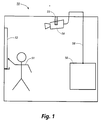
- Fig. 1 shows a general Board scanning system 50 in which the techniques of the present invention may be employed. It will be clear that the techniques herein described may further be applied to other types of systems, as well. For example, the techniques described may be used to interpret control commands via marks on paper in a paper-based user interface. The techniques may also be used as command entry interface for pen-based computing systems. The discussion herein, however, will be primarily described in terms of the Board scanning system described below.
- a board 52 accepts markings from a user 51.
- Camera subsystem 54 captures an image or images of the Board, which are fed to computer 56 via a network 58.
- the resolution of an electronic camera such as a video camera will be insufficient to capture an entire Board image with enough detail to discern the markings on the Board clearly. Therefore, several zoomed-in images of smaller subregions of the Board, called “image tiles,” must be captured independently, and then pieced together.
- Camera subsystem 54 is mounted on a computer-controlled pan/tilt head 55, and directed sequentially at various subregions, under program control, when an image capture command is executed. Camera subsystem 54 may alternately comprise an array of fixed cameras, each directed at a different subregion or subregions. For the discussion herein, camera subsystem 54 may be referred to as simply camera 54.
- the "raw" image tiles will in general overlap one another, contain perspective distortion due to the off-axis viewpoint of the camera, and contain uneven lightness levels across the board between foreground (written marks) and background (unmarked board) due to uncontrolled lighting conditions and reflections.
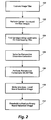
- the flowchart of Fig. 2 shows a general method for producing a binary rendition of the Board from a set of scanned image sections, including compensation for the above described effects.
- the scanned image sections are captured as "tiles.”
- Each tile is a portion of the Board image scanned by a camera, such as camera 54.
- a Board is captured as a series of tiles. The tiles slightly overlap with neighboring tiles, so that the entire image is scanned with no "missing" spaces.
- each tile is known from the position and direction of the camera on the pan/tilt head when the tile is scanned.
- the tiles may be described as "raw image” or “camera image” tiles, in that no processing has been done on them to either interpret or precisely locate them in the digital image.
- center-surround processing is performed on each camera image tile. Center-surround processing compensates for the lightness variations among and within tiles.
- Step 104 finds corresponding "landmarks" in overlapping tiles.
- "Landmarks” are described as marks on the Board which may be used to provide the correct orientation and overlap position of neighboring tiles. Landmarks that appear in a region of overlap between two tiles will be used to "match up" those two tiles to reconstruct the image.
- Step 106 solves for perspective distortion corrections that optimize global landmark mismatch functions. This step corrects for errors that occur in the dead reckoning of the tile location in the image. The transformation is weighted by a confidence in the location of each landmark, which is obtained in the previous step. Step 108 performs perspective corrections on all the tiles using the perspective transformation determined in step 106.
- step 110 the corrected data for all the tiles is written into a grey-level Board rendition image.
- this grey-level image is thresholded, producing a binary, electronically manipulable rendition of the Board image.
- FIGS. 3 and 4 illustrate applications of the present invention. More detail concerning the command features described herein may be found in previously referenced EP-A-000,000, corresponding to U.S. Patent Application Serial No. 08/303,929.
- Figure 3 shows a board image 150, including a hand drawn button consisting of two "nested” squares--one square immediately inside the other. This is referred to as a NESTED-BOX-BUTTON, or NBB 158. Drawing an "x” or a checkmark in the button “selects” the button. NBB 158 shows lines leading to symbolic textual annotations directing that hardcopy be sent to a printer “daily planet,” that an image file be stored called “test.im,” and that only red and blue colors be transcribed.
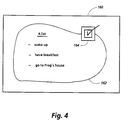
- Figure 4 shows an image 160, from “A list” in “Frog and Toad Together,” by Arnold Lobel, ⁇ 1972, HarperCollins Publishers.
- Image 160 has a region 162, selected by NBB 164, which includes lines of text.
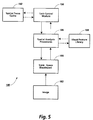
- Figure 5 presents an overall functional architecture 180 supporting the present invention.
- Information about the content of image 182 is maintained as symbolic tokens residing in the Scale-Space blackboard (SSB) data structure 184. These symbolic tokens serve as a resource for spatial analysis procedures 186, which may at times contribute new tokens to the Board data structure.
- task control module 190 directs spatial analysis procedures 186 to collect information about image 182 in order to build descriptions of the aspects of the image that are relevant to the immediate task.
- the Scale-Space blackboard data structure 184 facilitates spatial and geometric computations by providing indexing of symbolic tokens on the basis of spatial location and scale. These tokens are compact symbolic descriptors of abstract image events such as the occurrence of curves, corners, nested boxes, characters, etc.
- the SSB data structure 184 is further described in Saund, E., "Symbolic Construction of a 2-D Scale Space Image," IEEE TPAMI, V. 12 No. 8, August 1990. For convenience, in practice several SSB data structures may be maintained, each holding different kinds of information reflecting different stages of processing.
- a large and extensible visual feature library 188 is maintained in connection with spatial analysis procedures 186, with a knowledge base of prototypical spatial events which can be labeled explicitly by placing new tokens on the SSB.
- These spatial analysis procedures underlie the major image analysis tasks of recognizing command symbols, tracing curvilinear paths, and segmenting lines of handwritten text.
- the top level task control module 190 directs the application of spatial analysis procedures 186 according to a task execution strategy defined for the specific diagrammatic user interface specification.
- Associated with task control module 190 is a temporary store, spatial focus cache 192, which maintains state as to what button boxes or other task level objects are believed to be in the image, as well as information about locations of the image requiring examination in detail as processing resources become available.
- PRIMITIVE-CURVE-FRAGMENT representing relatively straight sections of curves having no internal junctions or crossings with other curves.
- the steps shown in Fig. 6 are used to identify curve fragments.
- Step 200 first thins the lines of the drawing using morphological erosion, a technique well-known to practitioners of computer vision.
- Step 202 detects curve junctions using a morphological hit-miss transform with masks that reflect junction configurations of 3x3 pixels.
- Step 204 traces curves between junctions, using any one of many curve tracing methods well known in computer vision literature.
- Step 206 detects corners on curves. Techniques for doing this are also available in computer vision literature.
- Step 208 breaks curves at corners, leaving elementary fragments to be labeled as PRIMITIVE-CURVE-FRAGMENT type tokens, which are written onto the SSB data structure.
- the use of handwritten text in a diagrammatic user interface entails two image analysis subproblems. First, the relevant text directives must be identified and segmented from other markings on the board, and second, the text must be recognized.
- the present invention offers means for solving the first of these subproblems.
- a combination of command symbols and curvilinear line tracing leads to the identification of locations in the image which are the beginning of a line of text. Then, text segmentation demarcates the region of the image containing the text. This can be difficult when ascenders and descenders extend into lines above and below the current line, and when the text drifts in height so that text lines cannot be clearly separated by horizontal lines.
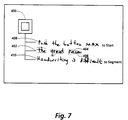
- Fig. 7 shows a simple command structure associated with a NBB 400.
- Various methods of tracing may be used to identify point 402, where text is expected.
- an agglomerative clustering of tokens forming a text line may be performed. Text segmentation is based on accumulating tokens along a text line, left to right, accepting only those tokens whose vertical position and vertical extent are approximately matched to the current estimate of the vertical position and vertical extent of the line.
- Error bars 404 and 406 show an estimate of the current height of the line. This current height is used as a parameter for deciding if the next character should be accepted or not. This aids in the acceptance of lines in which the writing may be smaller or larger as the line progresses. For example, the text at line 408 becomes smaller as it approaches the border of the image.
- the technique of the present invention keeps track of where the line is and how big it is at each point along its distance. Each character is compared with the immediately preceding character, rather than estimating a first character and comparing the rest of the line with that first character, as is done in previous systems. It also allows the segmentation to follow text as it tends to drift, as in line 410 for example, another common problem in handwritten images.
- Step 378 requires a determination of an initial starting location of the text line area. This may be determined by a number of methods, including via the steps in EP-A-000,000, corresponding to U.S. Patent Application 08/303,929, previously referenced.
- step 380 an initial estimate of line vertical position and vertical extent is formed, based on the initial location. These will be determined as a gaussian distribution whose mean is vertical position and whose variance is vertical extent. For example, in Fig. 9 initial token 471 has a mean 472 and variance 474.
- Step 382 collects PRIMITIVE-CURVE-FRAGMENT tokens in the vicinity and to the right of the initial horizontal position. These are sorted from left to right in step 384, and are called “candidate" tokens. For each candidate token in step 386, the vertical location and vertical extent of each candidate token is compared with the current estimated line vertical position and vertical extent in step 390.
- this token is accepted as part of the line in step 398, and the line estimated vertical position and vertical extent is updated by the well-known formula for combining gaussian means and variances in step 399.
- the addition of token 477 gives an updated mean, or vertical distance, 478, and a vertical extent 480.
- a vertical threshold distance may be determined according to a Fisher linear discriminant distance measure as described in "Pattern Classification and Scene Analysis” by Richard Duda and Peter Hart, ⁇ 1973, by John Wiley & Sons, Inc., pages 114-118.
- n l and n s are weighting factors for the existing line and new stroke, respectively.
- the existing line is given more weight than the new stroke.
- those questionable tokens that touch a previously accepted candidate token are accepted at step 388.
- token 481 has a vertical mean 483 not far outside the vertical extent 482, and so should be accepted.
- Token 483 is mostly outside the previous distribution, and may be considered questionable. However, token 483 touches an accepted token 481, and so would also be accepted.
- the effect of this technique is to collect tokens along a text line, left to right, dynamically updating the estimated line vertical position and line height along the way. From these tokens it is an easy matter to extract the corresponding region of the original bitmap image to send to a separate handwriting recognition module for recognition of the text.
Landscapes
- Engineering & Computer Science (AREA)
- Computer Vision & Pattern Recognition (AREA)
- Physics & Mathematics (AREA)
- General Physics & Mathematics (AREA)
- Multimedia (AREA)
- Theoretical Computer Science (AREA)
- Character Input (AREA)
- Processing Or Creating Images (AREA)
- Digital Computer Display Output (AREA)
- Character Discrimination (AREA)
Applications Claiming Priority (2)
| Application Number | Priority Date | Filing Date | Title |
|---|---|---|---|
| US30396294A | 1994-09-09 | 1994-09-09 | |
| US303962 | 1994-09-09 |
Publications (3)
| Publication Number | Publication Date |
|---|---|
| EP0701226A2 true EP0701226A2 (fr) | 1996-03-13 |
| EP0701226A3 EP0701226A3 (fr) | 1997-05-14 |
| EP0701226B1 EP0701226B1 (fr) | 2001-03-21 |
Family
ID=23174449
Family Applications (1)
| Application Number | Title | Priority Date | Filing Date |
|---|---|---|---|
| EP95306118A Expired - Lifetime EP0701226B1 (fr) | 1994-09-09 | 1995-09-01 | Méthode pour segmenter des lignes de texte manuscriptes sur une image scannée |
Country Status (3)
| Country | Link |
|---|---|
| EP (1) | EP0701226B1 (fr) |
| JP (1) | JP3781810B2 (fr) |
| DE (1) | DE69520396T2 (fr) |
Cited By (1)
| Publication number | Priority date | Publication date | Assignee | Title |
|---|---|---|---|---|
| US10503960B2 (en) * | 2015-09-02 | 2019-12-10 | Secuve Co., Ltd. | Segment-based handwritten signature authentication system and method |
Family Cites Families (2)
| Publication number | Priority date | Publication date | Assignee | Title |
|---|---|---|---|---|
| US4998285A (en) * | 1988-03-11 | 1991-03-05 | Kabushiki Kaisha Toshiba | Character recognition apparatus |
| JPH0816918B2 (ja) * | 1989-04-18 | 1996-02-21 | シャープ株式会社 | 行抽出方法 |
-
1995
- 1995-09-01 EP EP95306118A patent/EP0701226B1/fr not_active Expired - Lifetime
- 1995-09-01 JP JP22507195A patent/JP3781810B2/ja not_active Expired - Fee Related
- 1995-09-01 DE DE69520396T patent/DE69520396T2/de not_active Expired - Lifetime
Cited By (1)
| Publication number | Priority date | Publication date | Assignee | Title |
|---|---|---|---|---|
| US10503960B2 (en) * | 2015-09-02 | 2019-12-10 | Secuve Co., Ltd. | Segment-based handwritten signature authentication system and method |
Also Published As
| Publication number | Publication date |
|---|---|
| DE69520396T2 (de) | 2001-08-30 |
| DE69520396D1 (de) | 2001-04-26 |
| JP3781810B2 (ja) | 2006-05-31 |
| JPH08101883A (ja) | 1996-04-16 |
| EP0701226B1 (fr) | 2001-03-21 |
| EP0701226A3 (fr) | 1997-05-14 |
Similar Documents
| Publication | Publication Date | Title |
|---|---|---|
| US6411732B1 (en) | Method for interpreting hand drawn diagrammatic user interface commands | |
| US5511148A (en) | Interactive copying system | |
| CN111507251B (zh) | 试题图像中作答区域的定位方法、装置、电子设备及计算机存储介质 | |
| EP0701225B1 (fr) | Système pour transcrire des images sur un tableau avec un scanner de tableau à caméra | |
| US7697776B2 (en) | Model-based dewarping method and apparatus | |
| US7418126B2 (en) | Image distortion correcting method and apparatus, and storage medium | |
| EP0738987B1 (fr) | Traitement des formulaires compréhensibles par une machine | |
| US5856877A (en) | Apparatus and method for processing and reproducing image information | |
| CN106156761A (zh) | 面向移动终端拍摄的图像表格检测与识别方法 | |
| JP5229050B2 (ja) | 画像からの文書領域抽出装置、方法、及びプログラム | |
| EP1330109B1 (fr) | Système et procédé d'indexation et d'accès à des données documentaires balayées sur un tableau blanc | |
| CN110705534A (zh) | 一种适用于电子助视器的错题本生成方法 | |
| JP2001109844A (ja) | 文字列抽出方法、手書き文字列抽出方法、文字列抽出装置、および画像処理装置 | |
| US7280693B2 (en) | Document information input apparatus, document information input method, document information input program and recording medium | |
| JP2000187705A (ja) | 文書読取装置および方法および記憶媒体 | |
| EP0701226B1 (fr) | Méthode pour segmenter des lignes de texte manuscriptes sur une image scannée | |
| JP3954247B2 (ja) | 文書入力方法、文書入力プログラムを記録した記録媒体及び文書入力装置 | |
| JPH10222688A (ja) | 画像処理方法 | |
| JP2755299B2 (ja) | 画像処理方法 | |
| Dulla | Geometric correction of historical Arabic documents | |
| JP2983448B2 (ja) | 図面認識方法 | |
| CN118302739A (zh) | 隔空手势编辑方法、装置、显示系统及介质 | |
| Golpardaz et al. | Perspective rectification and skew correction in camera-based farsi document images | |
| JP3239965B2 (ja) | 文字認識装置 | |
| JPH0798747A (ja) | 文字切出し装置 |
Legal Events
| Date | Code | Title | Description |
|---|---|---|---|
| PUAI | Public reference made under article 153(3) epc to a published international application that has entered the european phase |
Free format text: ORIGINAL CODE: 0009012 |
|
| AK | Designated contracting states |
Kind code of ref document: A2 Designated state(s): DE FR GB |
|
| PUAL | Search report despatched |
Free format text: ORIGINAL CODE: 0009013 |
|
| AK | Designated contracting states |
Kind code of ref document: A3 Designated state(s): DE FR GB |
|
| 17P | Request for examination filed |
Effective date: 19971114 |
|
| 17Q | First examination report despatched |
Effective date: 19971229 |
|
| GRAG | Despatch of communication of intention to grant |
Free format text: ORIGINAL CODE: EPIDOS AGRA |
|
| GRAG | Despatch of communication of intention to grant |
Free format text: ORIGINAL CODE: EPIDOS AGRA |
|
| GRAH | Despatch of communication of intention to grant a patent |
Free format text: ORIGINAL CODE: EPIDOS IGRA |
|
| GRAH | Despatch of communication of intention to grant a patent |
Free format text: ORIGINAL CODE: EPIDOS IGRA |
|
| GRAA | (expected) grant |
Free format text: ORIGINAL CODE: 0009210 |
|
| AK | Designated contracting states |
Kind code of ref document: B1 Designated state(s): DE FR GB |
|
| REF | Corresponds to: |
Ref document number: 69520396 Country of ref document: DE Date of ref document: 20010426 |
|
| ET | Fr: translation filed | ||
| REG | Reference to a national code |
Ref country code: GB Ref legal event code: IF02 |
|
| PLBE | No opposition filed within time limit |
Free format text: ORIGINAL CODE: 0009261 |
|
| STAA | Information on the status of an ep patent application or granted ep patent |
Free format text: STATUS: NO OPPOSITION FILED WITHIN TIME LIMIT |
|
| 26N | No opposition filed | ||
| PGFP | Annual fee paid to national office [announced via postgrant information from national office to epo] |
Ref country code: DE Payment date: 20140822 Year of fee payment: 20 |
|
| PGFP | Annual fee paid to national office [announced via postgrant information from national office to epo] |
Ref country code: GB Payment date: 20140822 Year of fee payment: 20 |
|
| PGFP | Annual fee paid to national office [announced via postgrant information from national office to epo] |
Ref country code: FR Payment date: 20140922 Year of fee payment: 20 |
|
| REG | Reference to a national code |
Ref country code: DE Ref legal event code: R071 Ref document number: 69520396 Country of ref document: DE |
|
| REG | Reference to a national code |
Ref country code: GB Ref legal event code: PE20 Expiry date: 20150831 |
|
| PG25 | Lapsed in a contracting state [announced via postgrant information from national office to epo] |
Ref country code: GB Free format text: LAPSE BECAUSE OF EXPIRATION OF PROTECTION Effective date: 20150831 |