EP0701544B1 - Procede et appareil de formation d'ethylene et/ou d'ethane a partir de methane - Google Patents
Procede et appareil de formation d'ethylene et/ou d'ethane a partir de methane Download PDFInfo
- Publication number
- EP0701544B1 EP0701544B1 EP94905199A EP94905199A EP0701544B1 EP 0701544 B1 EP0701544 B1 EP 0701544B1 EP 94905199 A EP94905199 A EP 94905199A EP 94905199 A EP94905199 A EP 94905199A EP 0701544 B1 EP0701544 B1 EP 0701544B1
- Authority
- EP
- European Patent Office
- Prior art keywords
- ethylene
- catalyst
- methane
- adsorbent
- ethane
- Prior art date
- Legal status (The legal status is an assumption and is not a legal conclusion. Google has not performed a legal analysis and makes no representation as to the accuracy of the status listed.)
- Expired - Lifetime
Links
- VNWKTOKETHGBQD-UHFFFAOYSA-N methane Chemical compound C VNWKTOKETHGBQD-UHFFFAOYSA-N 0.000 title claims abstract description 95
- VGGSQFUCUMXWEO-UHFFFAOYSA-N Ethene Chemical compound C=C VGGSQFUCUMXWEO-UHFFFAOYSA-N 0.000 title claims abstract description 55
- 239000005977 Ethylene Substances 0.000 title claims abstract description 54
- OTMSDBZUPAUEDD-UHFFFAOYSA-N Ethane Chemical compound CC OTMSDBZUPAUEDD-UHFFFAOYSA-N 0.000 title claims abstract description 35
- 238000000034 method Methods 0.000 title claims abstract description 20
- 239000003054 catalyst Substances 0.000 claims abstract description 55
- 239000000463 material Substances 0.000 claims abstract description 33
- 239000001301 oxygen Substances 0.000 claims abstract description 31
- 229910052760 oxygen Inorganic materials 0.000 claims abstract description 31
- 239000003463 adsorbent Substances 0.000 claims abstract description 30
- QVGXLLKOCUKJST-UHFFFAOYSA-N atomic oxygen Chemical compound [O] QVGXLLKOCUKJST-UHFFFAOYSA-N 0.000 claims abstract description 30
- 239000007789 gas Substances 0.000 claims abstract description 29
- 239000002250 absorbent Substances 0.000 claims abstract description 25
- 230000002745 absorbent Effects 0.000 claims abstract description 25
- 239000000203 mixture Substances 0.000 claims abstract description 8
- 239000007784 solid electrolyte Substances 0.000 claims abstract description 7
- 239000007787 solid Substances 0.000 claims abstract description 6
- 230000003134 recirculating effect Effects 0.000 claims abstract description 5
- 238000010438 heat treatment Methods 0.000 claims abstract description 3
- 238000006243 chemical reaction Methods 0.000 claims description 24
- 229910052709 silver Inorganic materials 0.000 claims description 5
- 230000003647 oxidation Effects 0.000 claims description 3
- 238000007254 oxidation reaction Methods 0.000 claims description 3
- 238000005691 oxidative coupling reaction Methods 0.000 claims description 2
- 239000002245 particle Substances 0.000 claims description 2
- 230000001737 promoting effect Effects 0.000 claims 3
- BQCADISMDOOEFD-UHFFFAOYSA-N Silver Chemical compound [Ag] BQCADISMDOOEFD-UHFFFAOYSA-N 0.000 claims 2
- 239000002131 composite material Substances 0.000 claims 1
- 229910044991 metal oxide Inorganic materials 0.000 claims 1
- 239000004332 silver Substances 0.000 claims 1
- 239000008246 gaseous mixture Substances 0.000 abstract description 2
- 238000006025 oxidative dimerization reaction Methods 0.000 abstract description 2
- 238000010521 absorption reaction Methods 0.000 abstract 1
- 229910001882 dioxygen Inorganic materials 0.000 abstract 1
- 239000011949 solid catalyst Substances 0.000 abstract 1
- 238000001179 sorption measurement Methods 0.000 abstract 1
- 239000002808 molecular sieve Substances 0.000 description 16
- URGAHOPLAPQHLN-UHFFFAOYSA-N sodium aluminosilicate Chemical compound [Na+].[Al+3].[O-][Si]([O-])=O.[O-][Si]([O-])=O URGAHOPLAPQHLN-UHFFFAOYSA-N 0.000 description 16
- 229910001233 yttria-stabilized zirconia Inorganic materials 0.000 description 11
- 229930195733 hydrocarbon Natural products 0.000 description 10
- 150000002430 hydrocarbons Chemical class 0.000 description 10
- 230000003197 catalytic effect Effects 0.000 description 7
- 238000002474 experimental method Methods 0.000 description 6
- 230000007423 decrease Effects 0.000 description 5
- FKTOIHSPIPYAPE-UHFFFAOYSA-N samarium(III) oxide Inorganic materials [O-2].[O-2].[O-2].[Sm+3].[Sm+3] FKTOIHSPIPYAPE-UHFFFAOYSA-N 0.000 description 4
- CURLTUGMZLYLDI-UHFFFAOYSA-N Carbon dioxide Chemical compound O=C=O CURLTUGMZLYLDI-UHFFFAOYSA-N 0.000 description 3
- MCMNRKCIXSYSNV-UHFFFAOYSA-N ZrO2 Inorganic materials O=[Zr]=O MCMNRKCIXSYSNV-UHFFFAOYSA-N 0.000 description 3
- 230000000694 effects Effects 0.000 description 3
- 239000003345 natural gas Substances 0.000 description 3
- 229910052594 sapphire Inorganic materials 0.000 description 3
- 239000004215 Carbon black (E152) Substances 0.000 description 2
- 229910002092 carbon dioxide Inorganic materials 0.000 description 2
- 238000003795 desorption Methods 0.000 description 2
- 239000010411 electrocatalyst Substances 0.000 description 2
- 239000011343 solid material Substances 0.000 description 2
- 108010063955 thrombin receptor peptide (42-47) Proteins 0.000 description 2
- OKTJSMMVPCPJKN-UHFFFAOYSA-N Carbon Chemical compound [C] OKTJSMMVPCPJKN-UHFFFAOYSA-N 0.000 description 1
- UGFAIRIUMAVXCW-UHFFFAOYSA-N Carbon monoxide Chemical compound [O+]#[C-] UGFAIRIUMAVXCW-UHFFFAOYSA-N 0.000 description 1
- 239000012080 ambient air Substances 0.000 description 1
- 230000009286 beneficial effect Effects 0.000 description 1
- 229910052799 carbon Inorganic materials 0.000 description 1
- 239000001569 carbon dioxide Substances 0.000 description 1
- 229910002091 carbon monoxide Inorganic materials 0.000 description 1
- 239000012159 carrier gas Substances 0.000 description 1
- 238000001816 cooling Methods 0.000 description 1
- 230000008878 coupling Effects 0.000 description 1
- 238000010168 coupling process Methods 0.000 description 1
- 238000005859 coupling reaction Methods 0.000 description 1
- 239000011532 electronic conductor Substances 0.000 description 1
- -1 ethane and ethylene Chemical class 0.000 description 1
- 239000010419 fine particle Substances 0.000 description 1
- 239000000446 fuel Substances 0.000 description 1
- 239000008187 granular material Substances 0.000 description 1
- 239000011261 inert gas Substances 0.000 description 1
- 238000005839 oxidative dehydrogenation reaction Methods 0.000 description 1
- 239000008188 pellet Substances 0.000 description 1
- 230000009257 reactivity Effects 0.000 description 1
- 238000012552 review Methods 0.000 description 1
- 238000000926 separation method Methods 0.000 description 1
Images



Classifications
-
- C—CHEMISTRY; METALLURGY
- C07—ORGANIC CHEMISTRY
- C07C—ACYCLIC OR CARBOCYCLIC COMPOUNDS
- C07C2/00—Preparation of hydrocarbons from hydrocarbons containing a smaller number of carbon atoms
- C07C2/76—Preparation of hydrocarbons from hydrocarbons containing a smaller number of carbon atoms by condensation of hydrocarbons with partial elimination of hydrogen
- C07C2/82—Preparation of hydrocarbons from hydrocarbons containing a smaller number of carbon atoms by condensation of hydrocarbons with partial elimination of hydrogen oxidative coupling
- C07C2/84—Preparation of hydrocarbons from hydrocarbons containing a smaller number of carbon atoms by condensation of hydrocarbons with partial elimination of hydrogen oxidative coupling catalytic
-
- C—CHEMISTRY; METALLURGY
- C07—ORGANIC CHEMISTRY
- C07C—ACYCLIC OR CARBOCYCLIC COMPOUNDS
- C07C2523/00—Catalysts comprising metals or metal oxides or hydroxides, not provided for in group C07C2521/00
- C07C2523/38—Catalysts comprising metals or metal oxides or hydroxides, not provided for in group C07C2521/00 of noble metals
- C07C2523/48—Silver or gold
- C07C2523/50—Silver
Definitions
- This invention relates to a method, apparatus and catalyst for forming C 2 hydrocarbons, i.e. ethylene or ethane and ethylene from methane or natural gas.
- the reason for the low selectivity and at high methane conversion and thus the reason for the low measured values is that the desired products ethylene or ethane and ethylene are far more reactive with oxygen than methane and therefore get easily converted to CO/CO 2 when their concentration becomes comparable to that of methane, i.e. for high methane conversions.
- the present invention provides the means for totally avoiding the problem of the high reactivity of C 2 hydrocarbons by trapping them quantitatively in a suitable adsorbent or absorbent material maintained at a lower temperature and thus permits obtaining, as shown in the examples, C 2 hydrocarbon yield in excess of 80% and, more importantly, ethylene yield in excess of 75%.
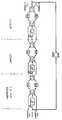
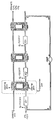
- This invention provides a means for converting methane or natural gas via partial oxidation to ethylene or ethane and ethylene and comprises a number n (n ⁇ 1) of units each consisting of (I) a catalyst or catalytic reactor (II) an oxygen feedthrough and (III) a suitable adsorbent or absorbent material maintained at a temperature significantly lower than that of the catalyst for continuously and quantitatively trapping ethane and ethylene.
- the n units are connected in series and any portion of the gas leaving each unit can be recirculated, if desirable, to any previous unit via a recirculation pump.
- the catalyst of catalytic reactor may comprise catalyst particles in a fixed or fluidized bed or it may comprise catalytic material coated on the reactor walls.
- the oxygen feedthrough is necessary in each unit to ensure that the methane to oxygen ratio in each catalyst unit can be controlled and maintained at desired levels. In general high methane to oxygen ratios favour high selectivity to C 2 hydrocarbons and to ethylene.
- Oxygen is supplied either via a gas feedthrough or electrochemically via a solid electrolyte cell (Vayenas et al 1990, 1992 and Tsiakaras and Vayenas 1993).
- the adsorbent or absorbent material can be in the form of granules in a fixed or fluidized bed and forms a molecular sieve trap for ethane and ethylene.
- Two or more molecular sieve traps are used interchangeably in each unit so that one is trapping ethane and ethylene at a lower temperature (typically below 100°C) while the other is releasing it at a higher temperature.
- the trapping material is continuously recirculated between the trapping zone which is maintained via cooling at a lower temperature (typically below 100°C) and a desorption zone where the trapped ethane and ethylene are released via heating.
- This invention provides a method and an apparatus for converting methane or natural gas to ethylene or to C 2 hydrocarbons, i.e. ethane and ethylene, which involves one or more successive contacts of a methane-oxygen-inert gas gaseous mixture with:
- the catalyst can be in the form of pellets, or extrudates, in a fixed bed reactor or fine particles in a fluidized bed reactor (Fig. 4) or can be in the form of a film coated on the reactor walls.
- the reactor walls can be fabricated from an O 2 -conducting solid electrolyte, such as yttria-stabilized-zirconia and oxygen can be supplied through the walls via application of a voltage between the catalyst film and a counter electrode film.
- the voltage generated spontaneously between the catalyst film and the counter electrode, due to different oxygen activities can be used to transport oxygen (Vayenas et al 1992).
- Mixed O 2 -electronic conductors can also be used.
- the catalyst material can be any solid material which catalyzes the oxidative coupling of methane (OCM) to ethane and ethylene (e.g. Keller and Bhasin 1982, Hinsen and Baerns 1983, Ito and Lunsford 1985, Lee and Oyama 1988, Jones et al 1986, Otsuka et al 1990, Eng and Stoukides 1991, Tsiakaras and Vayenas 1993).
- OCM methane
- ethylene e.g. Keller and Bhasin 1982, Hinsen and Baerns 1983, Ito and Lunsford 1985, Lee and Oyama 1988, Jones et al 1986, Otsuka et al 1990, Eng and Stoukides 1991, Tsiakaras and Vayenas 1993.
- Ag or Ag mixed with 1%CaO-doped-Sm 2 O 3 is an excellent catalyst for the OCM reaction at high (larger than 2 to 1), CH 4 to O 2 ratios as these material, give
- these materials are also highly conductive, and therefore can, whenever desirable, be used in conjunction with Y 2 O 3 -stabilized-ZrO 2 as well, as electrochemical oxygen feedthroughs, these materials are particularly suitable for the present invention.
- the invention refers to any material capable of catalyzing the OCM reaction.
- the adsorbent or absorbent material in this invention can be any material capable of trapping selectively ethylene or ethane and ethylene without trapping methane and oxygen to any significant extent.
- molecular sieve 5A is very well suited for the present invention as it traps effectively ethane and ethylene at temperatures below 100°C and releases them reversibly at temperatures above 300°C.
- suitable adsorbent materials which trap ethylene more efficiently than ethane such as e.g. molecular sieve 5A, it is possible to obtain very high ethylene yield values as shown on the Figures and Examples.
- the present invention differs from all previous methods and apparatuses used to convert methane to ethylene or ethane and ethylene in that the gas mixture is brought continuously in repeated and successive contact with a catalyst (at a high (>500°C) temperature) and an adsorbent or absorbent material (at a low ( ⁇ 100°C) temperature) with intermediate continuous addition of oxygen so that the desired product ethylene or the desired products ethane and ethylene are trapped quantitatively in the adsorbent or absorbent material and thus are not allowed to further react with oxygen and form carbon monoxide and carbon dioxide.
- a catalyst at a high (>500°C) temperature
- an adsorbent or absorbent material at a low ( ⁇ 100°C) temperature
- CMBCR countercurrent moving bed chromatographic reactor
- Aris and coworkers are the following:
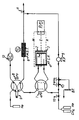
- a porous catalyst film of total mass 150 mg consisting of 20wt% Sm 2 O 3 doped with 1 wt% CaO and of 80 wt% Ag was deposited on the inside wall of an 8 mol% Y 2 O 3 -stabilized-ZrO 2 (YSZ) tube closed flat at one end as shown on Figure 5.
- the catalyst film 1 had a superficial area of 10 cm 2 .
- Two Ag films (denoted 2 and 3) were deposited on the outside walls of the YSZ tube and acted as counter and reference electrodes respectively.
- the YSZ tube together with the Ag-Sm 2 O 3 -CaO catalyst thus formed the fuel-cell type catalytic reactor 4.
- a recirculation pump 5 was used to recirculate the gas feed mixture comprising initially 20 mol% CH 4 in He between the YSZ reactor and the absorbent molecular sieve trap 6 containing 5 gr of molecular sieve 5A.
- the recirculation loop also comprised a 4-port-valve 7 and a 6-port-valve 8 with a gas-sampling-loop 9.
- the needle-valves 10 and 11 the apparatus could be operated either as a continuous flow reactor with gas recycle or as a batch reactor with recirculation. In this example the batch mode of operation with recirculation was chosen.
- I constant current
- I/4F Faraday's constant
- the total volume of the recirculation loop is 50 cm 3 .
- the composition of the gas present in the loop is then determined via the gas chromatograph 12 and the methane conversion the product selectivities and the yields are then computed from the measured gas composition.
- the carbon mass closure is then also checked between the initial and final composition.
- Example 2 The same apparatus, catalyst and experimental procedure described in Example 1 is used but in the present case oxygen is not introduced via the YSZ solid electrolyte but from the gas phase via the needle valve 13 ( Figure 5) at a flow rate of 3 ⁇ 10 -2 cm 3 STP/min or equivalently 2.2 ⁇ 10 -8 mol O 2 /s, i.e. very similar to that used in Example 1.
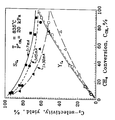
- the results are shown on Figure 6 (triangles) and are almost identical to those obtained in Example 1. Maximum C 2 yield is again 60%.
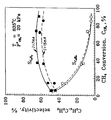
- Example 2 The same apparatus and experimental procedure described in Example 1 is used but in this case the catalyst is pure Ag (mass 129 mg, apparent surface area 18 cm 2 ) deposited on the YSZ solid electrolyte. The results are shown on Figure 9 for three different values of the applied current I. Maximum C 2 yield is 59%. This shows in conjunction with example 1 that the addition of Sm 2 O 3 (1% CaO) has only a small beneficial effect in the Ag catalyst performance.
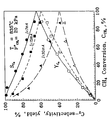
- Example 2 The same apparatus, catalyst and experimental procedure of Example 2 is used and two different catalyst supports are examined under conditions of gas-phase oxygen addition: Yttria-stabilized-zirconia (YSZ) as in Example 2 (triangles Figure 10) and ⁇ -Al 2 O 3 (circles, Figure 10).
- YSZ Yttria-stabilized-zirconia
- ⁇ -Al 2 O 3 circles, Figure 10
- the molecular sieve trap contains 5 gr of molecular sieve 5A.
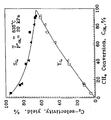
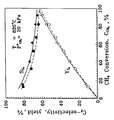
- Figure 11 shows the observed dependence of C 2 selectivity C 2 yield and ethylene yield on methane conversion; decreases slightly from 97% to 88% as the methane conversion increases from zero to 93% correspondingly. The C 2 yield increases from zero to 81% while the ethylene yield increases from zero to 78%. These are by far the highest C 2 and ethylene yields reported in the open or patent literature for the OCM reaction.
Landscapes
- Chemical & Material Sciences (AREA)
- Organic Chemistry (AREA)
- Chemical Kinetics & Catalysis (AREA)
- Organic Low-Molecular-Weight Compounds And Preparation Thereof (AREA)
- Catalysts (AREA)
- Low-Molecular Organic Synthesis Reactions Using Catalysts (AREA)
Abstract
Claims (12)
- Un procédé pour convertir du méthane à éthylène ou a éthane et éthylène, qui comprend le contact successif et répété d' un gaz d'alimentation, qui contient du méthane et de l' oxygène, avec un catalyseur et avec un matériel adsorbant ou absorbant, ledit catalyseur est capable de promouvoir l' oxydation partielle du méthane à éthane et éthylène aux températures plus hautes de 500°C, ledit matériel adsorbant ou absorbant est maintenu à une température typiquement plus basse de 100°C et est capable d' adsorber ou absorber l' éthylène ou l' éthane et l' éthylène et ensuite les libérer à une température plus haute.
- Le procédé de la revendication 1, où le gaz d'alimentation est un gaz qui contient du méthane et on ajoute de l' oxygène audit gaz, par un réservoir d'alimentation, entre chaque contact avec ledit catalyseur et ledit matériel adsorbant ou absorbant.
- Le procédé de la revendication 1, qui comprend le passage continuel d' un gaz d'alimentation qui contient du méthane, au contact avec une série des catalyseurs ou des couches de catalyseur qui sont capables de promouvoir la conversion du méthane à éthane et éthylène aux températures plus hautes de 500°C, chaque contact du gaz avec un desdits catalyseurs ou couches de catalyseur est suivi par le contact du gaz avec un matériel adsorbant ou absorbant, qui est contenu dans une chambre differente, qui est capable d' adsorber ou absorber l' éthylène ou l' éthane et l' éthylène aux températures plus basses de 100°C.
- Le procédé de la revendication 3, où on ajoute de l' oxygène audit gaz, qui contient du méthane, entre chaque contact avec ledit matériel adsorbant ou absorbant et ledit catalyseur.
- Le procédé d' une des revendications 1 à 4, où ledit catalyseur est supporté sur un électrolyte solide qui est capable de transporter l'oxygène.
- Le procédé d' une des revendications 1 à 5, où une part du gaz qui contient du méthane est continuellement recirculé pour le contact multiple avec ledit catalyseur et ledit matériel adsorbant ou absorbant.
- Le procédé de la revendication 1, qui comprend le contact d' un gaz d'alimentation qui contient du méthane et de l' oxygène avec un catalyseur et avec un matériel adsorbant ou absorbant dans un réacteur de couche fluidifiée avec recirculation solide, ledit catalyseur est capable de promouvoir le couplage oxydatif du méthane à éthane et éthylène aux températures plus hautes de 500°C, ledit matériel adsorbant ou absorbant est capable d'adsorber ou absorber l' éthane et l' éthylène aux températures plus basses de 100°C.
- Le procédé de la revendication 7, où une part dudit gaz d'alimentation est continuellement recirculé pour le multiple contact avec ledit catalyseur et ledit matériel adsorbant ou absorbant.
- Le procédé d' une des revendications 7 et 8, où ledit catalyseur est supporté aux parois du réacteur et ledit matériel adsorbant est recirculé entre une zone de température basse et une zone de température haute.
- Le procédé d' une des revendications 7 et 8, où ledit catalyseur et ledit matériel adsorbant ou absorbant forment des particules solides composites.
- Le procédé d' une des revendications 1 à 10, où l' éthane et l' éthylène sont libérer dudit matériel adsorbant ou absorbant par chauffage.
- Le procédé d' une des revendications 1 à 11, où lesdit catalyseurs comprennent une composition d' oxyde du métal-argent contenant d'argent.
Priority Applications (1)
| Application Number | Priority Date | Filing Date | Title |
|---|---|---|---|
| AT94905199T ATE175656T1 (de) | 1994-01-28 | 1994-01-28 | Verfahren und vorrichtung zur herstellung von ethylen oder ethan und ethylen aus methan |
Applications Claiming Priority (2)
| Application Number | Priority Date | Filing Date | Title |
|---|---|---|---|
| CN94191578.6A CN1119852A (zh) | 1994-01-28 | 1994-01-28 | 从甲烷形成乙烯或乙烷和乙烯的方法和装置 |
| PCT/GR1994/000001 WO1995020556A1 (fr) | 1994-01-28 | 1994-01-28 | Procede et appareil de formation d'ethylene et/ou d'ethane a partir de methane |
Publications (2)
| Publication Number | Publication Date |
|---|---|
| EP0701544A1 EP0701544A1 (fr) | 1996-03-20 |
| EP0701544B1 true EP0701544B1 (fr) | 1999-01-13 |
Family
ID=37076265
Family Applications (1)
| Application Number | Title | Priority Date | Filing Date |
|---|---|---|---|
| EP94905199A Expired - Lifetime EP0701544B1 (fr) | 1994-01-28 | 1994-01-28 | Procede et appareil de formation d'ethylene et/ou d'ethane a partir de methane |
Country Status (6)
| Country | Link |
|---|---|
| EP (1) | EP0701544B1 (fr) |
| JP (1) | JPH08508516A (fr) |
| CN (1) | CN1119852A (fr) |
| AU (1) | AU678808B2 (fr) |
| DE (1) | DE69415978D1 (fr) |
| WO (1) | WO1995020556A1 (fr) |
Cited By (1)
| Publication number | Priority date | Publication date | Assignee | Title |
|---|---|---|---|---|
| RU2224734C2 (ru) * | 2001-08-08 | 2004-02-27 | Институт химии нефти СО РАН | Способ получения этилена |
Families Citing this family (12)
| Publication number | Priority date | Publication date | Assignee | Title |
|---|---|---|---|---|
| US7325392B2 (en) | 2002-07-12 | 2008-02-05 | Catelectric Corp. | Control system for catalytic processes |
| US7950221B2 (en) | 2003-04-25 | 2011-05-31 | Catelectric Corp. | Methods and apparatus for controlling catalytic processes, including catalyst regeneration and soot elimination |
| GB0311774D0 (en) * | 2003-05-22 | 2003-06-25 | Bp Chem Int Ltd | Production of olefins |
| US7964084B2 (en) | 2007-09-20 | 2011-06-21 | Catelectric Corp. | Methods and apparatus for the synthesis of useful compounds |
| WO2009139852A1 (fr) | 2008-05-12 | 2009-11-19 | Catelectric Corp. | Procédés et appareil de commande de procédés catalytiques comprenant le dépôt de particules à base de carbone |
| US8815080B2 (en) * | 2009-01-26 | 2014-08-26 | Lummus Technology Inc. | Adiabatic reactor to produce olefins |
| US9403737B2 (en) | 2011-07-18 | 2016-08-02 | Northwestern University | Forming ethylene |
| US9394214B2 (en) | 2013-08-30 | 2016-07-19 | Exxonmobil Chemical Patents Inc. | Oxygen storage and production of C5+ hydrocarbons |
| US9353023B2 (en) | 2013-08-30 | 2016-05-31 | Exxonmobil Chemical Patents Inc. | Catalytic alkane conversion and olefin separation |
| CN108137435A (zh) * | 2015-10-15 | 2018-06-08 | 国际壳牌研究有限公司 | 甲烷氧化偶合的方法 |
| JP2017178885A (ja) * | 2016-03-31 | 2017-10-05 | 三菱ケミカル株式会社 | 炭化水素の製造方法 |
| CN111747808B (zh) * | 2019-03-27 | 2023-03-24 | 中国石油化工股份有限公司 | 一种利用流态化技术生产烃类的方法 |
Family Cites Families (1)
| Publication number | Priority date | Publication date | Assignee | Title |
|---|---|---|---|---|
| ZA907446B (en) * | 1989-09-19 | 1991-07-31 | Union Carbide Chem Plastic | Silver-containing catalysts for oxidative coupling |
-
1994
- 1994-01-28 DE DE69415978T patent/DE69415978D1/de not_active Expired - Lifetime
- 1994-01-28 AU AU58907/94A patent/AU678808B2/en not_active Ceased
- 1994-01-28 EP EP94905199A patent/EP0701544B1/fr not_active Expired - Lifetime
- 1994-01-28 JP JP7519958A patent/JPH08508516A/ja active Pending
- 1994-01-28 CN CN94191578.6A patent/CN1119852A/zh active Pending
- 1994-01-28 WO PCT/GR1994/000001 patent/WO1995020556A1/fr not_active Ceased
Cited By (1)
| Publication number | Priority date | Publication date | Assignee | Title |
|---|---|---|---|---|
| RU2224734C2 (ru) * | 2001-08-08 | 2004-02-27 | Институт химии нефти СО РАН | Способ получения этилена |
Also Published As
| Publication number | Publication date |
|---|---|
| JPH08508516A (ja) | 1996-09-10 |
| EP0701544A1 (fr) | 1996-03-20 |
| WO1995020556A1 (fr) | 1995-08-03 |
| AU5890794A (en) | 1995-08-15 |
| CN1119852A (zh) | 1996-04-03 |
| AU678808B2 (en) | 1997-06-12 |
| DE69415978D1 (de) | 1999-02-25 |
Similar Documents
| Publication | Publication Date | Title |
|---|---|---|
| EP0701544B1 (fr) | Procede et appareil de formation d'ethylene et/ou d'ethane a partir de methane | |
| CA1249603A (fr) | Procede de transformation du methane | |
| Pantazidis et al. | Oxidative dehydrogenation of propane on catalytic membrane reactors | |
| US4620057A (en) | Methane conversion | |
| CA1234842A (fr) | Conversion de methane | |
| US4523050A (en) | Methane conversion process | |
| Tan et al. | Methane Aromatization over 2 wt% Mo/HZSM-5 in the Presence of O2 and NO | |
| US11981632B2 (en) | Process for producing hydrogen, carbon, and ethylene from methane-containing feedstock | |
| US4727211A (en) | Methane conversion | |
| EP0216984A2 (fr) | Composition catalytique et méthode pour la conversion de composés organiques par oxydation | |
| US4996382A (en) | Process for preparation of hydrocarbons | |
| Tagawa et al. | Mechanistic aspects of oxidative coupling of methane over LaAlO 3 | |
| CN1014143B (zh) | 甲烷转化 | |
| CN113769733B (zh) | 甲烷氧化偶联制备碳二烃的催化剂体系及应用 | |
| CA1259341A (fr) | Conversion du methane | |
| US4775654A (en) | Composition of matter | |
| CA2158154A1 (fr) | Procede et appareil de formation d'ethylene et/ou d'ethane a partir de methane | |
| Fujimoto et al. | Selective oxidative coupling of methane with a membrane reactor | |
| US4727212A (en) | Methane conversion | |
| Petrov et al. | Study of the kinetic regularities of the oxidative methane coupling over Sr-La2O3 material | |
| Mouaddib et al. | Oxidative dimerisation of methane on a supported Pd-Ag catalyst using a diffusion controlled ceramic wall reactor | |
| EP0179857B1 (fr) | Conversion du methane | |
| Roos et al. | The Oxidative Coupling of Methane: Catalyst Requirements and Process Conditions | |
| Ramasamy et al. | Oxidative coupling of methane for the production of ethylene over Li-Ni/MgO catalys | |
| Mirodatos et al. | Structure sensitivity of oxidative coupling of methane and dehydrogenation of ethane over lanthana catalysts |
Legal Events
| Date | Code | Title | Description |
|---|---|---|---|
| PUAI | Public reference made under article 153(3) epc to a published international application that has entered the european phase |
Free format text: ORIGINAL CODE: 0009012 |
|
| AK | Designated contracting states |
Kind code of ref document: A1 Designated state(s): AT BE CH DE DK ES FR GB GR IT LI NL SE |
|
| 17P | Request for examination filed |
Effective date: 19960124 |
|
| 17Q | First examination report despatched |
Effective date: 19960930 |
|
| GRAG | Despatch of communication of intention to grant |
Free format text: ORIGINAL CODE: EPIDOS AGRA |
|
| GRAG | Despatch of communication of intention to grant |
Free format text: ORIGINAL CODE: EPIDOS AGRA |
|
| GRAH | Despatch of communication of intention to grant a patent |
Free format text: ORIGINAL CODE: EPIDOS IGRA |
|
| GRAH | Despatch of communication of intention to grant a patent |
Free format text: ORIGINAL CODE: EPIDOS IGRA |
|
| GRAA | (expected) grant |
Free format text: ORIGINAL CODE: 0009210 |
|
| AK | Designated contracting states |
Kind code of ref document: B1 Designated state(s): AT BE CH DE DK ES FR GB GR IT LI NL SE |
|
| PG25 | Lapsed in a contracting state [announced via postgrant information from national office to epo] |
Ref country code: SE Free format text: THE PATENT HAS BEEN ANNULLED BY A DECISION OF A NATIONAL AUTHORITY Effective date: 19990113 Ref country code: NL Free format text: LAPSE BECAUSE OF FAILURE TO SUBMIT A TRANSLATION OF THE DESCRIPTION OR TO PAY THE FEE WITHIN THE PRESCRIBED TIME-LIMIT Effective date: 19990113 Ref country code: LI Free format text: LAPSE BECAUSE OF FAILURE TO SUBMIT A TRANSLATION OF THE DESCRIPTION OR TO PAY THE FEE WITHIN THE PRESCRIBED TIME-LIMIT Effective date: 19990113 Ref country code: IT Free format text: LAPSE BECAUSE OF FAILURE TO SUBMIT A TRANSLATION OF THE DESCRIPTION OR TO PAY THE FEE WITHIN THE PRESCRIBED TIME-LIMIT;WARNING: LAPSES OF ITALIAN PATENTS WITH EFFECTIVE DATE BEFORE 2007 MAY HAVE OCCURRED AT ANY TIME BEFORE 2007. THE CORRECT EFFECTIVE DATE MAY BE DIFFERENT FROM THE ONE RECORDED. Effective date: 19990113 Ref country code: GR Free format text: LAPSE BECAUSE OF NON-PAYMENT OF DUE FEES Effective date: 19990113 Ref country code: FR Free format text: LAPSE BECAUSE OF FAILURE TO SUBMIT A TRANSLATION OF THE DESCRIPTION OR TO PAY THE FEE WITHIN THE PRESCRIBED TIME-LIMIT Effective date: 19990113 Ref country code: ES Free format text: THE PATENT HAS BEEN ANNULLED BY A DECISION OF A NATIONAL AUTHORITY Effective date: 19990113 Ref country code: CH Free format text: LAPSE BECAUSE OF FAILURE TO SUBMIT A TRANSLATION OF THE DESCRIPTION OR TO PAY THE FEE WITHIN THE PRESCRIBED TIME-LIMIT Effective date: 19990113 Ref country code: BE Free format text: LAPSE BECAUSE OF FAILURE TO SUBMIT A TRANSLATION OF THE DESCRIPTION OR TO PAY THE FEE WITHIN THE PRESCRIBED TIME-LIMIT Effective date: 19990113 Ref country code: AT Free format text: LAPSE BECAUSE OF FAILURE TO SUBMIT A TRANSLATION OF THE DESCRIPTION OR TO PAY THE FEE WITHIN THE PRESCRIBED TIME-LIMIT Effective date: 19990113 |
|
| REF | Corresponds to: |
Ref document number: 175656 Country of ref document: AT Date of ref document: 19990115 Kind code of ref document: T |
|
| REG | Reference to a national code |
Ref country code: CH Ref legal event code: EP |
|
| REF | Corresponds to: |
Ref document number: 69415978 Country of ref document: DE Date of ref document: 19990225 |
|
| PG25 | Lapsed in a contracting state [announced via postgrant information from national office to epo] |
Ref country code: GB Free format text: LAPSE BECAUSE OF NON-PAYMENT OF DUE FEES Effective date: 19990413 Ref country code: DK Free format text: LAPSE BECAUSE OF FAILURE TO SUBMIT A TRANSLATION OF THE DESCRIPTION OR TO PAY THE FEE WITHIN THE PRESCRIBED TIME-LIMIT Effective date: 19990413 |
|
| PG25 | Lapsed in a contracting state [announced via postgrant information from national office to epo] |
Ref country code: DE Free format text: LAPSE BECAUSE OF FAILURE TO SUBMIT A TRANSLATION OF THE DESCRIPTION OR TO PAY THE FEE WITHIN THE PRESCRIBED TIME-LIMIT Effective date: 19990414 |
|
| EN | Fr: translation not filed | ||
| NLV1 | Nl: lapsed or annulled due to failure to fulfill the requirements of art. 29p and 29m of the patents act | ||
| REG | Reference to a national code |
Ref country code: CH Ref legal event code: PL |
|
| PLBE | No opposition filed within time limit |
Free format text: ORIGINAL CODE: 0009261 |
|
| STAA | Information on the status of an ep patent application or granted ep patent |
Free format text: STATUS: NO OPPOSITION FILED WITHIN TIME LIMIT |
|
| GBPC | Gb: european patent ceased through non-payment of renewal fee |
Effective date: 19990413 |
|
| 26N | No opposition filed |