EP0702065B1 - Procédé pour empêcher le dépôt d'organismes aquatiques salissants - Google Patents
Procédé pour empêcher le dépôt d'organismes aquatiques salissants Download PDFInfo
- Publication number
- EP0702065B1 EP0702065B1 EP95114429A EP95114429A EP0702065B1 EP 0702065 B1 EP0702065 B1 EP 0702065B1 EP 95114429 A EP95114429 A EP 95114429A EP 95114429 A EP95114429 A EP 95114429A EP 0702065 B1 EP0702065 B1 EP 0702065B1
- Authority
- EP
- European Patent Office
- Prior art keywords
- bio
- jelly
- group
- aquatic
- paint
- Prior art date
- Legal status (The legal status is an assumption and is not a legal conclusion. Google has not performed a legal analysis and makes no representation as to the accuracy of the status listed.)
- Expired - Lifetime
Links
- LYYLXTYQVOYZHN-UHFFFAOYSA-N Cc(cc1)ccc1N=C Chemical compound Cc(cc1)ccc1N=C LYYLXTYQVOYZHN-UHFFFAOYSA-N 0.000 description 1
Classifications
-
- C—CHEMISTRY; METALLURGY
- C09—DYES; PAINTS; POLISHES; NATURAL RESINS; ADHESIVES; COMPOSITIONS NOT OTHERWISE PROVIDED FOR; APPLICATIONS OF MATERIALS NOT OTHERWISE PROVIDED FOR
- C09D—COATING COMPOSITIONS, e.g. PAINTS, VARNISHES OR LACQUERS; FILLING PASTES; CHEMICAL PAINT OR INK REMOVERS; INKS; CORRECTING FLUIDS; WOODSTAINS; PASTES OR SOLIDS FOR COLOURING OR PRINTING; USE OF MATERIALS THEREFOR
- C09D5/00—Coating compositions, e.g. paints, varnishes or lacquers, characterised by their physical nature or the effects produced; Filling pastes
- C09D5/16—Antifouling paints; Underwater paints
-
- C—CHEMISTRY; METALLURGY
- C09—DYES; PAINTS; POLISHES; NATURAL RESINS; ADHESIVES; COMPOSITIONS NOT OTHERWISE PROVIDED FOR; APPLICATIONS OF MATERIALS NOT OTHERWISE PROVIDED FOR
- C09D—COATING COMPOSITIONS, e.g. PAINTS, VARNISHES OR LACQUERS; FILLING PASTES; CHEMICAL PAINT OR INK REMOVERS; INKS; CORRECTING FLUIDS; WOODSTAINS; PASTES OR SOLIDS FOR COLOURING OR PRINTING; USE OF MATERIALS THEREFOR
- C09D5/00—Coating compositions, e.g. paints, varnishes or lacquers, characterised by their physical nature or the effects produced; Filling pastes
- C09D5/16—Antifouling paints; Underwater paints
- C09D5/1687—Use of special additives
-
- C—CHEMISTRY; METALLURGY
- C09—DYES; PAINTS; POLISHES; NATURAL RESINS; ADHESIVES; COMPOSITIONS NOT OTHERWISE PROVIDED FOR; APPLICATIONS OF MATERIALS NOT OTHERWISE PROVIDED FOR
- C09D—COATING COMPOSITIONS, e.g. PAINTS, VARNISHES OR LACQUERS; FILLING PASTES; CHEMICAL PAINT OR INK REMOVERS; INKS; CORRECTING FLUIDS; WOODSTAINS; PASTES OR SOLIDS FOR COLOURING OR PRINTING; USE OF MATERIALS THEREFOR
- C09D5/00—Coating compositions, e.g. paints, varnishes or lacquers, characterised by their physical nature or the effects produced; Filling pastes
- C09D5/16—Antifouling paints; Underwater paints
- C09D5/1606—Antifouling paints; Underwater paints characterised by the anti-fouling agent
-
- C—CHEMISTRY; METALLURGY
- C09—DYES; PAINTS; POLISHES; NATURAL RESINS; ADHESIVES; COMPOSITIONS NOT OTHERWISE PROVIDED FOR; APPLICATIONS OF MATERIALS NOT OTHERWISE PROVIDED FOR
- C09D—COATING COMPOSITIONS, e.g. PAINTS, VARNISHES OR LACQUERS; FILLING PASTES; CHEMICAL PAINT OR INK REMOVERS; INKS; CORRECTING FLUIDS; WOODSTAINS; PASTES OR SOLIDS FOR COLOURING OR PRINTING; USE OF MATERIALS THEREFOR
- C09D5/00—Coating compositions, e.g. paints, varnishes or lacquers, characterised by their physical nature or the effects produced; Filling pastes
- C09D5/16—Antifouling paints; Underwater paints
- C09D5/1606—Antifouling paints; Underwater paints characterised by the anti-fouling agent
- C09D5/1612—Non-macromolecular compounds
- C09D5/1625—Non-macromolecular compounds organic
Definitions
- the present invention relates to a method for preventing settlement of aquatic fouling organisms on the surface of aquatic structures, such as ships or bridges. More particularly, the present invention relates to a method to prevent it by means of a bio-jelly produced on the said surface.
- the present invention also relates to a bio-jelly producing agent useful for the said method and a bio-jelly producing paint containing the same.
- the present invention also relates to a novel low toxic antifouling agent.
- an antifouling paint containing an antifouling agent becomes popular because it can be easily applied for wide range, having high efficiency and easy for treating.
- the antifouling paint is designed so that the antifouling agent is emitted from the paint film into environmental water gradually or the paint film is abraded during the use in order to expose the newly developed surface successively. It is pointed out that such antifouling paint may be an environmental hazard .
- tin compounds most popular antifouling agents, have been found to be toxic against marine products in 1980's, and European and U.S. government began to regulate the use of tin containing antifouling paint.
- Development of a novel method for preventing settlement of aquatic organisms instead of using tin compound is highly desirable. However, no method has been developed except for using a relatively low toxic antifouling agent and many people in the art have been studying for low toxic agent instead for the tin compound.
- the present invention provides the method basically without biocidal antifouling agent.
- bio-jelly may be produced on the surface of a structure by applying a bio-jelly producing agent on the surface.
- a preferable compound is a benzylidene aniline derivative of the formula I: wherein n and m are integers of 0-5 respectively;
- X may be same or different and is selected from the group consisting of halogen, hydrocarbon or alkoxyl having 1-20 carbon atoms, nitro, amino, hydroxyl, carboxyl, ester, cyano, azo and azomehine;
- Y may be same or different and is selected from the group consisting of halogen, hydrocarbon or alkoxyl having 1-20 carbon atoms, nitro, amino, hydroxyl, carboxyl, ester, cyano, azo and azomethine.
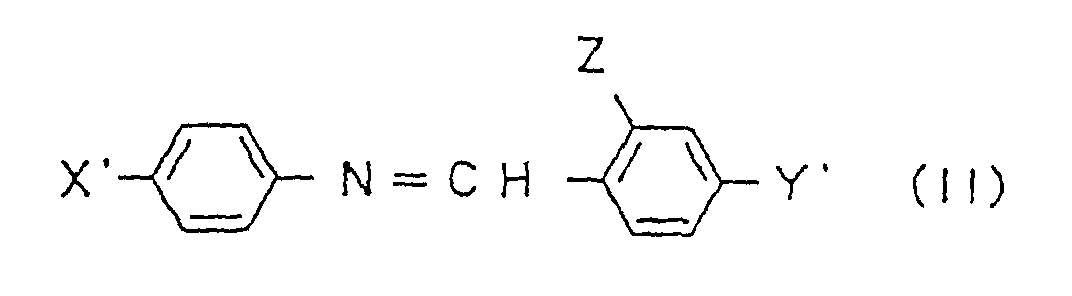
- Benzylideneaniline derivatives include the compound of following formula II: wherein, X' is selected from the group consisting of hydrogen, halogen, hydroxyl and nitro; Y' is selected from the group consisting of hydrogen, chloro and methyl; and Z is selected from the group consisting of hydrogen and hydroxyl; in which at least two of X', Y' and Z are simultaneously hydrogen atoms.
- aquatic fouling organisms means attached organisms which settle on surface of structures in aquatic atmosphere and lead to industrial and economical disadvantage. Individuals of which grow up to visible size. They include animals, for example barnacles, mussels, hydroid, bryoza, tuunicates and tubeworms, and plants, for example algae.
- aquatic structure includes ship bottom, fish-net, race pipe, bridge, sea structures and the like.
- lime layer means a thin layer of slimy texture consisting of metabolites of a variety of aquatic organisms, and deposited on surface of an aquatic structure.
- bio-jelly means a slime layer having a thickness of equal to or more than 0.3 mm.
- bio-jelly producing agent means an agent comprising of a compound having an ability to promote deposition of the slime and to produce bio-jelly on surface of an aquatic structure.
- bio-jelly producing paint composition means a paint composition for aquatic structure having an ability to promote deposition of the slime and to produce bio-jelly on surface of an aquatic structure.
- anti-ouling agent means a biocidal agent for preventing settlement of the aquatic fouling organisms.
- anti-antifouling paint means a paint for aquatic structure having an biocidal activity to prevent settlement of the aquatic fouling organisms.
- the present invention provides a method for preventing settlement of aquatic fouling organisms on surface of an aquatic structure comprising of a step to produce a thick slime layer, i.e. bio-jelly, on said surface.
- thickness of the slime layer is preferably equal to or more than 0.3 mm, more preferably 0.5-6 mm, and still more preferably, 1-5 mm.
- a slime layer having thickness of greater than 0.3 mm is called bio-jelly.
- the thickness of slime layer or bio-jelly is measured with a scale after the plate to be measured is out from water and leave it for one hour at room temperature.
- the slime layer or bio-jelly is composed essentially of metabolites of aquatic organisms, especially that of aquatic microorganisms. Some organisms, such as bacteria and diatoms, can inhabit the layer and are actually observed there.
- the layer contains a variety of saccharide, polysaccharide, lipids, glycoproteins and phospholipid.
- preferred bio-jelly contains a number of polysaccharides.
- the preferred polysaccharides are composed from one or more neutral monosaccharides including rhamnose, mannose, arabinose, glucose and the like. More preferably, at least 60 % by weight of the polysaccharides are composed from such neutral monosaccharides.
- bio-jelly can be produced on the surface of an aquatic structure by means of a paint containing a kind of compound.
- a compound useful for the present method includes 1,8-cineole, benzylidene aniline derivatives and compounds having styrene or cinnamoyl group.
- Preferable compound is a benzylidene aniline derivative of the formula I: wherein n and m are integers of 0-5 respectively, X may be the same or different and is selected from the group consisting of halogen, hydrocarbon or alkoxy having 1-20 carbon atoms, nitro, amino, hydroxyl, carboxyl, ester, cyano, azo and azomethine; Y may be the same or different and is selected from the group consisting of halogen, hydrocarbon or alkoxy having 1-20 carbon atoms, nitro, amino, hydroxyl, carboxyl, ester, cyano, azo and azomethine.
- n and m are 0 or 1 respectively.
- X is preferably a halogen, such as chloro or bromo; a hydrocarbon, especially a saturated or unsaturated aliphatic hydrocarbon having 1-18 carbon atoms which may or may not have a side chain, for example ethyl, isopropyl, n-propyl, t-butyl, hexyl, octyl, 2-ethylhexyl, nonyl, decyl, lauryl, stearyl and oleyl; an alkoxy, especially saturated or unsaturated an alkoxy group having 1-18 carbon atoms, for example ethoxy, butoxy, hexyloxy, octoxy, nonyloxy, stearyloxy, benzyloxy and naphthyloxy; hydroxy; and nitro.
- a hydrocarbon especially a saturated or unsaturated aliphatic hydrocarbon having 1-18 carbon atoms which may or may
- Examples of preferable bio-jelly producing agent of the present invention include 4'-ethylbenzylidene-4-ethyl aniline, 2'-isopropylbenzylidene-4-butoxyaniline, 4-nonyl benzylideneaniline, 4'-stearylbenzylidene-4-butoxyaniline, benzylidene-4-nonyloxyaniline, 4'-ethylbenzylidene-4-hexylaniline, 4'-ethoxybenzylidene-4-n-octylaniline, 2'-butoxybenzylidene-2-ethylaniline, 4'-naphthyloxy benzylidene aniline, 4'-ethylbenzylidene-4-nitroaniline, 3',4'-diethylbenzylidene-4-butylaniline, terephthalidene-di-4-butoxyaniline, di-4-butoxybenzyliden
- Benzylideneaniline derivative includes a compound of the following formula II: wherein, X' is selected from the group consisting of hydrogen, halogen, hydroxyl and nitro; Y' is selected from the group consisting of hydrogen, chloro and methyl; and Z is selected from the group consisting of hydrogen and hydroxyl; in which at least two of X', Y' and Z are simultaneously hydrogen atoms.
- bio-jelly producing agents include benzylidene aniline, benzylidene-4-chloroaniline, benzylidene-4-bromoaniline, benzylidene-4-nitroaniline, benzylidene-4-hydroxyaniline, 4'-methylbenzylideneaniline, 4'-chloro benzylideneaniline and 2'-hydroxybenzylideneaniline.
- bio-jelly producing agents useful in the method of the present invention are commercially available or may be synthesized according to conventional process.
- the bio-jelly producing agent may be incorporated into an appropriate paint composition and applied on the surface of an aquatic structure. Unlike tin compounds, the bio-jelly producing agent does not become an environmental hazard, therefore it may be used as a paint composition for fish net by dissolving or suspending it into an appropriate solvent and if necessary, adding an appropriate polymer.
- the present invention also provides a method wherein the step of applying the bio-jelly producing agent comprises the step of applying a paint composition comprising the above defined bio-jelly producing agent and a binder resin.
- a binder resin suitable for the paint composition has a glass transition temperature (Tg) of 15-120 °C, more preferably of 25-100 °C, a number-average molecular weight of 1000-50000, more preferably of 5000-30000, and a hydroxyl number of 0-100 mg KOH/g, more preferably of 0-80 mg KOH/g.
- Tg glass transition temperature
- the above range of Tg contributes to strength and abrading characteristics of the paint film which is also preferable as conventional antifouling paint.
- the paint film becomes too soft to keep itself from peeling into water during cruising of the ship.
- the Tg is greater than 120 °C, some cracks may spread on the paint film.
- sea water may invade inside of the paint film and too much of the bio-jelly producing agent may be released into the water, and therefore, antifouling activity cannot be kept long enough.
- binder resin examples include acrylic, polyester, alkyd, vinyl, epoxy, urethan and urea resins.
- the bio-jelly producing paint composition contains the bio-jelly producing agent in an amount of 15-75 %, preferably 20-60 % by weight of solid component of the composition.
- the composition also contains the binder resin in an amount of 20 - 70 %, preferably 30-60 % by total weight of the composition.
- the paint composition may comprise another ingredients including appropriate diluent, for example water, alcohol, alkyl glycol, cellosolve, acetate ester, xylene, toluene or ketone, extender pigment for example talc, coloring pigment and hardening agent.
- diluent for example water, alcohol, alkyl glycol, cellosolve, acetate ester, xylene, toluene or ketone
- extender pigment for example talc
- coloring pigment and hardening agent for example talc
- to the composition of the present invention may be added an amount of known antifoulant, pesticide or herbicide within the range which does not inhibit the production of bio-jelly.
- the paint composition may be applied on a structure by any one of the methods known in the art, for example painting, soaking or spraying.
- the bio-jelly produced on the structure is peeled gradually by mechanical force due to waves or cruising of the ship, and new bio-jelly is then produced.
- the paint film itself is abraded gradually due to cruising or waves and new paint surface is revealed successively. On this newly revealed paint surface, deposition of bio-jelly is better than on the old one and a thick layer of bio-jelly may be obtained again within a short time.
- Such an abrading character of the paint composition is estimated by degree of film consumption.
- the degree of film consumption is determined as follows. A test composition is applied on an acrylic resin disk and dried overnight at room temperature so that the thickness of the dried film is around 200 ⁇ m. The initial paint film thickness (d 0 ) of the dried disk was determined exactly with a roughness meter. The painted disk is rotated in sea water at a peripheral speed of 30 knot for one month, then, the thickness of the paint film (d 1 ) was determined with the roughness meter. The difference between d 0 and d 1 (i.e. d 1 -d 0 ) was determined as degree of film consumption. The bio-jelly producing paint showing a degree of film consumption of 2-40 ⁇ m/month, preferably 20-40 ⁇ m/month is useful for the present invention.
- the antifouling paint may be applied on surface of an aquatic structure by any known method including painting, soaking and spraying.
- a bio-jelly producing paint composition was prepared by mixing 20 g of butyral resin, 25 g of xylene, 5 g of n-butanol and 15 g of bio-jelly producing agent, 1,8-cineole homogeneously.
- the paint was applied on surface of an acrylic plate (300 mm x 100 mm x 2 mm) and dried so that the thickness of the paint film is about 200 ⁇ m.
- the plate was soaked into sea at the temperature of 12-18 °C. After 2 weeks, 1, 2, 4, and 8 months, thickness of slime layer (bio-jelly) deposited and amount of aquatic fouling organisms settled on the surface of the plate was determined. The results are shown in table 1.
- a paint composition similar to example 1 with the exception of using 7 g of tributyltinoxide (TBTO), a conventional tin antifoulant, instead of 1,8-cineole was prepared and determined its properties according to the procedure of example 1. The results are shown in table 1.
- TBTO tributyltinoxide
- a paint composition was prepared by dissolving 20 g of butyral resin into 40 g of xylene. The properties of the paint were determined according to the procedure of example 1. The results are shown in table 1.
- Bio-jelly or slime layer obtained in example 1 or comparative example 2 was removed and filtrated, and then purified by recrystallization with methanol.
- One hundred twenty mg of the each purified samples was putted into a tube and one ml aliquot of 4M trifluoroacetic acid was added. The tube was sealed under reduced pressure, and the sample was hydrolysed for 6 hours at 100 °C. Resulted product was dried under vacuo and dissolved into 1 ml of water. The solution was injected into HPLC and the peak area and retention time were compared with that of standard sample to determine and quantify the sugar. The result is shown in table 2.
- example 2 With the exception of immersing the disk into acetone without test compound, example 2 was repeated and evaluated the background activity. The result is shown in table 3.
- a bio-jelly producing paint composition was prepared by mixing 20 g of butyral resin, 25 g of xylene, 5 g of n-butanol and 15 g of respective bio-jelly producing agents listed in table 4.
- the properties of the composition were determined according to the procedure of example 1. The results are shown in table 4.
- a paint composition similar to example 3 with the exception of using 15 g of cuprous antifouling agent, i.e. cuprousoxide and 5 g of rosin instead of bio-jelly producing agent was prepared, and determined its properties according to the procedure of example 1. The results are shown in table 4.
- a bio-jelly producing paint composition was prepared by mixing 20 g of butyral resin, 25 g of xylene, 5 g of n-butanol and 15 g of respective bio-jelly producing agent listed in table 6 homogeneously.
- the properties of the compound were determined according to the procedure of example 1. The results are shown in table 6.
- the properties of the compound were determined according to the procedure of example 1. The results are shown in table 6.
- a paint composition was prepared by mixing 20 g of butyral resin, 15 g of xylene and 5 g of butanol. The properties of the paint were determined according to the procedure of example 1. The results are shown in table 6.
- a paint composition was prepared by dissolving 20 g of butyral resin into 40 g of xylene.
- the properties of the paint were determined according to the procedure of example 1. The results are shown in table 6.
- example 2 With the exception of immersing the disk into acetone without test compound, example 2 was repeated and evaluated background activity. The result is shown in table 7.
- Antibiotic activity of TBTO was determined according to the procedure of example 2. The result is shown in table 7.
- varnish A in which solid content of the resin is 53.0%, and number-average molecular weight of the resin is 9900, was obtained.
- binder resin B Preparation of binder resin B:
- varnish B in which solid content of the resin is 56.0%, and number-average molecular weight of the resin is 8600, was obtained.
- binder resin C-N listed in table 10 were synthesized.
- An antifouling paint composition of the present invention were prepared according to the formulations listed in tables 11-14, using above obtained varnishes.
- a paint composition containing no bio-jelly producing agent was prepared with components listed in table 15. Comparative Example 34 35 36 37 38 39 40 41 varnish A 50 45 40 50 varnish B 40 50 varnish M 50 varnish N 45 ethylbenzene 7.5 34 vinylcyclohexane 22.5 ethylcyclohexane 30 benzylideneaniline 20 25 titanium oxide 20 20 15 20 15 20 10 10 indian red 5 5 5 5 10 5 colloidal silica 1.5 1.5 1.5 1.5 1.5 1.5 1.5 3 3 3 xylene 16 16 13.5 23.5 9.5 23.5 5 n-butanol 7 7
- the antifouling paint composition prepared as above was applied on surface of an acrylic plate (300 mm x 100 mm x 2 mm) and dried so that the thickness of the paint film was about 200 ⁇ m.
- the plate was putted into lm depth of sea at the temperature of 12-18 °C, and observed of amount of settled animals such as barnacles and tubeworms, and plants such as algae and green algae by naked eyes and evaluated by % of settled area. The results are shown in table 16. settlement prevention 2 weeks 1 month 2 months 4 months 6 months Ex. 107 0/1 0/2 0/3 0/3 Ex. 108 0/2 0/2 0/2 0/2 0/2 Ex. 109 0/2 0/3 0/2 0/2 0/3 Ex.
Landscapes
- Chemical & Material Sciences (AREA)
- Life Sciences & Earth Sciences (AREA)
- Engineering & Computer Science (AREA)
- Materials Engineering (AREA)
- Wood Science & Technology (AREA)
- Organic Chemistry (AREA)
- Paints Or Removers (AREA)
- Agricultural Chemicals And Associated Chemicals (AREA)
Claims (8)
- Procédé de production d'une couche de bio-gelée présentant une épaisseur d'au moins 0,3 mm et étant composée de métabolites d'organismes aquatiques, sur la surface d'une structure aquatique pour empêcher le dépôt sur celle-ci d'organismes aquatiques salissants de taille visible, le procédé comprenant l'étape consistant à appliquer sur ladite surface un agent producteur de bio-gelée comprenant un composé de formule :
- Procédé selon la revendication 1, dans lequel la bio-gelée déposée sur la surface de la structure aquatique contient des polysaccharides.
- Procédé selon la revendication 2, dans lequel au moins 60% des polysaccharides sont composés de motifs de monosaccharides neutres choisis dans le groupe constitué par le rhamnose, le mannose, l'arabinose et le glucose.
- Procédé selon la revendication 1, dans lequel le composé est un dérivé de benzylidèneaniline de formule I :dans laquelle n et m représentent des nombres entiers de 0 à 5, les X pouvant respectivement être identiques ou différents et sont choisis chacun dans le groupe constitué par un atome d'halogène, un groupe hydrocarboné ou alcoxy ayant de 1 à 20 atomes de carbone, nitro, amino, hydroxyle, carboxyle, ester, cyano, azo et azo-méthine, les Y pouvant être identiques ou différents et sont choisis chacun dans le groupe constitué par un atome d'halogène, un groupe hydrocarboné ou alcoxy comportant de 1 à 20 atomes de carbone, nitro, amino, hydroxyle, carboxyle, ester, cyano, azo et azométhine.

- Procédé selon la revendication 4, dans lequel le dérivé de benzylidèneaniline répond à la formule II :dans laquelle X' est choisi dans le groupe constitué par un atome d'hydrogène, d'halogène, un groupe hydroxyle et nitro ; Y' est choisi dans le groupe constitué par un atome de chlore et le groupe méthyle ; et Z est choisi dans le groupe constitué par un atome d'hydrogène et le groupe hydroxyle ; et au moins deux des symboles X', Y' et Z représentent un atome d'hydrogène.
- Procédé selon l'une quelconque des revendications 1 à 5, dans lequel l'étape d'application de l'agent producteur de bio-gelée comprend l'étape consistant à appliquer une composition de peinture comprenant de 20 à 70% en poids d'une résine liante et de 15 à 75% en poids de l'agent producteur de bio-gelée, par rapport au poids total de la composition.
- Procédé selon la revendication 6, dans lequel la Tv (température de transition vitreuse) de la résine liante est de 15 à 120°C.
- Procédé selon la revendication 6 ou 7, dans lequel le film de peinture de la composition présente un degré de consommation du film de 2 à 40 µm/mois.
Priority Applications (1)
| Application Number | Priority Date | Filing Date | Title |
|---|---|---|---|
| EP01110545A EP1123950B1 (fr) | 1994-09-16 | 1995-09-14 | Procédé pour empêcher le dépôt d'organismes aquatiques salissants |
Applications Claiming Priority (18)
| Application Number | Priority Date | Filing Date | Title |
|---|---|---|---|
| JP22203094 | 1994-09-16 | ||
| JP22203394A JP3390543B2 (ja) | 1994-09-16 | 1994-09-16 | バイオゼリー形成剤 |
| JP222029/94 | 1994-09-16 | ||
| JP22202994 | 1994-09-16 | ||
| JP22203094A JP3342965B2 (ja) | 1994-09-16 | 1994-09-16 | バイオゼリー形成剤 |
| JP6222002A JPH0885767A (ja) | 1994-09-16 | 1994-09-16 | 防汚塗料 |
| JP22202594 | 1994-09-16 | ||
| JP22203394 | 1994-09-16 | ||
| JP22200294 | 1994-09-16 | ||
| JP22202994A JP3404147B2 (ja) | 1994-09-16 | 1994-09-16 | バイオゼリー形成剤 |
| JP222033/94 | 1994-09-16 | ||
| JP222002/94 | 1994-09-16 | ||
| JP222030/94 | 1994-09-16 | ||
| JP222025/94 | 1994-09-16 | ||
| JP22202594 | 1994-09-16 | ||
| JP26009894 | 1994-10-25 | ||
| JP6260098A JPH08119808A (ja) | 1994-10-25 | 1994-10-25 | 生物付着防止剤および該防止剤を含有する防汚塗料 |
| JP260098/94 | 1994-10-25 |
Related Child Applications (1)
| Application Number | Title | Priority Date | Filing Date |
|---|---|---|---|
| EP01110545A Division EP1123950B1 (fr) | 1994-09-16 | 1995-09-14 | Procédé pour empêcher le dépôt d'organismes aquatiques salissants |
Publications (3)
| Publication Number | Publication Date |
|---|---|
| EP0702065A2 EP0702065A2 (fr) | 1996-03-20 |
| EP0702065A3 EP0702065A3 (fr) | 1996-10-16 |
| EP0702065B1 true EP0702065B1 (fr) | 2001-11-28 |
Family
ID=27553976
Family Applications (2)
| Application Number | Title | Priority Date | Filing Date |
|---|---|---|---|
| EP01110545A Expired - Lifetime EP1123950B1 (fr) | 1994-09-16 | 1995-09-14 | Procédé pour empêcher le dépôt d'organismes aquatiques salissants |
| EP95114429A Expired - Lifetime EP0702065B1 (fr) | 1994-09-16 | 1995-09-14 | Procédé pour empêcher le dépôt d'organismes aquatiques salissants |
Family Applications Before (1)
| Application Number | Title | Priority Date | Filing Date |
|---|---|---|---|
| EP01110545A Expired - Lifetime EP1123950B1 (fr) | 1994-09-16 | 1995-09-14 | Procédé pour empêcher le dépôt d'organismes aquatiques salissants |
Country Status (7)
| Country | Link |
|---|---|
| US (1) | US5861435A (fr) |
| EP (2) | EP1123950B1 (fr) |
| KR (2) | KR100363364B1 (fr) |
| AU (1) | AU3066395A (fr) |
| CA (1) | CA2158191A1 (fr) |
| DE (2) | DE69524164T2 (fr) |
| DK (2) | DK0702065T3 (fr) |
Families Citing this family (12)
| Publication number | Priority date | Publication date | Assignee | Title |
|---|---|---|---|---|
| EP1086996B1 (fr) * | 1999-09-21 | 2004-07-28 | Nippon Paint Co., Ltd. | Résine incorporée dans un revêtement antisalissure et revêtement antisalissure |
| PL354994A1 (en) * | 1999-10-26 | 2004-03-22 | Dennis A. Guritza | Bio-supportive matrices, methods of making and using the same |
| EP1170359B1 (fr) | 2000-07-07 | 2004-10-13 | Nippon Paint Co., Ltd. | Microorganismes produisant un biojelly, peinture contenant ces microorganismes et procédé d' anti-sallissure |
| KR100386416B1 (ko) * | 2000-08-31 | 2003-06-02 | 주식회사 내비켐 | 해조류의 수용성 대사산물을 이용한 환경 친화적인방오제 |
| KR100386417B1 (ko) * | 2000-08-31 | 2003-06-02 | 주식회사 내비켐 | 해조류의 추출물을 이용한 환경 친화적인 방오제 |
| US6555228B2 (en) * | 2000-10-16 | 2003-04-29 | Dennis A. Guritza | Bio-supportive medium, and methods of making and using the same |
| TW200726746A (en) * | 2005-05-06 | 2007-07-16 | Microbia Inc | Processes for production of 4-biphenylylazetidin-2-ones |
| JP2008545700A (ja) * | 2005-05-25 | 2008-12-18 | マイクロビア インコーポレーテッド | 4−(ビフェニリル)アゼチジン−2−オンホスホン酸類の製造方法 |
| KR100778888B1 (ko) * | 2005-11-29 | 2007-11-28 | 재단법인서울대학교산학협력재단 | 베타아밀로이드 펩타이드 플라크의 영상화를 위한벤질리덴아닐린 계열의 유도체 및 그의 방사성 동위원소표지화합물 |
| MX2009013332A (es) * | 2007-06-08 | 2010-01-25 | Mannkind Corp | Inhibidores de ire-1 alfa. |
| US7934888B2 (en) * | 2008-01-18 | 2011-05-03 | Viv Suppression, Inc. | Marine anti-foulant system and methods for using same |
| EP2100589B1 (fr) | 2008-11-27 | 2017-07-26 | Symrise AG | Pyridine substituée par 4-alkyl en tant que parfum |
Family Cites Families (7)
| Publication number | Priority date | Publication date | Assignee | Title |
|---|---|---|---|---|
| JPS53102340A (en) * | 1977-02-18 | 1978-09-06 | Nichiyou Riyotsuka Kaihatsu Kk | Method of making oysterrproof paint for sailing ships |
| FR2384010A1 (fr) * | 1977-03-15 | 1978-10-13 | Nal Pour Expl Oceans Centre | Peinture antisalissure |
| JPS5665860A (en) * | 1979-10-31 | 1981-06-03 | Tokyo Organ Chem Ind Ltd | N-benzylidenaniline, its preparation and insecticide containing the same |
| JPS59124957A (ja) * | 1983-01-06 | 1984-07-19 | Mitsubishi Acetate Co Ltd | 船底塗布用組成物 |
| JPS61152765A (ja) * | 1984-12-27 | 1986-07-11 | Nippon Ekishiyou Kk | シクロデキストリン類で包接された化合物を含有した合成樹脂製品及びその製造方法 |
| JP2889304B2 (ja) * | 1990-02-27 | 1999-05-10 | 日本ペイント株式会社 | 水中有害生物防除剤 |
| JPH04128205A (ja) * | 1990-09-19 | 1992-04-28 | Taisei Corp | 海洋付着生物の防汚方法 |
-
1995
- 1995-09-13 CA CA002158191A patent/CA2158191A1/fr not_active Abandoned
- 1995-09-14 DE DE69524164T patent/DE69524164T2/de not_active Expired - Fee Related
- 1995-09-14 DK DK95114429T patent/DK0702065T3/da active
- 1995-09-14 EP EP01110545A patent/EP1123950B1/fr not_active Expired - Lifetime
- 1995-09-14 EP EP95114429A patent/EP0702065B1/fr not_active Expired - Lifetime
- 1995-09-14 DE DE69532214T patent/DE69532214D1/de not_active Expired - Lifetime
- 1995-09-14 DK DK01110545T patent/DK1123950T3/da active
- 1995-09-15 AU AU30663/95A patent/AU3066395A/en not_active Abandoned
- 1995-09-15 US US08/530,405 patent/US5861435A/en not_active Expired - Lifetime
- 1995-09-15 KR KR1019950030215A patent/KR100363364B1/ko not_active Expired - Lifetime
-
2002
- 2002-05-29 KR KR1020020029934A patent/KR100391528B1/ko not_active Expired - Lifetime
Also Published As
| Publication number | Publication date |
|---|---|
| EP1123950A1 (fr) | 2001-08-16 |
| AU3066395A (en) | 1996-03-28 |
| EP0702065A3 (fr) | 1996-10-16 |
| EP1123950B1 (fr) | 2003-11-26 |
| DE69524164D1 (de) | 2002-01-10 |
| DE69524164T2 (de) | 2002-07-04 |
| DE69532214D1 (de) | 2004-01-08 |
| CA2158191A1 (fr) | 1996-03-17 |
| KR100363364B1 (ko) | 2004-02-05 |
| KR100391528B1 (ko) | 2003-07-12 |
| KR960010800A (ko) | 1996-04-20 |
| EP0702065A2 (fr) | 1996-03-20 |
| US5861435A (en) | 1999-01-19 |
| DK0702065T3 (da) | 2002-03-18 |
| DK1123950T3 (da) | 2004-03-15 |
Similar Documents
| Publication | Publication Date | Title |
|---|---|---|
| EP0702065B1 (fr) | Procédé pour empêcher le dépôt d'organismes aquatiques salissants | |
| Feng et al. | The plant alkaloid camptothecin as a novel antifouling compound for marine paints: Laboratory bioassays and field trials | |
| CN102202506B (zh) | 刺糖多孢菌素防污组合物、其使用方法、以及受到保护而免于附着污损生物的制品 | |
| CA2192955A1 (fr) | Compositions empechant les depots d'organismes marins | |
| Bryan et al. | Bioactivity of echinoderm ethanolic body-wall extracts: an assessment of marine bacterial attachment and macroinvertebrate larval settlement | |
| WO2015000240A1 (fr) | Utilisation de camptothécine et de dérivés de celle-ci comme additif antidépôt | |
| JP2003528967A (ja) | ロジン及び酵素を含んで成る防汚塗料の組成物 | |
| JP2002535255A (ja) | 表面の海洋生物汚染の阻止 | |
| US5259701A (en) | Antifouling coating composition comprising furan compounds, method for protecting aquatic structures, and articles protected against fouling organisms | |
| WO1999005227A1 (fr) | Antisalissure des crustaces et coquillages et des appareils d'aquaculture | |
| O'Neill et al. | The formation of a" primary film" on materials submerged in the sea at Port Hueneme, California | |
| Soule et al. | Fouling and bioadhesion: life strategies of bryozoans | |
| Guenther et al. | Chemical antifouling defences of sea stars: effects of the natural products hexadecanoic acid, cholesterol, lathosterol and sitosterol | |
| KR20050120781A (ko) | 무독성 코팅 조성물, 이의 이용방법 및 생오손 유기체의부착으로부터 보호된 물품 | |
| JPH11500457A (ja) | 防汚剤としての有機ホウ素化合物の利用 | |
| CN101485321A (zh) | 齐墩果酸在制备海洋环保防污剂中的应用 | |
| JPH03239766A (ja) | 汚損生物防除剤及び汚損防止塗料組成物 | |
| CN100341964C (zh) | 海洋深水网箱的抗污漆 | |
| CN111937878B (zh) | 2,3-二芳基印酮化合物在制备海洋污损生物防除剂中的应用 | |
| CN112189666B (zh) | 圆弧菌醇化合物在制备海洋污损生物防除剂中的应用 | |
| JPH08225409A (ja) | 水中生物の付着防除剤および付着防除塗料 | |
| AU723361B2 (en) | Antifouling of shellfish and aquaculture apparatus | |
| JP3390543B2 (ja) | バイオゼリー形成剤 | |
| AU729349B2 (en) | Antifouling polymer compositions | |
| JPH08133920A (ja) | 水棲汚損生物付着防止方法 |
Legal Events
| Date | Code | Title | Description |
|---|---|---|---|
| PUAI | Public reference made under article 153(3) epc to a published international application that has entered the european phase |
Free format text: ORIGINAL CODE: 0009012 |
|
| AK | Designated contracting states |
Kind code of ref document: A2 Designated state(s): DE DK ES FR GB NL |
|
| PUAL | Search report despatched |
Free format text: ORIGINAL CODE: 0009013 |
|
| AK | Designated contracting states |
Kind code of ref document: A3 Designated state(s): DE DK ES FR GB NL |
|
| 17P | Request for examination filed |
Effective date: 19961026 |
|
| 17Q | First examination report despatched |
Effective date: 19980707 |
|
| GRAG | Despatch of communication of intention to grant |
Free format text: ORIGINAL CODE: EPIDOS AGRA |
|
| GRAG | Despatch of communication of intention to grant |
Free format text: ORIGINAL CODE: EPIDOS AGRA |
|
| GRAH | Despatch of communication of intention to grant a patent |
Free format text: ORIGINAL CODE: EPIDOS IGRA |
|
| GRAH | Despatch of communication of intention to grant a patent |
Free format text: ORIGINAL CODE: EPIDOS IGRA |
|
| GRAA | (expected) grant |
Free format text: ORIGINAL CODE: 0009210 |
|
| AK | Designated contracting states |
Kind code of ref document: B1 Designated state(s): DE DK ES FR GB NL |
|
| REG | Reference to a national code |
Ref country code: GB Ref legal event code: IF02 |
|
| REF | Corresponds to: |
Ref document number: 69524164 Country of ref document: DE Date of ref document: 20020110 |
|
| REG | Reference to a national code |
Ref country code: DK Ref legal event code: T3 |
|
| PG25 | Lapsed in a contracting state [announced via postgrant information from national office to epo] |
Ref country code: ES Free format text: LAPSE BECAUSE OF FAILURE TO SUBMIT A TRANSLATION OF THE DESCRIPTION OR TO PAY THE FEE WITHIN THE PRESCRIBED TIME-LIMIT Effective date: 20020530 |
|
| PLBE | No opposition filed within time limit |
Free format text: ORIGINAL CODE: 0009261 |
|
| STAA | Information on the status of an ep patent application or granted ep patent |
Free format text: STATUS: NO OPPOSITION FILED WITHIN TIME LIMIT |
|
| 26N | No opposition filed | ||
| PGFP | Annual fee paid to national office [announced via postgrant information from national office to epo] |
Ref country code: FR Payment date: 20050823 Year of fee payment: 11 |
|
| PGFP | Annual fee paid to national office [announced via postgrant information from national office to epo] |
Ref country code: DE Payment date: 20050909 Year of fee payment: 11 |
|
| PG25 | Lapsed in a contracting state [announced via postgrant information from national office to epo] |
Ref country code: DE Free format text: LAPSE BECAUSE OF NON-PAYMENT OF DUE FEES Effective date: 20070403 |
|
| REG | Reference to a national code |
Ref country code: FR Ref legal event code: ST Effective date: 20070531 |
|
| PG25 | Lapsed in a contracting state [announced via postgrant information from national office to epo] |
Ref country code: FR Free format text: LAPSE BECAUSE OF NON-PAYMENT OF DUE FEES Effective date: 20061002 |
|
| PGFP | Annual fee paid to national office [announced via postgrant information from national office to epo] |
Ref country code: DK Payment date: 20140910 Year of fee payment: 20 Ref country code: NL Payment date: 20140809 Year of fee payment: 20 |
|
| PGFP | Annual fee paid to national office [announced via postgrant information from national office to epo] |
Ref country code: GB Payment date: 20140910 Year of fee payment: 20 |
|
| REG | Reference to a national code |
Ref country code: DK Ref legal event code: EUP Effective date: 20150914 |
|
| REG | Reference to a national code |
Ref country code: NL Ref legal event code: MK Effective date: 20150913 |
|
| REG | Reference to a national code |
Ref country code: GB Ref legal event code: PE20 Expiry date: 20150913 |
|
| PG25 | Lapsed in a contracting state [announced via postgrant information from national office to epo] |
Ref country code: GB Free format text: LAPSE BECAUSE OF EXPIRATION OF PROTECTION Effective date: 20150913 |