EP0702786B1 - Mesure de la taille et de la charge de particules dans des colloides a multicomposants - Google Patents
Mesure de la taille et de la charge de particules dans des colloides a multicomposants Download PDFInfo
- Publication number
- EP0702786B1 EP0702786B1 EP94917520A EP94917520A EP0702786B1 EP 0702786 B1 EP0702786 B1 EP 0702786B1 EP 94917520 A EP94917520 A EP 94917520A EP 94917520 A EP94917520 A EP 94917520A EP 0702786 B1 EP0702786 B1 EP 0702786B1
- Authority
- EP
- European Patent Office
- Prior art keywords
- particles
- suspension
- unsteady
- charge
- force
- Prior art date
- Legal status (The legal status is an assumption and is not a legal conclusion. Google has not performed a legal analysis and makes no representation as to the accuracy of the status listed.)
- Expired - Lifetime
Links
- 239000002245 particle Substances 0.000 title claims abstract description 126
- 238000005259 measurement Methods 0.000 title claims description 27
- 239000000084 colloidal system Substances 0.000 title abstract description 20
- 239000000725 suspension Substances 0.000 claims abstract description 48
- 238000009826 distribution Methods 0.000 claims abstract description 34
- 238000000034 method Methods 0.000 claims abstract description 32
- 238000012544 monitoring process Methods 0.000 claims abstract description 5
- 230000005684 electric field Effects 0.000 claims description 24
- 239000007788 liquid Substances 0.000 claims description 22
- 230000008859 change Effects 0.000 claims description 8
- 230000004044 response Effects 0.000 claims description 8
- 230000005484 gravity Effects 0.000 claims description 6
- 238000012545 processing Methods 0.000 claims description 5
- 239000013049 sediment Substances 0.000 claims description 4
- 230000000694 effects Effects 0.000 abstract description 8
- 238000004062 sedimentation Methods 0.000 description 19
- 238000006073 displacement reaction Methods 0.000 description 13
- 238000004458 analytical method Methods 0.000 description 8
- 239000000203 mixture Substances 0.000 description 8
- 238000001228 spectrum Methods 0.000 description 6
- 239000012530 fluid Substances 0.000 description 4
- 230000014509 gene expression Effects 0.000 description 4
- 230000010287 polarization Effects 0.000 description 3
- 239000013598 vector Substances 0.000 description 3
- GWEVSGVZZGPLCZ-UHFFFAOYSA-N Titan oxide Chemical compound O=[Ti]=O GWEVSGVZZGPLCZ-UHFFFAOYSA-N 0.000 description 2
- 239000013078 crystal Substances 0.000 description 2
- 238000010586 diagram Methods 0.000 description 2
- 230000005518 electrochemistry Effects 0.000 description 2
- 238000012986 modification Methods 0.000 description 2
- 230000004048 modification Effects 0.000 description 2
- 230000035945 sensitivity Effects 0.000 description 2
- 239000007787 solid Substances 0.000 description 2
- XLYOFNOQVPJJNP-UHFFFAOYSA-N water Substances O XLYOFNOQVPJJNP-UHFFFAOYSA-N 0.000 description 2
- NAWXUBYGYWOOIX-SFHVURJKSA-N (2s)-2-[[4-[2-(2,4-diaminoquinazolin-6-yl)ethyl]benzoyl]amino]-4-methylidenepentanedioic acid Chemical compound C1=CC2=NC(N)=NC(N)=C2C=C1CCC1=CC=C(C(=O)N[C@@H](CC(=C)C(O)=O)C(O)=O)C=C1 NAWXUBYGYWOOIX-SFHVURJKSA-N 0.000 description 1
- VYPSYNLAJGMNEJ-UHFFFAOYSA-N Silicium dioxide Chemical compound O=[Si]=O VYPSYNLAJGMNEJ-UHFFFAOYSA-N 0.000 description 1
- 230000001133 acceleration Effects 0.000 description 1
- 230000002378 acidificating effect Effects 0.000 description 1
- 238000003491 array Methods 0.000 description 1
- 230000008901 benefit Effects 0.000 description 1
- 239000000919 ceramic Substances 0.000 description 1
- 239000007795 chemical reaction product Substances 0.000 description 1
- 238000000576 coating method Methods 0.000 description 1
- 230000001419 dependent effect Effects 0.000 description 1
- 238000010494 dissociation reaction Methods 0.000 description 1
- 230000005593 dissociations Effects 0.000 description 1
- 239000003814 drug Substances 0.000 description 1
- 238000002296 dynamic light scattering Methods 0.000 description 1
- 239000003792 electrolyte Substances 0.000 description 1
- 239000000839 emulsion Substances 0.000 description 1
- 238000002474 experimental method Methods 0.000 description 1
- 238000012388 gravitational sedimentation Methods 0.000 description 1
- 150000002500 ions Chemical class 0.000 description 1
- GQYHUHYESMUTHG-UHFFFAOYSA-N lithium niobate Chemical compound [Li+].[O-][Nb](=O)=O GQYHUHYESMUTHG-UHFFFAOYSA-N 0.000 description 1
- 239000000463 material Substances 0.000 description 1
- 238000000691 measurement method Methods 0.000 description 1
- 230000007246 mechanism Effects 0.000 description 1
- 239000013618 particulate matter Substances 0.000 description 1
- BASFCYQUMIYNBI-UHFFFAOYSA-N platinum Chemical compound [Pt] BASFCYQUMIYNBI-UHFFFAOYSA-N 0.000 description 1
- 230000008569 process Effects 0.000 description 1
- 230000002441 reversible effect Effects 0.000 description 1
- 238000012552 review Methods 0.000 description 1
- 238000001179 sorption measurement Methods 0.000 description 1
- 238000010561 standard procedure Methods 0.000 description 1
Images
Classifications
-
- G—PHYSICS
- G01—MEASURING; TESTING
- G01N—INVESTIGATING OR ANALYSING MATERIALS BY DETERMINING THEIR CHEMICAL OR PHYSICAL PROPERTIES
- G01N29/00—Investigating or analysing materials by the use of ultrasonic, sonic or infrasonic waves; Visualisation of the interior of objects by transmitting ultrasonic or sonic waves through the object
- G01N29/14—Investigating or analysing materials by the use of ultrasonic, sonic or infrasonic waves; Visualisation of the interior of objects by transmitting ultrasonic or sonic waves through the object using acoustic emission techniques
-
- G—PHYSICS
- G01—MEASURING; TESTING
- G01N—INVESTIGATING OR ANALYSING MATERIALS BY DETERMINING THEIR CHEMICAL OR PHYSICAL PROPERTIES
- G01N15/00—Investigating characteristics of particles; Investigating permeability, pore-volume or surface-area of porous materials
- G01N15/02—Investigating particle size or size distribution
- G01N15/0266—Investigating particle size or size distribution with electrical classification
-
- G—PHYSICS
- G01—MEASURING; TESTING
- G01N—INVESTIGATING OR ANALYSING MATERIALS BY DETERMINING THEIR CHEMICAL OR PHYSICAL PROPERTIES
- G01N27/00—Investigating or analysing materials by the use of electric, electrochemical, or magnetic means
- G01N27/26—Investigating or analysing materials by the use of electric, electrochemical, or magnetic means by investigating electrochemical variables; by using electrolysis or electrophoresis
- G01N27/416—Systems
- G01N27/447—Systems using electrophoresis
-
- G—PHYSICS
- G01—MEASURING; TESTING
- G01N—INVESTIGATING OR ANALYSING MATERIALS BY DETERMINING THEIR CHEMICAL OR PHYSICAL PROPERTIES
- G01N29/00—Investigating or analysing materials by the use of ultrasonic, sonic or infrasonic waves; Visualisation of the interior of objects by transmitting ultrasonic or sonic waves through the object
- G01N29/02—Analysing fluids
- G01N29/032—Analysing fluids by measuring attenuation of acoustic waves
-
- G—PHYSICS
- G01—MEASURING; TESTING
- G01N—INVESTIGATING OR ANALYSING MATERIALS BY DETERMINING THEIR CHEMICAL OR PHYSICAL PROPERTIES
- G01N2291/00—Indexing codes associated with group G01N29/00
- G01N2291/02—Indexing codes associated with the analysed material
- G01N2291/024—Mixtures
- G01N2291/02416—Solids in liquids
Definitions
- the present invention relates to a method and means for determining the distribution of particle size and charge in a colloidal system.
- a colloid is a suspension of small particles suspended in a fluid.
- the fluid may be a gas or a liquid
- the present invention relates to suspensions of particles in a liquid.
- the particles may be solid, or they may be emulsion droplets.
- the reader is referred to the text "Foundations of Colloid Science” by R J Hunter (Oxford Press 1987).
- Colloidal particles nearly all carry an electric charge.
- the charge which usually resides on the particle surface, can arise from a number of mechanisms including dissociation of acidic or basic groups on the surface or by the adsorption of ions from the surrounding liquid. This charge is balanced by an equal and opposite charge in the liquid. These opposite charges form a diffuse cloud around the particle.
- the voltage drop between the particle surface and the liquid outside this cloud is called the "zeta potential", denoted by the symbol ⁇ .
- the invention described is intended to measure the ⁇ potential and from that quantity the surface charge can be calculated (see e.g chapter 2 of "Zeta Potential in Colloid Science” by R.J. Hunter, Academic Press, 1981).
- Colloids have many applications in industries ranging from coatings and ceramics to pharmaceuticals and food processing. In many of these applications the efficiency of the process or the quality of the end-product depends crucially on the ⁇ potential and size of the colloidal particles.
- Known methods for determining particle size include electron microscopes, Coulter Counters, centrifuges and dynamic light scattering devices. Each of these devices suffers from the drawback that they can only deal with suspensions in which the particles are of a uniform composition. Thus they would not be able to determine the individual size distribution within a colloid of a mixture of titania and silica particles for example.
- ESA Electrokinetic Sonic Amplitude
- CVP Colloid Vibration Potential
- the present invention provides a method for determining the particle charge and for size distribution of particles suspended in a liquid medium, comprising the steps of:
- the present invention provides a device for determining the particle charge and/or size distributions of particles suspended in a liquid medium, comprising:
- the present invention relates to a modification of the method described in the applicant's previous patent, US 5059909.
- the present invention allows size and charge distributions to be determined in dilute suspensions containing mixtures of particles with different densities and ⁇ potentials.
- the present invention involves measurements on spatially inhomogeneous suspensions.
- the present technique does not require the use of 2 or more frequencies in the applied field, as in the applicant's earlier patent.
- the inhomogeneity can be caused by particle sedimentation under gravity or in a centrifugal field, by the electrophoretic motion of particles in a steady applied electric field, or by any effect which tends to separate particles according to ⁇ potential or size.
- the applied field causes the spatial distribution of the particles to change with time, and this leads to a corresponding change in the measured electroacoustic signal. If different species of particles are present in the colloid with sufficiently different properties under the applied field, the contribution of each can be separated.
- the present invention provides a method and means for extracting the zeta potentials and size distributions of the different particles from an analysis of the evolution of the electroacoustic signal with time.
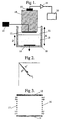
- the ESA is generated by a pulse of sinusoidal voltage from the signal generator 21.
- the top electrode 12 is attached to the bottom of a solid delay line 18.
- Delay line 18 is designed to introduce a delay between the application of the voltage pulse and the arrival of the ESA signal at the detecting transducer 15 on the top of delay line 18. In this way the ESA can be detected without any electrical interference from the applied voltage. It will be appreciated by the reader that this is a standard technique in pulse-echo ultrasonics ( see for example US patent No. 4497208 by Oja et al).
- the detecting transducer may be of any suitable type, for example formed from a piezoelectric material such as a lithium niobate crystal. If the instrument is required to be operated at a fixed frequency, the crystal can be cut to a thickness so as to resonate at that frequency, and thereby increase the transducer sensitivity.
- the applied voltage leads to an electric field that is spatially uniform across the gap.
- E(t) denote this electric field.
- the duration of the applied voltage pulse is assumed to be much smaller than the time for the particle distribution to change significantly. Thus in calculating the ESA effect generated by an applied pulse we can take the particle distribution as fixed during the period of the pulse.
- A is a device constant
- ⁇ is the particle density minus that of the liquid
- ⁇ (x) is the particle volume fraction (i.e the volume of particles per unit volume of suspension) at a distance x below the top electrode.
- the quantity u is the particle velocity due to the applied electric field. Since the field is spatially uniform, this velocity is the same for all particles in the gap at any instant. From the formula (1) it can be seen that the pressure is generated by spatial gradients in the particle concentration ⁇ . The contribution to the pressure from the particles at a distance x below the electrode involves the velocity u(t-x/c), that is the velocity at a time x/c earlier.
- the quantity c is the speed of sound in the liquid. The time delay x/c comes about because the pressure field from the particles a distance x below the electrodes propagates to the electrode at the speed of sound, and x/c is the time it takes for that sound wave to reach the top electrode.
- the ESA sound waves passes through the electrode 12 and into the delay line 18, as shown in figure 1.
- this pressure wave is preferably detected by transducer 15.
- transducer 15 As the sound wave strikes transducer 15 it generates a voltage signal that provides a measure of the pressure signal p(t).
- the detected signal is amplified by preamplifier 19, and processed by signal processor 20.
- preamplifier 19 As this is a common arrangement in pulse-echo ultrasonics, no detailed explanation of components will be provided as the technique is well understood by those skilled in the art.
- This second signal will reach transducer 15 at a time D/c later than the first, where D is the distance from the bottom electrode 11 to the bottom of the clear liquid layer 22, as shown in figure 1.
- D is the distance from the bottom electrode 11 to the bottom of the clear liquid layer 22, as shown in figure 1.
- the duration of the applied voltage pulse is less than this delay time.
- the delay D/c is greater than 10 ⁇ s.
- the speed of sound is about 1500ms -1 and thus the height D of the clear liquid layer above the bottom of the cell must be more than 1.5 cm if the two pulses are to be separated in time.
- the two signals will be separated in time until the suspension has sedimented a distance of 8.5cm.
- the first pulse which arises from the boundary between the suspension and the clear liquid layer.
- the delay between the applied voltage pulse and the transducer signal will increase at a rate proportional to the sedimentation velocity V of the particles.
- the sedimentation velocity can be determined from measuring this delay as a function of time.
- V is a complex quantity denoted by P( ⁇ ), and defined by
- any pulse p(t) can be represented as a sum (or to be more precise, an integral) of "harmonics", that is, signals which vary sinusoidally with time.
- the quantity P( ⁇ ) represents the harmonic component of p(t) with frequency ⁇ .
- the advantage of working in terms of Fourier Transforms P( ⁇ ), rather than p(t) is that the theory for analysing the ESA signals assumes sinusoidal variations, and so the application of that theory to our problem is more straightforward when we work with Fourier Transforms.
- the signal processing circuits for determining the Fourier Transform of a signal are standard and will not be described here.
- the constant of proportionality ⁇ D is termed the "frequency-dependent electrophoretic mobility" or, more simply, the “dynamic mobility”. From this definition it can be seen that the dynamic mobility is the particle velocity per unit electric field for the case of an alternating electric field.
- the dynamic mobility is related to the size and zeta potential of the particle by the formula (O'Brien 1988 equation 6.11): where and ⁇ is the permittivity of the suspending liquid.
- This formula can be used to determine the radius and ⁇ potential from the dynamic mobility of the particle.
- One known method of using this formula is set out in the applicant's earlier patent, US 5059909.
- P( ⁇ ) is made up of a sum of quantities which each vary sinusoidally with time.
- the frequencies and the amplitudes ⁇ j ( ⁇ ) ⁇ Dj of the various components can be determined from a standard Fourier analysis of the signal for P as a function of time. From the frequency of each component the sedimentation velocity and size can be determined.
- the Fourier Transform of the signal in this case has the form where we have grouped together the contributions from the components of the two species with the same sedimentation velocity. Since these species have different densities and the same sedimentation velocity they will have different radii.
- the Fourier Analysis of the signal we find the frequency and amplitude of the various components as before, and from the frequency we determine the sedimentation velocity. Since the density of each species is known we can determine the radii of each component in the sum, and hence we can calculate the G factor for each of the components in (10).
- the quantities G 1 and G 2 are complex numbers, while the coefficients ⁇ 1 ⁇ 1 ⁇ 1 and ⁇ 2 ⁇ 2 ⁇ 2 are real. In principle it should be possible to determine these two coefficients from the complex quantity S j , but in practice this can be difficult if the difference in density between the particles is not substantial. To illustrate this point consider the case when the type 1 particles have a density of 2g/cc and the type 2 particles have a density of 3g/cc, and suppose we seek to determine the ⁇ coefficients from the measurement of the quantity S j for those particles with a sedimentation velocity of 2 ⁇ m/s. From equation (2) we find that this sedimentation velocity corresponds to a particle radius of 1 ⁇ m for the type 1 particles, and 0.707 ⁇ m for the type 2 particles. When we calculate G 1 and G 2 for these particles using equation (7), we find that the arguments of these two quantities only differ by one degree. The quantities G 1 , G 2 , and S j are illustrated on the Argand diagram shown in figure 2.
- the equation (21) can be solved for ⁇ 1 by one of the standard numerical root-solving techniques, such as Newton's Method (see e.g. Chapter 5 of "Numerical Methods” by R Hornbeck. Quantum Publishers Inc., New York 1975).
- ⁇ 1 is known, ⁇ 2 can be determined from equation (20).
- the size distributions of ⁇ 1 j and ⁇ 2 j can then be determined from the expression (12) for S j .
- the top and bottom electrodes 11,12 are used to apply the DC field and the ESA voltage pulse, and are identical in function to those in figure 1.
- the vertical lines on the sides of the cell represent two arrays 16,17 of small plate-like electrodes, one on each side of the cell.
- the DC field is first applied to the top and bottom electrodes to bring about the particle displacements, as described above.
- the side electrodes are disconnected.
- the top and bottom electrodes are switched to ground and at the same time the electrodes A, A' and Z, Z' are connected to the applied voltage source (with voltages of opposite polarity) so that current from the top electrodes flows to A-A' and current from the bottom electrodes flows to Z-Z'.
- these electrodes and the neighbouring electrodes B-B' and Y-Y' are turned on. In this way the polarization charge is removed from the top and bottom electrodes and passed down the side electrodes, until the positive and negative charges meet at the midpoint electrodes and cancel.
- This cycle of applied voltage and discharge can be repeated to bring about the particle displacements required for size and zeta determination.
- the size and ⁇ distribution can be determined by measuring the ESA spectrum with and without the DC field displacements. From the measurement of the ESA without the DC field we get ⁇ j ⁇ j for each size group j. Then from the change in phase of the jth ESA component after applying the field we get the factor ⁇ j , which give ⁇ j , and hence ⁇ j can be determined.
- V ( ⁇ ) B ⁇ P a ( ⁇ ) K *( ⁇ ) ⁇ D ( ⁇ ) e - i ⁇ Vt c in the case of a single component monodisperse suspension.
- B is a device constant
- K* is the complex conductivity of the suspending liquid
- P a ( ⁇ ) is the Fourier transform of the applied pressure pulse.
- the procedure that we have described above for extracting the size distributions and ⁇ potentials from the measured electroacoustic signals involves a Fourier Analysis of signals, that is it involves the step of determining each of the harmonic components of the ESA signal as a function of time. This is not the only way to extract the size information, however.
Landscapes
- Chemical & Material Sciences (AREA)
- Physics & Mathematics (AREA)
- Health & Medical Sciences (AREA)
- Life Sciences & Earth Sciences (AREA)
- Pathology (AREA)
- Biochemistry (AREA)
- General Health & Medical Sciences (AREA)
- General Physics & Mathematics (AREA)
- Immunology (AREA)
- Analytical Chemistry (AREA)
- Molecular Biology (AREA)
- Acoustics & Sound (AREA)
- Dispersion Chemistry (AREA)
- Chemical Kinetics & Catalysis (AREA)
- Electrochemistry (AREA)
- Investigating Or Analyzing Materials By The Use Of Ultrasonic Waves (AREA)
- Physical Or Chemical Processes And Apparatus (AREA)
- Length Measuring Devices With Unspecified Measuring Means (AREA)
- Investigating Or Analysing Biological Materials (AREA)
- Colloid Chemistry (AREA)
Claims (8)
- Procédé pour déterminer les distributions de charge et/ou de taille particulaire des particules suspendues dans un milieu liquide, comprenant les étapes consistant à :soumettre la suspension à au moins une force constante ou à variation lente qui déplace les particules à une vitesse qui dépend de leur rayon ou de leur charge et établit de cette façon des inhomogénéités spatiales dans la suspension ;appliquer au moins l'un d'un champ électrique irrégulier et d'une force mécanique irrégulière à la suspension pour accélérer les particules, dans lequel la force à variation lente varie lentement par rapport à la fréquence du champ électrique irrégulier ou de la force mécanique irrégulière ;mesurer l'onde acoustique résultante générée par les particules suite à l'application du champ électrique irrégulier, ou la réponse électrique résultante générée par les particules suite à l'application de la force mécanique irrégulière ;surveiller la modification dans le temps de ces mesures due à l'évolution des inhomogénéités spatiales dans la suspension ; etcalculer les distributions de taille et/ou de charge particulaire pour les particules.
- Procédé selon la revendication 1, dans lequel lesdites particules appartiennent à au moins deux espèces différentes.
- Procédé selon la revendication 1 ou 2, dans lequel la force constante dans l'étape de soumission est la gravité.
- Procédé selon l'une quelconque des revendications précédentes, dans lequel l'étape de calcul comprend la détermination de la contribution à l'onde acoustique ou à la réponse électrique mesurée de chaque groupe de particules ayant le même mouvement sous l'influence d'au moins une force constante ou à variation lente, et le calcul des distributions granulométriques à partir de l'onde acoustique et de la réponse électrique mesurées de chaque groupe.
- Dispositif pour déterminer les distributions de charge et/ou de taille particulaire des particules suspendues dans un milieu liquide, comprenant :un récipient (10) pour recevoir un échantillon d'une suspension à mesurer ;des moyens pour soumettre la suspension à au moins une force constante ou à variation lente qui déplace les particules à une vitesse qui dépend de leur rayon ou de leur charge et établit de cette façon des inhomogénéités spatiales dans la suspension ;des moyens pour appliquer au moins l'un d'un champ électrique irrégulier et d'une force mécanique irrégulière à la suspension pour accélérer les particules, dans lesquels la force à variation lente varie lentement par rapport à la fréquence du champ électrique irrégulier ou à la force mécanique irrégulière ;des moyens de capteur (15) pour mesurer l'onde acoustique résultante générée par les particules suite à l'application du champ électrique irrégulier, ou la réponse électrique résultante générée par les particules suite à l'application de la force mécanique irrégulière ;un moyen pour surveiller la modification dans le temps des mesures due à l'évolution des inhomogénéités spatiales dans la suspension ; etun moyen de traitement (20) pour calculer les distributions de taille et/ou de charge particulaire pour les particules.
- Dispositif selon la revendication 5, dans lequel lesdites particules appartiennent à au moins deux espèces différentes.
- Dispositif selon la revendication 5 ou 6, dans lequel la force à variation lente à laquelle les particules sont soumises est la gravité et dans lequel les particules se sédimentent sous la gravité.
- Dispositif selon l'une quelconque des revendications 5 à 7, dans lequel ledit moyen de traitement (20) est adapté pour déterminer la contribution à l'onde acoustique ou à la réponse électrique mesurée de chaque groupe de particules ayant le même mouvement sous l'influence de la force constante ou à variation lente, et pour calculer les distributions granulométriques à partir de l'onde acoustique et de la réponse électrique mesurées de chaque groupe.
Applications Claiming Priority (4)
| Application Number | Priority Date | Filing Date | Title |
|---|---|---|---|
| AUPL9250/93 | 1993-06-07 | ||
| AUPL925093 | 1993-06-07 | ||
| AUPL925093 | 1993-06-07 | ||
| PCT/AU1994/000307 WO1994029694A1 (fr) | 1993-06-07 | 1994-06-07 | Mesure de la taille et de la charge de particules dans des colloïdes a multicomposants |
Publications (3)
| Publication Number | Publication Date |
|---|---|
| EP0702786A1 EP0702786A1 (fr) | 1996-03-27 |
| EP0702786A4 EP0702786A4 (fr) | 1998-01-14 |
| EP0702786B1 true EP0702786B1 (fr) | 2003-09-03 |
Family
ID=3776957
Family Applications (1)
| Application Number | Title | Priority Date | Filing Date |
|---|---|---|---|
| EP94917520A Expired - Lifetime EP0702786B1 (fr) | 1993-06-07 | 1994-06-07 | Mesure de la taille et de la charge de particules dans des colloides a multicomposants |
Country Status (8)
| Country | Link |
|---|---|
| US (1) | US5616872A (fr) |
| EP (1) | EP0702786B1 (fr) |
| JP (1) | JP3472876B2 (fr) |
| AT (1) | ATE249036T1 (fr) |
| AU (1) | AU673752B2 (fr) |
| DE (1) | DE69433111T2 (fr) |
| SG (1) | SG48746A1 (fr) |
| WO (1) | WO1994029694A1 (fr) |
Families Citing this family (31)
| Publication number | Priority date | Publication date | Assignee | Title |
|---|---|---|---|---|
| JPH09113434A (ja) * | 1995-10-20 | 1997-05-02 | Ngk Insulators Ltd | 軸流粒子センサ |
| JPH1062331A (ja) * | 1996-08-20 | 1998-03-06 | Ngk Insulators Ltd | 粒子センサ |
| US6196059B1 (en) * | 1997-08-11 | 2001-03-06 | Fraunhofer Gesellschaft Zur Forderung Der Angewandten Forschung E.V. | Piezoelectric resonator, process for the fabrication thereof including its use as a sensor element for the determination of the concentration of a substance contained in a liquid and/or for the determination of the physical properties of the liquid |
| US6109098A (en) * | 1998-06-30 | 2000-08-29 | Doukhin Dispersion Technology, Inc. | Particle size distribution and zeta potential using acoustic and electroacoustic spectroscopy |
| US6553849B1 (en) * | 1998-10-28 | 2003-04-29 | Dillon F. Scofield | Electrodynamic particle size analyzer |
| GB9913185D0 (en) * | 1999-06-07 | 1999-08-04 | Nat Power Plc | Sulfur precipitation detector |
| US6449563B1 (en) * | 1999-10-12 | 2002-09-10 | Dispersion Technology, Inc | Method and device for determining particle size distribution and zeta potential in concentrated dispersions |
| US6616533B1 (en) | 2000-05-31 | 2003-09-09 | Intel Corporation | Providing advertising with video games |
| AU2002234424B2 (en) * | 2001-02-26 | 2006-11-02 | Agilent Technologies, Inc. | Improved geometry for pulsed acoustic measurements of particle size |
| AUPR338101A0 (en) | 2001-02-26 | 2001-03-22 | Colloidal Dynamics Pty. Ltd. | Improved geometry for pulsed acoustic measurements |
| WO2003000119A2 (fr) * | 2001-06-22 | 2003-01-03 | The Penn State Research Foundation | Caracterisation de fluide au moyen d'ultrasons |
| CN100346767C (zh) * | 2001-06-29 | 2007-11-07 | 株式会社资生堂 | 复合粉体及配合复合粉体的皮肤外用剂 |
| US7213445B2 (en) * | 2001-12-05 | 2007-05-08 | Wayne State University | Acoustic particulates density sensor |
| US20030124712A1 (en) * | 2002-01-02 | 2003-07-03 | Bauman Mark A. | Method and apparatus for differentiating articles in a product stream |
| US6915214B2 (en) * | 2003-05-19 | 2005-07-05 | Dispersion Technology, Inc. | Method for determining electric properties of particles in liquids by means of combined electroacoustic and complex conductivity measurement |
| US7114375B2 (en) * | 2004-01-13 | 2006-10-03 | Battelle Memorial Institute | Process monitoring and particle characterization with ultrasonic backscattering |
| US20080039724A1 (en) * | 2006-08-10 | 2008-02-14 | Ralf Seip | Ultrasound transducer with improved imaging |
| US8702942B2 (en) * | 2010-12-17 | 2014-04-22 | Malvern Instruments, Ltd. | Laser doppler electrophoresis using a diffusion barrier |
| US10648945B2 (en) | 2010-12-17 | 2020-05-12 | Malvern Panalytical Limited | Laser doppler electrophoresis using a diffusion barrier |
| US8806915B2 (en) * | 2011-08-08 | 2014-08-19 | University Of California | Microfabricated particulate matter monitor |
| US9097641B2 (en) * | 2012-05-31 | 2015-08-04 | OCé PRINTING SYSTEMS GMBH | Method to determine the mass concentration of particles in a dispersion including particles and fluid |
| US10202843B2 (en) * | 2013-01-29 | 2019-02-12 | Statoil Petroleum As | Measuring settling in fluid mixtures |
| CN103926178A (zh) * | 2014-04-30 | 2014-07-16 | 天津圣纳科技有限公司 | 对可吸入颗粒物分类并测量浓度的机构及其检测方法 |
| JP2018521312A (ja) * | 2015-06-12 | 2018-08-02 | コーニンクレッカ フィリップス エヌ ヴェKoninklijke Philips N.V. | 粒子センサ及び粒子感知方法 |
| JP7010924B2 (ja) * | 2016-07-26 | 2022-02-10 | コーボ ユーエス,インコーポレイティド | 電気泳動を利用したマイクロ流体センサ |
| US11209394B2 (en) | 2016-07-26 | 2021-12-28 | Qorvo Us, Inc. | Cartridges for integrated BAW biosensors and methods for using the same |
| WO2018022757A1 (fr) | 2016-07-29 | 2018-02-01 | Qorvo Us, Inc. | Biocapteur d'ondes acoustiques de volume comprenant un dispositif de chauffage et un capteur de température et procédés d'utilisation de celui-ci |
| JP2020535784A (ja) | 2017-09-11 | 2020-12-03 | ザ・リサーチ・ファウンデイション・フォー・ザ・ステート・ユニバーシティ・オブ・ニューヨーク | 電気力学的シールドを使用してソーラーパネルを自己洗浄するためのシステム及び方法 |
| JP7578702B2 (ja) | 2020-01-27 | 2024-11-06 | フォルモサ プラスティクス コーポレイション, ユーエスエー | 触媒および触媒組成物の調製プロセス |
| US11339229B2 (en) | 2020-01-27 | 2022-05-24 | Formosa Plastics Corporation, U.S.A. | Process for preparing catalysts and catalyst compositions |
| WO2023239560A1 (fr) | 2022-06-09 | 2023-12-14 | Formosa Plastics Corporaton, U.S.A. | Activateurs de support composites d'argile et compositions de catalyseur |
Family Cites Families (9)
| Publication number | Priority date | Publication date | Assignee | Title |
|---|---|---|---|---|
| US4497208A (en) * | 1983-06-23 | 1985-02-05 | Matec, Inc. | Measurement of electro-kinetic properties of a solution |
| US4552019A (en) * | 1984-05-21 | 1985-11-12 | Dorr-Oliver, Incorporated | Method and apparatus for measuring a colloidal potential |
| US4602989A (en) * | 1985-09-17 | 1986-07-29 | Dorr-Oliver Incorporated | Method and apparatus for determining the zeta potential of colloidal particles |
| US4679439A (en) * | 1985-09-17 | 1987-07-14 | Dorr-Oliver Incorporated | Method and apparatus for measuring the unsteady sedimentation potential of colloidal particles |
| US4907453A (en) * | 1986-06-27 | 1990-03-13 | Pen Kem, Inc. | Colloid analyzer |
| US4674337A (en) * | 1986-07-07 | 1987-06-23 | Otakar Jonas | Particle detector |
| US5059909A (en) * | 1986-09-30 | 1991-10-22 | Colloidal Dynamics Pty. Ltd. | Determination of particle size and electrical charge |
| US5245290A (en) * | 1989-02-27 | 1993-09-14 | Matec Applied Sciences, Inc. | Device for determining the size and charge of colloidal particles by measuring electroacoustic effect |
| US5121629A (en) * | 1989-11-13 | 1992-06-16 | E. I. Du Pont De Nemours And Company | Method and apparatus for determining particle size distribution and concentration in a suspension using ultrasonics |
-
1994
- 1994-06-07 AT AT94917520T patent/ATE249036T1/de not_active IP Right Cessation
- 1994-06-07 WO PCT/AU1994/000307 patent/WO1994029694A1/fr not_active Ceased
- 1994-06-07 SG SG1996001167A patent/SG48746A1/en unknown
- 1994-06-07 JP JP50110895A patent/JP3472876B2/ja not_active Expired - Fee Related
- 1994-06-07 DE DE69433111T patent/DE69433111T2/de not_active Expired - Fee Related
- 1994-06-07 AU AU69214/94A patent/AU673752B2/en not_active Ceased
- 1994-06-07 EP EP94917520A patent/EP0702786B1/fr not_active Expired - Lifetime
- 1994-06-07 US US08/513,934 patent/US5616872A/en not_active Expired - Lifetime
Also Published As
| Publication number | Publication date |
|---|---|
| US5616872A (en) | 1997-04-01 |
| AU673752B2 (en) | 1996-11-21 |
| EP0702786A4 (fr) | 1998-01-14 |
| ATE249036T1 (de) | 2003-09-15 |
| DE69433111T2 (de) | 2004-07-08 |
| JPH08511342A (ja) | 1996-11-26 |
| EP0702786A1 (fr) | 1996-03-27 |
| DE69433111D1 (de) | 2003-10-09 |
| SG48746A1 (en) | 1998-05-18 |
| AU6921494A (en) | 1995-01-03 |
| WO1994029694A1 (fr) | 1994-12-22 |
| JP3472876B2 (ja) | 2003-12-02 |
Similar Documents
| Publication | Publication Date | Title |
|---|---|---|
| US5616872A (en) | Particle size and charge measurement in multi-component colloids | |
| KR970000633B1 (ko) | 입자 크기 및 전하량 측정 방법 및 장치 | |
| Mazumder et al. | Measurement of particle size and electrostatic charge distributions on toners using E-SPART analyzer | |
| Marlow et al. | Colloid vibration potential and the electrokinetic characterization of concentrated colloids | |
| EP0214769B1 (fr) | Analyseur de la charge et de la grandeur de particules d'aérosol | |
| AU684706B2 (en) | A device for determining the size and charge of colloidal particles | |
| US4602989A (en) | Method and apparatus for determining the zeta potential of colloidal particles | |
| US4679439A (en) | Method and apparatus for measuring the unsteady sedimentation potential of colloidal particles | |
| US4907453A (en) | Colloid analyzer | |
| Boynard et al. | Size determination of red blood cell aggregates induced by dextran using ultrasound backscattering phenomenon | |
| Smith et al. | Apparatus and methods for laser Doppler electrophoresis | |
| EP4392772B1 (fr) | Procédé et appareil d'analyse | |
| WO2004055505A1 (fr) | Systeme et procede de definition de profils dielectrophoretiques de particules | |
| JPS6055776B2 (ja) | 電気泳動移動度の測定装置 | |
| Mohan et al. | Laser Doppler spectroscopy as applied to electrophoresis in protein solutions | |
| Álvarez-Arenas et al. | Characterization of suspensions of particles in water by an ultrasonic resonant cell | |
| JP2004012149A (ja) | 液体物性測定装置 | |
| SU968706A1 (ru) | Устройство дл измерени скорости осаждени твердой составл ющей селевой массы | |
| Parker et al. | Ultrasonic Sensor for the characterization of colloidal slurries | |
| EP1573308A1 (fr) | Systeme et procede de definition de profils dielectrophoretiques de particules | |
| Cannon | Hopkinton, MA | |
| Domino et al. | How capillarity affects the propagation of elastic waves in soft gels | |
| Phillips | Effects of Frequency on Vibration Potentials | |
| Eggers et al. | Oscillating plate viscometer in the Hz to kHz range | |
| Christozov | Evaluation of the effect of centrifugation using a barycentric method |
Legal Events
| Date | Code | Title | Description |
|---|---|---|---|
| PUAI | Public reference made under article 153(3) epc to a published international application that has entered the european phase |
Free format text: ORIGINAL CODE: 0009012 |
|
| 17P | Request for examination filed |
Effective date: 19951208 |
|
| AK | Designated contracting states |
Kind code of ref document: A1 Designated state(s): AT BE CH DE DK ES FR GB GR IT LI NL SE |
|
| A4 | Supplementary search report drawn up and despatched |
Effective date: 19971124 |
|
| AK | Designated contracting states |
Kind code of ref document: A4 Designated state(s): AT BE CH DE DK ES FR GB GR IT LI NL SE |
|
| 17Q | First examination report despatched |
Effective date: 20010702 |
|
| GRAH | Despatch of communication of intention to grant a patent |
Free format text: ORIGINAL CODE: EPIDOS IGRA |
|
| GRAH | Despatch of communication of intention to grant a patent |
Free format text: ORIGINAL CODE: EPIDOS IGRA |
|
| GRAA | (expected) grant |
Free format text: ORIGINAL CODE: 0009210 |
|
| AK | Designated contracting states |
Kind code of ref document: B1 Designated state(s): AT BE CH DE DK ES FR GB GR IT LI NL SE |
|
| PG25 | Lapsed in a contracting state [announced via postgrant information from national office to epo] |
Ref country code: NL Free format text: LAPSE BECAUSE OF FAILURE TO SUBMIT A TRANSLATION OF THE DESCRIPTION OR TO PAY THE FEE WITHIN THE PRESCRIBED TIME-LIMIT Effective date: 20030903 Ref country code: AT Free format text: LAPSE BECAUSE OF FAILURE TO SUBMIT A TRANSLATION OF THE DESCRIPTION OR TO PAY THE FEE WITHIN THE PRESCRIBED TIME-LIMIT Effective date: 20030903 |
|
| REG | Reference to a national code |
Ref country code: GB Ref legal event code: FG4D |
|
| REG | Reference to a national code |
Ref country code: CH Ref legal event code: EP |
|
| REF | Corresponds to: |
Ref document number: 69433111 Country of ref document: DE Date of ref document: 20031009 Kind code of ref document: P |
|
| REG | Reference to a national code |
Ref country code: CH Ref legal event code: NV Representative=s name: PPS POLYVALENT PATENT SERVICE AG |
|
| PG25 | Lapsed in a contracting state [announced via postgrant information from national office to epo] |
Ref country code: SE Free format text: LAPSE BECAUSE OF FAILURE TO SUBMIT A TRANSLATION OF THE DESCRIPTION OR TO PAY THE FEE WITHIN THE PRESCRIBED TIME-LIMIT Effective date: 20031203 Ref country code: GR Free format text: LAPSE BECAUSE OF FAILURE TO SUBMIT A TRANSLATION OF THE DESCRIPTION OR TO PAY THE FEE WITHIN THE PRESCRIBED TIME-LIMIT Effective date: 20031203 Ref country code: DK Free format text: LAPSE BECAUSE OF FAILURE TO SUBMIT A TRANSLATION OF THE DESCRIPTION OR TO PAY THE FEE WITHIN THE PRESCRIBED TIME-LIMIT Effective date: 20031203 |
|
| PG25 | Lapsed in a contracting state [announced via postgrant information from national office to epo] |
Ref country code: ES Free format text: LAPSE BECAUSE OF FAILURE TO SUBMIT A TRANSLATION OF THE DESCRIPTION OR TO PAY THE FEE WITHIN THE PRESCRIBED TIME-LIMIT Effective date: 20031214 |
|
| NLV1 | Nl: lapsed or annulled due to failure to fulfill the requirements of art. 29p and 29m of the patents act | ||
| ET | Fr: translation filed | ||
| PGFP | Annual fee paid to national office [announced via postgrant information from national office to epo] |
Ref country code: GB Payment date: 20040517 Year of fee payment: 11 |
|
| PGFP | Annual fee paid to national office [announced via postgrant information from national office to epo] |
Ref country code: DE Payment date: 20040527 Year of fee payment: 11 |
|
| PGFP | Annual fee paid to national office [announced via postgrant information from national office to epo] |
Ref country code: BE Payment date: 20040602 Year of fee payment: 11 |
|
| PGFP | Annual fee paid to national office [announced via postgrant information from national office to epo] |
Ref country code: FR Payment date: 20040604 Year of fee payment: 11 |
|
| PLBE | No opposition filed within time limit |
Free format text: ORIGINAL CODE: 0009261 |
|
| STAA | Information on the status of an ep patent application or granted ep patent |
Free format text: STATUS: NO OPPOSITION FILED WITHIN TIME LIMIT |
|
| 26N | No opposition filed |
Effective date: 20040604 |
|
| PGFP | Annual fee paid to national office [announced via postgrant information from national office to epo] |
Ref country code: CH Payment date: 20040903 Year of fee payment: 11 |
|
| PG25 | Lapsed in a contracting state [announced via postgrant information from national office to epo] |
Ref country code: IT Free format text: LAPSE BECAUSE OF NON-PAYMENT OF DUE FEES Effective date: 20050607 Ref country code: GB Free format text: LAPSE BECAUSE OF NON-PAYMENT OF DUE FEES Effective date: 20050607 |
|
| PG25 | Lapsed in a contracting state [announced via postgrant information from national office to epo] |
Ref country code: LI Free format text: LAPSE BECAUSE OF NON-PAYMENT OF DUE FEES Effective date: 20050630 Ref country code: CH Free format text: LAPSE BECAUSE OF NON-PAYMENT OF DUE FEES Effective date: 20050630 Ref country code: BE Free format text: LAPSE BECAUSE OF NON-PAYMENT OF DUE FEES Effective date: 20050630 |
|
| PG25 | Lapsed in a contracting state [announced via postgrant information from national office to epo] |
Ref country code: DE Free format text: LAPSE BECAUSE OF NON-PAYMENT OF DUE FEES Effective date: 20060103 |
|
| REG | Reference to a national code |
Ref country code: CH Ref legal event code: PL |
|
| PG25 | Lapsed in a contracting state [announced via postgrant information from national office to epo] |
Ref country code: FR Free format text: LAPSE BECAUSE OF NON-PAYMENT OF DUE FEES Effective date: 20060228 |
|
| GBPC | Gb: european patent ceased through non-payment of renewal fee |
Effective date: 20050607 |
|
| REG | Reference to a national code |
Ref country code: FR Ref legal event code: ST Effective date: 20060228 |
|
| BERE | Be: lapsed |
Owner name: *COLLOIDAL DYNAMICS PTY. LTD Effective date: 20050630 |