EP0702929A1 - Waschbare Türmatte mit Ozonwiderstand - Google Patents
Waschbare Türmatte mit Ozonwiderstand Download PDFInfo
- Publication number
- EP0702929A1 EP0702929A1 EP95305507A EP95305507A EP0702929A1 EP 0702929 A1 EP0702929 A1 EP 0702929A1 EP 95305507 A EP95305507 A EP 95305507A EP 95305507 A EP95305507 A EP 95305507A EP 0702929 A1 EP0702929 A1 EP 0702929A1
- Authority
- EP
- European Patent Office
- Prior art keywords
- rubber
- mat
- rubber sheet
- dust
- epdm
- Prior art date
- Legal status (The legal status is an assumption and is not a legal conclusion. Google has not performed a legal analysis and makes no representation as to the accuracy of the status listed.)
- Granted
Links
- CBENFWSGALASAD-UHFFFAOYSA-N Ozone Chemical compound [O-][O+]=O CBENFWSGALASAD-UHFFFAOYSA-N 0.000 title claims abstract description 18
- 229920001971 elastomer Polymers 0.000 claims abstract description 81
- 239000005060 rubber Substances 0.000 claims abstract description 81
- 239000000428 dust Substances 0.000 claims abstract description 31
- 239000000654 additive Substances 0.000 claims abstract description 22
- 230000000996 additive effect Effects 0.000 claims abstract description 22
- 229920000642 polymer Polymers 0.000 claims abstract description 18
- 238000005336 cracking Methods 0.000 claims abstract description 14
- 230000005484 gravity Effects 0.000 claims abstract description 10
- 239000002666 chemical blowing agent Substances 0.000 claims abstract description 8
- 229920006112 polar polymer Polymers 0.000 claims abstract description 4
- 229920000459 Nitrile rubber Polymers 0.000 claims description 36
- 229920002943 EPDM rubber Polymers 0.000 claims description 30
- 239000004800 polyvinyl chloride Substances 0.000 claims description 23
- 229920003048 styrene butadiene rubber Polymers 0.000 claims description 23
- 239000000463 material Substances 0.000 claims description 21
- 239000002174 Styrene-butadiene Substances 0.000 claims description 19
- 229920000915 polyvinyl chloride Polymers 0.000 claims description 18
- 239000004744 fabric Substances 0.000 claims description 16
- 238000000034 method Methods 0.000 claims description 15
- 239000007787 solid Substances 0.000 claims description 5
- 150000002897 organic nitrogen compounds Chemical group 0.000 claims 1
- 238000009732 tufting Methods 0.000 claims 1
- 238000004073 vulcanization Methods 0.000 abstract description 10
- 230000003647 oxidation Effects 0.000 abstract description 6
- 238000007254 oxidation reaction Methods 0.000 abstract description 6
- 238000006385 ozonation reaction Methods 0.000 abstract description 6
- 239000004604 Blowing Agent Substances 0.000 description 13
- 239000000203 mixture Substances 0.000 description 10
- 150000001875 compounds Chemical class 0.000 description 8
- 238000002156 mixing Methods 0.000 description 8
- 239000004594 Masterbatch (MB) Substances 0.000 description 7
- 238000004519 manufacturing process Methods 0.000 description 7
- 239000007789 gas Substances 0.000 description 6
- 239000000126 substance Substances 0.000 description 6
- 239000003795 chemical substances by application Substances 0.000 description 5
- 230000006866 deterioration Effects 0.000 description 5
- 238000005406 washing Methods 0.000 description 5
- 238000007792 addition Methods 0.000 description 4
- 230000015572 biosynthetic process Effects 0.000 description 4
- 238000001035 drying Methods 0.000 description 4
- 238000000465 moulding Methods 0.000 description 4
- QVGXLLKOCUKJST-UHFFFAOYSA-N atomic oxygen Chemical compound [O] QVGXLLKOCUKJST-UHFFFAOYSA-N 0.000 description 3
- 239000011203 carbon fibre reinforced carbon Substances 0.000 description 3
- 238000012986 modification Methods 0.000 description 3
- 230000004048 modification Effects 0.000 description 3
- 229910052760 oxygen Inorganic materials 0.000 description 3
- 239000001301 oxygen Substances 0.000 description 3
- 229920001296 polysiloxane Polymers 0.000 description 3
- 238000010998 test method Methods 0.000 description 3
- IJGRMHOSHXDMSA-UHFFFAOYSA-N Atomic nitrogen Chemical compound N#N IJGRMHOSHXDMSA-UHFFFAOYSA-N 0.000 description 2
- 206010013786 Dry skin Diseases 0.000 description 2
- NINIDFKCEFEMDL-UHFFFAOYSA-N Sulfur Chemical compound [S] NINIDFKCEFEMDL-UHFFFAOYSA-N 0.000 description 2
- XLOMVQKBTHCTTD-UHFFFAOYSA-N Zinc monoxide Chemical compound [Zn]=O XLOMVQKBTHCTTD-UHFFFAOYSA-N 0.000 description 2
- XOZUGNYVDXMRKW-AATRIKPKSA-N azodicarbonamide Chemical compound NC(=O)\N=N\C(N)=O XOZUGNYVDXMRKW-AATRIKPKSA-N 0.000 description 2
- 238000007664 blowing Methods 0.000 description 2
- 125000000484 butyl group Chemical group [H]C([*])([H])C([H])([H])C([H])([H])C([H])([H])[H] 0.000 description 2
- 238000003490 calendering Methods 0.000 description 2
- 238000004140 cleaning Methods 0.000 description 2
- 238000004900 laundering Methods 0.000 description 2
- 239000003381 stabilizer Substances 0.000 description 2
- 238000003860 storage Methods 0.000 description 2
- 229910052717 sulfur Inorganic materials 0.000 description 2
- 239000011593 sulfur Substances 0.000 description 2
- 239000004156 Azodicarbonamide Substances 0.000 description 1
- 229920000742 Cotton Polymers 0.000 description 1
- 229920006602 NBR/PVC Polymers 0.000 description 1
- 239000006057 Non-nutritive feed additive Substances 0.000 description 1
- 239000004677 Nylon Substances 0.000 description 1
- 235000021355 Stearic acid Nutrition 0.000 description 1
- 239000004809 Teflon Substances 0.000 description 1
- 229920006362 Teflon® Polymers 0.000 description 1
- 239000003963 antioxidant agent Substances 0.000 description 1
- 230000003078 antioxidant effect Effects 0.000 description 1
- 235000019399 azodicarbonamide Nutrition 0.000 description 1
- 239000006229 carbon black Substances 0.000 description 1
- 230000000052 comparative effect Effects 0.000 description 1
- 238000004320 controlled atmosphere Methods 0.000 description 1
- 238000004132 cross linking Methods 0.000 description 1
- 238000000354 decomposition reaction Methods 0.000 description 1
- HBGGXOJOCNVPFY-UHFFFAOYSA-N diisononyl phthalate Chemical compound CC(C)CCCCCCOC(=O)C1=CC=CC=C1C(=O)OCCCCCCC(C)C HBGGXOJOCNVPFY-UHFFFAOYSA-N 0.000 description 1
- REQPQFUJGGOFQL-UHFFFAOYSA-N dimethylcarbamothioyl n,n-dimethylcarbamodithioate Chemical compound CN(C)C(=S)SC(=S)N(C)C REQPQFUJGGOFQL-UHFFFAOYSA-N 0.000 description 1
- 230000000694 effects Effects 0.000 description 1
- 238000005516 engineering process Methods 0.000 description 1
- WHQPNJDXIICPAH-UHFFFAOYSA-N ethyl propanedithioate Chemical compound CCSC(=S)CC WHQPNJDXIICPAH-UHFFFAOYSA-N 0.000 description 1
- 238000009472 formulation Methods 0.000 description 1
- 239000011159 matrix material Substances 0.000 description 1
- 239000002184 metal Substances 0.000 description 1
- 229910052751 metal Inorganic materials 0.000 description 1
- 125000002496 methyl group Chemical group [H]C([H])([H])* 0.000 description 1
- 229910052757 nitrogen Inorganic materials 0.000 description 1
- 229910017464 nitrogen compound Inorganic materials 0.000 description 1
- 150000002830 nitrogen compounds Chemical class 0.000 description 1
- 229920001778 nylon Polymers 0.000 description 1
- QIQXTHQIDYTFRH-UHFFFAOYSA-N octadecanoic acid Chemical compound CCCCCCCCCCCCCCCCCC(O)=O QIQXTHQIDYTFRH-UHFFFAOYSA-N 0.000 description 1
- OQCDKBAXFALNLD-UHFFFAOYSA-N octadecanoic acid Natural products CCCCCCCC(C)CCCCCCCCC(O)=O OQCDKBAXFALNLD-UHFFFAOYSA-N 0.000 description 1
- 239000007800 oxidant agent Substances 0.000 description 1
- 230000001590 oxidative effect Effects 0.000 description 1
- 239000008188 pellet Substances 0.000 description 1
- 239000004014 plasticizer Substances 0.000 description 1
- 229920000728 polyester Polymers 0.000 description 1
- 239000002861 polymer material Substances 0.000 description 1
- 230000000135 prohibitive effect Effects 0.000 description 1
- 239000008117 stearic acid Substances 0.000 description 1
- 229910052714 tellurium Inorganic materials 0.000 description 1
- PORWMNRCUJJQNO-UHFFFAOYSA-N tellurium atom Chemical compound [Te] PORWMNRCUJJQNO-UHFFFAOYSA-N 0.000 description 1
- 229920001169 thermoplastic Polymers 0.000 description 1
- 239000004416 thermosoftening plastic Substances 0.000 description 1
- 239000004636 vulcanized rubber Substances 0.000 description 1
- 239000011787 zinc oxide Substances 0.000 description 1
Images
Classifications
-
- B—PERFORMING OPERATIONS; TRANSPORTING
- B32—LAYERED PRODUCTS
- B32B—LAYERED PRODUCTS, i.e. PRODUCTS BUILT-UP OF STRATA OF FLAT OR NON-FLAT, e.g. CELLULAR OR HONEYCOMB, FORM
- B32B25/00—Layered products comprising a layer of natural or synthetic rubber
- B32B25/10—Layered products comprising a layer of natural or synthetic rubber next to a fibrous or filamentary layer
-
- A—HUMAN NECESSITIES
- A47—FURNITURE; DOMESTIC ARTICLES OR APPLIANCES; COFFEE MILLS; SPICE MILLS; SUCTION CLEANERS IN GENERAL
- A47L—DOMESTIC WASHING OR CLEANING; SUCTION CLEANERS IN GENERAL
- A47L23/00—Cleaning footwear
- A47L23/22—Devices or implements resting on the floor for removing mud, dirt, or dust from footwear
- A47L23/26—Mats or gratings combined with brushes ; Mats
- A47L23/266—Mats
-
- B—PERFORMING OPERATIONS; TRANSPORTING
- B32—LAYERED PRODUCTS
- B32B—LAYERED PRODUCTS, i.e. PRODUCTS BUILT-UP OF STRATA OF FLAT OR NON-FLAT, e.g. CELLULAR OR HONEYCOMB, FORM
- B32B25/00—Layered products comprising a layer of natural or synthetic rubber
- B32B25/14—Layered products comprising a layer of natural or synthetic rubber comprising synthetic rubber copolymers
-
- D—TEXTILES; PAPER
- D06—TREATMENT OF TEXTILES OR THE LIKE; LAUNDERING; FLEXIBLE MATERIALS NOT OTHERWISE PROVIDED FOR
- D06N—WALL, FLOOR, OR LIKE COVERING MATERIALS, e.g. LINOLEUM, OILCLOTH, ARTIFICIAL LEATHER, ROOFING FELT, CONSISTING OF A FIBROUS WEB COATED WITH A LAYER OF MACROMOLECULAR MATERIAL; FLEXIBLE SHEET MATERIAL NOT OTHERWISE PROVIDED FOR
- D06N7/00—Flexible sheet materials not otherwise provided for, e.g. textile threads, filaments, yarns or tow, glued on macromolecular material
- D06N7/0063—Floor covering on textile basis comprising a fibrous top layer being coated at the back with at least one polymer layer, e.g. carpets, rugs, synthetic turf
- D06N7/0071—Floor covering on textile basis comprising a fibrous top layer being coated at the back with at least one polymer layer, e.g. carpets, rugs, synthetic turf characterised by their backing, e.g. pre-coat, back coating, secondary backing, cushion backing
-
- B—PERFORMING OPERATIONS; TRANSPORTING
- B32—LAYERED PRODUCTS
- B32B—LAYERED PRODUCTS, i.e. PRODUCTS BUILT-UP OF STRATA OF FLAT OR NON-FLAT, e.g. CELLULAR OR HONEYCOMB, FORM
- B32B2471/00—Floor coverings
- B32B2471/04—Mats
-
- D—TEXTILES; PAPER
- D06—TREATMENT OF TEXTILES OR THE LIKE; LAUNDERING; FLEXIBLE MATERIALS NOT OTHERWISE PROVIDED FOR
- D06N—WALL, FLOOR, OR LIKE COVERING MATERIALS, e.g. LINOLEUM, OILCLOTH, ARTIFICIAL LEATHER, ROOFING FELT, CONSISTING OF A FIBROUS WEB COATED WITH A LAYER OF MACROMOLECULAR MATERIAL; FLEXIBLE SHEET MATERIAL NOT OTHERWISE PROVIDED FOR
- D06N2201/00—Chemical constitution of the fibres, threads or yarns
- D06N2201/02—Synthetic macromolecular fibres
-
- D—TEXTILES; PAPER
- D06—TREATMENT OF TEXTILES OR THE LIKE; LAUNDERING; FLEXIBLE MATERIALS NOT OTHERWISE PROVIDED FOR
- D06N—WALL, FLOOR, OR LIKE COVERING MATERIALS, e.g. LINOLEUM, OILCLOTH, ARTIFICIAL LEATHER, ROOFING FELT, CONSISTING OF A FIBROUS WEB COATED WITH A LAYER OF MACROMOLECULAR MATERIAL; FLEXIBLE SHEET MATERIAL NOT OTHERWISE PROVIDED FOR
- D06N2201/00—Chemical constitution of the fibres, threads or yarns
- D06N2201/02—Synthetic macromolecular fibres
- D06N2201/0263—Polyamide fibres
-
- D—TEXTILES; PAPER
- D06—TREATMENT OF TEXTILES OR THE LIKE; LAUNDERING; FLEXIBLE MATERIALS NOT OTHERWISE PROVIDED FOR
- D06N—WALL, FLOOR, OR LIKE COVERING MATERIALS, e.g. LINOLEUM, OILCLOTH, ARTIFICIAL LEATHER, ROOFING FELT, CONSISTING OF A FIBROUS WEB COATED WITH A LAYER OF MACROMOLECULAR MATERIAL; FLEXIBLE SHEET MATERIAL NOT OTHERWISE PROVIDED FOR
- D06N2201/00—Chemical constitution of the fibres, threads or yarns
- D06N2201/04—Vegetal fibres
- D06N2201/042—Cellulose fibres, e.g. cotton
-
- D—TEXTILES; PAPER
- D06—TREATMENT OF TEXTILES OR THE LIKE; LAUNDERING; FLEXIBLE MATERIALS NOT OTHERWISE PROVIDED FOR
- D06N—WALL, FLOOR, OR LIKE COVERING MATERIALS, e.g. LINOLEUM, OILCLOTH, ARTIFICIAL LEATHER, ROOFING FELT, CONSISTING OF A FIBROUS WEB COATED WITH A LAYER OF MACROMOLECULAR MATERIAL; FLEXIBLE SHEET MATERIAL NOT OTHERWISE PROVIDED FOR
- D06N2203/00—Macromolecular materials of the coating layers
- D06N2203/02—Natural macromolecular compounds or derivatives thereof
-
- D—TEXTILES; PAPER
- D06—TREATMENT OF TEXTILES OR THE LIKE; LAUNDERING; FLEXIBLE MATERIALS NOT OTHERWISE PROVIDED FOR
- D06N—WALL, FLOOR, OR LIKE COVERING MATERIALS, e.g. LINOLEUM, OILCLOTH, ARTIFICIAL LEATHER, ROOFING FELT, CONSISTING OF A FIBROUS WEB COATED WITH A LAYER OF MACROMOLECULAR MATERIAL; FLEXIBLE SHEET MATERIAL NOT OTHERWISE PROVIDED FOR
- D06N2203/00—Macromolecular materials of the coating layers
- D06N2203/04—Macromolecular compounds obtained by reactions only involving carbon-to-carbon unsaturated bonds
- D06N2203/042—Polyolefin (co)polymers
-
- D—TEXTILES; PAPER
- D06—TREATMENT OF TEXTILES OR THE LIKE; LAUNDERING; FLEXIBLE MATERIALS NOT OTHERWISE PROVIDED FOR
- D06N—WALL, FLOOR, OR LIKE COVERING MATERIALS, e.g. LINOLEUM, OILCLOTH, ARTIFICIAL LEATHER, ROOFING FELT, CONSISTING OF A FIBROUS WEB COATED WITH A LAYER OF MACROMOLECULAR MATERIAL; FLEXIBLE SHEET MATERIAL NOT OTHERWISE PROVIDED FOR
- D06N2203/00—Macromolecular materials of the coating layers
- D06N2203/04—Macromolecular compounds obtained by reactions only involving carbon-to-carbon unsaturated bonds
- D06N2203/045—Vinyl (co)polymers
- D06N2203/048—Polyvinylchloride (co)polymers
-
- D—TEXTILES; PAPER
- D06—TREATMENT OF TEXTILES OR THE LIKE; LAUNDERING; FLEXIBLE MATERIALS NOT OTHERWISE PROVIDED FOR
- D06N—WALL, FLOOR, OR LIKE COVERING MATERIALS, e.g. LINOLEUM, OILCLOTH, ARTIFICIAL LEATHER, ROOFING FELT, CONSISTING OF A FIBROUS WEB COATED WITH A LAYER OF MACROMOLECULAR MATERIAL; FLEXIBLE SHEET MATERIAL NOT OTHERWISE PROVIDED FOR
- D06N2205/00—Condition, form or state of the materials
- D06N2205/04—Foam
-
- D—TEXTILES; PAPER
- D06—TREATMENT OF TEXTILES OR THE LIKE; LAUNDERING; FLEXIBLE MATERIALS NOT OTHERWISE PROVIDED FOR
- D06N—WALL, FLOOR, OR LIKE COVERING MATERIALS, e.g. LINOLEUM, OILCLOTH, ARTIFICIAL LEATHER, ROOFING FELT, CONSISTING OF A FIBROUS WEB COATED WITH A LAYER OF MACROMOLECULAR MATERIAL; FLEXIBLE SHEET MATERIAL NOT OTHERWISE PROVIDED FOR
- D06N2205/00—Condition, form or state of the materials
- D06N2205/20—Cured materials, e.g. vulcanised, cross-linked
-
- Y—GENERAL TAGGING OF NEW TECHNOLOGICAL DEVELOPMENTS; GENERAL TAGGING OF CROSS-SECTIONAL TECHNOLOGIES SPANNING OVER SEVERAL SECTIONS OF THE IPC; TECHNICAL SUBJECTS COVERED BY FORMER USPC CROSS-REFERENCE ART COLLECTIONS [XRACs] AND DIGESTS
- Y10—TECHNICAL SUBJECTS COVERED BY FORMER USPC
- Y10T—TECHNICAL SUBJECTS COVERED BY FORMER US CLASSIFICATION
- Y10T428/00—Stock material or miscellaneous articles
- Y10T428/23907—Pile or nap type surface or component
- Y10T428/23979—Particular backing structure or composition
-
- Y—GENERAL TAGGING OF NEW TECHNOLOGICAL DEVELOPMENTS; GENERAL TAGGING OF CROSS-SECTIONAL TECHNOLOGIES SPANNING OVER SEVERAL SECTIONS OF THE IPC; TECHNICAL SUBJECTS COVERED BY FORMER USPC CROSS-REFERENCE ART COLLECTIONS [XRACs] AND DIGESTS
- Y10—TECHNICAL SUBJECTS COVERED BY FORMER USPC
- Y10T—TECHNICAL SUBJECTS COVERED BY FORMER US CLASSIFICATION
- Y10T428/00—Stock material or miscellaneous articles
- Y10T428/249921—Web or sheet containing structurally defined element or component
- Y10T428/249953—Composite having voids in a component [e.g., porous, cellular, etc.]
- Y10T428/249976—Voids specified as closed
- Y10T428/249977—Specified thickness of void-containing component [absolute or relative], numerical cell dimension or density
Definitions
- the present invention relates generally to launderable rubber backed dust control floor mats of the type which have a pile surface on one side and a rubber or rubber-like material on the other side and more particularly to such floor mats wherein the rubber-like material is a low density compound of base rubber and a polar polymer additive such as polyvinyl chloride (PVC), or ethylene-propylene-diene (EPDM) yielding enhanced protection against deterioration due to oxidation and ozone attack during use and repeated washings and dryings.
- PVC polyvinyl chloride
- EPDM ethylene-propylene-diene
- Dust control floor mats having a pile side and a rubber backing are generally used in access ways where people tend to brush or scrape their feet in order to prevent carrying moisture and/or dirt into other areas of the premises. Normally these mats are located in areas of high pedestrian traffic such as doorways.
- dust control mats by their nature must undergo frequent repeated washings and dryings so as to remove the dust deposited during use. These mats are generally rented from service entities which retrieve the soiled mats from the user and provide clean replacement mats on a frequent basis. The soiled mats are thereafter cleaned and dried in an industrial laundering process and then sent to another user in replacement of newly soiled mats.
- Dust control mats have had two significant problems arising from frequent washings and harsh environments of use.
- the energy required to wash and dry a typical floor mat is significant due to the overall mass of the mats.
- This overall mass is made up of the mass of the mat pile, the mass of the carrier fabric into which the mat pile is tufted, and most significantly, the mass of the rubber backing sheet which is integrated to the carrier fabric under heat and pressure.
- a reduction in the overall mass of the floor mat will result in a reduced energy requirement in washing and drying the mat.
- a relative reduction in the mass of the rubber backing sheet i.e. the heaviest component
- the floor mat of the present invention includes a rubber backing sheet which has a specific gravity which is approximately 25 percent less then the rubber sheets of typical prior floor mats. Accordingly, the overall energy requirements associated with the cleaning and handling of these mats is substantially reduced over that of prior mats.
- the second problem which is encountered is the deterioration of the carboncarbon double bonds in the matrix of the rubber backing sheet due to the exposure of the sheets to an oxidizing environment during use and cleaning.
- the exposure of the mats to oxidizing agents during the washing and drying process tends to cleave the carbon-carbon double bonds of the rubber sheet thereby substantially embrittling the rubber which leads to cracking under the stress of use.
- the exposure of the mats to oxygen and ozone, either atmospheric or generated, during storage and use leads to cracking over time.
- the mat of the present invention incorporates a rubber backing sheet which provides enhanced protection against oxygen as measured by standard ozone resistance tests and is thereby believed to substantially prolong the useful life of the mat. Accordingly, the mat of the present invention represents a useful advancement over the prior art.
- a dust control mat including a backing sheet of base rubber mixed with a polymer additive and a chemical blowing agent to produce a stable lightweight mat with enhanced resistance to oxygen and ozone attack.
- a dust control mat including a backing sheet of acrylonitrile-butadiene rubber (NBR) mixed with either polyvinyl chloride (PVC) or ethylene-propylene-diene (EPDM) or a backing sheet of styrene butadiene rubber (SBR) mixed with EPDM and including a chemical blowing agent.
- NBR acrylonitrile-butadiene rubber
- PVC polyvinyl chloride
- EPDM ethylene-propylene-diene
- SBR styrene butadiene rubber
- a dust control mat in one aspect of the present invention, includes a carrier fabric; a pile material tufted into the carrier fabric which forms a pile surface on one side of the carrier fabric and a vulcanized expanded backing sheet of rubber integrated to the other side of the carrier fabric.
- NBR polyvinyl chloride
- EPDM ethylene-propylene-diene
- the SBR is mixed with EPDM and undergoes chemical blowing during vulcanization to yield a two phase (gas/solid) closed cell structure having a specific gravity of less than about 0.98.
- the Bayer ozonation cracking incidence factor of the backing sheet after vulcanization is four (4) or less.
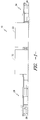
- Figure 1 is a schematic representation of a floor mat manufacturing machine.
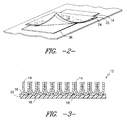
- FIG. 2 illustrates a molded floor mat as it exists the mat manufacturing machine of FIG. 1.
- FIG. 3 is a partial cross-sectional view of a completed vulcanized floor mat.
- FIG. 1 a schematic of a floor mat manufacturing machine 10 for producing the floor mat 12 (FIGS. 2 and 3) of the present invention.
- the floor mat 12 includes pile yarns 14 of cotton nylon, polyester or other suitable material tufted through a woven or nonwoven carrier layer 16 of suitable material with the bottom 18 of the tufts adhered to a rubber backing sheet 20.
- This adherence of the rubber backing sheet 20 to the carrier layer 16 and bottom of the tufts is effected during vulcanization (i.e. cross-linking) of the rubber backing sheet under heat and pressure as is well known to those of skill in the art.
- the bottom of the rubber backing sheet may also include a plurality of anti-creep cleats (not shown) as are well known to those in the art.
- the floor mat 12 of the present invention also preferably includes a border portion 24 around the perimeter.
- the floor mat 12 of the present invention is assembled molded and vulcanized on the manufacturing machine 10 of FIG. 1.
- the manufacturing machine 10 which is well known to those of skill in the art includes an endless, teflon coated conveyor belt 26 to carry the floor mats 12 from an assembly station 28, into a press molding apparatus 32, to a post cure oven 33 and out to a separating station 34.
- the press molding apparatus 32 can be of any type which is suitable such as that shown in U.S. patent 4,447,201 to Knudsen (incorporated by reference).
- the mats are preassembled at station 28 by laying down a metal plate or silicone or butyl pad 36 on the conveyor belt 26.
- the rubber backing sheet 20 as described more fully below is placed over the silicone pad and the tufted fabric comprising the pile yarns 14 tufted through the carrier layer 16 is placed on top of the rubber backing sheet 20.
- the rubber backing sheet laid down at the assembly station 28 is a solid calendared sheet of green (i.e. unvulcanized) acrylonitrile-butadiene rubber (NBR) or styrene butadiene rubber (SBR) mixed with a polymer additive such that the ratio of the NBR or SBR to the polymer additive is between about 1.2 and 9.
- the potentially preferred polymer additive is polyvinyl chloride (PVC) or ethylene-propylene-diene (EPDM). If SBR is the base material for the rubber backing sheet, EPDM is the preferred polymer additive.
- the conveyor belt 26 is then indexed to place the preassembled mat into the press mold 32 while a second mat is preassembled at station 28. While the first mat is in the press mold 32, it is exposed to a temperature between about 300°F and about 340°F. While in the press mold 32, the mat is exposed to pressures in the range of between about 20 psi and 40 psi. At the temperature and pressure occurring in the press mold 32, the rubber backing sheet 20 undergoes vulcanization and is integrated to the carrier layer 16 of the mat to form a substantially unitary structure. After about 3 to 6 minutes the conveyor belt 26 is again indexed to move the first vulcanized mat into a post cure oven 33 to complete the vulcanization but without the application of pressure. During this time yet a third mat is preassembled at station 28 while the second mat is indexed to the press mold.
- the post cure oven is operated at a temperature between about 300°F and 340°F but no pressure is applied to the mat.
- the conveyor belt is again indexed to move the first mat into the stripping station 34 wherein it is removed from the silicone pad and the conveyor belt 26 (FIG. 2) while the second, and third mats are indexed into the post cure oven 33, and the press mold 32 respectively, and a fourth mat is preassembled at station 28.
- the mat may also undergo a preheating operation prior to entering the press mold if desired as described in my U.S. patent 4,886,692.
- the base material for the rubber backing sheet 20 is acrylonitrile-butadiene rubber (NBR) or styrene-butadiene rubber (SBR).
- NBR acrylonitrile-butadiene rubber
- SBR styrene-butadiene rubber
- Other materials which may also be used include, by way of example, hydrogenated NBR and carboxylated NBR although the use of these materials may be cost prohibitive.
- the use of NBR or SBR is desirable from a cost perspective.
- these materials may be susceptible to oxidation and ozone attack (referred to as ozonation) due to the presence of unsaturated carbon-carbon double bonds.
- ozonation oxidation and ozone attack
- the specific gravity of fully vulcanized NBR or SBR compositions is relatively high being in the range of about 1.2 to about 1.45 which may result in a relatively heavier overall mat structure.
- the present invention makes use of fluxing technology to combine polar polymer materials in formation of the rubber backing sheet 20 to provide enhanced resistance to oxidation and ozonation while at the same time yielding a lighter material through the addition of chemical blowing agents.
- the rubber backing sheet 20 of the present invention comprises either NBR mixed with PVC or EPDM and a blowing agent in a fluxing operation or SBR mixed with EPDM and a blowing agent in a fluxing operation wherein the PVC or EPDM is mixed at a level such that the ratio of the base rubber (NBR or SBR) to the polymer additive (PVC or EPDM) is between about 1.2 (i.e. 55 parts base rubber and 45 parts polymer additive) and about 9.0 (i.e.
- This fluxing operation preferably takes place in a standard rubber internal mixer such as a Banbury mixer which is well known to those of skill in the art.
- a standard rubber internal mixer such as a Banbury mixer which is well known to those of skill in the art.
- the mixer is preferably operated at a temperature of between about 330°F to 340°F.
- the mixer is preferably operated at a slightly lower temperature of about 280°F to 300°F due to EPDM's thermoplastic nature.
- the rubber mixture is thereafter calendered as a solid sheet of unvulcanized material which is used in the manufacture of the floor mat 12 in the process as described above.
- the raw NBR is believed to be available from Miles Inc. Rubber Division in Akron, Ohio.
- the SBR may be purchased from Goodyear Tire and Rubber Company in Akron Ohio.
- the PVC may be purchased in pellet form from Goodyear Tire and Rubber Company in Akron Ohio.
- the EPDM may be purchased from Exxon . Corporation under the trade designation VistalonTM.
- a masterbatch of the polymer components is first prepared by mixing the base rubber (either NBR or SBR) with the additive polymer (either PVC or EPDM) in the desired ratio along with various stabilizers and processing agents.
- Exemplary compositions of the masterbatch for various additive ratios wherein PVC or EPDM is mixed with NBR are provided in Table 1A for ratios of NBR to the additive polymer of 9.0 (Column a), 2.3 (Column b) and 1.2 (Column c).
- plasticizer which is used is diisononylphthalate.
- the stabilizer is trinonylphenolphosphate available from Uniroyal Chemical under the trade designation PolyguardTM.
- the processing aid is purchased from the R.T. Vanderbilt Company in Norwalk Connecticut under the trade designation VanfreeTM AP-2.
- the antioxidant is purchased from Uniroyal Chemical under the trade designation OctamineTM.
- curative agents are added in a second stage mixing process for formation of the raw rubber compound which forms the backing sheet 20 of the mat 12 of the present invention.
- An exemplary composition of the raw rubber compound formed in this second stage mixing process is provided in Table 1B.
- Table 1B TABLE 1B MATERIAL PARTS BY WEIGHT Masterbatch Blend 100 Sulfur 1.25 Stearic Acid 1 Carbon Black N-550 40 Vulkacit Thiaram MS (TMTM) 0.5 Zinc Oxide 5 Blowing Agent 2.5
- compositions of the masterbatch for various additive ratios of SBR to EPDM are provided in Table 2A in a manner similar to that of Table 1A.
- curative agents are preferably added in a second stage mixing process for formation of the raw rubber compound which forms the backing sheet 20 of the mat 12 of the present invention.
- An exemplary composition of the raw rubber compound formed in this second stage mixing process is provided in Table 2B.
- Table 2B MATERIAL PARTS BY WEIGHT Masterbatch Blend 100 Sulfur 2 Methyl Zimate 1.25 Butyl Zimate 1.25 Dibutyl Thiurea 2.50 Tellurium Diethyldithiocarbanate 1 Blowing Agent 2.0
- the rubber backing sheet 20 preferably includes a blowing agent to effect the formation of closed gas cells in the rubber during vulcanization.
- the blowing agent which is preferably used is a nitrogen compound organic type agent which is stable at normal storage and mixing temperatures but which undergoes controllable gas evolution at reasonably well defined decomposition temperatures.
- blowing agents which may be used include: azodicarbonamide (CelogenTM AZ-type blowing agents) available from Uniroyal Chemical Inc. in Middlebury Connecticut and modified azodicarbonamide available from Miles Chemical in Akron, Ohio under the trade designation PoroforTM ADC-K.
- the uncured rubber compound containing PVC and/or EPDM and the blowing agent is assembled with the pile yarns 14 and carrier layer as previously described.
- the vulcanization of the rubber backing sheet is then at least partially effected within the press molding apparatus 32 wherein the applied pressure is between 20 and 40 psi. Under the high temperatures and pressure, the nitrogen which is formed by the blowing agent partly dissolves in the rubber. Due to the high internal gas pressure, small closed gas cells are formed within the structure as the pressure is relieved upon exit from the press molding apparatus.
- the post cure oven 33 is used to complete the vulcanization of the mat and provide additional stability to the resulting product.
- a primary object of the present invention is to provide enhanced resistance to oxidation and ozonation which tend to weaken the carboncarbon double bonds in the rubber.
- standardized tests may be used to evaluate the ozone resistance of a rubber compound formulation.
- the general procedure for conducting such tests is set forth in standards such as ASTM Standard D 518 entitled “Test Method for Rubber Deterioration - Surface Cracking;” D 1149 entitled “Test Method for Rubber Deterioration - Surface Ozone Cracking in a Chamber” and D 3395 entitled “Test Method for Rubber Deterioration - Dynamic Ozone Cracking in a Chamber” published in Annual Book of ASTM Standards, Vol. 09.01, 1992.
- the Bayer method ozone resistance test utilizes methods and equipment as described in ASTM Standard D 1149 and yields a quantitative cracking incidence factor as well as crack length factor. Specifically, in the Bayer method ozone resistance test cured slabs of the test material are cut into sections 55 X 45 X 4 mm for mounting on a loop mold. In a chamber, the specimens are then subjected to a controlled atmosphere of ozone at a partial pressure of approximately 50 mPa (pphm) in air. Both the number and average length of the cracks occurring in the rubber is then observed. Based on this observation, the sample is then assigned a rating comprising two numbers.
- the first number identifies the incidence of cracking while the second number identifies the length of the cracks as based on the following scale: BAYER METHOD SCALE FIRST NUMBER NUMBER OF CRACKS SECOND NUMBER LENGTH OF CRACKS (Bayer Cracking Incidence Factor) (Bayer Crack Length Factor) 0 No Cracking 0 No Cracks 1 1-2 Cracks 1 Just Visible 2 3-9 Cracks 2 1 mm 3 10-24 Cracks 3 2 mm 4 25-79 Cracks 4 Greater than 2 mm 5 80-250 Cracks 6 More than 250 cracks
- a sample rating of 3/2 would indicate the occupance of 10 to 24 cracks with an average length of 1 mm.
- a rubber sheet material was produced by fluxing together the materials as set forth in Table 1A in a standard rubber internal mixer at a temperature of about 330°F to 340°F for a period of one to two minutes. PVC additions were varied as shown in Table 1A to yield ratios of NBR to PVC of 9.0 (90 parts NBR to 10 parts PVC); 2.33 (70 parts NBR to 30 parts PVC); and 1.22 (55 parts NBR to 45 parts PVC). Additions of curative agents as provided in Table 1B were then made.
- Uncured sheets of the fluxed rubber compounds were then calendered and cured at a temperature of about 325°F for five (5) minutes under a pressure of about 40 psi and post cured at a temperature of about 325°F at atmospheric pressure for a period of five (5) minutes.
- Sample strips of the cured rubber sheets were then subjected to the Bayer Ozone Resistance Test with a 20% extension with samples being subjected to an ozone partial pressure of 50 mPa (pphm) in air for a period of 24 hours.
- the results of these tests as compared to comparative tests on fully cured NBR without a polar additive such as PVC or EPDM are set forth in Table 2.
Landscapes
- Engineering & Computer Science (AREA)
- Textile Engineering (AREA)
- Laminated Bodies (AREA)
- Manufacture Of Macromolecular Shaped Articles (AREA)
- Compositions Of Macromolecular Compounds (AREA)
Applications Claiming Priority (2)
| Application Number | Priority Date | Filing Date | Title |
|---|---|---|---|
| US296756 | 1981-08-27 | ||
| US29675694A | 1994-08-26 | 1994-08-26 |
Publications (2)
| Publication Number | Publication Date |
|---|---|
| EP0702929A1 true EP0702929A1 (de) | 1996-03-27 |
| EP0702929B1 EP0702929B1 (de) | 2001-12-05 |
Family
ID=23143415
Family Applications (1)
| Application Number | Title | Priority Date | Filing Date |
|---|---|---|---|
| EP95305507A Expired - Lifetime EP0702929B1 (de) | 1994-08-26 | 1995-08-08 | Waschbare Türmatte mit Ozonwiderstand |
Country Status (6)
| Country | Link |
|---|---|
| US (1) | US5902662A (de) |
| EP (1) | EP0702929B1 (de) |
| JP (1) | JP2889154B2 (de) |
| CA (1) | CA2155384A1 (de) |
| DE (1) | DE69524334T2 (de) |
| DK (1) | DK0702929T3 (de) |
Cited By (2)
| Publication number | Priority date | Publication date | Assignee | Title |
|---|---|---|---|---|
| EP0971064A2 (de) | 1998-07-10 | 2000-01-12 | Milliken & Company | Bodenmatte aus Einzelnylonfasern mit einer Ozon-beständigen nichtverschmutzenden Unterschicht |
| WO2000007811A1 (en) * | 1998-08-03 | 2000-02-17 | Milliken Research Corporation | Floor mat exhibiting reduced rippling effects and improved delaminating characteristics of its tufted pile fibers |
Families Citing this family (25)
| Publication number | Priority date | Publication date | Assignee | Title |
|---|---|---|---|---|
| US6455123B1 (en) * | 1998-09-08 | 2002-09-24 | Ernest B. Poe, Sr. | Nonslip padded mat |
| US6340514B1 (en) | 1999-08-13 | 2002-01-22 | Milliken & Company | Cushioned rubber floor mat article comprising at least one integrated rubber protrusion and at least two layers of rubber |
| US6296919B1 (en) | 1999-08-13 | 2001-10-02 | Milliken & Company | Cushioned carpeted floor mat with at least one cushioning integrated rubber protrusion |
| USRE38422E1 (en) | 1999-08-13 | 2004-02-10 | Milliken & Co. | Cushioned carpeted floor mat with at least one cushioning integrated rubber protrusion |
| US6303068B1 (en) | 1999-09-24 | 2001-10-16 | Milliken & Company | Process of making a cleated floor mat |
| AU5583501A (en) * | 2000-05-19 | 2001-12-03 | Milliken & Co | Cleat-forming woven fabric article for the manufacture of anti-creep floor mats |
| US6921502B1 (en) | 2000-09-01 | 2005-07-26 | Milliken & Company | Cushioned rubber floor mat article and method |
| CN1449259A (zh) | 2000-09-01 | 2003-10-15 | 美利肯公司 | 减震橡胶地板垫子制品及方法 |
| US6420015B1 (en) | 2000-09-27 | 2002-07-16 | Milliken & Company | Cushioned rubber floor mat and process |
| US6589631B1 (en) | 2000-10-04 | 2003-07-08 | Milliken & Company | Flashless rubber floor mat and method |
| US6723413B2 (en) | 2001-06-19 | 2004-04-20 | Ian D. Walters | Tufted surface covering and method |
| US6808588B1 (en) * | 2001-12-04 | 2004-10-26 | Milliken & Company | Continuous mat making process and product |
| EP1467647A1 (de) * | 2002-01-24 | 2004-10-20 | Milliken Denmark A/S | Waschbare fussbodenmatte |
| US6641829B1 (en) | 2002-10-22 | 2003-11-04 | Milliken & Company | Topical application of solid antimicrobials to carpet pile fibers during carpet manufacture |
| US20040076792A1 (en) * | 2002-10-22 | 2004-04-22 | Green David E. | Topically applied antimicrobial carpet treatment |
| US20060137800A1 (en) * | 2004-12-23 | 2006-06-29 | Semi Kao | Method for continuously making foamed rubber material with texture thereon |
| WO2007010497A1 (en) * | 2005-07-21 | 2007-01-25 | The Procter & Gamble Company | A disposable mat, a container comprising a disposable mat, a method of promoting the sale of a disposable mat, and a process of manufacturing a disposable mat |
| WO2007010495A1 (en) * | 2005-07-21 | 2007-01-25 | The Procter & Gamble Company | A disposable mat, a container comprising a disposable mat, and a method of promoting the sale of a disposable mat |
| US20070017838A1 (en) * | 2005-07-21 | 2007-01-25 | The Procter & Gamble Company | Method of promoting the sale of a disposable mat, a container comprising a disposable mat, and a shelve displaying said container |
| WO2007010496A2 (en) * | 2005-07-21 | 2007-01-25 | The Procter & Gamble Company | A disposable mat, a container comprising a disposable mat, and a method of promoting the sale of a disposable mat |
| KR100834523B1 (ko) * | 2006-05-12 | 2008-06-09 | (주)금강페이버 | 체육시설용 탄성매트 제조방법 및 그 제품 |
| JP5814277B2 (ja) | 2013-01-31 | 2015-11-17 | 住友ゴム工業株式会社 | 破壊エネルギー予測方法及びゴム組成物 |
| US10674701B2 (en) | 2015-06-19 | 2020-06-09 | Titan International, Inc. | Agricultural mat and associated systems and methods |
| US20170037568A1 (en) | 2015-08-05 | 2017-02-09 | Milliken & Company | Installation of Multi-Component Floor Mat |
| AU2016340057B2 (en) * | 2015-10-14 | 2019-06-27 | Milliken & Company | Flooring system |
Citations (5)
| Publication number | Priority date | Publication date | Assignee | Title |
|---|---|---|---|---|
| GB1493272A (en) * | 1976-07-02 | 1977-11-30 | Int Synthetic Rubber | Sponge rubber sheet |
| JPS58219036A (ja) * | 1982-06-15 | 1983-12-20 | Okamoto Kk | 一定厚みの長尺状スポンジゴムシ−トの連続製造方法 |
| JPS59168048A (ja) * | 1983-03-15 | 1984-09-21 | Matsushita Electric Works Ltd | 建築用ゴムシ−ト |
| EP0513449A1 (de) * | 1991-05-14 | 1992-11-19 | Duskin Company Limited | Bodenmatte |
| EP0556967A2 (de) * | 1992-02-18 | 1993-08-25 | Milliken Research Corporation | Fussmatte mit Stollen |
Family Cites Families (16)
| Publication number | Priority date | Publication date | Assignee | Title |
|---|---|---|---|---|
| GB493272A (en) * | 1938-05-06 | 1938-10-05 | Berkeley Charles Clarke | Improvements relating to suspensory bandages |
| US3306808A (en) * | 1963-11-22 | 1967-02-28 | Callaway Mills Co | Curl resistant dust collecting mats |
| US3661691A (en) * | 1970-12-28 | 1972-05-09 | Pandel Bradford | Flame-retardant vinyl foam carpet and method |
| US3949123A (en) * | 1972-12-08 | 1976-04-06 | Uniroyal Inc. | Coated fabric having suede-like surface |
| US4109039A (en) * | 1976-10-27 | 1978-08-22 | Uniroyal, Inc. | Carpet backing with rubber latex-solid polyvinyl chloride resin composition |
| US4111897A (en) * | 1977-10-31 | 1978-09-05 | The B. F. Goodrich Company | Epdm composition |
| US4447201A (en) * | 1981-06-29 | 1984-05-08 | Clean-Tex A/S | Vulcanizing press for vulcanizing flat articles |
| JPS58152037A (ja) * | 1982-03-05 | 1983-09-09 | Sumitomo Chem Co Ltd | 敷物用難燃パツキング組成物 |
| JPS62120248A (ja) * | 1985-11-19 | 1987-06-01 | Toyoda Gosei Co Ltd | ワイパブレ−ドゴム |
| JPS62268641A (ja) * | 1986-05-19 | 1987-11-21 | 豊田合成株式会社 | 積層体 |
| US4741065A (en) * | 1987-03-09 | 1988-05-03 | Milliken Research Corporation | Interlocking dust control mats |
| US4917932A (en) * | 1987-10-05 | 1990-04-17 | Mcclung Scott D | Floor mat with a non-slidable surface |
| US4886692A (en) * | 1988-07-11 | 1989-12-12 | Milliken Research Corporation | Dust control mat with non-cleated borders |
| US5187203A (en) * | 1991-10-23 | 1993-02-16 | Armstrong World Industries, Inc. | Non-corrosive elastomeric foam for insulating copper tubes |
| US5227214A (en) * | 1992-03-27 | 1993-07-13 | Milliken Research Corporation | Anti-creep mat |
| JP3120869U (ja) * | 2006-02-06 | 2006-04-20 | 株式会社山本進重郎商店 | バスピロー |
-
1995
- 1995-08-03 CA CA002155384A patent/CA2155384A1/en not_active Abandoned
- 1995-08-08 EP EP95305507A patent/EP0702929B1/de not_active Expired - Lifetime
- 1995-08-08 DE DE69524334T patent/DE69524334T2/de not_active Expired - Fee Related
- 1995-08-08 DK DK95305507T patent/DK0702929T3/da active
- 1995-08-22 JP JP7213570A patent/JP2889154B2/ja not_active Expired - Fee Related
-
1996
- 1996-04-25 US US08/637,586 patent/US5902662A/en not_active Expired - Fee Related
Patent Citations (5)
| Publication number | Priority date | Publication date | Assignee | Title |
|---|---|---|---|---|
| GB1493272A (en) * | 1976-07-02 | 1977-11-30 | Int Synthetic Rubber | Sponge rubber sheet |
| JPS58219036A (ja) * | 1982-06-15 | 1983-12-20 | Okamoto Kk | 一定厚みの長尺状スポンジゴムシ−トの連続製造方法 |
| JPS59168048A (ja) * | 1983-03-15 | 1984-09-21 | Matsushita Electric Works Ltd | 建築用ゴムシ−ト |
| EP0513449A1 (de) * | 1991-05-14 | 1992-11-19 | Duskin Company Limited | Bodenmatte |
| EP0556967A2 (de) * | 1992-02-18 | 1993-08-25 | Milliken Research Corporation | Fussmatte mit Stollen |
Non-Patent Citations (2)
| Title |
|---|
| DATABASE WPI Week 8405, Derwent World Patents Index; AN 84-027447 * |
| PATENT ABSTRACTS OF JAPAN vol. 9, no. 21 (C - 263) 29 January 1985 (1985-01-29) * |
Cited By (4)
| Publication number | Priority date | Publication date | Assignee | Title |
|---|---|---|---|---|
| EP0971064A2 (de) | 1998-07-10 | 2000-01-12 | Milliken & Company | Bodenmatte aus Einzelnylonfasern mit einer Ozon-beständigen nichtverschmutzenden Unterschicht |
| EP0971064A3 (de) * | 1998-07-10 | 2002-01-02 | Milliken & Company | Bodenmatte aus Einzelnylonfasern mit einer Ozon-beständigen nichtverschmutzenden Unterschicht |
| WO2000007811A1 (en) * | 1998-08-03 | 2000-02-17 | Milliken Research Corporation | Floor mat exhibiting reduced rippling effects and improved delaminating characteristics of its tufted pile fibers |
| AU750317B2 (en) * | 1998-08-03 | 2002-07-18 | Milliken & Company | Floor mat exhibiting reduced rippling effects and improved delaminating characteristics of its tufted pile fibers |
Also Published As
| Publication number | Publication date |
|---|---|
| DK0702929T3 (da) | 2002-03-18 |
| CA2155384A1 (en) | 1996-02-27 |
| HK1012538A1 (en) | 1999-08-06 |
| EP0702929B1 (de) | 2001-12-05 |
| JPH08187216A (ja) | 1996-07-23 |
| JP2889154B2 (ja) | 1999-05-10 |
| US5902662A (en) | 1999-05-11 |
| DE69524334D1 (de) | 2002-01-17 |
| DE69524334T2 (de) | 2002-08-14 |
Similar Documents
| Publication | Publication Date | Title |
|---|---|---|
| US5902662A (en) | Launderable floor mat with ozone resistance | |
| US6159576A (en) | Floor mat solely comprised of monofilament nylon fiber and having an ozone resistant, non-staining rubber backing sheet | |
| JP3450775B2 (ja) | 少なくとも1つの一体化ゴム突起と少なくとも2つのゴム層を含むクッションゴムフロアマット製品 | |
| EP1075937B1 (de) | Gepolsterter Bodenbelag aus mit Teppich belegten Platten enthaltend mindestens eine integrale Erhebung aus Gummi | |
| CN1206095C (zh) | 无飞边橡胶地板垫及其制备方法 | |
| US20030129354A1 (en) | Floor mat exhibiting reduced rippling effects and improved delaminating characteristics of its tufted pile fibers | |
| USRE38422E1 (en) | Cushioned carpeted floor mat with at least one cushioning integrated rubber protrusion | |
| US6420015B1 (en) | Cushioned rubber floor mat and process | |
| EP0513449B1 (de) | Herstellungsverfahren einer Bodenmatte | |
| US20020045021A1 (en) | Floor mat, system and method | |
| EP0973386B1 (de) | Relief-fussmatte | |
| HK1012538B (en) | Washable floor mats with ozone resistance | |
| KR101682530B1 (ko) | 내열성 및 내마모성이 우수한 매트용 조성물 | |
| GB2025321A (en) | Resilient composites | |
| HK1058921A (en) | Flashless rubber floor mat and method |
Legal Events
| Date | Code | Title | Description |
|---|---|---|---|
| PUAI | Public reference made under article 153(3) epc to a published international application that has entered the european phase |
Free format text: ORIGINAL CODE: 0009012 |
|
| AK | Designated contracting states |
Kind code of ref document: A1 Designated state(s): DE DK FR GB SE |
|
| 17P | Request for examination filed |
Effective date: 19960411 |
|
| 17Q | First examination report despatched |
Effective date: 19970704 |
|
| RAP1 | Party data changed (applicant data changed or rights of an application transferred) |
Owner name: MILLIKEN & COMPANY |
|
| GRAG | Despatch of communication of intention to grant |
Free format text: ORIGINAL CODE: EPIDOS AGRA |
|
| GRAG | Despatch of communication of intention to grant |
Free format text: ORIGINAL CODE: EPIDOS AGRA |
|
| GRAH | Despatch of communication of intention to grant a patent |
Free format text: ORIGINAL CODE: EPIDOS IGRA |
|
| GRAH | Despatch of communication of intention to grant a patent |
Free format text: ORIGINAL CODE: EPIDOS IGRA |
|
| GRAA | (expected) grant |
Free format text: ORIGINAL CODE: 0009210 |
|
| AK | Designated contracting states |
Kind code of ref document: B1 Designated state(s): DE DK FR GB SE |
|
| REG | Reference to a national code |
Ref country code: GB Ref legal event code: IF02 |
|
| REF | Corresponds to: |
Ref document number: 69524334 Country of ref document: DE Date of ref document: 20020117 |
|
| REG | Reference to a national code |
Ref country code: DK Ref legal event code: T3 |
|
| ET | Fr: translation filed | ||
| PGFP | Annual fee paid to national office [announced via postgrant information from national office to epo] |
Ref country code: SE Payment date: 20020625 Year of fee payment: 8 |
|
| PLBE | No opposition filed within time limit |
Free format text: ORIGINAL CODE: 0009261 |
|
| STAA | Information on the status of an ep patent application or granted ep patent |
Free format text: STATUS: NO OPPOSITION FILED WITHIN TIME LIMIT |
|
| 26N | No opposition filed | ||
| PGFP | Annual fee paid to national office [announced via postgrant information from national office to epo] |
Ref country code: DK Payment date: 20030624 Year of fee payment: 9 |
|
| PGFP | Annual fee paid to national office [announced via postgrant information from national office to epo] |
Ref country code: FR Payment date: 20030715 Year of fee payment: 9 |
|
| PG25 | Lapsed in a contracting state [announced via postgrant information from national office to epo] |
Ref country code: SE Free format text: LAPSE BECAUSE OF NON-PAYMENT OF DUE FEES Effective date: 20030809 |
|
| EUG | Se: european patent has lapsed | ||
| PGFP | Annual fee paid to national office [announced via postgrant information from national office to epo] |
Ref country code: GB Payment date: 20040804 Year of fee payment: 10 |
|
| PG25 | Lapsed in a contracting state [announced via postgrant information from national office to epo] |
Ref country code: DK Free format text: LAPSE BECAUSE OF NON-PAYMENT OF DUE FEES Effective date: 20040831 |
|
| PGFP | Annual fee paid to national office [announced via postgrant information from national office to epo] |
Ref country code: DE Payment date: 20040930 Year of fee payment: 10 |
|
| PG25 | Lapsed in a contracting state [announced via postgrant information from national office to epo] |
Ref country code: FR Free format text: LAPSE BECAUSE OF NON-PAYMENT OF DUE FEES Effective date: 20050429 |
|
| REG | Reference to a national code |
Ref country code: FR Ref legal event code: ST |
|
| REG | Reference to a national code |
Ref country code: DK Ref legal event code: EBP |
|
| PG25 | Lapsed in a contracting state [announced via postgrant information from national office to epo] |
Ref country code: GB Free format text: LAPSE BECAUSE OF NON-PAYMENT OF DUE FEES Effective date: 20050808 |
|
| PG25 | Lapsed in a contracting state [announced via postgrant information from national office to epo] |
Ref country code: DE Free format text: LAPSE BECAUSE OF NON-PAYMENT OF DUE FEES Effective date: 20060301 |
|
| GBPC | Gb: european patent ceased through non-payment of renewal fee |
Effective date: 20050808 |