EP0703069A1 - Dämpfungsmaterial für Formpresse - Google Patents
Dämpfungsmaterial für Formpresse Download PDFInfo
- Publication number
- EP0703069A1 EP0703069A1 EP95114311A EP95114311A EP0703069A1 EP 0703069 A1 EP0703069 A1 EP 0703069A1 EP 95114311 A EP95114311 A EP 95114311A EP 95114311 A EP95114311 A EP 95114311A EP 0703069 A1 EP0703069 A1 EP 0703069A1
- Authority
- EP
- European Patent Office
- Prior art keywords
- layer
- forming press
- woven fabric
- cushioning material
- press according
- Prior art date
- Legal status (The legal status is an assumption and is not a legal conclusion. Google has not performed a legal analysis and makes no representation as to the accuracy of the status listed.)
- Granted
Links
- 239000000463 material Substances 0.000 title claims abstract description 217
- 229920001971 elastomer Polymers 0.000 claims abstract description 118
- 239000002657 fibrous material Substances 0.000 claims abstract description 57
- 239000004745 nonwoven fabric Substances 0.000 claims description 113
- 239000000853 adhesive Substances 0.000 claims description 74
- 239000004744 fabric Substances 0.000 claims description 50
- 239000000835 fiber Substances 0.000 claims description 47
- 229920001973 fluoroelastomer Polymers 0.000 claims description 26
- 230000003578 releasing effect Effects 0.000 claims description 23
- 239000002759 woven fabric Substances 0.000 claims description 23
- 229920005989 resin Polymers 0.000 claims description 15
- 239000011347 resin Substances 0.000 claims description 15
- 230000003014 reinforcing effect Effects 0.000 claims description 14
- 238000013329 compounding Methods 0.000 claims description 13
- 238000004080 punching Methods 0.000 claims description 13
- KRHYYFGTRYWZRS-UHFFFAOYSA-M Fluoride anion Chemical compound [F-] KRHYYFGTRYWZRS-UHFFFAOYSA-M 0.000 claims description 12
- 239000003795 chemical substances by application Substances 0.000 claims description 12
- NIXOWILDQLNWCW-UHFFFAOYSA-N acrylic acid group Chemical group C(C=C)(=O)O NIXOWILDQLNWCW-UHFFFAOYSA-N 0.000 claims description 11
- 239000000178 monomer Substances 0.000 claims description 11
- 229920003002 synthetic resin Polymers 0.000 claims description 11
- 239000000057 synthetic resin Substances 0.000 claims description 11
- 239000002184 metal Substances 0.000 claims description 9
- 229920002943 EPDM rubber Polymers 0.000 claims description 8
- 229920006122 polyamide resin Polymers 0.000 claims description 6
- 239000011888 foil Substances 0.000 claims description 5
- 238000005979 thermal decomposition reaction Methods 0.000 claims description 5
- 230000004580 weight loss Effects 0.000 claims description 5
- 239000004640 Melamine resin Substances 0.000 claims description 2
- 229920000877 Melamine resin Polymers 0.000 claims description 2
- 230000009477 glass transition Effects 0.000 claims description 2
- 238000010030 laminating Methods 0.000 claims description 2
- 239000000203 mixture Substances 0.000 claims description 2
- -1 acryl Chemical group 0.000 claims 1
- 238000010073 coating (rubber) Methods 0.000 claims 1
- 150000002222 fluorine compounds Chemical group 0.000 claims 1
- 239000004760 aramid Substances 0.000 description 19
- 229920003235 aromatic polyamide Polymers 0.000 description 19
- 239000000123 paper Substances 0.000 description 17
- 239000011521 glass Substances 0.000 description 12
- 229920000459 Nitrile rubber Polymers 0.000 description 8
- 230000001070 adhesive effect Effects 0.000 description 8
- 238000010438 heat treatment Methods 0.000 description 8
- 230000008901 benefit Effects 0.000 description 7
- 230000008859 change Effects 0.000 description 7
- 238000009826 distribution Methods 0.000 description 7
- 229920002379 silicone rubber Polymers 0.000 description 7
- 239000004945 silicone rubber Substances 0.000 description 7
- 239000002655 kraft paper Substances 0.000 description 5
- 238000002156 mixing Methods 0.000 description 5
- 229920000181 Ethylene propylene rubber Polymers 0.000 description 4
- 229920000800 acrylic rubber Polymers 0.000 description 4
- 230000000694 effects Effects 0.000 description 4
- 239000003822 epoxy resin Substances 0.000 description 4
- 239000007788 liquid Substances 0.000 description 4
- 238000004519 manufacturing process Methods 0.000 description 4
- 239000011490 mineral wool Substances 0.000 description 4
- 229920000058 polyacrylate Polymers 0.000 description 4
- 229920000647 polyepoxide Polymers 0.000 description 4
- 239000012784 inorganic fiber Substances 0.000 description 3
- 238000003475 lamination Methods 0.000 description 3
- 238000003825 pressing Methods 0.000 description 3
- 239000004952 Polyamide Substances 0.000 description 2
- VYPSYNLAJGMNEJ-UHFFFAOYSA-N Silicium dioxide Chemical compound O=[Si]=O VYPSYNLAJGMNEJ-UHFFFAOYSA-N 0.000 description 2
- 229920005549 butyl rubber Polymers 0.000 description 2
- 239000011248 coating agent Substances 0.000 description 2
- 238000000576 coating method Methods 0.000 description 2
- 229920001577 copolymer Polymers 0.000 description 2
- STVZJERGLQHEKB-UHFFFAOYSA-N ethylene glycol dimethacrylate Chemical compound CC(=C)C(=O)OCCOC(=O)C(C)=C STVZJERGLQHEKB-UHFFFAOYSA-N 0.000 description 2
- 239000012210 heat-resistant fiber Substances 0.000 description 2
- 230000006872 improvement Effects 0.000 description 2
- 230000001788 irregular Effects 0.000 description 2
- 229920002647 polyamide Polymers 0.000 description 2
- 229920000728 polyester Polymers 0.000 description 2
- 230000003252 repetitive effect Effects 0.000 description 2
- 238000000926 separation method Methods 0.000 description 2
- 238000009827 uniform distribution Methods 0.000 description 2
- VDYWHVQKENANGY-UHFFFAOYSA-N 1,3-Butyleneglycol dimethacrylate Chemical compound CC(=C)C(=O)OC(C)CCOC(=O)C(C)=C VDYWHVQKENANGY-UHFFFAOYSA-N 0.000 description 1
- ZDTLUUIYCAMIMQ-UHFFFAOYSA-N 2-(2-hydroxyethoxy)-1-methoxyethanol;2-methylprop-2-enoic acid Chemical compound CC(=C)C(O)=O.COC(O)COCCO ZDTLUUIYCAMIMQ-UHFFFAOYSA-N 0.000 description 1
- IAMASUILMZETHW-UHFFFAOYSA-N 2-(2-hydroxyethoxy)-1-phenoxyethanol;prop-2-enoic acid Chemical compound OC(=O)C=C.OCCOCC(O)OC1=CC=CC=C1 IAMASUILMZETHW-UHFFFAOYSA-N 0.000 description 1
- RZVINYQDSSQUKO-UHFFFAOYSA-N 2-phenoxyethyl prop-2-enoate Chemical compound C=CC(=O)OCCOC1=CC=CC=C1 RZVINYQDSSQUKO-UHFFFAOYSA-N 0.000 description 1
- XOJWAAUYNWGQAU-UHFFFAOYSA-N 4-(2-methylprop-2-enoyloxy)butyl 2-methylprop-2-enoate Chemical compound CC(=C)C(=O)OCCCCOC(=O)C(C)=C XOJWAAUYNWGQAU-UHFFFAOYSA-N 0.000 description 1
- JHWGFJBTMHEZME-UHFFFAOYSA-N 4-prop-2-enoyloxybutyl prop-2-enoate Chemical compound C=CC(=O)OCCCCOC(=O)C=C JHWGFJBTMHEZME-UHFFFAOYSA-N 0.000 description 1
- SAPGBCWOQLHKKZ-UHFFFAOYSA-N 6-(2-methylprop-2-enoyloxy)hexyl 2-methylprop-2-enoate Chemical compound CC(=C)C(=O)OCCCCCCOC(=O)C(C)=C SAPGBCWOQLHKKZ-UHFFFAOYSA-N 0.000 description 1
- FIHBHSQYSYVZQE-UHFFFAOYSA-N 6-prop-2-enoyloxyhexyl prop-2-enoate Chemical compound C=CC(=O)OCCCCCCOC(=O)C=C FIHBHSQYSYVZQE-UHFFFAOYSA-N 0.000 description 1
- 229920000178 Acrylic resin Polymers 0.000 description 1
- 239000004925 Acrylic resin Substances 0.000 description 1
- 239000002202 Polyethylene glycol Substances 0.000 description 1
- 239000004734 Polyphenylene sulfide Substances 0.000 description 1
- LCXXNKZQVOXMEH-UHFFFAOYSA-N Tetrahydrofurfuryl methacrylate Chemical compound CC(=C)C(=O)OCC1CCCO1 LCXXNKZQVOXMEH-UHFFFAOYSA-N 0.000 description 1
- DAKWPKUUDNSNPN-UHFFFAOYSA-N Trimethylolpropane triacrylate Chemical compound C=CC(=O)OCC(CC)(COC(=O)C=C)COC(=O)C=C DAKWPKUUDNSNPN-UHFFFAOYSA-N 0.000 description 1
- OKKRPWIIYQTPQF-UHFFFAOYSA-N Trimethylolpropane trimethacrylate Chemical compound CC(=C)C(=O)OCC(CC)(COC(=O)C(C)=C)COC(=O)C(C)=C OKKRPWIIYQTPQF-UHFFFAOYSA-N 0.000 description 1
- HVVWZTWDBSEWIH-UHFFFAOYSA-N [2-(hydroxymethyl)-3-prop-2-enoyloxy-2-(prop-2-enoyloxymethyl)propyl] prop-2-enoate Chemical compound C=CC(=O)OCC(CO)(COC(=O)C=C)COC(=O)C=C HVVWZTWDBSEWIH-UHFFFAOYSA-N 0.000 description 1
- 125000003118 aryl group Chemical group 0.000 description 1
- 230000005540 biological transmission Effects 0.000 description 1
- 230000006835 compression Effects 0.000 description 1
- 238000007906 compression Methods 0.000 description 1
- 230000008602 contraction Effects 0.000 description 1
- 230000007423 decrease Effects 0.000 description 1
- 230000002542 deteriorative effect Effects 0.000 description 1
- RTZKZFJDLAIYFH-UHFFFAOYSA-N ether Substances CCOCC RTZKZFJDLAIYFH-UHFFFAOYSA-N 0.000 description 1
- 239000003365 glass fiber Substances 0.000 description 1
- 229910010272 inorganic material Inorganic materials 0.000 description 1
- 239000011147 inorganic material Substances 0.000 description 1
- 229920006277 melamine fiber Polymers 0.000 description 1
- 239000011368 organic material Substances 0.000 description 1
- 230000035699 permeability Effects 0.000 description 1
- 229920001223 polyethylene glycol Polymers 0.000 description 1
- 229920000069 polyphenylene sulfide Polymers 0.000 description 1
- 239000012779 reinforcing material Substances 0.000 description 1
- 238000007789 sealing Methods 0.000 description 1
- 239000000377 silicon dioxide Substances 0.000 description 1
- 229940096522 trimethylolpropane triacrylate Drugs 0.000 description 1
- 238000004073 vulcanization Methods 0.000 description 1
Images




Classifications
-
- B—PERFORMING OPERATIONS; TRANSPORTING
- B32—LAYERED PRODUCTS
- B32B—LAYERED PRODUCTS, i.e. PRODUCTS BUILT-UP OF STRATA OF FLAT OR NON-FLAT, e.g. CELLULAR OR HONEYCOMB, FORM
- B32B25/00—Layered products comprising a layer of natural or synthetic rubber
- B32B25/10—Layered products comprising a layer of natural or synthetic rubber next to a fibrous or filamentary layer
-
- B—PERFORMING OPERATIONS; TRANSPORTING
- B30—PRESSES
- B30B—PRESSES IN GENERAL
- B30B15/00—Details of, or accessories for, presses; Auxiliary measures in connection with pressing
- B30B15/06—Platens or press rams
- B30B15/061—Cushion plates
-
- B—PERFORMING OPERATIONS; TRANSPORTING
- B32—LAYERED PRODUCTS
- B32B—LAYERED PRODUCTS, i.e. PRODUCTS BUILT-UP OF STRATA OF FLAT OR NON-FLAT, e.g. CELLULAR OR HONEYCOMB, FORM
- B32B25/00—Layered products comprising a layer of natural or synthetic rubber
- B32B25/04—Layered products comprising a layer of natural or synthetic rubber comprising rubber as the main or only constituent of a layer, which is next to another layer of the same or of a different material
- B32B25/06—Layered products comprising a layer of natural or synthetic rubber comprising rubber as the main or only constituent of a layer, which is next to another layer of the same or of a different material of paper or cardboard
-
- B—PERFORMING OPERATIONS; TRANSPORTING
- B32—LAYERED PRODUCTS
- B32B—LAYERED PRODUCTS, i.e. PRODUCTS BUILT-UP OF STRATA OF FLAT OR NON-FLAT, e.g. CELLULAR OR HONEYCOMB, FORM
- B32B5/00—Layered products characterised by the non- homogeneity or physical structure, i.e. comprising a fibrous, filamentary, particulate or foam layer; Layered products characterised by having a layer differing constitutionally or physically in different parts
- B32B5/02—Layered products characterised by the non- homogeneity or physical structure, i.e. comprising a fibrous, filamentary, particulate or foam layer; Layered products characterised by having a layer differing constitutionally or physically in different parts characterised by structural features of a fibrous or filamentary layer
- B32B5/022—Non-woven fabric
-
- B—PERFORMING OPERATIONS; TRANSPORTING
- B32—LAYERED PRODUCTS
- B32B—LAYERED PRODUCTS, i.e. PRODUCTS BUILT-UP OF STRATA OF FLAT OR NON-FLAT, e.g. CELLULAR OR HONEYCOMB, FORM
- B32B5/00—Layered products characterised by the non- homogeneity or physical structure, i.e. comprising a fibrous, filamentary, particulate or foam layer; Layered products characterised by having a layer differing constitutionally or physically in different parts
- B32B5/02—Layered products characterised by the non- homogeneity or physical structure, i.e. comprising a fibrous, filamentary, particulate or foam layer; Layered products characterised by having a layer differing constitutionally or physically in different parts characterised by structural features of a fibrous or filamentary layer
- B32B5/024—Woven fabric
-
- B—PERFORMING OPERATIONS; TRANSPORTING
- B32—LAYERED PRODUCTS
- B32B—LAYERED PRODUCTS, i.e. PRODUCTS BUILT-UP OF STRATA OF FLAT OR NON-FLAT, e.g. CELLULAR OR HONEYCOMB, FORM
- B32B5/00—Layered products characterised by the non- homogeneity or physical structure, i.e. comprising a fibrous, filamentary, particulate or foam layer; Layered products characterised by having a layer differing constitutionally or physically in different parts
- B32B5/02—Layered products characterised by the non- homogeneity or physical structure, i.e. comprising a fibrous, filamentary, particulate or foam layer; Layered products characterised by having a layer differing constitutionally or physically in different parts characterised by structural features of a fibrous or filamentary layer
- B32B5/06—Layered products characterised by the non- homogeneity or physical structure, i.e. comprising a fibrous, filamentary, particulate or foam layer; Layered products characterised by having a layer differing constitutionally or physically in different parts characterised by structural features of a fibrous or filamentary layer characterised by a fibrous or filamentary layer mechanically connected, e.g. by needling to another layer, e.g. of fibres, of paper
-
- B—PERFORMING OPERATIONS; TRANSPORTING
- B32—LAYERED PRODUCTS
- B32B—LAYERED PRODUCTS, i.e. PRODUCTS BUILT-UP OF STRATA OF FLAT OR NON-FLAT, e.g. CELLULAR OR HONEYCOMB, FORM
- B32B5/00—Layered products characterised by the non- homogeneity or physical structure, i.e. comprising a fibrous, filamentary, particulate or foam layer; Layered products characterised by having a layer differing constitutionally or physically in different parts
- B32B5/22—Layered products characterised by the non- homogeneity or physical structure, i.e. comprising a fibrous, filamentary, particulate or foam layer; Layered products characterised by having a layer differing constitutionally or physically in different parts characterised by the presence of two or more layers which are next to each other and are fibrous, filamentary, formed of particles or foamed
- B32B5/24—Layered products characterised by the non- homogeneity or physical structure, i.e. comprising a fibrous, filamentary, particulate or foam layer; Layered products characterised by having a layer differing constitutionally or physically in different parts characterised by the presence of two or more layers which are next to each other and are fibrous, filamentary, formed of particles or foamed one layer being a fibrous or filamentary layer
- B32B5/26—Layered products characterised by the non- homogeneity or physical structure, i.e. comprising a fibrous, filamentary, particulate or foam layer; Layered products characterised by having a layer differing constitutionally or physically in different parts characterised by the presence of two or more layers which are next to each other and are fibrous, filamentary, formed of particles or foamed one layer being a fibrous or filamentary layer another layer next to it also being fibrous or filamentary
-
- B—PERFORMING OPERATIONS; TRANSPORTING
- B32—LAYERED PRODUCTS
- B32B—LAYERED PRODUCTS, i.e. PRODUCTS BUILT-UP OF STRATA OF FLAT OR NON-FLAT, e.g. CELLULAR OR HONEYCOMB, FORM
- B32B7/00—Layered products characterised by the relation between layers; Layered products characterised by the relative orientation of features between layers, or by the relative values of a measurable parameter between layers, i.e. products comprising layers having different physical, chemical or physicochemical properties; Layered products characterised by the interconnection of layers
- B32B7/04—Interconnection of layers
- B32B7/12—Interconnection of layers using interposed adhesives or interposed materials with bonding properties
-
- B—PERFORMING OPERATIONS; TRANSPORTING
- B32—LAYERED PRODUCTS
- B32B—LAYERED PRODUCTS, i.e. PRODUCTS BUILT-UP OF STRATA OF FLAT OR NON-FLAT, e.g. CELLULAR OR HONEYCOMB, FORM
- B32B2451/00—Decorative or ornamental articles
-
- B—PERFORMING OPERATIONS; TRANSPORTING
- B32—LAYERED PRODUCTS
- B32B—LAYERED PRODUCTS, i.e. PRODUCTS BUILT-UP OF STRATA OF FLAT OR NON-FLAT, e.g. CELLULAR OR HONEYCOMB, FORM
- B32B2457/00—Electrical equipment
- B32B2457/08—PCBs, i.e. printed circuit boards
-
- H—ELECTRICITY
- H05—ELECTRIC TECHNIQUES NOT OTHERWISE PROVIDED FOR
- H05K—PRINTED CIRCUITS; CASINGS OR CONSTRUCTIONAL DETAILS OF ELECTRIC APPARATUS; MANUFACTURE OF ASSEMBLAGES OF ELECTRICAL COMPONENTS
- H05K3/00—Apparatus or processes for manufacturing printed circuits
- H05K3/02—Apparatus or processes for manufacturing printed circuits in which the conductive material is applied to the surface of the insulating support and is thereafter removed from such areas of the surface which are not intended for current conducting or shielding
- H05K3/022—Processes for manufacturing precursors of printed circuits, i.e. copper-clad substrates
-
- Y—GENERAL TAGGING OF NEW TECHNOLOGICAL DEVELOPMENTS; GENERAL TAGGING OF CROSS-SECTIONAL TECHNOLOGIES SPANNING OVER SEVERAL SECTIONS OF THE IPC; TECHNICAL SUBJECTS COVERED BY FORMER USPC CROSS-REFERENCE ART COLLECTIONS [XRACs] AND DIGESTS
- Y10—TECHNICAL SUBJECTS COVERED BY FORMER USPC
- Y10S—TECHNICAL SUBJECTS COVERED BY FORMER USPC CROSS-REFERENCE ART COLLECTIONS [XRACs] AND DIGESTS
- Y10S428/00—Stock material or miscellaneous articles
- Y10S428/909—Resilient layer, e.g. printer's blanket
-
- Y—GENERAL TAGGING OF NEW TECHNOLOGICAL DEVELOPMENTS; GENERAL TAGGING OF CROSS-SECTIONAL TECHNOLOGIES SPANNING OVER SEVERAL SECTIONS OF THE IPC; TECHNICAL SUBJECTS COVERED BY FORMER USPC CROSS-REFERENCE ART COLLECTIONS [XRACs] AND DIGESTS
- Y10—TECHNICAL SUBJECTS COVERED BY FORMER USPC
- Y10T—TECHNICAL SUBJECTS COVERED BY FORMER US CLASSIFICATION
- Y10T442/00—Fabric [woven, knitted, or nonwoven textile or cloth, etc.]
- Y10T442/30—Woven fabric [i.e., woven strand or strip material]
- Y10T442/3325—Including a foamed layer or component
- Y10T442/335—Plural fabric layers
-
- Y—GENERAL TAGGING OF NEW TECHNOLOGICAL DEVELOPMENTS; GENERAL TAGGING OF CROSS-SECTIONAL TECHNOLOGIES SPANNING OVER SEVERAL SECTIONS OF THE IPC; TECHNICAL SUBJECTS COVERED BY FORMER USPC CROSS-REFERENCE ART COLLECTIONS [XRACs] AND DIGESTS
- Y10—TECHNICAL SUBJECTS COVERED BY FORMER USPC
- Y10T—TECHNICAL SUBJECTS COVERED BY FORMER US CLASSIFICATION
- Y10T442/00—Fabric [woven, knitted, or nonwoven textile or cloth, etc.]
- Y10T442/30—Woven fabric [i.e., woven strand or strip material]
- Y10T442/3325—Including a foamed layer or component
- Y10T442/335—Plural fabric layers
- Y10T442/3358—Including a nonwoven fabric layer
-
- Y—GENERAL TAGGING OF NEW TECHNOLOGICAL DEVELOPMENTS; GENERAL TAGGING OF CROSS-SECTIONAL TECHNOLOGIES SPANNING OVER SEVERAL SECTIONS OF THE IPC; TECHNICAL SUBJECTS COVERED BY FORMER USPC CROSS-REFERENCE ART COLLECTIONS [XRACs] AND DIGESTS
- Y10—TECHNICAL SUBJECTS COVERED BY FORMER USPC
- Y10T—TECHNICAL SUBJECTS COVERED BY FORMER US CLASSIFICATION
- Y10T442/00—Fabric [woven, knitted, or nonwoven textile or cloth, etc.]
- Y10T442/30—Woven fabric [i.e., woven strand or strip material]
- Y10T442/3325—Including a foamed layer or component
- Y10T442/3366—Woven fabric is coated, impregnated, or autogenously bonded
-
- Y—GENERAL TAGGING OF NEW TECHNOLOGICAL DEVELOPMENTS; GENERAL TAGGING OF CROSS-SECTIONAL TECHNOLOGIES SPANNING OVER SEVERAL SECTIONS OF THE IPC; TECHNICAL SUBJECTS COVERED BY FORMER USPC CROSS-REFERENCE ART COLLECTIONS [XRACs] AND DIGESTS
- Y10—TECHNICAL SUBJECTS COVERED BY FORMER USPC
- Y10T—TECHNICAL SUBJECTS COVERED BY FORMER US CLASSIFICATION
- Y10T442/00—Fabric [woven, knitted, or nonwoven textile or cloth, etc.]
- Y10T442/30—Woven fabric [i.e., woven strand or strip material]
- Y10T442/3472—Woven fabric including an additional woven fabric layer
- Y10T442/348—Mechanically needled or hydroentangled
- Y10T442/3488—Four or more layers
-
- Y—GENERAL TAGGING OF NEW TECHNOLOGICAL DEVELOPMENTS; GENERAL TAGGING OF CROSS-SECTIONAL TECHNOLOGIES SPANNING OVER SEVERAL SECTIONS OF THE IPC; TECHNICAL SUBJECTS COVERED BY FORMER USPC CROSS-REFERENCE ART COLLECTIONS [XRACs] AND DIGESTS
- Y10—TECHNICAL SUBJECTS COVERED BY FORMER USPC
- Y10T—TECHNICAL SUBJECTS COVERED BY FORMER US CLASSIFICATION
- Y10T442/00—Fabric [woven, knitted, or nonwoven textile or cloth, etc.]
- Y10T442/30—Woven fabric [i.e., woven strand or strip material]
- Y10T442/3472—Woven fabric including an additional woven fabric layer
- Y10T442/348—Mechanically needled or hydroentangled
- Y10T442/3496—Coated, impregnated, or autogenously bonded
-
- Y—GENERAL TAGGING OF NEW TECHNOLOGICAL DEVELOPMENTS; GENERAL TAGGING OF CROSS-SECTIONAL TECHNOLOGIES SPANNING OVER SEVERAL SECTIONS OF THE IPC; TECHNICAL SUBJECTS COVERED BY FORMER USPC CROSS-REFERENCE ART COLLECTIONS [XRACs] AND DIGESTS
- Y10—TECHNICAL SUBJECTS COVERED BY FORMER USPC
- Y10T—TECHNICAL SUBJECTS COVERED BY FORMER US CLASSIFICATION
- Y10T442/00—Fabric [woven, knitted, or nonwoven textile or cloth, etc.]
- Y10T442/30—Woven fabric [i.e., woven strand or strip material]
- Y10T442/3472—Woven fabric including an additional woven fabric layer
- Y10T442/3602—Three or more distinct layers
- Y10T442/3642—At least one layer contains natural or synthetic rubber
-
- Y—GENERAL TAGGING OF NEW TECHNOLOGICAL DEVELOPMENTS; GENERAL TAGGING OF CROSS-SECTIONAL TECHNOLOGIES SPANNING OVER SEVERAL SECTIONS OF THE IPC; TECHNICAL SUBJECTS COVERED BY FORMER USPC CROSS-REFERENCE ART COLLECTIONS [XRACs] AND DIGESTS
- Y10—TECHNICAL SUBJECTS COVERED BY FORMER USPC
- Y10T—TECHNICAL SUBJECTS COVERED BY FORMER US CLASSIFICATION
- Y10T442/00—Fabric [woven, knitted, or nonwoven textile or cloth, etc.]
- Y10T442/30—Woven fabric [i.e., woven strand or strip material]
- Y10T442/3707—Woven fabric including a nonwoven fabric layer other than paper
- Y10T442/3724—Needled
-
- Y—GENERAL TAGGING OF NEW TECHNOLOGICAL DEVELOPMENTS; GENERAL TAGGING OF CROSS-SECTIONAL TECHNOLOGIES SPANNING OVER SEVERAL SECTIONS OF THE IPC; TECHNICAL SUBJECTS COVERED BY FORMER USPC CROSS-REFERENCE ART COLLECTIONS [XRACs] AND DIGESTS
- Y10—TECHNICAL SUBJECTS COVERED BY FORMER USPC
- Y10T—TECHNICAL SUBJECTS COVERED BY FORMER US CLASSIFICATION
- Y10T442/00—Fabric [woven, knitted, or nonwoven textile or cloth, etc.]
- Y10T442/30—Woven fabric [i.e., woven strand or strip material]
- Y10T442/3707—Woven fabric including a nonwoven fabric layer other than paper
- Y10T442/3724—Needled
- Y10T442/3732—Including an additional nonwoven fabric
-
- Y—GENERAL TAGGING OF NEW TECHNOLOGICAL DEVELOPMENTS; GENERAL TAGGING OF CROSS-SECTIONAL TECHNOLOGIES SPANNING OVER SEVERAL SECTIONS OF THE IPC; TECHNICAL SUBJECTS COVERED BY FORMER USPC CROSS-REFERENCE ART COLLECTIONS [XRACs] AND DIGESTS
- Y10—TECHNICAL SUBJECTS COVERED BY FORMER USPC
- Y10T—TECHNICAL SUBJECTS COVERED BY FORMER US CLASSIFICATION
- Y10T442/00—Fabric [woven, knitted, or nonwoven textile or cloth, etc.]
- Y10T442/30—Woven fabric [i.e., woven strand or strip material]
- Y10T442/3707—Woven fabric including a nonwoven fabric layer other than paper
- Y10T442/3724—Needled
- Y10T442/3764—Coated, impregnated, or autogenously bonded
-
- Y—GENERAL TAGGING OF NEW TECHNOLOGICAL DEVELOPMENTS; GENERAL TAGGING OF CROSS-SECTIONAL TECHNOLOGIES SPANNING OVER SEVERAL SECTIONS OF THE IPC; TECHNICAL SUBJECTS COVERED BY FORMER USPC CROSS-REFERENCE ART COLLECTIONS [XRACs] AND DIGESTS
- Y10—TECHNICAL SUBJECTS COVERED BY FORMER USPC
- Y10T—TECHNICAL SUBJECTS COVERED BY FORMER US CLASSIFICATION
- Y10T442/00—Fabric [woven, knitted, or nonwoven textile or cloth, etc.]
- Y10T442/30—Woven fabric [i.e., woven strand or strip material]
- Y10T442/3707—Woven fabric including a nonwoven fabric layer other than paper
- Y10T442/378—Coated, impregnated, or autogenously bonded
-
- Y—GENERAL TAGGING OF NEW TECHNOLOGICAL DEVELOPMENTS; GENERAL TAGGING OF CROSS-SECTIONAL TECHNOLOGIES SPANNING OVER SEVERAL SECTIONS OF THE IPC; TECHNICAL SUBJECTS COVERED BY FORMER USPC CROSS-REFERENCE ART COLLECTIONS [XRACs] AND DIGESTS
- Y10—TECHNICAL SUBJECTS COVERED BY FORMER USPC
- Y10T—TECHNICAL SUBJECTS COVERED BY FORMER US CLASSIFICATION
- Y10T442/00—Fabric [woven, knitted, or nonwoven textile or cloth, etc.]
- Y10T442/30—Woven fabric [i.e., woven strand or strip material]
- Y10T442/3707—Woven fabric including a nonwoven fabric layer other than paper
- Y10T442/378—Coated, impregnated, or autogenously bonded
- Y10T442/3789—Plural nonwoven fabric layers
-
- Y—GENERAL TAGGING OF NEW TECHNOLOGICAL DEVELOPMENTS; GENERAL TAGGING OF CROSS-SECTIONAL TECHNOLOGIES SPANNING OVER SEVERAL SECTIONS OF THE IPC; TECHNICAL SUBJECTS COVERED BY FORMER USPC CROSS-REFERENCE ART COLLECTIONS [XRACs] AND DIGESTS
- Y10—TECHNICAL SUBJECTS COVERED BY FORMER USPC
- Y10T—TECHNICAL SUBJECTS COVERED BY FORMER US CLASSIFICATION
- Y10T442/00—Fabric [woven, knitted, or nonwoven textile or cloth, etc.]
- Y10T442/30—Woven fabric [i.e., woven strand or strip material]
- Y10T442/3707—Woven fabric including a nonwoven fabric layer other than paper
- Y10T442/378—Coated, impregnated, or autogenously bonded
- Y10T442/3829—Four or more layers
Definitions
- the present invention relates to cushioning material for forming press used for pressing of decorative laminates, printed circuit boards, copper-clad laminates (CCL), flexible printed circuit material (FPC), electrical laminates and so on.
- a laminate when a laminate is to be manufactured by hot press, generally, an object to be pressed is interposed between heating platens 1 and 2, and a prescribed pressure and heat are applied thereto.
- metal mirror plates 4 and 5 are arranged at positions directly in contact with the object 3 to be pressed.
- a flat cushioning material 6 is positioned between heating platen 1 and metal mirror plate 4
- a flat cushioning material 7 is positioned between heating platen 2 and metal mirror plate 5.
- a primary object of interposing cushioning materials 6 and 7 is to obtain a laminate having superior thickness precision and superior surface smoothness, by applying uniform pressure and uniform heat to the entire surface of the object 3 to be pressed. Therefore, cushioning property, thermal conductivity, heat resistance, durability, dimensional stability, surface releasing property and so on are necessary requirements of cushioning materials 6 and 7.
- One example includes a reinforcing woven fabric embedded in a rubber sheet 8, such as shown in Fig. 2.
- This cushioning material is superior to the one formed of kraft paper in its durability for repetitive use.
- side portions which are open expand, causing elongation or permanent set.
- This change in dimension affects the quality of the laminate to be pressed.
- reinforcing woven fabric 9 is embedded.
- rubber elasticity is lost, and as a result, advantages of rubber sheet 8 such as good cushioning property and the effect of making uniform the pressure are lost.
- thermal conductivity is so good that variation in temperature of heating platens is directly transmitted, causing variation in thermal conductivity.
- Fig. 3 shows a cushioning material prepared by needle punching non-woven fabric layer 10 with reinforcing foundation fabrics 11 interposed therebetween.
- Reinforcing foundation fabric 11 embedded in non-woven fabric layer 10 may be one layer or two or more layers.
- This cushioning material has good cushioning property as non-woven fabric layer 10 includes spaces, and it also has good heat insulating effect.
- compressive force unlike rubber, expansion in the direction of the side surfaces does not occur. In other words, dimensional stability with respect to compression is satisfactory.
- a non-woven fabric essentially includes ups and downs at its surface and has uneven area weight. Such ups and downs at the surface and the uneven area weight causes variation in thermal conductivity and variation in pressure. In addition, needle punching leads to further unevenness in area weight. The ratio of spaces in the non-woven fabric decreases with long time of use, and therefore thermal conductivity and cushioning property change with time. By contrast, rubber layer 8 shown in Fig. 2 experiences less change with time, since it does not have any space.
- a cushioning material shown in Fig. 4 includes rubber layers 13 with a reinforcing woven fabric 12 interposed therebetween, and needle punched non-woven fabric layers 14 and 15 such as shown in Fig. 3 on upper and lower surfaces of the rubber layers 13.
- the cushioning material has superior cushioning property of non-woven fabric layers 14 and 15 as well as superior stability with time of rubber layer 13.
- non-woven fabric layers 14 and 15 are on the outermost surfaces, disadvantages of the non-woven fabric layer, that is, ups and downs of the surface and uneven area weight are directly reflected on the cushioning material.
- a cushioning material shown in Fig. 5 is prepared by superimposing needle punched non-woven fabric layers 16 and 17 with an adhesive material 18, which is a glass cloth impregnated with epoxy resin, interposed. Since multiple layers of non-woven fabrics are superimposed in this manner, uneven area weight of each non-woven fabric layer can be offset to some extent. However, since non-woven fabric layers 16 and 17 still exist on the outermost surfaces, the aforementioned disadvantage inherent to the non-woven fabric layer cannot be thoroughly eliminated. Further, the adhesive material described above is hard, and therefore it cannot follow at all the change in shape of non-woven fabric layers 16 and 17 when compressive force is applied. Hence there is a possible problem of separation of the adhesive material caused by damage of glass cloth when the cushioning material is used for a long period of time.
- a cushioning material 19 shown in Fig. 6 is a paper-like material prepared by mixing aromatic polyamide fiber and rock wool.
- the cushioning material has superior heat resistance, experiences small change in dimension thanks to its material, and it also has the advantage of smaller variation of area weight.
- it has the following disadvantages. Namely, it has poor cushioning property, it has small ups and downs on its surface as it includes fiber material, and layers tend to separate from each other.
- Fig. 7 shows a cushioning material for forming press disclosed in Japanese Patent Publication No. 47-46945.
- the cushioning material has rubber layers 21 and 22 on an upper surface and a lower surface of a needle punched non-woven fabric layer 20. It is described that silicone rubber, nitrile rubber, butyl rubber or the like may be used for the rubber layer.
- Fig. 8 is an enlargement of the cross section of Fig. 7.
- the cushioning material shown in Fig. 7 has superior cushioning property of the needle punched non-woven fabric, as well as the effect of making uniform the pressure because of rubber elasticity of the surface rubber layers. Different from the cushioning materials shown in Figs. 3 to 5, the cushioning material has rubber layers 21 and 22 positioned on the upper and lower surfaces of needle punched non-woven fabric layer 20. Therefore, it is superior in that undesirable influences of ups and downs of the surface and uneven area weight of the needle punched non-woven fabric can be offset by the rubber layers 21 and 22.
- needle punched non-woven fabric layer 20 moves following the change in shape of rubber layers 21 and 22 when the cushioning material is used, resulting in uneven pressure.
- rubber layers 21 and 22 are not sufficient to remove the undesired influence of uneven area weight of the non-woven fabric layer.
- Third problem is the undesired influence caused by exudation of compounding agent contained in rubber layers 21 and 22. While the cushioning material is used under heat and pressure, compounding agent having low molecular weight exudes to the surfaces of rubber layers 21 and 22. When the exudation is left as it is, appearance of the cushioning material for forming press would be damaged, and in addition, there is a possibility that the exudation stains the mirror plate or the laminate to be pressed, or that the cushioning material is adhered to the mirror plate or the heating platen. In order to prevent exudation of the compounding agent, an exudation preventing layer such as a film or a metal foil may be adhered on the surfaces of rubber layers 21 and 22. However, actually, this approach has been not very successful, since an adhesive agent which is set causes uneven distribution of pressure, resulting in uneven pressurization, and poor heat resistance of the adhesive agent leads to the problem of uneven thermal conductivity or the problem of separation.
- An object of the present invention is to provide a cushioning material for forming press which allows transmission of uniform pressure to the entire surface for a long period of time.
- Another object of the present invention is to provide a cushioning material for forming press which exhibits uniform thermal conductivity over the entire surface.
- a still further object of the present invention is to provide a cushioning material for forming press having superior dimensional stability.
- a still further object of the present invention is to provide a cushioning material for forming press which neither stains a mirror plate or a laminate to be pressed, nor adheres to the mirror plate or a heating platen.
- the cushioning material for forming press in accordance with the present invention includes two or more fiber material layers, a bonding material layer positioned between each of the fiber material layers for bonding upper and lower fiber material layers, an upper rubber layer positioned on an upper surface of an uppermost fiber material layer, and a lower rubber layer positioned on a lower surface of a lowermost fiber material layer.
- Porous fiber material having spaces therein is preferred as the fiber material layer. Since such porous fiber material layer has spaces therein, it exhibits superior cushioning property.
- Non-woven fabric, woven fabric or paper may be employed as such fiber material layer.
- the cushioning material for forming press in accordance with the present invention includes, for the purpose of improving releasing property, an upper releasing layer positioned on the upper surface of the upper rubber layer and a lower releasing layer positioned on the lower surface of the lower rubber layer.
- a synthetic resin film, a metal foil, a woven fabric, paper or the like may be used as the releasing layer.
- the upper releasing layer serves as an upper exudation preventing layer for preventing exudation of the compounding agent included in the upper rubber layer
- the lower releasing layer serves as a lower exudation preventing layer for preventing exudation of the compounding agent included in the lower rubber layer.
- the exudation preventing layer is preferably formed of a film-like material having both impermeability to air and releasing property.
- a material specifically includes a synthetic resin film, a metal foil and the like.
- a woven fabric and paper have air permeability, these may be used as exudation preventing layer when they are treated to have impermeability to air, for example by coating a synthetic resin liquid, laminating a synthetic resin film or by heat treating surfaces of these.
- the woven fabric or paper is to be used as the exudation preventing layer by providing coating of synthetic resin liquid, polyamide resin, fluoride resin, melamine resin, acrylic resin or the like may be used as the synthetic resin liquid.
- All the fiber material layers may be formed of the same material, or they may differ. When all the fiber material layers are of the same material, coefficient of thermal expansion of all the fiber material layers is the same, therefore warp is not generated in the cushioning material, and uniform pressure distribution and uniform thermal conductivity can be easily obtained. Further, manufacturing is easy.
- fiber material layers are formed of different materials, advantages of respective materials can be synergistically obtained, while disadvantages of respective materials can be offset.
- different materials of fiber material layers have different coefficients of thermal expansion, and therefore in order to prevent warp of the cushioning material, combination of the materials in the upper portion and the lower portion should preferably by symmetrical.
- the bonding material layer has an adhesive agent.
- a heat resistant rubber or synthetic resin adhesive agent may be used, or alternatively, a liquid type or sheet type adhesive agent may be used.
- a liquid type or sheet type adhesive agent may be used.
- Preferable example includes fluoroelastomer adhesive agent, silicone rubber adhesive agent, hydrogenated nitrile rubber adhesive agent, EPM adhesive agent, EPDM adhesive agent, acrylic rubber adhesive agent, NBR adhesive agent, epoxy resin adhesive agent, polyamide resin adhesive agent and so on.
- two or more fiber material layers are laminated to obtain multilayered structure with a bonding material layer interposed. Therefore, uneven area weight of each fiber material layer can be offset, and precision of area weight of the cushioning material as a whole can be improved. Therefore, uniform pressure distribution and uniform thermal conductivity can be obtained.
- the bonding material layer has a sheet-like base material which suffers from small amount of deformation in the planar direction when subjected to heat or pressure, and an adhesive agent applied on opposing surfaces of the base material.
- An woven fabric, a synthetic resin film, a metal foil, inorganic fiber paper may be used as the base material.
- heat resistant rubber or synthetic resin adhesive agent may be used. More specifically, fluoroelastomer adhesive agent, silicone rubber adhesive agent, hydrogenated nitrile rubber adhesive agent, EPM adhesive agent, EPDM adhesive agent, acrylic rubber adhesive agent, NBR adhesive agent, epoxy resin adhesive agent, polyamide resin adhesive agent or the like may be used. Fluoroelastomer adhesive agent, EPDM adhesive agent or polyamide resin adhesive agent is preferable.
- two or more fiber material layers are laminated to obtain multilayered structure with a bonding material layer interposed, so that unevenness area weight of each fiber material layer can be offset and precision of area weight of the cushioning material as a whole can be improved.
- uniform pressure distribution and uniform thermal conductivity can be obtained.
- the cushioning material is used repetitively and repeatedly subjected to heat and pressure, the rubber layer tends to expand in the planar direction.
- the bonding material layer suppressing movement of the fiber material layer in the planar direction is placed between the fiber materials, movement of the fiber material layers following the expansion of the rubber layer can be prevented. Therefore, dimensional variation can be suppressed even when the material is used for a long period of time, and uniform distribution of pressure is maintained.
- the bonding material layer is a rubber sheet.
- the rubber sheet may be one in which reinforcing woven fabric is embedded.
- the fiber material layer is a non-woven fabric
- the bonding material layer is a foundation fabric
- the non-woven fabric and the foundation fabric are bonded by tangling between the fibers and the foundation fabric caused by needle punching.
- an adhesive agent may be applied to the foundation fabric so that the non-woven fabric and the foundation fabric are bonded not only by the tangling between fibers and foundation fabric caused by needle punching but also by adhesion by the adhesive agent. This results in firm bonding and further improvement of dimensional stability.
- the fiber material layer is a non-woven fabric and a first bonding material layer is a foundation fabric.
- the non-woven fabric and the foundation fabric are bonded by tangling between the fibers and the foundation fabric caused by needle punching.
- a second bonding material layer has an adhesive agent.
- the lamination of the fiber material layer and the bonding material layer multiple stages of bonded non-woven fabric layers prepared by bonding two or more non-woven fabric layers by means of the first bonding material layer are laminated by means of the second bonding material layer. According to this embodiment, since the bonded non-woven fabric layer is reinforced by the foundation fabric, it has good dimensional stability.
- the bonded non-woven fabric layers are laminated in multiple stages by means of the second bonding material layer, unevenness of area weight of the bonded non-woven fabric layers can be offset, precision of area weight of the cushioning material as a whole can be improved, and hence uniform pressure distribution and uniform thermal conductivity can be obtained.
- heat resistant rubber adhesive agent or synthetic resin adhesive agent may be used as the adhesive agent.
- the second bonding material layer has a sheet-like base material which suffers from small amount of deformation in planar direction when subjected to heat or pressure, and an adhesive agent applied on opposing surfaces of the base material. This contribute to further improvement of the dimensional stability of the cushioning material as a whole.
- an adhesive agent is applied to the foundation fabric of the first bonding material layer, for example.
- the non-woven fabric and the foundation fabric are bonded by tangling between the fibers and the foundation fabric caused by needle punching as well as by adhesion by adhesive agent. This further improves dimensional stability of the bonded non-woven fabric layer, and hence dimensional stability of the cushioning material as a whole can be improved.
- the bonding material layer has an adhesive agent, preferably, a fluoroelastomer adhesive agent is used.
- Fluoroelastomer adhesive agent has superior heat resistance. Further, since it is rubber adhesive agent, it exhibits superior flexibility even after vulcanization and bonding, not deteriorating cushioning property of the fiber material layer.
- polyamide fiber, polyester fiber, melamine fiber, polyphenylene sulfide fiber or the like is used for the fiber material layer.
- a heat resistance fiber of which glass transition temperature is at least 200°C and the temperature at which weight loss of 10 % is caused by thermal decomposition is at least 400°C, is used.
- Such heat resistant fiber may be heat resistant organic fiber or inorganic fiber.
- the heat resistant organic fiber includes aromatic polyamide fiber, polyamide fiber, aromatic polyester fiber and so on.
- the inorganic fiber includes glass fiber, rock wool fiber, silica fiber, metal fiber and the like. One of these heat resistant fibers or two or more of these mixed are used in the form of non-woven fabric, woven fabric or paper.
- an acrylic monomer is added in the composition forming the upper and lower rubber layers. Addition of acrylic monomer allows direct adhesion between the rubber layer and the releasing layer, without inserting an adhesive agent layer. Therefore, the manufacturing process can be simplified.
- the upper rubber layer and the upper releasing layer are adhered without any adhesive agent, and the lower rubber layer and the lower releasing layer are adhered without any adhesive agent.
- the rubber layer and the releasing layer are adhered without adhesive agent, unevenness of pressure and of thermal conductivity caused by the adhesive agent can be prevented.
- the temperature at which weight loss of 10 % is caused by thermal decomposition of upper and lower rubber layers is at least 380°C.
- a heat resistant rubber may be used as a material of the rubber layer. More specifically, fluoroelastomer, EPM, EPDM, hydrogenated nitrile rubber, silicone rubber, acrylic rubber, butyl rubber are preferable. These rubber materials may be used by itself, or blended or mixed with other organic or inorganic material.
- the compounding agent and the compounding ratio of the rubber layer mainly formed of the rubber material should preferably be adjusted so that the temperature at which the weight loss of 10% is caused by thermal decomposition is at least 380°C.
- the primary component of the upper and lower rubber layers is a highly heat resistant fluoroelastomer.
- the upper and lower releasing layers are formed by a fluoride resin film serving as the exudation preventing layer.
- the property required of the exudation preventing layer is that exudation of the compounding agent in the rubber can be effectively prevented.
- a material having modulus of elasticity close to that of rubber is preferable. If such requirements are satisfied, the elasticity of the rubber layer can be effectively utilized on the surfaces of the cushioning material, so that unevenness of pressure caused by ups and downs of the surfaces of the heating platen and the mirror plate can be absorbed by the rubber layer, and thermal expansion or contraction of the heating platen and the mirror plate can be followed. Thus uniform pressure distribution and uniform thermal conductivity can be obtained.
- the exudation preventing layer should preferably be formed by a fluoride resin film.
- fluoride resin films tetrafluoroethylene-perfluoroalkylvinyl ether copolymer (PFA) and tetrafluoroethylene-hexafluoropropylene copolymer (FEP) are particularly preferable.
- PFA tetrafluoroethylene-perfluoroalkylvinyl ether copolymer
- FEP tetrafluoroethylene-hexafluoropropylene copolymer
- Fig. 1 is a cross section showing various elements for pressing an object, arranged superimposed.
- Fig. 2 is a cross section showing an example of a conventional cushioning material for forming press.
- Fig. 3 is a cross section showing another example of the conventional cushioning material for forming press.
- Fig. 4 is a cross section showing a still further example of the conventional cushioning material for forming press.
- Fig. 5 is a cross section showing a still further example of the conventional cushioning material for forming press.
- Fig. 6 is a cross section showing a still further example of the conventional cushioning material for forming press.
- Fig. 7 is a cross section showing a still further example of the conventional cushioning material for forming press.
- Fig. 8 is a cross section showing, in enlargement, a portion of Fig. 7.
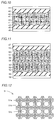
- Fig. 9 is a cross section showing an embodiment of the present invention.
- Fig. 10 is a cross section showing another embodiment of the present invention.
- Fig. 11 is a cross section showing a further embodiment of the present invention.
- Fig. 12 illustrates structure of a first bonding material layer 51 shown in Fig. 11.
- Fig. 13 is a cross section showing a still further embodiment of the present invention.
- Fig. 14 is a cross section showing a still further embodiment of the present invention.
- Fig. 15 is a cross section showing a still further embodiment of the present invention.
- Fig. 16 is a cross section showing a still further embodiment of the present invention.
- Fig. 17 is a cross section showing a still further embodiment of the present invention.
- the cushioning material for forming press shown in Fig. 9 includes two fiber material layers 31 and 32 positioned on upper and lower sides of a bonding material layer 30, respectively, an upper rubber layer 33 positioned on an upper surface of one fiber material layer 31, a lower rubber layer 34 positioned on a lower surface of the other fiber material layer 32, an upper exudation preventing layer 35 positioned on an upper surface of upper rubber layer 33 for preventing exudation of a compounding agent contained in upper rubber layer 33, and a lower exudation preventing layer 36 positioned on a lower surface of lower rubber layer 34 for preventing exudation of a compounding agent contained in lower rubber layer 34.
- a non-woven fabric, woven fabric or paper is used as fiber material layers 31 and 32. These two fiber material layers 31 and 32 may be formed of the same material or different materials.
- rubber having heat resistance may be used.
- fluoroelastomer EPM, EPDM, hydrogenated nitrile rubber, silicone rubber, acrylic rubber, butyl rubber or the like may be used.
- fluoroelastomer containing acrylic monomer is used.
- the acrylic monomer includes tetrahydrofurfuryl methacrylate, methoxy diethylene glycol methacrylate, phenoxy ethyl acrylate, phenoxy diethylene glycol acrylate, ethylene dimethacrylate, 1,3-butylene dimethacrylate, 1,4-butylene dimethacrylate, 1,6-hexanediol dimethacrylate, polyethylene glycol dimethacrylate, 1,4-butanediol diacrylate, 1,6-hexanediol diacrylate, 2,2'- bis (4-methacryloxy diethoxy phenyl) propane, 2,2'- bis (4-acryloxy diethoxy phenyl) propane, trimethylol propane triacrylate, trimethylol propane trimethacrylate and pentaerythritol triacrylate.
- fluoride resin film is most preferable as the exudation preventing layers 35 and 36.
- other materials can also be used.
- the exudation preventing layers 35 and 36 are directly adhered to rubber layers 34 and 35 without interposing any adhesive agent, and therefore the problems of uneven pressure and uneven temperature caused by the adhesive agent layer can be avoided.
- the cushioning material for forming press shown in Fig. 10 includes a non-woven fabric layer 40 containing a bonding material layer 41 therein, an upper rubber layer 42 positioned on an upper surface of non-woven fabric layer 40, a lower rubber layer 43 positioned on a lower surface of non-woven fabric layer 40, an upper exudation preventing layer 44 positioned on an upper surface of upper rubber layer 42, and a lower exudation preventing layer 45 positioned on a lower surface of lower rubber layer 43.
- Non-woven fabric layer 40 is formed of aromatic polyamide fiber.
- Bonding material 41 is a foundation fabric formed of aromatic polyamide fiber.
- Non-woven fabric layer 40 and foundation fabric 41 are needle punched, so that fibers enter meshes of the foundation fabric.
- the material of the upper and lower rubber layers 42 and 43 is fluoroelastomer containing acrylic monomer.
- Exudation preventing layers 44 and 45 are fluoride resin films.
- a cushioning material for forming press shown in Fig. 11 includes a lamination of a non-woven fabric layer 50 including a first bonding material layer 51 therein and a non-woven fabric layer 52 including a first bonding material layer 53 therein, with a second bonding material layer 54 interposed.
- An upper rubber layer 55 is positioned on an upper surface of non-woven fabric layer 50, and on its upper surface, an upper exudation preventing layer 57 is positioned.
- a lower rubber layer 56 is positioned on a lower surface of the other non-woven fabric layer 52, and on its lower surface, a lower exudation preventing layer 58 is positioned.
- Fig. 12 illustrates the structure of the first bonding material layer 51.
- the other first bonding material layer 53 has the identical structure.
- first bonding material layer 51 includes an open weave glass cloth 51a to which fluoroelastomer adhesive 51b is applied not sealing the mesh of the glass cloth.
- First bonding material layer 51 and non-woven fabric layer 50 are needle punched, and similarly, the other first bonding material layer 53 and non-woven fabric layer 52 are needle punched.
- first bonding material layer 51 has meshes 51c, and therefore fibers enter the meshes 51c. In this manner, by tangling of the fibers and the bonding material layer, expansion of non-woven fabric layers 50 and 52 in the planar direction is suppressed, and as a result, dimension in the thickness direction also is stabilized.
- An aromatic polyamide fiber is used as the non-woven fabric layers 50 and 52.
- the area weight of non-woven fabric layer 50 needle punched including the first bonding material layer 51 and the area weight of non-woven fabric layer 52 needle punched including the first bonding material layer 53 are both 650 g/m2.
- the second bonding material layer 54 is a glass cloth, to opposing surfaces of which fluoroelastomer adhesive agent is applied.
- the material of the upper and lower rubber layers 55 and 56 is a fluoroelastomer containing acrylic monomer.
- the material of the upper and lower exudation preventing layers 57 and 58 is a fluoride resin film.
- first bonding material layer and the non-woven fabric layer are bonded not only by the tangling of fibers but also by adhesion, bonding force is stronger than when they are bonded simply by needle punching. Therefore, dimensional stability of the bonded non-woven fabric layers (50 and 51 as well as 52 and 53) is improved.
- a cushioning material for forming press shown in Fig. 13 includes three bonded non-woven fabric layers 60, 61 and 62.
- Bonded non-woven fabric layers 60, 61 and 62 are non-woven fabric layers 60a, 61a, and 62a including first bonding material layers 60b, 61b and 62b therein, respectively, and these are needle punched.
- Area weight of each of the bonded non-woven fabric layers 60, 61 and 62 is 450 g/m2.
- the bonded non-woven fabric layers 60, 61 and 62 are bonded by means of second bonding material layers 63 and 64.
- an upper rubber layer 65 is positioned, and on its upper surface, an upper exudation preventing layer 67 is positioned.
- a lower rubber layer 66 is positioned, and on its lower surface, a lower exudation preventing layer 68 is positioned.
- Non-woven fabric layers 60a, 61a and 62a are formed of aromatic polyamide fiber.
- the second bonding material layers 63 and 64 are prepared by applying fluoroelastomer adhesive to opposing surfaces of a glass cloth.
- the material of rubber layers 65 and 66 is a fluoroelastomer including acrylic monomer.
- Exudation preventing layers 67 and 68 are formed of fluoride resin films.
- Embodiment 4 differs from that of Embodiment 3 first in that three bonded non-woven fabric layers are superimposed, and secondly, that the area weight of the bonded non-woven fabric layer is small. Since a number of bonded non-woven fabric layers each having smaller area weight are superimposed, the precision of area weight as a whole can be improved. However, as for the cushioning property, that of the second embodiment is superior.
- a cushioning material for forming press shown in Fig. 14 includes three paper layers 70, 71 and 72.
- the paper layer is paper like material prepared by mixing aromatic polyamide fiber and rock wool.
- the paper layers 70, 71 and 72 are bonded by means of bonding material layers 73 and 74.
- Bonding material layers 73 and 74 are prepared by applying a fluoroelastomer adhesive agent on opposing surfaces of a glass cloth.
- an upper rubber layer 75 is positioned, and on its upper surface, an upper exudation preventing layer 77 is positioned.
- a lower rubber layer 76 is positioned, and on its lower surface, a lower exudation preventing layer 78 is positioned.
- Upper and lower rubber layers 75 and 76 are formed of a fluoroelastomer including acrylic monomer.
- Exudation preventing layers 77 and 78 are fluoride resin films.
- Embodiment 5 The feature of Embodiment 5 is as follows.
- the area weight and the thickness precision of the paper layer itself are better than those of non-woven fabric. Therefore, precision of area weight as a whole can be improved. Further, since rubber layers are superimposed on the surfaces, cushioning property is better as compared with conventional cushioning material formed of paper made by mixing materials. Further, it does not have any ups and downs on its surfaces. However, as compared with Embodiments 2, 3 and 4 above and Embodiments 6, 7 and 8 which will be described in the following, cushioning property is inferior.
- a cushioning material for forming press shown in Fig. 15 has a woven fabric layer 80 at its center, and bonding material layers 81 and 82 on its upper and lower surfaces.
- a bonded non-woven fabric layer 83 is positioned on an upper surface of one bonding material layer 81.
- Bonded non-woven fabric layer 83 includes non-woven fabric layer 83a needle punched together with a bonding material layer 83b therein.
- a bonded non-woven fabric layer 84 is positioned on a lower surface of the other bonding material layer 82.
- Bonded non-woven fabric layer 84 also includes a non-woven fabric layer 84a which is needle punched together with a bonding material layer 84b therein.
- an upper rubber layer 85 is positioned, and further on its upper surface, an upper exudation preventing layer 87 is positioned.
- a lower rubber layer 86 is positioned, and on its lower surface, a lower exudation preventing layer 88 is positioned.
- the woven fabric layer 80 is formed of a multiple-ply woven cloth of aromatic polyamide fiber.
- Bonding material layers 81 and 82 are prepared by applying a fluoroelastomer adhesive agent on opposing surfaces of a glass cloth.
- Bonded non-woven fabric layers 83 and 84 have the same structure as the bonded non-woven fabric layer of Embodiment 4.
- Rubber layers 85 and 86 are of fluoroelastomer including acrylic monomer, and exudation preventing layers 87 and 88 are fluoride resin films.
- Embodiment 6 The feature of Embodiment 6 is that unevenness of area weight and poor dimensional stability which are the inherent disadvantages of the non-woven fabric are compensated for by the woven fabric layer 80, and that superior cushioning property, which is the advantage of the non-woven fabric, is fully exhibited.
- a cushioning material for forming press shown in Fig. 16 includes two bonded non-woven fabric layers 91 and 92 superimposed with a second bonding material layer 90 interposed.
- an upper rubber layer 93 is positioned, and on its upper surface, an upper exudation preventing layer 95 is positioned.
- a lower rubber layer 94 is positioned, and on its lower surface, a lower exudation preventing layer 96 is positioned.
- the upper bonded non-woven fabric layer 91 includes a non-woven fabric layer 91a needle punched together with a bonding material layer 91b therein.
- the lower bonded non-woven fabric layer 92 also includes a non-woven fabric layer 92a needle punched together with a bonding material layer 92b therein.
- Embodiment 7 shown in Fig. 16 is the same as Embodiment 3 shown in Fig. 11.
- Embodiment 7 has greater effect of absorbing unevenness in pressure derived from uneven area weight and ups and downs of the surfaces of the non-woven fabric layer.
- a cushioning material for forming press shown in Fig. 17 includes two bonded non-woven fabric layers 102 and 103 superimposed with a second bonding material layer 101 interposed.
- the upper bonded non-woven fabric layer 102 is prepared by needle punching a non-woven fabric layer 102a formed of an aromatic polyamide fiber and a bonding material layer 102b therein.
- the lower bonded non-woven fabric layer 103 is prepared by needle punching a non-woven fabric layer 103a formed of an aromatic polyamide fiber with a bonding material layer 103b positioned therein. Bonding material layers 102b and 103b have the same structure as the first bonding material layer 51 used in Embodiment 3.
- the second bonding material layer 101 includes a fluoroelastomer sheet 101a and a reinforcing woven fabric 101b of glass cloth embedded therein.
- a rubber layer 104 is positioned, and further thereon, an upper exudation preventing layer 106 is positioned.
- an upper exudation preventing layer 106 is positioned on an upper surface of the upper bonded non-woven fabric layer 102, and further thereon, an upper exudation preventing layer 106 is positioned.
- a lower rubber layer 105 is positioned, and further therebelow, a lower exudation preventing layer 107 is positioned.
- the upper and lower exudation preventing layers 106 and 107 include glass cloths 106a and 107a, fluoroelastomers 106b and 107b applied thereto, and polyamide resin 106c and 107c applied further thereto.
- Upper and lower rubber layers 104 and 105 are fluoroelastomer applied to the rear surfaces of upper and lower exudation preventing layers 106 and 107.
- a stack of 15 sheets of kraft paper A stack of 15 sheets of kraft paper.
- This example has the structure shown in Fig. 2. Silicone rubber was used as rubber sheet 8, and a plain woven fabric of an aromatic polyamide fiber was used as reinforcing woven fabric 9.
- This example has the structure shown in Fig. 3.
- An aromatic polyamide fiber was used as needle punched non-woven fabric 10 and a foundation fabric of an aromatic polyamide fiber was used as reinforcing foundation fabric 11.
- This example has the structure shown in Fig. 4.
- An aromatic polyamide fiber was used as needle punched non-woven fabric 14
- a foundation fabric of an aromatic polyamide fiber was used as the reinforcing foundation fabric
- EPDM was used as rubber layer 13
- a mock leno of glass cloth was used as the reinforcing woven fabric 12.
- This example has the structure shown in Fig. 5.
- An aromatic polyamide fiber was used as needle punched non-woven fabric 16
- a foundation fabric of an aromatic polyamide fiber was used as the reinforcing foundation fabric
- an adhesive material of a glass cloth impregnated with epoxy resin was used as adhesive material layer 18.
- This example has the structure shown in Fig. 6.
- paper like material 19 formed by mixing a paper like material prepared by mixing an aromatic polyamide fiber and rock wool was used.
- This example has the structure shown in Fig. 7. Silicone rubber was used for rubber layer 21, and an aromatic polyamide fiber was used as needle punched non-woven fabric 20.
Landscapes
- Engineering & Computer Science (AREA)
- Mechanical Engineering (AREA)
- Textile Engineering (AREA)
- Laminated Bodies (AREA)
- Casting Or Compression Moulding Of Plastics Or The Like (AREA)
- Moulding By Coating Moulds (AREA)
Applications Claiming Priority (3)
| Application Number | Priority Date | Filing Date | Title |
|---|---|---|---|
| JP22655294 | 1994-09-21 | ||
| JP226552/94 | 1994-09-21 | ||
| JP6226552A JP2649899B2 (ja) | 1994-09-21 | 1994-09-21 | 成形プレス用クッション材 |
Publications (2)
| Publication Number | Publication Date |
|---|---|
| EP0703069A1 true EP0703069A1 (de) | 1996-03-27 |
| EP0703069B1 EP0703069B1 (de) | 2000-06-07 |
Family
ID=16846950
Family Applications (1)
| Application Number | Title | Priority Date | Filing Date |
|---|---|---|---|
| EP95114311A Expired - Lifetime EP0703069B1 (de) | 1994-09-21 | 1995-09-12 | Dämpfungsmaterial für Formpresse |
Country Status (8)
| Country | Link |
|---|---|
| US (1) | US6514888B1 (de) |
| EP (1) | EP0703069B1 (de) |
| JP (1) | JP2649899B2 (de) |
| KR (1) | KR100186849B1 (de) |
| CN (1) | CN1068276C (de) |
| DE (1) | DE69517378T2 (de) |
| MY (1) | MY112925A (de) |
| TW (2) | TW378605U (de) |
Cited By (9)
| Publication number | Priority date | Publication date | Assignee | Title |
|---|---|---|---|---|
| EP0839639A1 (de) * | 1996-10-30 | 1998-05-06 | RHEINISCHE FILZTUCHFABRIK GmbH | Asbestos-free press pad |
| EP0842764A1 (de) * | 1996-11-13 | 1998-05-20 | RHEINISCHE FILZTUCHFABRIK GmbH | Presspolster, bestehend aus einem textilen Garn |
| EP1040909A1 (de) * | 1999-03-03 | 2000-10-04 | Thomas Josef Heimbach Gesellschaft mit beschränkter Haftung & Co. | Presspolster |
| EP1084821A3 (de) * | 1999-09-17 | 2002-01-02 | Ichikawa Co.,Ltd. | Hitzebeständiges Polstermaterial für Formpresse |
| WO2002002304A1 (de) * | 2000-07-05 | 2002-01-10 | Rheinische Filztuchfabrik Gmbh | Presspolster |
| US6391460B1 (en) | 1998-08-06 | 2002-05-21 | Yamauchi Corporation | Rubber for hot press cushioning pad, manufacturing method thereof, hot press cushioning pad and method of manufacturing printed circuit board |
| EP1632531A4 (de) * | 2003-06-09 | 2007-07-04 | Yamauchi Corp | Vulkanisierter fluorkautschuk und polstermaterial für heisspresse damit |
| EP1462233A4 (de) * | 2001-11-09 | 2007-10-17 | Yamauchi Corp | Polstermaterial zum heisspressen und verfahren zum herstellen einer geschichteten platte |
| EP3162527A4 (de) * | 2014-06-30 | 2017-12-06 | Yamauchi Corporation | Dämpfungsmaterial für warmwalze und herstellungsverfahren dafür |
Families Citing this family (31)
| Publication number | Priority date | Publication date | Assignee | Title |
|---|---|---|---|---|
| CN1081128C (zh) * | 1999-08-18 | 2002-03-20 | 湖北省化学研究所 | 软性印刷电路板专用的高分子塑料薄膜双面复合金属板的制造方法 |
| JP2001315248A (ja) * | 2000-05-01 | 2001-11-13 | Chuko Kasei Kogyo Kk | 複合シート |
| DE20102021U1 (de) * | 2001-02-03 | 2002-06-13 | Sachsenring Automobiltechnik AG, 08058 Zwickau | Material mit hoher mechanischer Belastbarkeit, sowie Verwendung desselben |
| US7776446B2 (en) * | 2001-06-04 | 2010-08-17 | Saint-Gobain Performance Plastics Corporation | Multi-layer release films |
| JP3733880B2 (ja) * | 2001-07-23 | 2006-01-11 | 株式会社 日立インダストリイズ | フィルム貼付装置 |
| JP3920611B2 (ja) * | 2001-09-28 | 2007-05-30 | ヤマウチ株式会社 | 熱プレス用クッション材およびその製造方法 |
| JP4183558B2 (ja) * | 2003-05-26 | 2008-11-19 | ヤマウチ株式会社 | 熱プレス用シート |
| US20050205749A1 (en) * | 2003-10-21 | 2005-09-22 | Campbell Scott D | Fiber mesh reinforced elastomeric vibration isolation pads |
| US7160413B2 (en) * | 2004-01-09 | 2007-01-09 | Mipox International Corporation | Layered support and method for laminating CMP pads |
| JP2006116596A (ja) * | 2004-05-28 | 2006-05-11 | Mitsuboshi Belting Ltd | 耐熱性プレス用緩衝材 |
| JP4837264B2 (ja) | 2004-07-14 | 2011-12-14 | ヤマウチ株式会社 | 熱プレス用クッション材 |
| US7776428B2 (en) * | 2006-02-13 | 2010-08-17 | Saint-Gobain Performance Plastics Corporation | Multi-layer release films |
| US20070202311A1 (en) * | 2006-02-28 | 2007-08-30 | Saint-Gobain Performance Plastics Corporation | Multi-layer release films |
| US20070206364A1 (en) * | 2006-03-02 | 2007-09-06 | Saint-Gobain Performance Plastics Corporation | Methods of forming a flexible circuit board |
| JP5204429B2 (ja) * | 2007-05-23 | 2013-06-05 | 三ツ星ベルト株式会社 | 熱プレス用クッション材 |
| JP5386200B2 (ja) * | 2008-04-30 | 2014-01-15 | 中興化成工業株式会社 | 複合シート |
| JP2010023504A (ja) * | 2008-06-19 | 2010-02-04 | Yamakatsu Labo:Kk | クッション性シート及びその製法 |
| JP2010260216A (ja) * | 2009-04-30 | 2010-11-18 | Nippon Valqua Ind Ltd | フッ素樹脂成形体およびその製造方法 |
| KR20120046252A (ko) * | 2009-07-23 | 2012-05-09 | 생-고뱅 퍼포먼스 플라스틱스 코포레이션 | 복합 완충 구조물 |
| JP5406002B2 (ja) * | 2009-12-18 | 2014-02-05 | クレハエラストマー株式会社 | 表面凹凸吸収用薄膜積層シート |
| CN102343703B (zh) * | 2010-08-04 | 2013-12-11 | 得万利科技股份有限公司 | 热压机用的缓冲材及其应用 |
| JP5685063B2 (ja) * | 2010-11-26 | 2015-03-18 | ヤマウチ株式会社 | 熱プレス用クッション材 |
| CN102729522B (zh) * | 2012-07-16 | 2014-09-03 | 李彭 | 一种折叠型珍珠棉包装件及其制作方法 |
| JP5726141B2 (ja) * | 2012-08-17 | 2015-05-27 | ヤマウチ株式会社 | 熱プレス用クッション材 |
| CN103837249B (zh) * | 2012-11-20 | 2016-12-21 | 深南电路有限公司 | 热盘温度均匀性的测试方法及测试装置 |
| DE102014010308B4 (de) * | 2014-07-02 | 2016-10-27 | Staedtler Mars Gmbh & Co. Kg | Schreib-, Zeichen-, Markier- und/oder Malgerät oder Kosmetikgerät oder Eingabegerät für berührungsempfindliche Oberflächen und Verfahren zu dessen Herstellung |
| CN104527171B (zh) * | 2015-01-16 | 2016-08-17 | 南京禄浦材料科技有限公司 | 一种硅氟橡胶板及其制备方法 |
| DE202015006923U1 (de) * | 2015-10-02 | 2015-10-16 | Rolf Espe | Presspolster für den Einsatz in hydraulischen Ein- oder Mehretagenheizpressen |
| JP7140381B2 (ja) * | 2018-10-09 | 2022-09-21 | ヤマウチ株式会社 | 熱プレス用クッション材および熱プレス用クッション材の製造方法 |
| CN111844963B (zh) * | 2020-08-14 | 2024-10-22 | 广东硕成科技股份有限公司 | 覆铜板层压复合材料阻热耐温弹性胶垫及其制造方法 |
| CN113099619B (zh) * | 2021-04-16 | 2025-07-25 | 广东硕成科技股份有限公司 | 线路板多层压合定位缓热缓冲垫、制造方法及其制造设备 |
Citations (8)
| Publication number | Priority date | Publication date | Assignee | Title |
|---|---|---|---|---|
| DE2627442A1 (de) * | 1976-06-18 | 1977-12-29 | Becker & Van Huellen | Presspolster fuer heizplattenpressen |
| GB1571266A (en) * | 1977-04-28 | 1980-07-09 | Habasit Ag | Dimentsionally stable synthetic conveyor belt |
| JPS5772812A (en) * | 1980-10-23 | 1982-05-07 | Yamauchi Rubber Ind Co Ltd | Production of cushioning material for molding press |
| US4461800A (en) * | 1981-11-27 | 1984-07-24 | Yamauchi Rubber Industry Co., Ltd. | Press pad for forming press |
| EP0123230A2 (de) * | 1983-04-15 | 1984-10-31 | Mitsubishi Paper Mills, Ltd. | Dämpfungsmaterial für die Schichtenbildung unter Heisspressung und für das Druckformen |
| DE3907453A1 (de) * | 1989-03-08 | 1990-09-20 | Clouth Gummiwerke Ag | Beschichteter, insbesondere gummierter textilstoff und verfahren zu seiner herstellung |
| WO1993018913A1 (en) * | 1992-03-25 | 1993-09-30 | Reeves Brothers, Inc. | Compressible ply for printing blankets |
| JPH0746945A (ja) | 1993-08-05 | 1995-02-21 | Nakata Enman Kk | 動物等の排便処理装置 |
Family Cites Families (3)
| Publication number | Priority date | Publication date | Assignee | Title |
|---|---|---|---|---|
| US4804576A (en) * | 1985-02-28 | 1989-02-14 | Canon Kabushiki Kaisha | Elastic rotatable member |
| IT1238678B (it) * | 1990-01-26 | 1993-09-01 | Reeves Spa | Tessuto per rivestimento di cilindri di un impianto di stampa, avente bassa affinita' per l'inchiostro |
| US5364683A (en) * | 1992-02-14 | 1994-11-15 | Reeves Brothers, Inc. | Compressible printing blanket and method of making same |
-
1994
- 1994-09-21 JP JP6226552A patent/JP2649899B2/ja not_active Expired - Fee Related
-
1995
- 1995-08-29 TW TW086216974U patent/TW378605U/zh unknown
- 1995-08-29 TW TW086215514U patent/TW373570U/zh unknown
- 1995-09-07 MY MYPI95002657A patent/MY112925A/en unknown
- 1995-09-12 DE DE69517378T patent/DE69517378T2/de not_active Expired - Fee Related
- 1995-09-12 EP EP95114311A patent/EP0703069B1/de not_active Expired - Lifetime
- 1995-09-20 KR KR1019950030854A patent/KR100186849B1/ko not_active Expired - Fee Related
- 1995-09-21 CN CN95117605A patent/CN1068276C/zh not_active Expired - Fee Related
-
1997
- 1997-07-10 US US08/890,882 patent/US6514888B1/en not_active Expired - Fee Related
Patent Citations (8)
| Publication number | Priority date | Publication date | Assignee | Title |
|---|---|---|---|---|
| DE2627442A1 (de) * | 1976-06-18 | 1977-12-29 | Becker & Van Huellen | Presspolster fuer heizplattenpressen |
| GB1571266A (en) * | 1977-04-28 | 1980-07-09 | Habasit Ag | Dimentsionally stable synthetic conveyor belt |
| JPS5772812A (en) * | 1980-10-23 | 1982-05-07 | Yamauchi Rubber Ind Co Ltd | Production of cushioning material for molding press |
| US4461800A (en) * | 1981-11-27 | 1984-07-24 | Yamauchi Rubber Industry Co., Ltd. | Press pad for forming press |
| EP0123230A2 (de) * | 1983-04-15 | 1984-10-31 | Mitsubishi Paper Mills, Ltd. | Dämpfungsmaterial für die Schichtenbildung unter Heisspressung und für das Druckformen |
| DE3907453A1 (de) * | 1989-03-08 | 1990-09-20 | Clouth Gummiwerke Ag | Beschichteter, insbesondere gummierter textilstoff und verfahren zu seiner herstellung |
| WO1993018913A1 (en) * | 1992-03-25 | 1993-09-30 | Reeves Brothers, Inc. | Compressible ply for printing blankets |
| JPH0746945A (ja) | 1993-08-05 | 1995-02-21 | Nakata Enman Kk | 動物等の排便処理装置 |
Non-Patent Citations (1)
| Title |
|---|
| DATABASE WPI Section Ch Week 8224, Derwent World Patents Index; Class A32, AN 82-48830E * |
Cited By (13)
| Publication number | Priority date | Publication date | Assignee | Title |
|---|---|---|---|---|
| US6339032B2 (en) | 1996-10-30 | 2002-01-15 | Rheinische Filztuchfabrik Gmbh | Press pad made of asbestos-free material |
| EP0839639A1 (de) * | 1996-10-30 | 1998-05-06 | RHEINISCHE FILZTUCHFABRIK GmbH | Asbestos-free press pad |
| EP0842764A1 (de) * | 1996-11-13 | 1998-05-20 | RHEINISCHE FILZTUCHFABRIK GmbH | Presspolster, bestehend aus einem textilen Garn |
| US6391460B1 (en) | 1998-08-06 | 2002-05-21 | Yamauchi Corporation | Rubber for hot press cushioning pad, manufacturing method thereof, hot press cushioning pad and method of manufacturing printed circuit board |
| AU730032B2 (en) * | 1999-03-03 | 2001-02-22 | Thomas Josef Heimbach Gesellschaft Mit Beschrankter Haftung & Co. | Pressing cushion |
| EP1040909A1 (de) * | 1999-03-03 | 2000-10-04 | Thomas Josef Heimbach Gesellschaft mit beschränkter Haftung & Co. | Presspolster |
| EP1084821A3 (de) * | 1999-09-17 | 2002-01-02 | Ichikawa Co.,Ltd. | Hitzebeständiges Polstermaterial für Formpresse |
| WO2002002304A1 (de) * | 2000-07-05 | 2002-01-10 | Rheinische Filztuchfabrik Gmbh | Presspolster |
| EP1462233A4 (de) * | 2001-11-09 | 2007-10-17 | Yamauchi Corp | Polstermaterial zum heisspressen und verfahren zum herstellen einer geschichteten platte |
| EP1632531A4 (de) * | 2003-06-09 | 2007-07-04 | Yamauchi Corp | Vulkanisierter fluorkautschuk und polstermaterial für heisspresse damit |
| US7671133B2 (en) | 2003-06-09 | 2010-03-02 | Yamauchi Corporation | Vulcanized fluorine rubber and cushioning material for heat press containing same |
| EP3162527A4 (de) * | 2014-06-30 | 2017-12-06 | Yamauchi Corporation | Dämpfungsmaterial für warmwalze und herstellungsverfahren dafür |
| US10272642B2 (en) | 2014-06-30 | 2019-04-30 | Yamauchi Corporation | Hot press cushioning material and manufacturing method thereof |
Also Published As
| Publication number | Publication date |
|---|---|
| MY112925A (en) | 2001-10-31 |
| US6514888B1 (en) | 2003-02-04 |
| KR100186849B1 (ko) | 1999-04-01 |
| DE69517378T2 (de) | 2001-01-04 |
| TW373570U (en) | 1999-11-01 |
| TW378605U (en) | 2000-01-01 |
| JP2649899B2 (ja) | 1997-09-03 |
| CN1068276C (zh) | 2001-07-11 |
| DE69517378D1 (de) | 2000-07-13 |
| KR960010242A (ko) | 1996-04-20 |
| JPH0890577A (ja) | 1996-04-09 |
| EP0703069B1 (de) | 2000-06-07 |
| CN1129171A (zh) | 1996-08-21 |
Similar Documents
| Publication | Publication Date | Title |
|---|---|---|
| EP0703069B1 (de) | Dämpfungsmaterial für Formpresse | |
| JP2760904B2 (ja) | 可撓性グラファイトラミネートおよびその製法 | |
| KR100551341B1 (ko) | 열 프레스용 쿠션재 및 그 제조방법 | |
| KR920002859A (ko) | 엘라스토머성 함침 부직재료 | |
| US20060014463A1 (en) | Cushioning pad for hot press | |
| EP1084821B1 (de) | Hitzebeständiges Polstermaterial für Formpresse | |
| US20020079053A1 (en) | Cushioning material for forming press | |
| JP2778347B2 (ja) | 積層板成形用クッション材 | |
| JP3121175B2 (ja) | 耐熱クッション材 | |
| JP3003249B2 (ja) | クッション材 | |
| EP0472177B1 (de) | Matter Film | |
| JP3528466B2 (ja) | 耐熱性、耐摩耗性に優れた積層体 | |
| JP2001088156A (ja) | 成型プレス用耐熱クッション材 | |
| JP3233775B2 (ja) | 金属コア両面化粧板 | |
| CN1279153A (zh) | 热压成型用复合耐热垫材料 | |
| JP2557350Y2 (ja) | 板 材 | |
| JP2002192657A (ja) | 化粧板 | |
| TH10360B (th) | วัสดุการทำเบาะเพื่อการอัดขึ้นรูป | |
| TH21378A (th) | วัสดุการทำเบาะเพื่อการอัดขึ้นรูป | |
| JPH07256670A (ja) | 成形プレス用クッション材 | |
| JPH07156335A (ja) | 成形プレス用クッション材 | |
| JPS62196148A (ja) | 補強用シ−ト | |
| JPS6119353A (ja) | クツシヨン材 | |
| TH5664A (th) | ซิปชนิดยืดได้ | |
| JPH05111916A (ja) | 積層板の製造方法 |
Legal Events
| Date | Code | Title | Description |
|---|---|---|---|
| PUAI | Public reference made under article 153(3) epc to a published international application that has entered the european phase |
Free format text: ORIGINAL CODE: 0009012 |
|
| 17P | Request for examination filed |
Effective date: 19960110 |
|
| AK | Designated contracting states |
Kind code of ref document: A1 Designated state(s): BE DE FR GB IT |
|
| 17Q | First examination report despatched |
Effective date: 19980916 |
|
| GRAG | Despatch of communication of intention to grant |
Free format text: ORIGINAL CODE: EPIDOS AGRA |
|
| GRAG | Despatch of communication of intention to grant |
Free format text: ORIGINAL CODE: EPIDOS AGRA |
|
| GRAG | Despatch of communication of intention to grant |
Free format text: ORIGINAL CODE: EPIDOS AGRA |
|
| GRAH | Despatch of communication of intention to grant a patent |
Free format text: ORIGINAL CODE: EPIDOS IGRA |
|
| GRAH | Despatch of communication of intention to grant a patent |
Free format text: ORIGINAL CODE: EPIDOS IGRA |
|
| GRAA | (expected) grant |
Free format text: ORIGINAL CODE: 0009210 |
|
| AK | Designated contracting states |
Kind code of ref document: B1 Designated state(s): BE DE FR GB IT |
|
| REF | Corresponds to: |
Ref document number: 69517378 Country of ref document: DE Date of ref document: 20000713 |
|
| ITF | It: translation for a ep patent filed | ||
| ET | Fr: translation filed | ||
| PLBE | No opposition filed within time limit |
Free format text: ORIGINAL CODE: 0009261 |
|
| STAA | Information on the status of an ep patent application or granted ep patent |
Free format text: STATUS: NO OPPOSITION FILED WITHIN TIME LIMIT |
|
| 26N | No opposition filed | ||
| REG | Reference to a national code |
Ref country code: GB Ref legal event code: IF02 |
|
| PGFP | Annual fee paid to national office [announced via postgrant information from national office to epo] |
Ref country code: GB Payment date: 20070921 Year of fee payment: 13 |
|
| PGFP | Annual fee paid to national office [announced via postgrant information from national office to epo] |
Ref country code: IT Payment date: 20070925 Year of fee payment: 13 Ref country code: DE Payment date: 20070926 Year of fee payment: 13 Ref country code: BE Payment date: 20070921 Year of fee payment: 13 |
|
| PGFP | Annual fee paid to national office [announced via postgrant information from national office to epo] |
Ref country code: FR Payment date: 20070926 Year of fee payment: 13 |
|
| BERE | Be: lapsed |
Owner name: *YAMAUCHI CORP. Effective date: 20080930 |
|
| GBPC | Gb: european patent ceased through non-payment of renewal fee |
Effective date: 20080912 |
|
| REG | Reference to a national code |
Ref country code: FR Ref legal event code: ST Effective date: 20090529 |
|
| PG25 | Lapsed in a contracting state [announced via postgrant information from national office to epo] |
Ref country code: BE Free format text: LAPSE BECAUSE OF NON-PAYMENT OF DUE FEES Effective date: 20080930 |
|
| PG25 | Lapsed in a contracting state [announced via postgrant information from national office to epo] |
Ref country code: IT Free format text: LAPSE BECAUSE OF NON-PAYMENT OF DUE FEES Effective date: 20080912 Ref country code: DE Free format text: LAPSE BECAUSE OF NON-PAYMENT OF DUE FEES Effective date: 20090401 |
|
| PG25 | Lapsed in a contracting state [announced via postgrant information from national office to epo] |
Ref country code: FR Free format text: LAPSE BECAUSE OF NON-PAYMENT OF DUE FEES Effective date: 20080930 |
|
| PG25 | Lapsed in a contracting state [announced via postgrant information from national office to epo] |
Ref country code: GB Free format text: LAPSE BECAUSE OF NON-PAYMENT OF DUE FEES Effective date: 20080912 |