EP0704443B1 - Dérivés de l'acide quinolone et naphthyridonecarboxylique - Google Patents
Dérivés de l'acide quinolone et naphthyridonecarboxylique Download PDFInfo
- Publication number
- EP0704443B1 EP0704443B1 EP95111579A EP95111579A EP0704443B1 EP 0704443 B1 EP0704443 B1 EP 0704443B1 EP 95111579 A EP95111579 A EP 95111579A EP 95111579 A EP95111579 A EP 95111579A EP 0704443 B1 EP0704443 B1 EP 0704443B1
- Authority
- EP
- European Patent Office
- Prior art keywords
- methyl
- oxo
- azatricyclo
- represents hydrogen
- dihydro
- Prior art date
- Legal status (The legal status is an assumption and is not a legal conclusion. Google has not performed a legal analysis and makes no representation as to the accuracy of the status listed.)
- Expired - Lifetime
Links
- IFWNYSOCYJKLRZ-UHFFFAOYSA-N CCC(C)(C)N(C=C(C(O)=O)C(c1c2)=O)c1cc(N(CC1C(CC3)C=C4)CC1C34N)c2F Chemical compound CCC(C)(C)N(C=C(C(O)=O)C(c1c2)=O)c1cc(N(CC1C(CC3)C=C4)CC1C34N)c2F IFWNYSOCYJKLRZ-UHFFFAOYSA-N 0.000 description 1
- UANPKLYMKQNGPT-UHFFFAOYSA-N NC1(CC2)C(CN(C3)c(c(F)cc4c5N67)c5OCC6=CSC7=C(C(O)=O)C4=O)C3C2CC1 Chemical compound NC1(CC2)C(CN(C3)c(c(F)cc4c5N67)c5OCC6=CSC7=C(C(O)=O)C4=O)C3C2CC1 UANPKLYMKQNGPT-UHFFFAOYSA-N 0.000 description 1
Classifications
-
- C—CHEMISTRY; METALLURGY
- C07—ORGANIC CHEMISTRY
- C07D—HETEROCYCLIC COMPOUNDS
- C07D401/00—Heterocyclic compounds containing two or more hetero rings, having nitrogen atoms as the only ring hetero atoms, at least one ring being a six-membered ring with only one nitrogen atom
- C07D401/02—Heterocyclic compounds containing two or more hetero rings, having nitrogen atoms as the only ring hetero atoms, at least one ring being a six-membered ring with only one nitrogen atom containing two hetero rings
- C07D401/04—Heterocyclic compounds containing two or more hetero rings, having nitrogen atoms as the only ring hetero atoms, at least one ring being a six-membered ring with only one nitrogen atom containing two hetero rings directly linked by a ring-member-to-ring-member bond
-
- A—HUMAN NECESSITIES
- A61—MEDICAL OR VETERINARY SCIENCE; HYGIENE
- A61P—SPECIFIC THERAPEUTIC ACTIVITY OF CHEMICAL COMPOUNDS OR MEDICINAL PREPARATIONS
- A61P31/00—Antiinfectives, i.e. antibiotics, antiseptics, chemotherapeutics
- A61P31/04—Antibacterial agents
-
- C—CHEMISTRY; METALLURGY
- C07—ORGANIC CHEMISTRY
- C07D—HETEROCYCLIC COMPOUNDS
- C07D471/00—Heterocyclic compounds containing nitrogen atoms as the only ring hetero atoms in the condensed system, at least one ring being a six-membered ring with one nitrogen atom, not provided for by groups C07D451/00 - C07D463/00
- C07D471/02—Heterocyclic compounds containing nitrogen atoms as the only ring hetero atoms in the condensed system, at least one ring being a six-membered ring with one nitrogen atom, not provided for by groups C07D451/00 - C07D463/00 in which the condensed system contains two hetero rings
- C07D471/04—Ortho-condensed systems
-
- C—CHEMISTRY; METALLURGY
- C07—ORGANIC CHEMISTRY
- C07D—HETEROCYCLIC COMPOUNDS
- C07D498/00—Heterocyclic compounds containing in the condensed system at least one hetero ring having nitrogen and oxygen atoms as the only ring hetero atoms
- C07D498/02—Heterocyclic compounds containing in the condensed system at least one hetero ring having nitrogen and oxygen atoms as the only ring hetero atoms in which the condensed system contains two hetero rings
- C07D498/06—Peri-condensed systems
-
- C—CHEMISTRY; METALLURGY
- C07—ORGANIC CHEMISTRY
- C07D—HETEROCYCLIC COMPOUNDS
- C07D513/00—Heterocyclic compounds containing in the condensed system at least one hetero ring having nitrogen and sulfur atoms as the only ring hetero atoms, not provided for in groups C07D463/00, C07D477/00 or C07D499/00 - C07D507/00
- C07D513/02—Heterocyclic compounds containing in the condensed system at least one hetero ring having nitrogen and sulfur atoms as the only ring hetero atoms, not provided for in groups C07D463/00, C07D477/00 or C07D499/00 - C07D507/00 in which the condensed system contains two hetero rings
- C07D513/04—Ortho-condensed systems
-
- C—CHEMISTRY; METALLURGY
- C07—ORGANIC CHEMISTRY
- C07D—HETEROCYCLIC COMPOUNDS
- C07D513/00—Heterocyclic compounds containing in the condensed system at least one hetero ring having nitrogen and sulfur atoms as the only ring hetero atoms, not provided for in groups C07D463/00, C07D477/00 or C07D499/00 - C07D507/00
- C07D513/12—Heterocyclic compounds containing in the condensed system at least one hetero ring having nitrogen and sulfur atoms as the only ring hetero atoms, not provided for in groups C07D463/00, C07D477/00 or C07D499/00 - C07D507/00 in which the condensed system contains three hetero rings
- C07D513/16—Peri-condensed systems
Definitions
- the invention relates to new quinolone and naphthyriconcarboxylic acid derivatives, in the 7-position by a tricyclic amine residue substitutes their salts, process for their preparation and antibacterial agents containing them.
- the compounds of the formula (II) used as starting compounds are known or can be prepared by known methods. They can be used both as racemic and as enantiomerically pure compounds. Examples include: 7-chloro-1-cyclopropyl-6-fluoro-1,4-dihydro-4-oxo-3-quinolinecarboxylic acid, 1-cyclopropyl-6,7-difluoro-1,4-dihydro-4-oxo-3-quinolinecarboxylic acid, 6-chloro-1-cyclopropyl-7,8-difluoro-1,4-dihydro-4-oxo-3-quinolinecarboxylic acid, 8-chloro-1-cyclopropyl-6,7-difluoro-1,4-dihydro-4- oxo-3-quinolinecarboxylic acid, 1-cyclopropyl-6,7,8-trifluoro-1,4-dihydro-4-oxo-3-quinolinecarboxylic acid, 5-bromo
- Monomethylated diamines (11) or (12) can be prepared, for example, by acylation of (5) with a chloroformate and subsequent reduction to (11) or (12).
- tricyclic amines of the formula (III) are: 4-azatricyclo [5.2.1.0 2,6 ] dec-8-en-1-ylamine, 4-azatricyclo [5.2.2.0 2,6 ] undec-8-en-1-ylamine, 4-azatricyclo [5.2.1.0 2 , 6 ] dec-8-en-1-ylamine-N-carboxylic acid tert-butyl ester, 4-azatricyclo [5.2.2.0 2,6 ] undec-8-en-1-ylamine-N-carboxylic acid tert-butyl ester , (4-Azatricyclo [5.2.1.0 2,6 ] dec-8-en-1-yl) methylamine, (4-azatricyclo [5.2.2.0 2,6 ] undec-8-en-1-yl) -methylamine, (4-azatricyclo [5.2.1.0 2.6 ] dec-8-en-1-yl) dimethylamine, (4-azatricyclo [5.2.2.0 2.6 ] undec-8-en-1-
- reaction of (II) with (III), in which the compounds (III) also in the form of their Salts, such as the hydrochloride, can be used preferably in a diluent such as dimethyl sulfoxide, N, N-dimethylformamide, N-methylpyrrolidone, hexamethyl-phosphoric acid trisamide, sulfolane, acetonitrile, Water, an alcohol such as methanol, ethanol, n-propanol, isopropanol, glycol monomethyl ether or pyridine. Mixtures of these diluents can also be used be used.
- a diluent such as dimethyl sulfoxide, N, N-dimethylformamide, N-methylpyrrolidone, hexamethyl-phosphoric acid trisamide, sulfolane, acetonitrile, Water, an alcohol such as methanol, ethanol, n-propanol, isopropanol, glycol
- acid binders can be used as acid binders be used. These preferably include the alkali metal hydroxides, alkali metal carbonates, organic amines and amidines. The following are particularly suitable: Triethylamine, 1,4-diazabicyclo [2.2.2] octane (DABCO), 1,8-diazabicyclo [5.4.0] undec-7-ene (DBU) or excess amine (III).
- DABCO 1,4-diazabicyclo [2.2.2] octane
- DBU 1,8-diazabicyclo [5.4.0] undec-7-ene
- III excess amine
- reaction temperatures can be varied over a wide range. In general you work between about 20 and 200 ° C, preferably between 80 and 160 ° C.
- the reaction can be carried out at normal pressure, but also at elevated pressure become. Generally one works at pressures between about 1 and 100 bar, preferably between 1 and 10 bar.
- Free amino groups can be protected during the reaction by a suitable amino protecting group, such as by the tert-butoxycarbonyl radical or a Azomethine protecting group, protected and again after the reaction to be released.
- a suitable amino protecting group such as by the tert-butoxycarbonyl radical or a Azomethine protecting group
- the basic carboxylic acid is used to prepare the esters according to the invention preferably in excess alcohol in the presence of strong acids, such as Sulfuric acid, anhydrous hydrogen chloride, methanesulfonic acid, p-toluenesulfonic acid or acidic ion exchangers, at temperatures of about 20 to 180 ° C, preferably about 60 to 120 ° C implemented.
- strong acids such as Sulfuric acid, anhydrous hydrogen chloride, methanesulfonic acid, p-toluenesulfonic acid or acidic ion exchangers
- the water of reaction formed can also be caused by azeotropic Distillation can be removed with chloroform, carbon tetrachloride or toluene.
- esters are also advantageously achieved by heating the underlying ones Acid with dimethylformamide dialkyl acetal in a solvent such as dimethylformamide.
- esters used as prodrug such as (5-methyl-2-oxo-1,3-dioxol-4-yl-methyl) ester
- an alkali salt of the underlying Carboxylic acid which may be protected by a protective group on the N atom can, with 4-bromomethyl or 4-chloromethyl-5-methyl-1,3-dioxol-2-one in a solvent such as dimethylformamide, dimethylacetamide, N-methyl-pyrrolidone, dimethyl sulfoxide or tetramethylurea at temperatures of about 0 to 100 ° C, preferably 0 to 50 ° C, obtained.
- the acid addition salts of the compounds according to the invention are prepared in the usual way, for example by dissolving in excess aqueous acid and Precipitating the salt with a water-miscible solvent such as methanol, Ethanol, acetone or acetonitrile. You can also get equivalent amounts of betaine and acid heat in water or an alcohol such as glycol monomethyl ether and then Evaporate to dryness or vacuum the precipitated salt.
- a water-miscible solvent such as methanol, Ethanol, acetone or acetonitrile.
- salts are, for example, the salts of hydrochloric acid, sulfuric acid, Acetic acid, glycolic acid, lactic acid, succinic acid, citric acid, tartaric acid, 2-hydroxyglutaric acid, Methanesulfonic acid, 4-toluenesulfonic acid, galacturonic acid, glucuronic acid, 5-oxotetrahydrofuran-2-carboxylic acid, embonic acid, glutamic acid or aspartic acid to understand.
- the alkali and alkaline earth metal salts of the carboxylic acids according to the invention are, for example by dissolving the betaine in excess alkali or alkaline earth solution, filtration from undissolved betaine and evaporation to dryness.
- Pharmaceutically suitable are sodium, potassium and calcium salts.
- a suitable silver salt such as silver nitrate are the corresponding Get silver salts.
- the active ingredients listed below and those listed in Tables 1 to 8 can also be prepared, which can be present both as racemates or as enantiomerically pure compounds or optionally also as diastereomer mixtures or as diastereomerically pure compounds: 8- (1-Amino-4-azatricyclo [5.2.1.0 2,6 ] dec-8-en-4-yl) -7-fluoro-5-oxo-9,1- (epoxymethano) -5H-thiazolo [3 , 2-a] quinoline-4-carboxylic acid, 8- (1-methylamino-4-azatricyclo [5.2.1.0 2,6 ] dec-8-en-4-yl) -7-fluoro-5-oxo-9, 1- (epoxymethano) -5H-thiazolo [3,2-a] quinoline-4-carboxylic acid, 8- (1-amino-7-methyl-4-azatricyclo [5.2.1.0 2,6 ] dec
- the compounds according to the invention have a strong antibiotic effect and show low toxicity a broad antibacterial spectrum against gram positive and gram-negative germs, especially against those against different Antibiotics, such as penicillins, cephalosporins, aminoglycosides, Sulfonamides, tetracyclines and commercially available quinolines are resistant.
- the compounds according to the invention are against a very broad spectrum of Microorganisms effective. With their help, gram-negative and gram-positive can Fights bacteria and bacterial-like microorganisms as well as through them Pathogens caused diseases are prevented, improved and / or cured.
- the compounds according to the invention are notable for an increased activity for dormant germs. With resting bacteria, that is bacteria that do not show demonstrable growth, the compounds are highly bactericidal. This refers not only to the amount to be used, but also to the Speed of killing. Such results could be seen in gram-positive and gram-negative bacteria, especially in Staphylococcus aureus, Pseudomonas aeruginosa, Enterococcus faecalis and Escherichia coli can be observed.
- the compounds according to the invention are particularly effective against typical and atypical mycobacteria and Helicobacter pylori as well as against bacteria-like ones Microorganisms such as mycoplasma and rickettsia. You are therefore particularly good in human and veterinary medicine for prophylaxis and chemotherapy of local and systemic infections caused by these pathogens are caused.
- the compounds are also particularly suitable for combating protozoonoses and helmets.
- the compounds of the invention can be used in various pharmaceutical Preparations are applied.
- preferred pharmaceutical preparations be tablets, dragees, capsules, pills, granules, suppositories, solutions, suspensions and emulsions, pastes, ointments, gels, creams, lotions, powders and sprays called.
- the compounds of the invention can also with ⁇ -lactam derivatives such as Example cephalosporins or penemes via so-called covalent bonds Dual action derivatives are linked.
- Tables 1 and 2 below list the minimum inhibitory concentrations as a measure of the antibacterial activity and the ID 50 values as a measure of the genotoxic potential of a substance both for compounds according to the invention and for reference compounds from the prior art (EP 520 240) .
- the minimum inhibitory concentrations were determined by a serial dilution method on Iso-Sensitest Agar (Oxoid). A series of agar plates were prepared for each test substance, which contained decreasing concentrations of the active ingredient at twice the dilution. The agar plates were inoculated with a mutipoint inoculator (Denley). Overnight cultures of the pathogens were used for inoculation, which had previously been diluted so that each inoculation point contained approximately 10 4 colony-forming particles. The inoculated agar plates were incubated at 37 ° C and the germ growth read off after about 20 hours. The MIC value ( ⁇ g / ml) indicates the lowest active substance concentration at which no growth was visible to the naked eye.
- the compounds according to the invention are distinguished in particular by the fact that they have fewer interactions with mammalian DNA compared to the compounds according to the prior art.
- ID 50 is the concentration of a substance at which DNA synthesis in cells from Chinese hamster ovaries (CHO-KI) is inhibited by 50%. This value is determined after incubation of the corresponding substances in decreasing dilution levels over defined periods. For this purpose, the DNA synthesis in CHO-KI cells is determined in comparison to controls using fluorophotometric methods. MIC values ( ⁇ g / ml) and ID 50 values of active substances from the prior art Species Strain Examples from EP 520 240 35 Ref. 1 Ref. 2 36 7 Ref. 3 Ref. 4 E.
- the salt is suspended in 300 ml of water and a solution of 12.5 g NaOH in 40 ml of water added.
- the salt quickly dissolves and dissolves the product crystallizes out for some time. Yield: 43.5 g (70% of theory).
- Example 2 Under appropriate conditions as in Example 1, a crude product is obtained with 6,7,8-trifluoro-1- (cis-2-fluorocyclopropyl) -1,4-dihydro-4-oxo-3-quinolinecarboxylic acid, which is purified chromatographically on silica gel (mobile solvent : Dichloromethane / 17% aqueous ammonia / methanol 30: 8: 1).
- Example 1 8-cyano-1-cyclopropyl-7-chloro-6-fluoro-1,4-dihydro-4-oxo-3-quinolinecarboxylic acid is used and the mixture is heated at 80 ° C. for 8 hours. After concentration and working up with ethanol, 7- (1-amino-4-azatricyclo [5.2.2.0 2,6 ] undec-8-en-4-yl) -8-cyano-1-cyclopropyl is obtained in 51% yield -6-fluoro-1,4-dihydro-4-oxo-3-quinolinecarboxylic acid, Melting point 180-182 ° C (with decomposition).
Landscapes
- Chemical & Material Sciences (AREA)
- Organic Chemistry (AREA)
- Health & Medical Sciences (AREA)
- Life Sciences & Earth Sciences (AREA)
- General Health & Medical Sciences (AREA)
- Chemical Kinetics & Catalysis (AREA)
- General Chemical & Material Sciences (AREA)
- Medicinal Chemistry (AREA)
- Nuclear Medicine, Radiotherapy & Molecular Imaging (AREA)
- Pharmacology & Pharmacy (AREA)
- Communicable Diseases (AREA)
- Animal Behavior & Ethology (AREA)
- Oncology (AREA)
- Public Health (AREA)
- Veterinary Medicine (AREA)
- Pharmaceuticals Containing Other Organic And Inorganic Compounds (AREA)
- Nitrogen Condensed Heterocyclic Rings (AREA)
- Nitrogen And Oxygen Or Sulfur-Condensed Heterocyclic Ring Systems (AREA)
- Cosmetics (AREA)
- Agricultural Chemicals And Associated Chemicals (AREA)
- Quinoline Compounds (AREA)
- Plural Heterocyclic Compounds (AREA)
Claims (11)
- Composés de formule (I)
- Q
- est un reste de formules
dans lesquelles .
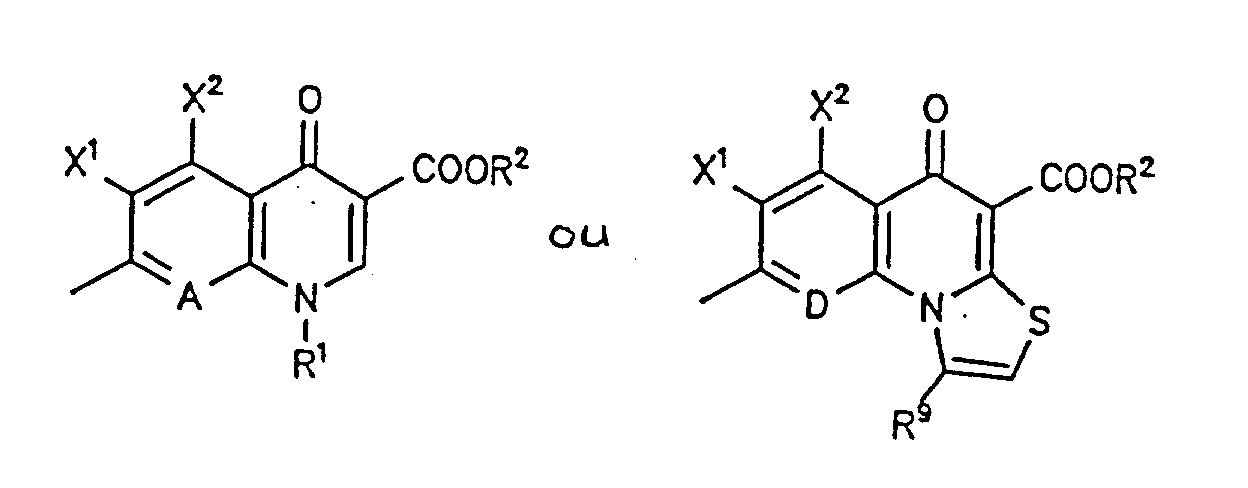
- R1
- est un groupe alkyle ayant 1 à 4 atomes de carbone éventuellement substitué une ou deux fois par un halogène ou un radical hydroxy, un groupe alcényle ayant 2 à 4 atomes de carbone, un groupe cycloalkyle ayant 3 à 6 atomes de carbone éventuellement substitué par un ou deux atomes de fluor, un groupe bicyclo[1.1.1]pent-1-yle, 1,1-diméthylpropargyle, 3-oxétannyle, méthoxy, amino, méthylamino, diméthylamino, un groupe phényle éventuellement substitué une ou deux fois par un halogène, un radical amino ou hydroxy,
- R2
- représente l'hydrogène, un groupe alkyle ayant 1 à 3 atomes de carbone éventuellement substitué par un radical hydroxy, méthoxy, amino, diméthylamino, un groupe benzyle, un groupe (5-méthyl-2-oxo-1,3-dioxole-4-yl)-méthyle, acétoxyméthyle, pivaloyloxyméthyle, 5-indanyle, phtalidinyle ou 3-acétoxy-2-oxobutyle,
- R9
- représente l'hydrogène ou un groupe alkyle ayant 1 à 3 atomes de carbone éventuellement substitué par un radical méthoxy, hydroxy ou un halogène,
- X1
- est un halogène ou un groupe nitro,
- X2
- représente l'hydrogène, un halogène, un groupe amino, hydroxy, méthoxy, mercapto, méthyle, halogénométhyle ou vinyle,
- A
- représente N ou un groupe C-R7 dans lequel
- R7
- est l'hydrogène, un halogène, un groupe CF3, OCH3, OCHF2, CH3, CN, CH=CH2 ou C≡CH ou peut aussi former conjointement avec R1 un pont de structure -*O-CH2-CH-CH3, -*S-CH2CH2-, -*S-CH2-CH-CH3, -*S-CH2-CH-CH2F, -*CH2-CH2-CH-CH3 ou -*O-CH2-N-R8, où l'atome marqué d'un * est lié à l'atome de carbone de A et où
- R8
- représente l'hydrogène, un groupe
méthyle ou formyle,
et - D
- représente N ou un groupe C-R10, dans lequel
- R10
- est l'hydrogène, un halogène, un groupe CF3, OCH3, OCHF2 ou CH3 ou peut aussi former conjointement avec R9 un pont de structure -*O-CH2-, -*NH-CH2-, -*N(CH3)-CH2-, -*N(C2H5)-CH2-, -*N(C3H5)-CH2- ou -*S-CH2-, où l'atome marqué d'un * est lié à l'atome de carbone de D, et
- T
- représente un reste de formule
dans laquelle
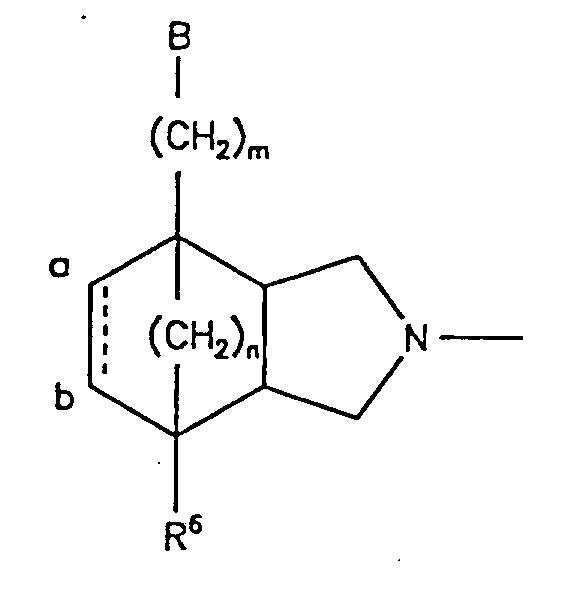
- B
- est un groupe NR3R4 ou OR5, où
- R3
- représente l'hydrogène, un groupe méthyle ou un groupe alkoxycarbonyle ayant là 4 atomes de carbone dans la partie alkyle,
- R4
- représente l'hydrogène ou un groupe méthyle, et
- R5
- représente l'hydrogène ou un groupe méthyle,
- R6
- est l'hydrogène ou un groupe méthyle,
- m
- a la valeur 0 ou 1 et
- n
- a la valeur 1 ou 2,
et leurs hydrates et leurs sels d'addition d'acides acceptables du point de vue pharmaceutique ainsi que les sels de métaux alcalins, de métaux alcalino-terreux, d'argent et de guanidinium des acides carboxyliques de base. - Composés de formule (I) suivant la revendication 1,
dans laquelle- Q et T
- ont la définition indiquée ci-dessus, et
- R1
- représente un groupe alkyle ayant 1 à 4 atomes de carbone éventuellement substitué une ou deux fois par un halogène, un groupe alcényle ayant 2 ou 3 atomes de carbone, un groupe cycloalkyle de 3 ou 4 atomes de carbone éventuellement substitué par un atome de fluor, un groupe bicyclo[1.1.1]pent-1-yle, 1,1-diméthylpropargyle, 3-oxétannyle, méthylamino, un groupe phényle éventuellement substitué une ou deux fois par du fluor, un radical amino ou hydroxy,
- R2
- représente l'hydrogène, un groupe alkyle ayant 1 ou 2 atomes de carbone, benzyle ou (5-méthyl-2-oxo-1,3-dioxole-4-yl)-méthyle,
- R9
- représente l'hydrogène ou un groupe alkyle ayant 1 ou 2 atomes de carbone éventuellement substitué une à trois fois par du fluor,
- X1
- représente le fluor ou le chlore,
- X2
- représente l'hydrogène, un halogène, un groupe amino, méthyle, trifluorométhyle ou vinyle,
- A
- représente N ou un groupe C-R7 dans lequel
- R7
- est l'hydrogène, un halogène, un groupe CF3, OCH3, OCHF2, CH3, CN, CH=CH2 ou C≡CH ou peut aussi former conjointement avec R1 un pont de structure -*O-CH2-CH-CH3, -*S-CH2CH-, -*CH2-CH2-CH-CH3 ou -*O-CH2-N-R8, où l'atome marqué d'un * est lié à l'atome de carbone de A et où
- R8
- représente l'hydrogène ou le groupe méthyle, et
- D
- représente N ou un groupe C-R10, dans lequel
- R10
- est l'hydrogène, le fluor, le chlore, un groupe CF3, OCH3 ou CH3 ou peut aussi former conjointement avec R9 un pont de structure -O-CH2-, -*N(CH3)-CH2-, -*N(C2H5)-CH2, -*N(C3H5)-CH2- ou -*S-CH2-, où l'atome marqué d'un * est lié à l'atome de carbone de D, et
- B
- est un groupe NR3R4 ou OR5, dans lequel
- R3
- représente l'hydrogène, un groupe méthyle ou un groupe alkoxycarbonyle ayant 1 à 4 atomes de carbone dans la partie alkyle,
- R4
- est l'hydrogène ou le groupe méthyle et
- R5
- est l'hydrogène ou le groupe méthyle,
- R6
- est l'hydrogène ou le groupe méthyle,
- m
- a la valeur 0 ou 1 et
- n
- a la valeur 1 ou 2,
et leurs hydrates et leurs sels d'addition d'acides acceptables du point de vue pharmaceutique ainsi que les sels de métaux alcalins, de métaux alcalino-terreux, d'argent et de guanidinium des acides carboxyliques de base. - Composés de formule (I) suivant la revendication 1,
dans laquelle- Q et T
- ont la définition indiquée ci-dessus et dans lesquels
- R1
- est un groupe alkyle ayant 1 à 4 atomes de carbone éventuellement substitué une ou deux fois par du fluor, un groupe vinyle, un groupe cyclopropyle éventuellement substitué par un atome de fluor, un groupe phényle éventuellement substitué une ou deux fois par du fluor,
- R2
- représente l'hydrogène, un groupe alkyle ayant 1 ou 2 atomes de carbone ou le groupe (5-méthyl-2-oxo-1,3-dioxole-4-yl)-méthyle,
- R9
- est l'hydrogène ou un groupe méthyle éventuellement substitué une à trois fois par du fluor,
- X1
- est le fluor,
- X2
- est l'hydrogène, le fluor, un groupe amino, méthyle ou vinyle,
- A
- représente N ou un groupe C-R7, dans lequel
- R7
- est l'hydrogène, le fluor, le chlore, le brome, un groupe CF3, OCH3, OCHF2, CH3, CN, CH=CH2 ou C≡CH ou peut aussi former conjointement avec R1 un pont de structure -*O-CH2-CH-CH3 ou -*O-CH2-N-R8, où l'atome marqué d'un * est lié à l'atome de carbone de A et où
- R8
- représente l'hydrogène ou le groupe méthyle, et
- D
- représente N ou un groupe C-R10, dans lequel
- R10
- est l'hydrogène, le fluor, le chlore ou un groupe OCH3 ou peut aussi former conjointement avec R9 un pont de structure -*O-CH2-, -*N(CH3)-CH2-, -*N-(C2H5)-CH2- ou -*S-CH2-, où l'atome marqué d'un * est lié à l'atome de carbone de D, et
- B
- représente un groupe NR3R4 ou OR5, dans lequel R3 est l'hydrogène ou le groupe méthyle, R4 est l'hydrogène ou le groupe méthyle, et R5 est l'hydrogène ou le groupe méthyle,
- R6
- est l'hydrogène,
- m
- a la valeur 0 ou 1 et
- n
- a la valeur 1 ou 2,
et leurs hydrates et leurs sels d'addition d'acides acceptables du point de vue pharmaceutique ainsi que les sels de métaux alcalins, de métaux alcalino-terreux, d'argent et de guanidinium des acides carboxyliques de base. - Composés diastéréoisomères purs et énantiomères purs selon les revendication 1 à 3.
- Procédé de production de composés de formule (I) suivant les revendications 1 à 4, caractérisé en ce qu'on fait réagir des composés de formule (II)
- Q
- a la définition indiquée ci-dessus et
- Y
- représente un halogène, en particulier le fluor ou le chlore,
dans laquelle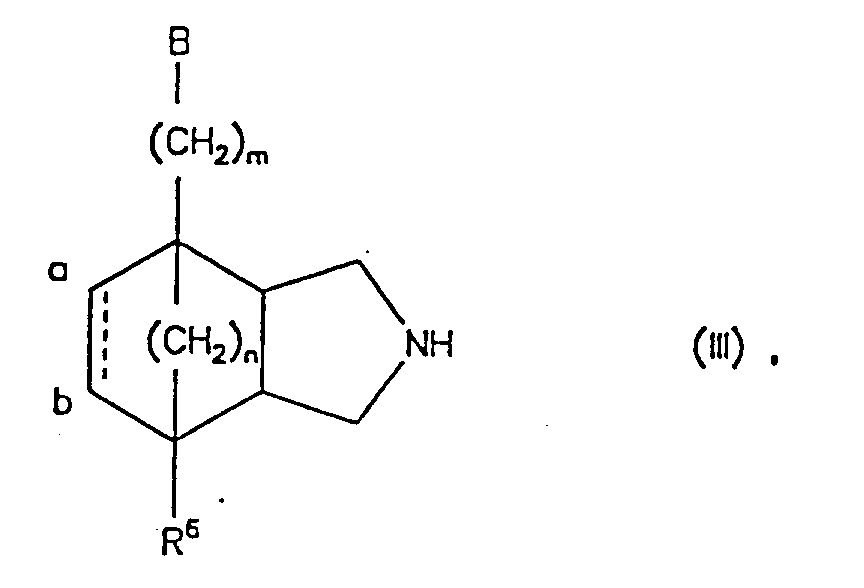
B, R6, m, n, a et b ont les définitions indiquées ci-dessus,
le cas échéant en présence d'accepteurs d'acides et on élimine les groupes protecteurs éventuellement présents. - Composés racémiques, diastéréoisomères purs et énantiomères purs du groupe constitué de :la 4-azatricyclo[5.2.1.02,6]déc-8-ène-1-ylaminela 4-azatricyclo[5.2.2.02,6]undéc-8-ène-1-ylamine,la (4-azatricyclo[5.2.2.02,6]undéc-8-ène-1-ylméthyl)amine,la (4-azatricyclo[5.2.2.02,6]undéc-8-ène-1-yl)diméthylamine,le 4-azatricyclo[5.2.2.02,6]undéc-8-ène-1-ol,le (4-azatricyclo[5.2.2.02,6]undéc-8-ène-1-yl)-méthanol,la 4-azatricyclo[5.2.1.02,6]déc-1-ylamine,la 4-azatricyclo[5.2.2.02,6]undéc-1-ylamine.
- Composés suivant les revendications 1 à 4, destinés à combattre des maladies.
- Composés suivant les revendications 1 à 4, destinés à combattre des infections bactériennes.
- Utilisation de composés suivant les revendications 1 à 4 dans la préparation de médicaments.
- Médicaments contenant les composés suivant les revendications 1 à 4.
- Compositions antibactériennes contenant des composés suivant les revendications 1 à 4.
Applications Claiming Priority (2)
| Application Number | Priority Date | Filing Date | Title |
|---|---|---|---|
| DE4427530 | 1994-08-04 | ||
| DE4427530A DE4427530A1 (de) | 1994-08-04 | 1994-08-04 | Chinolon- und Naphthyridoncarbonsäure-Derivate |
Publications (3)
| Publication Number | Publication Date |
|---|---|
| EP0704443A2 EP0704443A2 (fr) | 1996-04-03 |
| EP0704443A3 EP0704443A3 (fr) | 1996-08-14 |
| EP0704443B1 true EP0704443B1 (fr) | 2000-12-27 |
Family
ID=6524872
Family Applications (1)
| Application Number | Title | Priority Date | Filing Date |
|---|---|---|---|
| EP95111579A Expired - Lifetime EP0704443B1 (fr) | 1994-08-04 | 1995-07-24 | Dérivés de l'acide quinolone et naphthyridonecarboxylique |
Country Status (10)
| Country | Link |
|---|---|
| US (4) | US5605910A (fr) |
| EP (1) | EP0704443B1 (fr) |
| JP (1) | JPH0859656A (fr) |
| AT (1) | ATE198333T1 (fr) |
| CA (1) | CA2155153A1 (fr) |
| DE (2) | DE4427530A1 (fr) |
| DK (1) | DK0704443T3 (fr) |
| ES (1) | ES2154698T3 (fr) |
| GR (1) | GR3035489T3 (fr) |
| PT (1) | PT704443E (fr) |
Families Citing this family (2)
| Publication number | Priority date | Publication date | Assignee | Title |
|---|---|---|---|---|
| WO2011031745A1 (fr) | 2009-09-09 | 2011-03-17 | Achaogen, Inc. | Analogues de fluoroquinolone antibactériens |
| JP5713770B2 (ja) * | 2010-04-22 | 2015-05-07 | 日本エンバイロケミカルズ株式会社 | 工業用防腐・防汚組成物 |
Family Cites Families (18)
| Publication number | Priority date | Publication date | Assignee | Title |
|---|---|---|---|---|
| US4864023A (en) * | 1986-09-12 | 1989-09-05 | Hoffmann-La Roche Inc. | Pyrido(3,2,1-IJ)-1,3,4-benzoxadiazine derivatives |
| US5585491A (en) * | 1988-01-25 | 1996-12-17 | Otsuka Pharmaceutical Co., Ltd. | Antibacterial agents |
| JPH0262875A (ja) * | 1988-05-23 | 1990-03-02 | Wakunaga Pharmaceut Co Ltd | 新規イソインドリン誘導体 |
| JP2844079B2 (ja) * | 1988-05-23 | 1999-01-06 | 塩野義製薬株式会社 | ピリドンカルボン酸系抗菌剤 |
| US5328908A (en) * | 1988-10-24 | 1994-07-12 | Procter & Gamble Pharmaceuticals, Inc. | Antimicrobial quinolone thioureas |
| AU5123690A (en) * | 1989-03-13 | 1990-09-13 | Bristol-Myers Squibb Company | 5-substituted-1,4-dihydro-4-oxo-nephthyridine-3-carboxylate antibacterial agents |
| CA2030217A1 (fr) * | 1989-11-21 | 1991-05-22 | Jun Imose | Derives de l'acide pyridonecarboxylique, utiles comme medicaments veterinaires |
| JPH04253973A (ja) | 1990-04-20 | 1992-09-09 | Banyu Pharmaceut Co Ltd | ピリドンカルボン酸誘導体 |
| CA2076982A1 (fr) * | 1990-12-27 | 1992-06-28 | Akira Okura | Derives d'acide pyridonecarboxylique |
| DE4120646A1 (de) * | 1991-06-22 | 1992-12-24 | Bayer Ag | 7-isoindolinyl-chinolon- und naphthyridoncarbonsaeure-derivate |
| DE4121214A1 (de) * | 1991-06-27 | 1993-01-14 | Bayer Ag | 7-azaisoindolinyl-chinolon- und -naphthyridoncarbonsaeure-derivate |
| DE4123918A1 (de) * | 1991-07-19 | 1993-01-21 | Bayer Ag | 8-vinyl- und 8-ethinyl-chinoloncarbonsaeuren |
| DE4230804A1 (de) * | 1992-09-15 | 1994-03-17 | Bayer Ag | 7-Isoindolinyl-chinolon- und -naphthyridon-Derivate |
| DE4301246A1 (de) * | 1993-01-19 | 1994-07-21 | Bayer Ag | Chinolon- und Naphthyridoncarbonsäurederivate |
| US5631266A (en) * | 1993-04-26 | 1997-05-20 | Korea Research Institute Of Chemical Technology | Quinolone carboxylic acid derivatives and process for preparing the same |
| DE4329600A1 (de) * | 1993-09-02 | 1995-03-09 | Bayer Ag | Pyrido [1,2,3-d,e] [1,3,4] benzoxadiazinderivate |
| DE4408212A1 (de) * | 1994-03-11 | 1995-09-14 | Bayer Ag | 5-Vinyl- und 5-Ethinyl-chinolon- und -naphthyridon-carbonsäuren |
| DE4416622A1 (de) * | 1994-05-11 | 1995-11-16 | Bayer Ag | 8-Amino-10-(azabicycloalkyl)-pyrido[1,2,3-d.e] [1,3,4]benzoxa-diazinderivate |
-
1994
- 1994-08-04 DE DE4427530A patent/DE4427530A1/de not_active Withdrawn
-
1995
- 1995-07-24 PT PT95111579T patent/PT704443E/pt unknown
- 1995-07-24 AT AT95111579T patent/ATE198333T1/de not_active IP Right Cessation
- 1995-07-24 ES ES95111579T patent/ES2154698T3/es not_active Expired - Lifetime
- 1995-07-24 DK DK95111579T patent/DK0704443T3/da active
- 1995-07-24 DE DE59508920T patent/DE59508920D1/de not_active Expired - Fee Related
- 1995-07-24 EP EP95111579A patent/EP0704443B1/fr not_active Expired - Lifetime
- 1995-07-28 US US08/508,603 patent/US5605910A/en not_active Expired - Fee Related
- 1995-07-31 JP JP7212964A patent/JPH0859656A/ja active Pending
- 1995-08-01 CA CA002155153A patent/CA2155153A1/fr not_active Abandoned
-
1996
- 1996-12-12 US US08/764,548 patent/US5753669A/en not_active Expired - Fee Related
-
1998
- 1998-01-07 US US09/003,613 patent/US5990122A/en not_active Expired - Fee Related
- 1998-11-20 US US09/196,971 patent/US5986105A/en not_active Expired - Fee Related
-
2001
- 2001-02-28 GR GR20010400332T patent/GR3035489T3/el not_active IP Right Cessation
Also Published As
| Publication number | Publication date |
|---|---|
| US5990122A (en) | 1999-11-23 |
| EP0704443A3 (fr) | 1996-08-14 |
| DE4427530A1 (de) | 1996-02-08 |
| PT704443E (pt) | 2001-05-31 |
| GR3035489T3 (en) | 2001-05-31 |
| US5605910A (en) | 1997-02-25 |
| EP0704443A2 (fr) | 1996-04-03 |
| ES2154698T3 (es) | 2001-04-16 |
| CA2155153A1 (fr) | 1996-02-05 |
| JPH0859656A (ja) | 1996-03-05 |
| US5986105A (en) | 1999-11-16 |
| US5753669A (en) | 1998-05-19 |
| DE59508920D1 (de) | 2001-02-01 |
| ATE198333T1 (de) | 2001-01-15 |
| DK0704443T3 (da) | 2001-01-29 |
Similar Documents
| Publication | Publication Date | Title |
|---|---|---|
| EP0757990B1 (fr) | Dérivés d'acides 7-(1-pyrrolidinyl)-3-quinolone et -naphtyridone carboxyliques, procédé pour leur préparation, ainsi que des dérivés mono- et bicycliques substitués de pyrrolidines comme intermédiaires pour leur réalisation, leurs compositions antibacté rielles et additifs alimentaires | |
| EP0520277A2 (fr) | Dérivés d'acide 7-azaisoindolinyl-chinolone- et naphthyridoncarboxylique | |
| EP0588166B1 (fr) | Dérivés antibactériens de 7-isoindolinyl-quinolone et naphthyridone | |
| DE4120646A1 (de) | 7-isoindolinyl-chinolon- und naphthyridoncarbonsaeure-derivate | |
| EP0607825A1 (fr) | Acides 6-H-4-OXO-3-quinoléine-carboxyliques et leurs analoques comme agents antibactériens | |
| EP0550903A1 (fr) | Dérivés d'acides carboxyliques de quinolone- et de naphthyridone comme agents antibactériens | |
| EP0481274A1 (fr) | Dérivés des acides 7-(2,7-diazabicyclo[3.3.0]octyl)-3-quinolone- et -naphtyridonecarboxyliques | |
| EP0705828B1 (fr) | Dérivés carboxyliques de quinolones et de naphthyridones comme agents antibactériens | |
| EP0704443B1 (fr) | Dérivés de l'acide quinolone et naphthyridonecarboxylique | |
| EP0401623A1 (fr) | Procédé pour la préparation d'acides 7-(3-amino- et 3-aminométhyl-1-pyrrolidinyl)-3-quinolinonecarboxyliques et -naphtyridinecarboxyliques | |
| EP0589318B1 (fr) | Dérivés antibactériens d'acides de 7-(aminométhyl-oxa-7-azabicyclo(3.3.0)oct-7-yl)quinolone- et -naphthyridone-carboxyliques | |
| EP0647644A1 (fr) | Dérivés de pyrido 1,2,3-d,e 1,3,4 benzoxzine avec une activité antibactérienne | |
| EP0653425A1 (fr) | Dérivés de l'acide 1-(2-fluorocyclopropyle)-quinolone carboxylique et naphthyridone carboxylique, leur préparation et leur utilisation comme agents antibactériens | |
| EP0721948B1 (fr) | Dérivés carboxyliques de quinolone et naphthyridone comme agents antibactériens | |
| EP0726270B1 (fr) | Dérivés d'acides carboxyliques de la 1,6-naphthyridone | |
| DE4200414A1 (de) | Chinolon- und naphthyridon-carbonsaeure-derivate | |
| DD285601A5 (de) | Verfahren zur herstellung von 7-(1-pyrrolidinyl)-3-chinolon- und naphthyridoncarbonsaeure-derivaten | |
| DE19506535A1 (de) | 1,6-Naphthyridoncarbonsäurederivate |
Legal Events
| Date | Code | Title | Description |
|---|---|---|---|
| PUAI | Public reference made under article 153(3) epc to a published international application that has entered the european phase |
Free format text: ORIGINAL CODE: 0009012 |
|
| AK | Designated contracting states |
Kind code of ref document: A2 Designated state(s): AT BE CH DE DK ES FR GB GR IE IT LI LU MC NL PT SE |
|
| PUAL | Search report despatched |
Free format text: ORIGINAL CODE: 0009013 |
|
| AK | Designated contracting states |
Kind code of ref document: A3 Designated state(s): AT BE CH DE DK ES FR GB GR IE IT LI LU MC NL PT SE |
|
| 17P | Request for examination filed |
Effective date: 19970115 |
|
| GRAG | Despatch of communication of intention to grant |
Free format text: ORIGINAL CODE: EPIDOS AGRA |
|
| 17Q | First examination report despatched |
Effective date: 20000323 |
|
| GRAG | Despatch of communication of intention to grant |
Free format text: ORIGINAL CODE: EPIDOS AGRA |
|
| GRAH | Despatch of communication of intention to grant a patent |
Free format text: ORIGINAL CODE: EPIDOS IGRA |
|
| GRAH | Despatch of communication of intention to grant a patent |
Free format text: ORIGINAL CODE: EPIDOS IGRA |
|
| GRAA | (expected) grant |
Free format text: ORIGINAL CODE: 0009210 |
|
| AK | Designated contracting states |
Kind code of ref document: B1 Designated state(s): AT BE CH DE DK ES FR GB GR IE IT LI LU MC NL PT SE |
|
| REF | Corresponds to: |
Ref document number: 198333 Country of ref document: AT Date of ref document: 20010115 Kind code of ref document: T |
|
| REG | Reference to a national code |
Ref country code: CH Ref legal event code: EP |
|
| REG | Reference to a national code |
Ref country code: CH Ref legal event code: NV Representative=s name: E. BLUM & CO. PATENTANWAELTE |
|
| REG | Reference to a national code |
Ref country code: DK Ref legal event code: T3 |
|
| REF | Corresponds to: |
Ref document number: 59508920 Country of ref document: DE Date of ref document: 20010201 |
|
| REG | Reference to a national code |
Ref country code: IE Ref legal event code: FG4D Free format text: GERMAN |
|
| GBT | Gb: translation of ep patent filed (gb section 77(6)(a)/1977) |
Effective date: 20010130 |
|
| ITF | It: translation for a ep patent filed | ||
| ET | Fr: translation filed | ||
| REG | Reference to a national code |
Ref country code: ES Ref legal event code: FG2A Ref document number: 2154698 Country of ref document: ES Kind code of ref document: T3 |
|
| REG | Reference to a national code |
Ref country code: PT Ref legal event code: SC4A Free format text: AVAILABILITY OF NATIONAL TRANSLATION Effective date: 20010222 |
|
| PGFP | Annual fee paid to national office [announced via postgrant information from national office to epo] |
Ref country code: DE Payment date: 20010613 Year of fee payment: 7 |
|
| PGFP | Annual fee paid to national office [announced via postgrant information from national office to epo] |
Ref country code: GR Payment date: 20010619 Year of fee payment: 7 |
|
| PGFP | Annual fee paid to national office [announced via postgrant information from national office to epo] |
Ref country code: PT Payment date: 20010620 Year of fee payment: 7 Ref country code: IE Payment date: 20010620 Year of fee payment: 7 |
|
| PGFP | Annual fee paid to national office [announced via postgrant information from national office to epo] |
Ref country code: CH Payment date: 20010625 Year of fee payment: 7 |
|
| PGFP | Annual fee paid to national office [announced via postgrant information from national office to epo] |
Ref country code: MC Payment date: 20010626 Year of fee payment: 7 |
|
| PGFP | Annual fee paid to national office [announced via postgrant information from national office to epo] |
Ref country code: FR Payment date: 20010628 Year of fee payment: 7 |
|
| PGFP | Annual fee paid to national office [announced via postgrant information from national office to epo] |
Ref country code: ES Payment date: 20010705 Year of fee payment: 7 |
|
| PGFP | Annual fee paid to national office [announced via postgrant information from national office to epo] |
Ref country code: SE Payment date: 20010709 Year of fee payment: 7 |
|
| PGFP | Annual fee paid to national office [announced via postgrant information from national office to epo] |
Ref country code: GB Payment date: 20010718 Year of fee payment: 7 |
|
| PGFP | Annual fee paid to national office [announced via postgrant information from national office to epo] |
Ref country code: LU Payment date: 20010719 Year of fee payment: 7 |
|
| PGFP | Annual fee paid to national office [announced via postgrant information from national office to epo] |
Ref country code: DK Payment date: 20010723 Year of fee payment: 7 |
|
| PGFP | Annual fee paid to national office [announced via postgrant information from national office to epo] |
Ref country code: AT Payment date: 20010727 Year of fee payment: 7 |
|
| PGFP | Annual fee paid to national office [announced via postgrant information from national office to epo] |
Ref country code: NL Payment date: 20010731 Year of fee payment: 7 |
|
| PGFP | Annual fee paid to national office [announced via postgrant information from national office to epo] |
Ref country code: BE Payment date: 20010816 Year of fee payment: 7 |
|
| PLBE | No opposition filed within time limit |
Free format text: ORIGINAL CODE: 0009261 |
|
| STAA | Information on the status of an ep patent application or granted ep patent |
Free format text: STATUS: NO OPPOSITION FILED WITHIN TIME LIMIT |
|
| 26N | No opposition filed | ||
| REG | Reference to a national code |
Ref country code: GB Ref legal event code: IF02 |
|
| PG25 | Lapsed in a contracting state [announced via postgrant information from national office to epo] |
Ref country code: LU Free format text: LAPSE BECAUSE OF NON-PAYMENT OF DUE FEES Effective date: 20020724 Ref country code: IE Free format text: LAPSE BECAUSE OF NON-PAYMENT OF DUE FEES Effective date: 20020724 Ref country code: GB Free format text: LAPSE BECAUSE OF NON-PAYMENT OF DUE FEES Effective date: 20020724 Ref country code: AT Free format text: LAPSE BECAUSE OF NON-PAYMENT OF DUE FEES Effective date: 20020724 |
|
| PG25 | Lapsed in a contracting state [announced via postgrant information from national office to epo] |
Ref country code: SE Free format text: LAPSE BECAUSE OF NON-PAYMENT OF DUE FEES Effective date: 20020725 Ref country code: ES Free format text: LAPSE BECAUSE OF NON-PAYMENT OF DUE FEES Effective date: 20020725 |
|
| PG25 | Lapsed in a contracting state [announced via postgrant information from national office to epo] |
Ref country code: LI Free format text: LAPSE BECAUSE OF NON-PAYMENT OF DUE FEES Effective date: 20020731 Ref country code: DK Free format text: LAPSE BECAUSE OF NON-PAYMENT OF DUE FEES Effective date: 20020731 Ref country code: CH Free format text: LAPSE BECAUSE OF NON-PAYMENT OF DUE FEES Effective date: 20020731 Ref country code: BE Free format text: LAPSE BECAUSE OF NON-PAYMENT OF DUE FEES Effective date: 20020731 |
|
| BERE | Be: lapsed |
Owner name: *BAYER A.G. Effective date: 20020731 |
|
| PG25 | Lapsed in a contracting state [announced via postgrant information from national office to epo] |
Ref country code: PT Free format text: LAPSE BECAUSE OF NON-PAYMENT OF DUE FEES Effective date: 20030131 |
|
| PG25 | Lapsed in a contracting state [announced via postgrant information from national office to epo] |
Ref country code: NL Free format text: LAPSE BECAUSE OF NON-PAYMENT OF DUE FEES Effective date: 20030201 Ref country code: MC Free format text: LAPSE BECAUSE OF NON-PAYMENT OF DUE FEES Effective date: 20030201 Ref country code: DE Free format text: LAPSE BECAUSE OF NON-PAYMENT OF DUE FEES Effective date: 20030201 |
|
| PG25 | Lapsed in a contracting state [announced via postgrant information from national office to epo] |
Ref country code: GR Free format text: LAPSE BECAUSE OF NON-PAYMENT OF DUE FEES Effective date: 20030206 |
|
| REG | Reference to a national code |
Ref country code: DK Ref legal event code: EBP |
|
| EUG | Se: european patent has lapsed | ||
| REG | Reference to a national code |
Ref country code: CH Ref legal event code: PL |
|
| GBPC | Gb: european patent ceased through non-payment of renewal fee |
Effective date: 20020724 |
|
| PG25 | Lapsed in a contracting state [announced via postgrant information from national office to epo] |
Ref country code: FR Free format text: LAPSE BECAUSE OF NON-PAYMENT OF DUE FEES Effective date: 20030331 |
|
| NLV4 | Nl: lapsed or anulled due to non-payment of the annual fee |
Effective date: 20030201 |
|
| REG | Reference to a national code |
Ref country code: PT Ref legal event code: MM4A Free format text: LAPSE DUE TO NON-PAYMENT OF FEES Effective date: 20030131 |
|
| REG | Reference to a national code |
Ref country code: FR Ref legal event code: ST |
|
| REG | Reference to a national code |
Ref country code: IE Ref legal event code: MM4A |
|
| REG | Reference to a national code |
Ref country code: ES Ref legal event code: FD2A Effective date: 20030811 |
|
| PG25 | Lapsed in a contracting state [announced via postgrant information from national office to epo] |
Ref country code: IT Free format text: LAPSE BECAUSE OF NON-PAYMENT OF DUE FEES;WARNING: LAPSES OF ITALIAN PATENTS WITH EFFECTIVE DATE BEFORE 2007 MAY HAVE OCCURRED AT ANY TIME BEFORE 2007. THE CORRECT EFFECTIVE DATE MAY BE DIFFERENT FROM THE ONE RECORDED. Effective date: 20050724 |