EP0704445B1 - Préparation des composés de guanine substitués sur la position 9 - Google Patents
Préparation des composés de guanine substitués sur la position 9 Download PDFInfo
- Publication number
- EP0704445B1 EP0704445B1 EP95111473A EP95111473A EP0704445B1 EP 0704445 B1 EP0704445 B1 EP 0704445B1 EP 95111473 A EP95111473 A EP 95111473A EP 95111473 A EP95111473 A EP 95111473A EP 0704445 B1 EP0704445 B1 EP 0704445B1
- Authority
- EP
- European Patent Office
- Prior art keywords
- formula
- compound
- ethyl
- hydrogen
- alkyl
- Prior art date
- Legal status (The legal status is an assumption and is not a legal conclusion. Google has not performed a legal analysis and makes no representation as to the accuracy of the status listed.)
- Expired - Lifetime
Links
- 0 *C(CO)OC[n]1c(N=C(N)NC2=O)c2nc1 Chemical compound *C(CO)OC[n]1c(N=C(N)NC2=O)c2nc1 0.000 description 7
- UYTPUPDQBNUYGX-UHFFFAOYSA-N NC(NC1=O)=Nc2c1nc[nH]2 Chemical compound NC(NC1=O)=Nc2c1nc[nH]2 UYTPUPDQBNUYGX-UHFFFAOYSA-N 0.000 description 1
Classifications
-
- C—CHEMISTRY; METALLURGY
- C07—ORGANIC CHEMISTRY
- C07D—HETEROCYCLIC COMPOUNDS
- C07D473/00—Heterocyclic compounds containing purine ring systems
-
- A—HUMAN NECESSITIES
- A61—MEDICAL OR VETERINARY SCIENCE; HYGIENE
- A61P—SPECIFIC THERAPEUTIC ACTIVITY OF CHEMICAL COMPOUNDS OR MEDICINAL PREPARATIONS
- A61P31/00—Antiinfectives, i.e. antibiotics, antiseptics, chemotherapeutics
-
- A—HUMAN NECESSITIES
- A61—MEDICAL OR VETERINARY SCIENCE; HYGIENE
- A61P—SPECIFIC THERAPEUTIC ACTIVITY OF CHEMICAL COMPOUNDS OR MEDICINAL PREPARATIONS
- A61P31/00—Antiinfectives, i.e. antibiotics, antiseptics, chemotherapeutics
- A61P31/12—Antivirals
Definitions
- the present invention relates to processes for the synthesis of antiviral N-9 substituted guanine compounds.
- N-substituted derivatives of purines and related nucleosides have been shown to exhibit significant antiviral properties. Most notable are the N-9 alkylated products 9-[(1,3-dihydroxy-2-propoxy)methyl]guanine (i.e. ganciclovir) and 9-[(2-hydroxyethoxy)methyl]guanine, (i.e. acyclovir). It is clearly desirable to have inexpensive and efficient processes for manufacturing these and similar compounds.
- any process for manufacturing chemical compounds is gauged by several factors. For example, starting materials should be as simple structurally as feasible (so as to keep their costs low). The process is more efficient if intermediates do not require isolation and/or purification, since these procedures result in additional steps and lower yield. The process should yield a product that is free of by-products (e.g., undesired isomers, side-products and reagents). Shortcomings in any of the above parameters result in increased manufacturing costs, which impacts negatively on the desirability of the process.
- N-9 substituted guanine compounds involve the direct alkylation of a protected guanine base.
- guanine protected by acyl groups for example, diacetylguanine
- acyl groups may prove difficult to remove at the completion of the process, resulting in lower yields.
- known alkylation processes are not regiospecific for the N-9 position of the protected guanine base, and result in a mixture of N-9 and N-7 alkylation products. The unwanted N-7 isomer is difficult to separate from the desired N-9 compound, requiring chromatography for isolation. Chromatographic separation on a commercial scale is most undesirable, because of the increased costs associated with such a separation (cost of solvents and stationary phase, low yields of desired product, etc).
- N-9 substituted guanine compounds including ganciclovir and acyclovir
- the processes are essentially specific for the preparation of the N-9 isomer, since the alkylation step provides a high N-9/N-7 ratio of alkylated guanine product (a ratio of greater than 30:1 may be achieved), thus eliminating the need for the chromatographic separation of the N-9/N-7 isomer mixture.
- the processes also provide high yields, require simple starting materials and reaction conditions, and are carried out from start to finish in a single reaction vessel, delivering acyclovir and ganciclovir in greater than 99% purity.
- One aspect of the invention relates to an efficient and selective process for the preparation of an alkylated guanine compound of the formula: wherein:
- the invention also relates to an efficient and selective process for preparing compounds represented by the formula: wherein:
- alkyl means a monoradical branched or unbranched saturated hydrocarbon chain containing 1 to 12 carbon atoms, such as methyl, ethyl, propyl, tert-butyl, n-hexyl, n-octyl, n-decyl, unless otherwise indicated.
- C 1-6 means a monoradical branched or unbranched saturated hydrocarbon chain containing 1 to 6 carbon atoms, such as methyl, ethyl, n-propyl, isopropyl, n-butyl, tert-butyl, n-pentyl, n-hexyl, unless otherwise indicated.
- acylating agent refers to either an anhydride or an acyl halide.
- anhydride refers to compounds of the general structure RC(O)-O-C(O)R where R is lower alkyl or optionally substituted phenyl (e.g., acetic anhydride where R is methyl, propionic anhydride where R is ethyl, benzoic anhydride where R is phenyl).
- acyl halide refers to the group RC(O)X, where R is lower alkyl or optionally substituted phenyl and X is bromo or chloro (e.g., acetyl bromide where R is methyl and X is bromo, propionyl chloride where R is ethyl and X is t chloride, benzoyl chloride where R is phenyl and X is chloro).
- acylating agent having an acyl radical of formula R 8 C(O)- refers to an anhydride of formula R 8 C(O)OC(O)R 8 , or an acyl halide of formula R 8 C(O)X, where R 8 is lower alkyl or optionally substituted phenyl and X is bromo or chloro.
- base includes both strong bases and organic bases.
- strong base refers to bases such as sodium hydroxide, potassium hydroxide, lithium hydroxide, ammonium hydroxide, sodium bicarbonate, potassium carbonate.
- organic base refers to bases such as triethylamine, 4-pyrrolidinopyridine, dimethylaminopyridine (DMAP), N-methylmorpholine, N-ethylmorpholine, pyridine, dialkylanilines, diisopropylcyclohexylamine.
- bases such as triethylamine, 4-pyrrolidinopyridine, dimethylaminopyridine (DMAP), N-methylmorpholine, N-ethylmorpholine, pyridine, dialkylanilines, diisopropylcyclohexylamine.
- silation catalyst refers to catalysts that promote the silylation of guanine, for example ammonium sulfate, p-toluenesulfonic acid, trifluoromethane sulfonic acid, trimethylsilyl trifluoromethanesulfonate, bistrimethylsilyl sulfonate, sulfuric acid, potassium butylsulfonate, ammonium perchlorate, sodium perchlorate, sodium borofluoride, tin tetrachloride.
- the selective alkylation catalysts used in the present invention viz. trifluoromethane sulfonic acid, trimethylsilyl trifluoromethanesulfonate, and bistrimethylsilyl sulfonate promote the regiospecific alkylation of guanine or protected guanine at the N-9 position.
- inert organic solvent or “inert solvent” mean a solvent inert under the conditions of the reaction being described in conjunction therewith [including, for example, benzene, toluene, acetonitrile, tetrahydrofuran (“THF”), dimethylformamide (“DMF”), chloroform (“CHCl 3 "), methylene chloride (or dichloromethane or "CH 2 Cl 2 "), diethyl ether, ethyl acetate, acetone, methylethyl ketone, methanol, ethanol, propanol, isopropanol, tert-butanol, dioxane, pyridine, and the like].
- the solvents used in the reactions of the present invention are inert solvents.
- hydrolysis refers to the process of splitting a chemical bond by the addition of water; for example, hydrolysis of an alkyl ester gives an organic acid and an alcohol, hydrolysis of an amide gives an organic acid and an amine, hydrolysis of a silyl ether gives an alcohol. Hydrolysis may be accomplished by treatment with an inorganic acid, for example sulfuric acid, hydrochloric acid, hydrobromic acid, and the like, or by treatment with a strong base as defined above.
- silylating agent refers to a compound capable of silylating guanine.
- a preferred silylating agent is hexamethyldisilazane (which will give a compound of Formula (2) in which R 5 , R 6 , and R 7 are all methyl).
- R 5 , R 6 , and R 7 are all methyl.
- many other silylating agents are known in the art.
- guanine may be reacted with a trialkylsilyl halide of formula SiR 5 R 6 R 7 X, in which R 5 , R 6 , and R 7 are independently lower alkyl and X is chloro or bromo, such as trimethylsilyl chloride, tert-butyldimethylsilyl chloride, and the like, preferably in the presence of about 1-2 molar equivalents of a base.
- a trialkylsilyl halide of formula SiR 5 R 6 R 7 X in which R 5 , R 6 , and R 7 are independently lower alkyl and X is chloro or bromo, such as trimethylsilyl chloride, tert-butyldimethylsilyl chloride, and the like, preferably in the presence of about 1-2 molar equivalents of a base.
- the compound of Formula (2) is represented as follows: Formula (2) represents guanine protected by one, two, or three silyl groups, or a mixture thereof, where Z 1 , Z 2 , and Z 3 are independently hydrogen or a silyl group of formula SiR 5 R 6 R 7 , provided that at least one of Z 1 , Z 2 , and Z 3 must be a silyl group, in which R 5 , R 6 , and R 7 are independently lower alkyl. It should be noted that Formula (2) as drawn represents a mixture of N-7 and N-9 isomers (as a tautomeric mixture).
- Isolation and purification of the compounds and intermediates described herein can be effected, if desired, by any suitable separation or purification procedure such as, for example, filtration, extraction, crystallization, column chromatography, preparative high pressure liquid chromatography (preparative HPLC), thin-layer chromatography or thick-layer chromatography, or a combination of these procedures.
- suitable separation and isolation procedures can be had by reference to the examples hereinbelow. However, other equivalent separation or isolation procedures can also be used.
- the compound of Formula I where R 1 is hydrogen is named 9-(2-hydroxyethoxymethyl)guanine, i.e., acyclovir.
- the compound of Formula I where R 1 is -CH 2 OH is named 9-(1,3-dihydroxy-2-propoxymethyl)guanine, i.e., ganciclovir.
- Z 1 , Z 2 and Z 3 are independently hydrogen or a silyl protecting group of the formula R 5 R 6 R 7 Si, in which R 5 , R 6 , and R 7 are independently C 1-6 alkyl, provided that at least one of Z 1 , Z 2 and Z 3 is a silyl group; where R 2 is C 1-6 alkyl, and R 3 is hydrogen or -CH 2 OC(O)R 4 , in which R 4 is C 1-6 alkyl; where R 8 is C 1-6 alkyl or optionally substituted phenyl and X is chloro or bromo;
- the trialkylsilyl halides of formula R 5 R 6 R 7 SiX (where X is chloro or bromo) or hexamethyldisilazane are commercially available.
- Compounds of Formula (3) where R 3 is hydrogen are prepared by means well known in the art, for example by reaction of 1,3-dioxolane and acetic anhydride.
- Compounds of Formula (3) where R 3 is CH 2 OC(O)R 4 shown below as a compound of Formula (3a) where R 2 and R 4 are the same and are C 1-6 alkyl, may be prepared as shown in Reaction Scheme B below: where R 2 is C 1-6 alkyl and M is an alkali metal.
- Step 1 1,3-dichloro-2-propanol (Formula (a)) is reacted with paraformaldehyde (b) and hydrochloric acid to give the corresponding compound of Formula (c).
- an inert solvent preferably methylene chloride
- an inert solvent preferably toluene
- Step 1 guanine (Formula (1)) is silylated to give the corresponding protected compound of Formula (2).
- Guanine may be, for example, be protected using acyl groups, for example acetyl, or by silyl groups.
- acyl groups for example acetyl
- silyl groups for protection, guanine is silylated in such a manner that all active protons present in guanine are replaced by a silyl group before proceeding with the desired reaction, i.e. guanine is protected as the trisilyl derivative.
- guanine is reacted with about 3-10 molar equivalents of a silylating agent, preferably with hexamethyldisilazane (i.e. to give a compound of Formula (2) where R 5 , R 6 , and R 7 are all methyl), in the presence of an silylation catalyst, preferably trifluoro methanesulfonic acid, trimethylsilyltrifluoromethane sulfonate, or bistrimethylsilyl sulfonate, most preferably trifluoromethanesulfonic acid (about 0.01 to 0.1 molar equivalents).
- silylation catalyst preferably trifluoro methanesulfonic acid, trimethylsilyltrifluoromethane sulfonate, or bistrimethylsilyl sulfonate, most preferably trifluoromethanesulfonic acid (about 0.01 to 0.1 molar equivalents).
- the mixture is heated to reflux over a period of about 5-24 hours, preferably
- guanine is reacted with a silylating agent, preferably hexamethyldisilazane, in the presence of a silylating catalyst, preferably trifluoromethanesulfonic acid, as described in the preceding paragraph, but for a period of about 1-8 hours, preferably 2-4 hours.
- a silylating catalyst preferably trifluoromethanesulfonic acid
- guanine may be reacted with 1-5 molar equivalents of a trialkylsilyl halide of formula SiR 5 R 6 R 7 X, in which R 5 , R 6 , and R 7 are independently lower alkyl and X is chloro or bromo, such as trimethylsilyl chloride, tert-butyldimethylsilyl chloride, and the like, in the presence of about 1-5 molar equivalents of a base.
- a trialkylsilyl halide of formula SiR 5 R 6 R 7 X in which R 5 , R 6 , and R 7 are independently lower alkyl and X is chloro or bromo, such as trimethylsilyl chloride, tert-butyldimethylsilyl chloride, and the like, in the presence of about 1-5 molar equivalents of a base.
- ammonium sulfate, trifluoromethanesulfonic acid, trimethylsilyltrifluoromethane sulfonate, or bistrimethylsilyl sulfonate work well as silylation catalysts in the silylation of guanine described above.
- trifluoromethanesulfonic acid is preferred because it is much less expensive than trimethylsilyltrifluoromethane sulfonate or bistrimethylsilyl sulfonate, and is particularly preferred because trifluoromethanesulfonic acid is converted to trimethylsilyltrifluoromethane sulfonate during the course of the silylation reaction, which then functions as the preferred selective alkylation catalyst in Step 2 (i.e. no further catalyst need be added for Step 2).
- Step 2 protected guanine (Formula (2)) is selectively alkylated to give the corresponding N-9 isomer of Formula (4), plus a small amount of the N-7 isomer.
- the solution or slurry obtained from Step 1 is heated to a temperature in the range of about 75-115°C, preferably about 100°C.
- a compound of Formula (3) where R 2 is C1-6 alkyl, and R 3 is hydrogen or -CH 2 OC(O)R 4 , in which R 4 is C1-6 alkyl, and a selective alkylation catalyst (about 0.01 to 0.1 molar equivalents), such as trifluoromethanesulfonic acid, trimethylsilyltrifluoromethane sulfonate, or bistrimethylsilyl sulfonate, and the like, preferably trimethylsilyl trifluoromethane sulfonate.
- reaction mixture is heated to a temperature in the range of about 110°C to 140°C, preferably about 120°C, for a period of about 1.5 to 12 hours, preferably about 8 hours.
- excess compound of Formula (3) is removed under reduced pressure, yielding a solution of the desired compound of Formula (4), along with a small amount of the undesired N-7 isomer.
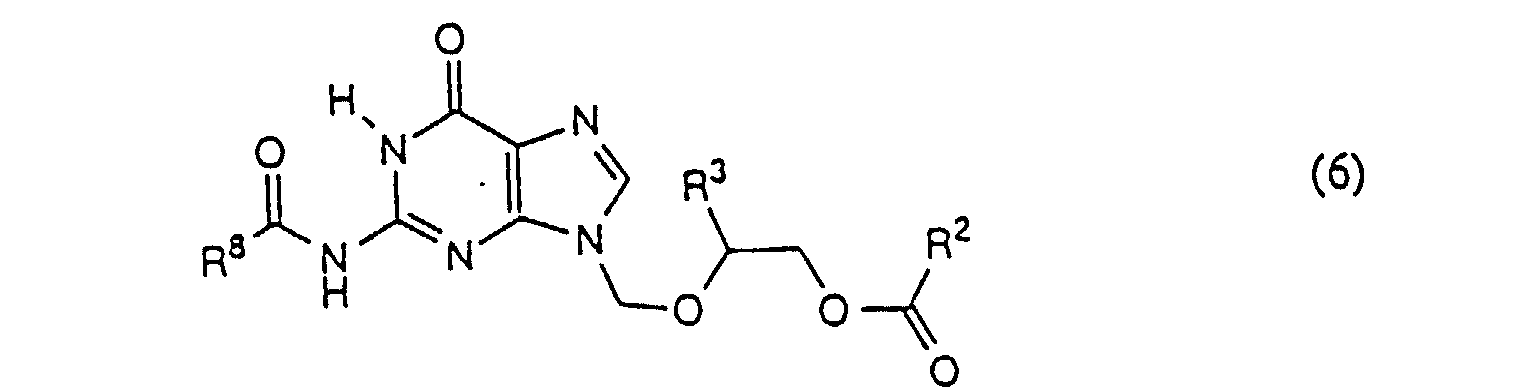
- Step 3 the N-9 isomer of Formula (4) is acylated and recrystallized, thus removing any residue of the N-7 isomer, to give the pure compound of Formula (6).
- the solution from Step 2 is heated to a temperature in the range of about 75-140°C, preferably about 100°C.
- a mixture of an organic base such as triethylamine, pyridine, and the like, preferably 4-dimethylaminopyridine (about 0.05 to 0.1 molar equivalents)
- R 8 is C 1-6 alkyl or phenyl and X is chloro or bromo.
- acyl halide a further 1-2 molar equivalents of a base are also added.
- an anhydride where R 8 is ethyl (about 1.2 to 3 molar equivalents) is employed.
- the mixture is heated to a temperature in the range of about 90 to 130°C, preferably about 100°C, for a period of about 0.5 to 2 hours, preferably about 1 hour.
- the reaction mixture is cooled to about room temperature, and unreacted acylating agent quenched by the addition of methanol and an inert solvent, preferably toluene.
- the reaction mixture is refluxed for about 1 hour, and then slowly cooled to -10 to 20°C, preferably about 0°C, and stood for 30 minutes to 6 hours, preferably about 1 hour. Pure compound of Formula (6) is obtained as a crystalline solid, with the N-7 isomer remaining in solution.
- Step 4 the pure compound of Formula (6) is hydrolyzed to give the corresponding compound of Formula I.
- the acylated guanine compound of Formula (6) is dissolved in a mixture of a protic solvent (about 15-30 molar equivalents), preferably methanol, and a strong base (about 5-20 molar equivalents), preferably ammonium hydroxide, at a temperature in the range of about 40 to 60°C, preferably about 50°C, at a pressure of about 10 psi, for a period of about 6 to 24 hours, preferably about 16 hours.
- the methanol and ammonium hydroxide is removed by distillation, and methanol (about 15-30 molar equivalents) is added back to the reaction mixture, which is then heated to reflux for about 1 hour.
- the reaction mixture is cooled to about 0°C for a period of about 1 hour, filtered and washed with methanol.
- the solid is optionally recrystallized, preferably from water, yielding the desired 9-subsituted guanine compound of Formula I.
- the compounds of Formula I may also be synthesized as described in Reaction Scheme C.
- R 8 is C 1-6 alkyl or phenyl, and R 5 , R 6 , and R 7 are independently C 1-6 alkyl; where R 2 is C 1-6 alkyl, and R 3 is hydrogen or -CH 2 OC(O)R 4 , in which R 4 is C 1-6 alkyl; where R 1 is hydrogen or -CH 2 OH.
- N-2 acylguanines of Formula (1a) are commercially available, for example from Aldrich.
- Step 2 protected N-2 acylguanine (Formula (2a)) is selectively alkylated to give the corresponding N-9 isomer of Formula (6), plus a small amount of the N-7 isomer.
- the reaction is carried out as shown for the preparation of compounds of Formula (4), in Reaction Scheme A, Step 2.
- a preferred process for synthesis of N-9 substituted guanine compounds entails first protecting guanine with trialkylsilyl, preferably trimethylsilyl, most preferably as tris(trimethylsilyl), reacting this protected compound with a compound of formula R 2 C(O)OCH 2 OCH(R 3 )CH 2 OC(O)R 2 , preferably where R 2 is ethyl and R 3 is -CH 2 OC(O)C 2 H 5 , to give an N-9 substituted guanine along with a small amount of the N-7 isomer.
- This compound is then acylated with an acylating agent of formula R 8 C(O)OC(O)R 8 or R 8 C(O)X, where R 8 is preferably ethyl, and crystallized to give pure N-2-acyl N-9 substituted guanine, which is hydrolysed to give the desired N-9 substituted guanine.
- a second preferred process involves first protecting N-2 acylguanine with trialkylsilyl, preferably trimethylsilyl, reacting this protected compound with a compound of formula R 2 C(O)OCH 2 OCH(R 3 )CH 2 OC(O)R 2 , preferably where R 2 is ethyl and R 3 is -CH 2 OC(O)C 2 H 5 , to give an N-9 substituted guanine along with a small amount of the N-7 isomer. This compound is then crystallized to give pure N-2-acyl N-9 substituted guanine, which is hydrolysed to give the desired N-9 substituted guanine.
- guanine (10 g), hexamethyldisilazane (HMDS, 50 ml), and trifluoromethane sulfonic acid (0.24 ml) was heated to reflux (130-135°C) for 16 hours.
- the resulting mixture was cooled to 35°C, and excess HMDS removed by distillation (0.1 to 1 mm Hg), slowly raising the bath temperature back to 105°C.
- the mixture was then cooled to 100°C, and 3-propionyloxy-2-propionyloxymethoxypropyl propionate (23.04 g) added.
- the resulting mixture was heated to 120-125°C for 8 hours, and the low boiling material removed by distillation.
- Example 1A To the resulting reaction mixture of Example 1A at 100°C was added a mixture of dimethylaminopyridine (0.663 g) and propionic anhydride (12.8 ml), and the mixture was stirred at 100°C for 1 hour. A mixture of methanol (3.95 ml) and toluene (100 ml) was then added, and the mixture refluxed for 30 minutes. The resulting solution was slowly cooled to 0°C over 2 hours, and maintained at 0°C for 1 hour.
- methanol 3.95 ml
- toluene 100 ml
- Diacetylguanine (3 g) was refluxed in a mixture of water (5 ml) and methanol (50 ml) for 4 hours. The solvents were then removed under reduced pressure, the residue washed with cold methanol, and dried under vacuum, to give N-acetyl-guanine, a compound of Formula (1a).
- This product was mixed with hexamethyldisilazane (50 ml), and trifluoromethane sulfonic acid (0.1 ml), and refluxed for 16 hours. Excess reactant was removed under reduced pressure (35-100°C, 0.1 mm), giving disilylated N-acetylguanine, a compound of Formula (2a).
- the silylated product was then mixed with 2-propionoxymethoxy-3-propionoxypropyl propionate (4.5 g). The resulting mixture was heated at 120°C for 7 hours, and cooled to 100°C. Methanol (5 ml) and toluene (5 ml) were then added, refluxed for 2 hours, then cooled to 0°C for 16 hours. The product was filtered off, washed with toluene, and dried, to yield 9-(1,3-dipropionoxy-2-propoxymethyl)-N 2 -acetylguanine, a compound of Formula (6), as a yellow crystalline product.
- a mixture of 10 gms (66 mmoles) of guanine, 50 ml of hexamethyldisilazane, and 0.4 gms (3 mmol) of ammonium sulfate was heated to 115-118°C for 18 hours. The ammonia gas was removed as it was formed. After 18 hours of heating, a solution was formed indicating the completion of silylation. To this solution was added 15 gms (85 mmol) of 2-oxa-1,4-butanediol diacetate and 0.1 ml of trimethylsilyl triflate. The mixture was heated to 130°C for a period of 4.5 hours.
- guanine (20 g), hexamethyldisilazane (HMDS, 100 ml), and trifluoromethane sulfonic acid (0.48 ml) was heated to reflux (130-135°C) for 8 hours.
- the resulting mixture was cooled to 105°C, and excess HMDS removed by distillation (0.1 to 1 mm Hg).
- the mixture was then cooled to 100°C, and 3-propionyloxy-2-propionyloxymethoxypropyl propionate (54.2 g) added.
- the resulting mixture was heated to 120-125°C for 7 hours, and the low boiling material removed by distillation.
- Example 1A To the resulting reaction mixture of Example 1A at 105°C was added a mixture of dimethylaminopyridine (1.32 g) and propionic anhydride (25.6 ml), and the mixture was stirred at 100°C for 1.5 hour. A mixture of methanol (16 ml) and toluene (200 ml) was then added, and the mixture refluxed for 30 minutes. The resulting solution was slowly cooled to 0°C over 2 hours, and maintained at 0°C for 1 hour.
Landscapes
- Chemical & Material Sciences (AREA)
- Organic Chemistry (AREA)
- Health & Medical Sciences (AREA)
- Life Sciences & Earth Sciences (AREA)
- Nuclear Medicine, Radiotherapy & Molecular Imaging (AREA)
- Animal Behavior & Ethology (AREA)
- General Chemical & Material Sciences (AREA)
- Medicinal Chemistry (AREA)
- Oncology (AREA)
- Pharmacology & Pharmacy (AREA)
- Communicable Diseases (AREA)
- Chemical Kinetics & Catalysis (AREA)
- General Health & Medical Sciences (AREA)
- Public Health (AREA)
- Veterinary Medicine (AREA)
- Virology (AREA)
- Pharmaceuticals Containing Other Organic And Inorganic Compounds (AREA)
- Low-Molecular Organic Synthesis Reactions Using Catalysts (AREA)
- Catalysts (AREA)
Claims (24)
- Procédé de préparation d'un composé représenté par la formule :dans laquelle :
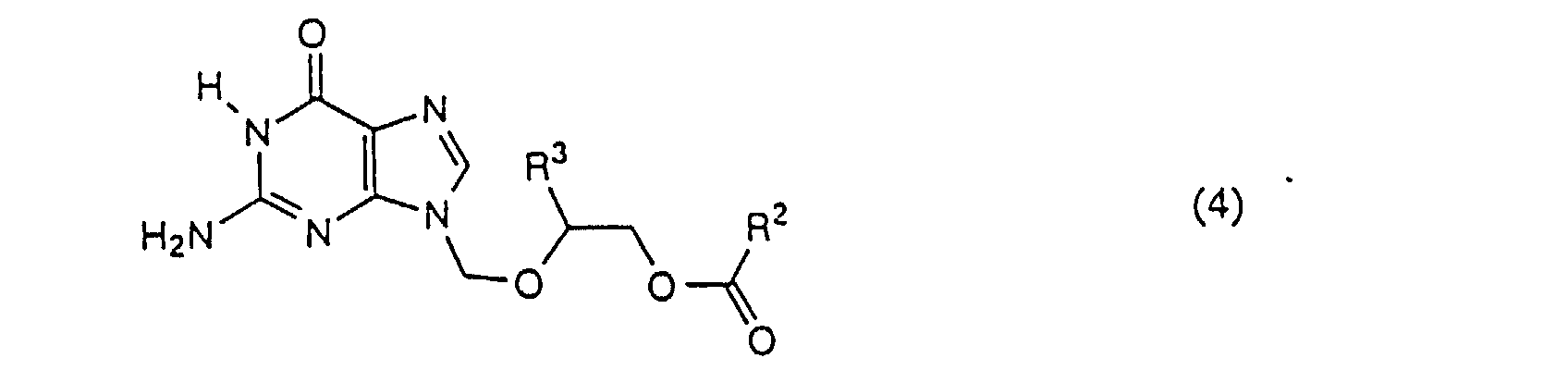 par mise en contact d'un composé ou d'un mélange de composés représentés par la formule :R2 est un radical alkyle en C1-6 ; etR3 est un atome d'hydrogène ou -CH2OC(O)R4 ; où R4 est un radical alkyle en C1-6 ;dans laquelle :
 dans laquelle R5, R6 et R7 sont chacun indépendamment des autres des radicaux alkyle en C1-6 ; à la condition qu'au moins l'un des radicaux Z soit R5R6R7Si ;Z1 est un atome d'hydrogène ou R5R6R7Si ;Z2 est un atome d'hydrogène ou R5R6R7Si ;Z3 est un atome d'hydrogène ou R5R6R7Si ;
avec un composé de formule :dans laquelle R2 et R3 sont tels que définis ci-dessus ;
lequel procédé est caractérisé en ce qu'il est mis en oeuvre en présence de 0,01 à 0,1 équivalents molaire d'un catalyseur choisi dans le groupe constitué de l'acide trifluorométhanesulfonique, du trifluorométhanesulfonate de triméthylsilyle et du sulfonate de bistriméthylsilyle. - Procédé selon la revendication 1, dans lequel ledit catalyseur est le trifluorométhanesulfonate de triméthylsilyle.
- Procédé selon la revendication 2, dans lequel R5, R6 et R7 sont tous des groupes méthyle.
- Procédé selon la revendication 3, dans lequel tant le composé de formule (2) que le trifluorométhanesulfonate de triméthylsilyle sont produits simultanément par mise en contact de guanine avec de l'hexaméthyldisilazane en présence d'acide trifluorométhanesulfonique.
- Procédé selon la revendication 4, dans lequel le composé de formule (2) est un composé ayant la formule :
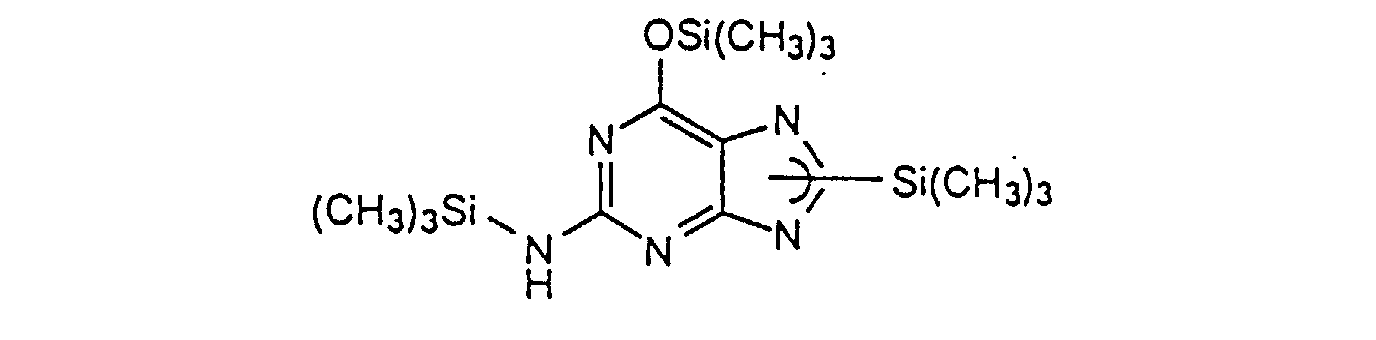
- Procédé selon la revendication 5, dans lequel R2 est le groupe éthyle, et R3 est -CH2OC(O)R4, où R4 est le groupe éthyle.
- Procédé selon la revendication 5, dans lequel R2 est le groupe éthyle et R3 est un atome d'hydrogène.
- Procédé selon la revendication 1, qui comprend les étapes supplémentaires consistant :a) à mettre en contact le composé de formule (4) avec un agent d'acylation ayant un radical acyle de formule R8C(O)-, dans laquelle R8 est un radical alkyle en C1-6 ou le groupe phényle ; éventuellement en présence d'une base, pour donner un composé représenté par la formule :dans laquelle R2, R3 et R8 sont tels que définis ci-dessus ;
 b) à séparer le composé représenté par la formule (6) ; etc) à hydrolyser le composé séparé de formule (6) pour donner un composé de formule I :dans laquelle R1 est un atome d'hydrogène ou -CH2OH.

- Procédé selon la revendication 8, dans lequel tant le composé de formule (2) que le trifluorométhanesulfonate de triméthylsilyle sont produits simultanément par mise en contact de guanine avec de l'hexaméthyldisilazane en présence d'acide trifluorométhanesulfonique.
- Procédé selon la revendication 9, dans lequel ledit agent d'acylation est l'anhydride propionique et ladite base est la 4-diméthylaminopyridine.
- Procédé selon la revendication 10, dans lequel le composé de formule (6) est séparé d'un solvant inerte par cristallisation.
- Procédé selon la revendication 11, dans lequel ledit solvant inerte est l'acétate d'isopropyle ou le toluène, éventuellement en mélange avec de l'hexane.
- Procédé selon la revendication 12, dans lequel l'hydrolyse est mise en oeuvre avec de l'hydroxyde d'ammonium.
- Procédé selon la revendication 13, dans lequel R2 est le groupe éthyle et R3 est un atome d'hydrogène.
- Procédé selon la revendication 13, dans lequel R2 est le groupe éthyle, et R3 est -CH2OC(O)R4, où R4 est le groupe éthyle.
- Procédé de préparation d'un composé représenté par la formule Idans laquelle :
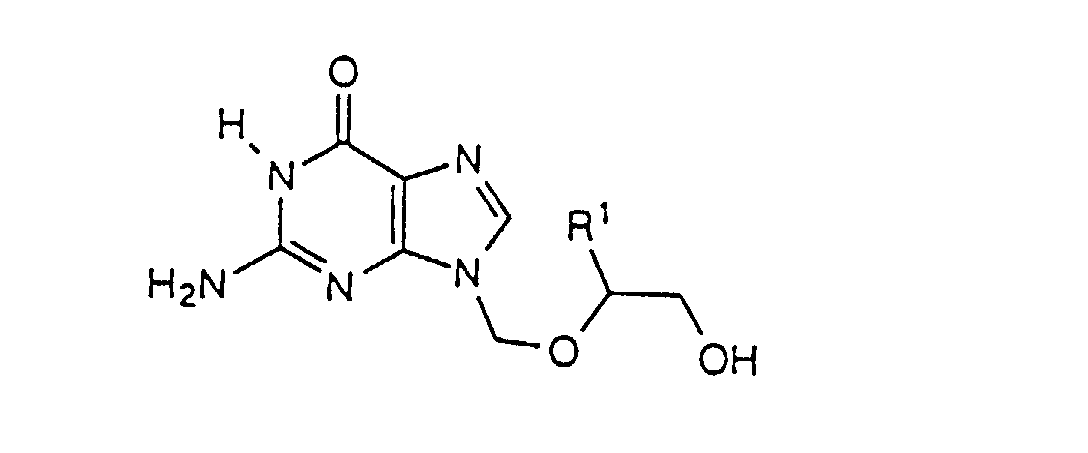 ledit procédé consistant :R1 est un atome d'hydrogène ou -CH2OH ;a) à mettre en contact un mélange d'isomères représenté par la formule :dans laquelle R5, R6 et R7 représentent indépendamment les uns des autres des radicaux alkyle en C1-6 et R8 est un radical alkyle en C1-6 ou le groupe phényle ; avec un composé représenté par la formule :
 dans laquelle :
 en présence de 0,01 à 0,1 équivalents molaires d'un catalyseur choisi dans le groupe constitué de l'acide trifluorométhanesulfonique, du trifluorométhanesulfonate de triméthylsilyle et du sulfonate de bistriméthylsilyle, pour donner un composé représenté par la formule :R2 est un radical alkyle en C1-6 ; etR3 est un atome d'hydrogène ou -CH2OC(O)R4, où R4 est un radical alkyle en C1-6 ;dans laquelle R2, R3 et R8 sont tels que définis ci-dessus ;
 b) à séparer le composé de formule (6) ; etc) à hydrolyser le composé séparé de formule (6).
- Procédé selon la revendication 16, dans lequel ledit catalyseur est le trifluorométhanesulfonate de triméthylsilyle.
- Procédé selon la revendication 17, dans lequel R5, R6 et R7 sont tous des groupes méthyle, et R2 et R8 représentent chacun indépendamment de l'autre le groupe méthyle ou éthyle.
- Procédé selon la revendication 18, dans lequel le composé de formule (6) est séparé, par cristallisation, de l'acétate d'isopropyle ou du toluène éventuellement en mélange avec de l'hexane.
- Procédé selon la revendication 19, dans lequel l'hydrolyse est mise en oeuvre avec de l'hydroxyde d'ammonium.
- Procédé selon la revendication 20, dans lequel R2 est le groupe éthyle, et R3 est -CH2OC(O)R4, où R4 est le groupe éthyle.
- Procédé selon la revendication 20, dans lequel R2 est le groupe éthyle et R3 est un atome d'hydrogène.
- Procédé de préparation d'un composé représenté par la formule Idans laquelle :
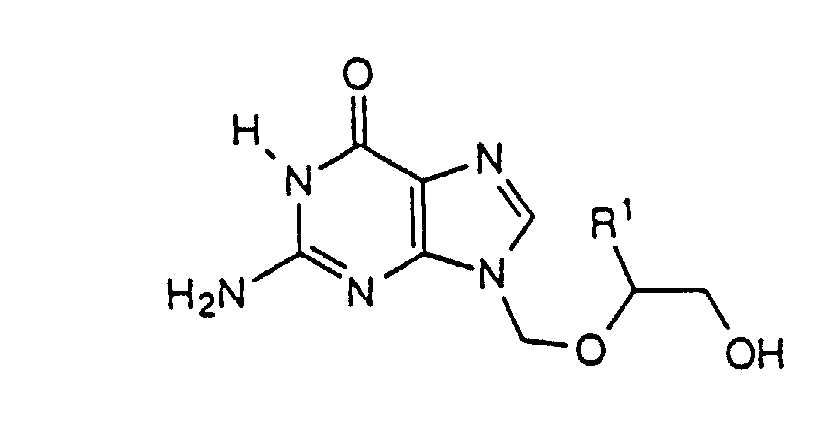 ledit procédé consistant :R1 est -CH2OH ;a) à mettre en contact un mélange d'isomères représenté par la formule :avec un composé de formule :
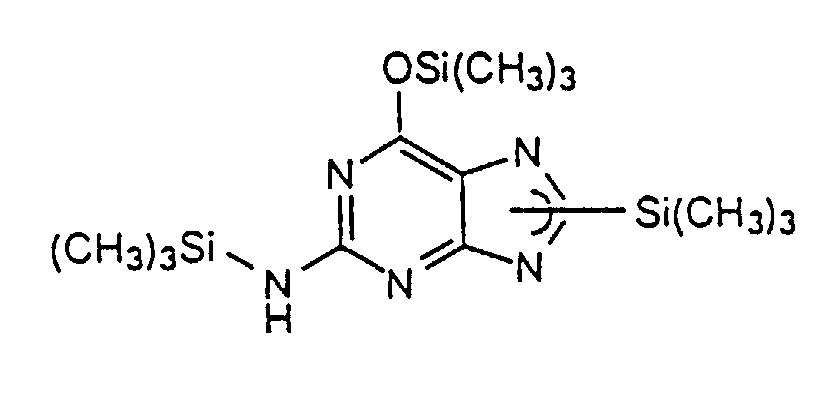 dans laquelle :
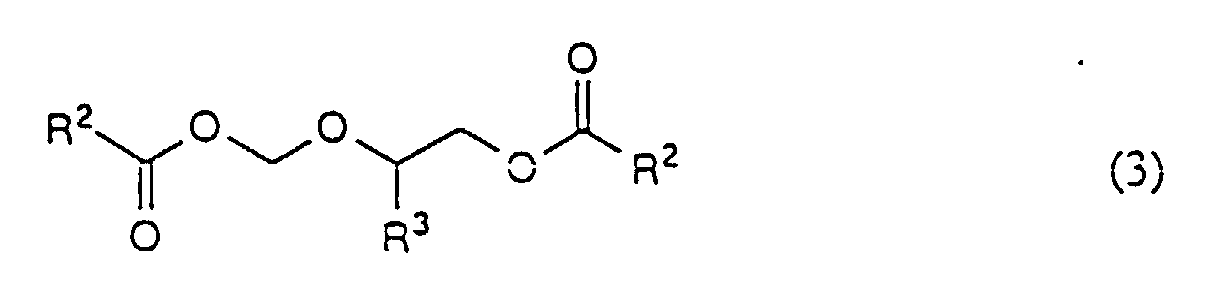 en présence de 0,01 à 0,1 équivalents molaires de trifluorométhanesulfonate de triméthylsilyle, pour obtenir un composé de formule :R2 est le groupe éthyle ; etR3 est -CH2OC(O)C2H5 ;dans laquelle R2 et R3 sont tels que définis ci-dessus ;
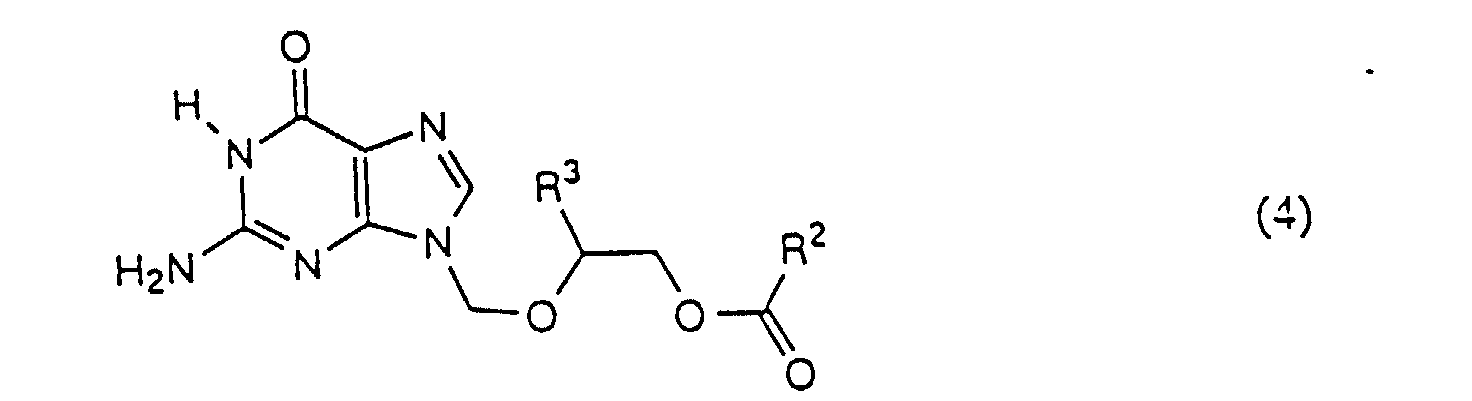 b) à mettre en contact le composé de formule (4) avec de l'anhydride propionique et de la diméthylaminopyridine, pour donner un composé représenté par la formule :dans laquelle R2 est le groupe éthyle, R3 est -CH2OC(O)C2H5 et R8 est le groupe éthyle ;
 c) à cristalliser dans le toluène le composé représenté par la formule (6) ; etd) à hydrolyser le composé cristallisé de formule (6) avec de l'hydroxyde d'ammonium.
- Procédé selon la revendication 23, dans lequel tant le composé de formule (2) que le trifluorométhanesulfonate de triméthylsilyle sont produits simultanément par mise en contact de guanine avec de l'hexaméthyldisilazane en présence d'acide trifluorométhanesulfonique.
Applications Claiming Priority (2)
| Application Number | Priority Date | Filing Date | Title |
|---|---|---|---|
| US08/286,045 US5565565A (en) | 1994-08-04 | 1994-08-04 | Preparation of N-9 substituted guanine compounds |
| US286045 | 1994-08-04 |
Publications (2)
| Publication Number | Publication Date |
|---|---|
| EP0704445A1 EP0704445A1 (fr) | 1996-04-03 |
| EP0704445B1 true EP0704445B1 (fr) | 1999-04-21 |
Family
ID=23096824
Family Applications (1)
| Application Number | Title | Priority Date | Filing Date |
|---|---|---|---|
| EP95111473A Expired - Lifetime EP0704445B1 (fr) | 1994-08-04 | 1995-07-21 | Préparation des composés de guanine substitués sur la position 9 |
Country Status (9)
| Country | Link |
|---|---|
| US (1) | US5565565A (fr) |
| EP (1) | EP0704445B1 (fr) |
| JP (1) | JP2944474B2 (fr) |
| KR (1) | KR100218610B1 (fr) |
| CN (2) | CN1051084C (fr) |
| AT (1) | ATE179174T1 (fr) |
| DE (1) | DE69509182T2 (fr) |
| DK (1) | DK0704445T3 (fr) |
| ES (1) | ES2131730T3 (fr) |
Families Citing this family (13)
| Publication number | Priority date | Publication date | Assignee | Title |
|---|---|---|---|---|
| WO1997024357A1 (fr) * | 1995-12-28 | 1997-07-10 | Mallinckrodt Chemical, Inc. | Procede de synthese et de purification d'un compose intervenant dans l'elaboration de l'acyclovir |
| US6040446A (en) * | 1996-01-26 | 2000-03-21 | Syntex (U.S.A.) Inc. | Process for preparing a 2-(2-amino-1,6-dihydro-6-oxo-purin-9-yl) methoxy-1,3-propanediol derivative |
| EP0976751A1 (fr) * | 1996-04-09 | 2000-02-02 | Lupin Laboratories Limited | Un procédé d'isomérisation d'un isomère N-7 en un isomère N-9 utile dans la synthèse de nucléosides acycliques |
| JPH11192744A (ja) | 1997-12-29 | 1999-07-21 | Canon Inc | Ledアレイ駆動装置および方法 |
| CN1091445C (zh) * | 1999-12-29 | 2002-09-25 | 湖北省医药工业研究院 | 抗病毒药物中间体、它们的制备及应用 |
| US20050176956A1 (en) * | 2001-10-15 | 2005-08-11 | Babu Jayachandra S. | Process for the preparation of ganciclovir intermediate n2-acetyl-9-(1,3-diacetoxy-2-propoxymethyl) guanine |
| US7078524B2 (en) * | 2002-11-22 | 2006-07-18 | Ranbaxy Laboratories Limited | Process for the synthesis of ganciclovir |
| ZA200702234B (en) * | 2006-03-21 | 2008-07-30 | Cipla Ltd | Preparation of ester of purine derivatives |
| US7497521B2 (en) * | 2006-08-30 | 2009-03-03 | Honda Motor Co., Ltd | Seat belt retractor mounting system |
| CA2691430C (fr) | 2007-06-28 | 2013-01-08 | Spinal Elements, Inc. | Dispositif de stabilisation vertebrale |
| CA2697710A1 (fr) * | 2007-08-24 | 2009-03-05 | Spinal Elements, Inc. | Dispositif de stabilisation spinale a tige a boucle |
| CN108503668A (zh) * | 2018-05-11 | 2018-09-07 | 浙江华贝药业有限责任公司 | 一种三甲基苯氧基硅烷的合成方法 |
| CN114047262B (zh) * | 2021-10-14 | 2024-12-13 | 湖北省宏源药业科技股份有限公司 | 一种分离测定易水解大极性化合物的方法 |
Family Cites Families (11)
| Publication number | Priority date | Publication date | Assignee | Title |
|---|---|---|---|---|
| GB1523865A (en) * | 1974-09-02 | 1978-09-06 | Wellcome Found | Purine compunds and salts thereof |
| US4355032B2 (en) * | 1981-05-21 | 1990-10-30 | 9-(1,3-dihydroxy-2-propoxymethyl)guanine as antiviral agent | |
| HU189609B (en) * | 1981-08-11 | 1986-07-28 | The Wellcome Foundation Ltd,Us | Process for production of new purin derivatives with antivirus effect and medical preparatives containing thereof as reagent |
| NZ201662A (en) * | 1981-08-26 | 1986-07-11 | Merck & Co Inc | 9-(1,3-(and 2,3)-dihydroxy-1-(and 2)-propoxy-methyl)guanine derivatives and methods for their preparation |
| US5250535A (en) * | 1982-02-01 | 1993-10-05 | Syntex Inc. | Substituted 9-(1 or 3-monoacyloxy or 1,3-diacyloxy-2-propoxymethyl) purines as antiviral agent |
| US4621140A (en) * | 1984-02-23 | 1986-11-04 | Syntex (U.S.A.) Inc. | Process for preparing 2,6-substituted-9-(1,3-dihydroxy-2-propoxymethyl)-purines and certain derivatives |
| DE3627024A1 (de) * | 1985-09-24 | 1987-04-02 | Hoechst Ag | In 6- und 9-stellung substituierte 2-aminopurine, ihre verwendung, diese purine enthaltende arzneimittel und verfahren zur herstellung der purine |
| DE3631562A1 (de) * | 1986-09-17 | 1988-03-31 | Hoechst Ag | In 9-stellung substituierte 2-amino-6-alkoxy-purine, ihre verwendung, diese purine enthaltende arzneimittel und verfahren zur herstellung der purine |
| JPS63107982A (ja) * | 1986-10-27 | 1988-05-12 | Minofuaagen Seiyaku Honpo:Goushi | 9−〔(2−ハイドロキシエトキシ)メチル〕−グアニンの製造方法 |
| JP3225545B2 (ja) * | 1991-09-18 | 2001-11-05 | 味の素株式会社 | 非環状ヌクレオシド類の製造法 |
| JPH05213903A (ja) * | 1991-12-09 | 1993-08-24 | Mitsubishi Kasei Corp | アシクロヌクレオシド誘導体の製造方法 |
-
1994
- 1994-08-04 US US08/286,045 patent/US5565565A/en not_active Expired - Lifetime
-
1995
- 1995-07-21 AT AT95111473T patent/ATE179174T1/de active
- 1995-07-21 DE DE69509182T patent/DE69509182T2/de not_active Expired - Lifetime
- 1995-07-21 DK DK95111473T patent/DK0704445T3/da active
- 1995-07-21 EP EP95111473A patent/EP0704445B1/fr not_active Expired - Lifetime
- 1995-07-21 ES ES95111473T patent/ES2131730T3/es not_active Expired - Lifetime
- 1995-08-03 CN CN95108673A patent/CN1051084C/zh not_active Expired - Lifetime
- 1995-08-03 KR KR1019950023927A patent/KR100218610B1/ko not_active Expired - Lifetime
- 1995-08-03 JP JP7197844A patent/JP2944474B2/ja not_active Expired - Lifetime
-
1999
- 1999-06-30 CN CNB991089235A patent/CN1137892C/zh not_active Expired - Lifetime
Non-Patent Citations (1)
| Title |
|---|
| Tetrahedron Letters, 1978, (15), 1339-42 * |
Also Published As
| Publication number | Publication date |
|---|---|
| EP0704445A1 (fr) | 1996-04-03 |
| JP2944474B2 (ja) | 1999-09-06 |
| DE69509182T2 (de) | 1999-10-21 |
| CN1137892C (zh) | 2004-02-11 |
| CN1120044A (zh) | 1996-04-10 |
| CN1246477A (zh) | 2000-03-08 |
| KR100218610B1 (ko) | 1999-09-01 |
| DK0704445T3 (da) | 1999-10-25 |
| CN1051084C (zh) | 2000-04-05 |
| ES2131730T3 (es) | 1999-08-01 |
| US5565565A (en) | 1996-10-15 |
| DE69509182D1 (de) | 1999-05-27 |
| JPH0859662A (ja) | 1996-03-05 |
| ATE179174T1 (de) | 1999-05-15 |
Similar Documents
| Publication | Publication Date | Title |
|---|---|---|
| US5336770A (en) | Transglycosilation process for producing acyclic nucleosides | |
| US5565565A (en) | Preparation of N-9 substituted guanine compounds | |
| HU204829B (en) | Process for producing purine derivatives with antiviral effect | |
| EP0152965B1 (fr) | Procédé pour la préparation de 2,6-substitué-9-(1,3-dihydroxy-2-propoxyméthyl)-purines et quelques dérivés | |
| US5792868A (en) | Process for producing acyclic nucleosides and process for separating purine nucleosides | |
| KR100573859B1 (ko) | 9-[4-아세톡시-3-(아세톡시메틸)부트-1-일]-2-아미노푸린의제조방법 | |
| EP0351126B1 (fr) | Procédé pour la préparation de O2,2'-anhydro-1-(bêta-D-arabinofuranosyl)thymine | |
| EP0294695A2 (fr) | Dérivés de labtane polyoxygénés, procédé pour leur préparation et leur utilisation comme médicaments | |
| HU196207B (en) | Process for preparing 9-/2-hydroxy-ethoxy/-methyl-guanine | |
| EP0072977A1 (fr) | Procédé de préparation de la 2-bêta-D-ribofuranosylthiazol-4-carboxamide | |
| US5567816A (en) | Preparation of acyclovir using 1,3 dioxolane | |
| EP0709385A1 (fr) | Préparation d'acyclovir | |
| EP0806425B1 (fr) | Procédé régiospécifique amélioré pour la synthèse de nucléosides acycliques | |
| US5688948A (en) | Process for isomerizing acyclic nucleosides and process for separating purine nucleosides | |
| KR100613812B1 (ko) | 푸린 유도체를 제조하는 방법 | |
| US6043364A (en) | Regiospecific process for synthesis of acyclic nucleosides | |
| EP0564006A2 (fr) | Dérivés de purine et procédé pour leur préparation | |
| JPH10130245A (ja) | アシクロヌクレオシドの製造方法 | |
| JPH07242694A (ja) | トリアゾロプリンヌクレオシド誘導体及び該誘導体を製造するのに有用な合成中間体 | |
| KR920002847B1 (ko) | 7-[D(-)-알파-아미노-알파-(p-히드록시페닐)아세트아미도]-3-(123-트리아졸-5-일)티오메틸-3-세펨-4-카르복실산의 제조방법 | |
| KR100618232B1 (ko) | 팜시클로버의 제조방법 | |
| Ghal et al. | An Efficient Synthesis of 2-[(4-Amino∼ 1, 2-dihyro-2-oxo-1-pyrimidinyl) methoxyi-l, 3-propanediyl-di-L-valinate an Anti-cytomegalovirus Agent | |
| JPS63284193A (ja) | 2’,3’−ジデオキシシチジン誘導体の製法 | |
| HU192932B (en) | Process for producing apovincaminol derivative | |
| JPH0796535B2 (ja) | シクロペンタン誘導体 |
Legal Events
| Date | Code | Title | Description |
|---|---|---|---|
| PUAI | Public reference made under article 153(3) epc to a published international application that has entered the european phase |
Free format text: ORIGINAL CODE: 0009012 |
|
| 17P | Request for examination filed |
Effective date: 19950721 |
|
| AK | Designated contracting states |
Kind code of ref document: A1 Designated state(s): AT BE CH DE DK ES FR GB IT LI NL |
|
| 17Q | First examination report despatched |
Effective date: 19970117 |
|
| GRAG | Despatch of communication of intention to grant |
Free format text: ORIGINAL CODE: EPIDOS AGRA |
|
| GRAG | Despatch of communication of intention to grant |
Free format text: ORIGINAL CODE: EPIDOS AGRA |
|
| GRAH | Despatch of communication of intention to grant a patent |
Free format text: ORIGINAL CODE: EPIDOS IGRA |
|
| GRAH | Despatch of communication of intention to grant a patent |
Free format text: ORIGINAL CODE: EPIDOS IGRA |
|
| GRAA | (expected) grant |
Free format text: ORIGINAL CODE: 0009210 |
|
| AK | Designated contracting states |
Kind code of ref document: B1 Designated state(s): AT BE CH DE DK ES FR GB IT LI NL |
|
| REF | Corresponds to: |
Ref document number: 179174 Country of ref document: AT Date of ref document: 19990515 Kind code of ref document: T |
|
| REG | Reference to a national code |
Ref country code: CH Ref legal event code: EP |
|
| REF | Corresponds to: |
Ref document number: 69509182 Country of ref document: DE Date of ref document: 19990527 |
|
| ET | Fr: translation filed | ||
| REG | Reference to a national code |
Ref country code: ES Ref legal event code: FG2A Ref document number: 2131730 Country of ref document: ES Kind code of ref document: T3 |
|
| REG | Reference to a national code |
Ref country code: DK Ref legal event code: T3 |
|
| PLBE | No opposition filed within time limit |
Free format text: ORIGINAL CODE: 0009261 |
|
| STAA | Information on the status of an ep patent application or granted ep patent |
Free format text: STATUS: NO OPPOSITION FILED WITHIN TIME LIMIT |
|
| 26N | No opposition filed | ||
| REG | Reference to a national code |
Ref country code: GB Ref legal event code: IF02 |
|
| PGFP | Annual fee paid to national office [announced via postgrant information from national office to epo] |
Ref country code: GB Payment date: 20140624 Year of fee payment: 20 |
|
| PGFP | Annual fee paid to national office [announced via postgrant information from national office to epo] |
Ref country code: DK Payment date: 20140624 Year of fee payment: 20 |
|
| PGFP | Annual fee paid to national office [announced via postgrant information from national office to epo] |
Ref country code: CH Payment date: 20140725 Year of fee payment: 20 Ref country code: NL Payment date: 20140710 Year of fee payment: 20 Ref country code: DE Payment date: 20140731 Year of fee payment: 20 |
|
| PGFP | Annual fee paid to national office [announced via postgrant information from national office to epo] |
Ref country code: ES Payment date: 20140716 Year of fee payment: 20 Ref country code: FR Payment date: 20140624 Year of fee payment: 20 Ref country code: AT Payment date: 20140624 Year of fee payment: 20 |
|
| PGFP | Annual fee paid to national office [announced via postgrant information from national office to epo] |
Ref country code: IT Payment date: 20140714 Year of fee payment: 20 |
|
| PGFP | Annual fee paid to national office [announced via postgrant information from national office to epo] |
Ref country code: BE Payment date: 20140708 Year of fee payment: 20 |
|
| REG | Reference to a national code |
Ref country code: DE Ref legal event code: R071 Ref document number: 69509182 Country of ref document: DE |
|
| REG | Reference to a national code |
Ref country code: NL Ref legal event code: V4 Effective date: 20150721 |
|
| REG | Reference to a national code |
Ref country code: DK Ref legal event code: EUP Effective date: 20150721 |
|
| REG | Reference to a national code |
Ref country code: NL Ref legal event code: V4 Effective date: 20150721 |
|
| REG | Reference to a national code |
Ref country code: CH Ref legal event code: PL |
|
| REG | Reference to a national code |
Ref country code: GB Ref legal event code: PE20 Expiry date: 20150720 |
|
| REG | Reference to a national code |
Ref country code: AT Ref legal event code: MK07 Ref document number: 179174 Country of ref document: AT Kind code of ref document: T Effective date: 20150721 |
|
| REG | Reference to a national code |
Ref country code: ES Ref legal event code: FD2A Effective date: 20151028 |
|
| PG25 | Lapsed in a contracting state [announced via postgrant information from national office to epo] |
Ref country code: GB Free format text: LAPSE BECAUSE OF EXPIRATION OF PROTECTION Effective date: 20150720 |
|
| PG25 | Lapsed in a contracting state [announced via postgrant information from national office to epo] |
Ref country code: ES Free format text: LAPSE BECAUSE OF EXPIRATION OF PROTECTION Effective date: 20150722 |