EP0704540B1 - Verfahren für die Einordnung von Gerste- und Malzsorten mittels Gendiagnose und ein dafür bestimmter Primer - Google Patents
Verfahren für die Einordnung von Gerste- und Malzsorten mittels Gendiagnose und ein dafür bestimmter Primer Download PDFInfo
- Publication number
- EP0704540B1 EP0704540B1 EP95115438A EP95115438A EP0704540B1 EP 0704540 B1 EP0704540 B1 EP 0704540B1 EP 95115438 A EP95115438 A EP 95115438A EP 95115438 A EP95115438 A EP 95115438A EP 0704540 B1 EP0704540 B1 EP 0704540B1
- Authority
- EP
- European Patent Office
- Prior art keywords
- barley
- malt
- variety
- primers
- pcr
- Prior art date
- Legal status (The legal status is an assumption and is not a legal conclusion. Google has not performed a legal analysis and makes no representation as to the accuracy of the status listed.)
- Expired - Lifetime
Links
- 235000007340 Hordeum vulgare Nutrition 0.000 title claims abstract description 33
- 108090000623 proteins and genes Proteins 0.000 title claims abstract description 28
- GXCLVBGFBYZDAG-UHFFFAOYSA-N N-[2-(1H-indol-3-yl)ethyl]-N-methylprop-2-en-1-amine Chemical compound CN(CCC1=CNC2=C1C=CC=C2)CC=C GXCLVBGFBYZDAG-UHFFFAOYSA-N 0.000 title claims abstract description 25
- 238000000034 method Methods 0.000 title claims description 31
- 240000005979 Hordeum vulgare Species 0.000 title abstract 2
- 238000003745 diagnosis Methods 0.000 title description 6
- 230000000295 complement effect Effects 0.000 claims abstract description 13
- 108020004414 DNA Proteins 0.000 claims description 35
- 241000209219 Hordeum Species 0.000 claims description 31
- 108091034117 Oligonucleotide Proteins 0.000 claims description 21
- JLCPHMBAVCMARE-UHFFFAOYSA-N [3-[[3-[[3-[[3-[[3-[[3-[[3-[[3-[[3-[[3-[[3-[[5-(2-amino-6-oxo-1H-purin-9-yl)-3-[[3-[[3-[[3-[[3-[[3-[[5-(2-amino-6-oxo-1H-purin-9-yl)-3-[[5-(2-amino-6-oxo-1H-purin-9-yl)-3-hydroxyoxolan-2-yl]methoxy-hydroxyphosphoryl]oxyoxolan-2-yl]methoxy-hydroxyphosphoryl]oxy-5-(5-methyl-2,4-dioxopyrimidin-1-yl)oxolan-2-yl]methoxy-hydroxyphosphoryl]oxy-5-(6-aminopurin-9-yl)oxolan-2-yl]methoxy-hydroxyphosphoryl]oxy-5-(6-aminopurin-9-yl)oxolan-2-yl]methoxy-hydroxyphosphoryl]oxy-5-(6-aminopurin-9-yl)oxolan-2-yl]methoxy-hydroxyphosphoryl]oxy-5-(6-aminopurin-9-yl)oxolan-2-yl]methoxy-hydroxyphosphoryl]oxyoxolan-2-yl]methoxy-hydroxyphosphoryl]oxy-5-(5-methyl-2,4-dioxopyrimidin-1-yl)oxolan-2-yl]methoxy-hydroxyphosphoryl]oxy-5-(4-amino-2-oxopyrimidin-1-yl)oxolan-2-yl]methoxy-hydroxyphosphoryl]oxy-5-(5-methyl-2,4-dioxopyrimidin-1-yl)oxolan-2-yl]methoxy-hydroxyphosphoryl]oxy-5-(5-methyl-2,4-dioxopyrimidin-1-yl)oxolan-2-yl]methoxy-hydroxyphosphoryl]oxy-5-(6-aminopurin-9-yl)oxolan-2-yl]methoxy-hydroxyphosphoryl]oxy-5-(6-aminopurin-9-yl)oxolan-2-yl]methoxy-hydroxyphosphoryl]oxy-5-(4-amino-2-oxopyrimidin-1-yl)oxolan-2-yl]methoxy-hydroxyphosphoryl]oxy-5-(4-amino-2-oxopyrimidin-1-yl)oxolan-2-yl]methoxy-hydroxyphosphoryl]oxy-5-(4-amino-2-oxopyrimidin-1-yl)oxolan-2-yl]methoxy-hydroxyphosphoryl]oxy-5-(6-aminopurin-9-yl)oxolan-2-yl]methoxy-hydroxyphosphoryl]oxy-5-(4-amino-2-oxopyrimidin-1-yl)oxolan-2-yl]methyl [5-(6-aminopurin-9-yl)-2-(hydroxymethyl)oxolan-3-yl] hydrogen phosphate Polymers Cc1cn(C2CC(OP(O)(=O)OCC3OC(CC3OP(O)(=O)OCC3OC(CC3O)n3cnc4c3nc(N)[nH]c4=O)n3cnc4c3nc(N)[nH]c4=O)C(COP(O)(=O)OC3CC(OC3COP(O)(=O)OC3CC(OC3COP(O)(=O)OC3CC(OC3COP(O)(=O)OC3CC(OC3COP(O)(=O)OC3CC(OC3COP(O)(=O)OC3CC(OC3COP(O)(=O)OC3CC(OC3COP(O)(=O)OC3CC(OC3COP(O)(=O)OC3CC(OC3COP(O)(=O)OC3CC(OC3COP(O)(=O)OC3CC(OC3COP(O)(=O)OC3CC(OC3COP(O)(=O)OC3CC(OC3COP(O)(=O)OC3CC(OC3COP(O)(=O)OC3CC(OC3COP(O)(=O)OC3CC(OC3COP(O)(=O)OC3CC(OC3CO)n3cnc4c(N)ncnc34)n3ccc(N)nc3=O)n3cnc4c(N)ncnc34)n3ccc(N)nc3=O)n3ccc(N)nc3=O)n3ccc(N)nc3=O)n3cnc4c(N)ncnc34)n3cnc4c(N)ncnc34)n3cc(C)c(=O)[nH]c3=O)n3cc(C)c(=O)[nH]c3=O)n3ccc(N)nc3=O)n3cc(C)c(=O)[nH]c3=O)n3cnc4c3nc(N)[nH]c4=O)n3cnc4c(N)ncnc34)n3cnc4c(N)ncnc34)n3cnc4c(N)ncnc34)n3cnc4c(N)ncnc34)O2)c(=O)[nH]c1=O JLCPHMBAVCMARE-UHFFFAOYSA-N 0.000 claims description 11
- 108091028043 Nucleic acid sequence Proteins 0.000 claims description 7
- 239000002773 nucleotide Substances 0.000 claims description 5
- 125000003729 nucleotide group Chemical group 0.000 claims description 5
- 238000003752 polymerase chain reaction Methods 0.000 description 22
- 108020004707 nucleic acids Proteins 0.000 description 18
- 150000007523 nucleic acids Chemical class 0.000 description 18
- 102000039446 nucleic acids Human genes 0.000 description 18
- 108091008146 restriction endonucleases Proteins 0.000 description 11
- 229920002401 polyacrylamide Polymers 0.000 description 7
- 230000003321 amplification Effects 0.000 description 6
- 238000001502 gel electrophoresis Methods 0.000 description 6
- 238000003199 nucleic acid amplification method Methods 0.000 description 6
- 238000004458 analytical method Methods 0.000 description 5
- 239000003550 marker Substances 0.000 description 5
- 239000000463 material Substances 0.000 description 5
- 208000034454 F12-related hereditary angioedema with normal C1Inh Diseases 0.000 description 4
- 235000013339 cereals Nutrition 0.000 description 4
- 239000012634 fragment Substances 0.000 description 4
- 208000016861 hereditary angioedema type 3 Diseases 0.000 description 4
- 239000000523 sample Substances 0.000 description 4
- FWMNVWWHGCHHJJ-SKKKGAJSSA-N 4-amino-1-[(2r)-6-amino-2-[[(2r)-2-[[(2r)-2-[[(2r)-2-amino-3-phenylpropanoyl]amino]-3-phenylpropanoyl]amino]-4-methylpentanoyl]amino]hexanoyl]piperidine-4-carboxylic acid Chemical compound C([C@H](C(=O)N[C@H](CC(C)C)C(=O)N[C@H](CCCCN)C(=O)N1CCC(N)(CC1)C(O)=O)NC(=O)[C@H](N)CC=1C=CC=CC=1)C1=CC=CC=C1 FWMNVWWHGCHHJJ-SKKKGAJSSA-N 0.000 description 3
- 108090000371 Esterases Proteins 0.000 description 3
- 108010068370 Glutens Proteins 0.000 description 3
- 238000009395 breeding Methods 0.000 description 3
- 230000001488 breeding effect Effects 0.000 description 3
- 238000011109 contamination Methods 0.000 description 3
- 238000001962 electrophoresis Methods 0.000 description 3
- 238000000605 extraction Methods 0.000 description 3
- 238000004890 malting Methods 0.000 description 3
- 239000000203 mixture Substances 0.000 description 3
- 238000003908 quality control method Methods 0.000 description 3
- 101710137053 B1-hordein Proteins 0.000 description 2
- 108090000637 alpha-Amylases Proteins 0.000 description 2
- 108010019077 beta-Amylase Proteins 0.000 description 2
- 230000015572 biosynthetic process Effects 0.000 description 2
- 238000001976 enzyme digestion Methods 0.000 description 2
- 238000011156 evaluation Methods 0.000 description 2
- 239000000499 gel Substances 0.000 description 2
- 239000011544 gradient gel Substances 0.000 description 2
- 239000011541 reaction mixture Substances 0.000 description 2
- 238000003786 synthesis reaction Methods 0.000 description 2
- KMEMIMRPZGDOMG-UHFFFAOYSA-N 2-cyanoethoxyphosphonamidous acid Chemical compound NP(O)OCCC#N KMEMIMRPZGDOMG-UHFFFAOYSA-N 0.000 description 1
- 101710130006 Beta-glucanase Proteins 0.000 description 1
- 208000019300 CLIPPERS Diseases 0.000 description 1
- LZZYPRNAOMGNLH-UHFFFAOYSA-M Cetrimonium bromide Chemical compound [Br-].CCCCCCCCCCCCCCCC[N+](C)(C)C LZZYPRNAOMGNLH-UHFFFAOYSA-M 0.000 description 1
- 241000196324 Embryophyta Species 0.000 description 1
- 108091005804 Peptidases Proteins 0.000 description 1
- 239000004365 Protease Substances 0.000 description 1
- 102100037486 Reverse transcriptase/ribonuclease H Human genes 0.000 description 1
- 108010006785 Taq Polymerase Proteins 0.000 description 1
- 102000004139 alpha-Amylases Human genes 0.000 description 1
- 229940024171 alpha-amylase Drugs 0.000 description 1
- 238000000137 annealing Methods 0.000 description 1
- 230000015556 catabolic process Effects 0.000 description 1
- 238000006243 chemical reaction Methods 0.000 description 1
- 208000021930 chronic lymphocytic inflammation with pontine perivascular enhancement responsive to steroids Diseases 0.000 description 1
- 238000003776 cleavage reaction Methods 0.000 description 1
- 230000002596 correlated effect Effects 0.000 description 1
- 230000000875 corresponding effect Effects 0.000 description 1
- 238000006731 degradation reaction Methods 0.000 description 1
- 230000029087 digestion Effects 0.000 description 1
- 230000000694 effects Effects 0.000 description 1
- 210000002257 embryonic structure Anatomy 0.000 description 1
- 238000006911 enzymatic reaction Methods 0.000 description 1
- ZMMJGEGLRURXTF-UHFFFAOYSA-N ethidium bromide Chemical compound [Br-].C12=CC(N)=CC=C2C2=CC=C(N)C=C2[N+](CC)=C1C1=CC=CC=C1 ZMMJGEGLRURXTF-UHFFFAOYSA-N 0.000 description 1
- 229960005542 ethidium bromide Drugs 0.000 description 1
- 230000035772 mutation Effects 0.000 description 1
- 238000000746 purification Methods 0.000 description 1
- 238000013094 purity test Methods 0.000 description 1
- 230000007017 scission Effects 0.000 description 1
- 238000000123 temperature gradient gel electrophoresis Methods 0.000 description 1
Images


Classifications
-
- C—CHEMISTRY; METALLURGY
- C12—BIOCHEMISTRY; BEER; SPIRITS; WINE; VINEGAR; MICROBIOLOGY; ENZYMOLOGY; MUTATION OR GENETIC ENGINEERING
- C12Q—MEASURING OR TESTING PROCESSES INVOLVING ENZYMES, NUCLEIC ACIDS OR MICROORGANISMS; COMPOSITIONS OR TEST PAPERS THEREFOR; PROCESSES OF PREPARING SUCH COMPOSITIONS; CONDITION-RESPONSIVE CONTROL IN MICROBIOLOGICAL OR ENZYMOLOGICAL PROCESSES
- C12Q1/00—Measuring or testing processes involving enzymes, nucleic acids or microorganisms; Compositions therefor; Processes of preparing such compositions
- C12Q1/68—Measuring or testing processes involving enzymes, nucleic acids or microorganisms; Compositions therefor; Processes of preparing such compositions involving nucleic acids
- C12Q1/6876—Nucleic acid products used in the analysis of nucleic acids, e.g. primers or probes
- C12Q1/6888—Nucleic acid products used in the analysis of nucleic acids, e.g. primers or probes for detection or identification of organisms
- C12Q1/6895—Nucleic acid products used in the analysis of nucleic acids, e.g. primers or probes for detection or identification of organisms for plants, fungi or algae
Definitions
- the present invention relates to a method for classifying the variety of malting barley or malt using gene diagnosis and primers used for said method.
- the variety classification method by way of comparing the electrophoretic pattern of hordein and esterase is not necessarily to be an accurate classification method, because the electrophoretic pattern may be modified according to growing conditions of barley or due to the degradation of the hordein and esterase by protease during malting process.
- most of classification methods using gene diagnosis use genes from unidentified origin as probe or primer, there has been a problem that results obtained by the method cannot be directly correlated with the effect on the quality of brew, even though mutation of materials or contamination of materials with other varieties are indicated.
- the present invention has been made considering the problem described above, and aims to provide a more satisfactory method for classifying barley or malt using gene diagnosis from the viewpoint of breeding malting barley or quality control of brewing materials.
- the present invention provides a variety classification method for barley or malt by performing polymerase chain reaction (PCR) with a set of primers designed to flank the site of a gene which is important for brewing, wherein the base sequence of the gene is different among varieties so as to amplify the genomic DNA of barley or malt, and classifying the variety of barley or malt based on the difference in base sequence of the amplified DNA.
- PCR polymerase chain reaction
- the gene important for brewing which is used for amplification by PCR is a ⁇ -amylase gene, an ⁇ -amylase gene, a ⁇ -glucanase gene or a gene encoding B1-Hordein.
- Oligonucleotides useful for the amplification of these genes are depicted in Table 1. According to the invention it is possible to use any primer set alone in order to amplify only one of the genes of interest or to use combinations of the primer sets in order to amplify any possible combination of two or more of the genes of interest. Furthermore, it is possible to use oligonucleotides having sequences complementary to those depicted in Table 1.
- the present invention also provides primers used for the variety classification method.
- Primers according to the present invention can be synthesized with a commercial automated DNA synthesizer using the ⁇ -cyanoethyl phosphoramidite method or thiophosphite method.
- the present invention provides a variety classification method for barley or malt comprising amplification of the genomic DNA of barley or malt by PCR with the primer having the base sequence complementary to the gene which is important gene in the brewing, and examination of the difference of base sequence of the amplified DNA,
- the present invention also provides a variety classification method for barley or malt comprising the amplification of genomic DNA of barley or malt by PCR, which is performed with either a set of oligonucleotides consisting of the sequence of (1) 5'-TTCAAAGCAGCAGCAGCG-3' (SEQ ID NO: 1) and (2) 5'-TTCTTCTGGTGCGCTCATC-3' (SEQ ID NO: 2) or a set of oligonucleotides composed of the sequences complementary to the nucleotides as the essential primer, and also a set of oligonucleotides consisting of the sequence of (3) 5'-ATAAGTGGGCATCAATTCGGC-3' (SEQ ID NO: 3) and.(4) 5'-GTGTGTCTGGCCAGGTAT-3' (SEQ ID NO: 4) or a set of oligonucleotides composed of the sequence complementary to them as the selective essential primer, and using either one of the two sets of essential primers and either one of the two sets of selective essential primers or
- the present invention provides a variety classification method for barley or malt comprising the amplification of the genomic DNA of barley or malt by PCR, which is performed with oligonucleotides consisting of the sequence of (5) 5'-CGTGAAAAAACCGCCGCCGA-3' (SEQ ID NO: 5), (6) 5'-CTTTCTCTCTAGCTGCGT-3' (SEQ ID NO: 6), (7) 5'-CCACCATGAAGACCTTCCTC-3' (SEQ ID NO: 7) and (8) 5'-TCGCAGGATCCTGTACAACG-3' (SEQ ID NO: 8) or oligonucleotides composed of the sequence complementary to them as a group of selective primers and further using, in addition to the essential primers and the selective elichial primers, a combination of at least any one or any two primers from the group of selective primers, and the classification of a variety of barley or malt based on the difference in the base sequence of the amplified DNA.
- the present invention provides oligonucleotides useful as PCR primers comprising nucleotide sequences as depicted in any one of the sequence listings SEQ ID NO:1 to 8 or sequences complementary to these nucleotide sequences.
- the present invention also relates to the use of the oligonucleotides according to the invention as PCR primers.
- the genomic DNA is first extracted from the sample of barley or malt. Extraction of the genomic DNA may be carried out, for example, by a CTAB method (Nucleic Acids Res., 8, 4321 (1980)). Then, a portion of the targeted gene is amplified by applying the primers of the present invention to the genomic DNA. The partial amplification of the genomic DNA may be carried out, for example, by PCR (Science, 230, 1350 (1985)). Then, the variety of barley or malt is classified either by the base sequence determination of amplified DNA thus obtained or based on the difference in the base sequence detected by electrophoresis on denatured gradient gel or temperature gradient gel, or on the restriction enzyme cleavage pattern.
- the method of the present invention aims to target the gene which is important for brewing, it is highly possible that results obtained may directly influence the quality of brew. Therefore, the method may become a satisfactory variety classification method from the viewpoint of breeding of brewer's barley or the quality control of brewing material.
- Fig. 1 is a photograph of the polyacrylamide gel electrophoretic pattern of DNAs which were amplified by PCR with primers (1) and (2), and then treated with restriction enzymes NcoI and EcoT22I.
- 1 to 10 correspond to the variety of barley
- A, B, B', C, and C' denote the type of electrophoretic pattern
- M is DNA MW marker 9 (Nippon Gene).
- Fig. 2 is a photograph of the polyacrylamide gel electrophoretic pattern of DNAs which were amplified by PCR with primers (3) and (4), and then treated with restriction enzyme TaqI.
- A, B and C denote the type of electrophoretic pattern and M is DNA MW marker 9 (Nippon Gene).
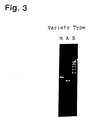
- Fig. 3 is a photograph of polyacrylamide gel electrophoretic pattern of DNAs which were amplified by PCR with primers (5) and (6), and then treated with restriction enzyme HaeIII.
- a and B denote the type of electrophoretic pattern and M is DNA MW marker 9 (Nippon Gene).
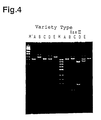
- Fig. 4 is a photography of polyacrylamide gel electrophoretic pattern of DNAs which are amplified by PCR with primers (7) and (8) (left half, A to E) and those which were then treated with restriction enzyme HaeIII (right half, A to E).
- A, B, C, D and E denote the type of polyacrylamide gel electrophoretic pattern
- M is DNA MW marker 9 (Nippon Gene) and M' DNA MW marker 2 (Nippon Gene).
- a PCR mixture (100 ⁇ l) which contained the genomic DNA (100 ng) extracted from 10 barley grains of each variety, dNTPs (20 nmol each), primers (1) and (2) (10 pmol each) and Taq DNA polymerase (2.5 U) was subjected to 33 cycles of reaction wherein each cycle consisted of incubating the mixture in sequence at 94°C for 1 min, 55°C for 2 min, and 72°C for 1 min, and then finally treated at 72°C for 5 min. After the completion of the PCR, restriction enzymes NcoI and EcoT22I (5 U each) and a buffer for the enzymatic reaction were added to the reaction mixture (8 ⁇ l), and the mixture was incubated at 37°C for 1 h.
- This reaction mixture was electrophoresed on 5% polyacrylamide gel. After the electrophoresis, the gel was stained with ethidium bromide, and then the DNA were made visible by UV exposure. Results are shown in Fig. 1. As shown in this figure, from the electrophoretic pattern of the fragments of DNAs obtained by digestion with restriction enzymes NcoI and EcoT22I, 10 varieties of barley could be classified into 5 types (A, B, B', C and C'). Furthermore, based on results of analyses on single grains, Variety Nos 5 and 10 were found to be a mixed type consisting of either C and C' or B and C, therefore denoted as C/C' and B/C respectively.
- Example 2 Analysis was performed under similar conditions to those described for Example 3, except that PCR was performed with the primer sequences (3) and (4) instead of (1) and (2) and subjected to 30 cycles instead of 33, and the restriction enzyme digestion was carried out with TaqI at 65°C instead of NcoI and EcoT22I at 37°C. As a result, as shown in Fig. 2, the electrophoretic pattern could be classified into 3 types (A, B and C).
- Example 3 Analysis was performed under similar conditions to the described for Example 3, except that PCR was performed with the primer sequences (5) and (6) instead of (1) and (2) and subjected to 30 cycles instead of 33, and restriction enzyme digestion was carried out with HaeIII instead of NcoI and EcoT22I. As a result, as shown in Fig. 3, the electrophoretic pattern could be classified into 2 types (A and B).
- PCR was performed under similar conditions to those described for Example 3, except for using the primer sequences (7) and (8), subjected to 30 cycles instead of 33, and annealing at 57°C instead of 55°C.
- a portion of the PCR products were electrophresed and the result was as shown on the left half of Fig. 4.
- the PCR products were digested with the restriction enzyme HaeIII under the similar conditions to those described for Example 3, and electrophoresed.
- the fragment patterns were as shown on the right half of Fig. 4.
- the electrophoresis pattern could be classified into 5 types (A, B, C, D and E).
- the purity of the sample can be estimated to a certain extent by quantifying the intensity of an electrophoretic band with an image analyzer. Furthermore, when each single grain or leaf bud is subjected to similar analysis, the extent of contamination and type of contaminating variety may be possibly determined qualitatively as well as quantitatively.
- primers according to the present invention are prepared to target the gene which is important for brewing, it is highly possible that results obtained by this invention will directly affect the quality of brewing products. Therefore, using the variety classification method with such primers, a satisfactory variety classification can be carried out from the viewpoint of breeding of barley for brewing and the quality control of materials used for brewing.
Landscapes
- Chemical & Material Sciences (AREA)
- Life Sciences & Earth Sciences (AREA)
- Engineering & Computer Science (AREA)
- Analytical Chemistry (AREA)
- Proteomics, Peptides & Aminoacids (AREA)
- Organic Chemistry (AREA)
- Health & Medical Sciences (AREA)
- Biotechnology (AREA)
- Zoology (AREA)
- Wood Science & Technology (AREA)
- Microbiology (AREA)
- Biochemistry (AREA)
- Biophysics (AREA)
- Molecular Biology (AREA)
- Physics & Mathematics (AREA)
- Mycology (AREA)
- Botany (AREA)
- Immunology (AREA)
- Bioinformatics & Cheminformatics (AREA)
- General Engineering & Computer Science (AREA)
- General Health & Medical Sciences (AREA)
- Genetics & Genomics (AREA)
- Measuring Or Testing Involving Enzymes Or Micro-Organisms (AREA)
- Distillation Of Fermentation Liquor, Processing Of Alcohols, Vinegar And Beer (AREA)
- Saccharide Compounds (AREA)
Claims (4)
- Verfahren für die Klassifizierung einer Gersten- oder Malzsorte mittels Amplifikation genomischer DNA von Gerste oder Malz durch PCR mit einem oder mehreren Primer-Paaren, umfassend Nucleotid-Sequenzen, die komplementär zu einem oder mehreren Genen sind, welche wichtig für den Brauprozeß sind, und Untersuchung von Unterschieden in der Nucleotid-Sequenz der amplifizierten DNA, wobei das/die Primer-Paar(e) ausgewählt ist/sind aus der Gruppe bestehend aus(i)bzw.
 oder Nucleotid-Sequenzen, die komplementär zu diesen Sequenzen sind;
 (ii)bzw.
 oder Nucleotid-Sequenzen, die komplementär zu diesen Sequenzen sind; und
 (iii)bzw.
 oder Nucleotid-Sequenzen, die komplementär zu diesen Sequenzen sind.
- Verfahren nach Anspruch 1, wobei die genomische DNA von Gerste oder Malz weiter mittels einer PCR mit einem anderen Paar von Oligonucleotiden als Primern amplifiziert wird, welche die Nucleotid-Sequenz umfassen
(iv)bzw. oder Nucleotid-Sequenzen, die komplementär zu diesen Sequenzen sind.
- Oligonucleotid, umfassend eine Nucleotid-Sequenz, dargestellt in einem der Sequenzprotokolle SEQ ID NO: 1 bis 6, oder eine Nucleotid-Sequenz, die komplementär zu einer dieser Sequenzen ist.
- Verwendung eines Oligonucleotids nach Anspruch 3 als PCR-Primer.
Applications Claiming Priority (3)
| Application Number | Priority Date | Filing Date | Title |
|---|---|---|---|
| JP261286/94 | 1994-09-29 | ||
| JP26128694A JP3660699B2 (ja) | 1994-09-29 | 1994-09-29 | 遺伝子診断を用いた大麦又は麦芽の品種識別方法及びそのプライマー |
| JP26128694 | 1994-09-29 |
Publications (3)
| Publication Number | Publication Date |
|---|---|
| EP0704540A2 EP0704540A2 (de) | 1996-04-03 |
| EP0704540A3 EP0704540A3 (de) | 1996-12-11 |
| EP0704540B1 true EP0704540B1 (de) | 2001-07-18 |
Family
ID=17359705
Family Applications (1)
| Application Number | Title | Priority Date | Filing Date |
|---|---|---|---|
| EP95115438A Expired - Lifetime EP0704540B1 (de) | 1994-09-29 | 1995-09-29 | Verfahren für die Einordnung von Gerste- und Malzsorten mittels Gendiagnose und ein dafür bestimmter Primer |
Country Status (8)
| Country | Link |
|---|---|
| US (1) | US5807676A (de) |
| EP (1) | EP0704540B1 (de) |
| JP (1) | JP3660699B2 (de) |
| AT (1) | ATE203278T1 (de) |
| AU (1) | AU703804B2 (de) |
| CA (1) | CA2159411A1 (de) |
| DE (1) | DE69521756T2 (de) |
| DK (1) | DK0704540T3 (de) |
Families Citing this family (6)
| Publication number | Priority date | Publication date | Assignee | Title |
|---|---|---|---|---|
| CA2295931C (en) * | 1997-06-26 | 2010-05-18 | Sapporo Breweries Ltd. | A method for identifying a barley variety and a barley having a brewing property |
| DK1164190T3 (da) * | 1999-03-20 | 2011-08-15 | Shunichi Shiozawa | Rheumatoid arthrit-gen og fremgangsmåde til diagnose af rheumatoid arthrit |
| AU2002335181B2 (en) * | 2001-10-04 | 2007-04-05 | Sapporo Breweries Limited | Method of selecting barley variety, barley beta-amylase gene and process for producing malt alcoholic drink |
| JP4113795B2 (ja) | 2003-03-25 | 2008-07-09 | サッポロビール株式会社 | 大麦リポキシゲナーゼ−1遺伝子、大麦の選抜方法、麦芽アルコール飲料用原料及び麦芽アルコール飲料の製造方法 |
| EP2040676A2 (de) * | 2006-07-06 | 2009-04-01 | Forest Laboratories, Inc. | Oral lösliche memantin-formulierungen |
| FR2911144B1 (fr) * | 2007-01-10 | 2012-12-14 | Inst Francais Des Boissons De La Brasserie Et De La Malterie | Methode d'obtention d'un profil genetique specifique d'une variete d'orge a l'aide de couples d'amorces. |
-
1994
- 1994-09-29 JP JP26128694A patent/JP3660699B2/ja not_active Expired - Fee Related
-
1995
- 1995-09-26 AU AU32899/95A patent/AU703804B2/en not_active Ceased
- 1995-09-27 US US08/534,684 patent/US5807676A/en not_active Expired - Fee Related
- 1995-09-28 CA CA002159411A patent/CA2159411A1/en not_active Abandoned
- 1995-09-29 DK DK95115438T patent/DK0704540T3/da active
- 1995-09-29 EP EP95115438A patent/EP0704540B1/de not_active Expired - Lifetime
- 1995-09-29 AT AT95115438T patent/ATE203278T1/de not_active IP Right Cessation
- 1995-09-29 DE DE69521756T patent/DE69521756T2/de not_active Expired - Fee Related
Also Published As
| Publication number | Publication date |
|---|---|
| AU703804B2 (en) | 1999-04-01 |
| US5807676A (en) | 1998-09-15 |
| DE69521756T2 (de) | 2002-05-23 |
| JP3660699B2 (ja) | 2005-06-15 |
| DE69521756D1 (de) | 2001-08-23 |
| CA2159411A1 (en) | 1996-03-30 |
| ATE203278T1 (de) | 2001-08-15 |
| AU3289995A (en) | 1996-04-18 |
| JPH0889298A (ja) | 1996-04-09 |
| EP0704540A2 (de) | 1996-04-03 |
| DK0704540T3 (da) | 2001-09-17 |
| EP0704540A3 (de) | 1996-12-11 |
Similar Documents
| Publication | Publication Date | Title |
|---|---|---|
| Chikuni et al. | Polymerase chain reaction assay for detection of sheep and goat meats | |
| JP5898829B2 (ja) | 中型縦列繰り返しdnaマーカーを特定し分析するための材料と方法 | |
| US7008771B1 (en) | Multiplex amplification of short tandem repeat loci | |
| EP1135530A2 (de) | Multiplex amplifizierung von kurzen tandemwiederholungs-loci | |
| KR102931263B1 (ko) | 인삼의 품종을 판별하기 위한 단일염기다형성을 갖는 유전자 마커 | |
| US20040146898A1 (en) | Microsatellite markers for plants of the genus triticeae and use thereof | |
| EP0704540B1 (de) | Verfahren für die Einordnung von Gerste- und Malzsorten mittels Gendiagnose und ein dafür bestimmter Primer | |
| WO1993018178A1 (en) | DIAGNOSIS OF β-THALASSEMIA USING A MULTIPLEX AMPLIFICATION REFRACTORY MUTATION SYSTEM | |
| KR100441471B1 (ko) | 돼지의외피색유전자형결정방법 | |
| JP2001520052A (ja) | ブタにおける被毛色遺伝子型を決定する方法 | |
| US20030013671A1 (en) | Genomic DNA library | |
| US20080113354A1 (en) | Methods and Compositions for High Sensitivity Fluorescent Mutation Detection with Mismatch Cutting Dna Endonucleases | |
| JP2009100653A (ja) | 一塩基多型(snp)を含むポリヌクレオチド、該ポリヌクレオチドから成るイネ品種判別用snpマーカー、及び、該snp分析によるイネの品種判別方法 | |
| JP5315519B2 (ja) | コイヘルペスウイルス(khv)の検出方法 | |
| US11530455B2 (en) | Penta E polymorphisms for human identification | |
| JP2002017399A (ja) | 塩基多型を検出する方法 | |
| JP4346933B2 (ja) | アブラナ科植物のs遺伝子型同定方法 | |
| CN119859708B (zh) | 小麦储藏蛋白含量调控基因TaARF14-1D的分子标记及其应用 | |
| Tsuchiya et al. | Identification of malting barley varieties by genome analysis | |
| KR102641019B1 (ko) | 콩 비린내 제거 유전형을 포함하는 계통 또는 품종 판별용 분자마커 세트 및 이의 용도 | |
| JP4650420B2 (ja) | 塩基判定方法及び塩基判定用キット | |
| Sander et al. | Comparison of detection platforms and post‐polymerase chain reaction DNA purification methods for use in conjunction with Cleavase fragment length polymorphism analysis | |
| KR20240169201A (ko) | 한우 판별용 고리매개등온증폭 프라이머 세트 |
Legal Events
| Date | Code | Title | Description |
|---|---|---|---|
| PUAI | Public reference made under article 153(3) epc to a published international application that has entered the european phase |
Free format text: ORIGINAL CODE: 0009012 |
|
| AK | Designated contracting states |
Kind code of ref document: A2 Designated state(s): AT BE DE DK FR GB IE IT NL |
|
| PUAL | Search report despatched |
Free format text: ORIGINAL CODE: 0009013 |
|
| AK | Designated contracting states |
Kind code of ref document: A3 Designated state(s): AT BE DE DK FR GB IE IT NL |
|
| 17P | Request for examination filed |
Effective date: 19970319 |
|
| 17Q | First examination report despatched |
Effective date: 19991124 |
|
| GRAG | Despatch of communication of intention to grant |
Free format text: ORIGINAL CODE: EPIDOS AGRA |
|
| GRAG | Despatch of communication of intention to grant |
Free format text: ORIGINAL CODE: EPIDOS AGRA |
|
| GRAG | Despatch of communication of intention to grant |
Free format text: ORIGINAL CODE: EPIDOS AGRA |
|
| GRAH | Despatch of communication of intention to grant a patent |
Free format text: ORIGINAL CODE: EPIDOS IGRA |
|
| GRAH | Despatch of communication of intention to grant a patent |
Free format text: ORIGINAL CODE: EPIDOS IGRA |
|
| GRAA | (expected) grant |
Free format text: ORIGINAL CODE: 0009210 |
|
| AK | Designated contracting states |
Kind code of ref document: B1 Designated state(s): AT BE DE DK FR GB IE IT NL |
|
| REF | Corresponds to: |
Ref document number: 203278 Country of ref document: AT Date of ref document: 20010815 Kind code of ref document: T |
|
| REG | Reference to a national code |
Ref country code: IE Ref legal event code: FG4D |
|
| REF | Corresponds to: |
Ref document number: 69521756 Country of ref document: DE Date of ref document: 20010823 |
|
| PGFP | Annual fee paid to national office [announced via postgrant information from national office to epo] |
Ref country code: FR Payment date: 20010911 Year of fee payment: 7 |
|
| PGFP | Annual fee paid to national office [announced via postgrant information from national office to epo] |
Ref country code: AT Payment date: 20010912 Year of fee payment: 7 |
|
| PGFP | Annual fee paid to national office [announced via postgrant information from national office to epo] |
Ref country code: DK Payment date: 20010913 Year of fee payment: 7 |
|
| REG | Reference to a national code |
Ref country code: DK Ref legal event code: T3 |
|
| PGFP | Annual fee paid to national office [announced via postgrant information from national office to epo] |
Ref country code: IE Payment date: 20010924 Year of fee payment: 7 |
|
| ITF | It: translation for a ep patent filed | ||
| PGFP | Annual fee paid to national office [announced via postgrant information from national office to epo] |
Ref country code: NL Payment date: 20010927 Year of fee payment: 7 |
|
| PGFP | Annual fee paid to national office [announced via postgrant information from national office to epo] |
Ref country code: GB Payment date: 20011003 Year of fee payment: 7 |
|
| PGFP | Annual fee paid to national office [announced via postgrant information from national office to epo] |
Ref country code: DE Payment date: 20011015 Year of fee payment: 7 |
|
| PGFP | Annual fee paid to national office [announced via postgrant information from national office to epo] |
Ref country code: BE Payment date: 20011116 Year of fee payment: 7 |
|
| ET | Fr: translation filed | ||
| REG | Reference to a national code |
Ref country code: GB Ref legal event code: IF02 |
|
| PLBE | No opposition filed within time limit |
Free format text: ORIGINAL CODE: 0009261 |
|
| STAA | Information on the status of an ep patent application or granted ep patent |
Free format text: STATUS: NO OPPOSITION FILED WITHIN TIME LIMIT |
|
| 26N | No opposition filed | ||
| PG25 | Lapsed in a contracting state [announced via postgrant information from national office to epo] |
Ref country code: GB Free format text: LAPSE BECAUSE OF NON-PAYMENT OF DUE FEES Effective date: 20020929 Ref country code: AT Free format text: LAPSE BECAUSE OF NON-PAYMENT OF DUE FEES Effective date: 20020929 |
|
| PG25 | Lapsed in a contracting state [announced via postgrant information from national office to epo] |
Ref country code: IE Free format text: LAPSE BECAUSE OF NON-PAYMENT OF DUE FEES Effective date: 20020930 Ref country code: DK Free format text: LAPSE BECAUSE OF NON-PAYMENT OF DUE FEES Effective date: 20020930 Ref country code: BE Free format text: LAPSE BECAUSE OF NON-PAYMENT OF DUE FEES Effective date: 20020930 |
|
| BERE | Be: lapsed |
Owner name: *SAPPORO BREWERIES LTD Effective date: 20020930 |
|
| PG25 | Lapsed in a contracting state [announced via postgrant information from national office to epo] |
Ref country code: NL Free format text: LAPSE BECAUSE OF NON-PAYMENT OF DUE FEES Effective date: 20030401 Ref country code: DE Free format text: LAPSE BECAUSE OF NON-PAYMENT OF DUE FEES Effective date: 20030401 |
|
| REG | Reference to a national code |
Ref country code: DK Ref legal event code: EBP |
|
| GBPC | Gb: european patent ceased through non-payment of renewal fee |
Effective date: 20020929 |
|
| PG25 | Lapsed in a contracting state [announced via postgrant information from national office to epo] |
Ref country code: FR Free format text: LAPSE BECAUSE OF NON-PAYMENT OF DUE FEES Effective date: 20030603 |
|
| REG | Reference to a national code |
Ref country code: IE Ref legal event code: MM4A |
|
| REG | Reference to a national code |
Ref country code: FR Ref legal event code: ST |
|
| PG25 | Lapsed in a contracting state [announced via postgrant information from national office to epo] |
Ref country code: IT Free format text: LAPSE BECAUSE OF NON-PAYMENT OF DUE FEES Effective date: 20050929 |