EP0704753A2 - Oberflächenbehandlung photographischer Papiere zur Verbesserung der Haftung - Google Patents
Oberflächenbehandlung photographischer Papiere zur Verbesserung der Haftung Download PDFInfo
- Publication number
- EP0704753A2 EP0704753A2 EP95202575A EP95202575A EP0704753A2 EP 0704753 A2 EP0704753 A2 EP 0704753A2 EP 95202575 A EP95202575 A EP 95202575A EP 95202575 A EP95202575 A EP 95202575A EP 0704753 A2 EP0704753 A2 EP 0704753A2
- Authority
- EP
- European Patent Office
- Prior art keywords
- ozone
- paper
- flame
- polyolefin
- paper base
- Prior art date
- Legal status (The legal status is an assumption and is not a legal conclusion. Google has not performed a legal analysis and makes no representation as to the accuracy of the status listed.)
- Granted
Links
- 238000004381 surface treatment Methods 0.000 title description 8
- CBENFWSGALASAD-UHFFFAOYSA-N Ozone Chemical compound [O-][O+]=O CBENFWSGALASAD-UHFFFAOYSA-N 0.000 claims abstract description 39
- 238000003851 corona treatment Methods 0.000 claims abstract description 32
- 229920000098 polyolefin Polymers 0.000 claims abstract description 19
- 238000011282 treatment Methods 0.000 claims abstract description 15
- 229920005989 resin Polymers 0.000 claims abstract description 13
- 239000011347 resin Substances 0.000 claims abstract description 13
- 229920005672 polyolefin resin Polymers 0.000 claims abstract description 8
- 238000004519 manufacturing process Methods 0.000 claims abstract description 5
- 238000000034 method Methods 0.000 claims description 15
- 239000000203 mixture Substances 0.000 claims description 14
- 208000028659 discharge Diseases 0.000 claims description 11
- 230000001464 adherent effect Effects 0.000 abstract 1
- 239000003570 air Substances 0.000 description 24
- 239000000758 substrate Substances 0.000 description 14
- 239000007789 gas Substances 0.000 description 13
- 239000001301 oxygen Substances 0.000 description 9
- 229910052760 oxygen Inorganic materials 0.000 description 9
- 229920000642 polymer Polymers 0.000 description 8
- QVGXLLKOCUKJST-UHFFFAOYSA-N atomic oxygen Chemical compound [O] QVGXLLKOCUKJST-UHFFFAOYSA-N 0.000 description 7
- 229920001684 low density polyethylene Polymers 0.000 description 7
- 239000004702 low-density polyethylene Substances 0.000 description 7
- VGGSQFUCUMXWEO-UHFFFAOYSA-N Ethene Chemical compound C=C VGGSQFUCUMXWEO-UHFFFAOYSA-N 0.000 description 6
- 229920001903 high density polyethylene Polymers 0.000 description 6
- 239000004700 high-density polyethylene Substances 0.000 description 6
- 230000003647 oxidation Effects 0.000 description 6
- 238000007254 oxidation reaction Methods 0.000 description 6
- -1 polyethylene Polymers 0.000 description 6
- 239000011248 coating agent Substances 0.000 description 5
- 238000000576 coating method Methods 0.000 description 5
- ATUOYWHBWRKTHZ-UHFFFAOYSA-N Propane Chemical compound CCC ATUOYWHBWRKTHZ-UHFFFAOYSA-N 0.000 description 4
- 239000000155 melt Substances 0.000 description 4
- VNWKTOKETHGBQD-UHFFFAOYSA-N methane Chemical compound C VNWKTOKETHGBQD-UHFFFAOYSA-N 0.000 description 4
- 230000008569 process Effects 0.000 description 4
- 239000000126 substance Substances 0.000 description 4
- 239000004698 Polyethylene Substances 0.000 description 3
- 125000004429 atom Chemical group 0.000 description 3
- 238000001125 extrusion Methods 0.000 description 3
- 230000001590 oxidative effect Effects 0.000 description 3
- 229920000573 polyethylene Polymers 0.000 description 3
- GWEVSGVZZGPLCZ-UHFFFAOYSA-N Titan oxide Chemical compound O=[Ti]=O GWEVSGVZZGPLCZ-UHFFFAOYSA-N 0.000 description 2
- 230000015572 biosynthetic process Effects 0.000 description 2
- 238000007766 curtain coating Methods 0.000 description 2
- 230000007423 decrease Effects 0.000 description 2
- 230000000694 effects Effects 0.000 description 2
- 238000002474 experimental method Methods 0.000 description 2
- 239000003345 natural gas Substances 0.000 description 2
- 239000002245 particle Substances 0.000 description 2
- 239000001294 propane Substances 0.000 description 2
- 239000004215 Carbon black (E152) Substances 0.000 description 1
- PXGOKWXKJXAPGV-UHFFFAOYSA-N Fluorine Chemical compound FF PXGOKWXKJXAPGV-UHFFFAOYSA-N 0.000 description 1
- 206010034972 Photosensitivity reaction Diseases 0.000 description 1
- 239000004743 Polypropylene Substances 0.000 description 1
- 239000012080 ambient air Substances 0.000 description 1
- 238000009835 boiling Methods 0.000 description 1
- 230000008859 change Effects 0.000 description 1
- 125000003636 chemical group Chemical group 0.000 description 1
- 239000003153 chemical reaction reagent Substances 0.000 description 1
- 239000000567 combustion gas Substances 0.000 description 1
- 150000001875 compounds Chemical class 0.000 description 1
- 238000000354 decomposition reaction Methods 0.000 description 1
- 230000032798 delamination Effects 0.000 description 1
- 238000013461 design Methods 0.000 description 1
- 238000011161 development Methods 0.000 description 1
- 239000003989 dielectric material Substances 0.000 description 1
- 239000000839 emulsion Substances 0.000 description 1
- 229910052731 fluorine Inorganic materials 0.000 description 1
- 239000011737 fluorine Substances 0.000 description 1
- 239000003574 free electron Substances 0.000 description 1
- 239000000383 hazardous chemical Substances 0.000 description 1
- 231100000206 health hazard Toxicity 0.000 description 1
- 229930195733 hydrocarbon Natural products 0.000 description 1
- 150000002430 hydrocarbons Chemical class 0.000 description 1
- 239000011256 inorganic filler Substances 0.000 description 1
- 229910003475 inorganic filler Inorganic materials 0.000 description 1
- 150000002500 ions Chemical class 0.000 description 1
- 238000003475 lamination Methods 0.000 description 1
- 230000007246 mechanism Effects 0.000 description 1
- 229920001179 medium density polyethylene Polymers 0.000 description 1
- 239000004701 medium-density polyethylene Substances 0.000 description 1
- 229910052751 metal Inorganic materials 0.000 description 1
- 239000002184 metal Substances 0.000 description 1
- 238000002156 mixing Methods 0.000 description 1
- 230000007935 neutral effect Effects 0.000 description 1
- 239000007800 oxidant agent Substances 0.000 description 1
- 125000004430 oxygen atom Chemical group O* 0.000 description 1
- 230000000149 penetrating effect Effects 0.000 description 1
- 230000036211 photosensitivity Effects 0.000 description 1
- 229920003023 plastic Polymers 0.000 description 1
- 239000004033 plastic Substances 0.000 description 1
- 238000012667 polymer degradation Methods 0.000 description 1
- 229920001155 polypropylene Polymers 0.000 description 1
- 230000037452 priming Effects 0.000 description 1
- 238000012545 processing Methods 0.000 description 1
- 230000001737 promoting effect Effects 0.000 description 1
- 230000009467 reduction Effects 0.000 description 1
- 229920003002 synthetic resin Polymers 0.000 description 1
- 239000000057 synthetic resin Substances 0.000 description 1
- 239000004408 titanium dioxide Substances 0.000 description 1
- 238000009281 ultraviolet germicidal irradiation Methods 0.000 description 1
- XLYOFNOQVPJJNP-UHFFFAOYSA-N water Chemical compound O XLYOFNOQVPJJNP-UHFFFAOYSA-N 0.000 description 1
Images

Classifications
-
- D—TEXTILES; PAPER
- D21—PAPER-MAKING; PRODUCTION OF CELLULOSE
- D21H—PULP COMPOSITIONS; PREPARATION THEREOF NOT COVERED BY SUBCLASSES D21C OR D21D; IMPREGNATING OR COATING OF PAPER; TREATMENT OF FINISHED PAPER NOT COVERED BY CLASS B31 OR SUBCLASS D21G; PAPER NOT OTHERWISE PROVIDED FOR
- D21H19/00—Coated paper; Coating material
- D21H19/10—Coatings without pigments
- D21H19/14—Coatings without pigments applied in a form other than the aqueous solution defined in group D21H19/12
- D21H19/20—Coatings without pigments applied in a form other than the aqueous solution defined in group D21H19/12 comprising macromolecular compounds obtained by reactions only involving carbon-to-carbon unsaturated bonds
- D21H19/22—Polyalkenes, e.g. polystyrene
-
- D—TEXTILES; PAPER
- D21—PAPER-MAKING; PRODUCTION OF CELLULOSE
- D21H—PULP COMPOSITIONS; PREPARATION THEREOF NOT COVERED BY SUBCLASSES D21C OR D21D; IMPREGNATING OR COATING OF PAPER; TREATMENT OF FINISHED PAPER NOT COVERED BY CLASS B31 OR SUBCLASS D21G; PAPER NOT OTHERWISE PROVIDED FOR
- D21H23/00—Processes or apparatus for adding material to the pulp or to the paper
- D21H23/02—Processes or apparatus for adding material to the pulp or to the paper characterised by the manner in which substances are added
- D21H23/22—Addition to the formed paper
- D21H23/30—Pretreatment of the paper
-
- D—TEXTILES; PAPER
- D21—PAPER-MAKING; PRODUCTION OF CELLULOSE
- D21H—PULP COMPOSITIONS; PREPARATION THEREOF NOT COVERED BY SUBCLASSES D21C OR D21D; IMPREGNATING OR COATING OF PAPER; TREATMENT OF FINISHED PAPER NOT COVERED BY CLASS B31 OR SUBCLASS D21G; PAPER NOT OTHERWISE PROVIDED FOR
- D21H23/00—Processes or apparatus for adding material to the pulp or to the paper
- D21H23/02—Processes or apparatus for adding material to the pulp or to the paper characterised by the manner in which substances are added
- D21H23/22—Addition to the formed paper
- D21H23/46—Pouring or allowing the fluid to flow in a continuous stream on to the surface, the entire stream being carried away by the paper
- D21H23/48—Curtain coaters
-
- G—PHYSICS
- G03—PHOTOGRAPHY; CINEMATOGRAPHY; ANALOGOUS TECHNIQUES USING WAVES OTHER THAN OPTICAL WAVES; ELECTROGRAPHY; HOLOGRAPHY
- G03C—PHOTOSENSITIVE MATERIALS FOR PHOTOGRAPHIC PURPOSES; PHOTOGRAPHIC PROCESSES, e.g. CINE, X-RAY, COLOUR, STEREO-PHOTOGRAPHIC PROCESSES; AUXILIARY PROCESSES IN PHOTOGRAPHY
- G03C1/00—Photosensitive materials
- G03C1/76—Photosensitive materials characterised by the base or auxiliary layers
- G03C1/775—Photosensitive materials characterised by the base or auxiliary layers the base being of paper
- G03C1/79—Macromolecular coatings or impregnations therefor, e.g. varnishes
-
- G—PHYSICS
- G03—PHOTOGRAPHY; CINEMATOGRAPHY; ANALOGOUS TECHNIQUES USING WAVES OTHER THAN OPTICAL WAVES; ELECTROGRAPHY; HOLOGRAPHY
- G03C—PHOTOSENSITIVE MATERIALS FOR PHOTOGRAPHIC PURPOSES; PHOTOGRAPHIC PROCESSES, e.g. CINE, X-RAY, COLOUR, STEREO-PHOTOGRAPHIC PROCESSES; AUXILIARY PROCESSES IN PHOTOGRAPHY
- G03C1/00—Photosensitive materials
- G03C1/76—Photosensitive materials characterised by the base or auxiliary layers
- G03C1/91—Photosensitive materials characterised by the base or auxiliary layers characterised by subbing layers or subbing means
- G03C1/915—Photosensitive materials characterised by the base or auxiliary layers characterised by subbing layers or subbing means using mechanical or physical means therefor, e.g. corona
Definitions
- This invention relates to a method for manufacturing a photographic paper support having a resin coating thereon. More particularly, it relates to a method of making a resin coated photographic paper having improved adhesion between the resin layer and the paper surface.
- synthetic resins of the polyolefin type such as polyethylene and polypropylene are coated on paper.
- the side to be coated with photographic emulsion has inorganic fillers such as titanium dioxide to provide white background.
- the opposite side has generally a blend of low density and high density polyethylene for curl control purpose. Since polyolefins are nonpolar by nature, extra steps are required to promote good bond between a polyolefin and paper surface.
- One method is to oxidize the molten polyolefin curtain prior to the coating. Polymer melt temperature is kept as high as 338°C. (640°F.) to promote oxidation.
- the high melt temperature produces unwelcome results such as polymer degradation and crosslinked gel formation.
- the distance between the die lip and the lamination nip can be adjusted to provide longer oxidation time. But too great distance can hurt oxidation because it will lower the melt temperature.
- the coating line speed can be reduced to allow more time for oxidation. But this is not attractive from the cost point of view.
- Another method is to precoat paper with adhesion promoting chemical primers.
- the photographic paper is a rather porous substrate, the priming solution soaks through the paper rather than staying on the surface. Also photosensitivity of chemical primers is another concern.
- U.S. Patent Nos. 5,147,678; 3,892,573; 4,135,932; 4,729,945; 4,186,018; and 4,128,426 describe treating polymeric surface using flame, corona, or ozone to improve on adhesion.
- U.S. Patent No. 4,481,289 describes treating paper surface with corona discharge and oxidizing the polyolefin melt curtain using ozone and air mixture. It claimed that, by this method, improved adhesion was observed at 183 m/min (600 FPM) line speed. A line speed of 183 m/min is rather slow in today's environment. There is a great need to increase the line speed to 457 m/min (1,500 FPM) or beyond.
- the invention contemplates a method of making resin coated photographic paper which comprises providing a paper base, subjecting the paper base to a flame treatment and a corona discharge treatment, providing a polyolefin melt curtain, treating the polyolefin resin melt curtain with a mixture of ozone and air and bringing the paper base in contact with the polyolefin melt curtain to provide a uniform layer of polyolefin resin on the paper base.
- the process in accordance with this invention provides excellent adhesion of the polyolefin resin to the paper substrate at speeds greatly exceeding that heretofore known.
- the paper base may be treated with two corona discharges, one either side of the flame treatment.
- photographic paper sheet 10 is moving in the direction shown by the horizontal arrow through a first corona discharge treatment zone 12, through a flame treatment zone 14, and then through a second corona discharge treatment zone 16 followed by passing around nip roller 18 and between nip roller 18 and chill roller 20.
- Chill roller 20 is provided with a matte finish and the pressure applied by rollers 18 and 20 is about 0.4 MPa(60 PSI).
- the molten polyolefin resin is conveyed in a molten sheet 22 from curtain coating device 24 to impinge upon the paper substrate 10 near the nip of rollers 18 and 20.
- Ozone coating station 26 is positioned just prior to the entrance of the curtain of molten polyolefin in order that the ozone treats the polyolefin sheet.
- the first corona discharge zone may embody a single horse shoe type electrode, 10.2 centimeters (4 inches) wide and 81.3 centimeters (32 inches) long and a dielectric coated roll.
- the first corona discharge treatment may be one provided by Pillar Technology, rated at 110 kHz and 12 kW.
- the second corona discharge treatment zone is located about 91.4 centimeters (3 feet) away from the first nip pressure roll 18 and has 6 electrodes with a bare roll.
- a suitable device of this type is supplied by Enercon and is rated at a 110 kHz and 12 kW.
- FIG. 2 A typical configuration for corona discharge treating at positions 12 or 16, in accordance with this invention is shown schematically in FIG. 2.
- the paper substrate 10, to be treated passes over a grounded roll 30, which roll 30 may or may not be coated with a dielectric material 32.
- a generator 34 such as a high frequency spark generator supplies a high voltage to electrode 36 which jumps the gap between the electrode 36 and the substrate 10 causing a corona discharge 38 upon the surface of the substrate 10.
- the circuit is completed by the connection of the metal roll 30 to ground 40 and then through resistor 42 back to the generator.
- the high voltage fields cause the oxygen molecules to break up into ions and electrons which react with the surface of the substrate. Those that do not react, recombine into molecules with either two atoms (normal oxygen) or three atoms (unstable reactive ozone).
- Power input for the surface treatment is defined by watt density formula.
- PS Power Supply (watts)
- LS Line Speed (meters/minute)
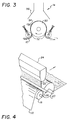
- FIG 3 is a diagrammatic representation of a suitable apparatus for conducting the flame treatment in accordance with this invention.
- the flame treating zone 14 receives the continuous substrate 10 from the first corona discharge treating zone 12 in Figure 1 and the substrate 10 passes over roll 50 where it is held under tention by means of tention rolls 52.
- the surface of the paper substrate 10 is treated with flame 54, which treatment takes place under an exhaust hood 56.
- the paper after passing over roll 50 and being subjected to the flame then moves continuously to the next station, which is shown in Figure 1 is the second corona discharge treatment zone 16. While two corona treating stations are preferred, the corona treatment is optional in this invention.
- the high temperature of the combustion gases causes the molecules of oxygen to come apart to form free oxygen atoms that are chemically very reactive. They also lose electrons to become positively charged oxygen ions.
- the electrically neutral gas made up of equal amounts of positively charged particles and negatively charged particles is known as "plasma.”
- plasma The electrically neutral gas made up of equal amounts of positively charged particles and negatively charged particles.
- these high speed, energetic, very reactive oxygen ions and free electrons bombard the substrate surface and react with the molecules. This process can be said to oxidize the surface, and requires an oxidizing flame which is a flame with excess oxygen.
- the quality of air can vary from time to time. There is a significant reduction of oxygen and an increase in water vapor in the air when the relative humidity is higher.
- the quality of commercially available gas can vary also due to changes in composition of the supply source. It can also change if the gas company adds propane and air to natural gas at peak loads.
- the type of gas can be natural gas, propane, or any other hydrocarbon gas.
- the moving paper web 10 carries with it a boundary layer of air. At high speeds, the flame 54 tends to mix with the boundary layer of air. To compensate for this extra air, the air/gas mixture should be richer in gas at higher line speeds than would be optimal at slow speeds in order to end up at proper plasma readings. For consistency of flame, a flame plasma analyzer is used.
- a small continuous sample of air/gas mixture was taken and burned into a controlled flame in a closed chamber within the analyzer.
- the flame plasma produces an electrical signal which is processed to produce the plasma value.
- the plasma value is an accurate, reproducible measure of the treating ability of an air/gas mixture.
- the plasma value should be kept from 30 to 80, preferably 45 to 60. The lower the plasma value, the leaner air/gas mixture becomes.
- the output of the burner must be increased as the speed of the web is increased to 914 M/min. (3,000 FPM) or higher in order to achieve the same level of treat.
- the output can range from 1 to 3970 Kg-cal/cm (10 to 40,000 Btu/inch), preferably 3.97 Kg-cal/cm to 1990K (40 to 20,000 Btu/inch).
- the burner/web gap should be increased with increased burner output so that the plasma portion of the flame, which is just beyond the unburnt cones of air/gas mixture, is just at the web surface.
- the distance between the tip of the cone and the moving web can be 0-10.2 cm (0 to 4 inches), preferably 0.254 cm to 5.08 cm (0.1 to 2 inches).
- the angle at which the tip of the cone contacts the moving web can be 30 to 90 degrees, preferably 45 to 90 degrees.
- the triple slot design ribbon burners were used, but any other types of commercially available burner can be used.
- a suitable flame treating device supplied by Wise Corporation has double burner heads (triple slots).
- FIG. 4 A suitable configuration for the application of ozone to the polyolefin melt is shown in Fig. 4.
- the paper substrate 10 which exits the second corona discharge treatment zone 16 passes over nip roll 18 and through the nip provided by roll 18 and chill roll 20.
- Polyolefin curtain coating extrusion die 24 provides a continuous sheet of molten polyolefin into the nip provided by rolls 18 and 20.
- the extrusion die 24 has a die gap of 0.076 cm (0.03 inch).
- an ozone applicator 26 Immediately above the nip is situated an ozone applicator 26 which treats the surface of the extruded polymer melt curtain with an ozone air mixture.
- the polyolefin-coated paper exits this zone in the direction shown by the arrow.
- Ozone is a three atom allotrope of oxygen (O2), which is typically formed from oxygen by either electrical discharge (as during lightning) or UV irradiation at specific wavelengths.
- the basic equation for the formation of ozone is This is an endothermic process and therefore the equilibrium between O2 and O3 is shifted towards O2 with increased temperature.
- the rate of ozone being generated in an ozonator decreases as temperature, pressure, and flow rate of incoming feed stock of air increases.
- Ozone oxidizes and decomposes organic and inorganic substances at a higher rate than other reagents.
- Ozone is the second most powerful oxidant after fluorine. This powerful oxidation nature is being used to treat the polymer melt curtain for improved adhesion.
- Ozone is a very unstable compound. Its half life at 21°C and 1 atmospheric pressure (70°F/14.7 psi) is about 20 minutes. It will be totally degraded at 220°C (428°F).
- the temperature of the ozone-containing gas applied to the polymer melt curtain should be closely controlled to be within the range between 25 and 205°C (80 and 400°F), preferably 37.8°C and 121°C (100 and 250°F). If the gas temperature exceeds 204°C (400°F), the decomposition of ozone will be accelerated, whereas if it is below 26.6°C (80°F), it will decrease the temperature of the polymer melt curtain. In both cases, the efficiency of treatment deteriorates significantly.
- the distance between the ozone/air applicator and the extruded polymer melt curtain can be kept from 0.254 cm to 7.62 cm (0.1 to 3.0 inches), preferably 0.50 cm to 2.54 cm (0.2 to 1.0 inches). If the distance is too short, it will affect melt curtain stability, while if the distance is too great, the efficiency of treatment drops significantly.
- the amount of ozone applied to the polymer melt curtain can range from 2 to 323 mg/m2 (0.2 to 30 mg per square feet), preferably 10.8 - 108 mg/m2 (1 to 10 mg per square feet). If the amount is too low, degree of oxidation deteriorates, while if it exceeds 30 mg, the excess ozone in the ambient air can become health hazards to operating personnel.
- a suitable ozonator is provided by Enercon Industries Corporation.
- An Enercon Compack 2,000 supplied power to the generator (input: 230/460 vac; 10/5 amps, 115 vac; 20 amps, output: 0 to 2 kW).
- a 2.54 cm (1 inch) diameter pipe with holes along the lengthwise direction (Fig. 4) was installed about 5.08 cm (2 inches) away from the laminator nip.
- a piece of plastic tubing running between the pipe and the ozonator carried the ozone/air mixture to the nip area.
- raw stock paper was first resin coated, and then it was passed through the line a second time with only one CDT unit turned on at a time.
- surface energies were checked: 46 dynes/cm from corona treatment 12 and 58 dynes/cm from corona treatment 16.
- a base paper sheet Kodak Coloredge photographic paper, 48.98 Kg/279 m2 (108 lb./3,000 sq. ft. in basis weight), was extrusion coated with NA 219 (LDPE by Quantum Chemicals, 0.923 gms/cc, 10 MI).
- NA 219 LDPE by Quantum Chemicals, 0.923 gms/cc, 10 MI
- the melt temperature was kept at 288°C (550°F).
- the line speed was at 305 m/min. (1,000 FPM).
- Different modes of surface treatment were applied. Neither corona discharge treatment (CDT) on paper alone, nor CDT on paper along with ozone/air treatment of polyethylene melt produced any bond at all. However, an excellent bond was achieved when the paper was treated with both CDT and flame, and the polyethylene melt curtain was treated with ozone/air mixture.
- a medium density polyethylene was prepared by blending 54 parts using LDPE and 46 part using HDPE.
- the melt temperature was raised to 315.6°C (600°F) in order to maintain melt curtain stability. In order to see the effect of flame treatment, it was turned on and off during the experiment. When the flame treater was turned off, the adhesion went from "excellent" to "no-bond.”
Landscapes
- Chemical & Material Sciences (AREA)
- Physics & Mathematics (AREA)
- Engineering & Computer Science (AREA)
- Materials Engineering (AREA)
- General Physics & Mathematics (AREA)
- Chemical Kinetics & Catalysis (AREA)
- Spectroscopy & Molecular Physics (AREA)
- Treatments Of Macromolecular Shaped Articles (AREA)
- Application Of Or Painting With Fluid Materials (AREA)
- Paper (AREA)
- Laminated Bodies (AREA)
Applications Claiming Priority (2)
| Application Number | Priority Date | Filing Date | Title |
|---|---|---|---|
| US313636 | 1994-09-27 | ||
| US08/313,636 US5503968A (en) | 1994-09-27 | 1994-09-27 | Flame treatment and corona discharge treatment of photographic paper for improved bond with ozone treated polyolefin resin coating |
Publications (3)
| Publication Number | Publication Date |
|---|---|
| EP0704753A2 true EP0704753A2 (de) | 1996-04-03 |
| EP0704753A3 EP0704753A3 (de) | 1996-08-21 |
| EP0704753B1 EP0704753B1 (de) | 1998-02-11 |
Family
ID=23216496
Family Applications (1)
| Application Number | Title | Priority Date | Filing Date |
|---|---|---|---|
| EP95202575A Expired - Lifetime EP0704753B1 (de) | 1994-09-27 | 1995-09-23 | Oberflächenbehandlung photographischer Papiere zur Verbesserung der Haftung |
Country Status (4)
| Country | Link |
|---|---|
| US (1) | US5503968A (de) |
| EP (1) | EP0704753B1 (de) |
| JP (1) | JPH08190171A (de) |
| DE (1) | DE69501609T2 (de) |
Cited By (7)
| Publication number | Priority date | Publication date | Assignee | Title |
|---|---|---|---|---|
| EP0867761A1 (de) * | 1997-03-24 | 1998-09-30 | Eastman Kodak Company | Ein Verfahren zur Erhöhung der Förderleistung photographischen Papiers durch Verwendung von Ozon |
| EP0872591A1 (de) * | 1997-04-16 | 1998-10-21 | Dettling, Bernhard | Verfahren zur Beschichtung von zellulose- und lignozellulosehaltigen Bahnen |
| WO1998046829A1 (en) * | 1997-04-16 | 1998-10-22 | Idi-Head Oy | Method of coating cellulosic and lignocellulosic webs |
| WO2000032875A1 (en) * | 1998-12-02 | 2000-06-08 | Tetra Laval Holdings & Finance, Sa | Double corona treatment of a polymer coated paperboard material |
| EP1130460A1 (de) * | 2000-03-03 | 2001-09-05 | Fuji Photo Film B.V. | Verfahren zur Herstellung polymerlaminierter Papierträger und durch dieses Verfahren hergestellte polymerlaminierte photographische Papierträger |
| EP0976545A3 (de) * | 1998-07-30 | 2001-11-21 | Fuji Photo Film Co., Ltd. | Träger für photographisches Papier und seine Herstellung |
| EP1619550A1 (de) | 2004-07-21 | 2006-01-25 | Fuji Photo Film B.V. | Beschichtetes Trägerpapier |
Families Citing this family (9)
| Publication number | Priority date | Publication date | Assignee | Title |
|---|---|---|---|---|
| US7078075B1 (en) | 1995-02-23 | 2006-07-18 | H.B. Fuller Licensing & Financing Inc. | Method for producing a continuous thermoplastic coating and articles constructed therefrom |
| DE19753266B4 (de) | 1997-12-01 | 2010-10-07 | H.B. Fuller Licensing & Financing, Inc., St. Paul | Verfahren zum Verbinden luftundurchlässiger Materialien |
| US5998119A (en) * | 1998-08-27 | 1999-12-07 | Eastman Kodak Company | Imaging element with a substrate containing low molecular weight hindered amine stabilizer |
| DE60128742T2 (de) * | 2000-03-03 | 2008-02-07 | Fujifilm Manufacturing Europe B.V. | Verfahren zur Herstellung polymerlaminierter Papierträger und durch dieses Verfahren hergestellte polymerlaminierte photographische Papierträger |
| US6824936B1 (en) | 2003-08-05 | 2004-11-30 | Eastman Kodak Company | Hindered amine light stabilizer for improved yellow dark stability |
| JP2006281569A (ja) * | 2005-03-31 | 2006-10-19 | Fuji Photo Film Co Ltd | 画像記録材料用支持体及びその製造方法並びに画像記録材料 |
| US8182737B2 (en) * | 2005-08-05 | 2012-05-22 | Tredegar Film Products Corporation | Formed film, methods and apparatus for manufacturing same, and articles comprising same |
| WO2009114794A2 (en) * | 2008-03-14 | 2009-09-17 | Alcan Packaging Flexible France | Ozone applicator and method for polymer oxidation |
| US20140272380A1 (en) * | 2013-03-15 | 2014-09-18 | Petoskey Plastics, Inc. | Co-extruded plastic film with a foam core and a method for coating the film on a substrate |
Citations (7)
| Publication number | Priority date | Publication date | Assignee | Title |
|---|---|---|---|---|
| US3892573A (en) | 1970-12-24 | 1975-07-01 | Fuji Photo Film Co Ltd | Method of improving the surface of a high molecular weight support |
| US4128426A (en) | 1976-03-01 | 1978-12-05 | Konishiroku Photo Industry Co., Ltd. | Process for subbing photographic hydrophobic films |
| US4135932A (en) | 1975-09-26 | 1979-01-23 | Bexford Limited | Process for preparation of photographic film involving corona treatment of polystyrene containing subbing layers and product |
| US4186018A (en) | 1970-07-29 | 1980-01-29 | Fuji Photo Film Co., Ltd. | Surface treatment of a support member for photographic light-sensitive materials |
| US4481289A (en) | 1981-03-23 | 1984-11-06 | Mitsubishi Paper Mills, Ltd. | Method for manufacturing photographic support |
| US4729945A (en) | 1983-08-12 | 1988-03-08 | Felix Schoeller, Jr. | Multilayer photographic support material |
| US5147678A (en) | 1988-12-22 | 1992-09-15 | The University Of Western Ontario | Modification of polymer surfaces by two-step reactions |
Family Cites Families (2)
| Publication number | Priority date | Publication date | Assignee | Title |
|---|---|---|---|---|
| EP0326410B1 (de) * | 1988-01-28 | 1993-01-20 | Mitsui Petrochemical Industries, Ltd. | Wasserdichtes laminiertes Papier und Verfahren zu dessen Herstellung |
| JPH05269941A (ja) * | 1992-01-27 | 1993-10-19 | Mitsubishi Paper Mills Ltd | 樹脂被覆紙 |
-
1994
- 1994-09-27 US US08/313,636 patent/US5503968A/en not_active Expired - Fee Related
-
1995
- 1995-09-23 DE DE69501609T patent/DE69501609T2/de not_active Expired - Fee Related
- 1995-09-23 EP EP95202575A patent/EP0704753B1/de not_active Expired - Lifetime
- 1995-09-26 JP JP7247943A patent/JPH08190171A/ja active Pending
Patent Citations (7)
| Publication number | Priority date | Publication date | Assignee | Title |
|---|---|---|---|---|
| US4186018A (en) | 1970-07-29 | 1980-01-29 | Fuji Photo Film Co., Ltd. | Surface treatment of a support member for photographic light-sensitive materials |
| US3892573A (en) | 1970-12-24 | 1975-07-01 | Fuji Photo Film Co Ltd | Method of improving the surface of a high molecular weight support |
| US4135932A (en) | 1975-09-26 | 1979-01-23 | Bexford Limited | Process for preparation of photographic film involving corona treatment of polystyrene containing subbing layers and product |
| US4128426A (en) | 1976-03-01 | 1978-12-05 | Konishiroku Photo Industry Co., Ltd. | Process for subbing photographic hydrophobic films |
| US4481289A (en) | 1981-03-23 | 1984-11-06 | Mitsubishi Paper Mills, Ltd. | Method for manufacturing photographic support |
| US4729945A (en) | 1983-08-12 | 1988-03-08 | Felix Schoeller, Jr. | Multilayer photographic support material |
| US5147678A (en) | 1988-12-22 | 1992-09-15 | The University Of Western Ontario | Modification of polymer surfaces by two-step reactions |
Cited By (9)
| Publication number | Priority date | Publication date | Assignee | Title |
|---|---|---|---|---|
| EP0867761A1 (de) * | 1997-03-24 | 1998-09-30 | Eastman Kodak Company | Ein Verfahren zur Erhöhung der Förderleistung photographischen Papiers durch Verwendung von Ozon |
| EP0872591A1 (de) * | 1997-04-16 | 1998-10-21 | Dettling, Bernhard | Verfahren zur Beschichtung von zellulose- und lignozellulosehaltigen Bahnen |
| WO1998046829A1 (en) * | 1997-04-16 | 1998-10-22 | Idi-Head Oy | Method of coating cellulosic and lignocellulosic webs |
| US6413591B1 (en) | 1997-04-16 | 2002-07-02 | Isi-Head Oy | Method of coating cellulosic and lignocellulosic webs |
| EP0976545A3 (de) * | 1998-07-30 | 2001-11-21 | Fuji Photo Film Co., Ltd. | Träger für photographisches Papier und seine Herstellung |
| US6623590B2 (en) | 1998-07-30 | 2003-09-23 | Fuji Photo Film Co., Ltd. | Support for photographic paper and its production |
| WO2000032875A1 (en) * | 1998-12-02 | 2000-06-08 | Tetra Laval Holdings & Finance, Sa | Double corona treatment of a polymer coated paperboard material |
| EP1130460A1 (de) * | 2000-03-03 | 2001-09-05 | Fuji Photo Film B.V. | Verfahren zur Herstellung polymerlaminierter Papierträger und durch dieses Verfahren hergestellte polymerlaminierte photographische Papierträger |
| EP1619550A1 (de) | 2004-07-21 | 2006-01-25 | Fuji Photo Film B.V. | Beschichtetes Trägerpapier |
Also Published As
| Publication number | Publication date |
|---|---|
| EP0704753A3 (de) | 1996-08-21 |
| US5503968A (en) | 1996-04-02 |
| DE69501609D1 (de) | 1998-03-19 |
| EP0704753B1 (de) | 1998-02-11 |
| DE69501609T2 (de) | 1998-09-17 |
| JPH08190171A (ja) | 1996-07-23 |
Similar Documents
| Publication | Publication Date | Title |
|---|---|---|
| EP0704753B1 (de) | Oberflächenbehandlung photographischer Papiere zur Verbesserung der Haftung | |
| US3600122A (en) | Method of grafting ethylenically unsaturated monomer to a polymeric substrate | |
| US8709351B2 (en) | Atmospheric treater with roller confined discharge chamber | |
| US5952108A (en) | Silicon oxide on a substrate | |
| US5391855A (en) | Apparatus for atmospheric plasma treatment of a sheet-like structure | |
| US6441553B1 (en) | Electrode for glow-discharge atmospheric-pressure plasma treatment | |
| JP2837993B2 (ja) | プラズマ処理方法およびその装置 | |
| US5215636A (en) | Pulsed discharge surface treatment apparatus and process | |
| DE69221067D1 (de) | Poröser Film und Vorrichtung zu seiner Herstellung | |
| WO1991017561A1 (en) | Apparatus for-plasma treatment of continuous material | |
| JP2001316855A (ja) | 材料の表面活性化方法 | |
| AU7488094A (en) | Method and apparatus for ozone generation and treatment of water | |
| EP0160889B1 (de) | Verfahren und Vorrichtung zur Oberflächenbehandlung von Folienbahnen | |
| US4028551A (en) | Apparatus and method for corona discharge priming a dielectric web | |
| Förster | Atmospheric pressure plasma in industrial applications: Surface treatment of thermally sensitive polymers | |
| US4055685A (en) | Process for the improvement of the adhesion of photographic layers to a film web by means of a corona treatment | |
| CN102218832B (zh) | 表面处理方法 | |
| EP1099025B1 (de) | Verfahren und vorrichtung zur behandlung der oberfläche eines bandes | |
| CN2330496Y (zh) | 塑料薄膜等离子体表面改性装置 | |
| CN115353801A (zh) | 一种新型交联剂及其制备高附着力厚型高亮聚酯基膜的方法 | |
| US8778080B2 (en) | Apparatus for double-plasma graft polymerization at atmospheric pressure | |
| Chen et al. | Atmospheric pressure DBD gun and its application in ink printability | |
| DE4212549C1 (de) | ||
| DE3619694A1 (de) | Verfahren und vorrichtung zur erzeugung funktioneller atomgruppierungen in makromolekularen stoffen | |
| US5954926A (en) | Glow discharge treatment of a web substrate surface in a web coating line |
Legal Events
| Date | Code | Title | Description |
|---|---|---|---|
| PUAI | Public reference made under article 153(3) epc to a published international application that has entered the european phase |
Free format text: ORIGINAL CODE: 0009012 |
|
| AK | Designated contracting states |
Kind code of ref document: A2 Designated state(s): DE FR GB |
|
| PUAL | Search report despatched |
Free format text: ORIGINAL CODE: 0009013 |
|
| AK | Designated contracting states |
Kind code of ref document: A3 Designated state(s): DE FR GB |
|
| 17P | Request for examination filed |
Effective date: 19970204 |
|
| GRAG | Despatch of communication of intention to grant |
Free format text: ORIGINAL CODE: EPIDOS AGRA |
|
| GRAG | Despatch of communication of intention to grant |
Free format text: ORIGINAL CODE: EPIDOS AGRA |
|
| GRAH | Despatch of communication of intention to grant a patent |
Free format text: ORIGINAL CODE: EPIDOS IGRA |
|
| 17Q | First examination report despatched |
Effective date: 19970610 |
|
| GRAH | Despatch of communication of intention to grant a patent |
Free format text: ORIGINAL CODE: EPIDOS IGRA |
|
| GRAA | (expected) grant |
Free format text: ORIGINAL CODE: 0009210 |
|
| AK | Designated contracting states |
Kind code of ref document: B1 Designated state(s): DE FR GB |
|
| REF | Corresponds to: |
Ref document number: 69501609 Country of ref document: DE Date of ref document: 19980319 |
|
| ET | Fr: translation filed | ||
| PLBE | No opposition filed within time limit |
Free format text: ORIGINAL CODE: 0009261 |
|
| STAA | Information on the status of an ep patent application or granted ep patent |
Free format text: STATUS: NO OPPOSITION FILED WITHIN TIME LIMIT |
|
| 26N | No opposition filed | ||
| REG | Reference to a national code |
Ref country code: GB Ref legal event code: IF02 |
|
| PGFP | Annual fee paid to national office [announced via postgrant information from national office to epo] |
Ref country code: GB Payment date: 20020808 Year of fee payment: 8 |
|
| PGFP | Annual fee paid to national office [announced via postgrant information from national office to epo] |
Ref country code: FR Payment date: 20020903 Year of fee payment: 8 |
|
| PGFP | Annual fee paid to national office [announced via postgrant information from national office to epo] |
Ref country code: DE Payment date: 20020930 Year of fee payment: 8 |
|
| PG25 | Lapsed in a contracting state [announced via postgrant information from national office to epo] |
Ref country code: GB Free format text: LAPSE BECAUSE OF NON-PAYMENT OF DUE FEES Effective date: 20030923 |
|
| PG25 | Lapsed in a contracting state [announced via postgrant information from national office to epo] |
Ref country code: DE Free format text: LAPSE BECAUSE OF NON-PAYMENT OF DUE FEES Effective date: 20040401 |
|
| GBPC | Gb: european patent ceased through non-payment of renewal fee |
Effective date: 20030923 |
|
| PG25 | Lapsed in a contracting state [announced via postgrant information from national office to epo] |
Ref country code: FR Free format text: LAPSE BECAUSE OF NON-PAYMENT OF DUE FEES Effective date: 20040528 |
|
| REG | Reference to a national code |
Ref country code: FR Ref legal event code: ST |