EP0704775A1 - Méthode et dispositif pour l'estimation de grandeurs pertinentes dans la manufacture de produits textiles - Google Patents
Méthode et dispositif pour l'estimation de grandeurs pertinentes dans la manufacture de produits textiles Download PDFInfo
- Publication number
- EP0704775A1 EP0704775A1 EP95111497A EP95111497A EP0704775A1 EP 0704775 A1 EP0704775 A1 EP 0704775A1 EP 95111497 A EP95111497 A EP 95111497A EP 95111497 A EP95111497 A EP 95111497A EP 0704775 A1 EP0704775 A1 EP 0704775A1
- Authority
- EP
- European Patent Office
- Prior art keywords
- data
- products
- model
- input
- process model
- Prior art date
- Legal status (The legal status is an assumption and is not a legal conclusion. Google has not performed a legal analysis and makes no representation as to the accuracy of the status listed.)
- Withdrawn
Links
Images



Classifications
-
- G—PHYSICS
- G05—CONTROLLING; REGULATING
- G05B—CONTROL OR REGULATING SYSTEMS IN GENERAL; FUNCTIONAL ELEMENTS OF SUCH SYSTEMS; MONITORING OR TESTING ARRANGEMENTS FOR SUCH SYSTEMS OR ELEMENTS
- G05B17/00—Systems involving the use of models or simulators of said systems
- G05B17/02—Systems involving the use of models or simulators of said systems electric
-
- G—PHYSICS
- G05—CONTROLLING; REGULATING
- G05B—CONTROL OR REGULATING SYSTEMS IN GENERAL; FUNCTIONAL ELEMENTS OF SUCH SYSTEMS; MONITORING OR TESTING ARRANGEMENTS FOR SUCH SYSTEMS OR ELEMENTS
- G05B13/00—Adaptive control systems, i.e. systems automatically adjusting themselves to have a performance which is optimum according to some preassigned criterion
- G05B13/02—Adaptive control systems, i.e. systems automatically adjusting themselves to have a performance which is optimum according to some preassigned criterion electric
- G05B13/0265—Adaptive control systems, i.e. systems automatically adjusting themselves to have a performance which is optimum according to some preassigned criterion electric the criterion being a learning criterion
- G05B13/027—Adaptive control systems, i.e. systems automatically adjusting themselves to have a performance which is optimum according to some preassigned criterion electric the criterion being a learning criterion using neural networks only
-
- G—PHYSICS
- G05—CONTROLLING; REGULATING
- G05B—CONTROL OR REGULATING SYSTEMS IN GENERAL; FUNCTIONAL ELEMENTS OF SUCH SYSTEMS; MONITORING OR TESTING ARRANGEMENTS FOR SUCH SYSTEMS OR ELEMENTS
- G05B19/00—Program-control systems
- G05B19/02—Program-control systems electric
- G05B19/418—Total factory control, i.e. centrally controlling a plurality of machines, e.g. direct or distributed numerical control [DNC], flexible manufacturing systems [FMS], integrated manufacturing systems [IMS] or computer integrated manufacturing [CIM]
- G05B19/41875—Total factory control, i.e. centrally controlling a plurality of machines, e.g. direct or distributed numerical control [DNC], flexible manufacturing systems [FMS], integrated manufacturing systems [IMS] or computer integrated manufacturing [CIM] characterised by quality surveillance of production
-
- G—PHYSICS
- G05—CONTROLLING; REGULATING
- G05B—CONTROL OR REGULATING SYSTEMS IN GENERAL; FUNCTIONAL ELEMENTS OF SUCH SYSTEMS; MONITORING OR TESTING ARRANGEMENTS FOR SUCH SYSTEMS OR ELEMENTS
- G05B2219/00—Program-control systems
- G05B2219/30—Nc systems
- G05B2219/32—Operator till task planning
- G05B2219/32193—Ann, neural base quality management
-
- G—PHYSICS
- G05—CONTROLLING; REGULATING
- G05B—CONTROL OR REGULATING SYSTEMS IN GENERAL; FUNCTIONAL ELEMENTS OF SUCH SYSTEMS; MONITORING OR TESTING ARRANGEMENTS FOR SUCH SYSTEMS OR ELEMENTS
- G05B2219/00—Program-control systems
- G05B2219/30—Nc systems
- G05B2219/32—Operator till task planning
- G05B2219/32338—Use new conditions for model, check, calculate if model meets objectives
-
- G—PHYSICS
- G05—CONTROLLING; REGULATING
- G05B—CONTROL OR REGULATING SYSTEMS IN GENERAL; FUNCTIONAL ELEMENTS OF SUCH SYSTEMS; MONITORING OR TESTING ARRANGEMENTS FOR SUCH SYSTEMS OR ELEMENTS
- G05B2219/00—Program-control systems
- G05B2219/30—Nc systems
- G05B2219/32—Operator till task planning
- G05B2219/32385—What is simulated, manufacturing process and compare results with real process
-
- G—PHYSICS
- G05—CONTROLLING; REGULATING
- G05B—CONTROL OR REGULATING SYSTEMS IN GENERAL; FUNCTIONAL ELEMENTS OF SUCH SYSTEMS; MONITORING OR TESTING ARRANGEMENTS FOR SUCH SYSTEMS OR ELEMENTS
- G05B2219/00—Program-control systems
- G05B2219/30—Nc systems
- G05B2219/33—Director till display
- G05B2219/33036—Error back propagation
-
- G—PHYSICS
- G05—CONTROLLING; REGULATING
- G05B—CONTROL OR REGULATING SYSTEMS IN GENERAL; FUNCTIONAL ELEMENTS OF SUCH SYSTEMS; MONITORING OR TESTING ARRANGEMENTS FOR SUCH SYSTEMS OR ELEMENTS
- G05B2219/00—Program-control systems
- G05B2219/30—Nc systems
- G05B2219/45—Nc applications
- G05B2219/45191—Spinning, web spinning
-
- Y—GENERAL TAGGING OF NEW TECHNOLOGICAL DEVELOPMENTS; GENERAL TAGGING OF CROSS-SECTIONAL TECHNOLOGIES SPANNING OVER SEVERAL SECTIONS OF THE IPC; TECHNICAL SUBJECTS COVERED BY FORMER USPC CROSS-REFERENCE ART COLLECTIONS [XRACs] AND DIGESTS
- Y02—TECHNOLOGIES OR APPLICATIONS FOR MITIGATION OR ADAPTATION AGAINST CLIMATE CHANGE
- Y02P—CLIMATE CHANGE MITIGATION TECHNOLOGIES IN THE PRODUCTION OR PROCESSING OF GOODS
- Y02P90/00—Enabling technologies with a potential contribution to greenhouse gas [GHG] emissions mitigation
- Y02P90/02—Total factory control, e.g. smart factories, flexible manufacturing systems [FMS] or integrated manufacturing systems [IMS]
Definitions
- the invention relates to a method and a device for predicting properties of products of a textile processing process based on a process model, starting from material properties that relate to the input product intended for processing and from configuration and setting variables that influence the course of the processing process.
- a disadvantage of this method is that the restrictions created by the requirement of a linear system of equations as a process model often do not meet the practical requirements for the accuracy of the simulation of a process by such a process model. Since the functional relationships between input data, output data, and configuration and setting parameters of a process are generally not linear, the simulation of a process using a linear model only achieves reasonably useful results in a narrow operating range.
- Another disadvantage of this method is that the practical implementation of the multiple linear regression method to determine the coefficients of the equations of a linear system of equations requires a very good mathematical understanding on the part of the person performing it if, despite the fundamental limitations mentioned, a model that is as practical as possible is to be created.
- the stated object is achieved in that the relationships between the input variables, the output variables and the configuration and setting variables are predetermined by a regular system, commonly referred to as a neural network, of non-linear, at least approximately similar equations.
- the coefficients which characterize the structurally defined equations of such a neural network are determined by means of an algorithm of the so-called “training method” known as “back propagation” for neural networks on the basis of results from systematically carried out experiments .
- the stated object is also achieved in that a given basic model in the area of the specific experience of a spinning mill can be adapted with simple means in such a way that it reproduces this area in the area of this specific experience.
- the stated object is further achieved in that at least one spinning machine with measuring devices for determining the input variables, with a computer with an input and output unit for data, with means for the transmission of data and signals between the computer and the measuring devices, with a program memory in the computer with a model structure that represents a neural network and is provided with a data memory with data about the input products, the output products and configuration and setting parameters.
- Another advantage is that due to the great adaptability of a neural network to nonlinear properties of a process to be modeled, no specific mathematical knowledge and / or insights into the mathematical relationships are necessary when determining the coefficients that characterize the equations on which the model is based and the operations required for this can also be carried out by personnel who are not specially mathematically trained.
- the method according to the invention can be subdivided into two main steps, in which on the one hand the formation of a forecast model and on the other hand the forecast by the forecast model take place.
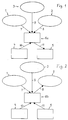
- the first main step of the method can be seen from FIG. It is assumed that material data 1 of an input product, material data 2 of an output product and setting or configuration data 3 of a given spinning machine, e.g. a card or a spinning machine for processing the input product.
- a model structure 4 is also specified, which together with model coefficients 5, which still have to be determined with a model formation process 6a, result in a usable process model 6.
- material data 1 include the fiber length, the fiber diameter and the type and quantitative distribution of nits and impurities, etc.
- a typical starting product can be a yarn, for example, which is determined by material data 2 such as its fineness, its uniformity, its tear strength, the frequency of yarn defects and nits, etc.
- the setting data include, for example, the drawing of the roving, the rotation of the yarn or the speed of the spindle or the rotor.
- configuration data the type of carding with card and cover and the relevant distances can be mentioned, etc.
- the model structure 4 is in turn determined by the type and arrangement of basic elements from which the model is constructed.
- the basic elements here are equations which can be implemented in terms of hardware by means of arrangements known per se with simple logic circuits, operational amplifiers, adders, multipliers, etc. Arranging the elements in series, parallel or combined in several layers and the type and number of connections between the elements are to be understood as the arrangement of the elements.
- Such a model structure consists of a system of nonlinear, at least approximately similar equations, which is commonly referred to as a neural network.
- Coefficients are to be understood as quantities or sets of numbers that can be assigned or added to the equations or elements in the model structure and that influence the behavior of the individual elements and thus the model.
- the model structure and the coefficients together form the model or process model.
- the process model is thus formed by specifying a model structure 4, specifying material data 1 of the input product, material data 2 of the output product and configuration and setting data 3 of the machine or the processing, and determining coefficients that cause a reproducible relationship between data sets of the material data 1 and 2 and the configuration data 3 arises. For this, given Data sets of material and configuration data as initial values, the coefficients specified until the relationship is correct, that is, until when the material data 1 of the input product and the configuration and setting data 3 are input, the material data 2 of the output product can be output with good approximation by the process model.
- the coefficients determined in this way are then an integral part of the process model, are expressed in the setting of its elements or are stored in a database which is known per se and which can be passed on to the elements at any time as required.
- the processes just described are further illustrated by arrows 7 to 11, which indicate a specific direction for the flow of data and specifications.
- the arrows 7 to 10 are directed against the model formation process 6a and thus indicate that material data, configuration and setting data and the model structure for this step are predefined from the outside. From this, useful coefficients are to be obtained, which is indicated by the direction of arrow 11, because it indicates the result.
- the second main step of the method can be seen from FIG.
- the same elements known from FIG. 1 are provided with the same reference numerals.
- the arrows 8 and 11 point in the opposite direction and thus indicate that the coefficients are now known and thus given and that material data 2 of starting products can be sought, for example.
- this step is only an example, because it is equally conceivable with this step to search for known material data 1 and 2 configuration data from the known process model, or material data 1 of the input product from the material data 2 and the configuration and setting data 3.
- the configuration and setting data 3 in this step could also be hypothetical processing data, that is, setting data of a machine that does not really exist. This could be used to determine how such a hypothetical machine works. In such cases, relevant data do not appear as individual data or as individual values, but rather in groups or as data sets that characterize products or machines.
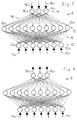
- FIG. 3 shows a schematic representation of a structure of a model as it is designated by the reference number 4 in FIGS. 1 and 2.
- the model 6 consists of individual equations or elements 12a to 12n of a first layer 12 which are at least approximately the same, elements 13a to 13n of a second layer 13 and elements 14a to 14n of a further layer 14. All elements are of the first layer 12 via connections 15 to all elements of the second layer 13 and these in turn connected to all elements of the further layer 14 via connections 16.
- the elements 12a to 12n of the first layer 12 have inputs 17a to 17n for a group of material data 1 of an input product and for configuration and setting data of a spinning machine.
- the elements 14a to 14n of the further layer 14 have inputs 18a to 18n for a group of material data 2. All of these elements 12a to 12n, 13a to 13n and 14a to 14n, when the model 6 is operating in the learning mode, receive coefficients which weight the data in the connections 15 and 16.
- FIG. 4 shows the model according to FIG. 3 when it works in the forecast mode.
- this consists in that, starting from input values 1 for material data and configuration and setting data 3, which are input via inputs 17a to 17n, output values for material data 2 of an output product are output via outputs 18a to 18n.
- outputs 18a to 18n With 18a to 18n, depending on the working method of the model, inputs are designated in one case and outputs for data in the other.
- FIGS. 3 and 4 are known to the experts as so-called neural networks and, for example, from R. Lippmann "An Introduction to Computing with Neural Nets", IEEE, Acoustics, Speech and Signal Processing Magazine, April 1987, pages 4 - 22 known.
- FIG. 5 shows, for example, the structure of an equation or an element 12, 13 or 14 from FIGS. 3 and 4 as it could be implemented in traditional electronics.
- an element consists of an operational amplifier 40, with a feedback 41.
- the operational amplifier 40 has one or more inputs 42a to 42n and an output 43, which opens into a downstream element 44, which can be designed as a filter, distortion or limiter, etc.
- the operational amplifier 40 is also connected to a feed line 45.
- the gain is determined by the resistor 46 of the feedback 41 and by series resistors W1, W2, Wn etc. which are assigned to the individual inputs 42a, 42b 42n.
- series resistors W1 to Wn are adjustable, so that the gain of the element 12, 13, 14 can be adjusted with respect to the individual inputs.
- the setting of the gain corresponds to what was previously referred to as setting the coefficients.
- the series resistors can be connected, for example, to a computer or to a coefficient generator, by means of which these series resistors W1, Wn can also be set individually by automated input of values.
- Figure 6 shows an element 12, 13, 14 again in a schematic representation with the formula for its transfer function.
- the input values x, W the values of the series resistors or the coefficients, and theta a constant.
- FIGS. 7, 8 and 9 each show a typical example of a transfer function which could be implemented by a limiter 44, u being the input values and f (u) being the output values.
- FIGS. 3 to 6 The structure shown in FIGS. 3 to 6 with the elements does not have to be constructed from discrete elements in the manner shown. It can just as well be implemented by a computer, the program of which functionally simulates such a structure.
- FIG. 10 again shows schematically a process model 6 'of a first spinning machine and a process model 6''of a further spinning machine, which are formed independently of one another in a known manner.
- the process models can then be connected to one another by using at least some of the output data 18 'of the first process model 6' as input data 17 'of the further process model 6''can be used, each process model being supplied with its own data about the configuration and the setting parameters.
- FIG. 11 shows schematically known processing operations 20, such as those which take place, for example, on cards, spinning machines, etc.
- Several processing runs here in parallel so that several machines 21, 22, 23, 24 etc. arranged in parallel are shown schematically, all of which a controller 21a, 22a, 23a, 24a etc. and a device 21b, 22b, 23b, 24b for Show feedback of data.
- the controls 21a to 24a are designed in particular to execute control commands which they can receive from a computer 26 or a database 27.
- the devices 21b to 24b are designed, for example, as sensors which report the setting and status values of the machines 21 to 24. These can be, for example, tachometers, pressure sensors, etc. with their evaluation circuits.
- Machines in this sense are, for example, cards, ring spinning machines, rotor spinning machines, etc., or spinning machines in general, all of which have their own control and device for monitoring or reporting data for various parameters. All of these machines 21 to 24 are connected to one another via a fieldbus 25 and additionally to a computer 26 as a processing unit, which in turn is connected to a data memory with a database 27 stored therein and to an input and output unit 28 for data.
- the processing unit is designed as a computer 26 with an associated program memory 26a and serves to receive data from the machines 21 etc. or to deliver data to them.
- This processing unit can in particular also be used or designed to collect input variables, output variables and setting variables of the individual machines and to relate them to one another and to store corresponding data records in the database 27.
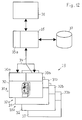
- a comparable arrangement as shown in FIG. 11 for a production process can be found in FIG. 12 for a textile test laboratory.
- Various tests 29 can be carried out in the test laboratory.
- a first test instrument 30 is designed, for example, to test the cross section and mass of yarns.
- a second test instrument 31 is designed, for example, for testing nonwovens or tapes.
- a third test instrument 32 is designed for measuring different sizes on individual fibers.
- Another test instrument 33 is designed, for example, to test the tensile strength of yarns, etc. All test instruments 30 to 33 have their own control 30a to 33a and their own data memory 30b to 33b.
- the controls 30a to 33a for example, issue control commands in the sense of orders to the actual test instruments 30a to 33a.
- the data memories 30b to 33b have stored measurement results, for example.
- the test instruments 30 to 33 are connected to a common fieldbus 34, which in turn is connected to a processing unit 35, via the controls and the data memories.
- This is constructed as a computer with a program memory 35a. As already known, this is also connected to an input and output unit 36 and a data memory with a database 37 stored therein. It is possible to provide a single and common processing unit 26 or 35 for one or more spinning machines 21 to 24 and measuring devices or test instruments 30 to 33 spatially separated therefrom. However, it is also conceivable to assign a computer to each spinning machine 21 to 24, which, for example, can be part of the control 21a to 24a and can operate in the sense of a processing unit in the aforementioned sense.
- the fieldbus 25 works as a means of moving the data between these computers.
- the databases 27 and / or 37 have an area with stored coefficients that can be fed to the computer 26 and / or 35 and thus can build up the model structure for the process model stored in the program memory 26a, 35a. Even if the test instruments 30 to 33 could each be provided with their own computer, it still makes sense to provide a common computer 35, as shown in FIG. 12. This is because the construction of a coefficient matrix according to the back propagation method requires a lot of computation requires that exceeds the capabilities of a single computer as it is assigned to a test instrument.
- the test laboratory is loaded with random samples that originate from the production process. The samples are taken before, between and at the end of each processing or machine. By testing the random samples, the success in the individual processing operations in the test laboratory can be measured.
- Through the networking of the individual test instruments 30, 31, 32, 33, etc. via the fieldbus 34 and the processing unit 35 input data and output data of the material from the corresponding tests can be recorded and in for each processing or machine 21, 22, 23, 24 etc. the database 37 are stored.
- the configuration and setting data of the machines 21, 22, 23, 24, etc. in question can be stored in the database 27 via the processing unit 26. In this way, all data for the creation of a model can be collected and stored in an orderly manner so that it can be called up.
- FIG. 13 shows, in particular, a schematic representation of the two databases 27 and 37, which are connected to a filter 50 implemented in software in the sense that the content of both databases 27 and 37 can be supplied to this filter at least temporarily.
- the filter 50 ensures that the material input and output data corresponding to one another are combined with the corresponding data of the machine or processing which has brought about the change in the material readable from the output data with the input data.
- output data relating to yarn fineness and yarn uniformity are to be related to setting data of a spinning machine and input data of a nonwoven or belt.
- various types of data must be merged, which are listed, for example, in field 51.
- This is divided into a field 52 for identification data, a field 53 for machine or configuration data and a field 54 for material data. Accordingly, the data from fields 52 and 53 must be extracted from database 27 and the data from fields 52 and 54 must be extracted from database 37. This takes place, for example, in one of the processing units 26 or 35, which have a filter 50, which can combine the configuration data and the material data on the basis of the identification data.
- This merging is known per se in database technology and is triggered, for example, in so-called “relational database systems" by the so-called "join command".
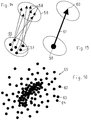
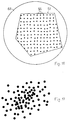
- Model 6 (FIGS. 3 and 4) is all the better and more universally applicable if material and configuration data which are as diverse as possible and which are as complete as possible in their entirety are taken into account when forming the model. If you get this data from an ongoing production, it may be that you only have data available in a narrow area. Such areas 55 and 56 are shown for input data 57 and output data 58 in FIG. 14. In such cases, it can be advantageous to determine data derived therefrom, for example by averaging the input data to an average value 59 and the output data to an average value 60, as shown in FIG. This is particularly useful if the input and output data do not exactly match due to statistical fluctuations. If this is the case, the modeling can be accelerated because there is only one data record at a time. This is indicated by a single arrow 61.
- each point 62, 63, 64 etc. represents a data record or a group of data records
- the above-mentioned averaging can be advantageous for areas 65 or parts of these areas where data is accumulated occur. This then leads to a diluted data record, as shown in FIG. 17.
- the experiences that are brought into the model via the data can be very different. They can extend over a large range of material data and configuration and setting data, as indicated by points 66 in an area 67 in FIG. 18. In addition, there will always be an area 68 outside of area 67 for which the experiences of the model do not apply because they are not supported by any experiences because there was no data available.
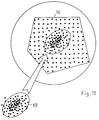
- FIG. 19 shows, there can also be a partial area 69 with particularly great experience within a area 70 with average experience.
- the process model is formed on the basis of data from a partial area 69 of the area 70. This can e.g. also mean that the greater experience was later brought into area 70.
- such models can help inexperienced people to favorably influence a production process.
- Experienced people are given the opportunity to deepen the experience.
Landscapes
- Engineering & Computer Science (AREA)
- Physics & Mathematics (AREA)
- General Physics & Mathematics (AREA)
- Automation & Control Theory (AREA)
- Artificial Intelligence (AREA)
- Evolutionary Computation (AREA)
- Health & Medical Sciences (AREA)
- Computer Vision & Pattern Recognition (AREA)
- Medical Informatics (AREA)
- Software Systems (AREA)
- General Engineering & Computer Science (AREA)
- Manufacturing & Machinery (AREA)
- Quality & Reliability (AREA)
- Spinning Or Twisting Of Yarns (AREA)
Applications Claiming Priority (2)
| Application Number | Priority Date | Filing Date | Title |
|---|---|---|---|
| CH2568/94 | 1994-08-22 | ||
| CH256894 | 1994-08-22 |
Publications (1)
| Publication Number | Publication Date |
|---|---|
| EP0704775A1 true EP0704775A1 (fr) | 1996-04-03 |
Family
ID=4236733
Family Applications (1)
| Application Number | Title | Priority Date | Filing Date |
|---|---|---|---|
| EP95111497A Withdrawn EP0704775A1 (fr) | 1994-08-22 | 1995-07-21 | Méthode et dispositif pour l'estimation de grandeurs pertinentes dans la manufacture de produits textiles |
Country Status (2)
| Country | Link |
|---|---|
| US (1) | US6263257B1 (fr) |
| EP (1) | EP0704775A1 (fr) |
Cited By (4)
| Publication number | Priority date | Publication date | Assignee | Title |
|---|---|---|---|---|
| WO1998047052A1 (fr) * | 1997-04-14 | 1998-10-22 | Siemens Aktiengesellschaft | Systeme d'automatisation |
| EP1764429A4 (fr) * | 2004-06-07 | 2009-09-09 | Shima Seiki Mfg | Appareil pour créer des images de fil pour fil mélangé, méthode pour créer des images de fil avec, et son programme |
| CN111623830A (zh) * | 2020-06-11 | 2020-09-04 | 深圳技术大学 | 一种机电设备运行状态的监测方法、装置及系统 |
| CN113848706A (zh) * | 2021-09-13 | 2021-12-28 | 无锡宏源机电科技股份有限公司 | 一种丝线张力检测方法、控制方法及控制装置 |
Families Citing this family (15)
| Publication number | Priority date | Publication date | Assignee | Title |
|---|---|---|---|---|
| PT1070280E (pt) * | 1998-03-31 | 2002-12-31 | Siemens Ag | Processo e dispositivo para a modelagem neuronal de um dispositivo de enrolamento de papel |
| US6735610B1 (en) * | 1999-04-29 | 2004-05-11 | Walter E. Pelton | Apparatus, methods, and computer program products for determining the coefficients of a function with decreased latency |
| US6922712B2 (en) * | 2000-02-26 | 2005-07-26 | Walter E. Pelton | Apparatus, methods, and computer program products for accurately determining the coefficients of a function |
| AU2001268309A1 (en) * | 2000-06-09 | 2001-12-17 | Walter E Pelton | Methods for reducing the number of computations in a discrete fourier transform |
| AU2001275444A1 (en) * | 2000-06-09 | 2001-12-17 | K. Walt Herridge | Apparatus, methods and computer program products for performing high speed division calculations |
| EP1306474A1 (fr) * | 2001-10-23 | 2003-05-02 | Viktor Achter GmbH & Co KG | Tissés plats légers et leur utilisation pour la fabrication de housses de siège |
| US6948347B2 (en) * | 2003-01-24 | 2005-09-27 | Isg Technologies Inc. | Graphical rolled steel sheet flatness display and method of using same |
| CH696544A5 (de) * | 2003-06-27 | 2007-07-31 | Rieter Ag Maschf | Textilmaschinenanlage. |
| DE102006014475A1 (de) * | 2006-03-29 | 2007-10-04 | Rieter Ingolstadt Spinnereimaschinenbau Ag | Verfahren zur Steuerung einer Textilmaschine, Vorrichtung zur Durchführung des Verfahrens sowie Textilmaschine |
| TWI311969B (en) | 2007-09-11 | 2009-07-11 | Ind Tech Res Inst | Negative-pressure type drug-moving device and medication dispensing device and system using the same |
| BR112017001009B8 (pt) * | 2014-07-31 | 2023-04-18 | Camozzi Digital S R L | Método de identificação de defeitos ou de degradação da operação de uma máquina têxtil |
| CN105353623B (zh) * | 2015-12-17 | 2018-04-13 | 西安理工大学 | 一种基于自抗扰控制的凹印套准控制方法 |
| EP3654114A1 (fr) * | 2018-11-16 | 2020-05-20 | Maschinenfabrik Rieter AG | Gestionnaire de paramètre, dispositif central et procédé d'adaptation de paramètres opérationnels dans une machine textile |
| LU503150B1 (de) * | 2022-12-07 | 2024-06-07 | Saurer Spinning Solutions Gmbh & Co Kg | Verfahren zur computergestützten Anpassung einer Konfiguration für unterschiedliche textile Produktionen |
| CN118643747B (zh) * | 2024-08-12 | 2024-11-22 | 南通飞隼信息科技有限公司 | 一种基于人工智能的纺织品加工设计方法及装置 |
Citations (6)
| Publication number | Priority date | Publication date | Assignee | Title |
|---|---|---|---|---|
| WO1992002866A1 (fr) * | 1990-08-03 | 1992-02-20 | E.I. Du Pont De Nemours And Company | Procede et systeme de commande et de mesure de processus par reseau neuronal informatise |
| DE4301130A1 (en) * | 1992-01-20 | 1993-07-22 | Hitachi Ltd | Control system with highly nonlinear characteristic - uses learning function and derives control values from selected parameter values of set point adjustment model |
| EP0573656A1 (fr) * | 1991-11-22 | 1993-12-15 | Nissan Texsys Co., Ltd. | Dispositif de commande dans un metier a tisser |
| US5285377A (en) * | 1990-10-30 | 1994-02-08 | Fujitsu Limited | Control apparatus structuring system |
| EP0588594A2 (fr) * | 1992-09-14 | 1994-03-23 | TEXACO, Inc. | Système de commande utilisant un réseau neuronal adaptif pour l'optimalisation des cibles et des trajectoires dans un système multivariable et non-linéaire |
| EP0604876A2 (fr) * | 1992-12-31 | 1994-07-06 | Zellweger Uster, Inc. | Méthodes pour la contrôle optimale des appareils de traitement de fibres |
Family Cites Families (1)
| Publication number | Priority date | Publication date | Assignee | Title |
|---|---|---|---|---|
| US5553196A (en) * | 1989-04-05 | 1996-09-03 | Yozan, Inc. | Method for processing data using a neural network having a number of layers equal to an abstraction degree of the pattern to be processed |
-
1995
- 1995-07-21 EP EP95111497A patent/EP0704775A1/fr not_active Withdrawn
- 1995-08-22 US US08/517,628 patent/US6263257B1/en not_active Expired - Fee Related
Patent Citations (6)
| Publication number | Priority date | Publication date | Assignee | Title |
|---|---|---|---|---|
| WO1992002866A1 (fr) * | 1990-08-03 | 1992-02-20 | E.I. Du Pont De Nemours And Company | Procede et systeme de commande et de mesure de processus par reseau neuronal informatise |
| US5285377A (en) * | 1990-10-30 | 1994-02-08 | Fujitsu Limited | Control apparatus structuring system |
| EP0573656A1 (fr) * | 1991-11-22 | 1993-12-15 | Nissan Texsys Co., Ltd. | Dispositif de commande dans un metier a tisser |
| DE4301130A1 (en) * | 1992-01-20 | 1993-07-22 | Hitachi Ltd | Control system with highly nonlinear characteristic - uses learning function and derives control values from selected parameter values of set point adjustment model |
| EP0588594A2 (fr) * | 1992-09-14 | 1994-03-23 | TEXACO, Inc. | Système de commande utilisant un réseau neuronal adaptif pour l'optimalisation des cibles et des trajectoires dans un système multivariable et non-linéaire |
| EP0604876A2 (fr) * | 1992-12-31 | 1994-07-06 | Zellweger Uster, Inc. | Méthodes pour la contrôle optimale des appareils de traitement de fibres |
Non-Patent Citations (1)
| Title |
|---|
| WU P ET AL.: "Decision surface modeling of textile spinning operations using neural network technology", 1994 IEEE ANNUAL TEXTILE, FIBER AND FILM INDUSTRY TECHNICAL CONFERENCE (CAT. NO.94CH3395-1), PROCEEDINGS OF 1994 IEEE/IAS ANNUAL TEXTILE, FIBER AND FILM INDUSTRY TECHNICAL CONFERENCE, GREENVILLE, SC, USA, 4-5 MAY 1994, ISBN 0-7803-1802-1, 1994, NEW YORK, NY, USA, IEEE, USA, pages 0 - 19 * |
Cited By (6)
| Publication number | Priority date | Publication date | Assignee | Title |
|---|---|---|---|---|
| WO1998047052A1 (fr) * | 1997-04-14 | 1998-10-22 | Siemens Aktiengesellschaft | Systeme d'automatisation |
| US6529780B1 (en) | 1997-04-14 | 2003-03-04 | Siemens Aktiengesellschaft | Method for automatic operation of industrial plants |
| EP1764429A4 (fr) * | 2004-06-07 | 2009-09-09 | Shima Seiki Mfg | Appareil pour créer des images de fil pour fil mélangé, méthode pour créer des images de fil avec, et son programme |
| CN111623830A (zh) * | 2020-06-11 | 2020-09-04 | 深圳技术大学 | 一种机电设备运行状态的监测方法、装置及系统 |
| CN113848706A (zh) * | 2021-09-13 | 2021-12-28 | 无锡宏源机电科技股份有限公司 | 一种丝线张力检测方法、控制方法及控制装置 |
| CN113848706B (zh) * | 2021-09-13 | 2024-01-12 | 无锡宏源机电科技股份有限公司 | 一种丝线张力检测方法、控制方法及控制装置 |
Also Published As
| Publication number | Publication date |
|---|---|
| US6263257B1 (en) | 2001-07-17 |
Similar Documents
| Publication | Publication Date | Title |
|---|---|---|
| DE69113164T2 (de) | Verfahren und Vorrichtung für die Steuerung eines Prozesses. | |
| DE3506924A1 (de) | Einrichtung fuer das spinnen von monofilfaeden aus thermoplastischem kunststoff | |
| EP3537237A1 (fr) | Système de traitement du tabac pour l'industrie de traitement du tabac et procédé de fonctionnement d'un dispositif | |
| CH693311A5 (de) | Regulierstreckwerk für Faserverbände. | |
| EP0685580A1 (fr) | Procédé et dispositif pour déterminer les causes de défauts des fils, mèches et rubans de fibres | |
| WO2017079853A1 (fr) | Réseau local pour le contrôle de la qualité de textile | |
| EP0631136A2 (fr) | Appareil pour la mesure de la masse ou de la densité transversale de rubans de fibres textiles, et utilisation de l'appareil | |
| WO2000042480A1 (fr) | Controle de la qualite dans une fabrication | |
| DE69031559T2 (de) | Fasertestverfahren | |
| EP2303743A1 (fr) | Procédé et dispositif de nettoyage de fil | |
| WO2004021229A1 (fr) | Procede et dispositif pour optimiser un processus | |
| DE19920592A1 (de) | Verfahren und Vorrichtung zur automatischen Erkennung von textilen Faserstoffen | |
| EP0534181B2 (fr) | Méthode pour détecter des déviations inadmissibles de paramètres d'un procédé | |
| EP0670058B1 (fr) | Procede d'identification d'un organe de reglage lors de la regulation de la section transversale d'une bande de materiau produite en continu | |
| EP1187786A1 (fr) | Procede et dispositif permettant le nettoyage de fils | |
| WO2021073996A1 (fr) | Procédé de détermination basée sur un modèle de paramètres de modèle | |
| DE102019111715B4 (de) | Verfahren zum Einstellen eines Fertigungsverfahrens für ein Bauteil | |
| DE102022105157A1 (de) | Zustandsdiagnosesystem | |
| EP3686697B1 (fr) | Optimisation du régulateur pour un système de commande d'une installation technique | |
| EP4356209B1 (fr) | Surveillance de la production de panneaux de matériau, en particulier de panneaux en matériau dérivé du bois, en particulier à l'aide d'une carte auto-organisatrice | |
| CH687994A5 (de) | Vorrichtung zur Produktionssteigerung von Spinnereimaschinen. | |
| EP2225953B1 (fr) | Machine d'équilibrage des températures destinée au traitement continu de masses contenant des graisses avec un degré d'équilibrage des températures constant | |
| AT524001B1 (de) | Verfahren zur Optimierung und/oder Bedienung mindestens eines Produktionsprozesses | |
| DE19931181B4 (de) | Verfahren und Vorrichtung zur Optimierung der Prozessführung sowie Prozessüberwachung in einer Anlage zur Schokoladeherstellung | |
| EP0431481A1 (fr) | Méthode pour déterminer en continu la finesse des fibres dans des fils et appareil pour la mise en oeuvre de cette méthode |
Legal Events
| Date | Code | Title | Description |
|---|---|---|---|
| PUAI | Public reference made under article 153(3) epc to a published international application that has entered the european phase |
Free format text: ORIGINAL CODE: 0009012 |
|
| AK | Designated contracting states |
Kind code of ref document: A1 Designated state(s): BE CH DE IT LI |
|
| 17P | Request for examination filed |
Effective date: 19960809 |
|
| 17Q | First examination report despatched |
Effective date: 19980304 |
|
| STAA | Information on the status of an ep patent application or granted ep patent |
Free format text: STATUS: THE APPLICATION IS DEEMED TO BE WITHDRAWN |
|
| 18D | Application deemed to be withdrawn |
Effective date: 19980715 |