EP3537237A1 - Système de traitement du tabac pour l'industrie de traitement du tabac et procédé de fonctionnement d'un dispositif - Google Patents
Système de traitement du tabac pour l'industrie de traitement du tabac et procédé de fonctionnement d'un dispositif Download PDFInfo
- Publication number
- EP3537237A1 EP3537237A1 EP19156654.6A EP19156654A EP3537237A1 EP 3537237 A1 EP3537237 A1 EP 3537237A1 EP 19156654 A EP19156654 A EP 19156654A EP 3537237 A1 EP3537237 A1 EP 3537237A1
- Authority
- EP
- European Patent Office
- Prior art keywords
- analysis
- control device
- batch
- tobacco
- control
- Prior art date
- Legal status (The legal status is an assumption and is not a legal conclusion. Google has not performed a legal analysis and makes no representation as to the accuracy of the status listed.)
- Withdrawn
Links
Images


Classifications
-
- G—PHYSICS
- G05—CONTROLLING; REGULATING
- G05B—CONTROL OR REGULATING SYSTEMS IN GENERAL; FUNCTIONAL ELEMENTS OF SUCH SYSTEMS; MONITORING OR TESTING ARRANGEMENTS FOR SUCH SYSTEMS OR ELEMENTS
- G05B13/00—Adaptive control systems, i.e. systems automatically adjusting themselves to have a performance which is optimum according to some preassigned criterion
- G05B13/02—Adaptive control systems, i.e. systems automatically adjusting themselves to have a performance which is optimum according to some preassigned criterion electric
- G05B13/0265—Adaptive control systems, i.e. systems automatically adjusting themselves to have a performance which is optimum according to some preassigned criterion electric the criterion being a learning criterion
-
- G—PHYSICS
- G05—CONTROLLING; REGULATING
- G05B—CONTROL OR REGULATING SYSTEMS IN GENERAL; FUNCTIONAL ELEMENTS OF SUCH SYSTEMS; MONITORING OR TESTING ARRANGEMENTS FOR SUCH SYSTEMS OR ELEMENTS
- G05B13/00—Adaptive control systems, i.e. systems automatically adjusting themselves to have a performance which is optimum according to some preassigned criterion
- G05B13/02—Adaptive control systems, i.e. systems automatically adjusting themselves to have a performance which is optimum according to some preassigned criterion electric
- G05B13/04—Adaptive control systems, i.e. systems automatically adjusting themselves to have a performance which is optimum according to some preassigned criterion electric involving the use of models or simulators
-
- G—PHYSICS
- G05—CONTROLLING; REGULATING
- G05B—CONTROL OR REGULATING SYSTEMS IN GENERAL; FUNCTIONAL ELEMENTS OF SUCH SYSTEMS; MONITORING OR TESTING ARRANGEMENTS FOR SUCH SYSTEMS OR ELEMENTS
- G05B19/00—Program-control systems
- G05B19/02—Program-control systems electric
- G05B19/418—Total factory control, i.e. centrally controlling a plurality of machines, e.g. direct or distributed numerical control [DNC], flexible manufacturing systems [FMS], integrated manufacturing systems [IMS] or computer integrated manufacturing [CIM]
- G05B19/4185—Total factory control, i.e. centrally controlling a plurality of machines, e.g. direct or distributed numerical control [DNC], flexible manufacturing systems [FMS], integrated manufacturing systems [IMS] or computer integrated manufacturing [CIM] characterised by the network communication
- G05B19/41855—Total factory control, i.e. centrally controlling a plurality of machines, e.g. direct or distributed numerical control [DNC], flexible manufacturing systems [FMS], integrated manufacturing systems [IMS] or computer integrated manufacturing [CIM] characterised by the network communication by local area network [LAN], network structure
-
- G—PHYSICS
- G05—CONTROLLING; REGULATING
- G05B—CONTROL OR REGULATING SYSTEMS IN GENERAL; FUNCTIONAL ELEMENTS OF SUCH SYSTEMS; MONITORING OR TESTING ARRANGEMENTS FOR SUCH SYSTEMS OR ELEMENTS
- G05B19/00—Program-control systems
- G05B19/02—Program-control systems electric
- G05B19/418—Total factory control, i.e. centrally controlling a plurality of machines, e.g. direct or distributed numerical control [DNC], flexible manufacturing systems [FMS], integrated manufacturing systems [IMS] or computer integrated manufacturing [CIM]
- G05B19/41875—Total factory control, i.e. centrally controlling a plurality of machines, e.g. direct or distributed numerical control [DNC], flexible manufacturing systems [FMS], integrated manufacturing systems [IMS] or computer integrated manufacturing [CIM] characterised by quality surveillance of production
Definitions
- the present invention relates to a system for the tobacco processing industry comprising a tobacco processing apparatus, a controller arranged to control the apparatus based on a plurality of control parameters stored in a memory, and at least one sensor adapted to detect at least one measurand is arranged, wherein the device is adapted to carry out tobacco processing in a batch processing over a plurality of batches.
- the invention further relates to a method for operating a device for tobacco processing in the tobacco processing industry.
- control parameters When commissioning a tobacco processing system, a plurality of control parameters must be established, which may be, for example, parameters for adjusting the device and / or a tobacco processing and / or processing plant to ensure an effective and high quality processing process.
- the defined control parameters include, for example, system settings and / or recipe parameters and are either typically based on the experience of skilled personnel or must be determined in complex on-site tests.
- the recipe for the tobacco product and the investment setting are difficult to optimize and adjust in complex technical devices or systems by the user.
- the manual, intuitive optimization of the machine is very dependent on the experience of the operator. Manual data extraction and analysis requires a lot of effort and expertise.
- the behavior of the system or the system is difficult to predict intuitively.
- the drift in the system and thus in the device for unfavorable running behavior if the control parameters are not systematically readjusted.
- the drift refers to the quality of the tobacco product which changes over the course of the operation of the system or over time and is caused, for example, by changing environmental conditions or starting materials.
- the readjustment or readjustment of the control parameters is complicated and costly and usually associated with reduced process quality with high rejects and possibly downtime of the system.
- Conventional control of control parameters is typically sluggish and can not always sufficiently compensate for environmental factors and other factors, resulting in a waste of tobacco or tobacco product.
- a generic system is for example from the EP 2 537 072 B1 which discloses an apparatus configured to perform at least one trial based on a trial design with a plurality of trial runs, varying selected control parameters, to find a suitable set of control parameters with which to process a future batch.
- the device thus performs a short-term data collection, runs a design plan and thus actively intervenes in the operation of the system.
- Conducting the experiments takes time and leads to a rejection of tobacco or tobacco products.
- the parameters found in the experiment are used for a batch and after completion of the batch, it may be necessary to new tests are carried out and new control parameters are found, which leads to the renewed possible rejection of tobacco or tobacco product.
- the object underlying the invention is to provide a system and a method which achieve a consistently high tobacco or tobacco product quality while ensuring improved efficiency and ease of operation.
- control device store in memory the measured values measured during operation with the sensor, after completion of the preparation of a batch for carrying out an analysis of the at least one measured variable on the basis of the measured values stored in the memory and for recalculation of at least one changed one Control parameter is set up based on the analysis.
- the measured during a batch Measured values are first stored in the memory, only to be evaluated, processed, analyzed and / or forwarded after completion of the preparation of a batch become.
- the process data comprising the measured values is preferably stored in a structured manner in a database in the memory.
- the control device After completion of the preparation of a batch and thus after the storage of the measured values in the memory, the control device carries out an analysis and evaluates and / or processes the measured values.
- the storage of the measured values makes it possible to archive the measured values over a long period of time in order to analyze the measured values, for example also with regard to their history, which allows a conclusion on the suitability of the control parameters, in particular for a completed batch.
- the analysis may further use the natural process noise due to the device and / or the variations induced by an operator or otherwise, such as changes in the recipe input and / or environmental conditions, to characterize the dryer. Potentially long-term noise and recipe changes are tracked during the operation without intervention or test procedure and included in the analysis.
- the results of the analysis are then used by the controller to recalculate the at least one control parameter with which, for example, a subsequent batch can be processed.
- the analysis allows a continuous adaptation of the control parameters for each batch to the circumstances.
- the invention avoids the need for carrying out attempts to determine the control parameters by collecting a database comprising the measured values and by long-term data collection.
- the invention takes the operator a complex Extracting data and evaluating and optimizing control parameters reduces operator and operator effort and provides improved plant settings through analysis and recalculation at regular intervals upon completion of a batch.
- control device is set up to carry out a statistical filtering of the measured values stored in the database before the analysis in order to identify relevant influencing variables and to be able to reject non-relevant measured values.
- statistical filtering can identify correlations in related metrics. For example, a temperature in the device or a performance of the device, for example a dryer, can be measured and evaluated. The temperature and the power may have a relationship which can be taken into account in the statistical filtering.
- statistical filtering can also identify and filter out measurement errors that are outlier.
- a description of the device as a mathematical-physical model with adapted model parameters is used for the analysis in order to be able to simulate the device as a virtual device, for example according to the virtual twin principle.
- the model parameters may include, for example, device characteristics and / or process parameters, such as, for example, power and volume and / or charge characteristics, such as input moisture (input material moisture), input quantity, density and initial moisture content (moisture of the product).
- the mathematical-physical model, the device or the Preferably emulate batch process to allow, for example, with the aid of other influencing parameters a precise recalculation of the at least one control parameter.
- the model may be based on a finite difference mass balance model that takes into account the mass of dry matter and the humidities of the input and / or output materials.
- the control parameter can be determined, for example, from the input humidity and the desired setpoint value of the outlet humidity.
- the control device is preferably set up to carry out the analysis by means of multiple regression in order to determine at least one regression parameter as the output of the analysis and thus to enable the most efficient recalculation of the at least one control parameter.
- the regression can be based on a linear and / or non-linear regression function, which can be derived from the mathematical-physical model.
- all historical relevant influencing variables or data or measured values stored in the memory are included in order to ensure a high degree of robustness against outliers.
- the regression model or the regression function is adapted to the data in order to take into account the characteristics of different batches.
- the control unit is preferably set up to weight the stored measured values of the analysis differently in order to take into account the respective requirements or conditions and to be able to take account of the batch and / or the environmental conditions, for example.
- the weighting of all historically relevant measured values may in particular mean that at least one cut-off is determined which deliberately disregards certain stored measured values, for example measured values before a specific time, or measured values within or outside a period. Furthermore, measured values can also be highlighted and / or differently weighted.
- control device is set up to store the regression parameters used for the multiple regression after completion of the preparation of a batch in order to resort to the regression parameters in at least one further analysis and / or to be able to improve or adapt the current batch.
- the control device is preferably set up to calculate and record relevant quality parameters characterizing the quality of the tobacco product and / or the batch process in order to allow the most effective possible monitoring of the device or of the system and / or the batch and to be able to assess the quality of the at least one determined control parameter ,
- quality parameters may be the standard deviation of the final moisture content of the processed or processed product, the starting shot, for example, in kg and / or the extension shot, for example, in kg.
- the at least one sensor is preferably set up to detect at least one tobacco characteristic or an environmental variable, in order to enable a most effective analysis with reference to relevant influencing variables.
- a tobacco property is the moisture of the output material, referred to as the input moisture Tobacco and an environmental quantity is the relative humidity of the environment.
- control device is set up to take into account pre-stored batch characteristics in order to be able to take account of the batch characteristics characterizing a batch in the analysis.
- the batch characteristics can be stored permanently in the memory, can be entered by an operator, and / or can be stored by the control device by means of a network connection.
- the batch characteristics may include, for example, input moisture, input, density and outlet humidity.
- the controller is adapted to use recalculated control parameters upon confirmation by an operator for future batch processing, advantageously via an operator terminal, to allow for operator control and / or operator and other information.
- an active intervention in the control parameters may be made by the operator, in which the operator changes or accepts the newly calculated control parameters.
- the control device is preferably set up to carry out the storage of the measured measured values, and inclusion in the analysis, over a period of at least one day, preferably at least one week, more preferably at least one month, particularly preferably at least one year, in order to obtain as meaningful an analysis as possible be able to perform the measured values in a certain time window and to be able to take into account, for example, daytime and / or seasonal fluctuations of the environmental conditions.
- exemplary it is possible to take into account changes in air humidity, or changes in other environmental variables, as a function of the time of day and / or seasonally or seasonally.
- control device is adapted to carry out the analysis by means of a downhill search method, preferably a downhill simplex algorithm, in order to enable an effective analysis.
- a downhill search method preferably a downhill simplex algorithm
- other search methods such as a hillclimbing search method
- the controller may be configured to apply a simplex method.
- the controller is adapted to perform the analysis with a self-learning algorithm, more preferably a neural network, to allow for an effective and adaptive analysis.
- a self-learning algorithm more preferably a neural network
- the control device is preferably set up for the calculation, detection and / or input of recipe parameters in order to enable the preparation of a batch with the desired recipe on the basis of the control parameters. Based on the recipe parameters, the recalculation of the at least one control parameter can be performed suitably.
- the apparatus comprises a dryer, in particular a drum dryer, and / or a conditioner, in particular a drum conditioner, to meet the requirements of the tobacco processing industry.
- a batch or a batch may be a tobacco bale or another defined tobacco portion.
- a system 10 for the conditioning, drying and / or conditioning of a tobacco product or tobacco comprises, as in Figure 1A a tobacco processing device 11, which is embodied for example as a conditioning device 111, in particular with a rotating dissolving conditioning drum, in which the coming, for example, from a slicer not shown tobacco product 12 is conveyed.
- a tobacco processing device 11 which is embodied for example as a conditioning device 111, in particular with a rotating dissolving conditioning drum, in which the coming, for example, from a slicer not shown tobacco product 12 is conveyed.
- the release conditioning drum 111 means not shown are provided which cause a rotation of the drum 111 a singling of the compressed tobacco leaves.
- the dissolution behavior is favorably influenced by an increase in the tobacco temperature.
- the heat is introduced into the drum 111 by process air saturated with steam, which is passed through the drum 111 in a recirculating air duct 13 and a feed nozzle 17 arranged at the tobacco inlet.
- the steam is introduced from a steam supply line 14 by means of a nozzle 15 in the recirculating air duct 13.
- the process air temperature may be regulated by a control loop 24 based on a valve 26 in the steam supply line 14 controlled by a signal from a temperature sensor 25.
- a steam heat exchanger 16 may be provided for preheating the drum 111.
- the tobacco leaves are moistened or conditioned.
- a arranged on the outlet side of the drum 111 moisture sensor 121 the moisture content of the expiring from the drum 111 tobacco product 21 can be determined.
- the supply of water through the nozzle 18 may be controlled by a feedback loop based on a signal from the sensor 20.
- the drum 111 may additionally comprise means for saucing the tobacco product, in particular a nozzle for the input of sauce and steam.
- the system 10 includes a controller 22, which may be implemented as a memory-programmed controller, and a memory 23.
- the memory 23 may be locally connected to the controller 22, be included therein, located in a local cloud of the operator and / or Internet-based his.
- the data dynamically read out by the sensor 20 is stored in a database in the memory 23.
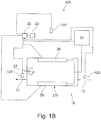
- An example of a system 10 for drying a tobacco product or tobacco comprises, as in FIG. 1B shown, a tobacco processing device 11, which is designed for example as a drum dryer 211.
- a tobacco processing device 11 which is designed for example as a drum dryer 211.
- the coming tobacco product 12 is conveyed and heated by heating modules 29 arranged in the drum dryer 211.
- a moisture sensor 120 arranged on the inlet side of the drum 211, the moisture content of the tobacco product 12 entering the drum 211 can be determined.
- the system 10 includes as well as in Figure 1A a control device 22, a reservoir 23, and a humidity sensor 121 arranged on the outlet side of the drum 211 for measuring the humidity of the tobacco product 21 discharging from the drum 211.
- the heating modules 29 are supplied with heat.
- the heating device 28 may be in operative connection with the control device 22 in order to be able to exchange data between the heating device 28 and the control device 22.
- the heating device 28 and the heating modules 29 provide the heat or temperature needed to dry the tobacco.
- Vane parts and / or cooling modules may be provided to achieve effective drying of the tobacco.
- an environment sensor 122 which is in a measuring relationship with the surroundings of the drum dryer 211, different environmental variables can be determined.
- the environmental sensor 122 may measure the temperature and / or humidity outside the tumble dryer 211.
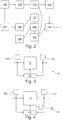
- FIG. 10 is a flowchart for a method of operating a system 10 as in any of the FIG Figures 1A or 1B to see. This in FIG. 2 The method shown is performed automatically and repeatably by the programmed electronic control device 22.
- the control device 22 may for example be associated with the system control of the system 303 and / or the device 11.
- the system 10 receives the processing or processing 100 of a batch.
- the control parameters for a first batch can be specified, for example, in the form of an estimate by input or by other determination by specialist personnel or operator 205.
- the controller 22 archives data in a database 104 in the memory 23.
- the data comprises measured variables which are measured with the at least one sensor 20 during operation, the measured measured quantities being stored as measured values in the database 104 ,
- the measurement of the dry air temperature, the blade temperature, the process air amount, the mass flow of air and / or tobacco or tobacco product, the steam mass flow, the input humidity, the outlet humidity, the relative humidity and / or the ambient air temperature be significant, since the above sizes have a direct impact on the control parameters, in particular on the conditioning performance, dryer temperature and / or dryer performance.
- the data from the database 104 is preferably subjected to processing, filtering and / or pre-analysis 105 by the controller 22.
- the processing, filtering and / or preliminary examination 105 can, for example, apply weightings of the measured values and preferably stored regression parameters and / or control parameters in order to specifically emphasize or suppress or otherwise control data.
- the rendering, filtering, and / or preliminary examination 105 may use statistical filters to identify outliers and correlations in the measurements, use a cut-off, and / or otherwise determine the appropriateness of the measurements. Likewise, suitable sizes and / or models for a subsequent analysis 107 can be determined or calculated.
- the control unit 22 carries out the analysis 107, preferably a regression analysis, of the previously stored data.
- the analysis 107 may be on a virtual device as a virtual image of the device 11 and / or based on a linear or non-linear regression of a data set of at least one measured value, which consists of a set of measured values stored in the database 104.
- the control device 22 is preferably configured to take into account changes 106 which describe the current environmental situation and / or changes generated by the operator in the recalculation of the control parameters.
- the changes 106 may also include laboratory values such as fill force and / or cut distribution that characterize the tobacco or tobacco product, respectively.
- a user or operator 205 can enter that the relative humidity of the environment is 80% or at another value and a batch of 6000 kg / h or another amount per unit of time tobacco is processed or processed.
- a recalculation 108 or extrapolation from the at least one new control parameters or the starting values for preferably a future or subsequent batch is based on the results of the analysis 107, for example the at least one regression parameter, and the changes 106.
- the device 11 is a dryer 211
- the Specify regression coefficients for example, that increases the dryer temperature by 1 K, the dryer performance example by 10 kg / h and / or increased by 10% relative humidity in the environment leads to a reduction of the dryer performance example by 50 kg / h.
- a forwarding 109 of the at least one recalculated control parameter to the system 10 takes place, which is a Update 102 of the at least one control parameter, for example, a specific recipe and / or plant parameter triggers.
- the processing 100 of a new batch begins and current measurement values are recorded in the database 104 together with the control parameters transmitted in the forwarding 109.
- the points in FIG. 2 indicate a potential repetition of the described method.
- control parameters of PID controllers can also be set, for example start-up ramps, i. the rise or fall of the temperature in the starting state or Abfahrschreib the device 11 to avoid over-drying or under-drying in the non-filled state.
- a system 10 comprising a device 11, for example a dryer 211, and a control device 22 and in each case a sensor 120 at a material input of the device 11 and a sensor 121 at the material output of the device 11 can be seen.
- the sensors 120, 121 can, for example, measure the input moisture and / or starting shot, for example in kg or the initial moisture content and / or the outfeed shot, for example in kg, and deposit the measured values measured in a memory 23, not shown here.
- the control unit 22 is set up to adjust the power of the device 11 and / or the temperature in the device 11 by means of at least one control parameter.
- the quantities obtained in previous batches are included in the determination of the at least one control parameter for coming batches.
- the at least one sensor 20 comprises in the embodiment according to FIG. 3 thus the sensors 120, 121.
- the illustrated embodiment includes a sensor 122 configured to measure an environmental condition.
- the sensor 122 may measure the relative humidity and / or ambient temperature and forward it to the control unit 22.
- the ambient conditions are also included as influencing parameters in the determination of the at least one control parameter in this example.
- the relative humidity has an influence on the necessary dryer temperature for a given specification of the difference to be achieved between the input moisture of the tobacco and the initial moisture content of the processed or processed tobacco and / or tobacco product.
- the at least one sensor 20 comprises in the embodiments according to FIG Fig. 1B and Fig. 4 thus the sensors 120, 121, 122.
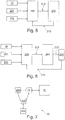
- FIGS. 5 and 6 schematically two representations of the operation of each embodiment of a system 10 for tobacco processing are shown.
- a batch is processed in a process 203 by a device 11, not shown here.
- the process 203 is largely determined by a product 201 and an environment 202.
- the product 201 includes both the input substances and the output materials.
- the environment 202 includes all relevant variables characterizing the environment 202 in the process 203, for example the temperature and / or the relative humidity.
- the data relevant for the process 203 is forwarded to a control unit 22, not shown here, which carries out the further processing 204.
- the further processing 204 includes, for example, the analysis 107, the recalculation 108 or the optimization and / or the display or the other transmission of the at least one control parameter, the measured values and / or other data.
- An automatic adaptation 210 in the form of an automatic coupling influencing the process 203 takes place from the further processing 204 of the data to the process 203.
- a communication 213 takes place with an operator 205, which, for example, comprises the transmission of the at least one control parameter to the operator 205 in the form of a proposal to be confirmed and / or changed by the operator 205.
- the operator is presented with a proposed modification 214 with modified control parameters.
- the accepted change proposal 214 is then introduced to the further process 203.
- the proposed modification 214 may be entered directly by the user 205 and / or introduced by the control unit 22 in the process.
- a proposed change 214 may include the statement that an increase in dryer temperature achieves a certain improved drying, and that, for a given humidity, the temperature increase is due to be adjusted.
- FIGS. 7 and 8th each show a schematic representation of the integration of a system 10 of tobacco processing in a network for data processing and communication.
- the system 10 comprising a device 11 and a control device 22 is connected to a network for data transfer.
- the device 11 is controlled by the control device 22, which is designed, for example, as a programmable logic controller, PLC or programmable logic controller, PLC.
- the control device 22 is connected to a human-machine interface 300, or a human machine interface, HMI.
- the man-machine interface 300 may be associated with the same assembly as the controller 22 or may be located, for example, by means of a network connection at a location remote from the controller 22.
- the man-machine interface 300 is preferably connected to a data processing device 301 by means of a virtual network computing software, VNC.
- the data processing device 301 may be, for example, a computer.
- the control device 22 is preferably connected to the data processing device 301 by means of an OPC Unified Architecture protocol. By means of the protocol several systems 10 can be connected.
- the data processing device 301 is connected by way of example to a cloud 302, which carries out the possibly resource-intensive calculation and the storage of the control parameters.
- each system 10 may include one or more controller 22 and human-machine interfaces 300 to, for example, allow the device to be detected and / or adjusted at different locations by, for example, various personnel.
- the system 10 can be connected to at least one further production facility 303, for example a facility 303 at a further location, and exchange data therewith.
- Each production facility 303 may in turn comprise a system 10.
Landscapes
- Engineering & Computer Science (AREA)
- General Physics & Mathematics (AREA)
- Automation & Control Theory (AREA)
- Physics & Mathematics (AREA)
- Artificial Intelligence (AREA)
- Quality & Reliability (AREA)
- Manufacturing & Machinery (AREA)
- Health & Medical Sciences (AREA)
- General Engineering & Computer Science (AREA)
- Computer Vision & Pattern Recognition (AREA)
- Evolutionary Computation (AREA)
- Medical Informatics (AREA)
- Software Systems (AREA)
- Manufacture Of Tobacco Products (AREA)
- Feedback Control In General (AREA)
Applications Claiming Priority (1)
| Application Number | Priority Date | Filing Date | Title |
|---|---|---|---|
| DE102018105504.8A DE102018105504A1 (de) | 2018-03-09 | 2018-03-09 | System zur Tabakaufbereitung für die Tabak verarbeitende Industrie, und Verfahren zum Betrieb einer Vorrichtung |
Publications (1)
| Publication Number | Publication Date |
|---|---|
| EP3537237A1 true EP3537237A1 (fr) | 2019-09-11 |
Family
ID=65516428
Family Applications (1)
| Application Number | Title | Priority Date | Filing Date |
|---|---|---|---|
| EP19156654.6A Withdrawn EP3537237A1 (fr) | 2018-03-09 | 2019-02-12 | Système de traitement du tabac pour l'industrie de traitement du tabac et procédé de fonctionnement d'un dispositif |
Country Status (3)
| Country | Link |
|---|---|
| EP (1) | EP3537237A1 (fr) |
| CN (1) | CN110244664A (fr) |
| DE (1) | DE102018105504A1 (fr) |
Cited By (11)
| Publication number | Priority date | Publication date | Assignee | Title |
|---|---|---|---|---|
| CN111125210A (zh) * | 2019-11-25 | 2020-05-08 | 云南昆船电子设备有限公司 | 烟厂制丝车间贮柜出柜防差错控制方法及计算机程序产品 |
| CN111938187A (zh) * | 2020-08-25 | 2020-11-17 | 红塔烟草(集团)有限责任公司 | 一种润叶加料机新风温度智能调节装置及调节方法 |
| CN112801523A (zh) * | 2021-02-04 | 2021-05-14 | 龙岩烟草工业有限责任公司 | 烟支质量的检测方法、装置、系统和存储介质 |
| CN114002977A (zh) * | 2021-10-22 | 2022-02-01 | 珠海格力电器股份有限公司 | 烟草烘干机组的控制方法、装置、电子设备及存储介质 |
| CN114271523A (zh) * | 2021-12-30 | 2022-04-05 | 贵州中烟工业有限责任公司 | 一种制丝系统 |
| CN115841026A (zh) * | 2022-11-23 | 2023-03-24 | 张家口卷烟厂有限责任公司 | 烟叶松散回潮出口温度自动预测系统 |
| CN115997960A (zh) * | 2022-11-30 | 2023-04-25 | 上海烟草集团有限责任公司 | 烘梗丝机出口水分的控制方法、装置及系统 |
| CN116058524A (zh) * | 2022-12-23 | 2023-05-05 | 红塔烟草(集团)有限责任公司 | 一种根据批加料量确定加料流量的方法 |
| CN116649600A (zh) * | 2023-04-04 | 2023-08-29 | 红云红河烟草(集团)有限责任公司 | 基于面条图式ecrs法优化烟草叶片线换牌时间的方法 |
| CN117413955A (zh) * | 2023-11-21 | 2024-01-19 | 北京航天拓扑高科技有限责任公司 | 一种烟草制丝线智能生产控制系统 |
| WO2024159083A1 (fr) * | 2023-01-27 | 2024-08-02 | Cargill, Incorporated | Optimisation de paramètres de machine |
Families Citing this family (2)
| Publication number | Priority date | Publication date | Assignee | Title |
|---|---|---|---|---|
| DE102020109858A1 (de) * | 2020-04-08 | 2021-10-14 | Balluff Gmbh | Verfahren zum Betreiben eines Systems |
| CN113040412A (zh) * | 2021-03-15 | 2021-06-29 | 红塔烟草(集团)有限责任公司 | 一种滚筒气流烘丝机智能控制方法和装置 |
Citations (3)
| Publication number | Priority date | Publication date | Assignee | Title |
|---|---|---|---|---|
| US20020123864A1 (en) * | 2001-03-01 | 2002-09-05 | Evren Eryurek | Remote analysis of process control plant data |
| WO2006124635A1 (fr) * | 2005-05-13 | 2006-11-23 | Pavilion Technologies, Inc. | Reseau neural utilisant des donnees spatialement dependantes en vue de commander un procede base sur le web |
| WO2011100990A1 (fr) * | 2010-02-17 | 2011-08-25 | Hauni Maschinenbau Ag | Dispositif de préparation du tabac dans l'industrie de transformation du tabac, ainsi que procédé de fonctionnement d'un dispositif |
Family Cites Families (1)
| Publication number | Priority date | Publication date | Assignee | Title |
|---|---|---|---|---|
| DE102014223158A1 (de) * | 2014-11-13 | 2016-05-19 | Hauni Maschinenbau Ag | Vorrichtung und Verfahren zum Soßieren eines Tabakmaterials |
-
2018
- 2018-03-09 DE DE102018105504.8A patent/DE102018105504A1/de not_active Ceased
-
2019
- 2019-02-12 EP EP19156654.6A patent/EP3537237A1/fr not_active Withdrawn
- 2019-03-08 CN CN201910175258.8A patent/CN110244664A/zh active Pending
Patent Citations (3)
| Publication number | Priority date | Publication date | Assignee | Title |
|---|---|---|---|---|
| US20020123864A1 (en) * | 2001-03-01 | 2002-09-05 | Evren Eryurek | Remote analysis of process control plant data |
| WO2006124635A1 (fr) * | 2005-05-13 | 2006-11-23 | Pavilion Technologies, Inc. | Reseau neural utilisant des donnees spatialement dependantes en vue de commander un procede base sur le web |
| WO2011100990A1 (fr) * | 2010-02-17 | 2011-08-25 | Hauni Maschinenbau Ag | Dispositif de préparation du tabac dans l'industrie de transformation du tabac, ainsi que procédé de fonctionnement d'un dispositif |
Non-Patent Citations (2)
| Title |
|---|
| FENG E ET AL: "A NEURAL METHODOLOGY FOR BATCH PROCESS OPTIMIZING CONTROL", PROCEEDINGS OF THE CONFERENCE ON CONTROL APPLICATIONS. VANCOUVER, SEPT. 13 - 16, 1993; [PROCEEDINGS OF THE CONFERENCE ON CONTROL APPLICATIONS], NEW YORK, IEEE, US, vol. 2 OF 02, 13 September 1993 (1993-09-13), pages 703 - 707, XP000451587 * |
| SINLAPAKUN VUNLOP ET AL: "Optimized PID controller design for electric furnace temperature systems with Nelder Mead Algorithm", 2015 12TH INTERNATIONAL CONFERENCE ON ELECTRICAL ENGINEERING/ELECTRONICS, COMPUTER, TELECOMMUNICATIONS AND INFORMATION TECHNOLOGY (ECTI-CON), IEEE, 24 June 2015 (2015-06-24), pages 1 - 4, XP033196890, DOI: 10.1109/ECTICON.2015.7206925 * |
Cited By (13)
| Publication number | Priority date | Publication date | Assignee | Title |
|---|---|---|---|---|
| CN111125210B (zh) * | 2019-11-25 | 2023-04-21 | 云南昆船电子设备有限公司 | 烟厂制丝车间贮柜出柜防差错控制方法 |
| CN111125210A (zh) * | 2019-11-25 | 2020-05-08 | 云南昆船电子设备有限公司 | 烟厂制丝车间贮柜出柜防差错控制方法及计算机程序产品 |
| CN111938187A (zh) * | 2020-08-25 | 2020-11-17 | 红塔烟草(集团)有限责任公司 | 一种润叶加料机新风温度智能调节装置及调节方法 |
| CN112801523A (zh) * | 2021-02-04 | 2021-05-14 | 龙岩烟草工业有限责任公司 | 烟支质量的检测方法、装置、系统和存储介质 |
| CN114002977A (zh) * | 2021-10-22 | 2022-02-01 | 珠海格力电器股份有限公司 | 烟草烘干机组的控制方法、装置、电子设备及存储介质 |
| CN114002977B (zh) * | 2021-10-22 | 2023-12-08 | 珠海格力电器股份有限公司 | 烟草烘干机组的控制方法、装置、电子设备及存储介质 |
| CN114271523A (zh) * | 2021-12-30 | 2022-04-05 | 贵州中烟工业有限责任公司 | 一种制丝系统 |
| CN115841026A (zh) * | 2022-11-23 | 2023-03-24 | 张家口卷烟厂有限责任公司 | 烟叶松散回潮出口温度自动预测系统 |
| CN115997960A (zh) * | 2022-11-30 | 2023-04-25 | 上海烟草集团有限责任公司 | 烘梗丝机出口水分的控制方法、装置及系统 |
| CN116058524A (zh) * | 2022-12-23 | 2023-05-05 | 红塔烟草(集团)有限责任公司 | 一种根据批加料量确定加料流量的方法 |
| WO2024159083A1 (fr) * | 2023-01-27 | 2024-08-02 | Cargill, Incorporated | Optimisation de paramètres de machine |
| CN116649600A (zh) * | 2023-04-04 | 2023-08-29 | 红云红河烟草(集团)有限责任公司 | 基于面条图式ecrs法优化烟草叶片线换牌时间的方法 |
| CN117413955A (zh) * | 2023-11-21 | 2024-01-19 | 北京航天拓扑高科技有限责任公司 | 一种烟草制丝线智能生产控制系统 |
Also Published As
| Publication number | Publication date |
|---|---|
| DE102018105504A1 (de) | 2019-09-12 |
| CN110244664A (zh) | 2019-09-17 |
Similar Documents
| Publication | Publication Date | Title |
|---|---|---|
| EP3537237A1 (fr) | Système de traitement du tabac pour l'industrie de traitement du tabac et procédé de fonctionnement d'un dispositif | |
| DE112011101738B4 (de) | Mehrstufiges Prozessmodellierungsverfahren | |
| DE10012258B4 (de) | Selbst-Abstimmung in einer verteilten Prozeß-Regelumgebung | |
| DE10048360B4 (de) | Integrierte, fortschrittliche Steuerblöcke in Prozeßsteuersystemen | |
| EP1779203B1 (fr) | Identification de parametres d'appareils de terrain dans la technique d'automatisation | |
| EP3891561B1 (fr) | Dispositif de commande pour la commande d'une installation de production ainsi qu'installation de production et procédé | |
| WO2010015465A1 (fr) | Procédé de diagnostic d'un système d'automatisation de processus | |
| DE102020104286A1 (de) | Verfahren und Vorrichtung zur Prozessoptimierung einer Produktionsanlage | |
| DE10021698A1 (de) | Auf einem einzelnen Computer realisierte integrierende Funktionalität für ein verteiltes Prozessregelsystem | |
| DE102008052592A1 (de) | Vorrichtung und Verfahren zur Steuerung einer Bearbeitungsanlage | |
| DE19518804A1 (de) | Verfahren zur Überwachung eines Produktionsprozesses | |
| WO2000066963A1 (fr) | Procede et dispositif permettant d'optimiser la gestion et la surveillance des processus dans une installation de fabrication de pates alimentaires | |
| DE202020100886U1 (de) | Vorrichtung zur Prozessoptimierung einer Produktionsanlage | |
| EP3384352B1 (fr) | Procédé et système d'optimisation de la mise en service d'au moins un appareil de champ d'une pluralité d'appareils de champ de la technique d'automatisation | |
| EP0704775A1 (fr) | Méthode et dispositif pour l'estimation de grandeurs pertinentes dans la manufacture de produits textiles | |
| DE60103125T2 (de) | Rheometrieverfahren und -vorrichtung sowie ihre anwendung zur steuerung der polymerherstellung | |
| CH659087A5 (de) | Vorrichtung zur steuerung und regelung einer karde oder krempel. | |
| DE69824616T2 (de) | Verfahren und vorrichtung fur regelung von einem hauptsächlichkontinuierlichen prozess | |
| EP0762245B1 (fr) | Méthode de détection d'une prédiction défectueuse dans une commande de processus à réseaux neuronaux | |
| EP3686697B1 (fr) | Optimisation du régulateur pour un système de commande d'une installation technique | |
| EP0445321B1 (fr) | Procédé de fabrication de pâte dans un lessiveur en continu | |
| EP2537072B1 (fr) | Dispositif de préparation du tabac dans l'industrie de transformation du tabac, ainsi que procédé de fonctionnement d'un dispositif | |
| DE10049021A1 (de) | Verfahren und Vorrichtung zum Erfassen von Betriebsdaten einer Produktionsanlage | |
| DE102018123436A1 (de) | Verfahren zum Überwachen einer Anlage der Automatisierungstechnik | |
| WO2022263458A1 (fr) | Surveillance de la production de panneaux de matériau, en particulier de panneaux en matériau dérivé du bois, en particulier à l'aide d'une carte auto-organisatrice |
Legal Events
| Date | Code | Title | Description |
|---|---|---|---|
| PUAI | Public reference made under article 153(3) epc to a published international application that has entered the european phase |
Free format text: ORIGINAL CODE: 0009012 |
|
| AK | Designated contracting states |
Kind code of ref document: A1 Designated state(s): AL AT BE BG CH CY CZ DE DK EE ES FI FR GB GR HR HU IE IS IT LI LT LU LV MC MK MT NL NO PL PT RO RS SE SI SK SM TR |
|
| AX | Request for extension of the european patent |
Extension state: BA ME |
|
| STAA | Information on the status of an ep patent application or granted ep patent |
Free format text: STATUS: THE APPLICATION IS DEEMED TO BE WITHDRAWN |
|
| 18D | Application deemed to be withdrawn |
Effective date: 20200312 |