EP0704966B1 - Dispositif à ondes acoustiques de surface - Google Patents
Dispositif à ondes acoustiques de surface Download PDFInfo
- Publication number
- EP0704966B1 EP0704966B1 EP95306380A EP95306380A EP0704966B1 EP 0704966 B1 EP0704966 B1 EP 0704966B1 EP 95306380 A EP95306380 A EP 95306380A EP 95306380 A EP95306380 A EP 95306380A EP 0704966 B1 EP0704966 B1 EP 0704966B1
- Authority
- EP
- European Patent Office
- Prior art keywords
- electrode
- electrode structure
- side transducer
- acoustic wave
- surface acoustic
- Prior art date
- Legal status (The legal status is an assumption and is not a legal conclusion. Google has not performed a legal analysis and makes no representation as to the accuracy of the status listed.)
- Expired - Lifetime
Links
- 238000010897 surface acoustic wave method Methods 0.000 title claims description 41
- 239000000758 substrate Substances 0.000 claims description 73
- PSHMSSXLYVAENJ-UHFFFAOYSA-N dilithium;[oxido(oxoboranyloxy)boranyl]oxy-oxoboranyloxyborinate Chemical compound [Li+].[Li+].O=BOB([O-])OB([O-])OB=O PSHMSSXLYVAENJ-UHFFFAOYSA-N 0.000 claims description 44
- 238000007667 floating Methods 0.000 claims description 10
- 239000013078 crystal Substances 0.000 claims description 8
- 230000001902 propagating effect Effects 0.000 claims description 3
- 239000007772 electrode material Substances 0.000 claims description 2
- 238000003780 insertion Methods 0.000 description 25
- 230000037431 insertion Effects 0.000 description 25
- 238000006243 chemical reaction Methods 0.000 description 19
- 238000010168 coupling process Methods 0.000 description 12
- 238000005859 coupling reaction Methods 0.000 description 12
- 230000008878 coupling Effects 0.000 description 11
- 238000004458 analytical method Methods 0.000 description 4
- XAGFODPZIPBFFR-UHFFFAOYSA-N aluminium Chemical compound [Al] XAGFODPZIPBFFR-UHFFFAOYSA-N 0.000 description 3
- 229910052782 aluminium Inorganic materials 0.000 description 3
- 239000000463 material Substances 0.000 description 3
- 229910012463 LiTaO3 Inorganic materials 0.000 description 2
- 238000010276 construction Methods 0.000 description 2
- 230000000694 effects Effects 0.000 description 2
- 238000004519 manufacturing process Methods 0.000 description 2
- 230000005624 perturbation theories Effects 0.000 description 2
- 239000010453 quartz Substances 0.000 description 2
- VYPSYNLAJGMNEJ-UHFFFAOYSA-N silicon dioxide Inorganic materials O=[Si]=O VYPSYNLAJGMNEJ-UHFFFAOYSA-N 0.000 description 2
- 229910003327 LiNbO3 Inorganic materials 0.000 description 1
- 230000002457 bidirectional effect Effects 0.000 description 1
- 238000004891 communication Methods 0.000 description 1
- 238000012937 correction Methods 0.000 description 1
- 238000005520 cutting process Methods 0.000 description 1
- 238000000151 deposition Methods 0.000 description 1
- 238000001459 lithography Methods 0.000 description 1
- 238000000034 method Methods 0.000 description 1
- 238000012986 modification Methods 0.000 description 1
- 230000004048 modification Effects 0.000 description 1
- 239000002245 particle Substances 0.000 description 1
- 230000009290 primary effect Effects 0.000 description 1
- 230000003068 static effect Effects 0.000 description 1
- 230000026683 transduction Effects 0.000 description 1
- 238000010361 transduction Methods 0.000 description 1
Images








Classifications
-
- H—ELECTRICITY
- H03—ELECTRONIC CIRCUITRY
- H03H—IMPEDANCE NETWORKS, e.g. RESONANT CIRCUITS; RESONATORS
- H03H9/00—Networks comprising electromechanical or electro-acoustic elements; Electromechanical resonators
- H03H9/02—Details
- H03H9/125—Driving means, e.g. electrodes, coils
- H03H9/145—Driving means, e.g. electrodes, coils for networks using surface acoustic waves
- H03H9/14502—Surface acoustic wave [SAW] transducers for a particular purpose
- H03H9/14505—Unidirectional SAW transducers
-
- H—ELECTRICITY
- H03—ELECTRONIC CIRCUITRY
- H03H—IMPEDANCE NETWORKS, e.g. RESONANT CIRCUITS; RESONATORS
- H03H9/00—Networks comprising electromechanical or electro-acoustic elements; Electromechanical resonators
- H03H9/02—Details
- H03H9/02535—Details of surface acoustic wave devices
- H03H9/02543—Characteristics of substrate, e.g. cutting angles
Definitions
- the present invention relates to a surface acoustic wave device (SAW device) for use in surface acoustic wave filter, surface acoustic resonator and so on, and more particularly to a surface acoustic wave device utilizing a natural single-phase unidirectional transducer property.
- SAW device surface acoustic wave device
- transversal type SAW filter in which on a piezoelectric substrate there are arranged a transmitter side transducer including positive and negative electrodes which are arranged in an inter-digital manner and are connected to 180° phase inverted output terminals of a signal source generating and a receiver side transducer including interdigitally arranged positive and negative electrodes.
- the transducer is of a bidirectionality type, so that a theoretical insertion loss of 6dB is introduced and an insertion loss could not be made smaller than 6dB.
- a multi-electrode structure multi-transducer type
- a plurality of receiver side transducers are arranged on both sides of each of a plurality of transmitter side transducers.
- unidirectional transducers which could realize a low insertion loss smaller than 1 dB as well as good phase and frequency characteristics.
- various kinds of unidirectional transducers and they may be roughly classified into (a) multi-phase unidirectional transducer and (b) single-phase unidirectional transducer.
- the unidirectional transducer As the latter single-phase unidirectional transducer, there have been proposed various types such as a single-phase unidirectional transducer using an asymmetry in an electrode structure or an internal reflection due to a mechanical loading effect of electrode; a reflection bank type single-phase unidirectional transducer having a reflection bank arranged between exciting electrodes; a floating electrode type single-phase unidirectional transducer using reflection due to a floating electrode; and a natural single-phase unidirectional transducer utilizing an anisotropy of a substrate.
- the unidirectionality is obtained by a fact that phases of an exciting wave and a reflected wave become in-phase in a forward direction, but become opposite-phase in a backward direction.
- the electrode structure becomes very complicated, and particularly a distance between adjacent edges of successive interdigital electrodes and a width of electrode fingers have to be smaller than ⁇ /4, wherein ⁇ is a wavelength of a surface acoustic wave. Upon increasing an operating frequency said distance and width become very small, so that it would be rather difficult to manufacture an electrode structure precisely.
- NSPUDT The natural single-phase unidirectional transducer
- the unidirectionality can be attained by an anisotropy of a substrate itself, so that although a regular or normal type electrode structure in which electrode fingers having a width of ⁇ /4 are arranged with an edge distance of ⁇ /4 is used, it is possible to realize the unidirectionality.
- various piezoelectric substrates which show NSPUDT such as quartz substrate, LiNbO 3 substrate and LiTaO 3 substrate.
- the present invention has for its object to provide a novel and useful surface acoustic wave device, which can remove or at least mitigate the above mentioned problems of the known NSPUDTs and can realize a surface acoustic wave device having practically usable characteristics.
- a surface acoustic wave device comprises:
- a desired NSPUDT property can be obtained by combining the lithium tetraborate substrate having an anisotropy and the electrode structure which can yield the unidirectionality together with the anisotropy of the substrate.
- the electrode structure of the surface acoustic wave device according to the invention use may be made of a usual normal type electrode structure, in which positive and negative electrode fingers having a width of ⁇ /4 are arranged interdigitally with an edge spacing of ⁇ /4. In the known SAW devices including the lithium tetraborate substrates, such a normal type electrode structure has not been used. Therefore, NSPUDT unidirectionality is not realized.
- the angles ⁇ and ⁇ are optimally 0° and 90°, respectively, but the ranges are set by considering manufacturing errors. That is to say, the inventors have confirmed that the desired result can be attained even if the angles ⁇ and ⁇ deviate from 0° and 90°, respectively by ⁇ 5°.
- the angle ⁇ is a parameter relating to the anisotropy.
- the inventors have confirmed that when the angle ⁇ is set to a value near 0°, 30° and 90°, it is impossible to obtain the NSPUDT unidirectionality by a combination of any electrode structure. Near 0°, a reflection by an electrode which is important for realizing the NSPUDT unidirectionality is weak, and near 30° and 90°, a difference in phase of a reflected wave and a excited wave could not be set to a necessary value for obtaining the NSPUDT behaviour, so that the unidirectionality could not be realized even by shifting a position of the electrode structure.
- Fig. 1 is a schematic view showing a relationship between coordinates and crystal axes of a lithium tetraborate substrate of the surface acoustic wave device according to the invention.
- cut angles of the lithium tetraborate single crystal constituting a substrate 1 are represented by Euler angles ( ⁇ , ⁇ , ⁇ ).
- a cut angle ⁇ is set to a value within a range -5° ⁇ 5° and a cut angle ⁇ is set to a value within a range of 85° ⁇ 95°.
- these cut angles ⁇ and ⁇ are set to ideal values of 0° and 90°, respectively.
- a cut angle ⁇ is most important for obtaining the NSPUDT behaviour and is represented by an angle between a crystal axis Z and a coordinate axis z.
- this cut angle ⁇ is set to a value within ranges 9° ⁇ 29° and 32° ⁇ 86°.
- the cut angles for realizing the desired NSPUDT property may be derived by an analysis combining two theories, i.e. the coupling-of-mode (COM) theory which reflects a perturbation effect of electrode upon an analysis for operation of a transducer as a primary effect, and a perturbation theory in which a particle velocity and a potential of a surface acoustic wave, material of electrodes and a dependency upon the electrode structure can be represented in a closed form.
- the coupling-of-modes (COM) theory is governed by four parameters, self-coupling coefficient ⁇ 11 , mutual coupling coefficient ⁇ 12 , transduction coefficient ⁇ and static capacitance C per unit length and per unit width.
- the mutual coupling coefficient ⁇ 12 is directly related to the electrode reflection so that it is essential for the NSPUDT behaviour.
- the mutual coupling coefficient ⁇ 12 is a real number, but in the NSPUDT and unidirectional interdigital electrode structure, the mutual coupling coefficient ⁇ 12 is represented by a complex number.
- ⁇ e 2j ⁇ 0 K E +K M h ⁇ e 2j ⁇ M wherein h is a thickness of an electrode film, a first term K E in a right side represents an electrical perturbation of electrode and a second term denotes an elastic perturbation.
- r + -j ⁇ 12 * ⁇
- r - -j ⁇ 12 ⁇
- r + and r - represent reflection coefficients viewed in a +x direction and a -x direction, respectively.
- r + ⁇ r - . ⁇ 12 * represents a complex conjugate.
- a positive sign is applied when a forward direction is coincided with +x direction in Fig. 1 and a negative sign is applied when a forward direction is -x direction.
- a unidirectionality D(dB) of NSPUDT is proportional to a magnitude of the reflection coefficient or mutual coupling coefficient ⁇ 12 , when the equation (3) is satisfied.
- the inventors have conducted theoretical analyses for three lithium tetraborate substrates having the cut angles of (0°, 90°, ⁇ ), (0°, ⁇ , 90°) and ( ⁇ , 90°, 90°) and large reflection coefficients and satisfying the above mentioned condition, while the electrode structure is made of aluminum.
- the electrode width is set to ⁇ /4.
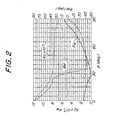
- Fig. 2 is a graph showing values of K E , K M and ⁇ M at the above mentioned cut angles while ⁇ is taken as a parameter.
- ⁇ M contributes to the directivity most largely.
- ⁇ is set to a value within such a range that 15° ⁇
- ⁇ 60° is satisfied, while a range near ⁇ 30° is excluded, because in said range no reflection occurs.
- ⁇ M deviates from -45° in accordance with an increase in ⁇ so that NSPUDT deviates from an ideal one.
- this deviation can be corrected by changing the electrode structure.
- K M is large so that a relatively large directivity can be attained by a thin electrode film.
- a power flow angle (PFA) of a substrate having cut angles (0°, ⁇ , 90°) is zero, and therefore the above range of ⁇ is practically useful.
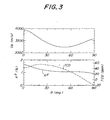
- Table 1 shows mode coupling parameters and SAW characteristics of lithium tetraborate substrates of (0°, 51°, 90°) cut satisfying the optimum phase condition and of (0°, 78°, 90°) cut attaining zero TCD, while the normal type electrode structure is used.
- values of quartz substrate and LiTaO 3 substrate are also shown for comparison.
- a solid line represents the conversion loss in -x direction in Fig. 1 and a broken line denotes the conversion loss in +x direction.
- the lithium tetraborate substrate according to the invention shows the good unidirectionality, but when such a substrate is used for a SAW filter, there occurs a problem. That is, when transmitter side and receiver side transducers having the same electrode structure are arranged on the lithium tetraborate substrate such that these transducers are faced each other, the forward directions of transducers orient in the same direction, so that the insertion loss becomes very large. In order to realize a practically usable SAW filter having a small insertion loss, the forward direction of the transmitter side transducer should be opposite to that of the receiver side transducer. In other words, in order to reduce the insertion loss, the directivity of one of the transducers has to be reversed or cancelled out.
- the reflection should be cancelled out with the aid of, for instance ⁇ /8 double electrode structure.
- ⁇ /4 normal type electrode structures are arranged on the lithium tetraborate substrate of (0°, 78°, 90°) cut as both the transmitter side and receiver side transducers
- a frequency characteristic of a SAW filter i.e. the insertion loss becomes as illustrated in Fig. 6.
- This frequency characteristic shows that the filter could not be used as a transversal filter in which the transmitter side transducer and receiver side transducer are arranged to be faced each other.
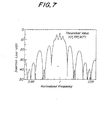
- a frequency characteristic of a SAW filter becomes as illustrated in Fig. 7. It can be understood that the frequency characteristic can be substantially improved as compared with Fig. 6, but there are relatively large ripples near a desired frequency. Further, due to the bidirectionality of the electrode structure, a theoretical minimum insertion loss is 6 dB, so that it is rather difficult to realize a practically usable SAW filter having a small insertion loss. This tendency is also seen when the lithium tetraborate substrate having the ideal cut angles of (0°, 51°, 90°) is used.
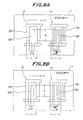
- Fig. 8A is a plan view showing a first embodiment of the SAW filter according to the invention, in which on a lithium tetraborate substrate having the ideal cut angles of (0°, 51°, 90°) are arranged a ⁇ /4 normal type electrode structure as the transmitter side transducer and ten pairs of double electrodes as the receiver side transducer.
- a structure illustrated in Fig. 8B was manufactured, in which a lithium tetraborate substrate 11 having the cut angles of (0°, 51°, 90°) is turned by 180° in a plane of the substrate and the transmitting direction (+x direction) of the a ⁇ /4 normal type electrode structure 12 is opposite to a ⁇ /8 double electrode 13.
- a solid line in Fig. 9 shows a measured insertion loss when the receiver side transducer electrode structure is arranged in the forward direction (-x direction) of the ⁇ /4 normal type electrode structure, and a broken line denotes a measured insertion loss when the receiver side transducer electrode structure is arranged in the backward direction (+x direction) of the ⁇ /4 normal type electrode structure.
- a net insertion loss of the SAW filter shown in Fig. 8A at a center frequency may be derived by subtracting a conversion loss (11.9 dB) of the double electrode structure from the insertion loss and becomes 3.7 dB and the directivity becomes 18dB, this precisely correspond to the theoretical values (insertion loss is 3.03 dB and directionality is 14dB) shown in Fig. 4.
- the transmitter side transducer 12 and receiver side transducer 13 are formed on the surface of the lithium tetraborate substrate by using a well developed lithography technique.
- the transmitter side transducer 12 is constructed by the normal type electrode structure having interdigital electrodes, in which positive electrode fingers 12a and negative electrode fingers 12b each having a width of ⁇ /4, i.e. 15/4 ⁇ m are opposed to each other alternately with an edge distance of substantially ⁇ /4.
- the number of electrode pairs is 50.
- An aperture length A which is defined as a length of a part of the electrodes at which the positive and negative electrodes are overlapped with each other is about 200 ⁇ m.
- the receiver side electrode structure is formed by the double electrode structure, in which two positive electrode fingers 13a and two negative electrode fingers 13b are arranged alternately with an edge distance of ⁇ /8, each electrode fingers having a width of ⁇ /8.
- the number of electrode pairs is ten and the aperture length A is 200 ⁇ .
- substantially one period of each electrode structures is shown at an enlarged scale for the sake of clearness.
- Fig. 10 illustrates a second embodiment of the SAW filter according to the invention. Also in the present embodiment, use is made of a (0°, 51°, 90°) cut lithium tetraborate substrate 21, and a normal type electrode structure of ⁇ /4 is arranged on the substrate as a transmitter side transducer 22.
- a receiver side transducer 23 is formed by a directionality reversed electrode structure.
- positive and negative electrode fingers 23a and 23b each having a width of ⁇ /8 are arranged with an edge distance of ⁇ /8 and a floating electrode 23c is inserted between a negative electrode finger 23b of an electrode pair and a positive electrode finger 23a of a next pair with an edge distance of ⁇ /8.
- only one period of the electrode structures of the transmitter side transducer 22 and receiver side transducer 23 for the sake of clearness.
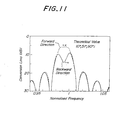
- Fig. 11 represents a conversion loss of the directionality reversed electrode structure in the present embodiment.
- a broken line shows a conversion loss in the +x direction which is opposite to the directionality of the transmitter side transducer 22 shown in Fig. 4, so that the SAW filter illustrated in Fig. 10 has an improved phase characteristic in which the insertion loss as well as the ripple are sufficiently small.
- Fig. 12 is a plan view showing a third embodiment of the surface acoustic wave device according to the invention.
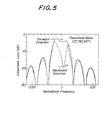
- a receiver side transducer of a ⁇ /8 double electrode structure and a transmitter side transducer which is basically identical with the ⁇ /4 normal type electrode structure but is slightly changed in order to correct the above mentioned deviation in the directionality shown in Fig. 5.
- a receiver side transducer 32 formed on a (0°, 78°, 90°) cut lithium tetraborate substrate 31 is formed by a double electrode structure in which two positive electrode fingers 32a and two negative electrode fingers 32b each having a width of ⁇ /8 are arranged alternatively with an edge distance of ⁇ /8.
- the number of electrode pairs is ten and the aperture length A is 200 ⁇ .
- the transmitter side transducer 33 comprises positive electrode fingers 33a arranged with a pitch of ⁇ /4 and a negative electrode 33b arranged between successive positive electrode fingers 33a includes a first negative electrode finger 33b-1 separated from a positive electrode finger 33a of a relevant electrode pair by a distance of 1.5 ⁇ /16 viewed in a propagating direction of the surface acoustic wave and a second negative electrode finger 33b-2 separated from the first negative electrode finger 33b-1 by a distance ⁇ /8. Therefore, a distance between the second negative electrode finger 33b-2 and a positive electrode finger 33a of a next electrode pair is 2.25 ⁇ /8.
- Fig. 13 shows a frequency dependency of a conversion loss of the transmitter side transducer 33 of the present embodiment. It can be clearly understood that in the present embodiment, the deviation in the directionality is corrected as compared with the conversion loss shown in Fig. 5. In this manner, in the present embodiment, although the (0°, 78°, 90°) cut lithium tetraborate substrate 31 is used, the good frequency characteristic can be obtained by slightly changing the construction of the electrode structure.
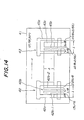
- Fig. 14 illustrates a fourth embodiment of the surface acoustic wave device according to the invention.
- a transmitter side transducer formed by a directionality corrected electrode structure
- a receiver side transducer is formed by a directionality reversed electrode structure having a corrected directionality.
- a directionality corrected electrode structure 42 is provided on a (0°, 78°, 90° as the transmitter side transducer, said electrode structure being identical with the electrode structure 33 shown in Fig. 12.
- the transmitter side transducer 42 comprises positive electrode fingers 42a arranged with a pitch of ⁇ /4 and a negative electrode 42b arranged between successive positive electrode fingers 42a includes a first negative electrode finger 42b-1 separated from a positive electrode finger 42a of a relevant electrode pair by a distance of 1.5 ⁇ /16 and a second negative electrode finger 42b-2 separated from the first negative electrode finger 42b-1 by a distance ⁇ /8.
- the receiver side transducer 43 comprises positive electrode finger 43a, negative electrode finger 43b and floating electrode 43c like the directionality reversed electrode structure shown in Fig. 10, but in the present embodiment the floating electrode 43c is shifted toward negative electrode finger 43b, i.e. toward the transmitter side transducer 42 by a distance of 2 ⁇ /56. Therefore, an edge distance between the negative electrode finger 43c and the floating electrode 43c becomes ⁇ (1/8-2/56) and an edge distance between the floating electrode 43c and the positive electrode finger 43a becomes ⁇ (1/8+2/56).
- Fig. 15 is a graph showing a conversion loss of the receiver side transducer 43 formed by the directionality reversed electrode structure having corrected directionality.
- the directionality is reversed, but also the deviation in the directionality seen in the conversion loss shown in Fig. 5 can be corrected sufficiently.
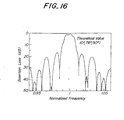
- Fig. 16 denotes a frequency dependency of the insertion loss of the SAW filter according to the invention. As can be seem from a comparison with Fig. 7, in the present embodiment, a ripple as well as an insertion loss are reduced.
- the lithium tetraborate substrate used in the present invention within the ranges of ⁇ of 9°-29° and 32°-86°, a variation of the value of ⁇ M contributing to NSPUDT largely is relatively slow, and further a deviation of the directivity can be corrected by slightly altering the electrode structure. Therefore, in the present invention it is possible to realize a practically usable surface acoustic wave device having a good property by setting the cut angle ⁇ to said ranges.
- the present invention is not limited to the embodiments explained above, but many alternations and modifications can be conceived by those skilled in the art within the scope of the invention.
- the lithium tetraborate substrates of the (0°, 51°, 90°) cut angles realizing the ideal NSPUDT behaviour and of the (0°, 78°, 90°) cut angles obtaining the zero TCD, but it is apparent that lithium tetraborate substrates having any cut angles within the ranges defined in claims may be equally used.
- a deviation of the directionality can be corrected by changing the electrode structure in a similar manner to that of the above mentioned embodiments or changing positions of electrodes.
- the surface acoustic wave device according to the invention is constructed as SAW filter, but in the present invention, the surface acoustic wave device may be constructed as a surface acoustic wave resonator.
- grating reflectors may be arranged on both sides of a ⁇ /4 normal type electrode structure or directionality corrected electrode structure.
- all the electrodes are made of aluminum, but may be made of other electrode material. However, in this case, all the electrodes are made of a same material.
- the transmitter side transducer and receiver side transducer may be reversed.
- the transmitter side transducer may be formed by the double electrode structure or directionality reversed electrode structures and the receiver side transducer may be formed by the normal type electrode structure.
- the desired object of the present invention can be attained although the electrode width and electrode edge distance deviate from desired values by about ⁇ 10% errors due to precise working.
- the natural single-phase unidirectional transducer behaviour can be obtained by a combination of the anisotropy of the lithium tetraborate substrate having given cut angles and the electrode structure, and it is possible to realize the surface acoustic wave device having a small insertion loss and an improved phase characteristic.
- the electrode structure to be used in combination such a substrate having an anisotropy may be of the ⁇ /4 base normal-type electrode structure or ⁇ /8 double electrode structure or directionality reversed electrode structure. These electrode structures can be manufactured precisely and easily, so that a yield is improved. Moreover, it is possible to reverse a directionality of NSPUDT without making the transmitter side electrode structure and the receiver side electrode structure of different materials, so that a SAW filter can be designed and manufactured very easily.
Landscapes
- Physics & Mathematics (AREA)
- Acoustics & Sound (AREA)
- Surface Acoustic Wave Elements And Circuit Networks Thereof (AREA)
Claims (11)
- Dispositif à ondes acoustiques de surface comprenant :un substrat réalisé en un cristal unique de tétraborate de lithium (Li2B4O7) dont la coupe et la direction de propagation sont déterminées de façon que les angles de coupe représentés par les angles d'Euler (ψ, , ) soient ψ = +5° ∼ -5°, = 9° ∼ 29° et 32° ∼ 86° et = 85° ∼ 95° ; etau moins une structure d'électrode formée sur une surface dudit substrat pour réaliser une propriété de transducteur unidirectionnel monophasée naturelle ensemble avec une anisotropie dudit substrat.
- Dispositif à ondes acoustiques de surface selon la revendication 1, où ladite structure d'électrode pour réaliser une propriété de transducteur unidirectionnel monophasée naturelle ensemble avec une anisotropie du substrat est formée par une structure d'électrode de type normal incluant des dents d'électrode positive et des dents d'électrode négative qui doivent être connectées à deux bornes d'une source de signaux monophasée ou d'une charge ayant une différence de phase de 180° et ont une largeur d'environ λ/4, lesdites dents d'électrodes positive et négative étant agencées alternativement avec une distance de bord d'environ λ/4, où λ est une longueur d'onde d'une onde acoustique de surface.
- Dispositif à ondes acoustiques de surface selon la revendication 2, où ladite structure d'électrode de type normal est agencée comme transducteur côté transmetteur ou comme transducteur côté récepteur, et une structure d'électrode double est prévue comme transducteur côté récepteur ou comme transducteur côté transmetteur, et dans ladite structure d'électrode double, deux dents d'électrode positive et deux dents d'électrode négative, chacune d'une largeur d'environ λ/8, sont agencées alternativement avec une distance de bord d'environ λ/8.
- Dispositif à ondes acoustiques de surface selon la revendication 2, où ladite structure d'électrode de type normal est agencée comme transducteur côté transmetteur ou comme transducteur côté récepteur, et une structure d'électrode à directionnalité inversée est prévue comme transducteur côté récepteur ou comme transducteur côté transmetteur, et dans ladite structure d'électrode à directionnalité inversée, des dents d'électrode positive et des dents d'électrode négative, chacune d'une largeur d'environ λ/8, sont agencées alternativement avec une distance de bord d'environ λ/8 selon un pas d'environ λ, et une électrode flottante d'une largeur d'environ 3λ/8 est agencée entre une dent d'électrode négative d'une paire d'électrodes et une dent d'électrode positive d'une paire d'électrodes suivante, avec une distance de bord d'environ λ/8.
- Dispositif à ondes acoustiques de surface selon la revendication 1, où ladite structure d'électrode pour réaliser une propriété de transducteur unidirectionnel monophasée naturelle ensemble avec une anisotropie du substrat est formée par une structure d'électrode à directionnalité corrigée incluant une électrode positive et une électrode négative qui doivent être connectées à deux bornes d'une source de signaux monophasée ou d'une charge ayant une différence de phase de 180°, ladite électrode positive comprend des dents d'électrode positive d'une largeur d'environ λ/4, où λ est une longueur d'onde d'une onde acoustique de surface et agencées avec un pas de λ, et ladite électrode négative comprend des premières dents d'électrode chacune d'une largeur d'environ λ/8 et séparées des dents d'électrode positive respectives d'une distance de bord d'environ 1,5λ/16 et des secondes dents d'électrode négative chacune d'une largeur d'environ λ/8 et séparées des premières dents respectives de l'électrode négative d'une distance de bord d'environ λ/8.
- Dispositif à ondes acoustiques de surface selon la revendication 5, où ladite structure d'électrode à directionnalité corrigée est prévue comme transducteur côté transmetteur ou comme transducteur côté récepteur et une structure d'électrode double est prévue comme transducteur côté récepteur ou comme transducteur côté transmetteur, et dans ladite structure d'électrode double, deux dents d'électrode positive et deux dents d'électrode négative, chacune d'une largeur d'environ λ/8, sont agencées alternativement avec une distance de bord d'environ λ/8.
- Dispositif à ondes acoustiques de surface selon la revendication 5, où ladite structure d'électrode à directionnalité corrigée est prévue comme transducteur côté transmetteur ou comme transducteur côté récepteur, et une structure d'électrode à directionnalité inversée est agencée comme transducteur côté récepteur ou comme transducteur côté transmetteur, et dans ladite structure d'électrode à directionnalité inversée, une dent d'électrode positive et une dent d'électrode négative, chacune d'une largeur d'environ λ/8, sont agencées alternativement avec une distance de bord d'environ λ/8 selon un pas d'environ λ, et une électrode flottante d'une largeur d'environ 3λ/8 est agencée entre une dent d'électrode négative d'une paire d'électrodes et une dent d'électrode positive d'une paire d'électrodes suivante avec une distance de bord d'environ λ/8.
- Dispositif à ondes acoustiques de surface selon la revendication 5, où ladite structure d'électrode à directionnalité corrigée est prévue comme transducteur côté transmetteur ou comme transducteur côté récepteur, et une structure d'électrode à directionnalité inversée présentant une directionnalité corrigée est prévue comme transducteur côté récepteur ou comme transducteur côté transmetteur, et dans ladite structure d'électrode à directionnalité inversée, des dents d'électrode positive, chacune d'une largeur d'environ λ/8, sont agencées selon un pas d'environ λ, des dents d'électrode négative chacune d'une largeur d'environ λ/8 sont agencées avec une distance de bord des dents d'électrode positive d'environ λ/8 et une électrode flottante chacune d'une largeur d'environ 3λ/8 sont agencées avec une distance de bord des dents d'électrode négative respectives d'environ (1/8-2/56) λ.
- Dispositif à ondes acoustiques de surface selon l'une des revendications 2, 3, 4, 5, 6, 7 et 8, où toutes les électrodes du transducteur côté transmetteur et du transducteur côté récepteur sont réalisées dans le même matériau d'électrode.
- Dispositif à ondes acoustiques de surface selon l'une des revendications 1 à 9, où ledit substrat est réalisé en un cristal unique de tétraborate de lithium présentant les angles de coupe d'Euler d'environ (0°, 51°, 90°).
- Dispositif à ondes acoustiques de surface selon l'une des revendications 1 à 9, où ledit substrat est réalisé en un cristal unique de tétraborate de lithium presentant les angles de coupe d'Euler d'environ (0°, 78°, 90°).
Applications Claiming Priority (3)
| Application Number | Priority Date | Filing Date | Title |
|---|---|---|---|
| JP23355094A JP3484237B2 (ja) | 1994-09-28 | 1994-09-28 | 弾性表面波デバイス |
| JP23355094 | 1994-09-28 | ||
| JP233550/94 | 1994-09-28 |
Publications (3)
| Publication Number | Publication Date |
|---|---|
| EP0704966A2 EP0704966A2 (fr) | 1996-04-03 |
| EP0704966A3 EP0704966A3 (fr) | 1997-08-27 |
| EP0704966B1 true EP0704966B1 (fr) | 2001-08-08 |
Family
ID=16956825
Family Applications (1)
| Application Number | Title | Priority Date | Filing Date |
|---|---|---|---|
| EP95306380A Expired - Lifetime EP0704966B1 (fr) | 1994-09-28 | 1995-09-12 | Dispositif à ondes acoustiques de surface |
Country Status (4)
| Country | Link |
|---|---|
| US (1) | US5698927A (fr) |
| EP (1) | EP0704966B1 (fr) |
| JP (1) | JP3484237B2 (fr) |
| DE (1) | DE69522065T2 (fr) |
Families Citing this family (12)
| Publication number | Priority date | Publication date | Assignee | Title |
|---|---|---|---|---|
| JP3268179B2 (ja) * | 1995-11-08 | 2002-03-25 | 正男 竹内 | 弾性表面波変換器及びこの変換器を用いた弾性表面波フィルタ |
| JPH10256870A (ja) * | 1997-03-14 | 1998-09-25 | Ngk Insulators Ltd | 弾性表面波デバイス |
| JP3291255B2 (ja) | 1998-09-22 | 2002-06-10 | 日本碍子株式会社 | 弾性表面波デバイス |
| US6420815B1 (en) * | 1999-09-16 | 2002-07-16 | Sanyo Electric Co., Ltd. | Substrate for surface acoustic wave device and surface acoustic wave device |
| JP2001257554A (ja) | 2000-01-07 | 2001-09-21 | Tdk Corp | 弾性表面波装置 |
| US6462698B2 (en) * | 2000-06-02 | 2002-10-08 | Research In Motion Limited | Wireless communication system using surface acoustic wave (SAW) single-phase unidirectional transducer (SPUDT) techniques |
| RU2195069C1 (ru) * | 2002-04-08 | 2002-12-20 | Зао Нпп "Элко" | Однонаправленный преобразователь поверхностных акустических волн |
| JP2003309406A (ja) * | 2002-04-16 | 2003-10-31 | Murata Mfg Co Ltd | 共振器、フィルタ、複合フィルタ装置、送受信装置、および通信装置 |
| US6833774B2 (en) * | 2002-06-25 | 2004-12-21 | Sawtek, Inc. | Surface acoustic wave filter |
| EP1667324B1 (fr) * | 2003-09-19 | 2012-07-04 | Toppan Printing Co., Ltd. | Element d'onde acoustique de surface et detecteur de difference d'environnement utilisant un tel element |
| DE102007063470A1 (de) * | 2007-12-20 | 2009-07-02 | IFW - Leibniz-Institut für Festkörper- und Werkstoffforschung Dresden e.V. | Wandler, Resonator und Filter für akustische Oberflächenwellen |
| US9726646B1 (en) * | 2013-05-29 | 2017-08-08 | National Technology & Engineering Solutions Of Sandia, Llc | Resonant surface acoustic wave chemical detector |
Family Cites Families (14)
| Publication number | Priority date | Publication date | Assignee | Title |
|---|---|---|---|---|
| US4162465A (en) * | 1977-09-14 | 1979-07-24 | University Of Illinois Foundation | Surface acoustic wave device with reflection suppression |
| US4634913B1 (en) * | 1980-06-11 | 1997-05-13 | Plessey Co Ltd | Application of lithium tetraborate to electronic devices |
| US4523119A (en) * | 1980-06-11 | 1985-06-11 | Plessey Overseas Limited | Application of lithium tetraborate to saw devices |
| JPS57103420A (en) * | 1980-12-18 | 1982-06-28 | Toko Inc | Grouped unidirectional surface acoustic wave transducer |
| JPS594310A (ja) * | 1982-06-30 | 1984-01-11 | Toshiba Corp | 弾性表面波装置 |
| GB8327551D0 (en) * | 1983-10-14 | 1983-11-16 | Secr Defence | Acoustic transducer |
| EP0166880B1 (fr) * | 1984-06-05 | 1990-01-03 | Kabushiki Kaisha Toshiba | Dispositif à ondes acoustiques de surface |
| JPH0244169A (ja) * | 1988-08-04 | 1990-02-14 | Nippon Kentetsu Co Ltd | 冷蔵オープンショーケースの運転制御方法 |
| JPH03119815A (ja) * | 1989-10-01 | 1991-05-22 | Kazuhiko Yamanouchi | 浮き電極をもつ内部反射型一方向性弾性表面波変換器 |
| US5264751A (en) * | 1989-10-20 | 1993-11-23 | Thomson-Csf | Unilateral surface wave transducer |
| JP3096102B2 (ja) * | 1991-08-29 | 2000-10-10 | 和彦 山之内 | 弾性表面波フィルタ装置 |
| JP3244094B2 (ja) * | 1992-03-13 | 2002-01-07 | キンセキ株式会社 | 弾性表面波装置 |
| US5438306A (en) * | 1992-07-02 | 1995-08-01 | Kazuhiko Yamanouchi | Surface acoustic wave filter device with symmetrical electrode arrangement |
| FR2695771B1 (fr) * | 1992-09-15 | 1994-10-28 | Thomson Csf | Transducteur d'ondes unidirectionnel. |
-
1994
- 1994-09-28 JP JP23355094A patent/JP3484237B2/ja not_active Expired - Fee Related
-
1995
- 1995-09-06 US US08/524,060 patent/US5698927A/en not_active Expired - Fee Related
- 1995-09-12 DE DE69522065T patent/DE69522065T2/de not_active Expired - Fee Related
- 1995-09-12 EP EP95306380A patent/EP0704966B1/fr not_active Expired - Lifetime
Also Published As
| Publication number | Publication date |
|---|---|
| US5698927A (en) | 1997-12-16 |
| DE69522065T2 (de) | 2002-03-28 |
| EP0704966A3 (fr) | 1997-08-27 |
| DE69522065D1 (de) | 2001-09-13 |
| JPH0897672A (ja) | 1996-04-12 |
| EP0704966A2 (fr) | 1996-04-03 |
| JP3484237B2 (ja) | 2004-01-06 |
Similar Documents
| Publication | Publication Date | Title |
|---|---|---|
| EP0704967B1 (fr) | Dispositif à ondes acoustiques de surface | |
| US12040773B2 (en) | Acoustic wave device | |
| US5698927A (en) | Surface acoustic wave device | |
| KR100397743B1 (ko) | 탄성표면파 장치 | |
| US6285112B1 (en) | Surface acoustic wave device comprising langasite single crystal substrate | |
| US6710683B2 (en) | Surface acoustic wave filter and communications apparatus using the same | |
| US6194809B1 (en) | Surface acoustic wave device comprising langasite single crystal substrate | |
| JPH06291585A (ja) | 弾性表面波素子およびフィルタ | |
| EP0802627B1 (fr) | Convertisseur d'ondes sonores de surface et dispositif de filtrage acoustique l'utilisant | |
| US7579932B2 (en) | Resonator SAW filter having a control interdigital transducer between input and output interdigital transducers | |
| WO2001035528A1 (fr) | Dispositif a ondes acoustiques de surface | |
| JP3014930B2 (ja) | 弾性表面波デバイス | |
| US6759788B2 (en) | Unidirectional surface acoustic wave transducer | |
| JP2002141768A (ja) | 表面弾性波素子 | |
| JP3040928B2 (ja) | 弾性表面波トランスデューサ | |
| EP1445859A2 (fr) | Filtre à ondes acoustiques de surface | |
| JP3197883B2 (ja) | 弾性表面波トランスデューサ | |
| JPH09219632A (ja) | 表面弾性波素子 | |
| JP2002043887A (ja) | 弾性表面波フィルタ及びこれを用いた通信機器 | |
| JP4310928B2 (ja) | 表面弾性波素子 | |
| JPH0216612B2 (fr) | ||
| JPH04331505A (ja) | 弾性表面波コンボルバ | |
| JP2002314363A (ja) | 表面弾性波素子 | |
| JP2001144573A (ja) | 表面弾性波素子 | |
| JPH07183758A (ja) | 弾性表面波フィルタ装置 |
Legal Events
| Date | Code | Title | Description |
|---|---|---|---|
| PUAI | Public reference made under article 153(3) epc to a published international application that has entered the european phase |
Free format text: ORIGINAL CODE: 0009012 |
|
| AK | Designated contracting states |
Kind code of ref document: A2 Designated state(s): DE FR GB |
|
| PUAL | Search report despatched |
Free format text: ORIGINAL CODE: 0009013 |
|
| AK | Designated contracting states |
Kind code of ref document: A3 Designated state(s): DE FR GB |
|
| 17P | Request for examination filed |
Effective date: 19980109 |
|
| GRAG | Despatch of communication of intention to grant |
Free format text: ORIGINAL CODE: EPIDOS AGRA |
|
| 17Q | First examination report despatched |
Effective date: 20001109 |
|
| GRAG | Despatch of communication of intention to grant |
Free format text: ORIGINAL CODE: EPIDOS AGRA |
|
| GRAH | Despatch of communication of intention to grant a patent |
Free format text: ORIGINAL CODE: EPIDOS IGRA |
|
| GRAH | Despatch of communication of intention to grant a patent |
Free format text: ORIGINAL CODE: EPIDOS IGRA |
|
| GRAA | (expected) grant |
Free format text: ORIGINAL CODE: 0009210 |
|
| AK | Designated contracting states |
Kind code of ref document: B1 Designated state(s): DE FR GB |
|
| REF | Corresponds to: |
Ref document number: 69522065 Country of ref document: DE Date of ref document: 20010913 |
|
| REG | Reference to a national code |
Ref country code: GB Ref legal event code: IF02 |
|
| ET | Fr: translation filed | ||
| PLBE | No opposition filed within time limit |
Free format text: ORIGINAL CODE: 0009261 |
|
| STAA | Information on the status of an ep patent application or granted ep patent |
Free format text: STATUS: NO OPPOSITION FILED WITHIN TIME LIMIT |
|
| 26N | No opposition filed | ||
| PGFP | Annual fee paid to national office [announced via postgrant information from national office to epo] |
Ref country code: GB Payment date: 20020902 Year of fee payment: 8 |
|
| PGFP | Annual fee paid to national office [announced via postgrant information from national office to epo] |
Ref country code: FR Payment date: 20020917 Year of fee payment: 8 |
|
| PGFP | Annual fee paid to national office [announced via postgrant information from national office to epo] |
Ref country code: DE Payment date: 20020923 Year of fee payment: 8 |
|
| PG25 | Lapsed in a contracting state [announced via postgrant information from national office to epo] |
Ref country code: GB Free format text: LAPSE BECAUSE OF NON-PAYMENT OF DUE FEES Effective date: 20030912 |
|
| PG25 | Lapsed in a contracting state [announced via postgrant information from national office to epo] |
Ref country code: DE Free format text: LAPSE BECAUSE OF NON-PAYMENT OF DUE FEES Effective date: 20040401 |
|
| GBPC | Gb: european patent ceased through non-payment of renewal fee |
Effective date: 20030912 |
|
| PG25 | Lapsed in a contracting state [announced via postgrant information from national office to epo] |
Ref country code: FR Free format text: LAPSE BECAUSE OF NON-PAYMENT OF DUE FEES Effective date: 20040528 |
|
| REG | Reference to a national code |
Ref country code: FR Ref legal event code: ST |