EP0705283B1 - Procede de production de poly-alpha-olefines amorphes au moyen d'un catalyseur a metal de transition de monocyclopentadienyle - Google Patents
Procede de production de poly-alpha-olefines amorphes au moyen d'un catalyseur a metal de transition de monocyclopentadienyle Download PDFInfo
- Publication number
- EP0705283B1 EP0705283B1 EP93916743A EP93916743A EP0705283B1 EP 0705283 B1 EP0705283 B1 EP 0705283B1 EP 93916743 A EP93916743 A EP 93916743A EP 93916743 A EP93916743 A EP 93916743A EP 0705283 B1 EP0705283 B1 EP 0705283B1
- Authority
- EP
- European Patent Office
- Prior art keywords
- radical
- radicals
- group
- hydrocarbyl
- substituted
- Prior art date
- Legal status (The legal status is an assumption and is not a legal conclusion. Google has not performed a legal analysis and makes no representation as to the accuracy of the status listed.)
- Expired - Lifetime
Links
- 229910052723 transition metal Inorganic materials 0.000 title claims abstract description 41
- 150000003624 transition metals Chemical class 0.000 title claims abstract description 41
- 238000000034 method Methods 0.000 title claims abstract description 39
- 239000003054 catalyst Substances 0.000 title claims description 66
- 239000004711 α-olefin Substances 0.000 claims abstract description 22
- -1 polypropylene Polymers 0.000 claims description 126
- 125000000058 cyclopentadienyl group Chemical group C1(=CC=CC1)* 0.000 claims description 33
- 238000006116 polymerization reaction Methods 0.000 claims description 31
- 239000003446 ligand Substances 0.000 claims description 29
- 239000004743 Polypropylene Substances 0.000 claims description 24
- 229920001155 polypropylene Polymers 0.000 claims description 24
- ZSWFCLXCOIISFI-UHFFFAOYSA-N endo-cyclopentadiene Natural products C1C=CC=C1 ZSWFCLXCOIISFI-UHFFFAOYSA-N 0.000 claims description 23
- 150000001875 compounds Chemical class 0.000 claims description 17
- IJGRMHOSHXDMSA-UHFFFAOYSA-N nitrogen Substances N#N IJGRMHOSHXDMSA-UHFFFAOYSA-N 0.000 claims description 16
- 125000004435 hydrogen atom Chemical group [H]* 0.000 claims description 15
- 229910052736 halogen Inorganic materials 0.000 claims description 14
- 125000001183 hydrocarbyl group Chemical group 0.000 claims description 13
- 230000002378 acidificating effect Effects 0.000 claims description 12
- 125000005842 heteroatom Chemical group 0.000 claims description 12
- 125000001424 substituent group Chemical group 0.000 claims description 12
- 230000000737 periodic effect Effects 0.000 claims description 11
- 238000004519 manufacturing process Methods 0.000 claims description 10
- 229910052757 nitrogen Inorganic materials 0.000 claims description 10
- QQONPFPTGQHPMA-UHFFFAOYSA-N propylene Natural products CC=C QQONPFPTGQHPMA-UHFFFAOYSA-N 0.000 claims description 10
- 125000004805 propylene group Chemical group [H]C([H])([H])C([H])([*:1])C([H])([H])[*:2] 0.000 claims description 10
- 239000010936 titanium Substances 0.000 claims description 10
- MDFFNEOEWAXZRQ-UHFFFAOYSA-N aminyl Chemical compound [NH2] MDFFNEOEWAXZRQ-UHFFFAOYSA-N 0.000 claims description 8
- 125000000129 anionic group Chemical group 0.000 claims description 8
- 229910052752 metalloid Inorganic materials 0.000 claims description 8
- 150000001408 amides Chemical class 0.000 claims description 7
- 239000002879 Lewis base Substances 0.000 claims description 6
- RTAQQCXQSZGOHL-UHFFFAOYSA-N Titanium Chemical compound [Ti] RTAQQCXQSZGOHL-UHFFFAOYSA-N 0.000 claims description 6
- 150000004820 halides Chemical class 0.000 claims description 6
- 150000007527 lewis bases Chemical class 0.000 claims description 6
- 230000007935 neutral effect Effects 0.000 claims description 6
- 229910052719 titanium Inorganic materials 0.000 claims description 6
- 150000004703 alkoxides Chemical class 0.000 claims description 5
- 229920006395 saturated elastomer Polymers 0.000 claims description 5
- 238000006467 substitution reaction Methods 0.000 claims description 5
- 125000006659 (C1-C20) hydrocarbyl group Chemical group 0.000 claims description 4
- 125000001118 alkylidene group Chemical group 0.000 claims description 4
- 125000005843 halogen group Chemical group 0.000 claims description 4
- 150000004678 hydrides Chemical class 0.000 claims description 4
- 150000002738 metalloids Chemical class 0.000 claims description 4
- 230000003647 oxidation Effects 0.000 claims description 4
- 238000007254 oxidation reaction Methods 0.000 claims description 4
- QJGQUHMNIGDVPM-UHFFFAOYSA-N nitrogen group Chemical group [N] QJGQUHMNIGDVPM-UHFFFAOYSA-N 0.000 claims description 2
- 239000012190 activator Substances 0.000 claims 2
- 229920013640 amorphous poly alpha olefin Polymers 0.000 abstract description 15
- 230000003197 catalytic effect Effects 0.000 abstract description 2
- RTZKZFJDLAIYFH-UHFFFAOYSA-N Diethyl ether Chemical compound CCOCC RTZKZFJDLAIYFH-UHFFFAOYSA-N 0.000 description 43
- 229920000642 polymer Polymers 0.000 description 26
- 239000000178 monomer Substances 0.000 description 22
- 150000003254 radicals Chemical class 0.000 description 22
- 238000006243 chemical reaction Methods 0.000 description 17
- 239000000047 product Substances 0.000 description 17
- 239000000203 mixture Substances 0.000 description 16
- 229920013639 polyalphaolefin Polymers 0.000 description 16
- YXFVVABEGXRONW-UHFFFAOYSA-N Toluene Chemical compound CC1=CC=CC=C1 YXFVVABEGXRONW-UHFFFAOYSA-N 0.000 description 15
- 239000003085 diluting agent Substances 0.000 description 15
- 229920005989 resin Polymers 0.000 description 15
- 239000011347 resin Substances 0.000 description 15
- 239000002904 solvent Substances 0.000 description 15
- 238000009826 distribution Methods 0.000 description 13
- AQZWEFBJYQSQEH-UHFFFAOYSA-N 2-methyloxaluminane Chemical compound C[Al]1CCCCO1 AQZWEFBJYQSQEH-UHFFFAOYSA-N 0.000 description 12
- 241000894007 species Species 0.000 description 12
- 150000003623 transition metal compounds Chemical class 0.000 description 12
- OFBQJSOFQDEBGM-UHFFFAOYSA-N n-pentane Natural products CCCCC OFBQJSOFQDEBGM-UHFFFAOYSA-N 0.000 description 11
- WYURNTSHIVDZCO-UHFFFAOYSA-N Tetrahydrofuran Chemical compound C1CCOC1 WYURNTSHIVDZCO-UHFFFAOYSA-N 0.000 description 8
- 229910052782 aluminium Inorganic materials 0.000 description 8
- KWGKDLIKAYFUFQ-UHFFFAOYSA-M lithium chloride Chemical compound [Li+].[Cl-] KWGKDLIKAYFUFQ-UHFFFAOYSA-M 0.000 description 8
- 241000349731 Afzelia bipindensis Species 0.000 description 7
- VGGSQFUCUMXWEO-UHFFFAOYSA-N Ethene Chemical compound C=C VGGSQFUCUMXWEO-UHFFFAOYSA-N 0.000 description 7
- 239000005977 Ethylene Substances 0.000 description 7
- 239000007788 liquid Substances 0.000 description 7
- IHLVCKWPAMTVTG-UHFFFAOYSA-N lithium;carbanide Chemical compound [Li+].[CH3-] IHLVCKWPAMTVTG-UHFFFAOYSA-N 0.000 description 7
- 239000012071 phase Substances 0.000 description 7
- 239000000243 solution Substances 0.000 description 7
- YMWUJEATGCHHMB-UHFFFAOYSA-N Dichloromethane Chemical compound ClCCl YMWUJEATGCHHMB-UHFFFAOYSA-N 0.000 description 6
- XAGFODPZIPBFFR-UHFFFAOYSA-N aluminium Chemical compound [Al] XAGFODPZIPBFFR-UHFFFAOYSA-N 0.000 description 6
- 239000000460 chlorine Substances 0.000 description 6
- 239000000470 constituent Substances 0.000 description 6
- 229930195733 hydrocarbon Natural products 0.000 description 6
- 239000007791 liquid phase Substances 0.000 description 6
- 238000002844 melting Methods 0.000 description 6
- 230000008018 melting Effects 0.000 description 6
- VLKZOEOYAKHREP-UHFFFAOYSA-N n-Hexane Chemical compound CCCCCC VLKZOEOYAKHREP-UHFFFAOYSA-N 0.000 description 6
- PAYRUJLWNCNPSJ-UHFFFAOYSA-N Aniline Chemical compound NC1=CC=CC=C1 PAYRUJLWNCNPSJ-UHFFFAOYSA-N 0.000 description 5
- 239000000853 adhesive Substances 0.000 description 5
- 230000001070 adhesive effect Effects 0.000 description 5
- 150000001335 aliphatic alkanes Chemical class 0.000 description 5
- 150000001336 alkenes Chemical class 0.000 description 5
- 150000001412 amines Chemical group 0.000 description 5
- QVGXLLKOCUKJST-UHFFFAOYSA-N atomic oxygen Chemical compound [O] QVGXLLKOCUKJST-UHFFFAOYSA-N 0.000 description 5
- 229910052744 lithium Inorganic materials 0.000 description 5
- 239000000463 material Substances 0.000 description 5
- 229910052751 metal Inorganic materials 0.000 description 5
- 125000002496 methyl group Chemical group [H]C([H])([H])* 0.000 description 5
- 125000000325 methylidene group Chemical group [H]C([H])=* 0.000 description 5
- 229910052760 oxygen Inorganic materials 0.000 description 5
- 239000001301 oxygen Substances 0.000 description 5
- 229920000098 polyolefin Polymers 0.000 description 5
- 229910018516 Al—O Inorganic materials 0.000 description 4
- 239000004215 Carbon black (E152) Substances 0.000 description 4
- 229940126062 Compound A Drugs 0.000 description 4
- NLDMNSXOCDLTTB-UHFFFAOYSA-N Heterophylliin A Natural products O1C2COC(=O)C3=CC(O)=C(O)C(O)=C3C3=C(O)C(O)=C(O)C=C3C(=O)OC2C(OC(=O)C=2C=C(O)C(O)=C(O)C=2)C(O)C1OC(=O)C1=CC(O)=C(O)C(O)=C1 NLDMNSXOCDLTTB-UHFFFAOYSA-N 0.000 description 4
- 125000004432 carbon atom Chemical group C* 0.000 description 4
- 238000001816 cooling Methods 0.000 description 4
- 125000001495 ethyl group Chemical group [H]C([H])([H])C([H])([H])* 0.000 description 4
- 239000000706 filtrate Substances 0.000 description 4
- 238000001914 filtration Methods 0.000 description 4
- 239000002184 metal Substances 0.000 description 4
- 239000003208 petroleum Substances 0.000 description 4
- 230000000379 polymerizing effect Effects 0.000 description 4
- 229910052710 silicon Inorganic materials 0.000 description 4
- 239000010703 silicon Substances 0.000 description 4
- 238000003756 stirring Methods 0.000 description 4
- YLQBMQCUIZJEEH-UHFFFAOYSA-N tetrahydrofuran Natural products C=1C=COC=1 YLQBMQCUIZJEEH-UHFFFAOYSA-N 0.000 description 4
- ZWYDDDAMNQQZHD-UHFFFAOYSA-L titanium(ii) chloride Chemical compound [Cl-].[Cl-].[Ti+2] ZWYDDDAMNQQZHD-UHFFFAOYSA-L 0.000 description 4
- YWWDBCBWQNCYNR-UHFFFAOYSA-N trimethylphosphine Chemical compound CP(C)C YWWDBCBWQNCYNR-UHFFFAOYSA-N 0.000 description 4
- 229910052726 zirconium Inorganic materials 0.000 description 4
- PBKONEOXTCPAFI-UHFFFAOYSA-N 1,2,4-trichlorobenzene Chemical compound ClC1=CC=C(Cl)C(Cl)=C1 PBKONEOXTCPAFI-UHFFFAOYSA-N 0.000 description 3
- UHOVQNZJYSORNB-UHFFFAOYSA-N Benzene Chemical compound C1=CC=CC=C1 UHOVQNZJYSORNB-UHFFFAOYSA-N 0.000 description 3
- 229910003074 TiCl4 Inorganic materials 0.000 description 3
- QCWXUUIWCKQGHC-UHFFFAOYSA-N Zirconium Chemical compound [Zr] QCWXUUIWCKQGHC-UHFFFAOYSA-N 0.000 description 3
- 125000000217 alkyl group Chemical group 0.000 description 3
- 238000004458 analytical method Methods 0.000 description 3
- 229920001585 atactic polymer Polymers 0.000 description 3
- 239000012298 atmosphere Substances 0.000 description 3
- 230000015572 biosynthetic process Effects 0.000 description 3
- 239000007795 chemical reaction product Substances 0.000 description 3
- 239000003153 chemical reaction reagent Substances 0.000 description 3
- 229920001577 copolymer Polymers 0.000 description 3
- 238000007334 copolymerization reaction Methods 0.000 description 3
- 238000013461 design Methods 0.000 description 3
- 229960004132 diethyl ether Drugs 0.000 description 3
- 230000000694 effects Effects 0.000 description 3
- 239000007789 gas Substances 0.000 description 3
- 125000001434 methanylylidene group Chemical group [H]C#[*] 0.000 description 3
- GYNNXHKOJHMOHS-UHFFFAOYSA-N methyl-cycloheptane Natural products CC1CCCCCC1 GYNNXHKOJHMOHS-UHFFFAOYSA-N 0.000 description 3
- JRZJOMJEPLMPRA-UHFFFAOYSA-N olefin Natural products CCCCCCCC=C JRZJOMJEPLMPRA-UHFFFAOYSA-N 0.000 description 3
- 239000002243 precursor Substances 0.000 description 3
- 239000002002 slurry Substances 0.000 description 3
- 239000007787 solid Substances 0.000 description 3
- 239000000725 suspension Substances 0.000 description 3
- XJDNKRIXUMDJCW-UHFFFAOYSA-J titanium tetrachloride Chemical compound Cl[Ti](Cl)(Cl)Cl XJDNKRIXUMDJCW-UHFFFAOYSA-J 0.000 description 3
- 238000013022 venting Methods 0.000 description 3
- LIKMAJRDDDTEIG-UHFFFAOYSA-N 1-hexene Chemical compound CCCCC=C LIKMAJRDDDTEIG-UHFFFAOYSA-N 0.000 description 2
- ZAMOUSCENKQFHK-UHFFFAOYSA-N Chlorine atom Chemical compound [Cl] ZAMOUSCENKQFHK-UHFFFAOYSA-N 0.000 description 2
- JLTDJTHDQAWBAV-UHFFFAOYSA-N N,N-dimethylaniline Chemical compound CN(C)C1=CC=CC=C1 JLTDJTHDQAWBAV-UHFFFAOYSA-N 0.000 description 2
- IMNFDUFMRHMDMM-UHFFFAOYSA-N N-Heptane Chemical compound CCCCCCC IMNFDUFMRHMDMM-UHFFFAOYSA-N 0.000 description 2
- XYFCBTPGUUZFHI-UHFFFAOYSA-N Phosphine Natural products P XYFCBTPGUUZFHI-UHFFFAOYSA-N 0.000 description 2
- OAICVXFJPJFONN-UHFFFAOYSA-N Phosphorus Chemical compound [P] OAICVXFJPJFONN-UHFFFAOYSA-N 0.000 description 2
- VYPSYNLAJGMNEJ-UHFFFAOYSA-N Silicium dioxide Chemical compound O=[Si]=O VYPSYNLAJGMNEJ-UHFFFAOYSA-N 0.000 description 2
- PPBRXRYQALVLMV-UHFFFAOYSA-N Styrene Chemical compound C=CC1=CC=CC=C1 PPBRXRYQALVLMV-UHFFFAOYSA-N 0.000 description 2
- NINIDFKCEFEMDL-UHFFFAOYSA-N Sulfur Chemical compound [S] NINIDFKCEFEMDL-UHFFFAOYSA-N 0.000 description 2
- 229910007928 ZrCl2 Inorganic materials 0.000 description 2
- 229910007932 ZrCl4 Inorganic materials 0.000 description 2
- 125000002877 alkyl aryl group Chemical group 0.000 description 2
- 150000004945 aromatic hydrocarbons Chemical class 0.000 description 2
- 239000003849 aromatic solvent Substances 0.000 description 2
- 125000003118 aryl group Chemical group 0.000 description 2
- HQABUPZFAYXKJW-UHFFFAOYSA-N butan-1-amine Chemical compound CCCCN HQABUPZFAYXKJW-UHFFFAOYSA-N 0.000 description 2
- 125000000484 butyl group Chemical group [H]C([*])([H])C([H])([H])C([H])([H])C([H])([H])[H] 0.000 description 2
- 238000012512 characterization method Methods 0.000 description 2
- 229910052801 chlorine Inorganic materials 0.000 description 2
- 238000012937 correction Methods 0.000 description 2
- 150000001923 cyclic compounds Chemical class 0.000 description 2
- DMEGYFMYUHOHGS-UHFFFAOYSA-N cycloheptane Chemical compound C1CCCCCC1 DMEGYFMYUHOHGS-UHFFFAOYSA-N 0.000 description 2
- 238000001704 evaporation Methods 0.000 description 2
- 230000008020 evaporation Effects 0.000 description 2
- 239000000835 fiber Substances 0.000 description 2
- 239000010408 film Substances 0.000 description 2
- 238000005227 gel permeation chromatography Methods 0.000 description 2
- 229910052732 germanium Inorganic materials 0.000 description 2
- 229910052735 hafnium Inorganic materials 0.000 description 2
- VBJZVLUMGGDVMO-UHFFFAOYSA-N hafnium atom Chemical compound [Hf] VBJZVLUMGGDVMO-UHFFFAOYSA-N 0.000 description 2
- 239000001307 helium Substances 0.000 description 2
- 229910052734 helium Inorganic materials 0.000 description 2
- SWQJXJOGLNCZEY-UHFFFAOYSA-N helium atom Chemical compound [He] SWQJXJOGLNCZEY-UHFFFAOYSA-N 0.000 description 2
- 125000004051 hexyl group Chemical group [H]C([H])([H])C([H])([H])C([H])([H])C([H])([H])C([H])([H])C([H])([H])* 0.000 description 2
- 150000002430 hydrocarbons Chemical class 0.000 description 2
- NNPPMTNAJDCUHE-UHFFFAOYSA-N isobutane Chemical compound CC(C)C NNPPMTNAJDCUHE-UHFFFAOYSA-N 0.000 description 2
- AFRJJFRNGGLMDW-UHFFFAOYSA-N lithium amide Chemical compound [Li+].[NH2-] AFRJJFRNGGLMDW-UHFFFAOYSA-N 0.000 description 2
- DLEDOFVPSDKWEF-UHFFFAOYSA-N lithium butane Chemical compound [Li+].CCC[CH2-] DLEDOFVPSDKWEF-UHFFFAOYSA-N 0.000 description 2
- 150000002736 metal compounds Chemical class 0.000 description 2
- 239000012968 metallocene catalyst Substances 0.000 description 2
- UAEPNZWRGJTJPN-UHFFFAOYSA-N methylcyclohexane Chemical compound CC1CCCCC1 UAEPNZWRGJTJPN-UHFFFAOYSA-N 0.000 description 2
- MZRVEZGGRBJDDB-UHFFFAOYSA-N n-Butyllithium Substances [Li]CCCC MZRVEZGGRBJDDB-UHFFFAOYSA-N 0.000 description 2
- 125000002347 octyl group Chemical group [H]C([*])([H])C([H])([H])C([H])([H])C([H])([H])C([H])([H])C([H])([H])C([H])([H])C([H])([H])[H] 0.000 description 2
- 239000003960 organic solvent Substances 0.000 description 2
- 229910052698 phosphorus Inorganic materials 0.000 description 2
- 239000011574 phosphorus Substances 0.000 description 2
- 229910000073 phosphorus hydride Inorganic materials 0.000 description 2
- 230000000704 physical effect Effects 0.000 description 2
- 238000002360 preparation method Methods 0.000 description 2
- 125000001436 propyl group Chemical group [H]C([*])([H])C([H])([H])C([H])([H])[H] 0.000 description 2
- 229910052717 sulfur Inorganic materials 0.000 description 2
- 239000011593 sulfur Substances 0.000 description 2
- 238000012546 transfer Methods 0.000 description 2
- 239000012808 vapor phase Substances 0.000 description 2
- XLYOFNOQVPJJNP-UHFFFAOYSA-N water Substances O XLYOFNOQVPJJNP-UHFFFAOYSA-N 0.000 description 2
- DUNKXUFBGCUVQW-UHFFFAOYSA-J zirconium tetrachloride Chemical compound Cl[Zr](Cl)(Cl)Cl DUNKXUFBGCUVQW-UHFFFAOYSA-J 0.000 description 2
- GGQQNYXPYWCUHG-RMTFUQJTSA-N (3e,6e)-deca-3,6-diene Chemical compound CCC\C=C\C\C=C\CC GGQQNYXPYWCUHG-RMTFUQJTSA-N 0.000 description 1
- 125000006527 (C1-C5) alkyl group Chemical group 0.000 description 1
- VXNZUUAINFGPBY-UHFFFAOYSA-N 1-Butene Chemical compound CCC=C VXNZUUAINFGPBY-UHFFFAOYSA-N 0.000 description 1
- 238000001644 13C nuclear magnetic resonance spectroscopy Methods 0.000 description 1
- YBYIRNPNPLQARY-UHFFFAOYSA-N 1H-indene Natural products C1=CC=C2CC=CC2=C1 YBYIRNPNPLQARY-UHFFFAOYSA-N 0.000 description 1
- WKBOTKDWSSQWDR-UHFFFAOYSA-N Bromine atom Chemical compound [Br] WKBOTKDWSSQWDR-UHFFFAOYSA-N 0.000 description 1
- 229920000089 Cyclic olefin copolymer Polymers 0.000 description 1
- XDTMQSROBMDMFD-UHFFFAOYSA-N Cyclohexane Chemical compound C1CCCCC1 XDTMQSROBMDMFD-UHFFFAOYSA-N 0.000 description 1
- PXGOKWXKJXAPGV-UHFFFAOYSA-N Fluorine Chemical compound FF PXGOKWXKJXAPGV-UHFFFAOYSA-N 0.000 description 1
- PGTKVMVZBBZCKQ-UHFFFAOYSA-N Fulvene Chemical compound C=C1C=CC=C1 PGTKVMVZBBZCKQ-UHFFFAOYSA-N 0.000 description 1
- 229910003865 HfCl4 Inorganic materials 0.000 description 1
- UFHFLCQGNIYNRP-UHFFFAOYSA-N Hydrogen Chemical compound [H][H] UFHFLCQGNIYNRP-UHFFFAOYSA-N 0.000 description 1
- WHXSMMKQMYFTQS-UHFFFAOYSA-N Lithium Chemical compound [Li] WHXSMMKQMYFTQS-UHFFFAOYSA-N 0.000 description 1
- CTQNGGLPUBDAKN-UHFFFAOYSA-N O-Xylene Chemical compound CC1=CC=CC=C1C CTQNGGLPUBDAKN-UHFFFAOYSA-N 0.000 description 1
- ISWSIDIOOBJBQZ-UHFFFAOYSA-N Phenol Chemical class OC1=CC=CC=C1 ISWSIDIOOBJBQZ-UHFFFAOYSA-N 0.000 description 1
- 239000004698 Polyethylene Substances 0.000 description 1
- 239000004793 Polystyrene Substances 0.000 description 1
- XUIMIQQOPSSXEZ-UHFFFAOYSA-N Silicon Chemical compound [Si] XUIMIQQOPSSXEZ-UHFFFAOYSA-N 0.000 description 1
- UCKMPCXJQFINFW-UHFFFAOYSA-N Sulphide Chemical compound [S-2] UCKMPCXJQFINFW-UHFFFAOYSA-N 0.000 description 1
- 229910010068 TiCl2 Inorganic materials 0.000 description 1
- 239000007983 Tris buffer Substances 0.000 description 1
- 239000000654 additive Substances 0.000 description 1
- 125000001931 aliphatic group Chemical group 0.000 description 1
- 238000000149 argon plasma sintering Methods 0.000 description 1
- 150000001491 aromatic compounds Chemical class 0.000 description 1
- 230000009286 beneficial effect Effects 0.000 description 1
- HQMRIBYCTLBDAK-UHFFFAOYSA-M bis(2-methylpropyl)alumanylium;chloride Chemical compound CC(C)C[Al](Cl)CC(C)C HQMRIBYCTLBDAK-UHFFFAOYSA-M 0.000 description 1
- GDTBXPJZTBHREO-UHFFFAOYSA-N bromine Substances BrBr GDTBXPJZTBHREO-UHFFFAOYSA-N 0.000 description 1
- 229910052794 bromium Inorganic materials 0.000 description 1
- 239000001273 butane Substances 0.000 description 1
- IAQRGUVFOMOMEM-UHFFFAOYSA-N butene Natural products CC=CC IAQRGUVFOMOMEM-UHFFFAOYSA-N 0.000 description 1
- 229910052799 carbon Inorganic materials 0.000 description 1
- 239000003795 chemical substances by application Substances 0.000 description 1
- 229910000365 copper sulfate Inorganic materials 0.000 description 1
- ARUVKPQLZAKDPS-UHFFFAOYSA-L copper(II) sulfate Chemical compound [Cu+2].[O-][S+2]([O-])([O-])[O-] ARUVKPQLZAKDPS-UHFFFAOYSA-L 0.000 description 1
- 125000004122 cyclic group Chemical group 0.000 description 1
- SRKKQWSERFMTOX-UHFFFAOYSA-N cyclopentane;titanium Chemical compound [Ti].[CH]1C=CC=C1 SRKKQWSERFMTOX-UHFFFAOYSA-N 0.000 description 1
- 125000002704 decyl group Chemical group [H]C([H])([H])C([H])([H])C([H])([H])C([H])([H])C([H])([H])C([H])([H])C([H])([H])C([H])([H])C([H])([H])C([H])([H])* 0.000 description 1
- 150000001993 dienes Chemical class 0.000 description 1
- YNLAOSYQHBDIKW-UHFFFAOYSA-M diethylaluminium chloride Chemical compound CC[Al](Cl)CC YNLAOSYQHBDIKW-UHFFFAOYSA-M 0.000 description 1
- UZBQIPPOMKBLAS-UHFFFAOYSA-N diethylazanide Chemical compound CC[N-]CC UZBQIPPOMKBLAS-UHFFFAOYSA-N 0.000 description 1
- SMBQBQBNOXIFSF-UHFFFAOYSA-N dilithium Chemical class [Li][Li] SMBQBQBNOXIFSF-UHFFFAOYSA-N 0.000 description 1
- JGHYBJVUQGTEEB-UHFFFAOYSA-M dimethylalumanylium;chloride Chemical compound C[Al](C)Cl JGHYBJVUQGTEEB-UHFFFAOYSA-M 0.000 description 1
- QKIUAMUSENSFQQ-UHFFFAOYSA-N dimethylazanide Chemical compound C[N-]C QKIUAMUSENSFQQ-UHFFFAOYSA-N 0.000 description 1
- LIKFHECYJZWXFJ-UHFFFAOYSA-N dimethyldichlorosilane Chemical compound C[Si](C)(Cl)Cl LIKFHECYJZWXFJ-UHFFFAOYSA-N 0.000 description 1
- DMBHHRLKUKUOEG-UHFFFAOYSA-N diphenylamine Chemical compound C=1C=CC=CC=1NC1=CC=CC=C1 DMBHHRLKUKUOEG-UHFFFAOYSA-N 0.000 description 1
- 238000010828 elution Methods 0.000 description 1
- LIWAQLJGPBVORC-UHFFFAOYSA-N ethylmethylamine Chemical compound CCNC LIWAQLJGPBVORC-UHFFFAOYSA-N 0.000 description 1
- 239000012530 fluid Substances 0.000 description 1
- 239000011737 fluorine Substances 0.000 description 1
- 229910052731 fluorine Inorganic materials 0.000 description 1
- 238000007306 functionalization reaction Methods 0.000 description 1
- 238000012685 gas phase polymerization Methods 0.000 description 1
- PDPJQWYGJJBYLF-UHFFFAOYSA-J hafnium tetrachloride Chemical compound Cl[Hf](Cl)(Cl)Cl PDPJQWYGJJBYLF-UHFFFAOYSA-J 0.000 description 1
- 125000003187 heptyl group Chemical group [H]C([*])([H])C([H])([H])C([H])([H])C([H])([H])C([H])([H])C([H])([H])C([H])([H])[H] 0.000 description 1
- 229920001519 homopolymer Polymers 0.000 description 1
- 230000007062 hydrolysis Effects 0.000 description 1
- 238000006460 hydrolysis reaction Methods 0.000 description 1
- 238000011065 in-situ storage Methods 0.000 description 1
- 238000010348 incorporation Methods 0.000 description 1
- 125000003454 indenyl group Chemical group C1(C=CC2=CC=CC=C12)* 0.000 description 1
- 239000012442 inert solvent Substances 0.000 description 1
- 239000004615 ingredient Substances 0.000 description 1
- PNDPGZBMCMUPRI-UHFFFAOYSA-N iodine Chemical compound II PNDPGZBMCMUPRI-UHFFFAOYSA-N 0.000 description 1
- 239000001282 iso-butane Substances 0.000 description 1
- 125000000959 isobutyl group Chemical group [H]C([H])([H])C([H])(C([H])([H])[H])C([H])([H])* 0.000 description 1
- 125000001972 isopentyl group Chemical group [H]C([H])([H])C([H])(C([H])([H])[H])C([H])([H])C([H])([H])* 0.000 description 1
- 238000004811 liquid chromatography Methods 0.000 description 1
- 229910003002 lithium salt Inorganic materials 0.000 description 1
- 159000000002 lithium salts Chemical class 0.000 description 1
- DBKDYYFPDRPMPE-UHFFFAOYSA-N lithium;cyclopenta-1,3-diene Chemical compound [Li+].C=1C=C[CH-]C=1 DBKDYYFPDRPMPE-UHFFFAOYSA-N 0.000 description 1
- NBTOZLQBSIZIKS-UHFFFAOYSA-N methoxide Chemical compound [O-]C NBTOZLQBSIZIKS-UHFFFAOYSA-N 0.000 description 1
- 238000002156 mixing Methods 0.000 description 1
- 238000012986 modification Methods 0.000 description 1
- 230000004048 modification Effects 0.000 description 1
- IJDNQMDRQITEOD-UHFFFAOYSA-N n-butane Chemical compound CCCC IJDNQMDRQITEOD-UHFFFAOYSA-N 0.000 description 1
- 125000000740 n-pentyl group Chemical group [H]C([H])([H])C([H])([H])C([H])([H])C([H])([H])C([H])([H])* 0.000 description 1
- CATWEXRJGNBIJD-UHFFFAOYSA-N n-tert-butyl-2-methylpropan-2-amine Chemical compound CC(C)(C)NC(C)(C)C CATWEXRJGNBIJD-UHFFFAOYSA-N 0.000 description 1
- YCWSUKQGVSGXJO-NTUHNPAUSA-N nifuroxazide Chemical group C1=CC(O)=CC=C1C(=O)N\N=C\C1=CC=C([N+]([O-])=O)O1 YCWSUKQGVSGXJO-NTUHNPAUSA-N 0.000 description 1
- 125000004433 nitrogen atom Chemical group N* 0.000 description 1
- 125000001400 nonyl group Chemical group [H]C([*])([H])C([H])([H])C([H])([H])C([H])([H])C([H])([H])C([H])([H])C([H])([H])C([H])([H])C([H])([H])[H] 0.000 description 1
- 238000006384 oligomerization reaction Methods 0.000 description 1
- 125000002524 organometallic group Chemical group 0.000 description 1
- IWDCLRJOBJJRNH-UHFFFAOYSA-N p-cresol Chemical compound CC1=CC=C(O)C=C1 IWDCLRJOBJJRNH-UHFFFAOYSA-N 0.000 description 1
- 125000000913 palmityl group Chemical group [H]C([*])([H])C([H])([H])C([H])([H])C([H])([H])C([H])([H])C([H])([H])C([H])([H])C([H])([H])C([H])([H])C([H])([H])C([H])([H])C([H])([H])C([H])([H])C([H])([H])C([H])([H])C([H])([H])[H] 0.000 description 1
- 125000001147 pentyl group Chemical group C(CCCC)* 0.000 description 1
- ISWSIDIOOBJBQZ-UHFFFAOYSA-M phenolate Chemical compound [O-]C1=CC=CC=C1 ISWSIDIOOBJBQZ-UHFFFAOYSA-M 0.000 description 1
- 125000001997 phenyl group Chemical group [H]C1=C([H])C([H])=C(*)C([H])=C1[H] 0.000 description 1
- 229920000573 polyethylene Polymers 0.000 description 1
- 229920001195 polyisoprene Polymers 0.000 description 1
- 229920002223 polystyrene Polymers 0.000 description 1
- 238000001556 precipitation Methods 0.000 description 1
- OSFBJERFMQCEQY-UHFFFAOYSA-N propylidene Chemical group [CH]CC OSFBJERFMQCEQY-UHFFFAOYSA-N 0.000 description 1
- 230000035484 reaction time Effects 0.000 description 1
- 238000001953 recrystallisation Methods 0.000 description 1
- 238000010992 reflux Methods 0.000 description 1
- 150000003839 salts Chemical class 0.000 description 1
- 229910000077 silane Inorganic materials 0.000 description 1
- 150000004756 silanes Chemical class 0.000 description 1
- 239000012265 solid product Substances 0.000 description 1
- 238000003892 spreading Methods 0.000 description 1
- 239000000126 substance Substances 0.000 description 1
- 238000003786 synthesis reaction Methods 0.000 description 1
- 229920000576 tactic polymer Polymers 0.000 description 1
- YMBCJWGVCUEGHA-UHFFFAOYSA-M tetraethylammonium chloride Chemical compound [Cl-].CC[N+](CC)(CC)CC YMBCJWGVCUEGHA-UHFFFAOYSA-M 0.000 description 1
- MCULRUJILOGHCJ-UHFFFAOYSA-N triisobutylaluminium Chemical compound CC(C)C[Al](CC(C)C)CC(C)C MCULRUJILOGHCJ-UHFFFAOYSA-N 0.000 description 1
- JLTRXTDYQLMHGR-UHFFFAOYSA-N trimethylaluminium Chemical compound C[Al](C)C JLTRXTDYQLMHGR-UHFFFAOYSA-N 0.000 description 1
- 125000000026 trimethylsilyl group Chemical group [H]C([H])([H])[Si]([*])(C([H])([H])[H])C([H])([H])[H] 0.000 description 1
- CNWZYDSEVLFSMS-UHFFFAOYSA-N tripropylalumane Chemical compound CCC[Al](CCC)CCC CNWZYDSEVLFSMS-UHFFFAOYSA-N 0.000 description 1
- 230000008016 vaporization Effects 0.000 description 1
- 239000003643 water by type Substances 0.000 description 1
- 239000008096 xylene Substances 0.000 description 1
Classifications
-
- C—CHEMISTRY; METALLURGY
- C08—ORGANIC MACROMOLECULAR COMPOUNDS; THEIR PREPARATION OR CHEMICAL WORKING-UP; COMPOSITIONS BASED THEREON
- C08F—MACROMOLECULAR COMPOUNDS OBTAINED BY REACTIONS ONLY INVOLVING CARBON-TO-CARBON UNSATURATED BONDS
- C08F110/00—Homopolymers of unsaturated aliphatic hydrocarbons having only one carbon-to-carbon double bond
- C08F110/04—Monomers containing three or four carbon atoms
- C08F110/06—Propene
-
- C—CHEMISTRY; METALLURGY
- C08—ORGANIC MACROMOLECULAR COMPOUNDS; THEIR PREPARATION OR CHEMICAL WORKING-UP; COMPOSITIONS BASED THEREON
- C08F—MACROMOLECULAR COMPOUNDS OBTAINED BY REACTIONS ONLY INVOLVING CARBON-TO-CARBON UNSATURATED BONDS
- C08F10/00—Homopolymers and copolymers of unsaturated aliphatic hydrocarbons having only one carbon-to-carbon double bond
-
- C—CHEMISTRY; METALLURGY
- C08—ORGANIC MACROMOLECULAR COMPOUNDS; THEIR PREPARATION OR CHEMICAL WORKING-UP; COMPOSITIONS BASED THEREON
- C08F—MACROMOLECULAR COMPOUNDS OBTAINED BY REACTIONS ONLY INVOLVING CARBON-TO-CARBON UNSATURATED BONDS
- C08F4/00—Polymerisation catalysts
- C08F4/42—Metals; Metal hydrides; Metallo-organic compounds; Use thereof as catalyst precursors
- C08F4/44—Metals; Metal hydrides; Metallo-organic compounds; Use thereof as catalyst precursors selected from light metals, zinc, cadmium, mercury, copper, silver, gold, boron, gallium, indium, thallium, rare earths or actinides
- C08F4/60—Metals; Metal hydrides; Metallo-organic compounds; Use thereof as catalyst precursors selected from light metals, zinc, cadmium, mercury, copper, silver, gold, boron, gallium, indium, thallium, rare earths or actinides together with refractory metals, iron group metals, platinum group metals, manganese, rhenium technetium or compounds thereof
- C08F4/62—Refractory metals or compounds thereof
- C08F4/64—Titanium, zirconium, hafnium or compounds thereof
- C08F4/659—Component covered by group C08F4/64 containing a transition metal-carbon bond
- C08F4/65912—Component covered by group C08F4/64 containing a transition metal-carbon bond in combination with an organoaluminium compound
-
- C—CHEMISTRY; METALLURGY
- C08—ORGANIC MACROMOLECULAR COMPOUNDS; THEIR PREPARATION OR CHEMICAL WORKING-UP; COMPOSITIONS BASED THEREON
- C08F—MACROMOLECULAR COMPOUNDS OBTAINED BY REACTIONS ONLY INVOLVING CARBON-TO-CARBON UNSATURATED BONDS
- C08F4/00—Polymerisation catalysts
- C08F4/42—Metals; Metal hydrides; Metallo-organic compounds; Use thereof as catalyst precursors
- C08F4/44—Metals; Metal hydrides; Metallo-organic compounds; Use thereof as catalyst precursors selected from light metals, zinc, cadmium, mercury, copper, silver, gold, boron, gallium, indium, thallium, rare earths or actinides
- C08F4/60—Metals; Metal hydrides; Metallo-organic compounds; Use thereof as catalyst precursors selected from light metals, zinc, cadmium, mercury, copper, silver, gold, boron, gallium, indium, thallium, rare earths or actinides together with refractory metals, iron group metals, platinum group metals, manganese, rhenium technetium or compounds thereof
- C08F4/62—Refractory metals or compounds thereof
- C08F4/64—Titanium, zirconium, hafnium or compounds thereof
- C08F4/659—Component covered by group C08F4/64 containing a transition metal-carbon bond
- C08F4/6592—Component covered by group C08F4/64 containing a transition metal-carbon bond containing at least one cyclopentadienyl ring, condensed or not, e.g. an indenyl or a fluorenyl ring
Definitions
- This invention relates to a process for polymerizing ⁇ -olefins which utilizes certain monocyclopentadienyl metal compounds of a Group IV B transition metal of the Periodic Table of Elements in an alumoxane activated catalyst system to produce, amorphous, and low crystallinity poly- ⁇ -olefins, particularly polypropylene and ⁇ -olefin copolymers of propylene.
- ⁇ -olefins which utilizes certain monocyclopentadienyl metal compounds of a Group IV B transition metal of the Periodic Table of Elements in an alumoxane activated catalyst system to produce, amorphous, and low crystallinity poly- ⁇ -olefins, particularly polypropylene and ⁇ -olefin copolymers of propylene.
- M w weight average molecular weight
- MWD narrow molecular weight distribution
- WO 87/03887 describes the use of a composition comprising a transition metal coordinated to at least one cyclopentadienyl and at least one heteroatom ligand as a transition metal component for use in an alumoxane activated catalyst system for ⁇ -olefin polymerization.
- the composition is broadly defined as a transition metal, preferably of Group IV B of the Periodic Table, which is coordinated with at least one cyclopentadienyl ligand and one to three heteroatom ligands, the balance of the transition metal coordination requirement being satisfied with cyclopentadienyl or hydrocarbyl ligands.
- catalyst systems described by this reference are illustrated solely with reference to transition metal compounds which are metallocenes, i.e., bis(cyclopentadienyl) Group Iv B transition metal compounds.
- a catalyst which will be capable of catalyzing the polymerization of ⁇ -olefin monomer(s) to produce a stereoregular low crystallinity or amorphous form of poly- ⁇ -olefin when desired.
- stereoregular polymers There are at least three different types of stereoregular polymers. These polymers are comprised of ⁇ -olefin monomers where hydrocarbyl groups are pendant from the polymer backbone chain. Relative to the polymer backbone chain, the pendant hydrocarbyl groups may be arranged in different stereochemical configurations which are denominated as, for example, atactic, isotactic, or syndiotactic pendant group configuration.
- the degree and type of tacticity of a polyolefin molecule are critical determinants of the physical properties which a resin composed of such polymer molecules will exhibit.
- Other critical determinants of the properties which a resin will exhibit are the type and relative concentration of monomers and comonomers, the weight average molecular weight (M w ) of the polymer molecules comprising the resin bulk, the molecular weight distribution (MWD) and the composition distribution of the resin.
- the weight average molecular weight (M w ) of a poly- ⁇ -olefin is an important physical property determinant of the practical uses to which such polymer can be put.
- the M w of such a resin must generally be in excess of 100,000. Where the M w is lower than 100,000 the polymer can be used for other applications such as adhesives and compatibilizers.
- the poly- ⁇ -olefin resin must generally have a high degree of crystallinity. Low crystallinity and amorphous poly- ⁇ -olefins are useful in adhesive compositions, in compatibilizing applications, as additives, etc.
- the degree of crystallinity which a poly- ⁇ -olefin is capable of obtaining is, in major part, determined by the stereochemical regularity of the hydrocarbyl groups which are pendent to the polymer molecule backbone, i.e., the tacticity of the polymer.
- tacticity Five types have been described in poly- ⁇ -olefins: atactic, normal isotactic, isotactic stereoblock, syndiotactic, and hemiisotactic. Although all of these tacticity configurations have been primarily demonstrated in the case of polypropylene, in theory each is equally possible for polymers comprised of any ⁇ -olefin, cyclic olefin or internal olefin.
- Atactic poly- ⁇ -olefins are those wherein the hydrocarbyl groups pendent to the polymer molecule backbone assume no regular order with reference to the backbone.
- This random, or atactic, structure is represented by a polymer backbone of alternating methylene and methine carbons, with randomly oriented branches substituting the methine carbons.
- the methine carbons randomly have R and S configurations, creating adjacent pairs either of like configuration (a "meso" or "m” dyad) or of unlike configuration (a "racemic” or “r” dyad).
- the atactic form of a polymer contains approximately equal fractions of meso and racemic dyads.
- Atactic poly- ⁇ -olefins are soluble in aliphatic and aromatic solvents at ambient temperature. Since atactic polymers exhibit no regular order or repeating unit configurations in the polymer chain, such atactic polymers are amorphous materials. An amorphous material tends to lack a molecular lattice structure and have poorly defined melting points. Thus typical atactic poly- ⁇ -olefins are amorphous, and generally have no measurable melting point. Atactic polymers exhibit little if any crystallinity, hence they are generally unsuitable for high strength applications regardless of the weight average molecular weight of the resin.
- Amorphous poly- ⁇ -olefins generally regarded to be atactic, noncrystalline and lacking in a molecular lattice structure which is characteristic of the solid state, tend to lack well defined melting points.
- Such amorphous poly- ⁇ -olefins have uses in adhesives and as compatibilizers among other things.
- the final resin properties and their suitability for particular applications depends on the type of tacticity, (stereoregularity), the melting point, the average molecular weight, the molecular weight distribution, the type and level of monomer and comonomer, the sequence distribution, and the presence or absence of head or end group functionality.
- the catalyst system by which such a atactic poly- ⁇ -olefin resin is to be produced should, desirably, be versatile in terms of M w , MWD, tacticity type and level, and comonomer choice. Further, the catalyst system should be capable of producing these polymers with or without head and/or end group functionality, such as olefinic unsaturation.
- Such catalyst system must be capable, as a commercially practical constraint, of producing such resins at an acceptable production rate.
- the catalyst system should be one which, at its productivity rate, provides a resin product which does not require a subsequent treatment to remove catalyst residue to a level which is acceptable for the resin in the end use application desired.
- methylalumoxane/metallocene catalyst systems the polymer characteristics (Mw, MWD, tacticity type, comonomer incorporation, etc.) are controlled either by modifications to the structure of the metallocene precursor or by adjustment of the process conditions (temperature, pressure, concentrations). In general, adjustment of process conditions does not allow independent control of tacticity level, Mw and comonomer content. Addition of chain transfer agents such as hydrogen gas to the reactor gives lower molecular weight products without affecting tacticity, however, the resulting polymer no longer has unsaturated end groups. End group functionalization is often an important feature in the application of low molecular weight polymers. Given these limitations, one must prepare a wide variety of differently substituted metallocene precursors to access the entire range of desired materials.
- EP-A-416815 discloses the use of a broad range of mono cyclopentadienyl metallocene compounds with alumoxane for polymerizing a wide range of monomers.
- Example 1 produces atactic polypropylene but the molecular weight using a zirconium metallocene compound is not stated.
- EP-A-416815 neither teaches nor suggests the use of the titanium metallocene species to provide high molecular weight atactic polypropylene.
- US-A-5055438 also disdoses the use of a broad range of mono cyclopentadienyl metallocene compounds with alumoxane for polymerizing a wide range of monomers but there is no teaching for the production of high molecular weight atactic polypropylene.
- WO93/12151 discloses the use of a broad range of mono cyclopentadienyl metallocene compounds with alumoxane for polymerizing a wide range of monomers but there is no disclosure for the making of atactic polypropylene.
- Example 13 while disdosing the production of high molecular weight isotactic polypropylene uses a process with a catalyst not incorporating alumoxane.
- the process of this invention employs a catalyst system previously disclosed in U.S. Patent No. 5,055,438, issued October 8, 1991, which is comprised of a transition metal component from Group IV B of the Periodic Table of the Elements (CRC Handbook of chemistry and Physics, 68th ed. 1987-1988) and an alumoxane component.
- the catalyst system may be employed in solution, slurry, gas phase or bulk phase polymerization procedure to produce poly- ⁇ -olefins of high or low weight average molecular a weight and relatively narrow molecular weight distribution.
- the present invention relates to using the catalyst of U.S. Patent No.
- amorphous poly- ⁇ -olefin is herein defined to mean a poly- ⁇ -olefin that lacks or has a poorly defined melting point and may or may not have low amounts of crystallinity.
- the amorphous product of this invention is substantially, preferably completely, atactic.
- the catalyst of this invention comprises a Group IVB transition metal component with a symmetrically substituted cyclopentadienyl ring and an alumoxane.
- the "Group IV B transition metal component" of the catalyst system is represented by the formula: wherein: M is Ti in its highest formal oxidation state (+4, d 0 complex) ; (C 5 H 4-x R x ) is a cyclopentadienyl ring which is symmetrically substituted with two or four substituent groups R, "x" is 2, or 4 denoting the degree of substitution, and each substituent group R is, independently, a radical selected from a group consisting of C 1 -C 20 hydrocarbyl radicals, substituted C 1 -C 20 hydrocarbyl radicals wherein one or more hydrogen atoms is replaced by a halogen radical, an amido radical, a phosphido radical, an alkoxy radical or any other radical containing a Lewis acidic or basic functionality, C 1 -C 20 hydrocar
- Symmetrical substitution exists when two R groups of approximately equal steric bulk are substituted at symmetric sites, i.e. 2,5: 3,4; etc.).
- a C 4 -C 20 ring can be considered symmetrically balanced with the bridging group, T.
- JR' z-2 is a heteroatom ligand in which J is an element with a coordination number of three from Group V A or an element with a coordination number of two from Group VI A of the Periodic Table of Elements, preferably nitrogen, phosphorus, oxygen or sulfur, and each R' is, independently a radical selected from a group consisting of C 1 -C 20 hydrocarbyl radicals, substituted C 1 -C 20 hydrocarbyl radicals wherein one or more hydrogen atoms are replaced by a halogen radical, an amido radical, a phosphido radical, an alkoxy radical or any other radical containing a Lewis acidic or basic functionality, and "z" is the coordination number of the element J;
- the alumoxane component of the catalyst may be represented by the formulas; (R 3 -Al-O) m ; R 4 (R 5 -Al-O) m AlR 6 2 or mixtures thereof, wherein R 3 -R 6 are, independently, a C 1 -C 5 alkyl group or halide and "m" is an integer ranging from 1 to 50 and preferably is from 13 to 25.
- Catalyst systems of the invention may be prepared by placing the "Group IV B transition metal component" and the alumoxane component in common solution in a normally liquid alkane or aromatic solvent, which solvent is preferably suitable for use as a polymerization diluent for the liquid phase polymerization of an ⁇ -olefin monomer.
- Those species of the Group IV B transition metal component wherein the metal is titanium have been found to impart beneficial properties to a catalyst system which are unexpected in view of what is known about the properties of bis(cyclopentadienyl) titanium compounds which are cocatalyzed by alumoxanes.
- titanocenes in their soluble form are generally unstable in the presence of aluminum alkyls
- the monocyclopentadienyl titanium metal components of this invention, particularly those wherein the heteroatom is nitrogen generally exhibit greater stability in the presence of aluminum alkyls and higher catalyst activity rates.
- titanium species of the Group IV B transition metal component catalyst of this invention generally exhibit higher catalyst activities and the production of poly- ⁇ -olefins of greater molecular weight than catalyst systems prepared with the zirconium or hafnium species of the Group IV B transition metal component.
- the transition metal component for the catalyst system may be tailored to function in the catalyst system to produce low crystallinity poly- ⁇ -olefins or tactic amorphous poly- ⁇ -olefins.
- the Group IV B transition metal component of the catalyst system is represented by the general formula: wherein M is Ti in its highest formal oxidation state (+4, d 0 complex); (C 5 H 4-x R x ) is a cyclopentadienyl ring which is symmetrically substituted with two or four substituent groups R, "x" is 2, or 4 denoting the degree of substitution, and each substituent group R is, independently, a radical selected from a group consisting of C 1 -C 20 hydrocarbyl radicals, substituted C 1 -C 20 hydrocarbyl radicals wherein one or more hydrogen atoms is replaced by a halogen radical, an amido radical, a phosphido radical, and alkoxy radical or any other radical containing a Lewis acidic or basic functionality, C 1 -C 20 hydrocarbyl-substituted metalloid radicals wherein the metalloid is selected from the Group IV A of the Periodic Table of Elements; and halogen radicals, amido radicals, phosphi
- Symmetrically substituted is defined to mean that the cyclopentadienyl ring is substituted with R groups that are of approximately of the same steric bulk. Typically the size of these R groups are within 2 carbons of each other. However, if two adjacent R groups are linked to form a ring, then the bridge (T) may function as the other "part" of the symmetrical "pair.” Likewise, the cyclopentadienyl ring may be substituted at all four sites with R groups and be considered symmetric as long as each of the symmetrical pairs were of similar steric bulk.
- JR' z-2 is a heteroatom ligand in which J is an element with a coordination number of three from Group V A or an element with a coordination number of two from Group vI A of the Periodic Table of Elements, preferably nitrogen, phosphorus, oxygen or sulfur with nitrogen being preferred, and each R' is, independently a radical selected from a group consisting of C 1 -C 20 hydrocarbyl radicals, substituted C 1 -C 20 hydrocarbyl radicals wherein one or more hydrogen atoms is replaced by a halogen radical, an amido radical, a phosphido radical, an alkoxy radical or any other radical containing a Lewis acidic or basic functionality, and "z" is the coordination number of the element J;
- T group which are suitable as a constituent group of the Group IV B transition metal component of the catalyst system are identified in column 1 of Table 1 under the heading "T".
- Suitable, but not limiting, Group IV B transition metal compounds which may be utilized in the catalyst system of this invention include those wherein the T group bridge is a dialkyl, diaryl or alkylaryl silane, or methylene or ethylene.
- Exemplary of the more preferred species of bridged Group IV B transition metal compounds are dimethylsilyl, methylphenylsilyl, diethylsilyl, ethylphenylsilyl, diphenylsilyl, ethylene or methylene bridged compounds.
- Most preferred of the bridged species are dimethylsilyl, diethylsilyl and methylphenylsilyl bridged compounds.
- Exemplary hydrocarbyl radicals for Q are methyl, ethyl, propyl, butyl, amyl, isoamyl, hexyl, isobutyl, heptyl, octyl, nonyl, decyl, cetyl, 2-ethylhexyl and phenyl with methyl being preferred.
- Exemplary halogen atoms for Q include chlorine, bromine, fluorine and iodine, with chlorine being preferred.
- Exemplary alkoxides and aryloxides for Q are methoxide, phenoxide and substituted phenoxides such as 4-methylphenoxide.
- Exemplary amides of Q are dimethylamide, diethylamide, methylethylamide, di- t -butylamide and diisoproylamide.
- Exemplary aryl amides are diphenylamide and any other substituted phenyl amides.
- Exemplary phosphides of Q are diphenylphosphide, dicyclohexylphosphide, diethylphosphide and dimethylphosphide
- Suitable hydrocarbyl and substituted hydrocarbyl radicals which may be substituted as an R group for at least one hydrogen atom in the cyclopentadienyl ring, will contain from 1 to 20 carbon atoms and include straight and branched alkyl radicals, cyclic hydrocarbon radicals, alkylsubstituted cyclic hydrocarbon radicals, aromatic radicals and alkyl-substituted aromatic radicals, amido-substituted hydrocarbon radicals, phosphidosubstituted hydrocarbon radicals, alkoxy-substituted hydrocarbon radicals, and cyclopentadienyl rings containing one or more fused saturated or unsaturated rings.
- Suitable organometallic radicals which may be substituted as an R group for at least one hydrogen atom in the cyclopentadienyl ring, include trimethylsilyl, triethylsilyl, ethyldimethylsilyl, methyldiethylsilyl, triphenylgermyl and trimethylgermyl.
- Other suitable radicals that may be substituted for one or more hydrogen atom in the cyclopentadienyl ring include halogen radicals, amido radicals, phosphido radicals, alkoxy radicals and alkylborido radicals.
- Suitable hydrocarbyl and substituted hydrocarbyl radicals which may be substituted as an R' group for at least one hydrogen atom in the heteroatom J ligand group, will contain from 1 to 20 carbon atoms and include straight and branched alkyl radicals, cyclic hydrocarbon radicals, alkyl-substituted cyclic hydrocarbon radicals, aromatic radicals and alkyl-substituted aromatic radical, halogen radicals, amido radicals, phosphido radicals and the like.
- heteroatom ligand groups JR' z-2
- Table 1 depicts representative constituent moieties for the "Group IV B transition metal component", the list is for illustrative purposes only and should not be construed to be limiting in any way. A number of final components may be formed by permuting all possible combinations of the constituent moieties with each other.
- titanium species of the Group IV B transition metal compound have generally been found to yield catalyst systems which in comparison to their zirconium or hafnium analogous, are of higher activity.
- Illustrative, but not limiting of the titanium species which may exhibit such superior properties are; dimethylsilyl (tetramethylcyclopentadienyl) (t-butylamido) titanium dichloride, dimethylsilyl(3,4-di-t-butylcyclopentadienyl) (cyclododecylamido) titanium dichloride, dimethylsilyl(2,5-dimethylcyclopentadienyl) cyclododecylamido titanium dichloride.
- the above compounds and those permuted from Table 1 include the neutral Lewis base ligand (L).
- the conditions under which complexes containing neutral Lewis base ligands such as ether or those which form dimeric compounds are determined by the steric bulk of the ligands about the metal center.
- the Group IV B transition metal compounds can be prepared by reacting a cyclopentadienyl lithium compound with a dihalo compound, whereupon a lithium halide salt is liberated and a monohalo substituent is covalently bound to the cyclopentadienyl compound.
- the so substituted cyclopentadienyl reaction product is next reacted with a lithium salt of a phosphide, oxide, sulfide or amide (for the sake of illustrative purposes, a lithium amide) whereupon the halo element of the monohalo substituent group of the reaction product reacts to liberate a lithium halide salt and the amine moiety of the lithium amide salt is covalently bound to the substituent of the cyclopentadienyl reaction product.
- a lithium salt of a phosphide, oxide, sulfide or amide for the sake of illustrative purposes, a lithium amide
- the resulting amine derivative of the cyclopentadienyl product is then reacted with an alkyl lithium reagent whereupon the labile hydrogen atoms, at the carbon atom of the cyclopentadienyl compound and at the nitrogen atom of the amine moiety covalently bound to the substituent group, react with the alkyl of the lithium alkyl reagent to liberate the alkane and produce a dilithium salt of the cyclopentadienyl compound.
- the bridged species of the Group IV B transition metal compound is produced by reacting the dilithium salt cyclopentadienyl compound with a Group IV B transition metal preferably a Group IV B transition metal halide.
- transition metal components preferred for use in the process for production of poly- ⁇ -olefins is that wherein the covalent bridging group T contains silicon and the heteroatom J of the heteroatom ligand is nitrogen.
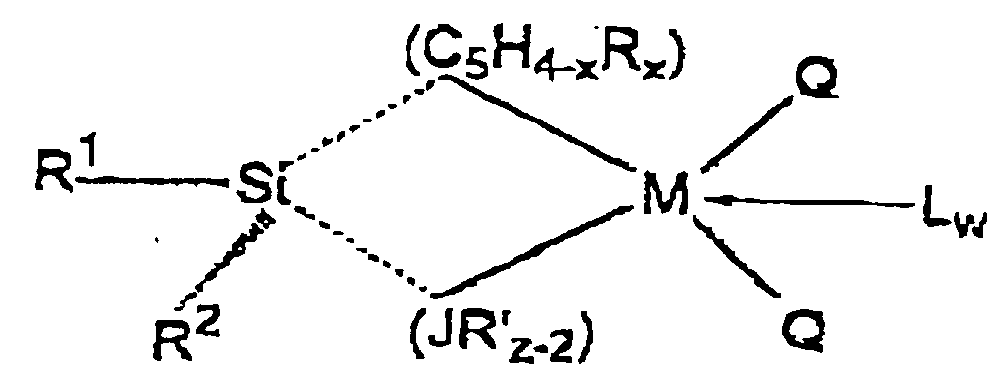
- a preferred class of transition metal components are of the formula: wherein Q, L, R', R, "x" and "w” are as previously defined and R 1 and are each independently a C 1 to C 20 hydrocarbyl radicals, substituted C 1 to C 20 hydrocarbyl radicals wherein one or more hydrogen atom is replaced by a halogen atom; R 1 and R 2 may also be joined forming a C 3 to C 20 ring which incorporates the silicon bridge.
- the alumoxane component of the catalyst system is an oligomeric compound which may be represented by the general formula (R 3 -Al-O) m which is a cyclic compound, or may be R 4 (R 5 -Al-O) m -AlR 6 2 which is a linear compound.
- An alumoxane is generally a mixture of both the linear and cyclic compounds.
- R 3 , R 4 , R 5 and R 6 are, independently a C 1 -C 5 alkyl radical, for example, methyl, ethyl, propyl, butyl or pentyl and "m" is an integer from 1 to 50.
- R 3 , R 4 , R 5 and R 6 are each methyl and "m" is at least 4.
- R 3-6 groups may be halide.
- alumoxanes can be prepared by various procedures.
- a trialkyl aluminum may be reacted with water, in the form of a moist inert organic solvent; or the trialkyl aluminum may be contacted with a hydrated salt, such as hydrated copper sulfate suspended in an inert organic solvent, to yield an alumoxane.
- a hydrated salt such as hydrated copper sulfate suspended in an inert organic solvent
- Suitable alumoxanes which may be utilized in the catalyst systems of this invention are those prepared by the hydrolysis of a trialkylaluminum; such as trimethylaluminum, triethyaluminum, tripropylaluminum; triisobutylaluminum, dimethylaluminumchloride, diisobutylaluminumchloride and diethylaluminumchloride,
- alumoxane for use is methylalumoxane (MAO).
- the catalyst systems employed in the method of the invention comprise a complex formed upon admixture of the Group Iv B transition metal component with an alumoxane component.
- the catalyst system may be prepared by addition of the requisite Group IV B transition metal and alumoxane components to an inert solvent in which olefin polymerization can be carried out by a solution, slurry, gas phase or bulk phase polymerization procedure.
- the catalyst system may be conveniently prepared by placing the selected Group IV B transition metal component and the selected alumoxane component, in any order of addition, in an alkane or aromatic hydrocarbon solvent -- preferably one which is also suitable for service as a polymerization diluent.
- an alkane or aromatic hydrocarbon solvent preferably one which is also suitable for service as a polymerization diluent.
- the catalyst system may be prepared in situ in the polymerization reactor.
- the catalyst system may be separately prepared, in concentrated form, and added to the polymerization diluent in a reactor.
- the components of the catalyst system may be prepared as separate solutions and added to the polymerization diluent in a reactor, in appropriate ratios, as is suitable for a continuous liquid phase polymerization reaction procedure.
- Alkane and aromatic hydrocarbons suitable as solvents for formation of the catalyst system and also as a polymerization diluent are exemplified by, but are not necessarily limited to, straight and branched chain hydrocarbons such as isobutane, butane, pentane, hexane, heptane and octane cyclic and alicyclic hydrocarbons such as cyclohexane, cycloheptane, methylcyclohexane, and methylcycloheptane, and aromatic and alkyl-substituted aromatic compounds such as benzene, toluene and xylene.
- Suitable solvents also include liquid olefins which may act as monomers or comonomers including ethylene, propylene, 1-butene and 1-hexene.
- the Group IV B transition metal compound is present in the polymerization diluent in a concentration of from 0.0001 to 1.0 millimoles/liter of diluent and the alumoxane component is present in an amount to provide a molar aluminum to transition metal ratio of from 1:1 to 20,000:1.
- Sufficient solvent should be employed so as to provide adequate heat transfer away from the catalyst components during reaction and to permit good mixing.
- the catalyst system ingredients -- that is, the Group IV B transition metal, the alumoxane, and polymerization diluent -- can be added to the reaction vessel rapidly or slowly.
- the temperature maintained during the contact of the catalyst components can vary widely, such as, for example, from -100° to 300°C. Greater or lesser temperatures can also be employed.
- the reaction is maintained within a temperature of from 25° to 100°C, most preferably about 25°C.
- the individual catalyst system components, as well as the catalyst system once formed, are protected from oxygen and moisture. Therefore, the reactions to prepare the catalyst system are performed in an oxygen and moisture free atmosphere and, where the catalyst system is recovered separately it is recovered in an oxygen and moisture free atmosphere. Preferably, therefore, the reactions are performed in the presence of an inert dry gas such as, for example, helium or nitrogen.
- an inert dry gas such as, for example, helium or nitrogen.
- the catalyst system is utilized in the liquid phase (slurry, solution, suspension or bulk phase or combination thereof), high pressure fluid phase or gas phase polymerization of an ⁇ -olefin monomer.
- liquid phase process comprises the steps of contacting an ⁇ -olefin monomer with the catalyst system in a suitable polymerization diluent and reacting said monomer in the presence of said catalyst system for a time and at a temperature sufficient to produce an amorphous poly- ⁇ -olefin as desired.
- the monomer for such process comprises an ⁇ -olefin having 3 to 20 carbon atoms.
- Propylene is a preferred monomer.
- Homopolymers of higher ⁇ -olefin such as ethylene, butene, styrene and copolymers thereof with ethylene and/or C 4 or higher ⁇ -olefins, diolefins, cyclic olefins and internal olefins can also be prepared.
- Conditions most preferred for the homo- or copolymerization of the ⁇ -olefin are those wherein an ⁇ -olefin is submitted to the reaction zone at pressures of from about 0.019 psia to 50,000 psia (1.3 ⁇ 10 -3 bar to 3445 bar) and the reaction temperature is maintained at from -100° to 300°C.
- the aluminum to transition metal molar ratio is preferably from 1:1 to 20,000 to 1. A more preferable range would be 1:1 to 2000:1.
- the reaction time is preferably from 10 seconds to 10 hours.
- one means for carrying out the process of the present invention for production of a copolymer is as follows: in a stirred-tank reactor liquid ⁇ -olefin monomer is introduced, such as propylene.
- the catalyst system is introduced via nozzles in either the vapor or liquid phase.
- the reactor contains a liquid phase composed substantially of the liquid ⁇ -olefin monomer together with a vapor phase containing vapors of the monomer.
- the reactor temperature and pressure may be controlled via reflux of vaporizing ⁇ -olefin monomer (autorefrigeration), as well as by cooling coils, jackets etc.
- the polymerization rate is controlled by the concentration of catalyst.
- Group IV B transition metal component for use in the catalyst system; (2) the type and amount of alumoxane used; (3) the polymerization diluent type and volume; (4) reaction temperature; and (5) reaction pressure, one may tailor the product polymer to the weight average molecular weight value desired while still maintaining the molecular weight distribution to a value below 6.0, preferably below 4.0. Optionally, higher molecular weight distributions can be tailored.
- the preferred polymerization diluents for practice of the process of the invention are aromatic diluents, such as toluene, or alkanes, such as hexane.
- aromatic diluents such as toluene, or alkanes, such as hexane.
- alpha- olefin itself may be used as the solvent.
- the resins that are prepared in accordance with this invention can be used to make a variety of products including films and fibers, adhesives and compatibilizers.
- lithiated substituted cyclopentadienyl compounds are typically prepared from the corresponding cyclopentadienyl ligand and n-BuLi or MeLi, or by reaction of MeLi with the proper fulvene.
- TiCl 4 was typically used in its etherate form. The etherate can be prepared by simply adding TiCl 4 to ether and filtering off the solid product which is then vacuum dried.
- TiCl 4 , ZrCl 4 , HfCl 4 , amines, silanes, substituted and unsubstituted cyclopentadienyl compounds or precursors, and lithium reagents were purchases from Aldrich Chemical Company, Petrarch Systems or Cerac. Methylalumoxane was supplied by either Schering or Ethyl corporation.
- the resins that are prepared in accordance with this invention can be used to make a variety of products including films, fibers, adhesives, compatibilizers and molded articles.
Landscapes
- Chemical & Material Sciences (AREA)
- Health & Medical Sciences (AREA)
- Chemical Kinetics & Catalysis (AREA)
- Medicinal Chemistry (AREA)
- Polymers & Plastics (AREA)
- Organic Chemistry (AREA)
- Transition And Organic Metals Composition Catalysts For Addition Polymerization (AREA)
- Addition Polymer Or Copolymer, Post-Treatments, Or Chemical Modifications (AREA)
Abstract
Claims (16)
- Procédé pour la production d'un polypropylène amorphe, comprenant les étapes consistant :(I) à mettre en contact du propylène dans des conditions de polymérisation avec une formulation de catalyseur comprenant :(C5H4-xRx) représente un noyau cyclopentadiényle qui est substitué de manière symétrique avec deux à quatre groupes R servant de substituants, "x" désignant le degré de substitution (x = 2 ou 4) et chaque groupe R représente, indépendamment, un radical choisi dans le groupe consistant en radicaux hydrocarbyle en C1 à C20, radicaux hydrocarbyle en C1 à C20 substitués dans lesquels un ou plusieurs atomes d'hydrogène sont remplacés par un radical halogéno, un radical amido, un radical phosphido, un radical alkoxy ou n'importe quel autre radical contenant une fonctionnalité acide ou basique de Lewis, des radicaux métalloidiques à substituants hydrocarbyle en C1 à C20, dans lesquels le métalloïde est choisi dans le groupe IV A du Tableau Périodique des Eléments, et des radicaux halogéno, des radicaux amido, des radicaux phosphido, des radicaux alkoxy, des radicaux alkylborido ou un radical contenant une fonctionnalité acide ou basique de Lewis, ou bien au moins deux groupes R adjacents sont joints en formant un noyau en C4 à C20, ce qui donne un ligand cyclopentadiényle polycyclique saturé ou insaturé ;(A) un activateur consistant en un alumoxane, et(B) un composé de métal de transition représenté par les formules :oder
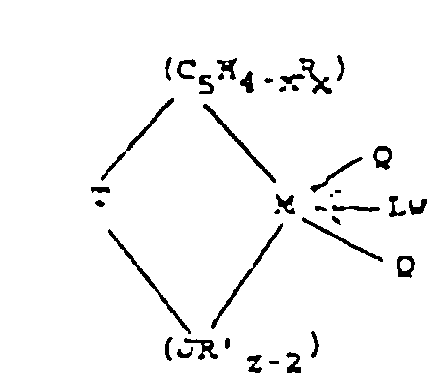 dans lesquelles M représente Ti à son état d'oxydation formelle le plus élevé :
 (JR'z-2) représente un ligand hétéroatomique dans lequel J représente un élément ayant un indice de coordination égal à trois du Groupe V A ou un élément ayant un indice de coordination égal à deux du Groupe VI A du Tableau Périodique des Eléments, chaque groupe R' représente, indépendamment, un radical choisi dans le groupe consistant en radicaux hydrocarbyle en C1 à C20, radicaux hydrocarbyle en C1 à C20 substitués dans lesquels un ou plusieurs atomes d'hydrogène sont remplacés par un radical halogéno, un radical amido, un radical phosphido, un radical alkoxy ou n'importe quel autre radical contenant une fonctionnalité acide ou basique de Lewis, et "z" représente l'indice de coordination de l'élément J ;chaque radical Q représente, indépendamment, un radical halogénure, hydrure ou un radical hydrocarbyle en C1 à C20 substitué ou non substitué, alcoolate, aryloxyde, amide, arylamide, phosphure ou arylphosphure, ou bien deux radicaux Q, conjointement, représentent un radical alkylidène, ou un radical hydrocarbyle cyclométallé ou n'importe quel ligand chélatant anionique divalent ;T représente un groupe de pontage covalent contenant un élément du Groupe IV A ou V A.M' a la même définition que M, et Q' a la même définition que Q ;L représente une base de Lewis neutre, "w" désignant un nombre de 0 à 3 ;(II) à recueillir un polypropylène amorphe ayant une moyenne pondérale du poids moléculaire supérieure à 100 000.
 - Procédé suivant la revendication 1, dans lequel le composé de métal de transition du Groupe IV-B est un composé de formule :dans laquelle R1 et R2 représentent, indépendamment, un radical hydrocarbyle en C1 a C20, un radical hydrocarbyle en C1 à C20 substitué dans lequel un ou plusieurs atomes d'hydrogène sont remplacés par des atomes d'halogènes ; R1 et R2 peuvent également être joints en formant un noyau en C3 à C20.
- Procédé suivant la revendication 1 ou 2, dans lequel J représente l'azote.
- Procédé suivant la revendication 1 ou 2, dans lequel R représente un radical hydrocarbyle en C1 à C20 et R' représente un radical cyclohydrocarbyle en C6 à C20 ou un radical aromatique.
- Procédé suivant la revendication 1, dans lequel R' représente un radical alkyle ou un radical cyclique.
- Procédé suivant la revendication 1 ou 2, dans lequel M représente le titane.
- Polypropylène amorphe totalement atactique, ayant une moyenne pcndérale du poids moléculaire supérieure à 200 000.
- Polyproprylène amorphe essentiellement atactique, ayant une moyenne pondérale au poids moléculaire supérieure à 500 000.
- polypropylène amorphe ayant une moyenne pondérale du poids moléculaire supérieure à 200 000, produit par un procédé comprenant les étapes consistant :(i) à mettre en contact une ou plusieurs α-oléfines dans des conditions de polymérisation avec une formulation de catalyseur comprenant :(C5H4-xRx) représente un noyau cyclopentadiényle qui est substitué de manière symétrique avec deux à quatre groupes R servant de substituants, "x" désignant le degré de substitution (x = 2 ou 4) et chaque radical R représente, indépendamment, un radical choisi dans le groupe consistant en radicaux hydrocarbyle en C1 à C20, radicaux hydrocarbyle en C1 à C20 substitués dans lesquels un ou plusieurs atomes d'hydrogène sont remplacés par un radical halogéno, un radical amido, un radical phosphido, et un radical alkoxy ou n'importe quel autre radical contenant une fonctionnalité acide ou basique de Lewis, des radicaux métalloidiques à substituants hydrocarbyle en C1 à C20 dans lesquels le métalloïde est choisi dans le Groupe IV A du Tableau Périodique des éléments, et des radicaux halogéno, des radicaux amido, des radicaux phosphido, des radicaux alkoxy, des radicaux alkylborido, ou un radical contenant une fonctionnalité acide ou basique de Lewis, ou bien au moins deux groupes R adjacents sont joints en formant un noyau en C4 à C20, ce qui donne un ligand cyclopentadiényle polycyclique saturé ou insaturé ;(a) un activateur consistant en un alumoxane, et(b) un composé de métal de transition représenté par la formule :oder
 dans laquelle M représente Ti à son état d'oxydation formel le plus élevé ; M' a la même signification que M ;
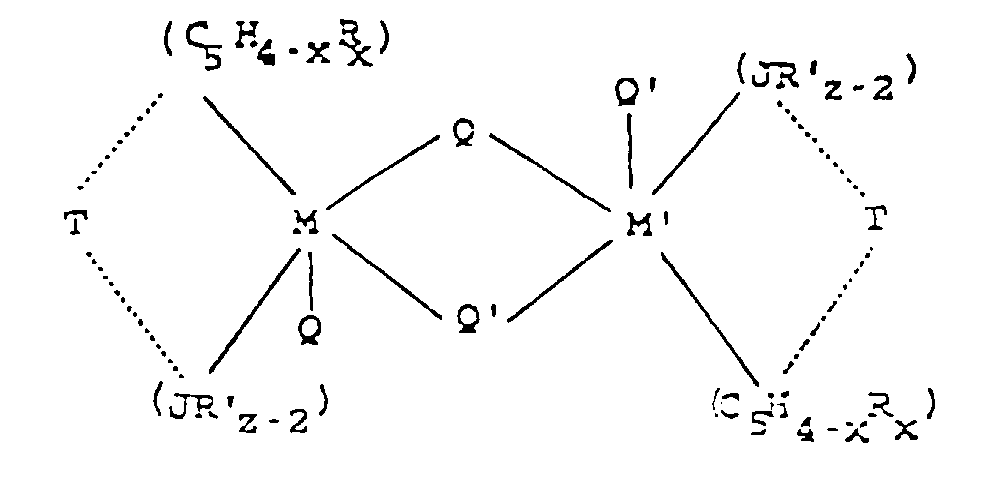 (JR'z-2) représente un ligand hétéroatomique dans lequel J représente un élément ayant un indice de coordination égal à trois du Groupe V A ou un élément ayant un indice de coordination égal à deux du Groupe VI A du Tableau Périodique des Eléments, chaque groupe R' représentant, indépendamment, un radical choisi dans le groupe consistant en radicaux hydrocarbyle en C1 à C20, radicaux hydrocarbyle en C1 à C20 substitués dans lesquels un ou plusieurs atomes d'hydrogène sont remplacés par un radical halogéno, un radical amido, un radical phosphido, et un radical alkoxy ou n'importe quel autre radical contenant une fonctionnalité acide ou basique de Lewis, et "z" représente l'indice de coordination de l'élément J ;chaque groupe Q représente, indépendamment, un ligand anionique univalent qui ne peut être un noyau cyclopentadiényle substitué ou non substitué, ledit ligand anionique univalent étant choisi entre un halogénure, un hydrure, un radical hydrocarbyle en C1 à C20 substitué ou non substitué, alcoolate, aryloxyde, amide, arylamide, phosphure ou arylphosphure, ou bien deux groupes Q, conjointement, représentent un radical alkylidène, ou un radical hydrocarbyle cyclométallé ou n'importe quel ligand chélatant anionique divalent ; Q' a la même signification que Q ;T représente un groupe de pontage covalent contenant un élément du Groupe IV A ou V A ;L représente une base neutre de Lewis, "w" désignant un nombre de 0 à 3 ;(ii) à recueillir un polypropylène amorphe ;
 - Polypropylène amorphe suivant la revendication 9, dans lequel le composé de métal de transition est un composé représenté par la formule :

- Polypropylène suivant la revendication 9, qui est atactique.
- Polypropylène suivant la revendication 11, qui a une moyenne pondérale du poids moléculaire supérieure à 500 000.
- Article ccmprenant le polypropylène selon la revendication 12.
- Polypropylène suivant la revendication 10, qui est atactique.
- Polypropylène suivant la revendication 10, qui a une moyenne pondérale du poids moléculaire supérieure à 500 000.
- Article comprenant le polypropylène suivant la revendication 10.
Applications Claiming Priority (1)
| Application Number | Priority Date | Filing Date | Title |
|---|---|---|---|
| PCT/US1993/006051 WO1995000562A1 (fr) | 1993-06-24 | 1993-06-24 | Procede de production de poly-alpha-olefines amorphes au moyen d'un catalyseur a metal de transition de monocyclopentadienyle |
Publications (2)
| Publication Number | Publication Date |
|---|---|
| EP0705283A1 EP0705283A1 (fr) | 1996-04-10 |
| EP0705283B1 true EP0705283B1 (fr) | 1999-01-13 |
Family
ID=22236720
Family Applications (1)
| Application Number | Title | Priority Date | Filing Date |
|---|---|---|---|
| EP93916743A Expired - Lifetime EP0705283B1 (fr) | 1993-06-24 | 1993-06-24 | Procede de production de poly-alpha-olefines amorphes au moyen d'un catalyseur a metal de transition de monocyclopentadienyle |
Country Status (6)
| Country | Link |
|---|---|
| EP (1) | EP0705283B1 (fr) |
| JP (1) | JPH08512063A (fr) |
| CA (1) | CA2166055C (fr) |
| DE (1) | DE69323096T2 (fr) |
| ES (1) | ES2128431T3 (fr) |
| WO (1) | WO1995000562A1 (fr) |
Families Citing this family (19)
| Publication number | Priority date | Publication date | Assignee | Title |
|---|---|---|---|---|
| CA2209773A1 (fr) * | 1995-01-31 | 1996-08-08 | Exxon Chemical Patents, Inc. | Elastomeres thermoplastiques de propylenes et procede de production a une chambre et deux catalyseurs |
| AU4702796A (en) * | 1995-03-01 | 1996-09-18 | Minnesota Mining And Manufacturing Company | Tris(pentafluorophenyl)borate complexes and catalysts derived therefrom |
| FI104825B (fi) | 1996-01-26 | 2000-04-14 | Borealis As | Olefiinien polymerointikatalysaattorisysteemi, sen valmistus ja käyttö |
| NL1003004C2 (nl) * | 1996-05-03 | 1997-11-06 | Dsm Nv | Met onderling verschillende groepen gesubstitueerde cyclopentadieen- verbinding. |
| US6124488A (en) * | 1996-05-03 | 2000-09-26 | Dsm N.V. | Cyclopentadiene compound substituted with branched alkyl groups |
| US6117811A (en) * | 1996-05-03 | 2000-09-12 | Dsm N.V. | Cyclopentadiene compound substituted with linear groups |
| NL1003006C2 (nl) * | 1996-05-03 | 1997-11-06 | Dsm Nv | Met vertakte alkylgroepen gesubstitueerde cyclopentadieenverbinding. |
| NL1003012C2 (nl) * | 1996-05-03 | 1997-11-06 | Dsm Nv | Met aralkylgroepen gesubstitueerde cyclopentadieenverbinding. |
| NL1003013C2 (nl) * | 1996-05-03 | 1997-11-06 | Dsm Nv | Met cyclische groepen gesubstitueerde cyclopentadieenverbinding. |
| NL1003000C2 (nl) * | 1996-05-03 | 1997-11-06 | Dsm Nv | Synthese van een amine-bevattend cyclopentadieen. |
| KR19990067851A (ko) | 1998-01-14 | 1999-08-25 | 고오사이 아끼오 | 올레핀 중합체, 올레핀 중합 촉매 및 올레핀 중합체의 제조 방법 |
| JP3533923B2 (ja) | 1998-01-28 | 2004-06-07 | 住友化学工業株式会社 | オレフィン重合体、オレフィン重合用触媒およびオレフィン重合体の製造方法 |
| MXPA00002181A (es) | 1998-07-02 | 2003-04-22 | Montell Technology Company Bv | Procedimiento para la preparacion de polimeros de alfa-olefinas sustancialmente amorfos composiciones que los contienen, y procedimiento para la preparacion de ligandos puenteados. |
| EP1010709A1 (fr) | 1998-12-14 | 2000-06-21 | Fina Research S.A. | Composé métallocène et son utilisation pour la production de polyoléfines |
| JP2001261737A (ja) * | 2000-03-14 | 2001-09-26 | Chisso Corp | 耐熱性に優れた柔軟性ポリプロピレン |
| JP2005171139A (ja) * | 2003-12-12 | 2005-06-30 | Tonen Chem Corp | 変性ポリプロピレン |
| US7872080B2 (en) | 2008-03-06 | 2011-01-18 | Sumitomo Chemical Company, Limited | Processes for producing a catalyst component for addition polymerization, a catalyst and an addition polymer |
| JP2011213804A (ja) | 2010-03-31 | 2011-10-27 | Sumitomo Chemical Co Ltd | 予備重合方法、予備重合済付加重合触媒成分およびそれを用いる付加重合体の製造方法 |
| JP2013082891A (ja) | 2011-09-28 | 2013-05-09 | Sumitomo Chemical Co Ltd | 洗浄方法、付加重合方法、予備重合方法、予備重合済付加重合触媒成分およびそれを用いる付加重合体の製造方法 |
Family Cites Families (4)
| Publication number | Priority date | Publication date | Assignee | Title |
|---|---|---|---|---|
| NZ235032A (en) * | 1989-08-31 | 1993-04-28 | Dow Chemical Co | Constrained geometry complexes of titanium, zirconium or hafnium comprising a substituted cyclopentadiene ligand; use as olefin polymerisation catalyst component |
| US5026798A (en) * | 1989-09-13 | 1991-06-25 | Exxon Chemical Patents Inc. | Process for producing crystalline poly-α-olefins with a monocyclopentadienyl transition metal catalyst system |
| ES2109473T3 (es) * | 1991-12-13 | 1998-01-16 | Exxon Chemical Patents Inc | Copolimeros de etileno/alfa-olefinas superiores. |
| EP0631589A1 (fr) * | 1992-03-16 | 1995-01-04 | Exxon Chemical Patents Inc. | CATALYSEUR IONIQUE UTILISE POUR PRODUIRE DES POLY-$g(a)-OLEFINES A TACTICITE CONTROLEE |
-
1993
- 1993-06-24 DE DE69323096T patent/DE69323096T2/de not_active Expired - Lifetime
- 1993-06-24 JP JP7502749A patent/JPH08512063A/ja active Pending
- 1993-06-24 ES ES93916743T patent/ES2128431T3/es not_active Expired - Lifetime
- 1993-06-24 WO PCT/US1993/006051 patent/WO1995000562A1/fr not_active Ceased
- 1993-06-24 CA CA002166055A patent/CA2166055C/fr not_active Expired - Fee Related
- 1993-06-24 EP EP93916743A patent/EP0705283B1/fr not_active Expired - Lifetime
Also Published As
| Publication number | Publication date |
|---|---|
| JPH08512063A (ja) | 1996-12-17 |
| ES2128431T3 (es) | 1999-05-16 |
| DE69323096D1 (de) | 1999-02-25 |
| DE69323096T2 (de) | 1999-08-05 |
| EP0705283A1 (fr) | 1996-04-10 |
| CA2166055C (fr) | 2006-10-17 |
| CA2166055A1 (fr) | 1995-01-05 |
| WO1995000562A1 (fr) | 1995-01-05 |
Similar Documents
| Publication | Publication Date | Title |
|---|---|---|
| US5504169A (en) | Process for producing amorphous poly-α-olefins with a monocyclopentadienyl transition metal catalyst system | |
| US5026798A (en) | Process for producing crystalline poly-α-olefins with a monocyclopentadienyl transition metal catalyst system | |
| US5055438A (en) | Olefin polymerization catalysts | |
| US5420217A (en) | Process for producing amorphous poly-α-olefins with a monocyclopentadienyl transition metal catalyst system | |
| US5096867A (en) | Monocyclopentadienyl transition metal olefin polymerization catalysts | |
| US5547675A (en) | Modified monocyclopentadienyl transition metal/alumoxane catalyst system for polymerization of olefins | |
| US5057475A (en) | Mono-Cp heteroatom containing group IVB transition metal complexes with MAO: supported catalyst for olefin polymerization | |
| US5227440A (en) | Mono-Cp heteroatom containing Group IVB transition metal complexes with MAO: supported catalysts for olefin polymerization | |
| CA2166055C (fr) | Methode de preparation de poly-.alpha.-olefines amorphes en presence d'un systeme catalytique a base d'un metal de transition monocyclopentadienylique | |
| EP0618931B2 (fr) | Systeme modifie de catalyseur de metal de transition monocyclopentadienyle/alumoxane pour la polymerisation d'olefines | |
| US7041841B1 (en) | Process for producing crystalline poly-α-olefins with a monocyclopentadienyl transition metal catalyst system | |
| AU667292C (en) | Process for producing crystalline poly-alpha-olefins with a monocyclopentadienyl transition metal catalyst system | |
| AU643237C (en) | Monocyclopentadienyl transition metal olefin polymerization catalysts | |
| EP1379561B1 (fr) | Procede de polymerisation d'olefines en utilisant des complexes de metal de transition | |
| AU656498C (en) | Supported monocyclopentadienyl transition metal olefin polymerization catal ysts |
Legal Events
| Date | Code | Title | Description |
|---|---|---|---|
| PUAI | Public reference made under article 153(3) epc to a published international application that has entered the european phase |
Free format text: ORIGINAL CODE: 0009012 |
|
| 17P | Request for examination filed |
Effective date: 19960123 |
|
| AK | Designated contracting states |
Kind code of ref document: A1 Designated state(s): BE DE ES FR GB IT NL SE |
|
| 17Q | First examination report despatched |
Effective date: 19960503 |
|
| GRAG | Despatch of communication of intention to grant |
Free format text: ORIGINAL CODE: EPIDOS AGRA |
|
| GRAG | Despatch of communication of intention to grant |
Free format text: ORIGINAL CODE: EPIDOS AGRA |
|
| GRAG | Despatch of communication of intention to grant |
Free format text: ORIGINAL CODE: EPIDOS AGRA |
|
| GRAH | Despatch of communication of intention to grant a patent |
Free format text: ORIGINAL CODE: EPIDOS IGRA |
|
| GRAH | Despatch of communication of intention to grant a patent |
Free format text: ORIGINAL CODE: EPIDOS IGRA |
|
| GRAA | (expected) grant |
Free format text: ORIGINAL CODE: 0009210 |
|
| AK | Designated contracting states |
Kind code of ref document: B1 Designated state(s): BE DE ES FR GB IT NL SE |
|
| REF | Corresponds to: |
Ref document number: 69323096 Country of ref document: DE Date of ref document: 19990225 |
|
| ITF | It: translation for a ep patent filed | ||
| ET | Fr: translation filed | ||
| REG | Reference to a national code |
Ref country code: ES Ref legal event code: FG2A Ref document number: 2128431 Country of ref document: ES Kind code of ref document: T3 |
|
| PLBE | No opposition filed within time limit |
Free format text: ORIGINAL CODE: 0009261 |
|
| STAA | Information on the status of an ep patent application or granted ep patent |
Free format text: STATUS: NO OPPOSITION FILED WITHIN TIME LIMIT |
|
| 26N | No opposition filed | ||
| REG | Reference to a national code |
Ref country code: GB Ref legal event code: IF02 |
|
| PGFP | Annual fee paid to national office [announced via postgrant information from national office to epo] |
Ref country code: SE Payment date: 20050603 Year of fee payment: 13 |
|
| PG25 | Lapsed in a contracting state [announced via postgrant information from national office to epo] |
Ref country code: SE Free format text: LAPSE BECAUSE OF NON-PAYMENT OF DUE FEES Effective date: 20060625 |
|
| EUG | Se: european patent has lapsed | ||
| PGFP | Annual fee paid to national office [announced via postgrant information from national office to epo] |
Ref country code: NL Payment date: 20070507 Year of fee payment: 15 |
|
| PGFP | Annual fee paid to national office [announced via postgrant information from national office to epo] |
Ref country code: ES Payment date: 20070612 Year of fee payment: 15 |
|
| PGFP | Annual fee paid to national office [announced via postgrant information from national office to epo] |
Ref country code: BE Payment date: 20070628 Year of fee payment: 15 |
|
| PGFP | Annual fee paid to national office [announced via postgrant information from national office to epo] |
Ref country code: IT Payment date: 20070619 Year of fee payment: 15 |
|
| BERE | Be: lapsed |
Owner name: *EXXON CHEMICAL PATENTS INC. Effective date: 20080630 |
|
| NLV4 | Nl: lapsed or anulled due to non-payment of the annual fee |
Effective date: 20090101 |
|
| PG25 | Lapsed in a contracting state [announced via postgrant information from national office to epo] |
Ref country code: BE Free format text: LAPSE BECAUSE OF NON-PAYMENT OF DUE FEES Effective date: 20080630 |
|
| PG25 | Lapsed in a contracting state [announced via postgrant information from national office to epo] |
Ref country code: NL Free format text: LAPSE BECAUSE OF NON-PAYMENT OF DUE FEES Effective date: 20090101 |
|
| REG | Reference to a national code |
Ref country code: ES Ref legal event code: FD2A Effective date: 20080625 |
|
| PG25 | Lapsed in a contracting state [announced via postgrant information from national office to epo] |
Ref country code: IT Free format text: LAPSE BECAUSE OF NON-PAYMENT OF DUE FEES Effective date: 20080624 |
|
| PG25 | Lapsed in a contracting state [announced via postgrant information from national office to epo] |
Ref country code: ES Free format text: LAPSE BECAUSE OF NON-PAYMENT OF DUE FEES Effective date: 20080625 |
|
| PGFP | Annual fee paid to national office [announced via postgrant information from national office to epo] |
Ref country code: FR Payment date: 20100617 Year of fee payment: 18 |
|
| PGFP | Annual fee paid to national office [announced via postgrant information from national office to epo] |
Ref country code: DE Payment date: 20100630 Year of fee payment: 18 |
|
| REG | Reference to a national code |
Ref country code: FR Ref legal event code: ST Effective date: 20120229 |
|
| REG | Reference to a national code |
Ref country code: DE Ref legal event code: R119 Ref document number: 69323096 Country of ref document: DE Effective date: 20120103 |
|
| PG25 | Lapsed in a contracting state [announced via postgrant information from national office to epo] |
Ref country code: FR Free format text: LAPSE BECAUSE OF NON-PAYMENT OF DUE FEES Effective date: 20110630 Ref country code: DE Free format text: LAPSE BECAUSE OF NON-PAYMENT OF DUE FEES Effective date: 20120103 |
|
| PGFP | Annual fee paid to national office [announced via postgrant information from national office to epo] |
Ref country code: GB Payment date: 20120525 Year of fee payment: 20 |
|
| REG | Reference to a national code |
Ref country code: GB Ref legal event code: PE20 Expiry date: 20130623 |
|
| PG25 | Lapsed in a contracting state [announced via postgrant information from national office to epo] |
Ref country code: GB Free format text: LAPSE BECAUSE OF EXPIRATION OF PROTECTION Effective date: 20130623 |