EP0706287B1 - Verfahren und Vorrichtung zur Berechnung von Farbtransformationstabellen - Google Patents
Verfahren und Vorrichtung zur Berechnung von Farbtransformationstabellen Download PDFInfo
- Publication number
- EP0706287B1 EP0706287B1 EP95420269A EP95420269A EP0706287B1 EP 0706287 B1 EP0706287 B1 EP 0706287B1 EP 95420269 A EP95420269 A EP 95420269A EP 95420269 A EP95420269 A EP 95420269A EP 0706287 B1 EP0706287 B1 EP 0706287B1
- Authority
- EP
- European Patent Office
- Prior art keywords
- spacing
- point
- grid
- index
- interest
- Prior art date
- Legal status (The legal status is an assumption and is not a legal conclusion. Google has not performed a legal analysis and makes no representation as to the accuracy of the status listed.)
- Expired - Lifetime
Links
Images




Classifications
-
- H—ELECTRICITY
- H04—ELECTRIC COMMUNICATION TECHNIQUE
- H04N—PICTORIAL COMMUNICATION, e.g. TELEVISION
- H04N1/00—Scanning, transmission or reproduction of documents or the like, e.g. facsimile transmission; Details thereof
- H04N1/46—Colour picture communication systems
- H04N1/56—Processing of colour picture signals
- H04N1/60—Colour correction or control
- H04N1/6058—Reduction of colour to a range of reproducible colours, e.g. to ink- reproducible colour gamut
Definitions
- the present invention is directed to a system for creating transformation tables that are used to convert color values from one type of device, such as a scanner, to another type of device, such as a printer, and, more particularly, to a system in which the input and output table grid points increase in spacing from some area of importance, such as neutral, allowing tables to be reduced in size while maintaining transform accuracy in a region of interest.
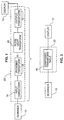
- Color signals or values produced by or for one device often need to be output to or represented by another device, such as a printer or display. Even though these devices may operate within the same color space such as RGB or u'v'L * the color values or signals produced by the first device need to be transformed into color values or signals suitable for the second device. To perform this transformation, several different sub-transformations are generally performed. Typical transformations that could be performed are illustrated in figure 1 when a system is providing color signals from a scanner to a display.
- This figure shows a transformation from a scanner 10 to a display 12 which includes input 14 and output 16 transforms and intermediate transforms 18 and 20 which make the image displayed on display 12 as close a visual match as possible to the input image scanned scanner 10 (See U.S. Patent 5,208,911).
- These transforms are typically multiterm equations represented in a computer 22 as a series of transform look-up and interpolation tables as depicted in figure 2 rather than as a series of formulas. This is because table look-ups and interpolations are much faster than formula computations for the computer formulas required in obtaining high quality color.
- Each transformation table includes a set of one-dimensional input tables 30, a three-dimensional grid table 32 and a set of one-dimensional output tables 34.
- the grid tables 32 are used for interpolation, they need to be large in order to provide a desired level of accuracy in the final result.
- table sizes can become prohibitive.
- a pleasing transform which modifies the color of flesh tones while leaving other colors unmodified.
- Such a transform has a high degree of curvature in color space yet must be tightly controlled.
- the grid size must grow to 32x32x32 (or 32,768 points) to achieve the degree of accuracy required in typical graphic arts applications.
- FIGS 4 and 5 graphically illustrate the nature of the problem.
- Each figure shows a two-dimensional slice through color space. The particular space they show is the CIE u'v'L * space.
- the two-dimensional slice is perpendicular to the luminance axis, so that it indicates chrominance.
- the curved dotted line indicates the set of all physically realizable colors, while the grids 36 and 38 indicate the coverage given by a 16x16 point and a 32x32 point uniform grid.
- the distance between adjacent grid points in figure 4 is large enough to introduce unacceptable inaccuracies when representing pleasing transforms as interpolation tables.
- European Patent Application publication number 0 615 379 describes an apparatus which connects RGB input to CMYK using an interpolation table.
- the interpolation table uses a grid whose intervals vary in a way which depends on the behavior of the transfer function employed. Thus determining the proper grid spacing requires an analysis of the particular transformation being modeled, and results in different grid spacings for different transformations. Having different grid spacings for different transformations can make the process of composition of color transformations more difficult.
- a transformation can be represented as a set of one-dimensional input look-up tables, a set of three-dimensional intermediate tables, and a set of one-dimensional output look-up tables. Because of interactions between the three types of tables, there is some ambiguity in how any given total transformation can be represented. In other words it is possible to modify the input tables, for instance, and compensate for the modification by making corresponding modifications to the output and/or intermediate tables. For any given transformation, as described in this application, this ambiguity can be exploited to produce a table representation which minimizes the size of the interpolation tables required to achieve a given level of accuracy. This minimization is often desirable for two reasons. First, it reduces the storage and memory required to use the table. Second, it reduces the amount of time required to compute the table. In situations where the table is being used to represent an interactive color move, this table computation time can be significant.
- the present invention is particularly useful in color spaces in which neutral parallels a coordinate system axis.
- the present invention solves the problem of reducing the size of the grid table for spaces in which all of the chrominance information is restricted to two color channels while maintaining accuracy in a desired region by creating non-linear grid spacing around a central point of a region of interest. This is shown in figure 6 for u'v'L * space with the luminance axis coming out of the paper.
- a point 60 is selected in the color gamut 62 in the color space 64, and particularly, in the center of a region of interest in a chrominance space such as a u'v'.
- the point 60 shown in figure 6 is the point representing D50, an illuminant commonly used for specifying neutral. Using a neutral point improves saturation-dependant transformation computations.
- the interpolation grid 68 is arranged relative to this selected point 60, so that the grid spacing along each axis increases with distance from the point 60. In the example, the grid spacing increases roughly linearly with distance from point 60 along each chrominance axis.
- the grid 68 in figure 6 has also been arranged so that the number of grid points on each side of point 60 in the u' dimension is roughly proportional to the length of the u axis on each side of point 60, and so that the number of grid points above point 60 is roughly 40% of the total number of grid points.
- the fine spacing or high resolution of the grid points in the region of interest maintains the desired accuracy of color transformations in this region at the sacrifice of lower resolution transformations in the periphery of the grid.
- the growth of grid point separation linearly with distance from point 60 when the point 60 is D50 results in a wedge 66 of constant hue going through roughly an equal number of grid points of the grid 68 as the wedge expands as it moves further away from neutral. This results in greater control over hue transformation. As can be seen by visual inspection of figures 4 and 5 this is not the case in a uniformly spaced grid.
- the nonuniform grid spacing around D50 is 1/3 the size of the spacing for a grid with the same number of uniformly spaced points. Thus, the accuracy is three times greater in the region of interest for a nonuniform grid than a uniform grid.
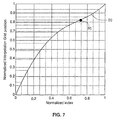
- the present invention starts with the one dimensional quadratic grid point transform curves or functions for the output transform for the u' and v' chromaticity coordinates. Since the grid point transform curves or functions of the u' and v' curves usually do not match in range, for example, the v' coordinates in figure 6 range from about .17 to about .58 while the u' coordinates range from about .07 to about .48, the curves need to be normalized to those ranges.
- the normalized grid point transform curve 80 for v' is shown in figure 7 and the normalized transform curve 82 for u' is shown in figure 8.
- the method of producing the non-uniformity can use any function that creates a spacing that increases as the distance from the point of interest increases.
- the preference is to use a function whose slope increases roughly linearly with distance from the point of interest.
- Figures 6-8 illustrate grid points for an output table. The input tables are created by inverting the output transform curves.
- grid points is 16 in the example being discussed
- dw is the distance from the neutral point
- the neutral point is the center of the region of interest
- remapped is the remapped grid point value
- slope is the slope at the point of interest, D50 or neutral in this example and which slope is 1/3 in this example
- Aplus and Aminus are normalization offset parameters that ensure that 0 maps to 0 and 1 maps to 1.
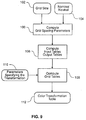
- the above-described step of computing or remapping the grid spacing from uniform to non-uniform from the input grid size 102 and the point of interest 104 is depicted in the flowchart of figure 9.
- the desired grid size 102 and neutral value 104 have been specified, they are used to compute 100 the grid remapping function for each table dimension, as described previously.
- the input and output tables are then computed 106.
- Each output table is made proportional to the corresponding grid remapping function. The constant of proportionality depends on how the tables are encoded.
- the inputs and outputs of each transformation are 8 bit numbers, while each grid table is a 12 bit number.
- the output tables map the range 0-4095 to the range 0-255.
- each input table is computed by inverting the corresponding output table.
- the grid table can be computed 108 using the following procedure. For each grid point: 1) use the output tables to compute the physical value corresponding to that grid point; 2) apply the desired transformation to that physical value; 3) use the input tables to compute the grid value corresponding to that result; and 4) use the result of (3) to populate the grid table at that point.
- the system combines or composes the input, output and intermediate tables into the final color transformation table 112 (for example, table 36). The steps of producing the intermediate tables and composing all the tables into a single table are also conventional.
- the present invention typically operates in an environment, as illustrated in figure 10, which includes a computer 150, such as an Apple Macintosh II, coupled to receive an input transform for an input device 152, such as a scanner, and an output transform for an output device 154, such as a display or printer.
- the computer system includes a storage device 156, such as a hard disk drive, which stores the tables and transforms used to create the composite table.
- a user interface 158 such as a keyboard with a display, can be used to specify the intermediate transforms and the desired grid size.
- non-uniform spacings of grid points can also be created. For example, two regions of interest in a color space can be defined and the number of grid points in each region can be increased over a uniform spacing with the areas between the regions receiving a sparser number of points.
- the invention has also been described with a constant slope characteristic being used to determine spacing. It is possible for the slope to vary with distance in a complex function.
Landscapes
- Engineering & Computer Science (AREA)
- Multimedia (AREA)
- Signal Processing (AREA)
- Image Processing (AREA)
- Color Image Communication Systems (AREA)
- Facsimile Image Signal Circuits (AREA)
Claims (7)
- Verfahren zum Erzeugen einer Farbtransformationstabelle mit folgenden Schritten:Bestimmen ungleichmäßiger Indexpunktabstände (100) für die Tabelle um einen Neutralpunkt (60) herum, so dass die Abstände im Interessenbereich klein und in den vom Interessenbereich entfernten Bereichen groß sind; undBestimmen von Einträgen (106) in der Tabelle unter Verwendung einer von den Indexpunkten abhängigen Transformationsfunktion.
- Verfahren nach Anspruch 1, dadurch gekennzeichnet, dass der Schritt zum Bestimmen ungleichmäßiger Indexpunktabstände folgende Schritte umfasst:Bestimmen der Indexpunkte (100) mit ungleichmäßigen Indexpunktabständen für Eingabe- und Ausgabetabellen, die ein geradliniges Koordinatensystem aufweisen, wobei die Indexpunkte um einem Neutralpunkt herum am dichtesten angeordnet sind, so dass ein Teil eines Farbraums, für den das menschliche Auge empfindlich ist, hervorgehoben wird; undwobei der Schritt zum Bestimmen von Einträgen in die Tabelle folgende Schritte umfasst:Bestimmen von Einträgen (106) in die Eingabe- und Ausgabetabelle unter Verwendung einer von den Indexpunkten abhängigen Transformationsfunktion;Erzeugen (110) einer Zwischentransformationstabelle unter Verwendung einer von den Einträgen abhängigen Zwischentransformationsfunktion; undZusammenfassen (112) der Eingabe-, Zwischen- und Ausgabetabelle zu einer einzigen Farbtransformationstabelle.
- Verfahren nach Anspruch 2, dadurch gekennzeichnet, dass sich die Abstände zwischen den Indexpunkten mit der Entfernung vom Neutralpunkt linear vergrößern.
- Verfahren nach Anspruch 2, dadurch gekennzeichnet, dass sich die Abstände zwischen den Indexpunkten mit der Entfernung vom Neutralpunkt quadratisch vergrößern.
- Verfahren nach Anspruch 1, dadurch gekennzeichnet, dass der Schritt zum Bestimmen ungleichmäßiger Indexpunktabstände folgende Schritte umfasst:Bestimmen eines Neutralpunkts (104) als Mittelpunkt eines Interessenbereichs in einem Luminanz-Farbraum, so dass Teile eines Farbraums, für den das menschliche Auge empfindlich ist, hervorgehoben werden; undBestimmen von Indexpunkten (100) im Farbraum mit ungleichmäßiger Beabstandung bezüglich des Mittelpunkts.
- Verfahren nach Anspruch 1, dadurch gekennzeichnet, dass der Schritt zum Bestimmen ungleichmäßiger Indexpunktabstände folgende Schritte umfasst:Eingeben eines Tabellengitterabstands (102), der Indexwerte mit gleichmäßigen Abständen aufweist; undBestimmen von neuen Indexwerten (100) mit ungleichmäßiger Beabstandung bezüglich eines Neutralpunkts, so dass Teile eines Farbraums, für den das menschliche Auge empfindlich ist, hervorgehoben werden.
- Vorrichtung zum Erzeugen einer Farbtransformationstabelle mit folgenden Komponenten:einem Plattenspeicher (156), der eine Transformationsfunktion speichert; undeinem Rechner (150), der mit dem Plattenspeicher verbunden ist und Tabellenindexpunkte mit ungleichmäßigen Abständen erzeugt, die um einen Neutralpunkt herum angeordnet sind, so dass die Abstände im Interessenbereich klein und in den vom Interessenbereich entfernten Bereichen groß sind, und der Einträge für die Indexpunkte unter Verwendung der Transformationsfunktion bestimmt.
Applications Claiming Priority (2)
| Application Number | Priority Date | Filing Date | Title |
|---|---|---|---|
| US320023 | 1989-03-07 | ||
| US08/320,023 US5644509A (en) | 1994-10-07 | 1994-10-07 | Method and apparatus for computing color transformation tables |
Publications (3)
| Publication Number | Publication Date |
|---|---|
| EP0706287A2 EP0706287A2 (de) | 1996-04-10 |
| EP0706287A3 EP0706287A3 (de) | 1996-12-27 |
| EP0706287B1 true EP0706287B1 (de) | 2001-08-01 |
Family
ID=23244552
Family Applications (1)
| Application Number | Title | Priority Date | Filing Date |
|---|---|---|---|
| EP95420269A Expired - Lifetime EP0706287B1 (de) | 1994-10-07 | 1995-09-25 | Verfahren und Vorrichtung zur Berechnung von Farbtransformationstabellen |
Country Status (4)
| Country | Link |
|---|---|
| US (1) | US5644509A (de) |
| EP (1) | EP0706287B1 (de) |
| JP (1) | JPH08194817A (de) |
| DE (1) | DE69521958T2 (de) |
Families Citing this family (32)
| Publication number | Priority date | Publication date | Assignee | Title |
|---|---|---|---|---|
| US6434266B1 (en) * | 1993-12-17 | 2002-08-13 | Canon Kabushiki Kaisha | Image processing method and apparatus for converting colors in a color image |
| US6046118A (en) * | 1996-08-02 | 2000-04-04 | E. I. Du Pont De Nemours And Company | Composite sheet material |
| US6118549A (en) * | 1997-03-26 | 2000-09-12 | Sharp Kabushiki Kaisha | Color conversion device |
| JPH1188709A (ja) | 1997-09-05 | 1999-03-30 | Fujitsu Ltd | 色変換テーブル構成変換方法並びに色変換テーブル構成変換プログラムを記録したコンピュータ読み取り可能な記録媒体 |
| US6501850B2 (en) | 1998-02-04 | 2002-12-31 | Eastman Kodak Company | Method for including traditional photographic calibration into digital color management |
| JP3912903B2 (ja) * | 1998-07-02 | 2007-05-09 | キヤノン株式会社 | データ変換方法およびその装置 |
| JP2000278546A (ja) * | 1999-01-22 | 2000-10-06 | Sony Corp | 画像処理装置及び画像処理方法、色域変換テーブル作成装置及び色域変換テーブル作成方法、画像処理プログラムを記録した記録媒体、並びに色域変換テーブル作成プログラムを記録した記録媒体 |
| US6278805B1 (en) * | 1999-05-13 | 2001-08-21 | Eastman Kodak Company | System for composing color transforms using class information |
| US6775028B1 (en) | 2000-02-24 | 2004-08-10 | Lexmark International, Inc. | Non-linear method of mapping the lightness and chroma of a display device gamut onto a printing device gamut |
| JP2002077661A (ja) * | 2000-09-05 | 2002-03-15 | Fujitsu Ltd | 色信号値抽出方法および色変換テーブル作成方法 |
| US6731796B2 (en) | 2000-12-06 | 2004-05-04 | Xerox Corporation | Graphical user interface for color transformation table editing that avoids reversal artifacts |
| US7233695B2 (en) * | 2002-07-01 | 2007-06-19 | Xerox Corporation | Scan color conversion method |
| US7433080B2 (en) | 2004-09-28 | 2008-10-07 | Toshiba Corporation | System and method for conversion of duotone images for display |
| US20060268297A1 (en) * | 2005-05-25 | 2006-11-30 | Lexmark International, Inc. | Method for constructing a lookup table for converting data from a first color space to a second color space |
| US7855802B2 (en) * | 2006-04-06 | 2010-12-21 | Canon Kabushiki Kaisha | Time-efficient generation of color look-up table |
| US8913073B2 (en) * | 2006-08-09 | 2014-12-16 | Adobe Systems Incorporated | Interpolation according to a function represented using unevenly spaced samples of the function |
| US7990588B2 (en) * | 2006-12-12 | 2011-08-02 | Canon Kabushiki Kaisha | Method of finding look-up table structures in color device sampling data |
| JP5230118B2 (ja) * | 2007-03-30 | 2013-07-10 | キヤノン株式会社 | 階調性評価装置および階調性評価方法 |
| JP5025323B2 (ja) | 2007-05-10 | 2012-09-12 | キヤノン株式会社 | 色処理装置および方法 |
| US8237990B2 (en) * | 2007-06-28 | 2012-08-07 | Adobe Systems Incorporated | System and method for converting over-range colors |
| US7952756B1 (en) | 2007-07-12 | 2011-05-31 | Adobe Systems Incorporated | Methods and systems for encoding over-range color values using in-range values |
| US7869088B2 (en) * | 2007-12-28 | 2011-01-11 | Infoprint Solutions Company, Llc | Methods and apparatus for determining a lookup table size for an AFP link CMR |
| US8456709B2 (en) * | 2009-11-17 | 2013-06-04 | Canon Kabushiki Kaisha | Image processing apparatus, image processing method, and lookup table generation method |
| JP5775338B2 (ja) * | 2011-03-17 | 2015-09-09 | キヤノン株式会社 | 色処理装置およびその方法、並びに、画像処理装置 |
| JP2014219724A (ja) * | 2013-05-01 | 2014-11-20 | キヤノン株式会社 | 画像処理装置、画像処理装置の制御方法、及び、プログラム |
| NZ728743A (en) | 2015-05-15 | 2019-02-22 | Hewlett Packard Development Co | Printer cartridges and memory devices containing compressed multi-dimensional color tables |
| US9992382B2 (en) | 2016-07-08 | 2018-06-05 | Hewlett-Packard Development Company, L.P. | Color table compression |
| US10674043B2 (en) | 2016-07-08 | 2020-06-02 | Hewlett-Packard Development Company, L.P. | Color table compression |
| WO2018009226A1 (en) | 2016-07-08 | 2018-01-11 | Hewlett-Packard Development Company, L.P. | Color look up table compression |
| US10516809B2 (en) * | 2018-02-28 | 2019-12-24 | Ricoh Company, Ltd. | Optimizing number of grid points in multi-dimensional color lookup table |
| US12231122B2 (en) | 2020-09-08 | 2025-02-18 | Interdigital Ce Patent Holdings, Sas | Device and method for applying a look-up table |
| EP4360301A1 (de) * | 2021-06-23 | 2024-05-01 | InterDigital CE Patent Holdings, SAS | Vorrichtung und verfahren zur anwendung einer nachschlagtabelle |
Family Cites Families (9)
| Publication number | Priority date | Publication date | Assignee | Title |
|---|---|---|---|---|
| JPS6052429B2 (ja) * | 1979-02-28 | 1985-11-19 | 大日本スクリ−ン製造株式会社 | 色修正演算方法 |
| JPH0222420B2 (de) * | 1979-10-05 | 1990-05-18 | Dokutoru Ingu* Rudorufu Heru Gmbh | |
| US4929978A (en) * | 1987-10-23 | 1990-05-29 | Matsushita Electric Industrial Co., Ltd. | Color correction method for color copier utilizing correction table derived from printed color samples |
| US5321797A (en) * | 1990-06-11 | 1994-06-14 | Eastman Kodak Company | Apparatus and method for performing coordinate transformation employing stored values and interpolation |
| JPH04246690A (ja) * | 1990-08-29 | 1992-09-02 | Xerox Corp | 高品質のイメージを並みの解像度で表示する方法 |
| US5208911A (en) * | 1990-09-28 | 1993-05-04 | Eastman Kodak Company | Method and apparatus for storing and communicating a transform definition which includes sample values representing an input/output relation of an image transformation |
| US5185661A (en) * | 1991-09-19 | 1993-02-09 | Eastman Kodak Company | Input scanner color mapping and input/output color gamut transformation |
| US5231504A (en) * | 1991-12-30 | 1993-07-27 | Xerox Corporation | Method for improved color reproduction using linear mixing calculations based on positional relationships between an original color and an achromatic region in a linear mixing space |
| EP0615379B1 (de) * | 1993-03-08 | 1999-05-19 | Canon Kabushiki Kaisha | Farbwandlungsvorrichtung |
-
1994
- 1994-10-07 US US08/320,023 patent/US5644509A/en not_active Expired - Lifetime
-
1995
- 1995-09-25 EP EP95420269A patent/EP0706287B1/de not_active Expired - Lifetime
- 1995-09-25 DE DE69521958T patent/DE69521958T2/de not_active Expired - Fee Related
- 1995-10-04 JP JP7257904A patent/JPH08194817A/ja active Pending
Also Published As
| Publication number | Publication date |
|---|---|
| EP0706287A3 (de) | 1996-12-27 |
| DE69521958T2 (de) | 2002-04-04 |
| JPH08194817A (ja) | 1996-07-30 |
| DE69521958D1 (de) | 2001-09-06 |
| US5644509A (en) | 1997-07-01 |
| EP0706287A2 (de) | 1996-04-10 |
Similar Documents
| Publication | Publication Date | Title |
|---|---|---|
| EP0706287B1 (de) | Verfahren und Vorrichtung zur Berechnung von Farbtransformationstabellen | |
| US6724507B1 (en) | Image processing method and image processing apparatus | |
| US5692071A (en) | Color image processing method and apparatus for generating device-dependent color signals | |
| US5202935A (en) | Color conversion apparatus for altering color values within selected regions of a reproduced picture | |
| US5731818A (en) | Method and apparatus for constrained gamut clipping | |
| US6724500B1 (en) | Piecewise color transformation by gamut partitioning | |
| CN100414447C (zh) | 色彩调整方法、色彩调整设备、色彩转换定义编辑设备以及图像处理设备 | |
| US6734851B2 (en) | Analytic warping | |
| US6882445B1 (en) | Color gamut compression apparatus and method | |
| EP0611231A1 (de) | Verfahren zur Farbbildkalibrierung und -verbesserung zwischen Vorrichtungen mit expliziten Beschränkungen | |
| EP0611230A1 (de) | Verfahren und Vorrichtung zur Transformation von Eingabefarbgrössen in einen Eingabefarbraum in Ausgabefarbgrössen in einen Ausgabefarbraum | |
| US20030112454A1 (en) | Color transform method for preferential gamut mapping of colors in images | |
| US5596510A (en) | Table-based linear interpolation for color correction system and method | |
| EP0732844B1 (de) | Vorrichtung zur Korrektur des Kontrastes | |
| EP0324271A1 (de) | Gerät zur Erzeugung eines zweidimensional Farbanzeige | |
| EP0566915B1 (de) | Bildschärfenverarbeitungsgerät | |
| US5564006A (en) | Real time transformation between color spaces | |
| EP0626781A2 (de) | Verfahren und Vorrichtung zur Umsetzung zwischen Farbräumen und zur Erzeugung einer dreidimensionalen inversen Nachschlagtabelle | |
| EP0481525B1 (de) | Farbwandlungsvorrichtung zur Änderung von Farbwerten innerhalb ausgewählter Flächen eines Wiedergabebildes | |
| US20030020934A1 (en) | Color region compressing method | |
| JPH09186905A (ja) | 色補正装置 | |
| JPH056427A (ja) | カラー画像処理装置 | |
| JP2005167503A (ja) | 画像処理装置およびそれを備えた画像形成装置 | |
| JPH1070669A (ja) | 色変換装置 | |
| JP3528386B2 (ja) | 色彩調整装置 |
Legal Events
| Date | Code | Title | Description |
|---|---|---|---|
| PUAI | Public reference made under article 153(3) epc to a published international application that has entered the european phase |
Free format text: ORIGINAL CODE: 0009012 |
|
| AK | Designated contracting states |
Kind code of ref document: A2 Designated state(s): DE FR GB |
|
| PUAL | Search report despatched |
Free format text: ORIGINAL CODE: 0009013 |
|
| AK | Designated contracting states |
Kind code of ref document: A3 Designated state(s): DE FR GB |
|
| 17P | Request for examination filed |
Effective date: 19970529 |
|
| 17Q | First examination report despatched |
Effective date: 19990211 |
|
| GRAG | Despatch of communication of intention to grant |
Free format text: ORIGINAL CODE: EPIDOS AGRA |
|
| GRAG | Despatch of communication of intention to grant |
Free format text: ORIGINAL CODE: EPIDOS AGRA |
|
| GRAH | Despatch of communication of intention to grant a patent |
Free format text: ORIGINAL CODE: EPIDOS IGRA |
|
| GRAH | Despatch of communication of intention to grant a patent |
Free format text: ORIGINAL CODE: EPIDOS IGRA |
|
| GRAA | (expected) grant |
Free format text: ORIGINAL CODE: 0009210 |
|
| AK | Designated contracting states |
Kind code of ref document: B1 Designated state(s): DE FR GB |
|
| REF | Corresponds to: |
Ref document number: 69521958 Country of ref document: DE Date of ref document: 20010906 |
|
| ET | Fr: translation filed | ||
| REG | Reference to a national code |
Ref country code: GB Ref legal event code: IF02 |
|
| PLBE | No opposition filed within time limit |
Free format text: ORIGINAL CODE: 0009261 |
|
| STAA | Information on the status of an ep patent application or granted ep patent |
Free format text: STATUS: NO OPPOSITION FILED WITHIN TIME LIMIT |
|
| 26N | No opposition filed | ||
| PGFP | Annual fee paid to national office [announced via postgrant information from national office to epo] |
Ref country code: GB Payment date: 20020808 Year of fee payment: 8 |
|
| PGFP | Annual fee paid to national office [announced via postgrant information from national office to epo] |
Ref country code: FR Payment date: 20020903 Year of fee payment: 8 |
|
| PGFP | Annual fee paid to national office [announced via postgrant information from national office to epo] |
Ref country code: DE Payment date: 20020930 Year of fee payment: 8 |
|
| PG25 | Lapsed in a contracting state [announced via postgrant information from national office to epo] |
Ref country code: GB Free format text: LAPSE BECAUSE OF NON-PAYMENT OF DUE FEES Effective date: 20030925 |
|
| PG25 | Lapsed in a contracting state [announced via postgrant information from national office to epo] |
Ref country code: DE Free format text: LAPSE BECAUSE OF NON-PAYMENT OF DUE FEES Effective date: 20040401 |
|
| GBPC | Gb: european patent ceased through non-payment of renewal fee |
Effective date: 20030925 |
|
| PG25 | Lapsed in a contracting state [announced via postgrant information from national office to epo] |
Ref country code: FR Free format text: LAPSE BECAUSE OF NON-PAYMENT OF DUE FEES Effective date: 20040528 |
|
| REG | Reference to a national code |
Ref country code: FR Ref legal event code: ST |