EP0707029B1 - Organopolysiloxanes ayant des groupes imidazolinyles et procédé pour leur préparation - Google Patents
Organopolysiloxanes ayant des groupes imidazolinyles et procédé pour leur préparation Download PDFInfo
- Publication number
- EP0707029B1 EP0707029B1 EP95306899A EP95306899A EP0707029B1 EP 0707029 B1 EP0707029 B1 EP 0707029B1 EP 95306899 A EP95306899 A EP 95306899A EP 95306899 A EP95306899 A EP 95306899A EP 0707029 B1 EP0707029 B1 EP 0707029B1
- Authority
- EP
- European Patent Office
- Prior art keywords
- imidazolinyl
- hydrocarbon radical
- monovalent hydrocarbon
- radical
- functional
- Prior art date
- Legal status (The legal status is an assumption and is not a legal conclusion. Google has not performed a legal analysis and makes no representation as to the accuracy of the status listed.)
- Expired - Lifetime
Links
- 125000005375 organosiloxane group Chemical group 0.000 title claims description 62
- 238000000034 method Methods 0.000 title claims description 6
- 238000002360 preparation method Methods 0.000 title claims description 5
- -1 siloxane units Chemical group 0.000 claims description 63
- 239000004215 Carbon black (E152) Substances 0.000 claims description 40
- 229930195733 hydrocarbon Natural products 0.000 claims description 40
- 239000000203 mixture Substances 0.000 claims description 25
- 238000006297 dehydration reaction Methods 0.000 claims description 8
- 125000004435 hydrogen atom Chemical group [H]* 0.000 claims description 8
- 125000001931 aliphatic group Chemical group 0.000 claims description 7
- TUJKJAMUKRIRHC-UHFFFAOYSA-N hydroxyl Chemical compound [OH] TUJKJAMUKRIRHC-UHFFFAOYSA-N 0.000 claims description 5
- KPUWHANPEXNPJT-UHFFFAOYSA-N disiloxane Chemical class [SiH3]O[SiH3] KPUWHANPEXNPJT-UHFFFAOYSA-N 0.000 claims description 4
- 229910052710 silicon Inorganic materials 0.000 claims description 3
- 239000010703 silicon Substances 0.000 claims description 3
- WCYWZMWISLQXQU-UHFFFAOYSA-N methyl Chemical group [CH3] WCYWZMWISLQXQU-UHFFFAOYSA-N 0.000 claims 2
- 150000001732 carboxylic acid derivatives Chemical class 0.000 claims 1
- 235000014113 dietary fatty acids Nutrition 0.000 description 14
- 239000000194 fatty acid Substances 0.000 description 14
- 229930195729 fatty acid Natural products 0.000 description 14
- 150000004665 fatty acids Chemical class 0.000 description 14
- YXFVVABEGXRONW-UHFFFAOYSA-N Toluene Chemical compound CC1=CC=CC=C1 YXFVVABEGXRONW-UHFFFAOYSA-N 0.000 description 12
- 238000001914 filtration Methods 0.000 description 9
- 229920001296 polysiloxane Polymers 0.000 description 9
- 238000004458 analytical method Methods 0.000 description 7
- 125000004122 cyclic group Chemical group 0.000 description 7
- 125000002636 imidazolinyl group Chemical group 0.000 description 7
- IJGRMHOSHXDMSA-UHFFFAOYSA-N Atomic nitrogen Chemical compound N#N IJGRMHOSHXDMSA-UHFFFAOYSA-N 0.000 description 6
- CTQNGGLPUBDAKN-UHFFFAOYSA-N O-Xylene Chemical compound CC1=CC=CC=C1C CTQNGGLPUBDAKN-UHFFFAOYSA-N 0.000 description 6
- 239000000654 additive Substances 0.000 description 6
- 238000001035 drying Methods 0.000 description 6
- 125000001841 imino group Chemical group [H]N=* 0.000 description 6
- 238000005259 measurement Methods 0.000 description 6
- 239000003921 oil Substances 0.000 description 6
- 235000019198 oils Nutrition 0.000 description 6
- 238000010992 reflux Methods 0.000 description 6
- 238000010186 staining Methods 0.000 description 6
- 239000008096 xylene Substances 0.000 description 6
- 230000000996 additive effect Effects 0.000 description 5
- 229910052757 nitrogen Inorganic materials 0.000 description 5
- 150000003254 radicals Chemical group 0.000 description 5
- 229910052799 carbon Inorganic materials 0.000 description 4
- 150000001735 carboxylic acids Chemical class 0.000 description 4
- 239000000047 product Substances 0.000 description 4
- XLYOFNOQVPJJNP-UHFFFAOYSA-N water Substances O XLYOFNOQVPJJNP-UHFFFAOYSA-N 0.000 description 4
- 238000001644 13C nuclear magnetic resonance spectroscopy Methods 0.000 description 3
- 125000003903 2-propenyl group Chemical group [H]C([*])([H])C([H])=C([H])[H] 0.000 description 3
- OKTJSMMVPCPJKN-UHFFFAOYSA-N Carbon Chemical compound [C] OKTJSMMVPCPJKN-UHFFFAOYSA-N 0.000 description 3
- 238000004566 IR spectroscopy Methods 0.000 description 3
- 125000003277 amino group Chemical group 0.000 description 3
- 125000004369 butenyl group Chemical group C(=CCC)* 0.000 description 3
- 239000000919 ceramic Substances 0.000 description 3
- 238000006243 chemical reaction Methods 0.000 description 3
- 238000011161 development Methods 0.000 description 3
- 125000001495 ethyl group Chemical group [H]C([H])([H])C([H])([H])* 0.000 description 3
- 239000000706 filtrate Substances 0.000 description 3
- 125000002496 methyl group Chemical group [H]C([H])([H])* 0.000 description 3
- 125000002924 primary amino group Chemical group [H]N([H])* 0.000 description 3
- 125000001436 propyl group Chemical group [H]C([*])([H])C([H])([H])C([H])([H])[H] 0.000 description 3
- 239000011541 reaction mixture Substances 0.000 description 3
- 239000004590 silicone sealant Substances 0.000 description 3
- 239000002904 solvent Substances 0.000 description 3
- 125000000391 vinyl group Chemical group [H]C([*])=C([H])[H] 0.000 description 3
- 229920002554 vinyl polymer Polymers 0.000 description 3
- OYHQOLUKZRVURQ-NTGFUMLPSA-N (9Z,12Z)-9,10,12,13-tetratritiooctadeca-9,12-dienoic acid Chemical compound C(CCCCCCC\C(=C(/C\C(=C(/CCCCC)\[3H])\[3H])\[3H])\[3H])(=O)O OYHQOLUKZRVURQ-NTGFUMLPSA-N 0.000 description 2
- WRIDQFICGBMAFQ-UHFFFAOYSA-N (E)-8-Octadecenoic acid Natural products CCCCCCCCCC=CCCCCCCC(O)=O WRIDQFICGBMAFQ-UHFFFAOYSA-N 0.000 description 2
- LQJBNNIYVWPHFW-UHFFFAOYSA-N 20:1omega9c fatty acid Natural products CCCCCCCCCCC=CCCCCCCCC(O)=O LQJBNNIYVWPHFW-UHFFFAOYSA-N 0.000 description 2
- QSBYPNXLFMSGKH-UHFFFAOYSA-N 9-Heptadecensaeure Natural products CCCCCCCC=CCCCCCCCC(O)=O QSBYPNXLFMSGKH-UHFFFAOYSA-N 0.000 description 2
- 239000005642 Oleic acid Substances 0.000 description 2
- ZQPPMHVWECSIRJ-UHFFFAOYSA-N Oleic acid Natural products CCCCCCCCC=CCCCCCCCC(O)=O ZQPPMHVWECSIRJ-UHFFFAOYSA-N 0.000 description 2
- 150000005840 aryl radicals Chemical class 0.000 description 2
- 239000003153 chemical reaction reagent Substances 0.000 description 2
- 238000003776 cleavage reaction Methods 0.000 description 2
- HNPSIPDUKPIQMN-UHFFFAOYSA-N dioxosilane;oxo(oxoalumanyloxy)alumane Chemical compound O=[Si]=O.O=[Al]O[Al]=O HNPSIPDUKPIQMN-UHFFFAOYSA-N 0.000 description 2
- IPCSVZSSVZVIGE-UHFFFAOYSA-N hexadecanoic acid Chemical compound CCCCCCCCCCCCCCCC(O)=O IPCSVZSSVZVIGE-UHFFFAOYSA-N 0.000 description 2
- 230000007062 hydrolysis Effects 0.000 description 2
- 238000006460 hydrolysis reaction Methods 0.000 description 2
- 230000003301 hydrolyzing effect Effects 0.000 description 2
- QXJSBBXBKPUZAA-UHFFFAOYSA-N isooleic acid Natural products CCCCCCCC=CCCCCCCCCC(O)=O QXJSBBXBKPUZAA-UHFFFAOYSA-N 0.000 description 2
- 125000004433 nitrogen atom Chemical group N* 0.000 description 2
- ZQPPMHVWECSIRJ-KTKRTIGZSA-N oleic acid Chemical compound CCCCCCCC\C=C/CCCCCCCC(O)=O ZQPPMHVWECSIRJ-KTKRTIGZSA-N 0.000 description 2
- 239000003960 organic solvent Substances 0.000 description 2
- 125000001997 phenyl group Chemical group [H]C1=C([H])C([H])=C(*)C([H])=C1[H] 0.000 description 2
- WBHHMMIMDMUBKC-XLNAKTSKSA-N ricinelaidic acid Chemical compound CCCCCC[C@@H](O)C\C=C\CCCCCCCC(O)=O WBHHMMIMDMUBKC-XLNAKTSKSA-N 0.000 description 2
- 229960003656 ricinoleic acid Drugs 0.000 description 2
- FEUQNCSVHBHROZ-UHFFFAOYSA-N ricinoleic acid Natural products CCCCCCC(O[Si](C)(C)C)CC=CCCCCCCCC(=O)OC FEUQNCSVHBHROZ-UHFFFAOYSA-N 0.000 description 2
- 229920006395 saturated elastomer Polymers 0.000 description 2
- 230000007017 scission Effects 0.000 description 2
- 239000003549 soybean oil Substances 0.000 description 2
- 235000012424 soybean oil Nutrition 0.000 description 2
- 238000003756 stirring Methods 0.000 description 2
- 238000012360 testing method Methods 0.000 description 2
- 125000003944 tolyl group Chemical group 0.000 description 2
- 125000005023 xylyl group Chemical group 0.000 description 2
- OGZPYBBKQGPQNU-DABLZPOSSA-N (e)-n-[bis[[(e)-butan-2-ylideneamino]oxy]-methylsilyl]oxybutan-2-imine Chemical compound CC\C(C)=N\O[Si](C)(O\N=C(/C)CC)O\N=C(/C)CC OGZPYBBKQGPQNU-DABLZPOSSA-N 0.000 description 1
- SMZOUWXMTYCWNB-UHFFFAOYSA-N 2-(2-methoxy-5-methylphenyl)ethanamine Chemical compound COC1=CC=C(C)C=C1CCN SMZOUWXMTYCWNB-UHFFFAOYSA-N 0.000 description 1
- NIXOWILDQLNWCW-UHFFFAOYSA-N 2-Propenoic acid Natural products OC(=O)C=C NIXOWILDQLNWCW-UHFFFAOYSA-N 0.000 description 1
- JBYXPOFIGCOSSB-GOJKSUSPSA-N 9-cis,11-trans-octadecadienoic acid Chemical compound CCCCCC\C=C\C=C/CCCCCCCC(O)=O JBYXPOFIGCOSSB-GOJKSUSPSA-N 0.000 description 1
- 0 CI1(C)C(*)=***1 Chemical compound CI1(C)C(*)=***1 0.000 description 1
- VTYYLEPIZMXCLO-UHFFFAOYSA-L Calcium carbonate Chemical compound [Ca+2].[O-]C([O-])=O VTYYLEPIZMXCLO-UHFFFAOYSA-L 0.000 description 1
- QOSSAOTZNIDXMA-UHFFFAOYSA-N Dicylcohexylcarbodiimide Chemical compound C1CCCCC1N=C=NC1CCCCC1 QOSSAOTZNIDXMA-UHFFFAOYSA-N 0.000 description 1
- 244000068988 Glycine max Species 0.000 description 1
- 235000010469 Glycine max Nutrition 0.000 description 1
- CERQOIWHTDAKMF-UHFFFAOYSA-N Methacrylic acid Chemical compound CC(=C)C(O)=O CERQOIWHTDAKMF-UHFFFAOYSA-N 0.000 description 1
- 238000005481 NMR spectroscopy Methods 0.000 description 1
- 235000021314 Palmitic acid Nutrition 0.000 description 1
- 235000021355 Stearic acid Nutrition 0.000 description 1
- 239000002253 acid Substances 0.000 description 1
- DTOSIQBPPRVQHS-PDBXOOCHSA-N alpha-linolenic acid Chemical compound CC\C=C/C\C=C/C\C=C/CCCCCCCC(O)=O DTOSIQBPPRVQHS-PDBXOOCHSA-N 0.000 description 1
- 235000020661 alpha-linolenic acid Nutrition 0.000 description 1
- 230000015572 biosynthetic process Effects 0.000 description 1
- 150000001721 carbon Chemical group 0.000 description 1
- 125000004432 carbon atom Chemical group C* 0.000 description 1
- 239000004359 castor oil Substances 0.000 description 1
- 235000019438 castor oil Nutrition 0.000 description 1
- 238000004140 cleaning Methods 0.000 description 1
- 229940108924 conjugated linoleic acid Drugs 0.000 description 1
- 230000018044 dehydration Effects 0.000 description 1
- 238000011067 equilibration Methods 0.000 description 1
- ZEMPKEQAKRGZGQ-XOQCFJPHSA-N glycerol triricinoleate Natural products CCCCCC[C@@H](O)CC=CCCCCCCCC(=O)OC[C@@H](COC(=O)CCCCCCCC=CC[C@@H](O)CCCCCC)OC(=O)CCCCCCCC=CC[C@H](O)CCCCCC ZEMPKEQAKRGZGQ-XOQCFJPHSA-N 0.000 description 1
- 238000010438 heat treatment Methods 0.000 description 1
- 150000002430 hydrocarbons Chemical class 0.000 description 1
- 229910052739 hydrogen Inorganic materials 0.000 description 1
- 239000001257 hydrogen Substances 0.000 description 1
- 230000005660 hydrophilic surface Effects 0.000 description 1
- 230000001771 impaired effect Effects 0.000 description 1
- 238000011835 investigation Methods 0.000 description 1
- OYHQOLUKZRVURQ-IXWMQOLASA-N linoleic acid Natural products CCCCC\C=C/C\C=C\CCCCCCCC(O)=O OYHQOLUKZRVURQ-IXWMQOLASA-N 0.000 description 1
- 229960004488 linolenic acid Drugs 0.000 description 1
- KQQKGWQCNNTQJW-UHFFFAOYSA-N linolenic acid Natural products CC=CCCC=CCC=CCCCCCCCC(O)=O KQQKGWQCNNTQJW-UHFFFAOYSA-N 0.000 description 1
- 239000000944 linseed oil Substances 0.000 description 1
- 235000021388 linseed oil Nutrition 0.000 description 1
- 238000002156 mixing Methods 0.000 description 1
- 239000002808 molecular sieve Substances 0.000 description 1
- 150000002763 monocarboxylic acids Chemical class 0.000 description 1
- WQEPLUUGTLDZJY-UHFFFAOYSA-N n-Pentadecanoic acid Natural products CCCCCCCCCCCCCCC(O)=O WQEPLUUGTLDZJY-UHFFFAOYSA-N 0.000 description 1
- 238000006386 neutralization reaction Methods 0.000 description 1
- QIQXTHQIDYTFRH-UHFFFAOYSA-N octadecanoic acid Chemical compound CCCCCCCCCCCCCCCCCC(O)=O QIQXTHQIDYTFRH-UHFFFAOYSA-N 0.000 description 1
- OQCDKBAXFALNLD-UHFFFAOYSA-N octadecanoic acid Natural products CCCCCCCC(C)CCCCCCCCC(O)=O OQCDKBAXFALNLD-UHFFFAOYSA-N 0.000 description 1
- 235000021313 oleic acid Nutrition 0.000 description 1
- 230000003647 oxidation Effects 0.000 description 1
- 238000007254 oxidation reaction Methods 0.000 description 1
- 230000000704 physical effect Effects 0.000 description 1
- 238000006116 polymerization reaction Methods 0.000 description 1
- 229940088417 precipitated calcium carbonate Drugs 0.000 description 1
- 239000002243 precursor Substances 0.000 description 1
- 229920002631 room-temperature vulcanizate silicone Polymers 0.000 description 1
- 238000010517 secondary reaction Methods 0.000 description 1
- 238000004062 sedimentation Methods 0.000 description 1
- 238000000926 separation method Methods 0.000 description 1
- URGAHOPLAPQHLN-UHFFFAOYSA-N sodium aluminosilicate Chemical compound [Na+].[Al+3].[O-][Si]([O-])=O.[O-][Si]([O-])=O URGAHOPLAPQHLN-UHFFFAOYSA-N 0.000 description 1
- 239000008117 stearic acid Substances 0.000 description 1
- 239000004094 surface-active agent Substances 0.000 description 1
- 238000003786 synthesis reaction Methods 0.000 description 1
- 239000003784 tall oil Substances 0.000 description 1
- 125000000383 tetramethylene group Chemical group [H]C([H])([*:1])C([H])([H])C([H])([H])C([H])([H])[*:2] 0.000 description 1
- 239000002383 tung oil Substances 0.000 description 1
- 229930195735 unsaturated hydrocarbon Natural products 0.000 description 1
- 125000006839 xylylene group Chemical group 0.000 description 1
Images




Classifications
-
- C—CHEMISTRY; METALLURGY
- C08—ORGANIC MACROMOLECULAR COMPOUNDS; THEIR PREPARATION OR CHEMICAL WORKING-UP; COMPOSITIONS BASED THEREON
- C08G—MACROMOLECULAR COMPOUNDS OBTAINED OTHERWISE THAN BY REACTIONS ONLY INVOLVING UNSATURATED CARBON-TO-CARBON BONDS
- C08G77/00—Macromolecular compounds obtained by reactions forming a linkage containing silicon with or without sulfur, nitrogen, oxygen or carbon in the main chain of the macromolecule
- C08G77/04—Polysiloxanes
- C08G77/38—Polysiloxanes modified by chemical after-treatment
- C08G77/382—Polysiloxanes modified by chemical after-treatment containing atoms other than carbon, hydrogen, oxygen or silicon
- C08G77/388—Polysiloxanes modified by chemical after-treatment containing atoms other than carbon, hydrogen, oxygen or silicon containing nitrogen
-
- C—CHEMISTRY; METALLURGY
- C07—ORGANIC CHEMISTRY
- C07F—ACYCLIC, CARBOCYCLIC OR HETEROCYCLIC COMPOUNDS CONTAINING ELEMENTS OTHER THAN CARBON, HYDROGEN, HALOGEN, OXYGEN, NITROGEN, SULFUR, SELENIUM OR TELLURIUM
- C07F7/00—Compounds containing elements of Groups 4 or 14 of the Periodic Table
- C07F7/02—Silicon compounds
- C07F7/08—Compounds having one or more C—Si linkages
- C07F7/0834—Compounds having one or more O-Si linkage
- C07F7/0838—Compounds with one or more Si-O-Si sequences
-
- C—CHEMISTRY; METALLURGY
- C07—ORGANIC CHEMISTRY
- C07F—ACYCLIC, CARBOCYCLIC OR HETEROCYCLIC COMPOUNDS CONTAINING ELEMENTS OTHER THAN CARBON, HYDROGEN, HALOGEN, OXYGEN, NITROGEN, SULFUR, SELENIUM OR TELLURIUM
- C07F7/00—Compounds containing elements of Groups 4 or 14 of the Periodic Table
- C07F7/02—Silicon compounds
- C07F7/21—Cyclic compounds having at least one ring containing silicon, but no carbon in the ring
-
- C—CHEMISTRY; METALLURGY
- C08—ORGANIC MACROMOLECULAR COMPOUNDS; THEIR PREPARATION OR CHEMICAL WORKING-UP; COMPOSITIONS BASED THEREON
- C08G—MACROMOLECULAR COMPOUNDS OBTAINED OTHERWISE THAN BY REACTIONS ONLY INVOLVING UNSATURATED CARBON-TO-CARBON BONDS
- C08G77/00—Macromolecular compounds obtained by reactions forming a linkage containing silicon with or without sulfur, nitrogen, oxygen or carbon in the main chain of the macromolecule
- C08G77/04—Polysiloxanes
- C08G77/045—Polysiloxanes containing less than 25 silicon atoms
-
- C—CHEMISTRY; METALLURGY
- C08—ORGANIC MACROMOLECULAR COMPOUNDS; THEIR PREPARATION OR CHEMICAL WORKING-UP; COMPOSITIONS BASED THEREON
- C08G—MACROMOLECULAR COMPOUNDS OBTAINED OTHERWISE THAN BY REACTIONS ONLY INVOLVING UNSATURATED CARBON-TO-CARBON BONDS
- C08G77/00—Macromolecular compounds obtained by reactions forming a linkage containing silicon with or without sulfur, nitrogen, oxygen or carbon in the main chain of the macromolecule
- C08G77/04—Polysiloxanes
- C08G77/22—Polysiloxanes containing silicon bound to organic groups containing atoms other than carbon, hydrogen and oxygen
- C08G77/26—Polysiloxanes containing silicon bound to organic groups containing atoms other than carbon, hydrogen and oxygen nitrogen-containing groups
Definitions
- This invention provides imidazolinyl-function-al organosiloxanes and a method for the preparation thereof. More particularly, this invention relates to imidazolinyl-func-tional organosiloxanes that carry an imidazolinyl radical substituted by an aliphatically unsaturated monovalent hydro-carbon radical at the 2 position of the imidazoline ring. These imidazolinyl-functional organosiloxanes are useful as additives for modifying the surfaces of cured products from room-temperature-curable (RTV) organopolysiloxane compositions.
- RTV room-temperature-curable
- Organosiloxanes containing an imidazolinyl radical such as that of the following formula in the molecule where the nitrogen atom bonded to the radical is the 1-position, the carbon atom bonded to hydrogen atom and the double bond is the 2-position, the nitrogen atom bonded to the double bond is the 3-position, and going in a counter clockwise direction the remaining carbon atoms are the 4-position and the 5-position are known from U.S. Patents 3,373,137, and 4,797,439.
- Organosiloxanes containing imidazolinyl-functional radicals with monovalent hydrocarbon radicals which are free of aliphatic unsaturation substituted in the 2-position are known from U.S. Patent 3,440,261.
- imidazolinyl-functional organosiloxane in which the 2-position of the imidazoline ring is substituted by an aliphatically unsaturated monovalent hydrocarbon radical is unknown.
- the present invention takes as its object the development of imidazolinyl-functional organosiloxanes in which an aliphatically unsaturated monovalent hydrocarbon radical is bonded at the 2-position of the imidazoline ring. Another object is a method for the preparation of these imidazolinyl-functional organosiloxanes.
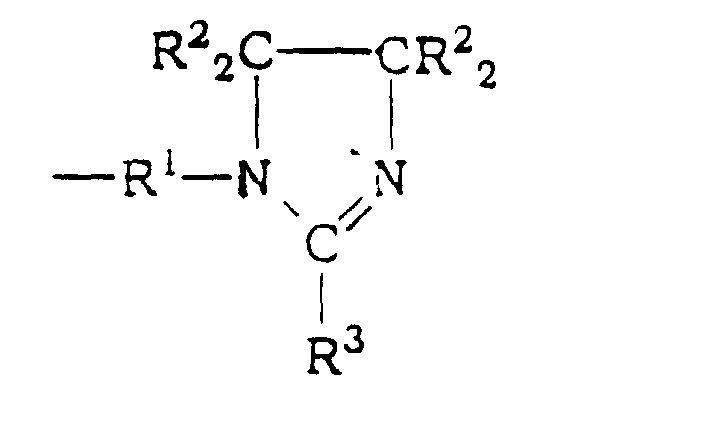
- the present invention provides an imidazolinyl-functional organosiloxane comprising from 2 to 1,100 siloxane units where at least one siloxane unit has an imidazolinyl radical of the following general formula bonded to silicon wherein R 1 is a C 1 to C 50 divalent hydrocarbon radical, each R 2 is selected from hydrogen atom or a C 1 to C 50 monovalent hydrocarbon radical, and R 3 is a C 2 to C 50 monovalent hydrocarbon radical with aliphatic unsaturation.
- the imidazolinyl-functional organosiloxanes of the present invention contains from 2 to 1,100 siloxane units where at least one siloxane unit has a imidazolinyl radical with the following general formula bonded to silicon.
- the radical R 1 is a C 1 to C 50 divalent hydrocarbon radical and is exemplified by alkylene radicals such as methylene, ethylene, propylene, and butylene, and by arylene radicals such as phenylene, tolylene, and xylylene.
- R 1 is preferably a C 1 to C 8 divalent hydrocarbon radical.
- Each of the radicals R 2 is hydrogen atom or an independently selected C 1 to C 50 monovalent hydrocarbon radical is selected specifically.
- R 2 is preferably hydrogen or a C 1 to C 8 monovalent hydrocarbon radical which is exemplified by methyl, ethyl, and propyl
- R 3 is a C 2 to C 50 aliphatically unsaturated monovalent hydrocarbon radical and is exemplified by vinyl, allyl, butenyl, heptadecenyl, and heptadecadienyl.
- R 3 is preferably a C 10 to C 20 monovalent hydrocarbon radical.
- Organosiloxanes where R 3 is a mixture of such C 10 to C 20 monovalent hydrocarbon radicals is most preferred.
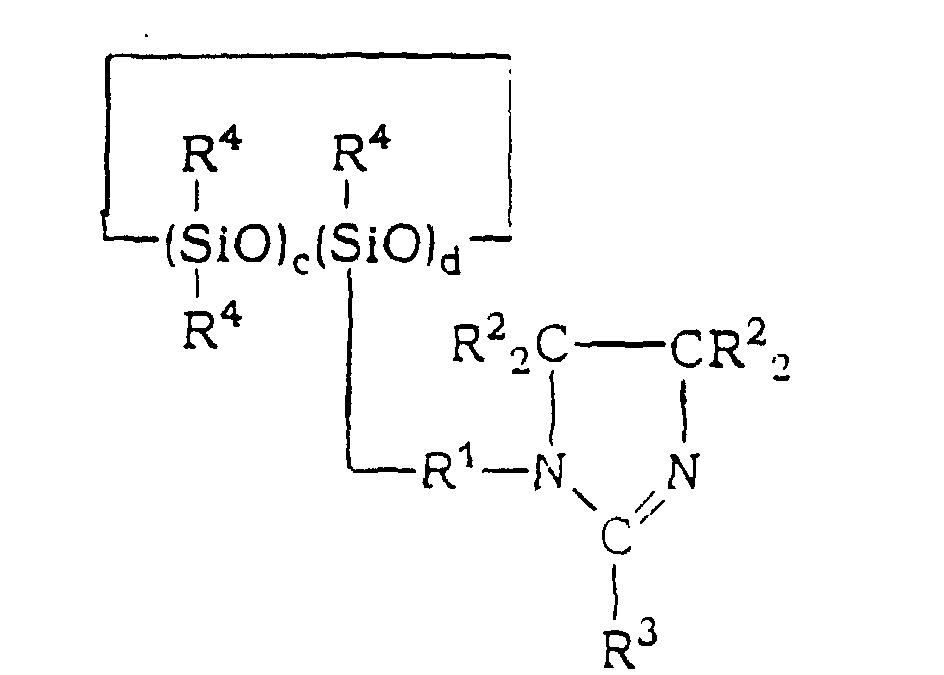
- the subject imidazolinyl-functional organosiloxanes are specifically exemplified by straight-chain organosiloxane with the general formula or by cyclic organosiloxane with the general formula wherein R 1 , R 2 , and R 3 are each defined as above.
- Each R 4 is independently selected from C 1 to C 50 monovalent hydrocarbon radicals. These are exemplified by alkyl radicals such as methyl, ethyl, and propyl or by aryl radicals such as phenyl, tolyl, and xylyl.
- R 4 is preferably a C 1 to C 8 monovalent hydrocarbon radical.
- Each R 5 is hydroxyl radical or an independent selection from C 1 to C 50 monovalent hydrocarbon radicals wherein said monovalent hydrocarbon radicals are exemplified by alkyl radicals such as methyl, ethyl, and propyl; by alkenyl radicals such as vinyl, allyl, and butenyl; and by aryl radicals such as phenyl, tolyl, and xylyl.
- R 5 is preferably hydroxyl radical or a C 1 to C 8 monovalent hydrocarbon radical.
- a and c each have values from 0 to 1,000
- b and d each have values from 1 to 100
- c + d is from 3 to 1,100.
- the preferred cyclic organosiloxanes are those in which c is from 0 to 30, d is from 1 to 30, and c + d is from 3 to 30.
- the imidazolinyl-functional organosiloxanes are specifically exemplified by organosiloxanes with the following formulas:
- the method for preparing our imidazolinyl-functional organosiloxanes is a dehydration reaction between (A) an amino-functional organosiloxane and (B) an aliphatically unsaturated monocarboxylic acid.
- straight chain imidazolinyl-functional organosiloxanes use as the starting siloxane
- (A) an amino-functional organosiloxane of the general formula Cyclic imidazolinyl-functional organosiloxanes use as the starting siloxanes
- the subject amino-functional organosiloxanes are synthesized, for example, by the alkali-catalyzed equilibration polymerization of such precursors as amino-functional cyclosiloxane and organo-cyclosiloxane using endblockers such as water and hexaalkyldi-siloxane where endblocking is desired.
- Amino-functional organosiloxanes of (A) encompass organosiloxanes exemplified by the following formulas:
- the carboxylic acid used as component (B) has the general formula R 3 COOH, wherein R 3 is a C 2 to C 50 aliphatically unsaturated monovalent hydrocarbon radical exemplified by vinyl, allyl, butenyl, heptadecenyl, and heptadecadienyl.
- the subject carboxylic acid is exemplified by acrylic acid, methacrylic acid, oleic acid, linoleic acid, linolenic acid, and ricinoleic acid; by drying oil fatty acids; and those obtained by the hydrolysis of a drying oil.
- Drying oil fatty acids are exemplified by soybean oil fatty acids, dehydrated castor oil fatty acids, tall oil fatty acids, linseed oil fatty acids, and tung oil fatty acids.
- the drying oil fatty acids are mixtures of carboxylic acids having the formula R 3 COOH and may also contain some saturated carboxylic acids as found in such drying oil hydrolysis products.
- the use of drying oil fatty acids is preferred when the imidazolinyl-functional organosiloxane of the present invention is used as an additive for modifying the surface of cured products from RTV organopolysiloxane compositions.
- the imidazolinyl-functional organosiloxanes are obtained by a dehydration reaction between components (A) and (B).
- Straight-chain amino-functional organosiloxanes are used as component (A) when straight-chain imidazolinyl-functional organosiloxanes are desired.
- Cyclic amino-functional organo-siloxanes are used as component (A) when cyclic imidazolinyl-functional organosiloxanes are used.
- the mixing ratio of components (A) and (B) in this method is preferably 0.5 mole of component (B) per 1 mole of amino group in component (A).
- Unreacted component (A) will remain when component (B) is used at less than 0.5 mole per 1 mole of amino group in component (A). While unreacted component (B) will remain when component (B) is used at more than 0.5 mole per 1 mole of amino group in component (A).
- the reaction temperature is preferably in the range from 100°C to 300°C, and more preferably in the range from 150°C to 250°C.
- the dehydration reaction does not go to completion at a reaction temperature below 100°C, which prevents synthesis of the imidazolinyl-functional organosiloxane. Undesirable secondary reactions become a possibility at temperatures in excess of 300°C.
- Organic solvent and dehydrating reagent may also be used in this preparative method insofar as the object of the present invention is not impaired. Toluene and xylene, which are already known for azeotropic dehydration, are advantageously used as an organic solvent. They are used in an amount that gives a reaction temperature in the range specified above.
- the dehydrating reagent is exemplified by molecular sieves and dicyclohexylcarbodiimide.
- imidazolinyl-functional organosiloxanes are miscible with organopolysiloxane to make RTV organopoly-siloxane compositions, they are useful as an additive for improving the physical properties of room-temperature curable organopoly-siloxane compositions. They are particularly useful as an additive for improving the surface of cured products obtained from room-temperature curable organopolysiloxane compositions.
- the aliphatic unsaturation of R 3 in the imidazolinyl radical provides the anti-staining property of any RTV silicone composition containing it as an additive.
- This anti-staining property is believed to be based on the ease of oxidation and hydrolytic cleavage attributed to R 3 which provides hydrophilicity to the surface of cured, RTV silicone-sealant compositions.
- This hydrophilicity is achieved by the hydrolytic cleavage of the oxidized aliphatically unsaturated monovalent hydrocarbon radical R 3 . If a saturated monovalent hydrocarbon radical were to replace R 3 and such a imidazolinyl-functional organosiloxane were used as an additive to an RTV silicone-sealant composition, a hydrophilic surface is not formed on the resulting cured, RTV silicone-sealant surface and a self-cleaning and anti-staining property is also not observed.
- the dehydration reaction was completed by stirring for 4.6 hours at 160°C to 179°C, after which interval 2.0 ml of water had distilled into the water-measurement tube.
- the resulting reaction mixture was then cooled to room temperature, combined with 20 g of filtration aid (RadioliteTM 900 from Showa Kagaku Kogyo Kabushiki Kaisha, Tokyo, Japan) and 146.3 g toluene, stirred for 30 minutes, and finally subjected to fine filtration.
- filtration aid RadioliteTM 900 from Showa Kagaku Kogyo Kabushiki Kaisha, Tokyo, Japan
- the -C 17 H 31 - radical shown in the above formula represents the reacted residue from the Hy-dieneTM acid mixture as determined from the molecular weight.
- reaction mixture was then cooled to room temperature, combined with 5 g of filtration aid (Radiolite 900TM) and 10 g of toluene, stirred for 30 minutes, and finally subjected to fine filtration.
- the solvent in the filtrate was stripped off at 70°C and 4.0 kPa (30 mmHg) for 1 hour and then at 72°C and 1.1 kPa (8 mmHg) to 80°C and 1.3 kPa (10 mmHg) for 2 hours to give 11.1 g of a straight-chain imidazolinyl-functional organosiloxane with the following formula:
- the -C 17 H 31 - radical shown in the above formula represents the reacted residue from the soybean fatty acid mixture as determined from the molecular weight.
- This mixed fatty acid was subsequently added dropwise over 2.2 hours at 145°C to 154°C into the mixture of cyclic amino-functional organosiloxane and xylene.
- the dehydration reaction was completed by stirring for 5.3 hours at 154°C to 190°C, after which interval 18.0 mL of water had distilled into the water-measurement tube.
- the resulting reaction mixture was then cooled to room temperature, combined with 20 g filtration aid (Radiolite 900TM) and 122.8 g of toluene, stirred for 30 minutes, and finally subjected to fine filtration.
- a room-temperature curable organopolysiloxane composition 15 g of the imidazolinyl-functional organosiloxane prepared in Example 1, 85 g of alpha,omega-dihydroxypolydimethylsiloxane with a viscosity at 25°C of 18 Pa.s, 100 g of precipitated calcium carbonate, 0.3 g of dibutyltin octoate, 1 g of surfactant, and 16.3 g of methyltris(methyl ethyl ketoxime)silane.
Landscapes
- Chemical & Material Sciences (AREA)
- Organic Chemistry (AREA)
- Health & Medical Sciences (AREA)
- Chemical Kinetics & Catalysis (AREA)
- Medicinal Chemistry (AREA)
- Polymers & Plastics (AREA)
- General Chemical & Material Sciences (AREA)
- Silicon Polymers (AREA)
Claims (8)
- Organosiloxane à fonction imidazolinyle, comprenant de 2 à 1 100 unités siloxanes, au moins une unité siloxane ayant un radical imidazolinyle de la formule générale suivante lié au siliciumdans laquelle R1 est un radical hydrocarboné divalent en C1 à C50, chaque R2 est choisi parmi l'atome d'hydrogène et un radical hydrocarboné monovalent en C1 à C50, et R3 est un radical hydrocarboné monovalent en C2 à C50 ayant une insaturation aliphatique.
- Organosiloxane à fonction imidazolinyle selon la revendication 1, l'organosiloxane ayant la formule générale suivantedans laquelle R1, R2 et R3 sont tels que définis dans la revendication 1, chaque R4 est un radical hydrocarboné monovalent en C1 à C50, chaque R5 est choisi parmi le radical hydroxyle et un radical hydrocarboné monovalent en C1 à C50, a est de 0 à 1 000, et b est de 1 à 100.

- Organosiloxane à fonction imidazolinyle selon la revendication 2, dans lequel R1 est un radical hydrocarboné divalent en C1 à C8, R2 est un atome d'hydrogène, R3 est un radical hydrocarboné monovalent en C10 à C20 ayant une insaturation aliphatique ou un mélange de ceux-ci, R4 est un radical hydrocarboné monovalent en C1 à C8, et R5 est un radical hydroxyle ou un radical hydrocarboné monovalent en C1 à C8.
- Organosiloxane à fonction imidazolinyle selon la revendication 3, dans lequel R1 est C3H6-, R3 est -C17H31-, R4 et R5 sont des radicaux méthyle.
- Organosiloxane à fonction imidazolinyle selon la revendication 1, dans lequel le siloxane a la formule générale suivantedans laquelle R1, R2 et R3 sont tels que définis dans la revendication 1, chaque R4 est un radical hydrocarboné monovalent en C1 à C50, c est de 0 à 1 000, d est de 1 à 100, et c + d est de 3 à 1 100.
- Organosiloxane à fonction imidazolinyle selon la revendication 5, dans lequel R1 est un radical hydrocarboné divalent en C1 à C8, R2 est un atome d'hydrogène, R3 est un radical hydrocarboné monovalent en C10 à C20 ayant une insaturation aliphatique ou un mélange de ceux-ci, R4 est un radical hydrocarboné monovalent en C1 à C8, c est 0 à 30, d est 3 à 30, et c + d est de 3 à 30.
- Organosiloxane à fonction imidazolinyle selon la revendication 5, dans lequel R1 est C3H6-, R3 est un mélange de -C17H31-, R4 est un radical méthyle et R5 est un radical méthyle.
- Procédé pour la préparation d'un organosiloxane à fonction imidazolinyle, comprenant une réaction de déshydratation entre(A) un organosiloxane à fonction amino ayant la formule généraledans laquelle R1 est un radical hydrocarboné divalent en C1 à C50, chaque R2 est choisi parmi un atome d'hydrogène et un radical hydrocarboné monovalent en C1 à C50, chaque R4 est un radical hydrocarboné monovalent en C1 à C50, chaque R5 est choisi parmi un radical hydroxyle et un radical hydrocarboné monovalent en C1 à C50, a est de 0 à 1 000 et b est de 1 à 100

ou un organosiloxane à fonction amino ayant la formule généraledans laquelle R1, R2 et R4 sont tels que définis ci-dessus, c est de 0 à 1 000, d est de 1 à 100, et c + d est de 3 à 1 100 et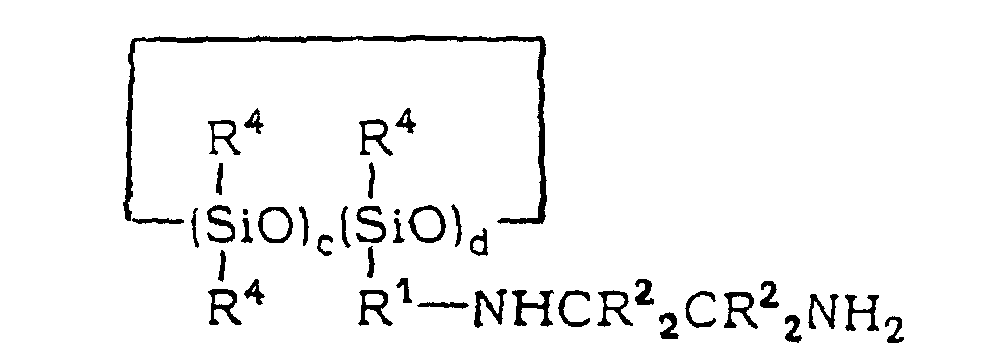 (B) un acide carboxylique ayant la formule générale R3COOH où R3 est un radical hydrocarboné monovalent en C2 à C50 ayant une insaturation aliphatique.
Applications Claiming Priority (2)
| Application Number | Priority Date | Filing Date | Title |
|---|---|---|---|
| JP261954/94 | 1994-09-30 | ||
| JP6261954A JPH08104756A (ja) | 1994-09-30 | 1994-09-30 | イミダゾリニル基含有オルガノポリシロキサンおよびその製造方法 |
Publications (2)
| Publication Number | Publication Date |
|---|---|
| EP0707029A1 EP0707029A1 (fr) | 1996-04-17 |
| EP0707029B1 true EP0707029B1 (fr) | 1998-10-21 |
Family
ID=17368974
Family Applications (1)
| Application Number | Title | Priority Date | Filing Date |
|---|---|---|---|
| EP95306899A Expired - Lifetime EP0707029B1 (fr) | 1994-09-30 | 1995-09-29 | Organopolysiloxanes ayant des groupes imidazolinyles et procédé pour leur préparation |
Country Status (6)
| Country | Link |
|---|---|
| US (1) | US5580943A (fr) |
| EP (1) | EP0707029B1 (fr) |
| JP (1) | JPH08104756A (fr) |
| KR (1) | KR960010724A (fr) |
| DE (1) | DE69505480T2 (fr) |
| TW (1) | TW344748B (fr) |
Families Citing this family (8)
| Publication number | Priority date | Publication date | Assignee | Title |
|---|---|---|---|---|
| JPH08127721A (ja) * | 1994-10-28 | 1996-05-21 | Toray Dow Corning Silicone Co Ltd | 室温硬化性オルガノポリシロキサン組成物 |
| KR100480666B1 (ko) * | 2001-08-14 | 2005-04-06 | 한국화학연구원 | 기능기를 갖는 규소 화합물 및 이를 이용하여 무기 고체의표면을 개질하는 방법 |
| EP2970715B1 (fr) * | 2013-03-15 | 2016-10-26 | Dow Corning Corporation | Compositions de silicone à fonction 2-amino-imidazole et procédés pour les préparer |
| DE102013219046A1 (de) | 2013-09-23 | 2015-03-26 | Rudolf Gmbh | Polysiloxane mit quaternierten heterocyclischen Gruppen |
| EP3154688B1 (fr) * | 2014-06-16 | 2021-08-11 | Sika Technology AG | Catalyseur de réticulation à motifs constitutifs siloxane |
| WO2018190815A1 (fr) * | 2017-04-12 | 2018-10-18 | GE Oil & Gas, Inc. | Compositions d'absorbant comprenant des aminosiloxanes |
| US12043638B2 (en) * | 2017-09-22 | 2024-07-23 | 3M Innovative Properties Company | Cyclic siloxanes, compositions, methods, and articles |
| JP2026013810A (ja) * | 2024-07-18 | 2026-01-29 | 信越化学工業株式会社 | 含窒素複素環基を有する反応性ポリオルガノシロキサン |
Family Cites Families (13)
| Publication number | Priority date | Publication date | Assignee | Title |
|---|---|---|---|---|
| US3373137A (en) * | 1962-05-18 | 1968-03-12 | Dow Corning | Nitrogen-containing organosilicon compounds and their preparation |
| NL129648C (fr) * | 1965-03-18 | 1900-01-01 | ||
| US3408361A (en) * | 1967-04-05 | 1968-10-29 | Hans S. Mannheimer | Methods for producing imidazolines and derivatives thereof |
| DE2420851C2 (de) * | 1974-04-30 | 1982-05-19 | Dynamit Nobel Ag, 5210 Troisdorf | Verfahren zur Verbesserung der Haftung zwischen anorganischen, oxidischen und/oder metallischen Oberflächen und organischen Bindemitteln unter Verwendung von organofunktionellen Siliciumverbindungen |
| IT1035489B (it) * | 1974-04-30 | 1979-10-20 | Dynamit Nobel Ag | Silani organo funzionali con struttura ad anello contenente azoto e procedimento per la loro produzione |
| US4467063A (en) * | 1983-04-01 | 1984-08-21 | General Electric Company | One package, stable, moisture curable, alkoxy-terminated organopolysiloxane compositions |
| US4507455A (en) * | 1984-05-11 | 1985-03-26 | Dow Corning Corporation | Silicones bearing acylated diaminohydrocarbyl radicals and method therefor |
| US4604443A (en) * | 1985-04-30 | 1986-08-05 | Ppg Industries, Inc. | Partial hydrolyzates containing hydrolyzable moieties from organosilane compounds |
| FR2603893B1 (fr) * | 1986-09-11 | 1988-12-09 | Rhone Poulenc Chimie | Composition diorganopolysiloxane durcissable en elastomere autoadherent |
| DE3719086C1 (de) * | 1987-06-06 | 1988-10-27 | Goldschmidt Ag Th | Diquartaere Polysiloxane,deren Herstellung und Verwendung in kosmetischen Zubereitungen |
| FR2621923A1 (fr) * | 1987-10-20 | 1989-04-21 | Rhone Poulenc Chimie | Composition organopolysiloxane a fonction cetiminoxy comportant un hydrogel comme agent de durcissement |
| US4874868A (en) * | 1988-03-16 | 1989-10-17 | The Procter & Gamble Company | Volatile silicons |
| US5084577A (en) * | 1988-03-16 | 1992-01-28 | The Procter & Gamble Company | Volatile silicon compounds |
-
1994
- 1994-09-30 JP JP6261954A patent/JPH08104756A/ja active Pending
-
1995
- 1995-09-28 US US08/535,393 patent/US5580943A/en not_active Expired - Fee Related
- 1995-09-29 EP EP95306899A patent/EP0707029B1/fr not_active Expired - Lifetime
- 1995-09-29 DE DE69505480T patent/DE69505480T2/de not_active Expired - Fee Related
- 1995-09-30 TW TW084110230A patent/TW344748B/zh active
- 1995-09-30 KR KR1019950034046A patent/KR960010724A/ko not_active Abandoned
Also Published As
| Publication number | Publication date |
|---|---|
| EP0707029A1 (fr) | 1996-04-17 |
| TW344748B (en) | 1998-11-11 |
| DE69505480D1 (de) | 1998-11-26 |
| JPH08104756A (ja) | 1996-04-23 |
| KR960010724A (ko) | 1996-04-20 |
| US5580943A (en) | 1996-12-03 |
| DE69505480T2 (de) | 1999-06-10 |
Similar Documents
| Publication | Publication Date | Title |
|---|---|---|
| US6127502A (en) | Polyorganosiloxanes having at least one organofunctional group with multiple hydrolyzable groups | |
| CN113166474B (zh) | 反应性硅氧烷 | |
| US4616076A (en) | Organopolysiloxane compounds containing sic-bonded alkoxysilylalkyl and polyoxyalkylene radicals | |
| US5354830A (en) | Vulcanizable one-component polysiloxanes | |
| US5540952A (en) | Non-yellowing textile softening process in which a composition comprising a polyorganosiloxane is used | |
| US4697026A (en) | Acryl functional silicone compounds | |
| US3317460A (en) | Hydroxyorganosiloxanes and copolymers | |
| EP0707029B1 (fr) | Organopolysiloxanes ayant des groupes imidazolinyles et procédé pour leur préparation | |
| US5670686A (en) | Alkyl substituted siloxanes and alkyl substituted polyether fluids | |
| US2924588A (en) | Organosiloxane alcohols | |
| EP0849307B1 (fr) | Composés organosiliciques, ioniques, leur préparation et leur utilisation | |
| KR0152308B1 (ko) | 친수기함유 오르가노폴리실록산 및 그 제조방법 | |
| US5475076A (en) | Organo(poly)siloxane compositions which can be cross-linked to give elastomers with elimination of alcohols | |
| US4554338A (en) | Room temperature vulcanizable organopolysiloxane compositions and method for making | |
| US4530989A (en) | Room temperature stable organopolysiloxane compositions | |
| US5036114A (en) | Acrylamide polysiloxane composition with improved heat stability | |
| US4849461A (en) | Acryl functional silicone compounds | |
| DE1495507A1 (de) | Organosiliciumverbindungen mit primaere Hydroxylgruppen enthaltenden organischen Resten und Verfahren zu ihrer Herstellung | |
| US3065202A (en) | Preparation of carbalkoxyalkylcontaining organopolysiloxanes | |
| CA1267991A (fr) | Organopolysiloxanes stabilises, et procede de stabilisation pertinent | |
| US5840805A (en) | Room-temperature-curable organopolysiloxane compositions | |
| US3464955A (en) | Carbalkoxyalkyl-containing organopolysiloxanes | |
| EP0491482A1 (fr) | Compositions de silicone, vulcanizables à température ambiante, avec un module d'élasticité amélioré | |
| CA1284849C (fr) | Compositions d'etancheite a auto-etalement, a base de silicone, et leur fabrication | |
| US4780501A (en) | Imidopolysiloxanes and method for making |
Legal Events
| Date | Code | Title | Description |
|---|---|---|---|
| PUAI | Public reference made under article 153(3) epc to a published international application that has entered the european phase |
Free format text: ORIGINAL CODE: 0009012 |
|
| AK | Designated contracting states |
Kind code of ref document: A1 Designated state(s): DE FR GB IT |
|
| 17P | Request for examination filed |
Effective date: 19960612 |
|
| GRAG | Despatch of communication of intention to grant |
Free format text: ORIGINAL CODE: EPIDOS AGRA |
|
| 17Q | First examination report despatched |
Effective date: 19980213 |
|
| GRAG | Despatch of communication of intention to grant |
Free format text: ORIGINAL CODE: EPIDOS AGRA |
|
| GRAH | Despatch of communication of intention to grant a patent |
Free format text: ORIGINAL CODE: EPIDOS IGRA |
|
| GRAH | Despatch of communication of intention to grant a patent |
Free format text: ORIGINAL CODE: EPIDOS IGRA |
|
| GRAA | (expected) grant |
Free format text: ORIGINAL CODE: 0009210 |
|
| AK | Designated contracting states |
Kind code of ref document: B1 Designated state(s): DE FR GB IT |
|
| REF | Corresponds to: |
Ref document number: 69505480 Country of ref document: DE Date of ref document: 19981126 |
|
| ITF | It: translation for a ep patent filed | ||
| ET | Fr: translation filed | ||
| PLBE | No opposition filed within time limit |
Free format text: ORIGINAL CODE: 0009261 |
|
| STAA | Information on the status of an ep patent application or granted ep patent |
Free format text: STATUS: NO OPPOSITION FILED WITHIN TIME LIMIT |
|
| 26N | No opposition filed | ||
| PGFP | Annual fee paid to national office [announced via postgrant information from national office to epo] |
Ref country code: GB Payment date: 20010806 Year of fee payment: 7 Ref country code: DE Payment date: 20010806 Year of fee payment: 7 |
|
| PGFP | Annual fee paid to national office [announced via postgrant information from national office to epo] |
Ref country code: FR Payment date: 20010807 Year of fee payment: 7 |
|
| REG | Reference to a national code |
Ref country code: GB Ref legal event code: IF02 |
|
| PG25 | Lapsed in a contracting state [announced via postgrant information from national office to epo] |
Ref country code: GB Free format text: LAPSE BECAUSE OF NON-PAYMENT OF DUE FEES Effective date: 20020929 |
|
| PG25 | Lapsed in a contracting state [announced via postgrant information from national office to epo] |
Ref country code: DE Free format text: LAPSE BECAUSE OF NON-PAYMENT OF DUE FEES Effective date: 20030401 |
|
| GBPC | Gb: european patent ceased through non-payment of renewal fee |
Effective date: 20020929 |
|
| PG25 | Lapsed in a contracting state [announced via postgrant information from national office to epo] |
Ref country code: FR Free format text: LAPSE BECAUSE OF NON-PAYMENT OF DUE FEES Effective date: 20030603 |
|
| REG | Reference to a national code |
Ref country code: FR Ref legal event code: ST |
|
| PG25 | Lapsed in a contracting state [announced via postgrant information from national office to epo] |
Ref country code: IT Free format text: LAPSE BECAUSE OF NON-PAYMENT OF DUE FEES;WARNING: LAPSES OF ITALIAN PATENTS WITH EFFECTIVE DATE BEFORE 2007 MAY HAVE OCCURRED AT ANY TIME BEFORE 2007. THE CORRECT EFFECTIVE DATE MAY BE DIFFERENT FROM THE ONE RECORDED. Effective date: 20050929 |