EP0707084A1 - Hochfeste beryllium-kupfer-legierung mit guter bearbeitbarkeit und wärmebeständigkeit und deren herstellung - Google Patents
Hochfeste beryllium-kupfer-legierung mit guter bearbeitbarkeit und wärmebeständigkeit und deren herstellung Download PDFInfo
- Publication number
- EP0707084A1 EP0707084A1 EP95903991A EP95903991A EP0707084A1 EP 0707084 A1 EP0707084 A1 EP 0707084A1 EP 95903991 A EP95903991 A EP 95903991A EP 95903991 A EP95903991 A EP 95903991A EP 0707084 A1 EP0707084 A1 EP 0707084A1
- Authority
- EP
- European Patent Office
- Prior art keywords
- weight
- temperature
- aging
- strength
- heat resistance
- Prior art date
- Legal status (The legal status is an assumption and is not a legal conclusion. Google has not performed a legal analysis and makes no representation as to the accuracy of the status listed.)
- Granted
Links
- 229910000881 Cu alloy Inorganic materials 0.000 title claims abstract description 22
- DMFGNRRURHSENX-UHFFFAOYSA-N beryllium copper Chemical compound [Be].[Cu] DMFGNRRURHSENX-UHFFFAOYSA-N 0.000 title claims abstract description 22
- 238000004519 manufacturing process Methods 0.000 title claims description 5
- 230000032683 aging Effects 0.000 claims abstract description 58
- 239000000463 material Substances 0.000 claims abstract description 40
- 229910000765 intermetallic Inorganic materials 0.000 claims abstract description 21
- 229910045601 alloy Inorganic materials 0.000 claims abstract description 9
- 239000000956 alloy Substances 0.000 claims abstract description 9
- 238000001816 cooling Methods 0.000 claims description 29
- 239000000203 mixture Substances 0.000 claims description 18
- 239000010419 fine particle Substances 0.000 claims description 12
- 239000010949 copper Substances 0.000 claims description 8
- 229910052759 nickel Inorganic materials 0.000 claims description 7
- 238000005482 strain hardening Methods 0.000 claims description 3
- 238000001556 precipitation Methods 0.000 abstract description 7
- 239000006104 solid solution Substances 0.000 abstract description 6
- 230000007423 decrease Effects 0.000 abstract description 4
- 230000003247 decreasing effect Effects 0.000 abstract description 3
- 238000004881 precipitation hardening Methods 0.000 abstract 1
- 238000005452 bending Methods 0.000 description 31
- 239000000243 solution Substances 0.000 description 19
- 230000035882 stress Effects 0.000 description 15
- 238000011156 evaluation Methods 0.000 description 11
- 238000002360 preparation method Methods 0.000 description 10
- 239000000047 product Substances 0.000 description 9
- 238000010438 heat treatment Methods 0.000 description 8
- 238000005728 strengthening Methods 0.000 description 6
- 238000005096 rolling process Methods 0.000 description 4
- 230000000052 comparative effect Effects 0.000 description 3
- 230000007246 mechanism Effects 0.000 description 3
- 239000002244 precipitate Substances 0.000 description 3
- 230000008859 change Effects 0.000 description 2
- 230000006872 improvement Effects 0.000 description 2
- 238000000034 method Methods 0.000 description 2
- 238000010791 quenching Methods 0.000 description 2
- 230000000171 quenching effect Effects 0.000 description 2
- 230000001105 regulatory effect Effects 0.000 description 2
- 238000012360 testing method Methods 0.000 description 2
- RYGMFSIKBFXOCR-UHFFFAOYSA-N Copper Chemical compound [Cu] RYGMFSIKBFXOCR-UHFFFAOYSA-N 0.000 description 1
- 229910000624 NiAl3 Inorganic materials 0.000 description 1
- 229910005883 NiSi Inorganic materials 0.000 description 1
- 239000002131 composite material Substances 0.000 description 1
- 150000001875 compounds Chemical class 0.000 description 1
- 238000007796 conventional method Methods 0.000 description 1
- 229910052802 copper Inorganic materials 0.000 description 1
- 238000004090 dissolution Methods 0.000 description 1
- 230000002431 foraging effect Effects 0.000 description 1
- 230000007774 longterm Effects 0.000 description 1
- 238000005259 measurement Methods 0.000 description 1
- 239000003595 mist Substances 0.000 description 1
- 230000009467 reduction Effects 0.000 description 1
- 238000005476 soldering Methods 0.000 description 1
- XLYOFNOQVPJJNP-UHFFFAOYSA-N water Substances O XLYOFNOQVPJJNP-UHFFFAOYSA-N 0.000 description 1
Images
Classifications
-
- C—CHEMISTRY; METALLURGY
- C22—METALLURGY; FERROUS OR NON-FERROUS ALLOYS; TREATMENT OF ALLOYS OR NON-FERROUS METALS
- C22C—ALLOYS
- C22C9/00—Alloys based on copper
- C22C9/01—Alloys based on copper with aluminium as the next major constituent
-
- C—CHEMISTRY; METALLURGY
- C22—METALLURGY; FERROUS OR NON-FERROUS ALLOYS; TREATMENT OF ALLOYS OR NON-FERROUS METALS
- C22C—ALLOYS
- C22C9/00—Alloys based on copper
-
- C—CHEMISTRY; METALLURGY
- C22—METALLURGY; FERROUS OR NON-FERROUS ALLOYS; TREATMENT OF ALLOYS OR NON-FERROUS METALS
- C22C—ALLOYS
- C22C9/00—Alloys based on copper
- C22C9/06—Alloys based on copper with nickel or cobalt as the next major constituent
-
- C—CHEMISTRY; METALLURGY
- C22—METALLURGY; FERROUS OR NON-FERROUS ALLOYS; TREATMENT OF ALLOYS OR NON-FERROUS METALS
- C22F—CHANGING THE PHYSICAL STRUCTURE OF NON-FERROUS METALS AND NON-FERROUS ALLOYS
- C22F1/00—Changing the physical structure of non-ferrous metals or alloys by heat treatment or by hot or cold working
- C22F1/08—Changing the physical structure of non-ferrous metals or alloys by heat treatment or by hot or cold working of copper or alloys based thereon
Definitions
- the present invention relates to beryllium-copper alloys used as electrically conductive spring materials for lead frames, terminals, connectors, relays, switches, jacks and the like, of which such properties as strength, workability and stress-relaxation are important, and a method for producing the same.
- Beryllium-copper alloys containing 0.2 to 0.3 % by weight of Be in copper have been known heretofore as electrically conductive spring materials and disclosed in Japanese Patent Examined Publication No. 4-53936 by the present applicant.
- beryllium-copper alloys there are aging materials of which an aging treatment is performed by users, and mill-hardened materials of which aging treatment have been applied before shipping.
- the stress-relaxation ratio is a value indicating reduction of spring properties for a long period of time and the measuring method thereof is regulated in EMAS (Japan Electronic Manufacturers Association Standard)-3003 as "Testing Method of Stress-Relaxation by Bending of Spring Materials".
- EMAS Joint Electronic Manufacturers Association Standard
- the stress-relaxation is defined as a phenomenon that the stress generated in materials under a constant strain decreases slowly with a lapse of time.
- the present invention contemplates to solve the above-mentioned conventional problems advantageously. It is an object of the invention to provide a beryllium-copper alloy which is excellent in strength as a matter of course, which can be used as an aging material having a wide tolerance of the aging treatment conditions, i.e., flexible treatment conditions so as to reduce the burden at the user end by making deformation at the aging treatment difficult, and which can be also used as a mill-hardened material having excellent workability and heat resistance. It is a further object of the invention to provide an advantageous method for producing the same.
- a beryllium-copper alloy excellent in strength, workability and heat resistance having a composition containing Be: 0.5 to 1.5 % by weight, at least one member selected from the group of Ni and Co: 0.3 to 1.5 % by weight, at least one member selected from the group of Si and Al: 0.5 to 2.5 % by weight, and the balance being substantially Cu, said alloy containing as an intermetallic compound NiBe or/and CoBe in the range of 0.20 to 0.90 % by weight, and at least 45 % thereof being present as fine particles having a diameter of 0.1 ⁇ m or less.
- the present invention provides a method for producing a beryllium-copper alloy which is excellent in strength, workability and heat resistance, and which comprises subjecting to hot working and subsequent cold working a cast material having a composition containing Be: 0.5 to 1.5 % by weight, at least one member selected from the group of Ni and Co: 0.3 to 1.5 % by weight, at least one member selected from the group of Si and Al: 0.5 to 2.5 % by weight, and the balance being substantially Cu, subsequently subjecting the material to a solution treatment at a temperature of 800°C or higher, cooling at a rate of 20°C/s or more between the temperature range of at least 800°C to 600°C, subsequently subjecting the material to finishing working of 5 to 40 %, and then applying aging treatment to the material at a temperature of 300 to 460°C.
- heat resistance that is, a heat treatment deformation amount, a deformed amount (change in warpage amount) of a material before and after aging treatment of a material having a size of 20 mm x 20 mm, and a plate thickness of 0.3 mm should be 10 ⁇ m or less.
- flexibility of the heat treatment conditions in accordance with the present invention should be such that a fluctuation of a tensile strength is within the range of ⁇ 8 kgf/mm2 even when optional aging conditions are selected.
- the first characteristic feature of the beryllium-copper alloy of the present invention resides in that, in order to reduce deformation due to heat treatment, the content of Be is made 1.5 % by weight or less which is markedly reduced as compared with the conventional beryllium-copper alloy. Nevertheless, when the content of Be is less than 0.5 % by weight, strength is insufficient since a strengthening mechanism is not effective. Accordingly, in the present invention, the content of Be is limited in the range of 0.5 to 1.5 % by weight. Incidentally, more preferred range of Be is 0.7 to 1.3 % by weight, and further preferred range is 0.9 to 1.1 % by weight.
- the second characteristic feature of the beryllium-copper alloy of the present invention resides in that lowering in strength accompanied by decreasing the content of Be as mentioned above is compensated by composite addition of Si, Al and Ni, Co.
- Si and Al are each dissolved in the Cu mother phase as a solid solution and contribute to improvement in strength by solid solution strengthening mechanism.
- strength and workability are insufficient
- conductivity, rolling workability and soldering property are lowered and also deformation due to heat treatment is promoted.
- Al and Si are to be contained in the range of 0.5 to 2.5 % by weight in either case of single use or in combination. More preferred range is 1.0 to 2.5 % by weight, and further preferred range is 1.5 to 2.5 % by weight.
- Ni and Co These precipitate in the Cu mother phases an intermetallic compound such as NiBe or CoBe, etc., and contribute to improvement in strength due to their precipitation strengthening mechanisms. And yet, by precipitation of such an intermetallic compound, heat resistance, etc. are also improved.
- Ni and Co should be contained in the range of 0.3 to 1.5 % by weight in either case of single use or in combination. More preferred range is 0.3 to 1.1 % by weight, and further preferred range is 0.3 to 0.7 % by weight.
- the amount of NiBe, CoBe intermetallic compounds to be precipitated is in the range of 0.20 to 0.90 % by weight.
- the reason is that when the content is less than 0.20 % by weight, sufficient strength cannot be obtained, while when it exceeds 0.90 % by weight, bending workability is markedly lowered and heat resistance is also lowered.
- more preferred amount of the intermetallic compound mainly comprising NiBe and CoBe is in the range of 0.20 to 0.60 % by weight when it is used as a mill-hardened material, whereas it is in the range of 0.30 to 0.75 % by weight when it is provided as an aging material.
- a size of the precipitate i.e., a grain size is important. The reason is that even when the content of the intermetallic compounds satisfy the above-mentioned preferred range, if the ratio of grains exceeding 0.1 ⁇ m is large, cracks will likely caused at working based on such coarse grains.
- the intermetallic compound at least 45 % of the compound should be contained as fine particles with a diameter of 0.1 ⁇ m or less.
- an intermetallic compound such as NiAl3, NiSi, etc. are also included in a little amount.
- Fe, Ti, Cr, etc. may be added as a sub-component in the range of 0.05 to 0.5 % by weight. These are components each of which contributes to improve strength, and particularly, Fe and Si are components which also contribute to improve workability.
- the third characteristic feature of the beryllium-copper alloy of the present invention resides in that heat treatment conditions are made flexible.
- the reason is that the precipitation temperature of NiBe or CoBe has an extremely wide temperature range of 300 to 460°C, and the treatment time also has extremely wide range of 15 minutes to 6 hours. And yet, even when in such wider treatment conditions, the variation range of tensile strength can be made within the range of ⁇ 8 kgf/mm2.
- the alloy of the present invention has essentially good hot workability and cool workability as long as it satisfies the above-mentioned composition range of the components.
- a solution treatment is carried out in order that elements forming intermetallic compounds such as NiBe, CoBe, etc. are sufficiently dissolved in the mother phase as a solid solution.
- the treatment temperature is less than 880°C, dissolution of elements forming intermetallic compounds into the alloy becomes insufficient and bending workability of the product becomes poor, so that it is necessary to set the solution treatment temperature as 880°C or higher.
- the alloy is cooled to normal temperature.
- the temperature range of 800 to 600°C is a range in which intermetallic compounds such as NiBe, CoBe, etc., are likely precipitated with a coarse grain.
- the cooling rate is slower than 20°C/s, most part of the intermetallic compounds precipitates as coarse grains, and as a result, precipitation of fine grains with a sufficient amount in the subsequent aging treatment cannot be expected. Such coarse grains make workability poor.
- the cooling should be carried out at a rate of 20°C/s or more for at least the temperature range of 800 to 600°C. More preferably, it is 40°C/s or more.
- the above-mentioned quenching treatment after the solution treatment is not limited only to the temperature range of 800 to 600°C, but it is needless to say that the same quenching treatment thereafter, for example, until at room temperature, is advantageous for maintaining a sufficient amount of solid solution of the elements for forming an intermetallic compound.
- cooling means any means are effective as long as the above-mentioned cooling rate can be ensured, and it is not particularly limited.
- water cooling, mist cooling, gas cooling, etc. are particularly advantageously adopted.
- finishing work is carried out to finish the alloy to a shape of a product.
- the working ratio is less than 5 %, sufficient strength cannot be obtained, while if it exceeds 40 %, bending workability deteriorates so that the working ratio is limited to the range of 5 to 40 %. More preferred working ratio is 10 to 20 %.
- the aging temperature when the aging temperature is less than 300°C, sufficient strength cannot be obtained or, even when obtained, bending workability deteriorates. On the other hand, if it exceeds 460°C, bending workability also deteriorates. Thus, it is necessary to set the aging temperature in a range of 300 to 460°C. Also, the aging time can be selected from a wide range of 15 min to 6 hours. More preferred aging treatment conditions are the temperature of 320 to 380°C and the time of 20 min to 3 hours, and further preferred treatment conditions are the temperature of 330 to 360°C and the time of 1 to 3 hours.
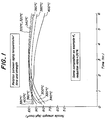
- Fig. 1 is a graph showing the relationship between aging treatment time and tensile strength of the obtained product, with an aging treatment temperature as a parameter.
- This example relates to mill-hardened materials, in which cast pieces of beryllium-copper alloys having the compositions each shown in Tables 1 to 7 were subjected to solution treatment, finishing working and then aging treatment under the conditions shown in these Tables to prepare products.
- the directions of bending were made parallel direction (0°) and perpendicular direction (90°) to the direction of rolling, and expressed by o: no rough, ⁇ : a little rough, ⁇ : markedly rough, X: cracks, and XX: rupture.
- the stress relaxation ratio (permanent deformation amount) was obtained by the measure using the cantilever beam method at the time of loading the stress of 80 % or less of 0.2 % proof stress at 200°C for 100 hours.
- This example relates to aging materials, in which cast pieces of beryllium-copper alloys having the compositions each shown in Tables 8 to 12 were subjected to solution treatment, finishing working and then aging treatment under the conditions shown in said Tables to prepare products.
- An alloy cast piece comprising the composition containing 0.8 % by weight of Be, 0.8 % by weight of Ni, 0.07 % by weight of Co and 1.0 % by weight of Al, and the balance being substantially Cu was subjected to hot working and then cold working according to conventional method. After solution treatment at 910°C, the cast piece was immediately cooled to room temperature at a rate of 40°C/s. Then, after subjecting the cast piece to finishing working with a working ratio of 20 %, aging treatment was carried out with various conditions.
- the beryllium-copper alloy of the present invention is advantageous in that it has high strength and excellent bending workability, and yet deformation amount at heat treatment is small even though the contents of expensive Be is lowered than conventional products.
- the beryllium-copper alloy of the present invention has wide tolerable aging treatment conditions, and as shown in Fig. 1, when it is within the temperature range of 320 to 380°C, even if the aging treatment time is substantially changed in the range of 15 minutes to 6 hours, change in tensile strength can be regulated within the range of ⁇ 8 kgf/mm2.
- the present invention provides advantages that not only an electrically conducting spring material having excellent properties can be realized economically, but also users' burden for aging treatment carried out by themselves can be markedly reduced.
Landscapes
- Chemical & Material Sciences (AREA)
- Engineering & Computer Science (AREA)
- Materials Engineering (AREA)
- Mechanical Engineering (AREA)
- Metallurgy (AREA)
- Organic Chemistry (AREA)
- Physics & Mathematics (AREA)
- Thermal Sciences (AREA)
- Crystallography & Structural Chemistry (AREA)
- Conductive Materials (AREA)
Applications Claiming Priority (5)
| Application Number | Priority Date | Filing Date | Title |
|---|---|---|---|
| JP2299794 | 1994-01-06 | ||
| JP22997/94 | 1994-01-06 | ||
| JP27246494 | 1994-11-07 | ||
| JP272464/94 | 1994-11-07 | ||
| PCT/JP1994/002253 WO1995018873A1 (en) | 1994-01-06 | 1994-12-27 | Beryllium copper alloy having high strength, machinability and heat resistance and production method thereof |
Publications (3)
| Publication Number | Publication Date |
|---|---|
| EP0707084A4 EP0707084A4 (de) | 1996-01-29 |
| EP0707084A1 true EP0707084A1 (de) | 1996-04-17 |
| EP0707084B1 EP0707084B1 (de) | 1999-03-24 |
Family
ID=26360290
Family Applications (1)
| Application Number | Title | Priority Date | Filing Date |
|---|---|---|---|
| EP95903991A Expired - Lifetime EP0707084B1 (de) | 1994-01-06 | 1994-12-27 | Hochfeste beryllium-kupfer-legierung mit guter bearbeitbarkeit und wärmebeständigkeit und deren herstellung |
Country Status (6)
| Country | Link |
|---|---|
| US (1) | US5824167A (de) |
| EP (1) | EP0707084B1 (de) |
| JP (1) | JP3059484B2 (de) |
| KR (1) | KR100328891B1 (de) |
| DE (1) | DE69417421T2 (de) |
| WO (1) | WO1995018873A1 (de) |
Families Citing this family (4)
| Publication number | Priority date | Publication date | Assignee | Title |
|---|---|---|---|---|
| JP3378430B2 (ja) | 1996-03-28 | 2003-02-17 | 日本碍子株式会社 | 耐熱性および曲げ部の美観に優れる高強度ベリリウム銅合金 |
| US6251199B1 (en) | 1999-05-04 | 2001-06-26 | Olin Corporation | Copper alloy having improved resistance to cracking due to localized stress |
| KR101717386B1 (ko) * | 2012-11-02 | 2017-03-16 | 엔지케이 인슐레이터 엘티디 | Cu-Be 합금 및 이의 제조방법 |
| WO2024090037A1 (ja) * | 2022-10-28 | 2024-05-02 | 日本碍子株式会社 | 鉛フリー快削ベリリウム銅合金 |
Family Cites Families (12)
| Publication number | Priority date | Publication date | Assignee | Title |
|---|---|---|---|---|
| GB600303A (en) * | 1943-07-05 | 1948-04-06 | Charles Clayton Misfeldt | Alloy |
| US2136212A (en) * | 1938-09-10 | 1938-11-08 | Mallory & Co Inc P R | Copper alloys |
| US2400566A (en) * | 1942-03-23 | 1946-05-21 | Charles C Misfeldt | Alloy |
| JPS5032019A (de) * | 1973-07-24 | 1975-03-28 | ||
| US4425168A (en) * | 1982-09-07 | 1984-01-10 | Cabot Corporation | Copper beryllium alloy and the manufacture thereof |
| JPS62199742A (ja) * | 1986-02-27 | 1987-09-03 | Ngk Insulators Ltd | 高強度銅基合金及びその製造方法 |
| JPS63125648A (ja) * | 1986-11-13 | 1988-05-28 | Ngk Insulators Ltd | ベリリウム銅合金の製造法 |
| DE3773470D1 (de) * | 1986-11-13 | 1991-11-07 | Ngk Insulators Ltd | Herstellung von kupfer-berylliumlegierungen. |
| JPS63223151A (ja) * | 1987-03-12 | 1988-09-16 | Ngk Insulators Ltd | ベリリウム銅合金材料よりなる部品成形体及びその製造方法 |
| JPH03294462A (ja) * | 1990-04-13 | 1991-12-25 | Furukawa Electric Co Ltd:The | 析出硬化型銅合金の溶体化処理方法 |
| JPH04221031A (ja) * | 1990-12-21 | 1992-08-11 | Nikko Kyodo Co Ltd | 高強度高熱伝導性プラスチック成形金型用銅合金およびその製造方法。 |
| JPH04268055A (ja) * | 1991-02-22 | 1992-09-24 | Yamaha Corp | リードフレーム用銅合金の製造方法 |
-
1994
- 1994-12-27 US US08/513,887 patent/US5824167A/en not_active Expired - Lifetime
- 1994-12-27 EP EP95903991A patent/EP0707084B1/de not_active Expired - Lifetime
- 1994-12-27 JP JP07518409A patent/JP3059484B2/ja not_active Expired - Lifetime
- 1994-12-27 KR KR1019950703779A patent/KR100328891B1/ko not_active Expired - Lifetime
- 1994-12-27 WO PCT/JP1994/002253 patent/WO1995018873A1/ja not_active Ceased
- 1994-12-27 DE DE69417421T patent/DE69417421T2/de not_active Expired - Lifetime
Also Published As
| Publication number | Publication date |
|---|---|
| KR960701230A (ko) | 1996-02-24 |
| JP3059484B2 (ja) | 2000-07-04 |
| EP0707084B1 (de) | 1999-03-24 |
| DE69417421T2 (de) | 1999-08-19 |
| EP0707084A4 (de) | 1996-01-29 |
| US5824167A (en) | 1998-10-20 |
| DE69417421D1 (de) | 1999-04-29 |
| KR100328891B1 (ko) | 2002-08-21 |
| WO1995018873A1 (en) | 1995-07-13 |
Similar Documents
| Publication | Publication Date | Title |
|---|---|---|
| KR100336173B1 (ko) | 전자부품용 동합금판 | |
| US8641838B2 (en) | Copper alloy sheet material and method of producing the same | |
| EP1997920B1 (de) | Kupferlegierung für elektrische und elektronische Geräte | |
| EP1873267B1 (de) | Kupferlegierung für elektronikmaterial | |
| EP2508632B1 (de) | Kupferlegierungsfolie | |
| KR100515804B1 (ko) | 고강도 티탄 구리 합금 및 그 제조법 및 그것을 사용한단자ㆍ커넥터 | |
| EP1325964B1 (de) | Material aus kupferlegierung für elektronik oder elektronische bauteile | |
| EP2508635B1 (de) | Kupferlegierungsfolie und herstellungsverfahren dafür | |
| EP1876250B1 (de) | Kupferlegierung auf cu-ni-si-co-cr-basis für elektronikmaterial und herstellungsverfahren dafür | |
| EP2351862B1 (de) | Kupferlegierungsblech, elektrische und elektronische bauteile sowie herstellungsverfahren für das kupferlegierungsblech | |
| EP1873266B1 (de) | Kupferlegierung | |
| TWI461548B (zh) | 銅-鎳-矽合金 | |
| EP1964937A1 (de) | Cu-Ni-Si-basiertes Kupferlegierungsfolienmaterial und Herstellungsverfahren dafür | |
| EP2612934A1 (de) | Kupferlegierungsfolienmaterial und herstellungsverfahren dafür | |
| EP1630239B1 (de) | Kupferlegierung und Verfahren zu deren Herstellung | |
| PL185531B1 (pl) | Stop oparty na miedzi i sposób obróbki stopu opartego na miedzi | |
| WO2005116282A1 (en) | Copper alloy | |
| EP2333127A1 (de) | Kupferlegierungsmaterial für elektrische und elektronische bauteile | |
| EP0769563A1 (de) | Eisen modifiziertes Phosphorbronze | |
| JP2790238B2 (ja) | 曲げ性および応力緩和特性に優れたチタン銅合金の製造方法 | |
| EP1862560A1 (de) | Kupferlegierung und herstellungsverfahren dafür | |
| EP1967596B1 (de) | Cu-Ni-Si-basiertes Kupferlegierungsfolienmaterial und Herstellungsverfahren dafür | |
| EP0707084B1 (de) | Hochfeste beryllium-kupfer-legierung mit guter bearbeitbarkeit und wärmebeständigkeit und deren herstellung | |
| KR101810925B1 (ko) | 내열성 및 방열성이 우수한 구리 합금 판재 | |
| EP3821046A1 (de) | Kupfer-nickel-silicium-legierungen mit hoher festigkeit und hoher elektrischer leitfähigkeit |
Legal Events
| Date | Code | Title | Description |
|---|---|---|---|
| A4 | Supplementary search report drawn up and despatched | ||
| AK | Designated contracting states |
Kind code of ref document: A4 Designated state(s): DE FR GB IT |
|
| PUAI | Public reference made under article 153(3) epc to a published international application that has entered the european phase |
Free format text: ORIGINAL CODE: 0009012 |
|
| 17P | Request for examination filed |
Effective date: 19950925 |
|
| AK | Designated contracting states |
Kind code of ref document: A1 Designated state(s): DE FR GB IT |
|
| 17Q | First examination report despatched |
Effective date: 19971110 |
|
| GRAG | Despatch of communication of intention to grant |
Free format text: ORIGINAL CODE: EPIDOS AGRA |
|
| GRAG | Despatch of communication of intention to grant |
Free format text: ORIGINAL CODE: EPIDOS AGRA |
|
| GRAH | Despatch of communication of intention to grant a patent |
Free format text: ORIGINAL CODE: EPIDOS IGRA |
|
| GRAH | Despatch of communication of intention to grant a patent |
Free format text: ORIGINAL CODE: EPIDOS IGRA |
|
| GRAA | (expected) grant |
Free format text: ORIGINAL CODE: 0009210 |
|
| AK | Designated contracting states |
Kind code of ref document: B1 Designated state(s): DE FR GB IT |
|
| REF | Corresponds to: |
Ref document number: 69417421 Country of ref document: DE Date of ref document: 19990429 |
|
| ET | Fr: translation filed | ||
| PLBE | No opposition filed within time limit |
Free format text: ORIGINAL CODE: 0009261 |
|
| STAA | Information on the status of an ep patent application or granted ep patent |
Free format text: STATUS: NO OPPOSITION FILED WITHIN TIME LIMIT |
|
| 26N | No opposition filed | ||
| REG | Reference to a national code |
Ref country code: GB Ref legal event code: IF02 |
|
| PG25 | Lapsed in a contracting state [announced via postgrant information from national office to epo] |
Ref country code: IT Free format text: LAPSE BECAUSE OF NON-PAYMENT OF DUE FEES Effective date: 20071227 |
|
| PGFP | Annual fee paid to national office [announced via postgrant information from national office to epo] |
Ref country code: DE Payment date: 20131224 Year of fee payment: 20 Ref country code: GB Payment date: 20131227 Year of fee payment: 20 |
|
| PGFP | Annual fee paid to national office [announced via postgrant information from national office to epo] |
Ref country code: IT Payment date: 20131107 Year of fee payment: 20 Ref country code: FR Payment date: 20131209 Year of fee payment: 20 |
|
| REG | Reference to a national code |
Ref country code: DE Ref legal event code: R071 Ref document number: 69417421 Country of ref document: DE |
|
| REG | Reference to a national code |
Ref country code: DE Ref legal event code: R071 Ref document number: 69417421 Country of ref document: DE |
|
| REG | Reference to a national code |
Ref country code: GB Ref legal event code: PE20 Expiry date: 20141226 |
|
| PG25 | Lapsed in a contracting state [announced via postgrant information from national office to epo] |
Ref country code: GB Free format text: LAPSE BECAUSE OF EXPIRATION OF PROTECTION Effective date: 20141226 |