EP0707088B1 - Barre en acier riche en carbone et fil d'acier presentant une excellente usinabilite dans le trefilage, et leur procede de production - Google Patents
Barre en acier riche en carbone et fil d'acier presentant une excellente usinabilite dans le trefilage, et leur procede de production Download PDFInfo
- Publication number
- EP0707088B1 EP0707088B1 EP94912064A EP94912064A EP0707088B1 EP 0707088 B1 EP0707088 B1 EP 0707088B1 EP 94912064 A EP94912064 A EP 94912064A EP 94912064 A EP94912064 A EP 94912064A EP 0707088 B1 EP0707088 B1 EP 0707088B1
- Authority
- EP
- European Patent Office
- Prior art keywords
- wire
- temperature
- cooling
- holding
- wire rod
- Prior art date
- Legal status (The legal status is an assumption and is not a legal conclusion. Google has not performed a legal analysis and makes no representation as to the accuracy of the status listed.)
- Expired - Lifetime
Links
Images
Classifications
-
- C—CHEMISTRY; METALLURGY
- C21—METALLURGY OF IRON
- C21D—MODIFYING THE PHYSICAL STRUCTURE OF FERROUS METALS; GENERAL DEVICES FOR HEAT TREATMENT OF FERROUS OR NON-FERROUS METALS OR ALLOYS; MAKING METAL MALLEABLE, e.g. BY DECARBURISATION OR TEMPERING
- C21D1/00—General methods or devices for heat treatment, e.g. annealing, hardening, quenching or tempering
- C21D1/18—Hardening; Quenching with or without subsequent tempering
- C21D1/19—Hardening; Quenching with or without subsequent tempering by interrupted quenching
- C21D1/20—Isothermal quenching, e.g. bainitic hardening
-
- C—CHEMISTRY; METALLURGY
- C21—METALLURGY OF IRON
- C21D—MODIFYING THE PHYSICAL STRUCTURE OF FERROUS METALS; GENERAL DEVICES FOR HEAT TREATMENT OF FERROUS OR NON-FERROUS METALS OR ALLOYS; MAKING METAL MALLEABLE, e.g. BY DECARBURISATION OR TEMPERING
- C21D8/00—Modifying the physical properties of ferrous metals or ferrous alloys by deformation combined with, or followed by, heat treatment
- C21D8/06—Modifying the physical properties of ferrous metals or ferrous alloys by deformation combined with, or followed by, heat treatment during manufacturing of rods or wires
-
- C—CHEMISTRY; METALLURGY
- C22—METALLURGY; FERROUS OR NON-FERROUS ALLOYS; TREATMENT OF ALLOYS OR NON-FERROUS METALS
- C22C—ALLOYS
- C22C38/00—Ferrous alloys, e.g. steel alloys
-
- C—CHEMISTRY; METALLURGY
- C21—METALLURGY OF IRON
- C21D—MODIFYING THE PHYSICAL STRUCTURE OF FERROUS METALS; GENERAL DEVICES FOR HEAT TREATMENT OF FERROUS OR NON-FERROUS METALS OR ALLOYS; MAKING METAL MALLEABLE, e.g. BY DECARBURISATION OR TEMPERING
- C21D2211/00—Microstructure comprising significant phases
- C21D2211/002—Bainite
Definitions
- This invention relates to high-carbon steel wire rod and wire excellent in drawability and methods of producing the same.
- Wire rod and wire are ordinarily drawn into a final products matched to the purpose of use. Before conducting the drawing process, however, it is necessary to put the wire rod or wire in a condition for drawing.
- Japanese Patent Publication No.Sho 60-56215 discloses a method for heat treatment of steel wire rod of high strength and small strength variance characterized in that wire rod of steel containing C : 0.2 - 1.0%, Si ⁇ 0.30% and Mn : 0.30 - 0.90% and at austenite formation temperature is cooled between 800 and 600 °C at a cooling rate of 15 - 60 °C/sec by immersion in fused salt of one or both of potassium nitrate and sodium nitrate fused by heating to a temperature of 350 - 600 °C and stirred by a gas.
- the wire rod of pearlite texture obtained by the heat treatment method described in the aforesaid patent publication involves the problems of ductility degradation during drawing at a high reduction of area and of cracking in twist testing (hereinafter referred to as "delamination").
- JP-A-63 024 046 discloses steel wire rod of high strength and ductility and having a composition similar to that of the present invention and comprising high C. A completely pearlitic structure is to be obtained.
- JP-A-51 005 965 discloses ductile high strength steel wire rod having a composition which overlaps that of the present invention, composition according to the invention being exemplified.
- a bainitic structure is obtained by isothermal patenting at 450-500°C, leading to hardnesses remarkably higher than HV 450.
- the object of this invention is to provide high-carbon steel wire rod and wire excellent in drawability and methods of producing the same which advantageously overcome the aforesaid problems of the prior art.
- the gist of the invention is as set out below.
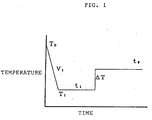
- Figure 1 is a diagram showing a heat treatment pattern of the present invention.
- Si is an element required for deoxidizing the steel and since the deoxidizing effect is therefore insufficient when the amount contained is too small, the lower limit thereof is set at 0.10%. Si is also an element which solid-solution hardens the steel and is further capable of reducing wire relaxation. However, since Si reduces the amount of scale formation, degrading mechanical scaling property, and also lowers the lubricity somewhat. The upper limit of Si content is therefore set at 1.50%.
- Mn is added at not less than 0.10% as a deoxidizing agent.
- Mn is an element which strengthens the steel by its presence in solid solution, increasing the amount added increases the likelihood of segregation at the center portion of the wire rod. Since the hardenability of the segregated portion increases, shifting the finishing time of transformation toward the long period side, the untransformed portion becomes martensite, leading to wire breakage during drawing.
- the upper limit of Mn content is therefore set at 1.00%.
- the upper limit of S content is set at 0.01% and the upper limit of P content is set at 0.02%.
- Cr an element which increases steel strength
- the upper limit of Cr content is set at 1.00%, while the lower limit thereof is set at 0.10% for increasing strength.
- the cooling start temperature (T 0 ) following wire rod rolling or following wire heating affects the texture following transformation.
- the lower limit is set at not less than the austenite transformation point (755 °C), which is the equilibrium transformation start temperature.
- the upper limit is set at 1100 °C for suppressing abnormal austenite grain growth.
- the cooling rate (V 1 ) following wire rod rolling or following wire heating is an important factor in suppressing the start of pearlite transformation. This was experimentally ascertained by the inventors. In the case of gradual cooling at an initial cooling rate of less than 60°C/sec, transformation starts on the high-temperature side of the pearlite transformation nose position, making it impossible to obtain a perfect bainite texture owing to formation of pearlite texture. While bainite texture forms at temperature under 500 °C, formation of a perfect bainite texture requires rapid cooling at the initial cooling stage.
- the lower limit of the cooling rate (V 1 ) is therefore set at 60 °C/sec, while the upper limit thereof is set at the industrially feasible 300 °C/sec.
- the isothermal holding temperature (T 1 ) after cooling is an important factor determining the formed texture.
- T 1 The isothermal holding temperature after cooling is an important factor determining the formed texture.
- pearlite texture forming at the center portion of the wire rod or wire increases tensile strength and degrades drawability.
- granulation of cementite in the bainite structure starts, increasing tensile strength and degrading drawability.
- the upper limit of the isothermal transformation temperature is therefore set at 500 °C and the lower limit thereof is set at 350 °C.
- Supercooled austenite texture is obtained by holding at 350 - 500 °C for a specified period of time.
- the cementite precipitation in the bainite texture which appears is coarser than in isothermal transformation.
- the two-step-transformed upper bainite texture softens.
- the holding time (T 2 ) after temperature increase is set as the period up to complete finishing of the transformation.
- Pearlite texture forms at the wire rod or wire center portion in a pearlite wire rod or wire treated at a isothermal transformation temperature exceeding 500 °C. Since pearlite texture has a laminar structure of cementite and ferrite, it makes a major contribution to work hardening, but a decrease in ductility cannot be prevented. In the high area reduction region, therefore, tensile strength increases with an accompanying degradation of twist characteristics, causing the occurrence of delamination.
- the bainite texture area ratio is measured from the observed sectional texture using the lattice point method.
- the area ratio is an important index indicating the state of bainite texture formation and influences the drawability.
- the lower limit of the area ratio is set at 80%, where the two-stepped transformation effect noticeably appears.
- the Vickers hardness of the upper bainite structure is an important factor indicating the characteristics of the specimen.
- the cementite precipitation in a bainite wire rod or wire which has been two-step-transformed by conducting a cooling step and a temperature increasing step is coarser than in the case of isothermal transformation. As a result, the two-step-transformed upper bainite texture is softened.
- the upper limit of the Vickers hardness is set at not more than 450.
- Table 1 shows the chemical compositions of tested steel specimens.
- a - D in Table 1 are invention steels and E and F are comparison steels.
- Steel E has a C content exceeding the upper limit and steel F has a Mn content exceeding the upper limit.
- the specimens were produced by casting 300 x 500 mm slabs with a continuous casting machine and then bloom pressing them into 122 - mm square slabs.
- the wire rods were drawn to 1.00 mm ⁇ at an average reduction of area of 17% and subjected to tensile test and twist test.
- the tensile test was conducted using the No. 2 test piece of JISZ2201 and the method described in JISZ2241.
- the specimen was cut to a test piece length of 100d + 100 and rotated at a rotational speed of 10 rpm between chucks spaced at 100d.
- d represents the wire diameter.
- No. 1 - No. 4 are invention steels.
- No. 5 - No. 10 are comparative steels.
- Table 3 shows the chemical compositions of tested steel specimens.
- a - D in Table 3 are invention steels and E and F are comparison steels.
- the specimens were produced by casting 300 x 500 mm slabs with a continuous casting machine, bloom pressing them into 122 - mm square slabs, and producing wire from these slabs.
- the wire were drawn to 1.00 mm ⁇ at an average reduction of area of 17% and subjected to tensile test and twist test.
- the tensile test was conducted using the No. 2 test piece of JISZ2201 and the method described in JISZ2241.
- the specimen was cut to a test piece length of 100d + 100 and rotated at a rotational speed of 10 rpm between chucks spaced at 100d.
- d represents the wire diameter.
- No. 1 - No. 4 are invention steels.
- No. 5 - No. 10 are comparative steels.
- the high-carbon steel wire rod or wire produced in accordance with this invention can be drawn to an appreciably higher reduction of area than possible by the prior art method, it has improved delamination resistance property.
- the present invention enables production of high-carbon steel wire rod and wire excellent in drawability, elimination of intermediate heat treatment in the secondary processing step, a large reduction in cost, a shortening of production period, and a reduction of equipment expenses.
Landscapes
- Chemical & Material Sciences (AREA)
- Engineering & Computer Science (AREA)
- Mechanical Engineering (AREA)
- Materials Engineering (AREA)
- Metallurgy (AREA)
- Organic Chemistry (AREA)
- Physics & Mathematics (AREA)
- Thermal Sciences (AREA)
- Crystallography & Structural Chemistry (AREA)
- Manufacturing & Machinery (AREA)
- Heat Treatment Of Strip Materials And Filament Materials (AREA)
- Heat Treatment Of Steel (AREA)
Claims (5)
- Fil machine laminé ou fil métallique en acier à haute teneur en carbone manifestant une capacité d'étirage excellente contenant, en pour cent en poids,en étant limité à une teneur enC : 0,80 - 0,90 %,Si: 0,10 - 1,50 %, etMn: 0,10 - 1,00 %,le reste étant du fer et des impuretés inévitables,P: qui n'est pas supérieure à 0,02 %,S: qui n'est pas supérieure à 0,01 %, etAl: qui n'est pas supérieure à 0,003 %,
et possédant une microstructure du domaine de la bainite supérieure qui, en termes de rapport de section, n'est pas inférieure à 80 % à l'état de cémentite grossière dispersée dans de la ferrite et une valeur Hv qui n'est pas supérieure à 450, ladite structure pouvant être obtenue à l'aide du procédé selon l'une quelconque des revendications 3 à 5. - Fil machine laminé ou fil métallique en acier à haute teneur en carbone manifestant une capacité d'étirage excellente selon la revendication 1, contenant en outre du Cr à raison de 0,10 à 1,00 % à titre d'élément d'alliage.
- Procédé de fabrication d'un fil machine laminé ou d'un fil métallique en acier à haute teneur en carbone manifestant une capacité d'étirage excellente, comprenant les étapes consistant à:
laminer une brame d'acier pour obtenir un fil machine laminé ou chauffer un fil métallique dans une plage de températures de 1100 à 755°C, à la fois la brame et le fil métallique possédant une composition qui contient, en pour cent en poids,qui est limitée à une teneur enC : 0,80 - 0,90 %,Si: 0,10 - 1,50 %, etMn: 0,10 - 1,00 %,le reste étant du fer et des impuretés inévitables,P: qui n'est pas supérieure à 0,02 %,S: qui n'est pas supérieure à 0,01 %, etAl: qui n'est pas supérieure à 0,003 %,
refroidir le fil machine laminé ou le fil métallique chauffé depuis une plage de températures de 1100 à 755°C, obtenu soit après le laminage à chaud, soit après le chauffage à cette température, jusqu'à une plage de températures de 350 à 500 °C à une vitesse de refroidissement de 60 à 300°C/sec, et
le maintenir dans cette plage de températures pendant un laps de temps qui n'est pas inférieur à une seconde et qui n'est pas supérieur à une période de X secondes dans les limites du domaine dans lequel la transformation bainitique ne s'entame pas, X étant déterminé par l'équation (1) ci-après, et
élever la température d'une valeur qui n'est pas inférieure à 10°C et qui n'est pas supérieure à 600°C - T1 (T1: température de maintien après le refroidissement) et la maintenir jusqu'à ce que la transformation bainitique soit complètement achevée,
T1: température de maintien après le refroidissement. - Procédé de fabrication d'un fil machine laminé ou d'un fil métallique en acier à haute teneur en carbone manifestant une capacité d'étirage excellente, comprenant les étapes consistant à:
laminer une brame d'acier pour obtenir un fil machine laminé ou chauffer un fil métallique dans une plage de températures de 1100 à 755°C, à la fois la brame et le fil métallique possédant une composition qui contient, en pour cent en poids,qui est limitée à une teneur enC : 0,80 - 0,90 %,Si: 0,10 - 1,50 %, etMn: 0,10 - 1,00 %,le reste étant du fer et des impuretés inévitables,P: qui n'est pas supérieure à 0,02 %,S: qui n'est pas supérieure à 0,01 %, etAl: qui n'est pas supérieure à 0,003 %,
refroidir le fil machine laminé ou le fil métallique chauffé depuis une plage de températures de 1100 à 755°C, obtenu soit après le laminage à chaud, soit après le chauffage à cette température, jusqu'à une plage de températures de 350 à 500°C à une vitesse de refroidissement de 60 à 300°C/sec, et
le maintenir dans cette plage de températures pendant un laps de temps commençant après le début de la transformation bainitique jusqu'à un moment dans le temps précédant l'achèvement de la transformation bainitique, plus précisément une période qui ne dépasse pas Y secondes comme déterminé par l'équation (2) ci-après, et
élever la température d'une valeur qui n'est pas inférieure à 10°C et qui n'est pas supérieure à 600°C - T1 (T1: température de maintien après le refroidissement) et la maintenir jusqu'à ce que la transformation bainitique soit complètement achevée,
T1: température de maintien après le refroidissement. - Procédé de fabrication d'un fil machine laminé ou d'un fil métallique en acier à haute teneur en carbone selon l'une quelconque des revendications 3 ou 4, dans lequel la composition contient en outre
Cr à raison de 0,10 à 1,00 %
à titre d'élément d'alliage.
Applications Claiming Priority (4)
| Application Number | Priority Date | Filing Date | Title |
|---|---|---|---|
| JP12298593 | 1993-05-25 | ||
| JP5122985A JP2984889B2 (ja) | 1992-07-08 | 1993-05-25 | 伸線加工性に優れた高炭素鋼線材または鋼線およびその製造方法 |
| JP122985/93 | 1993-05-25 | ||
| PCT/JP1994/000578 WO1994028187A1 (fr) | 1993-05-25 | 1994-04-06 | Barre en acier riche en carbone et fil d'acier presentant une excellente usinabilite dans le trefilage, et leur procede de production |
Publications (3)
| Publication Number | Publication Date |
|---|---|
| EP0707088A1 EP0707088A1 (fr) | 1996-04-17 |
| EP0707088A4 EP0707088A4 (fr) | 1998-09-02 |
| EP0707088B1 true EP0707088B1 (fr) | 2001-06-13 |
Family
ID=14849447
Family Applications (1)
| Application Number | Title | Priority Date | Filing Date |
|---|---|---|---|
| EP94912064A Expired - Lifetime EP0707088B1 (fr) | 1993-05-25 | 1994-04-06 | Barre en acier riche en carbone et fil d'acier presentant une excellente usinabilite dans le trefilage, et leur procede de production |
Country Status (4)
| Country | Link |
|---|---|
| US (1) | US5650027A (fr) |
| EP (1) | EP0707088B1 (fr) |
| DE (1) | DE69427473T2 (fr) |
| WO (1) | WO1994028187A1 (fr) |
Families Citing this family (7)
| Publication number | Priority date | Publication date | Assignee | Title |
|---|---|---|---|---|
| JP3580938B2 (ja) * | 1996-03-05 | 2004-10-27 | アイシン・エィ・ダブリュ株式会社 | 昇温ベイナイト処理法 |
| SE510344C2 (sv) * | 1997-08-01 | 1999-05-17 | Ovako Steel Ab | Sätt för fullständig bainithärdning av stål |
| DE19963973C1 (de) * | 1999-12-31 | 2001-05-31 | Bosch Gmbh Robert | Verfahren zum Bainitisieren von Stahlteilen |
| DE102007061084A1 (de) | 2007-12-19 | 2009-07-02 | Federal-Mogul Sealing Systems Gmbh | Metallische Flachdichtung und Herstellverfahren |
| CN103194582A (zh) * | 2013-04-22 | 2013-07-10 | 江阴法尔胜线材制品有限公司 | 一种超细碳素钢丝的生产方法 |
| CN104498805B (zh) * | 2014-12-29 | 2017-01-25 | 首钢总公司 | 一种高碳低氮绞线用钢的生产方法 |
| CN116213454A (zh) * | 2023-03-02 | 2023-06-06 | 盐城市联鑫钢铁有限公司 | 一种避免因混晶造成的钢盘圆拉拔断的轧制方法 |
Family Cites Families (5)
| Publication number | Priority date | Publication date | Assignee | Title |
|---|---|---|---|---|
| JPS60245722A (ja) * | 1984-05-21 | 1985-12-05 | Kawasaki Steel Corp | 高張力線材の製造方法 |
| JPH0653916B2 (ja) * | 1986-07-16 | 1994-07-20 | 日本鋼管株式会社 | 不安定破壊伝播停止能力に優れた耐摩耗性高性能レ−ル |
| JPS6324046A (ja) * | 1986-07-16 | 1988-02-01 | Kobe Steel Ltd | 高靭性高延性極細線用線材 |
| JPH064904B2 (ja) * | 1987-08-03 | 1994-01-19 | 株式会社神戸製鋼所 | ばね用▲高▼強度オイルテンパー線 |
| JPH081083A (ja) * | 1994-06-20 | 1996-01-09 | Kanto Auto Works Ltd | 樹脂バンパの塗装方法 |
-
1994
- 1994-04-06 EP EP94912064A patent/EP0707088B1/fr not_active Expired - Lifetime
- 1994-04-06 WO PCT/JP1994/000578 patent/WO1994028187A1/fr not_active Ceased
- 1994-04-06 DE DE69427473T patent/DE69427473T2/de not_active Expired - Fee Related
- 1994-04-06 US US08/545,676 patent/US5650027A/en not_active Expired - Fee Related
Also Published As
| Publication number | Publication date |
|---|---|
| US5650027A (en) | 1997-07-22 |
| EP0707088A1 (fr) | 1996-04-17 |
| WO1994028187A1 (fr) | 1994-12-08 |
| DE69427473D1 (de) | 2001-07-19 |
| DE69427473T2 (de) | 2002-04-18 |
| EP0707088A4 (fr) | 1998-09-02 |
Similar Documents
| Publication | Publication Date | Title |
|---|---|---|
| US8105698B2 (en) | Plated steel wire for parallel wire strand (PWS) with excellent twist properties | |
| KR100194431B1 (ko) | 피로특성을 가진 우수한 고강도강선재 및 고강도강선 | |
| KR101660616B1 (ko) | 스프링 가공성이 우수한 고강도 스프링용 강 선재 및 그의 제조 방법, 및 고강도 스프링 | |
| JPH08337843A (ja) | 打抜き加工性に優れた高炭素熱延鋼板及びその製造方法 | |
| EP0693570B1 (fr) | Barre de bainite ou fil d'acier pour trefilage et procede de production d'une telle barre ou d'un tel fil | |
| US5650027A (en) | High-carbon steel wire rod and wire excellent in drawability and methods of producing the same | |
| JPH083639A (ja) | 伸線加工性に優れた高炭素鋼線材または鋼線の製造方法 | |
| EP0708183B1 (fr) | Fil d'acier ou barre en acier riche en carbone presentant une excellente usinabilite dans le trefilage, et leur procede de production | |
| EP0707089B1 (fr) | Fil d'acier a haute teneur en carbone ou acier constituant un tel fil, presentant une excellente aptitude au trefilage, et son procede de fabrication | |
| JP2984889B2 (ja) | 伸線加工性に優れた高炭素鋼線材または鋼線およびその製造方法 | |
| EP0693571B1 (fr) | Barre de bainite ou fil d'acier pour trefilage et procede de production d'une telle barre ou d'un tel fil | |
| US5658399A (en) | Bainite wire rod and wire for drawing and methods of producing the same | |
| KR100336852B1 (ko) | 신선용 고강도 과공석 선재의 제조 방법 | |
| JP2984885B2 (ja) | 伸線加工用ベイナイト線材または鋼線およびその製造方法 | |
| JP2984887B2 (ja) | 伸線加工用ベイナイト線材または鋼線およびその製造方法 | |
| JP2984888B2 (ja) | 伸線加工性に優れた高炭素鋼線材または鋼線およびその製造方法 | |
| KR100276298B1 (ko) | 고망간함유 신선용 경강선재의 제조방법 | |
| JPH083649A (ja) | 伸線加工性に優れた高炭素鋼線材または鋼線の製造方法 | |
| JP2742967B2 (ja) | ベイナイト線材の製造法 | |
| JPH07268487A (ja) | 伸線加工性に優れた高炭素鋼線材または鋼線の製造方法 | |
| JP2984886B2 (ja) | 伸線加工用ベイナイト線材または鋼線およびその製造方法 | |
| KR20250132520A (ko) | 봉강, 볼트 및 볼트의 제조 방법 | |
| JPH07268465A (ja) | 伸線加工用ベイナイト線材または鋼線の製造方法 |
Legal Events
| Date | Code | Title | Description |
|---|---|---|---|
| PUAI | Public reference made under article 153(3) epc to a published international application that has entered the european phase |
Free format text: ORIGINAL CODE: 0009012 |
|
| 17P | Request for examination filed |
Effective date: 19951213 |
|
| AK | Designated contracting states |
Kind code of ref document: A1 Designated state(s): BE DE FR GB IT |
|
| A4 | Supplementary search report drawn up and despatched |
Effective date: 19980722 |
|
| AK | Designated contracting states |
Kind code of ref document: A4 Designated state(s): AT BE CH DE DK ES FR GB GR IE IT LI LU MC NL PT SE |
|
| 17Q | First examination report despatched |
Effective date: 19990209 |
|
| GRAG | Despatch of communication of intention to grant |
Free format text: ORIGINAL CODE: EPIDOS AGRA |
|
| GRAG | Despatch of communication of intention to grant |
Free format text: ORIGINAL CODE: EPIDOS AGRA |
|
| GRAH | Despatch of communication of intention to grant a patent |
Free format text: ORIGINAL CODE: EPIDOS IGRA |
|
| GRAH | Despatch of communication of intention to grant a patent |
Free format text: ORIGINAL CODE: EPIDOS IGRA |
|
| ITF | It: translation for a ep patent filed | ||
| RBV | Designated contracting states (corrected) |
Designated state(s): BE DE FR GB IT |
|
| GRAA | (expected) grant |
Free format text: ORIGINAL CODE: 0009210 |
|
| AK | Designated contracting states |
Kind code of ref document: B1 Designated state(s): BE DE FR GB IT |
|
| REF | Corresponds to: |
Ref document number: 69427473 Country of ref document: DE Date of ref document: 20010719 |
|
| ET | Fr: translation filed | ||
| REG | Reference to a national code |
Ref country code: GB Ref legal event code: IF02 |
|
| PLBE | No opposition filed within time limit |
Free format text: ORIGINAL CODE: 0009261 |
|
| STAA | Information on the status of an ep patent application or granted ep patent |
Free format text: STATUS: NO OPPOSITION FILED WITHIN TIME LIMIT |
|
| 26N | No opposition filed | ||
| PGFP | Annual fee paid to national office [announced via postgrant information from national office to epo] |
Ref country code: GB Payment date: 20030402 Year of fee payment: 10 |
|
| PGFP | Annual fee paid to national office [announced via postgrant information from national office to epo] |
Ref country code: FR Payment date: 20030408 Year of fee payment: 10 |
|
| PGFP | Annual fee paid to national office [announced via postgrant information from national office to epo] |
Ref country code: DE Payment date: 20030417 Year of fee payment: 10 |
|
| PGFP | Annual fee paid to national office [announced via postgrant information from national office to epo] |
Ref country code: BE Payment date: 20030625 Year of fee payment: 10 |
|
| PG25 | Lapsed in a contracting state [announced via postgrant information from national office to epo] |
Ref country code: GB Free format text: LAPSE BECAUSE OF NON-PAYMENT OF DUE FEES Effective date: 20040406 |
|
| PG25 | Lapsed in a contracting state [announced via postgrant information from national office to epo] |
Ref country code: BE Free format text: LAPSE BECAUSE OF NON-PAYMENT OF DUE FEES Effective date: 20040430 |
|
| BERE | Be: lapsed |
Owner name: *NIPPON STEEL CORP. Effective date: 20040430 |
|
| PG25 | Lapsed in a contracting state [announced via postgrant information from national office to epo] |
Ref country code: DE Free format text: LAPSE BECAUSE OF NON-PAYMENT OF DUE FEES Effective date: 20041103 |
|
| GBPC | Gb: european patent ceased through non-payment of renewal fee | ||
| PG25 | Lapsed in a contracting state [announced via postgrant information from national office to epo] |
Ref country code: FR Free format text: LAPSE BECAUSE OF NON-PAYMENT OF DUE FEES Effective date: 20041231 |
|
| REG | Reference to a national code |
Ref country code: FR Ref legal event code: ST |
|
| PG25 | Lapsed in a contracting state [announced via postgrant information from national office to epo] |
Ref country code: IT Free format text: LAPSE BECAUSE OF NON-PAYMENT OF DUE FEES;WARNING: LAPSES OF ITALIAN PATENTS WITH EFFECTIVE DATE BEFORE 2007 MAY HAVE OCCURRED AT ANY TIME BEFORE 2007. THE CORRECT EFFECTIVE DATE MAY BE DIFFERENT FROM THE ONE RECORDED. Effective date: 20050406 |