EP0708071A1 - Verfahren und Vorrichtung zur Herstellung von 5-(alkylalkyliden)-1,3-cyclopentadienen - Google Patents
Verfahren und Vorrichtung zur Herstellung von 5-(alkylalkyliden)-1,3-cyclopentadienen Download PDFInfo
- Publication number
- EP0708071A1 EP0708071A1 EP95402175A EP95402175A EP0708071A1 EP 0708071 A1 EP0708071 A1 EP 0708071A1 EP 95402175 A EP95402175 A EP 95402175A EP 95402175 A EP95402175 A EP 95402175A EP 0708071 A1 EP0708071 A1 EP 0708071A1
- Authority
- EP
- European Patent Office
- Prior art keywords
- resin
- reaction
- mixture
- cyclopentadiene
- organic solvent
- Prior art date
- Legal status (The legal status is an assumption and is not a legal conclusion. Google has not performed a legal analysis and makes no representation as to the accuracy of the status listed.)
- Withdrawn
Links
- 238000000034 method Methods 0.000 title claims abstract description 35
- 238000002360 preparation method Methods 0.000 title claims description 8
- ZSWFCLXCOIISFI-UHFFFAOYSA-N cyclopentadiene Chemical compound C1C=CC=C1 ZSWFCLXCOIISFI-UHFFFAOYSA-N 0.000 claims abstract description 63
- 239000011347 resin Substances 0.000 claims abstract description 59
- 229920005989 resin Polymers 0.000 claims abstract description 59
- XLYOFNOQVPJJNP-UHFFFAOYSA-N water Substances O XLYOFNOQVPJJNP-UHFFFAOYSA-N 0.000 claims abstract description 34
- -1 alkyl ketone Chemical class 0.000 claims abstract description 15
- 238000002156 mixing Methods 0.000 claims abstract description 4
- CSCPPACGZOOCGX-UHFFFAOYSA-N Acetone Chemical compound CC(C)=O CSCPPACGZOOCGX-UHFFFAOYSA-N 0.000 claims description 37
- 238000006243 chemical reaction Methods 0.000 claims description 22
- 239000003960 organic solvent Substances 0.000 claims description 18
- 239000000203 mixture Substances 0.000 claims description 15
- 238000000926 separation method Methods 0.000 claims description 14
- 239000003456 ion exchange resin Substances 0.000 claims description 13
- 229920003303 ion-exchange polymer Polymers 0.000 claims description 13
- 230000008929 regeneration Effects 0.000 claims description 13
- 238000011069 regeneration method Methods 0.000 claims description 13
- NWUYHJFMYQTDRP-UHFFFAOYSA-N 1,2-bis(ethenyl)benzene;1-ethenyl-2-ethylbenzene;styrene Chemical compound C=CC1=CC=CC=C1.CCC1=CC=CC=C1C=C.C=CC1=CC=CC=C1C=C NWUYHJFMYQTDRP-UHFFFAOYSA-N 0.000 claims description 12
- 238000004821 distillation Methods 0.000 claims description 7
- YXFVVABEGXRONW-UHFFFAOYSA-N Toluene Chemical compound CC1=CC=CC=C1 YXFVVABEGXRONW-UHFFFAOYSA-N 0.000 claims description 6
- 239000007795 chemical reaction product Substances 0.000 claims description 5
- 238000005406 washing Methods 0.000 claims description 5
- 239000007810 chemical reaction solvent Substances 0.000 claims description 4
- 238000001704 evaporation Methods 0.000 claims description 4
- 230000008020 evaporation Effects 0.000 claims description 4
- 239000000376 reactant Substances 0.000 claims description 4
- 238000004230 steam cracking Methods 0.000 claims description 4
- 125000000129 anionic group Chemical group 0.000 claims description 3
- 238000003756 stirring Methods 0.000 claims description 3
- CTQNGGLPUBDAKN-UHFFFAOYSA-N O-Xylene Chemical compound CC1=CC=CC=C1C CTQNGGLPUBDAKN-UHFFFAOYSA-N 0.000 claims description 2
- 150000001335 aliphatic alkanes Chemical class 0.000 claims description 2
- 150000001555 benzenes Chemical class 0.000 claims description 2
- 125000004432 carbon atom Chemical group C* 0.000 claims description 2
- 239000003153 chemical reaction reagent Substances 0.000 claims description 2
- 238000010924 continuous production Methods 0.000 claims description 2
- 230000001186 cumulative effect Effects 0.000 claims description 2
- 150000001924 cycloalkanes Chemical class 0.000 claims description 2
- 239000011541 reaction mixture Substances 0.000 claims description 2
- 239000002904 solvent Substances 0.000 claims description 2
- 239000008096 xylene Substances 0.000 claims description 2
- 238000010923 batch production Methods 0.000 claims 1
- 238000003287 bathing Methods 0.000 claims 1
- 239000012429 reaction media Substances 0.000 claims 1
- 150000002500 ions Chemical class 0.000 abstract description 2
- 238000009434 installation Methods 0.000 abstract 1
- WXACXMWYHXOSIX-UHFFFAOYSA-N 5-propan-2-ylidenecyclopenta-1,3-diene Chemical compound CC(C)=C1C=CC=C1 WXACXMWYHXOSIX-UHFFFAOYSA-N 0.000 description 10
- 238000004519 manufacturing process Methods 0.000 description 8
- 229920001429 chelating resin Polymers 0.000 description 4
- 150000001875 compounds Chemical class 0.000 description 4
- XDTMQSROBMDMFD-UHFFFAOYSA-N Cyclohexane Chemical compound C1CCCCC1 XDTMQSROBMDMFD-UHFFFAOYSA-N 0.000 description 3
- 230000000694 effects Effects 0.000 description 3
- 238000007210 heterogeneous catalysis Methods 0.000 description 3
- JQJJVBLKRXSWNS-UHFFFAOYSA-N 1,2-dimethyl-5-methylidenecyclopenta-1,3-diene Chemical compound CC1=C(C)C(=C)C=C1 JQJJVBLKRXSWNS-UHFFFAOYSA-N 0.000 description 2
- 150000003973 alkyl amines Chemical class 0.000 description 2
- 238000006482 condensation reaction Methods 0.000 description 2
- 239000002826 coolant Substances 0.000 description 2
- 238000001035 drying Methods 0.000 description 2
- 239000008240 homogeneous mixture Substances 0.000 description 2
- 238000011065 in-situ storage Methods 0.000 description 2
- QSHDDOUJBYECFT-UHFFFAOYSA-N mercury Chemical compound [Hg] QSHDDOUJBYECFT-UHFFFAOYSA-N 0.000 description 2
- 229910052753 mercury Inorganic materials 0.000 description 2
- 230000002572 peristaltic effect Effects 0.000 description 2
- 239000011949 solid catalyst Substances 0.000 description 2
- 238000010977 unit operation Methods 0.000 description 2
- CHRJZRDFSQHIFI-UHFFFAOYSA-N 1,2-bis(ethenyl)benzene;styrene Chemical compound C=CC1=CC=CC=C1.C=CC1=CC=CC=C1C=C CHRJZRDFSQHIFI-UHFFFAOYSA-N 0.000 description 1
- HECLRDQVFMWTQS-RGOKHQFPSA-N 1755-01-7 Chemical compound C1[C@H]2[C@@H]3CC=C[C@@H]3[C@@H]1C=C2 HECLRDQVFMWTQS-RGOKHQFPSA-N 0.000 description 1
- VHUUQVKOLVNVRT-UHFFFAOYSA-N Ammonium hydroxide Chemical group [NH4+].[OH-] VHUUQVKOLVNVRT-UHFFFAOYSA-N 0.000 description 1
- 239000000654 additive Substances 0.000 description 1
- 230000000996 additive effect Effects 0.000 description 1
- 150000001336 alkenes Chemical class 0.000 description 1
- 230000004075 alteration Effects 0.000 description 1
- 239000008346 aqueous phase Substances 0.000 description 1
- 229910001570 bauxite Inorganic materials 0.000 description 1
- 239000006227 byproduct Substances 0.000 description 1
- 239000003795 chemical substances by application Substances 0.000 description 1
- 238000009833 condensation Methods 0.000 description 1
- 230000005494 condensation Effects 0.000 description 1
- 238000010908 decantation Methods 0.000 description 1
- 239000012153 distilled water Substances 0.000 description 1
- 239000012530 fluid Substances 0.000 description 1
- 239000000446 fuel Substances 0.000 description 1
- 238000004817 gas chromatography Methods 0.000 description 1
- 238000010438 heat treatment Methods 0.000 description 1
- 230000000887 hydrating effect Effects 0.000 description 1
- 230000036571 hydration Effects 0.000 description 1
- 238000006703 hydration reaction Methods 0.000 description 1
- 238000005342 ion exchange Methods 0.000 description 1
- 239000007788 liquid Substances 0.000 description 1
- 238000010907 mechanical stirring Methods 0.000 description 1
- 239000012074 organic phase Substances 0.000 description 1
- 239000012071 phase Substances 0.000 description 1
- 229920000642 polymer Polymers 0.000 description 1
- 229920000098 polyolefin Polymers 0.000 description 1
- 239000000047 product Substances 0.000 description 1
- 230000001172 regenerating effect Effects 0.000 description 1
- 230000001105 regulatory effect Effects 0.000 description 1
- 238000002791 soaking Methods 0.000 description 1
Images
Classifications
-
- C—CHEMISTRY; METALLURGY
- C07—ORGANIC CHEMISTRY
- C07C—ACYCLIC OR CARBOCYCLIC COMPOUNDS
- C07C2/00—Preparation of hydrocarbons from hydrocarbons containing a smaller number of carbon atoms
- C07C2/86—Preparation of hydrocarbons from hydrocarbons containing a smaller number of carbon atoms by condensation between a hydrocarbon and a non-hydrocarbon
- C07C2/862—Preparation of hydrocarbons from hydrocarbons containing a smaller number of carbon atoms by condensation between a hydrocarbon and a non-hydrocarbon the non-hydrocarbon contains only oxygen as hetero-atoms
- C07C2/867—Preparation of hydrocarbons from hydrocarbons containing a smaller number of carbon atoms by condensation between a hydrocarbon and a non-hydrocarbon the non-hydrocarbon contains only oxygen as hetero-atoms the non-hydrocarbon is an aldehyde or a ketone
-
- C—CHEMISTRY; METALLURGY
- C07—ORGANIC CHEMISTRY
- C07C—ACYCLIC OR CARBOCYCLIC COMPOUNDS
- C07C2531/00—Catalysts comprising hydrides, coordination complexes or organic compounds
- C07C2531/02—Catalysts comprising hydrides, coordination complexes or organic compounds containing organic compounds or metal hydrides
- C07C2531/06—Catalysts comprising hydrides, coordination complexes or organic compounds containing organic compounds or metal hydrides containing polymers
- C07C2531/08—Ion-exchange resins
-
- C—CHEMISTRY; METALLURGY
- C07—ORGANIC CHEMISTRY
- C07C—ACYCLIC OR CARBOCYCLIC COMPOUNDS
- C07C2601/00—Systems containing only non-condensed rings
- C07C2601/06—Systems containing only non-condensed rings with a five-membered ring
- C07C2601/10—Systems containing only non-condensed rings with a five-membered ring the ring being unsaturated
Definitions
- the present invention relates to a process for the preparation of 5- (alkylalkylidene) -1,3-cyclopentadienes and the implementation device.
- US Patent 3,192,275 describes a mode of preparation of dialkylfulvenes which consists in reacting cyclopentadiene with an alkylacetonic compound in the presence of an alkylamine in a liquid medium.
- the process is discontinuous and includes several stages including a reaction stage, several stages of separation of the aqueous and organic phases such as decantation and rectification. Although the yields are very good, this process has numerous drawbacks linked to the use of large volumes of alkylamines as non-recoverable condensing agent, and to the high number of unit operations. It is moreover known that it is preferable to use solid catalysts which are easily isolable and recoverable, for the manufacture of products on an industrial scale.
- the purpose of the present invention is to have a process capable of preparing large quantities on an industrial scale of dialkylfulvenes by heterogeneous catalysis with a yield greater than 90%, in order to avoid multiplying the number of independent unit operations. .
- the present invention therefore relates to a process by heterogeneous catalysis for the preparation of 5- (alkylalkylidene) -1,3-cyclopentadienes consisting in reacting cyclopentadiene with an alkyl ketone in the presence of a strongly basic ion exchange resin characterized in that said resin contains between 25 and 55% by weight of water.
- ion exchange resins are preferably basic anionic resins of gel or macroreticulate type structure, constituted by a styrene / divinylbenzene polymer.
- the ion exchange is ensured by ammonium hydroxide functions providing the resin with a basicity of between 0.05 and 1.2 molar equivalents of hydroxide ions per mole of cyclopentadiene.
- the preferred resins of the invention are resins having a basicity between 0.06 and 1. molar equivalent of hydroxide ions per mole of cyclopentadiene.
- the resins of this type usually available commercially have water contents of between 60 and 75% by weight of the resin.
- these commercial resins are either partially dried, for example in an enclosure heated between 25 and 60 ° C. for a sufficient time, depending on the initial water content of said resin, or immediately hydrated by soaking in a sufficient quantity of water, these two modes making it possible to adjust the water content of the resin to the claimed interval.
- the method comprises at least one reaction step, at least one step for separating the reaction products and optionally at least one step for regenerating said ion exchange resin.
- Said reaction step consists in gradually bringing the resin with adjusted water content according to the invention, bathed in an organic solvent, the whole being maintained at a temperature between -20 ° C and 60 ° C, with a mixture homogeneous cyclopentadiene and at least one alkyl ketone obtained diluted or not in said organic solvent, the alkyl ketone / cyclopentadiene molar ratio being between 0.6 and 1.76.
- the organic solvent is chosen from the group consisting of alkanes, cycloalkanes and isoalkanes comprising from 5 to 8 carbon atoms, and benzene derivatives such as toluene, xylene or their derivatives taken alone or mixed.
- the alkylketone / cyclopentadiene molar ratio is preferably between 0.82 and 1.26 for a yield of dialkylfulvene greater than 90%.
- the step of separation of the reaction products consists in extracting the dialkylfulvenes from the organic solvent by a simple method known per se such as distillation or the only evaporation of said organic solvent used.
- the regeneration step of said ion exchange resin consists of washing it abundantly with said organic solvent so as to remove all traces of reagent, then rinsing it with acetone, and finally hydrating it. the content claimed by washing with water, these operations being carried out at a temperature close to ambient temperature.
- the reaction step consists in introducing said homogeneous mixture of reactants into a resin bath, in which the volume of organic solvent corresponds from 0 to 10 times the volume of the ion exchange resin, then to maintain this bath with stirring for at least 30 minutes and at most 3 hours between -5 ° C and 40 ° C, finally to evacuate the reaction solvent containing the dialkylfulvenes and to rinse said resin 3 to 5 times with a volume of organic solvent corresponding between 0.5 and 1.5 times the volume of resin.
- dialkylfulvenes are recovered in solution in the mixture constituted by the reaction solvent and solvents for rinsing the resin, then they are separated by any process known to those skilled in the art such as evaporation, rectification and distillation during l 'separation step.
- these steps are linked continuously.
- the homogeneous mixture of cyclopentadiene and alkyl ketone diluted in the organic solvent according to the invention the volume of which is at most five times the cumulative volume of reactants, circulates on the ion exchange resin at a temperature between -5 and 40 ° C with a vvh (charge volume on resin volume per hour) between 1.05 and 6.75 and at a pressure between 0.015 and 8 bars.
- dialkylfulvenes are separated from the organic solvent and from the traces of alkyl ketone and of cyclopentadiene by passage through a separation reactor implementing a process known to a person skilled in the art such as for example evaporation or distillation.
- Another object of the invention is the device for implementing the process according to the invention which, whatever the continuity of the process comprises at least one reactor for the reaction stage comprising means for heating and regulating the flows entering or leaving, at least one separation device of the evaporator or distillation type and possibly a separate reactor for the regeneration of the spent resin.
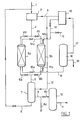
- FIG. 1 shows an illustration of the process and of the continuous device for preparing dialkylfulvenes.
- the cyclopentadiene charge arrives via line 1 in a mixer 2 into which is also sent via line 3 the alkyl ketone stored in the reservoir 13. After mixing, the reactants are directed via line 4 to a reactor containing the exchange resin ( 5a or 5b).
- the reaction mixture is sent via lines 6a or 6b and 6 to an evaporator 7, the residual cyclopentadiene can be recycled via line 9 to line 1 and acetone via line 12 to line 3.
- the dialkylfulvene is recovered via line 8 in order to be stored or used directly (via line 8a) or sent to a distillation column 10 to be purified and collected there via line 11.
- the two reactors 5a and 5b operate in parallel but one in reaction, the other in regeneration. If the reactor 5a is used for the manufacture of dialkylfulvene, the lines 4b and 6b are closed by means of the two valves shown. On the other hand, the valves of the regeneration circuit of the pipes 14b and 15b on either side of the reactor 5b are open while those of the pipes 14a and 15a leading to the reactor 5a are closed.
- Regeneration consists of washing the reactor 5b internally with acetone coming from the reservoir 13 via the lines 14 and 14b, removing this washing acetone through the lines 15b then 15, purifying the acetone in the reactor 16 and returning the pure acetone in the reservoir 13 via the line 17 to recycle it.
- the arrival of acetone is interrupted by closing the pipe 14 by closing the valve which is placed there and by making a certain amount of water penetrate into the pipe 14 via the pipe 15 to hydrate the resin, then isolating the reactor by closing the valves 14b and 15b.
- the outlet pipe 18 of the separator 16 makes it possible to remove the compounds other than acetone.
- the present example aims to demonstrate the influence of a limited quantity of water present in the ion exchange resin on the yield of the condensation reaction of acetone on cyclopentadiene for the manufacture of dimethylfulvene.
- starting resins take either a gel type resin, IRA 420-OH, sold by Rohm & Haas which contains 64.3% by weight of water for samples containing from 2 to 55% water, or a type resin macroréticulée, AMBERLYST A26-OH / E with an initial water content of 74.3% by weight.
- the volume of water necessary for the resin is added in order to reach the targeted water content, this added water being immediately absorbed by the resins according to the invention.
- 150 g of a previously prepared resin sample are introduced into a reactor equipped with mechanical stirring, a condensation system, a temperature control system and a dropping funnel. the assembly at a speed of 200 rpm. Then added over 21 min, a mixture at 15 ° C of 250 g of freshly distilled cyclopentadiene and 265 g of acetone. The temperature of the reactor is controlled during the addition so that it does not exceed 60 ° C., and the stirring is gradually increased up to 500 rpm. At the end of the addition, the mixture is stirred for 1.5 h, then filtered. The resin is rinsed 3 times with 200 ml of acetone.
- the reaction product and the rinsing solvents of the resin are combined to be evaporated on a rotary evaporator at a maximum temperature of 35 ° C, and under a vacuum corresponding to a pressure of 18 mm of mercury.
- a certain amount of 6,6-dimethylfulvene is thus recovered which is weighed to calculate the yield of 6,6-dimethylfulvene in% by weight relative to the charge of cyclopentadiene.
- Table I The results obtained for each resin sample are collated in Table I below.
- Table I clearly shows the effect of the H2O content of the resin, the highest yields being obtained when the latter contains 40 to 55% of water.
- the present example relates to the preparation of 6,6-dimethylfulvene from a C5 cut of steam cracking gasoline.
- the flow rate of the coolant circulating in the co-current in the double jacket is adjusted so that the temperature in the first third of the reactor does not exceed 32 ° C.
- samples are taken at the outlet of the reactor every 30 min, and are analyzed by gas chromatography. It is found that cyclopentadiene is converted on average to 76% into 6,6-dimethylfulvene, and that the reaction product contains less than 0.8% by weight of unreacted acetone.
- the resin being regenerated in situ, the reactor can be put back into operation.
- a valve system makes it possible to modify the circuits so as to isolate the reactors for the regeneration of the resin according to techniques known per se.
Landscapes
- Chemical & Material Sciences (AREA)
- Organic Chemistry (AREA)
- Organic Low-Molecular-Weight Compounds And Preparation Thereof (AREA)
- Low-Molecular Organic Synthesis Reactions Using Catalysts (AREA)
Applications Claiming Priority (2)
| Application Number | Priority Date | Filing Date | Title |
|---|---|---|---|
| FR9411799A FR2725199B1 (fr) | 1994-10-03 | 1994-10-03 | Procede et dispositif de preparation des 5-(alkylalkylidene)-1,3-cyclopentadienes |
| FR9411799 | 1994-10-03 |
Publications (1)
| Publication Number | Publication Date |
|---|---|
| EP0708071A1 true EP0708071A1 (de) | 1996-04-24 |
Family
ID=9467513
Family Applications (1)
| Application Number | Title | Priority Date | Filing Date |
|---|---|---|---|
| EP95402175A Withdrawn EP0708071A1 (de) | 1994-10-03 | 1995-09-28 | Verfahren und Vorrichtung zur Herstellung von 5-(alkylalkyliden)-1,3-cyclopentadienen |
Country Status (3)
| Country | Link |
|---|---|
| EP (1) | EP0708071A1 (de) |
| JP (1) | JPH08119879A (de) |
| FR (1) | FR2725199B1 (de) |
Families Citing this family (1)
| Publication number | Priority date | Publication date | Assignee | Title |
|---|---|---|---|---|
| JP4951904B2 (ja) * | 2004-09-10 | 2012-06-13 | 住友化学株式会社 | 精シクロペンタジエン化合物の製造方法 |
Citations (1)
| Publication number | Priority date | Publication date | Assignee | Title |
|---|---|---|---|---|
| US3051765A (en) * | 1959-03-30 | 1962-08-28 | Diamond Alkali Co | Chemical process for preparing fulvene compunds |
-
1994
- 1994-10-03 FR FR9411799A patent/FR2725199B1/fr not_active Expired - Fee Related
-
1995
- 1995-09-28 EP EP95402175A patent/EP0708071A1/de not_active Withdrawn
- 1995-10-03 JP JP7256327A patent/JPH08119879A/ja active Pending
Patent Citations (1)
| Publication number | Priority date | Publication date | Assignee | Title |
|---|---|---|---|---|
| US3051765A (en) * | 1959-03-30 | 1962-08-28 | Diamond Alkali Co | Chemical process for preparing fulvene compunds |
Also Published As
| Publication number | Publication date |
|---|---|
| FR2725199B1 (fr) | 1996-11-22 |
| JPH08119879A (ja) | 1996-05-14 |
| FR2725199A1 (fr) | 1996-04-05 |
Similar Documents
| Publication | Publication Date | Title |
|---|---|---|
| CA2156843A1 (fr) | Procede de production d'olefines alpha legeres de purete amelioree par oligomerisation de l'ethylene | |
| FR2879620A1 (fr) | Procede de conversion directe d'une charge comprenant des olefines a quatre et/ou cinq atomes de carbone, pour la production de propylene avec une co-production d'essence | |
| EP0351311B1 (de) | Gallosilikat-Katalysator und dessen Verwendung für die Aromatisierung von C2-C4-leichten Gasen | |
| EP2572782A1 (de) | Separationsverfahren von Buten-2 eines C4-Verschnitts, der Buten-2 und Buten-1 enthält, durch selektive Oligomerisation von Buten-1 | |
| EP0776880B1 (de) | Verfahren zur Hydroformylierung von olefinischen Verbindungen | |
| FR2690156A1 (fr) | Procédé de fabrication d'un additif pour essence, riche en éther. | |
| FR2545480A1 (fr) | Hydratation des olefines | |
| EP0708071A1 (de) | Verfahren und Vorrichtung zur Herstellung von 5-(alkylalkyliden)-1,3-cyclopentadienen | |
| EP2572783B1 (de) | Separationsverfahren von Penten-2 eines C5-Verschnitts, der Penten-2 und Penten-1 enthält, durch selektive Oligomerisation von Penten-1 | |
| FR2909667A1 (fr) | Elimination de l'acetonitrile dans la charge olefinique des procedes de production d'ethers par mise en oeuvre de liquides ioniques. | |
| FR2470762A1 (fr) | Procede de traitement d'un residu de production d'acide adipique | |
| EP0344043A1 (de) | Verfahren zur Herstellung von Citral | |
| EP0612563B1 (de) | Ein Halogen, Edelmetall und zusätzliches Metall enthaltender Komposit Katalysator, und seine Verwendung für die Aromatisierung von C2-C12 Kohlenwasserstoffen | |
| FR2857964A1 (fr) | Procede ameliore de production d'olefines-alpha legeres en particulier d'hexene-1, par oligomerisation de l'ethylene | |
| CH375145A (fr) | Procédé de préparation d'une composition catalytique pour la polymérisation d'hydrocarbures polymérisables | |
| FR2588265A1 (fr) | Procede d'adoucissement d'une charge d'hydrocarbures contenant des produits soufres | |
| JPH11513307A (ja) | 抽出方法 | |
| FR3085377A1 (fr) | Procede de preparation de nitropyrazoles | |
| EP0478428A2 (de) | Verfahren zur Herstellung von Boroxid durch Hydrolyse von Methylborat und seine Anwendung bei der Oxidation von gesättigten Kohlenwasserstoffen zu Alkoholen | |
| BE763512Q (de) | ||
| FR2900924A1 (fr) | Procede de production d'ethers incluant une separation de l'alcool par un liquide ionique | |
| EP0892776A1 (de) | Verfahren zur herstellung der essigsäure und/oder methylacetat durch isomerisierung des methylformiats | |
| BE549197A (de) | ||
| EP0612564A1 (de) | Komposit-Katalysator und seine Verwendung für die Aromatisierung von Kohlenwasserstoffen | |
| FR2862059A1 (fr) | Procede et dispositif pour produire une huile alkylee au moyen d'un catalyseur constitue par un liquide ionique composite |
Legal Events
| Date | Code | Title | Description |
|---|---|---|---|
| PUAI | Public reference made under article 153(3) epc to a published international application that has entered the european phase |
Free format text: ORIGINAL CODE: 0009012 |
|
| 17P | Request for examination filed |
Effective date: 19951004 |
|
| AK | Designated contracting states |
Kind code of ref document: A1 Designated state(s): AT BE CH DE DK ES GB GR IE IT LI LU NL PT SE |
|
| GRAG | Despatch of communication of intention to grant |
Free format text: ORIGINAL CODE: EPIDOS AGRA |
|
| STAA | Information on the status of an ep patent application or granted ep patent |
Free format text: STATUS: THE APPLICATION HAS BEEN WITHDRAWN |
|
| 17Q | First examination report despatched |
Effective date: 19970901 |
|
| 18W | Application withdrawn |
Withdrawal date: 19970906 |