EP0708076B1 - Procédé pour la dinitration de composés aromatiques - Google Patents
Procédé pour la dinitration de composés aromatiques Download PDFInfo
- Publication number
- EP0708076B1 EP0708076B1 EP95115901A EP95115901A EP0708076B1 EP 0708076 B1 EP0708076 B1 EP 0708076B1 EP 95115901 A EP95115901 A EP 95115901A EP 95115901 A EP95115901 A EP 95115901A EP 0708076 B1 EP0708076 B1 EP 0708076B1
- Authority
- EP
- European Patent Office
- Prior art keywords
- reactor
- hno
- process according
- mol
- dispersion
- Prior art date
- Legal status (The legal status is an assumption and is not a legal conclusion. Google has not performed a legal analysis and makes no representation as to the accuracy of the status listed.)
- Expired - Lifetime
Links
- 238000000034 method Methods 0.000 title claims description 41
- 230000008569 process Effects 0.000 title claims description 37
- 150000001491 aromatic compounds Chemical class 0.000 title claims description 9
- YXFVVABEGXRONW-UHFFFAOYSA-N Toluene Chemical compound CC1=CC=CC=C1 YXFVVABEGXRONW-UHFFFAOYSA-N 0.000 claims description 51
- 238000006243 chemical reaction Methods 0.000 claims description 47
- QAOWNCQODCNURD-UHFFFAOYSA-N Sulfuric acid Chemical compound OS(O)(=O)=O QAOWNCQODCNURD-UHFFFAOYSA-N 0.000 claims description 46
- UHOVQNZJYSORNB-UHFFFAOYSA-N Benzene Chemical compound C1=CC=CC=C1 UHOVQNZJYSORNB-UHFFFAOYSA-N 0.000 claims description 42
- 239000002253 acid Substances 0.000 claims description 36
- 238000002156 mixing Methods 0.000 claims description 36
- GRYLNZFGIOXLOG-UHFFFAOYSA-N Nitric acid Chemical compound O[N+]([O-])=O GRYLNZFGIOXLOG-UHFFFAOYSA-N 0.000 claims description 30
- 229910017604 nitric acid Inorganic materials 0.000 claims description 27
- 239000006185 dispersion Substances 0.000 claims description 20
- 239000007788 liquid Substances 0.000 claims description 20
- 239000000839 emulsion Substances 0.000 claims description 17
- 239000000376 reactant Substances 0.000 claims description 17
- OMBRFUXPXNIUCZ-UHFFFAOYSA-N dioxidonitrogen(1+) Chemical compound O=[N+]=O OMBRFUXPXNIUCZ-UHFFFAOYSA-N 0.000 claims description 16
- MVPPADPHJFYWMZ-UHFFFAOYSA-N chlorobenzene Chemical compound ClC1=CC=CC=C1 MVPPADPHJFYWMZ-UHFFFAOYSA-N 0.000 claims description 8
- 230000003068 static effect Effects 0.000 claims description 7
- 239000006227 byproduct Substances 0.000 claims description 6
- 238000004581 coalescence Methods 0.000 claims description 4
- 239000000470 constituent Substances 0.000 claims description 4
- 238000010924 continuous production Methods 0.000 claims description 3
- 239000012429 reaction media Substances 0.000 claims description 3
- CTQNGGLPUBDAKN-UHFFFAOYSA-N O-Xylene Chemical compound CC1=CC=CC=C1C CTQNGGLPUBDAKN-UHFFFAOYSA-N 0.000 claims description 2
- 239000008096 xylene Substances 0.000 claims description 2
- 239000012071 phase Substances 0.000 description 31
- 125000003118 aryl group Chemical group 0.000 description 29
- 239000000243 solution Substances 0.000 description 27
- 238000006396 nitration reaction Methods 0.000 description 25
- DYSXLQBUUOPLBB-UHFFFAOYSA-N 2,3-dinitrotoluene Chemical compound CC1=CC=CC([N+]([O-])=O)=C1[N+]([O-])=O DYSXLQBUUOPLBB-UHFFFAOYSA-N 0.000 description 24
- 239000000047 product Substances 0.000 description 23
- 239000000203 mixture Substances 0.000 description 20
- 238000005121 nitriding Methods 0.000 description 20
- 239000008346 aqueous phase Substances 0.000 description 14
- -1 nitronium ions Chemical class 0.000 description 14
- 230000000802 nitrating effect Effects 0.000 description 13
- XLYOFNOQVPJJNP-UHFFFAOYSA-N water Substances O XLYOFNOQVPJJNP-UHFFFAOYSA-N 0.000 description 13
- 239000012074 organic phase Substances 0.000 description 12
- 239000000126 substance Substances 0.000 description 10
- 238000009826 distribution Methods 0.000 description 9
- 238000004817 gas chromatography Methods 0.000 description 9
- 230000005501 phase interface Effects 0.000 description 8
- ZPTVNYMJQHSSEA-UHFFFAOYSA-N 4-nitrotoluene Chemical class CC1=CC=C([N+]([O-])=O)C=C1 ZPTVNYMJQHSSEA-UHFFFAOYSA-N 0.000 description 7
- 239000000463 material Substances 0.000 description 7
- 239000007858 starting material Substances 0.000 description 7
- QTBSBXVTEAMEQO-UHFFFAOYSA-N Acetic acid Chemical compound CC(O)=O QTBSBXVTEAMEQO-UHFFFAOYSA-N 0.000 description 6
- 238000005516 engineering process Methods 0.000 description 6
- 238000004519 manufacturing process Methods 0.000 description 6
- LQNUZADURLCDLV-UHFFFAOYSA-N nitrobenzene Chemical compound [O-][N+](=O)C1=CC=CC=C1 LQNUZADURLCDLV-UHFFFAOYSA-N 0.000 description 5
- SPSSULHKWOKEEL-UHFFFAOYSA-N 2,4,6-trinitrotoluene Chemical compound CC1=C([N+]([O-])=O)C=C([N+]([O-])=O)C=C1[N+]([O-])=O SPSSULHKWOKEEL-UHFFFAOYSA-N 0.000 description 4
- NBIIXXVUZAFLBC-UHFFFAOYSA-N Phosphoric acid Chemical compound OP(O)(O)=O NBIIXXVUZAFLBC-UHFFFAOYSA-N 0.000 description 4
- 150000007513 acids Chemical class 0.000 description 4
- 239000002360 explosive Substances 0.000 description 4
- 125000000449 nitro group Chemical group [O-][N+](*)=O 0.000 description 4
- VLTRZXGMWDSKGL-UHFFFAOYSA-N perchloric acid Chemical compound OCl(=O)(=O)=O VLTRZXGMWDSKGL-UHFFFAOYSA-N 0.000 description 4
- VYZAHLCBVHPDDF-UHFFFAOYSA-N Dinitrochlorobenzene Chemical compound [O-][N+](=O)C1=CC=C(Cl)C([N+]([O-])=O)=C1 VYZAHLCBVHPDDF-UHFFFAOYSA-N 0.000 description 3
- 150000001875 compounds Chemical class 0.000 description 3
- 230000005764 inhibitory process Effects 0.000 description 3
- 239000011541 reaction mixture Substances 0.000 description 3
- 229910052715 tantalum Inorganic materials 0.000 description 3
- GUVRBAGPIYLISA-UHFFFAOYSA-N tantalum atom Chemical compound [Ta] GUVRBAGPIYLISA-UHFFFAOYSA-N 0.000 description 3
- 239000000015 trinitrotoluene Substances 0.000 description 3
- WDCYWAQPCXBPJA-UHFFFAOYSA-N 1,3-dinitrobenzene Chemical compound [O-][N+](=O)C1=CC=CC([N+]([O-])=O)=C1 WDCYWAQPCXBPJA-UHFFFAOYSA-N 0.000 description 2
- BFCFYVKQTRLZHA-UHFFFAOYSA-N 1-chloro-2-nitrobenzene Chemical compound [O-][N+](=O)C1=CC=CC=C1Cl BFCFYVKQTRLZHA-UHFFFAOYSA-N 0.000 description 2
- 229940126062 Compound A Drugs 0.000 description 2
- NLDMNSXOCDLTTB-UHFFFAOYSA-N Heterophylliin A Natural products O1C2COC(=O)C3=CC(O)=C(O)C(O)=C3C3=C(O)C(O)=C(O)C=C3C(=O)OC2C(OC(=O)C=2C=C(O)C(O)=C(O)C=2)C(O)C1OC(=O)C1=CC(O)=C(O)C(O)=C1 NLDMNSXOCDLTTB-UHFFFAOYSA-N 0.000 description 2
- 238000005684 Liebig rearrangement reaction Methods 0.000 description 2
- 229910000147 aluminium phosphate Inorganic materials 0.000 description 2
- 230000008901 benefit Effects 0.000 description 2
- 230000015572 biosynthetic process Effects 0.000 description 2
- 239000003795 chemical substances by application Substances 0.000 description 2
- 230000007423 decrease Effects 0.000 description 2
- 230000003247 decreasing effect Effects 0.000 description 2
- GRYLNZFGIOXLOG-DYCDLGHISA-N deuterio nitrate Chemical compound [2H]O[N+]([O-])=O GRYLNZFGIOXLOG-DYCDLGHISA-N 0.000 description 2
- 238000004945 emulsification Methods 0.000 description 2
- 238000001704 evaporation Methods 0.000 description 2
- 239000011521 glass Substances 0.000 description 2
- VLZLOWPYUQHHCG-UHFFFAOYSA-N nitromethylbenzene Chemical compound [O-][N+](=O)CC1=CC=CC=C1 VLZLOWPYUQHHCG-UHFFFAOYSA-N 0.000 description 2
- 235000020030 perry Nutrition 0.000 description 2
- 238000005191 phase separation Methods 0.000 description 2
- 238000004886 process control Methods 0.000 description 2
- 238000000926 separation method Methods 0.000 description 2
- 238000011064 split stream procedure Methods 0.000 description 2
- ITMCEJHCFYSIIV-UHFFFAOYSA-N triflic acid Chemical compound OS(=O)(=O)C(F)(F)F ITMCEJHCFYSIIV-UHFFFAOYSA-N 0.000 description 2
- 238000004148 unit process Methods 0.000 description 2
- RMBFBMJGBANMMK-UHFFFAOYSA-N 2,4-dinitrotoluene Chemical compound CC1=CC=C([N+]([O-])=O)C=C1[N+]([O-])=O RMBFBMJGBANMMK-UHFFFAOYSA-N 0.000 description 1
- KZBOXYKTSUUBTO-UHFFFAOYSA-N 2-methyl-1,4-dinitrobenzene Chemical compound CC1=CC([N+]([O-])=O)=CC=C1[N+]([O-])=O KZBOXYKTSUUBTO-UHFFFAOYSA-N 0.000 description 1
- GAKLFAZBKQGUBO-UHFFFAOYSA-N 2-methyl-3-nitrophenol Chemical class CC1=C(O)C=CC=C1[N+]([O-])=O GAKLFAZBKQGUBO-UHFFFAOYSA-N 0.000 description 1
- INYDMNPNDHRJQJ-UHFFFAOYSA-N 3,4-dinitrotoluene Chemical compound CC1=CC=C([N+]([O-])=O)C([N+]([O-])=O)=C1 INYDMNPNDHRJQJ-UHFFFAOYSA-N 0.000 description 1
- CDBYLPFSWZWCQE-UHFFFAOYSA-L Sodium Carbonate Chemical compound [Na+].[Na+].[O-]C([O-])=O CDBYLPFSWZWCQE-UHFFFAOYSA-L 0.000 description 1
- 229910000831 Steel Inorganic materials 0.000 description 1
- 239000000654 additive Substances 0.000 description 1
- VEFXTGTZJOWDOF-UHFFFAOYSA-N benzene;hydrate Chemical compound O.C1=CC=CC=C1 VEFXTGTZJOWDOF-UHFFFAOYSA-N 0.000 description 1
- WPYMKLBDIGXBTP-UHFFFAOYSA-N benzoic acid Chemical compound OC(=O)C1=CC=CC=C1 WPYMKLBDIGXBTP-UHFFFAOYSA-N 0.000 description 1
- 239000007795 chemical reaction product Substances 0.000 description 1
- 238000001816 cooling Methods 0.000 description 1
- 238000000354 decomposition reaction Methods 0.000 description 1
- 230000006735 deficit Effects 0.000 description 1
- 230000001419 dependent effect Effects 0.000 description 1
- 238000010586 diagram Methods 0.000 description 1
- 238000009792 diffusion process Methods 0.000 description 1
- 239000002270 dispersing agent Substances 0.000 description 1
- 150000002148 esters Chemical class 0.000 description 1
- 239000004744 fabric Substances 0.000 description 1
- 230000002349 favourable effect Effects 0.000 description 1
- 230000017525 heat dissipation Effects 0.000 description 1
- 238000002347 injection Methods 0.000 description 1
- 239000007924 injection Substances 0.000 description 1
- 238000009413 insulation Methods 0.000 description 1
- 230000003993 interaction Effects 0.000 description 1
- 239000007791 liquid phase Substances 0.000 description 1
- 238000007726 management method Methods 0.000 description 1
- 125000000896 monocarboxylic acid group Chemical group 0.000 description 1
- FGHSTPNOXKDLKU-UHFFFAOYSA-N nitric acid;hydrate Chemical compound O.O[N+]([O-])=O FGHSTPNOXKDLKU-UHFFFAOYSA-N 0.000 description 1
- MPBREBZKIIHKIK-UHFFFAOYSA-N nitric acid;toluene Chemical compound O[N+]([O-])=O.CC1=CC=CC=C1 MPBREBZKIIHKIK-UHFFFAOYSA-N 0.000 description 1
- 150000005338 nitrobenzoic acids Chemical class 0.000 description 1
- IOVCWXUNBOPUCH-UHFFFAOYSA-O nitrosooxidanium Chemical compound [OH2+]N=O IOVCWXUNBOPUCH-UHFFFAOYSA-O 0.000 description 1
- 210000000056 organ Anatomy 0.000 description 1
- 230000036632 reaction speed Effects 0.000 description 1
- 230000009467 reduction Effects 0.000 description 1
- 150000003839 salts Chemical class 0.000 description 1
- 238000013341 scale-up Methods 0.000 description 1
- 238000007086 side reaction Methods 0.000 description 1
- 230000006641 stabilisation Effects 0.000 description 1
- 238000011105 stabilization Methods 0.000 description 1
- 239000010959 steel Substances 0.000 description 1
- 125000001424 substituent group Chemical group 0.000 description 1
- 230000007306 turnover Effects 0.000 description 1
- 230000005514 two-phase flow Effects 0.000 description 1
- 238000010626 work up procedure Methods 0.000 description 1
Images

Classifications
-
- C—CHEMISTRY; METALLURGY
- C07—ORGANIC CHEMISTRY
- C07C—ACYCLIC OR CARBOCYCLIC COMPOUNDS
- C07C201/00—Preparation of esters of nitric or nitrous acid or of compounds containing nitro or nitroso groups bound to a carbon skeleton
- C07C201/06—Preparation of nitro compounds
- C07C201/08—Preparation of nitro compounds by substitution of hydrogen atoms by nitro groups
-
- C—CHEMISTRY; METALLURGY
- C07—ORGANIC CHEMISTRY
- C07C—ACYCLIC OR CARBOCYCLIC COMPOUNDS
- C07C205/00—Compounds containing nitro groups bound to a carbon skeleton
- C07C205/06—Compounds containing nitro groups bound to a carbon skeleton having nitro groups bound to carbon atoms of six-membered aromatic rings
-
- B—PERFORMING OPERATIONS; TRANSPORTING
- B01—PHYSICAL OR CHEMICAL PROCESSES OR APPARATUS IN GENERAL
- B01J—CHEMICAL OR PHYSICAL PROCESSES, e.g. CATALYSIS OR COLLOID CHEMISTRY; THEIR RELEVANT APPARATUS
- B01J10/00—Chemical processes in general for reacting liquid with gaseous media other than in the presence of solid particles, or apparatus specially adapted therefor
- B01J10/002—Chemical processes in general for reacting liquid with gaseous media other than in the presence of solid particles, or apparatus specially adapted therefor carried out in foam, aerosol or bubbles
-
- B—PERFORMING OPERATIONS; TRANSPORTING
- B01—PHYSICAL OR CHEMICAL PROCESSES OR APPARATUS IN GENERAL
- B01J—CHEMICAL OR PHYSICAL PROCESSES, e.g. CATALYSIS OR COLLOID CHEMISTRY; THEIR RELEVANT APPARATUS
- B01J14/00—Chemical processes in general for reacting liquids with liquids; Apparatus specially adapted therefor
-
- B—PERFORMING OPERATIONS; TRANSPORTING
- B01—PHYSICAL OR CHEMICAL PROCESSES OR APPARATUS IN GENERAL
- B01J—CHEMICAL OR PHYSICAL PROCESSES, e.g. CATALYSIS OR COLLOID CHEMISTRY; THEIR RELEVANT APPARATUS
- B01J19/00—Chemical, physical or physico-chemical processes in general; Their relevant apparatus
- B01J19/0053—Details of the reactor
- B01J19/0066—Stirrers
-
- B—PERFORMING OPERATIONS; TRANSPORTING
- B01—PHYSICAL OR CHEMICAL PROCESSES OR APPARATUS IN GENERAL
- B01J—CHEMICAL OR PHYSICAL PROCESSES, e.g. CATALYSIS OR COLLOID CHEMISTRY; THEIR RELEVANT APPARATUS
- B01J19/00—Chemical, physical or physico-chemical processes in general; Their relevant apparatus
- B01J19/24—Stationary reactors without moving elements inside
- B01J19/2415—Tubular reactors
- B01J19/242—Tubular reactors in series
-
- B—PERFORMING OPERATIONS; TRANSPORTING
- B01—PHYSICAL OR CHEMICAL PROCESSES OR APPARATUS IN GENERAL
- B01J—CHEMICAL OR PHYSICAL PROCESSES, e.g. CATALYSIS OR COLLOID CHEMISTRY; THEIR RELEVANT APPARATUS
- B01J19/00—Chemical, physical or physico-chemical processes in general; Their relevant apparatus
- B01J19/26—Nozzle-type reactors, i.e. the distribution of the initial reactants within the reactor is effected by their introduction or injection through nozzles
-
- B—PERFORMING OPERATIONS; TRANSPORTING
- B01—PHYSICAL OR CHEMICAL PROCESSES OR APPARATUS IN GENERAL
- B01J—CHEMICAL OR PHYSICAL PROCESSES, e.g. CATALYSIS OR COLLOID CHEMISTRY; THEIR RELEVANT APPARATUS
- B01J2219/00—Chemical, physical or physico-chemical processes in general; Their relevant apparatus
- B01J2219/00049—Controlling or regulating processes
- B01J2219/00051—Controlling the temperature
- B01J2219/00074—Controlling the temperature by indirect heating or cooling employing heat exchange fluids
- B01J2219/00087—Controlling the temperature by indirect heating or cooling employing heat exchange fluids with heat exchange elements outside the reactor
- B01J2219/00103—Controlling the temperature by indirect heating or cooling employing heat exchange fluids with heat exchange elements outside the reactor in a heat exchanger separate from the reactor
-
- B—PERFORMING OPERATIONS; TRANSPORTING
- B01—PHYSICAL OR CHEMICAL PROCESSES OR APPARATUS IN GENERAL
- B01J—CHEMICAL OR PHYSICAL PROCESSES, e.g. CATALYSIS OR COLLOID CHEMISTRY; THEIR RELEVANT APPARATUS
- B01J2219/00—Chemical, physical or physico-chemical processes in general; Their relevant apparatus
- B01J2219/00049—Controlling or regulating processes
- B01J2219/00051—Controlling the temperature
- B01J2219/0015—Controlling the temperature by thermal insulation means
- B01J2219/00155—Controlling the temperature by thermal insulation means using insulating materials or refractories
-
- B—PERFORMING OPERATIONS; TRANSPORTING
- B01—PHYSICAL OR CHEMICAL PROCESSES OR APPARATUS IN GENERAL
- B01J—CHEMICAL OR PHYSICAL PROCESSES, e.g. CATALYSIS OR COLLOID CHEMISTRY; THEIR RELEVANT APPARATUS
- B01J2219/00—Chemical, physical or physico-chemical processes in general; Their relevant apparatus
- B01J2219/00761—Details of the reactor
- B01J2219/00763—Baffles
- B01J2219/00765—Baffles attached to the reactor wall
- B01J2219/00777—Baffles attached to the reactor wall horizontal
-
- B—PERFORMING OPERATIONS; TRANSPORTING
- B01—PHYSICAL OR CHEMICAL PROCESSES OR APPARATUS IN GENERAL
- B01J—CHEMICAL OR PHYSICAL PROCESSES, e.g. CATALYSIS OR COLLOID CHEMISTRY; THEIR RELEVANT APPARATUS
- B01J2219/00—Chemical, physical or physico-chemical processes in general; Their relevant apparatus
- B01J2219/18—Details relating to the spatial orientation of the reactor
- B01J2219/185—Details relating to the spatial orientation of the reactor vertical
-
- B—PERFORMING OPERATIONS; TRANSPORTING
- B01—PHYSICAL OR CHEMICAL PROCESSES OR APPARATUS IN GENERAL
- B01J—CHEMICAL OR PHYSICAL PROCESSES, e.g. CATALYSIS OR COLLOID CHEMISTRY; THEIR RELEVANT APPARATUS
- B01J2219/00—Chemical, physical or physico-chemical processes in general; Their relevant apparatus
- B01J2219/19—Details relating to the geometry of the reactor
- B01J2219/194—Details relating to the geometry of the reactor round
- B01J2219/1941—Details relating to the geometry of the reactor round circular or disk-shaped
- B01J2219/1943—Details relating to the geometry of the reactor round circular or disk-shaped cylindrical
-
- Y—GENERAL TAGGING OF NEW TECHNOLOGICAL DEVELOPMENTS; GENERAL TAGGING OF CROSS-SECTIONAL TECHNOLOGIES SPANNING OVER SEVERAL SECTIONS OF THE IPC; TECHNICAL SUBJECTS COVERED BY FORMER USPC CROSS-REFERENCE ART COLLECTIONS [XRACs] AND DIGESTS
- Y02—TECHNOLOGIES OR APPLICATIONS FOR MITIGATION OR ADAPTATION AGAINST CLIMATE CHANGE
- Y02P—CLIMATE CHANGE MITIGATION TECHNOLOGIES IN THE PRODUCTION OR PROCESSING OF GOODS
- Y02P20/00—Technologies relating to chemical industry
- Y02P20/50—Improvements relating to the production of bulk chemicals
- Y02P20/582—Recycling of unreacted starting or intermediate materials
Definitions
- the invention relates to a process for the continuous, direct production of multi-nitrated aromatics by reacting one aromatic with one Solution containing nitronium ions.
- nitrobenzene, dinitrobenzene, nitrochlorobenzene, nitrotoluene and dinitrotoluene have been produced isothermally in stirred tanks or loop reactors using a mixed acid of sulfuric acid and nitric acid. After a phase separation between the organic and aqueous phases, the nitrated aromatic product is obtained and the sulfuric acid is concentrated by evaporating water at elevated temperature. Multiple nitriding, for example dinitriding, is still carried out on an industrial scale using a two-stage isothermal nitriding. [ 2 ], [ 3 ].
- the nitration takes place in a two-phase reaction (organic aromatic phase and aqueous nitrating acid phase) essentially in the aqueous phase, so that the Solubility of aromatics in the aqueous phase, the mass transfer rate from phase to phase and the overall intrinsic reaction rate influence the global speed of sales.
- a complex reaction system with kinetic or material transport speed control.
- US-A 4,021,498 (1977) specifies such a method for mononitriding and describes that the adiabatic mononitriding works with an excess of nitric acid at mixing temperatures between 40 and 80 ° C, sulfuric acid contents of 60 to 70% by weight and a maximum temperature of below 145 ° C ,
- the reactor operating conditions are restricted specifically for the mononitriding of benzene. The process is carried out at about 10 mol% excess of benzene compared to HNO 3 and H 2 SO 4 contents of 58.5 to 66.5% by weight.
- the heat of nitriding can be described in US-A 3,928,475 (1975) and US-A 3,981,935 (1976) can be used in which benzene vapor and nitric acid in one Sulfuric acid-containing stirred kettles are dosed and the evaporating ones Products water and nitrobenzene together with benzene from the reactor be withdrawn in gaseous form. Both process variants use the heat of reaction for water removal, but give away part of the heat in where they evaporate large amounts of educt and recycle condensed.
- the use of a liquid jet for liquid / liquid mixing in mononitriding is already known in principle from US Pat. No. 3,160,669 (1964).
- EP-A 0,373,966 continues to work with an HNO 3 deficit so that the aromatic is not completely nitrided in the reactor. In the only example, a conversion of 55.3% for HNO 3 and 52.5% for benzene is achieved in a reactor with benzene injection via a nozzle.
- nitration with an excess of aromatics over HNO 3 is claimed.
- dinitration should be avoided.
- US-A 5,001,272 (1989) for the first time discloses a process for the production of a dinitrated aromatic. It is possible to convert toluene with highly concentrated aqueous nitric acid to dinitrotoluene without further additives. High molar excesses of HNO 3 compared to toluene of 5 to 9 at moderate temperatures between 40 and 70 ° C are required.
- US-A 5,099,078 (1990), US-A 5,099,080 (1991) and US-A 5,245,092 (1992) disclose a process for dinitriding toluene with highly concentrated nitric acid in a single apparatus.
- the molar excess of HNO 3 is chosen to be even higher.
- HNO 3 is added over-stoichiometrically with respect to toluene (molar ratio 2.15: 1.0) and the yield is more than 99% dinitrotoluene (DNT).
- DNT dinitrotoluene
- Mononitrotoluenes and trinitrotoluene occur only in very small amounts ( ⁇ 1%).
- the reactor is operated at throughputs of 1 to 3 l / h with very high pressure losses, which are difficult to control technically.
- the scale-up of such a laminar flow reactor is only possible through a technically very complex duplication of the individual thin tube reactors.
- the advantage of the adiabatic mode of operation is partly lost due to the reactor design due to the high heat dissipation losses and can only be limited by complex insulation measures.
- Suitable devices for the rapid mixing of two liquid streams are known from many references and patents [ 19 ]. Many special devices have been developed for liquid / liquid mixing. Some examples of this are US-A 4,596,699; US-A 4 647 212; US-A 4 361 407 and EP-A 272 974. In addition, special devices for the adiabatic mononitration of benzene in mixing tube reactors have also been disclosed (EP-A 0,373,966, US-A 4,994,242).
- the device patented in US Pat. No. 4,994,242 represents a tubular reactor equipped with spherical redispersing plates made of tantalum.
- Such redispersing elements are known in principle for carrying out two-phase reactions, for example in the form of sieve plates, bubble plates, nozzle plates, dispersing agents, homogenizers, dyn. Mixed organs etc. [ 20 ], [ 21 ], [ 22 ].
- a special novelty in US-A 4,994,242 is the high stability of the redispersing elements with minimal use of material (tantalum).
- the invention relates to a process for the continuous, adiabatic production of multi-nitrated aromatic compounds in a multi-nitration reactor, characterized in that in a single apparatus an aromatic compound with a molar ratio of HNO 3 to aromatic from 1.3 to 3.5 di- or higher nitriding, with the initial dispersion of the educt streams being carried out in less than a second to produce an emulsion as the reaction medium, in order to minimize the mass transfer inhibition and the formation of by-products (e.g. nitrobenzoic acids, nitrocresols) during the extremely rapid initial nitration, and by repeatedly redispersing the a high specific phase interface is maintained in order to achieve a high space-time yield. Trinitrated aromatics can also be produced by this process, but are not the subject of the present application.
- by-products e.g. nitrobenzoic acids, nitrocresols
- the solution containing nitronium ions can also be fed into the reactor in partial amounts.
- preferred feed points for these partial streams are the redispersors of the individual reactor stages along the reactor axis.
- the nitronium ion-containing solutions in such an embodiment preferably differ from one another in their composition, it being possible for the nitric acid contents of the individual split streams to be between 0 and 30% by weight. According to the invention, however, the stream containing nitronium ions used for the initial dispersion has at least a 20% share of the total HNO 3 fed to the reactor.
- Particularly preferred devices for the rapid mixing of the educts and jet mixers represent the start of the exothermic nitration reaction further advantages in the hermetic tightness and the variably adjustable Mixing performance and the global plug-flow characteristic.
- Prefers suitable geometries of jet mixers are, for example, from the patents EP-A 0 101 007 (1982) and DE 37 44 001 are known.
- the starting materials are carried out the first nitration to reduce unwanted side reactions in one fast mixing apparatus of the jet mixer type emulsified and at the same time and / or the strongly exothermic initial nitriding is then carried out.
- the the heat released is stored in the reaction mixture and preferred not released to the environment.
- the mixing intensity is in the jet mixer chosen so that initially almost exclusively mononitriding and then the dinitration takes place in the reactor because the temperature of the Reaction mixture during the mononitration the isomer distribution after Dinitration decisively influenced.
- the initial dispersion is successful the reactants to an emulsion as a reaction medium in a jet mixer with a specific energy input of 10 to 10,000 joules per liter, preferably with 50 to 2,000 J / l, particularly preferably with 100 to 1,000 J / l.
- the repeated redispersion of the coalescing emulsion by jet, static and dynamic mixer is preferably carried out with a specific energy input from 1 to 1,000 joules per liter, particularly preferably from 10 to 200 J / l.
- the control of the nitriding selectivity by the dispersion intensity i.e. through the different inhibition of mass transport of the chemical reactions, in particular of great importance for directing substituents on the aromatic ring (for example with toluene and chlorobenzene).
- the immiscible phases become intermixed in less than a second emulsified.
- the fine emulsion drops created by the specific energy input in a turbulent flow thus ensure extremely rapid mass transfer between organic and aqueous phase, cause a successive Mono and dinitration and thus largely avoid simultaneous Mono- and dinitriding, which lead to higher mean mononitriding temperatures and thus leads to deteriorated selectivities for many aromatics.
- the Mononitration is made possible by the rapid initial dispersion and fine emulsification finished in less than 30 seconds, preferably under 15 seconds.
- the preferred device for di- or multiple nitriding is the Combination of a jet mixer with a tubular reactor with static mixing elements.
- the required hold-up is due to the narrow range of dwell times of the reactor minimal, so that the process control through a little sluggish reactor is made significantly easier and the safety-critical amount of hotter Nitrating acid can be kept small.
- such a device Hermetically sealed and can be made inexpensively from enamelled steel, glass and / or Tantalum.
- a preferred device for carrying out the nitriding is a Tube reactor with recurring static mixers or jet mixers as Such redispersing agents. Recurring indwelling tube sections with redispersing agents are referred to here as reactor stages.
- Embodiment is the initial mixing through a fine emulsion generating jet mixer in a tubular reactor with 2 to 30 redispersion stages carried out.
- Preferred redispersors are different types of Sieve trays or perforated plates, which the coalescing emulsion prefers a specific energy input of 1 to 1000 joules per liter, especially preferably with 10 to 200 J / l, again finely dispersed.
- the mixing power can be along the longitudinal axis of the reactor decrease with increasing sales of the aromatic because the reaction rate is increasingly decreasing and the rate of mass transfer is increasing due to the better solubility of aromatics, higher diffusion speed and increased stability of the emulsion due to the increasing interfacial stabilization multi-nitrated aromatic droplets increases. Therefore it can also be possible in a very particularly preferred embodiment, the To reduce redispersion in the upper part of the reactor, for example by a larger distance between the redispersion stages, due to less intensive dispersing Components or due to lower flow velocities in the tubular reactor and / or in the redispersator.
- redispersion stages are essentially dependent on the rate of coalescence of the emulsion. High space-time yields can only be achieved with Avoid complete separation of the phases before redispersion to reach.
- the residence time between the dispersion stages is therefore according to the invention between 0.2 and 60 seconds. In a preferred embodiment are 0.5 to 15 seconds as the average residence time between the Dispersion levels set.
- the solution containing nitronium ions can be split according to the invention and fed to the tubular reactor in various concentrations.
- the composition of the mixed acid can be varied in order to achieve a temperature and nitric acid content curve along the reactor axis which is more favorable than the split mode of operation, and thus an improved selectivity of the nitration.
- the split stream is also introduced into the reactor using a jet mixer. At least 20% of the total HNO 3 is used for the initial dispersion of the nitronium ion-containing solution with aromatics.
- mixed acids are used as nitronium ion-containing solutions which, in addition to HNO 3, consist of at least one of the following acids: acetic acid, phosphoric acid, perchloric acid, trifluoromethanesulfonic acid, sulfuric acid.
- the HNO 3 can be used to form the nitronium-containing solution as free nitric acid or as one of its salts or esters or other compounds which develop nitric acid.
- Preferred solutions containing nitronium ions are mixed acids of nitric acid, acetic acid, phosphoric acid and sulfuric acid, it being possible for individual acids to be replaced by higher constituents of the remaining ones.
- a solution containing nitronium ions consists only of aqueous nitric and sulfuric acid.
- the mixed acid of nitric and sulfuric acid contains in a particularly preferred embodiment, that is to say when avoiding a split of the nitronium ion-containing solution, 80 to 100% by weight of inorganic constituents, 60 to 95% by weight of H 2 SO 4 , 1 to 20% by weight of HNO 3 and at least 3% by weight of H 2 O. It also consists of up to 20% by weight of organic components, which are composed of 70 to 100% by weight of multi-nitrated aromatics and the rest of by-products. According to the desired degree of nitration, the molar ratio between aromatic and nitric acid in the mixed acid should be selected according to the invention. In any case, the molar ratio of HNO 3 to aromatic in this solution is from 1.3 to 3.5, preferably from 1.5 to 3.0 and particularly preferably from 1.7 to 2.5.
- a molar ratio of HNO 3 : aromatic of 2.0 is theoretically required.
- Molar ratios of 1.3 to 3.5 are technically suitable, molar ratios of 1.5 to 3.0 are preferred, and molar ratios of 1.7 to 2.5 are particularly preferred for the dinitration.
- Stoichiometry and mixed acid composition determine the amounts of the aqueous and organic phase and the adiabatic temperature increase in the reactor.
- the reactor temperature is determined by the mixing temperature and the adiabatic temperature increase of the strongly exothermic reactions.
- the temperature is overall between 50 and 200 ° C.
- the mixing temperature of the reactants in the reactor feed is between 80 and 150 ° C., preferably between 100 and 130 ° C.
- the temperature of the outflowing products is between 130 and 200 ° C., preferably between 140 and 180 ° C.
- the mixing temperature of the reactants in the reactor feed is between 50 and 80 ° C. and the temperature of the effluent products is between 130 and 200 ° C., preferably between 140 and 180 ° C.
- the continuous, adiabatic dinitration according to this method can be carried out with all aromatics can be operated.
- preferred aromatics are toluene, Benzene, chlorobenzene and xylene.
- the heat of reaction of the initial nitration is combined with the intensive initial mixing and repeated redispersion to reduce the required water-binding components in the solution containing nitronium ions for the second nitration used
- the sulfuric acid content in mixed acid compared to an isothermal process by 1 to 10% by weight points can be reduced.
- the adiabatic procedure the heat of reaction completely to separate the product water can be used from the mixed acid, resulting in multiple nitration after this Makes the process particularly economical in terms of energy.
- an aromatic liquid flow A with a pump 1 pressed through a heat exchanger 2 into the two-stage nozzle tube reactor system 3.
- the starting material A is brought to the desired temperature.
- the liquid stream B consisting of the solution containing nitronium ions, is analogous to current A with a pump 4 through a heat exchanger 5 in the two-stage nozzle tube reactor system 3 is pressed.
- the two-stage nozzle tube reactor system 3 consists of one of the two immiscible streams fine dispersing nozzle 6, an indwelling tube 7, a redispersing nozzle 8 and another indwelling tube 9.
- the reactor system leaves the product stream C, consisting of an aqueous and an organic phase.
- the nozzle 6 is a jet mixer which is at the nozzle outlet for an immediate intense
- the two local phases are mixed thanks to the high local energy input organic phase divided and emulsified in the aqueous phase.
- the exothermic reaction of the starting materials A and B started, which takes place in the indwelling tube 7.
- the dinitration proceeds in several successive reaction steps, where nitronium ions add to the aromatic ring one after the other. With increasing nitro group number on the aromatic deactivates it, so that the Nitriding rate drops increasingly sharply.
- Through a coalescence of the organic Liquid droplets reduce the specific surface area of the Emulsion, so that to maintain a high nitriding rate Redispersion becomes necessary.
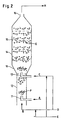
- the dinitration of an aromatic can also be carried out in a nozzle tube reactor 10 with multi-stage redispersion and initial intensive dispersion of the two immiscible liquid streams.
- the aromatic compound A is passed through the jet mixer 11 into the nitronium ion-containing solution B.
- Solutions B and C containing nitronium ions can be prepared by mixing aqueous nitric acid D with an aqueous auxiliary solution E. HNO 3 contents between 50 and 100% by weight are preferably used as the aqueous nitric acid D.
- the aqueous auxiliary solution E preferably consists of H 2 SO 4 , but can also additionally or predominantly contain H 3 PO 4 , CH 3 COOH, perchloric acid and trifluoromethanesulfonic acid.
- the liquid stream of the aromatic compound A is divided in the jet mixer 11 of the nozzle tube reactor 10 in the stream B containing nitronium ions and a finely dispersed emulsion F is formed.
- the contact between the two immiscible liquids A and B starts spontaneously when the aromatic and nitronium ions react , With its high phase interface, the fine emulsion F created by the introduction of kinetic energy ensures a high nitriding rate, which decreases due to the coalescence of the organic liquid droplets.
- this metering in of further nitronium ion-containing solution or highly concentrated sulfuric acid can be repeated analogously to stream C in the upper part of the reactor.
- the composition of solution C will generally not be identical to solution B and will preferably have a higher HNO 3 content.
- the coalesced aromatic droplets G are repeatedly divided into more finely dispersed droplets F using redispersing elements 15 (for example perforated plates).
- the product dispersion H is obtained via the reactor outlet 16.
- the product dispersion consisting of aqueous residual nitronium ion solution and aromatic phase is then worked up in the manner known for adiabatic nitration reactions (cf., for example, DE-A 42 38 390).
- a three-stage nozzle tube reactor according to FIG. 1 was available as a laboratory reactor Available.
- the educt streams consisted of a pure aromatic and a nitronium ion solution by mixing aqueous nitric acid with aqueous sulfuric acid, so-called mixed acid, was produced.
- the educt flows were dosed according to Figure 1 and thermostatted.
- the nozzle tube reactor was isolated to show temperature loss during adiabatic operation avoid.
- the composition of the mixed acid was made gravimetrically. After separation of the aqueous and organic phases, the organic phase first with 10% aqueous soda solution and then twice with water washed.
- the processed organic phase was analyzed by gas chromatography by means of a glass capillary column, the components in Area percent were determined.
- reaction temperatures along the reactor system only through the Composition of the material flows, the degree of conversion and the temperature of the Educts determined.
- a dispersing nozzle with a downstream one is used as the reactor stage Indicated indwelling tube.
- a three-stage nozzle tube reactor with a first mixing nozzle with an inner diameter of 0.3 mm and two redispersing nozzles with an inner diameter of 0.3 mm was used.
- a 60 mm long indwelling tube with an inner diameter of 4 mm was installed behind each nozzle.
- the reactor from Example 1 was used.
- the three-stage nozzle tube reactor from Example 1 modified with a first mixing nozzle with an inner diameter of 0.2 mm and a redispersing nozzle with an inner diameter of 0.2 mm was used.
- a 605 mm dwell pipe was installed behind the first nozzle and a dwell time pipe with a length of 605 mm, each with an inner diameter of 2 mm, and a further 2300 mm long dwell pipe with an inner diameter of 1.76 mm behind the second nozzle.
- the reactant temperature was 120 ° C.
- the three-stage nozzle tube reactor from Example 1 was modified with a first mixing nozzle with an inner diameter of 0.2 mm and a downstream indwelling tube of 550 mm length with 2 mm inner diameter, and two redispersing nozzles with an inner diameter of 0.3 mm and a respective indwelling tube of 220 mm length with 2 mm inner diameter used.
- the reactor from Example 4 was used.
- the reactor from Example 4 was used.
- the reactor from Example 4 was modified, in which a further three redispersing nozzles with an inner diameter of 0.3 mm and a subsequent 550 mm long indwelling tube with an inner diameter of 2 mm were used in addition to the mixing and the two redispersing nozzles.
- the reactor from Example 7 was used.
Landscapes
- Chemical & Material Sciences (AREA)
- Organic Chemistry (AREA)
- Chemical Kinetics & Catalysis (AREA)
- Dispersion Chemistry (AREA)
- Organic Low-Molecular-Weight Compounds And Preparation Thereof (AREA)
Claims (10)
- Procédé continu pour la dinitration de composés aromatiques par la réaction avec une solution contenant des ions nitronium, caractérisé en ce que :a) la dinitration est réalisée dans un seul appareil dans des conditions adiabatiques, dans une émulsion comme milieu de réaction ;b) dans le réacteur, on ajoute par mole de composé aromatique, 1,3 à 3,5 moles de HNO3 sous la forme d'une solution contenant des ions nitronium ;c) l'émulsion tendant à la coalescence est conservée par plusieurs dispersions ;d) la première dispersion du courant liquide est réalisée en moins d'une seconde pour la préparation de l'émulsion, ete) pour la première dispersion, on peut mettre en oeuvre au moins 20% du HNO3 total.
- Procédé suivant la revendication 1, caractérisé en ce que la solution contenant des ions nitronium est mise en oeuvre complètement pour la première dispersion des deux phases.
- Procédé suivant la revendication 1 ou 2, caractérisé en ce que la solution contenant des ions nitronium est un acide mixte d'acides sulfurique et nitrique aqueux.
- Procédé suivant l'une quelconque des revendications 1 à 3, caractérisé en ce que par mole de composé aromatique, sont présentes 1,5 à 3,0 moles de HNO3, de préférence 1,7 à 2,5 moles de HNO3, dans la solution contenant des ions nitronium.
- Procédé suivant l'une quelconque des revendications 1 à 4, caractérisé en ce que la première dispersion des réactifs dans un mélangeur à jet avec un apport spécifique d'énergie allant de 10 à 10 000 joules par litre, de préférence de 50 à 2000 J/litre, de manière particulièrement préférée de 100 à 1000 J/litre, conduit à une émulsion.
- Procédé suivant l'une quelconque des revendications 1 à 5, caractérisé en ce que la redispersion de l'émulsion est réalisée par un mélangeur à jet, statique ou dynamique, de préférence avec un apport spécifique d'énergie de 1 à 1000 joules par litre, de manière particulièrement préférée de 10 à 200 J/litre.
- Procédé suivant la revendication 2, caractérisé en ce que la solution contenant des ions nitronium consiste en 80 à 100% de fraction inorganique, qui se composent de 60 à 95% en poids d'acide sulfurique, 1 à 20% en poids d'acide nitrique et au moins 3% en poids d'eau, ainsi que de jusqu'à 20% en poids de constituants organiques, qui se composent de 70 à 100% en poids d'aromatiques dinitrés et pour le reste, de produits secondaires.
- Procédé suivant l'une quelconque des revendications 1 à 7, caractérisé en ce que la température de mélange des réactifs se situe dans l'intervalle allant de 80 à 150°C, de préférence de 100°C à 130°C et les réactifs quittent le réacteur à des températures allant de 130 à 200°C, de préférence de 140 à 180°C.
- Procédé suivant l'une quelconque des revendications 1 à 7, caractérisé en ce que la température de mélange des réactifs se situe dans l'intervalle allant de 50 à 80°C et que les réactifs quittent le réacteur à des températures allant de 130 à 200°C, de préférence de 140 à 180°C.
- Procédé suivant l'une quelconque des revendications 1 à 9, caractérisé en ce que les aromatiques consistent de préférence en le toluène, le benzène, le chlorobenzène ou le xylène.
Applications Claiming Priority (2)
| Application Number | Priority Date | Filing Date | Title |
|---|---|---|---|
| DE4437047 | 1994-10-17 | ||
| DE4437047A DE4437047A1 (de) | 1994-10-17 | 1994-10-17 | Verfahren zur Dinitrierung von aromatischen Verbindungen |
Publications (3)
| Publication Number | Publication Date |
|---|---|
| EP0708076A2 EP0708076A2 (fr) | 1996-04-24 |
| EP0708076A3 EP0708076A3 (fr) | 2001-09-19 |
| EP0708076B1 true EP0708076B1 (fr) | 2003-04-23 |
Family
ID=6530968
Family Applications (1)
| Application Number | Title | Priority Date | Filing Date |
|---|---|---|---|
| EP95115901A Expired - Lifetime EP0708076B1 (fr) | 1994-10-17 | 1995-10-09 | Procédé pour la dinitration de composés aromatiques |
Country Status (11)
| Country | Link |
|---|---|
| US (1) | US5616818A (fr) |
| EP (1) | EP0708076B1 (fr) |
| JP (1) | JPH08208566A (fr) |
| KR (1) | KR100374757B1 (fr) |
| CN (1) | CN1059667C (fr) |
| BR (1) | BR9504424A (fr) |
| CA (1) | CA2160520A1 (fr) |
| DE (2) | DE4437047A1 (fr) |
| ES (1) | ES2196036T3 (fr) |
| MX (1) | MX195979B (fr) |
| TW (1) | TW308584B (fr) |
Cited By (6)
| Publication number | Priority date | Publication date | Assignee | Title |
|---|---|---|---|---|
| DE102008048713A1 (de) | 2008-09-24 | 2010-03-25 | Bayer Materialscience Ag | Verfahren zur kontinuierlichen Herstellung von Nitrobenzol |
| EP2354117A1 (fr) | 2010-02-05 | 2011-08-10 | Bayer MaterialScience AG | Procédé destiné à la fabrication continue de nitrobenzène |
| WO2014016289A1 (fr) | 2012-07-27 | 2014-01-30 | Bayer Materialscience Ag | Procédé de preparation de nitrobenzène par nitrification adiabatique |
| WO2014016292A1 (fr) | 2012-07-27 | 2014-01-30 | Bayer Materialscience Ag | Procédé de preparation de nitrobenzène par nitrification adiabatique |
| WO2014016290A1 (fr) | 2012-07-27 | 2014-01-30 | Bayer Materialscience Ag | Procédé de preparation de nitrobenzène par nitrification adiabatique |
| WO2018162427A1 (fr) | 2017-03-07 | 2018-09-13 | Covestro Deutschland Ag | Procédé de préparation de nitrobenzène |
Families Citing this family (21)
| Publication number | Priority date | Publication date | Assignee | Title |
|---|---|---|---|---|
| NO303281B1 (no) * | 1996-08-28 | 1998-06-22 | Norsk Hydro As | Nitreringssystem og fremgangsmÕte for nitrering av aromatiske forbindelser |
| ATE555846T1 (de) * | 2000-03-02 | 2012-05-15 | Dow Global Technologies Llc | Rohrreaktor, verfahren zur durchführung von flüssig-flüssig mehrphasenreaktionen und verfahren zur ring-nitrierung von aromatischen verbindungen |
| WO2005005342A2 (fr) * | 2003-04-21 | 2005-01-20 | Bae Systems Ordnance Systems Inc. | Procede de fabrication de tnt a purete elevee |
| US20060153754A1 (en) * | 2004-10-26 | 2006-07-13 | Hauptmann Edward G | Dispersion-intensified, coalescence-intensified chemical reactor and method |
| US7041858B1 (en) | 2005-02-09 | 2006-05-09 | Bayer Materialscience Llc | Process for the production of dinitrotoluene |
| DE102006022447A1 (de) * | 2006-05-13 | 2007-11-15 | Bayer Materialscience Ag | Verfahren zur gekoppelten Herstellung von Chlor und Isocyanaten |
| DE102006033722A1 (de) * | 2006-07-21 | 2008-01-24 | Bayer Materialscience Ag | Verfahren zur Herstellung von Dinitrotoluol |
| WO2010054462A1 (fr) * | 2008-11-14 | 2010-05-20 | Noram International Limited | Méthode de réduction de la formation de sous-produit dinitrobenzène dans la production de mononitrobenzène |
| PT2473477E (pt) * | 2009-08-31 | 2015-02-10 | Basf Se | Método de produção de mononitrotolueno |
| BR112012008916B1 (pt) * | 2009-10-20 | 2021-04-06 | Angus Chemical Company | Processo para sintetizar pelo menos um nitroalcano |
| EA024988B1 (ru) | 2011-05-19 | 2016-11-30 | Йозеф Майсснер Гмбх Унд Ко. Кг | Способ и устройство для очистки продуктов нитрования |
| FR2975921A1 (fr) * | 2011-05-30 | 2012-12-07 | Rhodia Poliamida E Especialidades Ltda | Reacteur chimique industriel pour la production en continu d'alkylate d'alkyle |
| PT2991966T (pt) | 2013-04-29 | 2017-10-06 | Covestro Deutschland Ag | Processo para a produção de nitrobenzeno através de nitração adiabática |
| CN105017024B (zh) * | 2014-04-28 | 2017-03-29 | 山东华鸿化工有限公司 | 一种生产硝基苯的方法及装置 |
| DE102017110084C5 (de) | 2017-02-03 | 2026-02-26 | Josef Meissner Gmbh & Co. Kg | Verwendungen von Nitroaromaten in der adiabatischen Nitrierung von Aromaten |
| CN106824017A (zh) * | 2017-03-14 | 2017-06-13 | 四川泸州巨宏化工有限责任公司 | 用于生产甲基丁炔醇的副反应器 |
| WO2020011817A1 (fr) | 2018-07-12 | 2020-01-16 | Covestro Deutschland Ag | Procédé de production de nitrobenzène par nitrification adiabatique de benzène |
| KR102593920B1 (ko) * | 2018-07-24 | 2023-10-26 | 노람 엔지니어링 앤드 콘스트럭터스 엘티디. | 질소 반응기 및 방법 |
| CN109382059B (zh) * | 2018-11-27 | 2024-03-22 | 荣成腾飞橡胶科技股份有限公司 | 芳香族羧酸化合物在管式反应器内硝化的工艺及装置 |
| CN111495297B (zh) * | 2020-06-12 | 2024-11-12 | 山东友道化学有限公司 | 一种甲基苯甲酸的连续硝化反应系统及连续硝化工艺 |
| CN121568781A (zh) | 2023-08-25 | 2026-02-24 | 科思创德国股份有限公司 | 用于芳族化合物硝化的反应器,包括所述反应器的生产设备和使用所述反应器的硝化方法 |
Family Cites Families (26)
| Publication number | Priority date | Publication date | Assignee | Title |
|---|---|---|---|---|
| US2256999A (en) | 1939-03-08 | 1941-09-23 | Du Pont | Nitration of organic compounds |
| US3160669A (en) | 1962-04-13 | 1964-12-08 | Sumitomo Chemical Co | Emulsion process of producing aromatic nitro compounds |
| US3928475A (en) | 1974-08-09 | 1975-12-23 | Du Pont | Azeotropic nitration of benzene |
| US4021498A (en) | 1975-12-09 | 1977-05-03 | American Cyanamid Company | Adiabatic process for nitration of nitratable aromatic compounds |
| US3981935A (en) | 1975-12-10 | 1976-09-21 | E. I. Du Pont De Nemours And Company | Azeotropic nitration of benzene |
| US4091042A (en) | 1977-08-19 | 1978-05-23 | American Cyanamid Company | Continuous adiabatic process for the mononitration of benzene |
| FR2424875A1 (fr) | 1978-05-02 | 1979-11-30 | Elf Aquitaine | Procede de production de soufre a partir de deux gaz acides renfermant h2s et dont un seul contient nh3 |
| IT1128825B (it) | 1980-06-27 | 1986-06-04 | Fiat Ricerche | Dispositivo di miscelazione statico atto a miscelare omogeneamente due o piu componenti allo stato liquido o semiliquido |
| DE3230289A1 (de) * | 1982-08-14 | 1984-02-16 | Bayer Ag, 5090 Leverkusen | Herstellung von pharmazeutischen oder kosmetischen dispersionen |
| US5116536A (en) * | 1982-08-14 | 1992-05-26 | Bayer Aktiengesellschaft | Preparation of pharmaceutical or cosmetic dispersions |
| US4647212A (en) | 1986-03-11 | 1987-03-03 | Act Laboratories, Inc. | Continuous, static mixing apparatus |
| GR862922B (en) | 1986-12-18 | 1987-01-12 | Himikes Viomihanies Voreiou El | Tubular reactor |
| DE3744001C1 (de) | 1987-12-24 | 1989-06-08 | Bayer Ag | Verfahren zur kontinuierlichen Herstellung von Mono- oder Polyisocyanaten |
| US5001272A (en) | 1988-06-22 | 1991-03-19 | Olin Corporation | Process for the production of dinitrotoluene |
| US4994242A (en) | 1988-08-15 | 1991-02-19 | Noram Engineering And Constructors Ltd. | Jet impingement reactor |
| US4973770A (en) * | 1988-12-15 | 1990-11-27 | C-I-L, Inc. | Manufacture of organic nitro compounds |
| US4918250A (en) | 1989-04-21 | 1990-04-17 | Olin Corporation | Process for the production of dinitrotoluene using an inorganic salt as a phase separation agent |
| DE69026590T2 (de) | 1990-01-04 | 1996-10-31 | Nrm Int Tech | Nitrierungsverfahren |
| US5313009A (en) | 1990-01-04 | 1994-05-17 | Nrm International Technologies C.V. | Nitration process |
| US5057632A (en) | 1990-10-22 | 1991-10-15 | Olin Corporation | Process for preparing dinitrotoluene |
| US5099078A (en) | 1990-12-21 | 1992-03-24 | Olin Corporation | Process for preparing dinitrotoluene |
| US5099080A (en) * | 1991-03-08 | 1992-03-24 | Olin Corporation | Process for preparing dinitrotoluene |
| US5245092A (en) | 1991-03-15 | 1993-09-14 | Olin Corporation | Process for preparing dinitrotoluene with low by-product content |
| TW236610B (en) * | 1992-11-13 | 1994-12-21 | Bayer Ag | Preparation of dinitrotoluene |
| DE4238390A1 (de) * | 1992-11-13 | 1994-05-19 | Bayer Ag | Verfahren zur Herstellung von Dinitrotoluol |
| DE4309140C2 (de) * | 1993-03-22 | 2001-09-20 | Bayer Ag | Verfahren zur Herstellung von Dinitrotoluol |
-
1994
- 1994-10-17 DE DE4437047A patent/DE4437047A1/de not_active Withdrawn
-
1995
- 1995-10-09 ES ES95115901T patent/ES2196036T3/es not_active Expired - Lifetime
- 1995-10-09 EP EP95115901A patent/EP0708076B1/fr not_active Expired - Lifetime
- 1995-10-09 DE DE59510656T patent/DE59510656D1/de not_active Expired - Lifetime
- 1995-10-11 MX MX9504306A patent/MX195979B/es unknown
- 1995-10-13 US US08/543,095 patent/US5616818A/en not_active Expired - Lifetime
- 1995-10-13 CA CA002160520A patent/CA2160520A1/fr not_active Abandoned
- 1995-10-16 KR KR1019950035565A patent/KR100374757B1/ko not_active Expired - Fee Related
- 1995-10-16 BR BR9504424A patent/BR9504424A/pt not_active IP Right Cessation
- 1995-10-16 JP JP7291687A patent/JPH08208566A/ja not_active Ceased
- 1995-10-17 TW TW84110998A patent/TW308584B/zh not_active IP Right Cessation
- 1995-10-17 CN CN95109589A patent/CN1059667C/zh not_active Expired - Fee Related
Cited By (8)
| Publication number | Priority date | Publication date | Assignee | Title |
|---|---|---|---|---|
| DE102008048713A1 (de) | 2008-09-24 | 2010-03-25 | Bayer Materialscience Ag | Verfahren zur kontinuierlichen Herstellung von Nitrobenzol |
| EP2168942A1 (fr) | 2008-09-24 | 2010-03-31 | Bayer MaterialScience AG | Procédé destiné à la fabrication continue de nitrobenzène |
| EP2354117A1 (fr) | 2010-02-05 | 2011-08-10 | Bayer MaterialScience AG | Procédé destiné à la fabrication continue de nitrobenzène |
| DE102010006984A1 (de) | 2010-02-05 | 2011-08-11 | Bayer MaterialScience AG, 51373 | Verfahren zur kontinuierlichen Herstellung von Nitrobenzol |
| WO2014016289A1 (fr) | 2012-07-27 | 2014-01-30 | Bayer Materialscience Ag | Procédé de preparation de nitrobenzène par nitrification adiabatique |
| WO2014016292A1 (fr) | 2012-07-27 | 2014-01-30 | Bayer Materialscience Ag | Procédé de preparation de nitrobenzène par nitrification adiabatique |
| WO2014016290A1 (fr) | 2012-07-27 | 2014-01-30 | Bayer Materialscience Ag | Procédé de preparation de nitrobenzène par nitrification adiabatique |
| WO2018162427A1 (fr) | 2017-03-07 | 2018-09-13 | Covestro Deutschland Ag | Procédé de préparation de nitrobenzène |
Also Published As
| Publication number | Publication date |
|---|---|
| KR100374757B1 (ko) | 2003-06-02 |
| CN1059667C (zh) | 2000-12-20 |
| ES2196036T3 (es) | 2003-12-16 |
| CN1125723A (zh) | 1996-07-03 |
| BR9504424A (pt) | 1997-05-20 |
| MX195979B (en) | 2000-04-13 |
| DE4437047A1 (de) | 1996-04-18 |
| US5616818A (en) | 1997-04-01 |
| JPH08208566A (ja) | 1996-08-13 |
| TW308584B (en) | 1997-06-21 |
| KR960014088A (ko) | 1996-05-22 |
| EP0708076A2 (fr) | 1996-04-24 |
| EP0708076A3 (fr) | 2001-09-19 |
| DE59510656D1 (de) | 2003-05-28 |
| CA2160520A1 (fr) | 1996-04-18 |
Similar Documents
| Publication | Publication Date | Title |
|---|---|---|
| EP0708076A2 (fr) | Procédé pour la dinitration de composés aromatiques | |
| DE69026590T2 (de) | Nitrierungsverfahren | |
| EP1880989B1 (fr) | Procédé destiné à la fabrication de dinitrotoluol | |
| EP0771783B1 (fr) | Procédé pour la nitration de composés aromatiques | |
| EP2473477B1 (fr) | Procédé de production de composés organiques mononitrés | |
| EP0668263B1 (fr) | Procédé pour la préparation adiabatique de mononitrotoluènes | |
| EP2168942A1 (fr) | Procédé destiné à la fabrication continue de nitrobenzène | |
| EP2772304A2 (fr) | Dispositifs de nettoyage de produits de nitruration | |
| EP3555039B1 (fr) | Procédé et installation de nitration adiabatique de composés aromatiques | |
| EP0675104B1 (fr) | Procédé pour la préparation adiabatique de mononitrohalogénobenzènes | |
| EP1028937A1 (fr) | Procede de production de composes nitres aromatiques | |
| EP1508563B1 (fr) | Procédé pour la préparation de dinitrotoluene en deux étapes | |
| EP1205468B1 (fr) | Procédé continu isothermique pour la préparation de mononitrotoluènes | |
| DE69609039T2 (de) | Herstellungsverfahren für aromatische Mononitroverbindungen | |
| EP1099685B1 (fr) | Procédé pour la préparation adiabatique de 3,4-dichloronitrobenzène | |
| DE10117207C1 (de) | Kontinuierliches isothermes Verfahren zur Herstellung von Mononitrotoluolen in Gegenwart von Phosphorsäure | |
| DE19808748A1 (de) | Verfahren zur Herstellung aromatischer Nitroverbindungen |
Legal Events
| Date | Code | Title | Description |
|---|---|---|---|
| PUAI | Public reference made under article 153(3) epc to a published international application that has entered the european phase |
Free format text: ORIGINAL CODE: 0009012 |
|
| AK | Designated contracting states |
Kind code of ref document: A2 Designated state(s): BE DE ES FR GB IT NL |
|
| PUAL | Search report despatched |
Free format text: ORIGINAL CODE: 0009013 |
|
| AK | Designated contracting states |
Kind code of ref document: A3 Designated state(s): BE DE ES FR GB IT NL |
|
| RIC1 | Information provided on ipc code assigned before grant |
Free format text: 7C 07C 205/06 A, 7C 07C 201/08 B, 7C 07C 205/12 B |
|
| 17P | Request for examination filed |
Effective date: 20020319 |
|
| GRAH | Despatch of communication of intention to grant a patent |
Free format text: ORIGINAL CODE: EPIDOS IGRA |
|
| GRAH | Despatch of communication of intention to grant a patent |
Free format text: ORIGINAL CODE: EPIDOS IGRA |
|
| GRAA | (expected) grant |
Free format text: ORIGINAL CODE: 0009210 |
|
| AK | Designated contracting states |
Designated state(s): BE DE ES FR GB IT NL |
|
| REG | Reference to a national code |
Ref country code: GB Ref legal event code: FG4D Free format text: NOT ENGLISH |
|
| REF | Corresponds to: |
Ref document number: 59510656 Country of ref document: DE Date of ref document: 20030528 Kind code of ref document: P |
|
| GBT | Gb: translation of ep patent filed (gb section 77(6)(a)/1977) | ||
| REG | Reference to a national code |
Ref country code: ES Ref legal event code: FG2A Ref document number: 2196036 Country of ref document: ES Kind code of ref document: T3 |
|
| ET | Fr: translation filed | ||
| PLBE | No opposition filed within time limit |
Free format text: ORIGINAL CODE: 0009261 |
|
| STAA | Information on the status of an ep patent application or granted ep patent |
Free format text: STATUS: NO OPPOSITION FILED WITHIN TIME LIMIT |
|
| 26N | No opposition filed |
Effective date: 20040126 |
|
| PGFP | Annual fee paid to national office [announced via postgrant information from national office to epo] |
Ref country code: GB Payment date: 20041006 Year of fee payment: 10 |
|
| PGFP | Annual fee paid to national office [announced via postgrant information from national office to epo] |
Ref country code: ES Payment date: 20041011 Year of fee payment: 10 |
|
| PG25 | Lapsed in a contracting state [announced via postgrant information from national office to epo] |
Ref country code: GB Free format text: LAPSE BECAUSE OF NON-PAYMENT OF DUE FEES Effective date: 20051009 |
|
| PG25 | Lapsed in a contracting state [announced via postgrant information from national office to epo] |
Ref country code: ES Free format text: LAPSE BECAUSE OF NON-PAYMENT OF DUE FEES Effective date: 20051010 |
|
| GBPC | Gb: european patent ceased through non-payment of renewal fee |
Effective date: 20051009 |
|
| REG | Reference to a national code |
Ref country code: ES Ref legal event code: FD2A Effective date: 20051010 |
|
| PGFP | Annual fee paid to national office [announced via postgrant information from national office to epo] |
Ref country code: IT Payment date: 20081028 Year of fee payment: 14 |
|
| PG25 | Lapsed in a contracting state [announced via postgrant information from national office to epo] |
Ref country code: IT Free format text: LAPSE BECAUSE OF NON-PAYMENT OF DUE FEES Effective date: 20091009 |
|
| PGFP | Annual fee paid to national office [announced via postgrant information from national office to epo] |
Ref country code: BE Payment date: 20121018 Year of fee payment: 18 Ref country code: DE Payment date: 20121003 Year of fee payment: 18 Ref country code: FR Payment date: 20121018 Year of fee payment: 18 |
|
| PGFP | Annual fee paid to national office [announced via postgrant information from national office to epo] |
Ref country code: NL Payment date: 20121016 Year of fee payment: 18 |
|
| BERE | Be: lapsed |
Owner name: *BAYER A.G. Effective date: 20131031 |
|
| REG | Reference to a national code |
Ref country code: NL Ref legal event code: V1 Effective date: 20140501 |
|
| REG | Reference to a national code |
Ref country code: FR Ref legal event code: ST Effective date: 20140630 |
|
| REG | Reference to a national code |
Ref country code: DE Ref legal event code: R119 Ref document number: 59510656 Country of ref document: DE Effective date: 20140501 |
|
| PG25 | Lapsed in a contracting state [announced via postgrant information from national office to epo] |
Ref country code: DE Free format text: LAPSE BECAUSE OF NON-PAYMENT OF DUE FEES Effective date: 20140501 Ref country code: FR Free format text: LAPSE BECAUSE OF NON-PAYMENT OF DUE FEES Effective date: 20131031 Ref country code: NL Free format text: LAPSE BECAUSE OF NON-PAYMENT OF DUE FEES Effective date: 20140501 |
|
| PG25 | Lapsed in a contracting state [announced via postgrant information from national office to epo] |
Ref country code: BE Free format text: LAPSE BECAUSE OF NON-PAYMENT OF DUE FEES Effective date: 20131031 |