EP0708363A1 - Verfahren und Vorrichtung zum Ändern des pH-Wertes einer photographischen Entwicklerlösung - Google Patents
Verfahren und Vorrichtung zum Ändern des pH-Wertes einer photographischen Entwicklerlösung Download PDFInfo
- Publication number
- EP0708363A1 EP0708363A1 EP95202821A EP95202821A EP0708363A1 EP 0708363 A1 EP0708363 A1 EP 0708363A1 EP 95202821 A EP95202821 A EP 95202821A EP 95202821 A EP95202821 A EP 95202821A EP 0708363 A1 EP0708363 A1 EP 0708363A1
- Authority
- EP
- European Patent Office
- Prior art keywords
- ion concentration
- hydroxide ion
- solution
- altering
- photographic
- Prior art date
- Legal status (The legal status is an assumption and is not a legal conclusion. Google has not performed a legal analysis and makes no representation as to the accuracy of the status listed.)
- Granted
Links
- 238000000034 method Methods 0.000 title claims abstract description 16
- XLYOFNOQVPJJNP-UHFFFAOYSA-M hydroxide Chemical compound [OH-] XLYOFNOQVPJJNP-UHFFFAOYSA-M 0.000 claims abstract description 41
- 239000000463 material Substances 0.000 claims abstract description 19
- 238000012545 processing Methods 0.000 claims abstract description 11
- 238000011161 development Methods 0.000 claims abstract description 7
- 230000008859 change Effects 0.000 claims abstract description 5
- 239000002002 slurry Substances 0.000 claims description 23
- 230000004888 barrier function Effects 0.000 claims description 17
- 229910000831 Steel Inorganic materials 0.000 claims description 10
- 239000010959 steel Substances 0.000 claims description 10
- -1 silver halide Chemical class 0.000 claims description 9
- 150000003839 salts Chemical class 0.000 claims description 7
- OKTJSMMVPCPJKN-UHFFFAOYSA-N Carbon Chemical compound [C] OKTJSMMVPCPJKN-UHFFFAOYSA-N 0.000 claims description 6
- 229910052799 carbon Inorganic materials 0.000 claims description 6
- 238000005259 measurement Methods 0.000 claims description 5
- 210000002268 wool Anatomy 0.000 claims description 5
- 238000005868 electrolysis reaction Methods 0.000 claims description 4
- 239000007789 gas Substances 0.000 claims description 4
- 239000006174 pH buffer Substances 0.000 claims description 3
- 230000005855 radiation Effects 0.000 claims description 3
- 229910052709 silver Inorganic materials 0.000 claims description 3
- 239000004332 silver Substances 0.000 claims description 3
- 238000013022 venting Methods 0.000 claims 1
- VTYYLEPIZMXCLO-UHFFFAOYSA-L Calcium carbonate Chemical compound [Ca+2].[O-]C([O-])=O VTYYLEPIZMXCLO-UHFFFAOYSA-L 0.000 description 18
- 230000000694 effects Effects 0.000 description 14
- 239000002585 base Substances 0.000 description 10
- 229910000019 calcium carbonate Inorganic materials 0.000 description 9
- 239000003795 chemical substances by application Substances 0.000 description 9
- CIWBSHSKHKDKBQ-JLAZNSOCSA-N Ascorbic acid Chemical compound OC[C@H](O)[C@H]1OC(=O)C(O)=C1O CIWBSHSKHKDKBQ-JLAZNSOCSA-N 0.000 description 8
- 239000000872 buffer Substances 0.000 description 8
- 229910001220 stainless steel Inorganic materials 0.000 description 8
- 239000010935 stainless steel Substances 0.000 description 8
- QIGBRXMKCJKVMJ-UHFFFAOYSA-N Hydroquinone Chemical compound OC1=CC=C(O)C=C1 QIGBRXMKCJKVMJ-UHFFFAOYSA-N 0.000 description 6
- 239000004744 fabric Substances 0.000 description 6
- 239000007788 liquid Substances 0.000 description 6
- 239000003513 alkali Substances 0.000 description 5
- 229960005070 ascorbic acid Drugs 0.000 description 4
- 235000010323 ascorbic acid Nutrition 0.000 description 4
- 239000011668 ascorbic acid Substances 0.000 description 4
- 230000003139 buffering effect Effects 0.000 description 4
- 239000012141 concentrate Substances 0.000 description 4
- 239000001257 hydrogen Substances 0.000 description 4
- 229910052739 hydrogen Inorganic materials 0.000 description 4
- 239000012528 membrane Substances 0.000 description 4
- 230000003647 oxidation Effects 0.000 description 4
- 238000007254 oxidation reaction Methods 0.000 description 4
- BASFCYQUMIYNBI-UHFFFAOYSA-N platinum Chemical compound [Pt] BASFCYQUMIYNBI-UHFFFAOYSA-N 0.000 description 4
- LSNNMFCWUKXFEE-UHFFFAOYSA-L sulfite Chemical compound [O-]S([O-])=O LSNNMFCWUKXFEE-UHFFFAOYSA-L 0.000 description 4
- UFHFLCQGNIYNRP-UHFFFAOYSA-N Hydrogen Chemical compound [H][H] UFHFLCQGNIYNRP-UHFFFAOYSA-N 0.000 description 3
- KWYUFKZDYYNOTN-UHFFFAOYSA-M Potassium hydroxide Chemical compound [OH-].[K+] KWYUFKZDYYNOTN-UHFFFAOYSA-M 0.000 description 3
- 235000003560 Valerianella locusta Nutrition 0.000 description 3
- 240000004668 Valerianella locusta Species 0.000 description 3
- AXCZMVOFGPJBDE-UHFFFAOYSA-L calcium dihydroxide Chemical compound [OH-].[OH-].[Ca+2] AXCZMVOFGPJBDE-UHFFFAOYSA-L 0.000 description 3
- 239000000920 calcium hydroxide Substances 0.000 description 3
- 229910001861 calcium hydroxide Inorganic materials 0.000 description 3
- 238000002474 experimental method Methods 0.000 description 3
- 150000002500 ions Chemical class 0.000 description 3
- 229910052751 metal Inorganic materials 0.000 description 3
- 239000002184 metal Substances 0.000 description 3
- 238000002156 mixing Methods 0.000 description 3
- 230000000717 retained effect Effects 0.000 description 3
- CBCKQZAAMUWICA-UHFFFAOYSA-N 1,4-phenylenediamine Chemical compound NC1=CC=C(N)C=C1 CBCKQZAAMUWICA-UHFFFAOYSA-N 0.000 description 2
- BVKZGUZCCUSVTD-UHFFFAOYSA-L Carbonate Chemical compound [O-]C([O-])=O BVKZGUZCCUSVTD-UHFFFAOYSA-L 0.000 description 2
- RTAQQCXQSZGOHL-UHFFFAOYSA-N Titanium Chemical compound [Ti] RTAQQCXQSZGOHL-UHFFFAOYSA-N 0.000 description 2
- 150000001447 alkali salts Chemical class 0.000 description 2
- 239000003963 antioxidant agent Substances 0.000 description 2
- 230000003078 antioxidant effect Effects 0.000 description 2
- 235000006708 antioxidants Nutrition 0.000 description 2
- 230000007423 decrease Effects 0.000 description 2
- 238000001914 filtration Methods 0.000 description 2
- 239000012530 fluid Substances 0.000 description 2
- PCHJSUWPFVWCPO-UHFFFAOYSA-N gold Chemical compound [Au] PCHJSUWPFVWCPO-UHFFFAOYSA-N 0.000 description 2
- 229910052737 gold Inorganic materials 0.000 description 2
- 239000010931 gold Substances 0.000 description 2
- GPRLSGONYQIRFK-UHFFFAOYSA-N hydron Chemical compound [H+] GPRLSGONYQIRFK-UHFFFAOYSA-N 0.000 description 2
- 238000012986 modification Methods 0.000 description 2
- 230000004048 modification Effects 0.000 description 2
- 229910052697 platinum Inorganic materials 0.000 description 2
- 230000009467 reduction Effects 0.000 description 2
- HBMJWWWQQXIZIP-UHFFFAOYSA-N silicon carbide Chemical compound [Si+]#[C-] HBMJWWWQQXIZIP-UHFFFAOYSA-N 0.000 description 2
- 229910010271 silicon carbide Inorganic materials 0.000 description 2
- 239000008399 tap water Substances 0.000 description 2
- 235000020679 tap water Nutrition 0.000 description 2
- 229910052719 titanium Inorganic materials 0.000 description 2
- 239000010936 titanium Substances 0.000 description 2
- XLYOFNOQVPJJNP-UHFFFAOYSA-N water Substances O XLYOFNOQVPJJNP-UHFFFAOYSA-N 0.000 description 2
- NWUYHJFMYQTDRP-UHFFFAOYSA-N 1,2-bis(ethenyl)benzene;1-ethenyl-2-ethylbenzene;styrene Chemical compound C=CC1=CC=CC=C1.CCC1=CC=CC=C1C=C.C=CC1=CC=CC=C1C=C NWUYHJFMYQTDRP-UHFFFAOYSA-N 0.000 description 1
- BHPQYMZQTOCNFJ-UHFFFAOYSA-N Calcium cation Chemical compound [Ca+2] BHPQYMZQTOCNFJ-UHFFFAOYSA-N 0.000 description 1
- MYMOFIZGZYHOMD-UHFFFAOYSA-N Dioxygen Chemical compound O=O MYMOFIZGZYHOMD-UHFFFAOYSA-N 0.000 description 1
- DGAQECJNVWCQMB-PUAWFVPOSA-M Ilexoside XXIX Chemical compound C[C@@H]1CC[C@@]2(CC[C@@]3(C(=CC[C@H]4[C@]3(CC[C@@H]5[C@@]4(CC[C@@H](C5(C)C)OS(=O)(=O)[O-])C)C)[C@@H]2[C@]1(C)O)C)C(=O)O[C@H]6[C@@H]([C@H]([C@@H]([C@H](O6)CO)O)O)O.[Na+] DGAQECJNVWCQMB-PUAWFVPOSA-M 0.000 description 1
- 229920000557 Nafion® Polymers 0.000 description 1
- 229910019142 PO4 Inorganic materials 0.000 description 1
- QAOWNCQODCNURD-UHFFFAOYSA-N Sulfuric acid Chemical compound OS(O)(=O)=O QAOWNCQODCNURD-UHFFFAOYSA-N 0.000 description 1
- FMRLDPWIRHBCCC-UHFFFAOYSA-L Zinc carbonate Chemical compound [Zn+2].[O-]C([O-])=O FMRLDPWIRHBCCC-UHFFFAOYSA-L 0.000 description 1
- 230000009471 action Effects 0.000 description 1
- 238000004458 analytical method Methods 0.000 description 1
- QVGXLLKOCUKJST-UHFFFAOYSA-N atomic oxygen Chemical compound [O] QVGXLLKOCUKJST-UHFFFAOYSA-N 0.000 description 1
- 230000008901 benefit Effects 0.000 description 1
- NKWPZUCBCARRDP-UHFFFAOYSA-L calcium bicarbonate Chemical compound [Ca+2].OC([O-])=O.OC([O-])=O NKWPZUCBCARRDP-UHFFFAOYSA-L 0.000 description 1
- 229910000020 calcium bicarbonate Inorganic materials 0.000 description 1
- 229910001424 calcium ion Inorganic materials 0.000 description 1
- 229940075397 calomel Drugs 0.000 description 1
- 150000004649 carbonic acid derivatives Chemical class 0.000 description 1
- 230000003197 catalytic effect Effects 0.000 description 1
- 238000006243 chemical reaction Methods 0.000 description 1
- 230000008878 coupling Effects 0.000 description 1
- 238000010168 coupling process Methods 0.000 description 1
- 238000005859 coupling reaction Methods 0.000 description 1
- 230000002939 deleterious effect Effects 0.000 description 1
- 230000001419 dependent effect Effects 0.000 description 1
- 238000000502 dialysis Methods 0.000 description 1
- ZOMNIUBKTOKEHS-UHFFFAOYSA-L dimercury dichloride Chemical compound Cl[Hg][Hg]Cl ZOMNIUBKTOKEHS-UHFFFAOYSA-L 0.000 description 1
- 229910001882 dioxygen Inorganic materials 0.000 description 1
- 239000000839 emulsion Substances 0.000 description 1
- 238000000605 extraction Methods 0.000 description 1
- 230000002706 hydrostatic effect Effects 0.000 description 1
- 238000003780 insertion Methods 0.000 description 1
- 230000037431 insertion Effects 0.000 description 1
- 239000003456 ion exchange resin Substances 0.000 description 1
- 229920003303 ion-exchange polymer Polymers 0.000 description 1
- 229920000554 ionomer Polymers 0.000 description 1
- QWDJLDTYWNBUKE-UHFFFAOYSA-L magnesium bicarbonate Chemical compound [Mg+2].OC([O-])=O.OC([O-])=O QWDJLDTYWNBUKE-UHFFFAOYSA-L 0.000 description 1
- 239000002370 magnesium bicarbonate Substances 0.000 description 1
- 229910000022 magnesium bicarbonate Inorganic materials 0.000 description 1
- 235000014824 magnesium bicarbonate Nutrition 0.000 description 1
- ZLNQQNXFFQJAID-UHFFFAOYSA-L magnesium carbonate Chemical compound [Mg+2].[O-]C([O-])=O ZLNQQNXFFQJAID-UHFFFAOYSA-L 0.000 description 1
- 239000001095 magnesium carbonate Substances 0.000 description 1
- 229910000021 magnesium carbonate Inorganic materials 0.000 description 1
- VTHJTEIRLNZDEV-UHFFFAOYSA-L magnesium dihydroxide Chemical compound [OH-].[OH-].[Mg+2] VTHJTEIRLNZDEV-UHFFFAOYSA-L 0.000 description 1
- 239000000347 magnesium hydroxide Substances 0.000 description 1
- 229910001862 magnesium hydroxide Inorganic materials 0.000 description 1
- 239000000203 mixture Substances 0.000 description 1
- 239000001301 oxygen Substances 0.000 description 1
- 229910052760 oxygen Inorganic materials 0.000 description 1
- 238000001139 pH measurement Methods 0.000 description 1
- 239000002245 particle Substances 0.000 description 1
- 235000021317 phosphate Nutrition 0.000 description 1
- 150000003013 phosphoric acid derivatives Chemical class 0.000 description 1
- 239000000843 powder Substances 0.000 description 1
- 238000011160 research Methods 0.000 description 1
- 239000011734 sodium Substances 0.000 description 1
- 229910052708 sodium Inorganic materials 0.000 description 1
- 239000000126 substance Substances 0.000 description 1
- 239000001117 sulphuric acid Substances 0.000 description 1
- 235000011149 sulphuric acid Nutrition 0.000 description 1
- 230000036962 time dependent Effects 0.000 description 1
- 238000009423 ventilation Methods 0.000 description 1
- 239000011667 zinc carbonate Substances 0.000 description 1
- 229910000010 zinc carbonate Inorganic materials 0.000 description 1
- 235000004416 zinc carbonate Nutrition 0.000 description 1
- UGZADUVQMDAIAO-UHFFFAOYSA-L zinc hydroxide Chemical compound [OH-].[OH-].[Zn+2] UGZADUVQMDAIAO-UHFFFAOYSA-L 0.000 description 1
- 229940007718 zinc hydroxide Drugs 0.000 description 1
- 229910021511 zinc hydroxide Inorganic materials 0.000 description 1
- PCHQDTOLHOFHHK-UHFFFAOYSA-L zinc;hydrogen carbonate Chemical compound [Zn+2].OC([O-])=O.OC([O-])=O PCHQDTOLHOFHHK-UHFFFAOYSA-L 0.000 description 1
Images


Classifications
-
- G—PHYSICS
- G03—PHOTOGRAPHY; CINEMATOGRAPHY; ANALOGOUS TECHNIQUES USING WAVES OTHER THAN OPTICAL WAVES; ELECTROGRAPHY; HOLOGRAPHY
- G03C—PHOTOSENSITIVE MATERIALS FOR PHOTOGRAPHIC PURPOSES; PHOTOGRAPHIC PROCESSES, e.g. CINE, X-RAY, COLOUR, STEREO-PHOTOGRAPHIC PROCESSES; AUXILIARY PROCESSES IN PHOTOGRAPHY
- G03C5/00—Photographic processes or agents therefor; Regeneration of such processing agents
- G03C5/26—Processes using silver-salt-containing photosensitive materials or agents therefor
- G03C5/29—Development processes or agents therefor
- G03C5/31—Regeneration; Replenishers
-
- G—PHYSICS
- G03—PHOTOGRAPHY; CINEMATOGRAPHY; ANALOGOUS TECHNIQUES USING WAVES OTHER THAN OPTICAL WAVES; ELECTROGRAPHY; HOLOGRAPHY
- G03C—PHOTOSENSITIVE MATERIALS FOR PHOTOGRAPHIC PURPOSES; PHOTOGRAPHIC PROCESSES, e.g. CINE, X-RAY, COLOUR, STEREO-PHOTOGRAPHIC PROCESSES; AUXILIARY PROCESSES IN PHOTOGRAPHY
- G03C5/00—Photographic processes or agents therefor; Regeneration of such processing agents
- G03C5/26—Processes using silver-salt-containing photosensitive materials or agents therefor
-
- G—PHYSICS
- G03—PHOTOGRAPHY; CINEMATOGRAPHY; ANALOGOUS TECHNIQUES USING WAVES OTHER THAN OPTICAL WAVES; ELECTROGRAPHY; HOLOGRAPHY
- G03C—PHOTOSENSITIVE MATERIALS FOR PHOTOGRAPHIC PURPOSES; PHOTOGRAPHIC PROCESSES, e.g. CINE, X-RAY, COLOUR, STEREO-PHOTOGRAPHIC PROCESSES; AUXILIARY PROCESSES IN PHOTOGRAPHY
- G03C5/00—Photographic processes or agents therefor; Regeneration of such processing agents
- G03C5/26—Processes using silver-salt-containing photosensitive materials or agents therefor
- G03C5/263—Processes using silver-salt-containing photosensitive materials or agents therefor with an exterior influence, e.g. ultrasonics, electrical or thermal means
Definitions
- the invention relates to a method and apparatus for altering the pH of a photographic developing solution.
- the invention is of particular use in the development of an exposed radiation-sensitive silver halide material.
- a large number of photographic developing agents are known. Examples of such developing agents include hydroquinone, p-phenylenediamine and ascorbic acid.
- a solution of a developing agent should have a certain pH.
- the organic developing agents require an alkaline environment to be effective.
- the strength of the alkali will depend upon the nature of the developing agent and the activity required.
- the buffering action of the alkali i.e. the reserve of alkali available to neutralise the hydrogen ions formed during development, is important.
- the concentration of the developing agent decreases and the alkalinity decreases. These and other changes contribute to a reduction in the activity of the developer.
- This effect can be overcome by adding one or more replenishing solutions. For example, the addition of alkali can restore the original pH.
- the activity of the developer can also be reduced by aerial oxidation. It is common practice to incorporate sulphite in the developer as an antioxidant.
- EP-0 552 511 describes a method for controlling the pH of an ascorbic acid type developer.
- the pH of the developing solution is maintained during use by the automatic addition of an appropriate amount of alkali.
- the amount is controlled by a redox potential measuring system which monitors the pH of the developer.
- a method of altering the pH of a developer without having to add a separate solution is desirable.
- a way of reducing the tendency of a developer to oxidise in the air which diminishes or eliminates the need for an antioxidant such as sulphite is desirable.
- the invention provides a method for altering the pH of a photographic developing solution by altering the hydroxide ion concentration of the solution characterised in that the hydroxide ion concentration is altered electrolytically.
- Photographic processing apparatus comprises a photographic development stage in which a photographic material to be processed is treated with a photographic developer solution characterised in that the apparatus comprises means for electrolytically altering the hydroxide ion concentration of the developer solution and means for controlling the operation of electrolytically altering the hydroxide ion concentration based on the change of hydroxide ion concentration in use.
- a method for developing an exposed radiation-sensitive silver halide material using a photographic developing solution wherein the pH of the solution is altered to a desired value by altering the hydroxide ion concentration of the solution is characterised in that the pH of the solution is altered electrolytically.
- the pH of the developer can be altered without having to add a separate solution.
- the complexities of buffering high pH values can be avoided by generating base in the developer when needed.
- the ability to generate base on demand makes it possible to reduce the amount of base and buffer contained in developer concentrates.
- a reduction in the amount of base and buffer contained in developer concentrates increases the solubility of sulphite in the concentrates.
- the generation of base in this way avoids the sale and handling of concentrated hydroxide solutions.
- Some developing agents e.g. ascorbic acid oxidise in the air to give lower pH. Electrical generation of base on a time dependent basis helps to make such developers practical.
- the hydroxide ion concentration of the photographic developer solution may be altered electrolytically by contacting the solution with an electrolytic cell comprising an electrode in contact with the developing solution and an electrode in contact with a slurry of sparingly soluble salt capable of acting as a pH buffer which is separated from the developing solution by an ion-permeable barrier and passing an electric current through the cell.
- the potential difference applied to the electrodes may range from 0.5 to 50V, preferably from 2 to 10V.
- the current passing between the electrodes may range from 0.005 to 100A, preferably from 0.02 to 10A.
- the electrode in contact with the developer solution may be made of any suitable electroconductive material e.g. a metal such as steel including stainless steel, platinum, gold and titanium; or other materials such as carbon and silicon carbide.
- a metal such as steel including stainless steel, platinum, gold and titanium; or other materials such as carbon and silicon carbide.
- the electrode may take a variety of forms e.g. steel wool or steel mesh.
- the electrode in contact with the slurry of sparingly soluble salt may be made of any suitable electroconductive material e.g. a metal such as steel including stainless steel, platinum, gold and titanium; or other materials such as carbon and silicon carbide.
- a metal such as steel including stainless steel, platinum, gold and titanium; or other materials such as carbon and silicon carbide.
- the electrode may take a variety of forms e.g. steel wool or steel mesh.
- the slurry of sparingly soluble salt may comprise one or more basic salts.
- suitable salts include calcium carbonate, calcium bicarbonate, calcium hydroxide, magnesium carbonate, magnesium bicarbonate, magnesium hydroxide, zinc carbonate, zinc bicarbonate and zinc hydroxide.
- the ion-permeable barrier separating the slurry of sparingly soluble salt from the developer solution may be a liquid bridge, a membrane or a porous barrier. Although easy mixing of the slurry and developer should be avoided, some limited mixing is not deleterious. Examples of suitable ion-permeable barrier materials include osmosis membranes, dialysis membranes and ionomers e.g. NAFION (Du Pont).
- the developer solution comprises any suitable developing agent.
- developing agents are disclosed in Research Disclosure , December 1989, Item 308119, Section XX, published by Kenneth Mason Publications, Ltd., Dudley Annex, 12a North Street, Emsworth, Hampshire PO10 7DQ, England.
- the electrolytic cell can be used to raise the hydroxide ion concentration of the developer solution by making the electrode in contact with the developer solution the cathode.
- the current passing through the cell generates hydroxide ion at the cathode and hydrogen ion at the anode.
- the hydrogen ion is generated in the immediate proximity of a large quantity of base which will prevent the pH being lowered by this ion later.
- the base is in effect transferred from the slurry to the developer electrically in an amount which is proportional to the current and length of time for which the current is applied.
- the amount to be transferred can be determined by the usual techniques of time and/or workload, or by pH measurement, or by analysis.
- a current may be passed through the cell as the developer is used so that hydroxide ion is generated to replace that used in development. If the pH of the developer solution is too low to use immediately then the hydroxide can be generated before use.
- the pH of the developer can be lowered by turning the cell off and can be raised by turning it on. If the pH of the buffer is below the pH at which the developer is active, the pH of the developer will drop to below its active pH when the cell is turned off thus preserving it against aerial oxidation when not in use.
- the developer can then be re-activated by turning the cell on to raise the pH before it can be used again. This enables developer to be supplied in inactive or less active form to be activated by the cell.
- the electrolytic cell can be used to lower the hydroxide ion concentration of the developer solution by making the electrode in contact with the developer solution the anode.
- developer would normally be oxidised at the anode.
- the invention is of use in any photographic processing apparatus comprising a photographic development stage in which a photographic material to be processed is treated with a photographic developer solution.
- the photographic material may be a light sensitive photographic film or paper.
- many conventional photographic processors comprise a plurality of tanks containing various processing fluids, each tank having a plurality of rollers for transporting the light-sensitive material therethrough. Pumps may be used to circulate the processing fluids within the processor tanks.
- the invention provides means for electrolytically altering the hydroxide ion concentration of the developer solution and means for controlling the operation of electrolytically altering the hydroxide ion concentration based on the change of hydroxide ion concentration in use.
- the means for electrolytically altering the hydroxide ion concentration of the solution may comprise an electrolytic cell comprising an electrode for contacting the developing solution and an electrode in contact with a slurry of sparingly soluble basic salt which is separated from the electrode for contacting the developing solution by an ion-permeable barrier.
- the means for controlling the operation of electrolytically altering the hydroxide ion concentration based on the change of hydroxide ion concentration in use may take a variety of forms.
- the control means may comprise means for operating the electrolytic cell so that the current passed through the cell and the length of time for which the current is passed is sufficient to generate a desired amount of hydroxide ions in the developer solution.
- the desired amount of hydroxide ions may be that sufficient to maintain the pH of the developer solution at a constant value.
- the amount of hydroxide ions to be generated may be calculated according to the workload of the processor i.e. from a knowledge of the quantity of photographic material to be processed in a given time, the amount of hydroxide ion depletion can be calculated and the amount of electrolysis required to offset the depletion can be determined.
- the control means ensures that an appropriate current is passed through the electrolytic cell for an appropriate length of time.
- the means for controlling the operation of electrolytically altering the hydroxide ion concentration comprises means for measuring the hydroxide ion concentration or pH of the developing solution e.g. a redox electrode system.
- the amount of electrolysis required is based on the measurement provided by the measurement system.
- a control arrangement can be provided which is capable of producing an output pulse whose duration varies depending on the difference in potential between a reference potential and the potential measured by the redox electrode system, whereby said output pulse is used to operate a relay device controlling the operation of passing an electric current through the electrolytic cell.
- the electrolytic cell can be built into a cartridge pack with a connection device for coupling to a photographic processor.
- a cartridge pack is described in EP-A-0 608 947.
- the electrolytic cell can be in the form of a separate container e.g. a tube, and can have pH electrodes built in.
- the container can be a plug-in disposable item avoiding the need to calibrate the electrodes or to replace the slurry.
- the electrolytic cell can include an ion exchange resin in the developer path to replace calcium ions with a more soluble ion such as sodium.
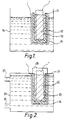
- FIG. 1 is a schematic representation of an electrolytic cell useful in the invention.
- the cell comprises a papier mache cup 11 which is loosely filled with calcium carbonate 12.
- An electrode of stainless steel cloth 13 is inserted in the calcium carbonate.
- Another stainless steel cloth electrode 14 is wrapped around the cup.
- the cell is immersed in a container of developer solution 15.
- the electrodes are connected to a power source (not shown) so that electrode 13 is the anode and electrode 14 is the cathode.
- FIG. 2 is a schematic representation of another electrolytic cell useful in the invention.
- Figure 2 shows a modification of the cell described in Figure 1 intended for inclusion in a recirculation system.
- the cell comprises a papier mache cup 21 which is loosely filled with calcium carbonate 22.
- An electrode of stainless steel cloth 23 is inserted in the calcium carbonate.
- Another stainless steel cloth electrode 24 is wrapped around the cup.
- the cell is immersed in a container of developer solution 25.
- the electrodes are connected to a power source (not shown) so that electrode 23 is the anode and electrode 24 is the cathode.
- the container 25 is closed and is provided with an inlet 26 and outlet 27 to allow recirculated solutions to be pumped through.
- the inner container of the electrode system is also closed but has a gas vent valve 28 to relieve the pressure which builds up as gas is generated.
- FIG. 3 is a schematic representation of photographic processing apparatus incorporating an electrolytic cell useful in the invention.
- the electrolytic cell 32 forms part of a chemical supply cartridge 31 for supplying processing solutions to a photographic processor (not shown).
- the cartridge 31 is coupled to the photographic processor through a connection device 33.
- the cartridge comprises a compartment containing developer solution, a compartment containing fixer solution and three separate compartments containing wash solution as shown.
- used developer solution flows from the photographic processor into the electrolytic cell 32 where the pH of the solution is adjusted in accordance with the invention.
- the developer solution then flows into the compartment containing developer solution from which it can be returned to the processor.
- a tap 34 or suitable device is opened as the cartridge is removed which allows the high pH developer to mix with the low pH contents of the inner container of the electrolytic cell 31.
- the pH is reduced for return to the factory or disposal.
- the pH may be reduced by reversing the current passed through the cell.
- FIG 4 is a schematic representation of apparatus in accordance with the invention.
- An electrolytic cell 41 of the type shown in Figure 1 is immersed in a container of developer solution 42.
- the electrodes of the electrolytic cell are connected to a power source 43.
- a redox electrode system 44 for producing a signal dependent on the state of oxidation of the developer solution is immersed in the container of developer solution 42.
- the redox electrode pH measuring system 44 may comprise a carbon electrode/calomel reference electrode.
- the value of the signal from the measuring system 44 is compared with a reference signal generated by a timing pulse generator 45 which produces a timing pulse corresponding to the difference between the signals.
- the timing pulse is employed to actuate a relay unit 46 to control the operation of the electrolytic cell 41.
- the timing pulse controls the passage of electrical current through the electrolytic cell 41 until the difference signal is reduced to zero.
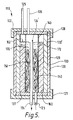
- FIG. 5 is a schematic representation of a further electrolytic cell useful in the invention.
- An improved electrolytic cell 110 comprises a cylindrical outer case 120, an annular anode 130, an ion-permeable barrier 140 and a cathode 150. Slurry 160 is retained between the ion-permeable barrier and the anode 130. Developer solution 170 is retained inside the ion-permeable barrier 140.
- the outer case 120 has a lower end cap 121 and an upper end cap 122. End caps 121, 122 may be fixed to the outer case 120 in any convenient manner. However, it is preferred that the outer case 120 has screw threads formed adjacent its ends (not shown) to provide a screw engagement for the end caps 121, 122.
- Lower end cap 121 has an inlet tube 123 and an outlet tube 124 formed therein. Outlet tube 124 is located centrally with respect to the outer case 120.
- Upper end cap 122 has vents 125, 126 formed therein. Respective seals 127, 128 are provided between lower and upper end caps 121, 122 and the anode 130 and ion-permeable barrier 140.
- Electrical connection to anode 130 is made by one or more circlips (not shown) which are located in circumferential wall surface 129 of case 120. As electrical connection to the anode 130 is not immersed in developer solution, it cannot be easily corroded.
- lower seal 127 seals around inlet and outlet tubes 123, 124 and upper seal 128 seals around vents 125, 126.
- Ion-permeable barrier 140 comprises a cylindrical support member which is located centrally inside outer case 120.
- the support member is covered with a filtration medium (not shown) which allows ions to migrate between developer solution 170 and slurry 160 without allowing particles of the slurry 160 to enter the developer solution 170.
- the support member may comprise a spring, a tube of steel mesh or similar material.
- the filtration medium may comprise filter paper, or a suitable plastic or metal equivalent material.
- the ion-permeable barrier 140 may be convoluted to increase the working surface area.
- Anode 130 made of carbon, is positioned between the ion-permeable barrier 140 and the outer case 120, lying adjacent inner surface 120' thereof.
- Cathode 150 is formed from steel wool and defines a cathodic region 152 positioned inside ion-permeable barrier 140 and surrounding inlet tube 123. Inlet tube 123 extends into the cathodic region 152.
- Slurry 160 is retained in the cell 110 between ion-permeable barrier 140 and carbon anode 130.
- the slurry 160 may be introduced into the cell 110 as a dry powder of calcium carbonate, calcium hydroxide or similar material.
- developer solution is pumped into the cell 110 via inlet 123, some of the solution will penetrate the ion-permeable barrier 140 and provide the liquid for the slurry 160.
- the cell can be filled with prepared slurry prior to use. It will be appreciated that oxygen gas produced during use will provide some circulation, and will be discharged at surface 162 and be vented via vent 125.
- Bubbles of hydrogen produced in the developer solution during the electrolytic reaction are carried upwards to the surface 172 of the developer solution 170 where they are discharged and can be vented out of the cell 110 through vent 126.
- vents 125, 126 are shown for oxygen and hydrogen respectively, a sufficiently large single vent (not shown) may be provided in upper end cap 122 to provide adequate ventilation for the cell 110 thereby preventing ignition of the gases.
- the electrolytic cell of the present invention can also be used to prevent or reduce aerial oxidation of developer solution in a processing machine.
- the voltage required to achieve these results is lower than that required to generate hydroxide ions and so no build up of hydroxide ions results.
- the invention is illustrated by way of example as follows.
- FIG. 1 An electrolytic cell as shown in Figure 1 was prepared.
- a Soxlet extraction thimble (a papier mache cup) 11 is loosely filled with calcium carbonate 12 and an electrode of stainless steel cloth is inserted in the carbonate 12.
- a stainless steel cloth cathode 13 is wrapped round the thimble and the whole lowered into a beaker of the desired liquid 15.
- the thimble can with advantage be filled with water before the insertion.
- a current of about 1A is passed through the cell at from 4 to 12V depending on conditions.
- Cell 2 represents a modification of Cell 1 in which tap water was used as the solution and the calcium carbonate was replaced with calcium hydroxide.
- the pH of the slurry was about 13.0.
- the solution was standard 2000 series developer (Photocomposition developer based on hydroquinone) that had been made up without the carbonate buffer and adjusted to pH 9 with potassium hydroxide.
- a time series showed that the pH and activity increased with the time spent electrolysing the cell until the full activity of the standard developer was obtained.
- liquid was an experimental ascorbic acid developer designed for composition emulsions.
- the pH and activity again increased with time in contact with the cell, giving a satisfactory activity at the expected pH.
Landscapes
- Physics & Mathematics (AREA)
- General Physics & Mathematics (AREA)
- Water Treatment By Electricity Or Magnetism (AREA)
- Silver Salt Photography Or Processing Solution Therefor (AREA)
- Photographic Processing Devices Using Wet Methods (AREA)
Applications Claiming Priority (2)
| Application Number | Priority Date | Filing Date | Title |
|---|---|---|---|
| GB9421243A GB9421243D0 (en) | 1994-10-21 | 1994-10-21 | Method and apparatus for altering the PH of a photographic developing solution |
| GB9421243 | 1994-10-21 |
Publications (2)
| Publication Number | Publication Date |
|---|---|
| EP0708363A1 true EP0708363A1 (de) | 1996-04-24 |
| EP0708363B1 EP0708363B1 (de) | 2000-08-16 |
Family
ID=10763191
Family Applications (1)
| Application Number | Title | Priority Date | Filing Date |
|---|---|---|---|
| EP95202821A Expired - Lifetime EP0708363B1 (de) | 1994-10-21 | 1995-10-18 | Verfahren und Vorrichtung zum Ändern des pH-Wertes einer photographischen Entwicklerlösung |
Country Status (5)
| Country | Link |
|---|---|
| US (1) | US5670303A (de) |
| EP (1) | EP0708363B1 (de) |
| JP (1) | JPH08211573A (de) |
| DE (1) | DE69518381T2 (de) |
| GB (1) | GB9421243D0 (de) |
Families Citing this family (1)
| Publication number | Priority date | Publication date | Assignee | Title |
|---|---|---|---|---|
| JP3969897B2 (ja) * | 1999-06-09 | 2007-09-05 | 富士フイルム株式会社 | 平版印刷用原板の現像処理方法及び現像処理装置 |
Citations (5)
| Publication number | Priority date | Publication date | Assignee | Title |
|---|---|---|---|---|
| FR847179A (fr) * | 1938-12-06 | 1939-10-04 | Procédé pour influencer le potentiel des bains de traitements photographiques | |
| FR875939A (fr) * | 1940-10-04 | 1942-10-08 | Procédé pour compenser l'influence de la température sur l'efficacité des bains de traitements photographiques | |
| GB942034A (en) * | 1959-08-20 | 1963-11-20 | Kodak Ltd | Development of photographic silver halide layers |
| EP0552511A1 (de) * | 1992-01-20 | 1993-07-28 | Agfa-Gevaert N.V. | Verfahren zur pH-Wertkontrolle eines Ascorbinsäureentwicklers |
| US5355191A (en) * | 1992-09-30 | 1994-10-11 | Fuji Photo Film Co., Ltd. | Photographic processing apparatus and method |
Family Cites Families (7)
| Publication number | Priority date | Publication date | Assignee | Title |
|---|---|---|---|---|
| GB1313796A (en) * | 1970-04-20 | 1973-04-18 | Ipc Services Ltd | Photographic processing |
| US4217188A (en) * | 1974-08-30 | 1980-08-12 | Teijin Ltd. | Method for storing developers |
| US4089760A (en) * | 1974-08-30 | 1978-05-16 | Nippon Evr Limited | Method for regenerating waste developers used for processing silver halide photographic materials and method for storing developers |
| US4145271A (en) * | 1976-10-12 | 1979-03-20 | Teijin Limited | Method for regenerating oxidized photographic developers |
| JPS5437731A (en) * | 1977-08-30 | 1979-03-20 | Fuji Photo Film Co Ltd | Method and apparatus for controlling halogen ion concentration in photographic processing solution |
| JPS561048A (en) * | 1979-06-15 | 1981-01-08 | Fuji Photo Film Co Ltd | Regenerating method for waste photographic processing solution |
| JPS5633644A (en) * | 1979-08-27 | 1981-04-04 | Fuji Photo Film Co Ltd | Regenerating method for photographic processing solution |
-
1994
- 1994-10-21 GB GB9421243A patent/GB9421243D0/en active Pending
-
1995
- 1995-08-28 US US08/520,344 patent/US5670303A/en not_active Expired - Fee Related
- 1995-10-18 EP EP95202821A patent/EP0708363B1/de not_active Expired - Lifetime
- 1995-10-18 DE DE69518381T patent/DE69518381T2/de not_active Expired - Fee Related
- 1995-10-20 JP JP7272592A patent/JPH08211573A/ja not_active Withdrawn
Patent Citations (5)
| Publication number | Priority date | Publication date | Assignee | Title |
|---|---|---|---|---|
| FR847179A (fr) * | 1938-12-06 | 1939-10-04 | Procédé pour influencer le potentiel des bains de traitements photographiques | |
| FR875939A (fr) * | 1940-10-04 | 1942-10-08 | Procédé pour compenser l'influence de la température sur l'efficacité des bains de traitements photographiques | |
| GB942034A (en) * | 1959-08-20 | 1963-11-20 | Kodak Ltd | Development of photographic silver halide layers |
| EP0552511A1 (de) * | 1992-01-20 | 1993-07-28 | Agfa-Gevaert N.V. | Verfahren zur pH-Wertkontrolle eines Ascorbinsäureentwicklers |
| US5355191A (en) * | 1992-09-30 | 1994-10-11 | Fuji Photo Film Co., Ltd. | Photographic processing apparatus and method |
Non-Patent Citations (1)
| Title |
|---|
| RESEARCH DISCLOSURE, vol. 308, no. 119, December 1989 (1989-12-01), EMSWORTH, HAMPSHIRE P010 7DQ ENGLAND |
Also Published As
| Publication number | Publication date |
|---|---|
| DE69518381T2 (de) | 2001-03-15 |
| US5670303A (en) | 1997-09-23 |
| DE69518381D1 (de) | 2000-09-21 |
| GB9421243D0 (en) | 1994-12-07 |
| JPH08211573A (ja) | 1996-08-20 |
| EP0708363B1 (de) | 2000-08-16 |
Similar Documents
| Publication | Publication Date | Title |
|---|---|---|
| US4283266A (en) | Method and apparatus for controlling halogen ion concentration in a photographic processing solution | |
| US4343868A (en) | Hydrogen ion-producing cell and technique for controlling the pH of battery electrolytes | |
| US4128464A (en) | Process for regenerating bleaching-fixing solution | |
| US4013527A (en) | Electrolytic oxidation of blix solution | |
| US4217188A (en) | Method for storing developers | |
| US4089760A (en) | Method for regenerating waste developers used for processing silver halide photographic materials and method for storing developers | |
| SU1634643A1 (ru) | Устройство дл электрохимической обработки жидкости | |
| EP0708363B1 (de) | Verfahren und Vorrichtung zum Ändern des pH-Wertes einer photographischen Entwicklerlösung | |
| US4139431A (en) | Process and apparatus for the removal of silver from fixer solutions | |
| US4145271A (en) | Method for regenerating oxidized photographic developers | |
| JPS6334461B2 (de) | ||
| US4065313A (en) | Bleach-fix regeneration monitoring method | |
| JPH0553259A (ja) | ハロゲン化銀感光材料の処理方法 | |
| US5424799A (en) | Light-sensitive material treating apparatus | |
| EP0329275B1 (de) | Verfahren zur Rückgewinnung von Silber aus photographischen Entwicklungslösungen und Vorrichtung dazu | |
| JPS6337042Y2 (de) | ||
| EP0729915A1 (de) | Verfahren zur Elektrooxydation von photographischen Lösungen | |
| JP3020549B2 (ja) | 被処理液の処理方法 | |
| EP0525059A1 (de) | Vorrichtung und verfahren zur regenerierung einer photographischen entwicklungslösung. | |
| JP2799607B2 (ja) | 写真処理液の処理方法 | |
| JP3384166B2 (ja) | 写真現像処理廃液の電解処理装置および電解処理方法 | |
| JPS61223737A (ja) | 写真処理液の脱銀方法及び写真処理機 | |
| JPH03215691A (ja) | 写真処理液からの銀回収方法及び装置 | |
| JPH05257249A (ja) | 写真感光材料の処理方法 | |
| JPH04317794A (ja) | 廃液処理装置 |
Legal Events
| Date | Code | Title | Description |
|---|---|---|---|
| PUAI | Public reference made under article 153(3) epc to a published international application that has entered the european phase |
Free format text: ORIGINAL CODE: 0009012 |
|
| AK | Designated contracting states |
Kind code of ref document: A1 Designated state(s): DE FR GB |
|
| 17P | Request for examination filed |
Effective date: 19961010 |
|
| 17Q | First examination report despatched |
Effective date: 19970114 |
|
| GRAG | Despatch of communication of intention to grant |
Free format text: ORIGINAL CODE: EPIDOS AGRA |
|
| GRAG | Despatch of communication of intention to grant |
Free format text: ORIGINAL CODE: EPIDOS AGRA |
|
| GRAH | Despatch of communication of intention to grant a patent |
Free format text: ORIGINAL CODE: EPIDOS IGRA |
|
| GRAH | Despatch of communication of intention to grant a patent |
Free format text: ORIGINAL CODE: EPIDOS IGRA |
|
| GRAH | Despatch of communication of intention to grant a patent |
Free format text: ORIGINAL CODE: EPIDOS IGRA |
|
| GRAA | (expected) grant |
Free format text: ORIGINAL CODE: 0009210 |
|
| AK | Designated contracting states |
Kind code of ref document: B1 Designated state(s): DE FR GB |
|
| REF | Corresponds to: |
Ref document number: 69518381 Country of ref document: DE Date of ref document: 20000921 |
|
| ET | Fr: translation filed | ||
| REG | Reference to a national code |
Ref country code: GB Ref legal event code: 732E |
|
| PLBE | No opposition filed within time limit |
Free format text: ORIGINAL CODE: 0009261 |
|
| STAA | Information on the status of an ep patent application or granted ep patent |
Free format text: STATUS: NO OPPOSITION FILED WITHIN TIME LIMIT |
|
| 26N | No opposition filed | ||
| REG | Reference to a national code |
Ref country code: GB Ref legal event code: IF02 |
|
| PGFP | Annual fee paid to national office [announced via postgrant information from national office to epo] |
Ref country code: GB Payment date: 20030915 Year of fee payment: 9 |
|
| PGFP | Annual fee paid to national office [announced via postgrant information from national office to epo] |
Ref country code: FR Payment date: 20031003 Year of fee payment: 9 |
|
| PGFP | Annual fee paid to national office [announced via postgrant information from national office to epo] |
Ref country code: DE Payment date: 20031031 Year of fee payment: 9 |
|
| PG25 | Lapsed in a contracting state [announced via postgrant information from national office to epo] |
Ref country code: GB Free format text: LAPSE BECAUSE OF NON-PAYMENT OF DUE FEES Effective date: 20041018 |
|
| PG25 | Lapsed in a contracting state [announced via postgrant information from national office to epo] |
Ref country code: DE Free format text: LAPSE BECAUSE OF NON-PAYMENT OF DUE FEES Effective date: 20050503 |
|
| GBPC | Gb: european patent ceased through non-payment of renewal fee |
Effective date: 20041018 |
|
| PG25 | Lapsed in a contracting state [announced via postgrant information from national office to epo] |
Ref country code: FR Free format text: LAPSE BECAUSE OF NON-PAYMENT OF DUE FEES Effective date: 20050630 |
|
| REG | Reference to a national code |
Ref country code: FR Ref legal event code: ST |