EP0708410A1 - Verfahren und Vorrichtung zur Analysierung einer grossen Menge von Informationen - Google Patents
Verfahren und Vorrichtung zur Analysierung einer grossen Menge von Informationen Download PDFInfo
- Publication number
- EP0708410A1 EP0708410A1 EP95112957A EP95112957A EP0708410A1 EP 0708410 A1 EP0708410 A1 EP 0708410A1 EP 95112957 A EP95112957 A EP 95112957A EP 95112957 A EP95112957 A EP 95112957A EP 0708410 A1 EP0708410 A1 EP 0708410A1
- Authority
- EP
- European Patent Office
- Prior art keywords
- information
- analysis
- unit
- data
- computer
- Prior art date
- Legal status (The legal status is an assumption and is not a legal conclusion. Google has not performed a legal analysis and makes no representation as to the accuracy of the status listed.)
- Withdrawn
Links
Images

Classifications
-
- A—HUMAN NECESSITIES
- A61—MEDICAL OR VETERINARY SCIENCE; HYGIENE
- A61B—DIAGNOSIS; SURGERY; IDENTIFICATION
- A61B5/00—Measuring for diagnostic purposes; Identification of persons
- A61B5/72—Signal processing specially adapted for physiological signals or for diagnostic purposes
- A61B5/7232—Signal processing specially adapted for physiological signals or for diagnostic purposes involving compression of the physiological signal, e.g. to extend the signal recording period
-
- A—HUMAN NECESSITIES
- A61—MEDICAL OR VETERINARY SCIENCE; HYGIENE
- A61B—DIAGNOSIS; SURGERY; IDENTIFICATION
- A61B5/00—Measuring for diagnostic purposes; Identification of persons
- A61B5/24—Detecting, measuring or recording bioelectric or biomagnetic signals of the body or parts thereof
- A61B5/316—Modalities, i.e. specific diagnostic methods
- A61B5/318—Heart-related electrical modalities, e.g. electrocardiography [ECG]
- A61B5/333—Recording apparatus specially adapted therefor
-
- G—PHYSICS
- G06—COMPUTING OR CALCULATING; COUNTING
- G06T—IMAGE DATA PROCESSING OR GENERATION, IN GENERAL
- G06T7/00—Image analysis
Definitions
- the present invention relates to a method for analyzing large amounts of information, e.g. analysis of pictures, in which method information carrying signals are processed and corresponding information data are compressed in such a way that the original signals can be recreated by data decompression, and to a device for such an analysis, comprising a unit for the acquisition, compression and storage of the information.
- a Holter ECG i.e. a single or multi-channel ECG recorded over 24 hours, requires 20 Mb of storage space per channel.
- the above described method was developed from the purely manual methods of the past.
- the analysis strongly resembles the analysis of individual QRS complexes made during e.g. an exercise ECG when the patient is briefly subjected to a defined workload while the heart activity of the patient is studied.
- the same or similar computer algorithms can be used. As the computer takes over the criteria and performs essentially the same evaluation which were previously performed manually the evaluation can be easily checked.
- Compressing and decompressing digitalized analog data take time and computer capacity.
- the compression operation is no problem, since there is plenty of time to digitize and compress the relatively slowly varying analog ECG signal.
- information decompression is often an inconveniently slow process in present-day Holter ECG analysis stations.
- a typical Holter recording comprises two or three 24-hour channels, which means that the total volume of information amounts to 40 to 60 Mb, an amount of information so large that it takes a considerable time to process, even with a fast PC.
- the time required to decompress data volumes of this magnitude ranges from 5 to 20 minutes, which approaches the time used by a physician for the analysis and diagnosis of the decompressed data volume.
- the computer Before the physician's analysis, the computer also performs the aforementioned preanalysis which takes a few more minutes. The time required for decompression and preanalysis of the ECG information therefore becomes inconveniently long. A shortening of this time would increase the productivity considerably.
- Another advantage of information compression is that much less time is needed to download information from the portable recording equipment to replay and analysis equipment.
- EP,A2,0 552 806 describes a system with a compression circuit for subdividing and compressing continuous digital data into compressed data blocks and an expansion circuit for restoring compressed data to their original, expanded state.
- EP-B1,0 129 981 describes a system for processing physiological signals, such as Holter ECG's, said system comprising devices for compressing data and restoring the original physiological signals for analysis.
- US,A,4 223 678 describes a device for recording cardiac arrhythmias, ECG signals being continuously recorded and temporarily stored in an auxiliary memory. When a fibrillation is detected, the corresponding part of the ECG is downloaded to a main memory and therefrom transmitted by telemetry to another device for analysis outside the patient.
- the object of the present invention is to eliminate the disadvantages of the aforementioned technic.
- the analysis of the information is thus performed on compressed data with retention of the possibility to restore the complete, original information. This will make the analysis much faster and more efficient.
- the analysis of the compressed information must obviously be performed according to other criteria than in the analysis of decompressed information.
- the analysis of compressed information conveys two important advantages, namely, firstly, the signal does not have to be decompressed, thereby eliminating the relatively long decompression times, and secondly, the signal analysis is considerably faster, since it is performed on a much smaller amount of information, i.e. one tenth of the total amount of information in the case of an Holter ECG.
- compressed data can be decompressed when necessary for the physician's final analysis, the final analysis then being based on the results of the computer analysis of compressed data and on the original signals, restored by data decompression, alternatively interesting parts of the information determined by the computer analysis can be restored by decompression for further manual analysis.
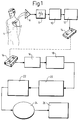
- FIG.1 shows a block diagram of a prior art device for recording and analyzing a Holter ECG
- FIG. 2 shows such a device according to the invention.
- FIG. 1 illustrates the equipment for recording a Holter ECG with electrodes 2 applied to the patient's 4 skin. This equipment is worn by the patient during the recording of the ECG.
- the signal picked up by the electrodes 2 is filtered and amplified in the filter and amplifier 6 and digitized in the A/D converter 8.
- the digitized information is compressed with the aid of a computer 10, the compressed information thereafter being stored, via the unit 12, on some appropriate medium, e.g. cassette tape 14.
- Data compression is a well-known technic and need not be described more in detail.
- By data compression the amount of information is reduced to, typically, one tenth or less of the total amount of information. This reduces the cost of the equipment required, since the need for a.o. storage capacity is reduced to the corresponding degree, and memories are comparatively expensive.
- FIG. 1 shows a previously known equipment for replay and analysis of the recorded ECG.
- the ECG recorded on the cassette tape 14 is downloaded to a working memory 16, whereupon the information is decompressed with the aid of the computer 18 and supplied to an analysis station 20.
- an automatic preanalysis is performed before the physician begins analyzing, editing and making a diagnosis from the data.
- the automatic preanalysis classifies different QRS morphologies and assigns all the QRS's to classes, the number of which can range from one or a few dozen up to 256 or more.
- the result of the preanalysis are issued via the unit 22, and the task of the physician then becomes to analyze the classes of QRS morphologies in order to interpret their significance, collect similar classes under main headings, such as "normal QRS", which originally could be found in 10-20 different classes with small morphological variations etc., at 24, and then the physician issues his final report, at 26.
- FIG. 2 the recording equipment shown in the upper part of the figure is identical to the recording equipment according to the prior art, cf. FIG. 1, and the same reference designations are used as in FIG. 1.
- the recorded information is downloaded from the cassette 14 to an working memory 28 and a computer 30 then performs an automatic preanalysis of the compressed information.
- This preanalysis is of course performed according to other criteria than those needed for the decompressed information. Developing the requisite algorithms for analyzing compressed ECG's present no difficulties for the man skilled in the art. In addition the algorithms can be easily verified by analyzing ECG's decompressed in the unit 32 for test purposes.
- the preanalyzed information is issued via the report unit 34 and the physician then carries out editing, analysis and diagnosis, at 36, and issues his final report, at 38, in a manner analogous to the previously known technic according to FIG. 1.
- the signal does not have to be decompressed, thereby eliminating the long time required for decompression.
- the signal analysis is much faster, since a greatly reduced amount of information needs to be processed, in the example mentioned above only one tenth of the total amount of information.
- the analysis procedure will be much faster, and the physician/operator will save much time and be able to work more efficiently.
- a simpler and cheaper computer can be used, thereby reducing the capital costs.
- the physician's analysis and diagnosis may require restoration of a certain part of the ECG signal to its original form with the aid of the decompression unit 32, so the complete signal is available to the physician.
Landscapes
- Health & Medical Sciences (AREA)
- Life Sciences & Earth Sciences (AREA)
- Engineering & Computer Science (AREA)
- Physics & Mathematics (AREA)
- Veterinary Medicine (AREA)
- Animal Behavior & Ethology (AREA)
- Public Health (AREA)
- General Health & Medical Sciences (AREA)
- Biophysics (AREA)
- Pathology (AREA)
- Biomedical Technology (AREA)
- Heart & Thoracic Surgery (AREA)
- Medical Informatics (AREA)
- Molecular Biology (AREA)
- Surgery (AREA)
- Cardiology (AREA)
- Computer Vision & Pattern Recognition (AREA)
- Theoretical Computer Science (AREA)
- General Physics & Mathematics (AREA)
- Artificial Intelligence (AREA)
- Physiology (AREA)
- Psychiatry (AREA)
- Signal Processing (AREA)
- Measurement And Recording Of Electrical Phenomena And Electrical Characteristics Of The Living Body (AREA)
- Image Analysis (AREA)
- Medical Treatment And Welfare Office Work (AREA)
Applications Claiming Priority (2)
| Application Number | Priority Date | Filing Date | Title |
|---|---|---|---|
| SE9403608 | 1994-10-21 | ||
| SE9403608A SE9403608D0 (sv) | 1994-10-21 | 1994-10-21 | Förfarande och anordning för att analysera stora mängder information |
Publications (1)
| Publication Number | Publication Date |
|---|---|
| EP0708410A1 true EP0708410A1 (de) | 1996-04-24 |
Family
ID=20395697
Family Applications (1)
| Application Number | Title | Priority Date | Filing Date |
|---|---|---|---|
| EP95112957A Withdrawn EP0708410A1 (de) | 1994-10-21 | 1995-08-17 | Verfahren und Vorrichtung zur Analysierung einer grossen Menge von Informationen |
Country Status (4)
| Country | Link |
|---|---|
| EP (1) | EP0708410A1 (de) |
| JP (1) | JPH08235271A (de) |
| FI (1) | FI954945L (de) |
| SE (1) | SE9403608D0 (de) |
Citations (5)
| Publication number | Priority date | Publication date | Assignee | Title |
|---|---|---|---|---|
| US4041468A (en) * | 1976-10-07 | 1977-08-09 | Pfizer Inc. | Method and system for analysis of ambulatory electrocardiographic tape recordings |
| US4223678A (en) | 1978-05-03 | 1980-09-23 | Mieczyslaw Mirowski | Arrhythmia recorder for use with an implantable defibrillator |
| EP0129981B1 (de) | 1983-05-24 | 1990-09-26 | Kabushiki Kaisya Advance | Verarbeitungssystem von physiologischen Signalen |
| EP0552806A2 (de) | 1992-01-23 | 1993-07-28 | Sharp Kabushiki Kaisha | Vorrichtung zur Aufzeichnung und Wiedergabe von Daten |
| US5255186A (en) * | 1991-08-06 | 1993-10-19 | Telectronics Pacing Systems, Inc. | Signal averaging of cardiac electrical signals using temporal data compression and scanning correlation |
-
1994
- 1994-10-21 SE SE9403608A patent/SE9403608D0/xx unknown
-
1995
- 1995-08-17 EP EP95112957A patent/EP0708410A1/de not_active Withdrawn
- 1995-10-17 FI FI954945A patent/FI954945L/fi unknown
- 1995-10-20 JP JP27274295A patent/JPH08235271A/ja active Pending
Patent Citations (5)
| Publication number | Priority date | Publication date | Assignee | Title |
|---|---|---|---|---|
| US4041468A (en) * | 1976-10-07 | 1977-08-09 | Pfizer Inc. | Method and system for analysis of ambulatory electrocardiographic tape recordings |
| US4223678A (en) | 1978-05-03 | 1980-09-23 | Mieczyslaw Mirowski | Arrhythmia recorder for use with an implantable defibrillator |
| EP0129981B1 (de) | 1983-05-24 | 1990-09-26 | Kabushiki Kaisya Advance | Verarbeitungssystem von physiologischen Signalen |
| US5255186A (en) * | 1991-08-06 | 1993-10-19 | Telectronics Pacing Systems, Inc. | Signal averaging of cardiac electrical signals using temporal data compression and scanning correlation |
| EP0552806A2 (de) | 1992-01-23 | 1993-07-28 | Sharp Kabushiki Kaisha | Vorrichtung zur Aufzeichnung und Wiedergabe von Daten |
Also Published As
| Publication number | Publication date |
|---|---|
| JPH08235271A (ja) | 1996-09-13 |
| FI954945A7 (fi) | 1996-04-22 |
| SE9403608D0 (sv) | 1994-10-21 |
| FI954945A0 (fi) | 1995-10-17 |
| FI954945L (fi) | 1996-04-22 |
Similar Documents
| Publication | Publication Date | Title |
|---|---|---|
| US7239988B2 (en) | Apparatus and method for efficient representation of periodic and nearly periodic signals for analysis | |
| JP3325941B2 (ja) | 急性イシェミー損傷を評価するための非侵入多重心電装置 | |
| US6370423B1 (en) | Method for analysis of biological voltage signals | |
| US6810282B2 (en) | Method and apparatus for dynamically selecting an electrocardiogram compression process based on computerized analysis of cardiac rhythm and contour | |
| DE10150364B4 (de) | Verfahren und System zur Kodierung physiologischer Daten | |
| DE19638738B4 (de) | Verfahren zur Gewinnung einer diagnostischen Aussage aus Signalen und Daten medizinischer Sensorsysteme | |
| DE10235805A1 (de) | Verfahren und Vorrichtung zur Anzeige und Analyse eines physiologischen Signals | |
| US5657398A (en) | High-quality, low-bit-rate method of compressing waveform data | |
| CA2019527A1 (en) | Signature verification data compression for storage on an identification card | |
| CN110507311B (zh) | 一种基于图像信息的心电分析方法、装置、设备及介质 | |
| Legewie et al. | On-line analysis of EEG with a small computer (period-amplitude analysis) | |
| US6152883A (en) | KLT-based quality controlled compression of a single lead egg | |
| DE3024824A1 (de) | Von einem patienten zu tragende datenerfassungs- und datenspeicheranordnung | |
| EP0708410A1 (de) | Verfahren und Vorrichtung zur Analysierung einer grossen Menge von Informationen | |
| JP2007090000A (ja) | 心電図データの圧縮方法および心電図テレメータ装置 | |
| JPH06237909A (ja) | 心電図データ処理装置 | |
| DE69619593T2 (de) | Wiedergabesystem für nicht invasiven Blutdruck | |
| Feldman et al. | Computer Detection, Classification, And Analysis of Neuronal Spike Sequences | |
| Magotra et al. | Lossless compression of electroencephalographic (EEG) data | |
| Ding et al. | ECG compression for mobile sensor platforms | |
| JP3035684B2 (ja) | 生体信号処理装置 | |
| Bhullar et al. | Computer-based techniques for the optimal extraction of medical data from graphical paper records | |
| JPH0838481A (ja) | 携帯型音声モニター装置 | |
| JPH01142872A (ja) | 画像処理装置 | |
| RU2007954C1 (ru) | Способ хранения медико-биологической информации и устройство для его осуществления |
Legal Events
| Date | Code | Title | Description |
|---|---|---|---|
| PUAI | Public reference made under article 153(3) epc to a published international application that has entered the european phase |
Free format text: ORIGINAL CODE: 0009012 |
|
| AK | Designated contracting states |
Kind code of ref document: A1 Designated state(s): DE FR GB |
|
| 17P | Request for examination filed |
Effective date: 19960706 |
|
| STAA | Information on the status of an ep patent application or granted ep patent |
Free format text: STATUS: THE APPLICATION HAS BEEN WITHDRAWN |
|
| 18W | Application withdrawn |
Withdrawal date: 19970708 |