EP0709420B1 - Copolymères à blocs de polyesters et de polycarbonates et procédé pour leur préparation - Google Patents
Copolymères à blocs de polyesters et de polycarbonates et procédé pour leur préparation Download PDFInfo
- Publication number
- EP0709420B1 EP0709420B1 EP95402410A EP95402410A EP0709420B1 EP 0709420 B1 EP0709420 B1 EP 0709420B1 EP 95402410 A EP95402410 A EP 95402410A EP 95402410 A EP95402410 A EP 95402410A EP 0709420 B1 EP0709420 B1 EP 0709420B1
- Authority
- EP
- European Patent Office
- Prior art keywords
- polyesters
- polycarbonates
- block copolymer
- distannoxane
- group
- Prior art date
- Legal status (The legal status is an assumption and is not a legal conclusion. Google has not performed a legal analysis and makes no representation as to the accuracy of the status listed.)
- Expired - Lifetime
Links
- 229920001400 block copolymer Polymers 0.000 title claims description 35
- 229920000728 polyester Polymers 0.000 title claims description 31
- 229920000515 polycarbonate Polymers 0.000 title claims description 28
- 239000004417 polycarbonate Substances 0.000 title claims description 28
- 238000000034 method Methods 0.000 title claims description 14
- 238000002360 preparation method Methods 0.000 title description 2
- 239000003054 catalyst Substances 0.000 claims description 25
- 150000005676 cyclic carbonates Chemical class 0.000 claims description 20
- 238000007142 ring opening reaction Methods 0.000 claims description 19
- 239000000178 monomer Substances 0.000 claims description 12
- 125000004432 carbon atom Chemical group C* 0.000 claims description 11
- GSCLMSFRWBPUSK-UHFFFAOYSA-N beta-Butyrolactone Chemical class CC1CC(=O)O1 GSCLMSFRWBPUSK-UHFFFAOYSA-N 0.000 claims description 10
- 238000004519 manufacturing process Methods 0.000 claims description 10
- ATJFFYVFTNAWJD-UHFFFAOYSA-N Tin Chemical group [Sn] ATJFFYVFTNAWJD-UHFFFAOYSA-N 0.000 claims description 6
- 125000000217 alkyl group Chemical group 0.000 claims description 6
- 239000011541 reaction mixture Substances 0.000 claims description 6
- 125000004435 hydrogen atom Chemical group [H]* 0.000 claims description 4
- 229910052799 carbon Inorganic materials 0.000 claims description 3
- 125000002496 methyl group Chemical group [H]C([H])([H])* 0.000 claims description 3
- 125000003545 alkoxy group Chemical group 0.000 claims description 2
- 125000003710 aryl alkyl group Chemical group 0.000 claims description 2
- 239000000470 constituent Substances 0.000 claims description 2
- 125000000951 phenoxy group Chemical group [H]C1=C([H])C([H])=C(O*)C([H])=C1[H] 0.000 claims description 2
- 125000001997 phenyl group Chemical group [H]C1=C([H])C([H])=C(*)C([H])=C1[H] 0.000 claims description 2
- YXFVVABEGXRONW-UHFFFAOYSA-N Toluene Chemical compound CC1=CC=CC=C1 YXFVVABEGXRONW-UHFFFAOYSA-N 0.000 description 63
- 229920000642 polymer Polymers 0.000 description 32
- YFHICDDUDORKJB-UHFFFAOYSA-N trimethylene carbonate Chemical compound O=C1OCCCO1 YFHICDDUDORKJB-UHFFFAOYSA-N 0.000 description 26
- RTZKZFJDLAIYFH-UHFFFAOYSA-N Diethyl ether Chemical compound CCOCC RTZKZFJDLAIYFH-UHFFFAOYSA-N 0.000 description 21
- VLKZOEOYAKHREP-UHFFFAOYSA-N n-Hexane Chemical compound CCCCCC VLKZOEOYAKHREP-UHFFFAOYSA-N 0.000 description 21
- HEDRZPFGACZZDS-UHFFFAOYSA-N Chloroform Chemical compound ClC(Cl)Cl HEDRZPFGACZZDS-UHFFFAOYSA-N 0.000 description 20
- 239000000203 mixture Substances 0.000 description 20
- LDLDJEAVRNAEBW-SCSAIBSYSA-N methyl (3r)-3-hydroxybutanoate Chemical compound COC(=O)C[C@@H](C)O LDLDJEAVRNAEBW-SCSAIBSYSA-N 0.000 description 17
- 231100000209 biodegradability test Toxicity 0.000 description 13
- 238000012360 testing method Methods 0.000 description 13
- 230000015572 biosynthetic process Effects 0.000 description 12
- 238000003786 synthesis reaction Methods 0.000 description 12
- 238000006243 chemical reaction Methods 0.000 description 11
- 230000000052 comparative effect Effects 0.000 description 11
- 239000000463 material Substances 0.000 description 11
- 229960004132 diethyl ether Drugs 0.000 description 7
- 150000002596 lactones Chemical class 0.000 description 7
- 230000008018 melting Effects 0.000 description 7
- 238000002844 melting Methods 0.000 description 7
- 239000007858 starting material Substances 0.000 description 7
- OKKJLVBELUTLKV-UHFFFAOYSA-N Methanol Chemical compound OC OKKJLVBELUTLKV-UHFFFAOYSA-N 0.000 description 6
- 229920001577 copolymer Polymers 0.000 description 6
- ZJCZULBNMYUGMV-UHFFFAOYSA-M dibutyl-chloro-[dibutyl(ethoxy)stannyl]oxystannane Chemical compound CCCC[Sn](Cl)(CCCC)O[Sn](CCCC)(CCCC)OCC ZJCZULBNMYUGMV-UHFFFAOYSA-M 0.000 description 6
- JJTUDXZGHPGLLC-IMJSIDKUSA-N 4511-42-6 Chemical compound C[C@@H]1OC(=O)[C@H](C)OC1=O JJTUDXZGHPGLLC-IMJSIDKUSA-N 0.000 description 5
- 229920005604 random copolymer Polymers 0.000 description 5
- 239000002904 solvent Substances 0.000 description 5
- XKRFYHLGVUSROY-UHFFFAOYSA-N Argon Chemical compound [Ar] XKRFYHLGVUSROY-UHFFFAOYSA-N 0.000 description 4
- WHBMMWSBFZVSSR-UHFFFAOYSA-N R3HBA Natural products CC(O)CC(O)=O WHBMMWSBFZVSSR-UHFFFAOYSA-N 0.000 description 4
- 150000001875 compounds Chemical class 0.000 description 4
- 229920002521 macromolecule Polymers 0.000 description 4
- 244000005700 microbiome Species 0.000 description 4
- GSCLMSFRWBPUSK-GSVOUGTGSA-N (4r)-4-methyloxetan-2-one Chemical compound C[C@@H]1CC(=O)O1 GSCLMSFRWBPUSK-GSVOUGTGSA-N 0.000 description 3
- WHBMMWSBFZVSSR-GSVOUGTGSA-N (R)-3-hydroxybutyric acid Chemical compound C[C@@H](O)CC(O)=O WHBMMWSBFZVSSR-GSVOUGTGSA-N 0.000 description 3
- UHOVQNZJYSORNB-UHFFFAOYSA-N Benzene Chemical compound C1=CC=CC=C1 UHOVQNZJYSORNB-UHFFFAOYSA-N 0.000 description 3
- BVKZGUZCCUSVTD-UHFFFAOYSA-L Carbonate Chemical compound [O-]C([O-])=O BVKZGUZCCUSVTD-UHFFFAOYSA-L 0.000 description 3
- ZMANZCXQSJIPKH-UHFFFAOYSA-N Triethylamine Chemical compound CCN(CC)CC ZMANZCXQSJIPKH-UHFFFAOYSA-N 0.000 description 3
- 150000004649 carbonic acid derivatives Chemical class 0.000 description 3
- 239000011261 inert gas Substances 0.000 description 3
- 239000012442 inert solvent Substances 0.000 description 3
- 238000012856 packing Methods 0.000 description 3
- 239000004033 plastic Substances 0.000 description 3
- 229920003023 plastic Polymers 0.000 description 3
- 239000010802 sludge Substances 0.000 description 3
- 229920005992 thermoplastic resin Polymers 0.000 description 3
- XLYOFNOQVPJJNP-UHFFFAOYSA-N water Substances O XLYOFNOQVPJJNP-UHFFFAOYSA-N 0.000 description 3
- JRFXQKZEGILCCO-UHFFFAOYSA-N 5,5-dimethyl-1,3-dioxan-2-one Chemical compound CC1(C)COC(=O)OC1 JRFXQKZEGILCCO-UHFFFAOYSA-N 0.000 description 2
- IJGRMHOSHXDMSA-UHFFFAOYSA-N Atomic nitrogen Chemical compound N#N IJGRMHOSHXDMSA-UHFFFAOYSA-N 0.000 description 2
- QIBZCGXCFXHQME-UHFFFAOYSA-M CCCCCCCC[Sn](Cl)(CCCCCCCC)O[Sn](CCCCCCCC)(CCCCCCCC)OCC Chemical compound CCCCCCCC[Sn](Cl)(CCCCCCCC)O[Sn](CCCCCCCC)(CCCCCCCC)OCC QIBZCGXCFXHQME-UHFFFAOYSA-M 0.000 description 2
- JYSDZSHYCPURGT-UHFFFAOYSA-L CCCC[Sn](O)(CCCC)O[Sn](Cl)(CCCC)CCCC Chemical compound CCCC[Sn](O)(CCCC)O[Sn](Cl)(CCCC)CCCC JYSDZSHYCPURGT-UHFFFAOYSA-L 0.000 description 2
- LFQSCWFLJHTTHZ-UHFFFAOYSA-N Ethanol Chemical compound CCO LFQSCWFLJHTTHZ-UHFFFAOYSA-N 0.000 description 2
- JVTAAEKCZFNVCJ-REOHCLBHSA-N L-lactic acid Chemical compound C[C@H](O)C(O)=O JVTAAEKCZFNVCJ-REOHCLBHSA-N 0.000 description 2
- MZRVEZGGRBJDDB-UHFFFAOYSA-N N-Butyllithium Chemical compound [Li]CCCC MZRVEZGGRBJDDB-UHFFFAOYSA-N 0.000 description 2
- XYFCBTPGUUZFHI-UHFFFAOYSA-N Phosphine Chemical compound P XYFCBTPGUUZFHI-UHFFFAOYSA-N 0.000 description 2
- WYURNTSHIVDZCO-UHFFFAOYSA-N Tetrahydrofuran Chemical compound C1CCOC1 WYURNTSHIVDZCO-UHFFFAOYSA-N 0.000 description 2
- 229920003232 aliphatic polyester Polymers 0.000 description 2
- 229910052786 argon Inorganic materials 0.000 description 2
- BYAIBSZGHQGSMX-UHFFFAOYSA-L chloro-[chloro(diphenyl)stannyl]oxy-diphenylstannane Chemical compound C=1C=CC=CC=1[Sn](C=1C=CC=CC=1)(Cl)O[Sn](Cl)(C=1C=CC=CC=1)C1=CC=CC=C1 BYAIBSZGHQGSMX-UHFFFAOYSA-L 0.000 description 2
- 238000000354 decomposition reaction Methods 0.000 description 2
- JGFBRKRYDCGYKD-UHFFFAOYSA-N dibutyl(oxo)tin Chemical compound CCCC[Sn](=O)CCCC JGFBRKRYDCGYKD-UHFFFAOYSA-N 0.000 description 2
- 238000003475 lamination Methods 0.000 description 2
- 238000000655 nuclear magnetic resonance spectrum Methods 0.000 description 2
- 239000004014 plasticizer Substances 0.000 description 2
- 229920001610 polycaprolactone Polymers 0.000 description 2
- 239000000126 substance Substances 0.000 description 2
- PAPBSGBWRJIAAV-UHFFFAOYSA-N ε-Caprolactone Chemical compound O=C1CCCCCO1 PAPBSGBWRJIAAV-UHFFFAOYSA-N 0.000 description 2
- PSPJNWNCSFSURY-UHFFFAOYSA-N (1-ethoxy-3-isothiocyanatotetradecyl)-stannyloxystannane Chemical compound CCCCCCCCCCCC(CC(OCC)[SnH2]O[SnH3])N=C=S PSPJNWNCSFSURY-UHFFFAOYSA-N 0.000 description 1
- GSCLMSFRWBPUSK-VKHMYHEASA-N (4s)-4-methyloxetan-2-one Chemical compound C[C@H]1CC(=O)O1 GSCLMSFRWBPUSK-VKHMYHEASA-N 0.000 description 1
- SCYULBFZEHDVBN-UHFFFAOYSA-N 1,1-Dichloroethane Chemical compound CC(Cl)Cl SCYULBFZEHDVBN-UHFFFAOYSA-N 0.000 description 1
- RYHBNJHYFVUHQT-UHFFFAOYSA-N 1,4-Dioxane Chemical compound C1COCCO1 RYHBNJHYFVUHQT-UHFFFAOYSA-N 0.000 description 1
- QHOINBKBMJLHPY-UHFFFAOYSA-N 2-chloroethyl formate Chemical compound ClCCOC=O QHOINBKBMJLHPY-UHFFFAOYSA-N 0.000 description 1
- ZUBVBRAWCGZYMQ-UHFFFAOYSA-N 4,5-dimethyl-1,3-dioxan-2-one Chemical compound CC1COC(=O)OC1C ZUBVBRAWCGZYMQ-UHFFFAOYSA-N 0.000 description 1
- SJZRECIVHVDYJC-UHFFFAOYSA-N 4-hydroxybutyric acid Chemical compound OCCCC(O)=O SJZRECIVHVDYJC-UHFFFAOYSA-N 0.000 description 1
- 229940006015 4-hydroxybutyric acid Drugs 0.000 description 1
- OVDQEUFSGODEBT-UHFFFAOYSA-N 4-methyl-1,3-dioxan-2-one Chemical compound CC1CCOC(=O)O1 OVDQEUFSGODEBT-UHFFFAOYSA-N 0.000 description 1
- FIURNUKOIGKIJB-UHFFFAOYSA-N 5-methyl-1,3-dioxan-2-one Chemical compound CC1COC(=O)OC1 FIURNUKOIGKIJB-UHFFFAOYSA-N 0.000 description 1
- AALAQOUFWNSFTF-UHFFFAOYSA-M CCCCCCCCCCCC[Sn](Cl)(CCCCCCCCCCCC)O[Sn](CCCCCCCCCCCC)(CCCCCCCCCCCC)OCC Chemical compound CCCCCCCCCCCC[Sn](Cl)(CCCCCCCCCCCC)O[Sn](CCCCCCCCCCCC)(CCCCCCCCCCCC)OCC AALAQOUFWNSFTF-UHFFFAOYSA-M 0.000 description 1
- NPLVDTBPSVYSJD-UHFFFAOYSA-N CCCCCC[Sn](CCCCCC)(OCC)O[Sn](CCCCCC)(CCCCCC)N=C=S Chemical compound CCCCCC[Sn](CCCCCC)(OCC)O[Sn](CCCCCC)(CCCCCC)N=C=S NPLVDTBPSVYSJD-UHFFFAOYSA-N 0.000 description 1
- JBCTXQGIJLAHKP-UHFFFAOYSA-M CCCC[Sn](Br)(CCCC)O[Sn](CCCC)(CCCC)OC Chemical compound CCCC[Sn](Br)(CCCC)O[Sn](CCCC)(CCCC)OC JBCTXQGIJLAHKP-UHFFFAOYSA-M 0.000 description 1
- FSCRIMREFGULQK-UHFFFAOYSA-M CCCC[Sn](Br)(CCCC)O[Sn](CCCC)(CCCC)OCC Chemical compound CCCC[Sn](Br)(CCCC)O[Sn](CCCC)(CCCC)OCC FSCRIMREFGULQK-UHFFFAOYSA-M 0.000 description 1
- LNDFKRASBICTEB-UHFFFAOYSA-N CCCC[Sn](CCCC)(OCC)O[Sn](CCCC)(CCCC)N=C=S Chemical compound CCCC[Sn](CCCC)(OCC)O[Sn](CCCC)(CCCC)N=C=S LNDFKRASBICTEB-UHFFFAOYSA-N 0.000 description 1
- LFQHVCMKQXYWQJ-UHFFFAOYSA-L CCCC[Sn](O)(CCCC)O[Sn](Br)(CCCC)CCCC Chemical compound CCCC[Sn](O)(CCCC)O[Sn](Br)(CCCC)CCCC LFQHVCMKQXYWQJ-UHFFFAOYSA-L 0.000 description 1
- ZAFNJMIOTHYJRJ-UHFFFAOYSA-N Diisopropyl ether Chemical compound CC(C)OC(C)C ZAFNJMIOTHYJRJ-UHFFFAOYSA-N 0.000 description 1
- AEMRFAOFKBGASW-UHFFFAOYSA-N Glycolic acid Chemical group OCC(O)=O AEMRFAOFKBGASW-UHFFFAOYSA-N 0.000 description 1
- DGAQECJNVWCQMB-PUAWFVPOSA-M Ilexoside XXIX Chemical compound C[C@@H]1CC[C@@]2(CC[C@@]3(C(=CC[C@H]4[C@]3(CC[C@@H]5[C@@]4(CC[C@@H](C5(C)C)OS(=O)(=O)[O-])C)C)[C@@H]2[C@]1(C)O)C)C(=O)O[C@H]6[C@@H]([C@H]([C@@H]([C@H](O6)CO)O)O)O.[Na+] DGAQECJNVWCQMB-PUAWFVPOSA-M 0.000 description 1
- CTQNGGLPUBDAKN-UHFFFAOYSA-N O-Xylene Chemical compound CC1=CC=CC=C1C CTQNGGLPUBDAKN-UHFFFAOYSA-N 0.000 description 1
- 229920000512 Poly[(R)-3-hydroxybutyric acid-co-(R)-3-hydroxyvaleric acid] Polymers 0.000 description 1
- UKLDJPRMSDWDSL-UHFFFAOYSA-L [dibutyl(dodecanoyloxy)stannyl] dodecanoate Chemical compound CCCCCCCCCCCC(=O)O[Sn](CCCC)(CCCC)OC(=O)CCCCCCCCCCC UKLDJPRMSDWDSL-UHFFFAOYSA-L 0.000 description 1
- 239000002253 acid Substances 0.000 description 1
- 150000001298 alcohols Chemical class 0.000 description 1
- 238000004458 analytical method Methods 0.000 description 1
- 150000001491 aromatic compounds Chemical class 0.000 description 1
- RWCCWEUUXYIKHB-UHFFFAOYSA-N benzophenone Chemical compound C=1C=CC=CC=1C(=O)C1=CC=CC=C1 RWCCWEUUXYIKHB-UHFFFAOYSA-N 0.000 description 1
- 239000012965 benzophenone Substances 0.000 description 1
- 239000000560 biocompatible material Substances 0.000 description 1
- MYHNLFIEOWPXJF-UHFFFAOYSA-L bromo-[bromo(dibutyl)stannyl]oxy-dibutylstannane Chemical compound CCCC[Sn](Br)(CCCC)O[Sn](Br)(CCCC)CCCC MYHNLFIEOWPXJF-UHFFFAOYSA-L 0.000 description 1
- YIIQJJGHJCYXIE-UHFFFAOYSA-L bromo-dibutyl-[dibutyl(phenoxy)stannyl]oxystannane Chemical compound CCCC[Sn](Br)(CCCC)O[Sn](CCCC)(CCCC)OC1=CC=CC=C1 YIIQJJGHJCYXIE-UHFFFAOYSA-L 0.000 description 1
- XCCORPSEMUMEHG-UHFFFAOYSA-N butyl-isothiocyanato-tributylstannyloxytin;hydrate Chemical compound O.CCCC[Sn](CCCC)O[Sn](CCCC)(CCCC)N=C=S XCCORPSEMUMEHG-UHFFFAOYSA-N 0.000 description 1
- 150000004292 cyclic ethers Chemical class 0.000 description 1
- FJBFPHVGVWTDIP-UHFFFAOYSA-N dibromomethane Chemical compound BrCBr FJBFPHVGVWTDIP-UHFFFAOYSA-N 0.000 description 1
- JVLGWEJONYVDMO-UHFFFAOYSA-N dibutyl(diisothiocyanato)stannane Chemical compound CCCC[Sn](N=C=S)(N=C=S)CCCC JVLGWEJONYVDMO-UHFFFAOYSA-N 0.000 description 1
- HAUMBEUFBHIWHT-UHFFFAOYSA-N dibutyl-[dibutyl(isothiocyanato)stannyl]oxy-isothiocyanatostannane Chemical compound CCCC[Sn](CCCC)(N=C=S)O[Sn](CCCC)(CCCC)N=C=S HAUMBEUFBHIWHT-UHFFFAOYSA-N 0.000 description 1
- YXJPAUHWZHYATP-UHFFFAOYSA-N dibutyl-[dibutyl(isothiocyanato)stannyl]oxy-methoxystannane Chemical compound CCCC[Sn](CCCC)(OC)O[Sn](CCCC)(CCCC)N=C=S YXJPAUHWZHYATP-UHFFFAOYSA-N 0.000 description 1
- QTQIAAOEAZOIRQ-UHFFFAOYSA-M dibutyl-[dibutyl(isothiocyanato)stannyl]oxy-phenoxystannane Chemical compound CCCC[Sn](N=C=S)(CCCC)O[Sn](CCCC)(CCCC)OC1=CC=CC=C1 QTQIAAOEAZOIRQ-UHFFFAOYSA-M 0.000 description 1
- MWFOVBOCPFXQMF-UHFFFAOYSA-L dibutyl-chloro-[dibutyl(chloro)stannyl]oxystannane Chemical compound CCCC[Sn](Cl)(CCCC)O[Sn](Cl)(CCCC)CCCC MWFOVBOCPFXQMF-UHFFFAOYSA-L 0.000 description 1
- MAGWETANODQPRB-UHFFFAOYSA-M dibutyl-chloro-[dibutyl(methoxy)stannyl]oxystannane Chemical compound CCCC[Sn](Cl)(CCCC)O[Sn](CCCC)(CCCC)OC MAGWETANODQPRB-UHFFFAOYSA-M 0.000 description 1
- POHXGXRZIKXNGW-UHFFFAOYSA-L dibutyl-chloro-[dibutyl(phenoxy)stannyl]oxystannane Chemical compound CCCC[Sn](Cl)(CCCC)O[Sn](CCCC)(CCCC)OC1=CC=CC=C1 POHXGXRZIKXNGW-UHFFFAOYSA-L 0.000 description 1
- 239000012975 dibutyltin dilaurate Substances 0.000 description 1
- 150000002009 diols Chemical class 0.000 description 1
- 238000003912 environmental pollution Methods 0.000 description 1
- 238000000605 extraction Methods 0.000 description 1
- 230000009477 glass transition Effects 0.000 description 1
- 238000010438 heat treatment Methods 0.000 description 1
- 125000002887 hydroxy group Chemical group [H]O* 0.000 description 1
- 239000005457 ice water Substances 0.000 description 1
- 125000001810 isothiocyanato group Chemical group *N=C=S 0.000 description 1
- JNHWIQQFHHENEZ-UHFFFAOYSA-N isothiocyanato-[isothiocyanato(dimethyl)stannyl]oxy-dimethylstannane Chemical compound S=C=N[Sn](C)(C)O[Sn](C)(C)N=C=S JNHWIQQFHHENEZ-UHFFFAOYSA-N 0.000 description 1
- 238000005259 measurement Methods 0.000 description 1
- 239000012567 medical material Substances 0.000 description 1
- 238000006140 methanolysis reaction Methods 0.000 description 1
- 230000000813 microbial effect Effects 0.000 description 1
- 229910052757 nitrogen Inorganic materials 0.000 description 1
- 150000002896 organic halogen compounds Chemical class 0.000 description 1
- 229910000073 phosphorus hydride Inorganic materials 0.000 description 1
- 229920001432 poly(L-lactide) Polymers 0.000 description 1
- 229920001223 polyethylene glycol Polymers 0.000 description 1
- 229940068917 polyethylene glycols Drugs 0.000 description 1
- 229920006254 polymer film Polymers 0.000 description 1
- 230000008929 regeneration Effects 0.000 description 1
- 238000011069 regeneration method Methods 0.000 description 1
- 238000011160 research Methods 0.000 description 1
- 238000007151 ring opening polymerisation reaction Methods 0.000 description 1
- 229910052708 sodium Inorganic materials 0.000 description 1
- 239000011734 sodium Substances 0.000 description 1
- 239000002689 soil Substances 0.000 description 1
- 238000000935 solvent evaporation Methods 0.000 description 1
- YLQBMQCUIZJEEH-UHFFFAOYSA-N tetrahydrofuran Natural products C=1C=COC=1 YLQBMQCUIZJEEH-UHFFFAOYSA-N 0.000 description 1
- KSBAEPSJVUENNK-UHFFFAOYSA-L tin(ii) 2-ethylhexanoate Chemical compound [Sn+2].CCCCC(CC)C([O-])=O.CCCCC(CC)C([O-])=O KSBAEPSJVUENNK-UHFFFAOYSA-L 0.000 description 1
- VOITXYVAKOUIBA-UHFFFAOYSA-N triethylaluminium Chemical compound CC[Al](CC)CC VOITXYVAKOUIBA-UHFFFAOYSA-N 0.000 description 1
- 239000008096 xylene Substances 0.000 description 1
Images

Classifications
-
- C—CHEMISTRY; METALLURGY
- C08—ORGANIC MACROMOLECULAR COMPOUNDS; THEIR PREPARATION OR CHEMICAL WORKING-UP; COMPOSITIONS BASED THEREON
- C08G—MACROMOLECULAR COMPOUNDS OBTAINED OTHERWISE THAN BY REACTIONS ONLY INVOLVING UNSATURATED CARBON-TO-CARBON BONDS
- C08G63/00—Macromolecular compounds obtained by reactions forming a carboxylic ester link in the main chain of the macromolecule
- C08G63/64—Polyesters containing both carboxylic ester groups and carbonate groups
-
- C—CHEMISTRY; METALLURGY
- C08—ORGANIC MACROMOLECULAR COMPOUNDS; THEIR PREPARATION OR CHEMICAL WORKING-UP; COMPOSITIONS BASED THEREON
- C08G—MACROMOLECULAR COMPOUNDS OBTAINED OTHERWISE THAN BY REACTIONS ONLY INVOLVING UNSATURATED CARBON-TO-CARBON BONDS
- C08G64/00—Macromolecular compounds obtained by reactions forming a carbonic ester link in the main chain of the macromolecule
- C08G64/18—Block or graft polymers
Definitions
- the present invention relates to process for preparing a block copolymer of polyesters and polycarbonates. More particularly, the present invention relates to a process for preparing a biodegradable and hydrolyzable thermoplastic resin.
- the copolymer of the invention is decomposable by micro-organisms living in the soil or in the water, so that it can be used as non-polluting and clean plastic material. This quality gives the polymer a broad scope of uses, functionally as varied as a material for a fishing line, a fishing net, a sheet for agricultural use, a packing film, a surface film for paper packing, a material for lamination layers, a plasticizer, a compatibilizer etc.
- the polymer according to the invention is biocompatible, so that it can be hydrolyzed and absorbed by a living body. It may therefore be used in medical materials e.g. for surgical sutures or clips without requiring the extraction of stitches.
- Aliphatic polyesters are known to be biodegradable and bio-compatible.
- poly (R)-3-hydroxybutyric acid hereinafter referred to as P[(R)-3HB]
- P[(R)-3HB] poly (R)-3-hydroxybutyric acid
- P[(R)-3HB] poly (R)-3-hydroxybutyric acid accumulated in microbial cells
- P[(R)-3HB] poly (R)-3-hydroxybutyric acid
- the random copolymers of polyesters synthesized as described above decrease their crystallinity and reduce their fragility.
- the random copolymerisation usually lowers the melting temperature. Therefore, to obtain a bio-degradable aliphatic polyester having a melting temperature at least as high as 100°C, the polymer has to contain a large proportion of optically active units of 3-hydroxybutyric acid or of L-lactic acid, or glycolic acid units. This in turn poses a serious industrial problem due to increased production costs. Further, it is a rather difficult task to obtain a soft film or rubber from the random copolymers while simultaneously maintaining a high melting temperature and strength.
- block copolymers of polyesters or block copolymers of polyesters and polycarbonates may preferably be synthesized.
- a microbially produced polymer P[(R)-3HB] was submitted to methanolysis to obtain oligomers. Terminal hydroxyl groups of the obtained oligomers were then reacted with triethylaluminium, thereby forming polymerisation starters.
- the starters were reacted with ⁇ -caprolactone (referred to as CL), L-lactide (L-LA) or D,L-lactide (DL-LA) to obtain a block copolymer of polyesters P[(R)-3HB] and poly ⁇ -caprolactone, referred to as P[(R)-3HB]-PCL, a block copolymer of polyesters P[(R)-3HB] and poly L-lactide, referred to as P[(R)-3HB]-P(L-LA) and a block copolymer of polyesters P[(R)-3HB] and poly D,L-lactide, referred to as P[(R)-3HB]-P(DL-LA).
- the microbially produced polymer P[(R)-3HB] is used as a starting-material, thereby incurring a higher production cost.
- block copolymers of polyesters and polycarbonates were reported in US patent No 4 243 775 and international application WO 89/05664. These are block copolymers of lactones and carbonates obtained by using alcohols as starters in the presence of a tin-type catalyst.
- a block copolymer of polyesters and polycarbonates comprising at least one of each of the constituting units (I) and (II) having the general formulae: where the sign * indicates an asymmetric carbon atom ; R 1 , R 2 , R 3 and R 4 are either a hydrogen atom or a methyl group; m and n are respectively a natural number ranging from 300 to 5,000.
- the proportion of monomers contained in the constituting unit (I) to those contained in the constituting unit (II) may range from 10:90 to 90:10, preferably from 20:80 to 80:20, most preferably from 30:70 to 70:30.
- the molecular weight by weight average may range from 60,000 to 1,000,000, preferably from 75,000 to 800,000 and most preferably from 100,000 to 500,000.
- the block copolymer according to the invention preferably has a melting temperature around, or higher than, 115°C.
- R 1 , R 2 , R 3 and R 4 are preferably hydrogen atoms. With this choice, the product tends to be more easily bio-degradable.
- the proportion of monomers contained in the constituting unit (I) is approximately equal to, or higher than, those contained in constituting unit (II). With this choice, the resulting copolymers tend to be more easily bio-degradable.
- the block copolymer of polyesters and polycarbonates may comprise, as a first moiety, the copolymer having at least one of each of the constituting units (I) and (II) and, as a second moiety, further polyesters of a formula corresponding to that of unit (I) or further polycarbonates of a formula corresponding to that of unit (II) but having a different monomer constituent from the first moiety, giving rise respectively to an ABA-type or ABC type copolymer.
- the invention process is a process for preparing the block copolymer of polyesters and polycarbonates, the process comprising the steps of:
- the process further comprises the step of: d) adding optically active ⁇ -butyrolactones or cyclic carbonates corresponding to the monomers of unit (II) but differing from those used in steps a) to c) and subsequently ring-opening and polymerising the added ⁇ -butyrolactones or cyclic carbonates.
- the whole process may be repeated where appropriate.
- the catalyst may be a tin-containing catalyst.
- the tin-containing catalyst is preferably a distannoxane having the general formula (III): where R 5 indicates an alkyl group having 1 to 12 carbon atoms, an aralkyl group having at most 12 carbon atoms or a phenyl group; X is selected from the group consisting of Cl, Br and NCS; and Y is selected from the group consisting of Cl, Br, NCS, OH, an alkoxy group having 1 to 4 carbon atoms and a phenoxy group.
- the preferred distannoxane is 1-ethoxy-3-halogenotetraalkyl distannoxane, the alkyl group having 4 to 12 carbon atoms.
- the product (R)-BL or (S)-BL was found to be easily ring-opened and polymerised by a distannoxane complex and, when the product (R)-BL or (S)-BL is successively added, to produce a high molecular polyester. Also when the product (R)-BL, for example, then cyclic carbonates, were successively added, a block copolymer of polyesters and polycarbonates having a high molecular weight was obtained.
- the new product has a high melting temperature, exceeding 100°C, and high strength, so that it can serve as a material for a wide range of practical uses. It can also be formed into a flexible thermoplastic resin having good bio-degradability and hydrolyzability.
- Another object of the present invention is to provide bio-degradable articles or bio-compatible articles comprising the block copolymer thus obtained.
- the articles may be used e.g. as a fishing line or net, a film, a packing film or as a sheet for agricultural use. They may also find new applications such as a thermo-resistant film for containing hot water or heating in an electrical range such a microwave oven, a surface film for a paper cup, a material for lamination layers, a plasticizer, a compatibility-lending material or the like.
- the material may also be used for medical articles such as surgical sutures, clips or the like.
- Optically active (R)- ⁇ -butyrolactone and (S)- ⁇ -butyrolactone starting materials for the block copolymer of polyesters and polycarbonates of the present invention can easily be obtained by the method disclosed in the documents by the present applicants, JP-A-Hei 4-210 683 and JP-A-Hei 5-345 867, according to which diketenes are asymmetrically hydrogenised in the presence of a ruthenium-optically active phosphine complex as catalyst.
- the cyclic carbonates which constitute another starting material of the invention, may e.g. comprise trimethylene carbonate, 2,2-dimethyltrimethylene carbonate, 2-methyltrimethylene carbonate, 3-methyltrimethylene carbonate, 2,3-dimethyltrimethylene carbonate, 2,4-dimethyltrimethylene carbonate, 2,3,4-trimethyltrimethylene carbonate, and 2,3,3,4-tetramethyltrimethylene carbonate.
- At least one compound among these cyclic carbonates is used and, when appropriate, several compounds thereof may be used together.
- an optically active ⁇ -butyrolactone is placed in a reactor with an inert solvent or without solvent under inert gas such as nitrogen or argon, and then a catalyst as described hereafter is added thereto.
- a first step to polymerisation is effected at a temperature ranging from 60 to 180°C under atmospheric pressure for 30 minutes to 5 hours.
- To the resultant solution is added a small amount of inert solvent, thereby lowering the viscosity of the solution.
- a second step of reaction is effected by adding cyclic carbonate, dissolved in a small amount of inert solvent, to the solution and by further reacting the mixture for 1 to 20 hours.
- An AB type-block copolymer can thus be obtained.
- An ABA type, an ABC type, etc, of the block copolymers are obtained by reacting the AB type-block copolymer with optically active ⁇ -butyrolactones or with cyclic carbonates corresponding to the monomers of unit (II) but differing from those used for the AB type according to the method described for the second step of copolymerisation.
- tin-containing catalysts for example distannoxanes etc.
- distannoxanes for example distannoxanes etc.
- dibutyltin oxide for example dibutyltin oxide
- stannous octoate for example dibutyltin dilaurate
- the distannoxane catalysts having the above-mentioned formula (III) comprise for example 1,3-dihalogenotetraalkyl distannoxanes such as 1,3-dichlorotetrabutyl distannoxane, 1,3-dichlorotetraphenyl distannoxane, 1,3-dibromotetrabutyl distannoxane, etc.; 1-hydroxy-3-halogenotetra alkyl distannoxanes such as 1-hydroxy-3-chlorotetra butyl distannoxane, 1-hydroxy-3-bromotetrabutyl distannoxane, etc.; 1-alkoxy-3-halogenotetraalkyl distannoxanes such as 1-methoxy-3-chlorotetrabutyl distannoxane, 1-ethoxy-3-chlorotetrabutyl distannoxane, 1-ethoxy-3-chlorotetraoctyl distannoxane, 1-ethoxy-3-chlor
- catalysts are easily synthesized by reacting dibutyltin oxide and dibutyltin diisothiocyanate in ethanol, as is described for example in J.Organomet. Chem., 1965(3),70, for the synthesis of 1,3-dichlorotetraphenyl distannoxane and in J.Org.Chem., 1991(56),5307 for the synthesis of 1-hydroxy-3-(isothiocyanate)tetrabutyl distannoxane.
- the present invention uses at least one such catalyst and, when appropriate, several such catalysts together.
- the catalyst is added in a proportion of 1/500 to 1/40,000 moles relative to the starting monomers, and preferably of 1/1,000 to 1/20,000 moles.
- any of the usual solvents for ring-opening polymerisation may be used. These include linear or cyclic ethers such as diisopropylether, tetrahydrofuran, 1,4-dioxane or the like, halogenated organic compounds such as methylene bromide, dichloroethane or the like, aromatic compounds such as toluene, benzene, xylene or the like and mixtures thereof.
- linear or cyclic ethers such as diisopropylether, tetrahydrofuran, 1,4-dioxane or the like
- halogenated organic compounds such as methylene bromide, dichloroethane or the like
- aromatic compounds such as toluene, benzene, xylene or the like and mixtures thereof.
- solvents may be a refined product of commercial solvents: a solvent may be refined by adding metallic sodium and benzophenone and by distillating under inert gas, then preserved in inert gas until use.
- Table 1 collectively indicates the monomer use ratio (molar ratio) in the synthesis of a block copolymer of polyesters and polycarbonates, as well as the monomer content ratio, molecular weight by weight average (Mw), molecular weight by number average (Mn), glass transition temperature (Tg), melting temperature (Tm) and decomposition temperature (Td) of said block copolymer.
- Mw molecular weight by weight average
- Mn molecular weight by number average
- Tg glass transition temperature
- Tm melting temperature
- Td decomposition temperature
- Example 1 Synthesis of AB type block polyesters-polycarbonates (referred to hereinafter as P[(R)-3HB]-PTMC) through successive ring-opening and copolymerisation of (R)- ⁇ -butyrolactone ((R)-BL) and trimethylene carbonate (TMC).
- P[(R)-3HB]-PTMC AB type block polyesters-polycarbonates
- TMC trimethylene carbonate
- Example 2 Synthesis of P[(R)-3HB]-PTMC through successive ring-opening and copolymerisation of (R)-BL and TMC.
- 7.15g (83mmol) of (R)-BL and 22.8mg (0.0203mmol) of 1-ethoxy-3-chlorotetrabutyl distannoxane were prepared in a 30 ml reactor and stirred for 1.5 hours at 100°C under an Ar atmosphere.
- 0.5ml of toluene was added to the reaction solution and, after 20 minutes, 3.42g (34mmol) of TMC dissolved in 0.5ml of toluene were further added thereto. Then, the mixture was reacted for 1.5 hours.
- the resulting product was dissolved in chloroform and precipitated by introducing it into a mixture solution (1:3) of diethylether and hexane. 7.75g of the block polymer subject of the example were obtained with 73.3% of yield.
- Example 3 Synthesis of P[(R)-3HB]-PTMC through successive ring-opening and copolymerisation of (R)-BL and TMC.
- 4.65g (54 mmol) of (R)-BL and 22.0mg (0.014mmol) of 1-ethoxy-3-chlorotetraoctyl distannoxane were prepared in a 30 ml reactor and stirred for 1.5 hours at 100°C under Ar atmosphere.
- 0.5ml of toluene was added to the reaction solution and, after 30 minutes, 5.46g (54mmol) of TMC dissolved in 0.5ml of toluene were further added thereto. Then, the mixture was reacted for 4.5 hours.
- the resulting product was dissolved in chloroform and precipitated by introducing it into a mixture solution (1:3) of diethylether and hexane. 8.69g of the block polymer subject of the example were obtained with 86.0% of yield.
- Example 4 Synthesis of P[(R)-3HB]-PTMC through successive ring-opening and copolymerisation of (R)-BL and TMC.
- 3.72g (43mmol) of (R)-BL and 11.6mg (0.011mmol) of 1-hydroxy-3-(isothiocyanate)tetrabutyl distannoxane were prepared in a reactor of 30ml and stirred-for 2.5 hours at 100°C under Ar atmosphere. 0.5ml of toluene was added to the reaction solution. After one hour, 4.04g (40mmol) of TMC dissolved in 0.3ml of toluene were further added to the mixture. Then, the mixture was reacted for 6 hours. The resulting product was dissolved in chloroform and precipitated by introducing it into a mixture solution (1:3) of diethylether and hexane. 3.41g of the block polymer subject of the example were obtained with 43.9% of yield.
- Example 5 Synthesis of P[(R)-3HB]-PTMC through successive ring-opening and copolymerisation of (R)-BL and TMC.
- 4.56g (53mmol) of (R)-BL and 23.6mg (0.023mmol) of 1-hydroxy-3-(isothiocyanate)tetrabutyl distannoxane were prepared in a reactor of 30ml and stirred for 1.5 hours at 100°C under Ar atmosphere.
- 0.5ml of toluene was added to the reaction solution and, after 30 minutes, 5.37g (53mmol) of TMC dissolved in 0.3ml of toluene were further added thereto. Then, the mixture was reacted for 3 hours.
- the resulting product was dissolved in chloroform and precipitated by introducing it into a mixture solution (1:3) of diethylether and hexane. 8.81g of the block polymer subject of the example were obtained with 88.7% yield.
- Example 6 Synthesis of P[(R)-3HB]-PTMC through successive ring-opening and copolymerisation of (R)-BL and TMC.
- 4.92g (57mmol) of (R)-BL and 27.3mg (0.026mmol) of 1-hydroxy-3-chlorotetrabutyl distannoxane were prepared in a reactor of 30ml and stirred for 1.5 hours at 100°C under Ar atmosphere. 0.5ml of toluene was added to the reaction solution. After 15 minutes, 5.85g (57mmol) of TMC dissolved in 0.3ml of toluene were further added thereto. Then the mixture was reacted for 4 hours. The resulting product was dissolved in chloroform and precipitated by introducing it into a mixture solution (1:3) of diethylether and a hexane. 7.22g of the block polymer subject of the example were obtained with 67.1% yield.
- Example 7 Synthesis of AB type block polyesters-polycarbonates (referred to hereinafter as P[(R)-3HB]-PDTC) through successive ring-opening and copolymerisation of (R)-BL and 2,2-dimethyltrimethylene carbonate (hereinafter, DTC). 3.89g (45mmol) of (R)-BL and 23.8mg (0.021mmol) of 1-ethoxy-3-chlorotetrabutyl distannoxane were prepared in a reactor of 30ml and stirred for 50 minutes at 100°C under Ar atmosphere. 0.5ml of toluene was added to the reaction solution.
- P[(R)-3HB]-PDTC 2,2-dimethyltrimethylene carbonate
- Comparative example 1 Synthesis of AB type block polyesters-polycarbonates (referred to hereinafter as P[( ⁇ )-3HB]-PTMC) through successive ring-opening and copolymerisation of ( ⁇ )-(3-butyrolactone (hereinafter ( ⁇ )-BL) and TMC. 5.53g (64mmol) of ( ⁇ )-BL and 28.2mg (0.021mmol) of 1-ethoxy-3-chlorotetrabutyl distannoxane were prepared in a reactor of 30ml and stirred for 40 minutes at 100°C under Ar atmosphere. 0.5ml of toluene was added to the reaction solution.
- Comparative example 2 Synthesis of AB type block polyesters-polycarbonates (referred to hereinafter as PCL-PTMC) through successive ring-opening and copolymerisation of ⁇ -caprolactone (hereinafter ⁇ -CL) and TMC.
- PCL-PTMC AB type block polyesters-polycarbonates
- ⁇ -CL ⁇ -caprolactone
- TMC ⁇ -caprolactone
- Test example 1 biodegradability test of the polymer according to example 1.
- Activated sludge was prepared in an amount of 500ppm (600ml) and used at pH 6.0 to 7.0 at 25°C.
- the polymer according to example 1 was formed into a film of 1cm x 1cm square and 0.05 to 0.1mm thick: the polymer was dissolved in chloroform, poured onto a disk and made into a film after solvent evaporation. 17 to 25mg of polymer film were placed in 50ml of flask containing 30ml of activated sludge and the flask was stirred in a water thermostat manufactured by Tytech Ltd. The decrease in polymer weight was determined after 1, 2, 3 and 4 weeks.
- Fig.1 shows a result in which the polymer according to example 1 loses 3.36mg weight after 4 weeks.
- Test example 2 Bio-degradability test of the polymer according to example 2.
- the polymer obtained in example 2 was submitted to the bio-degradability test as described for test example 1.
- the result is shown in Fig.1, which indicates a weight decrease of 4.99mg after 4 weeks.
- Test example 3 Bio-degradability test of the polymer according to example 3.
- the polymer obtained in example 3 was submitted to the bio-degradability test as described for test example 1.
- the result is shown in Fig.1, which indicates a weight decrease of 5.51mg after 4 weeks.
- Test example 4 Bio-degradability test of the polymer according to example 7.
- the polymer obtained in example 7 was submitted to the bio-degradability test as described for test example 1.
- the result is shown in Fig.1, which indicates a weight decrease of 2.10mg after 4 weeks.
- Comparative test example 1 Bio-degradability test of the polymer according to comparative example 1.
- the polymer obtained in comparative example 1 was submitted to the bio-degradability test as described for test example 1.
- the result is shown in Fig.1, which indicates a weight decrease of 0.19mg after 4 weeks.
- Comparative example 2 Bio-degradability test of the polymer according to comparative example 2.
- the polymer obtained in comparative example 2 was submitted to the bio-degradability test as described for test example 1.
- the result is shown in Fig.1, which indicates a weight decrease of 1.42mg after 4 weeks.
Landscapes
- Chemical & Material Sciences (AREA)
- Health & Medical Sciences (AREA)
- Chemical Kinetics & Catalysis (AREA)
- Medicinal Chemistry (AREA)
- Polymers & Plastics (AREA)
- Organic Chemistry (AREA)
- Polyesters Or Polycarbonates (AREA)
- Biological Depolymerization Polymers (AREA)
Claims (5)
- Procédé pour préparer un copolymère séquencé de polyesters et de polycarbonates comprenant au moins une unité parmi chacune des unités constitutives (I) et (II) ayant les formules générales :où le signe * indique un atome de carbone asymétrique, R1, R2, R3 et R4 sont un atome d'hydrogène ou un groupe méthyle, m et n sont chacun des nombres naturels respectifs compris entre 300 et 5 000, le procédé comprenant les étapes suivantes :
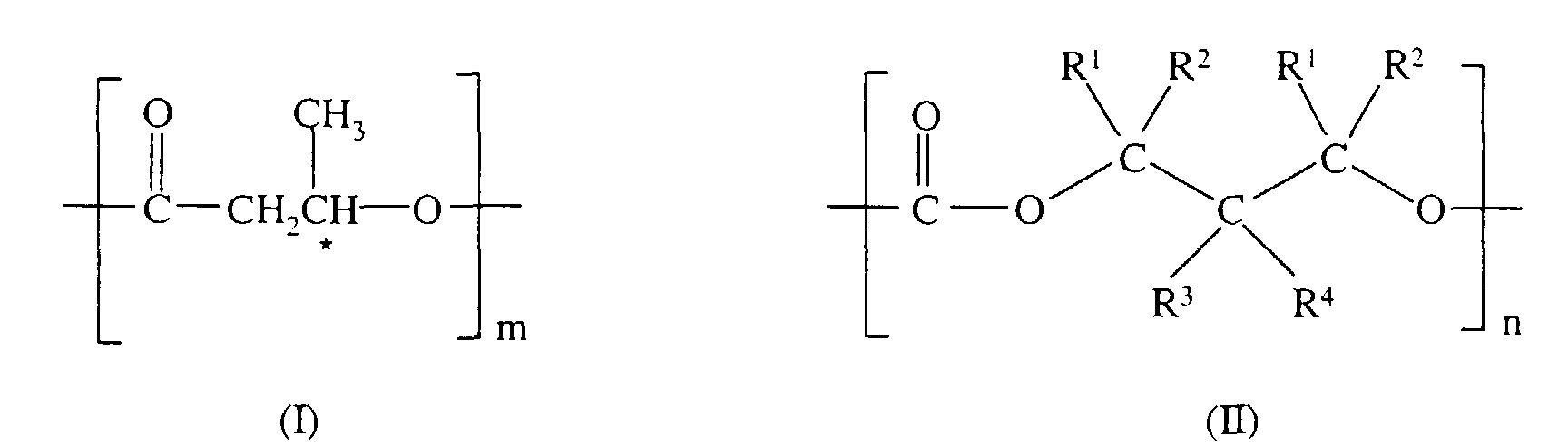 lesdites étapes étant répétées quand cela est approprié.a) linéarisation et polymérisation de β-butyrolactones optiquement actives en présence d'un catalyseur, de sorte que l'on obtient un mélange réactionnel ;b) addition de carbonates cycliques audit mélange réactionnel ; etd) linéarisation et polymérisation desdits carbonates cycliques;
 - Procédé pour préparer un copolymère séquencé de polyesters et de polycarbonates comprenant, comme première entité, un copolymère séquencé de polyesters et de polycarbonates comprenant au moins une unité parmi chacune des unités constitutives (I) et (II) ayant les formules générales :où le signe * indique un atome de carbone asymétrique, R1, R2, R3 et R4 sont un atome d'hydrogène ou un groupe méthyle, m et n sont chacun des nombres naturels respectifs compris entre 300 et 5 000 et, comme seconde entité, d'autres polyesters d'une formule correspondant à celle de l'unité (I) ou d'autres polycarbonates d'une formule correspondant à celle de l'unité (II) mais ayant un constituant monomère différent de la première entité, le procédé comprenant les étapes suivantes :
 les étapes a) à c) étant répétées quand cela est approprié et ledit procédé comprenant en outre l'étape suivante :a) linéarisation et polymérisation de β-butyrolactones optiquement actives en présence d'un catalyseur de sorte que l'on obtient un mélange réactionnel ;b) addition de carbonates cycliques audit mélange réactionnel ; etc) linéarisation et polymérisation desdits carbonates cycliques ;
d) addition de β-butyrolactones optiquement actives ou de carbonates cycliques correspondant aux monomères de l'unité (II) mais différents de ceux utilisés pour les étapes a) à c) puis linéarisation et polymérisation des β-butyrolactones ajoutées ou des carbonates cycliques ajoutés ;
les étapes a) à d) étant répétées quand cela est approprié. - Procédé pour préparer un copolymère séquencé de polyesters et de polycarbonates selon la revendication 1 ou 2, où le catalyseur est un catalyseur contenant de l'étain.
- Procédé pour préparer un copolymère séquencé de polyesters et de polycarbonates selon la revendication 3, où le catalyseur contenant de l'étain est un distannoxane ayant la formule générale (III) :où R5 indique un groupe alkyle ayant 1 à 12 atomes de carbone, un groupe aralkyle ayant au plus 12 atomes de carbone ou un groupe phényle, X est choisi dans le groupe consistant en Cl, Br et NCS, et Y est choisi dans le groupe consistant en Cl, Br, NCS, OH, un groupe alcoxy ayant 1 à 4 atomes de carbone et un groupe phénoxy.

- Procédé pour préparer un copolymère séquencé de polyesters et de polycarbonates selon la revendication 4, où le distannoxane est un 1-éthoxy-3-halogénotétraalkyldistannoxane, le groupe alkyle ayant 4 à 12 atomes de carbone.
Applications Claiming Priority (3)
| Application Number | Priority Date | Filing Date | Title |
|---|---|---|---|
| JP287178/94 | 1994-10-28 | ||
| JP28717894 | 1994-10-28 | ||
| JP28717894A JP3379841B2 (ja) | 1994-10-28 | 1994-10-28 | ブロック共重合ポリ(エステル−カーボネート)及びその製造方法 |
Publications (3)
| Publication Number | Publication Date |
|---|---|
| EP0709420A2 EP0709420A2 (fr) | 1996-05-01 |
| EP0709420A3 EP0709420A3 (fr) | 1996-07-10 |
| EP0709420B1 true EP0709420B1 (fr) | 2000-05-17 |
Family
ID=17714095
Family Applications (1)
| Application Number | Title | Priority Date | Filing Date |
|---|---|---|---|
| EP95402410A Expired - Lifetime EP0709420B1 (fr) | 1994-10-28 | 1995-10-27 | Copolymères à blocs de polyesters et de polycarbonates et procédé pour leur préparation |
Country Status (4)
| Country | Link |
|---|---|
| US (1) | US5631344A (fr) |
| EP (1) | EP0709420B1 (fr) |
| JP (1) | JP3379841B2 (fr) |
| DE (1) | DE69516972T2 (fr) |
Cited By (1)
| Publication number | Priority date | Publication date | Assignee | Title |
|---|---|---|---|---|
| US10759899B2 (en) | 2017-08-03 | 2020-09-01 | Colorado State University Research Foundation | Recyclable polymers based on ring-fused gamma-butyrolactones |
Families Citing this family (12)
| Publication number | Priority date | Publication date | Assignee | Title |
|---|---|---|---|---|
| JPH11106629A (ja) * | 1997-10-03 | 1999-04-20 | Takasago Internatl Corp | 香料含有徐放性生分解性樹脂組成物 |
| JPH11209463A (ja) * | 1998-01-19 | 1999-08-03 | Takasago Internatl Corp | β−ブチロラクトンの単独重合体または共重合体の製造方法 |
| KR100271463B1 (ko) * | 1998-07-13 | 2000-11-15 | 정명식 | 폴리(카보네이트-에스테르)및그제조방법 |
| US7084237B2 (en) * | 2000-05-15 | 2006-08-01 | Societe De Conseils De Recherches Et D'applications Scientifiques (S.C.R.A.S.) | Use of stannylenes and germylenes as polymerization catalysts for heterocycles |
| US6713593B2 (en) | 2000-10-11 | 2004-03-30 | Pohang Iron & Steel Co., Ltd. | Copolymer comprising alkylene carbonate and method of preparing same |
| WO2005105889A1 (fr) * | 2004-04-22 | 2005-11-10 | Dow Global Technologies, Inc. | Catalyseurs et procedes de polymerisation d'oligomeres macrocycliques |
| EP3047860B1 (fr) | 2006-07-20 | 2024-08-28 | OrbusNeich Medical Pte. Ltd. | Composition polymère bioabsorbable pour un dispositif médical |
| JP2008024849A (ja) * | 2006-07-21 | 2008-02-07 | Mitsui Chemicals Inc | 生分解性を有する水環境応答型ポリマーを含む水崩壊性組成物および水崩壊性成形体 |
| US7959942B2 (en) | 2006-10-20 | 2011-06-14 | Orbusneich Medical, Inc. | Bioabsorbable medical device with coating |
| US8691321B2 (en) | 2006-10-20 | 2014-04-08 | Orbusneich Medical, Inc. | Bioabsorbable polymeric composition and medical device background |
| RU2527471C1 (ru) * | 2013-04-19 | 2014-08-27 | Федеральное государственное унитарное предприятие "Научно-исследовательский институт химии и технологии полимеров имени академика В.А. Каргина с опытным заводом" (ФГУП "НИИ полимеров") | Полиэфирполикарбонаты олигомолочной кислоты |
| CN108503803B (zh) * | 2018-03-30 | 2019-03-01 | 佛山市巴盛诺新材料科技有限公司 | 一种利用脲/醇盐制备聚γ-丁内脂的方法 |
Family Cites Families (6)
| Publication number | Priority date | Publication date | Assignee | Title |
|---|---|---|---|---|
| US4470416A (en) | 1983-06-17 | 1984-09-11 | Ethicon, Inc. | Copolymers of lactide and/or glycolide with 1,5-dioxepan-2-one |
| DE3700193A1 (de) * | 1987-01-06 | 1988-07-14 | Bayer Ag | Sequenziert aufgebaute copolymere auf der basis von cyclischen carbonaten und estern |
| US5252701A (en) * | 1990-07-06 | 1993-10-12 | American Cyanamid Company | Segmented absorbable copolymer |
| DE69318946T2 (de) * | 1992-12-11 | 1998-12-17 | Takasago International Corp., Tokio/Tokyo | Biologisch abbaubares, optisch aktives Lactonpolymer und Verfahren zu seiner Herstellung |
| DE4310114A1 (de) * | 1993-03-27 | 1994-09-29 | Buna Ag | Carbonsäureester- und Kohlensäureestergruppen enthaltendes Polymer und Verfahren zu seiner Herstellung |
| JP3241505B2 (ja) * | 1993-08-11 | 2001-12-25 | 高砂香料工業株式会社 | 生分解性光学活性コポリマー及びその製造方法 |
-
1994
- 1994-10-28 JP JP28717894A patent/JP3379841B2/ja not_active Expired - Fee Related
-
1995
- 1995-10-27 DE DE69516972T patent/DE69516972T2/de not_active Expired - Fee Related
- 1995-10-27 US US08/549,544 patent/US5631344A/en not_active Expired - Fee Related
- 1995-10-27 EP EP95402410A patent/EP0709420B1/fr not_active Expired - Lifetime
Cited By (1)
| Publication number | Priority date | Publication date | Assignee | Title |
|---|---|---|---|---|
| US10759899B2 (en) | 2017-08-03 | 2020-09-01 | Colorado State University Research Foundation | Recyclable polymers based on ring-fused gamma-butyrolactones |
Also Published As
| Publication number | Publication date |
|---|---|
| EP0709420A2 (fr) | 1996-05-01 |
| DE69516972T2 (de) | 2000-10-05 |
| JP3379841B2 (ja) | 2003-02-24 |
| EP0709420A3 (fr) | 1996-07-10 |
| DE69516972D1 (de) | 2000-06-21 |
| US5631344A (en) | 1997-05-20 |
| JPH08127645A (ja) | 1996-05-21 |
Similar Documents
| Publication | Publication Date | Title |
|---|---|---|
| Nikolic et al. | Synthesis and characterization of biodegradable poly (butylene succinate-co-butylene adipate) s | |
| US5824751A (en) | Biodegradable high molecular composition | |
| EP0709420B1 (fr) | Copolymères à blocs de polyesters et de polycarbonates et procédé pour leur préparation | |
| US5633342A (en) | Method for the synthesis of environmentally degradable block copolymers | |
| CA2334110C (fr) | Polyurethanne biomedical; obtention et utilisation | |
| JP3263710B2 (ja) | 生分解性光学活性ポリマー及びその製造方法 | |
| US5202413A (en) | Alternating (ABA)N polylactide block copolymers | |
| WO1997015609A9 (fr) | Procede de synthese de copolymeres sequences degradables dans l'environnement | |
| US5594076A (en) | Hydrodegradable polyesters | |
| EP0640637A1 (fr) | Polyestercarbonates biodégradables et optiquement actifs | |
| WO1991002015A1 (fr) | Polyesters hydrodegradables | |
| US5840811A (en) | Optically active block polyester copolymer and method for production thereof | |
| CN101815741B (zh) | 制备丙交酯与1:4-3:6双脱水己糖醇的共聚物的方法 | |
| AU7971000A (en) | Poly (ether ester amide) and poly (ether ester urethane) copolymers | |
| Pepic et al. | Synthesis and characterization of biodegradable aliphatic copolyesters with poly (tetramethylene oxide) soft segments | |
| JP2000204146A (ja) | 高分子量脂肪族ポリエステル系重合体の製造方法 | |
| JP3339601B2 (ja) | ポリ乳酸系ポリエステルブロック共重合体 | |
| JP3408349B2 (ja) | 生分解性高分子用可塑剤 | |
| JP4047160B2 (ja) | 脂肪族ポリエステル共重合体からなるフィルム | |
| JP3273767B2 (ja) | 脂肪族ポリエステル系重合体及びその製造方法 | |
| CN1434067A (zh) | 脂肪族聚酯的制备方法 | |
| JPH1135680A (ja) | 生分解性ポリ乳酸エステルアミド及びその製造法 | |
| JP3492053B2 (ja) | 生分解性高分子組成物用相容化剤 | |
| JP4165800B2 (ja) | 生分解性樹脂及びフィルム | |
| JP3725006B2 (ja) | 半芳香族コポリエステルの製造方法 |
Legal Events
| Date | Code | Title | Description |
|---|---|---|---|
| PUAI | Public reference made under article 153(3) epc to a published international application that has entered the european phase |
Free format text: ORIGINAL CODE: 0009012 |
|
| AK | Designated contracting states |
Kind code of ref document: A2 Designated state(s): CH DE FR GB IT LI NL |
|
| PUAL | Search report despatched |
Free format text: ORIGINAL CODE: 0009013 |
|
| AK | Designated contracting states |
Kind code of ref document: A3 Designated state(s): CH DE FR GB IT LI NL |
|
| 17P | Request for examination filed |
Effective date: 19961230 |
|
| 17Q | First examination report despatched |
Effective date: 19980209 |
|
| GRAG | Despatch of communication of intention to grant |
Free format text: ORIGINAL CODE: EPIDOS AGRA |
|
| GRAG | Despatch of communication of intention to grant |
Free format text: ORIGINAL CODE: EPIDOS AGRA |
|
| GRAG | Despatch of communication of intention to grant |
Free format text: ORIGINAL CODE: EPIDOS AGRA |
|
| GRAH | Despatch of communication of intention to grant a patent |
Free format text: ORIGINAL CODE: EPIDOS IGRA |
|
| GRAH | Despatch of communication of intention to grant a patent |
Free format text: ORIGINAL CODE: EPIDOS IGRA |
|
| GRAA | (expected) grant |
Free format text: ORIGINAL CODE: 0009210 |
|
| AK | Designated contracting states |
Kind code of ref document: B1 Designated state(s): CH DE FR GB IT LI NL |
|
| RIN1 | Information on inventor provided before grant (corrected) |
Inventor name: TAKAHASHI, YOKO, TAKASAGO INT.CORP.CENTRAL RES LA Inventor name: HAGIWARA, TOSHIMISTU, TAKASAGO INT.CORP. CENTRAL Inventor name: HORI, YOJI, TAKASAGO INT.CORP.CENTRAL RES LAB Inventor name: YAMAGUCHI, AKIO, TAKASAGO INT.CORP.CENTRAL RES LA Inventor name: HONGO, HIDEYUKI, TAKASAGO INT.CORP.CENTRAL RES LAB |
|
| ITF | It: translation for a ep patent filed | ||
| REG | Reference to a national code |
Ref country code: CH Ref legal event code: EP |
|
| REF | Corresponds to: |
Ref document number: 69516972 Country of ref document: DE Date of ref document: 20000621 |
|
| ET | Fr: translation filed | ||
| REG | Reference to a national code |
Ref country code: CH Ref legal event code: NV Representative=s name: BOVARD AG PATENTANWAELTE |
|
| PLBE | No opposition filed within time limit |
Free format text: ORIGINAL CODE: 0009261 |
|
| STAA | Information on the status of an ep patent application or granted ep patent |
Free format text: STATUS: NO OPPOSITION FILED WITHIN TIME LIMIT |
|
| 26N | No opposition filed | ||
| REG | Reference to a national code |
Ref country code: GB Ref legal event code: IF02 |
|
| PGFP | Annual fee paid to national office [announced via postgrant information from national office to epo] |
Ref country code: FR Payment date: 20030910 Year of fee payment: 9 |
|
| PGFP | Annual fee paid to national office [announced via postgrant information from national office to epo] |
Ref country code: NL Payment date: 20030918 Year of fee payment: 9 |
|
| PGFP | Annual fee paid to national office [announced via postgrant information from national office to epo] |
Ref country code: DE Payment date: 20031008 Year of fee payment: 9 |
|
| PGFP | Annual fee paid to national office [announced via postgrant information from national office to epo] |
Ref country code: CH Payment date: 20031013 Year of fee payment: 9 |
|
| PGFP | Annual fee paid to national office [announced via postgrant information from national office to epo] |
Ref country code: GB Payment date: 20031021 Year of fee payment: 9 |
|
| PG25 | Lapsed in a contracting state [announced via postgrant information from national office to epo] |
Ref country code: GB Free format text: LAPSE BECAUSE OF NON-PAYMENT OF DUE FEES Effective date: 20041027 |
|
| PG25 | Lapsed in a contracting state [announced via postgrant information from national office to epo] |
Ref country code: LI Free format text: LAPSE BECAUSE OF NON-PAYMENT OF DUE FEES Effective date: 20041031 Ref country code: CH Free format text: LAPSE BECAUSE OF NON-PAYMENT OF DUE FEES Effective date: 20041031 |
|
| PG25 | Lapsed in a contracting state [announced via postgrant information from national office to epo] |
Ref country code: NL Free format text: LAPSE BECAUSE OF NON-PAYMENT OF DUE FEES Effective date: 20050501 |
|
| PG25 | Lapsed in a contracting state [announced via postgrant information from national office to epo] |
Ref country code: DE Free format text: LAPSE BECAUSE OF NON-PAYMENT OF DUE FEES Effective date: 20050503 |
|
| GBPC | Gb: european patent ceased through non-payment of renewal fee |
Effective date: 20041027 |
|
| REG | Reference to a national code |
Ref country code: CH Ref legal event code: PL |
|
| PG25 | Lapsed in a contracting state [announced via postgrant information from national office to epo] |
Ref country code: FR Free format text: LAPSE BECAUSE OF NON-PAYMENT OF DUE FEES Effective date: 20050630 |
|
| NLV4 | Nl: lapsed or anulled due to non-payment of the annual fee |
Effective date: 20050501 |
|
| REG | Reference to a national code |
Ref country code: FR Ref legal event code: ST |
|
| PG25 | Lapsed in a contracting state [announced via postgrant information from national office to epo] |
Ref country code: IT Free format text: LAPSE BECAUSE OF NON-PAYMENT OF DUE FEES Effective date: 20051027 |