EP0709674A2 - Reactif pour la classification de leucocytes - Google Patents
Reactif pour la classification de leucocytes Download PDFInfo
- Publication number
- EP0709674A2 EP0709674A2 EP95117161A EP95117161A EP0709674A2 EP 0709674 A2 EP0709674 A2 EP 0709674A2 EP 95117161 A EP95117161 A EP 95117161A EP 95117161 A EP95117161 A EP 95117161A EP 0709674 A2 EP0709674 A2 EP 0709674A2
- Authority
- EP
- European Patent Office
- Prior art keywords
- active agent
- alkyl
- leukocytes
- reagent according
- anionic active
- Prior art date
- Legal status (The legal status is an assumption and is not a legal conclusion. Google has not performed a legal analysis and makes no representation as to the accuracy of the status listed.)
- Granted
Links
Images


Classifications
-
- G—PHYSICS
- G01—MEASURING; TESTING
- G01N—INVESTIGATING OR ANALYSING MATERIALS BY DETERMINING THEIR CHEMICAL OR PHYSICAL PROPERTIES
- G01N33/00—Investigating or analysing materials by specific methods not covered by groups G01N1/00 - G01N31/00
- G01N33/48—Biological material, e.g. blood, urine; Haemocytometers
- G01N33/50—Chemical analysis of biological material, e.g. blood, urine; Testing involving biospecific ligand binding methods; Immunological testing
- G01N33/5005—Chemical analysis of biological material, e.g. blood, urine; Testing involving biospecific ligand binding methods; Immunological testing involving human or animal cells
- G01N33/5094—Chemical analysis of biological material, e.g. blood, urine; Testing involving biospecific ligand binding methods; Immunological testing involving human or animal cells for blood cell populations
-
- G—PHYSICS
- G01—MEASURING; TESTING
- G01N—INVESTIGATING OR ANALYSING MATERIALS BY DETERMINING THEIR CHEMICAL OR PHYSICAL PROPERTIES
- G01N15/00—Investigating characteristics of particles; Investigating permeability, pore-volume or surface-area of porous materials
- G01N15/10—Investigating individual particles
- G01N15/14—Optical investigation techniques, e.g. flow cytometry
- G01N15/1456—Optical investigation techniques, e.g. flow cytometry without spatial resolution of the texture or inner structure of the particle, e.g. processing of pulse signals
-
- Y—GENERAL TAGGING OF NEW TECHNOLOGICAL DEVELOPMENTS; GENERAL TAGGING OF CROSS-SECTIONAL TECHNOLOGIES SPANNING OVER SEVERAL SECTIONS OF THE IPC; TECHNICAL SUBJECTS COVERED BY FORMER USPC CROSS-REFERENCE ART COLLECTIONS [XRACs] AND DIGESTS
- Y10—TECHNICAL SUBJECTS COVERED BY FORMER USPC
- Y10T—TECHNICAL SUBJECTS COVERED BY FORMER US CLASSIFICATION
- Y10T436/00—Chemistry: analytical and immunological testing
- Y10T436/10—Composition for standardization, calibration, simulation, stabilization, preparation or preservation; processes of use in preparation for chemical testing
- Y10T436/101666—Particle count or volume standard or control [e.g., platelet count standards, etc.]
-
- Y—GENERAL TAGGING OF NEW TECHNOLOGICAL DEVELOPMENTS; GENERAL TAGGING OF CROSS-SECTIONAL TECHNOLOGIES SPANNING OVER SEVERAL SECTIONS OF THE IPC; TECHNICAL SUBJECTS COVERED BY FORMER USPC CROSS-REFERENCE ART COLLECTIONS [XRACs] AND DIGESTS
- Y10—TECHNICAL SUBJECTS COVERED BY FORMER USPC
- Y10T—TECHNICAL SUBJECTS COVERED BY FORMER US CLASSIFICATION
- Y10T436/00—Chemistry: analytical and immunological testing
- Y10T436/10—Composition for standardization, calibration, simulation, stabilization, preparation or preservation; processes of use in preparation for chemical testing
- Y10T436/107497—Preparation composition [e.g., lysing or precipitation, etc.]
-
- Y—GENERAL TAGGING OF NEW TECHNOLOGICAL DEVELOPMENTS; GENERAL TAGGING OF CROSS-SECTIONAL TECHNOLOGIES SPANNING OVER SEVERAL SECTIONS OF THE IPC; TECHNICAL SUBJECTS COVERED BY FORMER USPC CROSS-REFERENCE ART COLLECTIONS [XRACs] AND DIGESTS
- Y10—TECHNICAL SUBJECTS COVERED BY FORMER USPC
- Y10T—TECHNICAL SUBJECTS COVERED BY FORMER US CLASSIFICATION
- Y10T436/00—Chemistry: analytical and immunological testing
- Y10T436/10—Composition for standardization, calibration, simulation, stabilization, preparation or preservation; processes of use in preparation for chemical testing
- Y10T436/108331—Preservative, buffer, anticoagulant or diluent
Definitions
- This invention relates to a reagent to be used in the field of clinical inspection for the classification of blood cells, more particularly to a reagent for use in a method for the classification of leukocytes in which blood cells after lysis of erythrocytes are optically measured using a flow cytometer.
- an erythrocyte lysing agent (to be referred to as "hemolytic agent” hereinafter) mainly composed of a quaternary ammonium salt as a cationic surface active agent is added to a diluted blood solution to dissolve membranes and cytoplasmic contents of erythrocytes and leukocytes, and the remaining leukocyte nuclei are measured based on the Coulter's theory to count the number of leukocytes. Since leukocytes are observed in the shrunken form, this method has a problem in that information for the classification of leukocytes cannot be obtained.
- leukocytes are classified into three groups, namely lymphocyte, monocyte and granulocyte, based on the difference in their lysing rate and electric conductivity.
- lymphocyte a group including lymphocyte, monocyte, neutrophil, eosinophil and basophil, or at least four groups excluding basophil, because such a method can contribute to the diagnosis of diseases by counting blood leukocytes as individual groups.
- a flow cytometer has been used for the identification and analysis of cells and fine particles based on light scattering.
- a flow analyzer 4 of this cell measuring apparatus is designed to measure scattering from sample particles. That is, a sample solution containing particles to be measured is introduced into the flow analyzer 4 where laser beams generated from a laser source 1 are irradiated through radiation scattering lenses 2 and 3, the forward scattering after stoppage of direct light through an irradiation light stopper is measured by a forward scattering detector 9 via a forward scattering detection lens 8, and the voltage level measured by the detector is recorded in the analyzer 10.
- the side-way scattering in the flow analyzer 4 is measured by a side-way scattering detector 6 via a side-way scattering detection lens 5, and the voltage level measured by the detector is recorded in the analyzer 10. Based on both of the voltage levels in the analyzer 10, a two-dimensional distribution diagram (scattergram) of the forward scattering and side-way scattering is displayed on a display device 11.
- leukocytes are classified into three groups, namely lymphocyte, monocyte and granulocyte, by adding a hemolytic agent containing ammonium oxalate as its main component to a diluted blood solution to effect selective lysis of erythrocytes.
- This method requires 20 to 30 minutes for the lysis of erythrocytes so that it cannot be used as a method for use in the treatment of a large number of samples.
- distribution of each leukocyte group is not clear and eosinophil is included in the distribution of neutrophil, this method cannot isolate eosinophil as its single distribution.
- a leukocyte classification agent which contains at least one surface active agent (hereinafter sometimes referred to as merely "active agent") selected from the group consisting of polyoxyethylene anionic active agents and polyoxyethylene nontonic active agents and which can classify leukocytes into 3 to 5 groups.
- active agent surface active agent
- Both of these polyoxyethylene anionic and nonionic active agents are commonly represented the formula R1-R2-(CH2CH2O) n -A wherein R1 represents an alkyl or alkenyl group having 10 to 22 carbon atoms, R2 represents O, or COO, n is an integer of from 8 to 30 and A represents SO3Na, COONa, OSO3Na or ONa in the case of the anionic active agent or H in the case of the nonionic active agent.
- ethylene oxide addition mol number of from 8 to 30.
- Such a large ethylene oxide addition mol number causes reduction of cytolytic activity.
- separation of lymphocyte, monocyte and granulocyte is poor and eosinophil cannot be measured at the same time.
- an object of the present invention is to provide a leukocyte classification reagent (hemolytic agent) which lyses erythrocytes within a short period of time when added to a blood sample solution but does not cause damage on leukocytes for a certain period of time keeping their original state or close to the original state, so that leukocytes can be classified directly into four groups, namely lymphocyte, monocyte, eosinophil and neutrophil, by measuring forward scattering and side-way scattering by a flow cytometer after lysis of erythrocytes.
- hemolytic agent hemolytic agent
- the present invention provides a leukocyte classification reagent which comprises at least one surface active agent selected from the group consisting of anionic active agents and amphoteric active agents in an amount effective to classify leukocytes in a blood sample by lysing erythrocytes and acting upon leukocytes.
- the above anionic active agent is an alkyl sulfate anionic active agent represented by the formula (1): R-O-SO3X (1) wherein R represents an alkyl or alkylene group having 8 to 18 carbon atoms and X represents Na, K, NH4 or HN(CH2CH2OH)3; or a polyoxyethylene anionic active agent represented by the formula (2): R-O-(CH2CH2O) n -SO3X (2) wherein R represents an alkyl or alkylene group having 8 to 18 carbon atoms, n is an integer of 1 to 5 and X represents Na, K, NH4 or HN(CH2CH2OH)3.
- the polyoxyethylene anionic active agent is selected from the group consisting of sodium polyoxyethylene(3) C12 ⁇ 13 alkyl ether sulfate, sodium polyoxyethylene(3) C11 ⁇ 15 alkyl ether sulfate, polyoxyethylene(3) alkyl C11 ⁇ 15 alkyl ether triethanolamine and sodium lauryl sulfate.
- the anionic active agent can also be a coconut fatty acid anionic active agent represented by the formula (3): wherein R represents an alkyl or alkylene group having 8 to 18 carbon atoms, X represents CH2SO3 or COO and Y represents Na, K, NH4 or HN(CH2CH2OH)3.
- the coconut fatty acid anionic active agent is sodium coconut fatty acid methyltaurine or sodium coconut fatty acid sarcosine.
- amphoteric active agent is a 2-alkyl-N-carboxymethyl-N-hydroxyethyl imidazoliniumbetaine represented by the formula (4): wherein R represents an alkyl or alkylene group having 6 to 21 carbon atoms.
- the amphoteric active agent is 2-alkyl(C8H17-C18H37)-N-carboxymethyl-N-hydroxyethyl imidazoliniumbetaine.
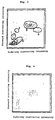
- Fig 1 is a two-dimensional distribution diagram when sodium polyoxyethylene(3) C12 ⁇ 13 alkyl ether sulfate was used as a hemolytic agent.
- Fig 2 is a two-dimensional distribution diagram when sodium polyoxyethylene(3) C11 ⁇ 15 alkyl ether sulfate was used as a hemolytic agent.
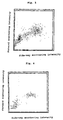
- Fig 3 is a two-dimensional distribution diagram when sodium lauryl sulfate was used as a hemolytic agent.
- Fig 4 is a two-dimensional distribution diagram when sodium lauryl sulfate was used as a hemolytic agent and classification of leukocytes was carried out at pH 10.
- Fig 5 is a two-dimensional distribution diagram when sodium lauryl sulfate was used as a hemolytic agent and classification of leukocytes was carried out at pH 3
- Fig 6 is a two-dimensional distribution diagram when sodium polyoxyethylene(3) C11 ⁇ 15 alkyl ether sulfate was used as a hemolytic agent and classification of leukocytes was carried out under an osmotic pressure of 450 mOsm/kg H2O.
- Fig 7 is a two-dimensional distribution diagram when sodium polyoxyethylene(3) C11 ⁇ 15 alkyl ether sulfate was used as a hemolytic agent and classification of leukocytes was carried out under an osmotic pressure of 220 mOsm/kg H2O.
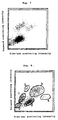
- Fig 8 is a two-dimensional distribution diagram when sodium coconut fatty acid methyltaurine was used as a hemolytic agent.
- Fig 9 is a two-dimensional distribution diagram when 2-C8 ⁇ 18 alkyl-N-carboxymethyl-N-hydroxyethyl imidazoliniumbetaine was used as a hemolytic agent.
- 0 erythrocyte ghost
- 1 lymphocyte
- 2 monocyte
- 3 neutrophil
- 4 represents eosinophil
- Fig. 10 is a schematic illustration showing the optical system of a flow cytometer in which the leukocyte classification reagent of the present invention is used.
- any anionic and amphoteric surface active agent can be used in the leukocyte classification reagent of the present invention as long as it enables lysis of erythrocytes within a short period of time when they are added to a blood sample solution without causing damage on leukocytes to maintain the original state of leukocytes or close to the original state.
- the group R preferably has 8 to 18 carbon atoms.
- R preferably has 8 to 18 carbon atoms and ethylene oxide addition mol numbers of 1 to 5.
- Hydrogen in the alkyl or alkylene group R takes a great role in the lysis of cells. The longer the chain length of R is, the stronger the cytolytic activity is, while the shorter the chain length is, the weaker the cytolytic activity is. However, the water solubility of the surface active agent becomes lower as the chain length of R becomes longer and the agent is sparingly soluble or makes a hemolysate turbid.
- the number of carbon atoms in the group R within the above-described range balances these cases with each other. Also, as the integer represented by n becomes larger, hydrophilicity of the agent increases, but its cytolytic activity is reduced.
- the group X does not take particular role in the reaction upon blood cells.
- the amphoteric active agent acts as an anionic active agent or a cationic active agent depending on the pH range, and it acts as an anionic active agent when used as a hemolytic agent at a pH value of 7 or higher.
- R preferably has 6 to 21 carbon atoms.
- each blood sample is diluted with a usual diluent in order to effect uniform dispersion of blood, prior to the addition of a hemolytic agent as the leukocyte classification reagent.
- a diluent comprises an osmotic pressure adjusting agent, a buffer agent, a chelating agent and an antimicrobial agent dissolved in proper amounts in distilled water, with its typical composition shown below.
- the osmotic pressure adjusting agent is used to adjust the osmotic pressure of blood sample solutions to such a level that blood cells can exist stably, namely 250 to 400 mOsm/kg H2O.
- hemolytic activity becomes strong, particularly accelerating lysis of erythrocytes, and neutrophils shrink a little.
- the osmotic pressure is lower than this range, hemolytic activity becomes weak and the amount of erythrocyte ghost (unlysed erythrocyte residue) becomes particularly large.
- the buffer agent can maintain blood sample solutions within a pH range of approximately from 6.8 to 7.6 so that blood cells can exist stably.
- the pH value must be within the optimum range of the agent. In consequence, a pH value outside the above range is applicable with the proviso that it does not spoil the purpose of the present invention.
- the purpose of the present invention can also be achieved by adding the hemolytic agent to the diluent in advance or by adding an appropriate amount of the surface active agent to the diluent directly without dilution.
- the anionic active agent of the present invention acts as the hemolytic agent generally within the pH range of from 3 to 11, and the amphoteric active agent within the pH range of from 7 to 11, though the optimum range varies depending on their kinds.
- the pH value is higher than these ranges, hemolytic activity becomes strong to cause lysis of not only erythrocytes but also leukocytes.
- the pH value is lower than these ranges, hemolytic activity becomes weak so that separation of distributions of respective leukocyte components becomes poor.
- the chelating agent is used to effect formation of chelate compounds with metal ions, in order to prevent generation of precipitate caused by metal ions during preservation of the diluent for a prolonged period of time or at the time of its use.
- the antimicrobial agent is used to prevent growth of fungi and bacteria during long-term preservation of the diluent.
- the amount of the hemolytic agent which contains the above-described surface active agent as the main component to be added to a blood sample diluted with the above-described diluent varies depending on the kind of the surface active agent. In general, however, the amount of ghost increases when the concentration of the surface active agent in the blood sample solution is so low that entire erythrocytes cannot be lysed. On the other hand, not only erythrocytes but also leukocytes are lysed when the active agent concentration is high.
- the time for hemolysis varies depending on the added amount of the hemolytic agent. The time for hemolysis becomes short when the added amount is large, but stable period of leukocytes also becomes short. In consequence, it is necessary to select proper amount of the surface active agent to be added.
- a hemolytic agent prepared by dissolving the polyoxyethylene anionic active agent represented by the above-described formula (2) in distilled water to give a concentration of 0.05% can be added to a blood sample obtained by diluting 50 ⁇ l of whole blood with 2 ml of the above-described diluent.
- the amount of the hemolytic agent should be determined depending on a dilution ratio of blood and the concentration of the surface active agent.
- a polyoxyethylene anionic active agent sodium polyoxyethylene(3) alkyl(C12 ⁇ 13 mixture) ether sulfate (C12 ⁇ 13-O-(CH2CH2O)3-SO3Na), was used in this example as a hemolytic agent component.
- a 25 ⁇ l portion of a blood sample was diluted with 1 ml of a diluent having the following composition.
- sodium chloride 9.0 g potassium dihydrogenphosphate 0.91 g disodium hydrogenphosphate 9.55 g EDTA 2Na 0.3 g sodium 1-hydroxypyridine-2-thionate 0.25 g distilled water 1000 ml
- leukocytes were clearly classified into four groups, namely lymphocyte (1), monocyte (2), neutrophil (3) and eosinophil (4).
- (0) represents erythrocyte ghost.
- two-dimensional distribution diagrams similar to the diagram shown in Fig. 1 were obtained when the above-described hemolytic agent (concentration, 0.175%) was added to the above-described diluted blood solution within the range of from 100 to 1,000 ⁇ l.
- the purpose of the present invention can also be achieved by adding the hemolytic agent to the diluent in advance or by adding an appropriate amount of the above-described surface active agent to the diluent directly without dilution.
- the surface active agent of this example showed the same result shown in Fig. 1 within the pH range of from 3 to 10.
- Example 2 were obtained within the addition range of from 50 to 300 ⁇ l (in the case of 0.25% hemolytic agent), within the pH range of from 6 to 10 and within the osmotic pressure range of from 250 to 400 mOsm/kg H2O similar to the case of Example 1.
- leukocyte classification tests were carried out in the same manner as described in Examples 1 to 3. In both cases, scattergrams similar to those shown in Figs. 1 to 3 were obtained in which leukocytes were clearly classified into four groups, namely lymphocyte, monocyte, neutrophil and eosinophil.
- a coconut fatty acid anionic active agent sodium coconut fatty acid methyltaurine (R-CON(CH3)CH2CH2SO3Na), was used as the active ingredient of hemolytic agent.
- leukocytes were clearly classified into four groups, namely lymphocyte (1), monocyte (2), neutrophil (3) and eosinophil (4).
- (0) represents erythrocyte ghost.
- a betaine amphoteric active agent 2-alkyl(C8H17-C18H37 mixture)-N-carboxymethyl-N-hydroxyethyl imidazoliniumbetaine represented by the formula: was used as the active ingredient of hemolytic agent.
- leukocyte classification tests were carried out in the same manner as described in Example 6.
- two-dimensional distribution diagrams similar to those shown in Fig. 9 were obtained in which leukocytes were clearly classified into four groups, namely lymphocyte, monocyte, neutrophil and eosinophil.
- the inventive leukocyte classification reagent can lyse erythrocytes within a short period of time when added to a diluted blood solution but does not cause damage on leukocytes, so that the original state of leukocytes or a state close thereto can be maintained for a certain period of time, and leukocytes therefore can be classified directly into four groups by simple procedure and construction, thus exerting great effects in the field of clinical inspection.
Landscapes
- Health & Medical Sciences (AREA)
- Life Sciences & Earth Sciences (AREA)
- Chemical & Material Sciences (AREA)
- Immunology (AREA)
- Engineering & Computer Science (AREA)
- Biochemistry (AREA)
- Physics & Mathematics (AREA)
- General Health & Medical Sciences (AREA)
- General Physics & Mathematics (AREA)
- Analytical Chemistry (AREA)
- Pathology (AREA)
- Cell Biology (AREA)
- Hematology (AREA)
- Molecular Biology (AREA)
- Urology & Nephrology (AREA)
- Biomedical Technology (AREA)
- Ecology (AREA)
- Biotechnology (AREA)
- Microbiology (AREA)
- Tropical Medicine & Parasitology (AREA)
- Dispersion Chemistry (AREA)
- Food Science & Technology (AREA)
- Medicinal Chemistry (AREA)
- Investigating Or Analysing Biological Materials (AREA)
- Measurement Of The Respiration, Hearing Ability, Form, And Blood Characteristics Of Living Organisms (AREA)
Priority Applications (3)
| Application Number | Priority Date | Filing Date | Title |
|---|---|---|---|
| EP00104166A EP1006361B1 (fr) | 1994-10-31 | 1995-10-31 | Réactif de classification des leucocytes |
| EP00118500A EP1058115B1 (fr) | 1994-10-31 | 1995-10-31 | Réactif pour la classification de leucocytes |
| EP00118501A EP1052509B1 (fr) | 1994-10-31 | 1995-10-31 | Reactif pour la classification de leucocytes |
Applications Claiming Priority (3)
| Application Number | Priority Date | Filing Date | Title |
|---|---|---|---|
| JP26657394 | 1994-10-31 | ||
| JP26657394A JP3324050B2 (ja) | 1994-10-31 | 1994-10-31 | 白血球分類用試薬および白血球分類方法 |
| JP266573/94 | 1994-10-31 |
Related Child Applications (3)
| Application Number | Title | Priority Date | Filing Date |
|---|---|---|---|
| EP00118500A Division EP1058115B1 (fr) | 1994-10-31 | 1995-10-31 | Réactif pour la classification de leucocytes |
| EP00118501A Division EP1052509B1 (fr) | 1994-10-31 | 1995-10-31 | Reactif pour la classification de leucocytes |
| EP00104166A Division EP1006361B1 (fr) | 1994-10-31 | 1995-10-31 | Réactif de classification des leucocytes |
Publications (3)
| Publication Number | Publication Date |
|---|---|
| EP0709674A2 true EP0709674A2 (fr) | 1996-05-01 |
| EP0709674A3 EP0709674A3 (fr) | 1996-11-20 |
| EP0709674B1 EP0709674B1 (fr) | 2001-06-27 |
Family
ID=17432696
Family Applications (4)
| Application Number | Title | Priority Date | Filing Date |
|---|---|---|---|
| EP00104166A Expired - Lifetime EP1006361B1 (fr) | 1994-10-31 | 1995-10-31 | Réactif de classification des leucocytes |
| EP00118500A Expired - Lifetime EP1058115B1 (fr) | 1994-10-31 | 1995-10-31 | Réactif pour la classification de leucocytes |
| EP95117161A Expired - Lifetime EP0709674B1 (fr) | 1994-10-31 | 1995-10-31 | Reactif pour la classification de leucocytes |
| EP00118501A Expired - Lifetime EP1052509B1 (fr) | 1994-10-31 | 1995-10-31 | Reactif pour la classification de leucocytes |
Family Applications Before (2)
| Application Number | Title | Priority Date | Filing Date |
|---|---|---|---|
| EP00104166A Expired - Lifetime EP1006361B1 (fr) | 1994-10-31 | 1995-10-31 | Réactif de classification des leucocytes |
| EP00118500A Expired - Lifetime EP1058115B1 (fr) | 1994-10-31 | 1995-10-31 | Réactif pour la classification de leucocytes |
Family Applications After (1)
| Application Number | Title | Priority Date | Filing Date |
|---|---|---|---|
| EP00118501A Expired - Lifetime EP1052509B1 (fr) | 1994-10-31 | 1995-10-31 | Reactif pour la classification de leucocytes |
Country Status (4)
| Country | Link |
|---|---|
| US (1) | US5747343A (fr) |
| EP (4) | EP1006361B1 (fr) |
| JP (1) | JP3324050B2 (fr) |
| DE (4) | DE69521476T2 (fr) |
Cited By (4)
| Publication number | Priority date | Publication date | Assignee | Title |
|---|---|---|---|---|
| EP2500727A1 (fr) * | 2006-08-09 | 2012-09-19 | Beckman Coulter, Inc. | Systeme de reactif pour cytométrie en flux, avec sarcosine |
| CN103575702A (zh) * | 2012-07-27 | 2014-02-12 | 深圳迈瑞生物医疗电子股份有限公司 | 白细胞分类计数试剂和白细胞分类方法 |
| CN107144519A (zh) * | 2017-05-24 | 2017-09-08 | 中山市滔略生物科技有限公司 | 血细胞分析仪用溶血剂及其制备方法 |
| CN109270281A (zh) * | 2017-07-18 | 2019-01-25 | 深圳市帝迈生物技术有限公司 | 提高白细胞分类结果准确性和计数结果重复性的方法及设备 |
Families Citing this family (31)
| Publication number | Priority date | Publication date | Assignee | Title |
|---|---|---|---|---|
| WO1999024831A1 (fr) * | 1997-11-11 | 1999-05-20 | Kowa Company, Ltd. | Procede et dispositif de numeration de globules blancs |
| FR2778413B1 (fr) * | 1998-05-07 | 2000-08-04 | Immunotech Sa | Nouveaux reactifs et methode de lyse des erythrocytes |
| WO2000049387A2 (fr) * | 1999-02-19 | 2000-08-24 | Idexx Laboratories, Inc. | Cytometre en flux a ouverture numerique elevee et procede de son utilisation |
| US6210969B1 (en) * | 1999-04-28 | 2001-04-03 | Coulter International Corp. | Composition and method for differentiation of basophil and eosinophil subpopulations of leukocytes in blood |
| US6214625B1 (en) * | 1999-04-28 | 2001-04-10 | Coulter International Corp. | Composition and method for differentiation of basophils and eosinophils in blood |
| US6618143B2 (en) * | 2000-02-18 | 2003-09-09 | Idexx Laboratories, Inc. | High numerical aperture flow cytometer and method of using same |
| US6320656B1 (en) * | 2000-02-18 | 2001-11-20 | Idexx Laboratories, Inc. | High numerical aperture flow cytometer and method of using same |
| EP2154522B1 (fr) | 2000-03-29 | 2017-03-01 | Panasonic Healthcare Holdings Co., Ltd. | Biocapteur |
| US6784981B1 (en) * | 2000-06-02 | 2004-08-31 | Idexx Laboratories, Inc. | Flow cytometry-based hematology system |
| US20060263888A1 (en) * | 2000-06-02 | 2006-11-23 | Honeywell International Inc. | Differential white blood count on a disposable card |
| JP4227019B2 (ja) * | 2001-10-23 | 2009-02-18 | デンカ生研株式会社 | 血液中の血球と菌の分離方法および血液中の菌の検出方法 |
| US20030157556A1 (en) * | 2002-02-13 | 2003-08-21 | Maggiore Jack A. | Biological fluid stabilizing composition and method of use thereof |
| US7092078B2 (en) * | 2003-03-31 | 2006-08-15 | Nihon Kohden Corporation | Flow cytometer for classifying leukocytes and method for determining detection angle range of the same |
| US7678578B2 (en) * | 2005-02-07 | 2010-03-16 | Beckman Coulter, Inc. | Cell permeabilization and stabilization reagent and method of use |
| CN101078720B (zh) * | 2006-05-22 | 2010-12-01 | 深圳迈瑞生物医疗电子股份有限公司 | 一种改进的用于对白细胞进行分类的试剂及方法 |
| CN101078721B (zh) * | 2006-05-23 | 2010-12-22 | 深圳迈瑞生物医疗电子股份有限公司 | 对白细胞进行分类的试剂及方法 |
| CN101349644B (zh) * | 2007-07-20 | 2012-06-27 | 深圳迈瑞生物医疗电子股份有限公司 | 一种白细胞分类试剂和其使用方法 |
| CN101464454B (zh) * | 2007-12-18 | 2016-08-03 | 深圳迈瑞生物医疗电子股份有限公司 | 白细胞分类试剂及方法 |
| CN101470108B (zh) * | 2007-12-24 | 2013-11-27 | 深圳迈瑞生物医疗电子股份有限公司 | 一种对白细胞进行分类的试剂和方法 |
| CN105440725A (zh) * | 2008-01-04 | 2016-03-30 | 深圳迈瑞生物医疗电子股份有限公司 | 不对称菁类荧光染料,组合物及在生物样品染色中的用途 |
| CN101602762B (zh) * | 2008-06-10 | 2013-10-16 | 深圳迈瑞生物医疗电子股份有限公司 | 不对称菁类化合物、其制备方法及应用 |
| CN101726579B (zh) * | 2008-10-17 | 2014-06-18 | 深圳迈瑞生物医疗电子股份有限公司 | 血液检测试剂和方法 |
| CN101750274B (zh) * | 2008-12-17 | 2014-06-25 | 深圳迈瑞生物医疗电子股份有限公司 | 白细胞分类计数试剂、试剂盒以及白细胞分类计数的方法 |
| CN101988082B (zh) * | 2009-07-31 | 2015-04-08 | 深圳迈瑞生物医疗电子股份有限公司 | 白细胞分类计数试剂、试剂盒及其制备方法和白细胞分类计数的方法 |
| CN102226804B (zh) * | 2011-03-28 | 2013-07-03 | 中国人民解放军总医院 | 一种用于血液白细胞五分类计数的溶血剂及其用途 |
| JP5559096B2 (ja) * | 2011-05-10 | 2014-07-23 | 株式会社堀場製作所 | 血球計数用試薬、及び血液検査方法 |
| CN110231469A (zh) * | 2018-03-06 | 2019-09-13 | 深圳市帝迈生物技术有限公司 | 一种白细胞三分类溶血剂 |
| US10914913B2 (en) | 2018-03-30 | 2021-02-09 | Idexx Laboratories, Inc. | Flow cytometer, laser optics assembly thereof, and methods of assembling the same |
| WO2020042027A1 (fr) * | 2018-08-29 | 2020-03-05 | 深圳迈瑞生物医疗电子股份有限公司 | Méthode d'essai d'échantillon de sang, dispositif d'essai d'échantillon de sang et support d'informations |
| CN111811996B (zh) * | 2020-05-29 | 2022-10-04 | 深圳市帝迈生物技术有限公司 | 白细胞分类试剂盒及其制备方法、染料废液处理方法 |
| CA3182847A1 (fr) | 2020-06-17 | 2021-12-23 | Garland Christian Misener | Cytometre de flux et ensemble optique laser associe |
Citations (1)
| Publication number | Priority date | Publication date | Assignee | Title |
|---|---|---|---|---|
| WO1988009504A1 (fr) | 1987-05-29 | 1988-12-01 | Toa Medical Electronics Co., Ltd. | Procede de classification de leucocytes et reactifs utilises |
Family Cites Families (14)
| Publication number | Priority date | Publication date | Assignee | Title |
|---|---|---|---|---|
| US4528274A (en) * | 1982-07-06 | 1985-07-09 | Coulter Electronics, Inc. | Multi-purpose blood diluent and lysing agent for differential determination of lymphoid-myeloid population of leukocytes |
| US4637986A (en) * | 1983-08-22 | 1987-01-20 | Ortho Diagnostic Systems, Inc. | Flow cytometry lysing reagent with leukoprotective agent for producing a 3-part WBC count |
| AU602129B2 (en) * | 1985-09-06 | 1990-10-04 | Technicon Instruments Corportion | Method for the determination of a differential white blood cell count |
| US5389549A (en) * | 1987-05-29 | 1995-02-14 | Toa Medical Electronics Co., Ltd. | Method for classifying leukocytes and a reagent used therefor |
| JP2619900B2 (ja) * | 1988-01-27 | 1997-06-11 | 東亜医用電子株式会社 | 血液中の白血球およびヘモグロビンの測定用試薬および方法 |
| JPH02212598A (ja) * | 1989-02-13 | 1990-08-23 | Kawaken Fine Chem Co Ltd | 液体洗浄剤組成物 |
| JPH0320213A (ja) * | 1989-06-17 | 1991-01-29 | Nippon Oil & Fats Co Ltd | 身体用液状洗浄剤組成物 |
| IT8921788A0 (it) * | 1989-09-21 | 1989-09-21 | Diesse Diagnostica | Reattivo utile per la rilevazione e la determinazione quantitativa dei leucociti in fluidi biologici. |
| JP2836865B2 (ja) * | 1989-10-23 | 1998-12-14 | 東亜医用電子株式会社 | 血液中の白血球およびヘモグロビンの測定用試薬 |
| US5242832A (en) * | 1990-03-01 | 1993-09-07 | Toa Medical Electronics Co., Ltd. | Reagent for measurement of leukocytes and hemoglobin in blood |
| JP3048260B2 (ja) * | 1991-07-29 | 2000-06-05 | シスメックス株式会社 | 白血球分類計数用試料調製方法 |
| EP0598663B1 (fr) * | 1992-11-19 | 2000-02-02 | Sysmex Corporation | Procédé de prétraitment pour analyse de sang |
| JP3301646B2 (ja) * | 1993-03-19 | 2002-07-15 | シスメックス株式会社 | 幼若細胞測定用試薬 |
| JP3467310B2 (ja) * | 1994-04-21 | 2003-11-17 | シスメックス株式会社 | 白血球分析用試薬及び白血球の分類方法 |
-
1994
- 1994-10-31 JP JP26657394A patent/JP3324050B2/ja not_active Expired - Fee Related
-
1995
- 1995-10-31 EP EP00104166A patent/EP1006361B1/fr not_active Expired - Lifetime
- 1995-10-31 EP EP00118500A patent/EP1058115B1/fr not_active Expired - Lifetime
- 1995-10-31 EP EP95117161A patent/EP0709674B1/fr not_active Expired - Lifetime
- 1995-10-31 EP EP00118501A patent/EP1052509B1/fr not_active Expired - Lifetime
- 1995-10-31 DE DE69521476T patent/DE69521476T2/de not_active Expired - Fee Related
- 1995-10-31 DE DE69529431T patent/DE69529431T2/de not_active Expired - Lifetime
- 1995-10-31 DE DE69530627T patent/DE69530627T2/de not_active Expired - Fee Related
- 1995-10-31 DE DE69530625T patent/DE69530625T2/de not_active Expired - Fee Related
- 1995-10-31 US US08/550,861 patent/US5747343A/en not_active Expired - Lifetime
Patent Citations (1)
| Publication number | Priority date | Publication date | Assignee | Title |
|---|---|---|---|---|
| WO1988009504A1 (fr) | 1987-05-29 | 1988-12-01 | Toa Medical Electronics Co., Ltd. | Procede de classification de leucocytes et reactifs utilises |
Cited By (5)
| Publication number | Priority date | Publication date | Assignee | Title |
|---|---|---|---|---|
| EP2500727A1 (fr) * | 2006-08-09 | 2012-09-19 | Beckman Coulter, Inc. | Systeme de reactif pour cytométrie en flux, avec sarcosine |
| CN103575702A (zh) * | 2012-07-27 | 2014-02-12 | 深圳迈瑞生物医疗电子股份有限公司 | 白细胞分类计数试剂和白细胞分类方法 |
| CN103575702B (zh) * | 2012-07-27 | 2016-06-01 | 深圳迈瑞生物医疗电子股份有限公司 | 白细胞分类计数试剂和白细胞分类方法 |
| CN107144519A (zh) * | 2017-05-24 | 2017-09-08 | 中山市滔略生物科技有限公司 | 血细胞分析仪用溶血剂及其制备方法 |
| CN109270281A (zh) * | 2017-07-18 | 2019-01-25 | 深圳市帝迈生物技术有限公司 | 提高白细胞分类结果准确性和计数结果重复性的方法及设备 |
Also Published As
| Publication number | Publication date |
|---|---|
| DE69529431T2 (de) | 2003-06-05 |
| DE69521476T2 (de) | 2001-10-11 |
| EP1006361A2 (fr) | 2000-06-07 |
| EP1052509B1 (fr) | 2003-05-02 |
| JP3324050B2 (ja) | 2002-09-17 |
| EP1058115A2 (fr) | 2000-12-06 |
| DE69530625D1 (de) | 2003-06-05 |
| EP1052509A3 (fr) | 2001-01-31 |
| EP1058115B1 (fr) | 2003-05-02 |
| EP1006361A3 (fr) | 2000-07-26 |
| EP1058115A3 (fr) | 2001-01-31 |
| DE69529431D1 (de) | 2003-02-20 |
| EP0709674A3 (fr) | 1996-11-20 |
| JPH08129012A (ja) | 1996-05-21 |
| DE69530625T2 (de) | 2003-10-16 |
| US5747343A (en) | 1998-05-05 |
| EP0709674B1 (fr) | 2001-06-27 |
| DE69521476D1 (de) | 2001-08-02 |
| EP1006361B1 (fr) | 2003-01-15 |
| DE69530627T2 (de) | 2003-12-18 |
| EP1052509A2 (fr) | 2000-11-15 |
| DE69530627D1 (de) | 2003-06-05 |
Similar Documents
| Publication | Publication Date | Title |
|---|---|---|
| US5747343A (en) | Leukocyte classification reagent | |
| US5486477A (en) | Reagent system for improved multiple species blood analysis | |
| US4882284A (en) | Method for quantitating and differentiating white blood cells | |
| US5389549A (en) | Method for classifying leukocytes and a reagent used therefor | |
| EP1004880B1 (fr) | Methode et réactifs de cytométrie de flux diagnostiques des érythroblastes | |
| EP0678743B1 (fr) | Réactif pour l'analyse de leucocytes et une méthode pour classifier des leucocytes | |
| JP2836865B2 (ja) | 血液中の白血球およびヘモグロビンの測定用試薬 | |
| EP0627624B1 (fr) | Système pour isoler et identifier des leucocytes | |
| US7135341B2 (en) | Reference control containing a nucleated red blood cell component | |
| EP2166353B1 (fr) | Réactif et trousse de réactifs pour analyse de leucocyte primitif | |
| US5316725A (en) | Reagent system for the improved determination of white blood cell subpopulations | |
| JPS60500921A (ja) | 白血球母集団の容積測定に用いる間質溶解剤 | |
| US5316951A (en) | Method for the improved determination of white blood cell subpopulations | |
| US5968832A (en) | Reagent for measurement of leukocytes and hemoglobin concentration in blood | |
| JPWO2004001408A1 (ja) | 白血球の分類計数方法 | |
| EP1766045B1 (fr) | Controle de reference hematologique contenant un composant de granulocytes immatures | |
| US6067158A (en) | Method for detecting abnormal morphology of erythrocytes | |
| US6214625B1 (en) | Composition and method for differentiation of basophils and eosinophils in blood | |
| US6210969B1 (en) | Composition and method for differentiation of basophil and eosinophil subpopulations of leukocytes in blood | |
| US20100178654A1 (en) | Reagent and reagent kit for analysis of immature leukocyte | |
| EP1682865B1 (fr) | Procede d'utilisation d'une composition de controle de reference pour la mesure des globules rouges nuclees | |
| JP3505621B2 (ja) | 白血球分類用試薬および白血球分類方法 |
Legal Events
| Date | Code | Title | Description |
|---|---|---|---|
| PUAI | Public reference made under article 153(3) epc to a published international application that has entered the european phase |
Free format text: ORIGINAL CODE: 0009012 |
|
| AK | Designated contracting states |
Kind code of ref document: A2 Designated state(s): DE ES FR GB IT NL |
|
| PUAL | Search report despatched |
Free format text: ORIGINAL CODE: 0009013 |
|
| AK | Designated contracting states |
Kind code of ref document: A3 Designated state(s): DE ES FR GB IT NL |
|
| 17P | Request for examination filed |
Effective date: 19970415 |
|
| 17Q | First examination report despatched |
Effective date: 19990819 |
|
| GRAG | Despatch of communication of intention to grant |
Free format text: ORIGINAL CODE: EPIDOS AGRA |
|
| GRAG | Despatch of communication of intention to grant |
Free format text: ORIGINAL CODE: EPIDOS AGRA |
|
| GRAH | Despatch of communication of intention to grant a patent |
Free format text: ORIGINAL CODE: EPIDOS IGRA |
|
| GRAH | Despatch of communication of intention to grant a patent |
Free format text: ORIGINAL CODE: EPIDOS IGRA |
|
| GRAA | (expected) grant |
Free format text: ORIGINAL CODE: 0009210 |
|
| AK | Designated contracting states |
Kind code of ref document: B1 Designated state(s): DE ES FR GB IT NL |
|
| ITF | It: translation for a ep patent filed | ||
| REF | Corresponds to: |
Ref document number: 69521476 Country of ref document: DE Date of ref document: 20010802 |
|
| PG25 | Lapsed in a contracting state [announced via postgrant information from national office to epo] |
Ref country code: GB Free format text: LAPSE BECAUSE OF NON-PAYMENT OF DUE FEES Effective date: 20011031 |
|
| ET | Fr: translation filed | ||
| PG25 | Lapsed in a contracting state [announced via postgrant information from national office to epo] |
Ref country code: ES Free format text: LAPSE BECAUSE OF FAILURE TO SUBMIT A TRANSLATION OF THE DESCRIPTION OR TO PAY THE FEE WITHIN THE PRESCRIBED TIME-LIMIT Effective date: 20011220 |
|
| REG | Reference to a national code |
Ref country code: GB Ref legal event code: IF02 |
|
| PLBE | No opposition filed within time limit |
Free format text: ORIGINAL CODE: 0009261 |
|
| STAA | Information on the status of an ep patent application or granted ep patent |
Free format text: STATUS: NO OPPOSITION FILED WITHIN TIME LIMIT |
|
| 26N | No opposition filed | ||
| GBPC | Gb: european patent ceased through non-payment of renewal fee |
Effective date: 20011031 |
|
| PGFP | Annual fee paid to national office [announced via postgrant information from national office to epo] |
Ref country code: DE Payment date: 20081027 Year of fee payment: 14 |
|
| PGFP | Annual fee paid to national office [announced via postgrant information from national office to epo] |
Ref country code: FR Payment date: 20081014 Year of fee payment: 14 |
|
| REG | Reference to a national code |
Ref country code: FR Ref legal event code: ST Effective date: 20100630 |
|
| PG25 | Lapsed in a contracting state [announced via postgrant information from national office to epo] |
Ref country code: FR Free format text: LAPSE BECAUSE OF NON-PAYMENT OF DUE FEES Effective date: 20091102 Ref country code: DE Free format text: LAPSE BECAUSE OF NON-PAYMENT OF DUE FEES Effective date: 20100501 |
|
| PGFP | Annual fee paid to national office [announced via postgrant information from national office to epo] |
Ref country code: NL Payment date: 20140910 Year of fee payment: 20 |
|
| PGFP | Annual fee paid to national office [announced via postgrant information from national office to epo] |
Ref country code: IT Payment date: 20141016 Year of fee payment: 20 |
|
| REG | Reference to a national code |
Ref country code: NL Ref legal event code: MK Effective date: 20151030 |