EP0709970A2 - Dispositif de correction de la composante continue dans un convertisseur analogique numérique - Google Patents
Dispositif de correction de la composante continue dans un convertisseur analogique numérique Download PDFInfo
- Publication number
- EP0709970A2 EP0709970A2 EP95307498A EP95307498A EP0709970A2 EP 0709970 A2 EP0709970 A2 EP 0709970A2 EP 95307498 A EP95307498 A EP 95307498A EP 95307498 A EP95307498 A EP 95307498A EP 0709970 A2 EP0709970 A2 EP 0709970A2
- Authority
- EP
- European Patent Office
- Prior art keywords
- analogue
- output
- input
- signal
- digital
- Prior art date
- Legal status (The legal status is an assumption and is not a legal conclusion. Google has not performed a legal analysis and makes no representation as to the accuracy of the status listed.)
- Withdrawn
Links
- 238000012937 correction Methods 0.000 title claims abstract description 31
- 238000005070 sampling Methods 0.000 claims abstract description 37
- 229920005994 diacetyl cellulose Polymers 0.000 claims description 11
- 238000010586 diagram Methods 0.000 description 4
- 230000000694 effects Effects 0.000 description 4
- 238000012546 transfer Methods 0.000 description 4
- 238000012952 Resampling Methods 0.000 description 3
- 238000010348 incorporation Methods 0.000 description 3
- 230000001939 inductive effect Effects 0.000 description 3
- 230000001419 dependent effect Effects 0.000 description 2
- 230000005611 electricity Effects 0.000 description 2
- 230000010354 integration Effects 0.000 description 2
- 238000005259 measurement Methods 0.000 description 2
- 238000009825 accumulation Methods 0.000 description 1
- 230000002301 combined effect Effects 0.000 description 1
- 125000004122 cyclic group Chemical group 0.000 description 1
- 238000013461 design Methods 0.000 description 1
- 238000001914 filtration Methods 0.000 description 1
- 238000000034 method Methods 0.000 description 1
- 238000007493 shaping process Methods 0.000 description 1
Images


Classifications
-
- H—ELECTRICITY
- H04—ELECTRIC COMMUNICATION TECHNIQUE
- H04L—TRANSMISSION OF DIGITAL INFORMATION, e.g. TELEGRAPHIC COMMUNICATION
- H04L25/00—Baseband systems
- H04L25/02—Details ; arrangements for supplying electrical power along data transmission lines
- H04L25/06—DC level restoring means; Bias distortion correction ; Decision circuits providing symbol by symbol detection
- H04L25/061—DC level restoring means; Bias distortion correction ; Decision circuits providing symbol by symbol detection providing hard decisions only; arrangements for tracking or suppressing unwanted low frequency components, e.g. removal of DC offset
- H04L25/063—Setting decision thresholds using feedback techniques only
-
- H—ELECTRICITY
- H03—ELECTRONIC CIRCUITRY
- H03M—CODING; DECODING; CODE CONVERSION IN GENERAL
- H03M3/00—Conversion of analogue values to or from differential modulation
- H03M3/30—Delta-sigma modulation
- H03M3/322—Continuously compensating for, or preventing, undesired influence of physical parameters
- H03M3/352—Continuously compensating for, or preventing, undesired influence of physical parameters of deviations from the desired transfer characteristic
- H03M3/354—Continuously compensating for, or preventing, undesired influence of physical parameters of deviations from the desired transfer characteristic at one point, i.e. by adjusting a single reference value, e.g. bias or gain error
- H03M3/356—Offset or drift compensation
-
- H—ELECTRICITY
- H03—ELECTRONIC CIRCUITRY
- H03M—CODING; DECODING; CODE CONVERSION IN GENERAL
- H03M3/00—Conversion of analogue values to or from differential modulation
- H03M3/30—Delta-sigma modulation
- H03M3/39—Structural details of delta-sigma modulators, e.g. incremental delta-sigma modulators
- H03M3/412—Structural details of delta-sigma modulators, e.g. incremental delta-sigma modulators characterised by the number of quantisers and their type and resolution
- H03M3/422—Structural details of delta-sigma modulators, e.g. incremental delta-sigma modulators characterised by the number of quantisers and their type and resolution having one quantiser only
- H03M3/43—Structural details of delta-sigma modulators, e.g. incremental delta-sigma modulators characterised by the number of quantisers and their type and resolution having one quantiser only the quantiser being a single bit one
-
- H—ELECTRICITY
- H03—ELECTRONIC CIRCUITRY
- H03M—CODING; DECODING; CODE CONVERSION IN GENERAL
- H03M3/00—Conversion of analogue values to or from differential modulation
- H03M3/30—Delta-sigma modulation
- H03M3/39—Structural details of delta-sigma modulators, e.g. incremental delta-sigma modulators
- H03M3/436—Structural details of delta-sigma modulators, e.g. incremental delta-sigma modulators characterised by the order of the loop filter, e.g. error feedback type
- H03M3/438—Structural details of delta-sigma modulators, e.g. incremental delta-sigma modulators characterised by the order of the loop filter, e.g. error feedback type the modulator having a higher order loop filter in the feedforward path
- H03M3/454—Structural details of delta-sigma modulators, e.g. incremental delta-sigma modulators characterised by the order of the loop filter, e.g. error feedback type the modulator having a higher order loop filter in the feedforward path with distributed feedback, i.e. with feedback paths from the quantiser output to more than one filter stage
Definitions
- This invention relates to a DC correction arrangement for an analogue to digital converter, and is especially, though not exclusively, concerned with the use of such an arrangement in an integrated AC electrical power measuring circuit.
- Such a power measuring circuit is disclosed in GB-B-2,239,097 and essentially comprises two inputs to receive analogue signals representative of instantaneous voltage and current.
- the voltage signal is passed through an analogue to digital converter (ADC) and multiplied by a digital signal representative of the current before being stored in an accumulator and sent to a display.
- ADC analogue to digital converter
- the current signal is digitised using a sigma-delta modulator.
- a sigma-delta modulator is an over sampled noise shaping quantizer and in the circuit described is configured to operate as an analogue to digital converter which produces an output which during each clock pulse period has a first or second value, i.e.
- the modulator output has values of "+1" and "+1" in equal ratios.
- the modulator output has a value of "+1” progressively more often than a value "-1”.
- the modulator output has value "-1" progressively more often than "+1".
- the output is thus a bit stream of "+1"s' and "-1"s' and this lends itself particularly to incorporation within an integrated AC power measuring circuit, where two streams of voltage and current representative data can simply be multiplied together to give an instantaneous measurement of power. This can be accumulated to measure the consumed energy.
- This invention provides an analogue to digital converter circuit arrangement comprising: an input to receive an analogue signal, a first sampling means operating at a first sampling frequency and operative to generate at an output a digital signal; and a DC correction feedback path connected between the output and the input and comprising in order between the output and input means for integrating said signal at the output, a second sampling means for sampling the integrated signal at a second sampling frequency which is a much lower frequency than said first sampling frequency, a digital to analogue converter and means for subtracting from the analogue signal received at the input the analogue signal at the output of the digital to analogue converter.
- the second sampling frequency is much lower than the first sampling frequency and since the digital to analogue converter (DAC) in the DC correction feedback path exhibits a (sinX)/X frequency characteristic with nulls at frequency intervals equal to the second sampling frequency, the DC correction feedback path does not modify the phase of the input signal at the second sampling frequency. Accordingly if the second sampling frequency is selected to be at the frequency of the input signal effective DC correction is possible without affecting the phase of the input signal. This is particularly advantageous in an AC power measuring circuit where the input signal represents the voltage or current.
- the first sampling means comprises a sigma-delta modulator.
- the sigma-delta modulator can be regarded as a linear amplifier with poor noise performance at high frequencies and, as such, has little effect on the low frequency response.
- By operating the sigma-delta modulator at a much higher frequency than the second sampling means ensures stable operation of the arrangement. If the sampling frequencies were close to each other the DC correction feedback path could result in potential instability problems when using a sigma-delta modulator for the first sampling means.
- the first comprises measuring the voltage drop across a shunt resistor.
- the first sampling means conveniently comprises a sigma-delta modulator and the DC correction feedback path further includes means connected between the input and said sigma-delta modulator for modifying the loop gain.
- the DC correction feedback path together with the sigma-delta modulator comprise a first order delta modulator.
- a further integrator is connected in series with the sigma-delta modulator thereby making the sigma-delta modulator a second order system.
- the DC correction feedback path includes two DACs and the output from the second sampling means is simultaneously fed to the two DACs, the output from one of which is subtracted from the input to the modulator before the further integrator and the other of which is subtracted from the input after the further integrator.
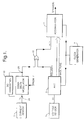
- a power measuring device includes a voltage sensor 1 and a current sensor 3 which respectively produce analogue outputs V v and V i which are respectively representative of the instantaneous values of the voltage and current supplied to a load (not shown) from an alternating current (AC) electricity supply (not shown).
- V v and V i are respectively representative of the instantaneous values of the voltage and current supplied to a load (not shown) from an alternating current (AC) electricity supply (not shown).
- the voltage representative output V v of the sensor 1 is applied to an analogue to digital converter (ADC) 5 within which it is sampled at regular intervals under the control of pulses derived from a clock generator 7 to produce a quantised representation of the magnitude of the output of the sensor 1, and hence of the instantaneous magnitude of the voltage supplied to the load, and a further bit representative of the polarity of the voltage.
- the clock frequency is high compared with the frequency of the AC electricity supply, eg 67kHz for a 50Hz supply.
- the current representative output V i of the sensor 3 is applied to a sigma-delta modulator 9 which includes a DC correction arrangement 10, the subject of this patent application.
- the modulator 9, under control of pulses from the clock generator 7, produces an output which during each clock pulse period has a first or second value, i.e. +1 or -1, dependent in part on the magnitude of the output V i of the sensor 3, and hence on the input value of the current supplied to the load.
- a first or second value i.e. +1 or -1
- the modulator output has values of -1 and +1 for equal numbers of clock periods
- the modulator output has a value +1 progressively more often than a value -1.
- the modulator output has a value -1 progressively more often than a value +1.
- the voltage magnitude representative output of the ADC 5 is supplied to an accumulator 11 and the voltage polarity representative output bit is supplied to one input of an exclusive-or gate 13.
- the output of the modulator 9 is supplied to the other input of the gate 13.
- the accumulator 11 is arranged to add the voltage magnitude representative output of the converter 5, or to subtract it from, the count in the accumulator 11 in dependence on the output of the gate 13, once during each clock period.
- the count in the accumulator 11 changes in any given interval by the output of the converter 5 times the number of times more in that interval that the output of the modulator 9 had one value rather than the other.
- the count in the accumulator 11 thus changes in proportion to the sum of the products in the instantaneous voltage and current supplied to the load at the instance of sampling the voltage, i.e. in proportion to the power supplied to the load.
- the accumulator 11 produces an output pulse each time the count of the accumulator 11 exceeds a predetermined value, the count of the accumulator 11 is then reset.
- the reset operation comprises reducing the count of the accumulator by a predetermined amount, not to zero to form a cyclic register.
- the output of the accumulator 11 thus comprises a train of pulses f(power) whose pulse rate is representative of the power supplied to the load. This pulse train is typically supplied to a counter (not shown) to provide a measure of the energy supplied to the load.
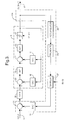
- Each sigma-delta modulator 9 is of a known second order type comprising two integrators (Int) 15, 16 connected in series, the output from which is passed through a quantiser 17 which is clocked at a rate of 67kHz. The output from the quantiser is fed back via two digital to analogue converters DAC's 18, 19 which operate simultaneously. The output from the DAC 18 is subtracted from the input signal before it passes through either integrator 15, 16, while the output from the second DAC 19 is subtracted from the input signal at a node 21 situated between the two integrators 15, 16.
- the output at line 23 is a stream of "+1s"' and "-1s"' whose relative proportions vary according to the magnitude of the input signal as described previously.
- a DC correction arrangement 10 is provided between the output 23 and input 24.
- the DC correction arrangement 10a shown in Figure 3 is intended for use with a current sensor 3 of the type comprising a shunt resistor and in essence together with the sigma-delta modulator 9 comprises a first order delta modulator.
- the digital output at 23 is firstly accumulated in a ten bit accumulator 25 which, in effect, performs an integrating function.
- the output from the accumulator 25 is then supplied to a truncation stage 26 which has the effect of removing a proportion of the least significant bits from, and scaling the output. It is preferred that excessive truncation is avoided for reasons that will be explained later on. Truncation by four bits is preferred.
- the feedback arrangement 10a is designed according to delta modulation principles.
- the scaling factors i.e. the first two terms in the above loop filter response
- a choice of which binary scaling factor to select requires two parameters to be considered; the range of the DC correction DAC 29 and the noise generated by the correction process. If a low value is selected then the DAC 29 has a very small effect at the input 24 to the converter, and many quantising levels will be required to cover an adequate range. For example, if a unity scaling factor is employed, thus requiring no truncation, each DAC level will provide DC cancellation for only .07% of the full scale input of the converter.
- each DAC level may be extended to cover more DC correction range at the input to the converter, however the noise generated by the feedback correction mechanism becomes more dominant and would ultimately start to limit the available performance. It has been found that scaling by a factor of sixteen at the truncation stage 26 gives acceptable results. Thus the truncation stage 26 is selected to remove the four least significant bits of the output from the accumulator 25.
- the effective correction range of each bit of the DAC 29 corresponds to 1.2% of the peak amplitude of the modulator 9. A six bit DAC 29 thus corrects for ⁇ 38% of the peak amplitude, thus requiring the presence of a ten bit accumulator 25.
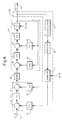
- the arrangement shown in Figure 4 is for use with a current sensor 3 of the inductive loop type which measures a derivative of the current. Accordingly an extra integrator 33 is required on the input side of the circuit.
- the modulator 9 and the DC correction path 10b are generally similar to that described with reference to Figure 3 and the same parts are identified with the same reference numerals.
- the output from the sampler 27 is fed in parallel to a pair of DACs 35, 37.
- the output from one of the DACs 35 is subtracted from the input at a node 39 before the input signal has been integrated by the integrator 33.
- the output of the other DAC 37 is subtracted from the input signal at a node 41 disposed after the integrator 33.
- the DC correction arrangement is thus a second order arrangement with the inner feedback via DAC 37 being required to stabilise the second order loop.
- the truncation stage 26 is again arranged to remove the four least significant bits from the output of a ten bit accumulator 25.
- K 2 I DAC37 /I DAC18 , where I DAC37 is the differential current per bit from the multibit DAC 37 and I DAC18 is the output current amplitude of the DAC 18 within the modulator 9.
- I DAC37 is the differential current per bit from the multibit DAC 37
- I DAC18 is the output current amplitude of the DAC 18 within the modulator 9.
- this impulse response must be scaled up by a factor of sixteen to accommodate the truncation by four bits.
- the signal passing through DAC 37 is selected to have an amplitude of twice that passing through DAC 35 and an analogue representation of the transfer function is given by: 1.5 + 50/s.
- I DAC37 (1.5 x 16 x 50 x I DAC18 )/67000.
- I DAC35 (50 x I DAC37 )/1.5
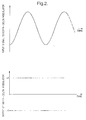
- Figure 5 illustrates the open loop pulse response of the feedback for the arrangement shown in Figure 4.
- Figure 5a shows a 20ms rectangular pulse entering the accumulator 25.
- Figure 5b shows the output of the accumulator 25, assuming the sampling rate of 67kHz.
- Figure 5c shows the output signal after having been truncated at stage 26.
- Figure 5d shows the consequential output of the resampler 27 and Figures 5e and 5f respectively the outputs from the DAC 35 and DAC 37.
- Figure 5g shows the response of the integrator 33 to the output from DAC 35 while Figure 5h shows the combined effect of the response shown in Figure 5g and the output of DAC 37, as shown in Figure 5f.
- Figure 5i shows the low frequency component of the output of the modulator (23), which is of the correct form to implement a second order sigma-delta response.
- the use of resampling at 50Hz combined with the above design parameters means that the circuit can switch between any set of DC levels in one clock period at the 50Hz rate.
- settling may take two clock cycles, since any change in the DC offset may not occur coincidentally with a resampling clock edge, and complete settling of the DC feedback path occurs within 40ms.
- the amount of electrical charge that need be collected before the DAC 29, or DACs 35, 37 switch between levels is not significant, eg about .085 coulombs. This ensures that dead zones, i.e. times during which a DC offset can occur due to the DAC being between levels, need not be of significant length.
- Both the described architectures can be easily implemented in integrated form along with the architecture show in Figure 1.
- the DC correction arrangement 10 can be applied to other forms of sampling means eg a multibit analogue to digital converter.
Landscapes
- Engineering & Computer Science (AREA)
- Theoretical Computer Science (AREA)
- Power Engineering (AREA)
- Computer Networks & Wireless Communication (AREA)
- Signal Processing (AREA)
- Compression, Expansion, Code Conversion, And Decoders (AREA)
- Analogue/Digital Conversion (AREA)
Applications Claiming Priority (2)
| Application Number | Priority Date | Filing Date | Title |
|---|---|---|---|
| GB9421492 | 1994-10-24 | ||
| GB9421492A GB9421492D0 (en) | 1994-10-24 | 1994-10-24 | DC correction arrangement for a sigma-delta modulator |
Publications (2)
| Publication Number | Publication Date |
|---|---|
| EP0709970A2 true EP0709970A2 (fr) | 1996-05-01 |
| EP0709970A3 EP0709970A3 (fr) | 1998-04-29 |
Family
ID=10763365
Family Applications (1)
| Application Number | Title | Priority Date | Filing Date |
|---|---|---|---|
| EP95307498A Withdrawn EP0709970A3 (fr) | 1994-10-24 | 1995-10-20 | Dispositif de correction de la composante continue dans un convertisseur analogique numérique |
Country Status (7)
| Country | Link |
|---|---|
| EP (1) | EP0709970A3 (fr) |
| AU (1) | AU691661B2 (fr) |
| GB (2) | GB9421492D0 (fr) |
| IL (1) | IL115657A0 (fr) |
| NO (1) | NO954228L (fr) |
| NZ (1) | NZ280277A (fr) |
| ZA (1) | ZA958767B (fr) |
Cited By (1)
| Publication number | Priority date | Publication date | Assignee | Title |
|---|---|---|---|---|
| EP1178637A1 (fr) * | 2000-08-04 | 2002-02-06 | Motorola, Inc. | Dispositif pour la réduction du décalage du niveau continu dans un récepteur à conversion directe |
Families Citing this family (1)
| Publication number | Priority date | Publication date | Assignee | Title |
|---|---|---|---|---|
| DE102012208281A1 (de) * | 2012-05-16 | 2013-11-21 | Robert Bosch Gmbh | Verfahren zur Entstörung eines Abtastprozesses sowie eine Vorrichtung zur Durchführung des Verfahrens |
Citations (1)
| Publication number | Priority date | Publication date | Assignee | Title |
|---|---|---|---|---|
| GB2239097B (en) | 1989-12-18 | 1993-08-11 | Gen Electric Co Plc | Electrical power measuring devices |
Family Cites Families (2)
| Publication number | Priority date | Publication date | Assignee | Title |
|---|---|---|---|---|
| US4951052A (en) * | 1989-07-10 | 1990-08-21 | General Electric Company | Correction of systematic error in an oversampled analog-to-digital converter |
| US4972189A (en) * | 1989-10-23 | 1990-11-20 | Grumman Aerospace Corporation | Correction for DC offset in A/D converters |
-
1994
- 1994-10-24 GB GB9421492A patent/GB9421492D0/en active Pending
-
1995
- 1995-10-13 GB GB9521046A patent/GB2294600B/en not_active Expired - Fee Related
- 1995-10-17 ZA ZA958767A patent/ZA958767B/xx unknown
- 1995-10-18 IL IL11565795A patent/IL115657A0/xx unknown
- 1995-10-18 NZ NZ280277A patent/NZ280277A/en unknown
- 1995-10-20 EP EP95307498A patent/EP0709970A3/fr not_active Withdrawn
- 1995-10-23 AU AU34403/95A patent/AU691661B2/en not_active Ceased
- 1995-10-23 NO NO954228A patent/NO954228L/no unknown
Patent Citations (1)
| Publication number | Priority date | Publication date | Assignee | Title |
|---|---|---|---|---|
| GB2239097B (en) | 1989-12-18 | 1993-08-11 | Gen Electric Co Plc | Electrical power measuring devices |
Cited By (5)
| Publication number | Priority date | Publication date | Assignee | Title |
|---|---|---|---|---|
| EP1178637A1 (fr) * | 2000-08-04 | 2002-02-06 | Motorola, Inc. | Dispositif pour la réduction du décalage du niveau continu dans un récepteur à conversion directe |
| WO2002013473A1 (fr) * | 2000-08-04 | 2002-02-14 | Motorola Inc. | Appareil permettant de reduire le decalage en continu dans un recepteur |
| US7212587B2 (en) | 2000-08-04 | 2007-05-01 | Freescale Semiconductor, Inc. | Apparatus for reducing DC offset in a receiver |
| KR100826464B1 (ko) | 2000-08-04 | 2008-05-02 | 프리스케일 세미컨덕터, 인크. | 수신기에서 dc 오프셋을 감소시키는 장치 및 방법 |
| JP4782972B2 (ja) * | 2000-08-04 | 2011-09-28 | フリースケール セミコンダクター インコーポレイテッド | 受信器内のdcオフセットを低減するための装置 |
Also Published As
| Publication number | Publication date |
|---|---|
| GB9421492D0 (en) | 1994-12-07 |
| GB2294600A (en) | 1996-05-01 |
| GB9521046D0 (en) | 1995-12-13 |
| AU3440395A (en) | 1996-05-09 |
| IL115657A0 (en) | 1996-01-19 |
| NZ280277A (en) | 1997-03-24 |
| EP0709970A3 (fr) | 1998-04-29 |
| NO954228D0 (no) | 1995-10-23 |
| ZA958767B (en) | 1996-05-21 |
| GB2294600B (en) | 1998-01-14 |
| NO954228L (no) | 1996-04-25 |
| AU691661B2 (en) | 1998-05-21 |
Similar Documents
| Publication | Publication Date | Title |
|---|---|---|
| EP0645893B1 (fr) | Convertisseurs analogique-numériques avec signal de tremblement | |
| EP0613256B1 (fr) | Convertisseur analogique-numérique avec signal de tremblement modulé | |
| US5485393A (en) | Method and apparatus for measuring electrical parameters using a differentiating current sensor and a digital integrator | |
| EP0084353B1 (fr) | Modulateur delta-sigma réalisé avec des capacités commutées | |
| US6205197B1 (en) | Programmable supervisory circuit and applications therefor | |
| JP3530587B2 (ja) | 可変利得入力ステージを備える信号処理回路 | |
| EP0513241B1 (fr) | Modulateur sigma delta | |
| EP0199745B1 (fr) | Convertisseur analogique numerique | |
| Cao et al. | High-accuracy circuits for on-chip capacitance ratio testing or sensor readout | |
| US5079510A (en) | Meter for accurately measuring integrated electric power | |
| EP0434248B1 (fr) | Dispositifs de mesure de puissance électrique | |
| US4992725A (en) | Meter for accurately measuring integrated electric power | |
| US6781361B2 (en) | Apparatus and system for electrical power metering using digital integration | |
| EP0988704B1 (fr) | Conversion analogique-numerique au moyen d'une entree ou de valeurs intermediaires modulees en frequence | |
| EP0483846A2 (fr) | Circuit de conversion analogique-numérique | |
| US5862069A (en) | Four quadrant multiplying apparatus and method | |
| EP0506079B1 (fr) | Système de Convertisseurs numérique/analogique sigma delta à bruit de quantification réduit | |
| EP0100103A1 (fr) | Modulateur de largeur d'impulsions et circuit d'intégration pour former un produit analogue avec un tel modulateur de largeur d'impulsions | |
| EP0709970A2 (fr) | Dispositif de correction de la composante continue dans un convertisseur analogique numérique | |
| US6587061B2 (en) | Analog computation circuits using synchronous demodulation and power meters and energy meters using the same | |
| US6278392B1 (en) | Gain adjustable sigma delta modulator system | |
| JP3138558B2 (ja) | A/d変換回路 | |
| JP3248845B2 (ja) | 交流測定装置 | |
| EP1378756B1 (fr) | Circuit numérique de mesure de la puissance | |
| EP0131261A2 (fr) | Processeur de convolution |
Legal Events
| Date | Code | Title | Description |
|---|---|---|---|
| PUAI | Public reference made under article 153(3) epc to a published international application that has entered the european phase |
Free format text: ORIGINAL CODE: 0009012 |
|
| AK | Designated contracting states |
Kind code of ref document: A2 Designated state(s): BE CH DE DK ES FR GB IE IT LI NL SE |
|
| RAP1 | Party data changed (applicant data changed or rights of an application transferred) |
Owner name: ABB METERING SYSTEMS LIMITED |
|
| PUAL | Search report despatched |
Free format text: ORIGINAL CODE: 0009013 |
|
| AK | Designated contracting states |
Kind code of ref document: A3 Designated state(s): BE CH DE DK ES FR GB IE IT LI NL SE |
|
| STAA | Information on the status of an ep patent application or granted ep patent |
Free format text: STATUS: THE APPLICATION IS DEEMED TO BE WITHDRAWN |
|
| 18D | Application deemed to be withdrawn |
Effective date: 19981030 |