EP0710642A2 - Halogenketone - Google Patents
Halogenketone Download PDFInfo
- Publication number
- EP0710642A2 EP0710642A2 EP96100322A EP96100322A EP0710642A2 EP 0710642 A2 EP0710642 A2 EP 0710642A2 EP 96100322 A EP96100322 A EP 96100322A EP 96100322 A EP96100322 A EP 96100322A EP 0710642 A2 EP0710642 A2 EP 0710642A2
- Authority
- EP
- European Patent Office
- Prior art keywords
- formula
- fluorocyclopropyl
- preparation
- halogen ketones
- ketone
- Prior art date
- Legal status (The legal status is an assumption and is not a legal conclusion. Google has not performed a legal analysis and makes no representation as to the accuracy of the status listed.)
- Ceased
Links
- DOGQVNJWOUMHTO-UHFFFAOYSA-N OC(Cc(cc1)ccc1Cl)(C[n]1ncnc1)C1(CC1)F Chemical compound OC(Cc(cc1)ccc1Cl)(C[n]1ncnc1)C1(CC1)F DOGQVNJWOUMHTO-UHFFFAOYSA-N 0.000 description 1
Classifications
-
- C—CHEMISTRY; METALLURGY
- C07—ORGANIC CHEMISTRY
- C07D—HETEROCYCLIC COMPOUNDS
- C07D307/00—Heterocyclic compounds containing five-membered rings having one oxygen atom as the only ring hetero atom
- C07D307/02—Heterocyclic compounds containing five-membered rings having one oxygen atom as the only ring hetero atom not condensed with other rings
- C07D307/26—Heterocyclic compounds containing five-membered rings having one oxygen atom as the only ring hetero atom not condensed with other rings having one double bond between ring members or between a ring member and a non-ring member
- C07D307/30—Heterocyclic compounds containing five-membered rings having one oxygen atom as the only ring hetero atom not condensed with other rings having one double bond between ring members or between a ring member and a non-ring member with hetero atoms or with carbon atoms having three bonds to hetero atoms with at the most one bond to halogen, e.g. ester or nitrile radicals, directly attached to ring carbon atoms
- C07D307/32—Oxygen atoms
- C07D307/33—Oxygen atoms in position 2, the oxygen atom being in its keto or unsubstituted enol form
-
- C—CHEMISTRY; METALLURGY
- C07—ORGANIC CHEMISTRY
- C07C—ACYCLIC OR CARBOCYCLIC COMPOUNDS
- C07C45/00—Preparation of compounds having >C = O groups bound only to carbon or hydrogen atoms; Preparation of chelates of such compounds
- C07C45/61—Preparation of compounds having >C = O groups bound only to carbon or hydrogen atoms; Preparation of chelates of such compounds by reactions not involving the formation of >C = O groups
- C07C45/63—Preparation of compounds having >C = O groups bound only to carbon or hydrogen atoms; Preparation of chelates of such compounds by reactions not involving the formation of >C = O groups by introduction of halogen; by substitution of halogen atoms by other halogen atoms
-
- C—CHEMISTRY; METALLURGY
- C07—ORGANIC CHEMISTRY
- C07C—ACYCLIC OR CARBOCYCLIC COMPOUNDS
- C07C45/00—Preparation of compounds having >C = O groups bound only to carbon or hydrogen atoms; Preparation of chelates of such compounds
- C07C45/61—Preparation of compounds having >C = O groups bound only to carbon or hydrogen atoms; Preparation of chelates of such compounds by reactions not involving the formation of >C = O groups
- C07C45/65—Preparation of compounds having >C = O groups bound only to carbon or hydrogen atoms; Preparation of chelates of such compounds by reactions not involving the formation of >C = O groups by splitting-off hydrogen atoms or functional groups; by hydrogenolysis of functional groups
-
- C—CHEMISTRY; METALLURGY
- C07—ORGANIC CHEMISTRY
- C07C—ACYCLIC OR CARBOCYCLIC COMPOUNDS
- C07C45/00—Preparation of compounds having >C = O groups bound only to carbon or hydrogen atoms; Preparation of chelates of such compounds
- C07C45/61—Preparation of compounds having >C = O groups bound only to carbon or hydrogen atoms; Preparation of chelates of such compounds by reactions not involving the formation of >C = O groups
- C07C45/67—Preparation of compounds having >C = O groups bound only to carbon or hydrogen atoms; Preparation of chelates of such compounds by reactions not involving the formation of >C = O groups by isomerisation; by change of size of the carbon skeleton
- C07C45/673—Preparation of compounds having >C = O groups bound only to carbon or hydrogen atoms; Preparation of chelates of such compounds by reactions not involving the formation of >C = O groups by isomerisation; by change of size of the carbon skeleton by change of size of the carbon skeleton
-
- C—CHEMISTRY; METALLURGY
- C07—ORGANIC CHEMISTRY
- C07C—ACYCLIC OR CARBOCYCLIC COMPOUNDS
- C07C49/00—Ketones; Ketenes; Dimeric ketenes; Ketonic chelates
- C07C49/29—Saturated compounds containing keto groups bound to rings
- C07C49/327—Saturated compounds containing keto groups bound to rings containing halogen
-
- C—CHEMISTRY; METALLURGY
- C07—ORGANIC CHEMISTRY
- C07D—HETEROCYCLIC COMPOUNDS
- C07D231/00—Heterocyclic compounds containing 1,2-diazole or hydrogenated 1,2-diazole rings
- C07D231/02—Heterocyclic compounds containing 1,2-diazole or hydrogenated 1,2-diazole rings not condensed with other rings
- C07D231/10—Heterocyclic compounds containing 1,2-diazole or hydrogenated 1,2-diazole rings not condensed with other rings having two or three double bonds between ring members or between ring members and non-ring members
- C07D231/12—Heterocyclic compounds containing 1,2-diazole or hydrogenated 1,2-diazole rings not condensed with other rings having two or three double bonds between ring members or between ring members and non-ring members with only hydrogen atoms, hydrocarbon or substituted hydrocarbon radicals, directly attached to ring carbon atoms
-
- C—CHEMISTRY; METALLURGY
- C07—ORGANIC CHEMISTRY
- C07D—HETEROCYCLIC COMPOUNDS
- C07D233/00—Heterocyclic compounds containing 1,3-diazole or hydrogenated 1,3-diazole rings, not condensed with other rings
- C07D233/54—Heterocyclic compounds containing 1,3-diazole or hydrogenated 1,3-diazole rings, not condensed with other rings having two double bonds between ring members or between ring members and non-ring members
- C07D233/56—Heterocyclic compounds containing 1,3-diazole or hydrogenated 1,3-diazole rings, not condensed with other rings having two double bonds between ring members or between ring members and non-ring members with only hydrogen atoms or radicals containing only hydrogen and carbon atoms, attached to ring carbon atoms
-
- C—CHEMISTRY; METALLURGY
- C07—ORGANIC CHEMISTRY
- C07D—HETEROCYCLIC COMPOUNDS
- C07D249/00—Heterocyclic compounds containing five-membered rings having three nitrogen atoms as the only ring hetero atoms
- C07D249/02—Heterocyclic compounds containing five-membered rings having three nitrogen atoms as the only ring hetero atoms not condensed with other rings
- C07D249/08—1,2,4-Triazoles; Hydrogenated 1,2,4-triazoles
Definitions
- the present invention relates to new halogen ketones and a process for their preparation.
- 1-fluorocyclopropyl-methyl-ketone can be prepared by treating 2-acetyl-2-chloro-4-butanolide with potassium fluoride and the resulting 2-acetyl-1-fluoro-4-butanolide with Reacts hydrogen bromide and the resulting 5-chloro-3-fluoropentan-2-one cyclized with potassium fluoride (see Synthesis 1977 , 189-191).
- This synthesis can be illustrated by the following formula scheme: A halogenation of the 1-fluorocyclopropyl-methyl-ketone on the methyl group has not yet been described.
- halogen ketones of the formula (I) can be prepared by using 1-fluoro-cyclopropyl-methyl-ketone of the formula reacted with chlorinating or brominating agents in the presence of a diluent.
- Suitable diluents for the preparation of the halogen ketones of the formula (I) according to the above process are all organic solvents which are customary for such reactions.
- Halogenated aliphatic hydrocarbons such as methylene chloride, chloroform and carbon tetrachloride can preferably be used.
- the temperatures can be varied within a certain range in the above process for the preparation of halogen ketones of the formula (I). In general, temperatures between -10 ° C and + 60 ° C, preferably between 0 ° C and + 40 ° C.
- a stoichiometric amount or an excess of chlorinating or brominating agent is generally employed per mole of 1-fluorocyclopropylmethyl ketone of the formula (II).
- the processing takes place according to usual methods. In general, the procedure is such that water is added to the reaction mixture, the phases are separated and the organic phase is washed, dried and concentrated. The remaining residue is subjected to distillation under reduced pressure.
- the halogen ketones of the formula (I) are valuable intermediates for the synthesis of active compounds with fungicidal properties (cf. EP-OS 0 436 348 and EP-OS 0 297 345).
- the compound of the formula produce by using halogen ketones of the formula (I) with 4-chlorobenzyl-magnesium chloride of the formula in the presence of a diluent and the resulting propanol derivatives of the formula in which Shark has the meaning given above, with 1,2,4-triazole in the presence of a diluent and, if appropriate, in the presence of an acid binder.
Landscapes
- Chemical & Material Sciences (AREA)
- Organic Chemistry (AREA)
- Chemical Kinetics & Catalysis (AREA)
- Organic Low-Molecular-Weight Compounds And Preparation Thereof (AREA)
- Low-Molecular Organic Synthesis Reactions Using Catalysts (AREA)
Abstract

in welcher
Hal für Chlor oder Brom steht,
und ein Verfahren zu deren Herstellung.
Description
- Die vorliegende Erfindung betrifft neue Halogenketone und ein Verfahren zu deren Herstellung.
- Es ist bereits bekannt geworden, daß sich 1-Fluorcyclopropyl-methyl-keton herstellen laßt, indem man 2-Acetyl-2-chlor-4-butanolid mit Kaliumfluorid behandelt, das dabei entstehende 2-Acetyl-1-fluor-4-butanolid mit Bromwasserstoff umsetzt und das sich dabei bildende 5-Chlor-3-fluor-pentan-2-on mit Kaliumfluorid cyclisiert (vergl. Synthesis 1977, 189-191). Diese Synthese kann durch das folgende Formelschema veranschaulicht werden:

Eine Halogenierung des 1-Fluorcyclopropyl-methyl-ketons an der Methylgruppe wurde bisher aber noch nicht beschrieben. - Es wurden nun neue Halogenketone der Formel

in welcher
Hal für Chlor oder Brom steht,
gefunden. - Weiterhin wurde gefunden, daß sich Halogenketone der Formel (I) herstellen lassen, indem man 1-Fluor-cyclopropyl-methyl-keton der Formel

mit Chlorierungs- oder Bromierungsmitteln in Gegenwart eines Verdünnungsmittels umsetzt. - Bei der Durchführung des obigen Verfahrens kommen alle für derartige Umsetzungen üblichen Chlorierungs- und Bromierungsreagenzien in Betracht. Vorzugsweise verwendbar sind Sulfurylchlorid, Sulfurylbromid und Brom.
- Als Verdünnungsmittel kommen bei der Herstellung der Halogenketone der Formel (I) nach dem obigen Verfahren alle für derartige Umsetzungen üblichen organischen Solventien in Frage. Vorzugsweise verwendbar sind halogenierte aliphatische Kohlenwasserstoffe, wie Methylenchlorid, Chloroform und Tetrachlorkohlenstoff.
- Die Temperaturen können bei dem obigen Verfahren zur Herstellung von Halogenketonen der Formel (I) innerhalb eines bestimmten Bereiches variiert werden. Im allgemeinen arbeitet man bei Temperaturen zwischen -10°C und +60°C, vorzugsweise zwischen 0°C und +40°C.
- Bei der Durchführung des obigen Verfahrens zur Herstellung von Halogenketonen der Formel (I) arbeitet man im allgemeinen unter Normaldruck. Es ist aber möglich, unter erhöhtem oder vermindertem Druck zu arbeiten.
- Bei der Durchführung des obigen Verfahrens zur Herstellung von Halogenketonen der Formel (I) setzt man auf 1 Mol an 1-Fluorcyclopropyl-methyl-keton der Formel (II) im allgemeinen eine stöchiometrische Menge oder auch einen Überschuß an Chlorierungs- oder Bromierungsmittel ein. Die Aufarbeitung erfolgt nach üblichen Methoden. Im allgemeinen geht man so vor, daß man das Reaktionsgemisch mit Wasser versetzt, die Phasen trennt, und die organische Phase wäscht, trocknet und einengt. Der verbleibende Rückstand wird einer Destillation unter vermindertem Druck unterworfen.
- Das 1-Fluorcyclopropyl-methyl-keton der Formel (II) ist bekannt (vgl. Synthesis 1977, 189-191).
- Die Halogenketone der Formel (I) sind wertvolle Zwischenprodukte zur Synthese von Wirkstoffen mit fungiziden Eigenschaften (vergl. EP-OS 0 436 348 und EP-OS 0 297 345). So läßt sich zum Beispiel die Verbindung der Formel

herstellen, indem man Halogenketone der Formel (I) mit 4-Chlorbenzyl-magnesium-chlorid der Formel
in Gegenwart eines Verdünnungsmittels umsetzt und die dabei anfallenden Propanol-Derivate der Formel
in welcher
Hai die oben angegebene Bedeutung hat,
mit 1,2,4-Triazol in Gegenwart eines Verdünnungsmittels und gegebenenfalls in Gegenwart eines Säurebindemittels umsetzt. - Die Erfindung wird durch die folgenden Beispiele veranschaulicht.
- Herstellung von 1-Fluorcyclopropyl-chlormethyl-keton der Formel

Unter Feuchtigkeitsausschluß werden 67,5 g (0,5 Mol) Sulfurylchlorid bei Raumtemperatur unter Rühren in ein Gemisch aus 40 g (0,4 Mol) 1-Fluor-cyclopropylmethyl-keton und 100 ml Methylenchlorid eingetropft. Nach beendeter Zugabe wird 6 Stunden bei Raumtemperatur nachgerührt. Anschließend gießt man das Reaktionsgemisch auf Eiswasser, trennt die Phasen, wäscht die organische Phase mit Wasser, trocknet über Calciumchlorid und zieht das Lösungsmittel unter vermindertem Druck ab. Der verbleibende Rückstand wird unter vermindertem Druck destilliert. Man erhält auf diese Weise 31,8 g (58% der Theorie) an 1-Fluorcyclopropyl-chlormethyl-keton in Form eines farblosen Öles.
Kp = 50°C / 22 mbar
¹H-NMR (200 MHz, CDCl₃, TMS-intern.)
δ = 1,46 ppm (s, 2H); 1,53 ppm (m, 2H), 4,65 ppm (d, 2H).
¹⁹F-NMR (200 MHz, CDCl₃, CFCl₃)
δ = 201,7 ppm (m). - Herstellung der Verbindung der Formel

-
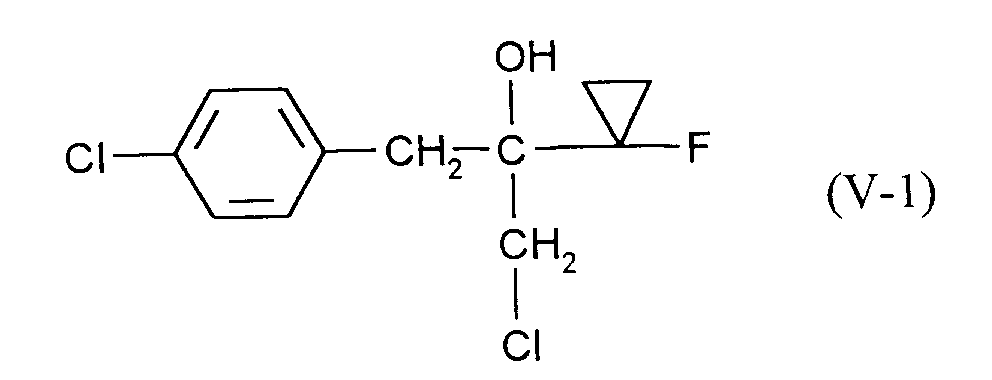
Eine Lösung von 37,3 g (0,25 Mol) 4-Chlor-benzylchlorid in 400 ml absolutem Diethylether wird bei Raumtemperatur in ein Gemisch aus 6,8 g (0,28 Mol) Magnesium-Spänen und 150 ml absolutem Diethylether getropft. Man erhitzt 30 Minuten unter Rückfluß und tropft die entstandene Lösung dann bei -78°C unter Rühren in eine Lösung von 34,1 g (0,25 Mol) 1-Fluorcyclopropyl-chlormethylketon in 250 ml absolutem Diethylether ein. Das Reaktionsgemisch wird 4 Stunden bei -78°C gerührt. Danach läßt man langsam auf 0°C erwärmen und tropft dann eine Lösung von 25 ml Essigsäure in 250 ml Diethylether hinzu. Das entstandene Reaktionsgemisch wird auf 1000 ml Wasser gegossen. Die organische Phase wird abgetrennt, mit wäßriger Natriumhydrogensulfit-Lösung und mit Wasser gewaschen, über Natriumsulfat getrocknet und unter vermindertem Druck eingeengt. Man erhält auf diese Weise 48,7 g (74% der Theorie) an 1-Chlor-2-(1-fluorcyclopropyl)-3-(4-chlorphenyl)propan-2-ol in Form eines oligen Produktes. -

Unter Stickstoffatmosphäre werden 27,6 g (0,4 Mol) 1,2,4-Triazol und 33,6 g (0,3 Mol) Kalium-tert.-butylat in 100 ml absolutem Dimethylformamid vorgelegt und auf 80°C erwärmt. Bei dieser Temperatur tropft man unter Rühren eine Lösung von 26,3 g (0,1 Mol) 1-Chlor-2-(1-fluor-cyclopropyl)-3-(4-chlorphenyl)-propan-2-ol in 50 ml absolutem Dimethylformamid hinzu. Es wird 6 Stunden bei 100°C nachgeführt und dann durch Abziehen des Verdünnungsmittel unter vermindertem Druck eingeengt. Man nimmt den Rückstand in Essigester auf, wäscht mit Wasser und zieht nach dem Trocknen über Natriumsulfat das Lösungsmittel unter vermindertem Druck ab. Das verbleibende Produkt wird über eine Kieselgel-Säure mit Chloroform als Laufmittel chromatographiert. Man erhält auf diese Weise 8,9 g (35% der Theorie) an 1-(4-Chlorphenyl)-2-(1-fluor-cyclopropyl)-3-(1,2,4-triazol-1-yl)-propan-2-ol in Form einer Festsubstanz.
Claims (2)
- Halogenketone der Formel
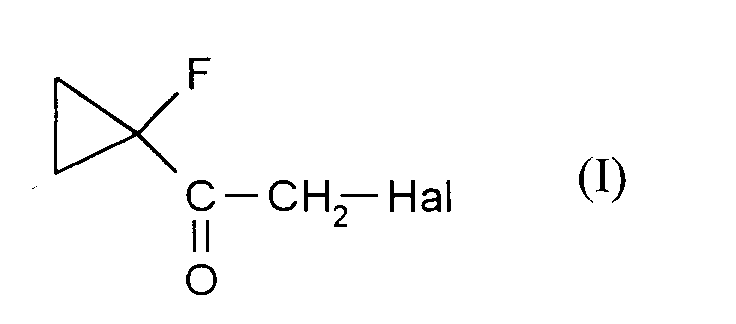
Hal für Chlor oder Brom steht. - Verfahren zur Herstellung von Halogenketonen der Formel

Hal für Chlor oder Brom steht,
dadurch gekennzeichnet, daß man 1-Fluorcyclopropyl-methyl-keton der Formel
Applications Claiming Priority (3)
| Application Number | Priority Date | Filing Date | Title |
|---|---|---|---|
| DE4206917 | 1992-03-05 | ||
| DE4206917A DE4206917A1 (de) | 1992-03-05 | 1992-03-05 | Verfahren zur herstellung von 1-fluorcyclopropyl-methyl-keton |
| EP93102759A EP0560109B1 (de) | 1992-03-05 | 1993-02-22 | Verfahren zur Herstellung von 1-Fluorcyclopropyl-methyl-keton |
Related Parent Applications (2)
| Application Number | Title | Priority Date | Filing Date |
|---|---|---|---|
| EP93102759.3 Division | 1993-02-22 | ||
| EP93102759A Division EP0560109B1 (de) | 1992-03-05 | 1993-02-22 | Verfahren zur Herstellung von 1-Fluorcyclopropyl-methyl-keton |
Publications (2)
| Publication Number | Publication Date |
|---|---|
| EP0710642A2 true EP0710642A2 (de) | 1996-05-08 |
| EP0710642A3 EP0710642A3 (de) | 1996-05-15 |
Family
ID=6453274
Family Applications (2)
| Application Number | Title | Priority Date | Filing Date |
|---|---|---|---|
| EP96100322A Ceased EP0710642A3 (de) | 1992-03-05 | 1993-02-22 | Halogenketone |
| EP93102759A Expired - Lifetime EP0560109B1 (de) | 1992-03-05 | 1993-02-22 | Verfahren zur Herstellung von 1-Fluorcyclopropyl-methyl-keton |
Family Applications After (1)
| Application Number | Title | Priority Date | Filing Date |
|---|---|---|---|
| EP93102759A Expired - Lifetime EP0560109B1 (de) | 1992-03-05 | 1993-02-22 | Verfahren zur Herstellung von 1-Fluorcyclopropyl-methyl-keton |
Country Status (5)
| Country | Link |
|---|---|
| US (2) | US5336809A (de) |
| EP (2) | EP0710642A3 (de) |
| JP (1) | JPH069480A (de) |
| DE (2) | DE4206917A1 (de) |
| ES (1) | ES2089607T3 (de) |
Families Citing this family (11)
| Publication number | Priority date | Publication date | Assignee | Title |
|---|---|---|---|---|
| DE19630449A1 (de) * | 1996-07-27 | 1998-01-29 | Huels Chemische Werke Ag | Verfahren zur Herstellung von Cyclopropylalkylketonen und 4,5-Dihydroalkylfuranen |
| DE19710879A1 (de) * | 1997-03-15 | 1998-09-17 | Huels Chemische Werke Ag | Verfahren zur Herstellung von hochreinem Cyclopropylmethylketon |
| JP3533134B2 (ja) * | 1999-02-15 | 2004-05-31 | 三井化学株式会社 | フッ素化剤及びその製法と使用 |
| CN101061090B (zh) * | 2004-11-05 | 2011-06-15 | 国立大学法人北海道大学 | α,α-二氟胺的制备方法 |
| EP2595995B1 (de) | 2010-07-22 | 2015-11-25 | Basf Se | Herbizide isoxazol[5,4-b]pyridine |
| WO2013035674A1 (ja) * | 2011-09-09 | 2013-03-14 | 株式会社クレハ | 2-ハロ-1-(1-ハロシクロプロピル)エタノンの製造方法 |
| CN104093312B (zh) | 2012-01-12 | 2017-04-26 | 巴斯夫欧洲公司 | 除草的异噁唑并[5,4‑b]吡啶类 |
| US10664652B2 (en) | 2013-06-15 | 2020-05-26 | Microsoft Technology Licensing, Llc | Seamless grid and canvas integration in a spreadsheet application |
| CN106278850B (zh) * | 2016-08-05 | 2018-10-16 | 扬州天辰精细化工有限公司 | 丙硫菌唑中间体1-氯-1-乙酰基环丙烷的合成方法 |
| CN110872230B (zh) * | 2018-08-30 | 2023-07-28 | 浙江九洲药业股份有限公司 | 一种1-(三氟甲基)环丙烷-1-羧酸化合物的制备方法及其中间体 |
| CN109608317B (zh) * | 2018-12-26 | 2021-11-12 | 瑞孚信江苏药业股份有限公司 | 一种α-乙酰基-γ-丁内酯裂解制备环丙基甲基酮的合成方法 |
Family Cites Families (5)
| Publication number | Priority date | Publication date | Assignee | Title |
|---|---|---|---|---|
| US4258207A (en) * | 1978-10-23 | 1981-03-24 | Shell Oil Company | Cyclopropanecarboxylate pesticides preparation |
| DE3812967A1 (de) * | 1987-06-24 | 1989-01-05 | Bayer Ag | Azolylmethyl-cyclopropyl-derivate |
| DE3824433A1 (de) * | 1988-07-19 | 1990-01-25 | Bayer Ag, 5090 Leverkusen | Fluorcyclopropyl-derivate |
| US5264632A (en) * | 1988-07-19 | 1993-11-23 | Bayer Aktiengesellschaft | 2,2-difluorocyclopropyl derivatives |
| GB9000130D0 (en) * | 1990-01-04 | 1990-03-07 | Ici Plc | Fungicides |
-
1992
- 1992-03-05 DE DE4206917A patent/DE4206917A1/de not_active Withdrawn
-
1993
- 1993-02-22 ES ES93102759T patent/ES2089607T3/es not_active Expired - Lifetime
- 1993-02-22 EP EP96100322A patent/EP0710642A3/de not_active Ceased
- 1993-02-22 EP EP93102759A patent/EP0560109B1/de not_active Expired - Lifetime
- 1993-02-22 DE DE59303220T patent/DE59303220D1/de not_active Expired - Fee Related
- 1993-02-26 JP JP5061327A patent/JPH069480A/ja active Pending
- 1993-03-02 US US08/025,194 patent/US5336809A/en not_active Expired - Fee Related
-
1994
- 1994-03-30 US US08/220,147 patent/US5371295A/en not_active Expired - Fee Related
Also Published As
| Publication number | Publication date |
|---|---|
| EP0710642A3 (de) | 1996-05-15 |
| JPH069480A (ja) | 1994-01-18 |
| US5336809A (en) | 1994-08-09 |
| DE59303220D1 (de) | 1996-08-22 |
| DE4206917A1 (de) | 1993-09-09 |
| EP0560109B1 (de) | 1996-07-17 |
| EP0560109A3 (en) | 1993-11-18 |
| ES2089607T3 (es) | 1996-10-01 |
| US5371295A (en) | 1994-12-06 |
| EP0560109A2 (de) | 1993-09-15 |
Similar Documents
| Publication | Publication Date | Title |
|---|---|---|
| EP0124009B1 (de) | Verfahren zur Herstellung von Oxiranen | |
| EP0560109B1 (de) | Verfahren zur Herstellung von 1-Fluorcyclopropyl-methyl-keton | |
| DE3006685C2 (de) | 3-Brom-4-fluorbenzonitril und Verfahren zur Herstellung eines substituierten 3-Brom-4-fluorbenzols | |
| DE4301247A1 (de) | Verfahren zur Herstellung mehrfach halogenierter Benzotrichloride und Benzoylchloride sowie neue Trihalogenbenzotrichloride und -benzoylchloride | |
| EP0132733B1 (de) | Neue Fluorpivalsäurefluoride und Verfahren zu ihrer Herstellung | |
| EP0124011A2 (de) | Verfahren zur Herstellung von Oxiranen | |
| EP0533013B1 (de) | Verfahren zur Herstellung von 1-Fluor-cyclopropan-1-carbonsäure | |
| EP0409049B1 (de) | Verfahren zur stereoselektiven Herstellung von Z-1,2-Diaryl-allyl-chloriden und deren Umsetzung zu Azolylmethyloxiranen sowie neue Zwischenprodukte | |
| EP0169439B1 (de) | Verfahren und Zwischenprodukte zur Synthese von diastereomeren Triazolyl-O,N-acetalen | |
| EP0365914B1 (de) | Neue Fluor enthaltende und an der CH3-Gruppe gegebenenfalls halogenierte Acetophenone und deren Herstellung aus neuen Fluor enthaltenden Benzonitrilen | |
| DE2401715C3 (de) | Verfahren zur Herstellung von 1-(1,2,4-Triazol-1-yl)-1-phenoxy-3,3-dimethyl-butan-2-on-Derivaten | |
| EP0290903B1 (de) | Beta-Fluoracyl-beta-halogenvinylalkylether | |
| DE3529259A1 (de) | Verfahren zur herstellung von halogensubstituierten benzoylacetonitrilen, 1-chlor-2-(2,4-dichlor-5-fluorphenyl)-ethan-2-on und seine herstellung | |
| DE69115389T2 (de) | Cyclohexenol Derivate | |
| EP0250897B1 (de) | Verfahren zur Herstellung von Hydroxybenzaldoxim-O-ethern | |
| DE3204692C2 (de) | ||
| EP0081675B1 (de) | Alkylcycloalkyl-triazolylmethyl-ketone und Verfahren zu ihrer Herstellung | |
| EP0103749B1 (de) | Dialkoxymethyl-butyrolactone, Verfahren zu ihrer Herstellung, Zwischenprodukte dafür und ihre Verwendung | |
| EP0308740A1 (de) | Verfahren zur Herstellung von 2,4-Dichlor-5-dichlormethyl-thiazol | |
| EP0150404B1 (de) | Alpha-Halogen-phenoxyalkylketone, Phenoxyalkylketone, Verfahren zu ihrer Herstellung, sowie ihre Verwendung als Zwischenprodukte zur Herstellung von Fungiziden | |
| DE69018619T2 (de) | Alpha, beta-ungesättigte ketone und ketoximderivat. | |
| DE10047111A1 (de) | Verfahren zur Herstellung von DELTA·1·-Pyrrolinen | |
| EP0056933A1 (de) | Verfahren zur Herstellung von 1-Aryloxy-methylketonen | |
| DE3204788A1 (de) | Verfahren zur herstellung von 5-substituierten 1-chlor-3,3-dimethylpentan-2-onen | |
| EP0010183A1 (de) | 3,3-Bisfluoromethyl-butan-2-on und Verfahren zu dessen Herstellung |
Legal Events
| Date | Code | Title | Description |
|---|---|---|---|
| PUAI | Public reference made under article 153(3) epc to a published international application that has entered the european phase |
Free format text: ORIGINAL CODE: 0009012 |
|
| PUAL | Search report despatched |
Free format text: ORIGINAL CODE: 0009013 |
|
| 17P | Request for examination filed |
Effective date: 19960111 |
|
| AC | Divisional application: reference to earlier application |
Ref document number: 560109 Country of ref document: EP |
|
| AK | Designated contracting states |
Kind code of ref document: A2 Designated state(s): BE CH DE ES FR GB IT LI NL |
|
| AK | Designated contracting states |
Kind code of ref document: A3 Designated state(s): BE CH DE ES FR GB IT LI NL |
|
| 17Q | First examination report despatched |
Effective date: 19980511 |
|
| GRAG | Despatch of communication of intention to grant |
Free format text: ORIGINAL CODE: EPIDOS AGRA |
|
| STAA | Information on the status of an ep patent application or granted ep patent |
Free format text: STATUS: THE APPLICATION HAS BEEN REFUSED |
|
| 18R | Application refused |
Effective date: 20001016 |