EP0712225A2 - Téléphone portable muni d'un dispositif mains-libres - Google Patents
Téléphone portable muni d'un dispositif mains-libres Download PDFInfo
- Publication number
- EP0712225A2 EP0712225A2 EP95307931A EP95307931A EP0712225A2 EP 0712225 A2 EP0712225 A2 EP 0712225A2 EP 95307931 A EP95307931 A EP 95307931A EP 95307931 A EP95307931 A EP 95307931A EP 0712225 A2 EP0712225 A2 EP 0712225A2
- Authority
- EP
- European Patent Office
- Prior art keywords
- mode
- microphone
- arm
- speaker
- portable telephone
- Prior art date
- Legal status (The legal status is an assumption and is not a legal conclusion. Google has not performed a legal analysis and makes no representation as to the accuracy of the status listed.)
- Withdrawn
Links
Images



Classifications
-
- H—ELECTRICITY
- H04—ELECTRIC COMMUNICATION TECHNIQUE
- H04M—TELEPHONIC COMMUNICATION
- H04M1/00—Substation equipment, e.g. for use by subscribers
- H04M1/60—Substation equipment, e.g. for use by subscribers including speech amplifiers
- H04M1/6033—Substation equipment, e.g. for use by subscribers including speech amplifiers for providing handsfree use or a loudspeaker mode in telephone sets
- H04M1/6041—Portable telephones adapted for handsfree use
- H04M1/6075—Portable telephones adapted for handsfree use adapted for handsfree use in a vehicle
Definitions
- This invention relates to a communication apparatus, such as may include a portable telephone which can be used together with a hands-free accessory.
- a hands-free accessory One accessory for using a portable telephone inside a car is known as a hands-free accessory.
- a hands-free accessory When a hands-free accessory is provided in a car and a portable telephone is connected to this hands-free accessory, it is possible to switch between a microphone and a speaker built into the portable telephone and a microphone and a speaker mounted inside the car and it is possible to have hands-free telephone conversations.
- the portable telephone when a portable telephone is used inside a car and the antenna of the portable telephone consequently becomes shielded by the body of the car, if the portable telephone is connected to a hands-free accessory the antenna of the portable telephone is connected to an external antenna mounted for example above the trunk of the car and as a result there is no loss of sensitivity of reception due to the shielding effect of the car body. Furthermore, because when a portable telephone is connected to hands-free accessory power is supplied to the portable telephone from a car battery, the portable telephone can be used for long periods.
- actual hands-free accessories are designed so that even when the portable telephone is connected to the hands-free accessory it is still possible to have a telephone conversation using the microphone and the speaker built into the portable telephone. That is, it is possible to selectively use either a hands-free mode wherein the speaker and microphone of the hands-free accessory are used or a normal mode wherein the speaker and microphone of the portable telephone are used.
- Fig. 1 shows the exterior of a portable telephone 100 and a hands-free accessory 200 according to the invention.
- a flat, rectangular boxlike plastic case 141 constitutes the main body of the portable telephone 100; an antenna 105 for transmission and reception is mounted on the top of the case 141 and a speaker 102 and operating keys 112 such as dialing keys are provided on the front of the case 141.
- a pull-out microphone 101 is mounted on for example the right side surface of the case 141. That is, a tubular microphone arm 151 made of a plastic having some elasticity has a lower end pivotally attached by means of a pivot mechanism 152 to the lower end of the right side surface of the case 141 and the microphone 101 is disposed inside the other end of this microphone arm 151.
- the microphone arm 151 is pivotable in a plane including the right side surface of the case 141 and also in front of the case 141, as shown by the arrow 159.
- the microphone arm 151 is retracted to along the right side surface of the case 141 as shown with broken lines in Fig. 1 (the closed state of the microphone arm 151) and in a second state the microphone arm 151 is pivotally pulled out to a position substantially 180° from the front surface of the case 141 (the open state of the microphone arm 151).
- the length of the microphone arm 151 and its point of attachment to the case 141 are so set that when the microphone arm 151 has been pulled out to its open position the distance between the microphone 101 and the speaker 102 is about the same as that between the microphone and speaker of an ordinary telephone.
- a permanent magnet 153 is mounted inside the central portion of the microphone arm 151, and a Hall effect device 121 serving as a magnetic field sensing device is disposed inside the case 141 in a position such that it faces the permanent magnet 153 when the microphone arm 151 is in its closed position (shown by the broken lines).
- a connector jack 113 for connecting a hands-free accessory 200 or the like to the portable telephone 100 is provided in the bottom of the case 141, and although not shown in the drawings this connector jack 113 is covered by a cover when not being used.
- the size of this portable telephone 100 when the microphone arm 151 is in its closed state is for example about 86mm (height) x 64mm (width) x 24mm (depth).
- a main unit 210 of the hands-free accessory 200 is disposed for example in a vehicle between a driver's seat and a passenger seat or under a dashboard.
- a connector plug 213 for being connected to the connector jack 113 of the portable telephone 100 is connected to the main unit 210 by a curl cord 212.
- a microphone 201 and a speaker 202 for hands-free use are connected to the main unit 210 by cords.
- the microphone 201 and the speaker 202 may be mounted anywhere in the vehicle the user likes.
- an external antenna 205 is connected to the main unit 210 by a coaxial cable 206.
- the external antenna 205 is for example mounted above the trunk of the vehicle.
- Fig. 2 and Fig. 3 respectively show examples of circuits of the portable telephone 100 and the hands-free accessory 200.
- a base band signal processor 103 processes for transmission or reception bass band signals such as voice or data signals and an RF signal processor 104 transmits or receives these bass band signals.
- Switching circuits 106 to 108 are for switching the portable telephone 100 between a normal mode and a hands-free mode.
- a controller 111 for system control controls the channels used by the RF signal processor 104 and transmission and reception thereof and carries out control of the base band signal processor 103 and accessing of data through the base band signal processor 103.
- the controller 111 also controls the switching circuits 106 to 108. Output of the operating keys 112 is fed to the controller 111.
- the connector jack 113 has contacts A to F, and these contacts A to F are severally connected to the circuits.
- the output signal of the Hall effect device 121 is fed to the controller 111 through a rectifying circuit 122.
- the output voltage of an internal rechargeable battery 131 is supplied to each of the various circuits.
- a voltage V ACC of a predetermined level is supplied to the contact C of the connector jack 113, and the controller 111 determines whether or not the portable telephone 100 is connected to the hands-free accessory 200 by means of this voltage V ACC .
- VOX switching circuits 214, 215, detector circuits 221, 222 and a voltage comparator circuit 223 are connected to voice signal lines of the main unit 210.
- the detector circuit 221 detects the level of a voice signal from the microphone 201 and outputs a direct current voltage of a level corresponding to the level of this voice signal.
- the detector circuit 222 similarly detects the level of a voice signal supplied to the speaker 202 and outputs a direct current voltage of a level corresponding to the level of that voice signal.
- the output voltages of these detector circuits 221, 222 are compared by the voltage comparator circuit 223. Outputs of the voltage comparator circuit 223 of opposite phase are supplied to the switching circuits 214, 215 as control signals thereof.
- a voltage regulator 231 is also provided in the main unit 210.
- An output voltage of a car battery 209 is supplied to the voltage regulator 231 and a stabilized output voltage of the voltage regulator 231 is supplied as an operating voltage to the circuits of the main unit 210 and is outputted through the curl cord 212 to the connector plug 213.
- the connector plug 213 has contacts which are severally connected to the contacts A to F of the connector jack 113.
- the predetermined voltage V ACC is produced by resistors 232, 233 and outputted through the curl cord 212 to the connector plug 213.
- the controller 111 can detect whether the microphone arm 151 is in its closed position or in its open position.
- the controller 111 can detect whether or not the hands-free accessory 200 is connected to the portable telephone 100 or whether the portable telephone 100 is on its own.
- the switching circuits 106 to 108 are put by the controller 111 into for example the states in which they are shown in Fig. 2.
- the portable telephone 100 When a power switch of the portable telephone 100 is turned ON, the portable telephone 100 goes into a waiting mode. That is, in this case, the RF signal processor 104, the base band signal processor 103 and part of the controller 111 are activated and the portable telephone 100 is able to respond to an incoming call request or the like from a portable telephone base station.
- the portable telephone 100 is rendered usable. That is, when from the waiting mode the microphone arm 151 is opened, operation of the keys 112 becomes effective and it is possible for example to make a call.
- a user's voice signal is fed from the microphone 101 through the switching circuit 106 to the base band signal processor 103 where it undergoes transmission processing.
- This processed voice signal is then fed to the RF signal processor 104 and turned into an outward channel transmission signal, and this transmission signal is fed through the switching circuit 108 to the antenna 105 and transmitted to the base station.
- a signal transmitted from the base station on an inward channel is received by the antenna 105, this received signal is fed through the switching circuit 108 to the RF signal processor 104 where a voice signal of the other party is extracted from it, and this voice signal is fed to the base band signal processor 103 where it undergoes reception processing. This processed voice signal is then fed through the switching circuit 107 to the speaker 102.
- the portable telephone 100 when the portable telephone 100 is on its own, it can be used in the same way as an ordinary portable telephone. Furthermore, it has a failsafe function with respect to the operating keys 112. 2 When the Portable Telephone 100 is Connected to the Hands-free Accessory 200 2-1 When the Microphone Arm 151 is in its Closed Position
- the switching circuits 106 to 108 are put by the controller 111 into states the reverse of those in which they are shown in Fig. 2.
- the output voltage of the car battery 209 is fed through the voltage regulator 231, the curl cord 212, the connector plug 213 and the contact D of the connector jack 113 to the portable telephone 100 and to the circuits of the portable telephone 100 as an operating voltage thereof, and the rechargeable battery 131 is charged.
- a voice signal of the user is fed through the microphone 201, the switching circuit 214, the connector plug 213, the contact A of the connector jack 113 and the switching circuit 106 to the base band signal processor 103, whereafter in the same way as when the portable telephone 100 is on its own this voice signal is turned into an outward channel transmission signal and outputted by the RF signal processor 104.
- the transmission signal from the RF signal processor 104 then passes through the switching circuit 108, the contact E of the connector jack 113, the connector plug 213, the curl cord 212, an internal wire of the main unit 210 and the coaxial cable 206 to the external antenna 205 and is transmitted to the base station.
- a signal transmitted from the base station on an inward channel is received by the external antenna 205, and in the reverse of the above is fed through the coaxial cable 206, an internal wire of the main unit 210, the curl cord 212, the connector plug 213, the contact E of the connector jack 113 and the switching circuit 108 to the RF signal processor 104, whereafter a voice signal of the other party is outputted by the base band signal processor 103.
- This voice signal is then fed through the switching circuit 107, the contact B of the connector jack 113, the connector plug 213, the curl cord 212 and the switching circuit 215 to the speaker 202.
- the level of the user's voice signal and the level of the other party's voice signal are compared by the voltage comparator circuit 223, the switching circuits 214, 215 are mutually oppositely ON/OFF controlled by the comparison output of the voltage comparator circuit 223, and of the switching circuits 214, 215 the switching circuit in the signal line of the voice signal which of the voice signals of the user and the other party is at the higher level is switched ON and the other switching circuit is switched OFF.
- the user pulls down the microphone arm 151 to its open position.
- the switching circuits 106 and 107 are put by the controller 111 into the states in which they are shown in Fig. 2 and the switching circuit 108 is put into the opposite state to that in which it is shown in Fig. 2.
- the microphone 101 and the speaker 102 can be used and the content of the conversation, and particularly the voice of the other party, is not heard by other people in the vehicle.
- step 301 it is determined whether or not the microphone arm 151 has been pulled out. If it has not been pulled out, processing proceeds to step 302. In step 302, it is determined whether or not the hands-free accessory 200 has been connected to the portable telephone 100. If it has not been connected, processing proceeds to step 303. Step 303 is the waiting mode wherein key inputs are ignored, as shown in steps 304, 305.
- step 302 When in step 302 it is determined that the hands-free accessory 200 is connected to the portable telephone 100, processing proceeds to step 307.
- step 307 the microphone 201 and the speaker 202 are selected.
- steps 308, 309 the portable telephone 100 goes into the normal mode and calling and receiving are carried out.
- step 301 When on the other hand in step 301 it is determined that the microphone arm 151 has been pulled out, processing proceeds immediately to step 306 and the microphone 101 and the speaker 102 built into the portable telephone 100 itself are used. The portable telephone 100 then goes into the normal mode in steps 308, 309 in the same way as described above.
- step 310 it is determined whether or not the power switch is OFF. When it is OFF, all processing is halted and when it is ON processing is repeated from the beginning.
- this portable telephone 100 can be used on its own or connected to the hands-free accessory 200, and even when the portable telephone 100 is connected to the hands-free accessory 200 it is possible to change between the normal mode and the hands-free mode just by opening and closing the microphone arm 151. Furthermore, because this opening and closing of the microphone arm 151 is the same operation as when the portable telephone 100 is being used on its own, changing over between the normal mode and the hands-free mode can be carried out extremely naturally even when the portable telephone 100 is connected to the hands-free accessory 200.
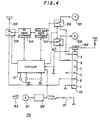
- a voltage V ACC from the hands-free accessory 200 is used to indicate whether or not the portable telephone 100 is connected to the hands-free accessory 200; however, alternatively a switch 199 mechanically switched ON and OFF when the connector plug 213 is plugged into and removed from the connector jack 113 may be provided, and whether or not the portable telephone 100 is connected to the hands-free accessory 200 may be detected from the output of this switch 199. This is shown Fig. 4.
- the portable telephone 100 is connected to the hands-free accessory 200 it is possible to change between the normal mode and the hands-free mode just by opening and closing the microphone arm 151. Furthermore, because this opening and closing of the microphone arm 151 is the same operation as when the portable telephone 100 is being used on its own, changing over between the normal mode and the hands-free mode can be carried out extremely naturally even when the portable telephone 100 is connected to the hands-free accessory 200.
Landscapes
- Engineering & Computer Science (AREA)
- Signal Processing (AREA)
- Mobile Radio Communication Systems (AREA)
- Telephone Set Structure (AREA)
Applications Claiming Priority (2)
| Application Number | Priority Date | Filing Date | Title |
|---|---|---|---|
| JP29891494A JP3360703B2 (ja) | 1994-11-08 | 1994-11-08 | 携帯電話機 |
| JP298914/94 | 1994-11-08 |
Publications (2)
| Publication Number | Publication Date |
|---|---|
| EP0712225A2 true EP0712225A2 (fr) | 1996-05-15 |
| EP0712225A3 EP0712225A3 (fr) | 1998-06-24 |
Family
ID=17865813
Family Applications (1)
| Application Number | Title | Priority Date | Filing Date |
|---|---|---|---|
| EP95307931A Withdrawn EP0712225A3 (fr) | 1994-11-08 | 1995-11-07 | Téléphone portable muni d'un dispositif mains-libres |
Country Status (4)
| Country | Link |
|---|---|
| US (1) | US5749057A (fr) |
| EP (1) | EP0712225A3 (fr) |
| JP (1) | JP3360703B2 (fr) |
| SG (1) | SG46959A1 (fr) |
Families Citing this family (26)
| Publication number | Priority date | Publication date | Assignee | Title |
|---|---|---|---|---|
| US5991646A (en) * | 1997-10-08 | 1999-11-23 | Sony Corporation | Articulating speaker and microphone for a wireless telephone with cigarette lighter adapter |
| US6002949A (en) * | 1997-11-18 | 1999-12-14 | Nortel Networks Corporation | Handset with a single transducer for handset and handsfree functionality |
| US6058184A (en) * | 1997-12-17 | 2000-05-02 | Sony Corporation Of Japan | Speaker unit with boom microphone |
| USD406587S (en) * | 1998-04-06 | 1999-03-09 | Sony Corporation | Cellular telephone with fold-out keyboard |
| USD408814S (en) | 1998-05-27 | 1999-04-27 | Sony Corporation | Cellular telephone with extendible microphone |
| USD424051S (en) * | 1998-05-28 | 2000-05-02 | Sony Corporation | Cellular telephone with pivotally extendible grip |
| KR100481845B1 (ko) * | 1998-06-10 | 2005-06-08 | 삼성전자주식회사 | 마이크로폰을 갖는 휴대형 컴퓨터 |
| US6266542B1 (en) * | 1998-09-24 | 2001-07-24 | Ericsson Inc. | Accessory allowing hands-free operation of a cellular telephone |
| US6512826B1 (en) * | 1998-11-30 | 2003-01-28 | Westech Korea Inc. | Multi-directional hand-free kit |
| TW472992U (en) * | 1999-02-01 | 2002-01-11 | Cotron Corp | Transferring device for telephone |
| USD424555S (en) * | 1999-03-17 | 2000-05-09 | Sony Corporation | Cellular telephone with pivotable belt clip/antenna |
| USD434403S (en) * | 2000-02-02 | 2000-11-28 | Sony Corporation | Cellular telephone handset |
| FR2807261B1 (fr) * | 2000-04-03 | 2002-05-17 | Raoul Girod | Systeme main-libre filtrant pour radiotelephones |
| JP4675458B2 (ja) * | 2000-06-28 | 2011-04-20 | 京セラ株式会社 | ハンズフリー装置 |
| US20020068617A1 (en) * | 2000-12-02 | 2002-06-06 | Han Kim Kyu | Hands free apparatus |
| US6678536B2 (en) | 2000-12-07 | 2004-01-13 | Mark Wendell Fletcher | Wireless microphone |
| US6542757B2 (en) * | 2001-01-11 | 2003-04-01 | Youngbo Engineering, Inc. | Headset docking device |
| US20040248623A1 (en) * | 2001-05-22 | 2004-12-09 | Safco Corporation | Hands free accessory for wireless telephones |
| USD460953S1 (en) | 2001-09-29 | 2002-07-30 | Tyler B. Argle | Cellular phone |
| US6836676B2 (en) * | 2001-11-02 | 2004-12-28 | Motorola, Inc. | Speakerphone accessory |
| US6957090B2 (en) * | 2002-03-08 | 2005-10-18 | Kyocera Wireless Corp. | Hands-free car kit |
| US7343174B2 (en) * | 2003-04-23 | 2008-03-11 | At&T Knowledge Ventures, L.P. | Wireless electronic drive-thru system and method |
| USD509200S1 (en) * | 2004-05-10 | 2005-09-06 | Dyna Llc | Single unit comfortable wireless communication device |
| US20090197649A1 (en) * | 2008-02-05 | 2009-08-06 | Rebelvox, Llc | Mobile phone with headset docking station |
| JP5455788B2 (ja) * | 2010-05-27 | 2014-03-26 | 富士フイルム株式会社 | 診断機器システム |
| JP6206103B2 (ja) * | 2013-11-07 | 2017-10-04 | アイコム株式会社 | 音声通信端末装置 |
Family Cites Families (18)
| Publication number | Priority date | Publication date | Assignee | Title |
|---|---|---|---|---|
| US4056696A (en) * | 1976-09-15 | 1977-11-01 | Bell Telephone Laboratories, Incorporated | Flat panel telephone station set |
| US4878237A (en) * | 1988-11-23 | 1989-10-31 | Cianflone Stephen P | Shoulder cradle for supporting a cellular car phone |
| US5212722A (en) * | 1989-07-24 | 1993-05-18 | Nec Corporation | Hands-free telephone having a handset volume attenuator for controlling speaker volume in a hands-free adaptor |
| CA2022605C (fr) * | 1989-08-11 | 1995-01-03 | Kazuya Hashimoto | Emetteur-recepteur radio portatif avec adaptateur et indicateur d'intensite de signal ameliores |
| US5175759A (en) * | 1989-11-20 | 1992-12-29 | Metroka Michael P | Communications device with movable element control interface |
| DE9005989U1 (de) * | 1990-05-26 | 1990-08-02 | Votronic Entwicklungs- Und Produktionsgesellschaft Fuer Elektronische Geraete Mbh, 6670 St Ingbert | Hör- und Sprecheinheit für in Kraftfahrzeugen angeordnete, mobile Telefone |
| DE69218465T2 (de) * | 1991-01-11 | 1997-07-03 | Toshiba Communication Technolo | Adapter zur Versorgung eines transportablen Funktelefons mit Spannung |
| US5659887A (en) * | 1991-06-15 | 1997-08-19 | Kabushiki Kaisha Honda Access | Portable radiotelephone and holder for mounting within a vehicle |
| US5282246A (en) * | 1991-11-08 | 1994-01-25 | Yang Chao Ming | Handsfree mobile telephone rack |
| DE4207507A1 (de) * | 1992-03-10 | 1993-09-16 | Philips Patentverwaltung | Nachrichtentechnisches geraet mit einer freisprecheinrichtung |
| JPH06102890A (ja) * | 1992-09-22 | 1994-04-15 | Pioneer Electron Corp | カラオケシステム |
| FR2706103B1 (fr) * | 1993-06-03 | 1997-01-31 | Ericsson Ge Mobile Communicat | Appareil radiotéléphonique. |
| US5557653A (en) * | 1993-07-27 | 1996-09-17 | Spectralink Corporation | Headset for hands-free wireless telephone |
| FR2711872B1 (fr) * | 1993-10-21 | 1996-02-09 | Jean Pierre Talvard | Appareil portatif indépendant formant annuaire et composeur téléphonique. |
| FI107002B (fi) * | 1994-01-13 | 2001-05-15 | Nokia Mobile Phones Ltd | Matkapuhelimen kädet vapaana- eli HF-laitteisto |
| TW367687B (en) * | 1994-08-09 | 1999-08-21 | At & T Corp | Telephone handset |
| US5504812A (en) * | 1994-10-11 | 1996-04-02 | Motorola, Inc. | Headset for use with a radiotelephone |
| US5490213A (en) * | 1994-11-28 | 1996-02-06 | Huang; Lin-Wei | Apparatus for hands-free operation of a mobile telephone unit in a car |
-
1994
- 1994-11-08 JP JP29891494A patent/JP3360703B2/ja not_active Expired - Fee Related
-
1995
- 1995-11-03 US US08/552,864 patent/US5749057A/en not_active Expired - Fee Related
- 1995-11-07 EP EP95307931A patent/EP0712225A3/fr not_active Withdrawn
- 1995-11-08 SG SG1995001762A patent/SG46959A1/en unknown
Non-Patent Citations (1)
| Title |
|---|
| None |
Also Published As
| Publication number | Publication date |
|---|---|
| SG46959A1 (en) | 1998-03-20 |
| JP3360703B2 (ja) | 2002-12-24 |
| EP0712225A3 (fr) | 1998-06-24 |
| JPH08140129A (ja) | 1996-05-31 |
| US5749057A (en) | 1998-05-05 |
Similar Documents
| Publication | Publication Date | Title |
|---|---|---|
| US5749057A (en) | Telephone handset for hands-free use in an auto mobile | |
| US5991640A (en) | Docking and electrical interface for personal use communication devices | |
| US5191602A (en) | Cellular telephone headset | |
| US5442814A (en) | Cellular telephone facilitating a response holding state | |
| CA2165020C (fr) | Telephone a haut-parleur cellulaire; son mode d'emploi | |
| US6330457B1 (en) | Telephone call service by sensing hand-held state of cellular telephone | |
| US6226529B1 (en) | System for providing a simultaneous data and voice channel within a single channel of a portable cellular telephone to provide position-enhanced cellular services (PECS) | |
| US5610971A (en) | Dual keypad telephone handset for mobile communications | |
| US6285890B1 (en) | Automatic sensing of communication or accessories for mobile terminals | |
| GB2329773A (en) | Car audio equipment with cellphone | |
| EP0483956A2 (fr) | Combinaison d'un radiorécepteur et d'un radiotéléphone | |
| KR19990062481A (ko) | 붐 마이크로폰을 구비한 스피커 유니트 | |
| US5349698A (en) | Radio communication system for a selected one of a plurality of terminal units of different kinds | |
| JPH11163989A (ja) | 携帯電話機 | |
| US6230030B1 (en) | Hands-free switching device for use with a mobile telephone in a car | |
| US8032076B2 (en) | Cellular telephone and multimedia accessory audio system adaptor and methods therefor | |
| JPH05176030A (ja) | 携帯電話機用アダプタ | |
| GB2420930A (en) | Auxiliary handset accessory kit and method for a radio telephoe in a vehicle | |
| KR950004457Y1 (ko) | 통화선택기능을 갖는 전화기용 아답타 | |
| KR100548398B1 (ko) | 휴대용 단말기의 스피커 장치 | |
| JPH10200616A (ja) | 携帯電話器操作装置 | |
| JP2002142007A (ja) | 自動車のハンドフリー通話装置 | |
| JPH0738636A (ja) | ハンズフリー通報装置 | |
| JPH09139765A (ja) | 携帯電話機の車載通話構造 | |
| JPH05300087A (ja) | 無線通信装置 |
Legal Events
| Date | Code | Title | Description |
|---|---|---|---|
| PUAI | Public reference made under article 153(3) epc to a published international application that has entered the european phase |
Free format text: ORIGINAL CODE: 0009012 |
|
| AK | Designated contracting states |
Kind code of ref document: A2 Designated state(s): DE FR GB |
|
| PUAL | Search report despatched |
Free format text: ORIGINAL CODE: 0009013 |
|
| AK | Designated contracting states |
Kind code of ref document: A3 Designated state(s): DE FR GB |
|
| 17P | Request for examination filed |
Effective date: 19981203 |
|
| 17Q | First examination report despatched |
Effective date: 20010531 |
|
| STAA | Information on the status of an ep patent application or granted ep patent |
Free format text: STATUS: THE APPLICATION IS DEEMED TO BE WITHDRAWN |
|
| 18D | Application deemed to be withdrawn |
Effective date: 20011011 |