EP0712905A1 - Reaktivfarbstoffe, ihre Herstellung und Verwendung - Google Patents
Reaktivfarbstoffe, ihre Herstellung und Verwendung Download PDFInfo
- Publication number
- EP0712905A1 EP0712905A1 EP95810702A EP95810702A EP0712905A1 EP 0712905 A1 EP0712905 A1 EP 0712905A1 EP 95810702 A EP95810702 A EP 95810702A EP 95810702 A EP95810702 A EP 95810702A EP 0712905 A1 EP0712905 A1 EP 0712905A1
- Authority
- EP
- European Patent Office
- Prior art keywords
- sulfo
- formula
- alkyl
- radical
- substituted
- Prior art date
- Legal status (The legal status is an assumption and is not a legal conclusion. Google has not performed a legal analysis and makes no representation as to the accuracy of the status listed.)
- Granted
Links
- 238000002360 preparation method Methods 0.000 title claims description 4
- -1 3-carboxy-pyridin-1-yl Chemical group 0.000 claims abstract description 200
- 125000000020 sulfo group Chemical group O=S(=O)([*])O[H] 0.000 claims abstract description 39
- 229910052736 halogen Inorganic materials 0.000 claims abstract description 33
- 125000000217 alkyl group Chemical group 0.000 claims abstract description 30
- 150000002367 halogens Chemical class 0.000 claims abstract description 30
- 125000002924 primary amino group Chemical group [H]N([H])* 0.000 claims abstract description 23
- 125000000664 diazo group Chemical group [N-]=[N+]=[*] 0.000 claims abstract description 21
- 229910052801 chlorine Inorganic materials 0.000 claims abstract description 19
- 238000005859 coupling reaction Methods 0.000 claims abstract description 18
- 230000008878 coupling Effects 0.000 claims abstract description 17
- 238000010168 coupling process Methods 0.000 claims abstract description 17
- 125000000391 vinyl group Chemical group [H]C([*])=C([H])[H] 0.000 claims abstract description 14
- 229920002554 vinyl polymer Polymers 0.000 claims abstract description 14
- 125000003178 carboxy group Chemical group [H]OC(*)=O 0.000 claims abstract description 13
- 125000003917 carbamoyl group Chemical group [H]N([H])C(*)=O 0.000 claims abstract description 12
- UHOVQNZJYSORNB-UHFFFAOYSA-N Benzene Chemical compound C1=CC=CC=C1 UHOVQNZJYSORNB-UHFFFAOYSA-N 0.000 claims abstract description 9
- 229910052794 bromium Inorganic materials 0.000 claims abstract description 9
- 125000001624 naphthyl group Chemical group 0.000 claims abstract description 7
- 125000000951 phenoxy group Chemical group [H]C1=C([H])C([H])=C(O*)C([H])=C1[H] 0.000 claims abstract description 7
- 125000000732 arylene group Chemical group 0.000 claims abstract description 6
- 125000000623 heterocyclic group Chemical group 0.000 claims abstract description 3
- 125000004573 morpholin-4-yl group Chemical group N1(CCOCC1)* 0.000 claims abstract description 3
- 150000002790 naphthalenes Chemical class 0.000 claims abstract description 3
- 150000003254 radicals Chemical class 0.000 claims description 69
- 125000002887 hydroxy group Chemical group [H]O* 0.000 claims description 44
- 239000001257 hydrogen Substances 0.000 claims description 39
- 229910052739 hydrogen Inorganic materials 0.000 claims description 39
- 150000001875 compounds Chemical class 0.000 claims description 36
- 125000000229 (C1-C4)alkoxy group Chemical group 0.000 claims description 35
- 125000001997 phenyl group Chemical group [H]C1=C([H])C([H])=C(*)C([H])=C1[H] 0.000 claims description 25
- 125000004178 (C1-C4) alkyl group Chemical group 0.000 claims description 23
- 125000000956 methoxy group Chemical group [H]C([H])([H])O* 0.000 claims description 22
- 125000002496 methyl group Chemical group [H]C([H])([H])* 0.000 claims description 22
- 229910052757 nitrogen Inorganic materials 0.000 claims description 22
- 125000004435 hydrogen atom Chemical group [H]* 0.000 claims description 19
- UFHFLCQGNIYNRP-UHFFFAOYSA-N Hydrogen Chemical compound [H][H] UFHFLCQGNIYNRP-UHFFFAOYSA-N 0.000 claims description 18
- 239000000460 chlorine Substances 0.000 claims description 18
- 238000004043 dyeing Methods 0.000 claims description 17
- 239000000985 reactive dye Substances 0.000 claims description 17
- 229920000742 Cotton Polymers 0.000 claims description 14
- 125000001495 ethyl group Chemical group [H]C([H])([H])C([H])([H])* 0.000 claims description 13
- ZAMOUSCENKQFHK-UHFFFAOYSA-N Chlorine atom Chemical compound [Cl] ZAMOUSCENKQFHK-UHFFFAOYSA-N 0.000 claims description 12
- 229920002678 cellulose Polymers 0.000 claims description 12
- 239000001913 cellulose Substances 0.000 claims description 12
- 125000004093 cyano group Chemical group *C#N 0.000 claims description 12
- 238000000034 method Methods 0.000 claims description 10
- PXGOKWXKJXAPGV-UHFFFAOYSA-N Fluorine Chemical group FF PXGOKWXKJXAPGV-UHFFFAOYSA-N 0.000 claims description 9
- 229910052731 fluorine Chemical group 0.000 claims description 9
- 239000011737 fluorine Chemical group 0.000 claims description 9
- 125000002490 anilino group Chemical group [H]N(*)C1=C([H])C([H])=C([H])C([H])=C1[H] 0.000 claims description 8
- GDTBXPJZTBHREO-UHFFFAOYSA-N bromine Chemical group BrBr GDTBXPJZTBHREO-UHFFFAOYSA-N 0.000 claims description 8
- 125000001309 chloro group Chemical group Cl* 0.000 claims description 8
- 239000002657 fibrous material Substances 0.000 claims description 8
- WKBOTKDWSSQWDR-UHFFFAOYSA-N Bromine atom Chemical group [Br] WKBOTKDWSSQWDR-UHFFFAOYSA-N 0.000 claims description 7
- 125000003236 benzoyl group Chemical group [H]C1=C([H])C([H])=C(C([H])=C1[H])C(*)=O 0.000 claims description 6
- 125000001424 substituent group Chemical group 0.000 claims description 6
- UFWIBTONFRDIAS-UHFFFAOYSA-N Naphthalene Chemical compound C1=CC=CC2=CC=CC=C21 UFWIBTONFRDIAS-UHFFFAOYSA-N 0.000 claims description 4
- 125000003161 (C1-C6) alkylene group Chemical group 0.000 claims description 3
- VGGSQFUCUMXWEO-UHFFFAOYSA-N Ethene Chemical compound C=C VGGSQFUCUMXWEO-UHFFFAOYSA-N 0.000 claims description 3
- JYNZIOFUHBJABQ-UHFFFAOYSA-N allyl-{6-[3-(4-bromo-phenyl)-benzofuran-6-yloxy]-hexyl-}-methyl-amin Chemical compound C=1OC2=CC(OCCCCCCN(C)CC=C)=CC=C2C=1C1=CC=C(Br)C=C1 JYNZIOFUHBJABQ-UHFFFAOYSA-N 0.000 claims description 3
- QQONPFPTGQHPMA-UHFFFAOYSA-N propylene Natural products CC=C QQONPFPTGQHPMA-UHFFFAOYSA-N 0.000 claims description 3
- 125000004400 (C1-C12) alkyl group Chemical group 0.000 claims description 2
- RJSYPKWVIJGNLO-UHFFFAOYSA-N CCOClOC Chemical group CCOClOC RJSYPKWVIJGNLO-UHFFFAOYSA-N 0.000 claims description 2
- 239000005977 Ethylene Substances 0.000 claims description 2
- 125000004397 aminosulfonyl group Chemical group NS(=O)(=O)* 0.000 claims description 2
- FDWBUGCBGXWJLC-UHFFFAOYSA-N naphthalen-1-yl(phenyl)diazene Chemical compound C1=CC=CC=C1N=NC1=CC=CC2=CC=CC=C12 FDWBUGCBGXWJLC-UHFFFAOYSA-N 0.000 claims description 2
- 125000005146 naphthylsulfonyl group Chemical group C1(=CC=CC2=CC=CC=C12)S(=O)(=O)* 0.000 claims description 2
- 125000000449 nitro group Chemical group [O-][N+](*)=O 0.000 claims description 2
- QJGQUHMNIGDVPM-UHFFFAOYSA-N nitrogen group Chemical group [N] QJGQUHMNIGDVPM-UHFFFAOYSA-N 0.000 claims description 2
- 125000003170 phenylsulfonyl group Chemical group C1(=CC=CC=C1)S(=O)(=O)* 0.000 claims description 2
- 125000004805 propylene group Chemical group [H]C([H])([H])C([H])([*:1])C([H])([H])[*:2] 0.000 claims description 2
- 125000002023 trifluoromethyl group Chemical group FC(F)(F)* 0.000 claims description 2
- 125000004769 (C1-C4) alkylsulfonyl group Chemical group 0.000 claims 1
- 125000000325 methylidene group Chemical group [H]C([H])=* 0.000 abstract description 7
- 229910006069 SO3H Inorganic materials 0.000 abstract description 5
- 125000003545 alkoxy group Chemical group 0.000 abstract description 3
- 125000004423 acyloxy group Chemical group 0.000 abstract description 2
- 125000004453 alkoxycarbonyl group Chemical group 0.000 abstract description 2
- 229910004727 OSO3H Inorganic materials 0.000 abstract 2
- 125000004414 alkyl thio group Chemical group 0.000 abstract 1
- 125000002947 alkylene group Chemical group 0.000 abstract 1
- 125000005843 halogen group Chemical group 0.000 abstract 1
- NYGZLYXAPMMJTE-UHFFFAOYSA-M metanil yellow Chemical group [Na+].[O-]S(=O)(=O)C1=CC=CC(N=NC=2C=CC(NC=3C=CC=CC=3)=CC=2)=C1 NYGZLYXAPMMJTE-UHFFFAOYSA-M 0.000 abstract 1
- 125000004957 naphthylene group Chemical group 0.000 abstract 1
- 125000000843 phenylene group Chemical group C1(=C(C=CC=C1)*)* 0.000 abstract 1
- HEMHJVSKTPXQMS-UHFFFAOYSA-M Sodium hydroxide Chemical compound [OH-].[Na+] HEMHJVSKTPXQMS-UHFFFAOYSA-M 0.000 description 54
- 239000000975 dye Substances 0.000 description 30
- XLYOFNOQVPJJNP-UHFFFAOYSA-N water Substances O XLYOFNOQVPJJNP-UHFFFAOYSA-N 0.000 description 28
- VEXZGXHMUGYJMC-UHFFFAOYSA-N Hydrochloric acid Chemical compound Cl VEXZGXHMUGYJMC-UHFFFAOYSA-N 0.000 description 16
- LPXPTNMVRIOKMN-UHFFFAOYSA-M sodium nitrite Chemical compound [Na+].[O-]N=O LPXPTNMVRIOKMN-UHFFFAOYSA-M 0.000 description 16
- 239000004744 fabric Substances 0.000 description 15
- 239000002253 acid Substances 0.000 description 12
- 150000002431 hydrogen Chemical group 0.000 description 11
- 150000003839 salts Chemical group 0.000 description 11
- 125000004432 carbon atom Chemical group C* 0.000 description 9
- 239000000203 mixture Substances 0.000 description 9
- 235000010288 sodium nitrite Nutrition 0.000 description 8
- IOVCWXUNBOPUCH-UHFFFAOYSA-M Nitrite anion Chemical compound [O-]N=O IOVCWXUNBOPUCH-UHFFFAOYSA-M 0.000 description 7
- 239000000835 fiber Substances 0.000 description 7
- LNOPIUAQISRISI-UHFFFAOYSA-N n'-hydroxy-2-propan-2-ylsulfonylethanimidamide Chemical compound CC(C)S(=O)(=O)CC(N)=NO LNOPIUAQISRISI-UHFFFAOYSA-N 0.000 description 7
- 239000000843 powder Substances 0.000 description 7
- HIVUAOXLSJITPA-UHFFFAOYSA-N 2-amino-5-hydroxynaphthalene-1,7-disulfonic acid Chemical compound OC1=CC(S(O)(=O)=O)=CC2=C(S(O)(=O)=O)C(N)=CC=C21 HIVUAOXLSJITPA-UHFFFAOYSA-N 0.000 description 6
- FAPWRFPIFSIZLT-UHFFFAOYSA-M Sodium chloride Chemical compound [Na+].[Cl-] FAPWRFPIFSIZLT-UHFFFAOYSA-M 0.000 description 6
- 239000003599 detergent Substances 0.000 description 6
- 238000003756 stirring Methods 0.000 description 6
- 125000004169 (C1-C6) alkyl group Chemical group 0.000 description 4
- KIWBPDUYBMNFTB-UHFFFAOYSA-N Ethyl hydrogen sulfate Natural products CCOS(O)(=O)=O KIWBPDUYBMNFTB-UHFFFAOYSA-N 0.000 description 4
- CDBYLPFSWZWCQE-UHFFFAOYSA-L Sodium Carbonate Chemical compound [Na+].[Na+].[O-]C([O-])=O CDBYLPFSWZWCQE-UHFFFAOYSA-L 0.000 description 4
- UIIMBOGNXHQVGW-UHFFFAOYSA-M Sodium bicarbonate Chemical compound [Na+].OC([O-])=O UIIMBOGNXHQVGW-UHFFFAOYSA-M 0.000 description 4
- 125000002777 acetyl group Chemical group [H]C([H])([H])C(*)=O 0.000 description 4
- 238000009833 condensation Methods 0.000 description 4
- 230000005494 condensation Effects 0.000 description 4
- 150000008049 diazo compounds Chemical class 0.000 description 4
- 238000006193 diazotization reaction Methods 0.000 description 4
- 125000001501 propionyl group Chemical group O=C([*])C([H])([H])C([H])([H])[H] 0.000 description 4
- 238000010186 staining Methods 0.000 description 4
- 239000002562 thickening agent Substances 0.000 description 4
- 210000002268 wool Anatomy 0.000 description 4
- 0 *CCS(c(cc1)ccc1N=Nc(c(S(O)(=O)=O)cc(cc1N)c2cc1S(O)(=O)=O)c2O)(=O)=O Chemical compound *CCS(c(cc1)ccc1N=Nc(c(S(O)(=O)=O)cc(cc1N)c2cc1S(O)(=O)=O)c2O)(=O)=O 0.000 description 3
- PNHUHPSIWGBXDF-UHFFFAOYSA-N 1,3,5-trichloro-2,4-dihydrotriazine Chemical compound ClN1CC(Cl)=CN(Cl)N1 PNHUHPSIWGBXDF-UHFFFAOYSA-N 0.000 description 3
- SLCXZASUVUINPC-UHFFFAOYSA-N 3-amino-8-hydroxynaphthalene-2,6-disulfonic acid Chemical compound OS(=O)(=O)C1=CC(O)=C2C=C(S(O)(=O)=O)C(N)=CC2=C1 SLCXZASUVUINPC-UHFFFAOYSA-N 0.000 description 3
- APRRQJCCBSJQOQ-UHFFFAOYSA-N 4-amino-5-hydroxynaphthalene-2,7-disulfonic acid Chemical compound OS(=O)(=O)C1=CC(O)=C2C(N)=CC(S(O)(=O)=O)=CC2=C1 APRRQJCCBSJQOQ-UHFFFAOYSA-N 0.000 description 3
- 239000004952 Polyamide Substances 0.000 description 3
- BNIILDVGGAEEIG-UHFFFAOYSA-L disodium hydrogen phosphate Chemical compound [Na+].[Na+].OP([O-])([O-])=O BNIILDVGGAEEIG-UHFFFAOYSA-L 0.000 description 3
- 238000002955 isolation Methods 0.000 description 3
- 125000003253 isopropoxy group Chemical group [H]C([H])([H])C([H])(O*)C([H])([H])[H] 0.000 description 3
- 125000003506 n-propoxy group Chemical group [H]C([H])([H])C([H])([H])C([H])([H])O* 0.000 description 3
- 229920002647 polyamide Polymers 0.000 description 3
- 239000011541 reaction mixture Substances 0.000 description 3
- 239000011734 sodium Substances 0.000 description 3
- 239000011780 sodium chloride Substances 0.000 description 3
- LJRGBERXYNQPJI-UHFFFAOYSA-M sodium;3-nitrobenzenesulfonate Chemical compound [Na+].[O-][N+](=O)C1=CC=CC(S([O-])(=O)=O)=C1 LJRGBERXYNQPJI-UHFFFAOYSA-M 0.000 description 3
- 239000000725 suspension Substances 0.000 description 3
- IXPNQXFRVYWDDI-UHFFFAOYSA-N 1-methyl-2,4-dioxo-1,3-diazinane-5-carboximidamide Chemical compound CN1CC(C(N)=N)C(=O)NC1=O IXPNQXFRVYWDDI-UHFFFAOYSA-N 0.000 description 2
- 125000001637 1-naphthyl group Chemical group [H]C1=C([H])C([H])=C2C(*)=C([H])C([H])=C([H])C2=C1[H] 0.000 description 2
- KYARBIJYVGJZLB-UHFFFAOYSA-N 7-amino-4-hydroxy-2-naphthalenesulfonic acid Chemical compound OC1=CC(S(O)(=O)=O)=CC2=CC(N)=CC=C21 KYARBIJYVGJZLB-UHFFFAOYSA-N 0.000 description 2
- 101100116570 Caenorhabditis elegans cup-2 gene Proteins 0.000 description 2
- 229920003043 Cellulose fiber Polymers 0.000 description 2
- 101100116572 Drosophila melanogaster Der-1 gene Proteins 0.000 description 2
- XSQUKJJJFZCRTK-UHFFFAOYSA-N Urea Chemical compound NC(N)=O XSQUKJJJFZCRTK-UHFFFAOYSA-N 0.000 description 2
- 230000002378 acidificating effect Effects 0.000 description 2
- 150000003863 ammonium salts Chemical class 0.000 description 2
- 239000004202 carbamide Substances 0.000 description 2
- 125000001951 carbamoylamino group Chemical group C(N)(=O)N* 0.000 description 2
- 238000006243 chemical reaction Methods 0.000 description 2
- 125000003754 ethoxycarbonyl group Chemical group C(=O)(OCC)* 0.000 description 2
- 125000002510 isobutoxy group Chemical group [H]C([H])([H])C([H])(C([H])([H])[H])C([H])([H])O* 0.000 description 2
- 125000000959 isobutyl group Chemical group [H]C([H])([H])C([H])(C([H])([H])[H])C([H])([H])* 0.000 description 2
- 125000001449 isopropyl group Chemical group [H]C([H])([H])C([H])(*)C([H])([H])[H] 0.000 description 2
- 229910052744 lithium Inorganic materials 0.000 description 2
- 239000000463 material Substances 0.000 description 2
- UCFFGYASXIPWPD-UHFFFAOYSA-N methyl hypochlorite Chemical compound COCl UCFFGYASXIPWPD-UHFFFAOYSA-N 0.000 description 2
- 125000006606 n-butoxy group Chemical group 0.000 description 2
- 125000004108 n-butyl group Chemical group [H]C([H])([H])C([H])([H])C([H])([H])C([H])([H])* 0.000 description 2
- 125000004123 n-propyl group Chemical group [H]C([H])([H])C([H])([H])C([H])([H])* 0.000 description 2
- 125000005184 naphthylamino group Chemical group C1(=CC=CC2=CC=CC=C12)N* 0.000 description 2
- 229920006395 saturated elastomer Polymers 0.000 description 2
- 125000005920 sec-butoxy group Chemical group 0.000 description 2
- 125000002914 sec-butyl group Chemical group [H]C([H])([H])C([H])([H])C([H])(*)C([H])([H])[H] 0.000 description 2
- 229910052708 sodium Inorganic materials 0.000 description 2
- 239000000661 sodium alginate Substances 0.000 description 2
- 235000010413 sodium alginate Nutrition 0.000 description 2
- 229940005550 sodium alginate Drugs 0.000 description 2
- 235000017557 sodium bicarbonate Nutrition 0.000 description 2
- 229910000030 sodium bicarbonate Inorganic materials 0.000 description 2
- XOAAWQZATWQOTB-UHFFFAOYSA-N taurine Chemical compound NCCS(O)(=O)=O XOAAWQZATWQOTB-UHFFFAOYSA-N 0.000 description 2
- 125000004213 tert-butoxy group Chemical group [H]C([H])([H])C(O*)(C([H])([H])[H])C([H])([H])[H] 0.000 description 2
- 125000000999 tert-butyl group Chemical group [H]C([H])([H])C(*)(C([H])([H])[H])C([H])([H])[H] 0.000 description 2
- QAQSNXHKHKONNS-UHFFFAOYSA-N 1-ethyl-2-hydroxy-4-methyl-6-oxopyridine-3-carboxamide Chemical compound CCN1C(O)=C(C(N)=O)C(C)=CC1=O QAQSNXHKHKONNS-UHFFFAOYSA-N 0.000 description 1
- FPZWZCWUIYYYBU-UHFFFAOYSA-N 2-(2-ethoxyethoxy)ethyl acetate Chemical group CCOCCOCCOC(C)=O FPZWZCWUIYYYBU-UHFFFAOYSA-N 0.000 description 1
- FHXUYFKYRBLZJU-UHFFFAOYSA-N 3-(5-methyl-3-oxo-1h-pyrazol-2-yl)benzenesulfonic acid Chemical compound N1C(C)=CC(=O)N1C1=CC=CC(S(O)(=O)=O)=C1 FHXUYFKYRBLZJU-UHFFFAOYSA-N 0.000 description 1
- YADSWTKOIHUSDX-UHFFFAOYSA-N 4,6-diaminobenzene-1,3-disulfonic acid Chemical compound NC1=CC(N)=C(S(O)(=O)=O)C=C1S(O)(=O)=O YADSWTKOIHUSDX-UHFFFAOYSA-N 0.000 description 1
- ZUQOBHTUMCEQBG-UHFFFAOYSA-N 4-amino-5-hydroxynaphthalene-1,7-disulfonic acid Chemical compound OS(=O)(=O)C1=CC(O)=C2C(N)=CC=C(S(O)(=O)=O)C2=C1 ZUQOBHTUMCEQBG-UHFFFAOYSA-N 0.000 description 1
- ZCNCWYFISJTFHB-UHFFFAOYSA-N 4-hydroxy-7-(methylamino)naphthalene-2-sulfonic acid Chemical compound OC1=CC(S(O)(=O)=O)=CC2=CC(NC)=CC=C21 ZCNCWYFISJTFHB-UHFFFAOYSA-N 0.000 description 1
- 244000025254 Cannabis sativa Species 0.000 description 1
- 235000012766 Cannabis sativa ssp. sativa var. sativa Nutrition 0.000 description 1
- 235000012765 Cannabis sativa ssp. sativa var. spontanea Nutrition 0.000 description 1
- DGAQECJNVWCQMB-PUAWFVPOSA-M Ilexoside XXIX Chemical compound C[C@@H]1CC[C@@]2(CC[C@@]3(C(=CC[C@H]4[C@]3(CC[C@@H]5[C@@]4(CC[C@@H](C5(C)C)OS(=O)(=O)[O-])C)C)[C@@H]2[C@]1(C)O)C)C(=O)O[C@H]6[C@@H]([C@H]([C@@H]([C@H](O6)CO)O)O)O.[Na+] DGAQECJNVWCQMB-PUAWFVPOSA-M 0.000 description 1
- WHXSMMKQMYFTQS-UHFFFAOYSA-N Lithium Chemical compound [Li] WHXSMMKQMYFTQS-UHFFFAOYSA-N 0.000 description 1
- SUZRRICLUFMAQD-UHFFFAOYSA-N N-methyltaurine Natural products CNCCS(O)(=O)=O SUZRRICLUFMAQD-UHFFFAOYSA-N 0.000 description 1
- 240000007817 Olea europaea Species 0.000 description 1
- ZLMJMSJWJFRBEC-UHFFFAOYSA-N Potassium Chemical compound [K] ZLMJMSJWJFRBEC-UHFFFAOYSA-N 0.000 description 1
- PMZURENOXWZQFD-UHFFFAOYSA-L Sodium Sulfate Chemical compound [Na+].[Na+].[O-]S([O-])(=O)=O PMZURENOXWZQFD-UHFFFAOYSA-L 0.000 description 1
- GSEJCLTVZPLZKY-UHFFFAOYSA-N Triethanolamine Chemical compound OCCN(CCO)CCO GSEJCLTVZPLZKY-UHFFFAOYSA-N 0.000 description 1
- HXELGNKCCDGMMN-UHFFFAOYSA-N [F].[Cl] Chemical compound [F].[Cl] HXELGNKCCDGMMN-UHFFFAOYSA-N 0.000 description 1
- 125000000738 acetamido group Chemical group [H]C([H])([H])C(=O)N([H])[*] 0.000 description 1
- 125000003668 acetyloxy group Chemical group [H]C([H])([H])C(=O)O[*] 0.000 description 1
- 125000002252 acyl group Chemical group 0.000 description 1
- 125000004442 acylamino group Chemical group 0.000 description 1
- 239000003513 alkali Substances 0.000 description 1
- 125000005236 alkanoylamino group Chemical group 0.000 description 1
- 125000004390 alkyl sulfonyl group Chemical group 0.000 description 1
- 150000001412 amines Chemical class 0.000 description 1
- QVGXLLKOCUKJST-UHFFFAOYSA-N atomic oxygen Chemical compound [O] QVGXLLKOCUKJST-UHFFFAOYSA-N 0.000 description 1
- 125000001231 benzoyloxy group Chemical group C(C1=CC=CC=C1)(=O)O* 0.000 description 1
- 238000009835 boiling Methods 0.000 description 1
- 125000001246 bromo group Chemical group Br* 0.000 description 1
- 235000009120 camo Nutrition 0.000 description 1
- 125000001589 carboacyl group Chemical group 0.000 description 1
- 235000005607 chanvre indien Nutrition 0.000 description 1
- 238000004040 coloring Methods 0.000 description 1
- 238000000502 dialysis Methods 0.000 description 1
- 125000001301 ethoxy group Chemical group [H]C([H])([H])C([H])([H])O* 0.000 description 1
- 125000006125 ethylsulfonyl group Chemical group 0.000 description 1
- 239000011487 hemp Substances 0.000 description 1
- 125000005842 heteroatom Chemical group 0.000 description 1
- 238000010409 ironing Methods 0.000 description 1
- 239000010985 leather Substances 0.000 description 1
- 125000001160 methoxycarbonyl group Chemical group [H]C([H])([H])OC(*)=O 0.000 description 1
- 125000006626 methoxycarbonylamino group Chemical group 0.000 description 1
- 125000004170 methylsulfonyl group Chemical group [H]C([H])([H])S(*)(=O)=O 0.000 description 1
- 230000007935 neutral effect Effects 0.000 description 1
- 150000002826 nitrites Chemical class 0.000 description 1
- 239000001301 oxygen Substances 0.000 description 1
- 229910052760 oxygen Inorganic materials 0.000 description 1
- 229920000728 polyester Polymers 0.000 description 1
- 229920002635 polyurethane Polymers 0.000 description 1
- 239000004814 polyurethane Substances 0.000 description 1
- 229910052700 potassium Inorganic materials 0.000 description 1
- 239000011591 potassium Substances 0.000 description 1
- 235000019353 potassium silicate Nutrition 0.000 description 1
- 230000009257 reactivity Effects 0.000 description 1
- 239000004627 regenerated cellulose Substances 0.000 description 1
- 239000013535 sea water Substances 0.000 description 1
- 239000000344 soap Substances 0.000 description 1
- 235000017550 sodium carbonate Nutrition 0.000 description 1
- 229910000029 sodium carbonate Inorganic materials 0.000 description 1
- 239000001488 sodium phosphate Substances 0.000 description 1
- NTHWMYGWWRZVTN-UHFFFAOYSA-N sodium silicate Chemical compound [Na+].[Na+].[O-][Si]([O-])=O NTHWMYGWWRZVTN-UHFFFAOYSA-N 0.000 description 1
- 229910052938 sodium sulfate Inorganic materials 0.000 description 1
- 235000011152 sodium sulphate Nutrition 0.000 description 1
- 238000010025 steaming Methods 0.000 description 1
- 239000000126 substance Substances 0.000 description 1
- 229960003080 taurine Drugs 0.000 description 1
- 125000003396 thiol group Chemical group [H]S* 0.000 description 1
- RYFMWSXOAZQYPI-UHFFFAOYSA-K trisodium phosphate Chemical compound [Na+].[Na+].[Na+].[O-]P([O-])([O-])=O RYFMWSXOAZQYPI-UHFFFAOYSA-K 0.000 description 1
- 229910000406 trisodium phosphate Inorganic materials 0.000 description 1
- 235000019801 trisodium phosphate Nutrition 0.000 description 1
- 238000005406 washing Methods 0.000 description 1
- 230000004584 weight gain Effects 0.000 description 1
- 235000019786 weight gain Nutrition 0.000 description 1
Classifications
-
- C—CHEMISTRY; METALLURGY
- C07—ORGANIC CHEMISTRY
- C07C—ACYCLIC OR CARBOCYCLIC COMPOUNDS
- C07C317/00—Sulfones; Sulfoxides
- C07C317/12—Sulfones; Sulfoxides having sulfone or sulfoxide groups bound to carbon atoms of rings other than six-membered aromatic rings
-
- C—CHEMISTRY; METALLURGY
- C09—DYES; PAINTS; POLISHES; NATURAL RESINS; ADHESIVES; COMPOSITIONS NOT OTHERWISE PROVIDED FOR; APPLICATIONS OF MATERIALS NOT OTHERWISE PROVIDED FOR
- C09B—ORGANIC DYES OR CLOSELY-RELATED COMPOUNDS FOR PRODUCING DYES, e.g. PIGMENTS; MORDANTS; LAKES
- C09B62/00—Reactive dyes, i.e. dyes which form covalent bonds with the substrates or which polymerise with themselves
- C09B62/44—Reactive dyes, i.e. dyes which form covalent bonds with the substrates or which polymerise with themselves with the reactive group not directly attached to a heterocyclic ring
- C09B62/503—Reactive dyes, i.e. dyes which form covalent bonds with the substrates or which polymerise with themselves with the reactive group not directly attached to a heterocyclic ring the reactive group being an esterified or non-esterified hydroxyalkyl sulfonyl or mercaptoalkyl sulfonyl group, a quaternised or non-quaternised aminoalkyl sulfonyl group, a heterylmercapto alkyl sulfonyl group, a vinyl sulfonyl or a substituted vinyl sulfonyl group, or a thiophene-dioxide group
- C09B62/507—Azo dyes
- C09B62/513—Disazo or polyazo dyes
-
- C—CHEMISTRY; METALLURGY
- C09—DYES; PAINTS; POLISHES; NATURAL RESINS; ADHESIVES; COMPOSITIONS NOT OTHERWISE PROVIDED FOR; APPLICATIONS OF MATERIALS NOT OTHERWISE PROVIDED FOR
- C09B—ORGANIC DYES OR CLOSELY-RELATED COMPOUNDS FOR PRODUCING DYES, e.g. PIGMENTS; MORDANTS; LAKES
- C09B62/00—Reactive dyes, i.e. dyes which form covalent bonds with the substrates or which polymerise with themselves
- C09B62/44—Reactive dyes, i.e. dyes which form covalent bonds with the substrates or which polymerise with themselves with the reactive group not directly attached to a heterocyclic ring
- C09B62/4401—Reactive dyes, i.e. dyes which form covalent bonds with the substrates or which polymerise with themselves with the reactive group not directly attached to a heterocyclic ring with two or more reactive groups at least one of them being directly attached to a heterocyclic system and at least one of them being directly attached to a non-heterocyclic system
- C09B62/4403—Reactive dyes, i.e. dyes which form covalent bonds with the substrates or which polymerise with themselves with the reactive group not directly attached to a heterocyclic ring with two or more reactive groups at least one of them being directly attached to a heterocyclic system and at least one of them being directly attached to a non-heterocyclic system the heterocyclic system being a triazine ring
- C09B62/4411—Azo dyes
- C09B62/4415—Disazo or polyazo dyes
Definitions
- the present invention relates to new reactive dyes, processes for their preparation and their use.
- the present invention is therefore based on the object of finding new, improved reactive dyes for dyeing and printing fiber materials which have the qualities characterized above to a high degree.
- the new dyes should above all be distinguished by high fixing yields and high fiber-dye binding stabilities, and moreover the portions which are not fixed on the fiber should be easy to wash out. They should also give dyeings with good general fastness properties, for example light and wet fastness properties.
- the compounds of formula (1) have at least two sulfo groups, each in the form of the free acid -SO3H as well as in any salt form, e.g. may be in the form of an alkali, alkaline earth or ammonium salt or in the form of a salt of an organic amine.
- any salt form e.g. may be in the form of an alkali, alkaline earth or ammonium salt or in the form of a salt of an organic amine.
- Examples are the sodium, potassium, lithium or ammonium salt, the salt of mono-, di- or triethanolamine or any Na / Li or Na / Li / NH4 mixed salts.
- C1-C4-alkyl generally means methyl, ethyl, n- or iso-propyl or n-, iso-, sec- or tert-butyl.
- C1-C4-alkoxy generally means methoxy, ethoxy, n- or iso-propoxy or n-, iso-, sec- or tert-butoxy and preferably methoxy or ethoxy.
- Halogen generally represents, for example, bromine or chlorine.
- Examples of C2-C4-alkanoyloxy are acetyl or propionyl, examples of C1-C4-alkoxy methoxycarbonyl or ethoxycarbonyl.
- C1-C6-alkylene is generally to be understood as straight-chain or in any way branched C1-C besch-alkylene; Examples are methylene, 1,1- or 1,2-ethylene, 1,2- or 1,3-propylene, 1,2-, 1,3-, 1,4- or 2,3-butylene, 1,4-, 2,3- or 2,4-pentylene, 2-methyl-1,5 -pentylene and 1,6-hexylene, these radicals being substituted as indicated or, with the exception of methylene, interrupted by a heteroatom -O- or -NR1-.
- Fiber-reactive groups are to be understood as those which are able to react with the hydroxyl groups of cellulose, the amino, carboxy, hydroxyl and thiol groups in wool and silk, or with the amino and possibly carboxy groups of synthetic polyamides to form covalent chemical bonds .
- the fiber-reactive groups of the formulas (2a), (2b) and (2c) are generally bonded to the dye residue directly or via a bridge member.
- Suitable leaving groups U which can be split off under alkaline conditions are e.g. Halogen such as chlorine or bromine, acyloxy such as acetoxy or benzoyloxy, phosphato, sulfato or thiosulfato.
- Suitable radicals Y are vinyl, ⁇ -bromo or ⁇ -chloroethyl, ⁇ -acetoxyethyl, ⁇ -benzoyloxyethyl, ⁇ -phosphatoethyl, ⁇ -sulfatoethyl and ⁇ -thiosulfatoethyl.
- Y preferably represents vinyl or ⁇ -sulfatoethyl.
- R1 is preferably hydrogen, methyl or ethyl and particularly preferably hydrogen.
- n is preferably the number 2 or 3 and particularly preferably the number 2.
- m is preferably the number 0.
- T represents amino which is optionally substituted by non-reactive radicals, it can e.g. to amino, N-C1-C4-alkylamino or N, N-di-C1-C4-alkylamino, the alkyl optionally being e.g. is substituted by sulfo, sulfato, hydroxy, carboxy or phenyl, cyclohexylamino, N-C1-C4-alkyl-N-phenylamino or phenylamino or naphthylamino, the phenyl or naphthyl optionally being e.g. is substituted by C1-C4-alkyl, C1-C4-alkoxy, C2-C4-alkanoylamino, carboxy, sulfo or halogen.
- non-reactive amino radicals T are amino, methylamino, ethylamino, ⁇ -hydroxyethylamino, N, N-di- ⁇ -hydroxyethylamino, ⁇ -sulfoethylamino, N-methyl-N- ⁇ -sulfoethylamino, N-methyl-N- ⁇ -hydroxyethylamino, cyclohexylamino, morpholino, o-, m- or p-chlorophenylamino, o-, m- or p-methylphenylamino, o-, m- or p-methoxyphenylamino, o-, m- or p-sulfophenylamino, disulfophenylamino, o-carboxyphenylamino, 1- or 2-naphthylamino, 1-sulfo-2-naphthylamino, 4,8-d
- T preferably has the meaning C1-C4-alkoxy, hydroxy, amino, N-mono- or N, N-di-C1-C4-alkylamino, in which the alkyl is unsubstituted or substituted by hydroxy, sulfato or sulfo , Morpholino, phenylamino or N-C1-C4-alkyl-N-phenylamino, in which the phenyl is in each case unsubstituted or substituted by sulfo, carboxy, acetylamino, methyl or methoxy.
- T is particularly preferably as a non-reactive radical for amino, N-mono- or N, N-di-C1-C4-alkylamino, in which the alkyl is unsubstituted or substituted by hydroxyl, sulfato or sulfo, morpholino, phenylamino or N-C1 -C4-alkyl-N-phenylamino, wherein the phenyl is in each case unsubstituted or substituted by sulfo, carboxy, acetylamino, methyl or methoxy.
- non-reactive radicals T are amino, N-methylamino, N-ethylamino, N- ⁇ -sulfoethylamino, N-methyl-N- ⁇ -sulfoethylamino, N-methyl-N- ⁇ -hydroxyethylamino, morpholino, phenylamino, 2- , 3- or 4-sulfophenylamino or N-C1-C4-alkyl-N-phenylamino.
- X is preferably halogen, e.g. Fluorine, chlorine or bromine and particularly preferably chlorine or fluorine.
- X2 is preferably bromine.
- Alk and alk ' are independent of each other e.g. a methylene, ethylene, 1,3-propylene, 1,4-butylene, 1,5-pentylene or 1,6-hexylene radical or their branched isomers.
- Alk and alk ' preferably each independently represent a C1-C4 alkylene radical and particularly preferably an ethylene radical or propylene radical.
- Arylene is preferably an 1,3- or 1,4-phenylene radical which is unsubstituted or substituted, for example, by sulfo, methyl, methoxy or carboxy, and particularly preferably one unsubstituted 1,3- or 1,4-phenylene radical.
- Z has a fiber-reactive group
- this preferably corresponds to the formula (2a), (2b) or (2c) given above, in which Y is vinyl, ⁇ -bromo or ⁇ -chloroethyl, ⁇ -acetoxyethyl, ⁇ -benzoyloxyethyl, ⁇ - Is phosphatoethyl, ⁇ -sulfatoethyl or ⁇ -thiosulfatoethyl, R1 is hydrogen, methyl or ethyl, n represents the number 2 or 3, X is halogen and T is C1-C4alkoxy, hydroxy, amino, N-mono- or N, N-Di-C1-C4-alkylamino, in which the alkyl is unsubstituted or substituted by hydroxy, sulfato or sulfo, morpholino, phenylamino or N-C1-C4-alkyl-N-phenylamino,
- a reactive radical contained in Z particularly preferably corresponds to the formula (2a) or (2c) given above, in which Y is vinyl or ⁇ -sulfatoethyl, R1 is hydrogen, X is chlorine or fluorine and T is amino, N-mono- or N, N -Di-C1-C4-alkylamino, in which the alkyl is unsubstituted or substituted by hydroxy, sulfato or sulfo, morpholino, phenylamino or N-C1-C4-alkyl-N-phenylamino, in which the phenyl in each case unsubstituted or by sulfo, carboxy, Acetylamino, methyl or methoxy substituted is means.
- radical K has a reactive radical, it is preferably a radical of the formula (2a), (2b) or (2c) given above, where Y is vinyl, ⁇ -bromo- or ⁇ -chloroethyl, ⁇ -acetoxyethyl, ⁇ - Benzoyloxyethyl, ⁇ -phosphatoethyl, ⁇ -sulfatoethyl or ⁇ -thiosulfatoethyl means R1 is hydrogen, methyl or ethyl, n represents the number 2 or 3, X is halogen and T is C1-C4alkoxy, hydroxy, amino, N-mono - Or N, N-di-C1-C4-alkylamino, in which the alkyl is unsubstituted or substituted by hydroxy, sulfato or sulfo, morpholino, phenylamino or N-C1-C4-alkyl-N-phenylamino, in
- the radicals K and Z can have one or more identical or different fiber-reactive groups.
- K means e.g. the rest of a coupling component of naphthalene, phenylazonaphthalene, 4-alkyl-6-hydroxypyridone- (2) -, 2,5-diamino-4-alkylpyridine-, 1-arylpyrazolone- (5) - or 1-aryl-5- aminopyrazole series, which may contain customary dye substituents and optionally one or more fiber-reactive groups.
- T1 and T2 independently of one another each preferably represent amino, N-mono- or N, N-Di-C1-C4-alkylamino, in which the alkyl is unsubstituted or substituted by hydroxy, sulfato or sulfo, morpholino or phenylamino or N-C1-C4-alkyl-N-phenylamino, in which the phenyl in each case is unsubstituted or by sulfo , Carboxy, acetylamino, methyl or methoxy is substituted.
- K preferably represents a radical of the formula or wherein X is chlorine or fluorine, T amino, N-mono- or N, N-di-C1-C4-alkylamino, wherein the alkyl is unsubstituted or substituted by hydroxy, sulfato or sulfo, morpholino or phenylamino or N-C1-C4 -Alkyl-N-phenylamino, in which the phenyl is in each case unsubstituted or substituted by sulfo, carboxy, acetylamino, methyl or methoxy, and Y has the meanings and preferences given above.
- K particularly preferably represents a radical of the formula (4c '), (4h') or (4h ") given above.
- Z preferably denotes a phenyl, naphthyl, phenylazo or naphthylazophenyl radical which contains one or more of the aforementioned fiber-reactive groups of the formula (2a), (2b) or (2c) and the substituents customary in organic dyes, such as those e.g. previously mentioned for K, may have.
- Examples of preferred substituents on the Z radical are C1-C4-alkyl, C1-C4-alkoxy, halogen, sulfo or a radical of the above-mentioned formula (2c ') and the aforementioned fiber-reactive groups.
- Z particularly preferably represents a phenyl, naphthyl, or phenylazophenyl radical which carries a fiber-reactive group of the formula (2a) and / or (2c), in which Y is vinyl or ⁇ -sulfatoethyl, R1 hydrogen, X chlorine or fluorine and T amino , N-mono- or N, N-di-C1-C4-alkylamino, wherein the alkyl is unsubstituted or by hydroxy, sulfato or is substituted by sulfo, morpholino, phenylamino or N-C1-C4-alkyl-N-phenylamino, in which the phenyl in each case is unsubstituted or substituted by sulfo, carboxy, acetylamino, methyl or methoxy, and further unsubstituted or by methyl, ethyl , Methoxy, ethoxy, chlorine,
- Z particularly preferably represents a radical of the formula or wherein R18 and R'18 each independently represent hydrogen, sulfo, methyl, ethyl, methoxy, ethoxy or chlorine, R19 is hydrogen, sulfo or a radical of the formula (2c) or (2c ') given above, wherein for R1, X, T, T1 and T2 have the meanings and preferences mentioned above, and Y has the meanings and preferences mentioned above.
- a preferred embodiment of the present invention are compounds of the formula represents, in which one of the radicals B1 and B2 is hydrogen and the other sulfo and the variables K and Z are as defined and preferred above.
- Compounds of the formula (1a) in which B1 is sulfo and B2 are hydrogen are particularly preferred.
- Another preferred embodiment of the present invention are compounds of the formula in which the meanings and preferences given above apply to the variables K and Z.
- the compounds of the formula (1) or (1a) or (1b) can be obtained, for example, by adding about 1 molar equivalent of a compound of the formula Z -NH2 (6) diazotized in a conventional manner, for example with nitrites such as sodium nitrite in an acid, for example hydrochloric acid, and with about one molar equivalent of a compound of the formula couples, and the monoazo compound obtained is again diazotized in the usual manner and with a compound of the formula K - H couples, where Z, B1, B2 and K each have the meaning given above.
- the above two coupling reactions are e.g. at a neutral to slightly acidic pH, e.g. at pH 3 to 7, and temperatures from -5 to 30 ° C.
- the compounds of the formulas (6) to (8) are known or can be obtained in a manner known per se.
- the compounds of the formula (1) are suitable as reactive dyes for dyeing and printing a wide variety of materials, such as silk, leather, wool, polyamide fibers and polyurethanes, and in particular cellulose-containing fiber materials of all kinds.
- Such fiber materials are, for example, natural cellulose fiber, such as cotton, linen and hemp, as well as cellulose and regenerated cellulose.
- the reactive dyes of formula (1) are also suitable for dyeing or printing fibers containing hydroxyl groups which are contained in blended fabrics, e.g. of mixtures of cotton with polyester fibers or polyamide fibers.
- the dyes according to the invention can be applied to the fiber material and fixed on the fiber in various ways, in particular in the form of aqueous dye solutions and printing pastes. They are suitable for both the exhaust process and dyeing according to the padding process, can be used at low dyeing temperatures and only require short steaming times for the pad-steam process. The degrees of fixation are high and the unfixed portions can be easily washed out, the difference between the degree of exhaustion and the degree of fixation being remarkably small, i.e. the soap loss is very low.
- the reactive dyes of formula (1) are also suitable for printing, especially on cotton, but also for printing nitrogen-containing fibers, e.g. of blended fabrics containing wool, silk or wool.
- Cellulose fiber materials have a high color strength and a high fiber-dye binding stability, both in the acidic and in the alkaline range, furthermore good light fastness and very good wet fastness properties, such as fastness to washing, water, sea water, over-dyeing and perspiration, as well as good Fastness to pleating, fastness to ironing, fastness to rubbing and especially chlorine.
- the diazo solution prepared in this way is then added at 0 to 5 ° C. to a solution of 32 parts of 6-amino-1-hydroxynaphthalene-3,5-disulfonic acid in 150 parts of water, and the pH is constant at pH 7 by adding sodium hydroxide solution held.
- the aminoazo compound obtained is of the formula diazotized again with 7 parts of sodium nitrite in hydrochloric acid solution at 0 to 5 ° C without prior isolation and the excess nitrite was finally destroyed with sulfamic acid (diazo solution 1).
- the diazo solution prepared in this way is then added at 0 to 5 ° C. to a solution of 32 parts of 6-amino-1-hydroxynaphthalene-3,5-disulfonic acid in 150 parts of water, and the pH is constant at pH 7 by adding sodium hydroxide solution held.
- the aminoazo compound obtained is of the formula Diazotized again with 7 parts of sodium nitrite in hydrochloric acid solution at 0 to 5 ° C without prior isolation and the excess nitrite was finally destroyed with sulfamic acid (diazo solution 4).
- the diazo solution prepared in this way is then added at 0 to 5 ° C. to a solution of 32 parts of 6-amino-1-hydroxynaphthalene-3,5-disulfonic acid in 150 parts of water, and the pH is constant at pH 7 by adding sodium hydroxide solution held.
- the aminoazo compound obtained is of the formula diazotized again with 7 parts of sodium nitrite in hydrochloric acid solution at 0 to 5 ° C without prior isolation and the excess nitrite was finally destroyed with sulfamic acid (diazo solution 7).
- diazo compounds of the following amino compounds can be prepared analogously to that described in Examples 7 to 9.
- the mixture is stirred until the coupling is complete, then the dye solution is freed from the dialysis salt and evaporated in vacuo.
- the compound is obtained in the form of the free acid of the formula corresponds, as a red powder, which dyes cellulose in red tones with good general fastness properties.
- Example 16 If one proceeds as described in Example 16 and uses an equivalent amount of the diazo solutions according to Example 10, 11 or 12 instead of the diazo solution 9, the compounds of the formula obtained, each dyeing cellulose in navy blue tones with good general fastness properties.
- a suspension of 32 parts is added to the diazo solution obtained at 0 to 5 ° C 1-Amino-8-hydroxynaphthalene-3,6-disulfonic acid was added dropwise in 100 parts of water, then 14 parts of 2-N-methylaminoethanesulfonic acid were added, and the pH was slowly increased to 6.5.
- the diazo solution 6 according to Example 6 is added dropwise and the pH is kept constant at 6.5.
- the dye solution is dialyzed freed of salt and evaporated in vacuo.
- the compound is obtained in the form of the free acid of the formula corresponds, as a dark powder, which dyes cellulose in olive tones with good general fastness properties.
- Example 10 2 parts of the dye obtained in Example 10 are dissolved in 400 parts of water; 1500 parts of a solution containing 53 g of sodium chloride per liter are added. This dye bath is mixed with 100 parts of cotton fabric at 40 ° C. After 45 minutes, 100 parts of a solution containing 16 g of sodium hydroxide and 20 g of calcined soda per liter are added. The temperature of the dyebath is kept at 40 ° C. for a further 45 minutes. The dyed goods are then rinsed, soaped at the boil with a nonionic detergent for a quarter of an hour, rinsed again and dried.
- Example 11 2 parts of the reactive dye obtained in Example 11 are dissolved in 400 parts of water; 1500 parts of a solution containing 53 g of sodium chloride per liter are added. This dye bath is mixed with 100 parts of a cotton fabric at 35 ° C. After 20 minutes, 100 parts of a solution containing 16 g of sodium hydroxide and 20 g of soda ash per liter are added. The temperature of the dyebath is kept at 35 ° C. for a further 15 minutes. The temperature is then raised to 60 ° C within 20 minutes. The temperature is held at 60 ° C for a further 35 minutes. It is then rinsed, soaped at the boil with a nonionic detergent for a quarter of an hour, rinsed again and dried.
- Example 12 8 parts of the reactive dye obtained in Example 12 are dissolved in 400 parts of water; 1400 parts of a solution containing 100 g of sodium sulfate per liter are added. This dye bath is mixed with 100 parts of a cotton fabric at 25 ° C. After 10 minutes, 200 parts of a solution containing 150 g of trisodium phosphate per liter are added. Then the temperature of the Dye bath increased to 60 ° C within 10 minutes. The temperature is kept at 60 ° C. for a further 90 minutes. It is then rinsed, soaped at the boil with a nonionic detergent for a quarter of an hour, rinsed again and dried.
- Example 13 4 parts of the reactive dye obtained in Example 13 are dissolved in 50 parts of water. 50 parts of a solution are added, which contains 5 g of sodium hydroxide and 20 g of calcined soda per liter. A cotton fabric is padded with the solution obtained so that it increases by 70% in weight, and then wound up on a drum. The cotton fabric is stored for 3 hours at room temperature. The dyed goods are then rinsed, soaped at the boil with a nonionic detergent for a quarter of an hour, rinsed again and dried.
- Example 14 6 parts of the reactive dye obtained in Example 14 are dissolved in 50 parts of water. Add 50 parts of a solution containing 16 g sodium hydroxide and 0.04 liter water glass (38 ° bé) per liter. A cotton fabric is padded with the solution obtained so that it increases by 70% of its weight, and then wound onto a drum. The cotton fabric is stored for 10 hours at room temperature. The dyed goods are then rinsed, soaped at the boil with a nonionic detergent for a quarter of an hour, rinsed again and dried.
- Example 13 2 parts of the reactive dye obtained in Example 13 are dissolved in 100 parts of water with the addition of 0.5 part of sodium m-nitrobenzenesulfonate.
- a cotton fabric is impregnated with the solution obtained so that it increases by 75% in weight, and then dried. Then the fabric is impregnated with a solution at 20 ° C, which contains 4 g of sodium hydroxide and 300 g of sodium chloride per liter, squeezed to 75% weight gain, the dye is dampened for 30 seconds at 100 to 102 ° C, rinsed, soaped during one Quarter of an hour in a 0.3% boiling solution of a non-ionic detergent, rinses and dries.
- 3 parts of the reactive dye obtained in Example 15 are sprinkled with rapid stirring into 100 parts of a stock thickener containing 50 parts of 5% sodium alginate thickener, 27.8 parts of water, 20 parts of urea, 1 part of sodium m-nitrobenzenesulfonate and 1.2 parts of sodium hydrogen carbonate .
- a stock thickener containing 50 parts of 5% sodium alginate thickener, 27.8 parts of water, 20 parts of urea, 1 part of sodium m-nitrobenzenesulfonate and 1.2 parts of sodium hydrogen carbonate .
- Example 16 5 parts of the reactive dye obtained in Example 16 are sprinkled with rapid stirring into 100 parts of a stock thickener containing 50 parts of 5% sodium alginate thickener, 36.5 parts of water, 10 parts of urea, 1 part of sodium m-nitrobenzenesulfonate and 2.5 parts of sodium hydrogen carbonate .
- a cotton fabric is printed with the printing paste thus obtained, the stability of which corresponds to the technical requirements, and the printed material obtained is dried and steamed for 8 minutes at 102 ° C. in saturated steam. The printed fabric is then rinsed, if necessary soaped at the boil and rinsed again, and then dried.
Landscapes
- Chemical & Material Sciences (AREA)
- Organic Chemistry (AREA)
- Coloring (AREA)
- Paper (AREA)
- Heterocyclic Carbon Compounds Containing A Hetero Ring Having Oxygen Or Sulfur (AREA)
Abstract
Description
- Die vorliegende Erfindung betrifft neue Reaktivfarbstoffe, Verfahren zu ihrer Herstellung und ihre Verwendung.
- Die Praxis des Färbens mit Reaktivfarbstoffen hat in neuerer Zeit zu erhöhten Anforderungen an die Qualität der Färbungen und die Wirtschaftlichkeit des Färbeprozesses geführt. Infolge dessen besteht weiterhin ein Bedarf nach neuen Reaktivfarbstoffen, welche verbesserte Eigenschaften, insbesondere in bezug auf die Applikation, aufweisen.
- Für das Färben werden heute Reaktivfarbstoffe gefordert, die eine ausreichende Substantivität haben und die zugleich eine gute Auswaschbarkeit der nicht fixierten Anteile aufweisen. Sie sollen ferner eine gute färberische Ausbeute aufweisen und hohe Reaktivität besitzen, wobei insbesondere Färbungen mit hohen Fixiergraden geliefert werden sollen. Von den bekannten Farbstoffen werden diese Anforderungen nicht in allen Eigenschaften erfüllt.
- Der vorliegenden Erfindung liegt daher die Aufgabe zugrunde, neue, verbesserte Reaktivfarbstoffe für das Färben und Bedrucken von Fasermaterialien zu finden, welche die oben charakterisierten Qualitäten in hohem Masse besitzen. Die neuen Farbstoffe sollten sich vor allem durch hohe Fixierausbeuten und hohe Faser-Farbstoff-Bindungsstabilitäten auszeichnen, und ausserdem sollten die nicht auf der Faser fixierten Anteile leicht auswaschbar sein. Sie sollten ferner Färbungen mit guten Allgemeinechtheiten, beispielsweise Licht- und Nassechtheiten, ergeben.
- Es hat sich gezeigt, dass mit den weiter unten definierten neuen reaktiven Farbstoffen die gestellte Aufgabe weitgehend gelöst wird.
- Gegenstand der vorliegenden Erfindung sind Verbindungen der Formel

-SO₂ - Y (2a),
-CONR₁ - (CH₂)n - SO₂ - Y (2b)
und





- R₂ Wasserstoff, gegebenenfalls durch Hydroxy, Sulfo, Sulfato, Carboxy oder Cyano substituiertes C₁-C₄-Alkyl oder einen Rest

- R₃ Wasserstoff, Hydroxy, Sulfo, Sulfato, Carboxy, Cyano, Halogen,
- C₁-C₄-Alkoxycarbonyl, C₁-C₄-Alkanoyloxy, Carbamoyl oder die Gruppe -SO₂-Y ist,
alk und alk' unabhängig voneinander C₁-C₆-Alkylen sind,
arylen einen unsubstituierten oder durch Sulfo, Carboxy, C₁-C₄-Alkyl, C₁-C₄-Alkoxy oder Halogen substituierten Phenylen- oder Naphthylenrest bedeutet, - Y₁ für eine Gruppe -CHX₂-CH₂X₂ oder -CX₂=CH₂ steht und X₂ Chlor oder Brom bedeutet,
- Q den Rest -O- oder -NR₁- bedeutet,
- W für eine Gruppe -SO₂-NR₂-, -CONR₂- oder -NR₂CO- steht,
- m die Zahl 0 oder 1 ist
- R₁ Wasserstoff oder C₁-C₄-Alkyl ist,
- Y Vinyl oder einen Rest -CH₂-CH₂-U bedeutet und U eine alkalisch abspaltbare Abgangsgruppe ist, und
- n für eine ganze Zahl von 1 bis 6 steht.
- Die Verbindungen der Formel (1) weisen mindestens zwei Sulfogruppen auf, die jeweils sowohl in Form der freien Säure -SO₃H als auch in einer beliebigen Salzform, z.B. in Form eines Alkali-, Erdalkali- oder Ammoniumsalzes oder in Form eines Salzes eines organischen Amins vorliegen können. Beispiele sind das Natrium-, Kalium-, Lithium- oder Ammoniumsalz, das Salz des Mono-, Di- oder Triethanolamins oder beliebige Na/Li- oder Na/Li/NH₄-Mischsalze.
- C₁-C₄-Alkyl bedeutet generell Methyl, Ethyl, n- oder iso-Propyl oder n-, iso-, sec.- oder tert.-Butyl. C₁-C₄-Alkoxy bedeutet generell Methoxy, Ethoxy, n- oder iso-Propoxy oder n-, iso-, sec.- oder tert.-Butoxy und vorzugsweise Methoxy oder Ethoxy. Halogen steht generell z.B. für Brom oder Chlor. Beispiele für C₂-C₄-Alkanoyloxy sind Acetyl oder Propionyl, Beispiele für C₁-C₄-Alkoxy Methoxycarbonyl oder Ethoxycarbonyl. Unter C₁-C₆-Alkylen ist generell geradkettiges oder in beliebiger Weise verzweigtes C₁-C₆-Alkylen zu verstehen; Beispiele sind Methylen, 1,1- oder 1,2-Ethylen, 1,2- oder 1,3-Propylen, 1,2-, 1,3-, 1,4- oder 2,3-Butylen, 1,4-, 2,3- oder 2,4-Pentylen, 2-Methyl-1,5-pentylen und 1,6-Hexylen, wobei diese Reste wie angegeben substituiert oder mit Ausnahme von Methylen durch ein Heteroatom -O- oder -NR₁- unterbrochen sein können.
- Unter faserreaktiven Gruppen sind solche zu verstehen, die mit den Hydroxygruppen der Cellulose, den Amino-, Carboxy-, Hydroxy- und Thiolgruppen bei Wolle und Seide, oder mit den Amino- und eventuell Carboxygruppen von synthetischen Polyamiden unter Bildung kovalenter chemischer Bindungen zu reagieren vermögen. Die faserreaktiven Gruppen der Formeln (2a), (2b) und (2c) sind in der Regel direkt oder über ein Brückenglied an den Farbstoffrest gebunden.
- Geeignete alkalisch abspaltbare Abgangsgruppen U sind z.B. Halogen wie etwa Chlor oder Brom, Acyloxy wie etwa Acetoxy oder Benzoyloxy, Phosphato, Sulfato oder Thiosulfato.
- Beispiele für geeignete Reste Y sind dementsprechend Vinyl, β-Brom- oder β-Chlorethyl, β-Acetoxyethyl, β-Benzoyloxyethyl, β-Phosphatoethyl, β-Sulfatoethyl und β-Thiosulfatoethyl. Y steht bevorzugt für Vinyl oder β-Sulfatoethyl.
- R₁ bedeutet vorzugsweise Wasserstoff, Methyl oder Ethyl und besonders bevorzugt Wasserstoff.
- n steht bevorzugt für die Zahl 2 oder 3 und besonders bevorzugt für die Zahl 2. m bedeutet bevorzugt die Zahl 0.
- Steht T für gegebenenfalls durch nicht-reaktive Reste substituiertes Amino, so kann es sich z.B. um Amino, N-C₁-C₄-Alkylamino oder N,N-Di-C₁-C₄-Alkylamino, wobei das Alkyl gegebenenfalls z.B. durch Sulfo, Sulfato, Hydroxy, Carboxy oder Phenyl substituiert ist, Cyclohexylamino, N-C₁-C₄-Alkyl-N-phenylamino oder Phenylamino oder Naphthylamino, wobei das Phenyl oder Naphthyl gegebenenfalls z.B. durch C₁-C₄-Alkyl, C₁-C₄-Alkoxy, C₂-C₄-Alkanoylamino, Carboxy, Sulfo oder Halogen substituiert ist, handeln.
- Beispiele für geeignete nicht-reaktive Aminoreste T sind Amino, Methylamino, Ethylamino, β-Hydroxyethylamino, N,N-Di-β-Hydroxyethylamino, β-Sulfoethylamino, N-Methyl-N-β-Sulfoethylamino, N-Methyl-N-β-Hydroxyethylamino, Cyclohexylamino, Morpholino, o-, m- oder p-Chlorphenylamino, o-, m- oder p-Methylphenylamino, o-, m- oder p-Methoxyphenylamino, o-, m- oder p-Sulfophenylamino, Disulfophenylamino, o-Carboxyphenylamino, 1- oder 2-Naphthylamino, 1-Sulfo-2-naphthylamino, 4,8-Disulfo-2-naphthylamino, N-Ethyl-N-phenylamino, N-Methyl-N-phenylamino, Methoxy, Ethoxy, n- oder iso-Propoxy sowie Hydroxy.
- Als nicht-reaktiver Rest hat T vorzugsweise die Bedeutung C₁-C₄-Alkoxy, Hydroxy, Amino, N-Mono- oder N,N-Di-C₁-C₄-Alkylamino, worin das Alkyl unsubstituiert oder durch Hydroxy, Sulfato oder Sulfo substituiert ist, Morpholino, Phenylamino oder N-C₁-C₄-Alkyl-N-phenylamino, worin das Phenyl jeweils unsubstituiert oder durch Sulfo, Carboxy, Acetylamino, Methyl oder Methoxy substituiert ist.
- Besondes bevorzugt steht T als nicht-reaktiver Rest für Amino, N-Mono- oder N,N-Di-C₁-C₄-Alkylamino, worin das Alkyl unsubstituiert oder durch Hydroxy, Sulfato oder Sulfo substituiert ist, Morpholino, Phenylamino oder N-C₁-C₄-Alkyl-N-phenylamino, worin das Phenyl jeweils unsubstituiert oder durch Sulfo, Carboxy, Acetylamino, Methyl oder Methoxy substituiert ist.
- Besonders bevorzugte nicht-reaktive Reste T sind Amino, N-Methylamino, N-Ethylamino, N-β-Sulfoethylamino, N-Methyl-N-β-Sulfoethylamino, N-Methyl-N-β-Hydroxyethylamino, Morpholino, Phenylamino, 2-, 3- oder 4-Sulfophenylamino oder N-C₁-C₄-Alkyl-N-phenylamino.
- X bedeutet bevorzugt Halogen, z.B. Fluor, Chlor oder Brom und insbesondere bevorzugt Chlor oder Fluor. X₂ bedeutet vorzugsweise Brom.
- Bei alk und alk' handelt es sich unabhängig voneinander z.B. um einen Methylen-, Ethylen-, 1,3-Propylen-, 1,4-Butylen-, 1,5-Pentylen- oder 1,6-Hexylenrest oder deren verzweigte Isomere.
- Bevorzugt stehen alk und alk' unabhängig voneinander je für einen C₁-C₄-Alkylenrest und insbesondere bevorzugt für einen Ethylenrest oder Propylenrest.
- arylen ist vorzugsweise ein unsubstituierter oder z.B. durch Sulfo, Methyl, Methoxy oder Carboxy substituierter 1,3- oder 1,4-Phenylenrest und besonders bevorzugt ein unsubstituierter 1,3- oder 1,4-Phenylenrest.
-
- R₂ ist vorzugsweise Wasserstoff oder C₁-C₄-Alkyl, besonders bevorzugt Wasserstoff, Methyl oder Ethyl und insbesondere bevorzugt Wasserstoff.
- R₃ bedeutet bevorzugt Wasserstoff.
- Q steht vorzugsweise für -NH- oder -O- und insbesondere bevorzugt für -O-.
- W bedeutet bevorzugt eine Gruppe der Formel -CONH- oder -NHCO-, insbesondere eine Gruppe der Formel -CONH-.
- Bevorzugt als Reaktivreste der Formeln (3a) bis (3f) sind solche, worin W eine Gruppe der Formel -CONH- oder -NHCO-, R₁, R₂ und R₃ je Wasserstoff, Q der Rest -O- oder -NH- , alk und alk' unabhängig voneinander je Ethylen oder Propylen, arylen unsubstituiertes oder durch Methyl, Methoxy, Carboxy oder Sulfo substituiertes Phenylen, Y Vinyl oder β-Sulfatoethyl, Y₁ -CHBr-CH₂Br oder -CBr=CH₂ und m die Zahl 0 bedeuten.
- Weist Z eine faserreaktive Gruppe auf, so entspricht diese bevorzugt der zuvor angegebenen Formel (2a), (2b) oder (2c), worin Y Vinyl, β-Brom- oder β-Chlorethyl, β-Acetoxyethyl, β-Benzoyloxyethyl, β-Phosphatoethyl, β-Sulfatoethyl oder β-Thiosulfatoethyl bedeutet, R₁ Wasserstoff, Methyl oder Ethyl ist, n für die Zahl 2 oder 3 steht, X Halogen ist und T C₁-C₄-Alkoxy, Hydroxy, Amino, N-Mono- oder N,N-Di-C₁-C₄-Alkylamino, worin das Alkyl unsubstituiert oder durch Hydroxy, Sulfato oder Sulfo substituiert ist, Morpholino, Phenylamino oder N-C₁-C₄-Alkyl-N-phenylamino, worin das Alkyl gegebenenfalls durch Hydroxy, Sulfo oder Sulfato und das Phenyl jeweils unsubstituiert oder durch Sulfo, Carboxy, Acetylamino, Methyl oder Methoxy substituiert ist, bedeutet.
- Ein in Z enthaltener Reaktivrest entspricht besonders bevorzugt der zuvor angegebenen Formel (2a) oder (2c), worin Y Vinyl oder β-Sulfatoethyl bedeutet, R₁ Wasserstoff ist, X Chlor oder Fluor ist und T Amino, N-Mono- oder N,N-Di-C₁-C₄-Alkylamino, worin das Alkyl unsubstituiert oder durch Hydroxy, Sulfato oder Sulfo substituiert ist, Morpholino, Phenylamino oder N-C₁-C₄-Alkyl-N-phenylamino, worin das Phenyl jeweils unsubstituiert oder durch Sulfo, Carboxy, Acetylamino, Methyl oder Methoxy substituiert ist, bedeutet.
- Weist der Rest K einen Reaktivrest auf, handelt es sich bevorzugt um einen Rest der zuvor angegebenen Formel (2a), (2b) oder (2c), worin Y Vinyl, β-Brom- oder β-Chlorethyl, β-Acetoxyethyl, β-Benzoyloxyethyl, β-Phosphatoethyl, β-Sulfatoethyl oder β-Thiosulfatoethyl bedeutet, R₁ Wasserstoff, Methyl oder Ethyl ist, n für die Zahl 2 oder 3 steht, X Halogen ist und T C₁-C₄-Alkoxy, Hydroxy, Amino, N-Mono- oder N,N-Di-C₁-C₄-Alkylamino, worin das Alkyl unsubstituiert oder durch Hydroxy, Sulfato oder Sulfo substituiert ist, Morpholino, Phenylamino oder N-C₁-C₄-Alkyl-N-phenylamino, worin das Alkyl gegebenenfalls durch Hydroxy, Sulfo oder Sulfato und das Phenyl jeweils unsubstituiert oder durch Sulfo, Carboxy, Acetylamino, Methyl oder Methoxy substituiert ist, oder einen faserreaktiven Rest der Formel


- Die Reste K und Z können einen oder auch mehrere gleiche oder verschiedene faserreaktive Gruppen aufweisen.
- K bedeutet z.B. den Rest einer Kupplungskomponente der Naphthalin-, Phenylazonaphthalin-, 4-Alkyl-6-hydroxypyridon-(2)-, 2,5-Diamino-4-alkylpyridin-, 1-Arylpyrazolon-(5)- oder 1-Aryl-5-aminopyrazol-Reihe, wobei diese farbstoffübliche Substituenten und gegebenenfalls eine oder mehrere faserreaktive Gruppen enthalten kann.
- Aus der Reihe der Substituenten seien beispielhaft genannt: Alkylgruppen mit 1 bis 12 Kohlenstoffatomen, insbesondere 1 bis 4 Kohlenstoffatomen, wie Methyl, Ethyl, n- oder iso-Propyl, oder n-, iso-, sec.- oder tert.-Butyl, Alkoxygruppen mit 1 bis 8 Kohlenstoffatomen, insbesondere 1 bis 4 Kohlenstoffatomen, wie Methoxy, Ethoxy, n- oder iso-Propoxy, oder n-, iso-, sec.- oder tert.-Butoxy, im Alkylteil z.B. durch Hydroxy, C₁-C₄-Alkoxy oder Sulfato substituiertes C₁-C₄-Alkoxy wie z.B. 2-Hydroxyethoxy, 3-Hydroxypropoxy, 2-Sulfatoethoxy, 2-Methoxyethoxy oder 2-Ethoxyethoxy, Acylaminogruppen mit 2 bis 8 Kohlenstoffatomen, insbesondere C₂-C₄-Alkanoylaminogruppen wie Acetylamino oder Propionylamino, Benzoylamino oder C2-C4-Alkoxycarbonylaminogruppen wie Methoxycarbonylamino oder Ethoxycarbonylamino, Amino, gegebenenfalls im Alkylteil z.B. durch Hydroxy, Sulfo, Sulfato oder C₁-C₄-Alkoxy substituiertes N-Mono- oder N,N-Di-C₁-C₄-Alkylamino, z.B. Methylamino, Ethylamino, N,N-Dimethyl- oder N,N-Diethylamino, Sulfomethylamino, β-Hydroxyethylamino, N,N-Di-(2-hydroxyethylamino), N-β-Sulfatoethylanino, gegebenenfalls im Phenylteil durch Methyl, Methoxy, Halogen oder Sulfo substituiertes Phenylamino, gegebenenfalls im Alkylteil durch Hydroxy, Sulfo oder Sulfato oder im Phenylteil gegebenenfalls durch Methyl, Methoxy, Halogen oder Sulfo substituiertes N-C₁-C₄-Alkyl-N-phenylamino, z.B. N-Methyl-N-phenylamino, N-Ethyl-N-phenylamino, N-β-Hydroxyethyl-N-phenylamino oder N-β-Sulfoethyl-N-phenylamino, gegebenenfalls durch Sulfo substituiertes Naphthylamino, Alkanoylgruppen mit 2 bis 8 Kohlenstoffatomen, insbesondere 2 bis 4 Kohlenstoffatomen, z.B. Acetyl oder Propionyl, Benzoyl, Alkoxycarbonyl mit 1 bis 4 Kohlenstoffatomen im Alkoxyrest, wie Methoxycarbonyl oder Ethoxycarbonyl, Alkylsulfonyl mit 1 bis 4 Kohlenstoffatomen, wie Methylsulfonyl oder Ethylsulfonyl, Phenyl- oder Naphthylsulfonyl, Trifluormethyl, Nitro, Cyano, Hydroxyl, Halogen, wie Fluor, Chlor oder Brom, Carbamoyl, N-C₁-C₄-Alkylcarbamoyl, wie N-Methylcarbamoyl oder N-Ethylcarbamoyl, Sulfamoyl, N-C₁-C₄-Alkylsulfamoyl wie N-Methylsulfamoyl, N-Ethylsulfamoyl, N-Propylsulfamoyl, N-Isopropylsulfamoyl oder N-Butylsulfamoyl, N-(β-Hydroxyethyl)-sulfamoyl, N,N-Di-(β-hydroxyethyl)-sulfamoyl, N-Phenylsulfamoyl, Ureido, Carboxy, Sulfomethyl, Sulfo, Sulfato, ein Rest der Formel

- K steht z.B. für einen Rest der Formel


- worin (R₇)₀₋₂ für 0 bis 2 gleiche oder verschiedene Substituenten R₇ aus der Gruppe Hydroxy und faserreaktiver Rest der zuvor angegebenen Formel (2a) steht;
- R₈ Wasserstoff oder gegebenenfalls durch Hydroxy, C₁-C₄-Alkoxy, Sulfato, Sulfo, Halogen oder Cyano substituiertes C₁-C₄-Alkyl ist;
- R₉ unabhängig die Bedeutung von R₈ hat oder C₂-C₄-Alkanoyl, Benzoyl oder einen faserreaktiven Rest der zuvor angegebenen Formel (2c) bedeutet;
- R₁₀ und R₁₀' unabhängig voneinander je Carbamoyl, Sulfomethyl oder Cyano sind;
- R₁₁ für Wasserstoff oder C₁-C₄-Alkyl, welches gegebenenfalls durch einen Rest der zuvor angegebenen Formel (2c) substituiert ist, steht;
- R₁₂ und R₁₃ unabhängig voneinander je für Wasserstoff oder gegebenenfalls durch Hydroxy, C₁-C₄-Alkoxy, Phenoxy, Sulfato, Sulfo, Carboxy, Amino oder N-Mono- oder N,N-Di-C₁-C₄-Alkylamino, welches seinerseits im Alkylteil durch Hydroxy, C₁-C₄-Alkoxy, Phenoxy, Sulfato, Sulfo, Carboxy oder einen faserreaktiven Rest der zuvor angegebenen Formel (2c) substituiert sein kann, substituiertes und/oder mit Ausnahme von Methyl gegebenenfalls durch -O- unterbrochenes C₁-C₁₂-Alkyl stehen;
- R₁₄ Methyl oder Carboxy bedeutet;
- R₁₅ Hydroxy oder Amino ist;
- (R₁₆)₀₋₃ für 0 bis 3 gleiche oder verschiedene Reste R₁₆ aus der Gruppe Sulfo, Halogen, Hydroxy, C₁-C₄-Alkoxy und C₁-C₄-Alkyl steht;
- (R₁₇)₀₋₂ für 0 bis 2 gleiche oder verschiedene Reste R₁₇ aus der Gruppe C₁-C₄-Alkyl, C₁-C₄-Alkoxy, im Alkylteil durch Hydroxy, C₁-C₄-Alkoxy oder Sulfato substituiertes C₁-C₄-Alkoxy, C₂-C₄-Alkanoylamino, Ureido, Halogen und Sulfo steht;
- K₁ unabhängig einen Rest der zuvor angegebenen Formel (4a) - (4f), (4h) oder (4i) und vorzugsweise einen Rest der Formel (4c) bedeutet;
- D₁ ein Phenyl- oder 1- oder 2-Naphthylrest ist, der 1 bis 3 gleiche oder verschiedene Reste aus der Gruppe Sulfo, C₁-C₄-Alkyl, C₁-C₄-Alkoxy, Halogen oder faserreaktiver Rest der Formel (2a), (2b) oder (2c) trägt;
- und X und Y jeweils die zuvor angegebene Bedeutung haben.
- Für die in den Formeln (4a) bis (4i) angegebenen Variablen gelten die folgenden Bevorzugungen:
- R₈ ist vorzugsweise Wasserstoff;
- R₉ bedeutet vorzugsweise Acetyl, Propionyl, Benzoyl oder einen faserreaktiven Rest der zuvor angegebenen Formel (2c);
- R₁₀ steht bevorzugt für Carbamoyl oder Sulfomethyl;
- R₁₀' steht bevorzugt für Cyano oder Carbamoyl;
- R₁₁ bedeutet bevorzugt Methyl oder Ethyl;
- R₁₂ steht bevorzugt für Wasserstoff oder gegebenenfalls durch Hydroxy, Methoxy, Ethoxy, Sulfato oder Sulfo, substituiertes C₁-C₆-Alkyl;
- R₁₃ hat vorzugsweise unabhängig die Bedeutung von R₁₂ oder steht für einen Rest der zuvor angegebenen Formel (2c);
- R₁₅ bedeutet bevorzugt Hydroxy;
- R₁₂ und R₁₃ stehen unabhängig voneinander je besonders bevorzugt für Wasserstoff oder unsubstituiertes oder durch Hydroxy, Sulfo oder Sulfato substituiertes C₁-C₆-Alkyl;
- (R₁₆)₀₋₃ steht bevorzugt für 0 bis 3 gleiche oder verschiedene Reste R₁₆ aus der Gruppe Sulfo, Methyl, Methoxy, Hydroxy und Chlor;
- (R₁₇)₀₋₂ bedeutet bevorzugt 0 bis 2 gleiche oder verschiedene Reste R₁₇ aus der Gruppe Methyl, Methoxy, im Alkylteil durch Hydroxy oder Sulfato substituiertes C₁-C₂-Alkoxy, Acetylamino, Propionylamino und Sulfo; und
- D₁ ist bevorzugt ein Phenyl- oder 1- oder 2-Naphthylrest, der 1 bis 3 gleiche oder verschiedene Reste aus der Gruppe Sulfo, Methyl, Methoxy, Chlor und faserreaktiver Rest der Formel (2a) oder (2c) trägt;
- K steht bevorzugt für einen Rest der Formel


- K steht besonders bevorzugt für einen Rest der zuvor angegebenen Formel (4c'), (4h') oder (4h").
- Z bedeutet vorzugsweise einen Phenyl-, Naphthyl-, Phenylazo- oder Naphthylazophenylrest, der eine oder mehrere der zuvor genannten faserreaktiven Gruppen der Formel (2a), (2b) oder (2c) sowie die bei organischen Farbstoffen üblichen Substituenten, wie sie z.B. zuvor für K genannt wurden, aufweisen kann.
- Beispiele für bevorzugte Substituenten am Rest Z sind C₁-C₄-Alkyl, C₁-C₄-Alkoxy, Halogen, Sulfo oder ein Rest der zuvor angegebenen Formel (2c') sowie die zuvor genannten faserreaktiven Gruppen.
- Z steht besonders bevorzugt für einen Phenyl-, Naphthyl-, oder Phenylazophenylrest, der eine faserreaktive Gruppe der Formel (2a) und/oder (2c) trägt, worin Y Vinyl oder β-Sulfatoethyl, R₁ Wasserstoff, X Chlor oder Fluor und T Amino, N-Mono- oder N,N-Di-C₁-C₄-Alkylamino, worin das Alkyl unsubstituiert oder durch Hydroxy, Sulfato oder Sulfo substituiert ist, Morpholino, Phenylamino oder N-C₁-C₄-Alkyl-N-phenylamino, worin das Phenyl jeweils unsubstituiert oder durch Sulfo, Carboxy, Acetylamino, Methyl oder Methoxy substituiert ist, bedeuten, und weiter unsubstituiert oder durch Methyl, Ethyl, Methoxy, Ethoxy, Chlor, Sulfo oder einen Rest der zuvor angegebenen Formel (2c'), worin für T₁ und T₂ die zuvor genannten Bedeutungen und Bevorzugungen gelten, substituiert ist.
- Z steht insbesondere bevorzugt für einen Rest der Formel


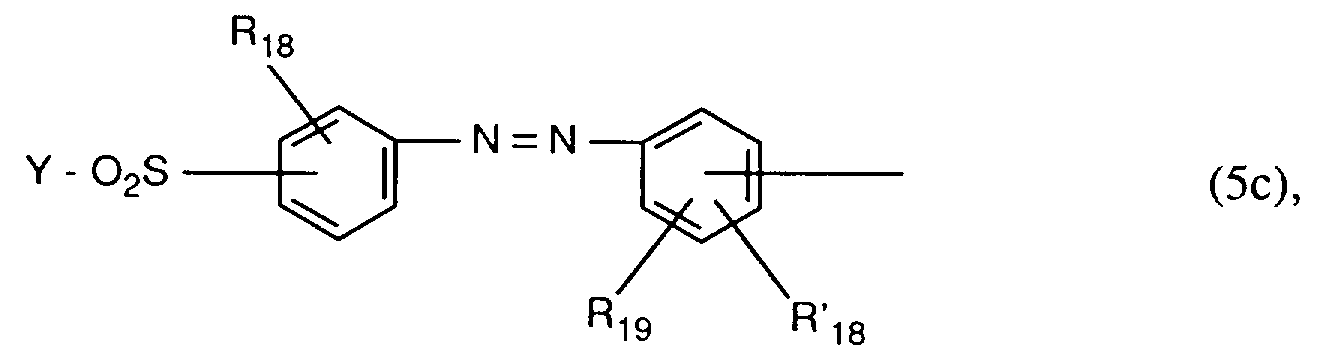
- Eine bevorzugte Ausführungsform der vorliegenden Erfindung stellen Verbindungen der Formel

- Eine weitere bevorzugte Ausführungsform der vorliegenden Erfindung stellen Verbindungen der Formel

- Die Verbindungen der Formel (1) bzw. (1a) oder (1b) können erhalten werden, z.B. indem man in etwa 1 Moläquivalent einer Verbindung der Formel
Z -NH₂ (6)
in üblicher Weise, z.B. mit Nitriten wie Natriumnitrit im sauren, z.B. salzsauren, Medium diazotiert und mit etwa einem Moläquivalent einer Verbindung der Formel

- Die beiden obengenannten Kupplungsreaktionen werden z.B. bei einem neutralen bis leicht sauren pH-Wert, z.B. bei pH 3 bis 7, und Temperaturen von -5 bis 30°C durchgeführt.
- Die Verbindungen der Formeln (6) bis (8) sind bekannt oder können in an sich bekannter Weise erhalten werden.
- Die Verbindungen der Formel (1) eignen sich als Reaktivfarbstoffe zum Färben und Bedrucken der verschiedensten Materialien, wie Seide, Leder, Wolle, Polyamidfasern und Polyurethanen, und insbesondere von cellulosehaltigen Fasermaterialien aller Art. Solche Fasermaterialien sind beispielsweise die natürliche Cellulosefaser, wie Baumwolle, Leinen und Hanf, sowie Zellstoff und regenerierte Cellulose. Die Reaktivfarbstoffe der Formel (1) sind auch zum Färben oder Bedrucken von hydroxylgruppenhaltigen Fasern geeignet, die in Mischgeweben enthalten sind, z.B. von Gemischen aus Baumwolle mit Polyesterfasern oder Polyamidfasern.
- Die erfindungsgemässen Farbstoffe lassen sich auf verschiedene Weise auf das Fasermaterial applizieren und auf der Faser fixieren, insbesondere in Form von wässrigen Farbstofflösungen und -druckpasten. Sie eignen sich sowohl für das Ausziehverfahren als auch zum Färben nach dem Foulardverfahren, können bei niedrigen Färbetemperaturen eingesetzt werden und erfordern bei Pad-Steam-Verfahren nur kurze Dämpfzeiten. Die Fixiergrade sind hoch, und die nicht fixierten Anteile können leicht ausgewaschen werden, wobei die Differenz zwischen Ausziehgrad und Fixiergrad bemerkenswert klein, d.h. der Seifverlust sehr gering ist. Die Reaktivfarbstoffe der Formel (1) eignen sich auch zum Druck, vor allem auf Baumwolle, ebenso aber auch zum Bedrucken von stickstoffhaltigen Fasern, z.B. von Wolle, Seide oder Wolle enthaltenden Mischgeweben.
- Die mit den erfindungsgemässen Farbstoffen hergestellten Färbungen und Drucke auf Cellulosefasermaterialien besitzen eine hohe Farbstärke und eine hohe Faser-Farbstoff-Bindungsstabilität, sowohl in saurem als auch in alkalischem Bereich, weiterhin eine gute Lichtechtheit und sehr gute Nassechtheitseigenschaften, wie Wasch-, Wasser-, Seewasser-, Überfärbe- und Schweissechtheiten, sowie eine gute Plissierechtheit, Bügelechtheit, Reibechtheit und insbesondere Chlorechtheit.
- Die nachfolgenden Beispiele dienen zur Erläuterung der Erfindung. Die Temperaturen sind in Celsiusgraden angegeben, Teile sind Gewichtsteile, die Prozentangaben beziehen sich auf Gewichtsprozente, sofern nicht anderes vermerkt. Gewichtsteile stehen zu Volumenteilen im Verhältnis von Kilogramm zum Liter.
- 28 Teile 2-(4-Aminophenylsulfonyl)-ethyl-hydrogensulfat werden in 150 Teile Wasser eingetragen und gut verrührt. Zu dieser Suspension gibt man 16 Teile konz. Salzsäure, kühlt auf 0 bis 5°C ab und tropft langsam 7 Teile Natriumnitrit, gelöst in 25 Teilen Wasser, zu. Nach erfolgter Diazotierung wird das überschüssige Nitrit mit Sulfaminsäure zerstört.
- Die solchermassen bereitete Diazolösung wird anschliessend bei 0 bis 5°C zu einer Lösung von 32 Teilen 6-Amino-1-hydroxynaphthalin-3,5-disulfonsäure in 150 Teilen Wasser gegeben und dabei der pH-Wert durch Zugabe von Natriumhydroxidlösung konstant bei pH 7 gehalten.
- Nachdem die Kupplung vollständig ist, wird die erhaltene Aminoazoverbindung der Formel

- Verfährt man wie im Beispiel 1 beschrieben und verwendet anstelle von 6-Amino-1-hydroxynaphthalin-3,5-disulfonsäure eine äquivalente Menge 6-Amino-1-hydroxynaphthalin-3,7-disulfonsäure oder 7-Amino-1-hydroxynaphthalin-3,6-disulfonsäure, erhält man Lösungen der Diazoverbindungen von folgenden Amino-Verbindungen.

- 35 Teile 2-(2-Amino-1-sulfonaphth-6-yl-sulfonyl)-ethyl-hydrogensulfat werden in 200 Teile Wasser eingetragen und gut verrührt. Zu dieser Suspension gibt man 16 Teile konz. Salzsäure, kühlt auf 0 bis 5°C ab und tropft langsam 7 Teile Natriumnitrit, gelöst in 25 Teilen Wasser, zu. Nach erfolgter Diazotierung wird das überschüssige Nitrit mit Sulfaminsäure zerstört.
- Die solchermassen bereitete Diazolösung wird anschliessend bei 0 bis 5°C zu einer Lösung von 32 Teilen 6-Amino-1-hydroxynaphthalin-3,5-disulfonsäure in 150 Teilen Wasser gegeben und dabei der pH-Wert durch Zugabe von Natriumhydroxidlösung konstant bei pH 7 gehalten.
- Nachdem die Kupplung vollständig ist, wird die erhaltene Aminoazoverbindung der Formel

- Verfährt man wie im Beispiel 4 beschrieben und verwendet anstelle von 6-Amino-1-hydroxynaphthalin-3,5-disulfonsäure eine äquivalente Menge 6-Amino-1-hydroxynaphthalin-3,7-disulfonsäure oder 7-Amino-1-hydroxynaphthalin-3,6-disulfonsäure, erhält man Lösungen der Diazoverbindungen von folgenden Amino-Verbindungen.

- 63 Teile der Verbindung der Formel

- Die solchermassen bereitete Diazolösung wird anschliessend bei 0 bis 5°C zu einer Lösung von 32 Teilen 6-Amino-1-hydroxynaphthalin-3,5-disulfonsäure in 150 Teilen Wasser gegeben und dabei der pH-Wert durch Zugabe von Natriumhydroxidlösung konstant bei pH 7 gehalten.
- Nachdem die Kupplung vollständig ist, wird die erhaltene Aminoazoverbindung der Formel

- Verfährt man wie im Beispiel 7 beschrieben und verwendet anstelle von 6-Amino-1-hydroxynaphthalin-3,5-disulfonsäure eine äquivalente Menge 6-Amino-1-hydroxynaphthalin-3,7-disulfonsäure oder 7-Amino-1-hydroxynaphthalin-3,6-disulfonsäure, erhält man Lösungen der Diazoverbindungen von folgenden Amino-Verbindungen.

- Analog wie in den Beispielen 7 bis 9 beschrieben lassen sich die Diazoverbindungen der folgenden Amino-Verbindungen herstellen.


- In die Diazolösung 1 gemäss Beispiel 1 werden bei ca. 5°C 20 Teile 1-Ethyl-4-methyl-5-carbamoyl-6-hydroxypyrid-2-on eingetragen. Danach erhöht man den pH-Wert des Reaktionsgemisches durch Zugabe von Natriumhydroxidlösung allmählich auf 7 und rührt, bis die Kupplung komplett ist. Die Farbstofflösung wird dialytisch von Salz befreit und im Vakuum eingedampft. Man erhält die Verbindung, die in Form der freien Säure der Formel

- In die Diazolösung 2 gemäss Beispiel 2 werden bei ca. 5°C 25 Teile 1-(3-sulfophenyl)-3-methylpyrazol-5-on eingetragen. Danach erhöht man den pH-Wert des Reaktionsgemisches durch Zugabe von Natriumhydroxidlösung allmählich auf 7 und rührt, bis die Kupplung komplett ist. Die Farbstofflösung wird dialytisch von Salz befreit und im Vakuum eingedampft. Man erhält die Verbindung, die in Form der freien Säure der Formel

- 18 Teile 1,3,5-Trichlortriazin werden in 100 Teilen Eis/Wasser-Gemisch angeschlämmt und mit 3 Teilen Dinatriumhydrogenphosphat gepuffert. Man tropft eine Lösung von 12 Teilen 2-Aminoethansulfonsäure in 25 Teilen Wasser bei 0 bis 5°C zu und hält den pH-Wert durch Zugabe von Natriumhydroxidlösung bei 7. Nach beendeter Kondensation werden 24 Teile 6-Amino-1-hydroxynaphthalin-3-sulfonsäure unter Konstanthaltung des pH-Werts bei 7 mit Natriumhydroxidlösung eingetragen und anschliessend auf Raumtemperatur erwärmen gelassen. Das nach beendeter Umsetzung erhaltene Biskondensat wird in die Diazolösung 1 gemäss Beispiel 1 getropft und der pH-Wert des Reaktionsgemisches durch Zugabe von Natriumhydroxidlösung allmählich auf 7 erhöht. Man rührt, bis die Kupplung komplett ist, befreit dann die Farbstofflösung dialytisch von Salz und dampft sie im Vakuum ein. Man erhält die Verbindung, die in Form der freien Säure der Formel

- Verfährt man wie im Beispiel 15 angegeben und verwendet anstelle von 24 Teilen 6-Amino-1-hydroxynaphthalin-3-sulfonsäure 26 Teile 6-Methylamino-1-hydroxynaphthalin-3-sulfonsäure, erhält man die Verbindung der Formel

- 18 Teile 1,3,5-Trichlortriazin werden in 100 Teilen Eis/Wasser-Gemisch angeschlämmt und mit 3 Teilen Dinatriumhydrogenphosphat gepuffert. Man tropft eine Lösung von 24 Teilen 1-Amino-8-hydroxynaphthalin-4,6-disulfonsäure in 100 Teilen Wasser zu und hält die Temperatur bei 0 bis 5°C. Nach beendeter Kondensation wird die Diazolösung 9 gemäss Beispiel 9 zugesetzt und der pH-Wert durch Zugabe von Natriumhydroxidlösung auf 7 erhöht. Man lässt unter Konstanthaltung des pH-Werts auf Raumtemperatur erwärmen und rührt, bis die Kupplung beendet ist. Anschliessend gibt man 7,5 Teile 2-N-Methylaminoethanol zu, erhöht den pH-Wert auf 9 und rührt bei diesem pH-Wert, bis die Kondensation vollständig ist. Die Farbstofflösung wird dialytisch von Salz befreit und im Vakuum eingedampft. Man erhält die Verbindung, die in Form der freien Säure der Formel

- Verfährt man wie im Beispiel 16 beschrieben und verwendet anstelle der Diazolösung 9 eine äquivalente Menge der Diazolösungen gemäss Beispiel 10, 11 oder 12, werden die Verbindungen der Formel


- 28 Teile 2-(4-Aminophenylsulfonyl)-ethyl-hydrogensulfat werden wie im Beispiel 1 beschrieben diazotiert und die erhaltene Diazolösung bei 0 bis 5°C zu einer Suspension von 32 Teilen 1-Amino-8-hydroxynaphthalin-3,6-disulfonsäure in 100 Teilen Wasser getropft. Man lässt auf Raumtemperatur erwärmen und rührt, bis die Kupplung vollständig ist. Danach wird auf 5 bis 10°C abgekühlt, der pH-Wert durch Zugabe von Natriumhydroxidlösung auf 3 bis 4 erhöht und die Diazolösung 1 gemäss Beispiel 1 unter Konstanthaltung des pH-Werts langsam zugetropft. Nach beendeter Kupplung wird die Farbstofflösung dialytisch von Salz befreit und im Vakuum eingedampft. Man erhält die Verbindung, die in Form der freien Säure der Formel

- 28 Teile 2-(4-Aminophenylsulfonyl)-ethyl-hydrogensulfat werden wie im Beispiel 1 beschrieben diazotiert und die erhaltene Diazolösung bei 0 bis 5°C zu einer Suspension von 32 Teilen 1-Amino-8-hydroxynaphthalin-3,6-disulfonsäure in 100 Teilen Wasser getropft. Man lässt auf Raumtemperatur erwärmen und rührt, bis die Kupplung vollständig ist. Danach wird auf 5 bis 10°C abgekühlt, der pH-Wert durch Zugabe von Natriumhydroxidlösung auf 3 bis 4 erhöht und die Diazolösung 3 gemäss Beispiel 3 unter Konstanthaltung des pH-Werts langsam zugetropft. Nach beendeter Kupplung wird die Farbstofflösung dialytisch von Salz befreit und im Vakuum eingedampft. Man erhält die Verbindung, die in Form der freien Säure der Formel

- 18 Teile 1,3,5-Trichlortriazin werden in 100 Teilen Eis/Wasser-Gemisch angeschlämmt und mit 3 Teilen Dinatriumhydrogenphosphat gepuffert. Man tropft eine mit Natriumhydroxidlösung neutralisierte Lösung von 27 Teilen
4,6-Diaminobenzol-1,3-disulfonsäure in 100 Teilen Wasser zu, stellt einen pH-Wert von 4,5 ein und hält diesen durch Zugabe von Natriumhydroxidlösung konstant. Nach beendeter Kondensation gibt man 16 Teile konz. Salzsäure dazu, kühlt auf 0 bis 5°C ab und tropft langsam 7 Teile Natriumnitrit, gelöst in 25 Teilen Wasser, zu. Am Ende der Diazotierung wird das überschüssiges Nitrit mit Sulfaminsäure zerstört. Zu der erhaltenen Diazolösung wird bei 0 bis 5°C eine Suspension von 32 Teilen
1-Amino-8-hydroxynaphthalin-3,6-disulfonsäure in 100 Teilen Wasser zugetropft, anschliessend 14 Teile 2-N-Methylaminoethansulfonsäure zugegeben und der pH-Wert langsam auf 6,5 erhöht. Sind die Reaktionen beendet, tropft man die Diazolösung 6 gemäss Beispiel 6 hinzu und hält den pH-Wert konstant bei 6,5. Nach beendeter Kupplung wird die Farbstofflösung dialytisch von Salz befreit und im Vakuum eingedampft. Man erhält die Verbindung, die in Form der freien Säure der Formel
- 2 Teile des gemäss Beispiel 10 erhaltenen Farbstoffes werden in 400 Teilen Wasser gelöst; dazu gibt man 1500 Teile einer Lösung, die pro Liter 53 g Natriumchlorid enthält. In dieses Färbebad geht man bei 40°C mit 100 Teilen Baumwollgewebe ein. Nach 45 Minuten werden 100 Teile einer Lösung, die pro Liter 16 g Natriumhydroxyd und 20 g kalziniertes Soda enthält, zugegeben. Die Temperatur des Färbebades wird weitere 45 Minuten bei 40°C gehalten. Danach wird die gefärbte Ware gespült, während einer Viertelstunde mit einem nichtionogenen Waschmittel kochend geseift, nochmals gespült und getrocknet.
- 2 Teile des gemäss Beispiel 11 erhaltenen Reaktivfarbstoffes werden in 400 Teilen Wasser gelöst; dazu gibt man 1500 Teile einer Lösung die pro Liter 53 g Natriumchlorid enthält. In dieses Färbebad geht man bei 35°C mit 100 Teilen eines Baumwollgewebes ein. Nach 20 Minuten werden 100 Teile einer Lösung, die pro Liter 16 g Natriumhydroxyd und 20 g kalziniertes Soda enthält, zugegeben. Die Temperatur des Färbebades wird weitere 15 Minuten bei 35°C gehalten. Danach wird die Temperatur innerhalb von 20 Minuten auf 60°C erhöht. Die Temperatur wird weitere 35 Minuten bei 60°C gehalten. Danach wird gespült, während einer Viertelstunde mit einem nichtionogenen Waschmittel kochend geseift, nochmals gespült und getrocknet.
- 8 Teile des gemäss Beispiel 12 erhaltenen Reaktivfarbstoffes werden in 400 Teilen Wasser gelöst; dazu gibt man 1400 Teile einer Lösung, die pro Liter 100 g Natriumsulfat enthält. In dieses Färbebad geht man bei 25°C mit 100 Teilen eines Baumwollgewebes ein. Nach 10 Minuten werden 200 Teile einer Lösung, die pro Liter 150 g Trinatriumphosphat enthält, zugegeben. Danach wird die Temperatur des Färbebades innerhalb von 10 Minuten auf 60°C erhöht. Die Temperatur wird weitere 90 Minuten auf 60°C gehalten. Danach wird gespült, während einer Viertelstunde mit einem nichtionogenen Waschmittel kochend geseift, nochmals gespült und getrocknet.
- 4 Teile des gemäss Beispiel 13 erhaltenen Reaktivfarbstoffes werden in 50 Teilen Wasser gelöst. Dazu gibt man 50 Teile einer Lösung, die pro Liter 5 g Natriumhydroxyd und 20 g kalziniertes Soda enthält. Mit der erhaltenen Lösung wird ein Baumwollgewebe foulardiert, so dass es um 70 % seines Gewichts zunimmt, und dann auf eine Kaule aufgewickelt. Das Baumwollgewebe wird so während 3 Stunden bei Raumtemperatur gelagert. Danach wird die gefärbte Ware gespült, während einer Viertelstunde mit einem nichtionogenen Waschmittel kochend geseift, nochmals gespült und getrocknet.
- 6 Teile des gemäss Beispiel 14 erhaltenen Reaktivfarbstoffes werden in 50 Teilen Wasser gelöst. Dazu gibt man 50 Teile einer Lösung, die pro Liter 16 g Natriumhydroxyd und 0,04 Liter Wasserglas (38°bé) enthält. Mit der erhaltenen Lösung wird ein Baumwollgewebe foulardiert, so dass es um 70 % seines Gewichts zunimmt, und dann auf eine Kaule aufgewickelt. Das Baumwollgewebe wird so während 10 Stunden bei Raumtemperatur gelagert. Danach wird die gefärbte Ware gespült, während einer Viertelstunde mit einem nichtionogenen Waschmittel kochend geseift, nochmals gespült und getrocknet.
- 2 Teile des gemäss Beispiel 13 erhaltenen Reaktivfarbstoffes werden unter Zusatz von 0,5 Teilen m-nitrobenzolsulfonsaurem Natrium in 100 Teilen Wasser gelöst. Mit der erhaltenen Lösung wird ein Baumwollgewebe imprägniert, so dass es um 75 % seines Gewichts zunimmt, und dann getrocknet. Dann imprägniert man das Gewebe mit einer 20°C warmen Lösung, die pro Liter 4 g Natriumhydroxyd und 300 g Natriumchlorid enthält, quetscht auf 75 % Gewichtszunahme ab, dämpft die Färbung während 30 Sekunden bei 100 bis 102°C, spült, seift während einer Viertelstunde in einer 0,3%igen kochenden Lösung eines nichtionogenen Waschmittels, spült und trocknet.
- 3 Teile des gemäss Beispiel 15 erhaltenen Reaktivfarbstoffes werden unter schnellem Rühren in 100 Teile einer Stammverdickung, enthaltend 50 Teile 5%ige Natriumalginatverdickung, 27,8 Teile Wasser, 20 Teile Harnstoff, 1 Teil m-nitrobenzolsulfonsaures Natrium sowie 1,2 Teile Natriumhydrogencarbonat, eingestreut. Mit der so erhaltenen Druckpaste bedruckt man ein Baumwollgewebe, trocknet und dämpft den erhaltenen bedruckten Stoff 2 Minuten bei 102°C in gesättigtem Dampf. Das bedruckte Gewebe wird dann gespült, gegebenenfalls kochend geseift und nochmals gespült, und anschliessend getrocknet.
- 5 Teile des gemäss Beispiel 16 erhaltenen Reaktivfarbstoffes werden unter schnellem Rühren in 100 Teile einer Stammverdickung, enthaltend 50 Teile 5%ige Natriumalginatverdickung, 36,5 Teile Wasser, 10 Teile Harnstoff, 1 Teil m-nitrobenzolsulfonsaures Natrium sowie 2,5 Teile Natriumhydrogencarbonat, eingestreut. Mit der so erhaltenen Druckpaste, deren Stabilität den technischen Anforderungen entspricht, bedruckt man ein Baumwollgewebe, trocknet und dämpft den erhaltenen bedruckten Stoff 8 Minuten bei 102°C in gesättigtem Dampf. Das bedruckte Gewebe wird dann gespült, gegebenenfalls kochend geseift und nochmals gespült, und anschliessend getrocknet.
Claims (13)
- Verbindungen der Formel

- SO₂ - Y (2a),
-CONR₁ - (CH₂)n - SO₂ - Y (2b)
und




 R₂ Wasserstoff, gegebenenfalls durch Hydroxy, Sulfo, Sulfato, Carboxy oder Cyano substituiertes C₁-C₄-Alkyl oder einen Rest
 R₃ Wasserstoff, Hydroxy, Sulfo, Sulfato, Carboxy, Cyano, Halogen,C₁-C₄-Alkoxycarbonyl, C₁-C₄-Alkanoyloxy, Carbamoyl oder die Gruppe -SO₂-Y ist,
alk und alk' unabhängig voneinander C₁-C₆-Alkylen sind,
arylen einen unsubstituierten oder durch Sulfo, Carboxy, C₁-C₄-Alkyl, C₁-C₄-Alkoxy oder Halogen substituierten Phenylen- oder Naphthylenrest bedeutetY₁ für eine Gruppe -CHX₂-CH₂X₂ oder -CX₂=CH₂ steht und X₂ Chlor oder Brom bedeutet,Q den Rest -O- oder -NR₁- bedeutet,W für eine Gruppe -SO₂-NR₂-, -CONR₂- oder -NR₂CO- steht,m die Zahl 0 oder 1 istR₁ Wasserstoff oder C₁-C₄-Alkyl ist,Y Vinyl oder einen Rest -CH₂-CH₂-U bedeutet und U eine alkalisch abspaltbare Abgangsgruppe ist, undn für eine ganze Zahl von 1 bis 6 steht. - Verbindungen gemäss Anspruch 1 der Formel


- Verbindungen gemäss Anspruch 1 oder 2, dadurch gekennzeichnet, dass mindestens einer der Reste K und Z eine faserreaktive Gruppe der im Anspruch 1 angegebenen Formel (2a), (2b) oder (2c) aufweist, worin Y Vinyl, β-Brom- oder β-Chlorethyl, β-Acetoxyethyl, β-Benzoyloxyethyl, β-Phosphatoethyl, β-Sulfatoethyl oder β-Thiosulfatoethyl bedeutet, R₁ Wasserstoff ist, n die Zahl 2 oder 3 bedeutet, X Halogen ist und T C₁-C₄-Alkoxy, Hydroxy, Amino, N-Mono- oder N,N-Di-C₁-C₄-Alkylamino, worin das Alkyl unsubstituiert oder durch Hydroxy, Sulfato oder Sulfo substituiert ist, Morpholino, Phenylamino oder N-C₁-C₄-Alkyl-N-phenylamino, worin das Phenyl jeweils unsubstituiert oder durch Sulfo, Carboxy, Acetylamino, Methyl oder Methoxy substituiert ist, oder einen Reaktivrest der im Anspruch 1 angegebenen Formel (3a) bis (3f) bedeutet, worin W eine Gruppe der Formel -CONH- oder -NHCO-, R₁, R₂ und R₃ je Wasserstoff, Q der Rest -O- oder -NH- , alk und alk' unabhängig voneinander je Ethylen oder Propylen, arylen unsubstituiertes oder durch Methyl, Methoxy, Carboxy oder Sulfo substituiertes Phenylen, Y₁ -CHBr-CH₂Br oder -CBr=CH₂ und m die Zahl 0 sind und Y die oben angegebene Bedeutung hat.
- Verbindungen gemäss einem der Ansprüche 1 bis 3, dadurch gekennzeichnet, dass K der Rest einer Kupplungskomponente der Naphthalin-, Phenylazonaphthalin-, 4-Alkyl-6-hydroxypyridon-(2)-, 2,5-Diamino-4-alkylpyridin-, 1-Arylpyrazolon-(5)- oder 1-Aryl-5-aminopyrazol-Reihe ist.
- Verbindungen gemäss einem der Ansprüche 1 bis 4, dadurch gekennzeichnet, dass K einen oder mehrere gleiche oder verschiedene Substituenten aus der Gruppe C₁-C₁₂-Alkyl, C₁-C₈-ASkoxy, im Alkylteil durch Hydroxy, C₁-C₄-Alkoxy oder Sulfato substituiertes C₁-C₄-Alkoxy, C₂-C₈-Acylamino, Amino, gegebenenfalls im Alkylteil durch Hydroxy, Sulfo, Sulfato oder C₁-C₄-Alkoxy substituiertes N-Mono- oder
N,N-Di-C₁-C₄-Alkylamino, gegebenenfalls im Phenylteil durch Methyl, Methoxy, Halogen oder Sulfo substituiertes Phenylamino, gegebenenfalls im Alkylteil durch Hydroxy, Sulfo oder Sulfato oder im Phenylteil gegebenenfalls durch Methyl, Methoxy, Halogen oder Sulfo substituiertes N-C₁-C₄-Alkyl-N-phenylamino, gegebenenfalls durch Sulfo substituiertes Naphthylamino, C₂-C₈-Alkanoyl, Benzoyl, C₁-C₄-Alkoxycarbonyl, C₁-C₄-Alkylsulfonyl, Phenyl- oder Naphthylsulfonyl, Trifluormethyl, Nitro, Cyano, Hydroxyl, Halogen, Carbamoyl, N-C₁-C₄-Alkylcarbamoyl, Sulfamoyl, N-C₁-C₄-Alkylsulfamoyl, N-(β-Hydroxyethyl)-sulfamoyl, N,N-Di-(β-hydroxyethyl)-sulfamoyl, N-Phenylsulfamoyl, Ureido, Carboxy, Sulfomethyl, Sulfo, Sulfato, Rest der Formel
- Verbindungen gemäss einem der Ansprüche 1 bis 5, dadurch gekennzeichnet, dass K für einen Rest der Formel


- Verbindungen gemäss Anspruch 6, dadurch gekennzeichnet, dass K für einen Rest der Formel (4c'), (4h') oder (4h") steht.
- Verbindungen gemäss einem der Ansprüche 1 bis 7, dadurch gekennzeichnet, dass Z einen Phenyl-, Naphthyl-, oder Phenylazophenylrest bedeutet, der eine faserreaktive Gruppe der im Anspruch 1 angegebenen Formel (2a) und/oder (2c) trägt, worin Y Vinyl oder β-Sulfatoethyl, R₁ Wasserstoff, X Chlor oder Fluor und T Amino, N-Mono- oder N,N-Di-C₁-C₄-Alkylamino, worin das Alkyl unsubstituiert oder durch Hydroxy, Sulfato oder Sulfo substituiert ist, Morpholino, Phenylamino oder N-C₁-C₄-Alkyl-N-phenylamino, worin das Phenyl jeweils unsubstituiert oder durch Sulfo, Carboxy, Acetylamino, Methyl oder Methoxy substituiert ist, bedeuten, und weiter unsubstituiert oder durch Methyl, Ethyl, Methoxy, Ethoxy, Chlor, Sulfo oder einen Rest der im Anspruch 5 angegebenen Formel (2c') substituiert ist.
- Verbindungen gemäss einem der Ansprüche 1 bis 8, dadurch gekennzeichnet, dass Z einen Rest der Formel


- Verbindungen gemäss Anspruch 1 der Formel


K für einen Rest der Formel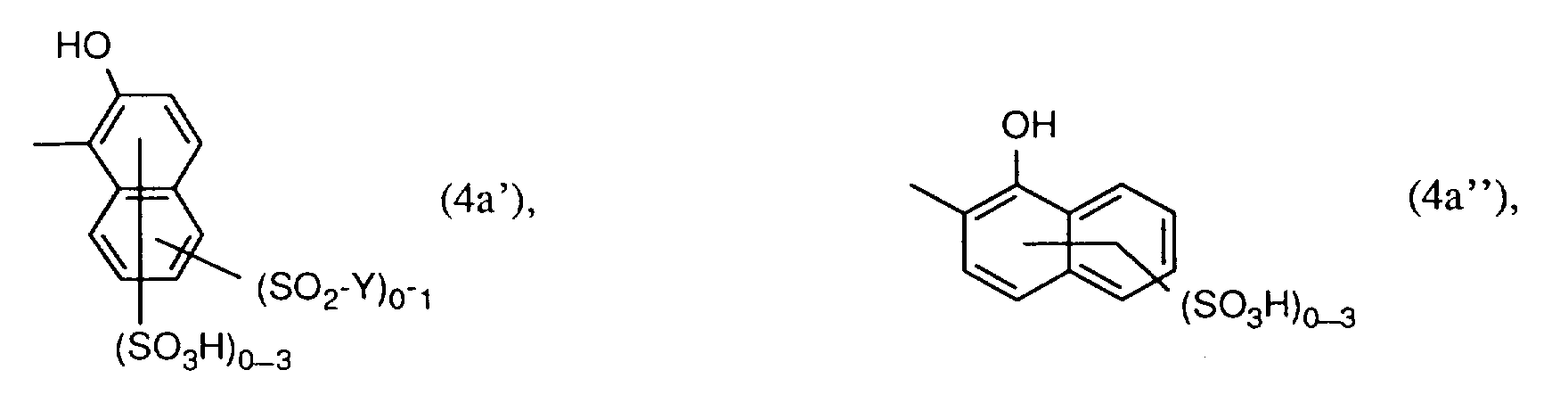


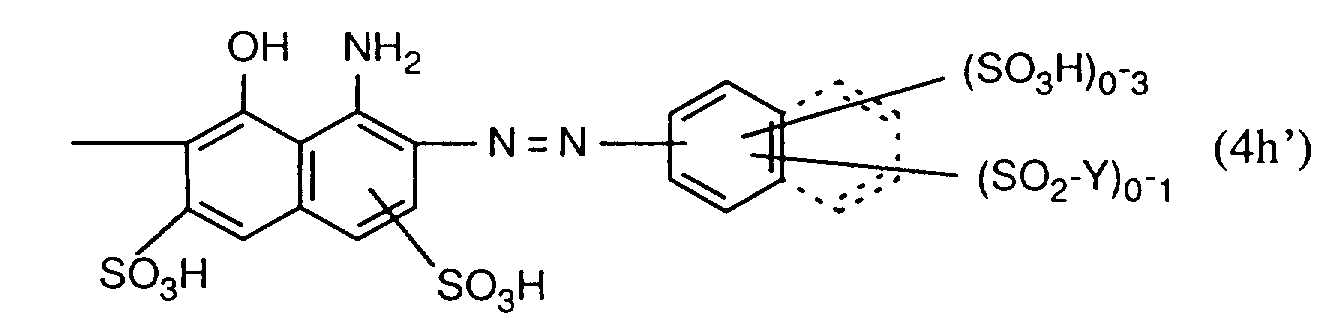

Z einen Rest der Formel


- Verfahren zur Herstellung von Verbindungen der Formel (1) gemäss Anspruch 1, dadurch gekennzeichnet, dass man in etwa 1 Moläquivalent einer Verbindung der Formel
Z -NH₂ (6)
diazotiert und mit etwa einem Moläquivalent einer Verbindung der Formel

- Verwendung von Verbindungen der Formel (1) als faserreaktive Farbstoffe zum Färben oder Bedrucken von hydroxylgruppenhaltigen oder stickstoffhaltigen Fasermaterialien.
- Verwendung gemäss Anspruch 12, dadurch gekennzeichnet, dass man cellulosehaltige Fasermaterialien, insbesondere baumwollhaltige Fasermaterialien, färbt oder bedruckt.
Applications Claiming Priority (3)
| Application Number | Priority Date | Filing Date | Title |
|---|---|---|---|
| CH346894 | 1994-11-17 | ||
| CH3468/94 | 1994-11-17 | ||
| CH346894 | 1994-11-17 |
Publications (2)
| Publication Number | Publication Date |
|---|---|
| EP0712905A1 true EP0712905A1 (de) | 1996-05-22 |
| EP0712905B1 EP0712905B1 (de) | 2001-08-29 |
Family
ID=4256617
Family Applications (1)
| Application Number | Title | Priority Date | Filing Date |
|---|---|---|---|
| EP95810702A Expired - Lifetime EP0712905B1 (de) | 1994-11-17 | 1995-11-08 | Reaktivfarbstoffe, ihre Herstellung und Verwendung |
Country Status (11)
| Country | Link |
|---|---|
| US (1) | US5686584A (de) |
| EP (1) | EP0712905B1 (de) |
| JP (1) | JP3804873B2 (de) |
| KR (1) | KR100429695B1 (de) |
| CN (1) | CN1067704C (de) |
| DE (1) | DE59509557D1 (de) |
| ES (1) | ES2161852T3 (de) |
| MY (1) | MY112819A (de) |
| PT (1) | PT712905E (de) |
| SG (1) | SG33581A1 (de) |
| TW (1) | TW411357B (de) |
Cited By (1)
| Publication number | Priority date | Publication date | Assignee | Title |
|---|---|---|---|---|
| GB2315276A (en) * | 1996-07-11 | 1998-01-28 | Sumitomo Chemical Co | Disazo and trisazo compounds and method for dyeing or textile printing fibre material using the same |
Families Citing this family (5)
| Publication number | Priority date | Publication date | Assignee | Title |
|---|---|---|---|---|
| KR100831600B1 (ko) | 2007-02-09 | 2008-05-23 | (주)경인양행 | 반응성 염료 조성물 및 이를 이용한 섬유의 염색방법 |
| JP6107352B2 (ja) * | 2013-04-12 | 2017-04-05 | 三菱化学株式会社 | 異方性色素膜用色素、該色素を含む組成物、異方性色素膜及び偏光素子 |
| CN105131646B (zh) * | 2015-05-25 | 2017-06-13 | 浙江龙盛集团股份有限公司 | 一种活性黄染料化合物及其制备方法和应用 |
| KR102539305B1 (ko) | 2021-09-03 | 2023-06-02 | 가나온주식회사 | 전기적 가압기능을 이용한 친환경 종이재 용기의 제조방법 및 그로 인해 제조된 종이재 용기 |
| KR20230128225A (ko) | 2022-02-26 | 2023-09-04 | 고광섭 | 전기적 가압방식을 이용한 친환경 종이재의 아이스크림 케이크용 받침판 및 그 제조방법 |
Citations (3)
| Publication number | Priority date | Publication date | Assignee | Title |
|---|---|---|---|---|
| CH487987A (de) * | 1965-08-28 | 1970-03-31 | Hoechst Ag | Verfahren zur Herstellung von Diazofarbstoffen und deren Metallkomplexverbindungen |
| DE3513260A1 (de) * | 1985-04-13 | 1986-10-23 | Bayer Ag, 5090 Leverkusen | Disazoreaktivfarbstoffe |
| CH684482A5 (de) * | 1991-12-20 | 1994-09-30 | Sandoz Ag | Disazo-Reaktivfarbstoffe. |
Family Cites Families (9)
| Publication number | Priority date | Publication date | Assignee | Title |
|---|---|---|---|---|
| US2945021A (en) * | 1956-09-14 | 1960-07-12 | Ciba Ltd | Monoazo and disazo triazine dyes |
| CH430003A (de) * | 1963-10-22 | 1967-02-15 | Geigy Ag J R | Verfahren zur Herstellung reaktiver Disazofarbstoffe |
| DE1794222C3 (de) * | 1968-09-25 | 1975-05-28 | Hoechst Ag, 6000 Frankfurt | Wasserlösliche Diazofarbstoffe und deren Metallkomplexverbindungen, Verfahren zu ihrer Herstellung und ihre Verwendung |
| DE3120187A1 (de) * | 1981-05-21 | 1982-12-09 | Hoechst Ag, 6000 Frankfurt | Wasserloesliche disazoverbindungen, verfahren zu deren herstellung und ihre verwendung als farbstoffe |
| DE3202120A1 (de) * | 1982-01-23 | 1983-07-28 | Hoechst Ag, 6230 Frankfurt | "wasserloesliche kupferkomplex-disazoverbindungen, verfahren zu deren herstellung und ihre verwendng als farbstoffe" |
| DE3477802D1 (en) * | 1983-06-10 | 1989-05-24 | Ciba Geigy Ag | Reactive dyes, their preparation and their use |
| DE3519551A1 (de) * | 1985-05-31 | 1986-12-04 | Bayer Ag, 5090 Leverkusen | Disazometallkomplexfarbstoffe |
| US4939324A (en) * | 1989-08-30 | 1990-07-03 | Key Tronic Corporation | Keyswitch for computer keyboard |
| DE59307910D1 (de) * | 1992-03-05 | 1998-02-12 | Ciba Geigy Ag | Reaktivfarbstoffe, Verfahren zu deren Herstellung und deren Verwendung |
-
1995
- 1995-10-27 TW TW084111442A patent/TW411357B/zh not_active IP Right Cessation
- 1995-11-02 MY MYPI95003308A patent/MY112819A/en unknown
- 1995-11-08 PT PT95810702T patent/PT712905E/pt unknown
- 1995-11-08 EP EP95810702A patent/EP0712905B1/de not_active Expired - Lifetime
- 1995-11-08 SG SG1995001765A patent/SG33581A1/en unknown
- 1995-11-08 DE DE59509557T patent/DE59509557D1/de not_active Expired - Fee Related
- 1995-11-08 ES ES95810702T patent/ES2161852T3/es not_active Expired - Lifetime
- 1995-11-15 US US08/559,263 patent/US5686584A/en not_active Expired - Fee Related
- 1995-11-15 CN CN95119286A patent/CN1067704C/zh not_active Expired - Fee Related
- 1995-11-16 KR KR1019950041588A patent/KR100429695B1/ko not_active Expired - Fee Related
- 1995-11-17 JP JP29959495A patent/JP3804873B2/ja not_active Expired - Fee Related
Patent Citations (3)
| Publication number | Priority date | Publication date | Assignee | Title |
|---|---|---|---|---|
| CH487987A (de) * | 1965-08-28 | 1970-03-31 | Hoechst Ag | Verfahren zur Herstellung von Diazofarbstoffen und deren Metallkomplexverbindungen |
| DE3513260A1 (de) * | 1985-04-13 | 1986-10-23 | Bayer Ag, 5090 Leverkusen | Disazoreaktivfarbstoffe |
| CH684482A5 (de) * | 1991-12-20 | 1994-09-30 | Sandoz Ag | Disazo-Reaktivfarbstoffe. |
Cited By (3)
| Publication number | Priority date | Publication date | Assignee | Title |
|---|---|---|---|---|
| GB2315276A (en) * | 1996-07-11 | 1998-01-28 | Sumitomo Chemical Co | Disazo and trisazo compounds and method for dyeing or textile printing fibre material using the same |
| GB2315276B (en) * | 1996-07-11 | 1999-03-24 | Sumitomo Chemical Co | Polyazo compound and method for dyeing or textile printing fiber material using the same |
| US6015885A (en) * | 1996-07-11 | 2000-01-18 | Sumitomo Chemical Company, Limited | Polyazo compound and method for dyeing or textileprinting fiber material using the same |
Also Published As
| Publication number | Publication date |
|---|---|
| ES2161852T3 (es) | 2001-12-16 |
| CN1067704C (zh) | 2001-06-27 |
| JPH08209016A (ja) | 1996-08-13 |
| DE59509557D1 (de) | 2001-10-04 |
| PT712905E (pt) | 2002-01-30 |
| MY112819A (en) | 2001-09-29 |
| JP3804873B2 (ja) | 2006-08-02 |
| TW411357B (en) | 2000-11-11 |
| KR100429695B1 (ko) | 2004-07-27 |
| KR960017632A (ko) | 1996-06-17 |
| HK1005549A1 (en) | 1999-01-15 |
| US5686584A (en) | 1997-11-11 |
| SG33581A1 (en) | 1996-10-18 |
| EP0712905B1 (de) | 2001-08-29 |
| CN1130177A (zh) | 1996-09-04 |
Similar Documents
| Publication | Publication Date | Title |
|---|---|---|
| EP1137716B1 (de) | Reaktivfarbstoffe, mischungen von reaktivfarbstoffen, deren herstellung und deren verwendung | |
| EP1035171B1 (de) | Azofarbstoffe, deren Herstellung und deren Verwendung | |
| EP0626429A1 (de) | Faserreaktive Farbstoffe, ihre Herstellung und Verwendung | |
| EP0623655A1 (de) | Faserreaktive Farbstoffe, ihre Herstellung und Verwendung | |
| EP0647683B1 (de) | Reaktivfarbstoffe, Verfahren zu deren Herstellung und deren Verwendung | |
| EP0716130B1 (de) | Reaktivfarbstoffe, deren Herstellung und Verwendung | |
| EP0764694B1 (de) | Reaktivfarbstoffe, ihre Herstellung und Verwendung | |
| EP0803543B1 (de) | Faserreaktive Farbstoffe, ihre Herstellung und Verwendung | |
| EP0755985B1 (de) | Farbstoffmischungen, Verfahren zu ihrer Herstellung und ihre Verwendung | |
| EP0712905B1 (de) | Reaktivfarbstoffe, ihre Herstellung und Verwendung | |
| EP0625551A1 (de) | Farbstoffmischungen, Verfahren zu deren Herstellung und deren Verwendung | |
| EP0776947B1 (de) | Faserreaktive Farbstoffe, ihre Herstellung und Verwendung | |
| EP0748850A1 (de) | Farbstoffe, Verfahren zu deren Herstellung und deren Verwendung | |
| EP0761768B1 (de) | Reaktivfarbstoffe, Verfahren zu deren Herstellung und deren Verwendung | |
| EP0285571B1 (de) | Reaktivfarbstoffe, deren Herstellung und Verwendung | |
| EP0581729B1 (de) | Reaktivfarbstoffe, Verfahren zu deren Herstellung und deren Verwendung | |
| EP0641839B1 (de) | Faserreaktive Farbstoffe, deren Herstellung und Verwendung | |
| EP0812886B1 (de) | Reaktivfarbstoffe, ihre Herstellung und Verwendung | |
| EP0581732B1 (de) | Farbstoffmischungen, Verfahren zu deren Herstellung und deren Verwendung | |
| EP0581731B1 (de) | Reaktivfarbstoffe, Verfahren zu deren Herstellung und deren Verwendung | |
| EP0688832A2 (de) | Reaktivfarbstoffe, ihre Herstellung und Verwendung | |
| EP1095105B1 (de) | Reaktivfarbstoffe, deren herstellung und deren verwendung | |
| EP0581733B1 (de) | Reaktivfarbstoffe, Verfahren zu deren Herstellung und deren Verwendung | |
| DE60010362T2 (de) | Reaktivfarbstoffe, Verfahren zu deren Herstellung und deren Verwendung | |
| EP1036825B1 (de) | Reaktivfarbstoffe, Verfahren zu deren Herstellung und deren Verwendung |
Legal Events
| Date | Code | Title | Description |
|---|---|---|---|
| PUAI | Public reference made under article 153(3) epc to a published international application that has entered the european phase |
Free format text: ORIGINAL CODE: 0009012 |
|
| AK | Designated contracting states |
Kind code of ref document: A1 Designated state(s): BE CH DE ES FR GB IT LI PT |
|
| 17P | Request for examination filed |
Effective date: 19961104 |
|
| RAP1 | Party data changed (applicant data changed or rights of an application transferred) |
Owner name: CIBA SC HOLDING AG |
|
| RAP3 | Party data changed (applicant data changed or rights of an application transferred) |
Owner name: CIBA SPECIALTY CHEMICALS HOLDING INC. |
|
| 17Q | First examination report despatched |
Effective date: 20000505 |
|
| GRAG | Despatch of communication of intention to grant |
Free format text: ORIGINAL CODE: EPIDOS AGRA |
|
| GRAG | Despatch of communication of intention to grant |
Free format text: ORIGINAL CODE: EPIDOS AGRA |
|
| GRAH | Despatch of communication of intention to grant a patent |
Free format text: ORIGINAL CODE: EPIDOS IGRA |
|
| GRAH | Despatch of communication of intention to grant a patent |
Free format text: ORIGINAL CODE: EPIDOS IGRA |
|
| GRAH | Despatch of communication of intention to grant a patent |
Free format text: ORIGINAL CODE: EPIDOS IGRA |
|
| GRAA | (expected) grant |
Free format text: ORIGINAL CODE: 0009210 |
|
| AK | Designated contracting states |
Kind code of ref document: B1 Designated state(s): BE CH DE ES FR GB IT LI PT |
|
| REG | Reference to a national code |
Ref country code: CH Ref legal event code: EP |
|
| GBT | Gb: translation of ep patent filed (gb section 77(6)(a)/1977) |
Effective date: 20010829 |
|
| REF | Corresponds to: |
Ref document number: 59509557 Country of ref document: DE Date of ref document: 20011004 |
|
| REG | Reference to a national code |
Ref country code: ES Ref legal event code: FG2A Ref document number: 2161852 Country of ref document: ES Kind code of ref document: T3 |
|
| REG | Reference to a national code |
Ref country code: GB Ref legal event code: IF02 |
|
| ET | Fr: translation filed | ||
| REG | Reference to a national code |
Ref country code: PT Ref legal event code: SC4A Free format text: AVAILABILITY OF NATIONAL TRANSLATION Effective date: 20011029 |
|
| PLBE | No opposition filed within time limit |
Free format text: ORIGINAL CODE: 0009261 |
|
| STAA | Information on the status of an ep patent application or granted ep patent |
Free format text: STATUS: NO OPPOSITION FILED WITHIN TIME LIMIT |
|
| 26N | No opposition filed | ||
| PGFP | Annual fee paid to national office [announced via postgrant information from national office to epo] |
Ref country code: CH Payment date: 20021018 Year of fee payment: 8 |
|
| PGFP | Annual fee paid to national office [announced via postgrant information from national office to epo] |
Ref country code: PT Payment date: 20021023 Year of fee payment: 8 |
|
| PGFP | Annual fee paid to national office [announced via postgrant information from national office to epo] |
Ref country code: ES Payment date: 20021108 Year of fee payment: 8 |
|
| PGFP | Annual fee paid to national office [announced via postgrant information from national office to epo] |
Ref country code: BE Payment date: 20021227 Year of fee payment: 8 |
|
| PG25 | Lapsed in a contracting state [announced via postgrant information from national office to epo] |
Ref country code: ES Free format text: LAPSE BECAUSE OF NON-PAYMENT OF DUE FEES Effective date: 20031110 |
|
| PG25 | Lapsed in a contracting state [announced via postgrant information from national office to epo] |
Ref country code: LI Free format text: LAPSE BECAUSE OF NON-PAYMENT OF DUE FEES Effective date: 20031130 Ref country code: CH Free format text: LAPSE BECAUSE OF NON-PAYMENT OF DUE FEES Effective date: 20031130 Ref country code: BE Free format text: LAPSE BECAUSE OF NON-PAYMENT OF DUE FEES Effective date: 20031130 |
|
| BERE | Be: lapsed |
Owner name: *CIBA SPECIALTY CHEMICALS HOLDING INC. Effective date: 20031130 |
|
| PG25 | Lapsed in a contracting state [announced via postgrant information from national office to epo] |
Ref country code: PT Free format text: LAPSE BECAUSE OF NON-PAYMENT OF DUE FEES Effective date: 20040531 |
|
| REG | Reference to a national code |
Ref country code: CH Ref legal event code: PL |
|
| REG | Reference to a national code |
Ref country code: PT Ref legal event code: MM4A Free format text: LAPSE DUE TO NON-PAYMENT OF FEES Effective date: 20040531 |
|
| REG | Reference to a national code |
Ref country code: ES Ref legal event code: FD2A Effective date: 20031110 |
|
| PGFP | Annual fee paid to national office [announced via postgrant information from national office to epo] |
Ref country code: DE Payment date: 20071130 Year of fee payment: 13 |
|
| PGFP | Annual fee paid to national office [announced via postgrant information from national office to epo] |
Ref country code: IT Payment date: 20071120 Year of fee payment: 13 |
|
| PGFP | Annual fee paid to national office [announced via postgrant information from national office to epo] |
Ref country code: GB Payment date: 20071005 Year of fee payment: 13 Ref country code: FR Payment date: 20071105 Year of fee payment: 13 |
|
| GBPC | Gb: european patent ceased through non-payment of renewal fee |
Effective date: 20081108 |
|
| PG25 | Lapsed in a contracting state [announced via postgrant information from national office to epo] |
Ref country code: IT Free format text: LAPSE BECAUSE OF NON-PAYMENT OF DUE FEES Effective date: 20081108 |
|
| REG | Reference to a national code |
Ref country code: FR Ref legal event code: ST Effective date: 20090731 |
|
| PG25 | Lapsed in a contracting state [announced via postgrant information from national office to epo] |
Ref country code: DE Free format text: LAPSE BECAUSE OF NON-PAYMENT OF DUE FEES Effective date: 20090603 |
|
| PG25 | Lapsed in a contracting state [announced via postgrant information from national office to epo] |
Ref country code: GB Free format text: LAPSE BECAUSE OF NON-PAYMENT OF DUE FEES Effective date: 20081108 |
|
| PG25 | Lapsed in a contracting state [announced via postgrant information from national office to epo] |
Ref country code: FR Free format text: LAPSE BECAUSE OF NON-PAYMENT OF DUE FEES Effective date: 20081130 |