EP0712907B1 - Water-soluble phthalocyanine dyes, process for their manufacture and use thereof - Google Patents
Water-soluble phthalocyanine dyes, process for their manufacture and use thereof Download PDFInfo
- Publication number
- EP0712907B1 EP0712907B1 EP19940118191 EP94118191A EP0712907B1 EP 0712907 B1 EP0712907 B1 EP 0712907B1 EP 19940118191 EP19940118191 EP 19940118191 EP 94118191 A EP94118191 A EP 94118191A EP 0712907 B1 EP0712907 B1 EP 0712907B1
- Authority
- EP
- European Patent Office
- Prior art keywords
- carbon atoms
- formula
- alkyl
- zero
- phthalocyanine dye
- Prior art date
- Legal status (The legal status is an assumption and is not a legal conclusion. Google has not performed a legal analysis and makes no representation as to the accuracy of the status listed.)
- Expired - Lifetime
Links
- IZOQZPVNVUGPAB-FIFLTTCUSA-N C/C(/N)=C(/C=CC=C1)\C1=C(/C)\N Chemical compound C/C(/N)=C(/C=CC=C1)\C1=C(/C)\N IZOQZPVNVUGPAB-FIFLTTCUSA-N 0.000 description 2
- GOALWKUVFUGSAH-XMYBZPLFSA-N CC(C1C=CC=CC1C(/N=C(/C1C=CC=CC1/C(/C)=N/C(c(cccc1)c1C(C)=C)=N)\NC)=N)=C Chemical compound CC(C1C=CC=CC1C(/N=C(/C1C=CC=CC1/C(/C)=N/C(c(cccc1)c1C(C)=C)=N)\NC)=N)=C GOALWKUVFUGSAH-XMYBZPLFSA-N 0.000 description 1
- GTBWUNKJSDRTRV-ISLQGBGESA-N CC(c(cccc1)c1/C(/C)=N/C(c1ccccc1C(C)=C)=N)=C Chemical compound CC(c(cccc1)c1/C(/C)=N/C(c1ccccc1C(C)=C)=N)=C GTBWUNKJSDRTRV-ISLQGBGESA-N 0.000 description 1
- GVEOAPLPUCEPDW-UHFFFAOYSA-N CC(c(cccc1)c1C(N)=N)=C Chemical compound CC(c(cccc1)c1C(N)=N)=C GVEOAPLPUCEPDW-UHFFFAOYSA-N 0.000 description 1
- PNRUNNHPSMLELM-UHFFFAOYSA-N CNc(cc1)ccc1S(=O)=O Chemical compound CNc(cc1)ccc1S(=O)=O PNRUNNHPSMLELM-UHFFFAOYSA-N 0.000 description 1
Classifications
-
- C—CHEMISTRY; METALLURGY
- C09—DYES; PAINTS; POLISHES; NATURAL RESINS; ADHESIVES; COMPOSITIONS NOT OTHERWISE PROVIDED FOR; APPLICATIONS OF MATERIALS NOT OTHERWISE PROVIDED FOR
- C09B—ORGANIC DYES OR CLOSELY-RELATED COMPOUNDS FOR PRODUCING DYES, e.g. PIGMENTS; MORDANTS; LAKES
- C09B62/00—Reactive dyes, i.e. dyes which form covalent bonds with the substrates or which polymerise with themselves
- C09B62/44—Reactive dyes, i.e. dyes which form covalent bonds with the substrates or which polymerise with themselves with the reactive group not directly attached to a heterocyclic ring
- C09B62/503—Reactive dyes, i.e. dyes which form covalent bonds with the substrates or which polymerise with themselves with the reactive group not directly attached to a heterocyclic ring the reactive group being an esterified or non-esterified hydroxyalkyl sulfonyl or mercaptoalkyl sulfonyl group, a quaternised or non-quaternised aminoalkyl sulfonyl group, a heterylmercapto alkyl sulfonyl group, a vinyl sulfonyl or a substituted vinyl sulfonyl group, or a thiophene-dioxide group
- C09B62/517—Porphines; Azaporphines
Definitions
- the invention is in the technical field of fiber-reactive dyes.
- the phthalocyanine dyes according to the invention are generally in the form obtained from mixtures of the individual compounds of the general formula (1), these individual compounds differ from one another by the degree of substitution distinguish the sulfo and sulfonamide groups on the phthalocyanine residue.
- the Formulas of the phthalocyanine dyes according to the invention therefore have indices which are usually fractional numbers.
- Alkaline eliminable substituents which are in the ⁇ -position of the ethyl group of Y are, for example halogen atoms such as bromine and chlorine, ester groups organic carboxylic and sulfonic acids, such as alkyl carboxylic acids, optionally substituted benzene carboxylic acids and optionally substituted benzenesulfonic acids, such as the alkanoyloxy groups from 2 to 5 Carbon atoms, of which in particular acetyloxy, benzoyloxy, sulfobenzoyloxy, Phenylsulfonyloxy and Toluylsulfonyloxy, furthermore acidic ester groups inorganic acids such as phosphoric acid, sulfuric acid and Thiosulfuric acid (phosphato, sulfato and thiosulfato groups), as well Dialkylamino groups with alkyl groups of 1 to 4 carbon atoms each, such as Dimethylamino and diethylamino
- sulfo groups mean groups corresponding to the general formula -SO 3 M
- carboxy groups correspond to the general formula -COOM
- thiosulfato groups correspond to the general formula -S-SO 3 M
- phosphato groups correspond to the general formula -OPO 3 M 2
- sulfato groups correspond to groups of the general formula -OSO 3 M, in which M has the meaning given above.
- Formula residues of the general formula -B-SO 2 -Y are, for example: 2- ( ⁇ -sulfatoethylsulfonyl) phenyl, 3- ( ⁇ -sulfatoethylsulfonyl) phenyl, 4- ( ⁇ -sulfatoethylsulfonyl) phenyl, 2-carboxy-5- ( ⁇ -sulfatoethylsulfonyl) phenyl, 2-chloro-3- ( ⁇ -sulfatoethylsulfonyl) phenyl, 2-chloro-4- ( ⁇ -sulfatoethylsulfonyl) phenyl, 2-bromo-4- ( ⁇ -sulfatoethylsulfonyl) phenyl, 4-methoxy-3- ( ⁇ -sulfatoethylsulfonyl) phenyl, 4-chloro-3- ( ⁇ -sulfatoethy
- R 3 is preferably hydrogen, methyl or methoxy
- R 4 is preferably hydrogen or methoxy.
- a is a number from zero to 3, preferably from 1 to 2.5
- b is from zero to 2
- c is a number from 1 to 4 , preferably from 1 to 2.
- Residues of the general formula -NR 1 R 2 are, for example, amino, methylamino, ethylamino, butylamino, benzylamino, ⁇ -hydroxyethylamino, dimethylamino, diethylamino, di (isopropyl) amino, N-methylbenzylamino, N-piperidino, N -Morpholino, di- ( ⁇ -hydroxyethyl) amino, ⁇ -sulfo-ethylamino, ⁇ -carboxy-ethylamino, ⁇ - (4-carboxy-phenyl) -ethylamino, phenylamino, N-methyl-phenylamino, 3-sulfo-phenylamino , 4-sulfo-phenylamino and cyanoamino.
- the present invention further relates to a process for the preparation of the phthalocyanine compounds of the general formula (1), which is characterized in that a phthalocyanine sulfonyl chloride of the general formula (3) in which PC and M has the meaning given above, p is a number from zero to 3 and q is a number from 1 to 4, the sum of (p + q) being 1 to 4, or a mixture thereof in aqueous or non-aqueous medium with an amine of the general formula (4) H 2 N ⁇ B ⁇ SO 2 ⁇ Y in which B and Y have the abovementioned meanings and Y here can also have the meaning of ⁇ -hydroxyethyl, and optionally with a further amino group-containing compound of the general formula H-NR 1 R 2 with R 1 and R 2 of the abovementioned meaning simultaneously or in in any order and with simultaneous or subsequent partial hydrolysis of the sulfochloride groups to sulfo groups.
- sulfochloride groups still present are hydrolyzed to sulfo groups at the end of the condensation reactions.
- partial hydrolysis of the sulfonyl chloride groups to sulfo groups is generally inevitable.
- the ⁇ -hydroxyethylsulfonyl group in the phthalocyanine compound obtained can be converted into a group of the formula -SO 2 -Y with Y equal to one in ⁇ - Position replaced by an ester group-substituted ethyl group, such as in the ⁇ -sulfatoethylsulfonyl group using sulfuric acid or sulfuric acid containing sulfur trioxide or chlorosulfonic acid.
- the condensation reactions according to the invention between the compounds of the general formula (3) and the amines of the general formulas (4) and H-NR 1 R 2 are in particular at a pH between 3.5 and 8.5, preferably between 4 and 8 between 5.5 and 6.5, and at a temperature between 0 ° C and 100 ° C, preferably between 20 and 60 ° C, in particular between 45 and 55 ° C.
- a catalyst such as pyridine, a pyridinesulfonic acid, pyridinecarboxylic acid, pyridinesulfonamide or pyridinecarbonamide compound, such as, preferably, nicotinic acid amide, analogously to those known from the initially mentioned US Pat. Nos. Or US Pat Procedures.
- the starting phthalocyanine sulfonic acid chloride compounds of the general formula (3) are prepared analogously to known procedures, as can be seen, for example, from information in the aforementioned US patent steps and from German Patent No. 891 121.
- a compound of the general formula (3) is prepared in such a way that the phthalocyanine of the formula (A) is introduced into chlorosulfonic acid and the batch is at a temperature between 80 and 150 ° C., preferably between 100 and 140 ° C., several Stirs for hours, then a chlorinating agent, preferably thionyl chloride, is added and the batch is stirred at 80 to 90 ° C. for several hours.
- Another possibility of producing a compound of the general formula (3) is the reaction of the phthalocyanine of the formula (A) with sulfuric acid / sulfur trioxide in sulfuric acid (oleum) containing sulfur trioxide with a sulfur trioxide content of about 50 to 65% by weight at about 80 ° C. After this reaction, the mixture is stirred into an ice-cooled aqueous solution of sodium chloride and the metal-containing phthalocyanine sulfonic acid obtained is converted into the phthalocyanine sulfonic acid chloride by customary procedures, for example using thionyl chloride in dimethylformamide.
- the metal phthalocyanine starting compounds of the general formula (A) are known or can be prepared analogously to known procedures.
- Literature on this can be found in US Pat. No. 2,202,632, the Swiss Patent 280 478, British patents 679 773 and 1 306 055, German Offenlegungsschrift 2 136 767, the French Patent Application Publication 2 103 195 and U.S. Patent 2,155,038 to be named.
- the deposition of the phthalocyanine dyes produced according to the invention general formula (1), hereinafter referred to as "dyes (1)”, from the Synthesis approaches are carried out either according to generally known methods Precipitation from the reaction medium using electrolytes, such as Sodium chloride or potassium chloride, or by evaporating the reaction solution, for example by spray drying, this reaction solution Buffer substance can be added.
- the dyes (1) have fiber-reactive Properties and have very good color shadows. You can therefore for dyeing and printing hydroxy and / or material containing carbonamide groups, in particular fiber material, and also of Leather.
- those in the synthesis of the Solutions according to the invention if appropriate after Add a buffer substance, if necessary after concentration, directly as Liquid preparation can be used for staining.
- the present invention therefore also relates to the use of Dyes (1) for dyeing (including printing) of hydroxy and Materials containing carbonamide groups and processes for their use on these substrates.
- the materials preferably come in the form of Fiber materials for use, especially in the form of textile fibers, such as Yarns, packages and fabrics.
- Materials containing hydroxyl groups are natural or synthetic materials containing hydroxyl groups, such as cellulose fiber materials, also in the form of paper, or their regenerated products and polyvinyl alcohols.
- Cellulose fiber materials are preferably cotton, but also others Vegetable fibers; like linen, hemp, jute and ramie fibers; regenerated Cellulose fibers are, for example, cellulose and viscose rayon.
- Materials containing carbonamide groups are, for example, synthetic and natural polyamides and polyurethanes, especially in the form of fibers, for example wool and other animal hair, silk, leather, polyamide-6,6, Polyamide-6, polyamide-11 and polyamide-4.
- the dyes (1) can, in particular, on the substrates mentioned the fiber materials mentioned, according to those for water-soluble dyes, especially for fiber-reactive dyes, known application techniques apply and fix. So you get with them on cellulose fibers after Extraction process from a long fleet using a wide variety acid-binding agents and optionally neutral salts, such as sodium chloride or sodium sulfate, dyeings in very good color yields and with excellent color structure. You dye at temperatures between 40 and 105 ° C, if appropriate at temperatures up to 130 ° C under pressure, optionally in the presence of customary dyeing auxiliaries, in aqueous Bath. You can do this by putting the material in the warm bath introduces and gradually warmed to the desired dyeing temperature and complete the dyeing process at this temperature. The undressing of the dye accelerating neutral salts can bath if desired, only after reaching the actual dyeing temperature be added.
- acid-binding agents and optionally neutral salts such as sodium chloride or sodium sulfate
- dyeings are also made on cellulose fibers get excellent color yields and very good color build, whereby by staying at room temperature or elevated temperature, for example up to about 60 ° C, by steaming or with dry heat in the usual way can be fixed.
- You can also get the usual printing process for cellulose fibers can be carried out either in one phase, for example by Print with a sodium bicarbonate or other acid binding agent and printing paste containing the colorant and then steaming at 100 to 103 ° C, or which can be carried out in two phases, for example by printing with neutral or slightly acidic, the Printing paste containing colorant and subsequent fixing either by Passing the printed goods through a hot electrolyte alkaline bath or by padding with an alkaline electrolyte Block liquor with subsequent lingering of this treated material or subsequent steaming or subsequent treatment with dry heat, strong-colored prints with good contours and a clear white background. The failure of the prints is little of changing fixing conditions dependent. Both in the dyeing and in the printing works are the ones with the The degrees of fixation obtained according to the invention are very high.
- the acid-binding and the fixation of the dyes on the cellulose fibers effecting agents are, for example, water-soluble basic salts of Alkali metals and the alkaline earth metals of inorganic or organic Acids, as well as compounds that release alkali in the heat.
- the alkali metal hydroxides and alkali metal salts of to name weak to moderate inorganic or organic acids, of the alkali compounds preferably the sodium and Potassium compounds are meant.
- Such acid-binding agents are for example sodium hydroxide, potassium hydroxide, sodium carbonate, Sodium bicarbonate, potassium carbonate, sodium formate, Sodium dihydrogen phosphate and disodium hydrogen phosphate.
- the dyes are chemically attached to the Cellulose fiber bound; especially the cellulose stains show after the usual post-treatment by rinsing to remove unfixed Dye proportions have excellent wet fastness properties, especially since they did not fix Wash out dye parts easily because of their good cold water solubility to let.
- the dyeings on polyurethane and polyamide fibers are usually made from acidic environment. So you can, for example, the dyebath acetic acid and / or ammonium sulfate and / or acetic acid and ammonium acetate or Add sodium acetate to get the desired pH.
- leveling aids such as based on a Reaction product of cyanuric chloride with three times the molar amount of one Aminobenzenesulfonic acid or aminonaphthalenesulfonic acid or based on a Reaction product of, for example, stearylamine with ethylene oxide.
- the material to be colored is at a temperature of around 40 ° C Bath introduced, moved there for some time, then the dye bath on the desired weakly acidic, preferably weakly acetic acid pH adjusted and the actual coloring at a temperature between 60 and 98 ° C carried out.
- the dyeings can also at boiling temperature or at temperatures up to 120 ° C (under pressure).
- Cellulose fiber materials have a high color strength and also good ones Light fastness and good wet fastness, such as washing, walking, water, Seawater, dyeing and sweat fastness, good as well Fastness to pleating, fastness to ironing and fastness to rubbing.
- the following examples serve to illustrate the invention.
- the compounds described by formula are given in the form of the free acid; generally they are prepared and isolated in the form of their alkali metal salts and used in the form of their salts for dyeing.
- the starting compounds mentioned in the following examples, in particular table examples in the form of the free acid as such or in the form of their salts, preferably alkali metal salts, such as lithium, sodium or potassium salts, can be used in the synthesis.
- the parts mentioned in the examples are parts by weight; the percentages represent percentages by weight, unless stated otherwise. Parts by weight relate to parts by volume in the ratio of kilograms to liters.
- the absorption maxima ( ⁇ max ) in the visible range specified for the compounds according to the invention were determined on the basis of their alkali metal salts in aqueous solution.
- the ⁇ max values are given in brackets when specifying the color; the wavelength specification refers to nm.
- this dichlorosilicon-phthalocyanine compound 30 parts are introduced into 440 parts of chlorosulfonic acid. The reaction is carried out for about four hours with vigorous stirring at 130 ° C., the batch is then cooled to 85 ° C. and 180 parts of thionyl chloride are slowly added over about 30 minutes. The reaction is carried out under reflux at about 85 ° C. for a further four hours, the batch is then added to 3000 parts of ice with stirring and the dichlorosilicon-phthalocyanine tetrasulfochloride of the formula obtained is filtered in the form of a moist filter cake.
- a solution with a pH of 6.5 of 36 parts 4- ( ⁇ -sulfatoethylsulfonyl) aniline in 100 parts of water are stirred with isolated as a moist filter cake Zinc (II) phthalocyanine sulfochloride from Example A and 4 parts of nicotinamide were added.
- the approach is still stirred two hours at 50 ° C and then at about 20 ° C while maintaining the pH of 6.5 after.
- the Approach filtered and the phthalocyanine dye according to the invention through Salt out with sodium chloride or by evaporating the reaction solution isolated under reduced pressure.
- the phthalocyanine dye according to the invention written in the form of the free acid, has the formula
- a phthalocyanine dye according to the invention is as described in Example 1, but instead of 4- ( ⁇ -sulfatoethylsulfonyl) aniline, the same amount of 3- ( ⁇ -sulfatoethylsulfonyl) aniline is used in the reaction mixture.
- the resulting phthalocyanine dye of the formula (written in the form of the free acid) shows good fiber-reactive, application properties and dyes, for example, cellulose fiber materials, such as cotton, according to the dyeing and printing processes customary in the art for fiber-reactive dyes in strong, brilliant green tones with good fastness properties.
- the dye according to the invention has very good fiber-reactive Dye properties and delivers on those mentioned in the description
- Fiber materials, such as cotton, according to those in the art for fiber-reactive dyes usual printing and dyeing processes strong, true, green prints and dyes.
- a solution with a pH of 6 of 16.3 parts of 4- ( ⁇ -sulfatoethylsulfonyl) aniline in 200 parts of water is added at a temperature of 35 ° C. while maintaining a pH between 5.8 and 6 , 2. 1.66 parts of nicotinamide and the dimethyl silicon phthalocyanine tetrasulfochloride obtained according to Example C as a water-moist filter cake.
- the mixture is stirred for some time under these reaction conditions and then the phthalocyanine dye according to the invention obtained, which, written in the form of the free acid, the formula, is isolated has, by evaporation of the aqueous synthesis solution under reduced pressure at about 60 ° C. It has very good dye properties and, for example on cellulose fiber materials, provides strong, true colors and prints in dark green tones under the conditions of use customary in technology for fiber-reactive dyes.
Landscapes
- Chemical & Material Sciences (AREA)
- Organic Chemistry (AREA)
- Coloring (AREA)
Description
Die Erfindung liegt auf dem technischen Gebiet der faserreaktiven Farbstoffe.The invention is in the technical field of fiber-reactive dyes.
Die Praxis des Färbens mit faserreaktiven Farbstoffen stellt zunehmend erhöhte Anforderungen an die Qualität der Färbungen und die ökologische Verträglichkeit der Farbstoffe und des Färbeprozesses. Infolgedessen besteht weiterhin insbesondere im Hinblick auf die ökologische Unbedenklichkeit der Verwendung der Farbstoffe der Bedarf nach neuen, insbesondere schwermetallfreien faserreaktiven Farbstoffen, die zudem gute färberische Qualitäten und Echtheitseigenschaften besitzen. Beispielsweise sind in den U.S.-Patentschriften Nrs. 4 237 050, 4 350 632 und 4 745 187 faserreaktive Schwermetallkomplex-Phthalocyaninfarbstoffe, wie insbesondere Kupfer- und Nickelphthalocyaninfarbstoffe, mit guten färberischen Eigenschaften beschrieben, die, über einen N-Arylsulfonamid- oder N-Alkylsulfonamid-Rest gebunden, eine faserreaktive Gruppe der Vinylsulfonreihe besitzen. Beim Zerfall dieser Schwermetallkomplex-Phthalocyaninfarbstoffe, beispielsweise beim Entsorgen von Färbereiabwässern und bei gebrauchten Textilien, werden deren Schwermetalle in die Umgebung freigesetzt, so daß die Schwermetalle in die Abwässer und Klärschlämme gelangen. Für die Einschränkung der Belastung von Abwässern und Klärschlämmen durch Schwermetallionen bestehen bereits umfangreiche gesetzliche Regelungen, so daß ein Weg gesucht werden mußte, die bisher bekannten Schwermetall-Phthalocyaninfarbstoffe durch andere, insbesondere solche ohne Schwermetallionenanteil, zu ersetzen.The practice of dyeing with fiber-reactive dyes is increasingly increasing Requirements for the quality of the dyeings and the ecological compatibility of dyes and the dyeing process. As a result, it persists especially with regard to the ecological safety of the use the dyes the need for new, especially heavy metal free fiber-reactive dyes, which also have good dyeing qualities and Possess authenticity properties. For example, in U.S. patents No. 4,237,050, 4,350,632 and 4,745,187 fiber reactive Heavy metal complex phthalocyanine dyes, such as in particular copper and Nickel phthalocyanine dyes, with good coloring properties described, the, via an N-arylsulfonamide or N-alkylsulfonamide radical bound, have a fiber-reactive group of the vinyl sulfone series. When decaying this heavy metal complex phthalocyanine dyes, for example Disposal of dyeing waste water and used textiles, will be their Heavy metals released into the environment, so that the heavy metals in the Sewage and sewage sludge get. For the limitation of the burden of Waste water and sewage sludge from heavy metal ions already exist extensive legal regulations, so that a way had to be found the previously known heavy metal phthalocyanine dyes by others, especially those without Heavy metal ion content to replace.
Mit der vorliegenden Erfindung wurden nunmehr neue, wasserlösliche
Phthalocyaninfarbstoffe der nachstehend angegebenen allgemeinen Formel (1)
gefunden, deren Metallzentralatom diesbezüglich unbedenklich ist und mit
denen qualitativ hochwertige Färbungen in brillanten grünen bis grünstichig
türkisfarbenen Tönen mit guten Echtheiten erhalten werden.

In dieser Formel bedeuten:
- PC
- ist der Rest des Phthalocyanins der allgemeinen Formel (A)
in welcher

- Me
- der bivalente Metallrest
-Zn(II)-, mit R gleich Methyl, Ethyl, Hydroxy oder Halogen, wie bevorzugt Chlor, ist;
- M
- ist Wasserstoff oder ein Alkalimetall, wie Natrium, Kalium oder Lithium, oder ein anderes salzbildendes Metall;
- R1
- ist Wasserstoff, Alkyl von 1 bis 6 C-Atomen, bevorzugt von 1 bis 4 C-Atomen, wie Methyl und Ethyl, oder ist Alkyl von 2 bis 6 C-Atomen, bevorzugt von 2 bis 4 C-Atomen, wie Ethyl und n-Propyl, das durch Alkoxy von 1 bis 4 C-Atomen, wie Methoxy und Ethoxy, Alkanoylamino von 2 bis 5 C-Atomen, wie Acetylamino und Propionylamino, Carboxy, Sulfo, Phosphato, Sulfato, Hydroxy oder Dialkylamino mit jeweils einem Alkyl von 1 bis 4 C-Atomen, wie Dimethylamino und Diethylamino, substituiert ist,
- R2
- ist Wasserstoff, Alkyl von 1 bis 6 C-Atomen, bevorzugt von 1 bis 4 C-Atomen, wie Methyl und Ethyl, oder ist Alkyl von 2 bis 6 C-Atomen, bevorzugt von 2 bis 4 C-Atomen, wie Ethyl und n-Propyl, das durch Alkoxy von 1 bis 4 C-Atomen, wie Methoxy und Ethoxy, Alkanoylamino von 2 bis 5 C-Atomen, wie Acetylamino und Propionylamino, Carboxy, Sulfo, Phosphato, Sulfato, Hydroxy, Phenyl, Sulfophenyl, Carboxyphenyl oder Dialkylamino mit jeweils einem Alkyl von 1 bis 4 C-Atomen, wie Dimethylamino und Diethylamino, substituiert ist, oder ist Phenyl, das durch Sulfo substituiert sein kann, oder
- R1 und R2
- bilden gemeinsam mit dem Stickstoffatom und einem Alkylen von 3
bis 8 C-Atomen, bevorzugt von 4 bis 6 C-Atomen, oder mit einer
weiteren Heterogruppe, wie einem Stickstoffatom oder Sauerstoffatom
oder einer Gruppe -NH-, und zwei Alkylenen von 1 bis 5
C-Atomen den
Rest eines 4- bis 8-gliedrigen heterocyclischen Rings, wie beispielsweise
den N-Piperidino-, N-Piperazino- oder N-Morpholino-Rest, oder
der Rest -NR1R2 ist Cyanoamino; - B
- ist ein Rest der allgemeinen Formel (2a) oder (2b)
in welchen

- R3
- Wasserstoff, Alkyl von 1 bis 4 C-Atomen, wie Ethyl und insbesondere Methyl, oder Alkoxy von 1 bis 4 C-Atomen, wie Ethoxy und insbesondere Methoxy, ist,
- R4
- Wasserstoff, Halogen, wie Brom und Chlor, Alkyl von 1 bis 4 C-Atomen, wie Ethyl und insbesondere Methyl, oder Alkoxy von 1 bis 4 C-Atomen, wie Ethoxy und insbesondere Methoxy, ist,
- M
- die obengenannte Bedeutung besitzt,
- m
- für Zahl Null oder 1 steht (wobei im Falle von m gleich Null diese Gruppe für Wasserstoff steht), bevorzugt Null ist,
- n
- die Zahl Null, 1 oder 2, bevorzugt 1 oder 2, bedeutet, und in Formel (2a) die Gruppe -SO2-Y bevorzugt in meta- oder para-Stellung zur Sulfonylaminogruppe gebunden ist und in Formel (2b) die Bindung vom Naphthalinrest zur Sulfonylaminogruppe bevorzugt in β-Stellung des Naphthalinrestes steht;
- Y
- ist Vinyl oder ist Ethyl, das in β-Stellung einen Substituenten enthält, der durch Alkali unter Bildung der Vinylgruppe eliminierbar ist, oder ist β-Sulfoethyl oder β-Hydroxyethyl;
- a
- ist eine Zahl von Null bis 3,
- b
- ist eine Zahl von Null bis 2 und
- c
- ist eine Zahl von 1 bis 4,
- PC
- is the rest of the phthalocyanine of the general formula (A) in which
- Me
- the bivalent metal residue
-Zn (II) -,where R is methyl, ethyl, hydroxy or halogen, such as preferably chlorine; - M
- is hydrogen or an alkali metal such as sodium, potassium or lithium, or another salt-forming metal;
- R 1
- is hydrogen, alkyl of 1 to 6 carbon atoms, preferably of 1 to 4 carbon atoms, such as methyl and ethyl, or is alkyl of 2 to 6 carbon atoms, preferably of 2 to 4 carbon atoms, such as ethyl and n Propyl, which is formed by alkoxy of 1 to 4 carbon atoms, such as methoxy and ethoxy, alkanoylamino of 2 to 5 carbon atoms, such as acetylamino and propionylamino, carboxy, sulfo, phosphato, sulfato, hydroxy or dialkylamino, each with an alkyl of 1 up to 4 carbon atoms, such as dimethylamino and diethylamino, is substituted,
- R 2
- is hydrogen, alkyl of 1 to 6 carbon atoms, preferably of 1 to 4 carbon atoms, such as methyl and ethyl, or is alkyl of 2 to 6 carbon atoms, preferably of 2 to 4 carbon atoms, such as ethyl and n Propyl by alkoxy of 1 to 4 carbon atoms, such as methoxy and ethoxy, alkanoylamino of 2 to 5 carbon atoms, such as acetylamino and propionylamino, carboxy, sulfo, phosphato, sulfato, hydroxy, phenyl, sulfophenyl, carboxyphenyl or dialkylamino is each substituted with an alkyl of 1 to 4 carbon atoms, such as dimethylamino and diethylamino, or is phenyl, which can be substituted by sulfo, or
- R 1 and R 2
- form together with the nitrogen atom and an alkylene of 3 to 8 C atoms, preferably from 4 to 6 C atoms, or with a further hetero group, such as a nitrogen atom or oxygen atom or a group -NH-, and two alkylenes from 1 to 5 C atoms the residue of a 4- to 8-membered heterocyclic ring, such as the N-piperidino, N-piperazino or N-morpholino residue, or
the residue -NR 1 R 2 is cyanoamino; - B
- is a radical of the general formula (2a) or (2b) in which
- R 3
- Is hydrogen, alkyl of 1 to 4 carbon atoms, such as ethyl and in particular methyl, or alkoxy of 1 to 4 carbon atoms, such as ethoxy and in particular methoxy,
- R 4
- Is hydrogen, halogen, such as bromine and chlorine, alkyl of 1 to 4 carbon atoms, such as ethyl and in particular methyl, or alkoxy of 1 to 4 carbon atoms, such as ethoxy and in particular methoxy,
- M
- has the meaning given above,
- m
- stands for number zero or 1 (where if m is zero this group stands for hydrogen), preferably zero,
- n
- the number zero, 1 or 2, preferably 1 or 2, and in formula (2a) the group -SO 2 -Y is preferably bonded in the meta or para position to the sulfonylamino group and in formula (2b) the bond from the naphthalene radical to the sulfonylamino group is preferably in the β-position of the naphthalene radical;
- Y
- is vinyl or is ethyl which contains a substituent in the β-position which can be eliminated by alkali to form the vinyl group, or is β-sulfoethyl or β-hydroxyethyl;
- a
- is a number from zero to 3,
- b
- is a number from zero to 2 and
- c
- is a number from 1 to 4,
Die einzelnen Formelglieder können im Rahmen ihrer Bedeutung zueinander gleiche oder voneinander verschiedene Bedeutungen besitzen.The individual formula elements can be related to each other within the meaning have the same or different meanings.
Die erfindungsgemäßen Phthalocyaninfarbstoffe werden in der Regel in Form von Gemischen der Einzelverbindungen der allgemeinen Formel (1) erhalten, wobei sich diese Einzelverbindungen voneinander durch den Substitutionsgrad der Sulfo- und Sulfonamidgruppen an dem Phthalocyaninrest unterscheiden. Die Formeln der erfindungsgemäßen Phthalocyaninfarbstoffe haben deshalb Indices, die in der Regel gebrochene Zahlen sind.The phthalocyanine dyes according to the invention are generally in the form obtained from mixtures of the individual compounds of the general formula (1), these individual compounds differ from one another by the degree of substitution distinguish the sulfo and sulfonamide groups on the phthalocyanine residue. The Formulas of the phthalocyanine dyes according to the invention therefore have indices which are usually fractional numbers.
Alkalisch eliminierbare Substituenten, die in β-Stellung der Ethylgruppe von Y stehen, sind beispielsweise Halogenatome, wie Brom und Chlor, Estergruppen organischer Carbon- und Sulfonsäuren, wie von Alkylcarbonsäuren, gegebenenfalls substituierter Benzolcarbonsäuren und gegebenenfalls substituierter Benzolsulfonsäuren, wie die Gruppen Alkanoyloxy von 2 bis 5 C-Atomen, hiervon insbesondere Acetyloxy, Benzoyloxy, Sulfobenzoyloxy, Phenylsulfonyloxy und Toluylsulfonyloxy, des weiteren saure Estergruppen anorganischer Säuren, wie der Phosphorsäure, Schwefelsäure und Thioschwefelsäure (Phosphato-, Sulfato- und Thiosulfatogruppen), ebenso Dialkylaminogruppen mit Alkylgruppen von jeweils 1 bis 4 C-Atomen, wie Dimethylamino und Diethylamino. Bevorzugt ist Y β-Sulfatoethyl oder Vinyl und insbesondere bevorzugt β-Sulfatoethyl.Alkaline eliminable substituents which are in the β-position of the ethyl group of Y are, for example halogen atoms such as bromine and chlorine, ester groups organic carboxylic and sulfonic acids, such as alkyl carboxylic acids, optionally substituted benzene carboxylic acids and optionally substituted benzenesulfonic acids, such as the alkanoyloxy groups from 2 to 5 Carbon atoms, of which in particular acetyloxy, benzoyloxy, sulfobenzoyloxy, Phenylsulfonyloxy and Toluylsulfonyloxy, furthermore acidic ester groups inorganic acids such as phosphoric acid, sulfuric acid and Thiosulfuric acid (phosphato, sulfato and thiosulfato groups), as well Dialkylamino groups with alkyl groups of 1 to 4 carbon atoms each, such as Dimethylamino and diethylamino. Y is preferably β-sulfatoethyl or vinyl and particularly preferably β-sulfatoethyl.
Die Gruppen "Sulfo", "Carboxy", "Thiosulfato", "Phosphato" und "Sulfato" schließen sowohl deren Säureform als auch deren Salzform ein. Demgemäß bedeuten Sulfogruppen Gruppen entsprechend der allgemeinen Formel -SO3M, Carboxygruppen Gruppen entsprechend der allgemeinen Formel -COOM, Thiosulfatogruppen Gruppen entsprechend der allgemeinen Formel -S-SO3M, Phosphatogruppen Gruppen entsprechend der allgemeinen Formel -OPO3M2 und Sulfatogruppen Gruppen entsprechend der allgemeinen Formel -OSO3M, in welchen M die obengenannte Bedeutung besitzt. The groups "sulfo", "carboxy", "thiosulfato", "phosphato" and "sulfato" include both their acid form and their salt form. Accordingly, sulfo groups mean groups corresponding to the general formula -SO 3 M, carboxy groups correspond to the general formula -COOM, thiosulfato groups correspond to the general formula -S-SO 3 M, phosphato groups correspond to the general formula -OPO 3 M 2 and sulfato groups correspond to groups of the general formula -OSO 3 M, in which M has the meaning given above.
Formelreste der allgemeinen Formel -B-SO2-Y sind beispielsweise: 2-(β-Sulfatoethylsulfonyl)-phenyl, 3-(β-Sulfatoethylsulfonyl)-phenyl, 4-(β-Sulfatoethylsulfonyl)-phenyl, 2-Carboxy-5-(β-sulfatoethylsulfonyl)-phenyl, 2-Chlor-3-(β-sulfatoethylsulfonyl)-phenyl, 2-Chlor-4-(β-sulfatoethylsulfonyl)-phenyl, 2-Brom-4-(β-sulfatoethylsulfonyl)-phenyl, 4-Methoxy-3-(β-sulfatoethylsulfonyl)-phenyl, 4-Chlor-3-(β-sulfatoethylsulfonyl)-phenyl, 2-Ethoxy-4- oder -5-(β-sulfatoethylsulfonyl)-phenyl, 2-Methyl-4-(β-sulfatoethylsulfonyl)-phenyl, 2-Methoxy-5- oder -4-(β-sulfatoethylsulfonyl)-phenyl, 2,4-Diethoxy-5-(β-sulfatoethylsulfonyl)-phenyl, 2,4-Dimethoxy-5-(β-sulfatoethylsulfonyl)-phenyl, 2,5-Dimethoxy-4-(β-sulfatoethylsulfonyl)-phenyl, 2-Methoxy-5-methyl-4-(β-sulfatoethylsulfonyl)-phenyl, 2- oder 3- oder 4-(β-Thiosulfatoethylsulfonyl)-phenyl, 2-Methoxy-5-(β-thiosulfatoethylsulfonyl)-phenyl, 2-Sulfo-4-(β-phosphatoethylsulfonyl)-phenyl, 2-Sulfo-4-vinylsulfonyl-phenyl, 2-Chlor-4- oder -5-(β-chlorethylsulfonyl)-phenyl, 3- oder 4-(β-Acetoxyethylsulfonyl)-phenyl, 5-(β-Sulfatoethylsulfonyl)-naphth-2-yl, 6- oder 7- oder 8-(β-Sulfatoethylsulfonyl)-naphth-2-yl, 6-(β-Sufatoethylsulfonyl)-1-sulfo-naphth-2-yl, 5-(β-Sulfatoethylsulfonyl)-1-sulfo-naphth-2-yl und 8-(β-Sulfatoethylsulfonyl)-6-sulfo-naphth-2-yl.Formula residues of the general formula -B-SO 2 -Y are, for example: 2- (β-sulfatoethylsulfonyl) phenyl, 3- (β-sulfatoethylsulfonyl) phenyl, 4- (β-sulfatoethylsulfonyl) phenyl, 2-carboxy-5- (β-sulfatoethylsulfonyl) phenyl, 2-chloro-3- (β-sulfatoethylsulfonyl) phenyl, 2-chloro-4- (β-sulfatoethylsulfonyl) phenyl, 2-bromo-4- (β-sulfatoethylsulfonyl) phenyl, 4-methoxy-3- (β-sulfatoethylsulfonyl) phenyl, 4-chloro-3- (β-sulfatoethylsulfonyl) phenyl, 2-ethoxy-4- or -5- (β-sulfatoethylsulfonyl) phenyl, 2-methyl- 4- (β-sulfatoethylsulfonyl) phenyl, 2-methoxy-5- or -4- (β-sulfatoethylsulfonyl) phenyl, 2,4-diethoxy-5- (β-sulfatoethylsulfonyl) phenyl, 2,4-dimethoxy- 5- (β-sulfatoethylsulfonyl) phenyl, 2,5-dimethoxy-4- (β-sulfatoethylsulfonyl) phenyl, 2-methoxy-5-methyl-4- (β-sulfatoethylsulfonyl) phenyl, 2- or 3- or 4- (β-thiosulfatoethylsulfonyl) phenyl, 2-methoxy-5- (β-thiosulfatoethylsulfonyl) phenyl, 2-sulfo-4- (β-phosphatoethylsulfonyl) phenyl, 2-sulfo-4-vinylsulfonylphenyl, 2- Chlorine-4 or -5- (β-chloroethylsulfonyl) phenyl, 3- or 4- (β-acetoxyethylsulfonyl) phenyl, 5- (β-sulfatoethylsulfonyl) naphth-2-yl, 6- or 7- or 8- (β-sulfatoethylsulfonyl ) -naphth-2-yl, 6- (β-sulfatoethylsulfonyl) -1-sulfo-naphth-2-yl, 5- (β-sulfatoethylsulfonyl) -1-sulfo-naphth-2-yl and 8- (β-sulfatoethylsulfonyl ) -6-sulfo-naphth-2-yl.
Bevorzugt in den Phthalocyaninfarbstoffen der allgemeinen Formel (1) ist R3 gleich Wasserstoff, Methyl oder Methoxy, und bevorzugt ist R4 gleich Wasserstoff oder Methoxy. Bevorzugt sind weiterhin Verbindungen der allgemeinen Formel (1), in welchen R1 und R2 unabhängig voneinander jedes Wasserstoff, Methyl oder Ethyl bedeutet, wobei b gleich 1 bis 2 ist, desweiteren solche, in welchen der Index b gleich Null ist. Bevorzugt sind weiterhin Phthalocyaninfarbstoffe der allgemeinen Formel (1), in welchen a eine Zahl von Null bis 3, bevorzugt von 1 bis 2,5, ist, b gleich Null bis 2, bevorzugt Null, ist und c gleich eine Zahl von 1 bis 4, bevorzugt von 1 bis 2, ist.In the phthalocyanine dyes of the general formula (1), R 3 is preferably hydrogen, methyl or methoxy, and R 4 is preferably hydrogen or methoxy. Preference is furthermore given to compounds of the general formula (1) in which R 1 and R 2 independently of one another are each hydrogen, methyl or ethyl, where b is 1 to 2, and furthermore those in which the index b is zero. Also preferred are phthalocyanine dyes of the general formula (1), in which a is a number from zero to 3, preferably from 1 to 2.5, b is from zero to 2, preferably zero, and c is a number from 1 to 4 , preferably from 1 to 2.
Reste der allgemeinen Formel -NR1R2 sind beispielsweise Amino, Methylamino, Ethylamino, Butylamino, Benzylamino, β-Hydroxy-ethylamino, Dimethylamino, Diethylamino, Di-(isopropyl)-amino, N-Methyl-benzylamino, N-Piperidino, N-Morpholino, Di-(β-hydroxyethyl)-amino, β-Sulfo-ethylamino, β-Carboxy-ethylamino, β-(4-Carboxy-phenyl)-ethylamino, Phenylamino, N-Methyl-phenylamino, 3-Sulfo-phenylamino, 4-Sulfo-phenylamino und Cyanoamino.Residues of the general formula -NR 1 R 2 are, for example, amino, methylamino, ethylamino, butylamino, benzylamino, β-hydroxyethylamino, dimethylamino, diethylamino, di (isopropyl) amino, N-methylbenzylamino, N-piperidino, N -Morpholino, di- (β-hydroxyethyl) amino, β-sulfo-ethylamino, β-carboxy-ethylamino, β- (4-carboxy-phenyl) -ethylamino, phenylamino, N-methyl-phenylamino, 3-sulfo-phenylamino , 4-sulfo-phenylamino and cyanoamino.
Die vorliegende Erfindung betrifft weiterhin ein Verfahren zur Herstellung der
Phthalocyaninverbindungen der allgemeinen Formel (1), das dadurch
gekennzeichnet ist, daß man ein Phthalocyaninsulfonsäurechlorid der
allgemeinen Formel (3)

Die erfindungsgemäßen Kondensationsreaktionen zwischen den Verbindungen der allgemeinen Formel (3) und den Aminen der allgemeinen Formeln (4) und H-NR1R2 werden bei einem pH-Wert zwischen 3,5 und 8,5, vorzugsweise zwischen 4 und 8, insbesondere zwischen 5,5 und 6,5, und bei einer Temperatur zwischen 0°C und 100°C, vorzugsweise zwischen 20 und 60°C, insbesondere zwischen 45 und 55°C, durchgeführt. In der Regel erfolgen sie in Gegenwart eines Katalysators, wie Pyridin, einer Pyridinsulfonsäure-, Pyridincarbonsäure-, Pyridinsulfonamid- oder Pyridincarbonamid-Verbindung, wie bevorzugt des Nicotinsäureamids, analog den aus den anfangs erwähnten U.S.-Patentschriften oder der US-PS 4 745 187 bekannten Verfahrensweisen.The condensation reactions according to the invention between the compounds of the general formula (3) and the amines of the general formulas (4) and H-NR 1 R 2 are in particular at a pH between 3.5 and 8.5, preferably between 4 and 8 between 5.5 and 6.5, and at a temperature between 0 ° C and 100 ° C, preferably between 20 and 60 ° C, in particular between 45 and 55 ° C. As a rule, they are carried out in the presence of a catalyst, such as pyridine, a pyridinesulfonic acid, pyridinecarboxylic acid, pyridinesulfonamide or pyridinecarbonamide compound, such as, preferably, nicotinic acid amide, analogously to those known from the initially mentioned US Pat. Nos. Or US Pat Procedures.
Die Ausgangs-Phthalocyaninsulfonsäurechlorid-Verbindungen der allgemeinen
Formel (3) werden analog bekannten Verfahrensweisen hergestellt, wie sie
beispielsweise aus Angaben in den zuvor genannten U.S.-Patentschritten sowie
aus der deutschen Patentschrift Nr. 891 121 ersichtlich sind. Beispielsweise
stellt man eine Verbindung der allgemeinen Formel (3) in der Weise her, daß
man das Phthalocyanin der Formel (A) in Chlorsulfonsäure einträgt und den
Ansatz bei einer Temperatur zwischen 80 und 150°C, bevorzugt zwischen 100
und 140°C, mehrere Stunden rührt, danach ein Chlorierungsmittel,
vorzugsweise Thionylchlorid, hinzu gibt und den Ansatz mehrere Stunden bei 80
bis 90°C weiterrührt. Der Ansatz wird sodann in zerstoßenes Eis eingerührt und
das ausgefällte Phthalocyaninsulfochlorid abgesaugt.
Eine andere Möglichkeit der Herstellung einer Verbindung der allgemeinen
Formel (3) ist die Umsetzung des Phthalocyanins der Formel (A) mit
Schwefelsäure/Schwefeltrioxid in Schwefeltrioxid enthaltender Schwefelsäure
(Oleum) mit einem Schwefeltrioxidgehalt von etwa 50 bis 65 Gew.-% bei etwa
80°C. Nach dieser Umsetzung rührt man den Ansatz in eine eisgekühlte
wäßrige Lösung von Natriumchlorid ein und überführt die erhaltene metallhaltige
Phthalocyaninsulfonsäure nach üblichen Verfahrensweisen, beispielsweise
mittels Thionylchlorid in Dimethylformamid, in das Phthalocyaninsulfonsäurechlorid.The starting phthalocyanine sulfonic acid chloride compounds of the general formula (3) are prepared analogously to known procedures, as can be seen, for example, from information in the aforementioned US patent steps and from German Patent No. 891 121. For example, a compound of the general formula (3) is prepared in such a way that the phthalocyanine of the formula (A) is introduced into chlorosulfonic acid and the batch is at a temperature between 80 and 150 ° C., preferably between 100 and 140 ° C., several Stirs for hours, then a chlorinating agent, preferably thionyl chloride, is added and the batch is stirred at 80 to 90 ° C. for several hours. The mixture is then stirred into crushed ice and the precipitated phthalocyanine sulfochloride is suctioned off.
Another possibility of producing a compound of the general formula (3) is the reaction of the phthalocyanine of the formula (A) with sulfuric acid / sulfur trioxide in sulfuric acid (oleum) containing sulfur trioxide with a sulfur trioxide content of about 50 to 65% by weight at about 80 ° C. After this reaction, the mixture is stirred into an ice-cooled aqueous solution of sodium chloride and the metal-containing phthalocyanine sulfonic acid obtained is converted into the phthalocyanine sulfonic acid chloride by customary procedures, for example using thionyl chloride in dimethylformamide.
Die Metallphthalocyanin-Ausgangsverbindungen der allgemeinen Formel (A) sind bekannt oder lassen sich analog bekannten Verfahrensweisen herstellen. Als Literatur hierüber können die US-PS 2 202 632, die schweizerische Patentschrift 280 478, die britischen Patentschriften 679 773 und 1 306 055, die deutsche Offenlegungsschrift 2 136 767, die französische Patentanmeldungs-Veröffentlichung 2 103 195 und die US-PS 2 155 038 genannt werden.The metal phthalocyanine starting compounds of the general formula (A) are known or can be prepared analogously to known procedures. As Literature on this can be found in US Pat. No. 2,202,632, the Swiss Patent 280 478, British patents 679 773 and 1 306 055, German Offenlegungsschrift 2 136 767, the French Patent Application Publication 2 103 195 and U.S. Patent 2,155,038 to be named.
Die Abscheidung der erfindungsgemäß hergestellten Phthalocyaninfarbstoffe der allgemeinen Formel (1), nachfolgend als "Farbstoffe (1)" bezeichnet, aus den Syntheseansätzen erfolgt nach allgemein bekannten Methoden entweder durch Ausfällen aus dem Reaktionsmedium mittels Elektrolyten, wie beispielsweise Natriumchlorid oder Kaliumchlorid, oder durch Eindampfen der Reaktionslösung, beispielsweise durch Sprühtrocknung, wobei dieser Reaktionslösung eine Puffersubstanz zugefügt werden kann. Die Farbstoffe (1) haben faserreaktive Eigenschaften und besitzen sehr gute Farbstoffeigenschatten. Sie können deshalb zum Färben und Bedrucken von hydroxy- und/oder carbonamidgruppenhaltigem Material, insbesondere Fasermaterial, wie auch von Leder, verwendet werden. Ebenso können auch die bei der Synthese der erfindungsgemäßen Verbindungen anfallenden Lösungen, gegebenenfalls nach Zusatz einer Puffersubstanz, gegebenenfalls nach Konzentrierung, direkt als Flüssigpräparation der färberischen Verwendung zugeführt werden.The deposition of the phthalocyanine dyes produced according to the invention general formula (1), hereinafter referred to as "dyes (1)", from the Synthesis approaches are carried out either according to generally known methods Precipitation from the reaction medium using electrolytes, such as Sodium chloride or potassium chloride, or by evaporating the reaction solution, for example by spray drying, this reaction solution Buffer substance can be added. The dyes (1) have fiber-reactive Properties and have very good color shadows. You can therefore for dyeing and printing hydroxy and / or material containing carbonamide groups, in particular fiber material, and also of Leather. Likewise, those in the synthesis of the Solutions according to the invention, if appropriate after Add a buffer substance, if necessary after concentration, directly as Liquid preparation can be used for staining.
Gegenstand der vorliegenden Erfindung ist deshalb auch die Verwendung der Farbstoffe (1) zum Färben (einschließliches Bedrucken) von hydroxy- und carbonamidgruppenhaltigen Materialien bzw. Verfahren zu deren Anwendung auf diesen Substraten. Bevorzugt kommen die Materialien in Form von Fasermaterialien zur Anwendung, insbesondere in Form von Textilfasern, wie Garnen, Wickelkörpern und Geweben. The present invention therefore also relates to the use of Dyes (1) for dyeing (including printing) of hydroxy and Materials containing carbonamide groups and processes for their use on these substrates. The materials preferably come in the form of Fiber materials for use, especially in the form of textile fibers, such as Yarns, packages and fabrics.
Hydroxygruppenhaltige Materialien sind natürliche oder synthetische hydroxygruppenhaltige Materialien, wie beispielsweise Cellulosefasermaterialien, auch in Form von Papier, oder deren Regeneratprodukte und Polyvinylalkohole. Cellulosefasermaterialien sind vorzugsweise Baumwolle, aber auch andere Pflanzenfasern; wie Leinen, Hanf, Jute und Ramiefasern; regenerierte Cellulosefasern sind beispielsweise Zellwolle und Viskosekunstseide.Materials containing hydroxyl groups are natural or synthetic materials containing hydroxyl groups, such as cellulose fiber materials, also in the form of paper, or their regenerated products and polyvinyl alcohols. Cellulose fiber materials are preferably cotton, but also others Vegetable fibers; like linen, hemp, jute and ramie fibers; regenerated Cellulose fibers are, for example, cellulose and viscose rayon.
Carbonamidgruppenhaltige Materialien sind beispielsweise synthetische und natürliche Polyamide und Polyurethane, insbesondere in Form der Fasern, beispielsweise Wolle und andere Tierhaare, Seide , Leder, Polyamid-6,6, Polyamid-6, Polyamid- 11 und Polyamid-4.Materials containing carbonamide groups are, for example, synthetic and natural polyamides and polyurethanes, especially in the form of fibers, for example wool and other animal hair, silk, leather, polyamide-6,6, Polyamide-6, polyamide-11 and polyamide-4.
Die Farbstoffe (1) lassen sich auf den genannten Substraten, insbesondere auf den genannten Fasermaterialien, nach den für wasserlösliche Farbstoffe, insbesondere für faserreaktive Farbstoffe, bekannten Anwendungstechniken applizieren und fixieren. So erhält man mit ihnen auf Cellulosefasern nach den Ausziehverfahren aus langer Flotte unter Verwendung von verschiedensten säurebindenden Mitteln und gegebenenfalls neutralen Salzen, wie Natriumchlorid oder Natriumsulfat, Färbungen in sehr guten Farbausbeuten und mit ausgezeichnetem Farbaufbau. Man färbt bei Temperaturen zwischen 40 und 105°C, gegebenenfalls bei Temperaturen bis zu 130°C unter Druck, gegebenenfalls in Gegenwart von üblichen Färbereihilfsmitteln, im wäßrigen Bad. Man kann dabei so vorgehen, daß man das Material in das warme Bad einbringt und dieses allmählich auf die gewünschte Färbetemperatur erwärmt und den Färbeprozeß bei dieser Temperatur zu Ende führt. Die das Ausziehen des Farbstoffes beschleunigenden Neutralsalze können dem Bade gewünschtenfalls auch erst nach Erreichen der eigentlichen Färbetemperatur zugesetzt werden.The dyes (1) can, in particular, on the substrates mentioned the fiber materials mentioned, according to those for water-soluble dyes, especially for fiber-reactive dyes, known application techniques apply and fix. So you get with them on cellulose fibers after Extraction process from a long fleet using a wide variety acid-binding agents and optionally neutral salts, such as sodium chloride or sodium sulfate, dyeings in very good color yields and with excellent color structure. You dye at temperatures between 40 and 105 ° C, if appropriate at temperatures up to 130 ° C under pressure, optionally in the presence of customary dyeing auxiliaries, in aqueous Bath. You can do this by putting the material in the warm bath introduces and gradually warmed to the desired dyeing temperature and complete the dyeing process at this temperature. The undressing of the dye accelerating neutral salts can bath if desired, only after reaching the actual dyeing temperature be added.
Nach den Klotzverfahren werden auf Cellulosefasern ebenfalls Färbungen mit ausgezeichneten Farbausbeuten und sehr gutem Farbaufbau erhalten, wobei durch Verweilen bei Raumtemperatur oder erhöhter Temperatur, beispielsweise bis zu etwa 60°C, durch Dämpfen oder mit Trockenhitze in üblicher Weise fixiert werden kann.After the block process, dyeings are also made on cellulose fibers get excellent color yields and very good color build, whereby by staying at room temperature or elevated temperature, for example up to about 60 ° C, by steaming or with dry heat in the usual way can be fixed.
Ebenfalls erhält man nach den üblichen Druckverfahren für Cellulosefasern, die entweder einphasig durchgeführt werden können, beispielsweise durch Bedrucken mit einer Natriumbicarbonat oder ein anderes säurebindendes Mittel und das Farbmittel enthaltenden Druckpaste und durch anschließendes Dämpfen bei 100 bis 103°C, oder die zweiphasig durchgeführt werden können, beispielsweise durch Bedrucken mit neutraler oder schwach saurer, das Farbmittel enthaltenden Druckpaste und anschließendes Fixieren entweder durch Hindurchführen der bedruckten Ware durch ein heißes elektrolythaltiges alkalisches Bad oder durch Überklotzen mit einer alkalischen elektrolythaltigen Klotzflotte mit anschließendem Verweilen dieses behandelten Materials oder anschließendem Dämpfen oder anschließender Behandlung mit Trockenhitze, farbstarke Drucke mit gutem Stand der Konturen und einem klaren Weißfond. Der Ausfall der Drucke ist von wechselnden Fixierbedingungen nur wenig abhängig. Sowohl in der Färberei als auch in der Druckerei sind die mit den erfindungsgemäßen Verbindungen erhaltenen Fixiergrade sehr hoch.You can also get the usual printing process for cellulose fibers can be carried out either in one phase, for example by Print with a sodium bicarbonate or other acid binding agent and printing paste containing the colorant and then steaming at 100 to 103 ° C, or which can be carried out in two phases, for example by printing with neutral or slightly acidic, the Printing paste containing colorant and subsequent fixing either by Passing the printed goods through a hot electrolyte alkaline bath or by padding with an alkaline electrolyte Block liquor with subsequent lingering of this treated material or subsequent steaming or subsequent treatment with dry heat, strong-colored prints with good contours and a clear white background. The failure of the prints is little of changing fixing conditions dependent. Both in the dyeing and in the printing works are the ones with the The degrees of fixation obtained according to the invention are very high.
Bei der Fixierung mittels Trockenhitze nach den üblichen Thermofixierverfahren verwendet man Heißluft von 120 bis 200°C. Neben dem üblichen Wasserdampf von 101 bis 103°C kann auch überhitzter Dampf und Druckdampf von Temperaturen bis zu 160°C eingesetzt werden.When fixing with dry heat according to the usual heat setting processes hot air from 120 to 200 ° C is used. In addition to the usual water vapor from 101 to 103 ° C can also superheated steam and pressure steam from Temperatures up to 160 ° C can be used.
Die säurebindenden und die Fixierung der Farbstoffe auf den Cellulosefasern bewirkenden Mittel sind beispielsweise wasserlösliche basische Salze der Alkalimetalle und der Erdalkalimetalle von anorganischen oder organischen Säuren, ebenso Verbindungen, die in der Hitze Alkali freisetzen. Insbesondere sind die Alkalimetallhydroxyde und Alkalimetallsalze von schwachen bis mittelstarken anorganischen oder organischen Säuren zu nennen, wobei von den Alkaliverbindungen vorzugsweise die Natrium- und Kaliumverbindungen gemeint sind. Solche säurebindenden Mittel sind beispielsweise Natriumhydroxyd, Kaliumhydroxyd, Natriumcarbonat, Natriumbicarbonat, Kaliumcarbonat, Natriumformiat, Natriumdihydrogenphosphat und Dinatriumhydrogenphosphat.The acid-binding and the fixation of the dyes on the cellulose fibers effecting agents are, for example, water-soluble basic salts of Alkali metals and the alkaline earth metals of inorganic or organic Acids, as well as compounds that release alkali in the heat. In particular, the alkali metal hydroxides and alkali metal salts of to name weak to moderate inorganic or organic acids, of the alkali compounds preferably the sodium and Potassium compounds are meant. Such acid-binding agents are for example sodium hydroxide, potassium hydroxide, sodium carbonate, Sodium bicarbonate, potassium carbonate, sodium formate, Sodium dihydrogen phosphate and disodium hydrogen phosphate.
Durch die Behandlung der Farbstoffe (1) mit den säurebindenden Mitteln, gegebenenfalls unter Wärmeeinwirkung, werden die Farbstoffe chemisch an die Cellulosefaser gebunden; insbesondere die Cellulosefärbungen zeigen nach der üblichen Nachbehandlung durch Spülen zur Entfernung von nicht fixierten Farbstoffanteilen ausgezeichnete Naßechtheiten, zumal sich nicht fixierte Farbstoffanteile leicht wegen ihrer guten Kaltwasserlöslichkeit auswaschen lassen.By treating the dyes (1) with the acid-binding agents, optionally under the action of heat, the dyes are chemically attached to the Cellulose fiber bound; especially the cellulose stains show after the usual post-treatment by rinsing to remove unfixed Dye proportions have excellent wet fastness properties, especially since they did not fix Wash out dye parts easily because of their good cold water solubility to let.
Die Färbungen auf Polyurethan- und Polyamidfasern werden üblicherweise aus saurem Milieu ausgeführt. So kann man beispielsweise dem Färbebad Essigsäure und/oder Ammoniumsulfat und/oder Essigsäure und Ammoniumacetat oder Natriumacetat zufügen, um den gewünschten pH-Wert zu erhalten. Zur Erreichung einer brauchbaren Egalität der Färbung empfiehlt sich ein Zusatz an üblichen Egalisierhilfsmitteln, wie beispielsweise auf Basis eines Umsetzungsproduktes von Cyanurchlorid mit der dreifach molaren Menge einer Aminobenzolsulfonsäure oder Aminonaphthalinsulfonsäure oder auf Basis eines Umsetzungsproduktes von beispielsweise Stearylamin mit Ethylenoxid. In der Regel wird das zu färbende Material bei einer Temperatur von etwa 40°C in das Bad eingebracht, dort einige Zeit darin bewegt, das Färbebad dann auf den gewünschten schwach sauren, vorzugsweise schwach essigsauren pH-Wert nachgestellt und die eigentliche Färbung bei einer Temperatur zwischen 60 und 98°C durchgeführt. Die Färbungen können aber auch bei Siedetemperatur oder bei Temperaturen bis zu 120°C (unter Druck) ausgeführt werden.The dyeings on polyurethane and polyamide fibers are usually made from acidic environment. So you can, for example, the dyebath acetic acid and / or ammonium sulfate and / or acetic acid and ammonium acetate or Add sodium acetate to get the desired pH. For An addition is recommended to achieve a useful levelness of coloration usual leveling aids, such as based on a Reaction product of cyanuric chloride with three times the molar amount of one Aminobenzenesulfonic acid or aminonaphthalenesulfonic acid or based on a Reaction product of, for example, stearylamine with ethylene oxide. In the Usually the material to be colored is at a temperature of around 40 ° C Bath introduced, moved there for some time, then the dye bath on the desired weakly acidic, preferably weakly acetic acid pH adjusted and the actual coloring at a temperature between 60 and 98 ° C carried out. The dyeings can also at boiling temperature or at temperatures up to 120 ° C (under pressure).
Die mit den Farbstoffen (1) hergestellten Färbungen und Drucke auf Cellulosefasermaterialien besitzen eine hohe Farbstärke, außerdem gute Lichtechtheiten und gute Naßechtheiten, wie Wasch-, Walk-, Wasser-, Seewasser-, Überfärbe- und Schweißechtheiten, darüber hinaus eine gute Plissierechtheit, Bügelechtheit und Reibechtheit.The dyeings and prints produced with the dyes (1) Cellulose fiber materials have a high color strength and also good ones Light fastness and good wet fastness, such as washing, walking, water, Seawater, dyeing and sweat fastness, good as well Fastness to pleating, fastness to ironing and fastness to rubbing.
Die nachstehenden Beispiele dienen zur Erläuterung der Erfindung. Die
formelmäßig beschriebenen Verbindungen sind in Form der freien Säure
angegeben; im allgemeinen werden sie in Form ihrer Alkalimetallsalze hergestellt
und isoliert und in Form ihrer Salze zum Färben verwendet. Ebenso können die
in den nachfolgenden Beispielen, insbesondere Tabellenbeispielen, in Form der
freien Säure genannten Ausgangsverbindungen als solche oder in Form ihrer
Salze, vorzugsweise Alkalimetallsalze, wie Lithium-, Natrium- oder Kaliumsalze,
in die Synthese eingesetzt werden.
Die in den Beispielen genannten Teile sind Gewichtsteile; die Prozentangaben
stellen Gewichtsprozente dar, sofern nicht anders vermerkt. Gewichtsteile
stehen zu Volumenteilen im Verhältnis von Kilogramm zu Liter.The following examples serve to illustrate the invention. The compounds described by formula are given in the form of the free acid; generally they are prepared and isolated in the form of their alkali metal salts and used in the form of their salts for dyeing. Likewise, the starting compounds mentioned in the following examples, in particular table examples, in the form of the free acid as such or in the form of their salts, preferably alkali metal salts, such as lithium, sodium or potassium salts, can be used in the synthesis.
The parts mentioned in the examples are parts by weight; the percentages represent percentages by weight, unless stated otherwise. Parts by weight relate to parts by volume in the ratio of kilograms to liters.
Die für die erfindungsgemäßen Verbindungen angegebenen Absorptionsmaxima (λmax) im sichtbaren Bereich wurden anhand ihrer Alkalimetallsalze in wäßriger Lösung ermittelt. In den Tabellenbeispielen sind die λmax-Werte bei der Farbtonangabe in Klammern gesetzt; die Wellenlängenangabe bezieht sich auf nm. The absorption maxima (λ max ) in the visible range specified for the compounds according to the invention were determined on the basis of their alkali metal salts in aqueous solution. In the table examples, the λ max values are given in brackets when specifying the color; the wavelength specification refers to nm.
25 Teile Zink(II)-Phthalocyanin werden in 120 Teile Chlorsulfonsäure eingetragen, wobei die Temperatur des Ansatzes auf 50 bis 60°C ansteigt. Man rührt noch 3 bis 4 Stunden bei 135°C weiter, kühlt den Ansatz sodann auf 80 bis 90°C und gibt langsam unter gutem Rühren 34 Vol.-Teile Thionylchlorid hinzu. Man rührt noch etwa vier Stunden bei 90°C weiter, rührt den Ansatz sodann auf Eis, saugt das ausgefallene Zink(II)-Phthalocyaninsulfochlorid mit einem durchschnittlichen Substitutionsgrad an Sulfochloridgruppen von 2,5 ab und wäscht es mit Eiswasser nach.25 parts of zinc (II) phthalocyanine are dissolved in 120 parts of chlorosulfonic acid entered, the temperature of the batch increases to 50 to 60 ° C. Man Stirring for a further 3 to 4 hours at 135 ° C, the mixture is then cooled 80 to 90 ° C and slowly gives 34 parts by volume of thionyl chloride with good stirring added. The mixture is stirred for about four hours at 90 ° C, the mixture is stirred then on ice, sucks the fancy Zinc (II) phthalocyanine sulfochloride with from an average degree of substitution of sulfochloride groups of 2.5 and wash it off with ice water.
In ein Gemisch aus 60 Teilen 2-Cyano-benzamid, 610 Teilen Chinolin und 364 Teilen 1,2-Dichlor-benzol gibt man langsam innerhalb von etwa 5 Minuten bei einer Temperatur von etwa 20°C 68 Teile Siliciumtetrachlorid, erhitzt das Reaktionsgemisch auf 205°C und führt die Umsetzung unter Rühren unter Rückflußtemperatur während 10 Minuten weiter. Man kühlt danach den Ansatz auf 180°C und saugt bei dieser Temperatur den Rückstand ab, der in 158 Teilen Eisessig suspendiert, danach wiederum abgesaugt und anschließend mit 150 Teilen einer wäßrigen 2n-Essigsäure und 400 Volumenteilen Ethanol gewaschen und getrocknet wird.In a mixture of 60 parts of 2-cyano-benzamide, 610 parts of quinoline and 364 parts of 1,2-dichlorobenzene are slowly added within about 5 minutes at a temperature of about 20 ° C 68 parts of silicon tetrachloride, heated Reaction mixture to 205 ° C and leads the reaction with stirring Reflux temperature continues for 10 minutes. The mixture is then cooled to 180 ° C and sucks off the residue at this temperature, which in 158 parts of glacial acetic acid suspended, then suctioned off again and then with 150 parts of an aqueous 2N acetic acid and 400 parts by volume of ethanol washed and dried.
30 Teile dieser Dichlorsilicium-phthalocyanin-Verbindung werden in 440 Teile
Chlorsulfonsäure eingetragen. Man führt die Umsetzung während etwa vier
Stunden unter intensivem Rühren bei 130°C durch, kühlt den Ansatz sodann
auf 85°C ab und gibt langsam während etwa 30 Minuten 180 Teile
Thionylchlorid hinzu. Man führt die Umsetzung unter Rückfluß bei etwa 85°C
für weitere vier Stunden durch, gibt den Ansatz sodann unter Rühren auf
3000 Teile Eis und filtriert das erhaltene
Dichlorsilicium-phthalocyanintetrasulfochlorid
der Formel

In ein Gemisch aus 35 Teilen Dichlorsilicium-phthalocyanin und 220 Teilen Tetrahydrofuran gibt man bei 20°C 29 Teile Methylmagnesiumbromid und führt die Umsetzung unter Rückflußtemperatur (ca. 67°C) während etwa 14 Stunden durch. Anschließend filtriert man ungelöste Bestandteile von dem abgekühlten Ansatz ab, versetzt das Filtrat mit 100 Teilen einer wäßrigen 5%igen Salzsäure, destilliert das Tetrahydrofuran ab und isoliert das erhaltene Dimethylsilicium-phthalocyanin durch Eindampfen der wäßrigen Phase.In a mixture of 35 parts of dichlorosilicon phthalocyanine and 220 parts Tetrahydrofuran is added at 20 ° C and 29 parts of methyl magnesium bromide the reaction under reflux temperature (about 67 ° C) for about 14 hours by. Subsequently, undissolved components are filtered from the cooled one Approach, the filtrate is mixed with 100 parts of an aqueous 5% hydrochloric acid, distills off the tetrahydrofuran and isolates the obtained Dimethyl silicon phthalocyanine by evaporating the aqueous phase.
18 Teile des Dimethylsilicium-phthalocyanins werden in 520 Teile
Chlorsulfonsäure eingetragen. Man führt die Umsetzung während etwa drei
Stunden bei 140°C unter gutem Rühren durch, kühlt den Ansatz auf 85°C ab
und gibt langsam 100 Teile Thionylchlorid hinzu. Man führt die Umsetzung unter
Rückflußtemperatur bei etwa 85°C zu Ende, gibt danach den Ansatz unter
gutem Rühren auf 2000 Teile Eis und filtriert das ausgeschiedene
Dimethylsilicium-phthalocyanin-tetrasulfochlorid der Formel

Eine Lösung mit einem pH-Wert von 6,5 von 36 Teilen 4-(β-Sulfatoethylsulfonyl)-anilin in 100 Teilen Wasser werden unter Rühren mit dem als feuchter Filterkuchen isolierten Zink(II)-phthalocyanin-sulfochlorid von Beispiel A und 4 Teilen Nicotinsäureamid versetzt. Man rührt den Ansatz noch zwei Stunden bei 50°C und anschließend bei etwa 20°C unter Einhaltung des pH-Wertes von 6,5 nach. Nach Beendigung der Kondensationsreaktion wird der Ansatz filtriert und der erfindungsgemäße Phthalocyaninfarbstoff durch Aussalzen mittels Natriumchlorid oder durch Eindampfen der Reaktionslösung unter reduziertem Druck isoliert.A solution with a pH of 6.5 of 36 parts 4- (β-sulfatoethylsulfonyl) aniline in 100 parts of water are stirred with isolated as a moist filter cake Zinc (II) phthalocyanine sulfochloride from Example A and 4 parts of nicotinamide were added. The approach is still stirred two hours at 50 ° C and then at about 20 ° C while maintaining the pH of 6.5 after. After the condensation reaction has ended, the Approach filtered and the phthalocyanine dye according to the invention through Salt out with sodium chloride or by evaporating the reaction solution isolated under reduced pressure.
Der erfindungsgemäße Phthalocyaninfarbstoff besitzt, in Form der freien Säure
geschrieben, die Formel

Er zeigt sehr gute faserreaktive Farbstoffeigenschaften, ist in Wasser sehr leicht löslich und liefert nach den in der Technik für faserreaktive Farbstoffe üblichen Applikations- und Fixierverfahren auf den in der Beschreibung genannten Materialien, wie insbesondere Cellulosefasermaterialien, wie Baumwolle, brillante, grüne Färbungen und Drucke mit guten Echtheitseigenschaften.It shows very good fiber-reactive dye properties and is very light in water soluble and delivers according to the usual in the art for fiber-reactive dyes Application and fixing methods on those mentioned in the description Materials, such as in particular cellulose fiber materials, such as cotton, brilliant, green colors and prints with good fastness properties.
Man verfährt zur Herstellung eines erfindungsgemäßen Phthalocyaninfarbstoffes
gemäß den Angaben des Beispieles 1, setzt jedoch anstelle des
4-(β-Sulfatoethylsulfonyl)-anilins die gleiche Menge an
3-(β-Sulfatoethylsulfonyl)-anilin in den Reaktionsansatz ein.
Der erhaltene erfindungsgemäße Phthalocyaninfarbstoff der Formel (in Form der
freien Säure geschrieben)

The resulting phthalocyanine dye of the formula (written in the form of the free acid)
Zu einer neutralen Lösung von 30 Teilen 4-(β-Sulfatoethylsulfonyl)-anilin
in
300 Teilen Wasser gibt man unter gutem Rühren bei 35°C und einem pH-Wert
zwischen 5,8 und 6,2 das gemäß Beispiel B in Form eines feuchten
Filterkuchens erhaltene Dichlorsilicium-phthalocyanin-tetrasulfochlorid sowie
3 Teile Nicotinsäureamid. Man rührt den Ansatz unter den angegebenen
Reaktionsbedingungen noch etwa drei Stunden weiter und isoliert sodann den
erfindungsgemäßen Phthalocyaninfarbstoff der Formel (in Form der freien Säure
geschrieben)

Der erfindungsgemäße Farbstoff besitzt sehr gute faserreaktive Farbstoffeigenschaften und liefert auf den in der Beschreibung genannten Fasermaterialien, wie beispielsweise Baumwolle, nach den in der Technik für faserreaktive Farbstoffe üblichen Druck- und Färbeverfahren farbstarke, echte, grüne Drucke und Färbungen. The dye according to the invention has very good fiber-reactive Dye properties and delivers on those mentioned in the description Fiber materials, such as cotton, according to those in the art for fiber-reactive dyes usual printing and dyeing processes strong, true, green prints and dyes.
Zu einer Lösung mit einem pH-Wert von 6 von 16,3 Teilen
4-(β-Sulfatoethylsulfonyl)-anilin in 200 Teilen Wasser gibt man bei einer
Temperatur von 35°C und unter Einhaltung eines pH-Wertes zwischen 5,8 und
6,2 1,66 Teile Nicotinsäureamid und das gemäß Beispiel C als wasserfeuchten
Filterkuchen erhaltene Dimethylsilicium-phthalocyanin-tetrasulfochlorid.
Man
rührt den Ansatz unter diesen Reaktionsbedingungen noch einige Zeit weiter und
isoliert sodann den erhaltenen erfindungsgemäßen Phthalocyaninfarbstoff, der,
in Form der freien Säure geschrieben, die Formel

Claims (9)
- A phthalocyanine dye of the formula (1)where

- PC
- is the radical of the phthalocyanine of the
formula (A)
where

- Me
- is the bivalent metal radical
-Zn(II)- ,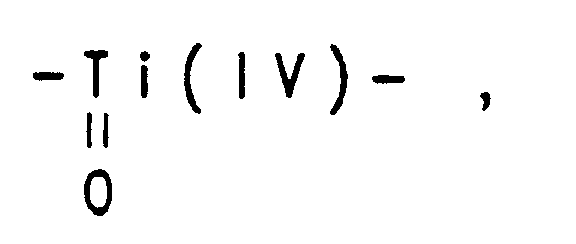 where R is methyl, ethyl, hydroxyl or halogen, preferably chlorine;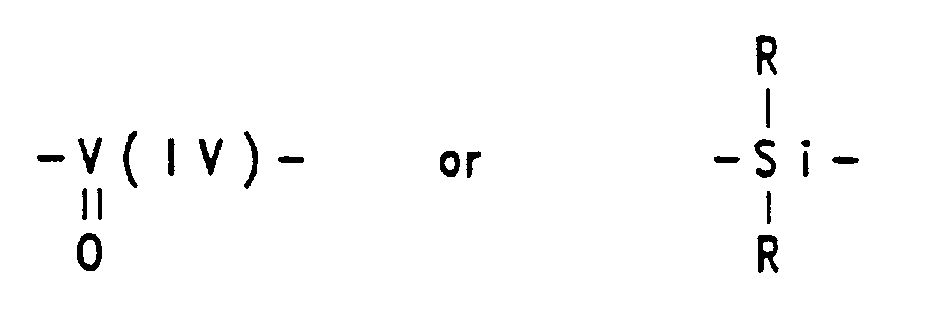
- M
- is hydrogen or an alkali metal or some other salt-forming metal;
- R1
- is hydrogen, alkyl of 1 to 6 carbon atoms, or is alkyl of 2 to 6 carbon atoms, which is substituted by alkoxy of 1 to 4 carbon atoms, cyano, alkanoylamino of 2 to 5 carbon atoms, carboxyl, sulfo, phosphato, sulfato, hydroxyl or dialkylamino having an alkyl each of 1 to 4 carbon atoms,
- R2
- is hydrogen, alkyl of 1 to 6 carbon atoms, or is alkyl of 2 to 6 carbon atoms, which is substituted by alkoxy of 1 to 4 carbon atoms, cyano, alkanoylamino of 2 to 5 carbon atoms, carboxyl, sulfo, phosphato, sulfato, hydroxyl, phenyl, sulfophenyl, carboxyphenyl or dialkylamino having an alkyl each of 1 to 4 carbon atoms, or
- R1 and R2,
- together with the nitrogen atom and an
alkylene of 3 to 8 carbon atoms, or with a
further hetero group and two alkylenes of 1 to 5
carbon atoms, form the radical of a 4- to 8-membered
heterocyclic ring, or
the radical -NR1R2 is cyanoamino; - B
- is a radical of the formula (2a) or (2b)
where
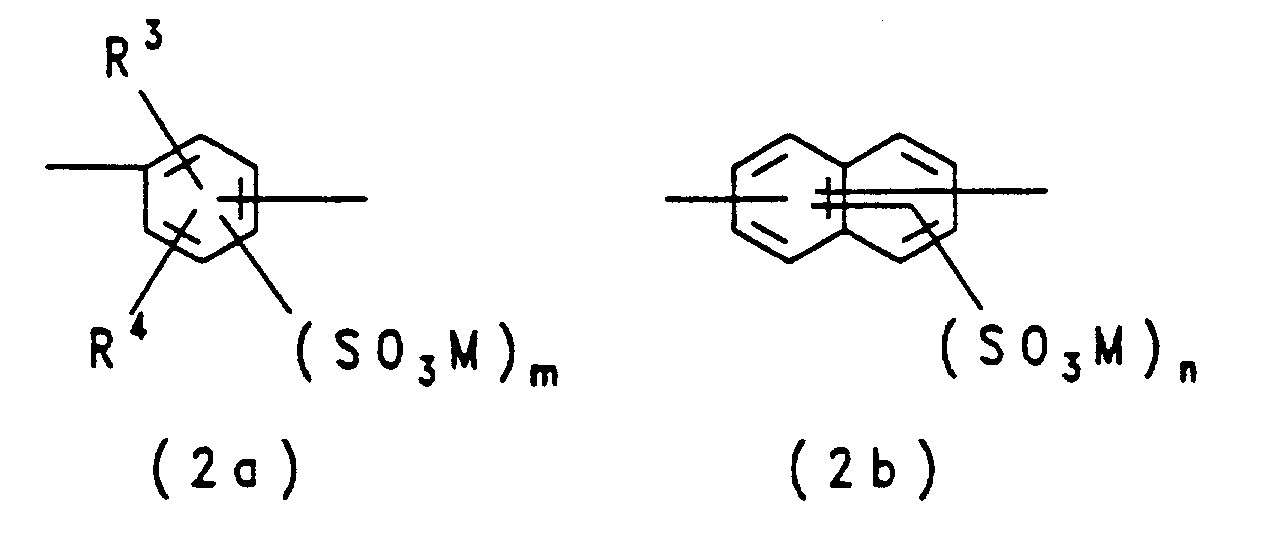
- R3
- is hydrogen, alkyl of 1 to 4 carbon atoms, or alkoxy of 1 to 4 carbon atoms,
- R4
- is hydrogen, halogen, alkyl of 1 to 4 carbon atoms, or alkoxy of 1 to 4 carbon atoms,
- M
- is as defined above,
- m
- is zero or 1, and
- n
- is zero, 1 or 2;
- Y
- is vinyl or is an ethyl group which, in the β-position, contains a substituent which is eliminable by alkali to leave a vinyl group, or Y is β-sulfoethyl or β-hydroxyethyl;
- a
- is from zero to 3,
- b
- is from zero to 2, and
- c
- is from 1 to 4,
- A phthalocyanine dye as claimed in claim 1, wherein B is a radical of the formula (2a) where R3 is hydrogen, methyl or methoxy, R4 is hydrogen or methoxy, and m is zero.
- A phthalocyanine dye as claimed in claim 1 or 2, wherein b is zero.
- A phthalocyanine dye as claimed in claim 3, wherein a is from zero to 3 and c is from 1 to 2.
- A phthalocyanine dye as claimed in at least one of claims 1 to 4, wherein Y is β-sulfatoethyl or vinyl.
- A phthalocyanine dye as claimed in at least one of claims 1 to 5, wherein Me is zinc(II).
- A process for preparing a phthalocyanine dye of the formula (1) of claim 1, which comprises reacting a phthalocyaninesulfonyl chloride of the formula (3)where PC and M are each as defined in claim 1, p is from zero to 3, and q is from 1 to 4, the sum of (p+q) being from 1 to 4, in an aqueous or non-aqueous medium with an amine of the formula (4)

- The use of a phthalocyanine dye of at least one of claims 1 to 6 or of a phthalocyanine dye prepared as claimed in claim 7 for dyeing hydroxyl- and/or carboxamido-containing material, in particular fiber material.
- A process for dyeing hydroxyl- and/or carboxamido-containing material, preferably fiber material, by applying a dye onto or into the material and fixing the dye on or in the material by means of heat or with the aid of an alkaline agent or by both measures, which comprises using a dye that is a phthalocyanine dye of at least one of claims 1 to 6 or a phthalocyanine dye prepared as claimed in claim 7.
Priority Applications (2)
| Application Number | Priority Date | Filing Date | Title |
|---|---|---|---|
| EP19940118191 EP0712907B1 (en) | 1994-11-18 | 1994-11-18 | Water-soluble phthalocyanine dyes, process for their manufacture and use thereof |
| DE59409376T DE59409376D1 (en) | 1994-11-18 | 1994-11-18 | Water-soluble phthalocyanine dyes, processes for their preparation and their use |
Applications Claiming Priority (1)
| Application Number | Priority Date | Filing Date | Title |
|---|---|---|---|
| EP19940118191 EP0712907B1 (en) | 1994-11-18 | 1994-11-18 | Water-soluble phthalocyanine dyes, process for their manufacture and use thereof |
Publications (2)
| Publication Number | Publication Date |
|---|---|
| EP0712907A1 EP0712907A1 (en) | 1996-05-22 |
| EP0712907B1 true EP0712907B1 (en) | 2000-05-24 |
Family
ID=8216471
Family Applications (1)
| Application Number | Title | Priority Date | Filing Date |
|---|---|---|---|
| EP19940118191 Expired - Lifetime EP0712907B1 (en) | 1994-11-18 | 1994-11-18 | Water-soluble phthalocyanine dyes, process for their manufacture and use thereof |
Country Status (2)
| Country | Link |
|---|---|
| EP (1) | EP0712907B1 (en) |
| DE (1) | DE59409376D1 (en) |
Family Cites Families (2)
| Publication number | Priority date | Publication date | Assignee | Title |
|---|---|---|---|---|
| GB931596A (en) * | 1960-12-30 | 1963-07-17 | Gen Aniline & Film Corp | Phthalocyanine dyestuffs |
| IN150949B (en) * | 1978-06-02 | 1983-01-29 | Hoechst Ag |
-
1994
- 1994-11-18 EP EP19940118191 patent/EP0712907B1/en not_active Expired - Lifetime
- 1994-11-18 DE DE59409376T patent/DE59409376D1/en not_active Expired - Fee Related
Also Published As
| Publication number | Publication date |
|---|---|
| DE59409376D1 (en) | 2000-06-29 |
| EP0712907A1 (en) | 1996-05-22 |
Similar Documents
| Publication | Publication Date | Title |
|---|---|---|
| EP0043560A1 (en) | Water-soluble azo compounds, process for their preparation and their use as dyestuffs | |
| EP0304751A1 (en) | Water soluble phtholocyanine compounds, process for their preparation and their use as dyestuffs | |
| EP0648815B1 (en) | Water soluble metal-free phthalocyanine dyes, process for their manufacture and use thereof | |
| EP0199950A1 (en) | Process for dyeing or printing fibre materials containing hydroxyl groups with new reactive dyes | |
| EP0629666B1 (en) | Water-soluble azo compounds, process for their preparation and their use as dyestuffs | |
| EP0043561B1 (en) | Water-soluble phthalocyanine compounds, process for their preparation and their use as dyestuffs | |
| DE3705789A1 (en) | COPPER COMPLEX-FORMAZAN COMPOUNDS, METHOD FOR THE PRODUCTION THEREOF AND THEIR USE AS DYES | |
| EP0279277B1 (en) | Water soluble monoazo-pyrazolone compounds, process for their preparation and their use as dyestuffs | |
| DE4338853A1 (en) | Water-soluble heavy metal-free phthalocyanine dyes, preparation thereof and use thereof | |
| EP0292904B1 (en) | Water soluble naphtyl-azo-pyrazolon compounds, process for their preparation and their use as dyes | |
| DE4340160A1 (en) | Water-soluble, metal-free phthalocyanine dyes, processes for their preparation and their use | |
| DE3327713A1 (en) | WATER-SOLUBLE DISAZO COMPOUNDS, METHOD FOR THE PRODUCTION THEREOF AND THEIR USE AS DYES | |
| EP0974622B1 (en) | Mixture of water soluble reactive azo dyes, process to manufacture it and its use | |
| EP0374815B1 (en) | Complex copper formazane compounds, process for their preparation and their use as dyestuffs | |
| EP0527441A2 (en) | Water-soluble phthalocyanine dyes, process for their preparation and their use | |
| EP0183054B1 (en) | Copper formazane compounds, process for their preparation and their use as dyestuffs | |
| DE3903455A1 (en) | COPPER COMPLEX MOLDING COMPOUNDS, METHOD FOR THE PRODUCTION THEREOF AND THEIR USE AS DYES | |
| EP0712907A1 (en) | Water-soluble, heavy-metal-free phthalocyanine dyes, process for their manufacture and use thereof | |
| EP0278903B1 (en) | Reactive dyes, their preparation and their use | |
| EP0541057A1 (en) | Water-soluble phthalocyanine dyes, process for their preparation and the use thereof | |
| EP0688831B1 (en) | Watersoluble anthraquinone compounds, process for their manufacturing and their use as dyestuffs | |
| DE2745481C2 (en) | Water-soluble phthalocyanine compounds, process for their preparation, their use as dyes for cellulose, polyamide fibers and leather | |
| EP0385392A1 (en) | Water soluble fibre-reactive dyes, process for their preparation dand their use | |
| EP0530660A2 (en) | Water-soluble phthalocyanine dyes, process for their preparation and the use thereof | |
| DE4325784A1 (en) | Water-soluble monoazo compounds, processes for their preparation and their use as dyes |
Legal Events
| Date | Code | Title | Description |
|---|---|---|---|
| PUAI | Public reference made under article 153(3) epc to a published international application that has entered the european phase |
Free format text: ORIGINAL CODE: 0009012 |
|
| AK | Designated contracting states |
Kind code of ref document: A1 Designated state(s): BE CH DE FR GB IE IT LI NL |
|
| 17P | Request for examination filed |
Effective date: 19961122 |
|
| RAP1 | Party data changed (applicant data changed or rights of an application transferred) |
Owner name: DYSTAR TEXTILFARBEN GMBH & CO. DEUTSCHLAND KG |
|
| GRAG | Despatch of communication of intention to grant |
Free format text: ORIGINAL CODE: EPIDOS AGRA |
|
| RTI1 | Title (correction) |
Free format text: WATER-SOLUBLE PHTHALOCYANINE DYES, PROCESS FOR THEIR MANUFACTURE AND USE THEREOF |
|
| 17Q | First examination report despatched |
Effective date: 19990920 |
|
| GRAG | Despatch of communication of intention to grant |
Free format text: ORIGINAL CODE: EPIDOS AGRA |
|
| GRAH | Despatch of communication of intention to grant a patent |
Free format text: ORIGINAL CODE: EPIDOS IGRA |
|
| GRAH | Despatch of communication of intention to grant a patent |
Free format text: ORIGINAL CODE: EPIDOS IGRA |
|
| GRAA | (expected) grant |
Free format text: ORIGINAL CODE: 0009210 |
|
| AK | Designated contracting states |
Kind code of ref document: B1 Designated state(s): BE CH DE FR GB IE IT LI NL |
|
| PG25 | Lapsed in a contracting state [announced via postgrant information from national office to epo] |
Ref country code: NL Free format text: LAPSE BECAUSE OF FAILURE TO SUBMIT A TRANSLATION OF THE DESCRIPTION OR TO PAY THE FEE WITHIN THE PRESCRIBED TIME-LIMIT Effective date: 20000524 Ref country code: IT Free format text: LAPSE BECAUSE OF FAILURE TO SUBMIT A TRANSLATION OF THE DESCRIPTION OR TO PAY THE FEE WITHIN THE PRESCRIBED TIME-LIMIT;WARNING: LAPSES OF ITALIAN PATENTS WITH EFFECTIVE DATE BEFORE 2007 MAY HAVE OCCURRED AT ANY TIME BEFORE 2007. THE CORRECT EFFECTIVE DATE MAY BE DIFFERENT FROM THE ONE RECORDED. Effective date: 20000524 Ref country code: GB Free format text: LAPSE BECAUSE OF FAILURE TO SUBMIT A TRANSLATION OF THE DESCRIPTION OR TO PAY THE FEE WITHIN THE PRESCRIBED TIME-LIMIT Effective date: 20000524 Ref country code: FR Free format text: LAPSE BECAUSE OF FAILURE TO SUBMIT A TRANSLATION OF THE DESCRIPTION OR TO PAY THE FEE WITHIN THE PRESCRIBED TIME-LIMIT Effective date: 20000524 |
|
| REG | Reference to a national code |
Ref country code: CH Ref legal event code: EP |
|
| REG | Reference to a national code |
Ref country code: IE Ref legal event code: FG4D Free format text: GERMAN |
|
| REF | Corresponds to: |
Ref document number: 59409376 Country of ref document: DE Date of ref document: 20000629 |
|
| EN | Fr: translation not filed | ||
| NLV1 | Nl: lapsed or annulled due to failure to fulfill the requirements of art. 29p and 29m of the patents act | ||
| GBV | Gb: ep patent (uk) treated as always having been void in accordance with gb section 77(7)/1977 [no translation filed] |
Effective date: 20000524 |
|
| PG25 | Lapsed in a contracting state [announced via postgrant information from national office to epo] |
Ref country code: BE Free format text: LAPSE BECAUSE OF NON-PAYMENT OF DUE FEES Effective date: 20001130 |
|
| PG25 | Lapsed in a contracting state [announced via postgrant information from national office to epo] |
Ref country code: IE Free format text: LAPSE BECAUSE OF NON-PAYMENT OF DUE FEES Effective date: 20010205 |
|
| REG | Reference to a national code |
Ref country code: IE Ref legal event code: FD4D |
|
| PLBE | No opposition filed within time limit |
Free format text: ORIGINAL CODE: 0009261 |
|
| STAA | Information on the status of an ep patent application or granted ep patent |
Free format text: STATUS: NO OPPOSITION FILED WITHIN TIME LIMIT |
|
| 26N | No opposition filed | ||
| BERE | Be: lapsed |
Owner name: DYSTAR TEXTILFARBEN G.M.B.H. & CO. DEUTSCHLAND K. Effective date: 20001130 |
|
| PG25 | Lapsed in a contracting state [announced via postgrant information from national office to epo] |
Ref country code: DE Free format text: LAPSE BECAUSE OF NON-PAYMENT OF DUE FEES Effective date: 20010801 |
|
| PGFP | Annual fee paid to national office [announced via postgrant information from national office to epo] |
Ref country code: CH Payment date: 20011022 Year of fee payment: 8 |
|
| PG25 | Lapsed in a contracting state [announced via postgrant information from national office to epo] |
Ref country code: LI Free format text: LAPSE BECAUSE OF NON-PAYMENT OF DUE FEES Effective date: 20021130 Ref country code: CH Free format text: LAPSE BECAUSE OF NON-PAYMENT OF DUE FEES Effective date: 20021130 |
|
| REG | Reference to a national code |
Ref country code: CH Ref legal event code: PL |