EP0712907B1 - Colorants phtalocyanines solubles dans l'eau, procédé pour leur fabrication et leur utilisation - Google Patents
Colorants phtalocyanines solubles dans l'eau, procédé pour leur fabrication et leur utilisation Download PDFInfo
- Publication number
- EP0712907B1 EP0712907B1 EP19940118191 EP94118191A EP0712907B1 EP 0712907 B1 EP0712907 B1 EP 0712907B1 EP 19940118191 EP19940118191 EP 19940118191 EP 94118191 A EP94118191 A EP 94118191A EP 0712907 B1 EP0712907 B1 EP 0712907B1
- Authority
- EP
- European Patent Office
- Prior art keywords
- carbon atoms
- formula
- alkyl
- zero
- phthalocyanine dye
- Prior art date
- Legal status (The legal status is an assumption and is not a legal conclusion. Google has not performed a legal analysis and makes no representation as to the accuracy of the status listed.)
- Expired - Lifetime
Links
- IZOQZPVNVUGPAB-FIFLTTCUSA-N C/C(/N)=C(/C=CC=C1)\C1=C(/C)\N Chemical compound C/C(/N)=C(/C=CC=C1)\C1=C(/C)\N IZOQZPVNVUGPAB-FIFLTTCUSA-N 0.000 description 2
- GOALWKUVFUGSAH-XMYBZPLFSA-N CC(C1C=CC=CC1C(/N=C(/C1C=CC=CC1/C(/C)=N/C(c(cccc1)c1C(C)=C)=N)\NC)=N)=C Chemical compound CC(C1C=CC=CC1C(/N=C(/C1C=CC=CC1/C(/C)=N/C(c(cccc1)c1C(C)=C)=N)\NC)=N)=C GOALWKUVFUGSAH-XMYBZPLFSA-N 0.000 description 1
- GTBWUNKJSDRTRV-ISLQGBGESA-N CC(c(cccc1)c1/C(/C)=N/C(c1ccccc1C(C)=C)=N)=C Chemical compound CC(c(cccc1)c1/C(/C)=N/C(c1ccccc1C(C)=C)=N)=C GTBWUNKJSDRTRV-ISLQGBGESA-N 0.000 description 1
- GVEOAPLPUCEPDW-UHFFFAOYSA-N CC(c(cccc1)c1C(N)=N)=C Chemical compound CC(c(cccc1)c1C(N)=N)=C GVEOAPLPUCEPDW-UHFFFAOYSA-N 0.000 description 1
- PNRUNNHPSMLELM-UHFFFAOYSA-N CNc(cc1)ccc1S(=O)=O Chemical compound CNc(cc1)ccc1S(=O)=O PNRUNNHPSMLELM-UHFFFAOYSA-N 0.000 description 1
Classifications
-
- C—CHEMISTRY; METALLURGY
- C09—DYES; PAINTS; POLISHES; NATURAL RESINS; ADHESIVES; COMPOSITIONS NOT OTHERWISE PROVIDED FOR; APPLICATIONS OF MATERIALS NOT OTHERWISE PROVIDED FOR
- C09B—ORGANIC DYES OR CLOSELY-RELATED COMPOUNDS FOR PRODUCING DYES, e.g. PIGMENTS; MORDANTS; LAKES
- C09B62/00—Reactive dyes, i.e. dyes which form covalent bonds with the substrates or which polymerise with themselves
- C09B62/44—Reactive dyes, i.e. dyes which form covalent bonds with the substrates or which polymerise with themselves with the reactive group not directly attached to a heterocyclic ring
- C09B62/503—Reactive dyes, i.e. dyes which form covalent bonds with the substrates or which polymerise with themselves with the reactive group not directly attached to a heterocyclic ring the reactive group being an esterified or non-esterified hydroxyalkyl sulfonyl or mercaptoalkyl sulfonyl group, a quaternised or non-quaternised aminoalkyl sulfonyl group, a heterylmercapto alkyl sulfonyl group, a vinyl sulfonyl or a substituted vinyl sulfonyl group, or a thiophene-dioxide group
- C09B62/517—Porphines; Azaporphines
Definitions
- the invention is in the technical field of fiber-reactive dyes.
- the phthalocyanine dyes according to the invention are generally in the form obtained from mixtures of the individual compounds of the general formula (1), these individual compounds differ from one another by the degree of substitution distinguish the sulfo and sulfonamide groups on the phthalocyanine residue.
- the Formulas of the phthalocyanine dyes according to the invention therefore have indices which are usually fractional numbers.
- Alkaline eliminable substituents which are in the ⁇ -position of the ethyl group of Y are, for example halogen atoms such as bromine and chlorine, ester groups organic carboxylic and sulfonic acids, such as alkyl carboxylic acids, optionally substituted benzene carboxylic acids and optionally substituted benzenesulfonic acids, such as the alkanoyloxy groups from 2 to 5 Carbon atoms, of which in particular acetyloxy, benzoyloxy, sulfobenzoyloxy, Phenylsulfonyloxy and Toluylsulfonyloxy, furthermore acidic ester groups inorganic acids such as phosphoric acid, sulfuric acid and Thiosulfuric acid (phosphato, sulfato and thiosulfato groups), as well Dialkylamino groups with alkyl groups of 1 to 4 carbon atoms each, such as Dimethylamino and diethylamino
- sulfo groups mean groups corresponding to the general formula -SO 3 M
- carboxy groups correspond to the general formula -COOM
- thiosulfato groups correspond to the general formula -S-SO 3 M
- phosphato groups correspond to the general formula -OPO 3 M 2
- sulfato groups correspond to groups of the general formula -OSO 3 M, in which M has the meaning given above.
- Formula residues of the general formula -B-SO 2 -Y are, for example: 2- ( ⁇ -sulfatoethylsulfonyl) phenyl, 3- ( ⁇ -sulfatoethylsulfonyl) phenyl, 4- ( ⁇ -sulfatoethylsulfonyl) phenyl, 2-carboxy-5- ( ⁇ -sulfatoethylsulfonyl) phenyl, 2-chloro-3- ( ⁇ -sulfatoethylsulfonyl) phenyl, 2-chloro-4- ( ⁇ -sulfatoethylsulfonyl) phenyl, 2-bromo-4- ( ⁇ -sulfatoethylsulfonyl) phenyl, 4-methoxy-3- ( ⁇ -sulfatoethylsulfonyl) phenyl, 4-chloro-3- ( ⁇ -sulfatoethy
- R 3 is preferably hydrogen, methyl or methoxy
- R 4 is preferably hydrogen or methoxy.
- a is a number from zero to 3, preferably from 1 to 2.5
- b is from zero to 2
- c is a number from 1 to 4 , preferably from 1 to 2.
- Residues of the general formula -NR 1 R 2 are, for example, amino, methylamino, ethylamino, butylamino, benzylamino, ⁇ -hydroxyethylamino, dimethylamino, diethylamino, di (isopropyl) amino, N-methylbenzylamino, N-piperidino, N -Morpholino, di- ( ⁇ -hydroxyethyl) amino, ⁇ -sulfo-ethylamino, ⁇ -carboxy-ethylamino, ⁇ - (4-carboxy-phenyl) -ethylamino, phenylamino, N-methyl-phenylamino, 3-sulfo-phenylamino , 4-sulfo-phenylamino and cyanoamino.
- the present invention further relates to a process for the preparation of the phthalocyanine compounds of the general formula (1), which is characterized in that a phthalocyanine sulfonyl chloride of the general formula (3) in which PC and M has the meaning given above, p is a number from zero to 3 and q is a number from 1 to 4, the sum of (p + q) being 1 to 4, or a mixture thereof in aqueous or non-aqueous medium with an amine of the general formula (4) H 2 N ⁇ B ⁇ SO 2 ⁇ Y in which B and Y have the abovementioned meanings and Y here can also have the meaning of ⁇ -hydroxyethyl, and optionally with a further amino group-containing compound of the general formula H-NR 1 R 2 with R 1 and R 2 of the abovementioned meaning simultaneously or in in any order and with simultaneous or subsequent partial hydrolysis of the sulfochloride groups to sulfo groups.
- sulfochloride groups still present are hydrolyzed to sulfo groups at the end of the condensation reactions.
- partial hydrolysis of the sulfonyl chloride groups to sulfo groups is generally inevitable.
- the ⁇ -hydroxyethylsulfonyl group in the phthalocyanine compound obtained can be converted into a group of the formula -SO 2 -Y with Y equal to one in ⁇ - Position replaced by an ester group-substituted ethyl group, such as in the ⁇ -sulfatoethylsulfonyl group using sulfuric acid or sulfuric acid containing sulfur trioxide or chlorosulfonic acid.
- the condensation reactions according to the invention between the compounds of the general formula (3) and the amines of the general formulas (4) and H-NR 1 R 2 are in particular at a pH between 3.5 and 8.5, preferably between 4 and 8 between 5.5 and 6.5, and at a temperature between 0 ° C and 100 ° C, preferably between 20 and 60 ° C, in particular between 45 and 55 ° C.
- a catalyst such as pyridine, a pyridinesulfonic acid, pyridinecarboxylic acid, pyridinesulfonamide or pyridinecarbonamide compound, such as, preferably, nicotinic acid amide, analogously to those known from the initially mentioned US Pat. Nos. Or US Pat Procedures.
- the starting phthalocyanine sulfonic acid chloride compounds of the general formula (3) are prepared analogously to known procedures, as can be seen, for example, from information in the aforementioned US patent steps and from German Patent No. 891 121.
- a compound of the general formula (3) is prepared in such a way that the phthalocyanine of the formula (A) is introduced into chlorosulfonic acid and the batch is at a temperature between 80 and 150 ° C., preferably between 100 and 140 ° C., several Stirs for hours, then a chlorinating agent, preferably thionyl chloride, is added and the batch is stirred at 80 to 90 ° C. for several hours.
- Another possibility of producing a compound of the general formula (3) is the reaction of the phthalocyanine of the formula (A) with sulfuric acid / sulfur trioxide in sulfuric acid (oleum) containing sulfur trioxide with a sulfur trioxide content of about 50 to 65% by weight at about 80 ° C. After this reaction, the mixture is stirred into an ice-cooled aqueous solution of sodium chloride and the metal-containing phthalocyanine sulfonic acid obtained is converted into the phthalocyanine sulfonic acid chloride by customary procedures, for example using thionyl chloride in dimethylformamide.
- the metal phthalocyanine starting compounds of the general formula (A) are known or can be prepared analogously to known procedures.
- Literature on this can be found in US Pat. No. 2,202,632, the Swiss Patent 280 478, British patents 679 773 and 1 306 055, German Offenlegungsschrift 2 136 767, the French Patent Application Publication 2 103 195 and U.S. Patent 2,155,038 to be named.
- the deposition of the phthalocyanine dyes produced according to the invention general formula (1), hereinafter referred to as "dyes (1)”, from the Synthesis approaches are carried out either according to generally known methods Precipitation from the reaction medium using electrolytes, such as Sodium chloride or potassium chloride, or by evaporating the reaction solution, for example by spray drying, this reaction solution Buffer substance can be added.
- the dyes (1) have fiber-reactive Properties and have very good color shadows. You can therefore for dyeing and printing hydroxy and / or material containing carbonamide groups, in particular fiber material, and also of Leather.
- those in the synthesis of the Solutions according to the invention if appropriate after Add a buffer substance, if necessary after concentration, directly as Liquid preparation can be used for staining.
- the present invention therefore also relates to the use of Dyes (1) for dyeing (including printing) of hydroxy and Materials containing carbonamide groups and processes for their use on these substrates.
- the materials preferably come in the form of Fiber materials for use, especially in the form of textile fibers, such as Yarns, packages and fabrics.
- Materials containing hydroxyl groups are natural or synthetic materials containing hydroxyl groups, such as cellulose fiber materials, also in the form of paper, or their regenerated products and polyvinyl alcohols.
- Cellulose fiber materials are preferably cotton, but also others Vegetable fibers; like linen, hemp, jute and ramie fibers; regenerated Cellulose fibers are, for example, cellulose and viscose rayon.
- Materials containing carbonamide groups are, for example, synthetic and natural polyamides and polyurethanes, especially in the form of fibers, for example wool and other animal hair, silk, leather, polyamide-6,6, Polyamide-6, polyamide-11 and polyamide-4.
- the dyes (1) can, in particular, on the substrates mentioned the fiber materials mentioned, according to those for water-soluble dyes, especially for fiber-reactive dyes, known application techniques apply and fix. So you get with them on cellulose fibers after Extraction process from a long fleet using a wide variety acid-binding agents and optionally neutral salts, such as sodium chloride or sodium sulfate, dyeings in very good color yields and with excellent color structure. You dye at temperatures between 40 and 105 ° C, if appropriate at temperatures up to 130 ° C under pressure, optionally in the presence of customary dyeing auxiliaries, in aqueous Bath. You can do this by putting the material in the warm bath introduces and gradually warmed to the desired dyeing temperature and complete the dyeing process at this temperature. The undressing of the dye accelerating neutral salts can bath if desired, only after reaching the actual dyeing temperature be added.
- acid-binding agents and optionally neutral salts such as sodium chloride or sodium sulfate
- dyeings are also made on cellulose fibers get excellent color yields and very good color build, whereby by staying at room temperature or elevated temperature, for example up to about 60 ° C, by steaming or with dry heat in the usual way can be fixed.
- You can also get the usual printing process for cellulose fibers can be carried out either in one phase, for example by Print with a sodium bicarbonate or other acid binding agent and printing paste containing the colorant and then steaming at 100 to 103 ° C, or which can be carried out in two phases, for example by printing with neutral or slightly acidic, the Printing paste containing colorant and subsequent fixing either by Passing the printed goods through a hot electrolyte alkaline bath or by padding with an alkaline electrolyte Block liquor with subsequent lingering of this treated material or subsequent steaming or subsequent treatment with dry heat, strong-colored prints with good contours and a clear white background. The failure of the prints is little of changing fixing conditions dependent. Both in the dyeing and in the printing works are the ones with the The degrees of fixation obtained according to the invention are very high.
- the acid-binding and the fixation of the dyes on the cellulose fibers effecting agents are, for example, water-soluble basic salts of Alkali metals and the alkaline earth metals of inorganic or organic Acids, as well as compounds that release alkali in the heat.
- the alkali metal hydroxides and alkali metal salts of to name weak to moderate inorganic or organic acids, of the alkali compounds preferably the sodium and Potassium compounds are meant.
- Such acid-binding agents are for example sodium hydroxide, potassium hydroxide, sodium carbonate, Sodium bicarbonate, potassium carbonate, sodium formate, Sodium dihydrogen phosphate and disodium hydrogen phosphate.
- the dyes are chemically attached to the Cellulose fiber bound; especially the cellulose stains show after the usual post-treatment by rinsing to remove unfixed Dye proportions have excellent wet fastness properties, especially since they did not fix Wash out dye parts easily because of their good cold water solubility to let.
- the dyeings on polyurethane and polyamide fibers are usually made from acidic environment. So you can, for example, the dyebath acetic acid and / or ammonium sulfate and / or acetic acid and ammonium acetate or Add sodium acetate to get the desired pH.
- leveling aids such as based on a Reaction product of cyanuric chloride with three times the molar amount of one Aminobenzenesulfonic acid or aminonaphthalenesulfonic acid or based on a Reaction product of, for example, stearylamine with ethylene oxide.
- the material to be colored is at a temperature of around 40 ° C Bath introduced, moved there for some time, then the dye bath on the desired weakly acidic, preferably weakly acetic acid pH adjusted and the actual coloring at a temperature between 60 and 98 ° C carried out.
- the dyeings can also at boiling temperature or at temperatures up to 120 ° C (under pressure).
- Cellulose fiber materials have a high color strength and also good ones Light fastness and good wet fastness, such as washing, walking, water, Seawater, dyeing and sweat fastness, good as well Fastness to pleating, fastness to ironing and fastness to rubbing.
- the following examples serve to illustrate the invention.
- the compounds described by formula are given in the form of the free acid; generally they are prepared and isolated in the form of their alkali metal salts and used in the form of their salts for dyeing.
- the starting compounds mentioned in the following examples, in particular table examples in the form of the free acid as such or in the form of their salts, preferably alkali metal salts, such as lithium, sodium or potassium salts, can be used in the synthesis.
- the parts mentioned in the examples are parts by weight; the percentages represent percentages by weight, unless stated otherwise. Parts by weight relate to parts by volume in the ratio of kilograms to liters.
- the absorption maxima ( ⁇ max ) in the visible range specified for the compounds according to the invention were determined on the basis of their alkali metal salts in aqueous solution.
- the ⁇ max values are given in brackets when specifying the color; the wavelength specification refers to nm.
- this dichlorosilicon-phthalocyanine compound 30 parts are introduced into 440 parts of chlorosulfonic acid. The reaction is carried out for about four hours with vigorous stirring at 130 ° C., the batch is then cooled to 85 ° C. and 180 parts of thionyl chloride are slowly added over about 30 minutes. The reaction is carried out under reflux at about 85 ° C. for a further four hours, the batch is then added to 3000 parts of ice with stirring and the dichlorosilicon-phthalocyanine tetrasulfochloride of the formula obtained is filtered in the form of a moist filter cake.
- a solution with a pH of 6.5 of 36 parts 4- ( ⁇ -sulfatoethylsulfonyl) aniline in 100 parts of water are stirred with isolated as a moist filter cake Zinc (II) phthalocyanine sulfochloride from Example A and 4 parts of nicotinamide were added.
- the approach is still stirred two hours at 50 ° C and then at about 20 ° C while maintaining the pH of 6.5 after.
- the Approach filtered and the phthalocyanine dye according to the invention through Salt out with sodium chloride or by evaporating the reaction solution isolated under reduced pressure.
- the phthalocyanine dye according to the invention written in the form of the free acid, has the formula
- a phthalocyanine dye according to the invention is as described in Example 1, but instead of 4- ( ⁇ -sulfatoethylsulfonyl) aniline, the same amount of 3- ( ⁇ -sulfatoethylsulfonyl) aniline is used in the reaction mixture.
- the resulting phthalocyanine dye of the formula (written in the form of the free acid) shows good fiber-reactive, application properties and dyes, for example, cellulose fiber materials, such as cotton, according to the dyeing and printing processes customary in the art for fiber-reactive dyes in strong, brilliant green tones with good fastness properties.
- the dye according to the invention has very good fiber-reactive Dye properties and delivers on those mentioned in the description
- Fiber materials, such as cotton, according to those in the art for fiber-reactive dyes usual printing and dyeing processes strong, true, green prints and dyes.
- a solution with a pH of 6 of 16.3 parts of 4- ( ⁇ -sulfatoethylsulfonyl) aniline in 200 parts of water is added at a temperature of 35 ° C. while maintaining a pH between 5.8 and 6 , 2. 1.66 parts of nicotinamide and the dimethyl silicon phthalocyanine tetrasulfochloride obtained according to Example C as a water-moist filter cake.
- the mixture is stirred for some time under these reaction conditions and then the phthalocyanine dye according to the invention obtained, which, written in the form of the free acid, the formula, is isolated has, by evaporation of the aqueous synthesis solution under reduced pressure at about 60 ° C. It has very good dye properties and, for example on cellulose fiber materials, provides strong, true colors and prints in dark green tones under the conditions of use customary in technology for fiber-reactive dyes.
Landscapes
- Chemical & Material Sciences (AREA)
- Organic Chemistry (AREA)
- Coloring (AREA)
Claims (9)
- Colorant phtalocyanine de formule générale (I)dans laquelle :

- PC
- représente le radical de la phtalocyanine de
formule générale (A)
dans laquelle
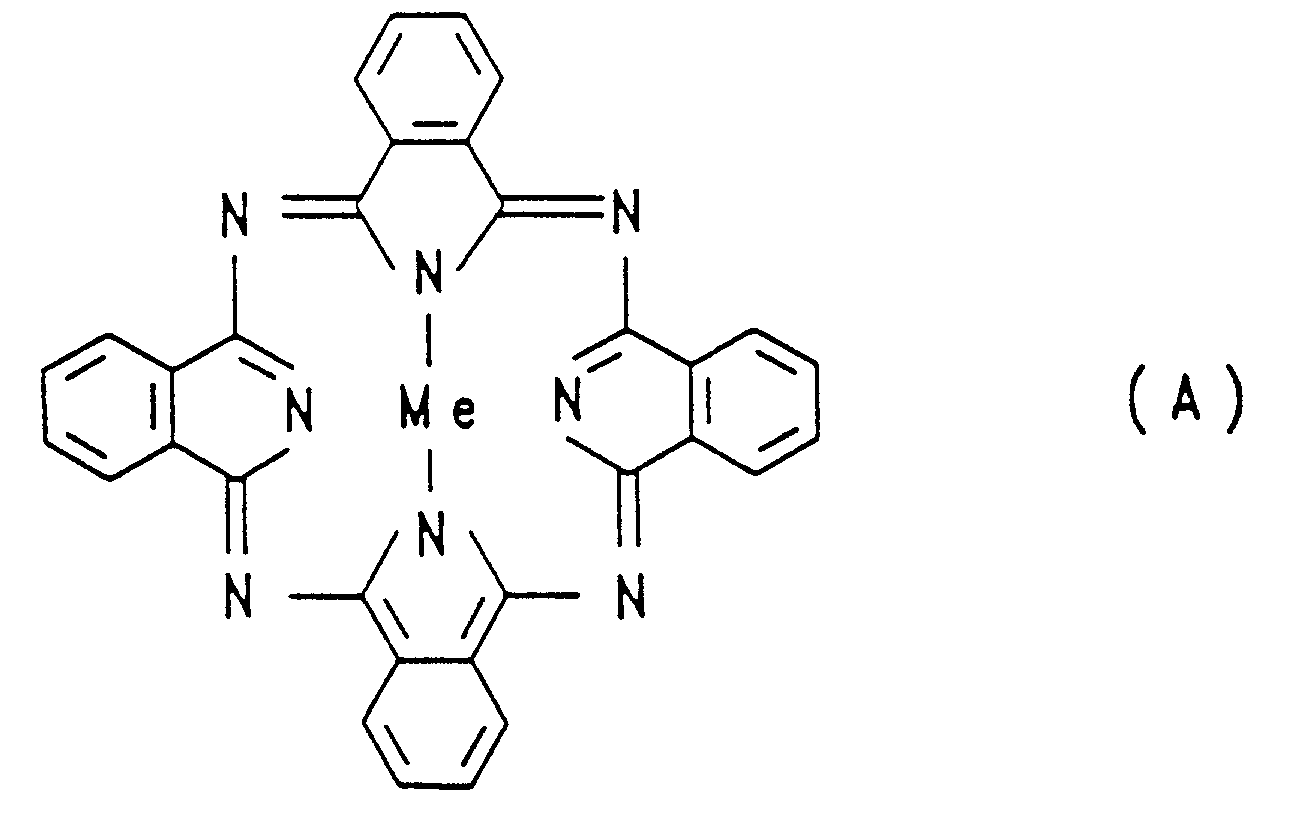
- Me
- représente le radical métallique bivalent
-Zn(II)-, où R est un méthyle, un éthyle, un hydroxy ou un halogène, comme de préférence un chlore ;
- M
- représente un hydrogène ou un métal alcalin ou un autre métal formant des sels ;
- R1
- représente un hydrogène, un alkyle ayant de 1 à 6 atomes de carbone ou un alkyle ayant de 2 à 6 atomes de carbone, qui est substitué par un alcoxy ayant de 1 à 4 atomes de carbone, un cyano, un alcanoylamino ayant de 2 à 5 atomes de carbone, un carboxy, un sulfo, un phosphato, un sulfato, un hydroxy ou un dialkylamino avec dans chaque cas un alkyle ayant de 1 à 4 atomes de carbone,
- R2
- représente un hydrogène, un alkyle ayant de 1 à 6 atomes de carbone ou un alkyle ayant de 2 à 6 atomes de carbone, qui est substitué par un alcoxy ayant de 1 à 4 atomes de carbone, un cyano, un alcanoylamino ayant de 2 à 5 atomes de carbone, un carboxy, un sulfo, un phosphato, un sulfato, un hydroxy, un phényle, un sulfophényle, un carboxyphényle ou un dialkylamino avec dans chaque cas un alkyle ayant de 1 à 4 atomes de carbone, ou
- R1 et R2
- forment, conjointement avec l'atome d'azote et un alkylène ayant de 3 à 8 atomes de carbone ou avec un autre groupe hétéro et deux alkylènes ayant de 1 à 5 atomes de carbone, le radical d'un noyau hétérocyclique à 4 à 8 chaínons, ou le radical -NR1R2 est un cyanoamino ;
- B
- représente un radical de formules générales (2a)
ou (2b)
dans lesquelles
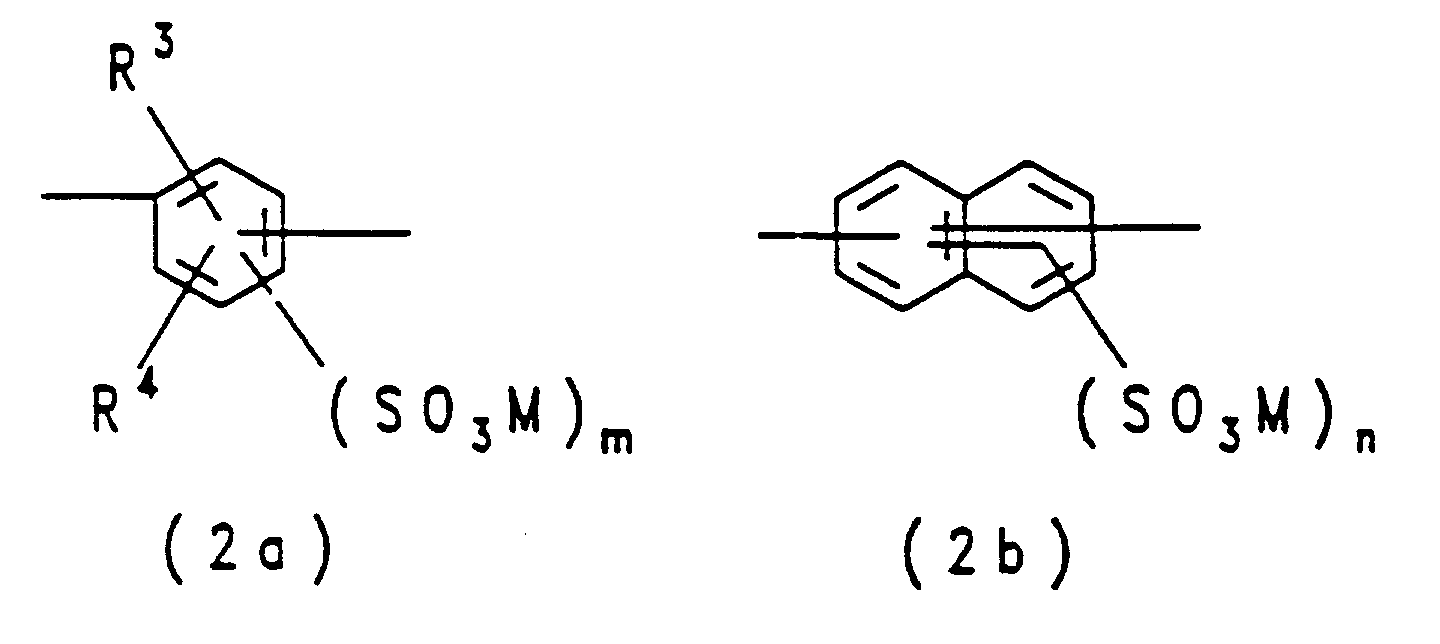
- R3
- représente un hydrogène, un alkyle ayant de 1 à 4 atomes de carbone ou un alcoxy ayant de 1 à 4 atomes de carbone,
- R4
- représente un hydrogène, un halogène, un alkyle ayant de 1 à 4 atomes de carbone ou un alcoxy ayant de 1 à 4 atomes de carbone,
- M
- est tel que défini ci-dessus,
- m
- représente le nombre zéro ou 1 et
- n
- représente le nombre zéro, 1 ou 2 ;
- Y
- représente un vinyle ou un éthyle, qui renferme un substituant en position β pouvant être éliminé par un alcali en formant le groupe vinyle, ou Y est un β-sulfoéthyle ou un β-hydroxyéthyle ;
- a
- représente un nombre de zéro à 3,
- b
- représente un nombre de zéro à 2, et
- c
- représente un nombre de 1 à 4,
- Colorant phtalocyanine selon la revendication 1, caractérisé en ce que B représente un radical de formule générale (2a), dans laquelle R3 est un hydrogène, un méthyle ou un méthoxy, R4 est un hydrogène ou un méthoxy et m représente le nombre zéro.
- Colorant phtalocyanine selon la revendication 1 ou 2, caractérisé en ce que b représente le nombre zéro.
- Colorant phtalocyanine selon la revendication 3, caractérisé en ce que a est un nombre de zéro à 3 et c est un nombre de 1 à 2.
- Colorant phtalocyanine selon au moins l'une des revendications 1 à 4, caractérisé en ce que Y est un β-sulfatoéthyle ou un vinyle.
- Colorant phtalocyanine selon au moins l'une des revendications 1 à 5, caractérisé en ce que Me est le zinc (II).
- Procédé de préparation d'un colorant phtalocyanine de formule générale (1) selon la revendication 1, caractérisé en ce que l'on fait réagir du chlorure d'acide phtalocyanine sulfonique de formule générale (3)dans laquelle PC et M sont tels que définis à la revendication 1, p représente un nombre de zéro à 3 et q représente un nombre de 1 à 4, la somme de (p+q) valant de 1 à 4, en milieu aqueux ou non aqueux, avec une amine de formule générale (4)

- Utilisation d'un colorant phtalocyanine selon au moins l'une des revendications 1 à 6 ou d'un colorant phtalocyanine préparé selon la revendication 7 pour la teinture d'une matière renfermant des groupes hydroxy et/ou carbonamide, en particulier d'une matière fibreuse.
- Procédé de teinture d'une matière renfermant des groupes hydroxy et/ou carbonamide, de préférence d'une matière fibreuse, dans lequel on applique un colorant sur la matière ou on l'incorpore dans la matière, et on fixe le colorant sur ou dans la matière par la chaleur ou à l'aide d'un agent alcalin ou par les deux mesures, caractérisé en ce que l'on utilise dans le procédé, en tant que colorant, un colorant phtalocyanine selon au moins l'une des revendications 1 à 6 ou un colorant phtalocyanine préparé selon la revendication 7.
Priority Applications (2)
| Application Number | Priority Date | Filing Date | Title |
|---|---|---|---|
| DE59409376T DE59409376D1 (de) | 1994-11-18 | 1994-11-18 | Wasserlösliche Phthalocyaninfarbstoffe, Verfahren zu ihrer Herstellung und ihre Verwendung |
| EP19940118191 EP0712907B1 (fr) | 1994-11-18 | 1994-11-18 | Colorants phtalocyanines solubles dans l'eau, procédé pour leur fabrication et leur utilisation |
Applications Claiming Priority (1)
| Application Number | Priority Date | Filing Date | Title |
|---|---|---|---|
| EP19940118191 EP0712907B1 (fr) | 1994-11-18 | 1994-11-18 | Colorants phtalocyanines solubles dans l'eau, procédé pour leur fabrication et leur utilisation |
Publications (2)
| Publication Number | Publication Date |
|---|---|
| EP0712907A1 EP0712907A1 (fr) | 1996-05-22 |
| EP0712907B1 true EP0712907B1 (fr) | 2000-05-24 |
Family
ID=8216471
Family Applications (1)
| Application Number | Title | Priority Date | Filing Date |
|---|---|---|---|
| EP19940118191 Expired - Lifetime EP0712907B1 (fr) | 1994-11-18 | 1994-11-18 | Colorants phtalocyanines solubles dans l'eau, procédé pour leur fabrication et leur utilisation |
Country Status (2)
| Country | Link |
|---|---|
| EP (1) | EP0712907B1 (fr) |
| DE (1) | DE59409376D1 (fr) |
Family Cites Families (2)
| Publication number | Priority date | Publication date | Assignee | Title |
|---|---|---|---|---|
| GB931596A (en) * | 1960-12-30 | 1963-07-17 | Gen Aniline & Film Corp | Phthalocyanine dyestuffs |
| IN150949B (fr) * | 1978-06-02 | 1983-01-29 | Hoechst Ag |
-
1994
- 1994-11-18 DE DE59409376T patent/DE59409376D1/de not_active Expired - Fee Related
- 1994-11-18 EP EP19940118191 patent/EP0712907B1/fr not_active Expired - Lifetime
Also Published As
| Publication number | Publication date |
|---|---|
| DE59409376D1 (de) | 2000-06-29 |
| EP0712907A1 (fr) | 1996-05-22 |
Similar Documents
| Publication | Publication Date | Title |
|---|---|---|
| EP0043560A1 (fr) | Composés azoiques solubles dans l'eau, procédé pour leur préparation et leur utilisation comme colorants | |
| EP0304751A1 (fr) | Composés phtalocyanine solubles dans l'eau, procédé pour leur préparation et leur emploi comme colorants | |
| EP0648815B1 (fr) | Colorants phtalocyanines exempts de métal, solubles dans l'eau, procédé pour leur fabrication et leur utilisation | |
| EP0629666B1 (fr) | Composés azoiques solubles dans l'eau, procédé pour leur preparation et leur utilisation comme colorants | |
| EP0043561B1 (fr) | Composés phtalocyaniques solubles dans l'eau, procédé pour leur préparation et leur utilisation comme colorants | |
| DE3705789A1 (de) | Kupferkomplex-formazan-verbindungen, verfahren zu ihrer herstellung und ihre verwendung als farbstoffe | |
| EP0279277B1 (fr) | Composés pyrazolone-monoazoiques solubles dans l'eau procédé pour leur préparation et leur emploi comme colorants | |
| DE4338853A1 (de) | Wasserlösliche schwermetallfreie Phthalocyaninfarbstoffe, Verfahren zu ihrer Herstellung und ihre Verwendung | |
| EP0292904B1 (fr) | Composés Naphtyl-azo-pyrazolone solubles dans l'eau, leur procédé de preparation et leur emploi comme colorants | |
| DE4340160A1 (de) | Wasserlösliche, metallfreie Phthalocyaninfarbstoffe, Verfahren zu ihrer Herstellung und ihre Verwendung | |
| EP0712907B1 (fr) | Colorants phtalocyanines solubles dans l'eau, procédé pour leur fabrication et leur utilisation | |
| DE3327713A1 (de) | Wasserloesliche disazoverbindungen, verfahren zu deren herstellung und ihre verwendung als farbstoffe | |
| EP0974622B1 (fr) | Mélange de colorants azoiques réactifs aquasolubles, son procédé de fabrication et son utilisation | |
| EP0374815B1 (fr) | Composés complexes de cuivre-formazane, procédé pour leur préparation et leur emploi comme colorants | |
| EP1132433A2 (fr) | Colorants réagissant avec la fibre soluble dans l'eau, leur procédé de préparation et leur utilisation | |
| EP0527441A2 (fr) | Colorants de type phtalocyanine, solubles dans l'eau, procédé pour leur préparation et leur utilisation | |
| EP0183054B1 (fr) | Composés formazaniques cuivrés, procédé pour leur préparation et leur utilisation comme colorants | |
| DE3903455A1 (de) | Kupferkomplex-formazanverbindungen, verfahren zu ihrer herstellung und ihre verwendung als farbstoffe | |
| EP0278903B1 (fr) | Colorants réactifs, leur préparation et leur utilisation | |
| EP0541057A1 (fr) | Colorants de type phthalocyanine solubles dans l'eau, méthode pour leur préparation et leur utilisation | |
| EP0688831B1 (fr) | Composés du type anthraquinonique solubles dans l'eau, procédé pour leur préparation et leur utilisation comme colorants | |
| DE2745481C2 (de) | Wasserlösliche Phthalocyanin-Verbindungen, Verfahren zu ihrer Herstellung, ihre Verwendung als Farbstoffe für Cellulose, Polyamidfasern und Leder | |
| EP0385392A1 (fr) | Colorants solubles dans l'eau réactifs avec les fibres, procédé pour leur préparation et leur utilisation | |
| EP0530660A2 (fr) | Colorants de type phthalocyanine solubles dans l'eau, procédé pour leur préparation et leur utilisation | |
| DE4325784A1 (de) | Wasserlösliche Monoazoverbindungen, Verfahren zu ihrer Herstellung und ihre Verwendung als Farbstoffe |
Legal Events
| Date | Code | Title | Description |
|---|---|---|---|
| PUAI | Public reference made under article 153(3) epc to a published international application that has entered the european phase |
Free format text: ORIGINAL CODE: 0009012 |
|
| AK | Designated contracting states |
Kind code of ref document: A1 Designated state(s): BE CH DE FR GB IE IT LI NL |
|
| 17P | Request for examination filed |
Effective date: 19961122 |
|
| RAP1 | Party data changed (applicant data changed or rights of an application transferred) |
Owner name: DYSTAR TEXTILFARBEN GMBH & CO. DEUTSCHLAND KG |
|
| GRAG | Despatch of communication of intention to grant |
Free format text: ORIGINAL CODE: EPIDOS AGRA |
|
| RTI1 | Title (correction) |
Free format text: WATER-SOLUBLE PHTHALOCYANINE DYES, PROCESS FOR THEIR MANUFACTURE AND USE THEREOF |
|
| 17Q | First examination report despatched |
Effective date: 19990920 |
|
| GRAG | Despatch of communication of intention to grant |
Free format text: ORIGINAL CODE: EPIDOS AGRA |
|
| GRAH | Despatch of communication of intention to grant a patent |
Free format text: ORIGINAL CODE: EPIDOS IGRA |
|
| GRAH | Despatch of communication of intention to grant a patent |
Free format text: ORIGINAL CODE: EPIDOS IGRA |
|
| GRAA | (expected) grant |
Free format text: ORIGINAL CODE: 0009210 |
|
| AK | Designated contracting states |
Kind code of ref document: B1 Designated state(s): BE CH DE FR GB IE IT LI NL |
|
| PG25 | Lapsed in a contracting state [announced via postgrant information from national office to epo] |
Ref country code: NL Free format text: LAPSE BECAUSE OF FAILURE TO SUBMIT A TRANSLATION OF THE DESCRIPTION OR TO PAY THE FEE WITHIN THE PRESCRIBED TIME-LIMIT Effective date: 20000524 Ref country code: IT Free format text: LAPSE BECAUSE OF FAILURE TO SUBMIT A TRANSLATION OF THE DESCRIPTION OR TO PAY THE FEE WITHIN THE PRESCRIBED TIME-LIMIT;WARNING: LAPSES OF ITALIAN PATENTS WITH EFFECTIVE DATE BEFORE 2007 MAY HAVE OCCURRED AT ANY TIME BEFORE 2007. THE CORRECT EFFECTIVE DATE MAY BE DIFFERENT FROM THE ONE RECORDED. Effective date: 20000524 Ref country code: GB Free format text: LAPSE BECAUSE OF FAILURE TO SUBMIT A TRANSLATION OF THE DESCRIPTION OR TO PAY THE FEE WITHIN THE PRESCRIBED TIME-LIMIT Effective date: 20000524 Ref country code: FR Free format text: LAPSE BECAUSE OF FAILURE TO SUBMIT A TRANSLATION OF THE DESCRIPTION OR TO PAY THE FEE WITHIN THE PRESCRIBED TIME-LIMIT Effective date: 20000524 |
|
| REG | Reference to a national code |
Ref country code: CH Ref legal event code: EP |
|
| REG | Reference to a national code |
Ref country code: IE Ref legal event code: FG4D Free format text: GERMAN |
|
| REF | Corresponds to: |
Ref document number: 59409376 Country of ref document: DE Date of ref document: 20000629 |
|
| EN | Fr: translation not filed | ||
| NLV1 | Nl: lapsed or annulled due to failure to fulfill the requirements of art. 29p and 29m of the patents act | ||
| GBV | Gb: ep patent (uk) treated as always having been void in accordance with gb section 77(7)/1977 [no translation filed] |
Effective date: 20000524 |
|
| PG25 | Lapsed in a contracting state [announced via postgrant information from national office to epo] |
Ref country code: BE Free format text: LAPSE BECAUSE OF NON-PAYMENT OF DUE FEES Effective date: 20001130 |
|
| PG25 | Lapsed in a contracting state [announced via postgrant information from national office to epo] |
Ref country code: IE Free format text: LAPSE BECAUSE OF NON-PAYMENT OF DUE FEES Effective date: 20010205 |
|
| REG | Reference to a national code |
Ref country code: IE Ref legal event code: FD4D |
|
| PLBE | No opposition filed within time limit |
Free format text: ORIGINAL CODE: 0009261 |
|
| STAA | Information on the status of an ep patent application or granted ep patent |
Free format text: STATUS: NO OPPOSITION FILED WITHIN TIME LIMIT |
|
| 26N | No opposition filed | ||
| BERE | Be: lapsed |
Owner name: DYSTAR TEXTILFARBEN G.M.B.H. & CO. DEUTSCHLAND K. Effective date: 20001130 |
|
| PG25 | Lapsed in a contracting state [announced via postgrant information from national office to epo] |
Ref country code: DE Free format text: LAPSE BECAUSE OF NON-PAYMENT OF DUE FEES Effective date: 20010801 |
|
| PGFP | Annual fee paid to national office [announced via postgrant information from national office to epo] |
Ref country code: CH Payment date: 20011022 Year of fee payment: 8 |
|
| PG25 | Lapsed in a contracting state [announced via postgrant information from national office to epo] |
Ref country code: LI Free format text: LAPSE BECAUSE OF NON-PAYMENT OF DUE FEES Effective date: 20021130 Ref country code: CH Free format text: LAPSE BECAUSE OF NON-PAYMENT OF DUE FEES Effective date: 20021130 |
|
| REG | Reference to a national code |
Ref country code: CH Ref legal event code: PL |