EP0713954A2 - Actuateur pour un perforateur - Google Patents
Actuateur pour un perforateur Download PDFInfo
- Publication number
- EP0713954A2 EP0713954A2 EP95307990A EP95307990A EP0713954A2 EP 0713954 A2 EP0713954 A2 EP 0713954A2 EP 95307990 A EP95307990 A EP 95307990A EP 95307990 A EP95307990 A EP 95307990A EP 0713954 A2 EP0713954 A2 EP 0713954A2
- Authority
- EP
- European Patent Office
- Prior art keywords
- piston
- housing
- actuator
- pressure
- pressure receiving
- Prior art date
- Legal status (The legal status is an assumption and is not a legal conclusion. Google has not performed a legal analysis and makes no representation as to the accuracy of the status listed.)
- Withdrawn
Links
- 239000002360 explosive Substances 0.000 claims abstract description 27
- 239000003999 initiator Substances 0.000 claims abstract description 21
- 238000010304 firing Methods 0.000 claims description 64
- 239000012530 fluid Substances 0.000 claims description 51
- 230000002706 hydrostatic effect Effects 0.000 claims description 30
- 238000000034 method Methods 0.000 claims description 24
- 238000004891 communication Methods 0.000 claims description 12
- 230000004044 response Effects 0.000 claims description 7
- 230000012923 response to hydrostatic pressure Effects 0.000 claims 1
- 230000009977 dual effect Effects 0.000 abstract 1
- 230000037361 pathway Effects 0.000 description 15
- 238000005474 detonation Methods 0.000 description 12
- 238000009527 percussion Methods 0.000 description 12
- 210000002445 nipple Anatomy 0.000 description 10
- 230000015572 biosynthetic process Effects 0.000 description 6
- 238000010276 construction Methods 0.000 description 5
- 238000007667 floating Methods 0.000 description 5
- 238000005422 blasting Methods 0.000 description 4
- 238000007789 sealing Methods 0.000 description 4
- 238000010008 shearing Methods 0.000 description 4
- 239000007858 starting material Substances 0.000 description 4
- 230000007246 mechanism Effects 0.000 description 3
- 238000012856 packing Methods 0.000 description 3
- 229920001296 polysiloxane Polymers 0.000 description 3
- IJGRMHOSHXDMSA-UHFFFAOYSA-N Atomic nitrogen Chemical compound N#N IJGRMHOSHXDMSA-UHFFFAOYSA-N 0.000 description 2
- 239000004215 Carbon black (E152) Substances 0.000 description 2
- 229930195733 hydrocarbon Natural products 0.000 description 2
- 150000002430 hydrocarbons Chemical class 0.000 description 2
- 230000000977 initiatory effect Effects 0.000 description 2
- 230000002028 premature Effects 0.000 description 2
- 239000006096 absorbing agent Substances 0.000 description 1
- 239000000654 additive Substances 0.000 description 1
- 230000000996 additive effect Effects 0.000 description 1
- 238000004873 anchoring Methods 0.000 description 1
- 238000013459 approach Methods 0.000 description 1
- 230000009172 bursting Effects 0.000 description 1
- 230000001934 delay Effects 0.000 description 1
- 230000003111 delayed effect Effects 0.000 description 1
- 238000013461 design Methods 0.000 description 1
- 238000010586 diagram Methods 0.000 description 1
- 230000005611 electricity Effects 0.000 description 1
- 239000007789 gas Substances 0.000 description 1
- 238000004519 manufacturing process Methods 0.000 description 1
- 229910052757 nitrogen Inorganic materials 0.000 description 1
- 230000004043 responsiveness Effects 0.000 description 1
- 230000000979 retarding effect Effects 0.000 description 1
- 230000035939 shock Effects 0.000 description 1
Images




Classifications
-
- E—FIXED CONSTRUCTIONS
- E21—EARTH OR ROCK DRILLING; MINING
- E21B—EARTH OR ROCK DRILLING; OBTAINING OIL, GAS, WATER, SOLUBLE OR MELTABLE MATERIALS OR A SLURRY OF MINERALS FROM WELLS
- E21B43/00—Methods or apparatus for obtaining oil, gas, water, soluble or meltable materials or a slurry of minerals from wells
- E21B43/11—Perforators; Permeators
- E21B43/116—Gun or shaped-charge perforators
- E21B43/1185—Ignition systems
Definitions
- the present invention relates generally to methods and apparatus for perforating wells and more particularly to an actuator for actuating the firing head of a perforating gun.
- the casing of the well is perforated to communicate the well bore with the hydrocarbon producing formation which is intersected by the well.
- a perforating gun with shaped charges is lowered into the well to a location adjacent the hydrocarbon producing formation.
- a firing head associated with the perforating gun detonates the shaped charges which penetrate the casing thus allowing formation fluids to flow from the formation through the perforations and into the production string for flowing to the surface.
- perforating guns have been actuated electrically, through drop bar mechanisms, and through pressure actuation.
- perforating guns have been actuated electrically.
- the firing head and perforating gun are lowered into the well on a wireline.
- Electrical current is sent through the wireline to set off the firing head which in turn detonates the shaped charges in the perforating gun.
- tubing conveyed perforating systems Other techniques are employed in tubing conveyed perforating systems.
- the firing head and perforating gun are lowered into the well on the end of a tubing string.
- One method of setting off the firing head is to drop a weight through the bore of the tubing string to impact the firing head and detonate the perforating gun.
- Tubing conveyed perforating systems are available,
- Other tubing conveyed perforating systems employ a differential firing head which is actuated by creating a pressure differential across an actuating piston in the firing head.
- the pressure differential is created by applying increased pressure either through the tubing string or through the annulus surrounding the tubing string to move the actuating piston in the firing head.
- the firing head actuating piston will have hydrostatic pressure applied across the actuating piston as the tool is run into the well.
- the increase in pressure is sufficiently large to initiate detonation of the firing head and perforating gun.
- hydrostatic pressure is on the low pressure side of the actuating piston and the increased pressure in the tubing string or annulus is on the high pressure side of the piston.
- a commercially available firing head system is the VannJet ® firing head and differential firing head combination manufactured and sold by the Vann Systems Division of Halliburton Company.
- the firing head and perforating gun are again lowered on a tubing string.
- This firing system includes a stinger which protrudes upwardly within the tubing string from above the differential firing head.
- a first explosive pathway extends from the upper end of the stinger to the firing head.
- the first explosive pathway includes a first booster charge, a length of primacord and a second booster charge.
- the VannJet ® firing head is lowered through the tubing string on a wireline and received over the stinger.
- a pressure increase within the bore of the tubing string is applied to the VannJet ® assembly causing the VannJet ® actuator to initiate a percussion detonator which in turn initiates the first explosive pathway.
- the VannJet ® firing head might be actuated by mechanical jarring or use of an electric timer.
- Methods which depend upon pressure increases transmitted down the tubing string or annulus from the surface have disadvantages. Quite often, required actuating pressures approach the pressure safety limits for surface equipment. These methods cannot be used in wells which have already been perforated since the previous perforations bleed off the increased pressure into the formation.
- annulus pressurization is used to initiate detonation, delay timing, using for example, pyrotechnic or electrical time delays, is necessary to allow the pressure to be bled off the annulus prior to detonation.
- One technique which avoids having to pressurize the tubing string or annulus is use of an electronic timer to operate an electrically-actuated blasting cap inside the combined firing head and gun.
- the timer is set preset to expire after a predetermined amount of time and then lowered by slickline into the tubing string to contact the blasting cap in the gun.
- an electric current is transmitted to the blasting cap detonating it.
- This system poses a safety risk since the electrical blasting cap is prone to premature detonation caused by stray electricity prior to being run into the well.
- a differential firing head is mounted on the perforating gun and lowered into the well on a tubing string.
- a landing nipple disposed in the tubing string above the differential firing head forms a lower tubing bore with the firing head.
- the differential firing head includes an actuating piston having a high pressure side communicating with the wellbore annulus through ports and a low pressure side communicating with the lower tubing bore.
- the annulus pressure and lower tubing bore pressure are substantially the same as the firing head and perforating gun are lowered into the well such that the pressure across the actuating piston is balanced.
- a firing head actuator is lowered through the tubing string and seated in the landing nipple above the differential firing head.
- the firing head actuator includes an atmospheric chamber with a valve for opening the atmospheric chamber to the lower tubing bore.
- the firing head actuator also includes an electric timer connected to a control system for opening the valve and thus exposing the atmospheric chamber to the lower tubing bore.
- the electric timer is preset to allow a predetermined amount of time to pass before the valve is opened.
- fluid trapped at hydrostatic pressure within the lower tubing bore is allowed to flow into the atmospheric chamber.
- Unbalanced pressure across the actuating piston of the firing head causes the actuating piston to move and actuate the differential firing head and perforating gun.
- the firing head actuator allows the well to be in an underbalanced condition during actuation since pressure increases are not used to start actuation.
- actuating system which is useful for detonating the gun in underbalanced and other wellbore conditions.
- the system should afford the relative effectiveness and certainty of systems which provide a complete explosive pathway between the actuator and the gun while maintaining the safety of proximity systems which keep the actuator separate from the gun at the surface and during emplacement. It would also be desirable to have an actuating system which did not require application of wellbore pressurization in order to operate reliably and which allows use of back up detonating systems.
- the present invention provides an actuator for actuating a perforating gun, said actuator comprising:
- the invention provides an actuator for a perforating gun for use within a wellbore, said actuator comprising:
- the invention also provides a piston assembly for placement in a wellbore tubing string and responsive to hydrostatic pressure within the tubing string, the piston assembly comprising:
- the invention also provides a method of firing a perforating apparatus suspended within a well, which method comprises the steps:
- the invention also includes a method of actuating a perforating apparatus suspended within a well, which method comprises the steps of:
- the actuator is conveyed into a tubing string to attach to portions of an emplaced perforating gun to form a complete explosive pathway between the actuator and the gun.
- the actuator detonates the gun by initiating an explosive charge along the explosive pathway created.
- existing hydrostatic pressure is used to start the actuation sequence.
- the timer may be started once the tool has been conveyed into the tubing string by means of a rupture disk arrangement.
- a tandem piston arrangement is described which improves responsiveness of the actuator to existing hydrostatic pressures. Necessary piston movement occurs entirely within the actuator and will operate at most existing hydrostatic pressures. As a result, there is little or no need to pressurize portions of the wellbore and then bleed the pressure off prior to actuation.
- the system permits the tool to be withdrawn and a backup detonation tool to be placed into the tubing string to detonate a secondary firing head.
- FIGURE 1 is an overall schematic illustration of one embodiment of tubing conveyed perforating system.
- FIGURES 2A-D are a partial cross-sectional representation of an embodiment of actuator tool 100 constructed in accordance with the present invention.
- the tool 100 is configured as it would appear after actuation.
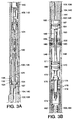
- FIGURES 3A-B are a partial cross-sectional representation of portions of the exemplary actuator tool 100 before actuation.
- FIGURES 4A-B are a partial cross-sectional representation of the portions shown in FIGS. 3A-B as they would appear after detonation.
- FIGURE 5 is a schematic representation of an embodiment for tool 100 featuring timer actuation prior to opening of valve assembly 126.
- FIGURE 6 is a schematic representation of an embodiment for tool 100 featuring timer actuation following opening of valve assembly 126.
- FIGURE 7 is a schematic representation of an alternative embodiment for tool 100 incorporating a rupture disk arrangement.
- FIGURE 8 is a detail of an exemplary rupture disk arrangement.
- FIGURE 9 is a schematic representation showing the tool 100 and one possible backup actuator.
- a well 10 is represented schematically by a well casing 12 having a wellbore or casing bore 14 defined therein.
- Exemplary arrangements for a tubing conveyed perforating string are briefly described by way of background, as they are generally known and understood by those skilled in the art.
- a portion of a tubing string 16 is shown in place within the wellbore 14 and forms an annulus 32 with the well casing 12. It will be appreciated that the tubing string 16 is lowered into the wellbore 14 from the earth's surface and the tubing string 16 will initially extend entirely to the surface of the well. In FIG. 1, only a lower portion of the tubing string 16 is illustrated. An on/off tool 18 has been disconnected from an upper tubing string portion.
- An auto-release gun hanger 20 may be used on the lower end of the tubing string 16 to anchor the tubing string 16 in place within the wellbore 14. This arrangement is shown by way of example only, and those skilled in the art will recognize that the gun hanger 20 may also be placed elsewhere within the tubing string with respect to associated perforating guns and firing heads.
- the tubing string 16 has assembled therewith a perforated nipple 22 with ports 23, a seating nipple or landing nipple 24.
- the landing nipple 24 divides the bore of the tubing string 16 into an upper tubing bore 33 and a lower tubing bore 35.
- a secondary, hydraulic differential firing head 26 and a perforating gun 28 are located above the gun hanger 20.
- a retrievable firing head tool 100 which includes generally a housing 102 and a bore 104 therethrough.
- the tool 100 is intended to be positioned within the tubing string 16 and lowered by wireline to attach to the stinger 29.
- the stinger 29 is preferably a VannJet ® stinger, the use and operation of which is well known in the art.
- a first explosive pathway 58 is provided between the stinger 29 and the gun 28 which detonates downwardly and, ultimately, fires the shaped charges 25 in the gun 28. Additional details regarding the construction of this type of stinger are given in our U.S. Patent No. 5,301,755 to which reference should be made for further details.
- the differential firing head 26 includes an actuating piston 60 and a firing piston 62. Details regarding the construction and operation of the differential firing head 26 are also provided in U.S. Patent No. 5,301,755.
- Firing piston 62 includes collet fingers 64 which are held in place by actuating piston 60 such that actuating piston 60 must move upwardly into upper cavity 78 to release firing piston 62.
- Ports 34 communicate the annulus 32 with the bore 66 located between pistons 60, 62.
- a lower cavity 70 is provided below firing piston 62.
- the differential firing head 26 may be actuated using hydraulic pressure differential and provides a second explosive pathway 56 to the perforating gun 28.
- a firing pin 72 projects into lower cavity 70 and is engaged with the second explosive pathway 56.
- first and second explosive pathways 58, 56 may include primacord.
- Shear pins 80 are provided to secure actuating piston 60 in position.
- Upper cavity 78 communicates by means of a conduit or other communication passageway 82 with the lower tubing bore 35.
- the actuating piston 60 includes a high pressure side communicating with bore 66 and the wellbore annulus 32 by means of ports 34.
- Actuating piston 60 also includes a low pressure side communicating with tubing bore 35 by means of upper cavity 78 and communication passageway 82.
- the pressure in annulus 32 and the pressure in the lower tubing bore 35 are substantially the same as the firing head 26 and perforating gun 28 lowered into the well 10 since well fluids may flow through the ports 23 in perforated nipple 22 causing the pressure across actuating piston 60 to be balanced.
- upper portions of tool 100 may be similar to that of the electronic self-contained timer operated firing head actuator of FIGS. 5A-5D of U.S. Patent 5,301,755.
- Methods of disposing an actuating tool within a tubing string are also described in that reference. However, portions of that tool, where helpful, will be described briefly here to aid the reader in understanding the invention. Connections between components, although not specifically described in all instances, are shown schematically and comprise conventional connection techniques such as threading and the use of elastomeric O-ring or other seals for fluid tightness where appropriate.
- an upper connector 106 includes a fishing neck 108 proximate its upper end for attachment by a slickline device (not shown).
- the upper connector is attached at threaded connection 110 to electronics housing 112 therebelow which contains a spring assembly or other shock absorber arrangement 114, battery pack 116 and electronics package 118.
- the electronics package 118 contains a timer or timer circuitry such as are known in the art and which may be preset to expire at the end of a predetermined amount of time.
- the electronics package 118 is associated with an electric motor 120 via a power cable 122.
- valve assembly 126 includes a valve housing 128 which is affixed to the electronics housing 112 at threaded connection 130.
- the valve housing includes lateral ports 134 which expose chamber 132 to the tubing string or well bore 16.
- the lower portion of the valve housing 128 is affixed at thread 139 to connector sub 138 which encloses bore 140.
- a valve stem 136 is slidably disposed within the valve housing 130 and presents a sealing end 137 which is removably disposable within bore 140 to selectively permit fluid communication between fluid entering the ports 134 and the bore 140 of the connector sub 138.
- the bore 140 is initially closed to fluid communication and contains unpressurized air.
- the lower end of the connector sub 138 is affixed at thread 144 to piston section housing 146 which contains fluid ports 148 communicating with the tubing string 16.
- the piston section housing 146 encloses an upper chamber 150 which, as shown in FIG. 3B, is initially filled with unpressurized air.
- a central chamber 152 is also initially air-filled, but due to the presence of fluid ports 148 will be filled with fluids from within the tubing string 16 or other portions of the wellbore once the tool 100 is disposed within the tubing string 16.
- a packing arrangement 156 separates the upper and central chambers 150 and 152 and, by virtue of seals 158, affords a generally fluid-tight seal between them. Allen screws 160 hold the packing arrangement 156 in place within the piston section housing 146.
- a piston assembly including an upper piston 162 and a lower piston 168 are reciprocally disposed in housing 146.
- Upper piston 162 is slidably disposed within the upper chamber 150 and includes a piston head 164 with an upper side 165 and a piston stem 166 which extends downwardly therefrom through the packing arrangement 156 and into the central chamber 152 below.
- the enlarged upper portion 164 includes a bore 167 to reduce the weight of upper piston 162 lessening the piston's inertial resistance to movement.
- a lower piston 168 is disposed within the piston section housing 146 below the fluid ports 148 and also includes a piston head 170 with an upper side 171 and a piston stem 172 extending downwardly therefrom.
- the lower end 169 of piston stem 166 abuts and terminates against upper side 171.
- the lower end of piston stem 172 terminates in a firing pin 174.
- the piston stem 172 also includes an annular downwardly facing shoulder 176.
- An initiator 182 is threaded to the lower end of piston section housing 146.
- the percussion initiator 182 may be of any known construction.
- a suitable percussion detonator is described in U.S. Patent No. 4,614,156, issued to Colle, Jr., et al., to which reference should be made for further details.
- the initiator includes firing pin 174 which is held in place by a set of shear pins or shear rings 178.
- the shear pins 178 may number between 1 and 20 to provide a shear resistance which may be set between 730 psi and 14,600 psi.
- a lower chamber 180 filled with unpressurized air, is defined between the piston head 170 of the lower piston 168 and the percussion initiator 182 therebelow.
- a downward pressure differential exists across the lower piston 168 as a result of hydrostatic fluid entering central chamber 152 through fluid ports 148.
- the hydrostatic pressure in the well communicates with the upper side 171 of lower piston 168 via fluid ports 148.
- Shear pins 178 provide a predetermined shear resistance to prevent the pressure from the hydrostatic head on upper side 171 to have sufficient force to shear pins 178.
- lower chamber 180 is basically at atmospheric pressure thereby creating a pressure differential across lower piston 168 which is insufficient to shear pins 178.
- Upper piston 162 is housed within upper chamber 150 which is also substantially at atmospheric pressure since the valve assembly 126 is closed prior to lowering tool 100 into the well.
- the hydrostatic head communicating through ports 148 act upon the lower end 169 of stem 166 of upper piston 162 tending to cause piston 162 to rise within upper chamber 150.
- valve assembly 126 Upon opening valve assembly 126, the well fluids are allowed to pass through ports 134 and bore 140 into upper chamber 150.
- the pressure of the hydrostatic head acts on the upper side 165 of upper piston 162. It is noted that because the hydrostatic pressure also acts upwardly on the lower end 169 of stem 166, the effective pressure area on the upper side 165 of upper piston 162 is the area of upper side 165 less the cross-sectional area of shaft 166, i.e., the effective pressure area.
- the hydrostatic head acting on the effective pressure area of upper piston 162 provides an additional force via stem 166 to the upper side 171 of lower piston 168. This additional force is designed, together with the force acting on the upper side 171 of lower piston 168, to provide sufficient force to shear pins 178.
- the area of upper side 171 of lower piston 168 and upper side 165 of upper piston 162 is 1.226 square inches.
- the force supported by the shear pins on the lower piston 168 would be 1,226 lbs.
- the shear pins 178 for example, would provide a shear resistance of approximately 1,600 lbs.
- valve assembly 126 Upon opening valve assembly 126, the 1,000 psi hydrostatic head would also act on the effective pressure area of upper piston 162 which would add an additional 1,030 pounds of force. Combined, upper and lower pistons 162, 168 would provide a force of 2,256 lbs which would be greater than the shear resistance of shear pins 178 thus shearing pins 178. The greatly increased downward force upon the upper piston 162 causes the lower piston 168 to snap downwardly to actuate firing pin 174.
- tandem piston assembly of the present invention has the advantage that motor 120 may be of limited size and still have sufficient power to operate the lead screw assembly 124 and open the valve assembly 126.
- the hydrostatic pressure through ports 134 acts upon the valve stem 136 and sealing end 137 creates friction against the cylindrical wall forming bore 140.
- the frictional engagement of sealing end 137 together with the hydrostatic head acting on stem 136 determines the size of electric motor 120 required to operate lead screw assembly 124 and open valve assembly 126.
- tandem pistons were to be eliminated and pressure was instead applied to a single pinned piston, an enlarged diameter bore 140 would likely be required to provide sufficient fluid volume upon the single piston to move that piston with adequate force and velocity to assure effective operation of the percussion initiator 182.
- the size requirements for the electrical motor 120 to operate lead screw assembly 124 and open valve assembly 126 would increase substantially.
- a smaller motor suffices for operation because a smaller bore fluid path 140 provides for placement of adequate fluid pressure upon upper piston 162 to ensure that its downward movement is effective in helping to shear pins 178.
- open ports 148 which are preferably larger in diameter than the fluid path of bore 140, permit the upper side of the lower piston 168 to be subjected to hydrostatic pressure while the tool 100 is within the well. Once pins 178 have sheared, the fluid volume and hydrostatic pressure from ports 148 assists in supplying sufficient downward force and velocity upon the lower piston 168 to aid it in effectively operating the percussion initiator 182.
- An explosives section housing 184 is affixed at thread 186 to the lower end of the housing of the initiator 182 and maintains a first booster charge 188 proximate the percussion initiator 182.
- a length of primacord 190 connects the first booster charge 188 to a second booster charge 192 proximate the lower end of the explosives section housing 184.
- a downwardly directed shaped charge 194 is associated with the second booster charge 192.
- the percussion initiator 182, primacord 190, booster charges 188 and 192, and shaped charge 194 may be collectively thought of as an explosive device operably associated with the timer of the electronics package 118 for initiation following the expiration of a preset amount of time.
- a colleted connector 196 Threaded below the shaped charge 194 is a colleted connector 196 which is fashioned to be complimentary to the profile of stinger 29. If detonated with the colleted connector 196 attached to the stinger 29, the shaped charge 194 will detonate downwardly into the stinger 29 and initiate the first explosive pathway 58 contained therein.
- the tubing string 16 is assembled with an on/off tool 18, a perforated nipple 22, a landing nipple 24, a differential firing head 26, a perforating gun 28, and exemplary auto release gun hanger 20.
- the tubing string 16 with the perforating system attached is lowered into the casing string 16 with the gun hanger 20 anchoring the tubing string 16 in place within the wellbore 14 so as to position the perforating gun 28 adjacent the producing zone 34 to be perforated.
- FIGS 3-6 there are shown methods of operation of firing tool 100 for the actuation of firing head 26 and perforating gun 28.
- the electronic timer of electronics package 118 Prior to lowering the firing tool 100 into the well 10, the electronic timer of electronics package 118 is set and started at the surface. A predetermined amount of time is set on the electronic timer to provide adequate time for the tool 100 to be lowered into the well, to be properly latched onto the stinger 29 and to disconnect and retrieve the wireline.
- the tool 100 is lowered into the bore of tubing string 16 on a wireline (not shown). The tool 100 is essentially lowered and latched onto stinger 29. Upon properly latching tool 100 onto stinger 29, the wireline is retrieved.
- FIGS. 3 and 4 illustrate the configuration of components within tool 100 before and after actuation, and comparison between the two figures, together with the diagrams of Figures 5 and 6, will aid in the understanding of the actuation sequence.
- motor 120 operates lead screw assembly 124 to open valve assembly 126.
- Hydrostatic pressure within the tubing string 16 and/or lower annulus enters the chamber 132, bore 140 and bore 167 through ports 134.
- a downward pressure differential is generated across the upper piston 162 by the fluid pressure at the upper side 165 to generate a downward axial force on the piston stem 166 to the lower piston 168.
- the shear pins 178 are sheared, permitting the upper and lower pistons 162, 168 to move rapidly downwardly within the piston section housing 146.
- the tandem piston arrangement of upper piston 162 and lower piston 168 aids in effecting actuation at existing tubing string or lower annulus pressures.
- the shear pins 178 will not shear at atmospheric pressures. The shearing actually results from a combination of fluid pressure at the upper side 171 of lower piston 168 and the axial force applied to the upper side 171 by the piston stem 166 of the upper piston 162.
- the actuation sequence described should function properly in response to pressures generated by the normal hydrostatic head within a tubing string in an underbalanced condition. There is, therefore, little or no need to pressurize portions of the annulus to initiate actuation.
- the tandem piston arrangement will function at hydrostatic pressure levels of as little as 500 psi. The maximum recommended pressure level is around 12,000 psi for these models.
- FIG. 7 there is shown schematically alternative means for starting the timer of the electronics package 118.
- the timer is set at the surface to operate electric motor 120 after a predetermined period of time.
- the alternative embodiment shown in Figures 7 and 8 allow the tool 100 to be conveyed into the tubing string 16 and attached to the stinger 29 before starting the timer in the electronics package 118.
- a starter means 200 which is threaded to the upper end of electronics housing 112.
- Starter means 200 includes a connector sub 202 threaded at 204 to the upper end of housing 112.
- the upper connector 206 of the preferred embodiment is mounted on top of the starter means 200 and includes a fishing neck 208 at its upper end for attachment by a slickline device (not shown).
- Upper connector 206 threadedly engages the upper end of connector sub 202 at 210.
- Upper connector 206 includes a cylindrical bore 212 in which is disposed a floating piston 214.
- a fluid passageway 216 communicates with the upper side of floating piston 214 with a transverse bore 218 extending to the annulus 32.
- a rupture disk 220 is disposed in bore 218.
- a silicone fluid is disposed in bore 212 below floating piston 214.
- Connector sub 202 includes an axial bore 222 which extends its length.
- a fluid retarding member 224 such as a visco jet, is disposed at the upper end of axial bore 222 and communicates with the bore 212 below floating piston 214.
- a grounding piston 230 is disposed in the lower end of connector sub 222 and upper end of housing 112. Grounding piston 230 is held in place by shear pins 226. The upper end of grounding piston 230 is exposed to axial bore 222.
- Fluid retardation member 214 includes a tortuous passageway slowing the passage of the silicone fluid from bore 212 into axial bore 222. As the pressure builds within axial bore 222, the pressure reaches a predetermined limit so as to shear pins 226.
- grounding piston 230 moves downwardly to engage the upper ends of the battery pack 116.
- grounding piston 230 engaging battery pack 116 a circuit is completed in the electronics package 118 thereby actuating the timer in electronics package 118.
- the visco jet is a well-known device for fluid restriction. If visco jet 224 were not used, upon bursting rupture disk 220, the hydrostatic pressure would cause the rapid downward movement of grounding piston 230 versus allowing the fluid to meter through axial bore 222 and ease grounding piston 230 into electrical contact with the upper end of battery pack 116.
- an air chamber actuator such as that shown and described in U.S. Patent 5,301,755 may be lowered into the tubing string 16 and seated in landing nipple 24.
- the screw mechanism Upon the expiration of the time on the electric timer, the screw mechanism will open the valve assembly and create a low pressure area in the lower tubular bore 35 such that actuating piston 60 in firing head 26 becomes unbalanced and the differential pressure across actuating piston 60 actuates firing piston 62 to thereby actuate firing head 26 as previously described. If tool 100 does not operate successfully, tool 100 may be withdrawn from the tubing string 16 and another method of detonation employed.
Landscapes
- Life Sciences & Earth Sciences (AREA)
- Engineering & Computer Science (AREA)
- Geology (AREA)
- Mining & Mineral Resources (AREA)
- Physics & Mathematics (AREA)
- Environmental & Geological Engineering (AREA)
- Fluid Mechanics (AREA)
- General Life Sciences & Earth Sciences (AREA)
- Geochemistry & Mineralogy (AREA)
- Percussive Tools And Related Accessories (AREA)
- Fluid-Driven Valves (AREA)
- Nozzles (AREA)
Applications Claiming Priority (2)
| Application Number | Priority Date | Filing Date | Title |
|---|---|---|---|
| US08/343,747 US5490563A (en) | 1994-11-22 | 1994-11-22 | Perforating gun actuator |
| US343747 | 1994-11-22 |
Publications (2)
| Publication Number | Publication Date |
|---|---|
| EP0713954A2 true EP0713954A2 (fr) | 1996-05-29 |
| EP0713954A3 EP0713954A3 (fr) | 1998-01-07 |
Family
ID=23347475
Family Applications (1)
| Application Number | Title | Priority Date | Filing Date |
|---|---|---|---|
| EP95307990A Withdrawn EP0713954A3 (fr) | 1994-11-22 | 1995-11-08 | Actuateur pour un perforateur |
Country Status (3)
| Country | Link |
|---|---|
| US (1) | US5490563A (fr) |
| EP (1) | EP0713954A3 (fr) |
| CA (1) | CA2163410A1 (fr) |
Cited By (2)
| Publication number | Priority date | Publication date | Assignee | Title |
|---|---|---|---|---|
| WO2014171914A1 (fr) * | 2013-04-15 | 2014-10-23 | Halliburton Energy Services, Inc. | Actionneur de tête de mise à feu pour un système de perforation de puits et procédé d'utilisation de ce dernier |
| US8991496B2 (en) | 2013-04-15 | 2015-03-31 | Halliburton Energy Services, Inc. | Firing head actuator for a well perforating system and method for use of same |
Families Citing this family (49)
| Publication number | Priority date | Publication date | Assignee | Title |
|---|---|---|---|---|
| US5791417A (en) | 1995-09-22 | 1998-08-11 | Weatherford/Lamb, Inc. | Tubular window formation |
| US5709265A (en) | 1995-12-11 | 1998-01-20 | Weatherford/Lamb, Inc. | Wellbore window formation |
| US5636692A (en) * | 1995-12-11 | 1997-06-10 | Weatherford Enterra U.S., Inc. | Casing window formation |
| US5603384A (en) * | 1995-10-11 | 1997-02-18 | Western Atlas International, Inc. | Universal perforating gun firing head |
| DE19882554C2 (de) * | 1997-07-23 | 2002-10-31 | Schlumberger Technology Corp | Vorrichtung zum lösbaren Koppeln einer Tiefbohrkanone mit einem Strang |
| US5992289A (en) * | 1998-02-17 | 1999-11-30 | Halliburton Energy Services, Inc. | Firing head with metered delay |
| US5960894A (en) * | 1998-03-13 | 1999-10-05 | Primex Technologies, Inc. | Expendable tubing conveyed perforator |
| US6179064B1 (en) * | 1998-07-22 | 2001-01-30 | Schlumberger Technology Corporation | System for indicating the firing of a perforating gun |
| US6257338B1 (en) | 1998-11-02 | 2001-07-10 | Halliburton Energy Services, Inc. | Method and apparatus for controlling fluid flow within wellbore with selectively set and unset packer assembly |
| US6253857B1 (en) | 1998-11-02 | 2001-07-03 | Halliburton Energy Services, Inc. | Downhole hydraulic power source |
| US6206100B1 (en) | 1999-12-20 | 2001-03-27 | Osca, Inc. | Separable one-trip perforation and gravel pack system and method |
| US6568474B2 (en) | 1999-12-20 | 2003-05-27 | Bj Services, Usa | Rigless one-trip perforation and gravel pack system and method |
| US6422148B1 (en) | 2000-08-04 | 2002-07-23 | Schlumberger Technology Corporation | Impermeable and composite perforating gun assembly components |
| US6675896B2 (en) * | 2001-03-08 | 2004-01-13 | Halliburton Energy Services, Inc. | Detonation transfer subassembly and method for use of same |
| US6708761B2 (en) * | 2001-11-13 | 2004-03-23 | Halliburton Energy Services, Inc. | Apparatus for absorbing a shock and method for use of same |
| GB2424009B (en) | 2004-09-07 | 2007-09-05 | Schlumberger Holdings | Automatic tool release |
| US7624681B2 (en) * | 2005-05-06 | 2009-12-01 | Schlumberger Technology Corporation | Initiator activated by a stimulus |
| GB0515068D0 (en) * | 2005-07-22 | 2005-08-31 | Moyes Peter B | Downhole trigger apparatus |
| US7510001B2 (en) * | 2005-09-14 | 2009-03-31 | Schlumberger Technology Corp. | Downhole actuation tools |
| US7387162B2 (en) * | 2006-01-10 | 2008-06-17 | Owen Oil Tools, Lp | Apparatus and method for selective actuation of downhole tools |
| US8118098B2 (en) * | 2006-05-23 | 2012-02-21 | Schlumberger Technology Corporation | Flow control system and method for use in a wellbore |
| EP2021578B1 (fr) * | 2006-05-26 | 2020-02-26 | Owen Oil Tools LP | Dispositifs et procédés de perforation pour applications de puits de forage haute pression |
| US7789153B2 (en) * | 2006-10-26 | 2010-09-07 | Alliant Techsystems, Inc. | Methods and apparatuses for electronic time delay and systems including same |
| US8002026B2 (en) * | 2006-10-26 | 2011-08-23 | Alliant Techsystems Inc. | Methods and apparatuses for electronic time delay and systems including same |
| US8113119B2 (en) | 2008-07-11 | 2012-02-14 | Halliburton Energy Services, Inc. | Surface safe explosive tool |
| US20100051278A1 (en) * | 2008-09-04 | 2010-03-04 | Integrated Production Services Ltd. | Perforating gun assembly |
| US20110056679A1 (en) * | 2009-09-09 | 2011-03-10 | Schlumberger Technology Corporation | System and method for controlling actuation of downhole tools |
| US8925631B2 (en) * | 2010-03-04 | 2015-01-06 | Schlumberger Technology Corporation | Large bore completions systems and method |
| US9540913B2 (en) * | 2012-04-11 | 2017-01-10 | Halliburton Energy Services, Inc. | Method and apparatus for actuating a differential pressure firing head |
| US8910556B2 (en) | 2012-11-19 | 2014-12-16 | Don Umphries | Bottom hole firing head and method |
| CN105492720B (zh) * | 2013-08-26 | 2018-10-30 | 德国德力能有限公司 | 弹道传送模块 |
| US9453402B1 (en) | 2014-03-12 | 2016-09-27 | Sagerider, Inc. | Hydraulically-actuated propellant stimulation downhole tool |
| CA3014081C (fr) * | 2016-02-11 | 2020-04-14 | Hunting Titan, Inc. | Systeme de transfert de detonation |
| CN107478112B (zh) * | 2017-09-21 | 2023-07-04 | 中国工程物理研究院电子工程研究所 | 一种高可靠直列式引信及其控制方法 |
| US10865626B2 (en) * | 2017-11-29 | 2020-12-15 | DynaEnergetics Europe GmbH | Hydraulic underbalance initiated safety firing head, well completion apparatus incorporating same, and method of use |
| US11274529B2 (en) | 2018-01-25 | 2022-03-15 | Hunting Titan, Inc. | Cluster gun system |
| WO2019148009A2 (fr) * | 2018-01-25 | 2019-08-01 | Hunting Titan, Inc. | Système de grappe d'armes à feu |
| US11193358B2 (en) * | 2018-01-31 | 2021-12-07 | DynaEnergetics Europe GmbH | Firing head assembly, well completion device with a firing head assembly and method of use |
| US10458213B1 (en) | 2018-07-17 | 2019-10-29 | Dynaenergetics Gmbh & Co. Kg | Positioning device for shaped charges in a perforating gun module |
| US11339614B2 (en) | 2020-03-31 | 2022-05-24 | DynaEnergetics Europe GmbH | Alignment sub and orienting sub adapter |
| USD903064S1 (en) * | 2020-03-31 | 2020-11-24 | DynaEnergetics Europe GmbH | Alignment sub |
| US11174713B2 (en) | 2018-12-05 | 2021-11-16 | DynaEnergetics Europe GmbH | Firing head and method of utilizing a firing head |
| USD1010758S1 (en) | 2019-02-11 | 2024-01-09 | DynaEnergetics Europe GmbH | Gun body |
| USD1019709S1 (en) | 2019-02-11 | 2024-03-26 | DynaEnergetics Europe GmbH | Charge holder |
| USD1034879S1 (en) | 2019-02-11 | 2024-07-09 | DynaEnergetics Europe GmbH | Gun body |
| KR102723869B1 (ko) * | 2019-08-29 | 2024-10-31 | 현대모비스 주식회사 | 차고 조절장치 |
| US12228018B2 (en) | 2019-12-10 | 2025-02-18 | Hunting Titan, Inc. | Cluster gun system |
| US11988049B2 (en) | 2020-03-31 | 2024-05-21 | DynaEnergetics Europe GmbH | Alignment sub and perforating gun assembly with alignment sub |
| US11732556B2 (en) | 2021-03-03 | 2023-08-22 | DynaEnergetics Europe GmbH | Orienting perforation gun assembly |
Citations (2)
| Publication number | Priority date | Publication date | Assignee | Title |
|---|---|---|---|---|
| US4614156A (en) | 1984-03-08 | 1986-09-30 | Halliburton Company | Pressure responsive explosion initiator with time delay and method of use |
| US5301755A (en) | 1993-03-11 | 1994-04-12 | Halliburton Company | Air chamber actuator for a perforating gun |
Family Cites Families (13)
| Publication number | Priority date | Publication date | Assignee | Title |
|---|---|---|---|---|
| US4560000A (en) * | 1982-04-16 | 1985-12-24 | Schlumberger Technology Corporation | Pressure-activated well perforating apparatus |
| US4509604A (en) * | 1982-04-16 | 1985-04-09 | Schlumberger Technology Corporation | Pressure responsive perforating and testing system |
| US4616718A (en) * | 1985-08-05 | 1986-10-14 | Hughes Tool Company | Firing head for a tubing conveyed perforating gun |
| AU7585487A (en) * | 1986-06-19 | 1988-01-12 | Phoenix Petroleum Services | Improvements relating to detonating heads |
| GB8629746D0 (en) * | 1986-12-12 | 1987-01-21 | Phoenix Petroleum Services | Installation of downhole pumps in wells |
| US4901802A (en) * | 1987-04-20 | 1990-02-20 | George Flint R | Method and apparatus for perforating formations in response to tubing pressure |
| GB8817178D0 (en) * | 1988-07-19 | 1988-08-24 | Phoenix Petroleum Services | Apparatus for detonating well casing perforating guns |
| US4886126A (en) * | 1988-12-12 | 1989-12-12 | Baker Hughes Incorporated | Method and apparatus for firing a perforating gun |
| US4969525A (en) * | 1989-09-01 | 1990-11-13 | Halliburton Company | Firing head for a perforating gun assembly |
| US5103906A (en) * | 1990-10-24 | 1992-04-14 | Halliburton Company | Hydraulic timer for downhole tool |
| US5042593A (en) * | 1990-11-02 | 1991-08-27 | Lloyd J. Songe, Jr. | Hydraulically damped detonator for use in perforating oil well tubing |
| US5101907A (en) * | 1991-02-20 | 1992-04-07 | Halliburton Company | Differential actuating system for downhole tools |
| US5279363A (en) * | 1991-07-15 | 1994-01-18 | Halliburton Company | Shut-in tools |
-
1994
- 1994-11-22 US US08/343,747 patent/US5490563A/en not_active Expired - Fee Related
-
1995
- 1995-11-08 EP EP95307990A patent/EP0713954A3/fr not_active Withdrawn
- 1995-11-21 CA CA002163410A patent/CA2163410A1/fr not_active Abandoned
Patent Citations (2)
| Publication number | Priority date | Publication date | Assignee | Title |
|---|---|---|---|---|
| US4614156A (en) | 1984-03-08 | 1986-09-30 | Halliburton Company | Pressure responsive explosion initiator with time delay and method of use |
| US5301755A (en) | 1993-03-11 | 1994-04-12 | Halliburton Company | Air chamber actuator for a perforating gun |
Cited By (2)
| Publication number | Priority date | Publication date | Assignee | Title |
|---|---|---|---|---|
| WO2014171914A1 (fr) * | 2013-04-15 | 2014-10-23 | Halliburton Energy Services, Inc. | Actionneur de tête de mise à feu pour un système de perforation de puits et procédé d'utilisation de ce dernier |
| US8991496B2 (en) | 2013-04-15 | 2015-03-31 | Halliburton Energy Services, Inc. | Firing head actuator for a well perforating system and method for use of same |
Also Published As
| Publication number | Publication date |
|---|---|
| US5490563A (en) | 1996-02-13 |
| EP0713954A3 (fr) | 1998-01-07 |
| CA2163410A1 (fr) | 1996-05-23 |
Similar Documents
| Publication | Publication Date | Title |
|---|---|---|
| US5490563A (en) | Perforating gun actuator | |
| EP0615053B1 (fr) | Système de perforation pour puits de pétrole | |
| EP0721051B1 (fr) | Mise en marche d'une tête de détonation | |
| US5603384A (en) | Universal perforating gun firing head | |
| US4629001A (en) | Tubing pressure operated initiator for perforating in a well borehole | |
| EP2401474B1 (fr) | Dispositif et procédés novateurs de mise à feu de perforateurs | |
| US4969525A (en) | Firing head for a perforating gun assembly | |
| US5551520A (en) | Dual redundant detonating system for oil well perforators | |
| US4509604A (en) | Pressure responsive perforating and testing system | |
| US6182750B1 (en) | Device for performing downhole functions | |
| US4544034A (en) | Actuation of a gun firing head | |
| US5911277A (en) | System for activating a perforating device in a well | |
| US4886126A (en) | Method and apparatus for firing a perforating gun | |
| US4554981A (en) | Tubing pressurized firing apparatus for a tubing conveyed perforating gun | |
| EP2085571B1 (fr) | Poinçon de tubes et outil de réglage en une seule manoeuvre | |
| US4560000A (en) | Pressure-activated well perforating apparatus | |
| EP0319321B1 (fr) | Dispositif de mise à feu pour un perforateur guidé par un tube et procédé pour perforer | |
| US5062485A (en) | Variable time delay firing head | |
| GB2321659A (en) | Downhole valve | |
| EP0183537A2 (fr) | Dispositif de puits de forage activé par pression de fluide | |
| US5007344A (en) | Dual firing system for a perforating gun | |
| US4678044A (en) | Tubing pressure operated initiator for perforating in a well borehole | |
| US4690227A (en) | Gun firing head | |
| EP0425568B1 (fr) | Appareil et procede pour faire detoner des perforateurs de puits | |
| US5386780A (en) | Method and apparatus for extended time delay of the detonation of a downhole explosive assembly |
Legal Events
| Date | Code | Title | Description |
|---|---|---|---|
| PUAI | Public reference made under article 153(3) epc to a published international application that has entered the european phase |
Free format text: ORIGINAL CODE: 0009012 |
|
| AK | Designated contracting states |
Kind code of ref document: A2 Designated state(s): DE FR GB NL |
|
| PUAL | Search report despatched |
Free format text: ORIGINAL CODE: 0009013 |
|
| AK | Designated contracting states |
Kind code of ref document: A3 Designated state(s): DE FR GB NL |
|
| 17P | Request for examination filed |
Effective date: 19980401 |
|
| STAA | Information on the status of an ep patent application or granted ep patent |
Free format text: STATUS: THE APPLICATION HAS BEEN WITHDRAWN |
|
| 18W | Application withdrawn |
Withdrawal date: 19981216 |