EP0714203A2 - Système d'affichage vidéo avec traitement numérique - Google Patents
Système d'affichage vidéo avec traitement numérique Download PDFInfo
- Publication number
- EP0714203A2 EP0714203A2 EP95118461A EP95118461A EP0714203A2 EP 0714203 A2 EP0714203 A2 EP 0714203A2 EP 95118461 A EP95118461 A EP 95118461A EP 95118461 A EP95118461 A EP 95118461A EP 0714203 A2 EP0714203 A2 EP 0714203A2
- Authority
- EP
- European Patent Office
- Prior art keywords
- video
- sources
- video data
- data
- digital
- Prior art date
- Legal status (The legal status is an assumption and is not a legal conclusion. Google has not performed a legal analysis and makes no representation as to the accuracy of the status listed.)
- Withdrawn
Links
Images

Classifications
-
- H—ELECTRICITY
- H04—ELECTRIC COMMUNICATION TECHNIQUE
- H04N—PICTORIAL COMMUNICATION, e.g. TELEVISION
- H04N5/00—Details of television systems
- H04N5/44—Receiver circuitry for the reception of television signals according to analogue transmission standards
- H04N5/445—Receiver circuitry for the reception of television signals according to analogue transmission standards for displaying additional information
- H04N5/45—Picture in picture, e.g. displaying simultaneously another television channel in a region of the screen
-
- H—ELECTRICITY
- H04—ELECTRIC COMMUNICATION TECHNIQUE
- H04N—PICTORIAL COMMUNICATION, e.g. TELEVISION
- H04N7/00—Television systems
- H04N7/01—Conversion of standards, e.g. involving analogue television standards or digital television standards processed at pixel level
- H04N7/0117—Conversion of standards, e.g. involving analogue television standards or digital television standards processed at pixel level involving conversion of the spatial resolution of the incoming video signal
- H04N7/012—Conversion between an interlaced and a progressive signal
Definitions
- This invention relates to digital television systems, more particularly to special features for digital television systems.
- Digital television has several advantages over the current standard analog system. Because the digital data can be packed, more data can be transmitted that allows for a better picture. Additionally, manipulation of the data on a picture element (pixel) level can reduce artifacts and increase the resolution and overall clarity of the picture.
- pixel picture element
- PIP picture-in-picture
- Picture-outside-picture typically has the extra channels along the side, top or bottom of the main channel, but instead of encroaching on the main channel's picture, they are boxed next to it.
- Additional special features are zoom, freeze, TV guide and his/hers.
- TV guide usually involves some number of channels all displayed simultaneously, with no main channel picture, so the viewer can decide what to watch. His/hers includes two pictures, side by side on the TV.
- a digital implementation of a television system with special features is disclosed.
- the ability to perform these functions digitally allows the system to function entirely in the digital realm after reception of the signal. If the signal received is analog, it is converted once to the digital domain and processed digitally all the way through the system. Performing these special functions in the digital domain also has the advantage of eliminating conversion to analog then back to digital if the incoming signal is digital. Addition of a switch allows all of these features to be provided with no redundant circuitry and therefore at minimum cost.
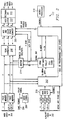
- Figure 1 shows a digital display system with a special features module.
- the incoming video could be in several formats. It could come in through a receiver such as 102 and enter the switch 106 as a composite video signal.
- Lines 104 represent input in S-Video format, where the chrominance and luminance have been separated into channels. All channels receivable by the television set, either in composite or in S-Video format, will be received at switch 106.
- the feature select line 116 represents the viewers' input.
- the main channel data will travel to the special features box through the chrominance and luminance switch (Y/C switch) 120 onto path 108 and the auxiliary video on path 110.
- the auxiliary channel could be handled in ways separate from the way in which the main channel is handled. However, for ease of discussion they are both processed the same way in Figure 1. Which channels comprise the auxiliary video depends upon the feature select signal 116 which is passed to the special features module 112 along path 118. For example, if the viewer wanted to watch channel 8 and have 2 picture-in-picture (PIP) displays of channels 4 and 6, the main channel data would be channel 8 and the selected, or predetermined, auxiliary channel data would be two channels wide with channels 4 and 6. The number of channels selectable is only limited by the amount of memory in the system. Additionally, all of the elements within box 100 could be on one device.
- PIP picture-in-picture
- Special features created by the special features circuitry include PIP, picture out of picture (POP), zoom, freeze, his/hers, and TV guide.
- PIP features has a main channel picture of moving video, with a smaller picture of moving video within the borders of the main picture. More than one smaller picture could be displayed. For circuitry conservation, the additional pictures may not be moving video, but "frozen" where one frame of data is displayed without change.
- POP differs from PIP in that the main channel picture remains uncovered by the smaller pictures.
- the two channels are reproduced side by side on the same screen. Zoom enlarges a portion of the picture to fill the entire display area. Freeze pauses the main video picture. Finally, TV guide allows the viewer to simultaneously display several channels of TV in order to select the one which is to be watched.
- ASIC application specific integrated circuit
- programmable logic device 212 programmable logic device 212 that will create the special features.
- the special feature data must be inserted in the appropriate place in the progressively scanned picture. Eventually, this adjusted data will be returned to the main video data stream just before it enters the scan converter 216, which actually performs the interlace to progressive scan conversion.
- Joining the signals from the main video channel are the signals from the auxiliary video channel.
- the luminance and color difference signals are low-pass filtered to eliminate any high frequency noise and sent to a multiplexer and analog to digital converter (MUX & A/D) 210. If the incoming data is digital television, the use of the A/D is no longer necessary.
- MUX & A/D analog to digital converter
- the ASIC or programmable logic device 212 also receives a horizontal and vertical synchronization signal from the main channel and the auxiliary channel. It decodes these signals and coordinates the flow of data from each channel accordingly. It also decodes the auxiliary channel synchronization signals to generate the multiplexer select and sample clock of the MUX & A/D 210.
- the ASIC 212 creates the appropriate feature to the correct scale under control of microprocessor 218.
- the feature data is processed it is sent via a 16-bit DRAM bus to a VRAM 226. At the appropriate time, the data then passes to buffer 214, or in the case of PIP/POP data, directly to MUX and color space converter 220.
- the ASIC 212 generates the necessary VRAM read and write addresses and control signals to implement the desired feature. For certain features, such as PIP/POP, the ASIC 212 also converts the auxiliary channel's interlaced data to progressive scan data for mixing into the main video channel's stream. Other features may utilize the scan converter 216 via the buffer 214.
- the color space converter inserts the PIP/POP data into the appropriate part of the picture data and converts the entire frame into red-green-blue (RGB) data. This RGB data is then sent to a data latch 222. Finally, if the signal contains gamma correction, the gamma must be removed via a degamma lookup table (LUT) 224 and the proscan video output is sent to the array.
- LUT degamma lookup table
- the resultant image has the appropriate feature, as selected by the viewer, in the overall picture, typically sent to the display device as one data stream.
- the digital processing of these features will become important if the incoming data stream is digital, rather than the analog standards currently used.
- using a digital means of display such as the DMD and LCD light modulators in conjunction with a digital special features implementation allows for better coordination and image correction by allowing additional processing of the data before it moves to the array to reduce other artifacts not necessarily related to the processing of special features. This includes such elements as motion and edge detection to eliminate other processing artifacts, or to enhance color and contrast.
Landscapes
- Engineering & Computer Science (AREA)
- Multimedia (AREA)
- Signal Processing (AREA)
- Television Systems (AREA)
- Studio Circuits (AREA)
- Compression Or Coding Systems Of Tv Signals (AREA)
- Two-Way Televisions, Distribution Of Moving Picture Or The Like (AREA)
Applications Claiming Priority (2)
| Application Number | Priority Date | Filing Date | Title |
|---|---|---|---|
| US34425694A | 1994-11-23 | 1994-11-23 | |
| US344256 | 1994-11-23 |
Publications (2)
| Publication Number | Publication Date |
|---|---|
| EP0714203A2 true EP0714203A2 (fr) | 1996-05-29 |
| EP0714203A3 EP0714203A3 (fr) | 1998-04-08 |
Family
ID=23349723
Family Applications (1)
| Application Number | Title | Priority Date | Filing Date |
|---|---|---|---|
| EP95118461A Withdrawn EP0714203A3 (fr) | 1994-11-23 | 1995-11-23 | Système d'affichage vidéo avec traitement numérique |
Country Status (5)
| Country | Link |
|---|---|
| US (1) | US5999227A (fr) |
| EP (1) | EP0714203A3 (fr) |
| JP (1) | JPH08251504A (fr) |
| KR (1) | KR960020415A (fr) |
| TW (1) | TW441213B (fr) |
Cited By (1)
| Publication number | Priority date | Publication date | Assignee | Title |
|---|---|---|---|---|
| EP1024663A3 (fr) * | 1999-01-29 | 2003-07-23 | Canon Kabushiki Kaisha | Dispositif de traitement d'image |
Families Citing this family (13)
| Publication number | Priority date | Publication date | Assignee | Title |
|---|---|---|---|---|
| KR100206114B1 (ko) * | 1996-10-11 | 1999-07-01 | 윤종용 | 외부 입출력 접속 적응형 비디오라인 접속장치 |
| EP0840522B1 (fr) * | 1996-10-28 | 2008-07-09 | Texas Instruments Incorporated | Améliorations pour systèmes d'affichage d'image |
| JP3360586B2 (ja) * | 1997-11-21 | 2002-12-24 | 日本電気株式会社 | スキャン変換装置及び方法 |
| WO2000021288A1 (fr) | 1998-10-01 | 2000-04-13 | Matsushita Electric Industrial Co., Ltd. | Equipement de conversion de signal d'image |
| US6971118B1 (en) * | 1999-07-28 | 2005-11-29 | Sharp Laboratories Of America, Inc. | System for displaying programming guide information |
| JP3998399B2 (ja) * | 1999-12-03 | 2007-10-24 | 松下電器産業株式会社 | 映像信号変換装置 |
| US7145704B1 (en) | 2003-11-25 | 2006-12-05 | Cheetah Omni, Llc | Optical logic gate based optical router |
| KR100441504B1 (ko) * | 2002-01-15 | 2004-07-23 | 삼성전자주식회사 | 주화면 및 부화면의 콤포지트신호 및 콤포넌트신호를 각각디지털신호로 변환할 수 있는 영상신호 복원장치 |
| KR100586669B1 (ko) * | 2003-08-27 | 2006-06-08 | 닛뽕빅터 가부시키가이샤 | 전송 시스템 |
| GB0419870D0 (en) * | 2004-09-08 | 2004-10-13 | Koninkl Philips Electronics Nv | Apparatus and method for processing video data |
| KR100716771B1 (ko) * | 2005-07-14 | 2007-05-14 | 삼성전자주식회사 | 디스플레이장치 및 그 제어방법 |
| US8947297B2 (en) * | 2006-01-30 | 2015-02-03 | The Invention Science Fund I, Llc | Positional display elements |
| EP2416565A1 (fr) * | 2010-08-05 | 2012-02-08 | Thomson Licensing | Procédé de traitement de signaux audio/vidéo et dispositif correspondant |
Citations (1)
| Publication number | Priority date | Publication date | Assignee | Title |
|---|---|---|---|---|
| EP0651577A2 (fr) | 1993-10-27 | 1995-05-03 | Texas Instruments Incorporated | Système de télévision numérique |
Family Cites Families (17)
| Publication number | Priority date | Publication date | Assignee | Title |
|---|---|---|---|---|
| US4712130A (en) * | 1986-08-29 | 1987-12-08 | Rca Corporation | Chrominance signal frequency converter as for a pix-in-pix television receiver |
| US4743958A (en) * | 1986-10-06 | 1988-05-10 | The Grass Valley Group, Inc. | Multiple television standards input selector and convertor |
| US4809069A (en) * | 1988-03-10 | 1989-02-28 | North American Philips Corporation | Multifunction memory for digital television |
| US5250933A (en) * | 1989-03-02 | 1993-10-05 | Hewlett-Packard Company | Method and apparatus for the simultaneous display of one or more selected images |
| US5134484A (en) * | 1989-06-01 | 1992-07-28 | Mindseye Educational Systems, Inc. | Superimposing method and apparatus useful for subliminal messages |
| US5367334A (en) * | 1991-05-20 | 1994-11-22 | Matsushita Electric Industrial Co., Ltd. | Video signal encoding and decoding apparatus |
| JPH04365278A (ja) * | 1991-06-13 | 1992-12-17 | Matsushita Electric Ind Co Ltd | 多画面表示回路 |
| EP0523299A1 (fr) * | 1991-07-18 | 1993-01-20 | International Business Machines Corporation | Système et méthode pour combiner des signaux vidéo composite multiples |
| KR950000828B1 (ko) * | 1991-12-11 | 1995-02-02 | 삼성전자 주식회사 | 다기능 내장형 tv |
| US5157495A (en) * | 1991-12-20 | 1992-10-20 | Eastman Kodak Company | Multi-mode video standard selection circuit and selection method |
| JPH05183833A (ja) * | 1992-01-07 | 1993-07-23 | Sony Corp | 表示装置 |
| US5351129A (en) * | 1992-03-24 | 1994-09-27 | Rgb Technology D/B/A Rgb Spectrum | Video multiplexor-encoder and decoder-converter |
| US5347318A (en) * | 1992-06-16 | 1994-09-13 | Canon Kabushiki Kaisha | Apparatus for processing video signals having different aspect ratios |
| US5331417A (en) * | 1992-09-15 | 1994-07-19 | Digital Pictures, Inc. | System and method of displaying a plurality of digital video images |
| JPH06189345A (ja) * | 1992-12-22 | 1994-07-08 | Matsushita Electric Ind Co Ltd | Hdtv信号伝送装置 |
| US5420534A (en) * | 1993-10-27 | 1995-05-30 | Loral Fairchild Corporation | Programmable NxM switching system with charge-coupled device multiplexer |
| US5453796A (en) * | 1994-06-28 | 1995-09-26 | Thomson Consumer Electronics, Inc. | Signal swap apparatus for a television receiver having an HDTV main picture signal processor and an NTSC Pix-in-Pix signal processor |
-
1995
- 1995-11-22 KR KR1019950042834A patent/KR960020415A/ko not_active Withdrawn
- 1995-11-23 EP EP95118461A patent/EP0714203A3/fr not_active Withdrawn
- 1995-11-24 JP JP7305828A patent/JPH08251504A/ja active Pending
-
1996
- 1996-01-05 TW TW085100071A patent/TW441213B/zh not_active IP Right Cessation
-
1997
- 1997-06-13 US US08/876,112 patent/US5999227A/en not_active Expired - Lifetime
Patent Citations (1)
| Publication number | Priority date | Publication date | Assignee | Title |
|---|---|---|---|---|
| EP0651577A2 (fr) | 1993-10-27 | 1995-05-03 | Texas Instruments Incorporated | Système de télévision numérique |
Cited By (3)
| Publication number | Priority date | Publication date | Assignee | Title |
|---|---|---|---|---|
| EP1024663A3 (fr) * | 1999-01-29 | 2003-07-23 | Canon Kabushiki Kaisha | Dispositif de traitement d'image |
| US6831634B1 (en) | 1999-01-29 | 2004-12-14 | Canon Kabushiki Kaisha | Image processing device |
| US7079129B2 (en) | 1999-01-29 | 2006-07-18 | Canon Kabushiki Kaisha | Image processing device |
Also Published As
| Publication number | Publication date |
|---|---|
| TW441213B (en) | 2001-06-16 |
| JPH08251504A (ja) | 1996-09-27 |
| KR960020415A (ko) | 1996-06-17 |
| US5999227A (en) | 1999-12-07 |
| EP0714203A3 (fr) | 1998-04-08 |
Similar Documents
| Publication | Publication Date | Title |
|---|---|---|
| US5796442A (en) | Multi-format television reciever | |
| US6421094B1 (en) | HDTV video display processor | |
| EP0766470B1 (fr) | Récepteur de télévision pour télétexte | |
| US5999227A (en) | Special features for digital television | |
| US5742350A (en) | Video system performing non-uniform interpolation of color space signals and method of using same | |
| US20100277645A1 (en) | Video apparatus and image sensing apparatus | |
| KR100186409B1 (ko) | 피씨와 티브이 적응형 피아이피 영상신호 처리회로 | |
| CA2241457A1 (fr) | Televiseur a haute definition pouvant afficher simultanement plusieurs images contenues dans des signaux diffuses par des systemes de diffusion differents | |
| EP0651571B1 (fr) | Dispositif et méthode pour données graphiques pour un récepteur de télévision | |
| US5729300A (en) | Double-screen simultaneous viewing circuit of a wide-television | |
| JP3847826B2 (ja) | 字幕データ表示制御装置 | |
| KR100311009B1 (ko) | 공통 포맷을 이용하는 영상 포맷 변환 장치와 그 방법 | |
| KR100426999B1 (ko) | 보조화상용아날로그비디오신호를샘플링하는방법및장치 | |
| JPS63200681A (ja) | 高品位テレビジヨン受信装置 | |
| AU746029B2 (en) | Picture-in-guide generator | |
| JPH0213076A (ja) | テレビジョン信号受信装置 | |
| KR100413471B1 (ko) | 디지털 티브이의 영상 처리 장치 | |
| KR100348444B1 (ko) | 텔레비젼의 표준신호 변환장치 | |
| JP2646132B2 (ja) | テレビジョン受像機 | |
| KR100251854B1 (ko) | 영상표시장치의 피아이피 처리 장치. | |
| US20050190297A1 (en) | Video signal processor and video display device | |
| KR100213005B1 (ko) | 화면 이동 장치 | |
| KR100279628B1 (ko) | 피디피티브이의 화면확대주사장치 | |
| KR920009876B1 (ko) | TV 수상기에서의 텔리텍스트 화면 피프(pip)장치 | |
| KR0138100Y1 (ko) | 영상 화면 디스플레이 회로 |
Legal Events
| Date | Code | Title | Description |
|---|---|---|---|
| PUAI | Public reference made under article 153(3) epc to a published international application that has entered the european phase |
Free format text: ORIGINAL CODE: 0009012 |
|
| AK | Designated contracting states |
Kind code of ref document: A2 Designated state(s): DE FR GB IT NL |
|
| PUAL | Search report despatched |
Free format text: ORIGINAL CODE: 0009013 |
|
| AK | Designated contracting states |
Kind code of ref document: A3 Designated state(s): DE FR GB IT NL |
|
| 17P | Request for examination filed |
Effective date: 19981006 |
|
| 17Q | First examination report despatched |
Effective date: 19991022 |
|
| STAA | Information on the status of an ep patent application or granted ep patent |
Free format text: STATUS: THE APPLICATION IS DEEMED TO BE WITHDRAWN |
|
| 18D | Application deemed to be withdrawn |
Effective date: 20000302 |