EP0714687A2 - Procédé et appareil de déshydratation de bones et autres - Google Patents
Procédé et appareil de déshydratation de bones et autres Download PDFInfo
- Publication number
- EP0714687A2 EP0714687A2 EP95118363A EP95118363A EP0714687A2 EP 0714687 A2 EP0714687 A2 EP 0714687A2 EP 95118363 A EP95118363 A EP 95118363A EP 95118363 A EP95118363 A EP 95118363A EP 0714687 A2 EP0714687 A2 EP 0714687A2
- Authority
- EP
- European Patent Office
- Prior art keywords
- sludge
- chamber
- pressure
- filter
- sludge chamber
- Prior art date
- Legal status (The legal status is an assumption and is not a legal conclusion. Google has not performed a legal analysis and makes no representation as to the accuracy of the status listed.)
- Granted
Links
Images










Classifications
-
- B—PERFORMING OPERATIONS; TRANSPORTING
- B01—PHYSICAL OR CHEMICAL PROCESSES OR APPARATUS IN GENERAL
- B01D—SEPARATION
- B01D25/00—Filters formed by clamping together several filtering elements or parts of such elements
- B01D25/12—Filter presses, i.e. of the plate or plate and frame type
- B01D25/127—Filter presses, i.e. of the plate or plate and frame type with one or more movable filter bands arranged to be clamped between the press plates or between a plate and a frame during filtration, e.g. zigzag endless filter bands
- B01D25/1275—Filter presses, i.e. of the plate or plate and frame type with one or more movable filter bands arranged to be clamped between the press plates or between a plate and a frame during filtration, e.g. zigzag endless filter bands the plates or the frames being placed in a non-vertical position
-
- B—PERFORMING OPERATIONS; TRANSPORTING
- B01—PHYSICAL OR CHEMICAL PROCESSES OR APPARATUS IN GENERAL
- B01D—SEPARATION
- B01D25/00—Filters formed by clamping together several filtering elements or parts of such elements
- B01D25/12—Filter presses, i.e. of the plate or plate and frame type
- B01D25/172—Plate spreading means
-
- B—PERFORMING OPERATIONS; TRANSPORTING
- B01—PHYSICAL OR CHEMICAL PROCESSES OR APPARATUS IN GENERAL
- B01D—SEPARATION
- B01D25/00—Filters formed by clamping together several filtering elements or parts of such elements
- B01D25/28—Leaching or washing filter cakes in the filter handling the filter cake for purposes other than regenerating
- B01D25/282—Leaching or washing filter cakes in the filter handling the filter cake for purposes other than regenerating for drying
- B01D25/285—Leaching or washing filter cakes in the filter handling the filter cake for purposes other than regenerating for drying by compression using inflatable membranes
-
- B—PERFORMING OPERATIONS; TRANSPORTING
- B01—PHYSICAL OR CHEMICAL PROCESSES OR APPARATUS IN GENERAL
- B01D—SEPARATION
- B01D25/00—Filters formed by clamping together several filtering elements or parts of such elements
- B01D25/28—Leaching or washing filter cakes in the filter handling the filter cake for purposes other than regenerating
- B01D25/282—Leaching or washing filter cakes in the filter handling the filter cake for purposes other than regenerating for drying
- B01D25/287—Leaching or washing filter cakes in the filter handling the filter cake for purposes other than regenerating for drying by compression using pistons
-
- B—PERFORMING OPERATIONS; TRANSPORTING
- B01—PHYSICAL OR CHEMICAL PROCESSES OR APPARATUS IN GENERAL
- B01D—SEPARATION
- B01D25/00—Filters formed by clamping together several filtering elements or parts of such elements
- B01D25/30—Feeding devices ; Discharge devices
-
- B—PERFORMING OPERATIONS; TRANSPORTING
- B01—PHYSICAL OR CHEMICAL PROCESSES OR APPARATUS IN GENERAL
- B01D—SEPARATION
- B01D25/00—Filters formed by clamping together several filtering elements or parts of such elements
- B01D25/32—Removal of the filter cakes
-
- B—PERFORMING OPERATIONS; TRANSPORTING
- B01—PHYSICAL OR CHEMICAL PROCESSES OR APPARATUS IN GENERAL
- B01D—SEPARATION
- B01D2201/00—Details relating to filtering apparatus
- B01D2201/20—Pressure-related systems for filters
- B01D2201/202—Systems for applying pressure to filters
Definitions
- the invention relates to a method for dewatering sludge and similar substances, in which the sludge is fed under pressure into at least one filter sludge-containing closed sludge chamber and in the sludge chamber a dehydrating hydrostatic pressure is built up Sludge chamber opened and the filter surfaces with the filter cake are moved out of the sludge chamber.
- dewater sludges and similar substances for example the sludge obtained in sewage treatment plants, after adding organic or inorganic flocculants or filter aids in chamber filter presses.
- the sludge is fed into filter chambers which are closed on all sides and the medium to be dewatered is pumped in by means of pumps until the desired dry matter content is reached.
- the filtrate contained in the medium to be dewatered is discharged through the partition walls of the individual filter chambers made of filter material.
- the invention has for its object to provide a completely new dewatering method and a device suitable for performing this method, in which the flocculation of the sludge is not destroyed during the build-up of the hydrostatic pressure, and in which with little technical Effort a significantly improved efficiency and moreover a significantly improved throughput is guaranteed.
- this object is essentially achieved in that the sludge is introduced into at least one intermediate container connected to the sludge chamber, that the sludge supply to the intermediate container is then separated, and that the hydrostatic pressure is then replaced by positive displacement of the Volume of sludge is generated from the intermediate container in the sludge chamber.
- the hydrostatic dewatering pressure can be built up gently without the flocculated sludge being mechanically influenced in such a way that the flocculation could be destroyed.
- the intermediate container receives a quantity of sludge which corresponds approximately to twice the volume of the sludge chamber.
- the invention can be further developed in an advantageous manner in that, after the sludge chamber has been filled, the hydrostatic pressure is generated by positive displacement of the part of the second filling of the intermediate container which exceeds the volume of the sludge chamber.
- the sludge is supplied to the intermediate container via an expansion tank, which is continuously filled with sludge. This achieves the advantage of a quasi-continuous mode of operation in that at least the sludge can be fed continuously.
- a preliminary dewatering of the sludge is carried out in the expansion tank.
- This represents something completely new in the field of chamber filter presses and the associated procedure and offers the advantage that the dewatering performance is increased considerably by achieving the desired dry matter contents in shorter working cycles, since the sludge chamber already has a higher dry matter content containing sludge.
- the stages work parallel to one another, which on the one hand achieves a considerable reduction in the cycle time in the sludge chamber and on the other hand greatly increases the throughput.
- the sludge chamber is separated from the intermediate container and then the volume of the sludge chamber is reduced, a mechanical drainage pressure being generated which is greater than the hydrostatic pressure previously reached.
- the sludge is introduced into the sludge chamber at several points simultaneously from a number of intermediate containers corresponding to the number of these points.
- the desired hydrostatic pressure is reached comparatively quickly by avoiding the need to transmit the filtration pressure through the entire substance in the chamber.
- Another object of the invention is a device for performing the above-described method with at least one side closed sludge chamber, which has filter surfaces and a sludge inlet, which is connected to a device generating a hydrostatic Filtration pressure, the filter surfaces between Pressure plates movable relative to each other are arranged, and the filter surfaces for discharging the filter cake are designed to be displaceable with respect to the sludge chamber after opening of the pressure plates, the object on which the invention is based is essentially achieved in that the device for generating the hydrostatic filtration pressure as one or is formed several intermediate containers that the intermediate container is designed as a piston-cylinder unit with a cylinder housing and a piston displaceable therein and a drive for the piston, the piston-cylinder unit having a sludge inlet and a sludge outlet connected to the sludge chamber, and that at the sludge inlet and at the sludge outlet alternately actuated blocking and control valves are provided.
- a particularly preferred embodiment consists in the fact that the sludge chamber has several sludge inlets, that a corresponding number of intermediate containers is provided, in which each sludge inlet is connected to one of the sludge inlets of the sludge chamber by a separate connecting line.
- the blocking and control valves are designed as ball valves. This ensures that the flocculated sludge is conveyed on particularly gently, in that ball valves of this type form the full line cross section and therefore do not offer any kinks or disturbances for the flow at which the flakes can be destroyed.
- the filter surfaces are straight back and forth slide filter tapes formed.
- the process of laboriously removing the sludge cake in known chamber filter presses is avoided by the filter belts, after dewatering, can laterally move the press cake obtained out of the opened sludge chamber, after which the filter cloths can then be cleaned in the simplest way while they are returning while they are back in the sludge chamber can be retracted.
- the sludge chamber is formed by an upper and lower filter surface, between which a flexible seal surrounding the sludge chamber is arranged.
- the seal is preferably attached to an auxiliary frame, the auxiliary frame being movably suspended from the upper pressure plate in a particularly preferred embodiment.
- the sludge chamber has an oval outline, since this results in a particularly favorable distribution of the pressure with respect to the seal surrounding the sludge chamber.
- each filter surface is supported on a bearing plate which is provided with channels open to the filter surface.
- the channels are parallel to the main axis of the sludge chamber, so that the filtrate exits at the end of the sludge chamber against the discharge direction due to the gradient.
- the lower pressure plate is supported on high-pressure generators, by means of which the volume of the sludge chamber can be reduced after the hydrostatic dewatering pressure has been reached in order to generate an additional, mechanical dewatering pressure.
- the lower pressure plate is designed as a hydraulic bed in that a number of high-pressure generators are arranged next to one another over the length and / or width of the lower pressure plate.
- the high pressure generators can each be arranged laterally outside the area of the sludge chamber.
- Hydraulic single cylinders are advantageously used as high pressure generators.
- This embodiment offers the advantage that the enormous pressures can be achieved with comparatively inexpensive high pressure generators, and at the same time bending stresses are avoided, since the high pressure is generated where it is needed, namely in the area of the surface area of the sludge chamber itself.
- the closed position of the sludge chamber is mechanically locked, wherein a pawl arrangement acting on the upper pressure plate is advantageously provided for locking.
- a plurality of sludge chambers are arranged one above the other.
- an intermediate plate is provided between the upper and the lower pressure plate, which has a bearing plate and a filter belt on each of its upper and lower sides, an auxiliary frame with a seal also being suspended on the underside.
- a preliminary dewatering device is provided in front of the intermediate container or containers, the sludge outlet of which is connected to the sludge feed line of the pressure container.
- the pre-dewatering device is advantageously designed as a surge tank, the inlet of which is connected to a continuous sludge supply.
- the pre-dewatering device has one or more filter baskets immersed in the sludge of the expansion tank, which are provided with a filtrate outlet.
- the filter basket (7) is arranged in a fixed position and that one or more brushes (38 B) are provided which reach over the height of the filter basket (7) and which run around on the filtrate side of the filter basket (7).
- the slowly rotating brushes significantly improve the dewatering behavior of the sludge without destroying the flocculation, since the brushes are arranged on the filtrate side.
- the invention can be further developed by providing stops defining the height of the sludge chamber between the pressure plates and / or intermediate plates. This feature is particularly advantageous in connection with the mechanical locking of the closed position of the sludge chambers, since this clearly defines the closed position.
- the volume of the sludge chamber is additionally reduced mechanically after the hydrostatic dewatering pressure has been reached, it is advantageous to compress the stops in accordance with the reduction in volume of the sludge chamber or the associated reduction in the height of the sludge chamber or train resilient.
- the invention furthermore relates to a seal for laterally sealing a pressure chamber which can be reduced in volume in the vertical direction, as is characterized in detail in the claims relating to this seal.
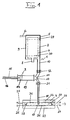
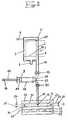
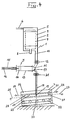
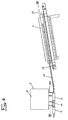
- FIGS. 1 to 4 To explain the different variants of the method according to the invention, reference is first made to the schematic representations according to FIGS. 1 to 4, in which various embodiments of the device according to the invention are shown with regard to their basic components.
- FIG. 1 The basic principle of the method according to the invention is best seen in FIG. 1.
- the device shown there, generally designated 1, consists of three main components, namely a pre-dewatering stage 2, an intermediate container 3 and a filter press 4.
- the pre-dewatering stage 2 consists of an expansion tank 5 which is connected to a continuous sludge feed 6.
- a filter basket 7 is arranged, which has a filtrate outlet 8.
- the filter basket 7 is immersed in the sludge 9 fed into the expansion tank.
- the expansion tank 5 has at its lower end a sludge outlet line 10 which is connected to the sludge inlet 11 of the intermediate tank 3.
- a blocking or control valve 12 is provided in the sludge outlet line 10, through which the supply of sludge to the intermediate container 3 can be interrupted.
- the intermediate container 3 is designed in the manner of a large injection syringe as a piston-cylinder unit and consists of a cylinder housing 13 and a piston 14 which can be displaced therein and which is connected with its piston rod to a drive 15, which in the exemplary embodiment is formed by a hydraulic piston or pneumatic piston 16.
- the sludge outlet 17 of the intermediate container 3 is connected via a line 18 to the sludge inlet 19 of a sludge chamber 20 of the filter press 4, with a further blocking or control valve 21 being provided in the line 18.
- the sludge chamber 20 of the filter press 4 is arranged between an upper pressure plate 22 and a lower pressure plate 23, which individually or both can be designed to be movable in the vertical direction.
- the sludge chamber 20 is formed by an upper filter surface 24 and a lower filter surface 25, which consist of an upper filter belt 26 and a lower filter belt 27, which can be moved back and forth in a straight line in the horizontal direction.
- a seal 28 which surrounds the sludge chamber 20 and which, when the sludge chamber is closed, lies sealingly against the two filter belts 26 and 27.
- a respective bearing plate 31 is arranged between the pressure plates 22, 23 and the filter belts 26, 27, which has open channels or grooves on the side of the filter belts 26, 27 which are used to remove the serve through the filter tapes emerging. This is explained in more detail below with reference to the various embodiments of the device according to the invention.
- the sludge to be dewatered is continuously fed into the expansion tank 5 through the continuous sludge feed 6, an upper sludge level 29 or a lower sludge level 30 being able to be set depending on the operating state, which corresponds to the respective maximum conditions.
- the continuously supplied sludge is subjected to a continuous preliminary dewatering under the effect of gravity in the expansion tank 5, the resulting filtrate being discharged from the filtrate outlet 8 of the filter basket 7.
- the sludge 9 already has a dry substance content of about 20% at the sludge outlet line 10.
- a sludge supply is transferred in portions into the intermediate container 3 by opening the control valve 12, which is preferably designed as a ball valve, and moving the piston 14 backwards from its front position by the drive 15.
- This filling of the intermediate container 3 can be extremely gentle and slow, so that the flocculation of the sludge is retained.
- the intermediate container 3 receives a sludge supply which corresponds to approximately one and a half times the volume of the sludge chamber 20.
- the control valve 12 is closed and then the control valve 21 is opened. Thereafter, the sludge volume contained in the intermediate container 3 is positively displaced from the intermediate container, in which the piston 14 is moved into its forward position by the drive 15.
- a hydrostatic pressure is already built up in the sludge chamber 20, since the volume of the intermediate container 3 is greater than the volume of the sludge chamber 20.
- the control valve 21 is then closed again and the control valve 12 is opened and the piston 14 is again in its rear Position moved by the drive 15 so that the intermediate container 3 is filled again with mud.
- the control valve 12 is closed again and the control valve 21 is opened and the piston 14 is moved forward again, so that an increased hydrostatic pressure is built up in the sludge chamber 20 by this movement with positive displacement of the contained sludge volume, which pressure should preferably be up to about 5 bar.
- the control valve 21 After reaching the desired hydrostatic pressure in the sludge chamber 20, the control valve 21 is closed again and by opening the control valve 12, the intermediate container 3 is completely filled again and is ready for the next cycle. At the same time, the sludge chamber 20 is opened by appropriate movement of the pressure plates 22 and / or 23 and the sludge cake produced is discharged from the sludge chamber 20 by horizontal movement of the filter belts 26, 27.
- the filter belts 26 and 27 are cleaned by washing nozzles provided on both sides, while these are moved back to their starting position, after which the sludge chamber is closed again and the cycle described above can then be repeated.
- the lower pressure plate 23 is mounted on a hydraulic bed 32, which consists of a plurality of high pressure generators 33 acting on the pressure plate 23.
- the volume of the sludge chamber 20 is increased by actuating the high pressure generator 33 reduced by pressing the lower pressure plate 23 upwards against the upper pressure plate 22.
- a mechanical drainage pressure is generated, which can be in the order of 30 bar, for example, and which is consequently greater than the hydrostatic pressure previously reached. This procedure enables a considerable, further increase in the dry matter content of the filter cake obtained.
- the high-pressure generator 33 is then relieved and the sludge chamber 20 is opened and the filter cake thus obtained is in turn discharged from the sludge chamber by horizontal movement of the filter belts 26 and 27.
- the sludge chamber is then closed again and the cycle described above can begin again.
- the embodiment according to FIG. 3 essentially corresponds to the embodiment according to FIG. 2 with the difference that on the one hand dewatering is carried out simultaneously in a plurality of sludge chambers 20 arranged one above the other, and that the sludge is fed in simultaneously at several points in the sludge chamber 20 from a corresponding number of intermediate containers , and consequently the hydrostatic pressure is built up from several points in the individual sludge chambers 20.
- the structural details reference is made to the description below of the various embodiments of the device according to the invention.
- the intermediate container 3 supplying the upper sludge chamber 20 being illustrated in dashed lines.
- FIG. 4 corresponds in essential details to the embodiment according to FIG. 2, see above that again the same reference numerals have been used for the same or equivalent parts.
- the sludge chamber 20 with the corresponding filter surfaces 25, 26 is arranged inclined to the horizontal, which serves to keep the filtrate emerging from the filter belts 26 and 27 above and below, which collects in the open channels of the bearing plates 31, constantly to be removed by gravity.
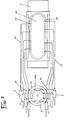
- FIGS. 5 to 13 For a description of a first practical embodiment of the device according to the invention, reference is made below to FIGS. 5 to 13, these figures dealing with technical details of the pre-dewatering stage 2, the intermediate container 3 and the associated filter press 4 connected to the intermediate container or containers 3.
- a filter basket 7 is provided in the expansion tank 5 of the pre-dewatering stage 2.
- a washing device 38 is provided, which consists of washing nozzles 38 A and at least one brush 38 B reaching over the height of the filter basket 7.
- a scraper 35 is provided on the inside of the filter basket 7, which can be moved up and down on a rod 35 A over the height of the filter basket 7.
- the unit consisting of the washing device 38 and the scraper 35 is driven in rotation via a drive 34, so that by rotating this unit and the upward and downward movement of the scraper 35, both the outside and the inside of the filter basket, which is cylindrical, are thoroughly cleaned can be.
- the scraper 35 mainly serves to periodically clean the bottom and the sludge outlets of the filter basket.
- the drive 34 is formed by an electric motor 35 and a spur gear 36.
- the brushes 35 b of which preferred three pieces are provided around the circumference of the filter basket, run slowly continuously around the filter basket, the bristles repeatedly entering the filter openings and activating the drainage.
- the filtrate flowing out of the filter basket 7 in accordance with the arrows 39 in FIGS. 5 and 8 is discharged to the outside through the filtrate outlet 8 provided in the bottom of the expansion tank 5.
- the partially dewatered sludge 9 inside the filter basket 7 can be withdrawn in portions into the corresponding number of intermediate containers 3 through a number of sludge outlet lines 10 under the control of a corresponding number of shut-off valves 12.
- the continuous sludge supply is formed by a mixer 40 which is fed by a continuously running pump and which is driven by a motor 41 and continuously feeds the sludge into the expansion tank 5.
- the mixer 40 is arranged upright and mixes the sludge with the flocculant, which is added by the metering device 40 B.
- the mixer 40 has a mixing and conveying screw 40 A, which is shown schematically in FIG. 5.
- a number of sludge outlets 10 A are provided in the bottom of the expansion tank 5 of the pre-dewatering stage 2, which are connected via the sludge outlet lines 10 to the sludge inlets 11 of the intermediate tank 3.
- the number of sludge outlets 10 A, the sludge outlet lines 10 and the intermediate container 3 corresponds to the number of sludge inlets 19 of the sludge chamber 20, as can best be seen from FIG.
- the sludge chamber 20 has a total of eight sludge inlets 19, which are each individually connected to eight intermediate containers 3 via eight lines 18.
- the eight intermediate containers 3 have a total volume which corresponds to one and a half times the volume of the sludge chamber 20.
- the intermediate container 3 is constructed from the basic principle like a large injection syringe, in which it is formed by a piston-cylinder unit 13, 14.
- the sludge inlet 11 connected to the sludge outlet line 10 is provided, in front of which the blocking and control valve 12 is arranged.
- the blocking and control valve 12 is designed as an electrically or hydraulically controlled ball valve in order to ensure that the flocculated sludge is conveyed as gently as possible, that is to say without cross-sectional changes or disturbances.
- the sludge outlet 17 of the intermediate container 3 is provided, which is connected to the line 18 and in front of which the second blocking and control valve 21 is arranged.
- the blocking and control valve 21 is also designed as an electrically or hydraulically controlled ball valve.
- the piston 14 is displaceably arranged back and forth, by means of which the positive displacement of the sludge volume in the intermediate container 3 takes place.
- the piston 14 has a drive 15 which is formed by a hydraulic or pneumatic piston 16 which is arranged displaceably in a cylinder 117 and is connected to the piston 14 via its piston rod 116.
- a lubricant container 103 is additionally provided in the embodiment according to FIG. 9, which is connected to an inlet 105 into the cylinder 13, which lies on the rear side of the piston 14.
- a valve 106 is additionally provided for maintenance work.
- the arrangement is such that when the piston 14 is moved forward by the drive 15 and displaces the sludge volume from the intermediate container, lubricant is simultaneously sucked in from the lubricant container 103 on the rear side of the piston, and thus the cylinder 13 is constantly lubricated becomes.
- the control valve 12 is opened and the control valve 21 is closed and the piston 14 is moved rearward and draws in a new volume of sludge from the expansion tank 5, the lubricant located behind the piston 14 in the cylinder 13 is displaced back into the lubricant tank 103.
- FIGS. 5 to 8 The filter press 4 illustrated in FIGS. 5 to 8 is described in more detail below in connection with FIG. 5 with a special reference to FIGS. 16 and 17.
- FIGS. 10 to 15 show details of the filter press 4 associated with the preliminary dewatering stage 2 and the intermediate containers 3 according to FIGS. 5 to 9, the basic structure of which corresponds to the procedure according to FIG. 1, but the technical possibilities are shown in FIGS. 14 and 15 are to increase the number of sludge chambers 20.
- FIGS. 10 to 13 show the filter press 4 in the two basic positions, namely once the open position according to FIGS. 10 and 11 for removing the filter cake and cleaning the filter surfaces and the closed position according to FIGS. 12 and 13, in which the sludge chamber is filled and drainage under hydrostatic Pressure is carried out according to the procedure shown in FIG. 1.
- the filter press shown in FIGS. 10 to 13 has the upper pressure plate 22 and the lower pressure plate 23, the upper pressure plate 22 being able to be raised and lowered relative to the lower pressure plate 23 by means of lifting cylinders 42 (FIG. 11).
- the bearing plate 31 Attached to the upper pressure plate 22 and the lower pressure plate 23 on the side facing the sludge chamber 20 is the bearing plate 31, which has channels 75 open in the direction of the sludge chamber 20 for discharging the filtrate.
- the bearing plates preferably consist of a low-friction plastic, since the filter belts 26 and 27 forming the upper and lower filter surfaces 24 and 25 slide on these bearing plates 31.
- the channels 75 of the bearing plates 31, which are illustrated only schematically in the figures of the drawings, are arranged such that they run in a straight line in the longitudinal direction of the sludge chambers 20 parallel to the main axis. Due to the gradient, this ensures that the filtrate collecting in the channels 75 is discharged against the discharge direction of the filter press on the front side of the bearing plates 31 under the action of gravity.
- the filter belts 26 and 27 are horizontally movable back and forth in the illustrated embodiment.
- the upper filter belt 26 is held at both ends by a reversible winding drive 44, so that the filter belt 26 is wound once onto the left winding drive 43, ie the filter surface 24 is moved into the sludge chamber 20, and in the opposite case the filter belt 26 is wound onto the right winding drive 44, ie the filter surface 24 is moved out of the sludge chamber 20.
- the filter belt 26 is still guided around a deflecting roller 46, to which a stripper 47 is assigned, which wipes off any residues of the filter cake adhering to the filter belt 26 during discharge.
- a swivel nozzle 49 which can be pivoted via a drive 48 and which, when the sludge chamber 20 is open and when the filter belts 26, 27 move back into the sludge chamber 20 after the filter cake has been dropped into the gap between the upper pressure plate 22 and the lower pressure plate 23 can be pivoted in order to wash both filter belts 26 and 27.
- the lower filter belt 27 is also received in accordance with the upper filter belt 26 by two winding drives 50 and 51, which are operated synchronously with the winding drives 43 and 44.
- the lower filter belt 27 is also guided around a deflection roller 52 with a scraper 53.
- the sludge inlets 19 into the sludge chamber 20, which are connected via a corresponding number of lines 18 to the likewise corresponding number of intermediate containers 3, are designed as horizontal, slit-like openings in the seal 28 surrounding the sludge chamber 20.
- a pawl device 54 is provided in the filter press 4 according to the invention, which consists of a number of pivotable pawls 55, which are mounted on a common axis 56 along both side edges of the filter press 4, each of the axes via pneumatic cylinders 57 and a lever drive 58 between the open position shown in FIGS. 10 and 11 and the locked position shown in FIGS. 12 and 13.
- effective stops 59 are provided between the upper pressure plate 22 and the lower pressure plate 23, by means of which the height of the closed sludge chamber 20 to be achieved when the upper pressure plate 22 is in a lowered position is determined.
- the filter press 4 is preferably set up in such a way that the sludge chamber 20 is inclined with respect to the horizontal, the inclination corresponding approximately to a gradient of the filter surfaces 24 and 25 of 5 °. This ensures that the filtrate entering the channels of the bearing plate 31 from the upper filter surface 24 is removed during the drainage due to the gradient.
- the sludge chamber is formed by the flexible seal 28 surrounding the sludge chamber 20 and the area of the filter belts 26 and 27 enclosed by it.
- the details of the seal 28 itself will be discussed in more detail below.
- the seal 28 is carried by an auxiliary frame 60 which is movably suspended up and down by means of push rods 61 on the upper pressure plate. This type of suspension is useful so that the sludge chamber 20 can be closed securely when the upper pressure plate 22 is lowered in the direction of the lower pressure plate 23 until the stops 59 are reached by relieving the lifting cylinders 42.
- the push rods 61 thus form drivers 62, which allow a limited relative movement between the upper pressure plate 22 and the seal 28.
- FIGS. 14 and 15 show a modular component in the form of an intermediate plate 63, by means of which the number of sludge chambers 20 arranged one above the other in the filter press 4 according to FIGS. 10 to 13 and likewise can increase arbitrarily in the embodiments described below.
- an intermediate plate 63 according to FIGS. 14 and 15 between the upper pressure plate 22 and the lower pressure plate 23, a further sludge chamber 20 is formed in each case.
- such an intermediate plate is loaded on both sides with the same pressure, since in the sludge chambers 20 lying one above the other the same drainage pressure is built up, its support plate 64 can consist, for example, of a light grating, since only a certain pressure resistance is important.
- each intermediate plate has on its upper and lower side one of the bearing plates 31 on which an upper filter belt 65 and a lower filter belt 66 slide.
- Corresponding winding drives 67, 68, 69 and 70 with the associated deflection rollers, wipers and a washing device are also provided on the intermediate plate 63 for the filter belts, which are identical to the details described above which are described with reference to the upper and lower pressure plates 22 and 23 have been described.
- the winding drives and the associated auxiliary devices for the two filter belts 65 and 66 are merely arranged in the intermediate plate 63.
- a seal 28 is also suspended with its subframe 60 in drivers 62.
- the stops 59 are also provided on the side edges of the intermediate plate 63.
- FIGS. 16 to 27 illustrate a further practical embodiment of the device according to the invention, as is useful for carrying out the method according to FIGS. 2 to 4, in particular according to FIG. 3.
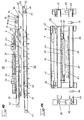
- FIG. 16 shows a side sectional view of the filter press 4, wherein the pre-dewatering device and the intermediate container 3 can be designed in accordance with FIGS. 5 to 9.
- the different operating states and the corresponding different positions of the individual components are also shown separated by the section lines XIX, XXII and XXV.
- the lower pressure plate 23 is also designed to be movable and serves to generate an additional mechanical drainage pressure by reducing the height of the sludge chambers 20 after the desired hydrostatic drainage pressure, which is set by the volume advance by means of the intermediate container 3, is achieved.
- the lower pressure plate 23 is mounted on a number of the high pressure generators 33 mentioned above, which, as in the exemplary embodiment according to FIGS. 16 to 27, can either be arranged in two rows along the longitudinal edges of the lower pressure plate 23, or which, as described above, can be designed as a hydraulic bed 32.
- each sludge chamber 20 is preferably oval in outline so that no corners and the like with corresponding pressure peaks arise.
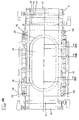
- FIG. 17 shows in the upper half how the sludge inlets 19 are arranged and designed in the seal 28 and that each of the sludge inlets 19 is assigned its own connecting line 18, which is separated with a sludge outlet 17 of an intermediate container 3 is connected.
- the stops 59 are also adapted to the changed requirements of this embodiment, in that the stops 59 have an upper part 73, which can either be resiliently pressed into the stop 59 or forms part of a correspondingly lowerable hydraulic cylinder .
- FIGS. 19 to 22 show the opened state of the sludge chambers 20, the lifting cylinders 42 lifting the upper pressure plate 22 upwards.
- the pawls 55 are opened by being pivoted into the open position by the pneumatic cylinders 57.
- the seal 28 of the upper sludge chamber 20 was first lifted from the top of the intermediate plate 63 by the catches 62 and then the entire intermediate plate 63 was moved upwards by the catches 71 together with their associated seal 28 from the lower pressure plate 23 , wherein the associated seal 28 of the intermediate plate 63 was also carried by the driver 62 of the intermediate plate 63.
- the high pressure generator 33 was relieved at the same time, so that in the state shown in FIG. 19 the lower pressure plate 23 has also been lowered, which is supported by the fact that it absorbs the reaction forces of the lifting cylinders 42.
- the stops 59 are also relieved in this state and assume the position shown in FIG. 21, in which the upper parts 73 define the height of the closed sludge chambers.
- the filter press 43 is ready to discharge the filter cake 74 formed in a previous cycle from the sludge chambers 20.
- the winding drives 44, 51 and 65, 68 assigned to the discharge end 45 of the filter press 4 are now actuated, while the winding drives 43, 50 and 67, 69 assigned to the other end of the filter press are released.
- the filter belts 26, 27 and 65, 66 are moved out of the sludge chambers 20 synchronously and after the filter cake 74 has been ejected, the winding drives 44, 51 and 68, 70 are released and the winding drives 43, 50, 67 and 69 are actuated so that the filter belts 26, 27 and 65, 66 are in turn moved back synchronously into the sludge chambers 20. At the same time, the filter belts are cleaned by means of the washing nozzles 49. At the end of this process, the filter press 4 is again in the state according to FIG. 19, but no filter cake 74 is contained in the sludge chambers 20.
- the filter press 4 is then transferred to the state according to FIGS. 22 to 24, the sludge chambers 20 being closed.
- the lifting cylinders 42 are relieved and, taking the seals 28 and the intermediate plate 63 with them, lower the upper pressure plate 22 onto the lower pressure plate 23.
- the high pressure generator 33 remain in the unloaded state.
- the upper pressure plate 22 and the intermediate plate 63 are lowered until they come into engagement with the upper parts 73 of the stops 59.
- the pawls 55 are locked by actuating the pneumatic cylinders 57 and are pivoted into the position shown in FIG. 22, in which the distance between the upper pressure plate 22 and the lower pressure plate 23 is mechanically fixed and fixed by the stops 59.
- the filtrate contained in the sludge is pressed outwards through the filter belts 26, 27 and 65, 66 into the channels in the bearing plates 31 and is opposed due to the arrangement of the channels 75 parallel to the main axis of the sludge chamber 20 and due to the gradient the discharge direction at the end of the filter press 4.
- shut-off valves 21 After reaching the desired hydrostatic pressure in the sludge chambers, for example after reaching 5 bar, the shut-off valves 21 are closed again and then the shut-off valves 12 are opened, the pistons 14 being retracted and taking over a new sludge volume in the intermediate container 3.
- the high pressure generators 33 are then actuated in order to mechanically reduce the volume of the sludge chambers 20 in the vertical direction and thus to generate an additional mechanical dewatering pressure which is possibly considerably above the hydrostatic dewatering pressure.
- This process is illustrated in FIGS. 25 to 27, the high-pressure generator 33 being illustrated in its fully extended position, in which the highest dewatering pressure was reached.
- the pawls 55 are still closed and the lower pressure plate 23 has been moved upwards by the high pressure generator 33 against the upper pressure plate 22.
- the upper parts 73 of the stops 59 were pressed into the stops 59 in this process in order to enable the distance between the lower pressure plate 23 and the intermediate plate 63 and the intermediate plate 63 and the upper pressure plate 22 to be reduced.
- FIG. 25 shows how the catches 62 or 71 and 72 enable these relative movements.
- the filter press 4 is thus ready for the further beginning of a cycle which, as described above, begins with the extension and throwing out of the filter cake 74 produced.
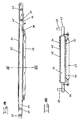
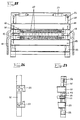
- FIGS. 28 and 29 illustrate a further embodiment of the filter press 4 in a lateral schematic view or a sectional view along the line 29 XXIX of FIG. 28, as has already been shown in principle in FIGS. 5 to 7.
- the embodiment illustrated in FIGS. 28 and 29 is a particularly simple embodiment with only one sludge chamber 20.
- the sludge chamber 20 has only one filter surface 25, which is formed by the lower filter belt 27 on the bearing plate 31.
- the sludge chamber 20 is enclosed on the top by the seal 28 on the upper pressure plate 22 and the pressure plate 22 itself.
- the sludge chamber 20 is directly delimited on the upper side by the pressure plate 22, the sludge inlets 19 are provided directly in the upper pressure plate 22.
- the control valves 21 are also arranged in the upper pressure plate 22 in the lines 18, so that the sludge volume in the lines 18 which is acted upon by the mechanical drainage pressure is thereby reduced.
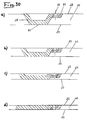
- FIGS. 30 and 31 particularly preferred embodiments of the seal 28 are shown in sectional views, which are generally suitable for the lateral sealing of pressure chambers that can be reduced in volume in the vertical direction.
- FIG. 30 shows the various operating states of the seal according to a to d, in which the position is illustrated in which the sludge chamber 20 is closed and the hydrostatic pressure is built up by means of the intermediate container 3.
- FIGS. 30 b to 30 d show the progressive deformation of the seal 28 during the generation of the mechanical drainage pressure in the filter press 4.
- the seal 28 is made in one piece, the circumference of the pressure chamber, i.e. in the embodiment of the sludge chamber 20 surrounding elastic body made of rubber or other suitable material.
- the body 80 has an approximately shell-like shape in cross section, which can be converted into a practically flat shape between the states a to d.
- the seal 28 is fastened to the upper pressure plate 22 by a frame 81 by means of bolts 82, the frame 81 simultaneously representing a stop for the maximum closing movement of the pressure chamber 20.
- the beveling of the profile of both the seal 28 and the frame 81 ensures that when the volume of the pressure chamber 20 is reduced, the sludge located near the seal 28 is displaced and moved towards the interior of the pressure chamber 20.
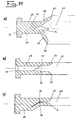
- FIG. 31 An embodiment of the seal 28 is illustrated in FIG. 31, as is useful in the case of filter surfaces located opposite one another in pressure chambers.
- FIG. 31 shows three different operating states of the seal 28, the mud inlet 19 leading through the seal 28 into the mud chamber 20 being shown simultaneously in the middle operating state b.
- the seal 28 consists of an integral elastic body made of rubber or another suitable material surrounding the circumference of the pressure chamber, in the embodiment of the mud chamber 20.
- the body 80 has the shape of a lying V in cross section, the tip of which is directed outward from the mud chamber 20.
- the free ends 88 and 89 of the V each form a sealing lip 83 and 84, which rests on the associated filter surface.
- a kink 85 and 86 is provided, at which the angle enclosed between the legs of the V increases.
- the angular increase at the kink 86 is a multiple of the angular increase at the kink 85, since when the mechanical drainage pressure in the sludge chamber 20 builds up, the lower filter surface is moved toward the upper filter surface.
- the symmetrical part of the V lies in a section 90 of the cross section of the seal 28, which is practically rectangular and forms an incision in this section 90, the lower leg of the symmetrical part of the V running parallel to the side edge of the rectangle.
- the rectangular section 90 is provided with a circumferential clamping or fastening projection 87 which is clamped in the auxiliary frame 60 in the exemplary embodiment of the device according to the present invention.
- the vertical distance between the sealing lips 83 and 84 in their relaxed state is approximately 80 mm.
- the distance between the sealing lips 83 and 84 is then about 60 mm. If, after reaching the hydrostatic dewatering pressure, the switch is made to the additional mechanical dewatering, the seal 28 can be compressed so far during this process that the distance between the sealing lips 83 and 84 is only about 30 to 35 mm, as shown in FIG. 3 c is.
Landscapes
- Chemical & Material Sciences (AREA)
- Chemical Kinetics & Catalysis (AREA)
- Treatment Of Sludge (AREA)
- Filtration Of Liquid (AREA)
- Drying Of Solid Materials (AREA)
Applications Claiming Priority (4)
| Application Number | Priority Date | Filing Date | Title |
|---|---|---|---|
| DE4442623 | 1994-12-01 | ||
| DE4442623 | 1994-12-01 | ||
| DE19539484A DE19539484C2 (de) | 1994-12-01 | 1995-10-24 | Verfahren und Vorrichtung zum Entwässern von Schlämmen und ähnlichen Substanzen |
| DE19539484 | 1995-10-24 |
Publications (3)
| Publication Number | Publication Date |
|---|---|
| EP0714687A2 true EP0714687A2 (fr) | 1996-06-05 |
| EP0714687A3 EP0714687A3 (fr) | 1996-08-21 |
| EP0714687B1 EP0714687B1 (fr) | 1999-04-07 |
Family
ID=25942438
Family Applications (1)
| Application Number | Title | Priority Date | Filing Date |
|---|---|---|---|
| EP95118363A Expired - Lifetime EP0714687B1 (fr) | 1994-12-01 | 1995-11-22 | Procédé et appareil de déshydratation de bones et autres |
Country Status (5)
| Country | Link |
|---|---|
| US (1) | US5863429A (fr) |
| EP (1) | EP0714687B1 (fr) |
| JP (1) | JP3693729B2 (fr) |
| AT (1) | ATE178499T1 (fr) |
| FI (1) | FI112647B (fr) |
Cited By (5)
| Publication number | Priority date | Publication date | Assignee | Title |
|---|---|---|---|---|
| EP0827767A3 (fr) * | 1996-08-28 | 1998-06-10 | Albert Bähr | Dispositif de déshydratation de boues et substances similaires |
| EP0982058A1 (fr) * | 1996-08-28 | 2000-03-01 | Albert Bähr | Appareil de déshydratation de boues et substances similaires |
| EP2165746A1 (fr) * | 2008-09-15 | 2010-03-24 | Albert Bähr | Procédé et dispositif de séparation solide-liquide de mélanges de matière et suspensions |
| CN103432790A (zh) * | 2013-09-02 | 2013-12-11 | 无锡锦和科技有限公司 | 压滤机的滑移式进料机构 |
| EP2703366A1 (fr) * | 2012-08-29 | 2014-03-05 | Albert Bähr | Dispositif de séparation solide-liquide de mélanges de matière et suspensions |
Families Citing this family (13)
| Publication number | Priority date | Publication date | Assignee | Title |
|---|---|---|---|---|
| US6256902B1 (en) * | 1998-11-03 | 2001-07-10 | John R. Flaherty | Apparatus and method for desiccating and deagglomerating wet, particulate materials |
| DE19900187C1 (de) * | 1999-01-06 | 2000-06-15 | Stockhausen Chem Fab Gmbh | Verfahren zur Entwässerung von Klärschlämmen mit Plattenfiltern (Filterpressen) |
| US7383766B2 (en) * | 2001-08-29 | 2008-06-10 | Mte Research Pty Ltd | Coal dewatering system and method |
| EP1559469B1 (fr) * | 2004-01-30 | 2011-10-12 | P.M.P.O. S.R.L. | Installation et procédé de traitement de fluide de refroidissement issu d'installation de traitement mécanique |
| US7208087B2 (en) * | 2005-02-15 | 2007-04-24 | Bio-Rad Laboratories, Inc. | Dual-chamber chromatographic cartridge |
| US20110084029A1 (en) * | 2009-10-08 | 2011-04-14 | Dominick O' Reilly | Waste treatment system |
| US20110089097A1 (en) * | 2009-10-19 | 2011-04-21 | O'reilly Dominick | Attachment and system for dewatering material |
| US20110094395A1 (en) * | 2009-10-26 | 2011-04-28 | O'reilly Dominick | Method and attachment for dewatering logs |
| CN106746459A (zh) * | 2016-12-27 | 2017-05-31 | 重庆亚协环保工程有限公司 | 浮选物压干设备 |
| US20180280840A1 (en) * | 2017-03-29 | 2018-10-04 | Larry Baxter | Method and Device for Separating Solids and Liquids using a Modified Pump |
| SE544566C2 (en) * | 2020-01-31 | 2022-07-19 | Hydria Water Ab | A separation device and method to separate contaminants from contaminated water |
| KR102795458B1 (ko) * | 2020-09-25 | 2025-04-11 | 주식회사 엘지화학 | 압축식 탈수기 |
| JP2024043122A (ja) * | 2022-09-16 | 2024-03-29 | キオクシア株式会社 | 端材回収装置 |
Family Cites Families (10)
| Publication number | Priority date | Publication date | Assignee | Title |
|---|---|---|---|---|
| US3796316A (en) * | 1972-07-07 | 1974-03-12 | A Matz | Water filtering apparatus |
| US4387633A (en) * | 1981-02-06 | 1983-06-14 | James Ballantyne | Sludge processing system |
| ZA822150B (en) * | 1981-04-10 | 1983-11-30 | Prestige Group Plc | Pressure cookers |
| JPS61126009A (ja) * | 1984-11-21 | 1986-06-13 | Yasuo Arai | 化粧料の充填固化方法および充填固化装置 |
| DE3734974A1 (de) * | 1986-10-21 | 1989-04-20 | Baehr Albert | Vorrichtung zum entwaessern von schlamm und aehnlichen substanzen |
| DE3914661C2 (de) * | 1989-05-03 | 1998-04-23 | Baehr Albert | Vorrichtung zur Fest-Flüssig-Trennung |
| NO901889L (no) * | 1989-05-10 | 1990-11-12 | Albert Baehr | Fremgangsmaate ved og kammerfilterpresse for avvanning av slam og lignende substanser. |
| DE3923298C1 (fr) * | 1989-07-14 | 1991-01-24 | Friedrich 7517 Waldbronn De Banzhaf | |
| US5236583A (en) * | 1992-05-20 | 1993-08-17 | Wang Yiu Te | High-pressure/vacuum operated apparatus for sewage and mud disposal |
| DE4223022A1 (de) * | 1992-07-14 | 1994-01-20 | Baehr Albert | Vorrichtung zum Entwässern von Schlamm und ähnlichen Substanzen |
-
1995
- 1995-11-22 AT AT95118363T patent/ATE178499T1/de not_active IP Right Cessation
- 1995-11-22 EP EP95118363A patent/EP0714687B1/fr not_active Expired - Lifetime
- 1995-11-28 US US08/563,426 patent/US5863429A/en not_active Expired - Fee Related
- 1995-11-30 FI FI955771A patent/FI112647B/fi active
- 1995-12-01 JP JP33565095A patent/JP3693729B2/ja not_active Expired - Fee Related
Non-Patent Citations (1)
| Title |
|---|
| None |
Cited By (9)
| Publication number | Priority date | Publication date | Assignee | Title |
|---|---|---|---|---|
| EP0827767A3 (fr) * | 1996-08-28 | 1998-06-10 | Albert Bähr | Dispositif de déshydratation de boues et substances similaires |
| US5961827A (en) * | 1996-08-28 | 1999-10-05 | Baehr; Albert | Apparatus for dewatering of sludge and similar substances |
| EP0982058A1 (fr) * | 1996-08-28 | 2000-03-01 | Albert Bähr | Appareil de déshydratation de boues et substances similaires |
| DE19727762C2 (de) * | 1996-08-28 | 2003-03-20 | Albert Baehr | Vorrichtung zum Entwässern von Schlamm und ähnlichen Substanzen |
| JP2007160309A (ja) * | 1996-08-28 | 2007-06-28 | Albert Baehr | スラッジ及び類似物の脱水装置 |
| EP2165746A1 (fr) * | 2008-09-15 | 2010-03-24 | Albert Bähr | Procédé et dispositif de séparation solide-liquide de mélanges de matière et suspensions |
| EP2703366A1 (fr) * | 2012-08-29 | 2014-03-05 | Albert Bähr | Dispositif de séparation solide-liquide de mélanges de matière et suspensions |
| CN103432790A (zh) * | 2013-09-02 | 2013-12-11 | 无锡锦和科技有限公司 | 压滤机的滑移式进料机构 |
| CN103432790B (zh) * | 2013-09-02 | 2015-08-05 | 无锡锦和科技有限公司 | 压滤机的滑移式进料机构 |
Also Published As
| Publication number | Publication date |
|---|---|
| JP3693729B2 (ja) | 2005-09-07 |
| FI955771A0 (fi) | 1995-11-30 |
| ATE178499T1 (de) | 1999-04-15 |
| EP0714687A3 (fr) | 1996-08-21 |
| JPH08224600A (ja) | 1996-09-03 |
| EP0714687B1 (fr) | 1999-04-07 |
| FI955771A7 (fi) | 1996-06-02 |
| US5863429A (en) | 1999-01-26 |
| FI112647B (fi) | 2003-12-31 |
Similar Documents
| Publication | Publication Date | Title |
|---|---|---|
| EP0714687B1 (fr) | Procédé et appareil de déshydratation de bones et autres | |
| EP0827767B1 (fr) | Dispositif de déshydratation de boues et substances similaires | |
| DE2844697C2 (de) | Filterpresse zum Entwässern von Schlamm und ähnlichen Substanzen | |
| EP2165746B1 (fr) | Procédé et dispositif de séparation solide-liquide de mélanges de matière et suspensions | |
| EP0397082B1 (fr) | Procédé et dispositif pour la déshydratation de boues et de produits analoques | |
| EP0654294A2 (fr) | Procédé et dispositif de filtration de particules solides de liquides et le rinçage du filtre à contre-courant | |
| DE2725645A1 (de) | Verfahren und vorrichtung zum kontinuierlichen filtern mittels eines endlosfilterbandes | |
| EP0264899B1 (fr) | Dispositif de déshydratation de boues et de matières similaires | |
| DE2533719A1 (de) | Filterpresse | |
| DE2707828C3 (de) | Filterpresse | |
| DE4013786A1 (de) | Verfahren zum entwaessern eines schlammvolumens und trennstraenge fuer die durchfuehrung des verfahrens | |
| EP0178389B1 (fr) | Filtre-presse à chambres | |
| DD252766A5 (de) | Filterpresse | |
| EP0245490B1 (fr) | Filtre-presse pour separer les liquides des boues pour obtenir une teneur elevee en solides | |
| DE10207451A1 (de) | Vorrichtung und Verfahren zur Entwässerung von Schlämmen | |
| DE19539484C2 (de) | Verfahren und Vorrichtung zum Entwässern von Schlämmen und ähnlichen Substanzen | |
| DE2731043A1 (de) | Doppelt wirkende filterpresse | |
| DD294237A5 (de) | Verfahren und kammerfilterpresse zum entwaessern von schlaemmen und aehnlichen substanzen | |
| EP0982058B1 (fr) | Appareil de déshydratation de boues et substances similaires | |
| DE3635766A1 (de) | Vorrichtung zum entwaessern von schlamm und aehnlichen substanzen | |
| DE19632964C1 (de) | Filterpresse | |
| DE4223022A1 (de) | Vorrichtung zum Entwässern von Schlamm und ähnlichen Substanzen | |
| DE4020405A1 (de) | Verfahren zur druckentwaesserung von waessrigen schlaemmen | |
| DE2114764A1 (de) | Filterpresse | |
| AT396923B (de) | Verfahren und trenneinrichtung zum auftrennen bzw. entwässern von flüssigkeit-feststoff-gemischen |
Legal Events
| Date | Code | Title | Description |
|---|---|---|---|
| PUAI | Public reference made under article 153(3) epc to a published international application that has entered the european phase |
Free format text: ORIGINAL CODE: 0009012 |
|
| AK | Designated contracting states |
Kind code of ref document: A2 Designated state(s): AT CH DE FR GB IT LI SE |
|
| PUAL | Search report despatched |
Free format text: ORIGINAL CODE: 0009013 |
|
| AK | Designated contracting states |
Kind code of ref document: A3 Designated state(s): AT CH DE FR GB IT LI SE |
|
| 17P | Request for examination filed |
Effective date: 19970411 |
|
| 17Q | First examination report despatched |
Effective date: 19970915 |
|
| GRAG | Despatch of communication of intention to grant |
Free format text: ORIGINAL CODE: EPIDOS AGRA |
|
| GRAG | Despatch of communication of intention to grant |
Free format text: ORIGINAL CODE: EPIDOS AGRA |
|
| GRAH | Despatch of communication of intention to grant a patent |
Free format text: ORIGINAL CODE: EPIDOS IGRA |
|
| GRAH | Despatch of communication of intention to grant a patent |
Free format text: ORIGINAL CODE: EPIDOS IGRA |
|
| GRAA | (expected) grant |
Free format text: ORIGINAL CODE: 0009210 |
|
| AK | Designated contracting states |
Kind code of ref document: B1 Designated state(s): AT CH DE FR GB IT LI SE |
|
| PG25 | Lapsed in a contracting state [announced via postgrant information from national office to epo] |
Ref country code: SE Free format text: THE PATENT HAS BEEN ANNULLED BY A DECISION OF A NATIONAL AUTHORITY Effective date: 19990407 |
|
| REF | Corresponds to: |
Ref document number: 178499 Country of ref document: AT Date of ref document: 19990415 Kind code of ref document: T |
|
| REG | Reference to a national code |
Ref country code: CH Ref legal event code: NV Representative=s name: ISLER & PEDRAZZINI AG Ref country code: CH Ref legal event code: EP |
|
| GBT | Gb: translation of ep patent filed (gb section 77(6)(a)/1977) |
Effective date: 19990413 |
|
| REF | Corresponds to: |
Ref document number: 59505582 Country of ref document: DE Date of ref document: 19990512 |
|
| ET | Fr: translation filed | ||
| PLBE | No opposition filed within time limit |
Free format text: ORIGINAL CODE: 0009261 |
|
| STAA | Information on the status of an ep patent application or granted ep patent |
Free format text: STATUS: NO OPPOSITION FILED WITHIN TIME LIMIT |
|
| 26N | No opposition filed | ||
| REG | Reference to a national code |
Ref country code: GB Ref legal event code: IF02 |
|
| REG | Reference to a national code |
Ref country code: CH Ref legal event code: PCAR Free format text: ISLER & PEDRAZZINI AG;POSTFACH 1772;8027 ZUERICH (CH) |
|
| PGFP | Annual fee paid to national office [announced via postgrant information from national office to epo] |
Ref country code: DE Payment date: 20081128 Year of fee payment: 14 Ref country code: CH Payment date: 20081128 Year of fee payment: 14 |
|
| PGFP | Annual fee paid to national office [announced via postgrant information from national office to epo] |
Ref country code: AT Payment date: 20081128 Year of fee payment: 14 |
|
| PGFP | Annual fee paid to national office [announced via postgrant information from national office to epo] |
Ref country code: IT Payment date: 20081128 Year of fee payment: 14 |
|
| PGFP | Annual fee paid to national office [announced via postgrant information from national office to epo] |
Ref country code: FR Payment date: 20080930 Year of fee payment: 14 |
|
| PGFP | Annual fee paid to national office [announced via postgrant information from national office to epo] |
Ref country code: GB Payment date: 20081113 Year of fee payment: 14 |
|
| REG | Reference to a national code |
Ref country code: CH Ref legal event code: PL |
|
| GBPC | Gb: european patent ceased through non-payment of renewal fee |
Effective date: 20091122 |
|
| REG | Reference to a national code |
Ref country code: FR Ref legal event code: ST Effective date: 20100730 |
|
| PG25 | Lapsed in a contracting state [announced via postgrant information from national office to epo] |
Ref country code: AT Free format text: LAPSE BECAUSE OF NON-PAYMENT OF DUE FEES Effective date: 20091122 |
|
| PG25 | Lapsed in a contracting state [announced via postgrant information from national office to epo] |
Ref country code: LI Free format text: LAPSE BECAUSE OF NON-PAYMENT OF DUE FEES Effective date: 20091130 Ref country code: FR Free format text: LAPSE BECAUSE OF NON-PAYMENT OF DUE FEES Effective date: 20091130 Ref country code: CH Free format text: LAPSE BECAUSE OF NON-PAYMENT OF DUE FEES Effective date: 20091130 |
|
| PG25 | Lapsed in a contracting state [announced via postgrant information from national office to epo] |
Ref country code: DE Free format text: LAPSE BECAUSE OF NON-PAYMENT OF DUE FEES Effective date: 20100601 |
|
| PG25 | Lapsed in a contracting state [announced via postgrant information from national office to epo] |
Ref country code: GB Free format text: LAPSE BECAUSE OF NON-PAYMENT OF DUE FEES Effective date: 20091122 |
|
| PG25 | Lapsed in a contracting state [announced via postgrant information from national office to epo] |
Ref country code: IT Free format text: LAPSE BECAUSE OF NON-PAYMENT OF DUE FEES Effective date: 20091122 |