EP0716106A2 - Verfahren zur Herstellung modifizierter Polyisocyanuratschäume für Wärmedämmungsmaterialien - Google Patents
Verfahren zur Herstellung modifizierter Polyisocyanuratschäume für Wärmedämmungsmaterialien Download PDFInfo
- Publication number
- EP0716106A2 EP0716106A2 EP95109640A EP95109640A EP0716106A2 EP 0716106 A2 EP0716106 A2 EP 0716106A2 EP 95109640 A EP95109640 A EP 95109640A EP 95109640 A EP95109640 A EP 95109640A EP 0716106 A2 EP0716106 A2 EP 0716106A2
- Authority
- EP
- European Patent Office
- Prior art keywords
- foam
- catalyst
- foams
- polyol
- represent
- Prior art date
- Legal status (The legal status is an assumption and is not a legal conclusion. Google has not performed a legal analysis and makes no representation as to the accuracy of the status listed.)
- Ceased
Links
- 239000006260 foam Substances 0.000 title claims abstract description 97
- 229920000582 polyisocyanurate Polymers 0.000 title claims abstract description 28
- 239000011495 polyisocyanurate Substances 0.000 title claims abstract description 27
- 238000000034 method Methods 0.000 title claims abstract description 16
- 238000002360 preparation method Methods 0.000 title abstract description 25
- 239000012774 insulation material Substances 0.000 title description 8
- 239000003054 catalyst Substances 0.000 claims abstract description 65
- 229920005862 polyol Polymers 0.000 claims abstract description 45
- 150000003077 polyols Chemical class 0.000 claims abstract description 44
- 150000001491 aromatic compounds Chemical class 0.000 claims abstract description 39
- 150000001718 carbodiimides Chemical class 0.000 claims abstract description 31
- XLYOFNOQVPJJNP-UHFFFAOYSA-N water Substances O XLYOFNOQVPJJNP-UHFFFAOYSA-N 0.000 claims abstract description 28
- 239000000203 mixture Substances 0.000 claims abstract description 25
- 229920001228 polyisocyanate Polymers 0.000 claims abstract description 22
- 239000005056 polyisocyanate Substances 0.000 claims abstract description 22
- 238000006243 chemical reaction Methods 0.000 claims abstract description 18
- 125000000217 alkyl group Chemical group 0.000 claims description 9
- 125000002496 methyl group Chemical group [H]C([H])([H])* 0.000 claims description 6
- ZBVOEVQTNYNNMY-UHFFFAOYSA-N O=P1=CCCC1 Chemical compound O=P1=CCCC1 ZBVOEVQTNYNNMY-UHFFFAOYSA-N 0.000 claims description 5
- 125000001797 benzyl group Chemical group [H]C1=C([H])C([H])=C(C([H])=C1[H])C([H])([H])* 0.000 claims description 5
- 125000001624 naphthyl group Chemical group 0.000 claims description 5
- 125000001997 phenyl group Chemical group [H]C1=C([H])C([H])=C(*)C([H])=C1[H] 0.000 claims description 5
- 125000004178 (C1-C4) alkyl group Chemical group 0.000 claims description 4
- VEXZGXHMUGYJMC-UHFFFAOYSA-N Hydrochloric acid Chemical compound Cl VEXZGXHMUGYJMC-UHFFFAOYSA-N 0.000 claims description 4
- ZFSLODLOARCGLH-UHFFFAOYSA-N isocyanuric acid Chemical compound OC1=NC(O)=NC(O)=N1 ZFSLODLOARCGLH-UHFFFAOYSA-N 0.000 claims description 4
- OKTJSMMVPCPJKN-UHFFFAOYSA-N Carbon Chemical compound [C] OKTJSMMVPCPJKN-UHFFFAOYSA-N 0.000 claims description 3
- 229910052799 carbon Inorganic materials 0.000 claims description 3
- 230000001737 promoting effect Effects 0.000 claims 4
- 238000005829 trimerization reaction Methods 0.000 abstract description 22
- 229920005903 polyol mixture Polymers 0.000 abstract description 8
- 239000004970 Chain extender Substances 0.000 abstract description 6
- CURLTUGMZLYLDI-UHFFFAOYSA-N Carbon dioxide Chemical compound O=C=O CURLTUGMZLYLDI-UHFFFAOYSA-N 0.000 description 27
- 230000000052 comparative effect Effects 0.000 description 27
- 238000009413 insulation Methods 0.000 description 26
- 238000007906 compression Methods 0.000 description 23
- 230000006835 compression Effects 0.000 description 23
- -1 alkali metal carboxylates Chemical class 0.000 description 17
- 239000012948 isocyanate Substances 0.000 description 16
- 229910002092 carbon dioxide Inorganic materials 0.000 description 14
- 150000002513 isocyanates Chemical class 0.000 description 14
- 239000001569 carbon dioxide Substances 0.000 description 12
- UPMLOUAZCHDJJD-UHFFFAOYSA-N 4,4'-Diphenylmethane Diisocyanate Chemical compound C1=CC(N=C=O)=CC=C1CC1=CC=C(N=C=O)C=C1 UPMLOUAZCHDJJD-UHFFFAOYSA-N 0.000 description 9
- 239000004721 Polyphenylene oxide Substances 0.000 description 9
- 150000001875 compounds Chemical class 0.000 description 9
- 230000000704 physical effect Effects 0.000 description 9
- 229920000570 polyether Polymers 0.000 description 9
- 239000004604 Blowing Agent Substances 0.000 description 8
- MTHSVFCYNBDYFN-UHFFFAOYSA-N diethylene glycol Chemical compound OCCOCCO MTHSVFCYNBDYFN-UHFFFAOYSA-N 0.000 description 8
- 229920005906 polyester polyol Polymers 0.000 description 8
- IMNIMPAHZVJRPE-UHFFFAOYSA-N triethylenediamine Chemical compound C1CN2CCN1CC2 IMNIMPAHZVJRPE-UHFFFAOYSA-N 0.000 description 8
- UFHFLCQGNIYNRP-UHFFFAOYSA-N Hydrogen Chemical compound [H][H] UFHFLCQGNIYNRP-UHFFFAOYSA-N 0.000 description 7
- OYQYHJRSHHYEIG-UHFFFAOYSA-N ethyl carbamate;urea Chemical compound NC(N)=O.CCOC(N)=O OYQYHJRSHHYEIG-UHFFFAOYSA-N 0.000 description 7
- 239000003063 flame retardant Substances 0.000 description 7
- 229910052739 hydrogen Inorganic materials 0.000 description 7
- 239000001257 hydrogen Substances 0.000 description 7
- 238000004519 manufacturing process Methods 0.000 description 7
- 239000004094 surface-active agent Substances 0.000 description 7
- LYCAIKOWRPUZTN-UHFFFAOYSA-N Ethylene glycol Chemical compound OCCO LYCAIKOWRPUZTN-UHFFFAOYSA-N 0.000 description 6
- DNIAPMSPPWPWGF-UHFFFAOYSA-N Propylene glycol Chemical compound CC(O)CO DNIAPMSPPWPWGF-UHFFFAOYSA-N 0.000 description 6
- XSQUKJJJFZCRTK-UHFFFAOYSA-N Urea Chemical compound NC(N)=O XSQUKJJJFZCRTK-UHFFFAOYSA-N 0.000 description 6
- 239000002253 acid Substances 0.000 description 6
- 150000007513 acids Chemical class 0.000 description 6
- 239000004202 carbamide Substances 0.000 description 6
- 239000006071 cream Substances 0.000 description 6
- 239000012973 diazabicyclooctane Substances 0.000 description 6
- 125000003118 aryl group Chemical group 0.000 description 5
- 230000015572 biosynthetic process Effects 0.000 description 5
- 239000004615 ingredient Substances 0.000 description 5
- 239000000463 material Substances 0.000 description 5
- DVKJHBMWWAPEIU-UHFFFAOYSA-N toluene 2,4-diisocyanate Chemical compound CC1=CC=C(N=C=O)C=C1N=C=O DVKJHBMWWAPEIU-UHFFFAOYSA-N 0.000 description 5
- 239000004971 Cross linker Substances 0.000 description 4
- PEDCQBHIVMGVHV-UHFFFAOYSA-N Glycerine Chemical compound OCC(O)CO PEDCQBHIVMGVHV-UHFFFAOYSA-N 0.000 description 4
- UEEJHVSXFDXPFK-UHFFFAOYSA-N N-dimethylaminoethanol Chemical compound CN(C)CCO UEEJHVSXFDXPFK-UHFFFAOYSA-N 0.000 description 4
- 229910000831 Steel Inorganic materials 0.000 description 4
- 125000002947 alkylene group Chemical group 0.000 description 4
- 239000012972 dimethylethanolamine Substances 0.000 description 4
- 229920002635 polyurethane Polymers 0.000 description 4
- 239000004814 polyurethane Substances 0.000 description 4
- 239000007921 spray Substances 0.000 description 4
- 239000010959 steel Substances 0.000 description 4
- RNFJDJUURJAICM-UHFFFAOYSA-N 2,2,4,4,6,6-hexaphenoxy-1,3,5-triaza-2$l^{5},4$l^{5},6$l^{5}-triphosphacyclohexa-1,3,5-triene Chemical compound N=1P(OC=2C=CC=CC=2)(OC=2C=CC=CC=2)=NP(OC=2C=CC=CC=2)(OC=2C=CC=CC=2)=NP=1(OC=1C=CC=CC=1)OC1=CC=CC=C1 RNFJDJUURJAICM-UHFFFAOYSA-N 0.000 description 3
- YMKWWHFRGALXLE-UHFFFAOYSA-N 4-methyl-1-phenyl-2,3-dihydro-1$l^{5}-phosphole 1-oxide Chemical compound C1CC(C)=CP1(=O)C1=CC=CC=C1 YMKWWHFRGALXLE-UHFFFAOYSA-N 0.000 description 3
- WSFSSNUMVMOOMR-UHFFFAOYSA-N Formaldehyde Chemical compound O=C WSFSSNUMVMOOMR-UHFFFAOYSA-N 0.000 description 3
- SJRJJKPEHAURKC-UHFFFAOYSA-N N-Methylmorpholine Chemical compound CN1CCOCC1 SJRJJKPEHAURKC-UHFFFAOYSA-N 0.000 description 3
- 229910019142 PO4 Inorganic materials 0.000 description 3
- ISWSIDIOOBJBQZ-UHFFFAOYSA-N Phenol Chemical compound OC1=CC=CC=C1 ISWSIDIOOBJBQZ-UHFFFAOYSA-N 0.000 description 3
- WYURNTSHIVDZCO-UHFFFAOYSA-N Tetrahydrofuran Chemical compound C1CCOC1 WYURNTSHIVDZCO-UHFFFAOYSA-N 0.000 description 3
- ZMANZCXQSJIPKH-UHFFFAOYSA-N Triethylamine Chemical compound CCN(CC)CC ZMANZCXQSJIPKH-UHFFFAOYSA-N 0.000 description 3
- 150000007824 aliphatic compounds Chemical class 0.000 description 3
- 125000001931 aliphatic group Chemical group 0.000 description 3
- 150000001412 amines Chemical class 0.000 description 3
- 230000015271 coagulation Effects 0.000 description 3
- 238000005345 coagulation Methods 0.000 description 3
- 239000011248 coating agent Substances 0.000 description 3
- 238000000576 coating method Methods 0.000 description 3
- 239000003086 colorant Substances 0.000 description 3
- 230000007423 decrease Effects 0.000 description 3
- ZBCBWPMODOFKDW-UHFFFAOYSA-N diethanolamine Chemical compound OCCNCCO ZBCBWPMODOFKDW-UHFFFAOYSA-N 0.000 description 3
- 125000002887 hydroxy group Chemical group [H]O* 0.000 description 3
- 239000010452 phosphate Substances 0.000 description 3
- 229920000642 polymer Polymers 0.000 description 3
- 239000000047 product Substances 0.000 description 3
- 230000009257 reactivity Effects 0.000 description 3
- 150000005846 sugar alcohols Polymers 0.000 description 3
- 150000003512 tertiary amines Chemical class 0.000 description 3
- RUELTTOHQODFPA-UHFFFAOYSA-N toluene 2,6-diisocyanate Chemical compound CC1=C(N=C=O)C=CC=C1N=C=O RUELTTOHQODFPA-UHFFFAOYSA-N 0.000 description 3
- 0 *C(c1ccc(*)cc1)c1ccc(*)cc1 Chemical compound *C(c1ccc(*)cc1)c1ccc(*)cc1 0.000 description 2
- HZAXFHJVJLSVMW-UHFFFAOYSA-N 2-Aminoethan-1-ol Chemical compound NCCO HZAXFHJVJLSVMW-UHFFFAOYSA-N 0.000 description 2
- QGZKDVFQNNGYKY-UHFFFAOYSA-N Ammonia Chemical compound N QGZKDVFQNNGYKY-UHFFFAOYSA-N 0.000 description 2
- PAYRUJLWNCNPSJ-UHFFFAOYSA-N Aniline Chemical compound NC1=CC=CC=C1 PAYRUJLWNCNPSJ-UHFFFAOYSA-N 0.000 description 2
- IAYPIBMASNFSPL-UHFFFAOYSA-N Ethylene oxide Chemical compound C1CO1 IAYPIBMASNFSPL-UHFFFAOYSA-N 0.000 description 2
- QIGBRXMKCJKVMJ-UHFFFAOYSA-N Hydroquinone Chemical compound OC1=CC=C(O)C=C1 QIGBRXMKCJKVMJ-UHFFFAOYSA-N 0.000 description 2
- GSEJCLTVZPLZKY-UHFFFAOYSA-N Triethanolamine Chemical compound OCCN(CCO)CCO GSEJCLTVZPLZKY-UHFFFAOYSA-N 0.000 description 2
- 239000000654 additive Substances 0.000 description 2
- 125000002723 alicyclic group Chemical group 0.000 description 2
- ADCOVFLJGNWWNZ-UHFFFAOYSA-N antimony trioxide Chemical compound O=[Sb]O[Sb]=O ADCOVFLJGNWWNZ-UHFFFAOYSA-N 0.000 description 2
- 150000004982 aromatic amines Chemical class 0.000 description 2
- 238000005452 bending Methods 0.000 description 2
- IISBACLAFKSPIT-UHFFFAOYSA-N bisphenol A Chemical compound C=1C=C(O)C=CC=1C(C)(C)C1=CC=C(O)C=C1 IISBACLAFKSPIT-UHFFFAOYSA-N 0.000 description 2
- 150000001720 carbohydrates Chemical class 0.000 description 2
- KYKAJFCTULSVSH-UHFFFAOYSA-N chloro(fluoro)methane Chemical compound F[C]Cl KYKAJFCTULSVSH-UHFFFAOYSA-N 0.000 description 2
- 230000003247 decreasing effect Effects 0.000 description 2
- 229940043237 diethanolamine Drugs 0.000 description 2
- 150000002009 diols Chemical class 0.000 description 2
- 125000001495 ethyl group Chemical group [H]C([H])([H])C([H])([H])* 0.000 description 2
- 238000005187 foaming Methods 0.000 description 2
- 235000011187 glycerol Nutrition 0.000 description 2
- RRAMGCGOFNQTLD-UHFFFAOYSA-N hexamethylene diisocyanate Chemical compound O=C=NCCCCCCN=C=O RRAMGCGOFNQTLD-UHFFFAOYSA-N 0.000 description 2
- 125000001449 isopropyl group Chemical group [H]C([H])([H])C([H])(*)C([H])([H])[H] 0.000 description 2
- WXZMFSXDPGVJKK-UHFFFAOYSA-N pentaerythritol Chemical compound OCC(CO)(CO)CO WXZMFSXDPGVJKK-UHFFFAOYSA-N 0.000 description 2
- NBIIXXVUZAFLBC-UHFFFAOYSA-K phosphate Chemical compound [O-]P([O-])([O-])=O NBIIXXVUZAFLBC-UHFFFAOYSA-K 0.000 description 2
- 239000002984 plastic foam Substances 0.000 description 2
- 229920000728 polyester Polymers 0.000 description 2
- 150000008442 polyphenolic compounds Chemical class 0.000 description 2
- 235000013824 polyphenols Nutrition 0.000 description 2
- 125000001436 propyl group Chemical group [H]C([*])([H])C([H])([H])C([H])([H])[H] 0.000 description 2
- WQGWDDDVZFFDIG-UHFFFAOYSA-N pyrogallol Chemical compound OC1=CC=CC(O)=C1O WQGWDDDVZFFDIG-UHFFFAOYSA-N 0.000 description 2
- 229920005989 resin Polymers 0.000 description 2
- 239000011347 resin Substances 0.000 description 2
- 150000003839 salts Chemical class 0.000 description 2
- 239000000565 sealant Substances 0.000 description 2
- 239000007858 starting material Substances 0.000 description 2
- 229960004418 trolamine Drugs 0.000 description 2
- XBTRYWRVOBZSGM-UHFFFAOYSA-N (4-methylphenyl)methanediamine Chemical compound CC1=CC=C(C(N)N)C=C1 XBTRYWRVOBZSGM-UHFFFAOYSA-N 0.000 description 1
- OYWRDHBGMCXGFY-UHFFFAOYSA-N 1,2,3-triazinane Chemical compound C1CNNNC1 OYWRDHBGMCXGFY-UHFFFAOYSA-N 0.000 description 1
- VGHSXKTVMPXHNG-UHFFFAOYSA-N 1,3-diisocyanatobenzene Chemical compound O=C=NC1=CC=CC(N=C=O)=C1 VGHSXKTVMPXHNG-UHFFFAOYSA-N 0.000 description 1
- SBJCUZQNHOLYMD-UHFFFAOYSA-N 1,5-Naphthalene diisocyanate Chemical compound C1=CC=C2C(N=C=O)=CC=CC2=C1N=C=O SBJCUZQNHOLYMD-UHFFFAOYSA-N 0.000 description 1
- IUKICUAZNUHIDR-UHFFFAOYSA-N 1-amino-4,4-dimethylpentan-3-ol Chemical compound CC(C)(C)C(O)CCN IUKICUAZNUHIDR-UHFFFAOYSA-N 0.000 description 1
- HXKKHQJGJAFBHI-UHFFFAOYSA-N 1-aminopropan-2-ol Chemical compound CC(O)CN HXKKHQJGJAFBHI-UHFFFAOYSA-N 0.000 description 1
- HOSWFGMPYWBJMK-UHFFFAOYSA-N 1-benzyl-4-methyl-2,3-dihydro-1$l^{5}-phosphole 1-oxide Chemical compound C1CC(C)=CP1(=O)CC1=CC=CC=C1 HOSWFGMPYWBJMK-UHFFFAOYSA-N 0.000 description 1
- WCTWAAFIWRIEKH-UHFFFAOYSA-N 1-ethyl-4-methyl-2,3-dihydro-1$l^{5}-phosphole 1-oxide Chemical compound CCP1(=O)CCC(C)=C1 WCTWAAFIWRIEKH-UHFFFAOYSA-N 0.000 description 1
- RQBUVIFBALZGPC-UHFFFAOYSA-N 1-isocyanato-4-(4-isocyanatophenyl)benzene Chemical compound C1=CC(N=C=O)=CC=C1C1=CC=C(N=C=O)C=C1 RQBUVIFBALZGPC-UHFFFAOYSA-N 0.000 description 1
- DTZHXCBUWSTOPO-UHFFFAOYSA-N 1-isocyanato-4-[(4-isocyanato-3-methylphenyl)methyl]-2-methylbenzene Chemical compound C1=C(N=C=O)C(C)=CC(CC=2C=C(C)C(N=C=O)=CC=2)=C1 DTZHXCBUWSTOPO-UHFFFAOYSA-N 0.000 description 1
- IUUONVQOMMQAEH-UHFFFAOYSA-N 1-methyl-2,3-dihydro-1$l^{5}-phosphole 1-oxide Chemical compound CP1(=O)CCC=C1 IUUONVQOMMQAEH-UHFFFAOYSA-N 0.000 description 1
- RZTDESRVPFKCBH-UHFFFAOYSA-N 1-methyl-4-(4-methylphenyl)benzene Chemical group C1=CC(C)=CC=C1C1=CC=C(C)C=C1 RZTDESRVPFKCBH-UHFFFAOYSA-N 0.000 description 1
- AHDSRXYHVZECER-UHFFFAOYSA-N 2,4,6-tris[(dimethylamino)methyl]phenol Chemical compound CN(C)CC1=CC(CN(C)C)=C(O)C(CN(C)C)=C1 AHDSRXYHVZECER-UHFFFAOYSA-N 0.000 description 1
- VOZKAJLKRJDJLL-UHFFFAOYSA-N 2,4-diaminotoluene Chemical compound CC1=CC=C(N)C=C1N VOZKAJLKRJDJLL-UHFFFAOYSA-N 0.000 description 1
- GTEXIOINCJRBIO-UHFFFAOYSA-N 2-[2-(dimethylamino)ethoxy]-n,n-dimethylethanamine Chemical compound CN(C)CCOCCN(C)C GTEXIOINCJRBIO-UHFFFAOYSA-N 0.000 description 1
- 125000001340 2-chloroethyl group Chemical group [H]C([H])(Cl)C([H])([H])* 0.000 description 1
- LIAWCKFOFPPVGF-UHFFFAOYSA-N 2-ethyladamantane Chemical compound C1C(C2)CC3CC1C(CC)C2C3 LIAWCKFOFPPVGF-UHFFFAOYSA-N 0.000 description 1
- LXUNKDFIOZFCAK-UHFFFAOYSA-N 2-ethylhexanoic acid;potassium Chemical compound [K].CCCCC(CC)C(O)=O LXUNKDFIOZFCAK-UHFFFAOYSA-N 0.000 description 1
- BOZRCGLDOHDZBP-UHFFFAOYSA-N 2-ethylhexanoic acid;tin Chemical compound [Sn].CCCCC(CC)C(O)=O BOZRCGLDOHDZBP-UHFFFAOYSA-N 0.000 description 1
- 125000000094 2-phenylethyl group Chemical group [H]C1=C([H])C([H])=C(C([H])=C1[H])C([H])([H])C([H])([H])* 0.000 description 1
- FZQMJOOSLXFQSU-UHFFFAOYSA-N 3-[3,5-bis[3-(dimethylamino)propyl]-1,3,5-triazinan-1-yl]-n,n-dimethylpropan-1-amine Chemical compound CN(C)CCCN1CN(CCCN(C)C)CN(CCCN(C)C)C1 FZQMJOOSLXFQSU-UHFFFAOYSA-N 0.000 description 1
- YBRVSVVVWCFQMG-UHFFFAOYSA-N 4,4'-diaminodiphenylmethane Chemical compound C1=CC(N)=CC=C1CC1=CC=C(N)C=C1 YBRVSVVVWCFQMG-UHFFFAOYSA-N 0.000 description 1
- CSELFPIZZHCPPA-UHFFFAOYSA-N 4-(2-methylpentan-3-yl)-1-phenyl-2,3-dihydro-1lambda5-phosphole 1-oxide Chemical compound C1(=CC=CC=C1)P1(C=C(CC1)C(CC)C(C)C)=O CSELFPIZZHCPPA-UHFFFAOYSA-N 0.000 description 1
- QZCISHQPIXDORJ-UHFFFAOYSA-N 4-chloro-1-phenyl-2,3-dihydro-1$l^{5}-phosphole 1-oxide Chemical compound C1CC(Cl)=CP1(=O)C1=CC=CC=C1 QZCISHQPIXDORJ-UHFFFAOYSA-N 0.000 description 1
- PIICEJLVQHRZGT-UHFFFAOYSA-N Ethylenediamine Chemical compound NCCN PIICEJLVQHRZGT-UHFFFAOYSA-N 0.000 description 1
- 229920000877 Melamine resin Polymers 0.000 description 1
- MKYBYDHXWVHEJW-UHFFFAOYSA-N N-[1-oxo-1-(2,4,6,7-tetrahydrotriazolo[4,5-c]pyridin-5-yl)propan-2-yl]-2-[[3-(trifluoromethoxy)phenyl]methylamino]pyrimidine-5-carboxamide Chemical compound O=C(C(C)NC(=O)C=1C=NC(=NC=1)NCC1=CC(=CC=C1)OC(F)(F)F)N1CC2=C(CC1)NN=N2 MKYBYDHXWVHEJW-UHFFFAOYSA-N 0.000 description 1
- IGFHQQFPSIBGKE-UHFFFAOYSA-N Nonylphenol Natural products CCCCCCCCCC1=CC=C(O)C=C1 IGFHQQFPSIBGKE-UHFFFAOYSA-N 0.000 description 1
- CBENFWSGALASAD-UHFFFAOYSA-N Ozone Chemical compound [O-][O+]=O CBENFWSGALASAD-UHFFFAOYSA-N 0.000 description 1
- GOOHAUXETOMSMM-UHFFFAOYSA-N Propylene oxide Chemical compound CC1CO1 GOOHAUXETOMSMM-UHFFFAOYSA-N 0.000 description 1
- VMHLLURERBWHNL-UHFFFAOYSA-M Sodium acetate Chemical compound [Na+].CC([O-])=O VMHLLURERBWHNL-UHFFFAOYSA-M 0.000 description 1
- CZMRCDWAGMRECN-UGDNZRGBSA-N Sucrose Chemical compound O[C@H]1[C@H](O)[C@@H](CO)O[C@@]1(CO)O[C@@H]1[C@H](O)[C@@H](O)[C@H](O)[C@@H](CO)O1 CZMRCDWAGMRECN-UGDNZRGBSA-N 0.000 description 1
- 229930006000 Sucrose Natural products 0.000 description 1
- RTAQQCXQSZGOHL-UHFFFAOYSA-N Titanium Chemical compound [Ti] RTAQQCXQSZGOHL-UHFFFAOYSA-N 0.000 description 1
- ZJCCRDAZUWHFQH-UHFFFAOYSA-N Trimethylolpropane Chemical compound CCC(CO)(CO)CO ZJCCRDAZUWHFQH-UHFFFAOYSA-N 0.000 description 1
- 239000007983 Tris buffer Substances 0.000 description 1
- PQYJRMFWJJONBO-UHFFFAOYSA-N Tris(2,3-dibromopropyl) phosphate Chemical compound BrCC(Br)COP(=O)(OCC(Br)CBr)OCC(Br)CBr PQYJRMFWJJONBO-UHFFFAOYSA-N 0.000 description 1
- HCHKCACWOHOZIP-UHFFFAOYSA-N Zinc Chemical compound [Zn] HCHKCACWOHOZIP-UHFFFAOYSA-N 0.000 description 1
- 229910001297 Zn alloy Inorganic materials 0.000 description 1
- UKLDJPRMSDWDSL-UHFFFAOYSA-L [dibutyl(dodecanoyloxy)stannyl] dodecanoate Chemical compound CCCCCCCCCCCC(=O)O[Sn](CCCC)(CCCC)OC(=O)CCCCCCCCCCC UKLDJPRMSDWDSL-UHFFFAOYSA-L 0.000 description 1
- 150000001298 alcohols Chemical class 0.000 description 1
- 150000007933 aliphatic carboxylic acids Chemical class 0.000 description 1
- 229910052783 alkali metal Inorganic materials 0.000 description 1
- 150000003973 alkyl amines Chemical class 0.000 description 1
- 229910052782 aluminium Inorganic materials 0.000 description 1
- XAGFODPZIPBFFR-UHFFFAOYSA-N aluminium Chemical compound [Al] XAGFODPZIPBFFR-UHFFFAOYSA-N 0.000 description 1
- FJMNNXLGOUYVHO-UHFFFAOYSA-N aluminum zinc Chemical compound [Al].[Zn] FJMNNXLGOUYVHO-UHFFFAOYSA-N 0.000 description 1
- 150000001414 amino alcohols Chemical group 0.000 description 1
- LHIJANUOQQMGNT-UHFFFAOYSA-N aminoethylethanolamine Chemical compound NCCNCCO LHIJANUOQQMGNT-UHFFFAOYSA-N 0.000 description 1
- 229910021529 ammonia Inorganic materials 0.000 description 1
- WPYMKLBDIGXBTP-UHFFFAOYSA-N benzoic acid Chemical compound OC(=O)C1=CC=CC=C1 WPYMKLBDIGXBTP-UHFFFAOYSA-N 0.000 description 1
- 239000004305 biphenyl Substances 0.000 description 1
- 229920001400 block copolymer Polymers 0.000 description 1
- 125000000484 butyl group Chemical group [H]C([*])([H])C([H])([H])C([H])([H])C([H])([H])[H] 0.000 description 1
- 150000001734 carboxylic acid salts Chemical class 0.000 description 1
- 150000001735 carboxylic acids Chemical class 0.000 description 1
- 239000003426 co-catalyst Substances 0.000 description 1
- 239000007859 condensation product Substances 0.000 description 1
- 239000004035 construction material Substances 0.000 description 1
- 229960002887 deanol Drugs 0.000 description 1
- 230000002950 deficient Effects 0.000 description 1
- 150000004985 diamines Chemical class 0.000 description 1
- 239000012975 dibutyltin dilaurate Substances 0.000 description 1
- 239000000539 dimer Substances 0.000 description 1
- 230000003292 diminished effect Effects 0.000 description 1
- USIUVYZYUHIAEV-UHFFFAOYSA-N diphenyl ether Natural products C=1C=CC=CC=1OC1=CC=CC=C1 USIUVYZYUHIAEV-UHFFFAOYSA-N 0.000 description 1
- 230000000694 effects Effects 0.000 description 1
- 229940031098 ethanolamine Drugs 0.000 description 1
- 229940012017 ethylenediamine Drugs 0.000 description 1
- NBVXSUQYWXRMNV-UHFFFAOYSA-N fluoromethane Chemical compound FC NBVXSUQYWXRMNV-UHFFFAOYSA-N 0.000 description 1
- 125000000524 functional group Chemical group 0.000 description 1
- 229910052736 halogen Inorganic materials 0.000 description 1
- 150000002367 halogens Chemical class 0.000 description 1
- BHEPBYXIRTUNPN-UHFFFAOYSA-N hydridophosphorus(.) (triplet) Chemical class [PH] BHEPBYXIRTUNPN-UHFFFAOYSA-N 0.000 description 1
- 229940102253 isopropanolamine Drugs 0.000 description 1
- 150000002596 lactones Chemical class 0.000 description 1
- VQPKAMAVKYTPLB-UHFFFAOYSA-N lead;octanoic acid Chemical compound [Pb].CCCCCCCC(O)=O VQPKAMAVKYTPLB-UHFFFAOYSA-N 0.000 description 1
- 125000000040 m-tolyl group Chemical group [H]C1=C([H])C(*)=C([H])C(=C1[H])C([H])([H])[H] 0.000 description 1
- JDSHMPZPIAZGSV-UHFFFAOYSA-N melamine Chemical compound NC1=NC(N)=NC(N)=N1 JDSHMPZPIAZGSV-UHFFFAOYSA-N 0.000 description 1
- 238000000465 moulding Methods 0.000 description 1
- 125000004108 n-butyl group Chemical group [H]C([H])([H])C([H])([H])C([H])([H])C([H])([H])* 0.000 description 1
- SNQQPOLDUKLAAF-UHFFFAOYSA-N nonylphenol Chemical compound CCCCCCCCCC1=CC=CC=C1O SNQQPOLDUKLAAF-UHFFFAOYSA-N 0.000 description 1
- 125000003261 o-tolyl group Chemical group [H]C1=C([H])C(*)=C(C([H])=C1[H])C([H])([H])[H] 0.000 description 1
- 239000003921 oil Substances 0.000 description 1
- 125000001037 p-tolyl group Chemical group [H]C1=C([H])C(=C([H])C([H])=C1*)C([H])([H])[H] 0.000 description 1
- UKODFQOELJFMII-UHFFFAOYSA-N pentamethyldiethylenetriamine Chemical compound CN(C)CCN(C)CCN(C)C UKODFQOELJFMII-UHFFFAOYSA-N 0.000 description 1
- 150000002989 phenols Chemical class 0.000 description 1
- 150000004986 phenylenediamines Chemical class 0.000 description 1
- DYFXGORUJGZJCA-UHFFFAOYSA-N phenylmethanediamine Chemical compound NC(N)C1=CC=CC=C1 DYFXGORUJGZJCA-UHFFFAOYSA-N 0.000 description 1
- 229920003023 plastic Polymers 0.000 description 1
- 239000004033 plastic Substances 0.000 description 1
- 229920001281 polyalkylene Polymers 0.000 description 1
- 229920006389 polyphenyl polymer Polymers 0.000 description 1
- 230000003449 preventive effect Effects 0.000 description 1
- 229940079877 pyrogallol Drugs 0.000 description 1
- 150000003856 quaternary ammonium compounds Chemical class 0.000 description 1
- 150000003242 quaternary ammonium salts Chemical class 0.000 description 1
- 238000007151 ring opening polymerisation reaction Methods 0.000 description 1
- 238000007789 sealing Methods 0.000 description 1
- 239000001632 sodium acetate Substances 0.000 description 1
- 235000017281 sodium acetate Nutrition 0.000 description 1
- 238000005507 spraying Methods 0.000 description 1
- 239000010935 stainless steel Substances 0.000 description 1
- 229910001220 stainless steel Inorganic materials 0.000 description 1
- 239000005720 sucrose Substances 0.000 description 1
- 230000000153 supplemental effect Effects 0.000 description 1
- 125000000999 tert-butyl group Chemical group [H]C([H])([H])C(*)(C([H])([H])[H])C([H])([H])[H] 0.000 description 1
- YLQBMQCUIZJEEH-UHFFFAOYSA-N tetrahydrofuran Natural products C=1C=COC=1 YLQBMQCUIZJEEH-UHFFFAOYSA-N 0.000 description 1
- 239000010936 titanium Substances 0.000 description 1
- 229910052719 titanium Inorganic materials 0.000 description 1
- YXFVVABEGXRONW-UHFFFAOYSA-N toluene Substances CC1=CC=CC=C1 YXFVVABEGXRONW-UHFFFAOYSA-N 0.000 description 1
- QQOWHRYOXYEMTL-UHFFFAOYSA-N triazin-4-amine Chemical compound N=C1C=CN=NN1 QQOWHRYOXYEMTL-UHFFFAOYSA-N 0.000 description 1
- CYRMSUTZVYGINF-UHFFFAOYSA-N trichlorofluoromethane Chemical compound FC(Cl)(Cl)Cl CYRMSUTZVYGINF-UHFFFAOYSA-N 0.000 description 1
- DQWPFSLDHJDLRL-UHFFFAOYSA-N triethyl phosphate Chemical compound CCOP(=O)(OCC)OCC DQWPFSLDHJDLRL-UHFFFAOYSA-N 0.000 description 1
- 229940086542 triethylamine Drugs 0.000 description 1
- 239000013638 trimer Substances 0.000 description 1
- WVLBCYQITXONBZ-UHFFFAOYSA-N trimethyl phosphate Chemical compound COP(=O)(OC)OC WVLBCYQITXONBZ-UHFFFAOYSA-N 0.000 description 1
- 150000004072 triols Chemical class 0.000 description 1
- XZZNDPSIHUTMOC-UHFFFAOYSA-N triphenyl phosphate Chemical compound C=1C=CC=CC=1OP(OC=1C=CC=CC=1)(=O)OC1=CC=CC=C1 XZZNDPSIHUTMOC-UHFFFAOYSA-N 0.000 description 1
- XVHSMXGREZXJKN-UHFFFAOYSA-N tris(2-bromo-4-methylphenyl) phosphate Chemical compound BrC1=CC(C)=CC=C1OP(=O)(OC=1C(=CC(C)=CC=1)Br)OC1=CC=C(C)C=C1Br XVHSMXGREZXJKN-UHFFFAOYSA-N 0.000 description 1
- HQUQLFOMPYWACS-UHFFFAOYSA-N tris(2-chloroethyl) phosphate Chemical compound ClCCOP(=O)(OCCCl)OCCCl HQUQLFOMPYWACS-UHFFFAOYSA-N 0.000 description 1
- GTRSAMFYSUBAGN-UHFFFAOYSA-N tris(2-chloropropyl) phosphate Chemical compound CC(Cl)COP(=O)(OCC(C)Cl)OCC(C)Cl GTRSAMFYSUBAGN-UHFFFAOYSA-N 0.000 description 1
- 125000005023 xylyl group Chemical group 0.000 description 1
- 229910052725 zinc Inorganic materials 0.000 description 1
- 239000011701 zinc Substances 0.000 description 1
Images


Classifications
-
- C—CHEMISTRY; METALLURGY
- C08—ORGANIC MACROMOLECULAR COMPOUNDS; THEIR PREPARATION OR CHEMICAL WORKING-UP; COMPOSITIONS BASED THEREON
- C08G—MACROMOLECULAR COMPOUNDS OBTAINED OTHERWISE THAN BY REACTIONS ONLY INVOLVING UNSATURATED CARBON-TO-CARBON BONDS
- C08G18/00—Polymeric products of isocyanates or isothiocyanates
- C08G18/06—Polymeric products of isocyanates or isothiocyanates with compounds having active hydrogen
- C08G18/28—Polymeric products of isocyanates or isothiocyanates with compounds having active hydrogen characterised by the compounds used containing active hydrogen
- C08G18/65—Low-molecular-weight compounds having active hydrogen with high-molecular-weight compounds having active hydrogen
- C08G18/6505—Low-molecular-weight compounds having active hydrogen with high-molecular-weight compounds having active hydrogen the low-molecular compounds being compounds of group C08G18/32 or polyamines of C08G18/38
-
- C—CHEMISTRY; METALLURGY
- C08—ORGANIC MACROMOLECULAR COMPOUNDS; THEIR PREPARATION OR CHEMICAL WORKING-UP; COMPOSITIONS BASED THEREON
- C08G—MACROMOLECULAR COMPOUNDS OBTAINED OTHERWISE THAN BY REACTIONS ONLY INVOLVING UNSATURATED CARBON-TO-CARBON BONDS
- C08G18/00—Polymeric products of isocyanates or isothiocyanates
- C08G18/06—Polymeric products of isocyanates or isothiocyanates with compounds having active hydrogen
-
- C—CHEMISTRY; METALLURGY
- C08—ORGANIC MACROMOLECULAR COMPOUNDS; THEIR PREPARATION OR CHEMICAL WORKING-UP; COMPOSITIONS BASED THEREON
- C08G—MACROMOLECULAR COMPOUNDS OBTAINED OTHERWISE THAN BY REACTIONS ONLY INVOLVING UNSATURATED CARBON-TO-CARBON BONDS
- C08G18/00—Polymeric products of isocyanates or isothiocyanates
- C08G18/06—Polymeric products of isocyanates or isothiocyanates with compounds having active hydrogen
- C08G18/08—Processes
- C08G18/16—Catalysts
-
- C—CHEMISTRY; METALLURGY
- C08—ORGANIC MACROMOLECULAR COMPOUNDS; THEIR PREPARATION OR CHEMICAL WORKING-UP; COMPOSITIONS BASED THEREON
- C08G—MACROMOLECULAR COMPOUNDS OBTAINED OTHERWISE THAN BY REACTIONS ONLY INVOLVING UNSATURATED CARBON-TO-CARBON BONDS
- C08G18/00—Polymeric products of isocyanates or isothiocyanates
- C08G18/06—Polymeric products of isocyanates or isothiocyanates with compounds having active hydrogen
- C08G18/08—Processes
- C08G18/16—Catalysts
- C08G18/161—Catalysts containing two or more components to be covered by at least two of the groups C08G18/166, C08G18/18 or C08G18/22
-
- C—CHEMISTRY; METALLURGY
- C08—ORGANIC MACROMOLECULAR COMPOUNDS; THEIR PREPARATION OR CHEMICAL WORKING-UP; COMPOSITIONS BASED THEREON
- C08G—MACROMOLECULAR COMPOUNDS OBTAINED OTHERWISE THAN BY REACTIONS ONLY INVOLVING UNSATURATED CARBON-TO-CARBON BONDS
- C08G18/00—Polymeric products of isocyanates or isothiocyanates
- C08G18/06—Polymeric products of isocyanates or isothiocyanates with compounds having active hydrogen
- C08G18/28—Polymeric products of isocyanates or isothiocyanates with compounds having active hydrogen characterised by the compounds used containing active hydrogen
- C08G18/30—Low-molecular-weight compounds
- C08G18/32—Polyhydroxy compounds; Polyamines; Hydroxyamines
- C08G18/3203—Polyhydroxy compounds
- C08G18/3215—Polyhydroxy compounds containing aromatic groups or benzoquinone groups
-
- C—CHEMISTRY; METALLURGY
- C08—ORGANIC MACROMOLECULAR COMPOUNDS; THEIR PREPARATION OR CHEMICAL WORKING-UP; COMPOSITIONS BASED THEREON
- C08G—MACROMOLECULAR COMPOUNDS OBTAINED OTHERWISE THAN BY REACTIONS ONLY INVOLVING UNSATURATED CARBON-TO-CARBON BONDS
- C08G18/00—Polymeric products of isocyanates or isothiocyanates
- C08G18/06—Polymeric products of isocyanates or isothiocyanates with compounds having active hydrogen
- C08G18/28—Polymeric products of isocyanates or isothiocyanates with compounds having active hydrogen characterised by the compounds used containing active hydrogen
- C08G18/30—Low-molecular-weight compounds
- C08G18/32—Polyhydroxy compounds; Polyamines; Hydroxyamines
- C08G18/3225—Polyamines
- C08G18/325—Polyamines containing secondary or tertiary amino groups
-
- C—CHEMISTRY; METALLURGY
- C08—ORGANIC MACROMOLECULAR COMPOUNDS; THEIR PREPARATION OR CHEMICAL WORKING-UP; COMPOSITIONS BASED THEREON
- C08G—MACROMOLECULAR COMPOUNDS OBTAINED OTHERWISE THAN BY REACTIONS ONLY INVOLVING UNSATURATED CARBON-TO-CARBON BONDS
- C08G2101/00—Manufacture of cellular products
-
- C—CHEMISTRY; METALLURGY
- C08—ORGANIC MACROMOLECULAR COMPOUNDS; THEIR PREPARATION OR CHEMICAL WORKING-UP; COMPOSITIONS BASED THEREON
- C08G—MACROMOLECULAR COMPOUNDS OBTAINED OTHERWISE THAN BY REACTIONS ONLY INVOLVING UNSATURATED CARBON-TO-CARBON BONDS
- C08G2115/00—Oligomerisation
- C08G2115/02—Oligomerisation to isocyanurate groups
-
- C—CHEMISTRY; METALLURGY
- C08—ORGANIC MACROMOLECULAR COMPOUNDS; THEIR PREPARATION OR CHEMICAL WORKING-UP; COMPOSITIONS BASED THEREON
- C08G—MACROMOLECULAR COMPOUNDS OBTAINED OTHERWISE THAN BY REACTIONS ONLY INVOLVING UNSATURATED CARBON-TO-CARBON BONDS
- C08G2115/00—Oligomerisation
- C08G2115/06—Oligomerisation to carbodiimide or uretone-imine groups
-
- C—CHEMISTRY; METALLURGY
- C08—ORGANIC MACROMOLECULAR COMPOUNDS; THEIR PREPARATION OR CHEMICAL WORKING-UP; COMPOSITIONS BASED THEREON
- C08G—MACROMOLECULAR COMPOUNDS OBTAINED OTHERWISE THAN BY REACTIONS ONLY INVOLVING UNSATURATED CARBON-TO-CARBON BONDS
- C08G2170/00—Compositions for adhesives
- C08G2170/60—Compositions for foaming; Foamed or intumescent adhesives
-
- Y—GENERAL TAGGING OF NEW TECHNOLOGICAL DEVELOPMENTS; GENERAL TAGGING OF CROSS-SECTIONAL TECHNOLOGIES SPANNING OVER SEVERAL SECTIONS OF THE IPC; TECHNICAL SUBJECTS COVERED BY FORMER USPC CROSS-REFERENCE ART COLLECTIONS [XRACs] AND DIGESTS
- Y10—TECHNICAL SUBJECTS COVERED BY FORMER USPC
- Y10S—TECHNICAL SUBJECTS COVERED BY FORMER USPC CROSS-REFERENCE ART COLLECTIONS [XRACs] AND DIGESTS
- Y10S521/00—Synthetic resins or natural rubbers -- part of the class 520 series
- Y10S521/901—Cellular polymer containing a carbodiimide structure
-
- Y—GENERAL TAGGING OF NEW TECHNOLOGICAL DEVELOPMENTS; GENERAL TAGGING OF CROSS-SECTIONAL TECHNOLOGIES SPANNING OVER SEVERAL SECTIONS OF THE IPC; TECHNICAL SUBJECTS COVERED BY FORMER USPC CROSS-REFERENCE ART COLLECTIONS [XRACs] AND DIGESTS
- Y10—TECHNICAL SUBJECTS COVERED BY FORMER USPC
- Y10S—TECHNICAL SUBJECTS COVERED BY FORMER USPC CROSS-REFERENCE ART COLLECTIONS [XRACs] AND DIGESTS
- Y10S521/00—Synthetic resins or natural rubbers -- part of the class 520 series
- Y10S521/902—Cellular polymer containing an isocyanurate structure
Definitions
- the present invention pertains to a process of the preparation of modified polyisocyanurate foams for heat insulation (hereinafter insulation) materials provided by reacting a polyisocyanate in the presence of a carbodiimide catalyst and a trimerization catalyst. More specifically, the present invention relates to the use of aromatic compounds that improve adhesion and compression strengths of the modified foams as well as their friability.
- the modified polyisocyanurate foams produced in these preparations have high friability and poor flame-retardancy for insulation materials.
- phosphorous compounds containing active hydrogen have been employed to improve the flame-retardancy of the foams, as disclosed in U.S. Pat. No. 3,994,893.
- the use of toluene diisocyanate has been employed in order to improve the friability and flame-retardancy of the foams and is described in U.S. Pat. No. 3,994,837.
- the present invention relates to the preparation of modified polyisocyanurate foams as insulation materials.
- Insulation panels made from the foams are often used as construction materials such as building walls and roofs of warehouses and factories.
- the panels are required to have low friability, high compression strength, excellent flame-retardancy, and, particularly, high adhesion to plates of the insulation panels.
- a main object of the present invention involves the use of the aromatic compounds in addition to the conventional process.
- the aromatic compounds are used as chain extenders to form hard segments which are scattered at molecular level as firm branches in polymer chains of the foams. Therefore, the use of the aromatic compounds enables to improve not only adhesion but also compression strength and friability of the foams.
- a foam reaction system contains a polyisocyanate and a polyol mixture comprising a trimerization catalyst, a carbodiimide catalyst, a polyol, water, and an aromatic compound.
- a suitable amount of the aromatic compound is 0.5 to 10.0 % by weight, which is determined based upon a total amount of the polyol mixture and the isocyanate.
- An amount of water in the present invention is typically 0.5 to 1.5 wt % based on the total weight of the reaction system.
- a foam reaction is obtained simply by adding the polyisocyanate to the polyol mixture and allowing the resulting mixture to foam.
- a supplemental object of the present invention is to use a carbodiimide catalyst of phospholene oxide and water to produce carbon dioxide as a blowing agent, allowing no use of chlorofluorocarbons.
- modified polyisocyanurate foams are provided by a reaction of a polyisocyanate in the presence of a polyol composition mixture comprising aromatic compounds, trimerization catalysts, carbodiimide catalysts, and water.
- aromatic compounds are used as a chain extender, and the use of the compounds is essence of the present invention in order to improve adhesion strength, compression strength, and friability of the foams.
- the trimerization catalyst promotes the formation of isocyanurate linkages whereas the carbodiimide catalyst promotes the formation of carbodiimide linkages, associating with evolution of carbon dioxide.
- another carbon dioxide is formed in a reaction of the polyisocyanate with water. As mentioned previously, these carbon dioxides are used as a blowing agent in the preparation, thus without using environmentally unsafe chlorofluorocarbons.
- Suitable polyisocyanates used in the present invention are aliphatic, alicyclic, and aromatic polyisocyanates. It may be possible to use polyisocyanates having a combination of these groups. It is also plausible to employ polyisocyanates used in the preparations of polyurethanes and polyisocyanurates.
- aromatic diisocyanates such as 2,4-toluene diisocyanate (2,4-TDI), 2,6-toluene diisocyanate (2,6-TDI), crude toluene diisocyanate (crude-TDI), 4,4'-diphenyl methane diisocyanate (pure-MDI), and polymethylene polyphenyl polyisocyanate (crude-MDI); aromatic triisocyanates such as 4,4',4''-triphenyl methane triisocyanate and 2,4,6-toluene triisocyanate; aromatic tetraisocyanates such as 4,4'-dimethyl diphenyl methane-2,2'-5,5'-tetraisocyanate; aliphatic isocyanates such as hexamethylene-1,6-diisocyanate; alicyclic isocyanates such as hydromethylene diphenyldiisocyanate; and others such as
- Suitable polyols used in the present invention are selected from aliphatic, saccharide, and aromatic polyols; it is suitable to use polyols with a combination of these groups.
- Such polyols are polyether polyols, polyester polyols, caster oils, and the like. It is also suitable to use either high or low molecular polyols that are normally used for the preparation of polyurethanes.
- the polyether polyols are prepared, for example, by the addition of alkylene oxide to active hydrogen containing compounds such as polyalcohols, polyphenols, amines, and polycarboxylic acids.
- Suitable polyalcohols for the preparation of the polyether polyols are diols such as ethylene glycol, propylene glycol, 1,4-butadiol, 1,6 hexadiol, diethylene glycol, and n-pentylglycol; and triols such as glycerin, pentaerythritol, and sucrose.
- Suitable polyphenols for the preparation of the polyether polyols are pyrogallol, hydroquinone, bisphenol A, and a condensation product of phenol and formaldehyde.
- Suitable amines for the preparation of the polyether polyols are ammonia; alcohol amines such as monoethanol amine, diethanol amine, triethanol amine, isopropanol amine, and amino ethyl ethanol amine; alkyl amines containing an C1-C22 alkyl group; aromatic amines such as diamines containing an C2-C6 alkylene group, polyalkylene amines, aniline, phenylene diamine, diamino toluene, xylene diamine, methylene dianiline, and diphenylether diamine; alicyclic amines such as isophorone diamine cyclohexylene diamine, and heterocyclic amines.
- Suitable carboxylic acids for the preparation of the polyether polyol are alicyclic polycarboxylic acids such as succinic, adipic, sebacic, maleic, and dimer acids; and aromatic polycarboxylic acids such as phthalic, terephthalic, trimellitic, and pyromellitic acids.
- More than two kinds of these active hydrogen containing compounds are used in the preparation of polyether polyols.
- the alkylene oxide added to the active hydrogen containing compounds may be any one of propylene oxide, ethylene oxide, butylene oxide, and tetrahydrofuran. If more than two kinds of these alkylene oxides are used, they may be either block or random-added to the active hydrogen containing compounds.
- polyester polyols are used as polyols in the present invention, but it is preferred to use condensed polyester polyols prepared from polyalcohols (such as the diols listed above, trimethylol propane, and glycerin) and polycarboxylic acids (the ones listed above); polyester polypolyols prepared from the ring-opening polymerization of lactones; polyester polyols prepared from the addition of ethylene oxide adducts of nonyl phenol to scrap polyesters.
- polyalcohols such as the diols listed above, trimethylol propane, and glycerin
- polycarboxylic acids the ones listed above
- polyester polypolyols prepared from the ring-opening polymerization of lactones
- polyester polyols prepared from the addition of ethylene oxide adducts of nonyl phenol to scrap polyesters.
- polystyrene resin Most preferred polyols are aromatic, aliphatic, aromatic or aliphatic amine, pentaerythritol, or saccharide polyether polyols; aromatic or aliphatic carboxylic acid polyester polyols; and lactic polyester polyols.
- the suitable and preferred polyols have their hydroxyl value ranges: generally, from 20 to 600 mg KOH/g; preferably, from 25 to 500 mg KOH/g; and, most preferably, from 50 to 400 mg KOH/g.
- More than two kinds of these polyols may be used in the present invention.
- Suitable aromatic compounds used in the present invention play an important role as chain extenders for the preparation of the modified polyisocyanurate foams.
- the aromatic compounds react with the polyisocyanate, resulting in the formation of hard segments in polymer chains of the foams.
- Cross linkers are often used to increase the cross linkage density of the foams, in resulting increases of compression and bending strengths but an increase of friability and a decrease of adhesion strength.
- the chain extenders improve not only the compression and bending strengths but also the friability and the adhesion.
- the aromatic compounds are represented by the following formulae (I) and (II): wherein R1 and R2 represent one of H and -CH3, R3 and R4 represent one of the following ( ⁇ ) and ( ⁇ ): ( ⁇ CH2CH2O) ⁇ n ( ⁇ ) and R5 and R6 represent C1-C4 alkyl groups, and n represents an integer from 1 to 4.
- trimerization catalysts used are hydroxyl alkyl quaternary ammonium compounds which are normally used in the preparation of polyisocyanurate resins or polyurethane polyisocyanurate resins. These compounds are described in U.S. Pat No. 4,040,992.
- trimerization catalysts in this invention are the following quaternary ammonium salts represented by the formula (V): wherein R14, R15, and R16 represent alkyl groups, R17 and R18 represent one of hydrogen and alkyl groups.
- quaternary ammonium compounds from (V-a) to (v-l): In particular, it is most preferred to use (V-a), (V-b), (V-k) and (V-l).
- trimerization catalysts are carboxylic acid salts such as potassium 2-ethyl hexanoic acid and sodium acetate; DBU (1,8-diazabicyclo [5,4,0] undencene-7) salts such as phenolic salts and acetic salts; tertiary amines such as 1,3,5-tris-(N,N-dimethyl amino propyl)-s-triazine, and 2,4,6-tris-(dimethyl amino methyl) phenol.
- carboxylic acid salts such as potassium 2-ethyl hexanoic acid and sodium acetate
- DBU 1,8-diazabicyclo [5,4,0] undencene-7) salts such as phenolic salts and acetic salts
- tertiary amines such as 1,3,5-tris-(N,N-dimethyl amino propyl)-s-triazine, and 2,4,6-tris-(dimethyl amino methyl) phenol
- trimerization catalysts listed above More than two kinds of the trimerization catalysts listed above may be used in the present invention.
- Carbodiimide catalysts containing phospholene oxide are used in the present invention and disclosed in U.S. Pat. No. 3,657,161. As mentioned previously, the catalysts function as a promoter for the formation of carbodiimide linkages and a blowing agent to form a carbon dioxide in the foam reaction. An amount of water used in the preparation of the foams is reduced such that the negative effect of the urea linkages, causing high friability of the foams, is diminished. The use of the catalysts in the present invention results that the foams have low friability, sufficient compression and adhesion strengths.
- Suitable substituted or unsubstituted alkyl groups for R7 are of straight chains, branching chains, and these types substituted partially by halogen and other functional groups. Such groups are methyl, ethyl, propyl, isopropyl, n-butyl, t-butyl, 2-phenylethyl, 2-chloroethyl, and 2-methoxylethyl. It is possible to use substituted or unsubstituted phenyl, benzyl, and naphthyl groups such as o-, p-, or m-tolyl, xylyl, naphthyl, 4-diphenyl, o-, p-, or m-chlorophyneyl.
- R7 are C1-C4 alkyl, phenyl, and benzyl.
- Suitable groups for R8 to R13 are hydrogen, chloride, methyl, ethyl, propyl, isopropyl, and butyl.
- Most suitable groups for R8 to R13 are hydrogen and methyl.
- 3-methyl-1-phenyl-2-phospholene oxide and 3-methyl-1-phenyl-2-phospholene oxide are represented by the formula (III-a), and the latter is represented by the formula (IV-a). More than two kinds of these carbodiimide catalysts described above may be used in the present invention.
- chlorofluorocarbons were used as blowing agents.
- chlorofluorocarbons are known to damage the ozone layer of the earth; thus, the use of chlorofluorocarbons tends to be totally prohibited in near future.
- a carbon dioxide which is obtained from the reaction of the polyisocyanate with water and the carbodiimide reaction (the formation of the carbodiimide linkages).
- carbon dioxide is formed in the following chemical reaction: 2R-NCO + H2O ⁇ R-NHC(O)NH-R + CO2.
- the modified polyisocyanurate foams are prepared in this invention.
- the urea linkages are formed in the reaction of water and the isocyanate.
- the linkages are distributed unevenly or ununiformly in the foams and cause coagulation or domain which makes the foams more friable and less compression.
- coagulation or domain which makes the foams more friable and less compression.
- the use of the aromatic compounds in the present invention improves compression strength, friability, and adhesion strength of the foams. Therefore, the use of the aromatic compounds solves the problem and provides modified polyisocyanurate foams having excellent adhesion strength and high compression strength.
- additives such as: (i) urethane-urea catalysts such as triethylene diamine, dimethyl ethanol amine, triethyl amine, trimethyl aminoethyl ethanol amine, dimethyl amino ethylether, pentamethyl diethylene triamine, N-methyl morpholine, dibutyl tin dilaurate, tin octoate, and lead octoate; (ii) cross-linkers, excluding chain extenders, such as ethylene glycol, propylene glycol, 1,4-butadiol, 1,6-hexadiol, diethylene glycol, triethanol amine, diethanol amine, ethylene diamine, and toluene diamine; (iii) surfactants such as dimethyl siloxane polyether block copolymer; (iv) flame-retardants such as triphenyl phosphate, triethyl phosphate
- a polyol composition mixture comprising polyols, aromatic compounds, water, trimerization catalysts, and carbodiimide catalysts. These components of the mixture must be selected from the corresponding compounds described previously. It is preferred to add urethane-urea catalysts, surfactants, cross-linkers, flame-retardants, and coloring agents to the polyol composition.
- a suitable amount of the aromatic compounds ranges from 0.5 to 10.0 wt % against the total weight of the polyol composition (including the aromatic compounds) and the polyisocyanate used in the present invention. It is unrecommended to use amounts of the aromatic compounds outside of that range, i.e. less than 0.5 wt % and greater than 10.0 wt %.
- the former causes a decrease of the number of hard segments in polymer chains the foams; therefore, adhesion strength of the modified foam decreases considerably.
- the latter causes to increase the number of hard segments; consequently, the foam becomes friable.
- a preferred amount of the trimerization catalysts ranges at from 0.1 to 10 wt % based upon an amount of solely the polyisocyanate. It is most preferred to use the trimerization catalysts of 0.5 to 5 wt %. On the other hand, it is preferred to use a range from 0.05 to 5 wt % of the carbodiimide catalysts based upon the amount of the polyisocyanate. It is most preferred to use the carbodiimide catalysts of 0.1 to 2 wt %. Furthermore, the relative weight percentage of the trimerization catalysts to the carbodiimide catalysts is preferred to be a range from 0.5 to 20 wt % in the present invention. It is most preferred to use a range of 1 to 10 wt %.
- a suitable amount of water is within a range from 0.3 % to 1.8 wt % against the total weight of the polyol composition (including the water itself) and the polyisocyanate. It is most preferred to use an amount of water from 0.5 % to 1.5 wt %.
- a rise density of the modified foam instead of the use of chlorofluorocarbons, it is possible to set a rise density of the modified foam to be less than 50 kg/m3.
- the isocyanate index defined by the equivalent ratio of (NCO/OH)
- NCO/OH equivalent ratio of (NCO/OH)
- an isocyanate index range from 1.8 to 5.0 and most preferably from 2.0 to 4.0.
- flame-retardancy of a polyisocyanurate foam increases.
- a reaction system used in the present invention consists of the following two parts: (i) an isocyanate or an isocyanate prepolymer comprising an isocyanate and polyols; (ii) a polyol composition consisting of polyols, aromatic compounds, trimerization catalysts, carbodiimide catalysts, water, and additives such as urethane-urea catalysts, cross-linkers, surfactants, flame-retardants, and coloring agents.
- the parts (i) and (ii) are mixed vigorously at ambient temperature. The mixture may be heated up to 90° C.
- Suitable materials of plates are prepainted zinc plated steel, prepainted aluminum, prepainted aluminum-zinc alloy plated steel, stainless steel, titanium, and the like. It is possible to use plastics and papers as materials of the plates.
- a modified polyisocyanurate foam is prepared by allowing the mixture to foam between the plates.
- the insulation panels comprise the modified foam and the plates sandwiching the foam. Details of a continuous manufacturing method of the insulation panels are explained in the following.
- FIG. 1 A simple machine for the manufacturing process is shown in Fig. 1; the figure is its cross sectional view.
- a top plate (1) is transported continuously by two pay-off reels (10a) and then by a pinch roller (12a) in Fig. 1.
- the top plate (1) goes through a shear (9) and reaches a profiling machine (11a).
- a bottom plate (2) is transported continuously by two pay-off reels (10b) and then by a pinch roller (12b) in Fig. 1.
- the bottom plate (2) goes through another shear (9) and reaches a profiling machine (11b).
- one end of the top plate (1) is roll-formed into a half part of a male end (32), as shown in Fig.3 (a); the other end is roll-formed into a half part of a female end (30), as shown in Fig.3 (a).
- one end of the bottom plate (2) is roll-formed into the other half of the male end (32); the other end is roll-formed into the other half of the female end (31).
- Surfaces of the plates may be roll-formed with various designs at the profiling machines (11a) and (11b).
- the top plate (1) is carried farther by a support roller (13). Both the top (1) and the bottom (2) plates meet at a pre-heater (15) to be heated at 30 to 80° C and reach an oven (8).
- An insulation mixture (4) containing all materials of the foam reaction system mentioned previously, is injected evenly from a spray nozzle (25), equipped in a coating gantry (16), at space between the plates.
- a typical spray density of the insulation material (4) is from 30 to 60 kg/m3.
- the gantry (16) can move forward and backward in order to spray the insulation material evenly between the plates.
- the space between the plates, equivalent of space between the vertical positions of the plates, is adjusted by conveyers (17a) and (17b) that are furnished in the oven (8) and move hydraulically upward and downward.
- Fig.2 illustrates an enlarged figure of the coating gantry (16) and the conveyers (17a) and (17b) in the oven (8).
- the figure also illustrates that the insulation mixture (4) is sprayed from the spray nozzle (25) toward the space between the top (1) and the bottom (2) plates.
- a traveling speed of the plates through the oven (8) and A spraying speed of the nozzle (25) are adjusted in order to mass-produce the panels (7) efficiently.
- An original panel (7) consists of the insulation mixture (4) sprayed and the top (1) and bottom (2) plates sandwiching the insulation mixture (4).
- the original panel (7) is transported farther and cut by a cutter (20) in order to make insulation panels (5) out of the original panel (7).
- the insulation panels (5) go though, first, a reject piler (22) that ejects defective samples out of a manufacturing line and, second, a main piler (24) that stacks the panels in units.
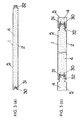
- FIG.3 (a) A cross sectional view of the insulation panel (5) is shown in Fig.3 (a).
- a cross sectional view of the insulation panels (5) is connected in series as shown in Fig.3 (b).
- a plastic foam sealant (31) is inserted at the end of the female end (30), and a piece of moisture preventive tape seals the top of the male end (32). The purpose of these sealing devices is to keep the insulation material (4) inside the panels (5).
- Crude-MDI modified diisocyanate
- a polyisocyanate was used in the present invention.
- the isocyanate was mixed with a polyol composition mixture comprising polyols, aromatic compounds, water, trimerization catalysts, carbodiimide catalysts, urethane-urea catalysts, surfactants, and flame-retardants. These components of the polyol mixture are selected from the corresponding compounds described previously.
- the admixture of the polyol mixture and the polyisocyanate was weighed exactly 150 g. The admixture was vigorously stirred with a mechanical drill (2200 rpm, with a 30 mm ⁇ drill fin) for five seconds.
- a 120 g portion of the admixture was transferred into a wooden box 150 x 150 x 150 mm for free rise.
- Cream and rise times of a foam in the box were measured.
- the cream time is defined as time length between when the portion is stirred and when it starts foaming.
- the rise time is defined as time length between when the portion is stirred and when it ends foaming.
- the foam was trimmed such that the volume of the foam became 100 x 100 x 100 mm and weighed.
- a free rise density of the foam was calculated by dividing the weight of the foam by the volume of the foam.
- Insulation panels of the modified polyisocyanurate foam were prepared in batches. First, two steel plates with thickness of 0.5 mm were supported with separated space in a 260 x 260 x 35 mm molding tray heated at 60° C. Second, a 120 g portion of the admixture was poured between the plates and allowed to foam. Third, the resulting insulation panel was cut into pieces at a size of 100 x 100 x 35 mm; a density of the foam was about 50 kg/m3.
- adhesion strength of the foam to steel plates is adhesion strength of the foam to steel plates, 10% compression strength, and friability. They were determined by: (i) JIS A 9514 for the standard of the adhesion strength, (ii) ASTM C 421 for the standard of the friability, and (iii) JIS K 6848 for the standard of the 10% compression strength, respectively.
- An amount of the aromatic compound BA-P4 was increased from 1.0 wt % to 10.0 wt % in example 1-4.
- values of the adhesion strength and 10% compression strength of the foams were increased when the amount of the aromatic compound was increased.
- Values of the friability of the foams were also decreased.
- No chlorofluorocarbon was used in the examples.
- a series of modified polyisocyanurate foams was prepared by the same process explained previously except with the uses of different aromatic compounds: namely, BA-P8, BA-8, and UNILINK-4200.
- MR-200 a crude-MDI (product of Nippon Polyurethane Kogyo Sha)
- PS-3152 a polyester polyol at the hydroxyl value of 315 (product of STEPAN Corporation).
- PS-2352 a polyester polyol at the hydroxyl value of 235 (product of STEPAN Corporation).
- a series of modified polyisocyanurate foams was prepared by the same process explained previously except with the uses of various trimerization catalysts: namely, DABCO TMR, DABCO K-15 and SA-NO.1.
- Modified polyisocyanurate foams prepared in comparative examples 1-9 were provided by the same preparation process explained previously in examples 1-12 except that at least one component of the polyol mixture was either missing or changed. Each sum of ingredients in these comparative examples was also weighed exactly 150 g. Cream times, rise times, and free rise densities of the foams were measured by the same methods used in examples. And adhesion strengths, 10% compression strengths, and friabilities of the foams were measured by using the same standards in examples.
- Table III sets forth ingredients and amounts used in comparative examples 1-6 and values of the physical properties for the foams prepared in these comparative examples.
Landscapes
- Chemical & Material Sciences (AREA)
- Health & Medical Sciences (AREA)
- Chemical Kinetics & Catalysis (AREA)
- Medicinal Chemistry (AREA)
- Polymers & Plastics (AREA)
- Organic Chemistry (AREA)
- Polyurethanes Or Polyureas (AREA)
- Compositions Of Macromolecular Compounds (AREA)
Applications Claiming Priority (2)
| Application Number | Priority Date | Filing Date | Title |
|---|---|---|---|
| JP304019/94 | 1994-12-07 | ||
| JP6304019A JP2584955B2 (ja) | 1994-12-07 | 1994-12-07 | 変性ポリイソシアヌレート発泡体及びその製造法並びにポリオール組成物 |
Publications (2)
| Publication Number | Publication Date |
|---|---|
| EP0716106A2 true EP0716106A2 (de) | 1996-06-12 |
| EP0716106A3 EP0716106A3 (de) | 1997-02-19 |
Family
ID=17928100
Family Applications (1)
| Application Number | Title | Priority Date | Filing Date |
|---|---|---|---|
| EP95109640A Ceased EP0716106A3 (de) | 1994-12-07 | 1995-06-21 | Verfahren zur Herstellung modifizierter Polyisocyanuratschäume für Wärmedämmungsmaterialien |
Country Status (4)
| Country | Link |
|---|---|
| US (1) | US5627220A (de) |
| EP (1) | EP0716106A3 (de) |
| JP (1) | JP2584955B2 (de) |
| KR (1) | KR0184631B1 (de) |
Cited By (2)
| Publication number | Priority date | Publication date | Assignee | Title |
|---|---|---|---|---|
| EP1600465A3 (de) * | 2004-05-28 | 2006-01-11 | Air Products And Chemicals, Inc. | Schnell entformende/ verlängerte Cremezeit aufweisende Polyurethanformulierungen |
| EP1997616A1 (de) * | 2007-06-01 | 2008-12-03 | Sika Technology AG | Wabenverbundplatten und Verwendung eines Zweikomponenten-Polyurethan-Klebemittels bei ihrer Herstellung |
Families Citing this family (6)
| Publication number | Priority date | Publication date | Assignee | Title |
|---|---|---|---|---|
| CZ301020B6 (cs) | 1998-09-10 | 2009-10-14 | The Dow Chemical Company | Zpusob výroby Mannichova polyolu |
| US20040176494A1 (en) * | 2003-03-05 | 2004-09-09 | Feske Elbert F. | Preparation of flame retarded polyisocyanurate foams |
| KR100935701B1 (ko) * | 2008-05-28 | 2010-01-07 | 한국신발피혁연구소 | 내가수분해성이 우수한 저비중 폴리우레탄 발포체 조성물 |
| KR20140136973A (ko) | 2012-03-06 | 2014-12-01 | 바스프 에스이 | 가요성 폴리우레탄 발포체 물품의 제조 방법 |
| CN108250404A (zh) * | 2017-12-28 | 2018-07-06 | 青岛海尔股份有限公司 | 聚氨酯硬质泡沫塑料及其制备方法 |
| JP7296968B2 (ja) * | 2018-01-16 | 2023-06-23 | ハンツマン・インターナショナル・エルエルシー | 長いクリーム時間と速硬化性を有するポリイソシアヌレート含有フォーム |
Citations (10)
| Publication number | Priority date | Publication date | Assignee | Title |
|---|---|---|---|---|
| US3657161A (en) | 1967-10-31 | 1972-04-18 | Baychem Corp | Polycarbodiimide-polyisocyanurate foam |
| US3894972A (en) | 1973-12-21 | 1975-07-15 | Basf Wyandotte Corp | Process for the preparation of carbodiimide-isocyanurate foams |
| US3928256A (en) | 1974-02-25 | 1975-12-23 | Basf Wyandotte Corp | Process for the preparation of carbodiimide-isocyanurate foams |
| US3981829A (en) | 1974-12-30 | 1976-09-21 | Basf Wyandotte Corporation | Process for the preparation of carbodiimide-isocyanurate foams |
| US3994893A (en) | 1975-11-03 | 1976-11-30 | E. R. Squibb & Sons, Inc. | 4-Amino derivatives of pyrozolo[1,5-a]quinoxaline-3-carboxylic acid and esters |
| US3994837A (en) | 1974-10-02 | 1976-11-30 | Basf Wyandotte Corporation | Urethane-modified carbodiimide-isocynurate foams prepared from TDI-rich isocyanates |
| US3998766A (en) | 1974-12-26 | 1976-12-21 | Basf Wyandotte Corporation | Urethane modified carbodimide-isocyanurate foams from organic polyisocyanates and oxyalkylated mannich polyols |
| US4040992A (en) | 1975-07-29 | 1977-08-09 | Air Products And Chemicals, Inc. | Catalysis of organic isocyanate reactions |
| US4166164A (en) | 1977-12-05 | 1979-08-28 | Basf Wyandotte Corporation | Process for the preparation of carbodiimide-isocyanurate foams |
| EP0381324A1 (de) | 1989-02-01 | 1990-08-08 | Imperial Chemical Industries Plc | Katalysator-Zusammensetzung |
Family Cites Families (5)
| Publication number | Priority date | Publication date | Assignee | Title |
|---|---|---|---|---|
| US3919128A (en) * | 1973-05-18 | 1975-11-11 | Ici America Inc | Urethane-modified polyisocyanurate foams |
| US3922238A (en) * | 1974-05-23 | 1975-11-25 | Basf Wyandotte Corp | Carbodiimide-isocyanurate foams containing urethane linkages |
| GB9126741D0 (en) * | 1991-12-17 | 1992-02-12 | Ici Plc | Polyurethane foams |
| US5223551A (en) * | 1991-12-26 | 1993-06-29 | Uop | Urea-modified isocyanurates and method of making rigid foams thereof |
| JP2604953B2 (ja) * | 1992-10-23 | 1997-04-30 | 日清紡績株式会社 | 変性ポリイソシアヌレート発泡体の製造法 |
-
1994
- 1994-12-07 JP JP6304019A patent/JP2584955B2/ja not_active Expired - Fee Related
-
1995
- 1995-03-10 KR KR1019950004864A patent/KR0184631B1/ko not_active Expired - Fee Related
- 1995-06-21 EP EP95109640A patent/EP0716106A3/de not_active Ceased
- 1995-06-22 US US08/493,409 patent/US5627220A/en not_active Expired - Fee Related
Patent Citations (11)
| Publication number | Priority date | Publication date | Assignee | Title |
|---|---|---|---|---|
| US3657161A (en) | 1967-10-31 | 1972-04-18 | Baychem Corp | Polycarbodiimide-polyisocyanurate foam |
| US3894972A (en) | 1973-12-21 | 1975-07-15 | Basf Wyandotte Corp | Process for the preparation of carbodiimide-isocyanurate foams |
| US3928256A (en) | 1974-02-25 | 1975-12-23 | Basf Wyandotte Corp | Process for the preparation of carbodiimide-isocyanurate foams |
| US3994837A (en) | 1974-10-02 | 1976-11-30 | Basf Wyandotte Corporation | Urethane-modified carbodiimide-isocynurate foams prepared from TDI-rich isocyanates |
| US3998766A (en) | 1974-12-26 | 1976-12-21 | Basf Wyandotte Corporation | Urethane modified carbodimide-isocyanurate foams from organic polyisocyanates and oxyalkylated mannich polyols |
| US3981829A (en) | 1974-12-30 | 1976-09-21 | Basf Wyandotte Corporation | Process for the preparation of carbodiimide-isocyanurate foams |
| US4040992A (en) | 1975-07-29 | 1977-08-09 | Air Products And Chemicals, Inc. | Catalysis of organic isocyanate reactions |
| US3994893A (en) | 1975-11-03 | 1976-11-30 | E. R. Squibb & Sons, Inc. | 4-Amino derivatives of pyrozolo[1,5-a]quinoxaline-3-carboxylic acid and esters |
| US4166164A (en) | 1977-12-05 | 1979-08-28 | Basf Wyandotte Corporation | Process for the preparation of carbodiimide-isocyanurate foams |
| EP0381324A1 (de) | 1989-02-01 | 1990-08-08 | Imperial Chemical Industries Plc | Katalysator-Zusammensetzung |
| US5126305A (en) | 1989-02-01 | 1992-06-30 | Imperial Chemical Industries Plc | Catalyst composition |
Cited By (6)
| Publication number | Priority date | Publication date | Assignee | Title |
|---|---|---|---|---|
| EP1600465A3 (de) * | 2004-05-28 | 2006-01-11 | Air Products And Chemicals, Inc. | Schnell entformende/ verlängerte Cremezeit aufweisende Polyurethanformulierungen |
| US8258198B2 (en) | 2004-05-28 | 2012-09-04 | Air Products And Chemicals, Inc. | Fast demold/extended cream time polyurethane formulations |
| US8618014B2 (en) | 2004-05-28 | 2013-12-31 | Air Products And Chemicals, Inc. | Fast demold/extended cream time polyurethane formulations |
| EP2787016A1 (de) * | 2004-05-28 | 2014-10-08 | Air Products And Chemicals, Inc. | Polyurethanformulierungen mit schnell entformender/verlängerter Cremezeit |
| EP1997616A1 (de) * | 2007-06-01 | 2008-12-03 | Sika Technology AG | Wabenverbundplatten und Verwendung eines Zweikomponenten-Polyurethan-Klebemittels bei ihrer Herstellung |
| US8246777B2 (en) | 2007-06-01 | 2012-08-21 | Sika Technology Ag | Honeycomb sandwich panels and the use of a two component polyurethane adhesive in the manufacture thereof |
Also Published As
| Publication number | Publication date |
|---|---|
| KR0184631B1 (ko) | 1999-05-15 |
| JP2584955B2 (ja) | 1997-02-26 |
| KR960022633A (ko) | 1996-07-18 |
| JPH08157550A (ja) | 1996-06-18 |
| US5627220A (en) | 1997-05-06 |
| EP0716106A3 (de) | 1997-02-19 |
Similar Documents
| Publication | Publication Date | Title |
|---|---|---|
| EP0656382B1 (de) | Verfahren zur Herstellung modifizierter Polyisocyanuratschaumstoffen | |
| US6403665B1 (en) | Rigid polyurethane foams | |
| US4098731A (en) | Process for the production of foams | |
| US6207725B1 (en) | Rigid polyurethane foams | |
| US5645928A (en) | Heat insulation panels manufactured from modified polyisocyanurate foams | |
| US4374935A (en) | Process for the preparation of flexible polyurethane foams employing polyester-polyether polyol mixtures | |
| US4791148A (en) | Isocyanate terminated quasi-prepolymers useful for preparing polyurethane/polyisocyanurate foams having low thermal conductivity | |
| DE602004002308T2 (de) | Organometallischer Katalysator mit niedrigem Säuregehalt für die Herstellung von Polyurethan-Weich-, Halbhart- und Hartschäumen | |
| EP0496081B1 (de) | Harte Polyurethan- und Polyisocyanurat-Schaumstoffe | |
| EP0604784B1 (de) | Verbundmaterialien für Kühlbehälter, die einen unter Anwendung von Lithiumsalzen mit Wasser verschäumten formbeständigen Polyurethanschaumstoff enthalten, und Verfahren zu ihrer Herstellung | |
| US4297442A (en) | Cellular elastomeric foams and method of production using an expanding agent containing a component reactive with the polyamine chain-lengthening agent | |
| US5627220A (en) | Process of the preparation of modified polyisocyanurate foams for heat insulation materials | |
| CA1090047A (en) | Urethane-modified isocyanurate foams having enhanced physical properties | |
| DE2506657A1 (de) | Verfahren zur herstellung von zellfoermigen schaumstoffen | |
| US4888365A (en) | Isocyanate terminated quasi-prepolymers useful for preparing polyurethane/polyisocyanurate foams having low thermal conductivity | |
| US20010003758A1 (en) | Rigid isocyanurate-modified polyurethane foams | |
| US3468819A (en) | Process for producing cellular polyurethanes,using alkyl or aryl acid phosphates | |
| US3909465A (en) | Process for the production of rigid foam resins which contain predominantly isocyanurate ring structures | |
| US4546116A (en) | Process for the production of highly elastic foams containing urethane groups and foams obtainable by this process | |
| EP0585636B1 (de) | Verfahren zur Herstellung modifizierter Polyisocyanuratschäume | |
| EP0187333B1 (de) | Verfahren zur Herstellung von Polyharnstoff-und/oder Polyhydrazodicarbonamid-Dispersionen und ihre Weiterverarbeitung zu Polyurethanen. | |
| EP0347497A2 (de) | Feuerhemmender Zusatz für auf Isocyanaten basierende Schäume | |
| JP2604952B2 (ja) | 変性ポリイソシアヌレート発泡体の製造法 | |
| JPH06145279A (ja) | 変性ポリイソシアヌレート発泡体の製造法 |
Legal Events
| Date | Code | Title | Description |
|---|---|---|---|
| PUAI | Public reference made under article 153(3) epc to a published international application that has entered the european phase |
Free format text: ORIGINAL CODE: 0009012 |
|
| AK | Designated contracting states |
Kind code of ref document: A2 Designated state(s): BE DE FR GB IT NL |
|
| PUAL | Search report despatched |
Free format text: ORIGINAL CODE: 0009013 |
|
| AK | Designated contracting states |
Kind code of ref document: A3 Designated state(s): BE DE FR GB IT NL |
|
| 17P | Request for examination filed |
Effective date: 19970521 |
|
| GRAG | Despatch of communication of intention to grant |
Free format text: ORIGINAL CODE: EPIDOS AGRA |
|
| 17Q | First examination report despatched |
Effective date: 19991004 |
|
| STAA | Information on the status of an ep patent application or granted ep patent |
Free format text: STATUS: THE APPLICATION HAS BEEN REFUSED |
|
| 18R | Application refused |
Effective date: 20000323 |