EP0716155A1 - Verfahren zur Herstellung von Alpha-Beta-Titanlegierung - Google Patents
Verfahren zur Herstellung von Alpha-Beta-Titanlegierung Download PDFInfo
- Publication number
- EP0716155A1 EP0716155A1 EP95308684A EP95308684A EP0716155A1 EP 0716155 A1 EP0716155 A1 EP 0716155A1 EP 95308684 A EP95308684 A EP 95308684A EP 95308684 A EP95308684 A EP 95308684A EP 0716155 A1 EP0716155 A1 EP 0716155A1
- Authority
- EP
- European Patent Office
- Prior art keywords
- titanium alloy
- phase
- transus
- transus minus
- minus
- Prior art date
- Legal status (The legal status is an assumption and is not a legal conclusion. Google has not performed a legal analysis and makes no representation as to the accuracy of the status listed.)
- Granted
Links
Images


Classifications
-
- C—CHEMISTRY; METALLURGY
- C22—METALLURGY; FERROUS OR NON-FERROUS ALLOYS; TREATMENT OF ALLOYS OR NON-FERROUS METALS
- C22F—CHANGING THE PHYSICAL STRUCTURE OF NON-FERROUS METALS AND NON-FERROUS ALLOYS
- C22F1/00—Changing the physical structure of non-ferrous metals or alloys by heat treatment or by hot or cold working
- C22F1/16—Changing the physical structure of non-ferrous metals or alloys by heat treatment or by hot or cold working of other metals or alloys based thereon
- C22F1/18—High-melting or refractory metals or alloys based thereon
- C22F1/183—High-melting or refractory metals or alloys based thereon of titanium or alloys based thereon
Definitions
- the present invention relates to a method for making an ⁇ + ⁇ alloy, and more particularly relates to a method for making an ⁇ + ⁇ alloy wherein fracture toughness can be improved.
- Fracture toughness of an ⁇ + ⁇ titanium alloy significantly varies with the type of microstructure. It is known that ⁇ heat-treated microstructure having coarse acicular ⁇ colonies generally shows superior fracture toughness compared with equiaxed fine microstructure.
- ductility decreases with the change of microstructure from an equiaxed fine microstructure to a ⁇ heat-treated microstructure. Further, the ductility is deteriorated by developing a coarse microstructure.
- the fracture toughness generally decreases with the increase of strength.
- Solution treatment and aging can be used as a method to increase the strength of an ⁇ + ⁇ titanium alloy. This method, however, is not expected to give high fracture toughness because of the resulted equiaxed fine microstructure thereof.
- JP-B-50-37004 the term "JP-B-" referred to herein stands for "Japanese examined patent publication”
- the Prior Art 1 discloses a method for increasing toughness by heating and holding an ⁇ + ⁇ titanium alloy at a temperature range of from ⁇ -transus minus 150 °C to ⁇ -transus minus 60 °C to maintain an ⁇ + ⁇ microstructure , and then by air-cooling or cooling at a higher speed than air-cooling, followed by stabilizing heat treatment.
- JP-A-61-194163 the term "JP-A-" referred to herein stands for "Japanese unexamined patent publication”
- the Prior Art 2 discloses that high toughness of an ⁇ + ⁇ titanium alloy is achieved by heating and holding the hot-worked alloy at a temperature range of from ⁇ -transus minus 50 °C to ⁇ -transus minus 10 °C, followed by cooling the ⁇ + ⁇ titanium alloy to 500°C or lower at a cooling rate of 0.1 to 5 °C/sec.
- the Prior Arts 1 and 2 have disadvantages described below. Both of them intend to acquire balance of high toughness and ductility at the same time by preparing the microstructure with primary ⁇ phase and transformed ⁇ structure in which an acicular ⁇ phase precipitates.
- the presence of acicular ⁇ phase presumably plays an important role in increasing the toughness. Nevertheless, the acicular ⁇ phase precipitates during the cooling step after the heat treatment, so the pattern of precipitation strongly depends on the stability of the ⁇ phase of the alloy.
- Prior Art 1 and Prior Art 2 specify the cooling rate after the heating and holding step as " air-cooling or higher than the air-cooling" and "a cooling rate ranging from 0.1 to 5 °C/sec", respectively.
- Those levels of cooling rate are not necessarily effective to improve the toughness of all types of ⁇ + ⁇ titanium alloys. The reason is that the stability of ⁇ phase considerably depends on the kinds of the elements of the ⁇ + ⁇ titanium alloy, and that the cooling rate specified by the Prior Arts is not necessarily optimum for the precipitation of acicular ⁇ phase effective for improving the fracture toughness.
- the present invention provides a method for making an ⁇ + ⁇ titanium alloy comprising the steps of;
- the present invention provides a method for making an ⁇ + ⁇ titanium alloy comprising the steps of;
- the inventors of the present invention conducted an extensive study for the balanced improvement of toughness, ductility, and strength of an ⁇ + ⁇ titanium alloy that has relatively high stability of ⁇ phase, and obtained the following-described findings. That is, the increase of fracture toughness is possible without deteriorating ductility by a series of treatment steps of: hot-working an ⁇ + ⁇ titanium alloy having relatively high stability of ⁇ phase in the ⁇ + ⁇ phase region; holding the titanium alloy at a heated temperature ranging from ⁇ - transus minus 55 °C to ⁇ -transus minus 10 °C, followed by cooling; re-heating the titanium alloy at a temperature range of from ⁇ -transus minus 250 °C to ⁇ -transus minus 120 °C, followed by cooling.
- the hot-working of the alloy in ⁇ + ⁇ phase includes various types of working such as rolling and forging performed in a temperature range where both ⁇ and ⁇ phases exist below the ⁇ transus.
- the volume fraction of the ⁇ phase which becomes supersaturated during cooling stage increases as higher temperatures are used for the heat treatment, and larger amount of ⁇ phase is replaced by the ⁇ phase during the cooling stage.
- the ⁇ phase precipitates in an acicular shape in the ⁇ phase matrix.
- the “Burgers orientation" there is a correlation of crystal habit called the "Burgers orientation" between the ⁇ phase and the ⁇ phase.
- microstructure when the alloy was hot-worked in an ⁇ + ⁇ phase region, followed by heating to a temperature below ⁇ transus and then cooling, it shows a bi-modal microstructure comprising equiaxed ⁇ phase and transformed ⁇ phase into which acicular ⁇ phase precipitates.
- Fig. 1 shows a change of volume fraction of equiaxed ⁇ phase, acicular ⁇ phase, and ⁇ phase of a Ti-4.5Al-3V-2Mo-2Fe alloy ( ⁇ transus temperature being 900°C), a kind of ⁇ + ⁇ titanium alloy that has relatively high stability of ⁇ phase and was developed by the inventor prior to the present invention.
- the alloy was subjected to a hot working such as rolling or forging having a reduction of area of 30% or more in the ⁇ + ⁇ phase region, and the hot worked alloy was heated to various temperatures, followed by air-cooling.
- ⁇ p denotes primary ⁇ phase
- ⁇ r denotes retained ⁇ phase.
- a preferable degree of hot-working from the stand point of practical application is 5% or more, and most preferably 30% or more.
- That type of bi-modal microstructure is taken as a structure having high toughness in prior arts. The reason is presumably that effective stress intensity factor decreases because of branching the cracks - the phenomenon specific to the acicular ⁇ microstructure, that the high ductility is maintained by the presence of primary ⁇ phase, that the energy absorption accompanied with a diminishing crack development before the stable crack propagation increases, and that these variables contribute to the increase of toughness in a synergetic manner.
- the inventors of the present invention further conducted a study to attain both high fracture toughness and high ductility at the same time, and derived a solution to increase the toughness by applying a heat treatment to the alloy in an ⁇ + ⁇ phase region ranging from ⁇ -transus minus 55 °C to ⁇ -transus minus 10 °C and further by re-heating after cooling.
- the second heat treatment is performed in a temperature range of from ⁇ -transus minus 250 °C to ⁇ -transus minus 120 °C because the secondary heat treatment makes the fine acicular ⁇ phase coarse enough to improve the toughness without making the total microstructure coarse.
- the period of heat treatment is not specifically limited. For practical application, however, the preferable heat treatment period is 30 minute or more, and more preferably 60 minute or more.
- the precipitation of acicular ⁇ phase occurs after air-cooling.
- the precipitated acicular ⁇ phase that appears after the air-cooling becomes very fine, and therefore the secondary heat treatment needs a long period for making the phase coarse enough to contribute to increasing fracture toughness. That is not practical.
- the first heat treatment exceeds ⁇ -transus minus 10 °C, the total microstructure becomes coarse, and the ductility deteriorates.
- the temperature range of the first heat treatment is specified to be from ⁇ -transus minus 55 °C and ⁇ -transus minus 10 °C.
- the heat treatment within this range attains favorable properties of, for example, 950 MPa or more of tensile strength, 35% or more of reduction of area, and 80 MPa ⁇ m 1/2 or more of fracture toughness (K IC ).
- An alloy that has relatively high stability of ⁇ phase has a Mo.eq. value of from 2 to 10 wt.%. That type of alloy is applicable for the method of the present invention to increase fracture toughness. If the Mo.eq. value is within the range, the method of the invention is applicable even when the alloy contains neutral elements such as Sn and Zr, which do not affect Mo.eq., and contains slight amount (usually in a range of from 0.01 to 0.5 wt.%) of Si, Pd, and Ru, which could enhance creep resistance and corrosion resistance, and further contains inevitable impurities such as O, C, N, H.
- the method of the present invention is more applicable when the composition of the alloy satisfies the following.
- Aluminum is an ⁇ -stabilizer, and has an effect to enhance the solid-solution strengthening of ⁇ phase.
- aluminum is an essential element for increasing the strength of an ⁇ + ⁇ titanium alloy.
- An aluminum content of less than 3 wt.% gives, however, insufficient strength, and that of above 5 wt.% results in an excessively stable ⁇ phase to increase the resistance to deformation, which is unfavorable. Therefore, the aluminum content range is determined to be 3.0 to 5.0 wt.%, and more preferably 3.4 to 5 wt.%.
- Vanadium has an effect of lowering ⁇ -transus and stabilizing the ⁇ phase.
- the addition of vanadium improves the hot-workability and induces the precipitation of fine acicular ⁇ phase in the ⁇ phase during the cooling stage after the heat treatment to improve the strength and the fracture toughness.
- Vanadium content of less than 2.1 wt.% results in an insufficient lowering of ⁇ -transus, and no improvement of workability is expected.
- the acicular ⁇ phase precipitated tends to become coarse, and it is not expected to obtain high strength.
- the vanadium content of above 3.7 wt.% results in an excessively stable ⁇ phase, and the precipitation of acicular ⁇ phase which contributes to increasing strength and fracture toughness becomes difficult.
- excess vanadium content is not economical. Consequently, the content of vanadium is determined to be 2.1 to 3.7 wt.%, and a more preferable range is 2.5 to 3.7 wt.%.
- Molybdenum has effects of lowering the ⁇ -transus, stabilizing the ⁇ phase, and suppressing the growth of crystal grains to provide fine crystal grains. Therefore, molybdenum has an effect of improving the workability. At a molybdenum content of below 0.85 wt.%, however, no fine structure is attained. With a molybdenum content of above 3.15 wt.%, the prepared ⁇ phase becomes excessively stable, and the improvement of strength and toughness is not easy. Accordingly, the content of molybdenum is determined to be 0.85 to 3.15 wt.%, and a more preferable range is 0.85 to 2.4 wt.%.
- iron Similar to vanadium and molybdenum, iron also has effects to lower the ⁇ -transus and stabilize the ⁇ phase. In addition, iron has a function to make the solid-solution strengthening of the ⁇ phase. Therefore, iron is effective for improving workability, strength, and toughness. At an iron content of below 0.85 wt.%, however, the stability of ⁇ phase is insufficient. On the other hand, an iron content of above 3.15 wt.% likely induces the generation of a domain where an irregular ⁇ phase called " ⁇ fleck" appears, which degrades the uniformity of structure. Therefore, the content of iron is specified to be 0.85 to 3.15 wt.%.
- the same oxygen content level as that in an ordinary ⁇ + ⁇ titanium alloy is preferable.
- the oxygen content below 0.06 wt.% fails to maintain sufficient strength.
- the oxygen content above 0.2 wt.% induces a sudden deterioration of ductility and workability. Consequently, the content of oxygen is specified tobe 0.06 to 0.2 wt.%.
- Iron, vanadium, and molybdenum are the elements to stabilize ⁇ phase as described above. They lower the ⁇ -transus and have a function to stabilize the ⁇ phase at an even lower temperature level, though there is some difference in effectiveness among them.
- the stability of ⁇ phase gives a significant effect on the mechanical properties of ⁇ + ⁇ titanium alloy. That is, the stability of ⁇ phase gives a considerable effect to the microstructure, depending on the heating temperature of ⁇ + ⁇ titanium alloy, the volume fraction of primary ⁇ phase, the precipitated style of ⁇ acicular phase, and their dependency on cooling rate. Accordingly, in an ⁇ + ⁇ titanium alloy having balanced properties of workability, strength, toughness, and ductility, which is a target of the present invention, these ⁇ -stabilizing elements need to be controlled within an optimum range.
- ⁇ phase is expressed quantitatively by a general eq.(1).
- eq.(1) an alloy which does not contain W, Nb, Ta, Cr, Ni, Co, and Cu, the values of these elements may be taken as zero.
- Al content is in a range of from 3 to 5 wt.% as specified above, eq.(1) is reduced to the following equation. 5 to 7 wt.% ⁇ 0.67 x V + 2.9 x Fe + Mo ⁇ 13 to 15 wt.%
- the above-specified composition 7 to 13 wt.% is adopted as specified in eq.(2). If the value is less than 7 wt.%, then the stability of ⁇ phase and the decrease of ⁇ -transus become somewhat insufficient, and the workability also becomes insufficient. If the value exceeds 13 wt.%, the ⁇ phase becomes stable, and the ⁇ transus excessively lowers, and a slightly long period is needed for the precipitation of acicular ⁇ phase which contributes to the improvement of toughness, and the control of microstructure becomes difficult.
- a Ti-4.5Al-3V-2Mo-2Fe alloy ( ⁇ -transus temperature : 895 °C) was forged in a ⁇ phase region, and the alloy was rolled in an ⁇ + ⁇ phase region from 100 mm to 27 mm of plate thickness.
- the plate was subjected to the first heat treatment in a temperature range of from 820 to 910 °C, followed by air-cooling.
- the plate was then subjected to the second heat treatment at 720 °C, and was air-cooled.
- the cooling rate after the first heat treatment was 2 °C/sec.
- the reduction of area provides a measure of the ultimate local ductility of a material up to the instant of rapture. From the original and final areas, the percentage reduction of area is calculated in the following manner; ⁇ ( Original area - Final area ) / Original area ⁇ x 100
- a plate having a thickness of 27 mm which was prepared by rolling in a similar procedure as example described above.
- the sheet was subjected to the first heat treatment at a temperature range of from 720 to 910 °C for 1 hr followed by air-cooling. No second heat treatment was conducted.
- the material was tested for determining the tensile properties and the fracture toughness both at the room temperature.
- Table 2 shows the condition of heat treatment, the microstructure, the tensile characteristic, and the fracture toughness.
- WQ, AC and FC signifyes the water quenching, air cooling and forced air cooling, respectively.
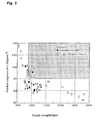
- Fig. 2 and Fig. 3 show a relation of strength and toughness and a relation of ductility and toughness of alloys which were heat-treated, respectively.
- the materials of the present invention give excellent properties such as tensile strength of 950 MPa or more, reduction of area of 35% or more, and fracture toughness of 80 MPa•m 1/2 or more.
- the method of the present invention enables an ⁇ + ⁇ titanium alloy having relatively stable ⁇ phase to increase its toughness while maintaining a favorable balance with strength and ductility.
Landscapes
- Chemical & Material Sciences (AREA)
- Physics & Mathematics (AREA)
- Thermal Sciences (AREA)
- Crystallography & Structural Chemistry (AREA)
- Engineering & Computer Science (AREA)
- Materials Engineering (AREA)
- Mechanical Engineering (AREA)
- Metallurgy (AREA)
- Organic Chemistry (AREA)
- Forging (AREA)
- Heat Treatment Of Steel (AREA)
Applications Claiming Priority (4)
| Application Number | Priority Date | Filing Date | Title |
|---|---|---|---|
| JP329269/94 | 1994-12-05 | ||
| JP32926994 | 1994-12-05 | ||
| JP33776794A JP3319195B2 (ja) | 1994-12-05 | 1994-12-28 | α+β型チタン合金の高靱化方法 |
| JP337767/94 | 1994-12-28 |
Publications (2)
| Publication Number | Publication Date |
|---|---|
| EP0716155A1 true EP0716155A1 (de) | 1996-06-12 |
| EP0716155B1 EP0716155B1 (de) | 1998-04-01 |
Family
ID=26573137
Family Applications (1)
| Application Number | Title | Priority Date | Filing Date |
|---|---|---|---|
| EP95308684A Expired - Lifetime EP0716155B1 (de) | 1994-12-05 | 1995-12-01 | Verfahren zur Herstellung von Alpha-Beta-Titanlegierung |
Country Status (4)
| Country | Link |
|---|---|
| US (1) | US5679183A (de) |
| EP (1) | EP0716155B1 (de) |
| JP (1) | JP3319195B2 (de) |
| DE (1) | DE69501939T2 (de) |
Cited By (11)
| Publication number | Priority date | Publication date | Assignee | Title |
|---|---|---|---|---|
| EP0909827A3 (de) * | 1997-08-04 | 1999-08-04 | Oregon Metallurgical Corporation | Preiswerte, verschweissbare und giessbare Titaniumlegierung hohen Moduls und daraus hergestellte Gegenstände |
| EP1078997A1 (de) * | 1999-08-27 | 2001-02-28 | General Electric Company | Wärmebehandlung zur Verbesserung der Eigenschaften von Alpha-Beta-Titan-Legierungen |
| RU2169791C2 (ru) * | 1999-10-14 | 2001-06-27 | Открытое акционерное общество Верхнесалдинское металлургическое производственное объединение | Способ изготовления плит из титановых сплавов |
| EP1382695A4 (de) * | 2001-02-28 | 2004-08-11 | Jfe Steel Corp | Stab aus titanlegierung und verfahren zu seiner herstellung |
| EP1953251A1 (de) * | 2007-01-31 | 2008-08-06 | General Electric Company | Verfahren und Artikel in Zusammenhang mit einer hochfesten und erosionsbeständigen Ti62222-Titanlegierung |
| RU2335572C1 (ru) * | 2006-12-12 | 2008-10-10 | Открытое Акционерное Общество "Корпорация Всмпо-Ависма" | Способ изготовления плит повышенной точности |
| WO2010047874A3 (en) * | 2008-09-18 | 2010-11-18 | Siemens Energy, Inc. | Solution heat treatment and overage heat treatment for titanium components |
| US7878925B2 (en) | 2005-02-23 | 2011-02-01 | Jfe Steel Corporation | Golf club head |
| EP1612289A3 (de) * | 2004-06-28 | 2012-07-25 | General Electric Company | Verfahren zur Herstellung von einem Beta behandelten Artikel aus einer Alpha-Beta-Titanlegierung |
| CN112899597A (zh) * | 2021-01-25 | 2021-06-04 | 东南大学 | 一种双相钛合金的热处理方法 |
| CN114836702A (zh) * | 2022-05-23 | 2022-08-02 | 中国科学院金属研究所 | 一种提高厚截面或变截面tc25g合金锻件性能稳定性的热处理工艺 |
Families Citing this family (30)
| Publication number | Priority date | Publication date | Assignee | Title |
|---|---|---|---|---|
| US20040261912A1 (en) * | 2003-06-27 | 2004-12-30 | Wu Ming H. | Method for manufacturing superelastic beta titanium articles and the articles derived therefrom |
| WO2004003243A1 (en) * | 2002-06-27 | 2004-01-08 | Memry Corporation | METHOD FOR MANUFACTURING SUPERELASTIC β TITANIUM ARTICLES AND THE ARTICLES DERIVED THEREFROM |
| US20040168751A1 (en) * | 2002-06-27 | 2004-09-02 | Wu Ming H. | Beta titanium compositions and methods of manufacture thereof |
| US20040221929A1 (en) | 2003-05-09 | 2004-11-11 | Hebda John J. | Processing of titanium-aluminum-vanadium alloys and products made thereby |
| JP4264411B2 (ja) * | 2004-04-09 | 2009-05-20 | 新日本製鐵株式会社 | 高強度α+β型チタン合金 |
| US7837812B2 (en) * | 2004-05-21 | 2010-11-23 | Ati Properties, Inc. | Metastable beta-titanium alloys and methods of processing the same by direct aging |
| US8337750B2 (en) * | 2005-09-13 | 2012-12-25 | Ati Properties, Inc. | Titanium alloys including increased oxygen content and exhibiting improved mechanical properties |
| DE102005052918A1 (de) * | 2005-11-03 | 2007-05-16 | Hempel Robert P | Kaltverformbare Ti-Legierung |
| US7611592B2 (en) * | 2006-02-23 | 2009-11-03 | Ati Properties, Inc. | Methods of beta processing titanium alloys |
| US20110093247A1 (en) * | 2008-06-13 | 2011-04-21 | Control Station, Inc. | System and method for non-steady state model fitting |
| US10053758B2 (en) | 2010-01-22 | 2018-08-21 | Ati Properties Llc | Production of high strength titanium |
| US9255316B2 (en) | 2010-07-19 | 2016-02-09 | Ati Properties, Inc. | Processing of α+β titanium alloys |
| US8499605B2 (en) | 2010-07-28 | 2013-08-06 | Ati Properties, Inc. | Hot stretch straightening of high strength α/β processed titanium |
| US9631261B2 (en) | 2010-08-05 | 2017-04-25 | Titanium Metals Corporation | Low-cost alpha-beta titanium alloy with good ballistic and mechanical properties |
| US8613818B2 (en) | 2010-09-15 | 2013-12-24 | Ati Properties, Inc. | Processing routes for titanium and titanium alloys |
| US9206497B2 (en) | 2010-09-15 | 2015-12-08 | Ati Properties, Inc. | Methods for processing titanium alloys |
| US10513755B2 (en) | 2010-09-23 | 2019-12-24 | Ati Properties Llc | High strength alpha/beta titanium alloy fasteners and fastener stock |
| US8652400B2 (en) | 2011-06-01 | 2014-02-18 | Ati Properties, Inc. | Thermo-mechanical processing of nickel-base alloys |
| US9050647B2 (en) | 2013-03-15 | 2015-06-09 | Ati Properties, Inc. | Split-pass open-die forging for hard-to-forge, strain-path sensitive titanium-base and nickel-base alloys |
| CN103122442B (zh) * | 2013-01-15 | 2015-05-20 | 西北工业大学 | 一种通过炉冷在双相钛合金中获得三态组织的方法 |
| US9869003B2 (en) | 2013-02-26 | 2018-01-16 | Ati Properties Llc | Methods for processing alloys |
| US9192981B2 (en) | 2013-03-11 | 2015-11-24 | Ati Properties, Inc. | Thermomechanical processing of high strength non-magnetic corrosion resistant material |
| US9777361B2 (en) | 2013-03-15 | 2017-10-03 | Ati Properties Llc | Thermomechanical processing of alpha-beta titanium alloys |
| US11111552B2 (en) | 2013-11-12 | 2021-09-07 | Ati Properties Llc | Methods for processing metal alloys |
| US10094003B2 (en) | 2015-01-12 | 2018-10-09 | Ati Properties Llc | Titanium alloy |
| JP6577210B2 (ja) * | 2015-03-11 | 2019-09-18 | テイタニウム メタルス コーポレイシヨンTitanium Metals Corporation | 良好な弾道及び機械特性を有する低コストのα−βチタニウム合金 |
| US10502252B2 (en) | 2015-11-23 | 2019-12-10 | Ati Properties Llc | Processing of alpha-beta titanium alloys |
| CN116623113B (zh) * | 2023-05-25 | 2025-05-27 | 沈阳工业大学 | 一种提高亚稳β钛合金板材强塑积的热轧后控温方法 |
| US12344918B2 (en) | 2023-07-12 | 2025-07-01 | Ati Properties Llc | Titanium alloys |
| CN120115698B (zh) * | 2025-05-14 | 2025-07-18 | 西部超导材料科技股份有限公司 | 一种提高(α+β)钛合金抗冲击性能的热处理方法及应用 |
Citations (9)
| Publication number | Priority date | Publication date | Assignee | Title |
|---|---|---|---|---|
| FR2162843A5 (de) * | 1971-10-06 | 1973-07-20 | United Aircraft Corp | |
| FR2162856A5 (en) * | 1971-11-22 | 1973-07-20 | Xeros | Heat treatment for alpha/beta titanium alloys - - having improved uniform ductility strength and structure |
| US3867208A (en) * | 1970-11-24 | 1975-02-18 | Nikolai Alexandrovich Grekov | Method for producing annular forgings |
| GB2148940A (en) * | 1983-10-31 | 1985-06-05 | United Technologies Corp | Titanium-based alloy having improved crack growth behaviour |
| EP0307386A1 (de) * | 1987-08-31 | 1989-03-15 | BÖHLER Gesellschaft m.b.H. | Verfahren zur Herstellung einer Titanlegierung und Verwendung einer Sprüheinrichtung zur Durchführung des Verfahrens |
| FR2623523A1 (fr) * | 1987-11-19 | 1989-05-26 | United Technologies Corp | Procede de traitement thermique d'alliages de titane |
| DE3804358A1 (de) * | 1988-02-12 | 1989-08-24 | Ver Schmiedewerke Gmbh | Optimierung der waermebehandlung zur erhoehung der kriechfestigkeit warmfester titanlegierungen |
| US4975125A (en) * | 1988-12-14 | 1990-12-04 | Aluminum Company Of America | Titanium alpha-beta alloy fabricated material and process for preparation |
| EP0408313A1 (de) * | 1989-07-10 | 1991-01-16 | Nkk Corporation | Legierung auf Titan-Basis und Verfahren zu deren Superplastischer Formgebung |
Family Cites Families (7)
| Publication number | Priority date | Publication date | Assignee | Title |
|---|---|---|---|---|
| US3901743A (en) * | 1971-11-22 | 1975-08-26 | United Aircraft Corp | Processing for the high strength alpha-beta titanium alloys |
| FR2235290B1 (de) * | 1973-06-26 | 1977-12-23 | Semt | |
| JPS61194163A (ja) * | 1985-02-22 | 1986-08-28 | Sumitomo Metal Ind Ltd | α+β型チタン合金の熱処理方法 |
| JPS62133051A (ja) * | 1985-12-03 | 1987-06-16 | Sumitomo Metal Ind Ltd | α+β型チタン合金の製造方法 |
| US5362441A (en) * | 1989-07-10 | 1994-11-08 | Nkk Corporation | Ti-Al-V-Mo-O alloys with an iron group element |
| JPH0823053B2 (ja) * | 1989-07-10 | 1996-03-06 | 日本鋼管株式会社 | 加工性に優れた高強度チタン合金およびその合金材の製造方法ならびにその超塑性加工法 |
| US5399212A (en) * | 1992-04-23 | 1995-03-21 | Aluminum Company Of America | High strength titanium-aluminum alloy having improved fatigue crack growth resistance |
-
1994
- 1994-12-28 JP JP33776794A patent/JP3319195B2/ja not_active Expired - Fee Related
-
1995
- 1995-11-29 US US08/564,923 patent/US5679183A/en not_active Expired - Lifetime
- 1995-12-01 DE DE69501939T patent/DE69501939T2/de not_active Expired - Lifetime
- 1995-12-01 EP EP95308684A patent/EP0716155B1/de not_active Expired - Lifetime
Patent Citations (9)
| Publication number | Priority date | Publication date | Assignee | Title |
|---|---|---|---|---|
| US3867208A (en) * | 1970-11-24 | 1975-02-18 | Nikolai Alexandrovich Grekov | Method for producing annular forgings |
| FR2162843A5 (de) * | 1971-10-06 | 1973-07-20 | United Aircraft Corp | |
| FR2162856A5 (en) * | 1971-11-22 | 1973-07-20 | Xeros | Heat treatment for alpha/beta titanium alloys - - having improved uniform ductility strength and structure |
| GB2148940A (en) * | 1983-10-31 | 1985-06-05 | United Technologies Corp | Titanium-based alloy having improved crack growth behaviour |
| EP0307386A1 (de) * | 1987-08-31 | 1989-03-15 | BÖHLER Gesellschaft m.b.H. | Verfahren zur Herstellung einer Titanlegierung und Verwendung einer Sprüheinrichtung zur Durchführung des Verfahrens |
| FR2623523A1 (fr) * | 1987-11-19 | 1989-05-26 | United Technologies Corp | Procede de traitement thermique d'alliages de titane |
| DE3804358A1 (de) * | 1988-02-12 | 1989-08-24 | Ver Schmiedewerke Gmbh | Optimierung der waermebehandlung zur erhoehung der kriechfestigkeit warmfester titanlegierungen |
| US4975125A (en) * | 1988-12-14 | 1990-12-04 | Aluminum Company Of America | Titanium alpha-beta alloy fabricated material and process for preparation |
| EP0408313A1 (de) * | 1989-07-10 | 1991-01-16 | Nkk Corporation | Legierung auf Titan-Basis und Verfahren zu deren Superplastischer Formgebung |
Cited By (14)
| Publication number | Priority date | Publication date | Assignee | Title |
|---|---|---|---|---|
| EP0909827A3 (de) * | 1997-08-04 | 1999-08-04 | Oregon Metallurgical Corporation | Preiswerte, verschweissbare und giessbare Titaniumlegierung hohen Moduls und daraus hergestellte Gegenstände |
| EP1078997A1 (de) * | 1999-08-27 | 2001-02-28 | General Electric Company | Wärmebehandlung zur Verbesserung der Eigenschaften von Alpha-Beta-Titan-Legierungen |
| RU2169791C2 (ru) * | 1999-10-14 | 2001-06-27 | Открытое акционерное общество Верхнесалдинское металлургическое производственное объединение | Способ изготовления плит из титановых сплавов |
| EP1382695A4 (de) * | 2001-02-28 | 2004-08-11 | Jfe Steel Corp | Stab aus titanlegierung und verfahren zu seiner herstellung |
| EP1612289A3 (de) * | 2004-06-28 | 2012-07-25 | General Electric Company | Verfahren zur Herstellung von einem Beta behandelten Artikel aus einer Alpha-Beta-Titanlegierung |
| US7878925B2 (en) | 2005-02-23 | 2011-02-01 | Jfe Steel Corporation | Golf club head |
| RU2335572C1 (ru) * | 2006-12-12 | 2008-10-10 | Открытое Акционерное Общество "Корпорация Всмпо-Ависма" | Способ изготовления плит повышенной точности |
| EP1953251A1 (de) * | 2007-01-31 | 2008-08-06 | General Electric Company | Verfahren und Artikel in Zusammenhang mit einer hochfesten und erosionsbeständigen Ti62222-Titanlegierung |
| WO2010047874A3 (en) * | 2008-09-18 | 2010-11-18 | Siemens Energy, Inc. | Solution heat treatment and overage heat treatment for titanium components |
| US9103011B2 (en) | 2008-09-18 | 2015-08-11 | Siemens Energy, Inc. | Solution heat treatment and overage heat treatment for titanium components |
| CN112899597A (zh) * | 2021-01-25 | 2021-06-04 | 东南大学 | 一种双相钛合金的热处理方法 |
| CN112899597B (zh) * | 2021-01-25 | 2021-09-28 | 东南大学 | 一种双相钛合金的热处理方法 |
| CN114836702A (zh) * | 2022-05-23 | 2022-08-02 | 中国科学院金属研究所 | 一种提高厚截面或变截面tc25g合金锻件性能稳定性的热处理工艺 |
| CN114836702B (zh) * | 2022-05-23 | 2023-05-12 | 中国科学院金属研究所 | 一种提高厚截面或变截面tc25g合金锻件性能稳定性的热处理工艺 |
Also Published As
| Publication number | Publication date |
|---|---|
| US5679183A (en) | 1997-10-21 |
| JPH08209317A (ja) | 1996-08-13 |
| DE69501939D1 (de) | 1998-05-07 |
| JP3319195B2 (ja) | 2002-08-26 |
| EP0716155B1 (de) | 1998-04-01 |
| DE69501939T2 (de) | 1998-07-30 |
Similar Documents
| Publication | Publication Date | Title |
|---|---|---|
| EP0716155B1 (de) | Verfahren zur Herstellung von Alpha-Beta-Titanlegierung | |
| US4067734A (en) | Titanium alloys | |
| JP3959766B2 (ja) | 耐熱性にすぐれたTi合金の処理方法 | |
| US5938867A (en) | Method of manufacturing aluminum aircraft sheet | |
| EP2481823B1 (de) | Nanokristall-titanlegierung und herstellungsverfahren dafür | |
| JP3388411B2 (ja) | 高強度の切欠き延性析出硬化ステンレス鋼合金 | |
| JPH0686638B2 (ja) | 加工性の優れた高強度Ti合金材及びその製造方法 | |
| NO872996L (no) | Aluminium-lithium-legeringer og fremgangsmaate ved fremstilling derav. | |
| JP2536673B2 (ja) | 冷間加工用チタン合金材の熱処理方法 | |
| AU2019249801A1 (en) | High temperature titanium alloys | |
| JPH09194969A (ja) | 高強度チタン合金およびその製造方法 | |
| EP0646655A1 (de) | Verfahren zur Herstellung von Blech aus einer Al-Legierung, die eine verzögerte natürliche Alterung, eine ausgezeichnete Verformbarkeit und Einbrennhärtbarkeit aufweist | |
| US4921548A (en) | Aluminum-lithium alloys and method of making same | |
| US4486244A (en) | Method of producing superplastic aluminum sheet | |
| US3743549A (en) | Thermomechanical process for improving the toughness of the high strength aluminum alloys | |
| JP2005076098A (ja) | 高強度α−β型チタン合金 | |
| JP2541042B2 (ja) | (α+β)型チタン合金の熱処理方法 | |
| EP0266741A1 (de) | Aluminium-Lithium-Legierungen und Verfahren zur Herstellung | |
| JP7038879B1 (ja) | Cu-Ti系銅合金板材、その製造方法、および通電部品 | |
| JP2001288518A (ja) | 高強度、高靱性チタン合金部材およびその製造方法 | |
| JP2024527351A (ja) | ニッケル基合金 | |
| JPH0663076B2 (ja) | 等軸細粒の(α+β)2相組織を有するチタン合金材の製造方法 | |
| JPH0860239A (ja) | 低温靱性に優れた厚鋼板の製造方法 | |
| JPH08134615A (ja) | 機械的性質の均衡性に優れた高力Ti合金の製造方法 | |
| JP3216837B2 (ja) | 耐熱ボルト用鉄基超耐熱合金 |
Legal Events
| Date | Code | Title | Description |
|---|---|---|---|
| PUAI | Public reference made under article 153(3) epc to a published international application that has entered the european phase |
Free format text: ORIGINAL CODE: 0009012 |
|
| 17P | Request for examination filed |
Effective date: 19951211 |
|
| AK | Designated contracting states |
Kind code of ref document: A1 Designated state(s): DE FR GB |
|
| GRAG | Despatch of communication of intention to grant |
Free format text: ORIGINAL CODE: EPIDOS AGRA |
|
| 17Q | First examination report despatched |
Effective date: 19970211 |
|
| GRAH | Despatch of communication of intention to grant a patent |
Free format text: ORIGINAL CODE: EPIDOS IGRA |
|
| GRAH | Despatch of communication of intention to grant a patent |
Free format text: ORIGINAL CODE: EPIDOS IGRA |
|
| GRAA | (expected) grant |
Free format text: ORIGINAL CODE: 0009210 |
|
| AK | Designated contracting states |
Kind code of ref document: B1 Designated state(s): DE FR GB |
|
| REF | Corresponds to: |
Ref document number: 69501939 Country of ref document: DE Date of ref document: 19980507 |
|
| ET | Fr: translation filed | ||
| PLBE | No opposition filed within time limit |
Free format text: ORIGINAL CODE: 0009261 |
|
| STAA | Information on the status of an ep patent application or granted ep patent |
Free format text: STATUS: NO OPPOSITION FILED WITHIN TIME LIMIT |
|
| 26N | No opposition filed | ||
| REG | Reference to a national code |
Ref country code: GB Ref legal event code: IF02 |
|
| REG | Reference to a national code |
Ref country code: FR Ref legal event code: TP |
|
| REG | Reference to a national code |
Ref country code: GB Ref legal event code: 732E |
|
| PGFP | Annual fee paid to national office [announced via postgrant information from national office to epo] |
Ref country code: DE Payment date: 20141125 Year of fee payment: 20 Ref country code: GB Payment date: 20141126 Year of fee payment: 20 |
|
| PGFP | Annual fee paid to national office [announced via postgrant information from national office to epo] |
Ref country code: FR Payment date: 20141208 Year of fee payment: 20 |
|
| REG | Reference to a national code |
Ref country code: DE Ref legal event code: R071 Ref document number: 69501939 Country of ref document: DE |
|
| REG | Reference to a national code |
Ref country code: GB Ref legal event code: PE20 Expiry date: 20151130 |
|
| PG25 | Lapsed in a contracting state [announced via postgrant information from national office to epo] |
Ref country code: GB Free format text: LAPSE BECAUSE OF EXPIRATION OF PROTECTION Effective date: 20151130 |