EP0716447A2 - Aus geschichteten Subschichten geformte Metallschichten und Anordnungen mit diesen Metallschichten - Google Patents
Aus geschichteten Subschichten geformte Metallschichten und Anordnungen mit diesen Metallschichten Download PDFInfo
- Publication number
- EP0716447A2 EP0716447A2 EP95308537A EP95308537A EP0716447A2 EP 0716447 A2 EP0716447 A2 EP 0716447A2 EP 95308537 A EP95308537 A EP 95308537A EP 95308537 A EP95308537 A EP 95308537A EP 0716447 A2 EP0716447 A2 EP 0716447A2
- Authority
- EP
- European Patent Office
- Prior art keywords
- layer
- sublayer
- deposition
- deposited
- temperature
- Prior art date
- Legal status (The legal status is an assumption and is not a legal conclusion. Google has not performed a legal analysis and makes no representation as to the accuracy of the status listed.)
- Withdrawn
Links
Images


Classifications
-
- H—ELECTRICITY
- H10—SEMICONDUCTOR DEVICES; ELECTRIC SOLID-STATE DEVICES NOT OTHERWISE PROVIDED FOR
- H10W—GENERIC PACKAGES, INTERCONNECTIONS, CONNECTORS OR OTHER CONSTRUCTIONAL DETAILS OF DEVICES COVERED BY CLASS H10
- H10W20/00—Interconnections in chips, wafers or substrates
- H10W20/40—Interconnections external to wafers or substrates, e.g. back-end-of-line [BEOL] metallisations or vias connecting to gate electrodes
- H10W20/45—Interconnections external to wafers or substrates, e.g. back-end-of-line [BEOL] metallisations or vias connecting to gate electrodes characterised by their insulating parts
- H10W20/48—Insulating materials thereof
-
- H—ELECTRICITY
- H10—SEMICONDUCTOR DEVICES; ELECTRIC SOLID-STATE DEVICES NOT OTHERWISE PROVIDED FOR
- H10W—GENERIC PACKAGES, INTERCONNECTIONS, CONNECTORS OR OTHER CONSTRUCTIONAL DETAILS OF DEVICES COVERED BY CLASS H10
- H10W20/00—Interconnections in chips, wafers or substrates
- H10W20/01—Manufacture or treatment
- H10W20/031—Manufacture or treatment of conductive parts of the interconnections
- H10W20/069—Manufacture or treatment of conductive parts of the interconnections by forming self-aligned vias or self-aligned contact plugs
-
- H—ELECTRICITY
- H10—SEMICONDUCTOR DEVICES; ELECTRIC SOLID-STATE DEVICES NOT OTHERWISE PROVIDED FOR
- H10W—GENERIC PACKAGES, INTERCONNECTIONS, CONNECTORS OR OTHER CONSTRUCTIONAL DETAILS OF DEVICES COVERED BY CLASS H10
- H10W20/00—Interconnections in chips, wafers or substrates
- H10W20/40—Interconnections external to wafers or substrates, e.g. back-end-of-line [BEOL] metallisations or vias connecting to gate electrodes
- H10W20/41—Interconnections external to wafers or substrates, e.g. back-end-of-line [BEOL] metallisations or vias connecting to gate electrodes characterised by their conductive parts
- H10W20/42—Vias, e.g. via plugs
-
- H—ELECTRICITY
- H10—SEMICONDUCTOR DEVICES; ELECTRIC SOLID-STATE DEVICES NOT OTHERWISE PROVIDED FOR
- H10W—GENERIC PACKAGES, INTERCONNECTIONS, CONNECTORS OR OTHER CONSTRUCTIONAL DETAILS OF DEVICES COVERED BY CLASS H10
- H10W20/00—Interconnections in chips, wafers or substrates
- H10W20/40—Interconnections external to wafers or substrates, e.g. back-end-of-line [BEOL] metallisations or vias connecting to gate electrodes
- H10W20/41—Interconnections external to wafers or substrates, e.g. back-end-of-line [BEOL] metallisations or vias connecting to gate electrodes characterised by their conductive parts
- H10W20/425—Barrier, adhesion or liner layers
Definitions
- This invention relates to the deposition of metal layers, such as the conductors in an integrated circuit.
- metal layers are used to make electrical contact to device active areas (e.g., as electrodes to the gate, source and drain of FETs) and to interconnect devices to one another (e.g., as runners between devices on the same level of an IC or as vias between devices on different levels).
- device active areas e.g., as electrodes to the gate, source and drain of FETs
- interconnect devices e.g., as runners between devices on the same level of an IC or as vias between devices on different levels.
- vias or windows with essentially vertical sidewalls are opened in an overlying dielectric layer to expose a portion of an underlying layer (e.g., the semiconductor active areas of devices or the commonly referred to "Metal- 1" of the first level of metalization).
- a plug of metal from an overlying metal layer extends through the via or window and makes an electrical connection between a metal layer and a semiconductor (device contact) or between two metal layers (interconnect).
- an overlying metal layer e.g., "Metal- 1" in the case of a device contacts or the commonly referred to "Metal-2" in the case of interconnects
- Metal- 1 in the case of a device contacts or the commonly referred to "Metal-2" in the case of interconnects
- Al and aluminum alloys are the most common materials used for such metal layers. Typically, these Al-based layers are deposited as single layers by means of a single-step deposition such as sputtering. Al-based, single-layer metalization, however, suffers several major problems when used to form interconnects in vias or windows: (1) poor step coverage at a top edge of the window, (2) pinch-off or a lack of metal deposition along a sidewall of the window, and (3) overhang or excessive metal above a top edge of the window. Any one or more of these problems may adversely affect IC reliability. Thus, poor step coverage and overhang often produce voids (an absence of metal) in the windows which reduce the ability of the interconnect to carry current. Pinch-off, on the other hand, causes electron crowding, and hence undesirably high current densities, in the sidewall regions where metal is absent.
- the Chen et al. patent goes on to describe an alternative technique in which aluminum is deposited continuously while the wafer is being heated. That is, a small amount of aluminum is deposited at or below 350° C, and as the wafer gradually heats to the desired deposition temperature (400-500 ° C), aluminum deposition continues. Chen et al. reports that this technique gives a layer of aluminum which is deposited with very small grain sizes, tending to minimize grain size growth at later stages (col. 4, lines 10-21).
- a method of making integrated circuits in which an opening (e.g., via or window) is filled with an Al-based plug by depositing a texture control Ti layer under conditions which yield a predetermined orientation in subsequently deposited Al-based layers.
- a plurality of Al-based sublayers are deposited: first, a fine grained first sublayer with essentially a ⁇ 111> orientation is deposited at a relatively cold temperature on the Ti layer; next, a second sublayer is deposited on the first sublayer while the temperature is ramped up from the cold temperature to a peak deposition temperature, so that, during the ramp up, a Ti-aluminide layer is formed at the interface between the Ti layer and the first sublayer, and so that the grain size of the Al-based material increases; and next, a third sublayer is deposited at the peak temperature. During deposition of the third sublayer, the entire microstructure of the plug adjusts itself so that the plug comprises a single grain or at most three grains, and, in addition, the texture of the entire plug has essentially a ⁇ 111> orientation.
- Another aspect of the invention is an integrated circuit including a Ti-aluminide layer and an Al-based plug which fills an opening (e.g., a via or window).
- the texture of the Al-based plug has essentially a ⁇ 111> orientation, and the plug itself comprises a single grain, or at most three grains.
- An integrated circuit typically comprises a semiconductor body (e.g., a silicon substrate or a silicon epitaxial layer on a substrate) in which the active regions of devices (e.g., FETs, bipolar transistors) or the passive regions of other devices (e.g., resistors, capacitors) are formed.
- Devices on different parts of a wafer are typically insulated from one another by insulative (e.g., oxide) regions, and selected devices are interconnected by means of conductive (e.g., metal) layers. Due to the complexity of the interconnection patterns, the metal layers are formed on more than one level (commonly two levels, but increasingly three or four levels).
- FIG. 1 schematically illustrates a portion of an IC 10 which includes a composite Metal-1 layer 12 on Si body 14.
- body 14 may comprise a wafer or substrate with or without a Si epitaxial layer and typically with silicon oxide isolation regions separating devices and/or device regions as described above, but not shown.
- interconnects between Metal-1 and Metal-2 the invention is also applicable to connections between Metal-1 and semiconductor device regions, or between Metal-2 and higher level metals.
- FIG. 1 shows that Metal-1 layer 12 is interconnected with composite Metal-2 layer 16 by means of metal plug 18.
- the Metal-1 and Metal-2 layers are separated from one another by insulative layer 20 in which an opening (e.g., a via or window) is formed to allow plug 18 to extend from Metal-2 to Metal-1.
- both the plug 18 and the Metal-2 layer 16 are formed by depositing a texture control Ti layer 24 under conditions which yield a predetermined orientation in subsequently deposited Al-based layers. More specifically, the texture control Ti layer 24 should be deposited under conditions which produce a close-packed Ti layer having essentially a basal plane (002) orientation. This basal plane of Ti has the same atomic configuration as the (111) plane of Al-based layers, which thereby induces Al-based layers to have essentially a ⁇ 111> orientation when deposited on such a Ti layer.
- a plurality of Al-based sublayers are sequentially deposited, each under different deposition conditions which result in grain boundary diffusion, recrystallization and grain growth.
- the sublayers may be deposited at different deposition rates and under conditions which produce a plug 18 having essentially a ⁇ 111> orientation and having a single grain or at most three grains.
- the maximum size of the grain(s) is determined by the dimensions of the plug (or of the via in which it is formed).
- fewer grains means fewer grain boundaries which, in turn, means fewer defects and, hence, better electromigration characteristics and less stress-induced voiding.
- a single grain is optimum in this regard, but two or three grains still provide excellent performance.
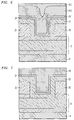
- FIGS. 2-6 illustrate the sequential steps in the fabrication of such an interconnect.
- the plug 18 and the laterally extending field portions are deposited initially as three sublayers.
- the invention is not limited in scope to three sublayers; more than three (e.g., four sublayers or more) are also suitable.
- a well-known composite barrier layer 22 is deposited on the bottom and sidewalls of via 19 and on the top of oxide layer 20.
- the barrier layer illustratively comprises two layers (not shown): a refractory metal (e.g., Ti) formed on the surface of the via and a refractory metal nitride (e.g., TiN) formed on the refractory metal.
- a refractory metal e.g., Ti
- a refractory metal nitride e.g., TiN
- Deposition of barrier layer 22 typically takes place at a substrate or wafer temperature in the range of about 25-400°C.
- a thin ( ⁇ 250 ⁇ ) texture control Ti layer 24 is deposited on barrier layer 22, under conditions which produce a close-packed structure with essentially a basal plane (002) orientation.
- layer 24 is deposited at a substrate or wafer temperature in the range of about 25-400°C; preferably at a cold temperature of ⁇ 100°C (50°C has been found to be suitable).
- a layer of Ti-aluminide is formed at the interface between layer 24 and the first deposited Al-based layer.
- the texture of the Al-based metals has essentially a ⁇ 111> orientation, and the plug 18 ultimately formed comprises a single grain (or at most three). Layer 24 also improves mechanical and electrical reliability.
- the composition of the AlCu or AlSiCu alloys may comprise about 0.05-5.0% Cu by weight and 0.05-5.0% Si by weight, and typically 0.5-2.0% Cu and 0.5-1.5% Si by weight.
- the first sublayer 16.1 shown in FIG. 4, is relatively thin and serves as a nucleation layer for deposition of the second sublayer.
- Sublayer 16.1 has a relatively small average grain size (e.g., ⁇ 2500 ⁇ , typically 1000-1700 ⁇ ) which is achieved by deposition at a cold substrate or wafer temperature of about 50-100°C.
- deposition also takes place at a relatively high deposition rate and at high power (e.g., 9-11 kW and about 160 to 190 ⁇ /sec.).
- the typical thickness of sublayer 16.1 is about 30-50% of the total thickness of the three sublayers.
- the second sublayer 16.2 shown in FIG. 5, has a much larger average grain size than sublayer 16.1; typically about 2-3 times larger, or illustratively about 2500 - 8000 ⁇ , depending on the dimensions of the plug.
- Sublayer 16.2 is deposited while the substrate or wafer temperature is ramped up from the deposition temperature of sublayer 16.1 to a peak temperature in the range of about 400-500°C (typically 460-500°C ).
- sublayer 16.2 is deposited at a much lower deposition rate (e.g., about 10 to 30 ⁇ /sec.) and at a much lower power (e.g., 0.5-1.5 kW) than sublayer 16.1.
- the previously-mentioned Ti-aluminide compound forms, typically at a temperature of about 300-350°C, at the interface between sublayer 16.1 and Ti layer 24.
- the former may or may not be totally converted to Ti-aluminide. If not, a portion of Ti layer 24 remains in the plug when the IC is completed.
- the deposited metal (M) flows into the vias (FIG. 5) typically to a thickness which is about 50-70% of the total thickness of the three sublayers (or of the Metal-2 layer 16).
- the third sublayer 16.3, shown in FIG. 6, has a relatively large average grain size (e.g., 2500-10,000 ⁇ ), depending on the dimensions of the plug. This characteristic is achieved by deposition at the peak temperature of the ramp up used in the previous step (e.g., at 460-500°C).
- sublayer 16.3 is also deposited at the relatively high deposition rates used for first sublayer 16.1.
- the microstructure of the plug 18 adjusts itself so that the plug comprises only a single large size grain or at most three large sized grains.
- the texture of the plug has essentially a ⁇ 111> orientation.
- the maximum grain size is determined by the dimensions of the plug.
- a plug which is 8000 ⁇ high and 8000 ⁇ wide may contain a single grain of 8000 ⁇ size or two grains each of 8000x4000 ⁇ size.
- FIG. 7 does not depict the various sublayers of Metal-2 layer 16.
- the sublayer deposition steps may be undertaken in the same deposition chamber by keeping the wafer or substrate heater off during the deposition of the first sublayer, turning it on at the beginning of the deposition of the second sublayer and leaving it on until all sublayer depositions are complete. Forming the plug in this manner allows multiple chamber processing in the cluster machine or tool because two or more chambers can be used for parallel processing of the sublayer deposition, thereby increasing throughput.
- the second sublayer may be deposited at an initial temperature which is less than, equal to, or greater than the deposition temperature of the first sublayer.
Landscapes
- Internal Circuitry In Semiconductor Integrated Circuit Devices (AREA)
- Electrodes Of Semiconductors (AREA)
Applications Claiming Priority (2)
| Application Number | Priority Date | Filing Date | Title |
|---|---|---|---|
| US349649 | 1994-12-05 | ||
| US08/349,649 US5523259A (en) | 1994-12-05 | 1994-12-05 | Method of forming metal layers formed as a composite of sub-layers using Ti texture control layer |
Publications (2)
| Publication Number | Publication Date |
|---|---|
| EP0716447A2 true EP0716447A2 (de) | 1996-06-12 |
| EP0716447A3 EP0716447A3 (de) | 1997-01-08 |
Family
ID=23373361
Family Applications (1)
| Application Number | Title | Priority Date | Filing Date |
|---|---|---|---|
| EP95308537A Withdrawn EP0716447A3 (de) | 1994-12-05 | 1995-11-28 | Aus geschichteten Subschichten geformte Metallschichten und Anordnungen mit diesen Metallschichten |
Country Status (4)
| Country | Link |
|---|---|
| US (1) | US5523259A (de) |
| EP (1) | EP0716447A3 (de) |
| JP (1) | JP3707627B2 (de) |
| KR (1) | KR960026265A (de) |
Cited By (6)
| Publication number | Priority date | Publication date | Assignee | Title |
|---|---|---|---|---|
| GB2306774A (en) * | 1995-10-17 | 1997-05-07 | Nissan Motor | Semiconductor device having aluminium interconnection |
| WO1997030479A1 (en) * | 1996-02-16 | 1997-08-21 | Advanced Micro Devices, Inc. | Deposition of a conductor in a via hole or trench |
| GB2314457A (en) * | 1996-06-17 | 1997-12-24 | Hyundai Electronics Ind | Metal wiring of semiconductor devices and method for forming the same |
| US5738917A (en) * | 1995-02-24 | 1998-04-14 | Advanced Micro Devices, Inc. | Process for in-situ deposition of a Ti/TiN/Ti aluminum underlayer |
| EP0721216B1 (de) * | 1995-01-03 | 2000-05-31 | International Business Machines Corporation | Weicher Metallleiter und Herstellungsverfahren |
| DE10053915A1 (de) * | 2000-10-31 | 2002-05-16 | Infineon Technologies Ag | Herstellungsverfahren für eine integrierte Schaltung |
Families Citing this family (40)
| Publication number | Priority date | Publication date | Assignee | Title |
|---|---|---|---|---|
| JP3401843B2 (ja) * | 1993-06-21 | 2003-04-28 | ソニー株式会社 | 半導体装置における多層配線の形成方法 |
| US5580823A (en) * | 1994-12-15 | 1996-12-03 | Motorola, Inc. | Process for fabricating a collimated metal layer and contact structure in a semiconductor device |
| JPH08176823A (ja) * | 1994-12-26 | 1996-07-09 | Sony Corp | 高融点金属薄膜の成膜方法 |
| US5691571A (en) * | 1994-12-28 | 1997-11-25 | Nec Corporation | Semiconductor device having fine contact hole with high aspect ratio |
| US5561083A (en) * | 1994-12-29 | 1996-10-01 | Lucent Technologies Inc. | Method of making multilayered Al-alloy structure for metal conductors |
| KR0161116B1 (ko) * | 1995-01-06 | 1999-02-01 | 문정환 | 반도체 장치의 금속층 형성방법 |
| DE69625265T2 (de) * | 1995-03-28 | 2003-09-04 | Texas Instruments Inc., Dallas | Halbleiterstrukturen |
| KR960042974A (de) * | 1995-05-23 | 1996-12-21 | ||
| KR0179827B1 (ko) * | 1995-05-27 | 1999-04-15 | 문정환 | 반도체 소자의 배선 형성방법 |
| US5962923A (en) * | 1995-08-07 | 1999-10-05 | Applied Materials, Inc. | Semiconductor device having a low thermal budget metal filling and planarization of contacts, vias and trenches |
| US6291336B1 (en) * | 1996-05-20 | 2001-09-18 | Taiwan Semiconductor Manufacturing Company | AlCu metal deposition for robust Rc via performance |
| US5856236A (en) * | 1996-06-14 | 1999-01-05 | Micron Technology, Inc. | Method of depositing a smooth conformal aluminum film on a refractory metal nitride layer |
| US6309971B1 (en) | 1996-08-01 | 2001-10-30 | Cypress Semiconductor Corporation | Hot metallization process |
| GB9619461D0 (en) * | 1996-09-18 | 1996-10-30 | Electrotech Ltd | Method of processing a workpiece |
| US5926736A (en) * | 1996-10-30 | 1999-07-20 | Stmicroelectronics, Inc. | Low temperature aluminum reflow for multilevel metallization |
| US6162729A (en) * | 1996-12-12 | 2000-12-19 | Asahi Kasei Kogyo Kabushiki Kaisha | Method of manufacturing multiple aluminum layer in a semiconductor device |
| US6110828A (en) * | 1996-12-30 | 2000-08-29 | Applied Materials, Inc. | In-situ capped aluminum plug (CAP) process using selective CVD AL for integrated plug/interconnect metallization |
| US6139905A (en) * | 1997-04-11 | 2000-10-31 | Applied Materials, Inc. | Integrated CVD/PVD Al planarization using ultra-thin nucleation layers |
| US5943601A (en) * | 1997-04-30 | 1999-08-24 | International Business Machines Corporation | Process for fabricating a metallization structure |
| JP3085247B2 (ja) * | 1997-07-07 | 2000-09-04 | 日本電気株式会社 | 金属薄膜の形成方法 |
| US5882399A (en) * | 1997-08-23 | 1999-03-16 | Applied Materials, Inc. | Method of forming a barrier layer which enables a consistently highly oriented crystalline structure in a metallic interconnect |
| US6365514B1 (en) * | 1997-12-23 | 2002-04-02 | Intel Corporation | Two chamber metal reflow process |
| JPH11186190A (ja) * | 1997-12-25 | 1999-07-09 | Sharp Corp | 半導体装置の製造方法 |
| US5981382A (en) * | 1998-03-13 | 1999-11-09 | Texas Instruments Incorporated | PVD deposition process for CVD aluminum liner processing |
| US6638856B1 (en) * | 1998-09-11 | 2003-10-28 | Cypress Semiconductor Corporation | Method of depositing metal onto a substrate |
| US6187670B1 (en) * | 1998-12-02 | 2001-02-13 | Advanced Micro Devices, Inc. | Multi-stage method for forming optimized semiconductor seed layers |
| TW409356B (en) * | 1999-03-11 | 2000-10-21 | United Microelectronics Corp | Manufacture method of inner connects |
| GB2349392B (en) | 1999-04-20 | 2003-10-22 | Trikon Holdings Ltd | A method of depositing a layer |
| JP2000315687A (ja) * | 1999-04-30 | 2000-11-14 | Mitsubishi Electric Corp | 半導体装置およびその製造方法 |
| JP3358587B2 (ja) * | 1999-05-26 | 2002-12-24 | 日本電気株式会社 | 半導体装置の製造方法 |
| US6627542B1 (en) * | 1999-07-12 | 2003-09-30 | Applied Materials, Inc. | Continuous, non-agglomerated adhesion of a seed layer to a barrier layer |
| KR100326253B1 (ko) * | 1999-12-28 | 2002-03-08 | 박종섭 | 반도체 소자의 캐패시터 형성방법 |
| JP3480416B2 (ja) * | 2000-03-27 | 2003-12-22 | セイコーエプソン株式会社 | 半導体装置 |
| JP3449333B2 (ja) * | 2000-03-27 | 2003-09-22 | セイコーエプソン株式会社 | 半導体装置の製造方法 |
| AU2001247109A1 (en) * | 2000-04-27 | 2001-11-12 | Nutool, Inc. | Conductive structure for use in multi-level metallization and process |
| US6943105B2 (en) * | 2002-01-18 | 2005-09-13 | International Business Machines Corporation | Soft metal conductor and method of making |
| KR100455380B1 (ko) * | 2002-02-27 | 2004-11-06 | 삼성전자주식회사 | 다층 배선 구조를 구비한 반도체 소자 및 그 제조 방법 |
| KR100555514B1 (ko) * | 2003-08-22 | 2006-03-03 | 삼성전자주식회사 | 저 저항 텅스텐 배선을 갖는 반도체 메모리 소자 및 그제조방법 |
| JP2010165989A (ja) * | 2009-01-19 | 2010-07-29 | Elpida Memory Inc | 半導体装置の製造方法 |
| CN115261948B (zh) * | 2021-04-30 | 2023-10-17 | 比亚迪股份有限公司 | 一种镀膜件及其制备方法、壳体及电子产品 |
Family Cites Families (14)
| Publication number | Priority date | Publication date | Assignee | Title |
|---|---|---|---|---|
| US4631804A (en) * | 1984-12-10 | 1986-12-30 | At&T Bell Laboratories | Technique for reducing substrate warpage springback using a polysilicon subsurface strained layer |
| US4742020A (en) * | 1985-02-01 | 1988-05-03 | American Telephone And Telegraph Company, At&T Bell Laboratories | Multilayering process for stress accommodation in deposited polysilicon |
| KR920005701B1 (ko) * | 1989-07-20 | 1992-07-13 | 현대전자산업 주식회사 | 반도체 집적회로 내의 소자 연결용 금속배선층 및 그 제조방법 |
| US4970176A (en) * | 1989-09-29 | 1990-11-13 | Motorola, Inc. | Multiple step metallization process |
| US5108951A (en) * | 1990-11-05 | 1992-04-28 | Sgs-Thomson Microelectronics, Inc. | Method for forming a metal contact |
| JPH04363024A (ja) * | 1990-11-30 | 1992-12-15 | Toshiba Corp | 半導体装置の製造方法 |
| JP2811131B2 (ja) * | 1991-04-26 | 1998-10-15 | 三菱電機株式会社 | 半導体装置の配線接続構造およびその製造方法 |
| US5147820A (en) * | 1991-08-26 | 1992-09-15 | At&T Bell Laboratories | Silicide formation on polysilicon |
| KR970009976B1 (ko) * | 1991-08-26 | 1997-06-19 | 아메리칸 텔리폰 앤드 텔레그라프 캄파니 | 증착된 반도체상에 형성된 개선된 유전체 |
| US5371042A (en) * | 1992-06-16 | 1994-12-06 | Applied Materials, Inc. | Method of filling contacts in semiconductor devices |
| US5300307A (en) * | 1992-09-14 | 1994-04-05 | The United States Of America As Represented By The United States Department Of Energy | Microstructure control of Al-Cu films for improved electromigration resistance |
| EP0594300B1 (de) * | 1992-09-22 | 1998-07-29 | STMicroelectronics, Inc. | Methode zur Herstellung eines Metallkontaktes |
| JPH06268083A (ja) * | 1993-03-11 | 1994-09-22 | Sony Corp | 半導体装置の配線 |
| US5356836A (en) * | 1993-08-19 | 1994-10-18 | Industrial Technology Research Institute | Aluminum plug process |
-
1994
- 1994-12-05 US US08/349,649 patent/US5523259A/en not_active Expired - Lifetime
-
1995
- 1995-11-28 EP EP95308537A patent/EP0716447A3/de not_active Withdrawn
- 1995-12-04 JP JP33769495A patent/JP3707627B2/ja not_active Expired - Lifetime
- 1995-12-05 KR KR1019950046636A patent/KR960026265A/ko not_active Ceased
Cited By (10)
| Publication number | Priority date | Publication date | Assignee | Title |
|---|---|---|---|---|
| EP0721216B1 (de) * | 1995-01-03 | 2000-05-31 | International Business Machines Corporation | Weicher Metallleiter und Herstellungsverfahren |
| US5738917A (en) * | 1995-02-24 | 1998-04-14 | Advanced Micro Devices, Inc. | Process for in-situ deposition of a Ti/TiN/Ti aluminum underlayer |
| GB2306774A (en) * | 1995-10-17 | 1997-05-07 | Nissan Motor | Semiconductor device having aluminium interconnection |
| GB2306774B (en) * | 1995-10-17 | 1997-12-17 | Nissan Motor | Semiconductor device having aluminum interconnection |
| US5869901A (en) * | 1995-10-17 | 1999-02-09 | Nissan Motor Co., Ltd. | Semiconductor device having aluminum interconnection and method of manufacturing the same |
| WO1997030479A1 (en) * | 1996-02-16 | 1997-08-21 | Advanced Micro Devices, Inc. | Deposition of a conductor in a via hole or trench |
| US5918149A (en) * | 1996-02-16 | 1999-06-29 | Advanced Micro Devices, Inc. | Deposition of a conductor in a via hole or trench |
| GB2314457A (en) * | 1996-06-17 | 1997-12-24 | Hyundai Electronics Ind | Metal wiring of semiconductor devices and method for forming the same |
| DE10053915A1 (de) * | 2000-10-31 | 2002-05-16 | Infineon Technologies Ag | Herstellungsverfahren für eine integrierte Schaltung |
| DE10053915C2 (de) * | 2000-10-31 | 2002-11-14 | Infineon Technologies Ag | Herstellungsverfahren für eine integrierte Schaltung |
Also Published As
| Publication number | Publication date |
|---|---|
| KR960026265A (ko) | 1996-07-22 |
| EP0716447A3 (de) | 1997-01-08 |
| JP3707627B2 (ja) | 2005-10-19 |
| JPH08255836A (ja) | 1996-10-01 |
| US5523259A (en) | 1996-06-04 |
Similar Documents
| Publication | Publication Date | Title |
|---|---|---|
| US5523259A (en) | Method of forming metal layers formed as a composite of sub-layers using Ti texture control layer | |
| US6016010A (en) | Voidless metallization on titanium aluminide in an interconnect | |
| US6555471B2 (en) | Method of making a void-free aluminum film | |
| EP0655780B1 (de) | Herstellungsverfahren von einem Aluminiumkontakt | |
| US6506668B1 (en) | Utilization of annealing enhanced or repaired seed layer to improve copper interconnect reliability | |
| US6570255B2 (en) | Method for forming interconnects on semiconductor substrates and structures formed | |
| US5904562A (en) | Method of metallizing a semiconductor wafer | |
| US5668055A (en) | Method of filling of contact openings and vias by self-extrusion of overlying compressively stressed matal layer | |
| US6066358A (en) | Blanket-selective chemical vapor deposition using an ultra-thin nucleation layer | |
| US5561083A (en) | Method of making multilayered Al-alloy structure for metal conductors | |
| US20020047208A1 (en) | Method and structure for improving electromigration of chip interconnects | |
| EP0594300A1 (de) | Methode zur Herstellung eines Metallkontaktes | |
| EP0488628A2 (de) | Verfahren zum Herstellen von aluminium gestapelter Verbindungs/kontaktlöchern für Mehrschichtverbindungen | |
| EP0840370B1 (de) | Niedrigtemperatur-Aluminiumaufschmelzen für mehrschichtige Metallisierung | |
| US6492267B1 (en) | Low temperature nitride used as Cu barrier layer | |
| US6344691B1 (en) | Barrier materials for metal interconnect in a semiconductor device | |
| JPH05211147A (ja) | アルミニウム配線およびその形成方法 | |
| US5804879A (en) | Aluminum scandium alloy interconnection | |
| US6271137B1 (en) | Method of producing an aluminum stacked contact/via for multilayer | |
| US6365514B1 (en) | Two chamber metal reflow process | |
| US6316132B1 (en) | Structure and method for preventing barrier failure | |
| US6319825B1 (en) | Metallization process of semiconductor device | |
| US6979642B1 (en) | Method of self-annealing conductive lines that separates grain size effects from alloy mobility | |
| US6500757B1 (en) | Method and apparatus for controlling grain growth roughening in conductive stacks | |
| JP2000340565A (ja) | 半導体集積回路装置およびその製造方法 |
Legal Events
| Date | Code | Title | Description |
|---|---|---|---|
| PUAI | Public reference made under article 153(3) epc to a published international application that has entered the european phase |
Free format text: ORIGINAL CODE: 0009012 |
|
| AK | Designated contracting states |
Kind code of ref document: A2 Designated state(s): DE FR GB IT |
|
| PUAL | Search report despatched |
Free format text: ORIGINAL CODE: 0009013 |
|
| AK | Designated contracting states |
Kind code of ref document: A3 Designated state(s): DE FR GB IT |
|
| 17P | Request for examination filed |
Effective date: 19970625 |
|
| 17Q | First examination report despatched |
Effective date: 19981008 |
|
| STAA | Information on the status of an ep patent application or granted ep patent |
Free format text: STATUS: THE APPLICATION HAS BEEN WITHDRAWN |
|
| 18W | Application withdrawn |
Withdrawal date: 20020129 |