EP0717084B1 - Composés anthraquinoniques réactifs solubles dans l'eau - Google Patents
Composés anthraquinoniques réactifs solubles dans l'eau Download PDFInfo
- Publication number
- EP0717084B1 EP0717084B1 EP95119363A EP95119363A EP0717084B1 EP 0717084 B1 EP0717084 B1 EP 0717084B1 EP 95119363 A EP95119363 A EP 95119363A EP 95119363 A EP95119363 A EP 95119363A EP 0717084 B1 EP0717084 B1 EP 0717084B1
- Authority
- EP
- European Patent Office
- Prior art keywords
- formula
- compound
- sulfo
- anthraquinone
- group
- Prior art date
- Legal status (The legal status is an assumption and is not a legal conclusion. Google has not performed a legal analysis and makes no representation as to the accuracy of the status listed.)
- Expired - Lifetime
Links
- 0 *c(c(C(c1c2cccc1)=O)c(c(N*)c1)C2=O)c1S(O)(=O)=O Chemical compound *c(c(C(c1c2cccc1)=O)c(c(N*)c1)C2=O)c1S(O)(=O)=O 0.000 description 1
Classifications
-
- C—CHEMISTRY; METALLURGY
- C09—DYES; PAINTS; POLISHES; NATURAL RESINS; ADHESIVES; COMPOSITIONS NOT OTHERWISE PROVIDED FOR; APPLICATIONS OF MATERIALS NOT OTHERWISE PROVIDED FOR
- C09B—ORGANIC DYES OR CLOSELY-RELATED COMPOUNDS FOR PRODUCING DYES, e.g. PIGMENTS; MORDANTS; LAKES
- C09B62/00—Reactive dyes, i.e. dyes which form covalent bonds with the substrates or which polymerise with themselves
- C09B62/44—Reactive dyes, i.e. dyes which form covalent bonds with the substrates or which polymerise with themselves with the reactive group not directly attached to a heterocyclic ring
- C09B62/503—Reactive dyes, i.e. dyes which form covalent bonds with the substrates or which polymerise with themselves with the reactive group not directly attached to a heterocyclic ring the reactive group being an esterified or non-esterified hydroxyalkyl sulfonyl or mercaptoalkyl sulfonyl group, a quaternised or non-quaternised aminoalkyl sulfonyl group, a heterylmercapto alkyl sulfonyl group, a vinyl sulfonyl or a substituted vinyl sulfonyl group, or a thiophene-dioxide group
- C09B62/505—Anthracene dyes
-
- D—TEXTILES; PAPER
- D06—TREATMENT OF TEXTILES OR THE LIKE; LAUNDERING; FLEXIBLE MATERIALS NOT OTHERWISE PROVIDED FOR
- D06P—DYEING OR PRINTING TEXTILES; DYEING LEATHER, FURS OR SOLID MACROMOLECULAR SUBSTANCES IN ANY FORM
- D06P1/00—General processes of dyeing or printing textiles, or general processes of dyeing leather, furs, or solid macromolecular substances in any form, classified according to the dyes, pigments, or auxiliary substances employed
- D06P1/38—General processes of dyeing or printing textiles, or general processes of dyeing leather, furs, or solid macromolecular substances in any form, classified according to the dyes, pigments, or auxiliary substances employed using reactive dyes
Definitions
- the present invention is in the technical field of anthraquinones fiber-reactive dyes.
- Anthraquinone dyes have been extensively described in the literature, for example in DE-C-11 03 886. They are characterized by their brilliance, good light fastness and the stability of the chromophore under both acidic and alkaline Conditions. However, they have the disadvantage of high raw material costs and comparatively low mole extinction. For this reason it is with Dyeing and printing substrates important that the dyes both superior fastness properties, improved process characteristics as well as competitive Have costs.
- the known anthraquinone dyes usually have the disadvantage of one elaborate synthesis, the product and space-time yield are unsatisfactory.
- the object of the present invention was to create new brilliant blue Anthraquinone dyes with high fastness properties and fixing yields are available to provide that overcome the disadvantages of the prior art.
- radical -YW-SO 2 X is in the meta or para position, particularly preferably in the para position, to the NH group of the phenyl ring.
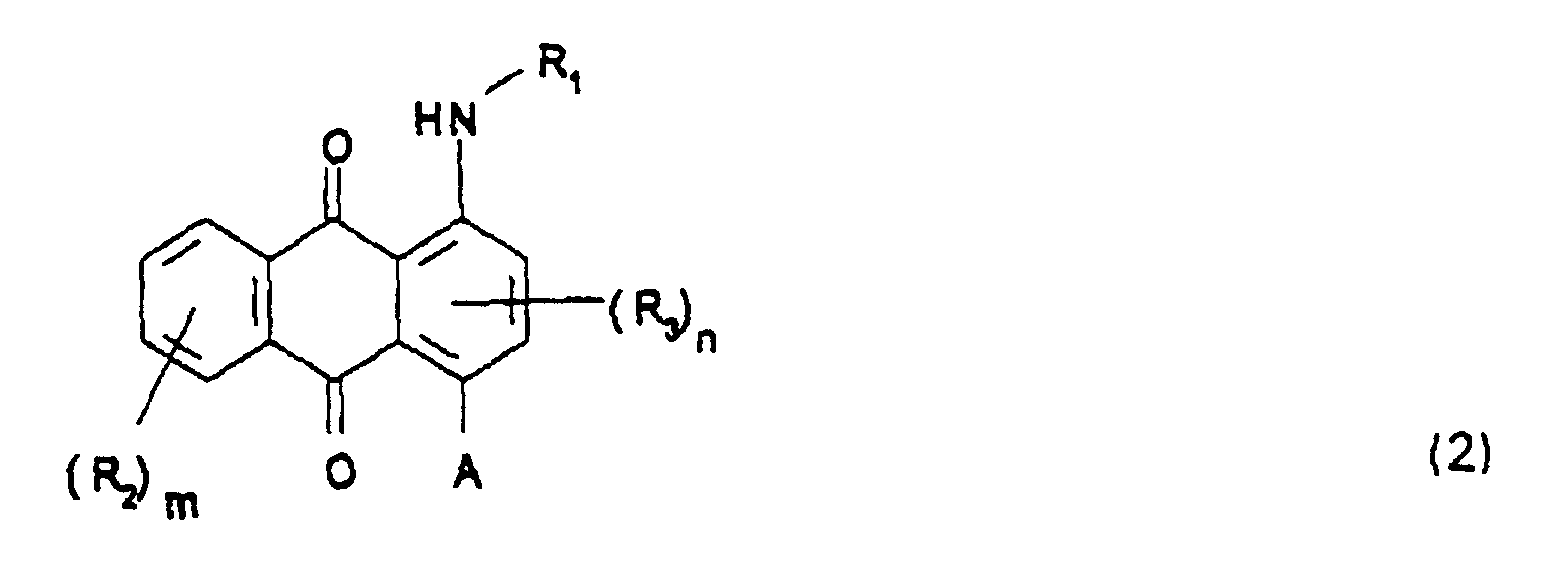
- the present invention further relates to a process for the preparation of the anthraquinone dyes (1) according to the invention, which is characterized in that a compound of the formula (2) in which A represents fluorine, chlorine, bromine, iodine, sulfo or nitro, but particularly preferably bromine, and the radicals R 1 , R 2 and R 3 have one of the meanings given above, with a compound of formula (3), where R 4 , Y, W and p have one of the abovementioned meanings and X has one of the abovementioned meanings in the presence of a copper compound.
- a catalytic amount in particular 1 to 5% by weight, is preferred, based on the compound of formula (2), a copper (I) compound, preferably a Cu (I) halide or Cu (I) pseudohalide, such as CuCl, CuBr, CuI or CuCN, used and the condensation at temperatures from 50 to 90 ° C, preferably 60 to 85 ° C, and pH values of 6 to 10, preferably 7 to 9, carried out.
- the reaction takes place in aqueous or aqueous-organic Medium in suspension or in solution. If you run the reaction in aqueous organic medium through, for example, the organic medium Acetone, dimethylformamide, dimethyl sulfoxide or N-methylpyrrolidone.
- the hydrohalic acid released during the condensation is advantageous continuously by adding aqueous alkali metal hydroxides, carbonates, phosphates, -silicate or -bicarbonates neutralized.
- the molar ratios of the Compounds of the formulas (2) and (3) are advantageously 1: 1 to 1: 1.4.
- the present invention further relates to a process for the preparation of an anthraquinone compound of the formula (1), characterized in that a compound of the formula (2) in which A represents fluorine, chlorine, bromine, iodine, sulfo or nitro and the radicals R 1 , R 2 , R 3 and n and m have the meanings given in formula (1), with a compound of the formula (3a) where R 4 , Y, W and p have the meanings given in formula (1) and X is ⁇ -hydroxyethyl, in the presence of a copper compound to give a compound of the formula (4) reacted and converted in a subsequent reaction step into an anthraquinone compound of formula (1).
- the preferred process variant is that in which one of the compounds of formula (3a) is assumed, with in a further process step the ⁇ -hydroxyethyl group to the desired fiber reactive group, e.g. ⁇ -sulfatoethyl group is esterified.
- R 4 is sulfo and p is 1 or 2
- the anthraquinone compound of formula (4) is by the action of Sulfuric acid, containing up to 60% by weight, preferably up to 25% by weight Sulfur trioxide, or by halogen sulfonic acid, such as chlorosulfonic acid, or esterified by phosphoric acid.
- sulfuric acid containing up to 10% by weight SO 3 and at temperatures from 0 to 40 ° C, preferably 10 to 30 ° C only the ⁇ -hydroxyethyl group is esterified to form the ⁇ -sulfatoethyl group.
- sulfuric acid containing 15 to 60% by weight of SO 3 and temperatures of 20 to 100 ° C, preferably 40 to 80 ° C is esterified in one step and the phenyl ring is sulfated at least once.
- the compounds of formula (1) are e.g. by stirring on ice / water deposited.
- Isolation of the dyes from this solution can e.g. by salting out or by spray drying.
- Especially the direct use of the standardized aqueous is advantageous Formulations to which buffer substances may be added and which can be concentrated if necessary for the corresponding ones application purposes.
- Compounds of formula (2) are, for example: 1-amino-4-bromo, 1-amino-4-bromo-2-sulfo, 1-amino-2,4-dibromo, 1-methylamino-2-carboxy-4-bromo, 1-ethylamino 2-carboxy-4-bromo, 1-isopropylamino-2-carboxy-4-bromo, 1-amino-4-bromo-2,6-disulfo, 1-amino-4-bromo-2,7-disulfo -, 1-Amino-4-bromo-2,5,8-trisulfo, 1-propylamino-4-bromo-2-sulfo, 1-amino-4-bromo-2-carboxy-, 1-amino-4 -bromo-2-sulfo-6-carboxy-, 1-amino-4-bromo-2-sulfo-7-carboxy-, 1-methylamino-4-bromo-,
- 1-Amino-4-bromo-2-sulfo-anthraquinone is particularly preferred as the anthraquinone component.
- the anthraquinone compounds mentioned are known to the person skilled in the art and are described, for example, in Houben-Weyl, vol. 7 / 3c, 4th edition, pp. 46 ff.
- Amino compounds of the formula (3a) are, for example: 4- [3- ( ⁇ -Hydroxyethylsulfonyl)] - propoxy-aniline, 4- [3- ( ⁇ -Hydroxyethylsulfonyl)] - propoxy-aniline-3-sulfonic acid, 4- [3- ( ⁇ -Hydroxyethylsulfonyl)] - propoxy- aniline-2-sulfonic acid, 3- [3- ( ⁇ -hydroxyethylsulfonyl)] - propoxy-aniline, 3- [3- ( ⁇ -hydroxyethylsulfonyl)] - propoxy-aniline-4-sulfonic acid, 5- [3- ( ⁇ - Hydroxyethylsulfonyl)] - propoxy-aniline-2-sulfonic acid, 4- [2- ( ⁇ -hydroxyethylsulfonyl)] - ethoxy-aniline, 4-
- Amino compounds of the formula (3) are, for example, 4- [3- ( ⁇ -sulfatoethylsulfonyl)] - propoxy-aniline, 4- [3- ( ⁇ -sulfatoethylsulfonyl)] - propoxy-aniline-3-sulfonic acid, 4- [3 - ( ⁇ -sulfatoethylsulfonyl)] - propoxy-aniline-2-sulfonic acid, 3- [3- ( ⁇ -sulfatoethylsulfonyl)] - propoxy-aniline, 3- [3- ( ⁇ -sulfatoethylsulfonyl)] - propoxy-aniline-4- sulfonic acid, 5- [3- ( ⁇ -sulfatoethylsulfonyl)] - propoxy-aniline-2-sulfonic acid, 4- [2- ( ⁇ -sulfatoethylsulfonyl)] -
- the compounds of formula (1) have fiber-reactive properties and have very good dye properties. You can use it for dyeing and printing materials containing hydroxyl, mercapto, amino and / or carbonamide groups, in particular fiber materials can be used. It's going to be brilliant blue Color shades with excellent fastness properties, such as light fastness and Chlorine fastness, obtained without the need for metal complexations are.
- the dyes according to the invention are therefore ecologically advantageous.
- the present invention therefore also relates to the use of Compounds of formula (1) for dyeing or printing the above Materials.
- the compound of formula (1) is applied to the material applied or introduced into the material and on or in the material fixed with heat or with the help of an alkaline agent.
- suitable materials are native or regenerated Cellulose materials such as cotton, linen, viscose, rayon, chemical modified cellulose fibers, protein fibers such as wool or silk, and synthetic polyamides, such as nylon or perlon, all of which are known to the person skilled in the art are well known.
- Suitable application methods are e.g. the pull-out process in reel runners, Jets or continuous dyeing techniques.
- The are particularly suitable Dyes according to the invention for dyeing and printing Cellulosic materials by using a short liquor application technique as for textile printing or pad dyeing processes, such as Continuous process.
- the dyes of the present invention are in shape in this specification of their free acids. But you can also use them as salts of these acids be applied. They are preferred in their salt form and particularly preferably used in the alkali metal and alkaline earth metal salt form such as e.g. as Na, K or Li salts.
- percentages mean percentages by weight and parts Parts by weight.
- the specified absorption maxima (Lambda max) in visible range were based on their alkali metal salts in aqueous solution determined.
- the filter cake is dried and introduced into about 200 parts of 100% sulfuric acid so that the temperature does not rise above 40 ° C., stirred for some time and 10 parts of 20% oleum are added again.
- the mixture is stirred for a while until the reaction is complete and the solution obtained is then stirred into ice water, adjusted to pH 2 with sodium carbonate, then suction filtered, the moist filter cake is again dissolved in water with sodium carbonate at pH 5, giving a deep blue solution obtained from which 63 parts of the dye of the formula by salting out with NaCl or preferably by evaporation in vacuo can be obtained with a purity of 93% by HPLC.
- the filter cake is dried, ground and then added to 200 parts of 100% sulfuric acid so that the temperature does not rise above 40 ° C.
- the reaction product is mixed with ice water, then filtered, again dissolved in water with sodium carbonate at pH 5, giving a deep blue solution from which 63 parts of the dye of the formula are obtained by salting out with NaCl or preferably by evaporation in vacuo can be obtained with a purity of 88% by HPLC.
- the mixture is then stirred at 60 ° C. for some time until the reaction has ended.
- the reaction product is mixed with ice water, then filtered, again dissolved in water with sodium carbonate at pH 5, giving a deep blue solution from which 70 parts of the dye of the formula are obtained by salting out with KCl or preferably by evaporation in vacuo can be obtained with a purity of 91% by HPLC.
Landscapes
- Chemical & Material Sciences (AREA)
- Organic Chemistry (AREA)
- Engineering & Computer Science (AREA)
- Textile Engineering (AREA)
- Coloring (AREA)
- Organic Low-Molecular-Weight Compounds And Preparation Thereof (AREA)
Claims (16)
- Composé anthraquinone de formule (1)dans laquelle
 R1 représente un hydrogène, un C1-C6-alkylcarbonyle, un C6-arylcarbonyle, un C1-C4-alkylphénylcarbonyle, un alkyle en C1-C6, un cycloalkyle en C3-C6 ou un phényle, où l'alkyle en C1-C6, le cycloalkyle en C3-C6, et le phényle peuvent être substitués par un ou plusieurs radicaux parmi le groupe constitué d'un hydroxy, d'un sulfo, d'un carboxy, d'un alkyle en C1-C4, d'un alcoxy en C1-C4, d'un halogène, d'un cyano, d'un amino et d'un nitro ;
- R2
- représente un sulfo ou un carboxy ;
- m
- représente un nombre de 0 à 2 ;
- R3
- représente un sulfo, un carboxy ou un halogène ;
- n
- représente le nombre 0 ou 1 ;
- R4
- représente un sulfo, un carboxy, un alkyle en C1-C4 ou un alcoxy en C1-C4 ;
- p
- représente un nombre de 0 à 2 ;
- W
- représente un groupe alkylène en C1-C6 ;
- X
- représente un vinyle ou -CH2-CH2-L, où L est un groupe pouvant être éliminé dans des conditions alcalines ; et
- Y
- représente un élément de pontage de formule -O- ou
- Composé anthraquinone selon la revendication 1, caractérisé en ce queR1 représente un hydrogène, un alkyle en C1-C4, un cycloalkyle en C5-C6, un acétyle, un benzoyle, un phényle ou un méthylphénylcarbonyle, ou un alkyle en C1-C4, un cycloalkyle en C5-C6 et un phényle qui sont substitués par 1 à 3 radicaux parmi le groupe constitué d'un hydroxy, d'un sulfo, d'un carboxy, d'un méthyle, d'un éthyle, d'un méthoxy, d'un éthoxy, d'un fluor, d'un chlore, d'un brome, d'un cyano ou d'un nitro.
- Composé anthraquinone selon la revendication 1 ou 2, caractérisé en ce que R3 est un chlore, un brome ou un groupe sulfo en position ortho par rapport au groupe NH-R1.
- Composé anthraquinone selon au moins l'une des revendications 1 à 3, caractérisé en ce que W est un alkylène en C2-C3, de préférence un 1,2-éthylène ou un 1,3-propylène.
- Composé anthraquinone selon au moins l'une des revendications 1 à 4, caractérisé en ce que L est un chlore, un brome, -OSO3M, -SSO3M ou -OPO3M2, où M représente un hydrogène ou un métal alcalin.
- Composé anthraquinone selon au moins l'une des revendications 1 à 5, caractérisé en ce que
- m
- est le nombre 0 ;
- n
- est le nombre 1 et
- p
- est le nombre 0 ou 1.
- Composé anthraquinone selon au moins l'une des revendications 1 à 6, caractérisé en ce que le radical -Y-W-SO2X est en position méta ou para par rapport au groupe NH du noyau phénylique.
- Composé anthraquinone selon la revendication 1, caractérisé par la formule (1a) ou (1b)dans lesquelles
 x désigne le nombre 2 ou 3 ;y vaut 0, 1 ou 2, en particulier 0 ou 1 ; etY1 désigne un β-sulfatoéthyle, un β-chloroéthyle ou un vinyle, à condition, pour le composé de formule (1b), qu'au cas où Y1 représente un vinyle, x soit le nombre 3.
 - Procédé de préparation d'un composé anthraquinone de formule (1) selon au moins l'une des revendications 1 à 8, caractérisé en ce que l'on fait réagir un composé de formule (2)dans laquelle A désigne un fluor, un chlore, un brome, un iode, un sulfo ou un nitro, mais particulièrement préférablement un brome, et les radicaux R1, R2 et R3 ainsi que m et n ont l'une des significations susmentionnées,
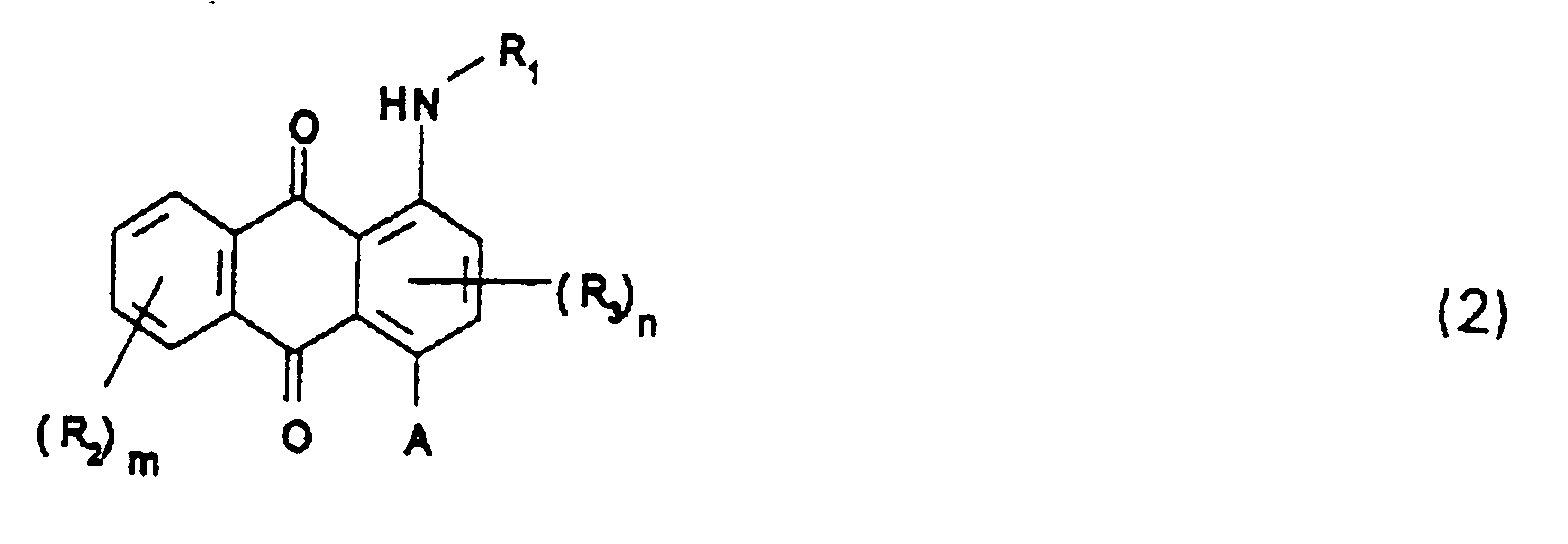
avec un composé de formule (3),dans laquelle R4, Y, W et p ont l'une des significations susmentionnées et X a l'une des significations susmentionnées, en présence d'un composé du cuivre.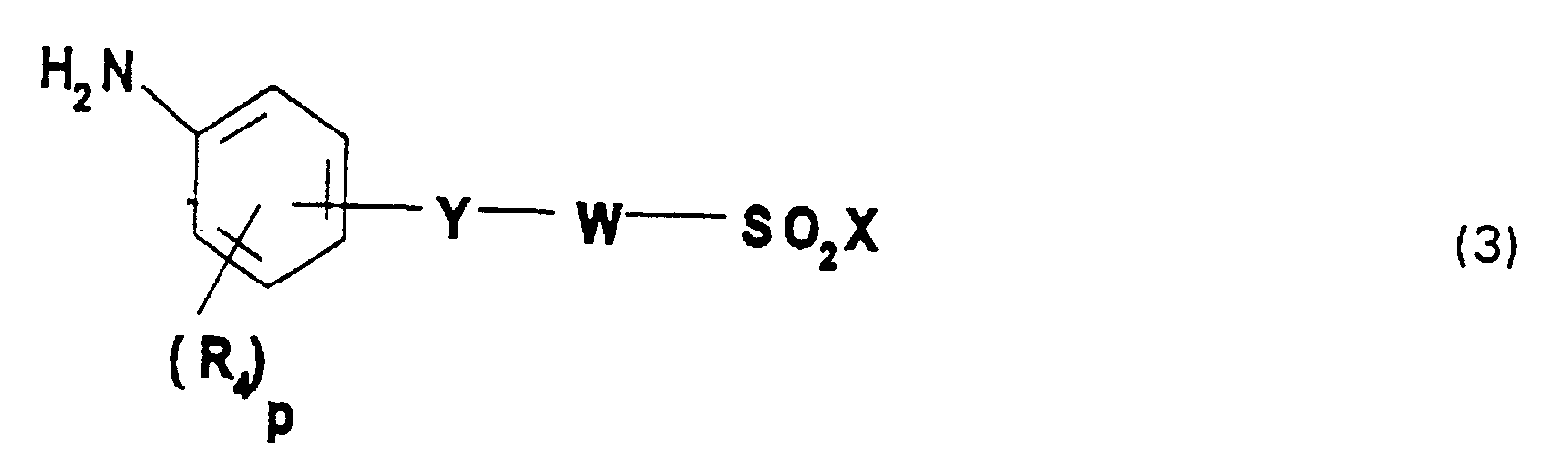
- Procédé de préparation d'un composé anthraquinone de formule (1) selon au moins l'une des revendications 1 à 8, caractérisé en ce que l'on fait réagir un composé de formule (2)dans laquelle A désigne un fluor, un chlore, un brome, un iode, un sulfo ou un nitro, et les radicaux R1, R2, R3 et n et m ont les significations mentionnées dans la formule (1), avec un composé de formule (3a)
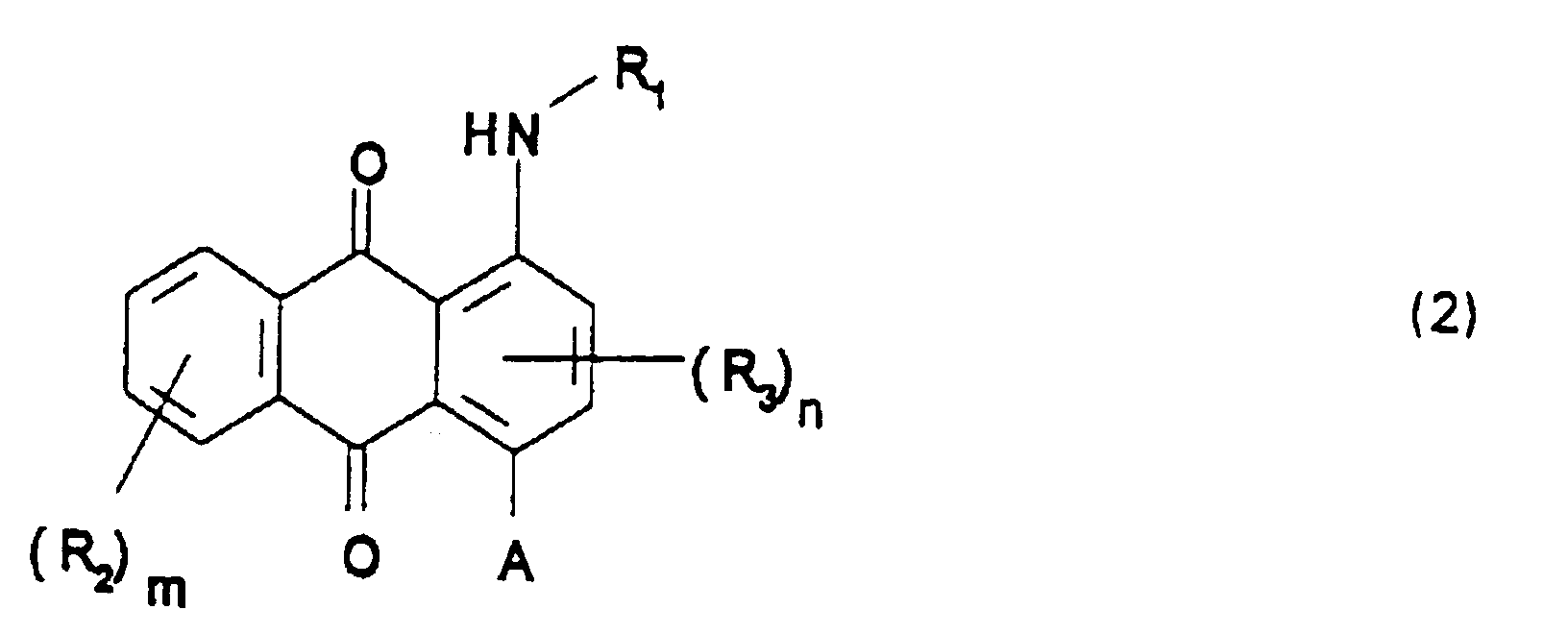 dans laquelle R4, Y, W et p ont les significations mentionnées dans la formule (1) et X représente un β-hydroxyéthyle, en présence d'un composé du cuivre, pour donner un composé de formule (4)
 et on le transforme en un composé anthraquinone de formule (1) dans une étape de réaction ultérieure.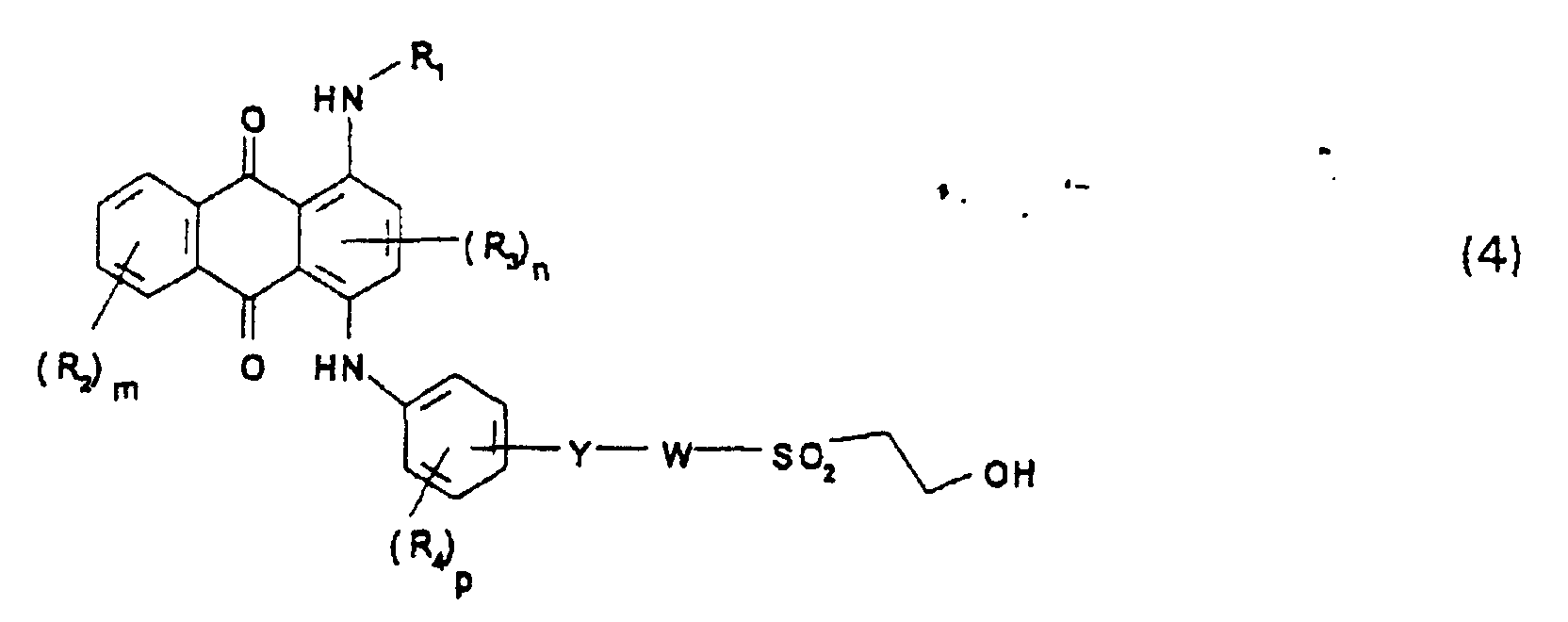
- Procédé selon la revendication 9 ou 10, caractérisé en ce que le composé du cuivre est un composé de Cu(I), de préférence le CuCl, le CuBr, le CuI ou le CuCN.
- Procédé selon la revendication 10 ou 11 pour la préparation d'un composé anthraquinone de formule (1), dans laquelle p représente le nombre 1 et L représente -OSO3M, caractérisé en ce que l'on utilise un composé de formule (3a) qui est dépourvu de groupes sulfo, et on procède à son estérification et sa sulfuration simultanée avec de l'acide sulfurique contenant de 15 à 60% en poids de SO3, à des températures de 20 à 100°C, de préférence de 40 à 80°C.
- Utilisation d'un composé anthraquinone de formule (1) selon au moins l'une des revendications 1 à 8, pour la teinture ou l'impression d'une matière renfermant des groupes hydroxy, mercapto, amino ou carboxamide ou renfermant une combinaison de ces groupes.
- Composé de formule (4)dans laquelle R1, R2 R3, R4, W, Y, m, n, et p ont les significations mentionnées dans au moins l'une des revendications 1 à 8.
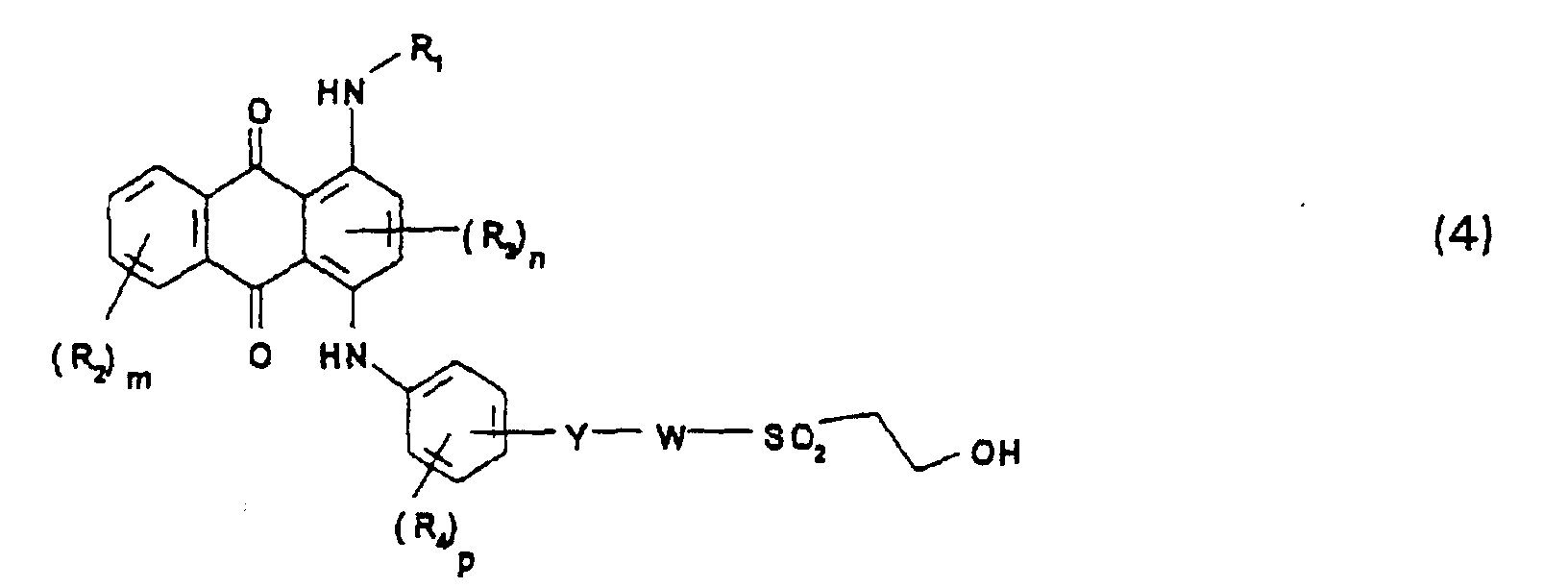
- Procédé de préparation d'un composé de formule (4) selon la revendication 14, caractérisé en ce que l'on fait réagir un composé de formule (2)dans laquelle A désigne un fluor, un chlore, un brome, un iode, un sulfo ou un nitro, et les radicaux R1, R2, R3 et m et n ont les significations mentionnées à la revendication 1,
avec un composé de formule (3a)dans laquelle R4, Y, W et p ont les significations mentionnées dans la formule (1) et X représente un β-hydroxyéthyle, en présence d'un composé du cuivre, de préférence le CuCl, le CuBr, le CuI ou le CuCN.
- Utilisation d'un composé de formule (4) selon la revendication 14 pour la préparation d'un colorant anthraquinone réactif, en faisant réagir le composé de formule (4) avec de l'acide sulfurique, de l'oléum, un acide halogénosulfonique ou de l'acide phosphorique.
Applications Claiming Priority (2)
| Application Number | Priority Date | Filing Date | Title |
|---|---|---|---|
| DE4444692A DE4444692A1 (de) | 1994-12-15 | 1994-12-15 | Wasserlösliche, faserreaktive Anthrachinonverbindung en |
| DE4444692 | 1994-12-15 |
Publications (2)
| Publication Number | Publication Date |
|---|---|
| EP0717084A1 EP0717084A1 (fr) | 1996-06-19 |
| EP0717084B1 true EP0717084B1 (fr) | 2000-11-22 |
Family
ID=6535880
Family Applications (1)
| Application Number | Title | Priority Date | Filing Date |
|---|---|---|---|
| EP95119363A Expired - Lifetime EP0717084B1 (fr) | 1994-12-15 | 1995-12-08 | Composés anthraquinoniques réactifs solubles dans l'eau |
Country Status (5)
| Country | Link |
|---|---|
| US (1) | US5744622A (fr) |
| EP (1) | EP0717084B1 (fr) |
| JP (1) | JPH08245898A (fr) |
| BR (1) | BR9505906A (fr) |
| DE (2) | DE4444692A1 (fr) |
Families Citing this family (4)
| Publication number | Priority date | Publication date | Assignee | Title |
|---|---|---|---|---|
| DE19802009A1 (de) * | 1997-01-22 | 1998-07-23 | Sumitomo Chemical Co | Monoazoverbindung und Zwischenprodukt für Faserreaktiv-Farbstoffverbindung |
| US7347879B2 (en) | 2004-02-27 | 2008-03-25 | L'Oreál, S.A. | Sulfur-containing secondary para-phenylenediamines dye compositions comprising such para-phenylenediamines, processes, and uses thereof |
| FR2866882B1 (fr) * | 2004-02-27 | 2017-04-14 | Oreal | Para-phenylenediamines secondaires soufrees, composition tinctoriale comprenant de telles para-phenylenediamines, procede mettant en oeuvre cette composition et utilisation |
| CN101481520B (zh) * | 2008-12-12 | 2013-03-20 | 天津德凯化工股份有限公司 | 一种酸性蓝260的制备方法 |
Family Cites Families (7)
| Publication number | Priority date | Publication date | Assignee | Title |
|---|---|---|---|---|
| NL120985C (fr) * | 1958-09-27 | |||
| DE1160125B (de) * | 1960-02-27 | 1963-12-27 | Basf Ag | Verfahren zur Herstellung von wasserloeslichen Farbstoffen der Anthrachinonreihe |
| BE793517A (fr) * | 1972-01-03 | 1973-06-29 | Bayer Ag | Colorants anthraquinoniques |
| US4514187A (en) * | 1982-07-21 | 1985-04-30 | Ciba-Geigy Corporation | Process for dyeing differential-dyeing polyamide fibres |
| DE3827530A1 (de) * | 1988-08-13 | 1990-03-15 | Bayer Ag | Reaktivfarbstoffe |
| US5183501A (en) * | 1990-10-17 | 1993-02-02 | Sumitomo Chemical Company, Limited | Ink compositions for ink jet recording |
| DE59405289D1 (de) * | 1993-05-18 | 1998-04-02 | Hoechst Ag | Wasserlöslichse faserreaktive Farbstoffe, Verfahren zu ihrer Herstellung und ihre Verwendung |
-
1994
- 1994-12-15 DE DE4444692A patent/DE4444692A1/de not_active Withdrawn
-
1995
- 1995-12-08 EP EP95119363A patent/EP0717084B1/fr not_active Expired - Lifetime
- 1995-12-08 DE DE59508870T patent/DE59508870D1/de not_active Expired - Fee Related
- 1995-12-13 US US08/571,573 patent/US5744622A/en not_active Expired - Fee Related
- 1995-12-14 BR BR9505906A patent/BR9505906A/pt not_active Application Discontinuation
- 1995-12-14 JP JP7325902A patent/JPH08245898A/ja not_active Withdrawn
Also Published As
| Publication number | Publication date |
|---|---|
| JPH08245898A (ja) | 1996-09-24 |
| BR9505906A (pt) | 1998-01-06 |
| DE4444692A1 (de) | 1996-06-20 |
| DE59508870D1 (de) | 2000-12-28 |
| US5744622A (en) | 1998-04-28 |
| EP0717084A1 (fr) | 1996-06-19 |
Similar Documents
| Publication | Publication Date | Title |
|---|---|---|
| EP0153599B1 (fr) | Colorants de la série triphènedioxazine portant des groupes vinylsulfonyles | |
| EP0036582B1 (fr) | Composés azoiques solubles dans l'eau, procédé pour leur préparation et leur utilisation comme colorants | |
| EP0028788A1 (fr) | Complexes de cuivre de composés formazaniques, procédé pour leur préparation et leur utilisation comme colorants | |
| EP0657508B1 (fr) | Colorants réactifs, procédé pour leur préparation et leur utilisation | |
| EP0775730B1 (fr) | Colorants réactifs, procédé pour leur préparation et leur utilisation | |
| EP0775731B1 (fr) | Colorants réactifs, procédé pour leur préparation et leur utilisation | |
| DE2729240C2 (de) | Azo-Reaktivfarbstoffe | |
| DE4444692A1 (de) | Wasserlösliche, faserreaktive Anthrachinonverbindung en | |
| EP0503385B1 (fr) | Doubles phénylazo- ou naphthylazobenzènes ayant plusieurs groupes réactifs, ainsi que leurs produits intermédiaires | |
| DE3879476T2 (de) | Faserreaktiv-azofarbstoffe, verfahren zu ihrer herstellung und ihre verwendung zum faerben von hydroxy und/oder carboxamidgruppen enthaltendem fasermaterial. | |
| EP0387589B1 (fr) | Colorants réactifs ayant trois groupes réactifs | |
| DE2840119C2 (fr) | ||
| EP0292955A2 (fr) | Composés d'acide monoazo-naphtol carbonique solubles dans l'eau, procédé pour leur préparation et leur emploi comme colorants | |
| DE3908073A1 (de) | Verdoppelte reaktivfarbstoffe | |
| EP0570333B1 (fr) | Colorants anthraquinoniques réactifs sur la fibre, méthode pour leur préparation et leur utilisation | |
| EP0730009B1 (fr) | Colorants anthraquinoniques réactifs sur la fibre | |
| DE4020769A1 (de) | Azoreaktivfarbstoffe mit mindestens zwei halogentriazinankern | |
| EP0741130B1 (fr) | Procédé pour la préparation des sulfones | |
| DE3943287A1 (de) | Azoverbindungen, verfahren zu deren herstellung und ihre verwendung als farbstoffe | |
| EP0012411A1 (fr) | Colorants réactifs anthraquinoniques et leur utilisation pour la teinture de matériaux renfermant des groupes hydroxyle ou amide | |
| DE4437265A1 (de) | Reaktivfarbstoffe, Verfahren zu deren Herstellung und deren Verwendung | |
| EP0029106A2 (fr) | Colorants réactifs contenant un groupe halogénoalcanoylamido ou halogénoacryloylamido, leur préparation et utilisation, ainsi que les composés intermédiaires halogénoalcanoylamido resp. halogénoacryloylamido | |
| AT201746B (de) | Verfahren zur Herstellung neuer Farbstoffe der Anthrachinonreihe | |
| EP0463478A2 (fr) | Colorants réactifs ayant la triphendioxazine comme chromophore | |
| EP0636665A1 (fr) | Composés azoiques solubles dans l'eau, leur préparation et leur utilisation comme colorants |
Legal Events
| Date | Code | Title | Description |
|---|---|---|---|
| PUAI | Public reference made under article 153(3) epc to a published international application that has entered the european phase |
Free format text: ORIGINAL CODE: 0009012 |
|
| AK | Designated contracting states |
Kind code of ref document: A1 Designated state(s): CH DE FR GB IT LI |
|
| 17P | Request for examination filed |
Effective date: 19961219 |
|
| RAP1 | Party data changed (applicant data changed or rights of an application transferred) |
Owner name: DYSTAR TEXTILFARBEN GMBH & CO. DEUTSCHLAND KG |
|
| 17Q | First examination report despatched |
Effective date: 19990809 |
|
| GRAG | Despatch of communication of intention to grant |
Free format text: ORIGINAL CODE: EPIDOS AGRA |
|
| 17Q | First examination report despatched |
Effective date: 19990809 |
|
| GRAG | Despatch of communication of intention to grant |
Free format text: ORIGINAL CODE: EPIDOS AGRA |
|
| GRAH | Despatch of communication of intention to grant a patent |
Free format text: ORIGINAL CODE: EPIDOS IGRA |
|
| GRAH | Despatch of communication of intention to grant a patent |
Free format text: ORIGINAL CODE: EPIDOS IGRA |
|
| GRAA | (expected) grant |
Free format text: ORIGINAL CODE: 0009210 |
|
| AK | Designated contracting states |
Kind code of ref document: B1 Designated state(s): CH DE FR GB IT LI |
|
| PG25 | Lapsed in a contracting state [announced via postgrant information from national office to epo] |
Ref country code: IT Free format text: LAPSE BECAUSE OF FAILURE TO SUBMIT A TRANSLATION OF THE DESCRIPTION OR TO PAY THE FEE WITHIN THE PRE;WARNING: LAPSES OF ITALIAN PATENTS WITH EFFECTIVE DATE BEFORE 2007 MAY HAVE OCCURRED AT ANY TIME BEFORE 2007. THE CORRECT EFFECTIVE DATE MAY BE DIFFERENT FROM THE ONE RECORDED.SCRIBED TIME-LIMIT Effective date: 20001122 |
|
| REG | Reference to a national code |
Ref country code: CH Ref legal event code: EP |
|
| ET | Fr: translation filed | ||
| REF | Corresponds to: |
Ref document number: 59508870 Country of ref document: DE Date of ref document: 20001228 |
|
| GBT | Gb: translation of ep patent filed (gb section 77(6)(a)/1977) |
Effective date: 20010110 |
|
| PLBE | No opposition filed within time limit |
Free format text: ORIGINAL CODE: 0009261 |
|
| STAA | Information on the status of an ep patent application or granted ep patent |
Free format text: STATUS: NO OPPOSITION FILED WITHIN TIME LIMIT |
|
| 26N | No opposition filed | ||
| REG | Reference to a national code |
Ref country code: GB Ref legal event code: IF02 |
|
| PGFP | Annual fee paid to national office [announced via postgrant information from national office to epo] |
Ref country code: DE Payment date: 20061130 Year of fee payment: 12 |
|
| PGFP | Annual fee paid to national office [announced via postgrant information from national office to epo] |
Ref country code: GB Payment date: 20061206 Year of fee payment: 12 |
|
| PGFP | Annual fee paid to national office [announced via postgrant information from national office to epo] |
Ref country code: FR Payment date: 20061208 Year of fee payment: 12 |
|
| PGFP | Annual fee paid to national office [announced via postgrant information from national office to epo] |
Ref country code: CH Payment date: 20061213 Year of fee payment: 12 |
|
| REG | Reference to a national code |
Ref country code: CH Ref legal event code: PL |
|
| GBPC | Gb: european patent ceased through non-payment of renewal fee |
Effective date: 20071208 |
|
| PG25 | Lapsed in a contracting state [announced via postgrant information from national office to epo] |
Ref country code: LI Free format text: LAPSE BECAUSE OF NON-PAYMENT OF DUE FEES Effective date: 20071231 Ref country code: DE Free format text: LAPSE BECAUSE OF NON-PAYMENT OF DUE FEES Effective date: 20080701 Ref country code: CH Free format text: LAPSE BECAUSE OF NON-PAYMENT OF DUE FEES Effective date: 20071231 |
|
| REG | Reference to a national code |
Ref country code: FR Ref legal event code: ST Effective date: 20081020 |
|
| PG25 | Lapsed in a contracting state [announced via postgrant information from national office to epo] |
Ref country code: GB Free format text: LAPSE BECAUSE OF NON-PAYMENT OF DUE FEES Effective date: 20071208 |
|
| PG25 | Lapsed in a contracting state [announced via postgrant information from national office to epo] |
Ref country code: FR Free format text: LAPSE BECAUSE OF NON-PAYMENT OF DUE FEES Effective date: 20071231 |