EP0717089B1 - Aufzeichnungsflüssigkeit - Google Patents
Aufzeichnungsflüssigkeit Download PDFInfo
- Publication number
- EP0717089B1 EP0717089B1 EP95119552A EP95119552A EP0717089B1 EP 0717089 B1 EP0717089 B1 EP 0717089B1 EP 95119552 A EP95119552 A EP 95119552A EP 95119552 A EP95119552 A EP 95119552A EP 0717089 B1 EP0717089 B1 EP 0717089B1
- Authority
- EP
- European Patent Office
- Prior art keywords
- group
- recording liquid
- dye
- formula
- represented
- Prior art date
- Legal status (The legal status is an assumption and is not a legal conclusion. Google has not performed a legal analysis and makes no representation as to the accuracy of the status listed.)
- Expired - Lifetime
Links
- 239000007788 liquid Substances 0.000 title claims description 67
- 239000000975 dye Substances 0.000 claims description 93
- 125000004432 carbon atom Chemical group C* 0.000 claims description 16
- 125000004435 hydrogen atom Chemical group [H]* 0.000 claims description 13
- 239000002253 acid Substances 0.000 claims description 12
- 125000000217 alkyl group Chemical group 0.000 claims description 11
- 238000000034 method Methods 0.000 claims description 10
- 239000000463 material Substances 0.000 claims description 7
- 125000004397 aminosulfonyl group Chemical group NS(=O)(=O)* 0.000 claims description 6
- 125000003178 carboxy group Chemical group [H]OC(*)=O 0.000 claims description 6
- 125000002887 hydroxy group Chemical group [H]O* 0.000 claims description 6
- 125000001997 phenyl group Chemical group [H]C1=C([H])C([H])=C(*)C([H])=C1[H] 0.000 claims description 5
- 125000001424 substituent group Chemical group 0.000 claims description 5
- LSNNMFCWUKXFEE-UHFFFAOYSA-M Bisulfite Chemical compound OS([O-])=O LSNNMFCWUKXFEE-UHFFFAOYSA-M 0.000 claims description 4
- 239000012736 aqueous medium Substances 0.000 claims description 4
- 125000000751 azo group Chemical group [*]N=N[*] 0.000 claims description 4
- 125000003917 carbamoyl group Chemical group [H]N([H])C(*)=O 0.000 claims description 4
- 239000001018 xanthene dye Substances 0.000 claims description 4
- 125000004178 (C1-C4) alkyl group Chemical group 0.000 claims description 3
- 125000003342 alkenyl group Chemical group 0.000 claims description 3
- 125000003545 alkoxy group Chemical group 0.000 claims description 3
- 125000003277 amino group Chemical group 0.000 claims description 3
- 125000003710 aryl alkyl group Chemical group 0.000 claims description 3
- 125000003118 aryl group Chemical group 0.000 claims description 3
- 150000001733 carboxylic acid esters Chemical group 0.000 claims description 3
- 125000000113 cyclohexyl group Chemical group [H]C1([H])C([H])([H])C([H])([H])C([H])(*)C([H])([H])C1([H])[H] 0.000 claims description 3
- 125000004185 ester group Chemical group 0.000 claims description 3
- 125000005843 halogen group Chemical group 0.000 claims description 3
- 125000000623 heterocyclic group Chemical group 0.000 claims description 3
- 125000000449 nitro group Chemical group [O-][N+](*)=O 0.000 claims description 3
- QJGQUHMNIGDVPM-UHFFFAOYSA-N nitrogen group Chemical group [N] QJGQUHMNIGDVPM-UHFFFAOYSA-N 0.000 claims description 3
- 125000000472 sulfonyl group Chemical group *S(*)(=O)=O 0.000 claims description 3
- 125000002023 trifluoromethyl group Chemical group FC(F)(F)* 0.000 claims description 3
- 229910006069 SO3H Inorganic materials 0.000 claims description 2
- 150000007860 aryl ester derivatives Chemical class 0.000 claims description 2
- 150000001732 carboxylic acid derivatives Chemical class 0.000 claims description 2
- 125000000020 sulfo group Chemical group O=S(=O)([*])O[H] 0.000 claims description 2
- -1 (substituted) phenylenediamine group Chemical group 0.000 description 26
- 238000001454 recorded image Methods 0.000 description 17
- XLYOFNOQVPJJNP-UHFFFAOYSA-N water Substances O XLYOFNOQVPJJNP-UHFFFAOYSA-N 0.000 description 17
- 0 C*(C)(CCC1CCN(C)CC1)C1CCN(C)CC1 Chemical compound C*(C)(CCC1CCN(C)CC1)C1CCN(C)CC1 0.000 description 12
- 239000000203 mixture Substances 0.000 description 12
- MTHSVFCYNBDYFN-UHFFFAOYSA-N diethylene glycol Chemical compound OCCOCCO MTHSVFCYNBDYFN-UHFFFAOYSA-N 0.000 description 9
- KFZMGEQAYNKOFK-UHFFFAOYSA-N Isopropanol Chemical compound CC(C)O KFZMGEQAYNKOFK-UHFFFAOYSA-N 0.000 description 8
- LYCAIKOWRPUZTN-UHFFFAOYSA-N Ethylene glycol Chemical compound OCCO LYCAIKOWRPUZTN-UHFFFAOYSA-N 0.000 description 6
- PEDCQBHIVMGVHV-UHFFFAOYSA-N Glycerine Chemical compound OCC(O)CO PEDCQBHIVMGVHV-UHFFFAOYSA-N 0.000 description 6
- 238000003860 storage Methods 0.000 description 6
- 150000003839 salts Chemical class 0.000 description 5
- 230000000052 comparative effect Effects 0.000 description 4
- 238000002845 discoloration Methods 0.000 description 4
- 238000005562 fading Methods 0.000 description 4
- 238000007654 immersion Methods 0.000 description 4
- WMFOQBRAJBCJND-UHFFFAOYSA-M Lithium hydroxide Chemical compound [Li+].[OH-] WMFOQBRAJBCJND-UHFFFAOYSA-M 0.000 description 3
- DNIAPMSPPWPWGF-UHFFFAOYSA-N Propylene glycol Chemical compound CC(O)CO DNIAPMSPPWPWGF-UHFFFAOYSA-N 0.000 description 3
- HEMHJVSKTPXQMS-UHFFFAOYSA-M Sodium hydroxide Chemical compound [OH-].[Na+] HEMHJVSKTPXQMS-UHFFFAOYSA-M 0.000 description 3
- XSQUKJJJFZCRTK-UHFFFAOYSA-N Urea Chemical compound NC(N)=O XSQUKJJJFZCRTK-UHFFFAOYSA-N 0.000 description 3
- 150000003973 alkyl amines Chemical class 0.000 description 3
- 239000003960 organic solvent Substances 0.000 description 3
- 239000002904 solvent Substances 0.000 description 3
- APRRQJCCBSJQOQ-UHFFFAOYSA-N 4-amino-5-hydroxynaphthalene-2,7-disulfonic acid Chemical compound OS(=O)(=O)C1=CC(O)=C2C(N)=CC(S(O)(=O)=O)=CC2=C1 APRRQJCCBSJQOQ-UHFFFAOYSA-N 0.000 description 2
- VHUUQVKOLVNVRT-UHFFFAOYSA-N Ammonium hydroxide Chemical compound [NH4+].[OH-] VHUUQVKOLVNVRT-UHFFFAOYSA-N 0.000 description 2
- XDTMQSROBMDMFD-UHFFFAOYSA-N C1CCCCC1 Chemical compound C1CCCCC1 XDTMQSROBMDMFD-UHFFFAOYSA-N 0.000 description 2
- IAZDPXIOMUYVGZ-UHFFFAOYSA-N Dimethylsulphoxide Chemical compound CS(C)=O IAZDPXIOMUYVGZ-UHFFFAOYSA-N 0.000 description 2
- LFQSCWFLJHTTHZ-UHFFFAOYSA-N Ethanol Chemical compound CCO LFQSCWFLJHTTHZ-UHFFFAOYSA-N 0.000 description 2
- SECXISVLQFMRJM-UHFFFAOYSA-N N-Methylpyrrolidone Chemical compound CN1CCCC1=O SECXISVLQFMRJM-UHFFFAOYSA-N 0.000 description 2
- FAPWRFPIFSIZLT-UHFFFAOYSA-M Sodium chloride Chemical compound [Na+].[Cl-] FAPWRFPIFSIZLT-UHFFFAOYSA-M 0.000 description 2
- 229920006362 Teflon® Polymers 0.000 description 2
- 239000000980 acid dye Substances 0.000 description 2
- 125000005907 alkyl ester group Chemical group 0.000 description 2
- 235000011114 ammonium hydroxide Nutrition 0.000 description 2
- RWZYAGGXGHYGMB-UHFFFAOYSA-N anthranilic acid Chemical compound NC1=CC=CC=C1C(O)=O RWZYAGGXGHYGMB-UHFFFAOYSA-N 0.000 description 2
- 150000001875 compounds Chemical class 0.000 description 2
- 239000000982 direct dye Substances 0.000 description 2
- 230000000694 effects Effects 0.000 description 2
- 125000001495 ethyl group Chemical group [H]C([H])([H])C([H])([H])* 0.000 description 2
- 125000001449 isopropyl group Chemical group [H]C([H])([H])C([H])(*)C([H])([H])[H] 0.000 description 2
- 230000007774 longterm Effects 0.000 description 2
- 125000002496 methyl group Chemical group [H]C([H])([H])* 0.000 description 2
- 125000004108 n-butyl group Chemical group [H]C([H])([H])C([H])([H])C([H])([H])C([H])([H])* 0.000 description 2
- 239000011541 reaction mixture Substances 0.000 description 2
- 239000007787 solid Substances 0.000 description 2
- UMGDCJDMYOKAJW-UHFFFAOYSA-N thiourea Chemical compound NC(N)=S UMGDCJDMYOKAJW-UHFFFAOYSA-N 0.000 description 2
- 125000004306 triazinyl group Chemical group 0.000 description 2
- PUPZLCDOIYMWBV-UHFFFAOYSA-N (+/-)-1,3-Butanediol Chemical compound CC(O)CCO PUPZLCDOIYMWBV-UHFFFAOYSA-N 0.000 description 1
- CYSGHNMQYZDMIA-UHFFFAOYSA-N 1,3-Dimethyl-2-imidazolidinon Chemical compound CN1CCN(C)C1=O CYSGHNMQYZDMIA-UHFFFAOYSA-N 0.000 description 1
- ZFPGARUNNKGOBB-UHFFFAOYSA-N 1-Ethyl-2-pyrrolidinone Chemical compound CCN1CCCC1=O ZFPGARUNNKGOBB-UHFFFAOYSA-N 0.000 description 1
- SBASXUCJHJRPEV-UHFFFAOYSA-N 2-(2-methoxyethoxy)ethanol Chemical compound COCCOCCO SBASXUCJHJRPEV-UHFFFAOYSA-N 0.000 description 1
- XNWFRZJHXBZDAG-UHFFFAOYSA-N 2-METHOXYETHANOL Chemical compound COCCO XNWFRZJHXBZDAG-UHFFFAOYSA-N 0.000 description 1
- 125000000094 2-phenylethyl group Chemical group [H]C1=C([H])C([H])=C(C([H])=C1[H])C([H])([H])C([H])([H])* 0.000 description 1
- GCYHRYNSUGLLMA-UHFFFAOYSA-N 2-prop-2-enoxyethanol Chemical compound OCCOCC=C GCYHRYNSUGLLMA-UHFFFAOYSA-N 0.000 description 1
- 125000003903 2-propenyl group Chemical group [H]C([*])([H])C([H])=C([H])[H] 0.000 description 1
- XUSNPFGLKGCWGN-UHFFFAOYSA-N 3-[4-(3-aminopropyl)piperazin-1-yl]propan-1-amine Chemical compound NCCCN1CCN(CCCN)CC1 XUSNPFGLKGCWGN-UHFFFAOYSA-N 0.000 description 1
- WKBOTKDWSSQWDR-UHFFFAOYSA-N Bromine atom Chemical compound [Br] WKBOTKDWSSQWDR-UHFFFAOYSA-N 0.000 description 1
- UZOFELREXGAFOI-UHFFFAOYSA-N CC1CCNCC1 Chemical compound CC1CCNCC1 UZOFELREXGAFOI-UHFFFAOYSA-N 0.000 description 1
- ZAMOUSCENKQFHK-UHFFFAOYSA-N Chlorine atom Chemical compound [Cl] ZAMOUSCENKQFHK-UHFFFAOYSA-N 0.000 description 1
- PXGOKWXKJXAPGV-UHFFFAOYSA-N Fluorine Chemical compound FF PXGOKWXKJXAPGV-UHFFFAOYSA-N 0.000 description 1
- SJEYSFABYSGQBG-UHFFFAOYSA-M Patent blue Chemical compound [Na+].C1=CC(N(CC)CC)=CC=C1C(C=1C(=CC(=CC=1)S([O-])(=O)=O)S([O-])(=O)=O)=C1C=CC(=[N+](CC)CC)C=C1 SJEYSFABYSGQBG-UHFFFAOYSA-M 0.000 description 1
- 239000002202 Polyethylene glycol Substances 0.000 description 1
- 125000000738 acetamido group Chemical group [H]C([H])([H])C(=O)N([H])[*] 0.000 description 1
- 229910052783 alkali metal Inorganic materials 0.000 description 1
- 150000001412 amines Chemical class 0.000 description 1
- QGZKDVFQNNGYKY-UHFFFAOYSA-O ammonium group Chemical group [NH4+] QGZKDVFQNNGYKY-UHFFFAOYSA-O 0.000 description 1
- 150000003863 ammonium salts Chemical group 0.000 description 1
- 238000010420 art technique Methods 0.000 description 1
- 125000001797 benzyl group Chemical group [H]C1=C([H])C([H])=C(C([H])=C1[H])C([H])([H])* 0.000 description 1
- 230000015572 biosynthetic process Effects 0.000 description 1
- OHJMTUPIZMNBFR-UHFFFAOYSA-N biuret Chemical compound NC(=O)NC(N)=O OHJMTUPIZMNBFR-UHFFFAOYSA-N 0.000 description 1
- GDTBXPJZTBHREO-UHFFFAOYSA-N bromine Substances BrBr GDTBXPJZTBHREO-UHFFFAOYSA-N 0.000 description 1
- 229910052794 bromium Inorganic materials 0.000 description 1
- 239000004202 carbamide Substances 0.000 description 1
- 239000001913 cellulose Substances 0.000 description 1
- 229920002678 cellulose Polymers 0.000 description 1
- 238000006243 chemical reaction Methods 0.000 description 1
- 239000000460 chlorine Substances 0.000 description 1
- 229910052801 chlorine Inorganic materials 0.000 description 1
- 238000004040 coloring Methods 0.000 description 1
- 238000006482 condensation reaction Methods 0.000 description 1
- 230000008878 coupling Effects 0.000 description 1
- 238000010168 coupling process Methods 0.000 description 1
- 238000005859 coupling reaction Methods 0.000 description 1
- MGNCLNQXLYJVJD-UHFFFAOYSA-N cyanuric chloride Chemical compound ClC1=NC(Cl)=NC(Cl)=N1 MGNCLNQXLYJVJD-UHFFFAOYSA-N 0.000 description 1
- 238000006193 diazotization reaction Methods 0.000 description 1
- GLUUGHFHXGJENI-UHFFFAOYSA-N diethylenediamine Natural products C1CNCCN1 GLUUGHFHXGJENI-UHFFFAOYSA-N 0.000 description 1
- 125000006222 dimethylaminomethyl group Chemical group [H]C([H])([H])N(C([H])([H])[H])C([H])([H])* 0.000 description 1
- 238000001035 drying Methods 0.000 description 1
- 235000019441 ethanol Nutrition 0.000 description 1
- 238000011156 evaluation Methods 0.000 description 1
- 239000004744 fabric Substances 0.000 description 1
- 229910052731 fluorine Inorganic materials 0.000 description 1
- 239000011737 fluorine Substances 0.000 description 1
- JEGUKCSWCFPDGT-UHFFFAOYSA-N h2o hydrate Chemical compound O.O JEGUKCSWCFPDGT-UHFFFAOYSA-N 0.000 description 1
- 238000006460 hydrolysis reaction Methods 0.000 description 1
- 125000002768 hydroxyalkyl group Chemical group 0.000 description 1
- 229910052744 lithium Inorganic materials 0.000 description 1
- NYGZLYXAPMMJTE-UHFFFAOYSA-M metanil yellow Chemical group [Na+].[O-]S(=O)(=O)C1=CC=CC(N=NC=2C=CC(NC=3C=CC=CC=3)=CC=2)=C1 NYGZLYXAPMMJTE-UHFFFAOYSA-M 0.000 description 1
- 125000001160 methoxycarbonyl group Chemical group [H]C([H])([H])OC(*)=O 0.000 description 1
- 125000004573 morpholin-4-yl group Chemical group N1(CCOCC1)* 0.000 description 1
- 125000006606 n-butoxy group Chemical group 0.000 description 1
- 125000004123 n-propyl group Chemical group [H]C([H])([H])C([H])([H])C([H])([H])* 0.000 description 1
- 229910052757 nitrogen Inorganic materials 0.000 description 1
- 125000004433 nitrogen atom Chemical group N* 0.000 description 1
- 125000000636 p-nitrophenyl group Chemical group [H]C1=C([H])C(=C([H])C([H])=C1*)[N+]([O-])=O 0.000 description 1
- 150000004885 piperazines Chemical class 0.000 description 1
- 125000004193 piperazinyl group Chemical group 0.000 description 1
- 229920000768 polyamine Polymers 0.000 description 1
- 229920001223 polyethylene glycol Polymers 0.000 description 1
- 239000011148 porous material Substances 0.000 description 1
- 229910052700 potassium Inorganic materials 0.000 description 1
- 238000001556 precipitation Methods 0.000 description 1
- 125000004076 pyridyl group Chemical group 0.000 description 1
- HNJBEVLQSNELDL-UHFFFAOYSA-N pyrrolidin-2-one Chemical compound O=C1CCCN1 HNJBEVLQSNELDL-UHFFFAOYSA-N 0.000 description 1
- 230000001105 regulatory effect Effects 0.000 description 1
- 238000005185 salting out Methods 0.000 description 1
- DUIOPKIIICUYRZ-UHFFFAOYSA-N semicarbazide Chemical compound NNC(N)=O DUIOPKIIICUYRZ-UHFFFAOYSA-N 0.000 description 1
- 229910052708 sodium Inorganic materials 0.000 description 1
- 239000011734 sodium Substances 0.000 description 1
- 239000011780 sodium chloride Substances 0.000 description 1
- HXJUTPCZVOIRIF-UHFFFAOYSA-N sulfolane Chemical compound O=S1(=O)CCCC1 HXJUTPCZVOIRIF-UHFFFAOYSA-N 0.000 description 1
- 239000000988 sulfur dye Substances 0.000 description 1
- 238000004381 surface treatment Methods 0.000 description 1
- 239000004094 surface-active agent Substances 0.000 description 1
- 239000000725 suspension Substances 0.000 description 1
- 239000008399 tap water Substances 0.000 description 1
- 235000020679 tap water Nutrition 0.000 description 1
- 125000000999 tert-butyl group Chemical group [H]C([H])([H])C(*)(C([H])([H])[H])C([H])([H])[H] 0.000 description 1
- 238000010998 test method Methods 0.000 description 1
- YODZTKMDCQEPHD-UHFFFAOYSA-N thiodiglycol Chemical compound OCCSCCO YODZTKMDCQEPHD-UHFFFAOYSA-N 0.000 description 1
- ZIBGPFATKBEMQZ-UHFFFAOYSA-N triethylene glycol Chemical compound OCCOCCOCCO ZIBGPFATKBEMQZ-UHFFFAOYSA-N 0.000 description 1
- 238000004506 ultrasonic cleaning Methods 0.000 description 1
- 125000000391 vinyl group Chemical group [H]C([*])=C([H])[H] 0.000 description 1
- 229920002554 vinyl polymer Polymers 0.000 description 1
- 229910052724 xenon Inorganic materials 0.000 description 1
- FHNFHKCVQCLJFQ-UHFFFAOYSA-N xenon atom Chemical compound [Xe] FHNFHKCVQCLJFQ-UHFFFAOYSA-N 0.000 description 1
Classifications
-
- C—CHEMISTRY; METALLURGY
- C09—DYES; PAINTS; POLISHES; NATURAL RESINS; ADHESIVES; COMPOSITIONS NOT OTHERWISE PROVIDED FOR; APPLICATIONS OF MATERIALS NOT OTHERWISE PROVIDED FOR
- C09D—COATING COMPOSITIONS, e.g. PAINTS, VARNISHES OR LACQUERS; FILLING PASTES; CHEMICAL PAINT OR INK REMOVERS; INKS; CORRECTING FLUIDS; WOODSTAINS; PASTES OR SOLIDS FOR COLOURING OR PRINTING; USE OF MATERIALS THEREFOR
- C09D11/00—Inks
- C09D11/30—Inkjet printing inks
- C09D11/32—Inkjet printing inks characterised by colouring agents
- C09D11/328—Inkjet printing inks characterised by colouring agents characterised by dyes
-
- C—CHEMISTRY; METALLURGY
- C09—DYES; PAINTS; POLISHES; NATURAL RESINS; ADHESIVES; COMPOSITIONS NOT OTHERWISE PROVIDED FOR; APPLICATIONS OF MATERIALS NOT OTHERWISE PROVIDED FOR
- C09B—ORGANIC DYES OR CLOSELY-RELATED COMPOUNDS FOR PRODUCING DYES, e.g. PIGMENTS; MORDANTS; LAKES
- C09B43/00—Preparation of azo dyes from other azo compounds
- C09B43/12—Preparation of azo dyes from other azo compounds by acylation of amino groups
- C09B43/136—Preparation of azo dyes from other azo compounds by acylation of amino groups with polyfunctional acylating agents
- C09B43/16—Preparation of azo dyes from other azo compounds by acylation of amino groups with polyfunctional acylating agents linking amino-azo or cyanuric acid residues
Definitions
- the present invention relates to a recording liquid. More particularly, the present invention relates to a recording liquid suitable for ink-jet recording.
- the ink-jet recording method has come into practical use in which droplets of a recording liquid containing a water-soluble dye, e.g., a direct dye or an acid dye, are issued from a minute ejection orifice to conduct recording.
- a water-soluble dye e.g., a direct dye or an acid dye
- the recording liquid it is required not only to rapidly fix to recording paper for general business use, e.g., paper for electrophotography or other PPCs (plain-paper copiers) and fanfold paper (continuous paper for computers), to give a print in which the printed characters are of good quality, that is, the printed characters (image) are free of blurring and have clear outlines, but also to have excellent storage stability. Therefore, usable solvents for the recording liquid are severely restricted.
- dyes for the recording liquid they are required, for example, not only to have sufficient solubility in the restricted solvents as described above and be stable even in long-term storage of the recording liquid, but also to give printed images having a high density and excellent water and light resistance. However, it has been difficult to satisfy these many requirements simultaneously.
- JP-A-61-101574 the term "JP-A” as used herein means an "unexamined published Japanese patent application”
- JP-A-61-101576 JP-A-61-195176
- JP-A-61-62562 JP-A-61-247771, JP-A-62-156168, JP-A-62-246974, JP-A-63-63765, JP-A-63-295685, JP-A-1-123866, JP-A-1-240584, JP-A-2-16171, JP-A-3-122171, JP-A-3-203970, and JP-A-4-153272
- JP-A-2-16171 JP-A-3-122171, JP-A-3-203970, and JP-A-4-153272
- dyes usable in ink-jet recording which have a structure comprising two molecules of a triazinyl-containing monoazo dye which are bonded together through a divalent organic connecting group; such a structure is similar to the structure of the dye for use in the present invention described hereinafter.
- the divalent organic connecting groups are not important.
- the examples of the connecting group which are given therein include a (substituted) phenylenediamine group, and differ from the connecting group in the present invention.
- the dye having the connecting group whose structure is planar lacks in insufficient coloring property, so that resulted images become to have insufficient color densities.
- the dyes containing these groups have a deep and strongly bluish color tone.
- the triazinyl-bonded group (represented by Z in the reference, which corresponds to X 1 or X 2 in the present invention) is preferably a group bonded to the triazinyl group through a nitrogen atom, e.g., NHC 2 H 4 OH or morpholino, and the structures of the dyes used in the Examples given in that reference are limited to those having the group.
- such a dye gives images with reduced chroma.
- the divalent organic connecting group used in the latter reference is a group derived from either a (substituted) phenylenediamine group or a substituted piperazine group and is hence different from the connecting groups in the present invention.
- the divalent organic connecting group derived from a (substituted) phenylenediamine is undesirable as described above, while use of the divalent organic connecting group derived from a substituted piperazine results in the dyes of insufficient resistance to light and water.
- An object of the present invention is to provide a magenta recording liquid which is satisfactory in print quality when used in ink-jet recording and writing utensils, to conduct recording on plain paper, gives recorded images having high density and excellent in light resistance and especially in water resistance and color tone, and has satisfactory stability in long-term storage.
- magenta dyes conventionally used in recording liquids have a drawback that the commercial dyes which have satisfactory water resistance and a high affinity for cellulose or paper as the main receiving material, i.e., direct dyes (e.g., sulfur dyes and azoic dyes), have an indistinct color tone, while the acid dyes which have a distinct color tone have poor water resistance.
- direct dyes e.g., sulfur dyes and azoic dyes
- This object has been achieved by the surprising finding that a recording liquid containing a specific dye satisfies, in particular, the requirements concerning color tone and water resistance.
- the present invention relates to a recording liquid comprising an aqueous medium and at least one dye selected from dyes, the free acid forms of which are represented by formula (I): wherein
- the present invention also relates to an ink-jet recording method comprising the step of adhering droplets of the recording liquid of the present invention, which are issued from a minute ejection orifice, to a receiving material.
- the dye for use in the present invention is a dye, the free acid form of which is represented by formula (I) described above, which is sometimes simply referred to as "dye represented by formula (I)".
- examples of R 1 , R 2 , R 3 , R 4 , R 5 , and R 6 which each independently represents a substituent in formula (I), include substituted or unsubstituted alkyl groups having 1 to 9 carbon atoms (e.g., methyl, ethyl, n-propyl, isopropyl, n-butyl, trifluoromethyl, and dimethylaminomethyl), alkoxy groups having 1 to 9 carbon atoms (e.g., methoxy, isopropoxy, and n-butoxy), halogen atoms (e.g., fluorine, chlorine, and bromine), a hydrogen atom, a hydroxyl group, substituted or unsubstituted carbamoyl groups (e.g., carbamoyl, N,N-dimethylcarbamoyl, and phenylcarbamoyl), substituted or unsubstituted sulfamoyl groups (
- X 1 and X 2 each independently represents a group represented by -OR 7 .
- substituent R 7 include a hydrogen atom, substituted or unsubstituted alkyl groups having 1 to 8 carbon atoms (e.g., methyl, ethyl, n-butyl, n-octyl, ethylhexyl, isopropyl, and t-butyl), substituted or unsubstituted alkenyl groups having 2 or 3 carbon atoms (e.g., vinyl and allyl), aryl groups (e.g., phenyl, 4-nitrophenyl, 4-butylphenyl, and 4-carboxyphenyl), aralkyl groups (e.g., benzyl and phenethyl), a cyclohexyl group, and nitrogenous heterocyclic groups (e.g., pyridyl).
- substituent R 7 include a hydrogen atom, substituted or un
- Y represents a divalent connecting group represented by any one of formulae (II) to (V): wherein a and b each represents a number of 0 to 6 and c represents a number of 0 or 1, wherein d represents a number of 1 to 6, wherein e represents a number of 1 to 6, wherein Z represents a hydrogen atom or an alkyl group having 1 to 4 carbon atoms.
- the dye for use in the present invention preferably has a structure represented by formula (I) wherein the number of carboxyl groups is not more than 3, generally from the standpoint of water resistance.
- n and n each is preferably 0 or 1.
- R 1 , R 2 , and R 3 and at least one of R 4 , R 5 , and R 6 are not a hydrogen atom.
- the dye When m and n in formula (I) each is 1, the dye preferably has a structure in which each SO 3 H group is bonded to the phenyl group at the ortho position with respect to the azo group.
- the dye preferably has a structure in which at least one of R 1 to R 3 and at least one of R 4 to R 6 each is a hydrogen atom, and at least one of R 1 to R 3 and at least one of R 4 to R 6 each is a group selected from a trifluoromethyl group, a substituted or unsubstituted sulfamoyl group, a group derived from a lower alkyl ester (a lower alkyl hereinafter means a C 1-4 alkyl) of a sulfonic acid, a group derived from a C 6-12 aryl ester of a sulfonic acid, a COOH group, and a group derived from a lower alkyl ester of a carboxylic acid, each of these groups being bonded to the phenyl group at the ortho position with respect to the azo group.
- a lower alkyl ester a lower alkyl hereinafter means a C 1-4 alkyl
- the dye preferably has a structure represented by formula (I) wherein the moieties are respectively.
- the dye preferably has a structure represented by formula (I) wherein X 1 and X 2 each represents an OH group, and the moieties are respectively, or respectively,
- dyes represented by formula (I) are dyes, the free acid forms of which are symmetrical about the connecting group Y, which are represented by formula (VI): wherein R 1 , R 2 , R 3 , R 7 , m, and Y have the same meanings as in formula (I).
- the dyes represented by formula (VI) are preferred from the standpoint of color tone, water resistance, and suitability for practical use.
- the dyes represented by formula (I) for use in the present invention may be used either in the free acid form (the structure represented by formula (I)) or in the form of a salt. Also usable is a dye in which part of the free acid groups is in a salt form. Furthermore, a combination of a salt-form dye and a dye in a free acid form may be used. Examples of dyes in such salt forms include alkali metal salts form, e.g., Na, Li, and K, salts, ammonium salts form wherein some of hydrogen atoms in ammonium group may optionally be substituted with an alkyl or hydroxyalkyl group, and organic amine salts form.
- organic amines examples include lower alkylamines, hydroxy-substituted lower alkylamines, carboxy-substituted lower alkylamines, and polyamines having 2 to 10 alkyleneimine units each having 2 to 4 carbon atoms.
- these salt-form structures two or more kinds of such salt groups may be present in the same molecule.
- the dyes represented by formula (I) can be produced by any known methods.
- dye No. (1) can be produced through steps (A) and (B).
- the dyes represented by formula (I) may be used either alone or in combination of two or more thereof which differ in substituent, or may be used in combination with another kind of dye.
- a recording liquid containing at least one dye selected from the following Group A of xanthene dyes in addition to any of the dyes represented by formula (I) is also preferably used.
- Group A C.I. AR-50, C.I. AR-51, C.I. AR-52, C.I. AR-87, C.I. AR-91, C.I. AR-92, C.I. AR-93, C.I. AR-94, C.I. AR-95, C.I. AR-98, C.I. AR-289, C.I. BR-1, and C.I. BV-10, wherein C.I. indicates Color Index, AR indicates Acid Red, BR indicates Basic Red, and BV indicates Basic Violet.
- the proportion of the former to the latter dye is preferably from 1/9 to 9/1 by weight.
- the total content of all dyes comprising at least one dye selected from the dyes represented by formula (I) is preferably from 0.5 to 5% by weight, more preferably from 2 to 4% by weight, based on the total amount of the recording liquid.
- a solvent for use as the aqueous medium in the present invention preferably comprises water and a water-soluble organic solvent.
- the water-soluble organic solvent include ethylene glycol, propylene glycol, butylene glycol, diethylene glycol, triethylene glycol, polyethylene glycol (weight-average molecular weight: about 190-400), glycerol, N-methylpyrrolidone, N-ethylpyrrolidone, 1,3-dimethylimidazolidinone, thiodiethanol, dimethyl sulfoxide, ethylene glycol monoallyl ether, ethylene glycol monomethyl ether, diethylene glycol monomethyl ether, 2-pyrrolidone, sulfolane, ethyl alcohol, and isopropanol.
- These water-soluble organic solvents are generally used in an amount of from 1 to 50% by weight based on the total amount of the recording liquid, while water is generally used in an amount of from 45 to 95% by weight based on the total amount of the recording liquid
- the property of quick drying after printing and print quality can be improved further by adding a compound selected from urea, thiourea, biuret, and semicarbazide to the recording liquid of the present invention in an amount of from 0.1 to 10% by weight, preferably from 0.5 to 5% by weight, based on the total amount of the recording liquid, or by adding a surfactant to the recording liquid in an amount of from 0.001 to 5.0% by weight based on the total amount of the recording liquid.
- a compound selected from urea, thiourea, biuret, and semicarbazide to the recording liquid of the present invention in an amount of from 0.1 to 10% by weight, preferably from 0.5 to 5% by weight, based on the total amount of the recording liquid, or by adding a surfactant to the recording liquid in an amount of from 0.001 to 5.0% by weight based on the total amount of the recording liquid.
- the recording liquid of the present invention is especially suitable for use in the ink-jet recording method in which the recording liquid is ejected as minute droplets and adhered to a receiving material to conduct recording.
- Techniques for ejecting the recording liquid as droplets are not particularly limited, and examples thereof include a technique in which electrical or thermal energy is used for droplet formation.
- the receiving material is not particularly limited, and examples thereof include plain paper, synthetic papers, and other materials, e.g., films and fabrics, which have undergone a surface treatment for facilitating recording-liquid fixation.
- ink-jet recording was conducted on paper for electrophotography (manufactured by Xerox Co.) with an ink-jet printer (trade name HG-3000, manufactured by Epson Co.) to obtain a recorded image bearing characters of a clear (high-chroma) magenta color.
- the recorded image was evaluated according to the following methods (a), (b), and (c). The results obtained are shown therewith.
- the recording liquid was placed in sealed Teflon® containers, and stored for 1 month at 5°C and 60°C. Thereafter, the recording liquid was examined for any change. As a result, precipitation of an insoluble matter was not observed.
- Example 1 Water and aqueous lithium hydroxide solution were added to a mixture of 5 parts by weight glycerol, 10 parts by weight of ethylene glycol, and 2.5 parts by weight of dye No. (2) specified hereinabove in such amounts as to regulate the pH of the resulting composition to 9 and the total amount thereof to 100 parts by weight.
- the resulting composition was treated in the same manner as in Example 1 to prepare a recording liquid.
- the recording liquid was used to conduct printing in the same manner as in Example 1 to obtain a recorded image bearing characters of a clear (high-chroma) magenta color.
- the recorded image was evaluated for properties (a) to (c) given in Example 1. As a result, satisfactory results were obtained in all the evaluations as in Example 1.
- the residual OD was 82.1%.
- Example 1 Recording liquids were prepared and subjected to printing in the same manner as in Example 1, except that 3 parts by weight of dye No. (20) or dye No. (24), each specified hereinabove, was used, respectively, in place of 3 parts by weight of dye No. (1).
- the recorded images were evaluated for properties (a) to (c) given in Example 1. As a result, satisfactory results were obtained as in Example 1.
- the residual OD were 90.1% and 92.2% for dye No. (20) and dye No. (24), respectively.
- a recording liquid was prepared and subjected to printing in the same manner as in Example 1, except that a mixture of 1.5 parts by weight of dye No. (1) and 1.5 parts by weight of dye No. (20) was used in place of dye No. (1).
- the recorded image was evaluated for properties (a) to (c) given in Example 1. As a result, satisfactory results were obtained as in Example 1.
- the residual OD was 91.9%.
- a recording liquid was prepared and subjected to printing in the same manner as in Example 1, except that dye (A) shown below was used in place of dye No. (1).
- the recorded image was evaluated for properties (a) to (c) given in Example 1.
- a recording liquid was prepared and subjected to printing in the same manner as in Example 1, except that dye (B) shown below, which is used in Example 2 of International Publication WO 94/16021, was used in place of dye No. (1).
- the recorded image was evaluated for properties (a) to (c) given in Example 1.
- a recording liquid was prepared and subjected to printing in the same manner as in Example 1, except that dye (C) shown below, which is the dye of the structure of Compound Example 5 given in JP-A-4-279671 wherein Z is an OH group, was used in place of dye No. (1).
- This print was evaluated for properties (a) to (c) given in Example 1.
- color tone was evaluated in terms of the chroma of the image. Specifically, the color tone was measured with a color difference meter (trade name SZ- ⁇ 80, manufactured by Nippon Denshoku Kogyo K.K., Japan) based on the CIE 1976 (L*a*b*) color space to determine the values of L*, a*, and b*. Images for which the value of a* 2 +b* 2 , which was calculated from a* and b*, was 60 or higher are indicated by A, images for which that value was 55 or higher but below 60 are indicated by B, and images for which that value was 55 or lower are indicated by C.
- A indicates that almost no discoloration or fading in image was visually observed; B indicates that slight discoloration or fading in image was visually observed; and C indicates that considerable discoloration or fading in image was observed and the image was not on a level suitable for practical use.
- A indicates that almost no or only slight blurring was visually observed in image outlines, and almost no decrease in image density was observed; B indicates that slight blurring in image outlines and a slight decrease in image density were observed; and C indicates that considerable blurring was observed and the original image outlines were difficult to recognize, and that the image was hence not on a level suitable for practical use.
- Storage stability was evaluated by placing the stored recording liquid into a test tube and visually examining the recording liquid while holding the same to sunlight. Symbol A indicates that the recording liquid was completely free from any insoluble matter; B indicates that a small amount of insoluble matter was observed; and C indicates that the recording liquid contained a considerable amount of insoluble matter and was not on a level suitable for practical use.
- Example 1 Water and ammonia water were added to a mixture of 10 parts by weight of diethylene glycol, 5 parts by weight of N-methylpyrrolidone, 3 parts by weight of isopropyl alcohol, 3 parts by weight of dye No. (1) specified hereinabove, and 1.2 parts by weight of C.I. AR-289 in such amounts as to regulate the pH of a resulting composition to 9 and the total amount thereof to 100 parts by weight.
- the resulting composition was treated in the same manner as in Example 1 to prepare a recording liquid.
- the recording liquid was used to conduct printing in the same manner as in Example 1.
- This print was evaluated for properties (a) to (c) given in Example 1. As a result, satisfactory results were obtained as in Example 1.
- the residual OD was 92.5%.
- a recording liquid was prepared and subjected to printing in the same manner as in Example 1, except that a mixture of 2.5 parts by weight of dye No. (7) and 0.7 parts by weight of C.I. BV-10 was used in place of 3 parts by weight of dye No. (1).
- the recorded image was evaluated for properties (a) to (c) given in Example 1. As a result, satisfactory results were obtained as in Example 25.
- the residual OD was 87.2%.
- a recording liquid was prepared and subjected to printing in the same manner as in Example 1, except that a mixture of 1.5 parts by weight of dye No. (1), 1.5 parts by weight of dye (D) represented by the structural formula given below, and 1.5 parts by weight of C.I. BR-1 was used in place of 3 parts by weight of dye No. (1).
- the print obtained was evaluated for properties (a) to (c) given in Example 1. As a result, satisfactory results were obtained as in Example 25. The residual OD was 94.8%.
- the recording liquid of the present invention is used for ink-jet recording and in writing utensils and, when used in recording on plain paper, it can give a image bearing characters of a clear magenta color. These printed characters are excellent in color density, light resistance, and water resistance. In addition, the recording liquid has satisfactory storage stability.
Landscapes
- Chemical & Material Sciences (AREA)
- Organic Chemistry (AREA)
- Life Sciences & Earth Sciences (AREA)
- Engineering & Computer Science (AREA)
- Materials Engineering (AREA)
- Wood Science & Technology (AREA)
- Inks, Pencil-Leads, Or Crayons (AREA)
Claims (13)
- Aufzeichnungsflüssigkeit, umfassend ein wäßriges Medium und mindestens einen Farbstoff, dessen Formen als freie Säure die Formel (I) aufweisen,wobei
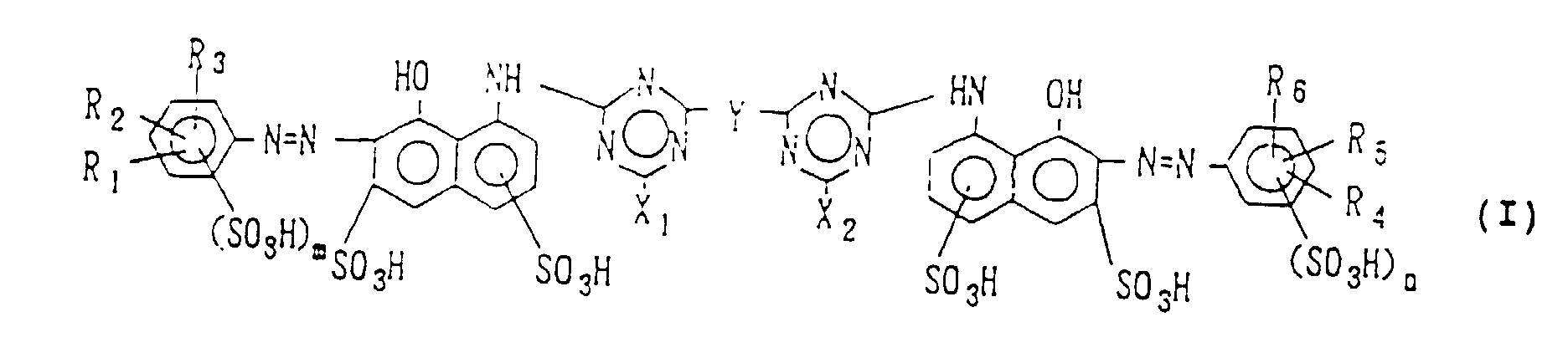 R1, R2, R3, R4, R5 und R6 jeweils unabhängig voneinander eine substituierte oder unsubstituierte Alkylgruppe mit 1 bis 9 Kohlenstoffatomen, eine Alkoxygruppe mit 1 bis 9 Kohlenstoffatomen, ein Halogenatom, ein Wasserstoffatom, eine Hydroxylgruppe, eine substituierte oder unsubstituierte Carbamoylgruppe, eine substituierte oder unsubstituierte Sulfamoylgruppe, eine substituierte oder unsubstituierte Aminogruppe, eine Nitrogruppe, eine Sulfonsäureestergruppe, eine Sulfonylgruppe, eine Carboxylgruppe oder eine Carbonsäureestergruppe darstellen,m und n jeweils unabhängig voneinander die Zahl 0, 1 oder 2 darstellen,X1 und X2 jeweils unabhängig voneinander eine -OR7-Gruppe darstellen,R7 ein Wasserstoffatom, eine Alkylgruppe mit 1 bis 8 Kohlenstoffatomen, eine Alkenylgruppe mit 2 oder 3 Kohlenstoffatomen, eine Arylgruppe, eine Aralkylgruppe, eine Cyclohexylgruppe oder eine heterocyclische Stickstoffgruppe, wobei diese Gruppen gegebenenfalls einen Substituenten aufweisen, darstellt undY eine divalente Verbindungsgruppe einer der Formeln (II) bis (V) darstellt,wobei und b jeweils eine Zahl von 0 bis 6 darstellen und c eine Zahl von 0 oder 1 darstellt.
 wobei d eine Zahl von 1 bis 6 darstellt.
 wobei e eine Zahl von 1 bis 6 darstellt.
 wobei Z ein Wasserstoffatom oder eine Alkylgruppe mit 1 bis 4 Kohlenstoffatomen darstellt.
- Aufzeichnungsflüssigkeit nach Anspruch 1, wobei mindestens ein Farbstoff eine Struktur der Formel (I) aufweist, wobei die Zahl der Carboxylgruppen nicht mehr als 3 ist.
- Aufzeichnungsflüssigkeit nach Anspruch 1, wobei mindestens ein Farbstoff eine Struktur der Formel (I) aufweist, wobei m und n jeweils die Zahl 1 sind und jeweils die SO3-Gruppe an die Phenylgruppe in Orthoposition in bezug auf die Azogruppe gebunden ist.
- Aufzeichnungsflüssigkeit nach Anspruch 1. wobei mindestens ein Farbstoff eine Struktur der Formel (I) aufweist, wobei m und n jeweils 0 sind, mindestens einer der Reste R1 bis R3 und mindestens einer der Reste R4 bis R6 jeweils ein Wasserstoffatom ist, und mindestens einer der Reste R1 bis R3 und mindestens einer der Reste R4 bis R6 jeweils eine Gruppe, gewählt aus der Trifluormethylgruppe, einer substituierten oder unsubstituierten Sulfamoylgruppe, einer von einem C1-4-Alkylester einer Sulfonsäure abgeleiteten Gruppe, einer von einem C6-C12-Arylester einer Sulfonsäure abgeleiteten Gruppe, einer COOH-Gruppe und einer von einem C1-4-Alkylester einer Carbonsäure abgeleiteten Gruppe ist, wobei jede dieser Gruppen an die Phenylgruppe in Orthoposition in bezug auf die Azogruppe gebunden ist.
- Aufzeichnungsflüssigkeit nach Anspruch 1, wobei mindestens ein Farbstoff eine Struktur der Formel (I) aufweist, wobei die Einheiten
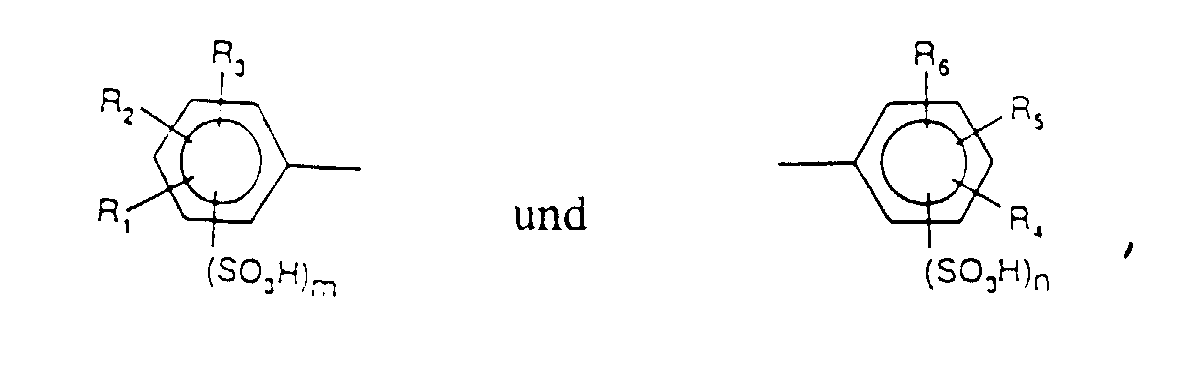 sind.
sind.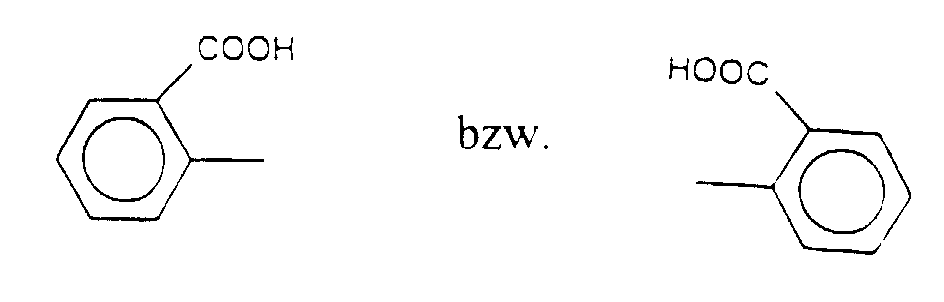
- Aufzeichnungsflüssigkeit nach Anspruch 1, wobei mindestens ein Farbstoff eine Struktur der Formel (I) aufweist, wobei X1 und X2 jeweils eine OH-Gruppe darstellen.
- Aufzeichnungsflüssigkeit nach Anspruch 1, wobei mindestens ein Farbstoff eine Struktur der Formel (I) aufweist, wobei die Einheiten
 sind.
sind.
- Aufzeichnungsflüssigkeit nach Anspruch 1, wobei mindestens ein Farbstoff eine Struktur der Formel (I) aufweist, wobei die Einheiten
 sind.
sind.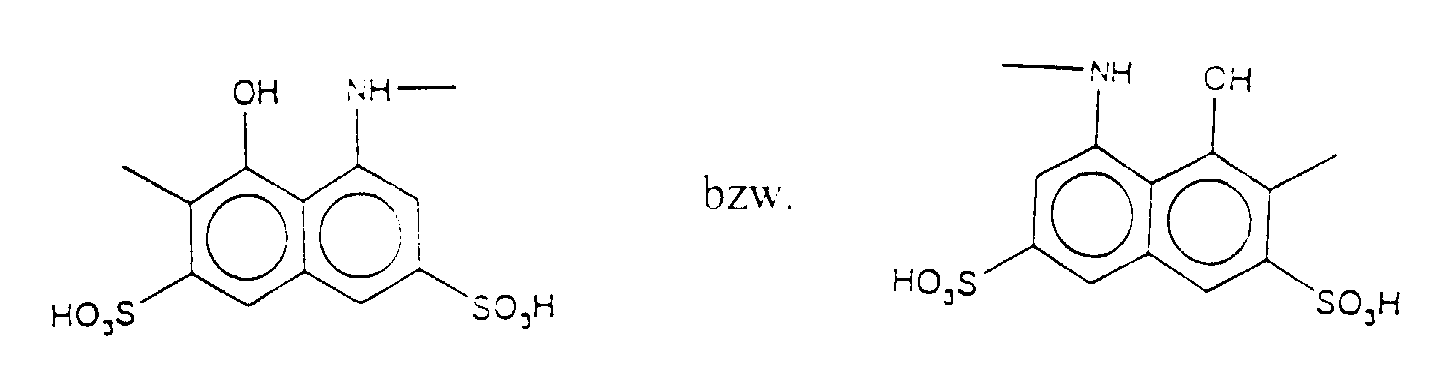
- Aufzeichnungsflüssigkeit nach Anspruch 1, wobei die Aufzeichnungsflüssigkeit weiter mindestens einen Xanthenfarbstoff aus C.I. AR-50, C.I. AR-51, C.I. AR-52, C.I. AR-87, C.I. AR-91. C.I. AR-92, C.I. AR-93, C.I. AR-94, C.I. AR-95, C.I. AR-98, C.I. AR-289, C.I. BR-1 und C.I. BV-10 umfaßt, wobei C.I. den Farbindex, AR Säure-Rot, BR Basen-Rot und BV Basen-Violett anzeigt.
- Aufzeichnungsflüssigkeit nach Anspruch 9, wobei das Verhältnis mindestens eines Farbstoffs, dessen Formen als freie Säure die Formel (I) aufweist, zu mindestens einem Xanthenfarbstoff von 1/9 bis 9/1 pro Gewicht beträgt.
- Aufzeichnungsflüssigkeit nach Anspruch 1, wobei die Gesamtmenge aller Farbstoffe, umfassend mindestens einen Farbstoff. dessen Formen als freie Säure die Formel (I) aufweist, 0,5 bis 5 Gewichts-% beträgt, bezogen auf die Gesamtmenge der Aufzeichnungsflüssigkeit.
- Tintenstrahlaufzeichnungsverfahren, umfassend den Schritt des Anhaftens von Tröpfchen einer Aufzeichnungsflüssigkeit, die aus einer winzigen Ausflußöffnung ausgestoßen werden, auf einem Aufnahmematerial, um ein Bild auf dem Aufnahmematerial aufzuzeichnen, wobei die Aufzeichnungsflüssigkeit ein wäßriges Medium und mindestens einen Farbstoff, dessen Formen als freie Säure die Formel (I) nach einem der Ansprüche 1 bis 11 aufweist, umfaßt.
- Verwendung einer Aufzeichnungsflüssigkeit nach einem der Ansprüche 1 bis 11 als Tintenstrahlflüssigkeit.
Applications Claiming Priority (4)
| Application Number | Priority Date | Filing Date | Title |
|---|---|---|---|
| JP30770894 | 1994-12-12 | ||
| JP307708/94 | 1994-12-12 | ||
| JP12006095A JP3396998B2 (ja) | 1995-05-18 | 1995-05-18 | 記録液 |
| JP120060/95 | 1995-05-18 |
Publications (2)
| Publication Number | Publication Date |
|---|---|
| EP0717089A1 EP0717089A1 (de) | 1996-06-19 |
| EP0717089B1 true EP0717089B1 (de) | 1999-03-24 |
Family
ID=26457707
Family Applications (1)
| Application Number | Title | Priority Date | Filing Date |
|---|---|---|---|
| EP95119552A Expired - Lifetime EP0717089B1 (de) | 1994-12-12 | 1995-12-12 | Aufzeichnungsflüssigkeit |
Country Status (3)
| Country | Link |
|---|---|
| US (1) | US5609673A (de) |
| EP (1) | EP0717089B1 (de) |
| DE (1) | DE69508543T2 (de) |
Families Citing this family (18)
| Publication number | Priority date | Publication date | Assignee | Title |
|---|---|---|---|---|
| GB9525883D0 (en) * | 1995-12-19 | 1996-02-21 | Zeneca Ltd | Chemical compounds |
| GB2308379B (en) * | 1995-12-19 | 2000-03-29 | Zeneca Ltd | Bisazo dyes for use in inks based on two linked 2-[7-(2'-sulpho-phenylazo)-8-hydroxy-3,6-disulphonaphthyl-amino]-4-substituted-triazin-6-yl units |
| GB9525882D0 (en) * | 1995-12-19 | 1996-02-21 | Zeneca Ltd | Chemical compounds |
| GB2308377A (en) * | 1995-12-19 | 1997-06-25 | Zeneca Ltd | Bisazo dyes for use in inks based on two linked 2-[7-(carboxy-phenylazo)-8-hydroxy-3,6-disulphonaphthylamino]-4-substituted-triazin-6-yl units |
| US5843217A (en) * | 1996-10-11 | 1998-12-01 | Minolta Co., Ltd. | Ink for ink jet recording |
| US5993525A (en) * | 1997-03-17 | 1999-11-30 | Mitsubishi Chemical Corporation | Recording liquid |
| WO1999016833A1 (en) * | 1997-09-27 | 1999-04-08 | Clariant Finance (Bvi) Limited | Bridged monoazo compounds |
| GB9820176D0 (en) * | 1998-09-16 | 1998-11-11 | Zeneca Ltd | Inks |
| US6835239B2 (en) * | 2000-08-08 | 2004-12-28 | Canon Kabushiki Kaisha | Fluorescent ink, and ink cartridge, recording unit, ink-jet recording method, and ink-jet recording apparatus employing the fluorescent ink |
| CA2354788C (en) * | 2000-08-08 | 2010-02-02 | Canon Kabushiki Kaisha | Ink, ink-jet recording process, recorded article, recording unit, ink cartridge, ink-jet recording apparatus, fluorescence enhancing method and method of elongating life time of fluorescence |
| GB0215982D0 (en) * | 2002-07-10 | 2002-08-21 | Dystar Textilfarben Gmbh & Co | Fibre reactive azo dyes |
| US7951233B2 (en) * | 2004-10-25 | 2011-05-31 | Hewlett-Packard Development Company, L.P. | Reactive color inks |
| US7727321B2 (en) * | 2006-02-16 | 2010-06-01 | Brother Kogyo Kabushiki Kaisha | Magenta ink for ink-jet recording |
| JP2008133431A (ja) * | 2006-11-01 | 2008-06-12 | Brother Ind Ltd | インクジェット記録用インクセット、インクジェット記録用インクセットの製造方法、画像形成方法及びインクジェット記録装置 |
| US8021470B2 (en) * | 2007-12-28 | 2011-09-20 | Brother Kogyo Kabushiki Kaisha | Water-based ink for ink-jet recording, ink cartridge and ink-jet recording apparatus |
| US8449664B2 (en) * | 2009-11-30 | 2013-05-28 | Brother Kogyo Kabushiki Kaisha | Water-based ink for ink-jet recording, ink cartridge, and ink-jet recording apparatus |
| US8430953B2 (en) * | 2009-11-30 | 2013-04-30 | Brother Kogyo Kabushiki Kaisha | Water-based ink for ink-jet recording, ink cartridge, and ink-jet recording apparatus |
| JP2011111611A (ja) * | 2009-11-30 | 2011-06-09 | Brother Industries Ltd | インクジェット記録用水性インクセット、インクカートリッジおよびインクジェット記録装置 |
Family Cites Families (7)
| Publication number | Priority date | Publication date | Assignee | Title |
|---|---|---|---|---|
| US4734190A (en) * | 1987-04-17 | 1988-03-29 | W. R. Grace & Co. | Sample dispensing system for liquid chromatography |
| GB8801486D0 (en) * | 1988-01-22 | 1988-02-24 | Ici Plc | Water-soluble dye |
| GB9016449D0 (en) * | 1990-07-26 | 1990-09-12 | Ici Plc | Anionic compounds |
| GB9016448D0 (en) * | 1990-07-26 | 1990-09-12 | Ici Plc | Anionic compounds |
| ATE136324T1 (de) * | 1992-03-06 | 1996-04-15 | Zeneca Ltd | Tintenzusammensetzungen |
| GB9325454D0 (en) * | 1993-01-12 | 1994-02-16 | Zeneca Ltd | Azo compound |
| DE4406950A1 (de) * | 1994-03-03 | 1995-09-07 | Bayer Ag | Disazofarbstoffe |
-
1995
- 1995-12-12 US US08/571,179 patent/US5609673A/en not_active Expired - Lifetime
- 1995-12-12 DE DE69508543T patent/DE69508543T2/de not_active Expired - Lifetime
- 1995-12-12 EP EP95119552A patent/EP0717089B1/de not_active Expired - Lifetime
Also Published As
| Publication number | Publication date |
|---|---|
| EP0717089A1 (de) | 1996-06-19 |
| DE69508543D1 (de) | 1999-04-29 |
| DE69508543T2 (de) | 1999-11-18 |
| US5609673A (en) | 1997-03-11 |
Similar Documents
| Publication | Publication Date | Title |
|---|---|---|
| EP0682088B1 (de) | Verwendung eines Monoazofarbstoffs mit einer Kupplungskomponente aus der Aminonaphtholsulfonsäure-Reihe als Farbstoff in einer Aufzeichnungsflüssigkeit sowie diesen enthaltende Aufzeichnungsflüssigkeit | |
| US5609673A (en) | Recording liquid | |
| JP3396997B2 (ja) | 記録液 | |
| EP0624632B1 (de) | Aufzeichnungsflüssigkeit | |
| EP0656407B1 (de) | Aufzeichnungsflüssigkeit | |
| EP0758672B1 (de) | Aufzeichnungsflüssigkeit | |
| EP0866105B1 (de) | Aufzeichnungsflüssigkeit und Disazofarbstoffe | |
| JP3440544B2 (ja) | 記録液 | |
| JP3486966B2 (ja) | 記録液 | |
| JP3396998B2 (ja) | 記録液 | |
| JP3829419B2 (ja) | カラー画像の形成方法 | |
| JPH07331145A (ja) | 記録液 | |
| JP4029493B2 (ja) | 記録液及び該記録液を用いたカラー画像の形成方法 | |
| JP3511677B2 (ja) | 記録液 | |
| JP3511652B2 (ja) | 記録液 | |
| JP3829462B2 (ja) | 記録液、インクジェット記録方法、及び水溶性色素 | |
| JP3829420B2 (ja) | 記録液及びインクジェット記録方法 | |
| JP3384218B2 (ja) | 記録液 | |
| JP4000649B2 (ja) | 記録液及びインクジェット記録方法 | |
| JP3484581B2 (ja) | 記録液 | |
| JP3428178B2 (ja) | 記録液 | |
| JP3503401B2 (ja) | 記録液 | |
| JP4136078B2 (ja) | 記録液 | |
| JP3412336B2 (ja) | 記録液 | |
| JP3467533B2 (ja) | 記録液 |
Legal Events
| Date | Code | Title | Description |
|---|---|---|---|
| PUAI | Public reference made under article 153(3) epc to a published international application that has entered the european phase |
Free format text: ORIGINAL CODE: 0009012 |
|
| AK | Designated contracting states |
Kind code of ref document: A1 Designated state(s): DE GB |
|
| 17P | Request for examination filed |
Effective date: 19960704 |
|
| GRAG | Despatch of communication of intention to grant |
Free format text: ORIGINAL CODE: EPIDOS AGRA |
|
| 17Q | First examination report despatched |
Effective date: 19980223 |
|
| GRAG | Despatch of communication of intention to grant |
Free format text: ORIGINAL CODE: EPIDOS AGRA |
|
| GRAG | Despatch of communication of intention to grant |
Free format text: ORIGINAL CODE: EPIDOS AGRA |
|
| GRAH | Despatch of communication of intention to grant a patent |
Free format text: ORIGINAL CODE: EPIDOS IGRA |
|
| GRAH | Despatch of communication of intention to grant a patent |
Free format text: ORIGINAL CODE: EPIDOS IGRA |
|
| GRAA | (expected) grant |
Free format text: ORIGINAL CODE: 0009210 |
|
| AK | Designated contracting states |
Kind code of ref document: B1 Designated state(s): DE GB |
|
| REF | Corresponds to: |
Ref document number: 69508543 Country of ref document: DE Date of ref document: 19990429 |
|
| PLBE | No opposition filed within time limit |
Free format text: ORIGINAL CODE: 0009261 |
|
| STAA | Information on the status of an ep patent application or granted ep patent |
Free format text: STATUS: NO OPPOSITION FILED WITHIN TIME LIMIT |
|
| 26N | No opposition filed | ||
| REG | Reference to a national code |
Ref country code: GB Ref legal event code: IF02 |
|
| PGFP | Annual fee paid to national office [announced via postgrant information from national office to epo] |
Ref country code: GB Payment date: 20141210 Year of fee payment: 20 Ref country code: DE Payment date: 20141209 Year of fee payment: 20 |
|
| REG | Reference to a national code |
Ref country code: DE Ref legal event code: R071 Ref document number: 69508543 Country of ref document: DE |
|
| REG | Reference to a national code |
Ref country code: GB Ref legal event code: PE20 Expiry date: 20151211 |
|
| PG25 | Lapsed in a contracting state [announced via postgrant information from national office to epo] |
Ref country code: GB Free format text: LAPSE BECAUSE OF EXPIRATION OF PROTECTION Effective date: 20151211 |