EP0718247A1 - .ouche vitreuse electro-conductrice par inclusion d'ions lithium et detecteur de co2 integrant cette couche - Google Patents
.ouche vitreuse electro-conductrice par inclusion d'ions lithium et detecteur de co2 integrant cette couche Download PDFInfo
- Publication number
- EP0718247A1 EP0718247A1 EP95921164A EP95921164A EP0718247A1 EP 0718247 A1 EP0718247 A1 EP 0718247A1 EP 95921164 A EP95921164 A EP 95921164A EP 95921164 A EP95921164 A EP 95921164A EP 0718247 A1 EP0718247 A1 EP 0718247A1
- Authority
- EP
- European Patent Office
- Prior art keywords
- thin
- film
- ionic conducting
- carbon dioxide
- noble metal
- Prior art date
- Legal status (The legal status is an assumption and is not a legal conclusion. Google has not performed a legal analysis and makes no representation as to the accuracy of the status listed.)
- Withdrawn
Links
Images


Classifications
-
- C—CHEMISTRY; METALLURGY
- C03—GLASS; MINERAL OR SLAG WOOL
- C03C—CHEMICAL COMPOSITION OF GLASSES, GLAZES OR VITREOUS ENAMELS; SURFACE TREATMENT OF GLASS; SURFACE TREATMENT OF FIBRES OR FILAMENTS MADE FROM GLASS, MINERALS OR SLAGS; JOINING GLASS TO GLASS OR OTHER MATERIALS
- C03C4/00—Compositions for glass with special properties
- C03C4/18—Compositions for glass with special properties for ion-sensitive glass
-
- C—CHEMISTRY; METALLURGY
- C03—GLASS; MINERAL OR SLAG WOOL
- C03C—CHEMICAL COMPOSITION OF GLASSES, GLAZES OR VITREOUS ENAMELS; SURFACE TREATMENT OF GLASS; SURFACE TREATMENT OF FIBRES OR FILAMENTS MADE FROM GLASS, MINERALS OR SLAGS; JOINING GLASS TO GLASS OR OTHER MATERIALS
- C03C3/00—Glass compositions
- C03C3/04—Glass compositions containing silica
-
- C—CHEMISTRY; METALLURGY
- C03—GLASS; MINERAL OR SLAG WOOL
- C03C—CHEMICAL COMPOSITION OF GLASSES, GLAZES OR VITREOUS ENAMELS; SURFACE TREATMENT OF GLASS; SURFACE TREATMENT OF FIBRES OR FILAMENTS MADE FROM GLASS, MINERALS OR SLAGS; JOINING GLASS TO GLASS OR OTHER MATERIALS
- C03C8/00—Enamels; Glazes; Fusion seal compositions being frit compositions having non-frit additions
- C03C8/24—Fusion seal compositions being frit compositions having non-frit additions, i.e. for use as seals between dissimilar materials, e.g. glass and metal; Glass solders
-
- G—PHYSICS
- G01—MEASURING; TESTING
- G01N—INVESTIGATING OR ANALYSING MATERIALS BY DETERMINING THEIR CHEMICAL OR PHYSICAL PROPERTIES
- G01N27/00—Investigating or analysing materials by the use of electric, electrochemical, or magnetic means
- G01N27/26—Investigating or analysing materials by the use of electric, electrochemical, or magnetic means by investigating electrochemical variables; by using electrolysis or electrophoresis
- G01N27/403—Cells and electrode assemblies
- G01N27/406—Cells and probes with solid electrolytes
- G01N27/407—Cells and probes with solid electrolytes for investigating or analysing gases
- G01N27/4073—Composition or fabrication of the solid electrolyte
- G01N27/4074—Composition or fabrication of the solid electrolyte for detection of gases other than oxygen
-
- G—PHYSICS
- G01—MEASURING; TESTING
- G01N—INVESTIGATING OR ANALYSING MATERIALS BY DETERMINING THEIR CHEMICAL OR PHYSICAL PROPERTIES
- G01N33/00—Investigating or analysing materials by specific methods not covered by groups G01N1/00 - G01N31/00
- G01N33/0004—Gaseous mixtures, e.g. polluted air
- G01N33/0009—General constructional details of gas analysers, e.g. portable test equipment
- G01N33/0027—General constructional details of gas analysers, e.g. portable test equipment concerning the detector
- G01N33/0036—General constructional details of gas analysers, e.g. portable test equipment concerning the detector specially adapted to detect a particular component
- G01N33/004—CO or CO2
Definitions
- the present invention relates to a lithium ionic conducting glass thin film and a carbon dioxide sensor comprising the lithium ionic conducting glass thin film.
- This carbon dioxide sensor is compact, of the power saving type and inexpensive and can measure the concentration of carbon dioxide in the air.
- the conventional carbon dioxide sensor of the solid electrolyte type comprises a sort of battery in which a noble metal electrode and a metal carbonate capable of creating a dissociation equilibrium with carbon dioxide are arranged on one side of a bulky solid electrolyte composed of a sintered ceramic body capable of conducting alkali ions such as Na+ and Li+ while a noble metal electrode is disposed on the opposite side of the bulky solid electrolyte and in which, when carbon dioxide contacts the metal carbonate, an electromotive force depending on the concentration of carbon dioxide is generated between the two electrodes.
- E E 0 + (RT/nF)ln(P CO2 )
- E0 a constant
- R a gas constant
- T an absolute temperature
- n the number of kinetic electrons
- F the Faraday constant
- P CO2 a partial pressure of carbon dioxide
- the carbon dioxide sensor of the solid electrolyte type detects the concentration of carbon dioxide by an electrode reaction effected between the metal carbonate disposed on one side of the solid electrolyte layer and carbon dioxide, so that the metal carbonate side is left open to the subject atmosphere while the opposite side is left open to the reference concentration atmosphere (generally, the air) in the measurement of carbon dioxide concentration. Therefore, the solid electrolyte for use therein is required to have a dense structure which completely shuts off both the atmospheres.
- the conventionally proposed carbon dioxide sensor of the solid electrolyte type is in the form of a pellet having a thickness ranging from several millimeters to several centimeters and a size ranging from several millimeters square to several centimeters square and prepared by the process such as the melt solidification process or the sintering process.
- the sintered ceramic body having been employed as the solid electrolyte has a porous structure, so that it occurs that carbon dioxide permeates the sintered ceramic body to thereby cause sensor output variation, i.e., noise. This is the cause of error found in carbon dioxide concentration measurements.
- the internal resistance of the carbon dioxide sensor is in direct proportion to the thickness of the employed solid electrolyte.
- the large thickness thereof leads to an extremely large internal resistance, so that the electromotive force of the carbon dioxide sensor is lowered to thereby disenable accurate measurement of the carbon dioxide concentration.
- the carbon dioxide sensor must be used at high temperatures such that the ion conductivity is high and the internal resistance is reduced, so that the operating temperature of the carbon dioxide sensor is generally as very high as about 350 to 600°C.
- the carbon dioxide sensor must be provided with a heater in the vicinity thereof for achieving the practical use of the carbon dioxide sensor.
- the heater for use therein must have a large capacity, so that the problem is encountered that the whole body of the carbon dioxide sensor inevitably has a large volume.
- a thin film of solid electrolyte is especially desired for miniaturizing the whole body of the carbon dioxide sensor, obtaining a thin film is difficult of a sintered body of a ceramic such as ⁇ -alumina, NASICON (Na1+ x ZrSi x P 3-x O12 wherein x is 0 - 3) or LISICON (Li 16-2x Zn(GeO4)4 wherein x is 0 - 8) having generally been employed as the solid electrolyte. Even if a thin film of such a sintered ceramic body is managed to obtain, the thin film formed sintered body is polycrystalline, so that there is a problem on the denseness for completely shutting off the gas present between the detector electrode and the reference electrode. When this thin film formed sintered body is used as the solid electrolyte, it occurs that the gas permeation therethrough brings about sensor output variation to thereby result in the cause of error.
- NASICON Na1+ x ZrSi x P 3-x O12 wherein x
- the speed of response of the carbon dioxide sensor is governed by the rate of diffusion of carbon dioxide in the metal carbonate employed in the detector electrode.
- the formation of the metal carbonate into a thin film is needed for increasing the response speed from the conventional about several minutes to several tens of seconds.
- the formation of the metal carbonate into a thin film is difficult in the use of the conventional melt solidification process or sintering process.
- the lithium ionic conducting (conductive) glass thin film of the present invention comprises a glass containing 20 to 80 mol% of an Li2O component.
- the thin carbon dioxide sensor of the present invention comprises a lithium ionic conducting (conductive) glass thin film as a solid electrolyte.
- the lithium ionic conducting glass thin film for use in the thin carbon dioxide sensor be a thin film comprising a material represented by the formula: (Li2O) x -(SiO2) (100-x) wherein 20 mol% ⁇ x mol% ⁇ 80 mol%.
- the lithium ionic conducting glass thin film be one formed by the sputtering process.
- Preferred examples of the thin carbon dioxide sensors according to the present invention include:
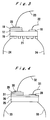
- Figs. 1, 2, 3 and 4 are explanatory diagrams showing examples of the structures of the thin carbon dioxide sensors according to the present invention.
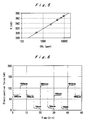
- Fig. 5 is a graph showing the relationship between the electromotive force and the concentration of carbon dioxide at an operating temperature of 400°C as measured by the use of the thin carbon dioxide sensor of Example 1 of the present invention.
- Fig. 6 is a view showing electromotive force response waveforms of the thin carbon dioxide sensor of Example 2 of the present invention to various carbon dioxide concentrations.
- Fig. 7 is a graph showing the relationship between the electromotive force and the concentration of carbon dioxide at an operating temperature of 400°C as measured by the use of the thin carbon dioxide sensor of Example 2 of the present invention.
- the lithium ionic conducting glass thin film of the present invention comprises a glass containing 20 to 80 mol% of an Li2O component and is a solid electrolyte.
- lithium ionic conducting glass thin films examples include glass thin films comprising respective materials represented by the formulae: (Li2O) x -(SiO2) (100-x) wherein 20 mol% ⁇ x mol% ⁇ 80 mol%; (Li2O) x -(P2O5) (100-x) wherein 30 mol% ⁇ x mol% ⁇ 70 mol%; (Li2O) x -(B2O3) (100-x) wherein 30 mol% ⁇ x mol% ⁇ 70 mol%; and (Li2O) x -(Al2O3) (100-x) wherein 30 mol% ⁇ x mol% ⁇ 70 mol%.
- the above lithium ionic conducting glass thin film can generally be formed by, for example, any of the sputtering, ion plating, ion beam evaporation, CVD, vacuum evaporation, electron beam evaporation, screen printing, spin coating and sol gel processes. Of these, the lithium ionic conducting glass thin film formed by the sputtering process is preferred.
- the lithium ionic conducting glass thin film of the present invention is a glass formed by the film forming process such as the sputtering process, so that it has a dense structure and is excellent in capability of shutting off gases.
- Nobuhito IMANAKA et al, Denki Kagaku, 61, 909 (1993) describe a sintered body, as a lithium ionic conductor, prepared from a powder obtained by mixing together Li2CO3, TiO2, (NH4)H2PO4 and Li3PO4 in a molar ratio of 0.5 : 2 : 3 : 0.2.
- the thin carbon dioxide sensor of the present invention will be described below with reference to examples of thin carbon dioxide sensors illustrated in Figs. 1 to 4.
- the thin carbon dioxide sensor of Fig. 1 includes a layer of metal carbonate 1 having a meshed noble metal electrode 2 buried therein, a lithium ionic conducting glass thin film 3 as a solid electrolyte and a layer of noble metal electrode 4 laminated in this sequence.
- the noble metal electrodes 2 and 4 are provided with respective leads 5 and 6 for electromotive force measurement.
- the metal carbonate 1 side is brought into contact with the measured atmosphere while the noble metal electrode 4 side is brought into contact with the reference atmosphere such as the air.
- the two atmospheres are partitioned from each other.
- Examples of the above metal carbonates 1 include lithium carbonate, sodium carbonate, potassium carbonate, barium carbonate, strontium carbonate and calcium carbonate. Of these, lithium carbonate or a mixture of lithium carbonate and another carbonate, especially, barium carbonate or potassium carbonate is preferably used.
- the thickness of the layer of the above metal carbonate depends on the type of the metal carbonate but generally ranges from 0.01 to 3 mm and preferably from 0.05 to 1 mm.
- the lithium ionic conducting glass thin film 3 for use in this invention is the above lithium ionic conducting glass thin film of the present invention and has a dense structure.
- Examples of the lithium ionic conducting glass thin films are as set forth above. Of them, preferred examples are glass thin films composed of respective materials represented by the formula: (Li2O) x -(SiO2) (100-x) wherein 20 mol% ⁇ x mol% ⁇ 80 mol%. Especially preferred examples are glass thin films composed of respective materials represented by the above formula in which x ranges from 40 to 60.
- Nb2O5, Ta2O5 or WO3 may be added to (Li2O) x -(SiO2) (100-x) in an amount of preferably 1 to 20 mol% and more preferably 5 to 15 mol% so as to increase the crystallization temperature and the ionic conductivity.
- the lithium ionic conducting glass thin film formed by the sputtering process is preferred.
- the use of the above lithium ionic conducting glass thin film as the solid electrolyte 3 enables miniaturization of the sensor, so that miniaturization of the whole body of the carbon dioxide sensor together with power saving can be attained by the employment of a heater with a capacity smaller than in the prior art.
- the thickness of the above lithium ionic conducting glass thin film generally ranges from 0.5 to 10 ⁇ m and preferably from 1 to 5 ⁇ m.
- Each of the above noble metal electrodes 2 and 4 may be composed of, for example, any of platinum, gold and silver, of which platinum and gold are preferred.
- Each of the above leads 5 and 6 may be composed of, for example, any of platinum, gold and silver, of which platinum and gold are preferred.
- a lithium ionic conducting glass thin film 8 and a thin metal carbonate film 9 in this sequence are laminated to one surface of an oxygen ionic conducting ceramic substrate 7, preferably, in the entirety of the surface and, further, a thin noble metal electrode film 10 is laminated to part of the surface of the thin metal carbonate film 9.
- a thin noble metal electrode film 11 and a thin film heater 12 are laminated to the other surface of the oxygen ionic conducting ceramic substrate 7 in a fashion such that the thin noble metal electrode film 11 and the thin film heater 12 are arranged so as not to contact each other.
- the thin noble metal electrode films 10 and 11 are provided with respective leads 13 and 14 for electromotive force measurement.
- the thin film heater 12 is provided with a heater lead 15.
- the thin noble metal electrode film 10 and the thin metal carbonate film 9 structures a detecting electrode.
- the oxygen ionic conducting ceramic substrate 7 and the thin noble metal electrode film 11 structures a reference electrode.
- the thin noble metal electrode film 10 and the thin metal carbonate film 9 structuring a detecting electrode may be laminated in reverse sequence.
- a lithium ionic conducting glass thin film 17 and a thin noble metal electrode film 18 are laminated to one surface of an oxygen ionic conducting ceramic substrate 16 in a fashion such that the lithium ionic conducting glass thin film 17 and the thin noble metal electrode film 18 are arranged so as not to contact each other, a thin metal carbonate film 19 is laminated to the entire surface of the lithium ionic conducting glass thin film 17 and further a thin noble metal electrode film 20 is laminated to part of the surface of the thin metal carbonate film 19.
- a thin film heater 21 is laminated to the other surface of the oxygen ionic conducting ceramic substrate 16.
- the thin noble metal electrode films 18 and 20 are provided with respective leads 22 and 23 for electromotive force measurement.
- the thin film heater 21 is provided with a heater lead 24.
- the thin noble metal electrode film 20 and the thin metal carbonate film 19 structures a detector electrode.
- the oxygen ionic conducting ceramic substrate 16 and the thin noble metal electrode film 18 structures a reference electrode.
- the thin noble metal electrode film 20 and the thin metal carbonate film 19 structuring a detecting electrode may be laminated in reverse sequence.
- an oxygen ionic conducting ceramic thin film 26 is laminated to a surface, preferably, the entire surface of a plane heater substrate 25, a lithium ionic conducting glass thin film 27 and a thin noble metal electrode film 28 are laminated to the surface of the oxygen ionic conducting ceramic thin film 26 in a fashion such that the lithium ionic conducting glass thin film 27 and the thin noble metal electrode film 28 are arranged so as not to contact each other, a thin metal carbonate film 29 is laminated to the entire surface of the lithium ionic conducting glass thin film 27 and further a thin noble metal electrode film 30 is laminated to the surface of the thin metal carbonate film 29.
- the thin noble metal electrode films 28 and 30 are provided with respective leads 31 and 32 for electromotive force measurement.
- the thin film heater 25 is provided with a heater lead 33.
- the thin noble metal electrode film 30 and the thin metal carbonate film 29 structures a detecting electrode.
- the oxygen ionic conducting ceramic substrate 26 and the thin noble metal electrode film 28 structures a reference electrode.
- the thin noble metal electrode film 30 and the thin metal carbonate film 29 structuring a detecting electrode may be laminated in reverse sequence.
- Examples of the oxygen ionic conducting ceramic substrates 7 and 16 of Figs. 2 and 3 include substrates of zirconia stabilized with any of the oxides Y2O3, MgO and CaO.
- the content of each of the oxides Y2O3, MgO and CaO in the substrate ranges from 5 to 20 mol%.
- each of the above substrates preferably ranges from 20 ⁇ m to 1 mm.
- the lithium ionic conducting glass thin films 8, 17 and 27 of Figs. 2 to 4 are identical with the above lithium ionic conducting glass thin film 3 of Fig. 1.
- each of the lithium ionic conducting glass thin films preferably ranges from 0.1 to 20 ⁇ m and more preferably from 0.5 to 5 ⁇ m.
- the respective metal carbonates composing the thin metal carbonate films 9, 19 and 29 of Figs. 2 to 4 are identical with the metal carbonate employed in the layer of metal carbonate 1 of Fig. 1. It is preferably lithium carbonate or a mixture of lithium carbonate and another carbonate.
- the above thin metal carbonate film can generally be formed by, for example, any of the sputtering, ion plating, ion beam evaporation, CVD, vacuum evaporation, electron beam evaporation, screen printing, spin coating and sol gel processes. Of these, the thin metal carbonate film formed by the sputtering process is preferred.
- the thickness of the thin metal carbonate film preferably ranges from 0.1 to 20 ⁇ m and more preferably from 0.5 to 5 ⁇ m.
- a preferred example of the thin noble metal electrode films 10, 11, 18, 20, 28 and 30 of Figs. 2 to 4 is a thin film of gold or platinum.
- the above thin noble metal electrode film can generally be formed by, for example, any of the sputtering, ion plating, ion beam evaporation, CVD, vacuum evaporation, electron beam evaporation, screen printing, spin coating and sol gel processes. Of these, the thin noble metal electrode film formed by the sputtering process is preferred. In this process, a porous thin noble metal electrode film of high gas permeation can be formed by controlling sputtering conditions. This thin noble metal electrode film can be used in combination with a meshed noble metal electrode.
- the thickness of the thin noble metal electrode film preferably ranges from 0.1 to 10 ⁇ m and more preferably from 0.2 to 2 ⁇ m.
- Examples of the oxygen ionic conducting ceramic thin film 26 of Fig. 4 include substrates of zirconia stabilized with any of the oxides Y2O3, MgO and CaO.
- the content of each of the oxides Y2O3, MgO and CaO in the substrate ranges from 5 to 20 mol%.
- the above oxygen ionic conducting ceramic thin film can generally be formed by, for example, any of the sputtering, ion plating, ion beam evaporation, CVD, vacuum evaporation, electron beam evaporation, screen printing, spin coating and sol gel processes. Of these, the oxygen ionic conducting ceramic thin film formed by the sputtering process is preferred.
- the thickness of the oxygen ionic conducting ceramic thin film preferably ranges from 0.1 to 20 ⁇ m and still preferably from 0.5 to 5 ⁇ m.
- Each of the thin film heaters 12 and 21 of Figs. 2 and 3 is composed of a platinum/rhodium alloy, a platinum/palladium alloy, ruthenium oxide or the like.
- the above thin film heater can generally be formed by, for example, any of the sputtering, ion plating, ion beam evaporation, CVD, vacuum evaporation, electron beam evaporation, screen printing, spin coating and sol gel processes. Of these, the thin film heater formed by the sputtering process is preferred.
- the thickness of the thin film heater preferably ranges from 0.1 to 10 ⁇ m and more preferably from 0.2 to 2 ⁇ m.
- the plane heater substrate 25 of Fig. 4 is composed of a platinum/rhodium alloy, a platinum/palladium alloy, ruthenium oxide or the like.
- the thickness of the plane heater substrate preferably ranges from 20 ⁇ m to 1 mm.
- the lithium ionic conducting glass thin film of the present invention comprises a glass containing 20 to 80 mol% of an Li2O component, so that it has a dense structure which shuts off gases and can be used as a solid electrolyte of a carbon dioxide sensor.
- the lithium ionic conducting glass thin film of the present invention finds applications in a thin lithium secondary-battery (microbattery), an analog memory, an electrochromic element (dimmer glass) and the like.
- the solid electrolyte of the thin carbon dioxide sensor of the present invention comprises a lithium ionic conducting glass thin film having a dense structure, so that, even if the carbon dioxide sensor is used in the form of a thin film, it enables complete elimination of noise attributed to gas permeation, thereby realizing an improvement of accuracy in measurement of carbon dioxide concentration as well as miniaturization of the sensor.
- thin carbon dioxide sensor of the present invention is formed into a thin film, so that the sensor has a low internal resistance, acts at low operating temperatures and exhibits a high response speed. Therefore, a heater having a capacity smaller than in the prior art can be used in the thin carbon dioxide sensor of the present invention, so that, even when a structure integral with a heater and the like is employed, miniaturization and power saving can be attained for the integrated carbon dioxide sensor.
- the whole body of the thin carbon dioxide sensor of the present invention in which an oxide ionic conducting ceramic is used as a substrate or thin film can be inserted in a subject gas in the measurement of carbon dioxide concentration because the oxygen ionic conducting ceramic shuts off ions other than oxygen ions.
- the thin carbon dioxide sensor of the present invention can find applications in various fields such as environment, agriculture and medical care.
- a reagent of lithium carbonate was weighed in a predetermined amount, put in an alumina crucible and heated in an electric furnace at about 750°C for about 3 hr.
- a meshed platinum (100 mesh) as an electrode 2 was dipped in the thus molten lithium carbonate to effect coating.
- a layer of metal carbonate 1 having a thickness of about 0.5 mm was formed.
- oxygen-reactive sputtering was performed on one surface of the layer of metal carbonate 1 with the use of a sintered body of Li2SiO3 as a target, thereby forming a solid electrolyte of an (Li2O)50-(SiO2)50 film 3 having a thickness of about 1 ⁇ m.
- the side of metal carbonate 1 of the thus obtained sensor was exposed to a subject atmosphere whose carbon dioxide concentration changed from 500 ppm to 1% by volume while the platinum sputter film side of the sensor was exposed to the air, and the electromotive force generated between the platinum leads 5 and 6 was measured at an operating temperature of 400°C.
- the subject atmosphere and the air as the reference atmosphere was partitioned by means of a glass tube.
- Fig. 5 demonstrates that a thin carbon dioxide sensor exhibiting a good linearity in accordance with the Nernst formula was obtained in Example 1.
- a lithium ionic conducting glass thin film 17 of about 1 ⁇ m in thickness was formed as a solid electrolyte on part of a surface of a ZrO2 substrate 16 (size: 10 mm x 10 mm x 0.5 mm) having a Y2O3 content of 0.8 mol%.
- the lithium ionic conducting glass thin film 17 was prepared by the oxygen-reactive radio-frequency (RF) magnetron sputtering process with the use of molten lithium silicate (Li2SiO3) as a target, and its composition was regulated to (Li2O)45-(SiO2)55 by a quartz chip placed on the target.
- the crystallization temperature of the lithium ionic conducting glass thin film 17 is not lower than 600°C.
- a thin lithium carbonate film of about 1 ⁇ m in thickness as a thin metal carbonate film 19 constituting a detector electrode and a thin gold film of about 0.21 ⁇ m in thickness as a thin noble metal electrode film 20 were laminated to the above lithium ionic conducting glass thin film 17.
- the thin lithium carbonate film was prepared by the radio-frequency magnetron sputtering process with the use of molten lithium carbonate as a target.
- the thin gold film was prepared by the direct-current (DC) magnetron sputtering process with the use of gold as a target.
- a thin gold film as a thin noble metal electrode film 18 constituting a reference electrode was formed on the same side of the substrate 16 as provided with the laminate of the lithium ionic conducting glass thin film 17, the thin metal carbonate film 19 and the thin noble metal electrode film 20 with a spacing given between this thin gold film and the laminate.
- This thin gold film was prepared in the same manner as employed to obtain the above thin gold film as the thin noble metal electrode film 20.
- a thin film heater 21 was formed on the back of the oxygen ionic conducting ceramic substrate 16, i.e., the surface of the oxygen ionic conducting ceramic substrate 16 on which the above laminate of the lithium ionic conducting glass thin film 17, the thin noble metal electrode film 18, etc. was not provided.
- the thin film heater 21 was a thin platinum film of 2 ⁇ m in thickness and was prepared by the direct-current (DC) magnetron sputtering process with the use of platinum as a target.
- the whole body of the thus obtained sensor was inserted in subject atmospheres of varied carbon dioxide concentrations, and the electromotive force generated between the gold lead as lead 22 for electromotive force measurement and the gold lead 23 as lead for electromotive force measurement was measured at an operating temperature of 400°C. Direct-current voltage was applied to the thin film heater 21 so as to hold the operating temperature constant at 400°C.
Landscapes
- Chemical & Material Sciences (AREA)
- Life Sciences & Earth Sciences (AREA)
- Engineering & Computer Science (AREA)
- Health & Medical Sciences (AREA)
- Chemical Kinetics & Catalysis (AREA)
- General Chemical & Material Sciences (AREA)
- Geochemistry & Mineralogy (AREA)
- Materials Engineering (AREA)
- Organic Chemistry (AREA)
- General Health & Medical Sciences (AREA)
- General Physics & Mathematics (AREA)
- Pathology (AREA)
- Physics & Mathematics (AREA)
- Analytical Chemistry (AREA)
- Biochemistry (AREA)
- Immunology (AREA)
- Food Science & Technology (AREA)
- Combustion & Propulsion (AREA)
- Medicinal Chemistry (AREA)
- Molecular Biology (AREA)
- Electrochemistry (AREA)
- Measuring Oxygen Concentration In Cells (AREA)
- Glass Compositions (AREA)
Applications Claiming Priority (3)
| Application Number | Priority Date | Filing Date | Title |
|---|---|---|---|
| JP13029494 | 1994-06-13 | ||
| JP130294/94 | 1994-06-13 | ||
| PCT/JP1995/001181 WO1995034515A1 (fr) | 1994-06-13 | 1995-06-13 | Couche vitreuse electro-conductrice par inclusion d'ions lithium et detecteur de co2 integrant cette couche |
Publications (2)
| Publication Number | Publication Date |
|---|---|
| EP0718247A1 true EP0718247A1 (fr) | 1996-06-26 |
| EP0718247A4 EP0718247A4 (fr) | 2000-09-06 |
Family
ID=15030878
Family Applications (1)
| Application Number | Title | Priority Date | Filing Date |
|---|---|---|---|
| EP95921164A Withdrawn EP0718247A4 (fr) | 1994-06-13 | 1995-06-13 | .ouche vitreuse electro-conductrice par inclusion d'ions lithium et detecteur de co2 integrant cette couche |
Country Status (6)
| Country | Link |
|---|---|
| US (1) | US5755940A (fr) |
| EP (1) | EP0718247A4 (fr) |
| JP (1) | JP3017538B2 (fr) |
| KR (1) | KR100186895B1 (fr) |
| CA (1) | CA2169350A1 (fr) |
| WO (1) | WO1995034515A1 (fr) |
Cited By (6)
| Publication number | Priority date | Publication date | Assignee | Title |
|---|---|---|---|---|
| EP1028094A3 (fr) * | 1997-02-06 | 2000-09-20 | Kabushiki Kaisha Ohara | Vitro-céramiques conducteurs d'ions d'alcalin, cellules électriques et senseurs de gaz utilisant ces vitro-céramiques |
| EP1029828A3 (fr) * | 1996-10-28 | 2000-09-20 | Kabushiki Kaisha Ohara | Vitro-céramiques conducteurs d'ions de lithium, cellules électriques et senseurs de gaz utilisant ces vitro-céramiques |
| US6315881B1 (en) | 1995-11-15 | 2001-11-13 | Kabushiki Kaisha Ohara | Electric cells and gas sensors using alkali ion conductive glass ceramic |
| WO2004042380A3 (fr) * | 2002-11-01 | 2004-08-12 | Honeywell Int Inc | Capteur de gaz |
| CN105193278A (zh) * | 2015-10-20 | 2015-12-30 | 苏州市灵通玻璃制品有限公司 | 一种防渗透电饭煲控制面板玻璃 |
| EP3472881B1 (fr) * | 2016-06-15 | 2023-10-11 | Ilika Technologies Limited | Verre borosilicaté de lithium comme électrolyte et verre borosilicaté de lithium comme couche de protection pour électrode |
Families Citing this family (36)
| Publication number | Priority date | Publication date | Assignee | Title |
|---|---|---|---|---|
| DE19623487C2 (de) * | 1996-06-12 | 1999-01-07 | Max Planck Gesellschaft | Gavanische Zelle und deren Verwendung als Gassensor |
| WO1999030328A1 (fr) * | 1997-12-11 | 1999-06-17 | Mitsui Chemicals, Inc. | Couches minces d'electrolyte solide et capteurs de gaz fabriques au moyen de ces couches |
| JPH11281615A (ja) * | 1998-03-27 | 1999-10-15 | Akebono Brake Res & Dev Center Ltd | ガスセンサー素子 |
| US6387845B1 (en) * | 1999-03-23 | 2002-05-14 | Kabushiki Kaisha Toshiba | Carbon dioxide gas absorbent containing lithium silicate |
| US6270651B1 (en) * | 2000-02-04 | 2001-08-07 | Abetif Essalik | Gas component sensor |
| US8431264B2 (en) | 2002-08-09 | 2013-04-30 | Infinite Power Solutions, Inc. | Hybrid thin-film battery |
| US8404376B2 (en) | 2002-08-09 | 2013-03-26 | Infinite Power Solutions, Inc. | Metal film encapsulation |
| US8236443B2 (en) | 2002-08-09 | 2012-08-07 | Infinite Power Solutions, Inc. | Metal film encapsulation |
| US20070264564A1 (en) | 2006-03-16 | 2007-11-15 | Infinite Power Solutions, Inc. | Thin film battery on an integrated circuit or circuit board and method thereof |
| US8394522B2 (en) | 2002-08-09 | 2013-03-12 | Infinite Power Solutions, Inc. | Robust metal film encapsulation |
| US7993773B2 (en) | 2002-08-09 | 2011-08-09 | Infinite Power Solutions, Inc. | Electrochemical apparatus with barrier layer protected substrate |
| US6916679B2 (en) * | 2002-08-09 | 2005-07-12 | Infinite Power Solutions, Inc. | Methods of and device for encapsulation and termination of electronic devices |
| US8445130B2 (en) | 2002-08-09 | 2013-05-21 | Infinite Power Solutions, Inc. | Hybrid thin-film battery |
| US8021778B2 (en) | 2002-08-09 | 2011-09-20 | Infinite Power Solutions, Inc. | Electrochemical apparatus with barrier layer protected substrate |
| KR100682883B1 (ko) * | 2002-11-27 | 2007-02-15 | 삼성전자주식회사 | 고체 전해질, 그의 제조방법 및 이를 채용한 리튬전지 및 박막전지 |
| US8728285B2 (en) | 2003-05-23 | 2014-05-20 | Demaray, Llc | Transparent conductive oxides |
| US7264700B1 (en) * | 2004-01-20 | 2007-09-04 | Los Alamos National Security, Llc | Thin film mixed potential sensors |
| US7959769B2 (en) | 2004-12-08 | 2011-06-14 | Infinite Power Solutions, Inc. | Deposition of LiCoO2 |
| KR101127370B1 (ko) | 2004-12-08 | 2012-03-29 | 인피니트 파워 솔루션스, 인크. | LiCoO2의 증착 |
| CN101523571A (zh) | 2006-09-29 | 2009-09-02 | 无穷动力解决方案股份有限公司 | 柔性基板上沉积的电池层的掩模和材料限制 |
| US8197781B2 (en) | 2006-11-07 | 2012-06-12 | Infinite Power Solutions, Inc. | Sputtering target of Li3PO4 and method for producing same |
| US8052854B1 (en) * | 2007-05-25 | 2011-11-08 | The United States Of America As Represented By The Administrator Of National Aeronautics And Space Administration | Carbon dioxide gas sensors and method of manufacturing and using same |
| CN101903560B (zh) | 2007-12-21 | 2014-08-06 | 无穷动力解决方案股份有限公司 | 用于电解质膜的溅射靶的方法 |
| US8268488B2 (en) | 2007-12-21 | 2012-09-18 | Infinite Power Solutions, Inc. | Thin film electrolyte for thin film batteries |
| US8518581B2 (en) | 2008-01-11 | 2013-08-27 | Inifinite Power Solutions, Inc. | Thin film encapsulation for thin film batteries and other devices |
| WO2009124191A2 (fr) | 2008-04-02 | 2009-10-08 | Infinite Power Solutions, Inc. | Commande de sur/sous tension passive et protection pour des dispositifs de stockage d’énergie associés à un captage d’énergie |
| JP2012500610A (ja) | 2008-08-11 | 2012-01-05 | インフィニット パワー ソリューションズ, インコーポレイテッド | 電磁エネルギー獲得ための統合コレクタ表面を有するエネルギーデバイスおよびその方法 |
| CN102150185B (zh) | 2008-09-12 | 2014-05-28 | 无穷动力解决方案股份有限公司 | 具有经由电磁能进行数据通信的组成导电表面的能量装置及其方法 |
| WO2010042594A1 (fr) | 2008-10-08 | 2010-04-15 | Infinite Power Solutions, Inc. | Module de capteurs sans fil alimenté par l’environnement |
| CN102576828B (zh) | 2009-09-01 | 2016-04-20 | 萨普拉斯特研究有限责任公司 | 具有集成薄膜电池的印刷电路板 |
| US20140151242A1 (en) * | 2010-05-25 | 2014-06-05 | Automotive Test Solutions, Inc. | Leak detection formula, analyzer and methods of use |
| EP2577777B1 (fr) | 2010-06-07 | 2016-12-28 | Sapurast Research LLC | Dispositif électrochimique à haute densité rechargeable |
| ES2393586B1 (es) * | 2011-06-10 | 2013-07-26 | Centro De Estudios E Investigaciones Tecnicas (Ceit) | Sensor electroquímico para la medición de concentración de gases y procedimiento para su fabricación |
| KR101769303B1 (ko) | 2016-06-14 | 2017-08-18 | 현대자동차주식회사 | 고체전해질용 co2 센서 및 이의 제조방법 |
| KR101960193B1 (ko) * | 2017-11-28 | 2019-03-19 | 인하대학교 산학협력단 | 소다라임 유리를 이용한 가스 센서 |
| EP3953304B1 (fr) * | 2019-03-26 | 2024-05-01 | CellMo Materials Innovation, Inc. | Dispositif capteur de gaz à base de mousse d'oxyde métallique |
Family Cites Families (21)
| Publication number | Priority date | Publication date | Assignee | Title |
|---|---|---|---|---|
| US1990768A (en) * | 1933-09-05 | 1935-02-12 | W M Welch Mfg Company | Electrode apparatus |
| US2462843A (en) * | 1945-02-07 | 1949-03-01 | Nat Technical Lab | Glass electrode |
| US2497235A (en) * | 1947-12-12 | 1950-02-14 | Leeds & Northrup Co | ph-responsive glass electrodes |
| US2986511A (en) * | 1957-08-27 | 1961-05-30 | Cambridge Instr Company Inc | Apparatus for measuring the ph of solutions |
| US3862016A (en) * | 1960-10-13 | 1975-01-21 | Beckman Instruments Inc | Method of measuring sodium ion concentration |
| NL125166C (fr) * | 1960-10-24 | |||
| US3480536A (en) * | 1965-11-19 | 1969-11-25 | Beckman Instruments Inc | Ion sensitive lanthanum-cerium containing glass electrode |
| FR2428617A2 (fr) * | 1978-06-13 | 1980-01-11 | France Etat | Conducteurs cationiques amorphes du lithium |
| DE3017947A1 (de) * | 1980-05-10 | 1981-11-12 | Bosch Gmbh Robert | Elektrochemischer messfuehler fuer die bestimmung des sauerstoffgehaltes in gasen und verfahren zum herstellen von sensorelementen fuer derartige messfuehler |
| JPS5960814A (ja) * | 1982-09-29 | 1984-04-06 | 株式会社日立製作所 | 酸化リチウム系非晶質イオン導電体 |
| JPS59162147A (ja) * | 1983-03-03 | 1984-09-13 | Takeshi Nomura | ガラス |
| US4612263A (en) * | 1985-10-01 | 1986-09-16 | Combustion Engineering, Inc. | Power cell having a glass solid electrolyte |
| US5217826A (en) * | 1990-07-31 | 1993-06-08 | Matsushita Electric Industrial Co., Ltd. | Lithium-ion conducting solid electrolyte |
| JPH0495351A (ja) * | 1990-07-31 | 1992-03-27 | Matsushita Electric Ind Co Ltd | リチウムイオン伝導性固体電解質 |
| US5194134A (en) * | 1990-08-09 | 1993-03-16 | Yazaki Corporation | Gaseous carbon dioxide detection sensor |
| JPH06160347A (ja) * | 1992-04-23 | 1994-06-07 | Nippon Ceramic Co Ltd | Co2センサ |
| JPH06160348A (ja) * | 1992-04-23 | 1994-06-07 | Nippon Ceramic Co Ltd | Co2センサ |
| JP3151925B2 (ja) * | 1992-05-07 | 2001-04-03 | 松下電器産業株式会社 | 非晶質リチウムイオン伝導性固体電解質並びにその合成法 |
| JP3343934B2 (ja) * | 1992-05-07 | 2002-11-11 | 松下電器産業株式会社 | 非晶質リチウムイオン伝導性固体電解質並びにその合成法 |
| JP3343936B2 (ja) * | 1992-05-12 | 2002-11-11 | 松下電器産業株式会社 | 非晶質リチウムイオン伝導性固体電解質並びにその合成法 |
| JPH06265520A (ja) * | 1993-03-15 | 1994-09-22 | Nippon Ceramic Co Ltd | Co2センサ |
-
1995
- 1995-06-13 CA CA002169350A patent/CA2169350A1/fr not_active Abandoned
- 1995-06-13 JP JP07517326A patent/JP3017538B2/ja not_active Expired - Lifetime
- 1995-06-13 KR KR1019960700660A patent/KR100186895B1/ko not_active Expired - Fee Related
- 1995-06-13 WO PCT/JP1995/001181 patent/WO1995034515A1/fr not_active Ceased
- 1995-06-13 EP EP95921164A patent/EP0718247A4/fr not_active Withdrawn
- 1995-06-13 US US08/591,650 patent/US5755940A/en not_active Expired - Fee Related
Cited By (6)
| Publication number | Priority date | Publication date | Assignee | Title |
|---|---|---|---|---|
| US6315881B1 (en) | 1995-11-15 | 2001-11-13 | Kabushiki Kaisha Ohara | Electric cells and gas sensors using alkali ion conductive glass ceramic |
| EP1029828A3 (fr) * | 1996-10-28 | 2000-09-20 | Kabushiki Kaisha Ohara | Vitro-céramiques conducteurs d'ions de lithium, cellules électriques et senseurs de gaz utilisant ces vitro-céramiques |
| EP1028094A3 (fr) * | 1997-02-06 | 2000-09-20 | Kabushiki Kaisha Ohara | Vitro-céramiques conducteurs d'ions d'alcalin, cellules électriques et senseurs de gaz utilisant ces vitro-céramiques |
| WO2004042380A3 (fr) * | 2002-11-01 | 2004-08-12 | Honeywell Int Inc | Capteur de gaz |
| CN105193278A (zh) * | 2015-10-20 | 2015-12-30 | 苏州市灵通玻璃制品有限公司 | 一种防渗透电饭煲控制面板玻璃 |
| EP3472881B1 (fr) * | 2016-06-15 | 2023-10-11 | Ilika Technologies Limited | Verre borosilicaté de lithium comme électrolyte et verre borosilicaté de lithium comme couche de protection pour électrode |
Also Published As
| Publication number | Publication date |
|---|---|
| JP3017538B2 (ja) | 2000-03-13 |
| CA2169350A1 (fr) | 1995-12-21 |
| KR960703813A (ko) | 1996-08-31 |
| US5755940A (en) | 1998-05-26 |
| EP0718247A4 (fr) | 2000-09-06 |
| WO1995034515A1 (fr) | 1995-12-21 |
| KR100186895B1 (ko) | 1999-04-15 |
Similar Documents
| Publication | Publication Date | Title |
|---|---|---|
| EP0718247A1 (fr) | .ouche vitreuse electro-conductrice par inclusion d'ions lithium et detecteur de co2 integrant cette couche | |
| JPWO1995034515A1 (ja) | リチウムイオン伝導性ガラス薄膜およびそのガラス薄膜を用いた薄型炭酸ガスセンサ | |
| JP3293741B2 (ja) | NOxセンサ | |
| JPH03130657A (ja) | 酸素センサ | |
| JPS639179B2 (fr) | ||
| JPH10503022A (ja) | 気体状の無水物を計測するための固体電解質センサ | |
| US20050252789A1 (en) | Hydrogen sensing apparatus and method | |
| EP0766085B1 (fr) | Dispositif électrochimique | |
| US3974054A (en) | Measuring cell for determining oxygen concentrations in a gas mixture | |
| US6325905B1 (en) | Solid electrolyte type carbon dioxide gas sensor element | |
| Chu | Thin-and thick-film solid ionic devices | |
| CA1137168A (fr) | Dispositif destine au controle d'un element dans un melange fluide | |
| JP2932916B2 (ja) | ガスセンサ | |
| JPS62261934A (ja) | 電気化学的に温度を測定する温度センサ | |
| US4310402A (en) | Gas tight sealant for zirconia sensors | |
| JP2948124B2 (ja) | 酸素センサー | |
| Yu-Quan et al. | An auto-calibrated miniature microhole cathode array sensor system for measuring dissolved oxygen | |
| Leppävuori et al. | The Use of Hybrid Microelectronics in the Construction of Ion‐Selective Electrodes | |
| JPH09264873A (ja) | 二酸化炭素センサ | |
| JP2993340B2 (ja) | ガスセンサ | |
| JPH09292366A (ja) | 炭酸ガスセンサとその製造方法 | |
| CA1293023C (fr) | Capteur de gaz double combine autoreferentiel | |
| JPWO1999030328A1 (ja) | 固体電解質薄膜およびそれを用いたガスセンサー | |
| JPH09325129A (ja) | 炭酸ガスセンサ | |
| WO1999030328A1 (fr) | Couches minces d'electrolyte solide et capteurs de gaz fabriques au moyen de ces couches |
Legal Events
| Date | Code | Title | Description |
|---|---|---|---|
| PUAI | Public reference made under article 153(3) epc to a published international application that has entered the european phase |
Free format text: ORIGINAL CODE: 0009012 |
|
| AK | Designated contracting states |
Kind code of ref document: A1 Designated state(s): DE FR GB IT NL |
|
| 17P | Request for examination filed |
Effective date: 19960523 |
|
| RAP1 | Party data changed (applicant data changed or rights of an application transferred) |
Owner name: MITSUI CHEMICALS, INC. |
|
| RIN1 | Information on inventor provided before grant (corrected) |
Inventor name: SHINDO, KIYOTAKA, MITSUI PETROCHEMICAL IND., LTD. |
|
| A4 | Supplementary search report drawn up and despatched |
Effective date: 20000725 |
|
| AK | Designated contracting states |
Kind code of ref document: A4 Designated state(s): DE FR GB IT NL |
|
| RIC1 | Information provided on ipc code assigned before grant |
Free format text: 7C 03C 4/18 A, 7G 01N 27/416 B, 7G 01N 27/413 B, 7C 04B 41/85 B, 7G 01N 33/00 B, 7G 01N 27/407 B, 7H 01M 6/18 B, 7C 03C 8/24 B |
|
| 17Q | First examination report despatched |
Effective date: 20011217 |
|
| RTI1 | Title (correction) |
Free format text: CARBON DIOXIDE GAS SENSOR USING A LITHIUM ION-CONDUCTING GLASS FILM |
|
| GRAH | Despatch of communication of intention to grant a patent |
Free format text: ORIGINAL CODE: EPIDOS IGRA |
|
| STAA | Information on the status of an ep patent application or granted ep patent |
Free format text: STATUS: THE APPLICATION IS DEEMED TO BE WITHDRAWN |
|
| 18D | Application deemed to be withdrawn |
Effective date: 20030318 |