EP0719020A2 - Cycle adaptif de puissance pour un téléphone sans fil - Google Patents
Cycle adaptif de puissance pour un téléphone sans fil Download PDFInfo
- Publication number
- EP0719020A2 EP0719020A2 EP95308751A EP95308751A EP0719020A2 EP 0719020 A2 EP0719020 A2 EP 0719020A2 EP 95308751 A EP95308751 A EP 95308751A EP 95308751 A EP95308751 A EP 95308751A EP 0719020 A2 EP0719020 A2 EP 0719020A2
- Authority
- EP
- European Patent Office
- Prior art keywords
- unit
- handset unit
- base unit
- state
- transmitter
- Prior art date
- Legal status (The legal status is an assumption and is not a legal conclusion. Google has not performed a legal analysis and makes no representation as to the accuracy of the status listed.)
- Withdrawn
Links
- 230000001351 cycling effect Effects 0.000 title claims description 9
- 230000003044 adaptive effect Effects 0.000 title description 2
- 238000004891 communication Methods 0.000 claims abstract description 33
- 238000000034 method Methods 0.000 claims description 31
- 230000004044 response Effects 0.000 claims description 18
- 230000005540 biological transmission Effects 0.000 claims description 11
- 238000012544 monitoring process Methods 0.000 abstract description 6
- 230000002035 prolonged effect Effects 0.000 abstract 1
- 230000008569 process Effects 0.000 description 24
- 238000010586 diagram Methods 0.000 description 4
- 238000001514 detection method Methods 0.000 description 3
- 230000011664 signaling Effects 0.000 description 3
- 230000005236 sound signal Effects 0.000 description 3
- 238000012546 transfer Methods 0.000 description 3
- 230000004913 activation Effects 0.000 description 2
- 239000004065 semiconductor Substances 0.000 description 2
- 230000003466 anti-cipated effect Effects 0.000 description 1
- 230000000881 depressing effect Effects 0.000 description 1
- 230000002349 favourable effect Effects 0.000 description 1
- 238000007562 laser obscuration time method Methods 0.000 description 1
- 230000013011 mating Effects 0.000 description 1
- 238000012986 modification Methods 0.000 description 1
- 230000004048 modification Effects 0.000 description 1
- 238000012545 processing Methods 0.000 description 1
- 230000036962 time dependent Effects 0.000 description 1
- 230000007704 transition Effects 0.000 description 1
Images


Classifications
-
- H—ELECTRICITY
- H04—ELECTRIC COMMUNICATION TECHNIQUE
- H04M—TELEPHONIC COMMUNICATION
- H04M1/00—Substation equipment, e.g. for use by subscribers
- H04M1/72—Mobile telephones; Cordless telephones, i.e. devices for establishing wireless links to base stations without route selection
- H04M1/725—Cordless telephones
- H04M1/73—Battery saving arrangements
-
- H—ELECTRICITY
- H04—ELECTRIC COMMUNICATION TECHNIQUE
- H04B—TRANSMISSION
- H04B7/00—Radio transmission systems, i.e. using radiation field
- H04B7/24—Radio transmission systems, i.e. using radiation field for communication between two or more posts
- H04B7/26—Radio transmission systems, i.e. using radiation field for communication between two or more posts at least one of which is mobile
-
- H—ELECTRICITY
- H04—ELECTRIC COMMUNICATION TECHNIQUE
- H04W—WIRELESS COMMUNICATION NETWORKS
- H04W52/00—Power management, e.g. Transmission Power Control [TPC] or power classes
- H04W52/02—Power saving arrangements
- H04W52/0209—Power saving arrangements in terminal devices
- H04W52/0251—Power saving arrangements in terminal devices using monitoring of local events, e.g. events related to user activity
- H04W52/0254—Power saving arrangements in terminal devices using monitoring of local events, e.g. events related to user activity detecting a user operation or a tactile contact or a motion of the device
-
- Y—GENERAL TAGGING OF NEW TECHNOLOGICAL DEVELOPMENTS; GENERAL TAGGING OF CROSS-SECTIONAL TECHNOLOGIES SPANNING OVER SEVERAL SECTIONS OF THE IPC; TECHNICAL SUBJECTS COVERED BY FORMER USPC CROSS-REFERENCE ART COLLECTIONS [XRACs] AND DIGESTS
- Y02—TECHNOLOGIES OR APPLICATIONS FOR MITIGATION OR ADAPTATION AGAINST CLIMATE CHANGE
- Y02D—CLIMATE CHANGE MITIGATION TECHNOLOGIES IN INFORMATION AND COMMUNICATION TECHNOLOGIES [ICT], I.E. INFORMATION AND COMMUNICATION TECHNOLOGIES AIMING AT THE REDUCTION OF THEIR OWN ENERGY USE
- Y02D30/00—Reducing energy consumption in communication networks
- Y02D30/70—Reducing energy consumption in communication networks in wireless communication networks
Definitions
- This invention relates to cordless telephones and, more particularly, to a cordless telephone arranged for extending the useful battery life of a handset unit in such telephone.
- a typical cordless telephone system includes a handset or remote unit and a base unit.
- the base unit is connected to the telephone lines and includes an antenna, a transmitter and a receiver for communicating a radio frequency carrier signal that is modulated by switching signals and audio signals to and from the handset unit as appropriate.
- Power for operation of the base unit is obtained from local line power.
- the handset unit includes a speaker and a microphone, and also an antenna, a transmitter and a receiver for likewise communicating telephone switching signals and audio signals to and from the base unit.
- Power for operation of the handset unit is obtained from a battery contained therein. This battery is usually charged by the local line power when the handset unit is placed in a cradle located in the base unit.
- the receiver of the handset unit In the operation of a typical cordless telephone handset unit in originating and receiving a call, the receiver of the handset unit normally remains in an on-condition whenever the handset unit is removed from the base unit. If a user desires to place a call from the handset unit, the transmitter in the handset unit generates a control signal that is transmitted to the base unit. Upon receipt and detection of the control signal, the base unit seizes the telephone lines so as to enable audio signals and switching signals from the handset unit that are received by the base unit within a given audio frequency band to be passed on to the telephone lines. If an incoming telephone ringing signal is sensed by the base unit, reflecting an incoming call, the base unit, in turn, transmits this ringing signal to the handset unit where it is detected by the handset unit receiver which activates a ringer in the handset unit.
- High battery drain current limits the period of time for reliable operation of handset units while located remote from associated base units.
- one specific arrangement disclosed in U. S. Patent 4,731,814 and issued to W. R. Becker et al. on March 15, 1988, reduces the battery drain current in the handset unit when the telephone is not in use and the handset unit is on-hook, i.e., no telephone call is in progress. Operation of the handset unit is through a process wherein power to the transmitter in the handset unit is removed and power to the receiver and other selected circuitry in the handset unit is controlled to minimize power consumption when the handset unit is located remote from the base unit and also monitoring for a telephone ring signal from the base unit.
- Control of the power to the receiver and the other selected circuitry in the handset unit of the Becker et al. arrangement is achieved by cycling the power to these circuits on and off while the handset unit is in a standby state. And the handset unit only responds to a ringing signal received from the base unit that is accompanied by an identification code that the handset unit recognizes.
- a cordless telephone provides for conserving battery power in an associated handset unit when this unit is located remote from an associated base unit and in a standby state.
- the handset unit while in the standby state for less than a predetermined time period, the handset unit resides in a low-power monitoring mode which includes deactivating certain internal circuitry and reducing by a first time period the on-time state of other internal circuitry for conserving battery power.
- the handset unit After being in the standby state for greater than the predetermined time period, the handset unit continues to reside in the low-power monitoring mode, but further reduces by a second time period the on-time state of the other internal circuitry for greater conservation of battery power. Communications between the handset unit and the base unit is easily reestablished by either one of these units irrespective of the time that the handset unit has been in the standby state.
- the portable transceiver may comprise a handset unit 20, and the fixed station may comprise a base unit 10 of a cordless telephone communication system to which the present invention may be applied.
- the base unit 10 transmits to and receives signals from the handset unit 20 over an antenna 106 and couples these signals onto a telephone line 101, 102.
- the handset unit similarly transmits and receives signals over an antenna 206 and is initially used to contact the base unit for enabling the placing of a call over the telephone line 101, 102.
- a randomly generated security code stored in the base unit 10 is transferred to the handset unit 20 while the handset unit is located in a mating cradle 105 in the base unit 10.
- a battery which allows operation of the handset unit 20 while remote from the base unit 10, is normally charged when the handset unit 20 is placed in the base unit charging cradle 105.
- a direct-current charging path for the battery is established over contacts 103 and 104 in the base unit 10 and contacts 203 and 204 in the handset unit 20 for charging of the battery. These contacts also allow transfer circuits in the base unit 10 and the handset unit 20 to respectively transmit and receive the security code and also an operating frequency channel over this path.
- a format suitable for transferring of the security code and other data over a direct-current charging path is described in U. S. Patent 4,736,404 issued to R. E. Anglikowski et al. on April 5, 1988.
- a controlled power-up/power-down mode of operation is implemented. Power to a radio receiver, a control unit and certain other selected circuitry in the handset unit 20 are controlled to minimize power consumption when the handset unit 20 is in a standby-and-out-of-cradle state.
- the handset unit 20 resides in this state while not being used by a user in communicating with the base unit 10. Power to other non-essential circuitry in the handset unit is turned completely off during this power saving state.
- multiple events can cause the control unit to turn on to a full operating mode from the alternating power-up/power-down mode.
- a key depression on the handset unit, detection of a digitally formatted radio signal transmitted from the base unit 10, and the handset unit 20 being cradled in the base unit 10 for charging are all events which cause the control unit in the handset unit 20 to turn on to and remain in the full operating mode until processing of these events is completed.
- a message format for the radio signals transmitted between the base unit and the handset unit is provided in the form of frequency shift keyed (FSK) signals and includes a data field.
- This data field may be in the form of either command opcode data or dial digit data, thereby allowing for many different commands or functions.
- the message format also includes a synchronizing header signal that immediately precedes the data field.
- a format suitable for transmission of the data messages between the base unit 10 and the handset unit 20 is described in U. S. Patent 4,731,814 which issued to W. R. Becker et al. on March 15, 1988.
- Any communications between the base unit and the handset unit are established first through interpretation of the data field in the FSK signals.
- the base unit receives the incoming ringing signal on the telephone lines, it transmits the FSK signal with the ring-on opcode to the handset unit for changing the handset unit 20 from the alternating power-up/power-down mode to the full operating mode.
- a security code that the handset unit recognizes also must be in the data field received by the handset unit.
- the handset unit receiver When a signal is transmitted on the frequency on which the handset unit 20 is monitoring, the handset unit receiver turns on and remains on long enough to receive and interpret the security code transmitted by a base unit on this frequency.
- the security code identifies the transmitting base unit as being the correct base unit to which the handset unit should respond. All other signals received on this frequency without a security code that the handset unit recognizes are ignored.
- the handset unit Once the handset unit has verified that the signaling base unit has the proper security code, it turns on to a full operating mode, in this instance the PHONE mode. If the handset unit does not recognize the code being transmitted by the base unit, it leaves the full operating mode and returns to the power-up/power-down mode of operation.
- This common security code is also included in any transmission of the FSK signals from the handset unit to the base unit and must similarly identify the handset unit as being the correct handset unit to which the base unit should respond.
- the handset unit receiver also remains on for approximately 10 seconds whenever a user goes on-hook, i.e., terminates a call while in the PHONE mode or INTERCOM mode.
- FIG. 2 there is shown a block representation of the major functional components of the base unit 10 and the handset unit 20, both depicted in FIG. 1 and operative over a plurality of communication channels.
- control unit 120 which advantageously provides a number of control functions.
- the control unit 120 provides control signals such as clear and restart to a timer 129 and also receives input as to the time accumulated in this timer.
- This timer 129 measures a period of time over which the handset unit is continually configured in the standby state.
- the control unit 120 also generates security code and frequency channel data, which includes data indicative of an active channel selected by the base unit 10 and initially communicated to the handset unit 20 over the charge contact interface 103, 104, 203, and 204 or subsequently over the radio frequency (RF) link as needed to avoid interference.
- security code and frequency channel data includes data indicative of an active channel selected by the base unit 10 and initially communicated to the handset unit 20 over the charge contact interface 103, 104, 203, and 204 or subsequently over the radio frequency (RF) link as needed to avoid interference.
- RF radio frequency
- the security code data transmitted from the base unit 10 to the handset unit 20 via the battery charge contact interface, is also transmitted while establishing initial communications or call set-up during the time that the handset unit 20 is located remote from the base unit 10 as well as during the transfer of subsequent opcode data between these units during ongoing communications.
- This control unit 120 compares the received security code data with its stored security code data during the establishing of the two-way RF communications link between the handset unit 20 and the base unit 10. A favorable comparison of the data from the two security codes must be achieved in order for the base unit 10 to respond to a request-for-service signal from a handset unit.
- This control unit 120 also receives and processes opcode data provided by the handset unit 20 for dialing and providing signaling information out to a central office or other appropriate switch via a telephone circuit 121 and over tip-ring lines 101 and 102.
- Control unit 120 may be implemented through the use of a microcomputer containing ROM, RAM and through use of the proper coding. Such a microcomputer is known in the art and is readily available from semiconductor manufacturers such as Signetics, Intel and AMD.
- the telephone circuit 121 serves as a "plain old telephone service" (POTS) interface for voice signals on the tip-ring lines 101 and 102 which are sent to radio transmitter 122 and received from radio receiver 123.
- a conventional power supply (not shown) provides operating power for all of the circuitry in the base unit 10.
- Both the base unit 10 and the handset unit 20 are operable on a plurality of communication channels.
- the control unit 120 configures the radio transmitter 122 and the radio receiver 123 in the base unit 10 for proper operation on the active one of the plurality of channels when communicating with handset unit 20.
- the transmit and receive signals of the base unit 10 are coupled to a duplexer 124 which permits the radio transmitter 122 and the radio receiver 123 to both simultaneously operate over antenna 125 while preventing the output of transmitter 122 from being coupled directly to the input of the receiver 123.
- transmitter 122 is turned off while receiver 123 remains on to detect the request-for-service signal.
- control unit 220 which stores the security code data that is generated by the base unit 10 and provided to the handset unit 20.
- This security code data stored in control unit 220 is transmitted from the handset unit 20 to the base unit 10 while establishing initial communications through a request for service signal as well as during the transfer of subsequent opcode data to the base unit.
- These signals are transmitted in a frequency shift keying (FSK) format and include a synchronizing signal immediately followed by a data field which includes the security code generated by the control unit 120.
- FSK frequency shift keying
- this control unit 220 may be implemented through the use of a microcomputer containing ROM, RAM and through use of the proper coding. Such a microcomputer is known in the art and is readily available from semiconductor manufacturers such as Signetics, Intel and AMD.
- Communications with the base unit 10 are provided via a radio transmitter 222 and a radio receiver 223 in the handset unit 20.
- the output of the transmitter 222 and input for the receiver 223 are commonly coupled through a duplexer 224 to an antenna 225.
- the receiver 223 demodulates voice signals transmitted by the base unit 10 and couples these signals to an acoustical device such as, for example, loudspeaker 231.
- the transmitter 222 has as its input speech signals from a microphone 230, security code data from control unit 220, and opcode data representative of entries on a keypad 228, all of which it transmits to the base unit 10.
- the keypad 228 is used for entering dial digits and control functions executable by the control unit 220 or transmitted to the base unit 10.
- a battery 227 is also included in the handset unit 20 for providing operating power for all circuitry in this unit.
- a timer 229 is connected to the control unit 220 and provides input to the control unit as to the length of time accumulated therein.
- the control unit provides control signals such as clear and restart to this timer.
- This timer 229 measures a period of time over which the handset unit is continually configured in the standby state.
- a controlled power-up/power-down mode of operation for the handset unit 20 is implemented in accordance with the teachings of U.S. Patent 4,731,814 issued to W. R. Becker et al.
- the battery 227 in the handset unit 20 is normally charged while the handset unit is placed in the cradle of the base unit.
- power to the control unit 220, receiver 223 and certain other selected circuitry in the handset unit 20 is controlled to minimize power consumption. Power to other non-essential circuitry in the handset unit 20 is turned completely off during this state.
- the handset unit automatically turns on to a full operating mode from the controlled power-up/power-down mode in response to events such as a user depressing a key on the keypad 228 or the receipt of a ring indication from a base unit, the ring indication being indicative of an incoming call directed to the handset unit.
- FIG. 3 there is shown a pair of timing diagrams for illustrating the operation of the cordless telephone system in providing increased battery life through use of a first and a second power-up/power-down mode of operation for the handset unit.
- the timing for transmission of a message format from the base unit (BASE) is identified in this figure, and the timing for activation of the handset unit (HANDSET) for receipt of this message format is also identified in this figure.
- the format for transmission of the RF messages between the base unit and handset unit are the same irrespective of the direction of the message, with the exception of a preamble or header used by the base unit initially to preface command messages in the standby-and-out-of-cradle state.
- the header is not included, however, when signaling is initiated from the handset unit to the base unit.
- the first header signal shown in FIG. 3 with a period length 32, is approximately 575 milliseconds in length and comprises alternating 2.5 millisecond marks and spaces transmitted prior to a synchronization period and data field.
- the synchronization period is 16.5 milliseconds in length and is immediately followed by a 21-bit (36.75 millisecond) data field.
- the data field may be comprised of either command opcode data or dial digit data.
- the 21 bits of the opcode data comprise a 16-bit security code, a 4-bit opcode and a single EVEN parity bit.
- the opcode data field comprises the digital command information codes, except those containing dial digit data.
- the 21 bits of the dial digit data field are comprised of the leading 12 bits of the security code, a 4-bit representation of the number to be dialed, an opcode of F-hex to indicate that dial digit data is contained therein and a single EVEN parity bit.
- a first header signal with a period length 32 is employed in accordance with the disclosed embodiment.
- Period length 32 is approximately 575 milliseconds.
- Power to the receiver 223 in the handset unit is provided in power-on cycles 31 and 33, both occurring over a period length of approximately 30 milliseconds for detecting this first header signal.
- the receiver 223 is turned on to detect the first header signal transmitted by the base unit 10. If a signal is not detected, the control unit 220 in the handset unit turns off the power to the receiver for a power-off cycle having a period length of approximately 430 milliseconds.
- the receiver 223 is turned on either by the control unit after 430 milliseconds have elapsed, or by a button press on the keypad or an in-cradle detection signal. If at some point after any power-on cycle of the handset unit, the base unit starts to transmit the first header signal, the handset receiver will turn on with a power-on cycle in time to detect transmission of this first header. In order to insure that each transmitted header is detected, the length of each power-off cycle for the handset unit receiver is designed such that the first header signal bridges across two power-on cycles.
- the header signal provided by the base unit is, similarly, lengthened.
- timer circuit 129 in the base unit and timer circuit 229 in the handset unit both measure a period of time for which the handset unit is continually in the standby state. If such period of time for the handset unit is, by way of example, less than "N" hours which is illustratively selected as 24 hours, then the control units 120 and 220 continue to respectively use the shorter header signal and power-off cycle. On the other hand, once the period of time in which the handset unit has been in the standby state exceeds N hours, then the control units 120 and 220 respectively switch to the longer header signal and power-off cycle. Although 24 hours have been illustratively selected as the time after which the handset unit and base unit switch to the longer header signal and power-off cycle, it is to be understood that other times, shorter and longer, may be selected and are anticipated.
- timer circuit 129 in the base unit and the timer circuit 229 in the handset unit respectively configure the base unit and the handset unit in a timely manner
- precision oscillators may be employed in these timer circuits. These precision oscillators insure that the timer circuits both reach a predetermined time period, e.g., 24 hours, at exactly the same time.
- simple non-precision oscillators may be employed in these timer circuits.
- the time selected for the handset unit to switch from the shorter to the longer power-off cycle is set at some time which occurs later than the time set for the base unit to switch to its longer header signal.
- the timer circuit 129 in the base unit is set such that the base unit switches from the shorter to the longer header signal after approximately 24 hours
- the timer circuit 229 in the handset unit may be set such that the handset unit switches from the shorter to the longer power-off cycle after approximately 25 hours.
- the handset unit will be configured with a power-on cycle appropriate for receiving either of the transmitted header signals while the base unit transitions from the short to the longer header signal.
- the handset unit is arrangeable to clearly and reliably bridge across the shorter header signal as well as the longer header signal when the time of transition between these two header signals is not clearly defined.
- both timer circuits 129 and 226 continue their respective counts in accumulating measured time and are not cleared.
- the receiver in the handset unit may be activated by other cordless telephones in its reception range transmitting a modulated carrier on the frequency to which the receiver is then tuned, or any source of noise occurring at this carrier frequency, such false activation signals advantageously do not affect the timer circuits 129 and 226.
- a second header signal with a period length 37 is employed in accordance with the disclosed embodiment.
- Period length 37 is approximately 1,150 milliseconds.
- Power to the receiver 223 in the handset unit 20 is provided in power-on cycles 36 and 38, both occurring over a period length of approximately 30 milliseconds for detecting this second header signal.
- the receiver 223 is turned on to detect the second header signal that is transmitted by the base unit with the period length 37. If this second header signal is not detected, the control unit 220 in the handset unit turns off the power to the receiver for a power-off cycle having a period length 39 of approximately 860 milliseconds.
- the receiver 223 is turned on once again by the control unit for detecting the signal header. If, at some point after any power on-cycle of the handset unit, the base unit starts to transmit the second header signal, the handset unit receiver will turn on with another power-on cycle, as illustrated by power-on cycle 38, in time to detect transmission of this second header signal. In order to insure that each transmitted header is detected, the length of each power off-cycle for the receiver of the handset unit is designed such that the second header signal bridges across two of the second longer power-on cycles.
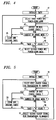
- FIG. 4 there is shown a flow chart for illustrating the operation of the cordless telephone with the desired functionality in adjusting the power cycling of the handset unit 20 between a first and a second power-up/power-down operating mode.
- the functions in this flow chart are advantageously provided by a process or program stored in ROM contained in control unit 220.
- step 41 The process is entered in step 41 where the timer 229 is initialized. From this step, the process advances to step 42 where the handset unit configured in the first power-up/power-down mode. From step 42, the process advances to decision 43 where a determination is made as to whether the handset unit is then located in the base charge cradle. If the handset unit is not in the base charge cradle, the process advances to decision 44 where a determination is made as to whether the handset unit is in the AWAKE mode. While in the AWAKE mode, the handset unit is considered to be in the full operating mode and is generally either in the PHONE or INTERCOM mode communicating with the base unit. Both the receiver and the transmitter of the handset unit are active while the handset unit is in the AWAKE mode.
- step 45 any time accumulated on the timer is cleared and the timer restarted at zero time. From step 45, the process returns to step 42.
- the process advances to decision 46 where a determination is made as to whether the time accumulated on the timer is in excess of N hours, illustratively described herein as 24 hours. If the time accumulated on the timer is less than N hours, the process returns to decision 42. If, however, the time accumulated on the timer is greater than N hours, the process advances to step 47 where the second power-up/power-down mode of operating is selected. From step 47, the process returns to the decision 43.
- FIG. 5 there is shown a flow chart illustrating the operation of the base unit 10 with the desired functionality in selecting either a first header signal or a second header signal for transmission to the handset unit.
- the second header signal has a length considerably longer than the first header signal.
- the functions in this flow chart are advantageously provided by a process or program stored in ROM contained in control unit 120.
- step 51 The process is entered in step 51 where the timer 129 in the base unit is initialized. From step 51, the process advances to step 52 where the base unit is configured for providing the first header signal to the handset unit. From step 52, the process advances to decision 53 where a determination is made as to whether the handset unit is then located in the base charge cradle. If the handset unit is not in the base charge cradle, the process advances to decision 54 where a determination is made as to whether the handset unit is in the AWAKE mode. This determination is easily made in the base unit since any communications by the handset while in the full operating mode will be made with the base unit.
- step 55 any time accumulated on the timer is cleared and the timer restarted at zero time. From step 55, the process returns to step 52.
- the process advances to decision 56 where a determination is made as to whether the time accumulated on the timer is in excess of N hours. If the time accumulated on the timer is less than N hours, the process returns to decision 52. If, however, the time accumulated on the timer is greater than N hours, the process advances to step 57 where the second header signal is selected for transmission to the handset unit. From step 57, the process returns to decision 53 where it continues to monitor whether the handset unit is in the base charge cradle and to step 54 where it determines whether the handset unit is in the AWAKE mode.
- cordless telephone system described earlier herein may be easily modified to include a third and even a fourth power-off cycle for the handset unit, these power-off cycles having increasingly longer period lengths.
- base unit would be configured to include corresponding increasingly longer header signals for use with the time dependent power-off cycles selected in the handset unit.
Landscapes
- Engineering & Computer Science (AREA)
- Computer Networks & Wireless Communication (AREA)
- Signal Processing (AREA)
- Mobile Radio Communication Systems (AREA)
- Telephone Function (AREA)
Applications Claiming Priority (2)
| Application Number | Priority Date | Filing Date | Title |
|---|---|---|---|
| US08/360,472 US5519762A (en) | 1994-12-21 | 1994-12-21 | Adaptive power cycling for a cordless telephone |
| US360472 | 1994-12-21 |
Publications (1)
| Publication Number | Publication Date |
|---|---|
| EP0719020A2 true EP0719020A2 (fr) | 1996-06-26 |
Family
ID=23418100
Family Applications (1)
| Application Number | Title | Priority Date | Filing Date |
|---|---|---|---|
| EP95308751A Withdrawn EP0719020A2 (fr) | 1994-12-21 | 1995-12-05 | Cycle adaptif de puissance pour un téléphone sans fil |
Country Status (7)
| Country | Link |
|---|---|
| US (1) | US5519762A (fr) |
| EP (1) | EP0719020A2 (fr) |
| JP (1) | JPH08265400A (fr) |
| KR (1) | KR960027585A (fr) |
| CA (1) | CA2160395A1 (fr) |
| SG (1) | SG34339A1 (fr) |
| TW (1) | TW276301B (fr) |
Cited By (1)
| Publication number | Priority date | Publication date | Assignee | Title |
|---|---|---|---|---|
| US6353749B1 (en) | 1996-09-25 | 2002-03-05 | Nokia Mobile Phones Limited | Method and arrangement for controlling the operation of mobile communication equipment in a power-off state |
Families Citing this family (67)
| Publication number | Priority date | Publication date | Assignee | Title |
|---|---|---|---|---|
| US6002918A (en) * | 1989-06-29 | 1999-12-14 | Symbol Technologies, Inc. | Power-saving arrangement and method for mobile units in communications network |
| DK0671818T3 (da) * | 1994-03-07 | 2006-04-03 | Phonak Comm Ag | Miniaturemodtager til modtagelse af et höjfrekvent frekvens- eller fasemoduleret signal |
| US6580700B1 (en) | 1995-10-27 | 2003-06-17 | Symbol Technologies, Inc. | Data rate algorithms for use in wireless local area networks |
| US5812954A (en) * | 1995-11-27 | 1998-09-22 | Nokia Mobile Phones Ltd. | Mobile telephone power key lock function |
| US6005885A (en) * | 1995-12-12 | 1999-12-21 | Intermec Ip Corp. | Methodology for discontinuous radio reception utilizing embedded frame length words |
| JPH09247035A (ja) * | 1996-03-08 | 1997-09-19 | Nec Eng Ltd | 低消費電力回路 |
| US6205343B1 (en) | 1996-05-28 | 2001-03-20 | Motorola, Inc. | Peak current reduction in a cordless telephone handset |
| US5917433A (en) * | 1996-06-26 | 1999-06-29 | Orbital Sciences Corporation | Asset monitoring system and associated method |
| US5799256A (en) * | 1996-07-17 | 1998-08-25 | Motorola, Inc. | Battery saving method and communication device using prediction of user location, movement and actions |
| JP3433019B2 (ja) * | 1996-09-12 | 2003-08-04 | 株式会社東芝 | 移動通信機とそのバッテリセービング方法 |
| JP3740231B2 (ja) * | 1996-11-19 | 2006-02-01 | キヤノン株式会社 | 無線通信システム及び無線通信装置 |
| US6078819A (en) * | 1997-11-01 | 2000-06-20 | Lucent Technologies Inc. | Apparatus and method for prolonging battery life in a portable telephone having first and second deactivating conditions |
| US6088595A (en) * | 1997-11-01 | 2000-07-11 | Lucent Technologies Inc. | Arrangement for configuring multiple portable units for communicating with each other in a frequency hopping system |
| KR100318963B1 (ko) * | 1998-11-13 | 2002-03-20 | 윤종용 | 무선단말기의소비전력감소방법 |
| US6480727B1 (en) | 1999-01-12 | 2002-11-12 | Tellabs Operations, Inc. | Using inactivity levels to extend subscriber equipment battery life |
| US6501969B1 (en) * | 1999-05-05 | 2002-12-31 | Agere Systems Inc. | Extended power savings for electronic devices |
| US7945284B1 (en) * | 1999-11-23 | 2011-05-17 | Agere Systems Inc. | Cordless telephone with MP3 player capability |
| US6678537B1 (en) * | 1999-11-23 | 2004-01-13 | Agere Systems Inc. | Adjustment of period of real-time slow drift correction of alignment of handset's local oscillator for a cordless telephone |
| KR100353460B1 (ko) * | 1999-12-29 | 2002-09-19 | 삼성전자 주식회사 | 무선단말기의 전력 제어 방법 |
| JP2001275269A (ja) * | 2000-03-28 | 2001-10-05 | Sony Corp | コードレス電話機の子機に内蔵されている2次電池の充電方法 |
| IL137123A (en) * | 2000-07-02 | 2009-07-20 | Ofer Avni | Method for monitoring cellular communications and system therefor |
| KR100396778B1 (ko) * | 2001-06-25 | 2003-09-02 | 엘지전자 주식회사 | 이동통신 단말기의 전력 제어방법 |
| DE112004000865T5 (de) * | 2003-05-19 | 2006-03-30 | Matsushita Electric Industrial Co., Ltd., Kadoma | Funkkommunikationsvorrichtung |
| US20050059406A1 (en) * | 2003-09-17 | 2005-03-17 | Trapeze Networks, Inc. | Wireless LAN measurement feedback |
| US20050059405A1 (en) * | 2003-09-17 | 2005-03-17 | Trapeze Networks, Inc. | Simulation driven wireless LAN planning |
| US7221927B2 (en) * | 2004-02-13 | 2007-05-22 | Trapeze Networks, Inc. | Station mobility between access points |
| JP2006238270A (ja) * | 2005-02-28 | 2006-09-07 | Toshiba Corp | 情報処理装置 |
| EP1867094A2 (fr) * | 2005-03-15 | 2007-12-19 | Trapeze Networks, Inc. | Systeme et procede pour distribuer les cles dans un reseau sans fil |
| US7551574B1 (en) * | 2005-03-31 | 2009-06-23 | Trapeze Networks, Inc. | Method and apparatus for controlling wireless network access privileges based on wireless client location |
| US7573859B2 (en) | 2005-10-13 | 2009-08-11 | Trapeze Networks, Inc. | System and method for remote monitoring in a wireless network |
| US7724703B2 (en) | 2005-10-13 | 2010-05-25 | Belden, Inc. | System and method for wireless network monitoring |
| US7551619B2 (en) | 2005-10-13 | 2009-06-23 | Trapeze Networks, Inc. | Identity-based networking |
| WO2007044986A2 (fr) | 2005-10-13 | 2007-04-19 | Trapeze Networks, Inc. | Systeme et procede de controle a distance dans un reseau sans fil |
| US8638762B2 (en) | 2005-10-13 | 2014-01-28 | Trapeze Networks, Inc. | System and method for network integrity |
| US20070106998A1 (en) * | 2005-10-27 | 2007-05-10 | Zeldin Paul E | Mobility system and method for messaging and inter-process communication |
| US8250587B2 (en) * | 2005-10-27 | 2012-08-21 | Trapeze Networks, Inc. | Non-persistent and persistent information setting method and system for inter-process communication |
| US20070254687A1 (en) * | 2006-05-01 | 2007-11-01 | Shary Nassimi | Wirefree Intercom Having Secure Transmission System and Process |
| US20070254680A1 (en) * | 2006-05-01 | 2007-11-01 | Shary Nassimi | Wirefree intercom having low power system and process |
| US7869823B2 (en) * | 2006-05-01 | 2011-01-11 | The Chamberlain Group, Inc. | Wirefree intercom having error free transmission system and process |
| US7558266B2 (en) * | 2006-05-03 | 2009-07-07 | Trapeze Networks, Inc. | System and method for restricting network access using forwarding databases |
| US20070260720A1 (en) * | 2006-05-03 | 2007-11-08 | Morain Gary E | Mobility domain |
| US8966018B2 (en) | 2006-05-19 | 2015-02-24 | Trapeze Networks, Inc. | Automated network device configuration and network deployment |
| US20070268516A1 (en) * | 2006-05-19 | 2007-11-22 | Jamsheed Bugwadia | Automated policy-based network device configuration and network deployment |
| US20070268515A1 (en) * | 2006-05-19 | 2007-11-22 | Yun Freund | System and method for automatic configuration of remote network switch and connected access point devices |
| US20070268506A1 (en) * | 2006-05-19 | 2007-11-22 | Paul Zeldin | Autonomous auto-configuring wireless network device |
| US20070268514A1 (en) * | 2006-05-19 | 2007-11-22 | Paul Zeldin | Method and business model for automated configuration and deployment of a wireless network in a facility without network administrator intervention |
| US7577453B2 (en) * | 2006-06-01 | 2009-08-18 | Trapeze Networks, Inc. | Wireless load balancing across bands |
| US9191799B2 (en) | 2006-06-09 | 2015-11-17 | Juniper Networks, Inc. | Sharing data between wireless switches system and method |
| US7912982B2 (en) * | 2006-06-09 | 2011-03-22 | Trapeze Networks, Inc. | Wireless routing selection system and method |
| US9258702B2 (en) | 2006-06-09 | 2016-02-09 | Trapeze Networks, Inc. | AP-local dynamic switching |
| US8818322B2 (en) | 2006-06-09 | 2014-08-26 | Trapeze Networks, Inc. | Untethered access point mesh system and method |
| US7844298B2 (en) * | 2006-06-12 | 2010-11-30 | Belden Inc. | Tuned directional antennas |
| US7724704B2 (en) * | 2006-07-17 | 2010-05-25 | Beiden Inc. | Wireless VLAN system and method |
| US8340110B2 (en) | 2006-09-15 | 2012-12-25 | Trapeze Networks, Inc. | Quality of service provisioning for wireless networks |
| US8072952B2 (en) | 2006-10-16 | 2011-12-06 | Juniper Networks, Inc. | Load balancing |
| US20080107077A1 (en) * | 2006-11-03 | 2008-05-08 | James Murphy | Subnet mobility supporting wireless handoff |
| JP4661777B2 (ja) * | 2006-12-27 | 2011-03-30 | ブラザー工業株式会社 | コードレス通信システム |
| US7873061B2 (en) | 2006-12-28 | 2011-01-18 | Trapeze Networks, Inc. | System and method for aggregation and queuing in a wireless network |
| WO2008083339A2 (fr) * | 2006-12-28 | 2008-07-10 | Trapeze Networks, Inc. | Système de réseau sans fil compatible à l'application et procédé |
| US8902904B2 (en) | 2007-09-07 | 2014-12-02 | Trapeze Networks, Inc. | Network assignment based on priority |
| US8509128B2 (en) * | 2007-09-18 | 2013-08-13 | Trapeze Networks, Inc. | High level instruction convergence function |
| US8238942B2 (en) | 2007-11-21 | 2012-08-07 | Trapeze Networks, Inc. | Wireless station location detection |
| US8150357B2 (en) | 2008-03-28 | 2012-04-03 | Trapeze Networks, Inc. | Smoothing filter for irregular update intervals |
| US8474023B2 (en) | 2008-05-30 | 2013-06-25 | Juniper Networks, Inc. | Proactive credential caching |
| US8978105B2 (en) * | 2008-07-25 | 2015-03-10 | Trapeze Networks, Inc. | Affirming network relationships and resource access via related networks |
| US8238298B2 (en) | 2008-08-29 | 2012-08-07 | Trapeze Networks, Inc. | Picking an optimal channel for an access point in a wireless network |
| US8542836B2 (en) | 2010-12-01 | 2013-09-24 | Juniper Networks, Inc. | System, apparatus and methods for highly scalable continuous roaming within a wireless network |
Citations (3)
| Publication number | Priority date | Publication date | Assignee | Title |
|---|---|---|---|---|
| US4731814A (en) | 1986-02-21 | 1988-03-15 | AT&T Information Systems Inc. American Telephone & Telegraph Company | Computer-controlled cordless telephone |
| US4736404A (en) | 1985-03-29 | 1988-04-05 | American Telephone And Telegraph Company, At&T Technologies Inc. | Security arrangement for cordless telephone system |
| US5044010A (en) | 1990-03-29 | 1991-08-27 | At&T Bell Laboratories | Arrangement and method for selecting an available communication channel for a cordless telephone |
Family Cites Families (3)
| Publication number | Priority date | Publication date | Assignee | Title |
|---|---|---|---|---|
| US5128938A (en) * | 1989-03-03 | 1992-07-07 | Motorola, Inc. | Energy saving protocol for a communication system |
| US5237603A (en) * | 1989-12-11 | 1993-08-17 | Sony Corporation | Cordless telephone which intermittently monitors predetermined channels from all available channels |
| JP2796464B2 (ja) * | 1991-12-27 | 1998-09-10 | 株式会社日立製作所 | 無線通信システム、および、無線通信方法 |
-
1994
- 1994-12-21 US US08/360,472 patent/US5519762A/en not_active Expired - Lifetime
-
1995
- 1995-03-31 TW TW084103149A patent/TW276301B/zh active
- 1995-10-12 CA CA002160395A patent/CA2160395A1/fr not_active Abandoned
- 1995-12-05 EP EP95308751A patent/EP0719020A2/fr not_active Withdrawn
- 1995-12-19 SG SG1995002221A patent/SG34339A1/en unknown
- 1995-12-20 JP JP7331272A patent/JPH08265400A/ja not_active Withdrawn
- 1995-12-20 KR KR1019950052567A patent/KR960027585A/ko not_active Withdrawn
Patent Citations (3)
| Publication number | Priority date | Publication date | Assignee | Title |
|---|---|---|---|---|
| US4736404A (en) | 1985-03-29 | 1988-04-05 | American Telephone And Telegraph Company, At&T Technologies Inc. | Security arrangement for cordless telephone system |
| US4731814A (en) | 1986-02-21 | 1988-03-15 | AT&T Information Systems Inc. American Telephone & Telegraph Company | Computer-controlled cordless telephone |
| US5044010A (en) | 1990-03-29 | 1991-08-27 | At&T Bell Laboratories | Arrangement and method for selecting an available communication channel for a cordless telephone |
Cited By (1)
| Publication number | Priority date | Publication date | Assignee | Title |
|---|---|---|---|---|
| US6353749B1 (en) | 1996-09-25 | 2002-03-05 | Nokia Mobile Phones Limited | Method and arrangement for controlling the operation of mobile communication equipment in a power-off state |
Also Published As
| Publication number | Publication date |
|---|---|
| CA2160395A1 (fr) | 1996-06-22 |
| TW276301B (en) | 1996-05-21 |
| KR960027585A (ko) | 1996-07-22 |
| JPH08265400A (ja) | 1996-10-11 |
| SG34339A1 (en) | 1996-12-06 |
| US5519762A (en) | 1996-05-21 |
Similar Documents
| Publication | Publication Date | Title |
|---|---|---|
| US5519762A (en) | Adaptive power cycling for a cordless telephone | |
| US4731814A (en) | Computer-controlled cordless telephone | |
| US5353341A (en) | Cordless telephone arranged for operation in a frequency hopping system | |
| US6148213A (en) | Method and apparatus for accessing a telephone answering device from a cordless telephone portable unit | |
| US5568510A (en) | Apparatus and method for obtaining synchronism between a base station and a portable unit arranged for operation in a frequency hopping system | |
| US4897864A (en) | Control method and appartus for a radio telephone system | |
| EP0435775B1 (fr) | Téléphone sans fil | |
| KR920009334B1 (ko) | 무선전화장치 | |
| JP2664923B2 (ja) | 無線電話装置 | |
| US6411808B1 (en) | Portable terminal equipment | |
| JPH05327586A (ja) | 間欠受信方式 | |
| EP0494459A2 (fr) | Système de sonnerie distinctive pour un téléphone sans fil | |
| EP0433166B1 (fr) | Téléphone sans fil | |
| JPS5912055B2 (ja) | 移動通信方式 | |
| JPH06311101A (ja) | 携帯無線電話装置 | |
| KR0141655B1 (ko) | 무선 전화기 핸디 통화중 밧데리 방전시 베이스로 자동 통화 절환 방법 | |
| KR100424632B1 (ko) | 키폰시스템에서 주야간 모드 설정 방법 | |
| KR0173074B1 (ko) | 구내전화 사용시 시외통화 방지장치 | |
| JPH0753322Y2 (ja) | コードレス電話機における信号伝送制御装置 | |
| JPH0295056A (ja) | コードレス電話機 | |
| JPH0787166A (ja) | ディジタルコードレス電話 | |
| JPH08223283A (ja) | 電話機装置 | |
| JPH03198559A (ja) | コードレステレホンシステム | |
| JPH0425232A (ja) | 無線電話機 | |
| JPH01236740A (ja) | 無線電話装置 |
Legal Events
| Date | Code | Title | Description |
|---|---|---|---|
| PUAI | Public reference made under article 153(3) epc to a published international application that has entered the european phase |
Free format text: ORIGINAL CODE: 0009012 |
|
| AK | Designated contracting states |
Kind code of ref document: A2 Designated state(s): DE FR GB IT |
|
| STAA | Information on the status of an ep patent application or granted ep patent |
Free format text: STATUS: THE APPLICATION HAS BEEN WITHDRAWN |
|
| 18W | Application withdrawn |
Withdrawal date: 19980901 |