EP0719621B1 - Färben von Holzfurnieren mit Küpenfarbstoffen - Google Patents
Färben von Holzfurnieren mit Küpenfarbstoffen Download PDFInfo
- Publication number
- EP0719621B1 EP0719621B1 EP95120131A EP95120131A EP0719621B1 EP 0719621 B1 EP0719621 B1 EP 0719621B1 EP 95120131 A EP95120131 A EP 95120131A EP 95120131 A EP95120131 A EP 95120131A EP 0719621 B1 EP0719621 B1 EP 0719621B1
- Authority
- EP
- European Patent Office
- Prior art keywords
- wood
- dyeing
- dye
- previous
- sheets according
- Prior art date
- Legal status (The legal status is an assumption and is not a legal conclusion. Google has not performed a legal analysis and makes no representation as to the accuracy of the status listed.)
- Expired - Lifetime
Links
- 239000002023 wood Substances 0.000 title claims abstract description 60
- 238000004043 dyeing Methods 0.000 title claims abstract description 41
- 239000000975 dye Substances 0.000 title claims abstract description 36
- 238000000034 method Methods 0.000 claims abstract description 41
- 239000000984 vat dye Substances 0.000 claims abstract description 29
- QTWZICCBKBYHDM-UHFFFAOYSA-N leucomethylene blue Chemical compound C1=C(N(C)C)C=C2SC3=CC(N(C)C)=CC=C3NC2=C1 QTWZICCBKBYHDM-UHFFFAOYSA-N 0.000 claims abstract description 15
- 230000003647 oxidation Effects 0.000 claims abstract description 10
- 238000007254 oxidation reaction Methods 0.000 claims abstract description 10
- 229920002522 Wood fibre Polymers 0.000 claims abstract description 7
- 238000010521 absorption reaction Methods 0.000 claims abstract description 4
- 238000004040 coloring Methods 0.000 claims abstract description 3
- 239000000126 substance Substances 0.000 claims description 16
- QTBSBXVTEAMEQO-UHFFFAOYSA-N Acetic acid Chemical compound CC(O)=O QTBSBXVTEAMEQO-UHFFFAOYSA-N 0.000 claims description 12
- 230000000694 effects Effects 0.000 claims description 9
- MHAJPDPJQMAIIY-UHFFFAOYSA-N Hydrogen peroxide Chemical compound OO MHAJPDPJQMAIIY-UHFFFAOYSA-N 0.000 claims description 8
- 239000003638 chemical reducing agent Substances 0.000 claims description 7
- LYCAIKOWRPUZTN-UHFFFAOYSA-N Ethylene glycol Chemical compound OCCO LYCAIKOWRPUZTN-UHFFFAOYSA-N 0.000 claims description 6
- PEDCQBHIVMGVHV-UHFFFAOYSA-N Glycerine Chemical compound OCC(O)CO PEDCQBHIVMGVHV-UHFFFAOYSA-N 0.000 claims description 6
- 239000004094 surface-active agent Substances 0.000 claims description 6
- QVGXLLKOCUKJST-UHFFFAOYSA-N atomic oxygen Chemical compound [O] QVGXLLKOCUKJST-UHFFFAOYSA-N 0.000 claims description 5
- 239000001301 oxygen Substances 0.000 claims description 5
- 229910052760 oxygen Inorganic materials 0.000 claims description 5
- XBDQKXXYIPTUBI-UHFFFAOYSA-N dimethylselenoniopropionate Natural products CCC(O)=O XBDQKXXYIPTUBI-UHFFFAOYSA-N 0.000 claims description 4
- 230000003472 neutralizing effect Effects 0.000 claims description 4
- 230000035515 penetration Effects 0.000 claims description 4
- XLYOFNOQVPJJNP-UHFFFAOYSA-N water Substances O XLYOFNOQVPJJNP-UHFFFAOYSA-N 0.000 claims description 4
- 239000003795 chemical substances by application Substances 0.000 claims description 3
- 239000012279 sodium borohydride Substances 0.000 claims description 3
- 229910000033 sodium borohydride Inorganic materials 0.000 claims description 3
- 238000009736 wetting Methods 0.000 claims description 3
- 239000002202 Polyethylene glycol Substances 0.000 claims description 2
- DWAQJAXMDSEUJJ-UHFFFAOYSA-M Sodium bisulfite Chemical compound [Na+].OS([O-])=O DWAQJAXMDSEUJJ-UHFFFAOYSA-M 0.000 claims description 2
- 239000003792 electrolyte Substances 0.000 claims description 2
- 238000006386 neutralization reaction Methods 0.000 claims description 2
- 229920001223 polyethylene glycol Polymers 0.000 claims description 2
- 235000019260 propionic acid Nutrition 0.000 claims description 2
- IUVKMZGDUIUOCP-BTNSXGMBSA-N quinbolone Chemical compound O([C@H]1CC[C@H]2[C@H]3[C@@H]([C@]4(C=CC(=O)C=C4CC3)C)CC[C@@]21C)C1=CCCC1 IUVKMZGDUIUOCP-BTNSXGMBSA-N 0.000 claims description 2
- JVBXVOWTABLYPX-UHFFFAOYSA-L sodium dithionite Chemical compound [Na+].[Na+].[O-]S(=O)S([O-])=O JVBXVOWTABLYPX-UHFFFAOYSA-L 0.000 claims description 2
- 239000004289 sodium hydrogen sulphite Substances 0.000 claims description 2
- 235000010267 sodium hydrogen sulphite Nutrition 0.000 claims description 2
- 239000002904 solvent Substances 0.000 claims description 2
- 238000007792 addition Methods 0.000 claims 2
- 239000005708 Sodium hypochlorite Substances 0.000 claims 1
- 238000007599 discharging Methods 0.000 claims 1
- 238000001035 drying Methods 0.000 claims 1
- 238000011946 reduction process Methods 0.000 claims 1
- SUKJFIGYRHOWBL-UHFFFAOYSA-N sodium hypochlorite Chemical compound [Na+].Cl[O-] SUKJFIGYRHOWBL-UHFFFAOYSA-N 0.000 claims 1
- 230000006641 stabilisation Effects 0.000 claims 1
- HEMHJVSKTPXQMS-UHFFFAOYSA-M Sodium hydroxide Chemical compound [OH-].[Na+] HEMHJVSKTPXQMS-UHFFFAOYSA-M 0.000 description 12
- 239000000463 material Substances 0.000 description 6
- 238000002360 preparation method Methods 0.000 description 5
- FAPWRFPIFSIZLT-UHFFFAOYSA-M Sodium chloride Chemical compound [Na+].[Cl-] FAPWRFPIFSIZLT-UHFFFAOYSA-M 0.000 description 4
- 239000000980 acid dye Substances 0.000 description 4
- 235000011121 sodium hydroxide Nutrition 0.000 description 4
- 235000009414 Elaeocarpus kirtonii Nutrition 0.000 description 3
- OWYWGLHRNBIFJP-UHFFFAOYSA-N Ipazine Chemical compound CCN(CC)C1=NC(Cl)=NC(NC(C)C)=N1 OWYWGLHRNBIFJP-UHFFFAOYSA-N 0.000 description 3
- 241000219000 Populus Species 0.000 description 3
- 235000013584 Tabebuia pallida Nutrition 0.000 description 3
- 244000236151 Tabebuia pallida Species 0.000 description 3
- 238000010586 diagram Methods 0.000 description 3
- 239000000835 fiber Substances 0.000 description 3
- SJEYSFABYSGQBG-UHFFFAOYSA-M Patent blue Chemical compound [Na+].C1=CC(N(CC)CC)=CC=C1C(C=1C(=CC(=CC=1)S([O-])(=O)=O)S([O-])(=O)=O)=C1C=CC(=[N+](CC)CC)C=C1 SJEYSFABYSGQBG-UHFFFAOYSA-M 0.000 description 2
- 230000015572 biosynthetic process Effects 0.000 description 2
- 230000000052 comparative effect Effects 0.000 description 2
- 238000011156 evaluation Methods 0.000 description 2
- WQYVRQLZKVEZGA-UHFFFAOYSA-N hypochlorite Chemical compound Cl[O-] WQYVRQLZKVEZGA-UHFFFAOYSA-N 0.000 description 2
- UHOKSCJSTAHBSO-UHFFFAOYSA-N indanthrone blue Chemical compound C1=CC=C2C(=O)C3=CC=C4NC5=C6C(=O)C7=CC=CC=C7C(=O)C6=CC=C5NC4=C3C(=O)C2=C1 UHOKSCJSTAHBSO-UHFFFAOYSA-N 0.000 description 2
- 238000004519 manufacturing process Methods 0.000 description 2
- 239000011780 sodium chloride Substances 0.000 description 2
- LPXPTNMVRIOKMN-UHFFFAOYSA-M sodium nitrite Chemical compound [Na+].[O-]N=O LPXPTNMVRIOKMN-UHFFFAOYSA-M 0.000 description 2
- GFFQNEGBFFGLQG-UHFFFAOYSA-N vat yellow 2 Chemical compound S1C2=C3C(=O)C4=CC=C5N=C(C=6C=CC=CC=6)SC5=C4C(=O)C3=CC=C2N=C1C1=CC=CC=C1 GFFQNEGBFFGLQG-UHFFFAOYSA-N 0.000 description 2
- 235000018185 Betula X alpestris Nutrition 0.000 description 1
- 235000018212 Betula X uliginosa Nutrition 0.000 description 1
- LSNNMFCWUKXFEE-UHFFFAOYSA-M Bisulfite Chemical compound OS([O-])=O LSNNMFCWUKXFEE-UHFFFAOYSA-M 0.000 description 1
- 241000167854 Bourreria succulenta Species 0.000 description 1
- 240000000731 Fagus sylvatica Species 0.000 description 1
- 235000010099 Fagus sylvatica Nutrition 0.000 description 1
- WQZGKKKJIJFFOK-GASJEMHNSA-N Glucose Natural products OC[C@H]1OC(O)[C@H](O)[C@@H](O)[C@@H]1O WQZGKKKJIJFFOK-GASJEMHNSA-N 0.000 description 1
- 239000007832 Na2SO4 Substances 0.000 description 1
- 235000008331 Pinus X rigitaeda Nutrition 0.000 description 1
- 241000018646 Pinus brutia Species 0.000 description 1
- 235000011613 Pinus brutia Nutrition 0.000 description 1
- 241000274582 Pycnanthus angolensis Species 0.000 description 1
- 241000219492 Quercus Species 0.000 description 1
- 235000016976 Quercus macrolepis Nutrition 0.000 description 1
- 239000004115 Sodium Silicate Substances 0.000 description 1
- PMZURENOXWZQFD-UHFFFAOYSA-L Sodium Sulfate Chemical compound [Na+].[Na+].[O-]S([O-])(=O)=O PMZURENOXWZQFD-UHFFFAOYSA-L 0.000 description 1
- 239000002253 acid Substances 0.000 description 1
- 238000010306 acid treatment Methods 0.000 description 1
- NIXOWILDQLNWCW-UHFFFAOYSA-N acrylic acid group Chemical group C(C=C)(=O)O NIXOWILDQLNWCW-UHFFFAOYSA-N 0.000 description 1
- 230000032683 aging Effects 0.000 description 1
- 239000000981 basic dye Substances 0.000 description 1
- WQZGKKKJIJFFOK-VFUOTHLCSA-N beta-D-glucose Chemical compound OC[C@H]1O[C@@H](O)[C@H](O)[C@@H](O)[C@@H]1O WQZGKKKJIJFFOK-VFUOTHLCSA-N 0.000 description 1
- 230000015556 catabolic process Effects 0.000 description 1
- 239000001913 cellulose Substances 0.000 description 1
- 229920002678 cellulose Polymers 0.000 description 1
- 235000019693 cherries Nutrition 0.000 description 1
- 239000003086 colorant Substances 0.000 description 1
- 238000006731 degradation reaction Methods 0.000 description 1
- 239000000982 direct dye Substances 0.000 description 1
- FTZLWXQKVFFWLY-UHFFFAOYSA-L disodium;2,5-dichloro-4-[3-methyl-5-oxo-4-[(4-sulfonatophenyl)diazenyl]-4h-pyrazol-1-yl]benzenesulfonate Chemical compound [Na+].[Na+].CC1=NN(C=2C(=CC(=C(Cl)C=2)S([O-])(=O)=O)Cl)C(=O)C1N=NC1=CC=C(S([O-])(=O)=O)C=C1 FTZLWXQKVFFWLY-UHFFFAOYSA-L 0.000 description 1
- GRWZHXKQBITJKP-UHFFFAOYSA-N dithionous acid Chemical compound OS(=O)S(O)=O GRWZHXKQBITJKP-UHFFFAOYSA-N 0.000 description 1
- 125000000524 functional group Chemical group 0.000 description 1
- 239000008103 glucose Substances 0.000 description 1
- 238000005470 impregnation Methods 0.000 description 1
- 239000012535 impurity Substances 0.000 description 1
- 125000000468 ketone group Chemical group 0.000 description 1
- 150000002605 large molecules Chemical class 0.000 description 1
- 229920005610 lignin Polymers 0.000 description 1
- 229920002521 macromolecule Polymers 0.000 description 1
- 239000000203 mixture Substances 0.000 description 1
- 239000005445 natural material Substances 0.000 description 1
- 238000001782 photodegradation Methods 0.000 description 1
- 238000006303 photolysis reaction Methods 0.000 description 1
- 230000015843 photosynthesis, light reaction Effects 0.000 description 1
- 239000011120 plywood Substances 0.000 description 1
- 229920000728 polyester Polymers 0.000 description 1
- 229920002635 polyurethane Polymers 0.000 description 1
- 239000004814 polyurethane Substances 0.000 description 1
- 230000001172 regenerating effect Effects 0.000 description 1
- 238000004088 simulation Methods 0.000 description 1
- 235000010288 sodium nitrite Nutrition 0.000 description 1
- NTHWMYGWWRZVTN-UHFFFAOYSA-N sodium silicate Chemical compound [Na+].[Na+].[O-][Si]([O-])=O NTHWMYGWWRZVTN-UHFFFAOYSA-N 0.000 description 1
- 229910052911 sodium silicate Inorganic materials 0.000 description 1
- 229910052938 sodium sulfate Inorganic materials 0.000 description 1
- 235000011152 sodium sulphate Nutrition 0.000 description 1
- NTOOJLUHUFUGQI-UHFFFAOYSA-M sodium;4-(4-acetamidoanilino)-1-amino-9,10-dioxoanthracene-2-sulfonate Chemical compound [Na+].C1=CC(NC(=O)C)=CC=C1NC1=CC(S([O-])(=O)=O)=C(N)C2=C1C(=O)C1=CC=CC=C1C2=O NTOOJLUHUFUGQI-UHFFFAOYSA-M 0.000 description 1
- 239000000758 substrate Substances 0.000 description 1
- 239000004753 textile Substances 0.000 description 1
- 230000000007 visual effect Effects 0.000 description 1
- 229910052724 xenon Inorganic materials 0.000 description 1
- FHNFHKCVQCLJFQ-UHFFFAOYSA-N xenon atom Chemical compound [Xe] FHNFHKCVQCLJFQ-UHFFFAOYSA-N 0.000 description 1
Images

Classifications
-
- B—PERFORMING OPERATIONS; TRANSPORTING
- B27—WORKING OR PRESERVING WOOD OR SIMILAR MATERIAL; NAILING OR STAPLING MACHINES IN GENERAL
- B27K—PROCESSES, APPARATUS OR SELECTION OF SUBSTANCES FOR IMPREGNATING, STAINING, DYEING, BLEACHING OF WOOD OR SIMILAR MATERIALS, OR TREATING OF WOOD OR SIMILAR MATERIALS WITH PERMEANT LIQUIDS, NOT OTHERWISE PROVIDED FOR; CHEMICAL OR PHYSICAL TREATMENT OF CORK, CANE, REED, STRAW OR SIMILAR MATERIALS
- B27K5/00—Treating of wood not provided for in groups B27K1/00, B27K3/00
- B27K5/04—Combined bleaching or impregnating and drying of wood
-
- B—PERFORMING OPERATIONS; TRANSPORTING
- B27—WORKING OR PRESERVING WOOD OR SIMILAR MATERIAL; NAILING OR STAPLING MACHINES IN GENERAL
- B27K—PROCESSES, APPARATUS OR SELECTION OF SUBSTANCES FOR IMPREGNATING, STAINING, DYEING, BLEACHING OF WOOD OR SIMILAR MATERIALS, OR TREATING OF WOOD OR SIMILAR MATERIALS WITH PERMEANT LIQUIDS, NOT OTHERWISE PROVIDED FOR; CHEMICAL OR PHYSICAL TREATMENT OF CORK, CANE, REED, STRAW OR SIMILAR MATERIALS
- B27K3/00—Impregnating wood, e.g. impregnation pretreatment, for example puncturing; Wood impregnation aids not directly involved in the impregnation process
- B27K3/02—Processes; Apparatus
- B27K3/0278—Processes; Apparatus involving an additional treatment during or after impregnation
-
- B—PERFORMING OPERATIONS; TRANSPORTING
- B27—WORKING OR PRESERVING WOOD OR SIMILAR MATERIAL; NAILING OR STAPLING MACHINES IN GENERAL
- B27K—PROCESSES, APPARATUS OR SELECTION OF SUBSTANCES FOR IMPREGNATING, STAINING, DYEING, BLEACHING OF WOOD OR SIMILAR MATERIALS, OR TREATING OF WOOD OR SIMILAR MATERIALS WITH PERMEANT LIQUIDS, NOT OTHERWISE PROVIDED FOR; CHEMICAL OR PHYSICAL TREATMENT OF CORK, CANE, REED, STRAW OR SIMILAR MATERIALS
- B27K3/00—Impregnating wood, e.g. impregnation pretreatment, for example puncturing; Wood impregnation aids not directly involved in the impregnation process
- B27K3/16—Inorganic impregnating agents
-
- B—PERFORMING OPERATIONS; TRANSPORTING
- B27—WORKING OR PRESERVING WOOD OR SIMILAR MATERIAL; NAILING OR STAPLING MACHINES IN GENERAL
- B27K—PROCESSES, APPARATUS OR SELECTION OF SUBSTANCES FOR IMPREGNATING, STAINING, DYEING, BLEACHING OF WOOD OR SIMILAR MATERIALS, OR TREATING OF WOOD OR SIMILAR MATERIALS WITH PERMEANT LIQUIDS, NOT OTHERWISE PROVIDED FOR; CHEMICAL OR PHYSICAL TREATMENT OF CORK, CANE, REED, STRAW OR SIMILAR MATERIALS
- B27K5/00—Treating of wood not provided for in groups B27K1/00, B27K3/00
- B27K5/001—Heating
-
- B—PERFORMING OPERATIONS; TRANSPORTING
- B27—WORKING OR PRESERVING WOOD OR SIMILAR MATERIAL; NAILING OR STAPLING MACHINES IN GENERAL
- B27K—PROCESSES, APPARATUS OR SELECTION OF SUBSTANCES FOR IMPREGNATING, STAINING, DYEING, BLEACHING OF WOOD OR SIMILAR MATERIALS, OR TREATING OF WOOD OR SIMILAR MATERIALS WITH PERMEANT LIQUIDS, NOT OTHERWISE PROVIDED FOR; CHEMICAL OR PHYSICAL TREATMENT OF CORK, CANE, REED, STRAW OR SIMILAR MATERIALS
- B27K5/00—Treating of wood not provided for in groups B27K1/00, B27K3/00
- B27K5/02—Staining or dyeing wood; Bleaching wood
-
- C—CHEMISTRY; METALLURGY
- C09—DYES; PAINTS; POLISHES; NATURAL RESINS; ADHESIVES; COMPOSITIONS NOT OTHERWISE PROVIDED FOR; APPLICATIONS OF MATERIALS NOT OTHERWISE PROVIDED FOR
- C09D—COATING COMPOSITIONS, e.g. PAINTS, VARNISHES OR LACQUERS; FILLING PASTES; CHEMICAL PAINT OR INK REMOVERS; INKS; CORRECTING FLUIDS; WOODSTAINS; PASTES OR SOLIDS FOR COLOURING OR PRINTING; USE OF MATERIALS THEREFOR
- C09D15/00—Woodstains
Definitions
- the present invention relates to dyeing of a wood material in the form of sheets of wood intended for the production of veneering, wood panels, a multilaminar wood product and others.
- Dyeing refers in particular here to the obtaining of even colouring throughout the thickness of the wood material.
- the dyeing method according to the present invention can be applied to sheets of wood of various wood types, both coniferous and broad-leaved, such as for example poplar, beech, oak, pine, fir, ash, birch, cherry, Nigerian Whitewood, "koto”, “ilomba” (Pycanthus kombo) etc., which can be used for veneering or for preparing multilaminar wood or forforming wood-based panels.
- the traditional dyeing system referred above causes low light fastness to be obtained due to phenomena of photodegradation under exposure to light, phenomena which vary according to the tone, dye and substrate.
- the colour change of dyed woods exposed to the light is due mainly to the formation of free radicals generated by the photolysis of some chemical bonds both in the molecules of the wood (lignin, cellulose, hernicellulose etc.) and in those of the dyes, particularly if small in size, as are those mentioned above normally.
- the action of light oxidation caused by the radicals is also accelerated by various factors such as atmospheric oxygen and humidity.
- JP-A-56 056 810 a process for dyeing wood using vat dye solutions under pressure is described.
- the general object of the present invention is that of obtaining a dyed wood with high fastness to light.
- Present invention concern also a dyed sheet of wood obtained with the above cited method of dyeing wood by using a dye chosen in the "vat dye” class.
- vat dyes By dyes belonging to the class of vat dyes we refer to those indicated under the item "Vat Dyes” of the Color Index published by the American Society of Dyers and Colourists, such as for example Indanthren from BASF, Cibanone from Ciba Geigy, Sandotrene from Sandoz and others.
- the wood sheets dyed with vat dyes and the materials which can be obtained therefrom have brilliant colours which are also very fast to light.
- vat dyes are normally insoluble in water, but can be dissolved in a form defined as "leuco" by reduction of some functional groups such as for example the ketone groups.
- the fibre is immersed in the solution containing the leuco form of the dye, stabilised if necessary, and, when it has diffused, the dye is restored by oxidation of the leuco form absorbed by the fibre.
- the dyes belonging to the vat class normally consist of large molecules with intrinsic features of resistance to attacks by radicals.
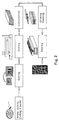
- the sheets if necessary purged of chromophorous impurities and otherwise, are placed in a dyebath containing at least one vat dye previously reduced into a soluble form (leuco) (see preparation 1 of Fig. 1), together with a certain amount of agents for reducing and correcting the pH level, suitable for preventing oxidation of the dyes themselves during the process of impregnation of the wood.
- a dyebath containing at least one vat dye previously reduced into a soluble form (leuco) (see preparation 1 of Fig. 1), together with a certain amount of agents for reducing and correcting the pH level, suitable for preventing oxidation of the dyes themselves during the process of impregnation of the wood.
- the quantity of reducing agents is to be determined on each occasion in such a way that said quantity is sufficient for neutralising the oxidating effect of the oxygen present both in the air above the dyebath and in the solvent, and such as to neutralise the oxidating effect of the wood being dyed.
- vat dye substances that facilitate or improve the penetration of vat dye are surface-active agents, such as a wetting surfactant agent. These substances facilitating penetration of the vat dye can also be electrolytes (NaCl, Na2SO4 etc.).
- the time and temperature required for dyeing with the dye in reduced form will depend on the type and thickness of the wood used; purely by way of an example, purged broad-leaved sheets with a thickness smaller than 1 mm require times varying from 30 minutes to 12 hours, with temperatures of between 60° and 110°C.
- hydrosulphite is normally chosen as a reducing substance, even if other substances can be used such as for example bisulphite with sodium borohydride.
- phase of absorption of the dye in leuco form After the phase of absorption of the dye in leuco form, the phase of fixing of the same by oxidation is performed.
- said oxidation process is performed by the formation of a bath containing substances such as for example hydrogen peroxide, hypochlorite or gaseous oxygen at a temperature of between 40° and 105° for a time sufficient for restoring the insoluble form of the dye (30 minutes - 2 hours).
- substances such as for example hydrogen peroxide, hypochlorite or gaseous oxygen at a temperature of between 40° and 105° for a time sufficient for restoring the insoluble form of the dye (30 minutes - 2 hours).
- said oxidation process can also be carried out by exposure to air.
- a second preferred embodiment of the method of the present invention foresees preparation of the reduced form of the dye, belonging to the vat class, directly in the dyebath, by adding a suitable quantity of reducing agents at controlled pH (normally alkaline).
- vat dyes known as "solubilised” are foreseen, in other words those in which the soluble leuco form is prepared and stabilised in a period of time prior to and independent of dyeing.
- a fourth preferred embodiment finally foresees the reduction of the dye to the soluble form electrochemically, and also possible maintaining of this state in the dyebath itself, again via this method (cf. preparation 4 of Figure 1).
- Broad-leaved wood (Nigerian Whitewood) processed into sheets with a thickness of 0.60 mm is purged at 100°C in a bath containing 66 cc/l of 35% hydrogen peroxide, 4 g/l of sodium silicate with pH 10 through sodium hydroxide until the undesirable substances are eliminated.
- the leuco form of the colour combination required is prepared by dissolving a sufficient quantity of dye for obtaining a concentration in the dyebath of 1 g/l of Vat Yellow 2 (NGC Sandotrene Yellow from Sandoz), Vat Blue 66 (Clf Indanthren Blue from BASF) and Vat Red 13 (6BMD Cibanone Red from Ciba Geigy) in a volume of water equal to a sixth of the dyebath itself (preparation of the vat) with a mixture of sodium bisulphite plus sodium borohydride with pH 13.5 through caustic soda until the litmus paper for vat dyes (Vat Yellow 2) changes colour.
- Vat Yellow 2 NNC Sandotrene Yellow from Sandoz
- Vat Blue 66 Clf Indanthren Blue from BASF
- Vat Red 13 6BMD Cibanone Red from Ciba Geigy
- Dyeing is then performed by immersing the purged wood in a bath containing the dye, previously prepared in the leuco form in the manner described above, with pH 13 through NaOH with 8 g/l of wetting surfactant agent (Primasol NF from BASF) added, constantly checking (every 30 minutes) the state of reduction of the bath by appropriate litmus paper and if necessary restoring the suitable dyeing conditions by sodium hydrosulphite and NaOH.
- wetting surfactant agent Primary NF from BASF
- the wood is finally stabilised by neutralising the fibre via acid treatment with acetic acid, with 2 g/l polyethylene glycol added, at 95°C for one hour.
- Broad-leaved wood (poplar) processed into sheets with a thickness of 0.75 mm is dyed using 2 g/l of Vat Red 13 (6BMD Cibanone Red from Ciba Geigy) reduced to the leuco form and maintained in this form by electrolytic reduction in an ionic environment through sodium chloride at 99°C for 6 hours.
- Vat Red 13 6BMD Cibanone Red from Ciba Geigy
- the dyes are oxidated by exposing the individual sheets to the air for a time sufficiently long for regenerating the original colour.
- the sheets dyed in the two ways described above are dried according to known procedures, for example in a hot air tunnel.
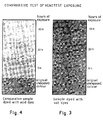
- sample of wood dyed according to the present invention with a dye belonging to the vat class does not show any substantial loss of colour even after exposure of over fifty hours.
Landscapes
- Life Sciences & Earth Sciences (AREA)
- Engineering & Computer Science (AREA)
- Wood Science & Technology (AREA)
- Forests & Forestry (AREA)
- Chemical & Material Sciences (AREA)
- Inorganic Chemistry (AREA)
- Materials Engineering (AREA)
- Organic Chemistry (AREA)
- Chemical And Physical Treatments For Wood And The Like (AREA)
- Coloring (AREA)
- Paints Or Removers (AREA)
Claims (17)
- Eine Methode zum Färben von Holzfurnieren, die folgendes umfaßt:das Eintauchen der Holzfurniere in eine Küpe, die ein Farbbad enthält, welches mindestens einen Küpenfarbstoff in einer wasserlöslichen Leukoform und mindestens eine Substanz umfaßt, die aus oberflächenaktiven Mitteln, Elektrolyten und Imprägnierungsmitteln ausgewählt wird, um das Eindringen des Küpenfarbstoffs in die Holzfasern zu verstärken;die Durchführung der Färbung unter Atmosphärendruck, während der alkalische pH-Wert des Farbbads regelmäßig überprüft wird, um eine optimale Stabilisierung der Leukoform des aufgelösten Küpenfarbstoffs zu garantieren;das Ablassen des Farbbads und Oxydieren des in die Holzfurniere eingezogenen Küpenfarbstoffs, um den Küpenfarbstoff wieder in eine stabile, unlösliche Form zu bringen;die Neutralisation der gefärbten Holzfurniere;das Trocknen der Holzfurniere.
- Eine Methode zum Färben von Holzfurnieren gemäß Anspruch 1,
dadurch gekennzeichnet, daß das genannte oberflächenaktive Mittel ein benetzender, oberflächenaktiver Stoff ist. - Eine Methode zum Färben von Holzfurnieren gemäß einem beliebigen der vorausgegangenen Ansprüche, dadurch gekennzeichnet, daß die Oxydation der Leukoform des in die Holzfaser eingedrungenen Küpenfarbstoffs, mit dem Ziel, die Farbe in ihre unlösliche, stabile Form zurückzuversetzen, unter Atmosphärendruck erfolgt.
- Eine Methode zum Färben von Holzfurnieren gemäß einem beliebigen der vorausgegangenen Ansprüche, dadurch gekennzeichnet, daß das Eindringen des Küpenfarbstoffs in löslicher Leukoform bei einer Temperatur erfolgt, die zwischen 60 und 110°C liegt.
- Eine Methode zum Färben von Holzfurnieren gemäß einem beliebigen der vorausgegangenen Ansprüche, dadurch gekennzeichnet, daß das Eindringen des Küpenfarbstoffs in löslicher Leukoform in die Holzfaser in der Zeit erfolgt, die notwendig ist, um eine gleichmäßige Färbung der gesamten Stärke des Holzfurniers zu erzielen.
- Eine Methode zum Färben von Holzfurnieren gemäß einem beliebigen der vorausgegangenen Ansprüche, dadurch gekennzeichnet, daß dem Farbbad eine Menge von Reduktionsmitteln hinzugefügt wird, die für die Neutralisation der Oxydationswirkung des Sauerstoffs benötigt wird, der in der Luft über dem Bad und in dem Lösemittel enthalten ist, und um die Oxydationswirkung des in der Färbung begriffenen Holzes zu neutralisieren.
- Eine Methode zum Färben von Holzfurnieren gemäß einem beliebigen der vorausgegangenen Ansprüche, dadurch gekennzeichnet, daß eine ständige Kontrolle in Bezug auf den Reduktionszustand des Farbbads durchgeführt wird und das erforderliche Reduktionsmittel hinzugegeben wird, damit dieser Reduktionszustand über das gesamte Verfahren hindurch gewährleistet ist.
- Eine Methode zum Färben von Holzfurnieren gemäß einem beliebigen der vorausgegangenen Ansprüche, dadurch gekennzeichnet, daß das genannte Oxydationsverfahren durch Zugabe eines Oxydationsmittels erfolgt.
- Eine Methode zum Färben von Holzfurnieren gemäß dem vorausgegangenen Anspruch, dadurch gekennzeichnet, daß das Oxydationsmittel vorzugsweise unter Wasserstoffperoxyd, Natrium-Hypochlorit und gasförmigem Sauerstoff ausgewählt wird.
- Eine Methode zum Färben von Holzfurnieren gemäß einem beliebigen der vorausgegangenen Ansprüche von 1 bis 7, dadurch gekennzeichnet, daß das genannte Oxydationsverfahren dadurch erfolgt, daß es der Luft ausgesetzt wird.
- Eine Methode zum Färben von Holzfurnieren gemäß einem beliebigen der vorausgegangenen Ansprüche, dadurch gekennzeichnet, daß während der Neutralisationsphase vorzugsweise ein Stoff, wie beispielsweise Essigsäure oder Propionsäure, bei Bedarf bei Zugabe von mindestens einem Imprägnierungsmittel, verwendet wird.
- Eine Methode zum Färben von Holzfurnieren gemäß Anspruch 11, dadurch gekennzeichnet, daß das Imprägnierungsmittel unter Äthylenglykol, Polyäthylenglykol und Glycerin ausgewählt wird.
- Eine Methode zum Färben von Holzfurnieren gemäß einem beliebigen der vorausgegangenen Ansprüche, dadurch gekennzeichnet, daß sie in einer der Färbung selbst vorausgehenden Phase eine Phase der Reduzierung des Küpenfarbstoffs auf die Leukoform umfaßt, und zwar durch die Aufbereitung der in Wasser dispergierten Farbe, welches Reduktionsmittel mit solchen pH-Werten enthält, daß die reduzierte Form der Farbe selbst stabilisiert wird.
- Eine Methode zum Färben von Holzfurnieren gemäß einem beliebigen der vorausgegangenen Ansprüche, dadurch gekennzeichnet, daß der genannte Küpenfarbstoff dem Farbbad in einer vorgelösten, reduzierten Form beigegeben wird.
- Eine Methode zum Färben von Holzfurnieren gemäß einem beliebigen der vorausgegangenen Ansprüche von 1 bis 13, dadurch gekennzeichnet, daß sie eine Phase der Reduzierung des Küpenfarbstoffs auf die gelöste Form direkt im Farbbad umfaßt, und zwar durch entsprechende Zugaben von Reduktionsmitteln mit solchen pH-Werten, daß die reduzierte Form der Farbe selbst stabilisiert wird.
- Eine Methode zum Färben von Holzfurnieren gemäß einem beliebigen der vorausgegangenen Ansprüche, dadurch gegenzeichnet, daß das Reduktionsmittel unter Natriumhydrosulfit und Natrium Bisulfit bei Zugabe von Natrium-Bohrhydrid ausgewählt wird.
- Eine Methode zum Färben von Holzfurnieren gemäß einem beliebigen der vorausgegangenen Ansprüche, dadurch gekennzeichnet, daß der Küpenfarbstoff auf Leukoform reduziert und in dieser Form durch Nutzung von elektrolytischen Reduktionsverfahren beibehalten wird.
Applications Claiming Priority (2)
| Application Number | Priority Date | Filing Date | Title |
|---|---|---|---|
| ITMI942670 | 1994-12-28 | ||
| ITMI942670A IT1271814B (it) | 1994-12-28 | 1994-12-28 | Tintura di fogli di legno mediante coloranti appartenenti alla classe "al tino". |
Publications (3)
| Publication Number | Publication Date |
|---|---|
| EP0719621A1 EP0719621A1 (de) | 1996-07-03 |
| EP0719621B1 true EP0719621B1 (de) | 2001-08-16 |
| EP0719621B9 EP0719621B9 (de) | 2002-08-21 |
Family
ID=11370101
Family Applications (1)
| Application Number | Title | Priority Date | Filing Date |
|---|---|---|---|
| EP95120131A Expired - Lifetime EP0719621B9 (de) | 1994-12-28 | 1995-12-20 | Färben von Holzfurnieren mit Küpenfarbstoffen |
Country Status (4)
| Country | Link |
|---|---|
| EP (1) | EP0719621B9 (de) |
| AT (1) | ATE204224T1 (de) |
| DE (1) | DE69522191T2 (de) |
| IT (1) | IT1271814B (de) |
Families Citing this family (2)
| Publication number | Priority date | Publication date | Assignee | Title |
|---|---|---|---|---|
| CN100379537C (zh) * | 2005-03-11 | 2008-04-09 | 丁冠真 | 利用纯杨木制作实木地板的工艺方法 |
| CN115091565B (zh) * | 2022-07-15 | 2023-09-01 | 浙江农林大学 | 一种利用霉变废弃原竹制备大片刨花板的方法 |
Family Cites Families (5)
| Publication number | Priority date | Publication date | Assignee | Title |
|---|---|---|---|---|
| CA1081936A (en) * | 1975-11-19 | 1980-07-22 | Richard L. Doerr | Oxidation of vat and sulfur dyes with vanadate activated bromate or iodate in combination with a nitrate |
| JPS5656810A (en) * | 1979-10-15 | 1981-05-19 | Dantani Plywood Co | Method of dyeing wood |
| DE3174788D1 (en) * | 1980-12-30 | 1986-07-10 | Ciba Geigy Ag | Process for dyeing or printing cellulosic materials and mixed cellulose/polyester fabrics |
| JPH02150305A (ja) * | 1988-11-30 | 1990-06-08 | Matsushita Electric Works Ltd | 木材の光退色防止方法 |
| DE4230870A1 (de) * | 1992-09-16 | 1994-03-17 | Basf Ag | Verfahren zum Färben und Bedrucken von textilen Materialien aus Cellulosefasern |
-
1994
- 1994-12-28 IT ITMI942670A patent/IT1271814B/it active IP Right Grant
-
1995
- 1995-12-20 AT AT95120131T patent/ATE204224T1/de not_active IP Right Cessation
- 1995-12-20 DE DE69522191T patent/DE69522191T2/de not_active Expired - Fee Related
- 1995-12-20 EP EP95120131A patent/EP0719621B9/de not_active Expired - Lifetime
Also Published As
| Publication number | Publication date |
|---|---|
| IT1271814B (it) | 1997-06-09 |
| ITMI942670A0 (it) | 1994-12-28 |
| ATE204224T1 (de) | 2001-09-15 |
| EP0719621A1 (de) | 1996-07-03 |
| DE69522191D1 (de) | 2001-09-20 |
| EP0719621B9 (de) | 2002-08-21 |
| DE69522191T2 (de) | 2002-05-02 |
| ITMI942670A1 (it) | 1996-06-28 |
Similar Documents
| Publication | Publication Date | Title |
|---|---|---|
| DE69513290T2 (de) | Verfahren zur färbung von kunststoffen mit küpenfarbstoffen | |
| EP0699797A2 (de) | Ausziehfärbeverfahren für Schwefelfarbstoffe | |
| EP0719621B9 (de) | Färben von Holzfurnieren mit Küpenfarbstoffen | |
| CZ20031221A3 (cs) | Způsob barvení textilního substrátu | |
| Daniels | Oxidative damage and the preservation of organic artefacts | |
| US3837804A (en) | Process for deacidifying a book which has a pyroxylin-containing cover | |
| KR102452759B1 (ko) | 염색된 피혁형 시트 및 섬유 구조체 | |
| CN121086547A (zh) | 一种黄色还原染色剂、染色液及其制备方法与应用 | |
| JP2001205604A (ja) | 染色木材及びその製造方法 | |
| Abd El-Thalouth et al. | Ecofriendly discharge printing on cotton fabrics using laccase enzyme | |
| KR20000057370A (ko) | 황 염료 및 배트 염료의 환원 방법 | |
| US2380503A (en) | Dyeing | |
| US2705689A (en) | Method of modifying the surface of unsaturated cellulose ester containing bodies | |
| JP2004169205A (ja) | 高白色度漂白クラフトパルプの製造方法 | |
| Zeronian et al. | Historic Textile and Paper Materials II | |
| Szczepanowska et al. | Fungal stains on paper—their removal and prevention | |
| Fox | Wet and Dry Boundaries on Cellulosic Textiles and their Influence on Dyes and Dyeing–II | |
| RU2156691C1 (ru) | Способ отбеливания древесины | |
| Broadbent et al. | The application of reactive dyes to cotton by a wet‐on‐wet cold pad‐batch method | |
| CN121605025A (zh) | 着色乙酰化木材 | |
| US2517296A (en) | Method of coloring walnut sapwood using hydroquinone | |
| DE906927C (de) | Verfahren zum Bedrucken bzw. Faerben von nicht aus Cellulose bestehenden Fasern mit Kuepenfarbstoffen | |
| Davidson et al. | Retardation of the photoyellowing of untreated wool and wool treated with fluorescent whitening agents by the action of reducing agents | |
| JPS6136118B2 (de) | ||
| CN1392033A (zh) | 木材单板的染色方法 |
Legal Events
| Date | Code | Title | Description |
|---|---|---|---|
| PUAI | Public reference made under article 153(3) epc to a published international application that has entered the european phase |
Free format text: ORIGINAL CODE: 0009012 |
|
| AK | Designated contracting states |
Kind code of ref document: A1 Designated state(s): AT BE CH DE DK ES FR GB GR IE IT LI LU MC NL PT SE |
|
| 17P | Request for examination filed |
Effective date: 19961127 |
|
| 17Q | First examination report despatched |
Effective date: 19990719 |
|
| GRAG | Despatch of communication of intention to grant |
Free format text: ORIGINAL CODE: EPIDOS AGRA |
|
| GRAG | Despatch of communication of intention to grant |
Free format text: ORIGINAL CODE: EPIDOS AGRA |
|
| GRAH | Despatch of communication of intention to grant a patent |
Free format text: ORIGINAL CODE: EPIDOS IGRA |
|
| GRAH | Despatch of communication of intention to grant a patent |
Free format text: ORIGINAL CODE: EPIDOS IGRA |
|
| GRAA | (expected) grant |
Free format text: ORIGINAL CODE: 0009210 |
|
| AK | Designated contracting states |
Kind code of ref document: B1 Designated state(s): AT BE CH DE DK ES FR GB GR IE IT LI LU MC NL PT SE |
|
| PG25 | Lapsed in a contracting state [announced via postgrant information from national office to epo] |
Ref country code: NL Free format text: LAPSE BECAUSE OF FAILURE TO SUBMIT A TRANSLATION OF THE DESCRIPTION OR TO PAY THE FEE WITHIN THE PRESCRIBED TIME-LIMIT Effective date: 20010816 Ref country code: LI Free format text: LAPSE BECAUSE OF FAILURE TO SUBMIT A TRANSLATION OF THE DESCRIPTION OR TO PAY THE FEE WITHIN THE PRESCRIBED TIME-LIMIT Effective date: 20010816 Ref country code: GR Free format text: LAPSE BECAUSE OF NON-PAYMENT OF DUE FEES Effective date: 20010816 Ref country code: FR Free format text: LAPSE BECAUSE OF FAILURE TO SUBMIT A TRANSLATION OF THE DESCRIPTION OR TO PAY THE FEE WITHIN THE PRESCRIBED TIME-LIMIT Effective date: 20010816 Ref country code: CH Free format text: LAPSE BECAUSE OF FAILURE TO SUBMIT A TRANSLATION OF THE DESCRIPTION OR TO PAY THE FEE WITHIN THE PRESCRIBED TIME-LIMIT Effective date: 20010816 Ref country code: BE Free format text: LAPSE BECAUSE OF FAILURE TO SUBMIT A TRANSLATION OF THE DESCRIPTION OR TO PAY THE FEE WITHIN THE PRESCRIBED TIME-LIMIT Effective date: 20010816 Ref country code: AT Free format text: LAPSE BECAUSE OF FAILURE TO SUBMIT A TRANSLATION OF THE DESCRIPTION OR TO PAY THE FEE WITHIN THE PRESCRIBED TIME-LIMIT Effective date: 20010816 |
|
| REF | Corresponds to: |
Ref document number: 204224 Country of ref document: AT Date of ref document: 20010915 Kind code of ref document: T |
|
| REG | Reference to a national code |
Ref country code: CH Ref legal event code: EP |
|
| REF | Corresponds to: |
Ref document number: 69522191 Country of ref document: DE Date of ref document: 20010920 |
|
| REG | Reference to a national code |
Ref country code: IE Ref legal event code: FG4D |
|
| PG25 | Lapsed in a contracting state [announced via postgrant information from national office to epo] |
Ref country code: SE Free format text: LAPSE BECAUSE OF FAILURE TO SUBMIT A TRANSLATION OF THE DESCRIPTION OR TO PAY THE FEE WITHIN THE PRESCRIBED TIME-LIMIT Effective date: 20011116 Ref country code: PT Free format text: LAPSE BECAUSE OF FAILURE TO SUBMIT A TRANSLATION OF THE DESCRIPTION OR TO PAY THE FEE WITHIN THE PRESCRIBED TIME-LIMIT Effective date: 20011116 Ref country code: DK Free format text: LAPSE BECAUSE OF FAILURE TO SUBMIT A TRANSLATION OF THE DESCRIPTION OR TO PAY THE FEE WITHIN THE PRESCRIBED TIME-LIMIT Effective date: 20011116 |
|
| PG25 | Lapsed in a contracting state [announced via postgrant information from national office to epo] |
Ref country code: MC Free format text: LAPSE BECAUSE OF NON-PAYMENT OF DUE FEES Effective date: 20011220 Ref country code: LU Free format text: LAPSE BECAUSE OF NON-PAYMENT OF DUE FEES Effective date: 20011220 Ref country code: IE Free format text: LAPSE BECAUSE OF FAILURE TO SUBMIT A TRANSLATION OF THE DESCRIPTION OR TO PAY THE FEE WITHIN THE PRESCRIBED TIME-LIMIT Effective date: 20011220 Ref country code: GB Free format text: LAPSE BECAUSE OF NON-PAYMENT OF DUE FEES Effective date: 20011220 |
|
| REG | Reference to a national code |
Ref country code: GB Ref legal event code: IF02 |
|
| NLV1 | Nl: lapsed or annulled due to failure to fulfill the requirements of art. 29p and 29m of the patents act | ||
| PG25 | Lapsed in a contracting state [announced via postgrant information from national office to epo] |
Ref country code: ES Free format text: LAPSE BECAUSE OF FAILURE TO SUBMIT A TRANSLATION OF THE DESCRIPTION OR TO PAY THE FEE WITHIN THE PRESCRIBED TIME-LIMIT Effective date: 20020228 |
|
| REG | Reference to a national code |
Ref country code: CH Ref legal event code: PL |
|
| PLBE | No opposition filed within time limit |
Free format text: ORIGINAL CODE: 0009261 |
|
| STAA | Information on the status of an ep patent application or granted ep patent |
Free format text: STATUS: NO OPPOSITION FILED WITHIN TIME LIMIT |
|
| PG25 | Lapsed in a contracting state [announced via postgrant information from national office to epo] |
Ref country code: DE Free format text: LAPSE BECAUSE OF NON-PAYMENT OF DUE FEES Effective date: 20020702 |
|
| 26N | No opposition filed | ||
| GBPC | Gb: european patent ceased through non-payment of renewal fee |
Effective date: 20011220 |
|
| REG | Reference to a national code |
Ref country code: IE Ref legal event code: MM4A |
|
| PG25 | Lapsed in a contracting state [announced via postgrant information from national office to epo] |
Ref country code: IT Free format text: LAPSE BECAUSE OF NON-PAYMENT OF DUE FEES;WARNING: LAPSES OF ITALIAN PATENTS WITH EFFECTIVE DATE BEFORE 2007 MAY HAVE OCCURRED AT ANY TIME BEFORE 2007. THE CORRECT EFFECTIVE DATE MAY BE DIFFERENT FROM THE ONE RECORDED. Effective date: 20051220 |