EP0719626A2 - Kontinuierliches Herstellungsverfahren und Vorrichtung zum Herstellen von thermoplastischen Polyesterharzschaumstoff - Google Patents
Kontinuierliches Herstellungsverfahren und Vorrichtung zum Herstellen von thermoplastischen Polyesterharzschaumstoff Download PDFInfo
- Publication number
- EP0719626A2 EP0719626A2 EP95120581A EP95120581A EP0719626A2 EP 0719626 A2 EP0719626 A2 EP 0719626A2 EP 95120581 A EP95120581 A EP 95120581A EP 95120581 A EP95120581 A EP 95120581A EP 0719626 A2 EP0719626 A2 EP 0719626A2
- Authority
- EP
- European Patent Office
- Prior art keywords
- polyester resin
- thermoplastic polyester
- extruder
- foam
- manufacturing
- Prior art date
- Legal status (The legal status is an assumption and is not a legal conclusion. Google has not performed a legal analysis and makes no representation as to the accuracy of the status listed.)
- Granted
Links
Images

Classifications
-
- B—PERFORMING OPERATIONS; TRANSPORTING
- B29—WORKING OF PLASTICS; WORKING OF SUBSTANCES IN A PLASTIC STATE IN GENERAL
- B29B—PREPARATION OR PRETREATMENT OF THE MATERIAL TO BE SHAPED; MAKING GRANULES OR PREFORMS; RECOVERY OF PLASTICS OR OTHER CONSTITUENTS OF WASTE MATERIAL CONTAINING PLASTICS
- B29B17/00—Recovery of plastics or other constituents of waste material containing plastics
- B29B17/04—Disintegrating plastics, e.g. by milling
-
- B—PERFORMING OPERATIONS; TRANSPORTING
- B29—WORKING OF PLASTICS; WORKING OF SUBSTANCES IN A PLASTIC STATE IN GENERAL
- B29C—SHAPING OR JOINING OF PLASTICS; SHAPING OF MATERIAL IN A PLASTIC STATE, NOT OTHERWISE PROVIDED FOR; AFTER-TREATMENT OF THE SHAPED PRODUCTS, e.g. REPAIRING
- B29C48/00—Extrusion moulding, i.e. expressing the moulding material through a die or nozzle which imparts the desired form; Apparatus therefor
-
- B—PERFORMING OPERATIONS; TRANSPORTING
- B29—WORKING OF PLASTICS; WORKING OF SUBSTANCES IN A PLASTIC STATE IN GENERAL
- B29B—PREPARATION OR PRETREATMENT OF THE MATERIAL TO BE SHAPED; MAKING GRANULES OR PREFORMS; RECOVERY OF PLASTICS OR OTHER CONSTITUENTS OF WASTE MATERIAL CONTAINING PLASTICS
- B29B17/00—Recovery of plastics or other constituents of waste material containing plastics
- B29B17/0026—Recovery of plastics or other constituents of waste material containing plastics by agglomeration or compacting
- B29B17/0042—Recovery of plastics or other constituents of waste material containing plastics by agglomeration or compacting for shaping parts, e.g. multilayered parts with at least one layer containing regenerated plastic
-
- B—PERFORMING OPERATIONS; TRANSPORTING
- B29—WORKING OF PLASTICS; WORKING OF SUBSTANCES IN A PLASTIC STATE IN GENERAL
- B29C—SHAPING OR JOINING OF PLASTICS; SHAPING OF MATERIAL IN A PLASTIC STATE, NOT OTHERWISE PROVIDED FOR; AFTER-TREATMENT OF THE SHAPED PRODUCTS, e.g. REPAIRING
- B29C44/00—Shaping by internal pressure generated in the material, e.g. swelling or foaming ; Producing porous or cellular expanded plastics articles
- B29C44/20—Shaping by internal pressure generated in the material, e.g. swelling or foaming ; Producing porous or cellular expanded plastics articles for articles of indefinite length
-
- B—PERFORMING OPERATIONS; TRANSPORTING
- B29—WORKING OF PLASTICS; WORKING OF SUBSTANCES IN A PLASTIC STATE IN GENERAL
- B29C—SHAPING OR JOINING OF PLASTICS; SHAPING OF MATERIAL IN A PLASTIC STATE, NOT OTHERWISE PROVIDED FOR; AFTER-TREATMENT OF THE SHAPED PRODUCTS, e.g. REPAIRING
- B29C44/00—Shaping by internal pressure generated in the material, e.g. swelling or foaming ; Producing porous or cellular expanded plastics articles
- B29C44/34—Auxiliary operations
- B29C44/3469—Cell or pore nucleation
- B29C44/348—Cell or pore nucleation by regulating the temperature and/or the pressure, e.g. suppression of foaming until the pressure is rapidly decreased
-
- B—PERFORMING OPERATIONS; TRANSPORTING
- B29—WORKING OF PLASTICS; WORKING OF SUBSTANCES IN A PLASTIC STATE IN GENERAL
- B29C—SHAPING OR JOINING OF PLASTICS; SHAPING OF MATERIAL IN A PLASTIC STATE, NOT OTHERWISE PROVIDED FOR; AFTER-TREATMENT OF THE SHAPED PRODUCTS, e.g. REPAIRING
- B29C44/00—Shaping by internal pressure generated in the material, e.g. swelling or foaming ; Producing porous or cellular expanded plastics articles
- B29C44/34—Auxiliary operations
- B29C44/36—Feeding the material to be shaped
- B29C44/46—Feeding the material to be shaped into an open space or onto moving surfaces, i.e. to make articles of indefinite length
- B29C44/50—Feeding the material to be shaped into an open space or onto moving surfaces, i.e. to make articles of indefinite length using pressure difference, e.g. by extrusion or by spraying
- B29C44/507—Feeding the material to be shaped into an open space or onto moving surfaces, i.e. to make articles of indefinite length using pressure difference, e.g. by extrusion or by spraying extruding the compound through an annular die
-
- B—PERFORMING OPERATIONS; TRANSPORTING
- B29—WORKING OF PLASTICS; WORKING OF SUBSTANCES IN A PLASTIC STATE IN GENERAL
- B29C—SHAPING OR JOINING OF PLASTICS; SHAPING OF MATERIAL IN A PLASTIC STATE, NOT OTHERWISE PROVIDED FOR; AFTER-TREATMENT OF THE SHAPED PRODUCTS, e.g. REPAIRING
- B29C48/00—Extrusion moulding, i.e. expressing the moulding material through a die or nozzle which imparts the desired form; Apparatus therefor
- B29C48/03—Extrusion moulding, i.e. expressing the moulding material through a die or nozzle which imparts the desired form; Apparatus therefor characterised by the shape of the extruded material at extrusion
- B29C48/04—Particle-shaped
-
- B—PERFORMING OPERATIONS; TRANSPORTING
- B29—WORKING OF PLASTICS; WORKING OF SUBSTANCES IN A PLASTIC STATE IN GENERAL
- B29C—SHAPING OR JOINING OF PLASTICS; SHAPING OF MATERIAL IN A PLASTIC STATE, NOT OTHERWISE PROVIDED FOR; AFTER-TREATMENT OF THE SHAPED PRODUCTS, e.g. REPAIRING
- B29C48/00—Extrusion moulding, i.e. expressing the moulding material through a die or nozzle which imparts the desired form; Apparatus therefor
- B29C48/03—Extrusion moulding, i.e. expressing the moulding material through a die or nozzle which imparts the desired form; Apparatus therefor characterised by the shape of the extruded material at extrusion
- B29C48/09—Articles with cross-sections having partially or fully enclosed cavities, e.g. pipes or channels
- B29C48/10—Articles with cross-sections having partially or fully enclosed cavities, e.g. pipes or channels flexible, e.g. blown foils
-
- B—PERFORMING OPERATIONS; TRANSPORTING
- B29—WORKING OF PLASTICS; WORKING OF SUBSTANCES IN A PLASTIC STATE IN GENERAL
- B29C—SHAPING OR JOINING OF PLASTICS; SHAPING OF MATERIAL IN A PLASTIC STATE, NOT OTHERWISE PROVIDED FOR; AFTER-TREATMENT OF THE SHAPED PRODUCTS, e.g. REPAIRING
- B29C48/00—Extrusion moulding, i.e. expressing the moulding material through a die or nozzle which imparts the desired form; Apparatus therefor
- B29C48/25—Component parts, details or accessories; Auxiliary operations
- B29C48/285—Feeding the extrusion material to the extruder
- B29C48/297—Feeding the extrusion material to the extruder at several locations, e.g. using several hoppers or using a separate additive feeding
-
- B—PERFORMING OPERATIONS; TRANSPORTING
- B29—WORKING OF PLASTICS; WORKING OF SUBSTANCES IN A PLASTIC STATE IN GENERAL
- B29C—SHAPING OR JOINING OF PLASTICS; SHAPING OF MATERIAL IN A PLASTIC STATE, NOT OTHERWISE PROVIDED FOR; AFTER-TREATMENT OF THE SHAPED PRODUCTS, e.g. REPAIRING
- B29C48/00—Extrusion moulding, i.e. expressing the moulding material through a die or nozzle which imparts the desired form; Apparatus therefor
- B29C48/25—Component parts, details or accessories; Auxiliary operations
- B29C48/36—Means for plasticising or homogenising the moulding material or forcing it through the nozzle or die
- B29C48/365—Means for plasticising or homogenising the moulding material or forcing it through the nozzle or die using pumps, e.g. piston pumps
- B29C48/37—Gear pumps
-
- B—PERFORMING OPERATIONS; TRANSPORTING
- B29—WORKING OF PLASTICS; WORKING OF SUBSTANCES IN A PLASTIC STATE IN GENERAL
- B29C—SHAPING OR JOINING OF PLASTICS; SHAPING OF MATERIAL IN A PLASTIC STATE, NOT OTHERWISE PROVIDED FOR; AFTER-TREATMENT OF THE SHAPED PRODUCTS, e.g. REPAIRING
- B29C48/00—Extrusion moulding, i.e. expressing the moulding material through a die or nozzle which imparts the desired form; Apparatus therefor
- B29C48/25—Component parts, details or accessories; Auxiliary operations
- B29C48/36—Means for plasticising or homogenising the moulding material or forcing it through the nozzle or die
- B29C48/375—Plasticisers, homogenisers or feeders comprising two or more stages
- B29C48/39—Plasticisers, homogenisers or feeders comprising two or more stages a first extruder feeding the melt into an intermediate location of a second extruder
-
- B—PERFORMING OPERATIONS; TRANSPORTING
- B29—WORKING OF PLASTICS; WORKING OF SUBSTANCES IN A PLASTIC STATE IN GENERAL
- B29C—SHAPING OR JOINING OF PLASTICS; SHAPING OF MATERIAL IN A PLASTIC STATE, NOT OTHERWISE PROVIDED FOR; AFTER-TREATMENT OF THE SHAPED PRODUCTS, e.g. REPAIRING
- B29C48/00—Extrusion moulding, i.e. expressing the moulding material through a die or nozzle which imparts the desired form; Apparatus therefor
- B29C48/25—Component parts, details or accessories; Auxiliary operations
- B29C48/36—Means for plasticising or homogenising the moulding material or forcing it through the nozzle or die
- B29C48/395—Means for plasticising or homogenising the moulding material or forcing it through the nozzle or die using screws surrounded by a cooperating barrel, e.g. single screw extruders
- B29C48/40—Means for plasticising or homogenising the moulding material or forcing it through the nozzle or die using screws surrounded by a cooperating barrel, e.g. single screw extruders using two or more parallel screws or at least two parallel non-intermeshing screws, e.g. twin screw extruders
-
- B—PERFORMING OPERATIONS; TRANSPORTING
- B29—WORKING OF PLASTICS; WORKING OF SUBSTANCES IN A PLASTIC STATE IN GENERAL
- B29C—SHAPING OR JOINING OF PLASTICS; SHAPING OF MATERIAL IN A PLASTIC STATE, NOT OTHERWISE PROVIDED FOR; AFTER-TREATMENT OF THE SHAPED PRODUCTS, e.g. REPAIRING
- B29C48/00—Extrusion moulding, i.e. expressing the moulding material through a die or nozzle which imparts the desired form; Apparatus therefor
- B29C48/25—Component parts, details or accessories; Auxiliary operations
- B29C48/36—Means for plasticising or homogenising the moulding material or forcing it through the nozzle or die
- B29C48/50—Details of extruders
- B29C48/76—Venting, drying means; Degassing means
-
- C—CHEMISTRY; METALLURGY
- C08—ORGANIC MACROMOLECULAR COMPOUNDS; THEIR PREPARATION OR CHEMICAL WORKING-UP; COMPOSITIONS BASED THEREON
- C08J—WORKING-UP; GENERAL PROCESSES OF COMPOUNDING; AFTER-TREATMENT NOT COVERED BY SUBCLASSES C08B, C08C, C08F, C08G or C08H
- C08J9/00—Working-up of macromolecular substances to porous or cellular articles or materials; After-treatment thereof
- C08J9/0061—Working-up of macromolecular substances to porous or cellular articles or materials; After-treatment thereof characterized by the use of several polymeric components
-
- C—CHEMISTRY; METALLURGY
- C08—ORGANIC MACROMOLECULAR COMPOUNDS; THEIR PREPARATION OR CHEMICAL WORKING-UP; COMPOSITIONS BASED THEREON
- C08J—WORKING-UP; GENERAL PROCESSES OF COMPOUNDING; AFTER-TREATMENT NOT COVERED BY SUBCLASSES C08B, C08C, C08F, C08G or C08H
- C08J9/00—Working-up of macromolecular substances to porous or cellular articles or materials; After-treatment thereof
- C08J9/04—Working-up of macromolecular substances to porous or cellular articles or materials; After-treatment thereof using blowing gases generated by a previously added blowing agent
- C08J9/12—Working-up of macromolecular substances to porous or cellular articles or materials; After-treatment thereof using blowing gases generated by a previously added blowing agent by a physical blowing agent
- C08J9/14—Working-up of macromolecular substances to porous or cellular articles or materials; After-treatment thereof using blowing gases generated by a previously added blowing agent by a physical blowing agent organic
- C08J9/141—Hydrocarbons
-
- B—PERFORMING OPERATIONS; TRANSPORTING
- B29—WORKING OF PLASTICS; WORKING OF SUBSTANCES IN A PLASTIC STATE IN GENERAL
- B29C—SHAPING OR JOINING OF PLASTICS; SHAPING OF MATERIAL IN A PLASTIC STATE, NOT OTHERWISE PROVIDED FOR; AFTER-TREATMENT OF THE SHAPED PRODUCTS, e.g. REPAIRING
- B29C48/00—Extrusion moulding, i.e. expressing the moulding material through a die or nozzle which imparts the desired form; Apparatus therefor
- B29C48/25—Component parts, details or accessories; Auxiliary operations
- B29C48/285—Feeding the extrusion material to the extruder
- B29C48/29—Feeding the extrusion material to the extruder in liquid form
-
- B—PERFORMING OPERATIONS; TRANSPORTING
- B29—WORKING OF PLASTICS; WORKING OF SUBSTANCES IN A PLASTIC STATE IN GENERAL
- B29K—INDEXING SCHEME ASSOCIATED WITH SUBCLASSES B29B, B29C OR B29D, RELATING TO MOULDING MATERIALS OR TO MATERIALS FOR MOULDS, REINFORCEMENTS, FILLERS OR PREFORMED PARTS, e.g. INSERTS
- B29K2067/00—Use of polyesters or derivatives thereof, as moulding material
-
- B—PERFORMING OPERATIONS; TRANSPORTING
- B29—WORKING OF PLASTICS; WORKING OF SUBSTANCES IN A PLASTIC STATE IN GENERAL
- B29K—INDEXING SCHEME ASSOCIATED WITH SUBCLASSES B29B, B29C OR B29D, RELATING TO MOULDING MATERIALS OR TO MATERIALS FOR MOULDS, REINFORCEMENTS, FILLERS OR PREFORMED PARTS, e.g. INSERTS
- B29K2105/00—Condition, form or state of moulded material or of the material to be shaped
- B29K2105/04—Condition, form or state of moulded material or of the material to be shaped cellular or porous
-
- B—PERFORMING OPERATIONS; TRANSPORTING
- B29—WORKING OF PLASTICS; WORKING OF SUBSTANCES IN A PLASTIC STATE IN GENERAL
- B29K—INDEXING SCHEME ASSOCIATED WITH SUBCLASSES B29B, B29C OR B29D, RELATING TO MOULDING MATERIALS OR TO MATERIALS FOR MOULDS, REINFORCEMENTS, FILLERS OR PREFORMED PARTS, e.g. INSERTS
- B29K2105/00—Condition, form or state of moulded material or of the material to be shaped
- B29K2105/06—Condition, form or state of moulded material or of the material to be shaped containing reinforcements, fillers or inserts
- B29K2105/16—Fillers
-
- B—PERFORMING OPERATIONS; TRANSPORTING
- B29—WORKING OF PLASTICS; WORKING OF SUBSTANCES IN A PLASTIC STATE IN GENERAL
- B29K—INDEXING SCHEME ASSOCIATED WITH SUBCLASSES B29B, B29C OR B29D, RELATING TO MOULDING MATERIALS OR TO MATERIALS FOR MOULDS, REINFORCEMENTS, FILLERS OR PREFORMED PARTS, e.g. INSERTS
- B29K2105/00—Condition, form or state of moulded material or of the material to be shaped
- B29K2105/26—Scrap or recycled material
-
- B—PERFORMING OPERATIONS; TRANSPORTING
- B29—WORKING OF PLASTICS; WORKING OF SUBSTANCES IN A PLASTIC STATE IN GENERAL
- B29L—INDEXING SCHEME ASSOCIATED WITH SUBCLASS B29C, RELATING TO PARTICULAR ARTICLES
- B29L2031/00—Other particular articles
- B29L2031/712—Containers; Packaging elements or accessories, Packages
- B29L2031/7158—Bottles
-
- C—CHEMISTRY; METALLURGY
- C08—ORGANIC MACROMOLECULAR COMPOUNDS; THEIR PREPARATION OR CHEMICAL WORKING-UP; COMPOSITIONS BASED THEREON
- C08J—WORKING-UP; GENERAL PROCESSES OF COMPOUNDING; AFTER-TREATMENT NOT COVERED BY SUBCLASSES C08B, C08C, C08F, C08G or C08H
- C08J2201/00—Foams characterised by the foaming process
- C08J2201/02—Foams characterised by the foaming process characterised by mechanical pre- or post-treatments
- C08J2201/03—Extrusion of the foamable blend
-
- C—CHEMISTRY; METALLURGY
- C08—ORGANIC MACROMOLECULAR COMPOUNDS; THEIR PREPARATION OR CHEMICAL WORKING-UP; COMPOSITIONS BASED THEREON
- C08J—WORKING-UP; GENERAL PROCESSES OF COMPOUNDING; AFTER-TREATMENT NOT COVERED BY SUBCLASSES C08B, C08C, C08F, C08G or C08H
- C08J2203/00—Foams characterized by the expanding agent
- C08J2203/14—Saturated hydrocarbons, e.g. butane; Unspecified hydrocarbons
-
- C—CHEMISTRY; METALLURGY
- C08—ORGANIC MACROMOLECULAR COMPOUNDS; THEIR PREPARATION OR CHEMICAL WORKING-UP; COMPOSITIONS BASED THEREON
- C08J—WORKING-UP; GENERAL PROCESSES OF COMPOUNDING; AFTER-TREATMENT NOT COVERED BY SUBCLASSES C08B, C08C, C08F, C08G or C08H
- C08J2300/00—Characterised by the use of unspecified polymers
- C08J2300/30—Polymeric waste or recycled polymer
-
- C—CHEMISTRY; METALLURGY
- C08—ORGANIC MACROMOLECULAR COMPOUNDS; THEIR PREPARATION OR CHEMICAL WORKING-UP; COMPOSITIONS BASED THEREON
- C08J—WORKING-UP; GENERAL PROCESSES OF COMPOUNDING; AFTER-TREATMENT NOT COVERED BY SUBCLASSES C08B, C08C, C08F, C08G or C08H
- C08J2367/00—Characterised by the use of polyesters obtained by reactions forming a carboxylic ester link in the main chain; Derivatives of such polymers
- C08J2367/02—Polyesters derived from dicarboxylic acids and dihydroxy compounds
-
- C—CHEMISTRY; METALLURGY
- C08—ORGANIC MACROMOLECULAR COMPOUNDS; THEIR PREPARATION OR CHEMICAL WORKING-UP; COMPOSITIONS BASED THEREON
- C08J—WORKING-UP; GENERAL PROCESSES OF COMPOUNDING; AFTER-TREATMENT NOT COVERED BY SUBCLASSES C08B, C08C, C08F, C08G or C08H
- C08J2467/00—Characterised by the use of polyesters obtained by reactions forming a carboxylic ester link in the main chain; Derivatives of such polymers
- C08J2467/02—Polyesters derived from dicarboxylic acids and dihydroxy compounds
-
- Y—GENERAL TAGGING OF NEW TECHNOLOGICAL DEVELOPMENTS; GENERAL TAGGING OF CROSS-SECTIONAL TECHNOLOGIES SPANNING OVER SEVERAL SECTIONS OF THE IPC; TECHNICAL SUBJECTS COVERED BY FORMER USPC CROSS-REFERENCE ART COLLECTIONS [XRACs] AND DIGESTS
- Y02—TECHNOLOGIES OR APPLICATIONS FOR MITIGATION OR ADAPTATION AGAINST CLIMATE CHANGE
- Y02W—CLIMATE CHANGE MITIGATION TECHNOLOGIES RELATED TO WASTEWATER TREATMENT OR WASTE MANAGEMENT
- Y02W30/00—Technologies for solid waste management
- Y02W30/50—Reuse, recycling or recovery technologies
- Y02W30/62—Plastics recycling; Rubber recycling
-
- Y—GENERAL TAGGING OF NEW TECHNOLOGICAL DEVELOPMENTS; GENERAL TAGGING OF CROSS-SECTIONAL TECHNOLOGIES SPANNING OVER SEVERAL SECTIONS OF THE IPC; TECHNICAL SUBJECTS COVERED BY FORMER USPC CROSS-REFERENCE ART COLLECTIONS [XRACs] AND DIGESTS
- Y10—TECHNICAL SUBJECTS COVERED BY FORMER USPC
- Y10T—TECHNICAL SUBJECTS COVERED BY FORMER US CLASSIFICATION
- Y10T428/00—Stock material or miscellaneous articles
- Y10T428/249921—Web or sheet containing structurally defined element or component
- Y10T428/249953—Composite having voids in a component [e.g., porous, cellular, etc.]
-
- Y—GENERAL TAGGING OF NEW TECHNOLOGICAL DEVELOPMENTS; GENERAL TAGGING OF CROSS-SECTIONAL TECHNOLOGIES SPANNING OVER SEVERAL SECTIONS OF THE IPC; TECHNICAL SUBJECTS COVERED BY FORMER USPC CROSS-REFERENCE ART COLLECTIONS [XRACs] AND DIGESTS
- Y10—TECHNICAL SUBJECTS COVERED BY FORMER USPC
- Y10T—TECHNICAL SUBJECTS COVERED BY FORMER US CLASSIFICATION
- Y10T428/00—Stock material or miscellaneous articles
- Y10T428/31504—Composite [nonstructural laminate]
- Y10T428/31786—Of polyester [e.g., alkyd, etc.]
- Y10T428/31794—Of cross-linked polyester
Definitions
- the present invention relates to continuous manufacturing method and manufacturing apparatus of thermoplastic polyester resin foam. More particularly, it relates to continuous manufacturing method and manufacturing apparatus of foam characterized by reusing recovered material made of recycled thermoplastic polyester resin.
- Thermoplastic polyester resin (hereinafter called PET) is engineering plastics excellent in heat resistance, chemical resistance and weather resistance, and also superior in tensile strength and other mechanical properties. This resin is mass produced by blow forming or the like and used widely as liquid containers.
- the PET is a crystalline resin, so that it is difficult to make resin foam, but it is extruded and foamed by adding a crosslinking agent as disclosed in the United States Patent No. 5,000,991 to obtain a foamed sheet, and this foamed sheet is heated and formed into a container, and is recently used as a heat resistant container usable in heating and cooking in a microwave oven.
- the PET has a moisture absorbing property, and when the resin containing moisture is put in an extruder heated to high temperature, it is hydrolyzed and deteriorates, and therefore it must be dried to 300 ppm or less.
- the trimming loss of PET foamed sheet is ground and reused. This ground material is dried preliminarily. In this drying process, usually, the ground material is put in a dryer and is heated for some time while circulating dry air. The ground material of foam is bulky and a large dryer is needed, and the heating time must be kept for at least several hours, and hence this drying process is complicated, and omission of this drying has been expected.
- the dried state varies significantly, and it leads to fluctuations of the supply materials.
- the invention therefore provides a continuous manufacturing method of thermoplastic polyester resin foam characterized by adding a crosslinking agent to a thermoplastic polyester resin, feeding into an extruder, fusing and kneading in the extruder to increase the weight-average molecular weight of the resin, evacuating and sucking from the barrel of the extruder to remove moisture from the fused resin, injecting a foaming agent into the fused resin to obtain a formed fused resin, and extruding and foaming it from the extruder into a low pressure region, and a manufacturing apparatus of thermoplastic polyester resin foam comprising an extruder having a vent port in the portion corresponding to the resin fusing section of the barrel, an extruder having a foaming agent pressure feed port on the way of the barrel, a connection tube for coupling these two extruders, an evacuating device consecutive to the vent port, and a die attached to the front end of the extruder.
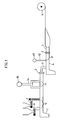
- Fig. 1 is a schematic sectional view of a foam manufacturing apparatus according to the invention
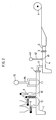
- Fig. 2 is a schematic sectional view of other foam manufacturing apparatus according to the invention
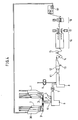
- Fig. 3 is a schematic side view of other embodiment of the invention
- Fig. 4 is a schematic side view of a different embodiment of the invention.
- the resin used in the invention is PET from fresh material or recovered material.
- the PET is a linear polyester of high molecular weight formed by ester bonding between aromatic dicarboxylic acid and dihydric alcohol.
- dicarboxylic acid for composing the PET include terephthalic acid, isophthalic acid, naphthalene decarboxylate, diphenyl ether decarboxylate, diphenyl sulfone decarboxylate, and diphenoxy ethane decarboxylate
- dihydric alcohol include ethylene glycol, trimethylene glycol, tetramethylene glycol, hexamethylene glycol, and diethylene glycol, and therefore the PET is formed by ester bonding of them.
- PET modified by crosslinking agent or branching agent may be also used.
- PETs it is preferred to use polyethylene terephthalate, polybutylene terephthalate, polyethylene naphthalate, polybutylene terephthalate elastomer, amorphous polyester, polycyclohexane terephthalate, and their mixtures.
- the recovered materials are ground materials of containers once used as liquid containers for non-sparking beverage, carbonate beverage, juice, alcohol and cosmetics which were blow formed and occur in quantities, and materials cut with a wrapping film and a film for photograph which have been once used.
- They may further include ground materials of trimming loss occurring in manufacture of formed parts by heat forming of PET foamed sheet.
- ground materials may further include ground materials of trimming loss occurring in manufacture of formed parts by heat forming of PET foamed sheet.
- ground materials are cut to a size for passing through 15 mm punch hole screen, they can be easily supplied into the extruder.
- the recovered materials are varied in distribution of water content and molecular weight as compared with fresh materials, but the invention is capable of removing moisture sufficiently and less than a fixed amount thereof even in such resins.
- recovered materials are used as the PET.
- Recovered materials are generally deteriorated, and smaller in molecular weight, and hence low in melt viscosity, and are amorphous.
- fresh materials are generally large in molecular weight and high in melt viscosity.
- a crosslinking agent is generally added to the resin or the molten resin. By adjusting the weight-average molecular weight of the PET to 90,000 to 200,000, the resin can be foamed 3 to 20 times. This crosslinking agent is known to function as the branching agent.
- crosslinking agent various known substances can be used. Examples include multifunctional epoxy compound, acid dianhydride having two or more acid anhydride groups in a molecule, oxazoline compound, and multifunctional isocyanate, among others. Among them, from the viewpoint of ease of handling and sanitary aspect for human health, multifunctional epoxy compound and acid dianhydride are preferred, and more preferably acid dianhydride should be used.
- acid dianhydride examples include pyromellitic acid, naphthalene tetracarboxylic acid anhydride, benzophenone tetracarboxylic acid anhydride, and cyclopentane tetracarboxylic anhydride.
- the crosslinking agent that can be used in the invention is a compound of acid dianhydride, at least one acid anhydride group of which is divided into two carboxyl group due to ring-opening, or a compound comprising three or more carboxyl groups not containing acid anhydride group.
- Specific examples are pyromellitic acid, trimellitic acid, tricarballylic acid, trimesic acid, trimesitinic acid, and gallic acid.
- such crosslinking agent may be added by 0.01 to 5 parts by weight to 100 parts by weight of PET.
- the crosslinking agent is acid dianhydride or a compound containing three or more of its open-ring forms or carboxyl groups
- a compound of a metal belonging to group I or II may be either organic or inorganic.
- sodium carbonate, potassium carbonate, or lithium carbonate is added by 0.01 to 5 parts by weight to 100 parts by weight of PET.
- the foam index is a value obtained by measuring the rate of hydroxyl end group of all end groups of PET molecule, and intrinsic viscosity.
- the intrinsic viscosity of PET is determined by, for example, stirring and dissolving 0.300 g of PET in 25 ml of orthochlorophenol at 140°C for 1 hour, putting this solution in a 35°C thermostatic oven, measuring the solution viscosity by Ostwald viscometer, and calculating.
- the number of carboxyl end groups in PET is determined in the following method. In 10 ml of benzyl alcohol, about 100 mg of PET is dissolved at 200°C, the solution is titrated in 1/50 N NaOH/ethanol solution using phenol red as indicator, and the number of carboxyl end groups is calculated. This value is converted into the equivalent number of carboxyl groups per 10 6 g of polymer. Finally by subtracting the number of carboxyl end groups from the total number of end groups, the number of hydroxyl end groups is determined. Thus, the ratio of hydroxyl end group is determined as number of hydroxyl end group/total number of end groups.
- the foam viscosity is obtained as intrinsic viscosity x ratio of number of hydroxyl end groups.
- the PET either the PET of which foam index is 0.4 or more is selected, or the foam index of PET is adjusted to be 0.4 or more.
- the foaming property of the PET depends greatly on the weight-average molecular weight Mw.
- the Mw of independently foaming PET foam superior in extrusion foaming property is 80, 000 to 250,000, and preferably 90,000 to 200,000. If less than 80,000, the forming performance is only less than two times, and if exceeding 250,000, melt fracture occurs and the appearance is impaired.
- a twin extruder is excellent in biting into irregular ground materials and smooth in kneading with crosslinking agent and others, and hence the extrusion amount is stable.
- This twin extruder is preferably of the type of two screws engaging with each other, and more preferably the two screws should rotate in the same direction.
- the ratio of extrusion amount/number of revolutions is preferably 0.28 to 1.67, more preferably 0.33 to 1.43, and most preferably 0.42 to 1.25.
- a vent port is opened in the portion exactly in the molten state of PET. The vent port is extended in the width direction of the barrel, about the engaging portion of the two screws, up to nearly right above the center line of the screw axis.
- An evacuating device is connected to the vent port. Cutting off the air coming into the vent port from the screw side, by actuating the evacuating device, the vent port is desired to be evacuated to 20 Torr or less, preferably to a strong vacuum state of 10 Torr or less.
- Pressure fluctuations should be smaller, 9 Torr or less, or preferably 5 Torr or less.
- the resin feed port of the extruder is preferably provided with constant feed means for feeding a constant volume, and a commercial constant feed device may be used.
- Commercial constant feed devices are designed to control the falling solid matter amount by moving the belt, vibrating the spring, or rotating the screw. Using individual constant feed devices, it is preferred to feed the fresh material of PET, recovered material, and crosslinking agent independently by constant amount, but the PET and crosslinking agent may be premixed, and supplied by one constant feed device.
- a single extruder of excellent stable feeding performance is connected by means of a connection tube.
- a gear pump may be also provided.
- a foaming agent press- feed port is provided in the barrel of the single extruder. From the foaming agent press-feed port, the foaming agent is press-fed into the barrel.
- the screw of the single extruder is preferred to be provided in part with Dulmage screw, pin or other mechanism helpful for dispersing the foaming agent.
- the weighing portion at the front end of the screw is longer, and L/D of the weighing portion, that is, the ratio of its length and diameter is preferred to be 5 or more, preferably 7 or more, and further its stabilizing portion is desired to be of full flight, not varying in pitch and depth.
- a die of sheet, plate, profile or other shape is attached at the front end of the single extruder.
- the die is provided with linear or annular orifice for extruding the PET in a sheet form.
- the orifice is linear, a flat foamed sheet is extruded, and it may be advanced on a flat plate or roll, but in the case of an annular orifice, an annular mandrel is attached to its end, and the PET is held in a cylindrical form and foamed, and cooled, then the cylinder is cut open to spread into a sheet.
- foamed sheet may be either formed successively, or once taken up on a roll to let stand for a while, and then formed.
- the foamed sheet is heated and softened in the heating process, and then sequentially pressed to a forming die in the forming process and formed.
- the heating process being put in a heating oven incorporating a plurality of infrared ceramic heaters, the material is heated to over the glass transition temperature of PET (about 70 to 75°C) and below crystallization temperature (about 130°C).
- the forming die in vacuum forming may be either convex die or concave die, but preferably may comprise both.
- the formed foamed sheet has the portion not formed between the formed pieces, that is, the portion of trimming loss.
- the formed sheet is, while maintaining the formed shape, heated over the crystallization temperature (about 130°C) and below melting point (about 250 to 260°C) to be fixed thermally, and then put into a trimming device. Herein, by cutting, it is separated into the formed piece and trimming loss. The formed piece is directly discharged as a product.
- the trimming loss is then ground. If the trimming loss is an irregular continuous form, it is first cut into short pieces, and obtained short pieces are ground.
- a roll crusher, rod mill, ball mill, hammer mill or the like may be used for grinding.
- the recovered material obtained by passing such PET ground pieces through 15 mm ⁇ punch holes is particularly excellent in biting stability in the extruder.
- the recovered material from the PET foamed sheet is modified by the crosslinking agent, but, to the contrary, deteriorated by heat and is different in properties from the initial raw material. It is therefore preferred to add a crosslinking agent newly to the recovered material.
- the PET foamed sheet may be used in wider applications when processed into laminate foamed sheets by laminating at least one side with non-foamed film, Al or other metal foil, or metal deposition film. Lamination is achieved by fusion by heat, adhesion by adhesive, and coextrusion by extruder.
- Usable non-foamed films include thermoplastic polyester resin, polyolefin resin, polyamide resin, polyvinylidene chloride resin, polyacrylonitrile resin, and ethylene-vinyl alcohol copolymer, among others. Since these materials are excellent in gas barrier property, especially steam permeability, and the food preservation is excellent when applied in food containers. The food containers forming laminate foamed sheet using Al or other metal foil completely cut off transfer if the foamed sheet is somewhat contaminated, so that the contained food is not polluted.
- various additives may be used as required.
- fine powder of fluoroplastics may be mixed to reinforce.
- fluoroplastics the following resins are preferred, i.e., Polytetrafluoroethylene, Fluorinated ethylene-propylene copolymer, Tetrafluoroethylene-perfluoroalkoxyethylene copolymer, Polychlorotrifluoroethylene, Ethylene-tetrafluoroethylene copolymer, Polyvinylidene fluoride and Polyvinyl fluoride.
- foaming nucleating agent flame retardant, antistatic agent, antioxidant, ultraviolet ray absorbent, coloring matter and others may be also added.
- additives may be easily dispersed uniformly in PET by adding them from the feed port of the twin extruder together with the PET.
- foaming agent various known foaming agents can be used. Foaming agents are roughly classified into' physical foaming agents and chemical foaming agents,. and in particular it is preferred to use physical foaming agents. Physical foaming agents are further classified into inert gas, saturated aliphatic hydrocarbon, saturated alicyclic hydrocarbon, halogenated hydrocarbon, ether, ketone and others, and all of them may be used in the invention.
- inert gas includes carbon dioxide and nitrogen
- saturated aliphatic hydrocarbon includes propane and butane
- saturated alicyclic hydrocarbon includes cyclohexane
- halogenated hydrocarbon includes methyl chloride
- tetrafluoroethane ether
- ketone includes acetone. They may be used either alone or in combination.
- the apparatus for executing the invention is, for example, schematically shown in structures in Fig. 1 and Fig. 2.
- reference numeral 1 is a twin extruder
- 2 is a front end of the extruder, that is, the extruder head
- 3 is a connection tube
- 4 is a single extruder
- 5 is a die.
- Reference numerals 6, 7 and 8 are constant feed devices
- 9 is a PET foam
- 11 is a vent port
- 12 is a resin feed port or crosslinking agent feed port
- 13 is an additive feed port
- 14 is suction pipe
- 15 is a vacuum pump
- 41 is a foaming agent press-feed port
- 42 is a foaming agent feed pipe
- 43 is a foaming agent feed device.
- FIG. 3 a fresh material is put into a hopper 1
- a recovered material is put into a hopper 20
- a crosslinking agent is put into a hopper 2
- they are individually charged into a twin extruder 6 separately from constant feed devices 3 and 3' and through material charge ports 4 and 4'.
- the twin extruder 6 has two vent ports 5, from which they are sucked in.
- the PET fused and kneaded in the twin extruder 6 is sent into a second extruder 8 by a gear pump 7, and the foaming agent sent by a pump 9 is press-fed, and is cylindrically extruded from a die 11, cooled on a cylindrical mandrel 12, and cut by a cutter 13, thereby forming a foamed sheet 15.
- the foamed sheet 15 is taken up on a take-up roll 14 to be formed into a roll.
- Fig. 4 shows a nearly same method as in Fig. 3, but Fig. 4' differs from Fig. 3. in that the foamed sheet 15 is not rolled, but is put immediately into the heating oven 16 to be heated.
- the PET of fresh material or recovered material of bulky ground material is supplied into the extruder, and fused and kneaded, and moisture is sucked and removed in vacuum from the barrel of the extruder, and therefore the conventional complicated drying process is not needed.
- the bulky ground material of foam can be directly supplied into the extruder, large dryer is not necessary, and the PET form can be continuously manufactured efficiently.
- the PET hardly deteriorates by heat in this process of removing the moisture from the barrel by sucking in vacuum.
- the PET and crosslinking agent are supplied into the axial extruder, and fused and kneaded in the extruder to increase the weight-average molecular weight of the resin, and the melt viscosity suited to foaming is obtained, while the deteriorated PET is modified, and PET form of high quality and foamed to a high degree can be manufactured continuously.
- the twin extruder when used, biting is excellent into the ground material of irregular shape, and a constant volume can be extruded, and it is kneaded uniformly with the crosslinking agent, and the extrusion volume is stable, and the PET foam of high quality can be continuously manufactured.
- the foamed sheet is softened, and formed by a forming die, and is cut off and divided into the formed piece and the remainder, and the remainder is supplied into the extruder as recovered material by grinding, so that all the rest other than the formed piece can be recovered and formed into a formed piece, and the foaming process and forming process can be executed continuously, so that the manufacturing method is very effective.
- the manufacturing apparatus of the invention is useful in that the method of the invention can be executed easily.
- a mixture of 100 parts of recovered material by grinding PET bottle in uncrystallized state with the intrinsic viscosity of 0.65, weight-average molecular weight Mw of 53,200 and foam index of 0.38, 1 part of talk, and 0.05 part of sodium carbonate mixed in a tumbler was charged into a hopper of a constant feed device 6 having a screw feeder, and was continuously supplied into the extruder in the first stage at a rate of 33 kg/hr.
- a mixture of 100 parts of polyethylene terephthalate of fresh material in uncrystallized state with the intrinsic viscosity of 0.81, Mw of 75,000 and foam index of 0.63, 1 part of talc, 0.05 part of sodium carbonate, and 1.0 part of pyromellitic acid anhydride mixed in a tumbler was charged into a hopper of a constant feed device 7 having a screw feeder, and was continuously supplied into the extruder in the first stage at a rate of 17 kg/hr.
- the extruder in the first stage was a twin extruder of engagement type and same rotating direction, with the length of 2400 mm and diameter of screw of 65 mm ⁇ .
- the screw rotating speed of the twin extruder in the first stage was 60 rpm, and the temperature of the extruder cylinder was maintained in a range of 240°C to 285°C.
- the moisture in the extruder was removed from the vent port connected to a vacuum pump provided somewhere in the extruder in the first stage. The degree of vacuum at this time was 4.5 Torr. After moisture removal from the extruder in the first stage and viscosity increasing reaction, the molten mixture was supplied into the single extruder 4 having a diameter of the screw of 65 mm and L/D 25 through the connection tube 3 maintained at
- the screw rotating speed of the extruder in the second stage was 60 rpm, and the temperature of the extruder cylinder was maintained in a range of 265°C to 275°C.
- foaming agent butane
- foaming agent was injected in at a rate of 0.7 part.
- the molten mixture containing the foaming agent was extruded into the atmosphere through a circular die 5 of aperture 80 mm ⁇ and slit width 0.5 mm.
- the extruded molten resin mixture was foamed and taken up, and was formed in a cylindrical form by a cylindrical mandrel of 205 mm ⁇ in diameter and 740 mm in length, and part of the cylindrical foam was cut open, and it was taken up in a sheet form. At this time, cooling water was circulated in the cylindrical mandrel to keep the surface temperature at 25°C.
- the obtained foamed sheet had a beautiful appearance with the density of 0.23 g/cc, width of 640 mm, and thickness of 1.5 mm.
- the Mw of the foamed sheet was 118,000.
- the molten resin was taken out from the head of the extruder in the first stage, and the weight-average molecular weight of the removed resin was measured, and the value was 125,000.
- a fresh material of polyethylene terephthalate in uncrystallized sate with the intrinsic viscosity of 0.81, Mw of 75,000 and foam index of 0.639 was charged into a hopper of the constant feed device 6 with screw feeder, and continuously supplied into the extruder in the first stage at a rate of 45 kg/hr.
- a mixture of 15 wt.% of sodium carbonate and 85 wt.% of pyromellitic acid anhydride mixed in a super-mixer was charged into a hopper of a brush type fine powder constant feed device 8, and continuously supplied into the extruder in the first stage at a rate of 33 g/hr.
- the obtained foamed sheet had a beautiful appearance with the density of 0.23 g/cc, width of 640 mm, and thickness of 1.5 mm.
- the molten resin was taken out from the head of the extruder in the first stage, and the Mw of this resin was 134,000.
- the Mw of the foamed sheet was 129,000.
- the twin extrudet 6 was of engagement type with a diameter of the screw of 65 mm, and a second extruder 8 was a single extruder with a diameter of the screw of 65 mm.
- a mixture of flakes of PET bottle with weight-average molecular weight (Mw) of about 70,000, and ground matter of recovered material of trimming loss after forming at a ratio of 3:2 by weight was continuously supplied into the twin extruder 6 through a material charge port 4' at a rate of about 45 kg/hr from a constant supplying device 3' of recovered material.
- the barrel length of the twin extruder 6 was 2400 mm, the screw rotating speed was 84 rpm, and the temperature of the extruder cylinder was controlled in a range of 240 to 285°C. From two vent ports 5 provided somewhere in the twin extruder 6, moisture and other volatile matter were removed from the molten resin in the extruder at a degree of vacuum of 4.5 Torr by sucking in vacuum.
- the melt viscosity of the PET was raised, and it was supplied into the single extruder 8.
- This foaming resin was extruded into the atmosphere from an annular orifice with aperture of 80 mm and slit width of 0.5 mm. The extrusion fluctuations at this time were measured 10 times for 3 minutes each, and 2.72% was obtained.
- the extruded foaming resin was advanced on the cooling mandrel 12 of 205 mm in diameter while being foamed, and the temperature was lowered from about 200°C to 65°C in this process, and was formed in a cylindrical shape.
- One position of the cylindrical foamed piece was cut open by a cutter 13, and spread into a sheet, and taken up by a take- up roll 14, and 300 m was rolled.
- the obtained foam had the density of 0:27 g/cc, thickness of 1.43 mm, tensile tear elongation in the extrusion direction of the foamed sheet of 95.3%, that in the width direction of 87.5%, and degree of crystallization of 7%.
- the foamed sheet 15 was let stand in a rolled state for 2 weeks. Then this rolled foamed sheet 15 was put in a thermal adhesion device 21, and was unwound, and a non-foamed PET film 22 was adhered to this foamed sheet 15 to obtain a laminate sheet.
- the non-foamed PET film 22 had a density of 1.3 and thickness of 0.025 mm, and was undrawn, and the side contacting with the foamed sheet was printed in a pattern by a heat resistant ink.
- the foamed sheet 15 and non-foamed film 22 were glued together by passing through pairs of rolls 23 and 24, and 25 and 26. Of these rolls, the upper roll 23 is heated to 155°C, the lower roll 24 was cooled to 30°C, and the rolls 25 and 26 were both cooled to 25°C. Thus obtained laminate sheet was about 60°C at the entrance of a heating oven 16.
- the heating oven 16 incorporated a plurality of far infrared ceramic heaters in its upper and lower parts. A required area of the laminate sheet was intermittently carried into the heating oven 16. The laminate sheet was heated in the heating oven 16 so that the surface might be 145 to 160°C.
- a forming device 17 was a vacuum compressed air forming device consisting of an convex pattern 27 and a concave pattern 28, and each pattern was provided with a heater so as to adjust the die temperature.
- the convex pattern 27 was designedto feed compressed air at 1 kg/cm 2
- the concave pattern 28 was to be evacuated to -600 mmHg.
- the both patterns were brought closer or apart by a hydraulic device.
- Each pattern was heated to 180°C.
- the laminate sheet sent in between the convex pattern and concave pattern was formed by the vacuum action from the concave pattern 28, and was also formed by the compressed air action from the convex pattern 27.
- the forming press time was 7 seconds which was the duration required for the degree of crystallization of DSC to reach 17 to 30%, Each pattern was adjusted so as to obtain the formed piece in the following dimensions:
- Gratin dish measuring 125 mm x 155 mm x 30 mm (depth), with wall thickness of 2.0 to 2.5 mm in the bottom and 1.30 to 1.45 mm on the sides.
- the laminate sheet was heated over the glass transition temperature (about 70 to 75°C) and below crystallization temperature (about 130°C), and formed, and while maintaining the formed shape, it was then heated over the crystallization temperature and below melting point (about 250 to 260°C), and was cooled in a cooling die (not shown), and sent into a trimming device 18 to be trimmed, and a heat resistant container of laminated foamed sheet was obtained.
- the scraps formed by trimming were continuously fed into a grinder to be formed into chips for passing through 10 mm punch holes, and recovered material was obtained directly in this form, which was reused by sending into a hopper 20 provided in the upper part of the extruder 6.
- 0.3 wt.% of pyromellitic acid anhydride was added to pet, and extruded and foamed, and ground material of scraps of the obtained foamed sheet (Mw about 130,000) was continuously supplied into the twin extruder 6 through a charge port 4' at a rate of about 14 kg/hr from a recovered material constant supplying device 3'.
- the screw rotating speed of the twin extruder 6 was 79 rpm, and the temperature of the extruder cylinder was controlled in a range of 240 to 290°C. From two vent ports provided in the twin extruder 6, moisture and other volatile matter were removed from the molten resin in the extruder by sucking in vacuum at degree of vacuum of 4.5 Torr.
- the molten PET crosslinked in the twin extruder 6 was poured into the second extruder 8 by a gear pump 7 rotating at 45 rpm.
- a gear pump 7 rotating at 45 rpm.
- about 0.15 part of nitrogen as foaming agent was press-fed into the resin by a pump 9, and a foaming resin was obtained.
- This foaming resin was extruded into the atmosphere from an annular orifice of 95 mm in aperture and slit width of 0.5 mm.
- the extruded foaming sheet was foamed and moved on the cooling mandrel 12 of 205 mm in diameter, and was formed into a cylindrical form by lowering the temperature from about 200°C to 68°C.
- One position of the cylindrical form was cut by a cutter 13, and spread into a flat plate, and taken up bv a take-up roll 14, and a foamed sheet was obtained.
- This foamed sheet has the density of 0.36 g/cc, tensile tear elongation of 99.7% in extrusion direction, that of 85.6% in width direction, thickness of 1.02 mm, and degree of crystallization of 8%.
- This PET foamed sheet was directly put into a heating oven 16 without being taken up, and heated.
- the heating oven 16 is same as used in embodiment 3.
- the foamed sheet was 57°C at the entrance of the heating oven. Transfer into the heating oven 16 was an intermittent moving method.
- the foamed sheet was heated to a surface temperature of 145 to 160°
- the PET foamed sheet was then put into a forming device 17.
- the forming device 17 was same as used in embodiment 3.
- the convex pattern 27 was designed to supply compressed air of 0.9 kg/cm 1 , the concave pattern was to evacuate at -550 mmHg, and each pattern was heated to 180°C.
- the PET foamed sheet was formed by the vacuum action from the concave pattern 28, and was also formed for 7 seconds by the compressed air action from the convex pattern 27, and was formed into a gratin dish in the same size as in embodiment 3.
- the wall thickness of this container was 0.65 to 0.95 mm in the bottom, and 0.45 to 0.60 mm on the sides.
- the foamed sheet was, same as in embodiment 3, heated over the glass transition temperature (about 70 to 75°C) and below crystallization temperature (about 130°C), and formed, and while maintaining the formed shape, it was then heated over the crystallization temperature and below melting point (about 250 to 260°C), and was cooled in a cooling die (not shown), and sent into a trimming device 18 to be trimmed, and a heat resistant container of foamed sheet was obtained.
- the scraps formed by trimming were continuously fed into a grinder, and as chips for passing through 10 mm punch holes, the recovered material was reused by sending into a hopper 20 provided in. the upper part of the extruder 6.
- the embodiment was executed similarly by using the apparatus in embodiment 3, except that the materials of the PET resin and conditions of use of the apparatus were slightly changed. Mainly the changed points are described-below.
- a ground matter obtained bv grinding PET foamed sheet with the weight-average molecular weight of about 130,000 was put into a recovered material hopper 20 in Fig. 3, and charged into the twin extruder 6 at a rate of about 50 kg/hr.
- the twin extruder 6 rotated the screw at a rate of 80 rpm, and the cylinder temperature was controlled in a range of 230 to 290°C. By sucking at degree of vacuum of 5.0 Torr from two vent ports provided in the twin extruder 6, volatile matter in the molten PET was removed.
- This foaming PET was extruded into the atmosphere from an annular slit of aperture of 80 mm and width of 0.4mm. The extrusion fluctuations were measured 10 times for 3 minutes each, and 2.91% was obtained.
- the extruded PET was foamed and advanced along the cooling mandrel of 205 mm in diameter, and was cooled from about 200°C to 70°C, and a cylindrical form was obtained. The cylindrical form was cut at one position by a cutter 13, and spread into a sheet, and taken up on a take-up roll 14, and was rolled in a length of 300 m.
- the obtained foamed sheet had the density of 0.35 g/cm 3 , tensile tear elongation of 98.2% in the extrusion direction, that of 86.5% in the width direction, thickness of 1.00 mm, and degree of crystallization of 7%.
- the PET foamed sheet was formed into a gratin dish in the same manner as in embodiment 3.
- container had a thickness of 0.97 to 1.35 mm in the bottom, and 0.65 to 0.88 mm on the sides.
- Scraps after cutting out the container were ground and reused same as in embodiment 3. By thus recycling the scraps, the PET was used completely without discarding any portion.
- a twin extruder rotting in same direction of engagement type of aperture of 65 mm ⁇ was used as the extruder in the -first stage, and a single extruder with aperture of 65 mm ⁇ and L/D of 25 was used as the extruder in the second stage.
- 100 parts of recovered flakes of PET bottle with intrinsic viscosity of 0.70 and Mw of 70,000 was continuously supplied from the material charge port of the extruder in the first stage at a rate of 66 kg/hr from a material constant supplying device having a screw feeder.
- a mixture of 100 parts of fresh polyethylene terephthalate resin with intrinsic viscosity of 1.10, 3 parts of talc, and 1.0 part of pyromellitic acid anhydride unpacked 377 days before mixed in a tumbler was continuously supplied into the extruder in the first stage from other material feed port at a rate of 34kg/hr from the material constant supplying device with screw feeder.
- the cylinder barrel of the extruder in the first stage was a continuously linked structure of 12 barrel units of 200 mm in length.
- the screw rotating speed of the twin extruder in the first stage was 120 rpm, and the temperature of the extruder cylinder was maintained in a range of 240 to 285°C. From two vent ports (opening area 12 cm 2 each) connected to the vacuum pump in the midst of the extruder in the first stage, moisture in the extruder was removed. At this time, the degree of vacuum was 4.5 Torr.
- the molten mixture was supplied into the single extruder in the second stage through a connection tube maintained at 275°C,
- the screw rotating speed of the extruder in the second stage was 65 rpm, and the temperature of the extruder cylinder was maintained in a range of 265 to 275°C.
- 0.7 part of foaming agent (butane) was injected from a middle of the extruder in the second stage.
- the molten mixture containing the foaming agent was extruded into the atmosphere from a circular die of aperture of 80 mm ⁇ and slit width of 0.5 mm.
- the extruded molten resin mixture was foamed and taken up, and formed into a cylindrical shape by a cylindrical mandrel of 330 mm ⁇ in diameter and 740 mm in length, and part of the cylindrical foam was cut open, and taken up as sheet. At this time, cooling water was circulated in the cylindrical mandrel, and the surface temperature was kept at 25°C.
- the obtained foamed sheet had the density of 0.23 g/cc, width of 1040 mm, and thickness of 1.0 mm.
- a mixture of 100 parts of polyethylene terephthalate resin with intrinsic viscosity of 0.81 and Mw of 75,000, 1 part of talc, and 0.05 part of sodium carbonate mixed in a tumbler was continuously supplied from a material charge port of an extruder in the first stage at a rate of 30 kg/hr from a material supplying device with a screw feeder.
- a mixture of 100 parts of polyethylene terephthalate resin with intrinsic viscosity of 0.81 and Mw of 75,000, 1 part of talc, 0.05 part of sodium carbonate, and 1.0 part of pyromellitic acid mixed in a tumbler was continuously supplied into the extruder in the first stage from other material feed port at a rate of 20 kg/hr from the material constant supplying device with screw feeder.
- the screw rotating speed of the twin extruder in the first stage was 120 rpm, and the temperature of the extruder cylinder was maintained in a range of 240 to 285°C. From two vent ports (opening area 12 cm 2 each) connected to the vacuum pump in the midst of the extruder in the first stage, moisture in the extruder was removed.
- the degree of vacuum was 4.1 Torr.
- the molten mixture was supplied into the single extruder in the second stage through a connection tube maintained at 275°C.
- the screw rotating speed of the extruder in the second stage was 33 rpm, and the temperature of the extruder cylinder was maintained in a range of 265 to 275°C, Besides, from a middle of the extruder in the second stage, 1.2 parts of foaming agent (butane) was injected.
- the molten mixture containing the foaming agent was extruded into the atmosphere from a multi-nozzle opening having a total of 312 nozzles, consisting of three rows with 104 nozzles in each row, with the hole diameter of 1.2 mm, lateral pitch of 2.8 mm, and vertical pitch of 6.0 mm.
- the extruded foam was immediately advanced while keeping close to the sizing die (thickness 18 mm x length 300 mm) controlled at 60°C in contact with the die.
- the sizing die thinness 18 mm x length 300 mm
- a mixture of 100 parts of polyethylene-2,6-naphthalate resin with intrinsic viscosity of 0.55 and Mw of 42,300, 1 part of talc, and 0.05 part of sodium carbonate mixed in a tumbler was continuously supplied from a material charge port of an extruder in the first stage at a rate of 60 kg/hr from a material supplying device with a screw feeder.
- a mixture of 100 parts of polyethylene-2,6-naphthalate resin with intrinsic viscosity of 0.55, 1 part of talc, 0.05 part of sodium carbonate, and 1.3 parts of trimellitic acid mixed in a tumbler was continuously supplied into the extruder in the first stage from other material feed port at a rate of 40 kg/hr from the material constant supplying device with screw feeder.
- the screw rotating speed of the twin extruder in the first stage was 120 rpm, and the temperature of the extruder cylinder was maintained in a range of 255 to 290°C. From two vent ports (opening area 12 cm 2 each) connected to the vacuum pump in the midst of the extruder in the first stage, moisture in the extruder was removed. At this time, the degree of vacuum was 4.3 Torr.
- the molten mixture was supplied into the single extruder in the second stage through a connection tube maintained at 275°C.
- the screw rotating speed of the extruder in the second stage was 64 rpm, and the temperature of the extruder cylinder was maintained at 260°C.
- 0.9 part of foaming agent (butane) was injected from a middle of the extruder in the second stage.
- the molten mixture containing the foaming agent was extruded into the atmosphere from a circular die with aperture of 80 mm ⁇ and slit width of 0.5 mm.
- the extruded molten resin mixture was foamed and taken up, and formed into a cylindrical shape by a cylindrical mandrel of 330 mm ⁇ in diameter and 740 mm in length, and part of the cylindrical foam was cut open, and taken up as sheet. At this time, cooling water was circulated in the cylindrical mandrel, and the surface temperature was kept at 25°C.
- the obtained foamed sheet had the density of 0.20 g/cm 3 , width of 1040 mm, and thickness of 1.0 mm.
- This example was executed in the same manner as in embodiment 6, except that the PET used in embodiment 6 was used by drying with a dehumidifying dryer, and that it was not evacuated and sucked by the extruder in the first stage.
- the molten mixture containing the foaming agent was extruded from a circular die of aperture of 80 mm ⁇ and slit width of 0.5 mm at a rate of 100 kg/hr, but the foaming agent and resin were intermittently discharged from the die, and foamed sheet could not be obtained.
- the molten mixture containing the foaming agent was extruded at a rate of 50kg/hr, but the foaming agent and resin were intermittently discharged from the die, only foam with density of 0,68 g/cm 3 poor in appearance and having many pores was obtained.
- the Mw of the foam was 78,000.
- the molten mixture containing the foaming agent was extruded at a rate of 100 kg/hr, but the foaming agent and resin were intermittently discharged from the die, and foamed sheet could not be obtained.
Landscapes
- Engineering & Computer Science (AREA)
- Mechanical Engineering (AREA)
- Environmental & Geological Engineering (AREA)
- Chemical & Material Sciences (AREA)
- Chemical Kinetics & Catalysis (AREA)
- Health & Medical Sciences (AREA)
- Materials Engineering (AREA)
- Medicinal Chemistry (AREA)
- Polymers & Plastics (AREA)
- Organic Chemistry (AREA)
- Extrusion Moulding Of Plastics Or The Like (AREA)
- Manufacture Of Porous Articles, And Recovery And Treatment Of Waste Products (AREA)
- Processing And Handling Of Plastics And Other Materials For Molding In General (AREA)
- Separation, Recovery Or Treatment Of Waste Materials Containing Plastics (AREA)
Priority Applications (1)
| Application Number | Priority Date | Filing Date | Title |
|---|---|---|---|
| EP20000117347 EP1055499B1 (de) | 1994-12-27 | 1995-12-27 | Thermoplastischer Polyesterharzschaumstoff |
Applications Claiming Priority (9)
| Application Number | Priority Date | Filing Date | Title |
|---|---|---|---|
| JP339666/94 | 1994-12-27 | ||
| JP33966694 | 1994-12-27 | ||
| JP06339666A JP3086392B2 (ja) | 1994-12-27 | 1994-12-27 | 熱可塑性ポリエステル系樹脂発泡体の製造方法 |
| JP6697795 | 1995-02-28 | ||
| JP66977/95 | 1995-02-28 | ||
| JP7066977A JP3059355B2 (ja) | 1995-02-28 | 1995-02-28 | 熱可塑性ポリエステル系樹脂発泡体の製造方法 |
| JP07240572A JP3126907B2 (ja) | 1995-08-24 | 1995-08-24 | 熱可塑性ポリエステル系樹脂発泡成形体の製造方法 |
| JP24057295 | 1995-08-24 | ||
| JP240572/95 | 1995-08-24 |
Related Child Applications (1)
| Application Number | Title | Priority Date | Filing Date |
|---|---|---|---|
| EP20000117347 Division EP1055499B1 (de) | 1994-12-27 | 1995-12-27 | Thermoplastischer Polyesterharzschaumstoff |
Publications (3)
| Publication Number | Publication Date |
|---|---|
| EP0719626A2 true EP0719626A2 (de) | 1996-07-03 |
| EP0719626A3 EP0719626A3 (de) | 1996-12-11 |
| EP0719626B1 EP0719626B1 (de) | 2003-02-26 |
Family
ID=27299320
Family Applications (2)
| Application Number | Title | Priority Date | Filing Date |
|---|---|---|---|
| EP19950120581 Expired - Lifetime EP0719626B1 (de) | 1994-12-27 | 1995-12-27 | Kontinuierliches Herstellungsverfahren zum Herstellen von thermoplastischem Polyesterharzschaumstoff |
| EP20000117347 Expired - Lifetime EP1055499B1 (de) | 1994-12-27 | 1995-12-27 | Thermoplastischer Polyesterharzschaumstoff |
Family Applications After (1)
| Application Number | Title | Priority Date | Filing Date |
|---|---|---|---|
| EP20000117347 Expired - Lifetime EP1055499B1 (de) | 1994-12-27 | 1995-12-27 | Thermoplastischer Polyesterharzschaumstoff |
Country Status (9)
| Country | Link |
|---|---|
| US (4) | US5958164A (de) |
| EP (2) | EP0719626B1 (de) |
| KR (1) | KR100363291B1 (de) |
| CN (2) | CN1081977C (de) |
| AU (1) | AU697806B2 (de) |
| CA (1) | CA2166170C (de) |
| DE (2) | DE69529733T2 (de) |
| DK (1) | DK0719626T3 (de) |
| TW (1) | TW372242B (de) |
Cited By (17)
| Publication number | Priority date | Publication date | Assignee | Title |
|---|---|---|---|---|
| WO1998051467A1 (en) * | 1997-05-09 | 1998-11-19 | B.C. Foam S.R.L. | A process for the production of expanded polyester, in particular pet |
| WO1999048770A1 (en) * | 1998-03-20 | 1999-09-30 | Eastman Chemical Company | Polyester foam for use in a modified atmospheric package |
| US6187830B1 (en) | 1997-07-11 | 2001-02-13 | Akzo Nobel Nv | Process for the preparation of foamed articles |
| EP1193039A1 (de) * | 2000-09-29 | 2002-04-03 | Fuji Photo Film Co., Ltd. | Verfahren zur Wiederverwendung von Kuststoffteilen für lichtempfindliches Material |
| US6604848B2 (en) | 1999-03-29 | 2003-08-12 | Kabushiki Kaisha Kobe Seiko Sho | Method for continuously mixing polyester resins |
| EP1440783A1 (de) * | 2003-01-25 | 2004-07-28 | Motech GmbH Technology & Systems | Verfahren zur Herstellung eines Verpackungsbandes |
| EP3089867A4 (de) * | 2013-12-30 | 2017-09-20 | Toray Plastics (America) , Inc. | Verfahren zur herstellung von bestrahlungsvernetztem polypropylenschaumstoff |
| US9821533B2 (en) | 2014-12-30 | 2017-11-21 | Toray Plastics (America), Inc. | Coextruded, crosslinked multilayer polyolefin foam structures from recycled metallized polyolefin material and methods of making the same |
| US10035327B2 (en) | 2014-12-30 | 2018-07-31 | Toray Plastics (America), Inc. | Coextruded, crosslinked multilayer polyolefin foam structures from recycled polyolefin foam material and methods of making the same |
| US10384388B2 (en) | 2014-12-30 | 2019-08-20 | Toray Plastics (America), Inc. | Coextruded, crosslinked multilayer polyolefin foam structures and methods of making the same |
| IT201800004069A1 (it) * | 2018-03-29 | 2019-09-29 | Point Plastic S R L | Metodo per la realizzazione di un materiale espanso a base di pet riciclato |
| CN110405979A (zh) * | 2019-07-22 | 2019-11-05 | 泉州市泉港区科尚赢德工业科技有限公司 | 一种全自动塑料泡沫颗粒连续覆膜干燥生产线 |
| US10501598B2 (en) | 2017-06-29 | 2019-12-10 | Toray Plastics (America), Inc. | Method of making coextruded, crosslinked multilayer polyolefin foam structures from recycled crosslinked polyolefin foam material |
| US10814590B2 (en) | 2013-12-31 | 2020-10-27 | Toray Plastics (America), Inc. | Methods of producing foam structures from recycled metallized polyolefin material |
| US11007761B2 (en) | 2017-03-31 | 2021-05-18 | Toray Plastics (America), Inc. | Method of making coextruded, cross-linked polyolefin foam with TPU cap layers |
| US11590677B2 (en) | 2019-03-29 | 2023-02-28 | Toray Plastics (America), Inc. | Method of making coextruded, crosslinked polyolefin foam with KEE cap layers |
| US11590730B2 (en) | 2019-03-29 | 2023-02-28 | Toray Plastics (America), Inc. | Coextruded, crosslinked polyolefin foam with KEE cap layers |
Families Citing this family (67)
| Publication number | Priority date | Publication date | Assignee | Title |
|---|---|---|---|---|
| US6186765B1 (en) * | 1997-03-31 | 2001-02-13 | Toshiba Kikai Kabushiki Kaisha | Apparatus for forming a molded multilayer product |
| US6780481B1 (en) | 1999-05-13 | 2004-08-24 | 3M Innovative Properties Company | Melt processable thermoplastic polymer composition |
| DE10103213A1 (de) * | 2001-01-25 | 2002-08-14 | Wacker Polymer Systems Gmbh | Verfahren zur Herstellung von wiederverwertbaren Formkörpern |
| WO2002099219A1 (en) * | 2001-05-31 | 2002-12-12 | Dow Global Technologies Inc. | Improved built-up roof system |
| US20030186045A1 (en) * | 2001-05-31 | 2003-10-02 | Trevor Wardle | Built-up roof system |
| US6942627B2 (en) * | 2001-07-19 | 2005-09-13 | Ethicon Endo-Surgery, Inc. | Surgical biopsy device having a flexible cutter |
| WO2003037448A1 (en) * | 2001-10-30 | 2003-05-08 | Jeffrey Tocci | Moldable golf club grip and method of manufacturing the same |
| CA2476537A1 (en) | 2002-03-14 | 2003-09-25 | Dow Global Technologies Inc. | Application of a membrane roof cover system having a polyester foam layer |
| US7951449B2 (en) * | 2002-06-27 | 2011-05-31 | Wenguang Ma | Polyester core materials and structural sandwich composites thereof |
| US20050001344A1 (en) * | 2002-11-04 | 2005-01-06 | Chang Jui Yang | Method for forming foamable boards |
| US20040094256A1 (en) * | 2002-11-18 | 2004-05-20 | Chang Jui Yang | Method for forming foamable boards |
| ZA200510141B (en) * | 2003-05-17 | 2008-05-28 | Microgreen Polymers Inc | Method of producing thermoformed articles from gas impregnated polymer |
| US9296126B2 (en) | 2003-05-17 | 2016-03-29 | Microgreen Polymers, Inc. | Deep drawn microcellularly foamed polymeric containers made via solid-state gas impregnation thermoforming |
| US20070059511A1 (en) * | 2004-03-31 | 2007-03-15 | Edwards Walter L | Low density foamed polymers |
| JP4093419B2 (ja) * | 2004-07-30 | 2008-06-04 | 株式会社デュエラ | 発泡シート、その製造方法および製造装置 |
| ITUD20050003A1 (it) * | 2005-01-19 | 2006-07-20 | Andrea Strizzolo | Dispositivo per il trattamento di materie plastiche provenienti dal riciclo di rifiuti |
| ITUD20050004A1 (it) * | 2005-01-19 | 2006-07-20 | Andrea Strizzolo | Impianto e procedimento per il trattamento di materie plastiche eterogenee provenienti dal riciclo di rifiuti |
| US7868090B2 (en) * | 2006-12-28 | 2011-01-11 | Sabic Innovative Plastics Ip B.V. | Polyester molding compositions |
| US8877331B2 (en) | 2007-01-17 | 2014-11-04 | MicroGREEN Polymers | Multi-layered foamed polymeric objects having segmented and varying physical properties and related methods |
| ATE536995T1 (de) | 2007-01-17 | 2011-12-15 | Microgreen Polymers Inc | Mehrlagige, geschäumte polymergegenstände |
| DK2072563T4 (da) | 2007-12-19 | 2015-08-10 | Armacell Entpr Gmbh & Co Kg | Polymerblanding til termoplastiske cellulære materialer |
| DK2103411T3 (da) * | 2008-03-19 | 2012-02-27 | Armacell Enterprise Gmbh | Sidefødning af reaktionsdygtige tilsætningsstoffer til forbedret ekstrusion af reaktionsdygtigt skum |
| US8568125B2 (en) | 2008-04-14 | 2013-10-29 | Microgreen Polymers Inc. | Roll fed flotation/impingement air ovens and related thermoforming systems for corrugation-free heating and expanding of gas impregnated thermoplastic webs |
| KR100897630B1 (ko) | 2008-09-26 | 2009-05-14 | (주)애린엠피테크 | 폴리에틸렌테레프탈레이트의 수평 압출 방법 및 장치 |
| US8080194B2 (en) | 2008-06-13 | 2011-12-20 | Microgreen Polymers, Inc. | Methods and pressure vessels for solid-state microcellular processing of thermoplastic rolls or sheets |
| US7914718B2 (en) * | 2008-08-28 | 2011-03-29 | Corning Incorporated | Gas pore former in cellular monoliths |
| US8827197B2 (en) | 2008-11-04 | 2014-09-09 | Microgreen Polymers Inc | Apparatus and method for interleaving polymeric roll for gas impregnation and solid-state foam processing |
| ITMI20082348A1 (it) * | 2008-12-30 | 2010-06-30 | Meccaniche Luigi Bander A S P A Costruzioni | Processo ed apparecchiatura di estrusione di poliestere espanso impiegabile in impianti di produzione di foglie, lastre o tubi di poliestere espanso |
| ATE557061T1 (de) * | 2009-06-02 | 2012-05-15 | Armacell Enterprise Gmbh | Polyesterschaummaterial mit flammbeständigem verhalten |
| US9296185B2 (en) | 2010-04-19 | 2016-03-29 | Dart Container Corporation | Method for joining thermoplastic polymer material |
| US20120232175A1 (en) * | 2011-03-11 | 2012-09-13 | Mucell Extrusion, Llc | Pet foam articles and related methods |
| CN102761632B (zh) * | 2011-04-28 | 2016-04-13 | 比亚迪股份有限公司 | 一种手机外壳及其制作方法 |
| CN103764738A (zh) * | 2011-08-29 | 2014-04-30 | 积水化成品工业株式会社 | 模内发泡成型用芳香族聚酯系树脂发泡颗粒及其制造方法、模内发泡成型体、复合结构构件、以及汽车用构件 |
| US8722163B2 (en) | 2011-09-16 | 2014-05-13 | Pepsico, Inc. | Recyclable colorants in plastic beverage containers |
| CN102431174A (zh) * | 2011-10-10 | 2012-05-02 | 郭大宝 | 一种食品包装具成型设备 |
| WO2013085773A1 (en) * | 2011-12-06 | 2013-06-13 | 3M Innovative Properties Company | Methods of bonding polyester substrates |
| BR112014014218A2 (pt) | 2011-12-15 | 2017-06-13 | Styron Europe Gmbh | aparelho para misturar aditivos em um meio a ser bombeado |
| US9914247B2 (en) | 2012-02-29 | 2018-03-13 | Dart Container Corporation | Method for infusing a gas into a thermoplastic material, and related systems |
| EP3401255A1 (de) | 2013-01-14 | 2018-11-14 | Dart Container Corporation | Systeme zum abwickeln einer rolle aus einem mit einem porösen material vernetzten material und entsprechende verfahren |
| CN103434076B (zh) * | 2013-09-06 | 2016-04-06 | 山东通佳机械有限公司 | 高强度发泡板挤出成型方法 |
| CN103921366B (zh) * | 2014-03-19 | 2016-05-25 | 浙江歌瑞新材料有限公司 | 一种fep有色粒子的生产工艺 |
| CN104057592A (zh) * | 2014-06-25 | 2014-09-24 | 天华化工机械及自动化研究设计院有限公司 | 聚酯型材的加工装置 |
| WO2016064819A1 (en) | 2014-10-23 | 2016-04-28 | 3M Innovative Properties Company | Shim-stack foaming die |
| CN107073900B (zh) | 2014-10-23 | 2019-09-17 | 3M创新有限公司 | 横向聚结的泡沫板 |
| WO2017026716A1 (ko) * | 2015-08-13 | 2017-02-16 | 주식회사 휴비스 | 폴리에스테르 발포체와 폴리에스테르 수지층을 포함하는 다층 구조의 복합체 및 이의 용도 |
| WO2017057826A1 (ko) | 2015-09-30 | 2017-04-06 | 주식회사 휴비스 | 폴리에스테르 발포 시트와 폴리에스테르 수지층을 포함하는 복합체, 및 이를 포함하는 자동차 내외장재 |
| US12365148B2 (en) | 2015-11-13 | 2025-07-22 | Greentex Solutions, Llc | Composite products and related methods for manufacturing composite products from recycled composite materials |
| US20170136713A1 (en) | 2015-11-13 | 2017-05-18 | James C. Holmes, IV | Composite materials and related methods for manufacturing composite materials |
| KR101784884B1 (ko) * | 2015-12-31 | 2017-11-07 | 주식회사 휴비스 | 마스터배치 조성물 및 이를 이용한 폴리에스테르 수지 발포체의 제조방법 |
| CN107234743B (zh) * | 2017-06-15 | 2023-12-29 | 马鞍山宏力橡胶制品有限公司 | 一种废旧橡胶再生混炼胶生产系统 |
| US11111350B2 (en) | 2017-10-26 | 2021-09-07 | Wrh Technology, Llc | Method for production of low density polyester foam and articles made thereof utilizing low I.V. polyester feedstock |
| CN108068155B (zh) * | 2017-11-17 | 2019-09-13 | 招远市金欧新型聚酯有限公司 | 一种用于聚酯原料切片烘干装置 |
| CN110498973B (zh) | 2018-05-16 | 2023-09-01 | 北欧化工公司 | 发泡聚丙烯组合物 |
| CN109605708B (zh) * | 2018-12-14 | 2020-07-17 | 北京化工大学 | 一种热塑性聚酯挤出发泡成型方法 |
| CN109435194B (zh) * | 2018-12-14 | 2024-03-01 | 北京化工大学 | 一种用于热塑性聚酯发泡成型装置 |
| KR102212094B1 (ko) * | 2018-12-18 | 2021-02-04 | 주식회사 휴비스 | 가공성이 우수한 복합시트 및 이를 포함하는 포장용기의 제조방법 |
| CN109955452A (zh) * | 2019-01-08 | 2019-07-02 | 郑州大学 | 一种等规聚丙烯挤出发泡装置及工艺 |
| RU2710907C1 (ru) * | 2019-07-29 | 2020-01-14 | Дмитрий Сергеевич Расторгуев | Многослойный материал на основе вспененного вторичного полиэтилентерефталата и способ его производства |
| RU2717050C1 (ru) * | 2019-08-16 | 2020-03-17 | Дмитрий Сергеевич Расторгуев | Полимерный материал и способ его производства |
| CN111319180B (zh) * | 2020-04-20 | 2022-01-04 | 江苏聚核高分子功能材料研究院有限公司 | 回收pet进行连续挤出物理发泡制备板材的工艺 |
| CN112793026A (zh) * | 2021-01-28 | 2021-05-14 | 武汉旭力保温材料有限公司 | 基于环保发泡工艺的保温板成型工艺及其加工系统 |
| WO2022259476A1 (ja) * | 2021-06-10 | 2022-12-15 | 三井化学株式会社 | 混練装置 |
| CN113667090B (zh) * | 2021-08-04 | 2022-10-18 | 佛山林至高分子材料科技有限公司 | 一种人工软骨仿生吸能材料及其成型工艺 |
| CN113942208B (zh) * | 2021-10-25 | 2022-07-01 | 广州海天塑胶有限公司 | 一种采用微发泡注塑工艺制备汽车车内饰件的成型装置 |
| CN114379049A (zh) * | 2021-12-30 | 2022-04-22 | 义乌市双童日用品有限公司 | 一种吸管全自动化生产线及生产方法 |
| AU2024229342A1 (en) * | 2023-02-27 | 2025-07-17 | Eastman Chemical Company | Blow up ratios in foamed sheet production processes |
| NL2036991B1 (en) * | 2024-02-08 | 2025-08-20 | Cfl Holding Ltd | Method for obtaining an at least partially foamed building panel |
Family Cites Families (30)
| Publication number | Priority date | Publication date | Assignee | Title |
|---|---|---|---|---|
| GB1143558A (de) * | 1967-03-28 | |||
| US3733381A (en) * | 1970-12-31 | 1973-05-15 | Standard Oil Co | Continuous process for making thermoformed articles of manufacture |
| US3795633A (en) * | 1971-12-17 | 1974-03-05 | Ford Motor Co | Recovery of thermoplastic foam |
| DE2638840C2 (de) * | 1975-08-30 | 1983-12-22 | Chang Shao Shizuoka Chi | Verfahren zur Herstellung von Produkten aus Polyäthylenterephthalat |
| US4034013A (en) * | 1975-11-13 | 1977-07-05 | Rohm And Haas Company | Impact and melt strength improvement of poly(alkylene terephthalate) |
| US4002581A (en) * | 1975-12-08 | 1977-01-11 | General Electric Company | Foamed thermoplastic compositions of a linear polyester and an ionically crosslinked copolymer |
| DE2703461C2 (de) * | 1977-01-28 | 1985-01-10 | Davy McKee AG, 6000 Frankfurt | Stopwerk zur Vorverdichtung zerkleinerter voluminöser Polymerabfälle |
| US4185060A (en) * | 1978-03-17 | 1980-01-22 | Ladney M Jr | Method of manufacturing structural foam plastic products free from undesirable contaminant constituents |
| JPS5930184B2 (ja) * | 1978-03-22 | 1984-07-25 | 東レ株式会社 | 難燃性ポリエステル組成物 |
| FR2439074A1 (fr) * | 1978-10-18 | 1980-05-16 | Rhone Poulenc Textile | Procede de regeneration de polymere a partir de dechets |
| JPS6054850B2 (ja) * | 1979-11-15 | 1985-12-02 | 積水化成品工業株式会社 | 熱可塑性樹脂発泡体の製造方法及び装置 |
| GB2075032B (en) * | 1980-04-28 | 1983-07-27 | Teijin Ltd | Polyethylene terephthalate resin compositions |
| US4391971A (en) * | 1981-12-28 | 1983-07-05 | The Goodyear Tire & Rubber Company | Color improvement and acetaldehyde reduction in high molecular weight polyesters |
| DE3327993C2 (de) * | 1983-08-03 | 1986-03-06 | Heidelberger Druckmaschinen Ag, 6900 Heidelberg | Einrichtung an Druckmaschinen zum Aufbringen von Lack |
| US4954568A (en) * | 1985-08-16 | 1990-09-04 | Shell Oil Company | Impact resistant blends of thermoplastic polyesters and modified block copolymers |
| GB8630819D0 (en) * | 1986-12-23 | 1987-02-04 | Exxon Chemical Patents Inc | Polycarbonate compositions |
| NL8802113A (nl) * | 1988-08-27 | 1990-03-16 | Stamicarbon | Werkwijze voor het herverwerken van polyetheentereftalaat. |
| CA2004300C (en) * | 1988-12-01 | 1999-05-11 | Motoshige Hayashi | Process for producing polyester resin foam and polyester resin foam sheet |
| EP0386663A1 (de) * | 1989-03-06 | 1990-09-12 | U.C. Industries, Inc. | Verfahren zur Herstellung von Styrolschaumstoffen |
| CH678184A5 (de) * | 1989-03-09 | 1991-08-15 | Tisslan S A | |
| US5102591A (en) * | 1989-12-27 | 1992-04-07 | General Electric Company | Method for removing volatile substances from polyphenylene ether resin blends |
| US5026790A (en) * | 1990-08-14 | 1991-06-25 | General Electric Company | Polyester compositions exhibiting enhanced melt viscosity |
| DE4213326A1 (de) * | 1991-10-30 | 1993-05-06 | Bayer Ag, 5090 Leverkusen, De | Recycelbarer thermoplastschaum mit hoher glastemperatur |
| IT1252223B (it) * | 1991-12-16 | 1995-06-05 | M & G Ricerche Spa | Resine poliestere cellulari e loro procedimento di preparazione |
| US5314927A (en) * | 1992-05-13 | 1994-05-24 | Showa Highpolymer Co., Ltd. | Polyester foamed articles and method for producing the same |
| JPH0654850A (ja) * | 1992-08-11 | 1994-03-01 | Toshiba Corp | 超音波診断装置 |
| JP2908970B2 (ja) | 1993-10-28 | 1999-06-23 | 積水化成品工業株式会社 | 熱可塑性ポリエステル系樹脂発泡体の製造方法 |
| JP2908973B2 (ja) | 1993-11-17 | 1999-06-23 | 積水化成品工業株式会社 | 熱可塑性樹脂発泡体の製造方法 |
| SE502080C2 (sv) * | 1993-11-30 | 1995-08-07 | Plm Ab | Förpackningsmaterial, sätt att framställa detta, behållare bestående av sådant material samt användning av materialet för framställning av behållare |
| US5391582A (en) * | 1994-04-19 | 1995-02-21 | E. I. Du Pont De Nemours And Company | Poly(ethylene terephthalate) foams comprising recycled plastic and methods relating thereto |
-
1995
- 1995-12-26 KR KR1019950056327A patent/KR100363291B1/ko not_active Expired - Fee Related
- 1995-12-27 DE DE69529733T patent/DE69529733T2/de not_active Expired - Fee Related
- 1995-12-27 DK DK95120581T patent/DK0719626T3/da active
- 1995-12-27 CN CN95119482A patent/CN1081977C/zh not_active Expired - Fee Related
- 1995-12-27 TW TW084113980A patent/TW372242B/zh not_active IP Right Cessation
- 1995-12-27 US US08/579,271 patent/US5958164A/en not_active Expired - Fee Related
- 1995-12-27 EP EP19950120581 patent/EP0719626B1/de not_active Expired - Lifetime
- 1995-12-27 DE DE1995633340 patent/DE69533340T2/de not_active Expired - Lifetime
- 1995-12-27 CA CA 2166170 patent/CA2166170C/en not_active Expired - Fee Related
- 1995-12-27 EP EP20000117347 patent/EP1055499B1/de not_active Expired - Lifetime
- 1995-12-28 AU AU40764/95A patent/AU697806B2/en not_active Ceased
-
1998
- 1998-10-05 US US09/166,073 patent/US6254977B1/en not_active Expired - Lifetime
-
1999
- 1999-02-22 US US09/253,756 patent/US6537404B1/en not_active Expired - Fee Related
-
2001
- 2001-10-20 CN CN011358106A patent/CN1217780C/zh not_active Expired - Fee Related
-
2003
- 2003-02-04 US US10/357,356 patent/US20030155063A1/en not_active Abandoned
Cited By (27)
| Publication number | Priority date | Publication date | Assignee | Title |
|---|---|---|---|---|
| RU2201344C2 (ru) * | 1997-05-09 | 2003-03-27 | Б.К. ФОАМ С.р.л. | Способ получения вспененного полиэфира, в частности пэтф |
| AU734019B2 (en) * | 1997-05-09 | 2001-05-31 | B.C. Foam S.R.L. | A process for the production of expanded polyester, in particular pet |
| WO1998051467A1 (en) * | 1997-05-09 | 1998-11-19 | B.C. Foam S.R.L. | A process for the production of expanded polyester, in particular pet |
| US6409948B1 (en) | 1997-05-09 | 2002-06-25 | B.C. Foam S.R.L. | Process and apparatus for the production of expanded polyester, in particular pet |
| US6187830B1 (en) | 1997-07-11 | 2001-02-13 | Akzo Nobel Nv | Process for the preparation of foamed articles |
| WO1999048770A1 (en) * | 1998-03-20 | 1999-09-30 | Eastman Chemical Company | Polyester foam for use in a modified atmospheric package |
| US6604848B2 (en) | 1999-03-29 | 2003-08-12 | Kabushiki Kaisha Kobe Seiko Sho | Method for continuously mixing polyester resins |
| EP1193039A1 (de) * | 2000-09-29 | 2002-04-03 | Fuji Photo Film Co., Ltd. | Verfahren zur Wiederverwendung von Kuststoffteilen für lichtempfindliches Material |
| US6783715B2 (en) | 2000-09-29 | 2004-08-31 | Fuji Photo Film Co., Ltd. | Method of recycling molded plastic parts for photosensitive material and recycled plastic molded parts |
| US7087671B2 (en) | 2000-09-29 | 2006-08-08 | Fuji Photo Film Co., Ltd. | Recycled plastic molded parts for photosensitive materials |
| EP1440783A1 (de) * | 2003-01-25 | 2004-07-28 | Motech GmbH Technology & Systems | Verfahren zur Herstellung eines Verpackungsbandes |
| US10137624B2 (en) | 2013-12-30 | 2018-11-27 | Toray Plastics (America), Inc. | Method to direct compound extruded structure for the production of irradiation crosslinked polypropylene foam |
| EP3089867A4 (de) * | 2013-12-30 | 2017-09-20 | Toray Plastics (America) , Inc. | Verfahren zur herstellung von bestrahlungsvernetztem polypropylenschaumstoff |
| US9878479B2 (en) | 2013-12-30 | 2018-01-30 | Toray Plastics (America), Inc. | Method to direct compound extruded structure for the production of irradiation crosslinked polypropylene foam |
| US10814590B2 (en) | 2013-12-31 | 2020-10-27 | Toray Plastics (America), Inc. | Methods of producing foam structures from recycled metallized polyolefin material |
| US9821533B2 (en) | 2014-12-30 | 2017-11-21 | Toray Plastics (America), Inc. | Coextruded, crosslinked multilayer polyolefin foam structures from recycled metallized polyolefin material and methods of making the same |
| US10150273B2 (en) | 2014-12-30 | 2018-12-11 | Toray Plastics (America), Inc. | Coextruded, crosslinked multilayer polyolefin foam structures from recycled metallized polyolefin material and methods of making the same |
| US10384388B2 (en) | 2014-12-30 | 2019-08-20 | Toray Plastics (America), Inc. | Coextruded, crosslinked multilayer polyolefin foam structures and methods of making the same |
| US10035327B2 (en) | 2014-12-30 | 2018-07-31 | Toray Plastics (America), Inc. | Coextruded, crosslinked multilayer polyolefin foam structures from recycled polyolefin foam material and methods of making the same |
| US11007761B2 (en) | 2017-03-31 | 2021-05-18 | Toray Plastics (America), Inc. | Method of making coextruded, cross-linked polyolefin foam with TPU cap layers |
| US11628657B2 (en) | 2017-03-31 | 2023-04-18 | Toray Plastics (America), Inc. | Method of making coextruded, cross-linked polyolefin foam with TPU cap layers |
| US10501598B2 (en) | 2017-06-29 | 2019-12-10 | Toray Plastics (America), Inc. | Method of making coextruded, crosslinked multilayer polyolefin foam structures from recycled crosslinked polyolefin foam material |
| IT201800004069A1 (it) * | 2018-03-29 | 2019-09-29 | Point Plastic S R L | Metodo per la realizzazione di un materiale espanso a base di pet riciclato |
| WO2019186499A1 (en) * | 2018-03-29 | 2019-10-03 | Point Plastic S.R.L. | Method to manufacture a recycled pet-based foam material |
| US11590677B2 (en) | 2019-03-29 | 2023-02-28 | Toray Plastics (America), Inc. | Method of making coextruded, crosslinked polyolefin foam with KEE cap layers |
| US11590730B2 (en) | 2019-03-29 | 2023-02-28 | Toray Plastics (America), Inc. | Coextruded, crosslinked polyolefin foam with KEE cap layers |
| CN110405979A (zh) * | 2019-07-22 | 2019-11-05 | 泉州市泉港区科尚赢德工业科技有限公司 | 一种全自动塑料泡沫颗粒连续覆膜干燥生产线 |
Also Published As
| Publication number | Publication date |
|---|---|
| KR100363291B1 (ko) | 2003-05-09 |
| DE69529733D1 (de) | 2003-04-03 |
| DE69533340T2 (de) | 2005-06-30 |
| CA2166170C (en) | 2002-07-09 |
| US20030155063A1 (en) | 2003-08-21 |
| EP1055499B1 (de) | 2004-08-04 |
| EP0719626A3 (de) | 1996-12-11 |
| CN1131085A (zh) | 1996-09-18 |
| CA2166170A1 (en) | 1996-06-28 |
| CN1217780C (zh) | 2005-09-07 |
| EP0719626B1 (de) | 2003-02-26 |
| US6537404B1 (en) | 2003-03-25 |
| US5958164A (en) | 1999-09-28 |
| KR960021467A (ko) | 1996-07-18 |
| CN1081977C (zh) | 2002-04-03 |
| US6254977B1 (en) | 2001-07-03 |
| TW372242B (en) | 1999-10-21 |
| DK0719626T3 (da) | 2003-06-10 |
| EP1055499A1 (de) | 2000-11-29 |
| AU4076495A (en) | 1996-07-04 |
| MX9600072A (es) | 1997-07-31 |
| DE69533340D1 (de) | 2004-09-09 |
| AU697806B2 (en) | 1998-10-15 |
| CN1392041A (zh) | 2003-01-22 |
| DE69529733T2 (de) | 2003-10-23 |
Similar Documents
| Publication | Publication Date | Title |
|---|---|---|
| US6254977B1 (en) | High molecular weight thermoplastic polyester resin foam | |
| DE69417482T2 (de) | Erhöhter durchsatz beim schäumen und anderen schmelzverfahren von polyester | |
| KR960003278B1 (ko) | 폴리프로필렌 폼 시이트 | |
| EP0570221A2 (de) | Polypropylenschaumstoff | |
| US3937777A (en) | Process for the production of sheets of foamed thermoplastics synthetic resins | |
| CA2486159A1 (en) | To enhance the thermal insulation of polymeric foam by reducing cell anisotropic ratio and the method for production thereof | |
| EP4434711A1 (de) | Biologisch abbaubare polymerperlen, herstellungsverfahren und vorrichtung | |
| EP2631060A1 (de) | Niederdruckverfahren zum Herstellen eines Polymerfilms durch Extrusionsblasen | |
| KR100540269B1 (ko) | 발포 폴리에스테르, 특히 pet를 제조하는 방법 | |
| EP1075373B1 (de) | Verfahren zum herstellen von kunststoffschaumgegenständen mit niedriger dichte | |
| AU3587393A (en) | Acrylonitrile polymer compositions and articles and methods for their preparation | |
| EP1232202B1 (de) | nERFAHREN UND VORRICHTUNG ZUR HERSTELLUNG VON ZUMINDEST TEILWEISE OFFENZELLIGEN SCHAUMFOLIEN AUS STYROLPOLYMERISATEN | |
| WO2005042627A1 (en) | Pla-based degradable foams and process for their production | |
| EP1246865A1 (de) | Verfahren zur herstellung eines modifizierten thermoplastischen polyesterharzes und seiner geschäumten form | |
| DE19800166A1 (de) | Verfahren und Vorrichtung zur Herstellung von Polyester-Schaumstoffen | |
| JP3126907B2 (ja) | 熱可塑性ポリエステル系樹脂発泡成形体の製造方法 | |
| MXPA96000072A (en) | Method and continuous manufacturing apparatus of polyester thermoplastic resin foam | |
| JP3086392B2 (ja) | 熱可塑性ポリエステル系樹脂発泡体の製造方法 | |
| JP3059355B2 (ja) | 熱可塑性ポリエステル系樹脂発泡体の製造方法 | |
| JP2000190376A (ja) | 微細な気泡を有する発泡ポリエステルシ―トとその成形方法 |
Legal Events
| Date | Code | Title | Description |
|---|---|---|---|
| PUAI | Public reference made under article 153(3) epc to a published international application that has entered the european phase |
Free format text: ORIGINAL CODE: 0009012 |
|
| AK | Designated contracting states |
Kind code of ref document: A2 Designated state(s): BE CH DE DK FR GB IT LI LU NL |
|
| PUAL | Search report despatched |
Free format text: ORIGINAL CODE: 0009013 |
|
| AK | Designated contracting states |
Kind code of ref document: A3 Designated state(s): BE CH DE DK FR GB IT LI LU NL |
|
| 17P | Request for examination filed |
Effective date: 19961220 |
|
| 17Q | First examination report despatched |
Effective date: 19990126 |
|
| RTI1 | Title (correction) |
Free format text: CONTINUOUS MANUFACTURING METHOD OF THERMOPLASTIC POLYESTER RESIN FOAM |
|
| GRAG | Despatch of communication of intention to grant |
Free format text: ORIGINAL CODE: EPIDOS AGRA |
|
| GRAG | Despatch of communication of intention to grant |
Free format text: ORIGINAL CODE: EPIDOS AGRA |
|
| GRAH | Despatch of communication of intention to grant a patent |
Free format text: ORIGINAL CODE: EPIDOS IGRA |
|
| GRAH | Despatch of communication of intention to grant a patent |
Free format text: ORIGINAL CODE: EPIDOS IGRA |
|
| GRAA | (expected) grant |
Free format text: ORIGINAL CODE: 0009210 |
|
| AK | Designated contracting states |
Designated state(s): BE CH DE DK FR GB IT LI LU NL |
|
| REG | Reference to a national code |
Ref country code: GB Ref legal event code: FG4D |
|
| REG | Reference to a national code |
Ref country code: CH Ref legal event code: NV Representative=s name: E. BLUM & CO. PATENTANWAELTE Ref country code: CH Ref legal event code: EP |
|
| REF | Corresponds to: |
Ref document number: 69529733 Country of ref document: DE Date of ref document: 20030403 Kind code of ref document: P |
|
| REG | Reference to a national code |
Ref country code: DK Ref legal event code: T3 |
|
| ET | Fr: translation filed | ||
| PLBE | No opposition filed within time limit |
Free format text: ORIGINAL CODE: 0009261 |
|
| STAA | Information on the status of an ep patent application or granted ep patent |
Free format text: STATUS: NO OPPOSITION FILED WITHIN TIME LIMIT |
|
| 26N | No opposition filed |
Effective date: 20031127 |
|
| PGFP | Annual fee paid to national office [announced via postgrant information from national office to epo] |
Ref country code: FR Payment date: 20051208 Year of fee payment: 11 |
|
| PGFP | Annual fee paid to national office [announced via postgrant information from national office to epo] |
Ref country code: GB Payment date: 20051221 Year of fee payment: 11 |
|
| PGFP | Annual fee paid to national office [announced via postgrant information from national office to epo] |
Ref country code: DE Payment date: 20051222 Year of fee payment: 11 |
|
| PGFP | Annual fee paid to national office [announced via postgrant information from national office to epo] |
Ref country code: IT Payment date: 20061231 Year of fee payment: 12 |
|
| PG25 | Lapsed in a contracting state [announced via postgrant information from national office to epo] |
Ref country code: DE Free format text: LAPSE BECAUSE OF NON-PAYMENT OF DUE FEES Effective date: 20070703 |
|
| GBPC | Gb: european patent ceased through non-payment of renewal fee |
Effective date: 20061227 |
|
| REG | Reference to a national code |
Ref country code: FR Ref legal event code: ST Effective date: 20070831 |
|
| REG | Reference to a national code |
Ref country code: CH Ref legal event code: PFA Owner name: SEKISUI KASEIHIN KOGYO KABUSHIKI KAISHA Free format text: SEKISUI KASEIHIN KOGYO KABUSHIKI KAISHA#4-4, NISHITENMA 2-CHOME, KITA-KU#OSAKA-SHI, OSAKA 530 (JP) -TRANSFER TO- SEKISUI KASEIHIN KOGYO KABUSHIKI KAISHA#4-4, NISHITENMA 2-CHOME, KITA-KU#OSAKA-SHI, OSAKA 530 (JP) |
|
| PG25 | Lapsed in a contracting state [announced via postgrant information from national office to epo] |
Ref country code: GB Free format text: LAPSE BECAUSE OF NON-PAYMENT OF DUE FEES Effective date: 20061227 |
|
| PG25 | Lapsed in a contracting state [announced via postgrant information from national office to epo] |
Ref country code: FR Free format text: LAPSE BECAUSE OF NON-PAYMENT OF DUE FEES Effective date: 20070102 |
|
| PG25 | Lapsed in a contracting state [announced via postgrant information from national office to epo] |
Ref country code: IT Free format text: LAPSE BECAUSE OF NON-PAYMENT OF DUE FEES Effective date: 20071227 |
|
| PGFP | Annual fee paid to national office [announced via postgrant information from national office to epo] |
Ref country code: DK Payment date: 20121211 Year of fee payment: 18 |
|
| PGFP | Annual fee paid to national office [announced via postgrant information from national office to epo] |
Ref country code: CH Payment date: 20121213 Year of fee payment: 18 |
|
| PGFP | Annual fee paid to national office [announced via postgrant information from national office to epo] |
Ref country code: LU Payment date: 20130103 Year of fee payment: 18 |
|
| PGFP | Annual fee paid to national office [announced via postgrant information from national office to epo] |
Ref country code: NL Payment date: 20121215 Year of fee payment: 18 |
|
| PGFP | Annual fee paid to national office [announced via postgrant information from national office to epo] |
Ref country code: BE Payment date: 20121217 Year of fee payment: 18 |
|
| BERE | Be: lapsed |
Owner name: *SEKISUI KASEIHIN KOGYO K.K. Effective date: 20131231 |
|
| REG | Reference to a national code |
Ref country code: DK Ref legal event code: EBP Effective date: 20131231 |
|
| REG | Reference to a national code |
Ref country code: NL Ref legal event code: V1 Effective date: 20140701 |
|
| REG | Reference to a national code |
Ref country code: CH Ref legal event code: PL |
|
| PG25 | Lapsed in a contracting state [announced via postgrant information from national office to epo] |
Ref country code: LU Free format text: LAPSE BECAUSE OF NON-PAYMENT OF DUE FEES Effective date: 20131227 |
|
| PG25 | Lapsed in a contracting state [announced via postgrant information from national office to epo] |
Ref country code: LI Free format text: LAPSE BECAUSE OF NON-PAYMENT OF DUE FEES Effective date: 20131231 Ref country code: BE Free format text: LAPSE BECAUSE OF NON-PAYMENT OF DUE FEES Effective date: 20131231 Ref country code: CH Free format text: LAPSE BECAUSE OF NON-PAYMENT OF DUE FEES Effective date: 20131231 Ref country code: NL Free format text: LAPSE BECAUSE OF NON-PAYMENT OF DUE FEES Effective date: 20140701 |
|
| PG25 | Lapsed in a contracting state [announced via postgrant information from national office to epo] |
Ref country code: DK Free format text: LAPSE BECAUSE OF NON-PAYMENT OF DUE FEES Effective date: 20131231 |