EP0721108B1 - Dispositif capteur pour condition d'accélération - Google Patents
Dispositif capteur pour condition d'accélération Download PDFInfo
- Publication number
- EP0721108B1 EP0721108B1 EP95309044A EP95309044A EP0721108B1 EP 0721108 B1 EP0721108 B1 EP 0721108B1 EP 95309044 A EP95309044 A EP 95309044A EP 95309044 A EP95309044 A EP 95309044A EP 0721108 B1 EP0721108 B1 EP 0721108B1
- Authority
- EP
- European Patent Office
- Prior art keywords
- substrate
- housing
- bottom wall
- blade member
- sidewall
- Prior art date
- Legal status (The legal status is an assumption and is not a legal conclusion. Google has not performed a legal analysis and makes no representation as to the accuracy of the status listed.)
- Expired - Lifetime
Links
- 230000001133 acceleration Effects 0.000 title claims description 40
- 239000000758 substrate Substances 0.000 claims description 72
- 239000003990 capacitor Substances 0.000 claims description 10
- 230000004044 response Effects 0.000 claims description 6
- 239000012858 resilient material Substances 0.000 claims description 5
- 230000007613 environmental effect Effects 0.000 claims description 4
- 238000007789 sealing Methods 0.000 claims 1
- 239000000463 material Substances 0.000 description 14
- 229910052751 metal Inorganic materials 0.000 description 10
- 239000002184 metal Substances 0.000 description 10
- 230000003750 conditioning effect Effects 0.000 description 5
- 239000011521 glass Substances 0.000 description 5
- 239000000956 alloy Substances 0.000 description 4
- 229910045601 alloy Inorganic materials 0.000 description 4
- PNEYBMLMFCGWSK-UHFFFAOYSA-N aluminium oxide Inorganic materials [O-2].[O-2].[O-2].[Al+3].[Al+3] PNEYBMLMFCGWSK-UHFFFAOYSA-N 0.000 description 4
- 238000000034 method Methods 0.000 description 4
- 230000009977 dual effect Effects 0.000 description 3
- 239000003566 sealing material Substances 0.000 description 3
- 229910000679 solder Inorganic materials 0.000 description 3
- 238000003466 welding Methods 0.000 description 3
- XEEYBQQBJWHFJM-UHFFFAOYSA-N Iron Chemical compound [Fe] XEEYBQQBJWHFJM-UHFFFAOYSA-N 0.000 description 2
- PXHVJJICTQNCMI-UHFFFAOYSA-N Nickel Chemical compound [Ni] PXHVJJICTQNCMI-UHFFFAOYSA-N 0.000 description 2
- 230000002411 adverse Effects 0.000 description 2
- 239000011248 coating agent Substances 0.000 description 2
- 238000000576 coating method Methods 0.000 description 2
- 238000004806 packaging method and process Methods 0.000 description 2
- 230000035945 sensitivity Effects 0.000 description 2
- 239000004593 Epoxy Substances 0.000 description 1
- 229920000106 Liquid crystal polymer Polymers 0.000 description 1
- 239000004977 Liquid-crystal polymers (LCPs) Substances 0.000 description 1
- 239000004642 Polyimide Substances 0.000 description 1
- 229910000831 Steel Inorganic materials 0.000 description 1
- 238000005452 bending Methods 0.000 description 1
- 238000004891 communication Methods 0.000 description 1
- 239000000356 contaminant Substances 0.000 description 1
- 229910052593 corundum Inorganic materials 0.000 description 1
- 230000008878 coupling Effects 0.000 description 1
- 238000010168 coupling process Methods 0.000 description 1
- 238000005859 coupling reaction Methods 0.000 description 1
- 230000003247 decreasing effect Effects 0.000 description 1
- 229920001971 elastomer Polymers 0.000 description 1
- 239000013536 elastomeric material Substances 0.000 description 1
- 239000012777 electrically insulating material Substances 0.000 description 1
- 230000004907 flux Effects 0.000 description 1
- 238000009434 installation Methods 0.000 description 1
- 229910052742 iron Inorganic materials 0.000 description 1
- 238000004519 manufacturing process Methods 0.000 description 1
- 238000002844 melting Methods 0.000 description 1
- 230000008018 melting Effects 0.000 description 1
- 239000000203 mixture Substances 0.000 description 1
- 238000012986 modification Methods 0.000 description 1
- 230000004048 modification Effects 0.000 description 1
- 229910052759 nickel Inorganic materials 0.000 description 1
- TWNQGVIAIRXVLR-UHFFFAOYSA-N oxo(oxoalumanyloxy)alumane Chemical compound O=[Al]O[Al]=O TWNQGVIAIRXVLR-UHFFFAOYSA-N 0.000 description 1
- 229920001721 polyimide Polymers 0.000 description 1
- 229920001296 polysiloxane Polymers 0.000 description 1
- 230000008569 process Effects 0.000 description 1
- 230000001681 protective effect Effects 0.000 description 1
- 238000007650 screen-printing Methods 0.000 description 1
- 230000035939 shock Effects 0.000 description 1
- 229920002379 silicone rubber Polymers 0.000 description 1
- 239000004945 silicone rubber Substances 0.000 description 1
- 239000010959 steel Substances 0.000 description 1
- 229910001845 yogo sapphire Inorganic materials 0.000 description 1
Images


Classifications
-
- G—PHYSICS
- G01—MEASURING; TESTING
- G01P—MEASURING LINEAR OR ANGULAR SPEED, ACCELERATION, DECELERATION, OR SHOCK; INDICATING PRESENCE, ABSENCE, OR DIRECTION, OF MOVEMENT
- G01P1/00—Details of instruments
- G01P1/02—Housings
- G01P1/023—Housings for acceleration measuring devices
-
- G—PHYSICS
- G01—MEASURING; TESTING
- G01P—MEASURING LINEAR OR ANGULAR SPEED, ACCELERATION, DECELERATION, OR SHOCK; INDICATING PRESENCE, ABSENCE, OR DIRECTION, OF MOVEMENT
- G01P15/00—Measuring acceleration; Measuring deceleration; Measuring shock, i.e. sudden change of acceleration
- G01P15/02—Measuring acceleration; Measuring deceleration; Measuring shock, i.e. sudden change of acceleration by making use of inertia forces using solid seismic masses
- G01P15/08—Measuring acceleration; Measuring deceleration; Measuring shock, i.e. sudden change of acceleration by making use of inertia forces using solid seismic masses with conversion into electric or magnetic values
- G01P15/125—Measuring acceleration; Measuring deceleration; Measuring shock, i.e. sudden change of acceleration by making use of inertia forces using solid seismic masses with conversion into electric or magnetic values by capacitive pick-up
-
- G—PHYSICS
- G01—MEASURING; TESTING
- G01P—MEASURING LINEAR OR ANGULAR SPEED, ACCELERATION, DECELERATION, OR SHOCK; INDICATING PRESENCE, ABSENCE, OR DIRECTION, OF MOVEMENT
- G01P15/00—Measuring acceleration; Measuring deceleration; Measuring shock, i.e. sudden change of acceleration
- G01P15/18—Measuring acceleration; Measuring deceleration; Measuring shock, i.e. sudden change of acceleration in two or more dimensions
Definitions
- This application relates generally to sensors such as accelerometers having acceleration responsive means which are movable for providing an electrical signal in response to the existence of acceleration of a body being monitored.
- compact, rugged and inexpensive accelerometer devices comprising a stiff, rigid, electrically insulating substrate having a recess in the form of a groove formed in one substrate surface. Electrically conductive film means are deposited on that surface to define a capacitor detect plate inside the recess, a capacitor source plate connector pad outside the recess and circuit paths which are connected to the detect plate and source plate connector and to respective terminal pads along an edge of the substrate surface.
- the accelerometer device includes a flat, electrically conductive plate or blade member of stiffly resilient metal which is formed with an attachment portion, a capacitor source plate portion and integral resilient beam means in a common plane.
- the attachment portion of the member is secured in electrically conductive relation to the source plate connector on the substrate with a thin layer of solder. Spacing between the upper surfaces of the detect plate and the source plate is determined by the depth of the recess.
- glass frit including a bonding glass meltable at one temperature and glass rods of a small, precisely determined diameter which remain shape-retaining at the melting temperature of the bonding glass, is deposited over two spaced portions of the source connector to provide a precise level of attachment of the source plate to the source plate connector.
- U.S. Patent No. 5,239,871 assigned to the assignee of the present invention, another accelerometer device is shown comprising an essentially flat electrically insulating substrate with a detect plate and a source plate connector disposed thereon and with a similar conductive blade member secured to the substrate in electrically conductive relation to the capacitor source plate connector. Spacing between the source plate portion and the detect plate is accomplished by using a shim between the attachment plate portion and source plate connector in one embodiment and in another embodiment by reducing the thickness of a portion of the metal plate.
- use of a shim adds an additional part and process step which adds to the cost of the device.
- Use of a metal blade having a reduced thickness portion results in a more expensive blade member and one for which it is difficult to provide a properly balanced and mounted source plate portion.
- an accelerometer device comprising a substrate having an electrically conductive detect plate on a top surface thereof and a bore between top and bottom surfaces of the substrate.
- An electrically conductive metal plate or blade having an attachment portion, a source plate portion and an integral beam means connecting the attachment portion to the source plate portion is fixedly attached, as by welding, to the end of an electrically conductive pin inserted in the bore with the source plate portion spaced a selected distance from the detect plate and with the pin in electrical engagement with a conductive path which extends from the top surface of the substrate into the bore.
- the axial position of the pin is adjusted to provide a selected capacitance level between the detect plate and the source plate portion.
- Accelerometer devices made in accordance with the teachings of the copending application are compact and rugged while at the same time have lower thermal errors than prior art devices.
- an acceleration condition responsive sensor comprising a substrate having a first surface, an electrically conductive detect plate mounted on the first surface of the substrate, an electrically conductive blade member having first and second axes in the plane of the blade perpendicular to each other and first and second ends and having an attachment portion which is located generally at the center of mass of the blade member, a source plate portion and integral resilient beam means extending between the attachment and source plate portions, the resilient beam means including:
- the attachment portion is mounted on the substrate by welding to a pin received in a bore formed through the substrate with the source plate portion overlying the detect plate in selected spaced relation.
- circuit paths disposed on the substrate electrically connect the detect plate and the metal blade member to form a capacitor, the source plate portion being movable relative to the detect plate in response to an acceleration force acting along a Z-axis to provide an electric signal. Due to the increased sensitivity of the metal blade member, the blade member can be made sufficiently small so that it can be mounted in housings of a size and configuration used for other types of condition sensors, such as capacitor pressure transducers and, as a result, can be accommodated more easily in the small spaces available in many vehicular applications.
- the blade members can be mounted on a cylindrical substrate which in turn is received in a cup-shaped housing to form a basic module which can be directly mounted to a circuit board or the like.
- the module can also include a connector body with a signal conditioning electric circuit received between the substrate and the connector body and can be directly mounted by means of a threaded member attached to the housing or it could be received on a mounting bracket which in turn can be fastened to a support to be monitored.
- first and second modules are received in a housing so that they sense acceleration forces acting along two axes extending in different directions.
- an improved seal between the connector body and the housing containing a condition sensing device such as an accelerometer and associated electrical circuitry in which the housing is electrically connected to the circuitry is provided by placing the distal end portion of a tab on which a connecting electrical trace is disposed between the connector body and the housing with a seal placed outboard of the distal end and with the housing wall deformed into the tab to make an effective electrical connection.
- over-travel protection of the source plate is provided by a separate shell received over the substrate and blade member in one embodiment and in another embodiment the substrate is inverted so that the bottom wall of the housing serves to limit blade member travel.
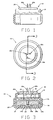
- a condition-responsive sensor 10 made in accordance with a first embodiment of the invention and as shown in Figs. 1-7 comprises a generally cylindrical cup-shaped housing 12 formed of suitable material having a bottom 12a and an upstanding wall 12b. Steel is particularly advantageous due to its magnetic shielding characteristics.
- a substrate 18 formed of suitable material such as electrically insulative aluminum oxide, Al 2 O 3 , is placed within housing 12 preferably on a gasket 14 of elastomeric material for a purpose to be described below. It will be understood that the substrate could be composed of various materials such as metal for example, having an electrically insulative top surface or other electrically insulating materials.
- Substrate 18 is preferably configured as a cylindrical disc conforming generally to housing 12 and has a bore 18a formed therethrough between opposite face surfaces.
- An electrically conductive detect plate 18b (Fig. 5) is provided on a top surface 18c of substrate 18. Plate 18b can be placed on the substrate in any suitable manner as by screen printing.
- Associated circuit paths 18d and 18e are also formed on surface 18c in a similar manner. Bore 18a is aligned with a source plate mounting portion 18f electrically connected to path 18d.
- a mounting element in the form of a pin 22, formed of material having a coefficient of thermal expansion closely matching that of substrate 18, is received in bore 18a.
- pin 22 when the substrate employed is composed of 94% alumina ceramic, pin 22 can be formed of alloy 42, an alloy having a nominal composition by weight of 42% nickel and the balance iron. Both alloy 42 and 94% alumina have closely matching expansion properties over an appropriate temperature range.
- Pin 22 is preferably formed with a curved end portion 22a on each end to serve as a weld projection. A recess (not shown) may be formed in the top surface of substrate 18 around bore 18a to enhance flow of coating material from trace 18f into the bore. Further details of a suitable pin mounting arrangement can be obtained from application Serial No. 08/148,042 (corresponding to EP 0 652 440, which document falls under Art. 54 (3) EPC.).
- An electrically conductive blade member 24, best seen in Fig. 4, is formed of material having a selected coefficient of thermal expansion relative to that of the substrate and pin to which it is to be mounted, e.g., in the structure described above, alloy 42 would be appropriate.
- Blade member 24 has a source plate portion 24a, preferably at the center of seismic mass, attached at each lateral side to a respective beam 24b defined by a slot 24c which extends adjacent to the sides essentially the full length of blade member 24, i.e., along a vertical axis 24d from a first end 24e to a second end 24f of the blade member.
- Each slot 24c has a portion 24g which extends generally parallel to the horizontal axis 24h along the second end of the blade member toward the center of the second end forming a pair or torsion arms 24i each connected to a respective elongated beam member 24b at the second end of the blade member.
- Slot portions 24g have a terminus 24j closely spaced from one another to form a central pivot 24k connecting torsion arms 24i to a central brace portion 24m.
- Central brace portion 24m is defined by slots 24c and 24g along with a centrally disposed horizontally extending slot 24n forming counter-flexing zones 24o which are connected to attachment portion 24p. Attachment portion 24p is separated from source plate portion 24a by a slot 24t which is in communication with respective slots 24c.
- Slots 24t and 24n have cutout portions 24r at opposite sides of attachment portions 24p to form pivots 24s coupling attachment portions 24p to counter-flex zones 24o.
- the attachment portion is preferably located at the center of mass to minimize torsional components resulting from forces applied along the horizontal and vertical directions which could adversely affect the connection of the blade member to the pin. Such forces could occur, for example, as a result of dropping the sensor prior to installation.
- the source plate portion 24a extends from beam members 24b in a direction back toward the attachment portion.
- blade member 24 is similar to that disclosed in copending application Serial No. 08/148,042, mentioned above, the provision of torsion arms 24i and central pivot 24k result in improved sensitivity or deflection of the blade member so that the blade member can be made significantly smaller both in the horizontal and vertical directions while still providing sufficient deflection of the source plate portion in response to acceleration forces along the z axis, i.e., an axis perpendicular to the horizontal and vertical directions.
- the foot print of the blade member having a given material thickness can be significantly decreased in size and still provide sufficient deflection due to torsion arms 24i and central pivot 24k in spite of the fact that a significant portion of the deflection is provided by beams 24b extending essentially the full length of the blade and that deflection is proportional to length cubed.
- the blade member can be made sufficiently small to fit in a variety of packaging configurations and can be received in locations previously not suitable or not large enough for the larger prior art sensors, as will be discussed in greater detail below.
- Shell 26 is generally cylindrical having a sidewall 26a extending from end wall 26b.
- a recess 26c is formed in end wall 26b to provide space for metal blade member 24 with wall 26b serving to limit deflection of the blade member 24 to prevent overstressing due to abnormally high acceleration forces.
- Electrically conductive pins 18g, 18h and 18i, received in bores formed in substrate 18, extend through apertures formed in end wall 26b.
- Raised areas 26d are formed on the top surface of shell 26 around the bores receiving pins 18g, 18h and 18I to help avoid any coating material which may be placed on circuit components placed on top of shell 26 from flowing into the pin bores.
- Substrate 18 is preferably formed with an indexing notch 18k, see Figs. 5 and 6, which cooperates with an indexing rib 26e formed on sidewall 26a of shell 26, see Fig. 7a, so that shell 26 will be properly aligned on substrate 18 thereby avoiding any stress from being placed on the conductive pins 18g, 18h and 18I due to misalignment.
- wall 26a which also serves to prevent entry of contaminants, extends from end wall 26b a distance which is slightly less than the thickness of substrate 18.
- the substrate and shell assembly of Figure 7 is then received in housing 12, seen in Fig. 3, on resilient layer 14.
- Layer 14 is preferably provided with a central open area 14a to prevent the possibility of the material of layer 14 from extruding into bore 18a when the assembly is fastened to housing 12 decribed below.
- a connector body 20 having a cavity 20a adapted to receive signal conditioning circuit means 30, such as that shown in coassigned Patent No. 4,875,135 to which reference may be had for further details, is received in housing 12 over shell 26.
- Connector body 20 mounts terminals 20b, 20c and 20d and may be fastened to housing 12 in any suitable manner, as by bending the outer distal end of wall 12b inwardly onto connector body 20 and against the bias provided by resilient layer 14.
- a closed end sleeve 28 of resilient material is placed about housing 12 so that if the sensor is subjected to a blow along an axis other than the z axis, e.g., is dropped, the sleeve will cushion the shock and avoid damaging the blade member and/or the mounting of the blade member.
- Sensor 10 can be separately mounted as by clipping it to a bracket or the like. Further, as shown in Figs. 8-10 first and second sensor modules can be mounted in a housing 42 having sensor seating cavities 42a, 42b oriented at a selected angle with one another, e.g. 90°, in which a respective sensor 10 can be placed to make a dual axis sensor assembly 40 so that acceleration forces can be sensed in two different directions.
- the terminals of each sensor module can be connected through a suitable harness or circuit board to terminals 42c-42f in connector 42g shown in Fig. 9.
- the terminals of sensor module 10 comprising 20b, 20c, 20d are used for power V cc , output V o and ground respectively.
- Terminals 20c (V cc ) and 20d (ground) of one sensor module 10 can be connected to respective terminals 20c and 20d of the second sensor module 10 to reduce the required number of terminals of dual sensor assembly 40.
- the sensors are potted into cavities 42a, 42b and, if desired, a lid 44 can be received over the cavities.
- Suitable mounting holes 42i in mounting bracket 42j can be used to mount sensor assembly 40 to a body whose acceleration is to be monitored using conventional fasteners.
- housing 42 is described having a dual sensor assembly 40, it is within the purview of the invention to incorporate three or more sensors oriented at selected angles so that acceleration forces can be sensed in various selected directions, if desired. Fig.
- FIG 11 shows a modified sensor 10' which uses terminal pins 18g, 18h, 18i to directly, physically and electrically couple the sensor to a circuit board 50.
- Substrate 18 is inverted and received on an annular seat 12'c formed in tubular housing 12' with blade member 24', attached to pin 22, disposed between substrate 18 and bottom wall 12'a which serves to prevent over-travel of the blade member.
- terminal pins 18g, 18h, 18i extend out the opposite face surface of substrate 18 for connection to circuit traces on circuit board 50.
- the signal conditioning circuit can be disposed on circuit board 50, if desired, rather than in the sensor 10' housing.
- blade member 24' is shown mounted in a non-central location, e.g., at central brace portion 24m, although mounting at attachment portion 24p is claimed.
- sensor 10" can be mounted by providing a threaded member 12"d either integrally attached to housing 12" or attached by welding or the like thereto.
- a close ended sleeve 12"e of resilient material such as rubber may be placed over threaded member 12"d prior to use both to protect the thread as well as to provide a cushion along with sleeve 28' in the event that sensor 10" is dropped on a hard surface.
- Sleeve 28' in addition to providing a protective cushion, also facilitates mounting of the sensor by providing frictional drive capability. That is, the sensor can be grasped through the sleeve and rotated without having to use the hexagonal mounting portion 12"f.
- housing 12" is shown as being formed of metal, it will be understood that the housing and threaded member could be formed from suitable material, e.g., polymeric material, if desired.
- Connector body 20' is shown with a shroud 20'e around terminals 20'b, 20'c, 20'd.
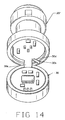
- Signal conditioning circuitry 30 received in cavity 20'a is shown comprising a flexible substrate 30a of polyimide or other suitable material on which circuit traces and components are disposed.
- a tab 30b extends from flexible substrate 30a on which a circuit trace 30d (Fig. 14) is disposed to provide a ground connection for circuit 30.
- the tab on which the ground trace is disposed extends out of the circuit receiving cavity formed between connector body and the sensor sub-assembly between the connector body and metallic housing member with the distal free end of the housing wall deformed over against the tab and the connector body to make electrical connection between the circuit trace on the tab and the housing member.
- sealing material such as silicone typically is placed around the interface between the connector body and the housing wall to form an environmental seal in the manner described in U.S. Patent No. 4,875,135 referenced above.
- sealing material such as silicone typically is placed around the interface between the connector body and the housing wall to form an environmental seal in the manner described in U.S. Patent No. 4,875,135 referenced above.
- tab 30b is chosen to have a length only sufficient to extend to a point intermediate the outer distal end of wall 12b and the bottom of connector body 20'.
- a detent 12c is then formed in wall 12b in alignment with tab 30b and extending through the tab into connector body 20' to make an effective electrical connection between the ground trace on tab 30b and housing 12".
- a conventional flexible gasket such as 0-ring seal member 13 is then placed around connector body 20' and the outer distal portion 12d of housing 12" is rolled over onto member 13 to form an effective environmental seal in an easily controlled assembly procedure.
- Calibration window 20'f can continue to be sealed using conventional epoxy material 20'g, such as silicone rubber, since the opening is sufficiently large that a dispenser can easily and accurately be inserted into it.
Landscapes
- Physics & Mathematics (AREA)
- General Physics & Mathematics (AREA)
- Pressure Sensors (AREA)
Claims (15)
- Capteur (10) réagissant à une condition d'accélération, comprenant un substrat (18) ayant une première surface (18c), une plaque de détection (18b) conductrice de l'électricité, montée sur la première surface du substrat, un organe formant lame (24) conducteur de l'électricité, ayant des premier et deuxième axes, dans le plan de la lame, perpendiculaires l'un à l'autre, et des première (24e) et des deuxième (24f) extrémités et ayant une partie de fixation (24p) située globalement au centre de gravité de l'organe formant lame, une partie formant plaque source (24a) et des moyens formant poutre élastique monolithique, s'étendant entre les parties de plaque de fixation et de plaque source, les moyens formant poutre élastique comprenant :une paire d'organes formant poutre (24b) allongés, formés par une fente (24c) respective adjacente à des côtés opposés de l'organe formant lame et s'étendant dans la direction du premier axe, sensiblement depuis la première extrémité (24e) vers la deuxième extrémité (24f) de l'organe formant lame, les organes formant poutre étant connectés, à la première extrémité de l'organe formant lame, à la partie formant plaque source (24a), la partie formant plaque source s'étendant à l'arrière dans une direction tournée vers la partie de fixation (24p) depuis la connexion avec les organes formant poutre ;une paire de bras de torsion (24i) connectés aux organes formant poutre allongés respectifs, à la deuxième extrémité de l'organe formant lame, les fentes respectives ayant une partie s'étendant parallèlement au deuxième axe, sur la deuxième extrémité de l'organe formant lame, en direction du centre de la deuxième extrémité formant la paire de bras de torsion (24i) ; etun pivot central (24k), les fentes respectives ayant une terminaison (24j) intimement espacées les unes des autres pour former le pivot central (24k) ;l'organe formant lame (24) étant monté sur le substrat (18) via la partie de fixation, la partie formant plaque source (24a) recouvrant la plaque de détection (18b) en une relation espacée sélectionnée, des chemins de circuit étant disposés sur le substrat, en étant reliés électriquement à la plaque de détection et à l'organe formant lame conductrice de l'électricité afin de former un condensateur électrique, la partie formant plaque source étant déplaçable par rapport à la plaque de détection, en réponse à une force d'accélération, dans le but de fournir un signal électrique.
- Capteur réagissant à une condition d'accélération selon la revendication 1, dans lequel l'organe formant lame (24) est globalement rectangulaire, observé en vue en plan, et le substrat est globalement cylindrique.
- Capteur réagissant à une condition d'accélération selon la revendication 1, dans lequel le substrat (18) a un perçage (18a) s'étendant perpendiculairement à la première surface, l'organe formant lame (24) est fixé à une tige (22), la tige étant logée dans le perçage.
- Capteur réagissant à une condition d'accélération selon la revendication 1, dans lequel le substrat (18) a un perçage (18a) s'étendant perpendiculairement à la première surface, et la partie de fixation (24p) de l'organe formant lame (24) est fixée à une tige (22), la tige étant logée dans le perçage.
- Capteur réagissant à une condition d'accélération selon la revendication 1, comprenant en outre une butée anti-débattement excessif, espacée d'une distance sélectionnée vis-à-vis de la première surface du substrat, afin d'empêcher tout déplacement de débattement excessif de l'organe formant lame.
- Capteur réagissant à une condition d'accélération selon la revendication 5, comprenant en outre un boítier (12) en forme de coupe, ayant une paroi inférieure (12a) et une paroi latérale(12b) s'étendant depuis la paroi inférieure vers une partie d'extrémité distale, une enveloppe formant siège étant formée sur la paroi latérale, le substrat étant logé dans le boítier, la première surface du substrat étant disposée sur l'enveloppe formant siège, la paroi inférieure (12a) étant espacée de la première surface, d'une distance sélectionnée, pour servir de butée anti-débattement excessif pour empêcher tout déplacement de débattement excessif de l'organe formant lame (24).
- Capteur réagissant à une condition d'accélération selon la revendication 5, comprenant en outre un boítier en forme de coupe, ayant une paroi inférieure et une paroi latérale s'étendant depuis la paroi inférieure vers une partie d'extrémité distale, le substrat étant logé dans le boítier, la première surface du substrat (18) étant orientée à l'opposé de la paroi inférieure, une enveloppe (26) ayant une paroi supérieure et une paroi latérale, dépendant de la paroi supérieure, la paroi latérale et l'enveloppe étant disposées sur la première surface du substrat, la paroi supérieure étant espacée de la première surface du substrat, de la valeur d'une distance sélectionnée, pour servir de butée anti-débattement excessif pour empêcher tout déplacement de débattement excessif de la part de l'organe formant lame.
- Capteur réagissant à une condition d'accélération selon la revendication 1, comprenant en outre un boítier (12) en forme de coupe, métallique, ayant une paroi inférieure et une paroi latérale s'étendant depuis la paroi inférieure vers une partie d'extrémité distale, le substrat (18) étant logé dans le boítier, la première surface du substrat étant tournée à l'opposé de la paroi inférieure, un corps de connecteur (20) fermant le boítier en forme de coupe et formant une cavité de logement de circuit entre le corps de connecteur et le substrat, un substrat de circuit flexible étant logé dans la cavité, le substrat de circuit flexible ayant une patte s'étendant depuis celui-ci, avec sur elle une piste de circuit de masse, la patte s'étendant entre le corps de connecteur et la paroi latérale du boítier jusqu'à un point intermédiaire entre la paroi inférieure du boítier et la partie d'extrémité distale de la paroi latérale, un élément à déclic, formé dans la paroi latérale par l'intermédiaire de la patte et pénétrant dans le corps de connecteur pour établir une connexion électrique entre la piste de circuit de masse et le boítier, un organe formant joint, logé entre le corps de connecteur et la paroi latérale du boítier, la partie d'extrémité distale de la paroi latérale étant retournée pour emprisonner l'organe formant joint et former un joint d'étanchéité envers l'environnement.
- Capteur réagissant à une condition d'accélération selon la revendication 8, comprenant en outre une couche en matériau (19) élastique, disposée entre le substrat (18) et la paroi inférieure du boítier.
- Capteur réagissant à une condition d'accélération selon la revendication 1, comprenant en outre un boítier (12') en forme de coupe, ayant une paroi inférieure et une paroi latérale s'étendant depuis la paroi inférieure vers une partie d'extrémité distale, le substrat étant logé dans le boítier, le substrat étant formé d'une pluralité de trous de logement de tige, une tige de borne (18g, 18h, 18i) conductrice de l'électricité étant logée dans chaque perçage, en prise de contact électrique avec les chemins de circuit se trouvant sur le substrat et une carte de circuit (50), les tiges de borne conductrice de l'électricité s'étendant à travers des ouvertures ménagées dans la carte de circuit et étant fixées à la carte de circuit afin de monter sur elles le capteur.
- Capteur réagissant à une condition d'accélération selon la revendication 1, comprenant en outre un boítier (12) en forme de coupe ayant une paroi inférieure et une paroi latérale s'étendant depuis la paroi inférieure, le substrat étant logé dans le boítier et du matériau (28) élastique étant disposé à l'intérieur du boítier, sur les parois latérale et inférieure du boítier.
- Capteur réagissant à une condition d'accélération selon la revendication 1, comprenant en outre un boítier (12") en forme de coupe ayant une paroi inférieure et une paroi latérale s'étendant depuis la paroi inférieure, le substrat (18) étant logé dans le boítier et un organe fileté (12"d) s'étendant vers le bas depuis la paroi inférieure.
- Capteur réagissant à une condition d'accélération selon la revendication 12, dans lequel du matériau (28') élastique est disposé à l'extérieur du boítier, sur la paroi latérale.
- Ensemble de capteur réagissant à une condition d'accélération, comprenant un support, des premier et deuxième sièges de capteur dans un boítier ayant une surface de portée disposée sur le support, les surfaces d'étanchéité étant situées dans des premier et deuxième plans respectifs qui se coupent mutuellement, des premier et deuxième modules de capteurs d'accélération, les premier et deuxième modules de capteurs d'accélération étant montés dans les premier et deuxième sièges respectifs, la paroi inférieure du boítier respectif étant situé dans un plan globalement parallèle à des premier et deuxième plans respectifs, de manière que les forces d'accélération soient appréhendées dans deux directions différentes, dans lequel chacun desdits premier et deuxième modules de capteurs est réalisé selon l'une quelconque des revendications précédentes.
- Ensemble de capteur réagissant à une condition d'accélération selon la revendication 14, dans lequel les premier et deuxième plans sont perpendiculaires l'un à l'autre.
Applications Claiming Priority (2)
| Application Number | Priority Date | Filing Date | Title |
|---|---|---|---|
| US367655 | 1995-01-03 | ||
| US08/367,655 US5542296A (en) | 1995-01-03 | 1995-01-03 | Compact capacitive acceleration sensor |
Publications (3)
| Publication Number | Publication Date |
|---|---|
| EP0721108A2 EP0721108A2 (fr) | 1996-07-10 |
| EP0721108A3 EP0721108A3 (fr) | 1998-08-05 |
| EP0721108B1 true EP0721108B1 (fr) | 2002-10-16 |
Family
ID=23448068
Family Applications (1)
| Application Number | Title | Priority Date | Filing Date |
|---|---|---|---|
| EP95309044A Expired - Lifetime EP0721108B1 (fr) | 1995-01-03 | 1995-12-12 | Dispositif capteur pour condition d'accélération |
Country Status (4)
| Country | Link |
|---|---|
| US (1) | US5542296A (fr) |
| EP (1) | EP0721108B1 (fr) |
| JP (1) | JPH08233856A (fr) |
| DE (1) | DE69528572T2 (fr) |
Families Citing this family (9)
| Publication number | Priority date | Publication date | Assignee | Title |
|---|---|---|---|---|
| US6243654B1 (en) | 1997-10-07 | 2001-06-05 | Telemonitor, Inc. | Transducer assembly with smart connector |
| KR20000074442A (ko) * | 1999-05-21 | 2000-12-15 | 오세옥 | 다용도 충격센서 |
| EP1162467A3 (fr) * | 2000-05-30 | 2002-07-24 | Matsushita Electric Industrial Co., Ltd. | Capteur d'accélération |
| US7181968B2 (en) * | 2004-08-25 | 2007-02-27 | Autoliv Asp, Inc. | Configurable accelerometer assembly |
| US8186221B2 (en) * | 2009-03-24 | 2012-05-29 | Freescale Semiconductor, Inc. | Vertically integrated MEMS acceleration transducer |
| DE102011005113A1 (de) * | 2011-03-04 | 2012-09-06 | Zf Friedrichshafen Ag | Gehäuse und Abdeckungselement für einen Sensorträger |
| JP5845672B2 (ja) | 2011-07-13 | 2016-01-20 | セイコーエプソン株式会社 | センサーデバイスおよび電子機器 |
| JP2019035589A (ja) * | 2017-08-10 | 2019-03-07 | セイコーエプソン株式会社 | 物理量センサー、慣性計測ユニット、電子機器、および移動体 |
| JP6545918B1 (ja) * | 2019-05-22 | 2019-07-17 | Imv株式会社 | 加速度センサコアユニット、加速度センサを載置する基板のたわみを防止する方法 |
Family Cites Families (6)
| Publication number | Priority date | Publication date | Assignee | Title |
|---|---|---|---|---|
| US4736629A (en) * | 1985-12-20 | 1988-04-12 | Silicon Designs, Inc. | Micro-miniature accelerometer |
| DE3611360A1 (de) * | 1986-04-04 | 1987-10-08 | Bosch Gmbh Robert | Sensor zur selbsttaetigen ausloesung von insassenschutzvorrichtungen |
| US4875135A (en) * | 1988-12-02 | 1989-10-17 | Texas Instruments Incorporated | Pressure sensor |
| US5239871A (en) * | 1990-12-17 | 1993-08-31 | Texas Instruments Incorporated | Capacitive accelerometer |
| US5345823A (en) * | 1991-11-12 | 1994-09-13 | Texas Instruments Incorporated | Accelerometer |
| US5555766A (en) * | 1993-11-04 | 1996-09-17 | Texas Instruments Incorporated | Acceleration sensor apparatus and method for making same |
-
1995
- 1995-01-03 US US08/367,655 patent/US5542296A/en not_active Expired - Lifetime
- 1995-12-12 EP EP95309044A patent/EP0721108B1/fr not_active Expired - Lifetime
- 1995-12-12 DE DE69528572T patent/DE69528572T2/de not_active Expired - Lifetime
- 1995-12-25 JP JP7337235A patent/JPH08233856A/ja active Pending
Also Published As
| Publication number | Publication date |
|---|---|
| DE69528572D1 (de) | 2002-11-21 |
| US5542296A (en) | 1996-08-06 |
| EP0721108A2 (fr) | 1996-07-10 |
| DE69528572T2 (de) | 2003-12-11 |
| JPH08233856A (ja) | 1996-09-13 |
| EP0721108A3 (fr) | 1998-08-05 |
Similar Documents
| Publication | Publication Date | Title |
|---|---|---|
| EP0542436B1 (fr) | Accéléromètre | |
| EP0523862B1 (fr) | Dispositif de montage pour un accéléromètre, ayant un dépendance réduite à la température | |
| EP0540071B1 (fr) | Dispositif de mesure d'accélération avec circuit d'évaluation | |
| JP3020426B2 (ja) | トランスデューサアセンブリ、回路基板に取り付けるためのトランスデューサデバイス、及び回路基板にトランスデューサを取り付ける方法 | |
| EP0660119B1 (fr) | Capteur d'accélération | |
| US6040625A (en) | Sensor package arrangement | |
| US5548999A (en) | Mounting arrangement for acceleration detector element | |
| US6536287B2 (en) | Simplified capacitance pressure sensor | |
| EP0543430B1 (fr) | Palpeur de pression et méthode pour son assemblage | |
| EP0491506B1 (fr) | Accéléromètre et procédé de fabrication | |
| EP0519626A1 (fr) | Accéléromètre piézorésistif avec une masse centrale dans un support | |
| EP0721108B1 (fr) | Dispositif capteur pour condition d'accélération | |
| EP1407278B1 (fr) | Capteur d'acceleration | |
| JP3437876B2 (ja) | 加速度センサ装置およびその製造方法 | |
| EP0550037B1 (fr) | Accéléromètre piézoélectrique | |
| US4987780A (en) | Integrated accelerometer assembly | |
| GB2234817A (en) | Integrated accelerometer assembly | |
| JPH07110341A (ja) | 三次元加速度センサユニットとそのユニットをパッケージした三次元加速度センサ | |
| JP2001337107A (ja) | 半導体加速度センサ及び半導体加速度センサパッケージ |
Legal Events
| Date | Code | Title | Description |
|---|---|---|---|
| PUAI | Public reference made under article 153(3) epc to a published international application that has entered the european phase |
Free format text: ORIGINAL CODE: 0009012 |
|
| AK | Designated contracting states |
Kind code of ref document: A2 Designated state(s): DE FR GB IT NL |
|
| PUAL | Search report despatched |
Free format text: ORIGINAL CODE: 0009013 |
|
| AK | Designated contracting states |
Kind code of ref document: A3 Designated state(s): DE FR GB IT NL |
|
| 17P | Request for examination filed |
Effective date: 19981125 |
|
| 17Q | First examination report despatched |
Effective date: 19991019 |
|
| GRAG | Despatch of communication of intention to grant |
Free format text: ORIGINAL CODE: EPIDOS AGRA |
|
| GRAG | Despatch of communication of intention to grant |
Free format text: ORIGINAL CODE: EPIDOS AGRA |
|
| GRAG | Despatch of communication of intention to grant |
Free format text: ORIGINAL CODE: EPIDOS AGRA |
|
| GRAH | Despatch of communication of intention to grant a patent |
Free format text: ORIGINAL CODE: EPIDOS IGRA |
|
| GRAH | Despatch of communication of intention to grant a patent |
Free format text: ORIGINAL CODE: EPIDOS IGRA |
|
| GRAA | (expected) grant |
Free format text: ORIGINAL CODE: 0009210 |
|
| AK | Designated contracting states |
Kind code of ref document: B1 Designated state(s): DE FR GB IT NL |
|
| PG25 | Lapsed in a contracting state [announced via postgrant information from national office to epo] |
Ref country code: NL Free format text: LAPSE BECAUSE OF FAILURE TO SUBMIT A TRANSLATION OF THE DESCRIPTION OR TO PAY THE FEE WITHIN THE PRESCRIBED TIME-LIMIT Effective date: 20021016 Ref country code: IT Free format text: LAPSE BECAUSE OF FAILURE TO SUBMIT A TRANSLATION OF THE DESCRIPTION OR TO PAY THE FEE WITHIN THE PRE;WARNING: LAPSES OF ITALIAN PATENTS WITH EFFECTIVE DATE BEFORE 2007 MAY HAVE OCCURRED AT ANY TIME BEFORE 2007. THE CORRECT EFFECTIVE DATE MAY BE DIFFERENT FROM THE ONE RECORDED.SCRIBED TIME-LIMIT Effective date: 20021016 |
|
| REG | Reference to a national code |
Ref country code: GB Ref legal event code: FG4D |
|
| REF | Corresponds to: |
Ref document number: 69528572 Country of ref document: DE Date of ref document: 20021121 |
|
| NLV1 | Nl: lapsed or annulled due to failure to fulfill the requirements of art. 29p and 29m of the patents act | ||
| ET | Fr: translation filed | ||
| PLBE | No opposition filed within time limit |
Free format text: ORIGINAL CODE: 0009261 |
|
| STAA | Information on the status of an ep patent application or granted ep patent |
Free format text: STATUS: NO OPPOSITION FILED WITHIN TIME LIMIT |
|
| 26N | No opposition filed |
Effective date: 20030717 |
|
| REG | Reference to a national code |
Ref country code: GB Ref legal event code: 732E |
|
| REG | Reference to a national code |
Ref country code: FR Ref legal event code: TP |
|
| PGFP | Annual fee paid to national office [announced via postgrant information from national office to epo] |
Ref country code: FR Payment date: 20101203 Year of fee payment: 16 |
|
| PGFP | Annual fee paid to national office [announced via postgrant information from national office to epo] |
Ref country code: GB Payment date: 20101123 Year of fee payment: 16 |
|
| PGFP | Annual fee paid to national office [announced via postgrant information from national office to epo] |
Ref country code: DE Payment date: 20101230 Year of fee payment: 16 |
|
| GBPC | Gb: european patent ceased through non-payment of renewal fee |
Effective date: 20111212 |
|
| REG | Reference to a national code |
Ref country code: FR Ref legal event code: ST Effective date: 20120831 |
|
| REG | Reference to a national code |
Ref country code: DE Ref legal event code: R119 Ref document number: 69528572 Country of ref document: DE Effective date: 20120703 |
|
| PG25 | Lapsed in a contracting state [announced via postgrant information from national office to epo] |
Ref country code: DE Free format text: LAPSE BECAUSE OF FAILURE TO SUBMIT A TRANSLATION OF THE DESCRIPTION OR TO PAY THE FEE WITHIN THE PRESCRIBED TIME-LIMIT Effective date: 20120703 Ref country code: GB Free format text: LAPSE BECAUSE OF NON-PAYMENT OF DUE FEES Effective date: 20111212 |
|
| PG25 | Lapsed in a contracting state [announced via postgrant information from national office to epo] |
Ref country code: FR Free format text: LAPSE BECAUSE OF NON-PAYMENT OF DUE FEES Effective date: 20120102 |