EP0721446B1 - Chirale tenside und verfahren zu ihrer verwendung in chiralen trennungen - Google Patents
Chirale tenside und verfahren zu ihrer verwendung in chiralen trennungen Download PDFInfo
- Publication number
- EP0721446B1 EP0721446B1 EP94930460A EP94930460A EP0721446B1 EP 0721446 B1 EP0721446 B1 EP 0721446B1 EP 94930460 A EP94930460 A EP 94930460A EP 94930460 A EP94930460 A EP 94930460A EP 0721446 B1 EP0721446 B1 EP 0721446B1
- Authority
- EP
- European Patent Office
- Prior art keywords
- chiral
- surfactant
- alkyls
- capillary
- linear
- Prior art date
- Legal status (The legal status is an assumption and is not a legal conclusion. Google has not performed a legal analysis and makes no representation as to the accuracy of the status listed.)
- Expired - Lifetime
Links
- 239000004094 surface-active agent Substances 0.000 title claims abstract description 141
- 238000000034 method Methods 0.000 title claims abstract description 47
- 238000000926 separation method Methods 0.000 title abstract description 131
- 239000000693 micelle Substances 0.000 claims abstract description 53
- HBAQYPYDRFILMT-UHFFFAOYSA-N 8-[3-(1-cyclopropylpyrazol-4-yl)-1H-pyrazolo[4,3-d]pyrimidin-5-yl]-3-methyl-3,8-diazabicyclo[3.2.1]octan-2-one Chemical class C1(CC1)N1N=CC(=C1)C1=NNC2=C1N=C(N=C2)N1C2C(N(CC1CC2)C)=O HBAQYPYDRFILMT-UHFFFAOYSA-N 0.000 claims abstract description 38
- 230000002209 hydrophobic effect Effects 0.000 claims abstract description 26
- 238000005251 capillar electrophoresis Methods 0.000 claims abstract description 25
- 239000003792 electrolyte Substances 0.000 claims abstract description 19
- 108010011485 Aspartame Proteins 0.000 claims abstract description 11
- IAOZJIPTCAWIRG-QWRGUYRKSA-N aspartame Chemical compound OC(=O)C[C@H](N)C(=O)N[C@H](C(=O)OC)CC1=CC=CC=C1 IAOZJIPTCAWIRG-QWRGUYRKSA-N 0.000 claims abstract description 11
- 239000000605 aspartame Substances 0.000 claims abstract description 10
- 229960003438 aspartame Drugs 0.000 claims abstract description 10
- 235000010357 aspartame Nutrition 0.000 claims abstract description 10
- 239000000203 mixture Substances 0.000 claims abstract description 10
- 150000001875 compounds Chemical class 0.000 claims description 81
- 125000000217 alkyl group Chemical group 0.000 claims description 49
- 229930195733 hydrocarbon Natural products 0.000 claims description 44
- 150000002430 hydrocarbons Chemical class 0.000 claims description 42
- 150000001413 amino acids Chemical class 0.000 claims description 27
- 239000004215 Carbon black (E152) Substances 0.000 claims description 22
- -1 zwitterions Polymers 0.000 claims description 20
- 235000013877 carbamide Nutrition 0.000 claims description 19
- 229920000570 polyether Polymers 0.000 claims description 19
- 150000007942 carboxylates Chemical class 0.000 claims description 17
- 238000004587 chromatography analysis Methods 0.000 claims description 16
- 150000001414 amino alcohols Chemical class 0.000 claims description 14
- 239000000470 constituent Substances 0.000 claims description 14
- 239000004721 Polyphenylene oxide Substances 0.000 claims description 12
- 238000005370 electroosmosis Methods 0.000 claims description 11
- FEWJPZIEWOKRBE-UHFFFAOYSA-N Tartaric Acid Chemical class [H+].[H+].[O-]C(=O)C(O)C(O)C([O-])=O FEWJPZIEWOKRBE-UHFFFAOYSA-N 0.000 claims description 10
- 229910052760 oxygen Inorganic materials 0.000 claims description 10
- 235000002906 tartaric acid Nutrition 0.000 claims description 10
- 150000001412 amines Chemical class 0.000 claims description 9
- 150000005846 sugar alcohols Polymers 0.000 claims description 8
- OKTJSMMVPCPJKN-UHFFFAOYSA-N Carbon Chemical compound [C] OKTJSMMVPCPJKN-UHFFFAOYSA-N 0.000 claims description 7
- 229910052799 carbon Inorganic materials 0.000 claims description 7
- 150000003456 sulfonamides Chemical class 0.000 claims description 7
- 210000002700 urine Anatomy 0.000 claims description 7
- 150000001298 alcohols Chemical class 0.000 claims description 6
- 125000003342 alkenyl group Chemical group 0.000 claims description 6
- 229910002091 carbon monoxide Inorganic materials 0.000 claims description 6
- 229910052736 halogen Inorganic materials 0.000 claims description 6
- 150000002367 halogens Chemical group 0.000 claims description 6
- 150000003863 ammonium salts Chemical class 0.000 claims description 5
- 150000004657 carbamic acid derivatives Chemical class 0.000 claims description 4
- 150000003839 salts Chemical class 0.000 claims description 4
- 150000003467 sulfuric acid derivatives Chemical class 0.000 claims description 4
- 150000003672 ureas Chemical class 0.000 claims description 4
- 238000004130 chiral capillary electrophoresis Methods 0.000 claims description 3
- 150000003460 sulfonic acids Chemical class 0.000 claims description 3
- 239000007864 aqueous solution Substances 0.000 claims description 2
- 150000001721 carbon Chemical group 0.000 claims description 2
- 238000009472 formulation Methods 0.000 claims description 2
- 125000001453 quaternary ammonium group Chemical group 0.000 claims description 2
- 239000013060 biological fluid Substances 0.000 claims 1
- 230000015572 biosynthetic process Effects 0.000 abstract description 17
- 238000003786 synthesis reaction Methods 0.000 abstract description 15
- 230000003389 potentiating effect Effects 0.000 abstract description 10
- 230000005684 electric field Effects 0.000 abstract description 2
- VWPOSFSPZNDTMJ-UCWKZMIHSA-N nadolol Chemical compound C1[C@@H](O)[C@@H](O)CC2=C1C=CC=C2OCC(O)CNC(C)(C)C VWPOSFSPZNDTMJ-UCWKZMIHSA-N 0.000 description 89
- 125000005647 linker group Chemical group 0.000 description 31
- YMWUJEATGCHHMB-UHFFFAOYSA-N Dichloromethane Chemical compound ClCCl YMWUJEATGCHHMB-UHFFFAOYSA-N 0.000 description 30
- OKKJLVBELUTLKV-UHFFFAOYSA-N Methanol Chemical compound OC OKKJLVBELUTLKV-UHFFFAOYSA-N 0.000 description 24
- 229940024606 amino acid Drugs 0.000 description 24
- 239000012491 analyte Substances 0.000 description 24
- 230000037230 mobility Effects 0.000 description 24
- XSQUKJJJFZCRTK-UHFFFAOYSA-N Urea Chemical compound NC(N)=O XSQUKJJJFZCRTK-UHFFFAOYSA-N 0.000 description 23
- KWGRBVOPPLSCSI-WPRPVWTQSA-N (-)-ephedrine Chemical compound CN[C@@H](C)[C@H](O)C1=CC=CC=C1 KWGRBVOPPLSCSI-WPRPVWTQSA-N 0.000 description 22
- KFXDHGFKZUDVAR-INIZCTEOSA-N (2s)-2-(dodecoxycarbonylamino)-3-methylbutanoic acid Chemical compound CCCCCCCCCCCCOC(=O)N[C@@H](C(C)C)C(O)=O KFXDHGFKZUDVAR-INIZCTEOSA-N 0.000 description 22
- 239000000243 solution Substances 0.000 description 22
- 235000001014 amino acid Nutrition 0.000 description 21
- 239000000047 product Substances 0.000 description 21
- 238000000638 solvent extraction Methods 0.000 description 21
- XLYOFNOQVPJJNP-UHFFFAOYSA-N water Substances O XLYOFNOQVPJJNP-UHFFFAOYSA-N 0.000 description 21
- 239000011541 reaction mixture Substances 0.000 description 19
- 239000000523 sample Substances 0.000 description 19
- 239000012071 phase Substances 0.000 description 16
- QTBSBXVTEAMEQO-UHFFFAOYSA-N Acetic acid Chemical compound CC(O)=O QTBSBXVTEAMEQO-UHFFFAOYSA-N 0.000 description 15
- KZSNJWFQEVHDMF-BYPYZUCNSA-N L-valine Chemical compound CC(C)[C@H](N)C(O)=O KZSNJWFQEVHDMF-BYPYZUCNSA-N 0.000 description 15
- KZSNJWFQEVHDMF-UHFFFAOYSA-N Valine Natural products CC(C)C(N)C(O)=O KZSNJWFQEVHDMF-UHFFFAOYSA-N 0.000 description 15
- 239000000872 buffer Substances 0.000 description 15
- 239000004202 carbamide Substances 0.000 description 15
- 238000004128 high performance liquid chromatography Methods 0.000 description 15
- 238000001012 micellar electrokinetic chromatography Methods 0.000 description 15
- 239000004474 valine Substances 0.000 description 14
- 238000002835 absorbance Methods 0.000 description 13
- 229960004255 nadolol Drugs 0.000 description 13
- VEXZGXHMUGYJMC-UHFFFAOYSA-N Hydrochloric acid Chemical compound Cl VEXZGXHMUGYJMC-UHFFFAOYSA-N 0.000 description 12
- HEMHJVSKTPXQMS-UHFFFAOYSA-M Sodium hydroxide Chemical compound [OH-].[Na+] HEMHJVSKTPXQMS-UHFFFAOYSA-M 0.000 description 12
- ISAOCJYIOMOJEB-UHFFFAOYSA-N benzoin Chemical compound C=1C=CC=CC=1C(O)C(=O)C1=CC=CC=C1 ISAOCJYIOMOJEB-UHFFFAOYSA-N 0.000 description 12
- 239000003607 modifier Substances 0.000 description 11
- QAOWNCQODCNURD-UHFFFAOYSA-L sulfate group Chemical group S(=O)(=O)([O-])[O-] QAOWNCQODCNURD-UHFFFAOYSA-L 0.000 description 11
- XWTYSIMOBUGWOL-UHFFFAOYSA-N (+-)-Terbutaline Chemical compound CC(C)(C)NCC(O)C1=CC(O)=CC(O)=C1 XWTYSIMOBUGWOL-UHFFFAOYSA-N 0.000 description 10
- LEBVLXFERQHONN-UHFFFAOYSA-N 1-butyl-N-(2,6-dimethylphenyl)piperidine-2-carboxamide Chemical compound CCCCN1CCCCC1C(=O)NC1=C(C)C=CC=C1C LEBVLXFERQHONN-UHFFFAOYSA-N 0.000 description 10
- IJGRMHOSHXDMSA-UHFFFAOYSA-N Atomic nitrogen Chemical compound N#N IJGRMHOSHXDMSA-UHFFFAOYSA-N 0.000 description 10
- KXDHJXZQYSOELW-UHFFFAOYSA-M Carbamate Chemical compound NC([O-])=O KXDHJXZQYSOELW-UHFFFAOYSA-M 0.000 description 10
- ZMANZCXQSJIPKH-UHFFFAOYSA-N Triethylamine Chemical compound CCN(CC)CC ZMANZCXQSJIPKH-UHFFFAOYSA-N 0.000 description 10
- 229960003150 bupivacaine Drugs 0.000 description 10
- KWGRBVOPPLSCSI-UHFFFAOYSA-N d-ephedrine Natural products CNC(C)C(O)C1=CC=CC=C1 KWGRBVOPPLSCSI-UHFFFAOYSA-N 0.000 description 10
- 239000003599 detergent Substances 0.000 description 10
- 229960002179 ephedrine Drugs 0.000 description 10
- 230000003993 interaction Effects 0.000 description 10
- IUBSYMUCCVWXPE-UHFFFAOYSA-N metoprolol Chemical compound COCCC1=CC=C(OCC(O)CNC(C)C)C=C1 IUBSYMUCCVWXPE-UHFFFAOYSA-N 0.000 description 10
- 229960002237 metoprolol Drugs 0.000 description 10
- AQHHHDLHHXJYJD-UHFFFAOYSA-N propranolol Chemical compound C1=CC=C2C(OCC(O)CNC(C)C)=CC=CC2=C1 AQHHHDLHHXJYJD-UHFFFAOYSA-N 0.000 description 10
- 239000007787 solid Substances 0.000 description 10
- 229960000195 terbutaline Drugs 0.000 description 10
- XEKOWRVHYACXOJ-UHFFFAOYSA-N Ethyl acetate Chemical compound CCOC(C)=O XEKOWRVHYACXOJ-UHFFFAOYSA-N 0.000 description 9
- YQEZLKZALYSWHR-UHFFFAOYSA-N Ketamine Chemical compound C=1C=CC=C(Cl)C=1C1(NC)CCCCC1=O YQEZLKZALYSWHR-UHFFFAOYSA-N 0.000 description 9
- TYVHNYJYPBZLST-MRXNPFEDSA-N [(2s)-2-(dodecanoylamino)-3-methylbutyl] hydrogen sulfate Chemical compound CCCCCCCCCCCC(=O)N[C@@H](C(C)C)COS(O)(=O)=O TYVHNYJYPBZLST-MRXNPFEDSA-N 0.000 description 9
- 150000001408 amides Chemical class 0.000 description 9
- 230000000694 effects Effects 0.000 description 9
- 229960003299 ketamine Drugs 0.000 description 9
- 230000007935 neutral effect Effects 0.000 description 9
- 238000005192 partition Methods 0.000 description 9
- RCKJPJNAXOGQDQ-INIZCTEOSA-N (2s)-2-(dodecylcarbamoylamino)-3-methylbutanoic acid Chemical compound CCCCCCCCCCCCNC(=O)N[C@@H](C(C)C)C(O)=O RCKJPJNAXOGQDQ-INIZCTEOSA-N 0.000 description 8
- 238000005160 1H NMR spectroscopy Methods 0.000 description 8
- 239000008346 aqueous phase Substances 0.000 description 8
- 230000001965 increasing effect Effects 0.000 description 8
- 239000000126 substance Substances 0.000 description 8
- METKIMKYRPQLGS-GFCCVEGCSA-N (R)-atenolol Chemical compound CC(C)NC[C@@H](O)COC1=CC=C(CC(N)=O)C=C1 METKIMKYRPQLGS-GFCCVEGCSA-N 0.000 description 7
- QHGUCRYDKWKLMG-QMMMGPOBSA-N (R)-octopamine Chemical compound NC[C@H](O)C1=CC=C(O)C=C1 QHGUCRYDKWKLMG-QMMMGPOBSA-N 0.000 description 7
- QHGUCRYDKWKLMG-MRVPVSSYSA-N Octopamine Natural products NC[C@@H](O)C1=CC=C(O)C=C1 QHGUCRYDKWKLMG-MRVPVSSYSA-N 0.000 description 7
- 229960002274 atenolol Drugs 0.000 description 7
- 230000008859 change Effects 0.000 description 7
- 238000001514 detection method Methods 0.000 description 7
- 238000010907 mechanical stirring Methods 0.000 description 7
- 229960001576 octopamine Drugs 0.000 description 7
- 239000002244 precipitate Substances 0.000 description 7
- 229940124530 sulfonamide Drugs 0.000 description 7
- 150000003892 tartrate salts Chemical class 0.000 description 7
- FSOIWVKMFCDTNT-VXGBXAGGSA-N (2r,3r)-4-(decylamino)-2,3-dihydroxy-4-oxobutanoic acid Chemical compound CCCCCCCCCCNC(=O)[C@H](O)[C@@H](O)C(O)=O FSOIWVKMFCDTNT-VXGBXAGGSA-N 0.000 description 6
- WEVYAHXRMPXWCK-UHFFFAOYSA-N Acetonitrile Chemical compound CC#N WEVYAHXRMPXWCK-UHFFFAOYSA-N 0.000 description 6
- ZGUNAGUHMKGQNY-ZETCQYMHSA-N L-alpha-phenylglycine zwitterion Chemical compound OC(=O)[C@@H](N)C1=CC=CC=C1 ZGUNAGUHMKGQNY-ZETCQYMHSA-N 0.000 description 6
- 229910019142 PO4 Inorganic materials 0.000 description 6
- DBMJMQXJHONAFJ-UHFFFAOYSA-M Sodium laurylsulphate Chemical compound [Na+].CCCCCCCCCCCCOS([O-])(=O)=O DBMJMQXJHONAFJ-UHFFFAOYSA-M 0.000 description 6
- 244000028419 Styrax benzoin Species 0.000 description 6
- 235000000126 Styrax benzoin Nutrition 0.000 description 6
- 235000008411 Sumatra benzointree Nutrition 0.000 description 6
- WYURNTSHIVDZCO-UHFFFAOYSA-N Tetrahydrofuran Chemical compound C1CCOC1 WYURNTSHIVDZCO-UHFFFAOYSA-N 0.000 description 6
- 150000007513 acids Chemical class 0.000 description 6
- 125000000129 anionic group Chemical group 0.000 description 6
- 230000008901 benefit Effects 0.000 description 6
- 229960002130 benzoin Drugs 0.000 description 6
- 238000010586 diagram Methods 0.000 description 6
- 230000006870 function Effects 0.000 description 6
- 238000001502 gel electrophoresis Methods 0.000 description 6
- 235000019382 gum benzoic Nutrition 0.000 description 6
- 238000004811 liquid chromatography Methods 0.000 description 6
- XIYASIZLPAMJNJ-MRXNPFEDSA-N n-[(2s)-1-hydroxy-3-methylbutan-2-yl]dodecanamide Chemical compound CCCCCCCCCCCC(=O)N[C@H](CO)C(C)C XIYASIZLPAMJNJ-MRXNPFEDSA-N 0.000 description 6
- PHUTUTUABXHXLW-UHFFFAOYSA-N pindolol Chemical compound CC(C)NCC(O)COC1=CC=CC2=NC=C[C]12 PHUTUTUABXHXLW-UHFFFAOYSA-N 0.000 description 6
- 229960002508 pindolol Drugs 0.000 description 6
- WWQYTEPUEUNBOM-SANMLTNESA-N (2,5-dioxopyrrolidin-1-yl) (2s)-2-(9h-fluoren-9-ylmethoxycarbonylamino)-3-(1h-indol-3-yl)propanoate Chemical compound O=C([C@H](CC=1C2=CC=CC=C2NC=1)NC(=O)OCC1C2=CC=CC=C2C2=CC=CC=C21)ON1C(=O)CCC1=O WWQYTEPUEUNBOM-SANMLTNESA-N 0.000 description 5
- FDQRWAXZUGJTLI-SFHVURJKSA-N (2s)-3-methyl-2-(tetradecoxycarbonylamino)butanoic acid Chemical compound CCCCCCCCCCCCCCOC(=O)N[C@@H](C(C)C)C(O)=O FDQRWAXZUGJTLI-SFHVURJKSA-N 0.000 description 5
- KWTSXDURSIMDCE-QMMMGPOBSA-N (S)-amphetamine Chemical compound C[C@H](N)CC1=CC=CC=C1 KWTSXDURSIMDCE-QMMMGPOBSA-N 0.000 description 5
- ZTVIKZXZYLEVOL-MCOXGKPRSA-N Homatropine Chemical compound O([C@H]1C[C@H]2CC[C@@H](C1)N2C)C(=O)C(O)C1=CC=CC=C1 ZTVIKZXZYLEVOL-MCOXGKPRSA-N 0.000 description 5
- 239000002253 acid Substances 0.000 description 5
- 229940025084 amphetamine Drugs 0.000 description 5
- 238000004296 chiral HPLC Methods 0.000 description 5
- 238000004817 gas chromatography Methods 0.000 description 5
- 229960000857 homatropine Drugs 0.000 description 5
- 238000002347 injection Methods 0.000 description 5
- 239000007924 injection Substances 0.000 description 5
- 229910052757 nitrogen Inorganic materials 0.000 description 5
- LRCXRAABFLIVAI-UHFFFAOYSA-N norfenefrine Chemical compound NCC(O)C1=CC=CC(O)=C1 LRCXRAABFLIVAI-UHFFFAOYSA-N 0.000 description 5
- 229960001856 norfenefrine Drugs 0.000 description 5
- 125000002924 primary amino group Chemical group [H]N([H])* 0.000 description 5
- 229960003712 propranolol Drugs 0.000 description 5
- 230000002441 reversible effect Effects 0.000 description 5
- WQHXCNGQDLRDMP-INIZCTEOSA-N (2s)-2-(dodecanoylamino)-3-methylbutanoic acid Chemical compound CCCCCCCCCCCC(=O)N[C@@H](C(C)C)C(O)=O WQHXCNGQDLRDMP-INIZCTEOSA-N 0.000 description 4
- LKVMMBZJIKTLKG-MRXNPFEDSA-N (2s)-2-(dodecoxycarbonylamino)-3,3-dimethylbutanoic acid Chemical compound CCCCCCCCCCCCOC(=O)N[C@H](C(O)=O)C(C)(C)C LKVMMBZJIKTLKG-MRXNPFEDSA-N 0.000 description 4
- RUVNZJYQUCJQDX-LMOVPXPDSA-N (2s)-2-amino-n-dodecyl-4-methylpentanamide;hydrochloride Chemical compound Cl.CCCCCCCCCCCCNC(=O)[C@@H](N)CC(C)C RUVNZJYQUCJQDX-LMOVPXPDSA-N 0.000 description 4
- YYSZUKSQSLZMKY-BYPYZUCNSA-N (2s)-3-methyl-2-(2,2,3,3,4,4,5,5,6,6,7,7,8,8,8-pentadecafluorooctanoylamino)butanoic acid Chemical compound CC(C)[C@@H](C(O)=O)NC(=O)C(F)(F)C(F)(F)C(F)(F)C(F)(F)C(F)(F)C(F)(F)C(F)(F)F YYSZUKSQSLZMKY-BYPYZUCNSA-N 0.000 description 4
- NWYYWIJOWOLJNR-UHFFFAOYSA-N 2-Amino-3-methyl-1-butanol Chemical compound CC(C)C(N)CO NWYYWIJOWOLJNR-UHFFFAOYSA-N 0.000 description 4
- 229920000858 Cyclodextrin Polymers 0.000 description 4
- FEWJPZIEWOKRBE-JCYAYHJZSA-N Dextrotartaric acid Chemical compound OC(=O)[C@H](O)[C@@H](O)C(O)=O FEWJPZIEWOKRBE-JCYAYHJZSA-N 0.000 description 4
- VYPSYNLAJGMNEJ-UHFFFAOYSA-N Silicium dioxide Chemical compound O=[Si]=O VYPSYNLAJGMNEJ-UHFFFAOYSA-N 0.000 description 4
- WPMWEFXCIYCJSA-UHFFFAOYSA-N Tetraethylene glycol monododecyl ether Chemical compound CCCCCCCCCCCCOCCOCCOCCOCCO WPMWEFXCIYCJSA-UHFFFAOYSA-N 0.000 description 4
- 238000004458 analytical method Methods 0.000 description 4
- 239000012043 crude product Substances 0.000 description 4
- 238000011161 development Methods 0.000 description 4
- DLNKOYKMWOXYQA-UHFFFAOYSA-N dl-pseudophenylpropanolamine Natural products CC(N)C(O)C1=CC=CC=C1 DLNKOYKMWOXYQA-UHFFFAOYSA-N 0.000 description 4
- ILRSCQWREDREME-UHFFFAOYSA-N dodecanamide Chemical compound CCCCCCCCCCCC(N)=O ILRSCQWREDREME-UHFFFAOYSA-N 0.000 description 4
- 238000001962 electrophoresis Methods 0.000 description 4
- 239000012530 fluid Substances 0.000 description 4
- 239000005350 fused silica glass Substances 0.000 description 4
- 230000014759 maintenance of location Effects 0.000 description 4
- 230000003204 osmotic effect Effects 0.000 description 4
- 239000008188 pellet Substances 0.000 description 4
- DLNKOYKMWOXYQA-APPZFPTMSA-N phenylpropanolamine Chemical compound C[C@@H](N)[C@H](O)C1=CC=CC=C1 DLNKOYKMWOXYQA-APPZFPTMSA-N 0.000 description 4
- 229960000395 phenylpropanolamine Drugs 0.000 description 4
- 239000003115 supporting electrolyte Substances 0.000 description 4
- FMCGSUUBYTWNDP-GXSJLCMTSA-N (+)-N-methylpseudoephedrine Chemical compound CN(C)[C@@H](C)[C@@H](O)C1=CC=CC=C1 FMCGSUUBYTWNDP-GXSJLCMTSA-N 0.000 description 3
- CVRDTSFNHOQTRZ-IBGZPJMESA-N (2S)-2-(dodecoxycarbonylamino)-2-phenylacetic acid Chemical compound C(CCCCCCCCCCC)OC(=O)N[C@@H](C1=CC=CC=C1)C(=O)O CVRDTSFNHOQTRZ-IBGZPJMESA-N 0.000 description 3
- KFXDHGFKZUDVAR-MRXNPFEDSA-N (2r)-2-(dodecoxycarbonylamino)-3-methylbutanoic acid Chemical compound CCCCCCCCCCCCOC(=O)N[C@H](C(C)C)C(O)=O KFXDHGFKZUDVAR-MRXNPFEDSA-N 0.000 description 3
- QYQZWTWWFULPSH-ZIAGYGMSSA-N (2r,3r)-4-(dodecylamino)-2,3-dihydroxy-4-oxobutanoic acid Chemical compound CCCCCCCCCCCCNC(=O)[C@H](O)[C@@H](O)C(O)=O QYQZWTWWFULPSH-ZIAGYGMSSA-N 0.000 description 3
- OSIUWEQUTNAMAZ-INIZCTEOSA-N (2s)-2-(dodecylsulfonylamino)-3-methylbutanoic acid Chemical compound CCCCCCCCCCCCS(=O)(=O)N[C@@H](C(C)C)C(O)=O OSIUWEQUTNAMAZ-INIZCTEOSA-N 0.000 description 3
- ZCIDEGKXZDWUNZ-NTISSMGPSA-N (2s)-n-dodecylpyrrolidine-2-carboxamide;hydrochloride Chemical compound Cl.CCCCCCCCCCCCNC(=O)[C@@H]1CCCN1 ZCIDEGKXZDWUNZ-NTISSMGPSA-N 0.000 description 3
- WUOBZWTXWATBNG-QGZVFWFLSA-N 1-dodecyl-3-[(2s)-1-hydroxy-3-methylbutan-2-yl]urea Chemical compound CCCCCCCCCCCCNC(=O)N[C@H](CO)C(C)C WUOBZWTXWATBNG-QGZVFWFLSA-N 0.000 description 3
- YIDSTEJLDQMWBR-UHFFFAOYSA-N 1-isocyanatododecane Chemical compound CCCCCCCCCCCCN=C=O YIDSTEJLDQMWBR-UHFFFAOYSA-N 0.000 description 3
- KZXRWWVROVHSPI-UHFFFAOYSA-N 5-(1h-indol-3-ylmethyl)-3-phenyl-2-sulfanylideneimidazolidin-4-one Chemical compound O=C1C(CC=2C3=CC=CC=C3NC=2)NC(=S)N1C1=CC=CC=C1 KZXRWWVROVHSPI-UHFFFAOYSA-N 0.000 description 3
- CSCPPACGZOOCGX-UHFFFAOYSA-N Acetone Chemical compound CC(C)=O CSCPPACGZOOCGX-UHFFFAOYSA-N 0.000 description 3
- 0 CCCCCCCCCCCCOC(*([C@@](C)(CC1CCCCC1)C(O)=O)=C)=O Chemical compound CCCCCCCCCCCCOC(*([C@@](C)(CC1CCCCC1)C(O)=O)=C)=O 0.000 description 3
- 230000005526 G1 to G0 transition Effects 0.000 description 3
- ZDXPYRJPNDTMRX-VKHMYHEASA-N L-glutamine Chemical compound OC(=O)[C@@H](N)CCC(N)=O ZDXPYRJPNDTMRX-VKHMYHEASA-N 0.000 description 3
- KWYUFKZDYYNOTN-UHFFFAOYSA-M Potassium hydroxide Chemical compound [OH-].[K+] KWYUFKZDYYNOTN-UHFFFAOYSA-M 0.000 description 3
- 150000001449 anionic compounds Chemical class 0.000 description 3
- 125000002091 cationic group Chemical group 0.000 description 3
- 238000006243 chemical reaction Methods 0.000 description 3
- 239000001257 hydrogen Substances 0.000 description 3
- 229910052739 hydrogen Inorganic materials 0.000 description 3
- NBIIXXVUZAFLBC-UHFFFAOYSA-K phosphate Chemical compound [O-]P([O-])([O-])=O NBIIXXVUZAFLBC-UHFFFAOYSA-K 0.000 description 3
- 239000010452 phosphate Substances 0.000 description 3
- 229960003857 proglumide Drugs 0.000 description 3
- 159000000000 sodium salts Chemical class 0.000 description 3
- 239000002904 solvent Substances 0.000 description 3
- 239000011975 tartaric acid Substances 0.000 description 3
- 238000012360 testing method Methods 0.000 description 3
- YLQBMQCUIZJEEH-UHFFFAOYSA-N tetrahydrofuran Natural products C=1C=COC=1 YLQBMQCUIZJEEH-UHFFFAOYSA-N 0.000 description 3
- 239000003643 water by type Substances 0.000 description 3
- CEMAWMOMDPGJMB-UHFFFAOYSA-N (+-)-Oxprenolol Chemical compound CC(C)NCC(O)COC1=CC=CC=C1OCC=C CEMAWMOMDPGJMB-UHFFFAOYSA-N 0.000 description 2
- SNICXCGAKADSCV-JTQLQIEISA-N (-)-Nicotine Chemical compound CN1CCC[C@H]1C1=CC=CN=C1 SNICXCGAKADSCV-JTQLQIEISA-N 0.000 description 2
- MTCFGRXMJLQNBG-REOHCLBHSA-N (2S)-2-Amino-3-hydroxypropansäure Chemical compound OC[C@H](N)C(O)=O MTCFGRXMJLQNBG-REOHCLBHSA-N 0.000 description 2
- OZXWOMGOUYGANS-NXEZZACHSA-N (2r,3r)-2,3-dihydroxy-4-(octylamino)-4-oxobutanoic acid Chemical compound CCCCCCCCNC(=O)[C@H](O)[C@@H](O)C(O)=O OZXWOMGOUYGANS-NXEZZACHSA-N 0.000 description 2
- ZRMXKOLSSKYDLY-AWEZNQCLSA-N (2s)-2-(decylcarbamoylamino)-3-methylbutanoic acid Chemical compound CCCCCCCCCCNC(=O)N[C@@H](C(C)C)C(O)=O ZRMXKOLSSKYDLY-AWEZNQCLSA-N 0.000 description 2
- IUIWIPYLHAJVBK-AWEZNQCLSA-N (2s)-2-(dodecoxycarbonylamino)propanoic acid Chemical compound CCCCCCCCCCCCOC(=O)N[C@@H](C)C(O)=O IUIWIPYLHAJVBK-AWEZNQCLSA-N 0.000 description 2
- CYTSFKCMHMNMEW-IBGZPJMESA-N (2s)-2-[cyclohexyl(dodecoxycarbonyl)amino]propanoic acid Chemical compound CCCCCCCCCCCCOC(=O)N([C@@H](C)C(O)=O)C1CCCCC1 CYTSFKCMHMNMEW-IBGZPJMESA-N 0.000 description 2
- BUNAGAZEMHAPCQ-UQKRIMTDSA-N (2s)-2-amino-n-dodecylpropanamide;hydrochloride Chemical compound Cl.CCCCCCCCCCCCNC(=O)[C@H](C)N BUNAGAZEMHAPCQ-UQKRIMTDSA-N 0.000 description 2
- IGPYKBDKHZLUQD-LBPRGKRZSA-N (2s)-3-methyl-2-(octoxycarbonylamino)butanoic acid Chemical compound CCCCCCCCOC(=O)N[C@@H](C(C)C)C(O)=O IGPYKBDKHZLUQD-LBPRGKRZSA-N 0.000 description 2
- 238000001644 13C nuclear magnetic resonance spectroscopy Methods 0.000 description 2
- SROJTDXOAQBNAS-UHFFFAOYSA-N 2-[benzoyl(carboxy)amino]propanoic acid Chemical compound OC(=O)C(C)N(C(O)=O)C(=O)C1=CC=CC=C1 SROJTDXOAQBNAS-UHFFFAOYSA-N 0.000 description 2
- ZUNXHUPAUYHHBT-UHFFFAOYSA-N 3-phenyl-5-propyl-2-sulfanylideneimidazolidin-4-one Chemical compound O=C1C(CCC)NC(=S)N1C1=CC=CC=C1 ZUNXHUPAUYHHBT-UHFFFAOYSA-N 0.000 description 2
- QYQZWTWWFULPSH-UHFFFAOYSA-N 4-(dodecylamino)-2,3-dihydroxy-4-oxobutanoic acid Chemical compound CCCCCCCCCCCCNC(=O)C(O)C(O)C(O)=O QYQZWTWWFULPSH-UHFFFAOYSA-N 0.000 description 2
- XGPFPXALZVOKRI-UHFFFAOYSA-N 5-methyl-3-phenyl-2-sulfanylideneimidazolidin-4-one Chemical compound O=C1C(C)NC(=S)N1C1=CC=CC=C1 XGPFPXALZVOKRI-UHFFFAOYSA-N 0.000 description 2
- BTBUEUYNUDRHOZ-UHFFFAOYSA-N Borate Chemical compound [O-]B([O-])[O-] BTBUEUYNUDRHOZ-UHFFFAOYSA-N 0.000 description 2
- MFTBEXMDEDUAKZ-NTISSMGPSA-N C(CCCCCCCCCCC)(=O)N[C@@H](C(C)C)C(=O)O.[Na] Chemical compound C(CCCCCCCCCCC)(=O)N[C@@H](C(C)C)C(=O)O.[Na] MFTBEXMDEDUAKZ-NTISSMGPSA-N 0.000 description 2
- ZAMOUSCENKQFHK-UHFFFAOYSA-N Chlorine atom Chemical compound [Cl] ZAMOUSCENKQFHK-UHFFFAOYSA-N 0.000 description 2
- RTZKZFJDLAIYFH-UHFFFAOYSA-N Diethyl ether Chemical compound CCOCC RTZKZFJDLAIYFH-UHFFFAOYSA-N 0.000 description 2
- 108010016626 Dipeptides Proteins 0.000 description 2
- LFQSCWFLJHTTHZ-UHFFFAOYSA-N Ethanol Chemical compound CCO LFQSCWFLJHTTHZ-UHFFFAOYSA-N 0.000 description 2
- PXGOKWXKJXAPGV-UHFFFAOYSA-N Fluorine Chemical compound FF PXGOKWXKJXAPGV-UHFFFAOYSA-N 0.000 description 2
- ONIBWKKTOPOVIA-BYPYZUCNSA-N L-Proline Chemical compound OC(=O)[C@@H]1CCCN1 ONIBWKKTOPOVIA-BYPYZUCNSA-N 0.000 description 2
- CKLJMWTZIZZHCS-REOHCLBHSA-N L-aspartic acid Chemical compound OC(=O)[C@@H](N)CC(O)=O CKLJMWTZIZZHCS-REOHCLBHSA-N 0.000 description 2
- ROHFNLRQFUQHCH-YFKPBYRVSA-N L-leucine Chemical compound CC(C)C[C@H](N)C(O)=O ROHFNLRQFUQHCH-YFKPBYRVSA-N 0.000 description 2
- COLNVLDHVKWLRT-QMMMGPOBSA-N L-phenylalanine Chemical compound OC(=O)[C@@H](N)CC1=CC=CC=C1 COLNVLDHVKWLRT-QMMMGPOBSA-N 0.000 description 2
- ROHFNLRQFUQHCH-UHFFFAOYSA-N Leucine Natural products CC(C)CC(N)C(O)=O ROHFNLRQFUQHCH-UHFFFAOYSA-N 0.000 description 2
- UAQVHNZEONHPQG-UHFFFAOYSA-N N-benzoylalanine Chemical compound OC(=O)C(C)NC(=O)C1=CC=CC=C1 UAQVHNZEONHPQG-UHFFFAOYSA-N 0.000 description 2
- ONIBWKKTOPOVIA-UHFFFAOYSA-N Proline Natural products OC(=O)C1CCCN1 ONIBWKKTOPOVIA-UHFFFAOYSA-N 0.000 description 2
- MTCFGRXMJLQNBG-UHFFFAOYSA-N Serine Natural products OCC(N)C(O)=O MTCFGRXMJLQNBG-UHFFFAOYSA-N 0.000 description 2
- WDVHFJRDWVMUHX-MRXNPFEDSA-N [(2s)-2-(2-dodecanoylhydrazinyl)-3-methylbutyl] hydrogen sulfate Chemical compound CCCCCCCCCCCC(=O)NN[C@@H](C(C)C)COS(O)(=O)=O WDVHFJRDWVMUHX-MRXNPFEDSA-N 0.000 description 2
- OQZWZYMNZXTMOT-KRWDZBQOSA-N [(2s)-2-(dodecanoylamino)-4-methylpentyl] hydrogen sulfate Chemical compound CCCCCCCCCCCC(=O)N[C@@H](CC(C)C)COS(O)(=O)=O OQZWZYMNZXTMOT-KRWDZBQOSA-N 0.000 description 2
- HCXMSZZOGAWIBK-MRXNPFEDSA-N [[(2s)-3-methyl-1-sulfooxybutan-2-yl]amino] dodecanoate Chemical compound CCCCCCCCCCCC(=O)ON[C@@H](C(C)C)COS(O)(=O)=O HCXMSZZOGAWIBK-MRXNPFEDSA-N 0.000 description 2
- 230000002378 acidificating effect Effects 0.000 description 2
- 125000003368 amide group Chemical group 0.000 description 2
- 150000003862 amino acid derivatives Chemical class 0.000 description 2
- QGZKDVFQNNGYKY-UHFFFAOYSA-O ammonium group Chemical group [NH4+] QGZKDVFQNNGYKY-UHFFFAOYSA-O 0.000 description 2
- 235000003704 aspartic acid Nutrition 0.000 description 2
- OQFSQFPPLPISGP-UHFFFAOYSA-N beta-carboxyaspartic acid Natural products OC(=O)C(N)C(C(O)=O)C(O)=O OQFSQFPPLPISGP-UHFFFAOYSA-N 0.000 description 2
- 239000003833 bile salt Substances 0.000 description 2
- 229940093761 bile salts Drugs 0.000 description 2
- 125000003178 carboxy group Chemical group [H]OC(*)=O 0.000 description 2
- 239000000460 chlorine Substances 0.000 description 2
- 229910052801 chlorine Inorganic materials 0.000 description 2
- 229940097362 cyclodextrins Drugs 0.000 description 2
- POULHZVOKOAJMA-UHFFFAOYSA-N dodecanoic acid Chemical compound CCCCCCCCCCCC(O)=O POULHZVOKOAJMA-UHFFFAOYSA-N 0.000 description 2
- NQGIJDNPUZEBRU-UHFFFAOYSA-N dodecanoyl chloride Chemical compound CCCCCCCCCCCC(Cl)=O NQGIJDNPUZEBRU-UHFFFAOYSA-N 0.000 description 2
- IFNMTQARFPYRSV-QGZVFWFLSA-N dodecyl n-[(2s)-1-hydroxy-3-methylbutan-2-yl]carbamate Chemical compound CCCCCCCCCCCCOC(=O)N[C@H](CO)C(C)C IFNMTQARFPYRSV-QGZVFWFLSA-N 0.000 description 2
- JRBPAEWTRLWTQC-UHFFFAOYSA-N dodecylamine Chemical compound CCCCCCCCCCCCN JRBPAEWTRLWTQC-UHFFFAOYSA-N 0.000 description 2
- 238000002474 experimental method Methods 0.000 description 2
- 229910052731 fluorine Inorganic materials 0.000 description 2
- 239000011737 fluorine Substances 0.000 description 2
- 238000001511 high performance liquid chromatography nuclear magnetic resonance spectroscopy Methods 0.000 description 2
- 230000006872 improvement Effects 0.000 description 2
- DEZPANARNACQPX-YFKPBYRVSA-N methyl (2s)-3-methyl-2-(2,2,3,3,4,4,5,5,6,6,7,7,8,8,8-pentadecafluorooctanoylamino)butanoate Chemical compound COC(=O)[C@H](C(C)C)NC(=O)C(F)(F)C(F)(F)C(F)(F)C(F)(F)C(F)(F)C(F)(F)C(F)(F)F DEZPANARNACQPX-YFKPBYRVSA-N 0.000 description 2
- 238000004244 micellar electrokinetic capillary chromatography Methods 0.000 description 2
- 230000005012 migration Effects 0.000 description 2
- 238000013508 migration Methods 0.000 description 2
- 230000004048 modification Effects 0.000 description 2
- 238000012986 modification Methods 0.000 description 2
- YOUZYPAIFOEGMH-GFCCVEGCSA-N n-[(2s)-1-hydroxy-3-methylbutan-2-yl]octanamide Chemical compound CCCCCCCC(=O)N[C@H](CO)C(C)C YOUZYPAIFOEGMH-GFCCVEGCSA-N 0.000 description 2
- 150000007524 organic acids Chemical class 0.000 description 2
- 235000005985 organic acids Nutrition 0.000 description 2
- 239000003960 organic solvent Substances 0.000 description 2
- 229960004570 oxprenolol Drugs 0.000 description 2
- 239000002245 particle Substances 0.000 description 2
- COLNVLDHVKWLRT-UHFFFAOYSA-N phenylalanine Natural products OC(=O)C(N)CC1=CC=CC=C1 COLNVLDHVKWLRT-UHFFFAOYSA-N 0.000 description 2
- 238000002953 preparative HPLC Methods 0.000 description 2
- HFHDHCJBZVLPGP-UHFFFAOYSA-N schardinger α-dextrin Chemical compound O1C(C(C2O)O)C(CO)OC2OC(C(C2O)O)C(CO)OC2OC(C(C2O)O)C(CO)OC2OC(C(O)C2O)C(CO)OC2OC(C(C2O)O)C(CO)OC2OC2C(O)C(O)C1OC2CO HFHDHCJBZVLPGP-UHFFFAOYSA-N 0.000 description 2
- 230000035945 sensitivity Effects 0.000 description 2
- 239000002002 slurry Substances 0.000 description 2
- 238000001179 sorption measurement Methods 0.000 description 2
- 150000003871 sulfonates Chemical class 0.000 description 2
- 238000000825 ultraviolet detection Methods 0.000 description 2
- HXVMKHSSZSEDFU-GOSISDBHSA-N (2R)-2-(dodecylamino)-4-methylpentan-1-ol Chemical compound CCCCCCCCCCCCN[C@H](CC(C)C)CO HXVMKHSSZSEDFU-GOSISDBHSA-N 0.000 description 1
- DMXRUPWSGBJFSO-NTISSMGPSA-N (2S)-2-amino-N-dodecyl-4-methylsulfanylbutanamide hydrochloride Chemical class Cl.CCCCCCCCCCCCNC(=O)[C@@H](N)CCSC DMXRUPWSGBJFSO-NTISSMGPSA-N 0.000 description 1
- AJWFQCNUNFFTHX-HNNXBMFYSA-N (2s)-1-dodecanoylpyrrolidine-2-carboxylic acid Chemical compound CCCCCCCCCCCC(=O)N1CCC[C@H]1C(O)=O AJWFQCNUNFFTHX-HNNXBMFYSA-N 0.000 description 1
- SIOSITHYMWKQHS-INIZCTEOSA-N (2s)-1-dodecoxycarbonylpyrrolidine-2-carboxylic acid Chemical compound CCCCCCCCCCCCOC(=O)N1CCC[C@H]1C(O)=O SIOSITHYMWKQHS-INIZCTEOSA-N 0.000 description 1
- JWSRHRPUPCNJRG-AWEZNQCLSA-N (2s)-2-(decoxycarbonylamino)-3-methylbutanoic acid Chemical compound CCCCCCCCCCOC(=O)N[C@@H](C(C)C)C(O)=O JWSRHRPUPCNJRG-AWEZNQCLSA-N 0.000 description 1
- ZLTBBTBZFUJZCN-QFIPXVFZSA-N (2s)-2-(didecylamino)propanoic acid Chemical compound CCCCCCCCCCN([C@@H](C)C(O)=O)CCCCCCCCCC ZLTBBTBZFUJZCN-QFIPXVFZSA-N 0.000 description 1
- ITMNWUVPQBNHMB-IBGZPJMESA-N (2s)-2-(dodecanoylamino)-2-phenylacetic acid Chemical compound CCCCCCCCCCCC(=O)N[C@H](C(O)=O)C1=CC=CC=C1 ITMNWUVPQBNHMB-IBGZPJMESA-N 0.000 description 1
- XGFQVJQXCLZRFH-ZDUSSCGKSA-N (2s)-2-(dodecanoylamino)-3-hydroxypropanoic acid Chemical compound CCCCCCCCCCCC(=O)N[C@@H](CO)C(O)=O XGFQVJQXCLZRFH-ZDUSSCGKSA-N 0.000 description 1
- VCRXMSMANOGRCM-ZDUSSCGKSA-N (2s)-2-(dodecanoylamino)butanedioic acid Chemical compound CCCCCCCCCCCC(=O)N[C@H](C(O)=O)CC(O)=O VCRXMSMANOGRCM-ZDUSSCGKSA-N 0.000 description 1
- JWWLZGNVVVDLSU-AWEZNQCLSA-N (2s)-2-(dodecoxycarbonylamino)-3-hydroxypropanoic acid Chemical compound CCCCCCCCCCCCOC(=O)N[C@@H](CO)C(O)=O JWWLZGNVVVDLSU-AWEZNQCLSA-N 0.000 description 1
- WBAMXZLSNCBWQH-QMMMGPOBSA-N (2s)-2-(hexylcarbamoylamino)propanoic acid Chemical compound CCCCCCNC(=O)N[C@@H](C)C(O)=O WBAMXZLSNCBWQH-QMMMGPOBSA-N 0.000 description 1
- PDOAELJTFRFFGV-YDALLXLXSA-N (2s)-2-amino-3-methyl-n-octylbutanamide;hydrochloride Chemical compound Cl.CCCCCCCCNC(=O)[C@@H](N)C(C)C PDOAELJTFRFFGV-YDALLXLXSA-N 0.000 description 1
- KFZXRJYICXHSIX-FERBBOLQSA-N (2s)-2-amino-3-methyl-n-tetradecylbutanamide;hydrochloride Chemical compound Cl.CCCCCCCCCCCCCCNC(=O)[C@@H](N)C(C)C KFZXRJYICXHSIX-FERBBOLQSA-N 0.000 description 1
- ASZKANJELVLQFU-UQKRIMTDSA-N (2s)-2-amino-n-decyl-3-methylbutanamide;hydrochloride Chemical compound Cl.CCCCCCCCCCNC(=O)[C@@H](N)C(C)C ASZKANJELVLQFU-UQKRIMTDSA-N 0.000 description 1
- MVFOUGOWJHDBDM-AWEZNQCLSA-N (2s)-2-amino-n-decyl-4-methylsulfanylbutanamide Chemical compound CCCCCCCCCCNC(=O)[C@@H](N)CCSC MVFOUGOWJHDBDM-AWEZNQCLSA-N 0.000 description 1
- SZUMGHGZFKDFPU-LBPRGKRZSA-N (2s)-3-methyl-2-(octanoylamino)butanoic acid Chemical compound CCCCCCCC(=O)N[C@@H](C(C)C)C(O)=O SZUMGHGZFKDFPU-LBPRGKRZSA-N 0.000 description 1
- DZWGQQHKQWYODO-LBPRGKRZSA-N (2s)-4-amino-2-(decoxycarbonylamino)-4-oxobutanoic acid Chemical compound CCCCCCCCCCOC(=O)N[C@H](C(O)=O)CC(N)=O DZWGQQHKQWYODO-LBPRGKRZSA-N 0.000 description 1
- HALOHUBWKUUSLS-ZDUSSCGKSA-N (2s)-5-(diaminomethylideneamino)-2-(quinolin-6-ylcarbamoylamino)pentanoic acid Chemical compound N1=CC=CC2=CC(NC(=O)N[C@@H](CCCN=C(N)N)C(O)=O)=CC=C21 HALOHUBWKUUSLS-ZDUSSCGKSA-N 0.000 description 1
- HUFJOZQZAVJNRC-GJZGRUSLSA-N (2s,3s)-2-(dodecoxycarbonylamino)-3-hydroxybutanoic acid Chemical compound CCCCCCCCCCCCOC(=O)N[C@@H]([C@H](C)O)C(O)=O HUFJOZQZAVJNRC-GJZGRUSLSA-N 0.000 description 1
- YDHKTMVVKRLZET-IRXDYDNUSA-N (2s,3s)-2-(dodecoxycarbonylamino)-3-methylpentanoic acid Chemical compound CCCCCCCCCCCCOC(=O)N[C@H](C(O)=O)[C@@H](C)CC YDHKTMVVKRLZET-IRXDYDNUSA-N 0.000 description 1
- KCOMBVVXDYATNL-QJHJCNPRSA-N (2s,3s)-2-amino-n-dodecyl-3-methylpentanamide;hydrochloride Chemical compound Cl.CCCCCCCCCCCCNC(=O)[C@@H](N)[C@@H](C)CC KCOMBVVXDYATNL-QJHJCNPRSA-N 0.000 description 1
- ISXBHVUDVUGMRH-JTQLQIEISA-N (3s)-3-amino-4-(octylamino)-4-oxobutanoic acid Chemical compound CCCCCCCCNC(=O)[C@@H](N)CC(O)=O ISXBHVUDVUGMRH-JTQLQIEISA-N 0.000 description 1
- KEQGZUUPPQEDPF-UHFFFAOYSA-N 1,3-dichloro-5,5-dimethylimidazolidine-2,4-dione Chemical compound CC1(C)N(Cl)C(=O)N(Cl)C1=O KEQGZUUPPQEDPF-UHFFFAOYSA-N 0.000 description 1
- ZGCHLAJIRWDGFE-UHFFFAOYSA-N 1-aminopropane-1,1-diol Chemical compound CCC(N)(O)O ZGCHLAJIRWDGFE-UHFFFAOYSA-N 0.000 description 1
- LDMOEFOXLIZJOW-UHFFFAOYSA-N 1-dodecanesulfonic acid Chemical compound CCCCCCCCCCCCS(O)(=O)=O LDMOEFOXLIZJOW-UHFFFAOYSA-N 0.000 description 1
- XFEWMFDVBLLXFE-UHFFFAOYSA-N 1-isocyanatodecane Chemical compound CCCCCCCCCCN=C=O XFEWMFDVBLLXFE-UHFFFAOYSA-N 0.000 description 1
- HANWHVWXFQSQGJ-UHFFFAOYSA-N 1-tetradecoxytetradecane Chemical class CCCCCCCCCCCCCCOCCCCCCCCCCCCCC HANWHVWXFQSQGJ-UHFFFAOYSA-N 0.000 description 1
- AQQBRCXWZZAFOK-UHFFFAOYSA-N 2,2,3,3,4,4,5,5,6,6,7,7,8,8,8-pentadecafluorooctanoyl chloride Chemical compound FC(F)(F)C(F)(F)C(F)(F)C(F)(F)C(F)(F)C(F)(F)C(F)(F)C(Cl)=O AQQBRCXWZZAFOK-UHFFFAOYSA-N 0.000 description 1
- OEMSOUAIXGVVDH-UHFFFAOYSA-N 2,3-dihydroxybutanedioic acid;urea Chemical compound NC(N)=O.OC(=O)C(O)C(O)C(O)=O OEMSOUAIXGVVDH-UHFFFAOYSA-N 0.000 description 1
- WQHXCNGQDLRDMP-UHFFFAOYSA-N 2-(dodecanoylamino)-3-methylbutanoic acid Chemical compound CCCCCCCCCCCC(=O)NC(C(C)C)C(O)=O WQHXCNGQDLRDMP-UHFFFAOYSA-N 0.000 description 1
- UYTOHYBIBPDOKX-UHFFFAOYSA-N 2-(dodecanoylamino)propanoic acid Chemical compound CCCCCCCCCCCC(=O)NC(C)C(O)=O UYTOHYBIBPDOKX-UHFFFAOYSA-N 0.000 description 1
- NGNBDVOYPDDBFK-UHFFFAOYSA-N 2-[2,4-di(pentan-2-yl)phenoxy]acetyl chloride Chemical compound CCCC(C)C1=CC=C(OCC(Cl)=O)C(C(C)CCC)=C1 NGNBDVOYPDDBFK-UHFFFAOYSA-N 0.000 description 1
- YOETUEMZNOLGDB-UHFFFAOYSA-N 2-methylpropyl carbonochloridate Chemical compound CC(C)COC(Cl)=O YOETUEMZNOLGDB-UHFFFAOYSA-N 0.000 description 1
- KCWDEJBEBHHEPT-UHFFFAOYSA-N 3-amino-4-(nonylamino)-4-oxobutanoic acid Chemical compound CCCCCCCCCNC(=O)C(N)CC(O)=O KCWDEJBEBHHEPT-UHFFFAOYSA-N 0.000 description 1
- HEIKHJHSVLQGGN-UHFFFAOYSA-N 3-phenyl-5-propan-2-yl-2-sulfanylideneimidazolidin-4-one Chemical compound O=C1C(C(C)C)NC(=S)N1C1=CC=CC=C1 HEIKHJHSVLQGGN-UHFFFAOYSA-N 0.000 description 1
- HRXXSWPUYDARQL-UHFFFAOYSA-N 5-(hydroxymethyl)-3-phenyl-2-sulfanylideneimidazolidin-4-one Chemical compound O=C1C(CO)NC(=S)N1C1=CC=CC=C1 HRXXSWPUYDARQL-UHFFFAOYSA-N 0.000 description 1
- FJQCWUDEVCYMRZ-UHFFFAOYSA-N 5-butyl-3-phenyl-2-sulfanylideneimidazolidin-4-one Chemical compound O=C1C(CCCC)NC(=S)N1C1=CC=CC=C1 FJQCWUDEVCYMRZ-UHFFFAOYSA-N 0.000 description 1
- ZCYVEMRRCGMTRW-UHFFFAOYSA-N 7553-56-2 Chemical compound [I] ZCYVEMRRCGMTRW-UHFFFAOYSA-N 0.000 description 1
- GWFSQQNGMPGBEF-GHCJXIJMSA-N Ala-Asp-Ile Chemical compound CC[C@H](C)[C@@H](C(=O)O)NC(=O)[C@H](CC(=O)O)NC(=O)[C@H](C)N GWFSQQNGMPGBEF-GHCJXIJMSA-N 0.000 description 1
- WKBOTKDWSSQWDR-UHFFFAOYSA-N Bromine atom Chemical compound [Br] WKBOTKDWSSQWDR-UHFFFAOYSA-N 0.000 description 1
- ZAAQPJABYLTFNI-HNNXBMFYSA-N CCCCCCCCCCCC(N[C@@H](CC)COS(O)(=O)=O)=O Chemical compound CCCCCCCCCCCC(N[C@@H](CC)COS(O)(=O)=O)=O ZAAQPJABYLTFNI-HNNXBMFYSA-N 0.000 description 1
- VMFBHTKSMSXLBQ-IBGZPJMESA-N CCCCCCCCCCCCNC(N[C@@](C)(C(C)C)C(O)=O)=O Chemical compound CCCCCCCCCCCCNC(N[C@@](C)(C(C)C)C(O)=O)=O VMFBHTKSMSXLBQ-IBGZPJMESA-N 0.000 description 1
- RYGMFSIKBFXOCR-UHFFFAOYSA-N Copper Chemical compound [Cu] RYGMFSIKBFXOCR-UHFFFAOYSA-N 0.000 description 1
- UFHFLCQGNIYNRP-UHFFFAOYSA-N Hydrogen Chemical compound [H][H] UFHFLCQGNIYNRP-UHFFFAOYSA-N 0.000 description 1
- DGAQECJNVWCQMB-PUAWFVPOSA-M Ilexoside XXIX Chemical group C[C@@H]1CC[C@@]2(CC[C@@]3(C(=CC[C@H]4[C@]3(CC[C@@H]5[C@@]4(CC[C@@H](C5(C)C)OS(=O)(=O)[O-])C)C)[C@@H]2[C@]1(C)O)C)C(=O)O[C@H]6[C@@H]([C@H]([C@@H]([C@H](O6)CO)O)O)O.[Na+] DGAQECJNVWCQMB-PUAWFVPOSA-M 0.000 description 1
- SNDPXSYFESPGGJ-BYPYZUCNSA-N L-2-aminopentanoic acid Chemical compound CCC[C@H](N)C(O)=O SNDPXSYFESPGGJ-BYPYZUCNSA-N 0.000 description 1
- QNAYBMKLOCPYGJ-REOHCLBHSA-N L-alanine Chemical compound C[C@H](N)C(O)=O QNAYBMKLOCPYGJ-REOHCLBHSA-N 0.000 description 1
- AGPKZVBTJJNPAG-WHFBIAKZSA-N L-isoleucine Chemical compound CC[C@H](C)[C@H](N)C(O)=O AGPKZVBTJJNPAG-WHFBIAKZSA-N 0.000 description 1
- SNDPXSYFESPGGJ-UHFFFAOYSA-N L-norVal-OH Natural products CCCC(N)C(O)=O SNDPXSYFESPGGJ-UHFFFAOYSA-N 0.000 description 1
- AYFVYJQAPQTCCC-GBXIJSLDSA-N L-threonine Chemical compound C[C@@H](O)[C@H](N)C(O)=O AYFVYJQAPQTCCC-GBXIJSLDSA-N 0.000 description 1
- QIVBCDIJIAJPQS-VIFPVBQESA-N L-tryptophane Chemical compound C1=CC=C2C(C[C@H](N)C(O)=O)=CNC2=C1 QIVBCDIJIAJPQS-VIFPVBQESA-N 0.000 description 1
- 239000005639 Lauric acid Substances 0.000 description 1
- OGLNTVZUARMGNY-FQEVSTJZSA-N N-Palmitoyl valine Chemical compound CCCCCCCCCCCCCCCC(=O)N[C@@H](C(C)C)C(O)=O OGLNTVZUARMGNY-FQEVSTJZSA-N 0.000 description 1
- WABSUFYQSOVVQJ-MJGOQNOKSA-N N-[(1S,2R)-1,3-dihydroxy-1-phenylpropan-2-yl]decanamide Chemical compound C(CCCCCCCCC)(=O)N[C@@H]([C@H](C1=CC=CC=C1)O)CO WABSUFYQSOVVQJ-MJGOQNOKSA-N 0.000 description 1
- YDRZKBOJGCKDLT-OWJIYDKWSA-N N-[(2S)-1-hydroxy-1-phenylbutan-2-yl]tetradecanamide Chemical compound C(CCCCCCCCCCCCC)(=O)N[C@@H](CC)C(C1=CC=CC=C1)O YDRZKBOJGCKDLT-OWJIYDKWSA-N 0.000 description 1
- 229910004835 Na2B4O7 Inorganic materials 0.000 description 1
- 229920003171 Poly (ethylene oxide) Polymers 0.000 description 1
- 239000002202 Polyethylene glycol Substances 0.000 description 1
- RYVPKPNOVYCJAP-GOSISDBHSA-N R-Palmitoyl-(1-methyl) Ethanolamide Chemical compound CCCCCCCCCCCCCCCC(=O)N[C@H](C)CO RYVPKPNOVYCJAP-GOSISDBHSA-N 0.000 description 1
- QIVBCDIJIAJPQS-UHFFFAOYSA-N Tryptophan Natural products C1=CC=C2C(CC(N)C(O)=O)=CNC2=C1 QIVBCDIJIAJPQS-UHFFFAOYSA-N 0.000 description 1
- KTEIRQKNTPMGLL-NUBCRITNSA-N [(2s)-2-amino-3-methylbutyl] hydrogen sulfate;carbamic acid Chemical compound NC(O)=O.CC(C)[C@H](N)COS(O)(=O)=O KTEIRQKNTPMGLL-NUBCRITNSA-N 0.000 description 1
- STUHMULLUIYPOG-QGZVFWFLSA-N [(2s)-3-methyl-2-(12-oxododecylamino)butyl] hydrogen sulfate Chemical compound OS(=O)(=O)OC[C@H](C(C)C)NCCCCCCCCCCCC=O STUHMULLUIYPOG-QGZVFWFLSA-N 0.000 description 1
- QNEPTKZEXBPDLF-JDTILAPWSA-N [(3s,8s,9s,10r,13r,14s,17r)-10,13-dimethyl-17-[(2r)-6-methylheptan-2-yl]-2,3,4,7,8,9,11,12,14,15,16,17-dodecahydro-1h-cyclopenta[a]phenanthren-3-yl] carbonochloridate Chemical compound C1C=C2C[C@@H](OC(Cl)=O)CC[C@]2(C)[C@@H]2[C@@H]1[C@@H]1CC[C@H]([C@H](C)CCCC(C)C)[C@@]1(C)CC2 QNEPTKZEXBPDLF-JDTILAPWSA-N 0.000 description 1
- 230000002776 aggregation Effects 0.000 description 1
- 238000004220 aggregation Methods 0.000 description 1
- 229960003767 alanine Drugs 0.000 description 1
- 235000004279 alanine Nutrition 0.000 description 1
- 125000003158 alcohol group Chemical group 0.000 description 1
- 230000001476 alcoholic effect Effects 0.000 description 1
- 150000001409 amidines Chemical class 0.000 description 1
- 125000003277 amino group Chemical group 0.000 description 1
- 238000013459 approach Methods 0.000 description 1
- 239000012736 aqueous medium Substances 0.000 description 1
- 239000008122 artificial sweetener Substances 0.000 description 1
- 235000021311 artificial sweeteners Nutrition 0.000 description 1
- 230000003190 augmentative effect Effects 0.000 description 1
- 150000007514 bases Chemical class 0.000 description 1
- 235000013361 beverage Nutrition 0.000 description 1
- 230000001588 bifunctional effect Effects 0.000 description 1
- GDTBXPJZTBHREO-UHFFFAOYSA-N bromine Substances BrBr GDTBXPJZTBHREO-UHFFFAOYSA-N 0.000 description 1
- 229910052794 bromium Inorganic materials 0.000 description 1
- 238000011094 buffer selection Methods 0.000 description 1
- 239000008364 bulk solution Substances 0.000 description 1
- NMGFRGWSRHOQOP-UHFFFAOYSA-N carbamic acid;urea Chemical compound NC(N)=O.NC(O)=O NMGFRGWSRHOQOP-UHFFFAOYSA-N 0.000 description 1
- 150000001720 carbohydrates Chemical class 0.000 description 1
- 235000014633 carbohydrates Nutrition 0.000 description 1
- 125000006297 carbonyl amino group Chemical group [H]N([*:2])C([*:1])=O 0.000 description 1
- 125000005392 carboxamide group Chemical group NC(=O)* 0.000 description 1
- 150000001732 carboxylic acid derivatives Chemical group 0.000 description 1
- 230000015556 catabolic process Effects 0.000 description 1
- 125000003636 chemical group Chemical group 0.000 description 1
- XTHPWXDJESJLNJ-UHFFFAOYSA-N chlorosulfonic acid Substances OS(Cl)(=O)=O XTHPWXDJESJLNJ-UHFFFAOYSA-N 0.000 description 1
- 230000003098 cholesteric effect Effects 0.000 description 1
- 238000010668 complexation reaction Methods 0.000 description 1
- 150000001879 copper Chemical class 0.000 description 1
- 229910052802 copper Inorganic materials 0.000 description 1
- 239000010949 copper Substances 0.000 description 1
- 238000013480 data collection Methods 0.000 description 1
- 230000003247 decreasing effect Effects 0.000 description 1
- 239000008367 deionised water Substances 0.000 description 1
- 229910021641 deionized water Inorganic materials 0.000 description 1
- 230000001419 dependent effect Effects 0.000 description 1
- 235000021483 diet soft drink Nutrition 0.000 description 1
- 150000002009 diols Chemical group 0.000 description 1
- BNIILDVGGAEEIG-UHFFFAOYSA-L disodium hydrogen phosphate Chemical compound [Na+].[Na+].OP([O-])([O-])=O BNIILDVGGAEEIG-UHFFFAOYSA-L 0.000 description 1
- 229910000397 disodium phosphate Inorganic materials 0.000 description 1
- UQGFMSUEHSUPRD-UHFFFAOYSA-N disodium;3,7-dioxido-2,4,6,8,9-pentaoxa-1,3,5,7-tetraborabicyclo[3.3.1]nonane Chemical compound [Na+].[Na+].O1B([O-])OB2OB([O-])OB1O2 UQGFMSUEHSUPRD-UHFFFAOYSA-N 0.000 description 1
- 238000004090 dissolution Methods 0.000 description 1
- PBULHKIPTBIZHO-UHFFFAOYSA-N dodecane-1-sulfonyl chloride Chemical compound CCCCCCCCCCCCS(Cl)(=O)=O PBULHKIPTBIZHO-UHFFFAOYSA-N 0.000 description 1
- 125000003438 dodecyl group Chemical group [H]C([H])([H])C([H])([H])C([H])([H])C([H])([H])C([H])([H])C([H])([H])C([H])([H])C([H])([H])C([H])([H])C([H])([H])C([H])([H])C([H])([H])* 0.000 description 1
- 239000003814 drug Substances 0.000 description 1
- 230000002708 enhancing effect Effects 0.000 description 1
- 239000003797 essential amino acid Substances 0.000 description 1
- 235000020776 essential amino acid Nutrition 0.000 description 1
- 150000002148 esters Chemical class 0.000 description 1
- 238000000605 extraction Methods 0.000 description 1
- 238000011049 filling Methods 0.000 description 1
- 238000001914 filtration Methods 0.000 description 1
- NBVXSUQYWXRMNV-UHFFFAOYSA-N fluoromethane Chemical compound FC NBVXSUQYWXRMNV-UHFFFAOYSA-N 0.000 description 1
- 235000013305 food Nutrition 0.000 description 1
- 235000003599 food sweetener Nutrition 0.000 description 1
- 239000011521 glass Substances 0.000 description 1
- 150000002334 glycols Chemical class 0.000 description 1
- 150000002357 guanidines Chemical class 0.000 description 1
- 230000026030 halogenation Effects 0.000 description 1
- 238000005658 halogenation reaction Methods 0.000 description 1
- 230000020169 heat generation Effects 0.000 description 1
- 125000001183 hydrocarbyl group Chemical group 0.000 description 1
- 238000010348 incorporation Methods 0.000 description 1
- 230000002452 interceptive effect Effects 0.000 description 1
- 239000011630 iodine Substances 0.000 description 1
- 229910052740 iodine Inorganic materials 0.000 description 1
- 229960000310 isoleucine Drugs 0.000 description 1
- AGPKZVBTJJNPAG-UHFFFAOYSA-N isoleucine Natural products CCC(C)C(N)C(O)=O AGPKZVBTJJNPAG-UHFFFAOYSA-N 0.000 description 1
- NWYYWIJOWOLJNR-RXMQYKEDSA-N l-valinol Chemical compound CC(C)[C@H](N)CO NWYYWIJOWOLJNR-RXMQYKEDSA-N 0.000 description 1
- 150000002613 leucine derivatives Chemical class 0.000 description 1
- 239000003446 ligand Substances 0.000 description 1
- 230000000670 limiting effect Effects 0.000 description 1
- 239000011159 matrix material Substances 0.000 description 1
- 230000007246 mechanism Effects 0.000 description 1
- 229910052751 metal Inorganic materials 0.000 description 1
- 239000002184 metal Substances 0.000 description 1
- KUGLDBMQKZTXPW-JEDNCBNOSA-N methyl (2s)-2-amino-3-methylbutanoate;hydrochloride Chemical compound Cl.COC(=O)[C@@H](N)C(C)C KUGLDBMQKZTXPW-JEDNCBNOSA-N 0.000 description 1
- 150000004702 methyl esters Chemical class 0.000 description 1
- 238000002156 mixing Methods 0.000 description 1
- 239000000178 monomer Substances 0.000 description 1
- MLBCPOXUIUCVQL-QHCPKHFHSA-N n-[(1r)-2-hydroxy-1-phenylethyl]hexadecanamide Chemical compound CCCCCCCCCCCCCCCC(=O)N[C@@H](CO)C1=CC=CC=C1 MLBCPOXUIUCVQL-QHCPKHFHSA-N 0.000 description 1
- YVSMIFNUCDJGHV-XNMGPUDCSA-N n-[(1r,2r)-1,3-dihydroxy-1-phenylpropan-2-yl]octadecanamide Chemical compound CCCCCCCCCCCCCCCCCC(=O)N[C@H](CO)[C@H](O)C1=CC=CC=C1 YVSMIFNUCDJGHV-XNMGPUDCSA-N 0.000 description 1
- CGLZACDGQKKGHK-XMMPIXPASA-N n-[(2r)-1-hydroxy-3-phenylpropan-2-yl]hexadecanamide Chemical compound CCCCCCCCCCCCCCCC(=O)N[C@@H](CO)CC1=CC=CC=C1 CGLZACDGQKKGHK-XMMPIXPASA-N 0.000 description 1
- UAXBLLZGOWGCHR-OAQYLSRUSA-N n-[(2r)-1-hydroxy-4-methylpentan-2-yl]hexadecanamide Chemical compound CCCCCCCCCCCCCCCC(=O)N[C@@H](CO)CC(C)C UAXBLLZGOWGCHR-OAQYLSRUSA-N 0.000 description 1
- NIMFQKATIYTDRL-UHFFFAOYSA-N n-dodecyl-3-phenylpropanehydrazide;hydrochloride Chemical compound Cl.CCCCCCCCCCCCN(N)C(=O)CCC1=CC=CC=C1 NIMFQKATIYTDRL-UHFFFAOYSA-N 0.000 description 1
- 229960002715 nicotine Drugs 0.000 description 1
- SNICXCGAKADSCV-UHFFFAOYSA-N nicotine Natural products CN1CCCC1C1=CC=CN=C1 SNICXCGAKADSCV-UHFFFAOYSA-N 0.000 description 1
- 229920001542 oligosaccharide Polymers 0.000 description 1
- 150000002482 oligosaccharides Chemical class 0.000 description 1
- 150000007530 organic bases Chemical class 0.000 description 1
- 239000012074 organic phase Substances 0.000 description 1
- 238000012856 packing Methods 0.000 description 1
- 230000036961 partial effect Effects 0.000 description 1
- 229920001223 polyethylene glycol Polymers 0.000 description 1
- 239000002243 precursor Substances 0.000 description 1
- 238000002360 preparation method Methods 0.000 description 1
- 230000008569 process Effects 0.000 description 1
- 239000002994 raw material Substances 0.000 description 1
- 230000009467 reduction Effects 0.000 description 1
- 230000002829 reductive effect Effects 0.000 description 1
- 239000012488 sample solution Substances 0.000 description 1
- 150000003335 secondary amines Chemical class 0.000 description 1
- 239000011734 sodium Substances 0.000 description 1
- 229910052708 sodium Inorganic materials 0.000 description 1
- 238000005063 solubilization Methods 0.000 description 1
- 230000007928 solubilization Effects 0.000 description 1
- 230000003381 solubilizing effect Effects 0.000 description 1
- 239000012086 standard solution Substances 0.000 description 1
- 239000007858 starting material Substances 0.000 description 1
- 238000003756 stirring Methods 0.000 description 1
- 238000006467 substitution reaction Methods 0.000 description 1
- FDDDEECHVMSUSB-UHFFFAOYSA-N sulfanilamide Chemical compound NC1=CC=C(S(N)(=O)=O)C=C1 FDDDEECHVMSUSB-UHFFFAOYSA-N 0.000 description 1
- 125000000565 sulfonamide group Chemical group 0.000 description 1
- 239000003765 sweetening agent Substances 0.000 description 1
- 229940095064 tartrate Drugs 0.000 description 1
- 125000002987 valine group Chemical group [H]N([H])C([H])(C(*)=O)C([H])(C([H])([H])[H])C([H])([H])[H] 0.000 description 1
Images


Classifications
-
- C—CHEMISTRY; METALLURGY
- C07—ORGANIC CHEMISTRY
- C07C—ACYCLIC OR CARBOCYCLIC COMPOUNDS
- C07C237/00—Carboxylic acid amides, the carbon skeleton of the acid part being further substituted by amino groups
- C07C237/02—Carboxylic acid amides, the carbon skeleton of the acid part being further substituted by amino groups having the carbon atoms of the carboxamide groups bound to acyclic carbon atoms of the carbon skeleton
- C07C237/04—Carboxylic acid amides, the carbon skeleton of the acid part being further substituted by amino groups having the carbon atoms of the carboxamide groups bound to acyclic carbon atoms of the carbon skeleton the carbon skeleton being acyclic and saturated
- C07C237/06—Carboxylic acid amides, the carbon skeleton of the acid part being further substituted by amino groups having the carbon atoms of the carboxamide groups bound to acyclic carbon atoms of the carbon skeleton the carbon skeleton being acyclic and saturated having the nitrogen atoms of the carboxamide groups bound to hydrogen atoms or to acyclic carbon atoms
-
- C—CHEMISTRY; METALLURGY
- C07—ORGANIC CHEMISTRY
- C07B—GENERAL METHODS OF ORGANIC CHEMISTRY; APPARATUS THEREFOR
- C07B57/00—Separation of optically-active compounds
-
- C—CHEMISTRY; METALLURGY
- C07—ORGANIC CHEMISTRY
- C07C—ACYCLIC OR CARBOCYCLIC COMPOUNDS
- C07C233/00—Carboxylic acid amides
- C07C233/01—Carboxylic acid amides having carbon atoms of carboxamide groups bound to hydrogen atoms or to acyclic carbon atoms
- C07C233/16—Carboxylic acid amides having carbon atoms of carboxamide groups bound to hydrogen atoms or to acyclic carbon atoms having the nitrogen atom of at least one of the carboxamide groups bound to a carbon atom of a hydrocarbon radical substituted by singly-bound oxygen atoms
- C07C233/17—Carboxylic acid amides having carbon atoms of carboxamide groups bound to hydrogen atoms or to acyclic carbon atoms having the nitrogen atom of at least one of the carboxamide groups bound to a carbon atom of a hydrocarbon radical substituted by singly-bound oxygen atoms with the substituted hydrocarbon radical bound to the nitrogen atom of the carboxamide group by an acyclic carbon atom
- C07C233/18—Carboxylic acid amides having carbon atoms of carboxamide groups bound to hydrogen atoms or to acyclic carbon atoms having the nitrogen atom of at least one of the carboxamide groups bound to a carbon atom of a hydrocarbon radical substituted by singly-bound oxygen atoms with the substituted hydrocarbon radical bound to the nitrogen atom of the carboxamide group by an acyclic carbon atom having the carbon atom of the carboxamide group bound to a hydrogen atom or to a carbon atom of an acyclic saturated carbon skeleton
-
- C—CHEMISTRY; METALLURGY
- C07—ORGANIC CHEMISTRY
- C07C—ACYCLIC OR CARBOCYCLIC COMPOUNDS
- C07C233/00—Carboxylic acid amides
- C07C233/01—Carboxylic acid amides having carbon atoms of carboxamide groups bound to hydrogen atoms or to acyclic carbon atoms
- C07C233/45—Carboxylic acid amides having carbon atoms of carboxamide groups bound to hydrogen atoms or to acyclic carbon atoms having the nitrogen atom of at least one of the carboxamide groups bound to a carbon atom of a hydrocarbon radical substituted by carboxyl groups
- C07C233/46—Carboxylic acid amides having carbon atoms of carboxamide groups bound to hydrogen atoms or to acyclic carbon atoms having the nitrogen atom of at least one of the carboxamide groups bound to a carbon atom of a hydrocarbon radical substituted by carboxyl groups with the substituted hydrocarbon radical bound to the nitrogen atom of the carboxamide group by an acyclic carbon atom
- C07C233/47—Carboxylic acid amides having carbon atoms of carboxamide groups bound to hydrogen atoms or to acyclic carbon atoms having the nitrogen atom of at least one of the carboxamide groups bound to a carbon atom of a hydrocarbon radical substituted by carboxyl groups with the substituted hydrocarbon radical bound to the nitrogen atom of the carboxamide group by an acyclic carbon atom having the carbon atom of the carboxamide group bound to a hydrogen atom or to a carbon atom of an acyclic saturated carbon skeleton
-
- C—CHEMISTRY; METALLURGY
- C07—ORGANIC CHEMISTRY
- C07C—ACYCLIC OR CARBOCYCLIC COMPOUNDS
- C07C235/00—Carboxylic acid amides, the carbon skeleton of the acid part being further substituted by oxygen atoms
- C07C235/02—Carboxylic acid amides, the carbon skeleton of the acid part being further substituted by oxygen atoms having carbon atoms of carboxamide groups bound to acyclic carbon atoms and singly-bound oxygen atoms bound to the same carbon skeleton
- C07C235/04—Carboxylic acid amides, the carbon skeleton of the acid part being further substituted by oxygen atoms having carbon atoms of carboxamide groups bound to acyclic carbon atoms and singly-bound oxygen atoms bound to the same carbon skeleton the carbon skeleton being acyclic and saturated
- C07C235/06—Carboxylic acid amides, the carbon skeleton of the acid part being further substituted by oxygen atoms having carbon atoms of carboxamide groups bound to acyclic carbon atoms and singly-bound oxygen atoms bound to the same carbon skeleton the carbon skeleton being acyclic and saturated having the nitrogen atoms of the carboxamide groups bound to hydrogen atoms or to acyclic carbon atoms
-
- C—CHEMISTRY; METALLURGY
- C07—ORGANIC CHEMISTRY
- C07C—ACYCLIC OR CARBOCYCLIC COMPOUNDS
- C07C271/00—Derivatives of carbamic acids, i.e. compounds containing any of the groups, the nitrogen atom not being part of nitro or nitroso groups
- C07C271/06—Esters of carbamic acids
- C07C271/08—Esters of carbamic acids having oxygen atoms of carbamate groups bound to acyclic carbon atoms
- C07C271/10—Esters of carbamic acids having oxygen atoms of carbamate groups bound to acyclic carbon atoms with the nitrogen atoms of the carbamate groups bound to hydrogen atoms or to acyclic carbon atoms
- C07C271/16—Esters of carbamic acids having oxygen atoms of carbamate groups bound to acyclic carbon atoms with the nitrogen atoms of the carbamate groups bound to hydrogen atoms or to acyclic carbon atoms to carbon atoms of hydrocarbon radicals substituted by singly-bound oxygen atoms
-
- C—CHEMISTRY; METALLURGY
- C07—ORGANIC CHEMISTRY
- C07C—ACYCLIC OR CARBOCYCLIC COMPOUNDS
- C07C271/00—Derivatives of carbamic acids, i.e. compounds containing any of the groups, the nitrogen atom not being part of nitro or nitroso groups
- C07C271/06—Esters of carbamic acids
- C07C271/08—Esters of carbamic acids having oxygen atoms of carbamate groups bound to acyclic carbon atoms
- C07C271/10—Esters of carbamic acids having oxygen atoms of carbamate groups bound to acyclic carbon atoms with the nitrogen atoms of the carbamate groups bound to hydrogen atoms or to acyclic carbon atoms
- C07C271/22—Esters of carbamic acids having oxygen atoms of carbamate groups bound to acyclic carbon atoms with the nitrogen atoms of the carbamate groups bound to hydrogen atoms or to acyclic carbon atoms to carbon atoms of hydrocarbon radicals substituted by carboxyl groups
-
- C—CHEMISTRY; METALLURGY
- C07—ORGANIC CHEMISTRY
- C07C—ACYCLIC OR CARBOCYCLIC COMPOUNDS
- C07C271/00—Derivatives of carbamic acids, i.e. compounds containing any of the groups, the nitrogen atom not being part of nitro or nitroso groups
- C07C271/06—Esters of carbamic acids
- C07C271/32—Esters of carbamic acids having oxygen atoms of carbamate groups bound to carbon atoms of rings other than six-membered aromatic rings
- C07C271/34—Esters of carbamic acids having oxygen atoms of carbamate groups bound to carbon atoms of rings other than six-membered aromatic rings with the nitrogen atoms of the carbamate groups bound to hydrogen atoms or to acyclic carbon atoms
-
- C—CHEMISTRY; METALLURGY
- C07—ORGANIC CHEMISTRY
- C07C—ACYCLIC OR CARBOCYCLIC COMPOUNDS
- C07C275/00—Derivatives of urea, i.e. compounds containing any of the groups, the nitrogen atoms not being part of nitro or nitroso groups
- C07C275/04—Derivatives of urea, i.e. compounds containing any of the groups, the nitrogen atoms not being part of nitro or nitroso groups having nitrogen atoms of urea groups bound to acyclic carbon atoms
- C07C275/06—Derivatives of urea, i.e. compounds containing any of the groups, the nitrogen atoms not being part of nitro or nitroso groups having nitrogen atoms of urea groups bound to acyclic carbon atoms of an acyclic and saturated carbon skeleton
- C07C275/10—Derivatives of urea, i.e. compounds containing any of the groups, the nitrogen atoms not being part of nitro or nitroso groups having nitrogen atoms of urea groups bound to acyclic carbon atoms of an acyclic and saturated carbon skeleton being further substituted by singly-bound oxygen atoms
-
- C—CHEMISTRY; METALLURGY
- C07—ORGANIC CHEMISTRY
- C07C—ACYCLIC OR CARBOCYCLIC COMPOUNDS
- C07C275/00—Derivatives of urea, i.e. compounds containing any of the groups, the nitrogen atoms not being part of nitro or nitroso groups
- C07C275/04—Derivatives of urea, i.e. compounds containing any of the groups, the nitrogen atoms not being part of nitro or nitroso groups having nitrogen atoms of urea groups bound to acyclic carbon atoms
- C07C275/06—Derivatives of urea, i.e. compounds containing any of the groups, the nitrogen atoms not being part of nitro or nitroso groups having nitrogen atoms of urea groups bound to acyclic carbon atoms of an acyclic and saturated carbon skeleton
- C07C275/16—Derivatives of urea, i.e. compounds containing any of the groups, the nitrogen atoms not being part of nitro or nitroso groups having nitrogen atoms of urea groups bound to acyclic carbon atoms of an acyclic and saturated carbon skeleton being further substituted by carboxyl groups
-
- C—CHEMISTRY; METALLURGY
- C07—ORGANIC CHEMISTRY
- C07C—ACYCLIC OR CARBOCYCLIC COMPOUNDS
- C07C305/00—Esters of sulfuric acids
- C07C305/02—Esters of sulfuric acids having oxygen atoms of sulfate groups bound to acyclic carbon atoms of a carbon skeleton
- C07C305/04—Esters of sulfuric acids having oxygen atoms of sulfate groups bound to acyclic carbon atoms of a carbon skeleton being acyclic and saturated
- C07C305/06—Hydrogenosulfates
-
- C—CHEMISTRY; METALLURGY
- C07—ORGANIC CHEMISTRY
- C07C—ACYCLIC OR CARBOCYCLIC COMPOUNDS
- C07C309/00—Sulfonic acids; Halides, esters, or anhydrides thereof
- C07C309/01—Sulfonic acids
- C07C309/02—Sulfonic acids having sulfo groups bound to acyclic carbon atoms
- C07C309/03—Sulfonic acids having sulfo groups bound to acyclic carbon atoms of an acyclic saturated carbon skeleton
- C07C309/17—Sulfonic acids having sulfo groups bound to acyclic carbon atoms of an acyclic saturated carbon skeleton containing carboxyl groups bound to the carbon skeleton
- C07C309/18—Sulfonic acids having sulfo groups bound to acyclic carbon atoms of an acyclic saturated carbon skeleton containing carboxyl groups bound to the carbon skeleton containing amino groups bound to the same carbon skeleton
-
- C—CHEMISTRY; METALLURGY
- C07—ORGANIC CHEMISTRY
- C07C—ACYCLIC OR CARBOCYCLIC COMPOUNDS
- C07C311/00—Amides of sulfonic acids, i.e. compounds having singly-bound oxygen atoms of sulfo groups replaced by nitrogen atoms, not being part of nitro or nitroso groups
- C07C311/01—Sulfonamides having sulfur atoms of sulfonamide groups bound to acyclic carbon atoms
- C07C311/02—Sulfonamides having sulfur atoms of sulfonamide groups bound to acyclic carbon atoms of an acyclic saturated carbon skeleton
- C07C311/03—Sulfonamides having sulfur atoms of sulfonamide groups bound to acyclic carbon atoms of an acyclic saturated carbon skeleton having the nitrogen atoms of the sulfonamide groups bound to hydrogen atoms or to acyclic carbon atoms
- C07C311/06—Sulfonamides having sulfur atoms of sulfonamide groups bound to acyclic carbon atoms of an acyclic saturated carbon skeleton having the nitrogen atoms of the sulfonamide groups bound to hydrogen atoms or to acyclic carbon atoms to acyclic carbon atoms of hydrocarbon radicals substituted by carboxyl groups
-
- C—CHEMISTRY; METALLURGY
- C07—ORGANIC CHEMISTRY
- C07D—HETEROCYCLIC COMPOUNDS
- C07D207/00—Heterocyclic compounds containing five-membered rings not condensed with other rings, with one nitrogen atom as the only ring hetero atom
- C07D207/02—Heterocyclic compounds containing five-membered rings not condensed with other rings, with one nitrogen atom as the only ring hetero atom with only hydrogen or carbon atoms directly attached to the ring nitrogen atom
- C07D207/04—Heterocyclic compounds containing five-membered rings not condensed with other rings, with one nitrogen atom as the only ring hetero atom with only hydrogen or carbon atoms directly attached to the ring nitrogen atom having no double bonds between ring members or between ring members and non-ring members
- C07D207/10—Heterocyclic compounds containing five-membered rings not condensed with other rings, with one nitrogen atom as the only ring hetero atom with only hydrogen or carbon atoms directly attached to the ring nitrogen atom having no double bonds between ring members or between ring members and non-ring members with hetero atoms or with carbon atoms having three bonds to hetero atoms with at the most one bond to halogen, e.g. ester or nitrile radicals, directly attached to ring carbon atoms
- C07D207/16—Carbon atoms having three bonds to hetero atoms with at the most one bond to halogen, e.g. ester or nitrile radicals
-
- C—CHEMISTRY; METALLURGY
- C07—ORGANIC CHEMISTRY
- C07J—STEROIDS
- C07J41/00—Normal steroids containing one or more nitrogen atoms not belonging to a hetero ring
- C07J41/0033—Normal steroids containing one or more nitrogen atoms not belonging to a hetero ring not covered by C07J41/0005
- C07J41/0055—Normal steroids containing one or more nitrogen atoms not belonging to a hetero ring not covered by C07J41/0005 the 17-beta position being substituted by an uninterrupted chain of at least three carbon atoms which may or may not be branched, e.g. cholane or cholestane derivatives, optionally cyclised, e.g. 17-beta-phenyl or 17-beta-furyl derivatives
-
- C—CHEMISTRY; METALLURGY
- C09—DYES; PAINTS; POLISHES; NATURAL RESINS; ADHESIVES; COMPOSITIONS NOT OTHERWISE PROVIDED FOR; APPLICATIONS OF MATERIALS NOT OTHERWISE PROVIDED FOR
- C09K—MATERIALS FOR MISCELLANEOUS APPLICATIONS, NOT PROVIDED FOR ELSEWHERE
- C09K23/00—Use of substances as emulsifying, wetting, dispersing, or foam-producing agents
- C09K23/22—Amides or hydrazides
- C09K23/24—Amides of higher fatty acids with aminoalkylated sulfonic acids
-
- G—PHYSICS
- G01—MEASURING; TESTING
- G01N—INVESTIGATING OR ANALYSING MATERIALS BY DETERMINING THEIR CHEMICAL OR PHYSICAL PROPERTIES
- G01N27/00—Investigating or analysing materials by the use of electric, electrochemical, or magnetic means
- G01N27/26—Investigating or analysing materials by the use of electric, electrochemical, or magnetic means by investigating electrochemical variables; by using electrolysis or electrophoresis
- G01N27/416—Systems
- G01N27/447—Systems using electrophoresis
- G01N27/44704—Details; Accessories
- G01N27/44747—Composition of gel or of carrier mixture
-
- C—CHEMISTRY; METALLURGY
- C07—ORGANIC CHEMISTRY
- C07C—ACYCLIC OR CARBOCYCLIC COMPOUNDS
- C07C2601/00—Systems containing only non-condensed rings
- C07C2601/12—Systems containing only non-condensed rings with a six-membered ring
- C07C2601/14—The ring being saturated
Definitions
- the invention is in the field of chromatography.
- the invention relates to improvements in the separation of chiral compounds by micellar electrokinetic capillary chromatography.
- Capillary electrophoresis is a well known separation technique that is of increasing interest to those concerned with separations. It is a modification of electrophoresis, typically practiced in a thin glass capillary instead of on a 2-dimensional surface such as paper or in a gel. This technique offers the benefits of high efficiency and resolution, rapid separations, the ability to analyze small sample amounts, and a desirable simplicity from the point of view of the apparatus required when compared to competing analytical techniques such as gel electrophoresis, gas chromatography, and liquid chromatography. As in all separation systems high resolution is the end objective and as in other systems resolution is a function of efficiency (theoretical plates) and selectivity (Weinberger, R. "Practical Capillary Electrophoresis", Academic Press, San Diego, CA 1993).
- the benefits of capillary electrophoresis derive to a large extent from the use of narrow diameter capillary tubes, which permit efficient removal of the heat generated in the separation process. This heat removal prevents convective mixing which would degrade the separating power.
- the narrow diameter tubes also allow high voltages to be used to generate the electric field in the capillary while limiting current flow and hence heat generation.
- a CE separation begins by filling the capillary with a supporting electrolyte. Next, a small amount of sample is injected into one end of the capillary. Typical sample injection volumes range from 1-20 nanoliters. After sample injection, a high voltage is applied to the capillary and the sample components are separated on the basis of different charge/mass ratios.
- a capillary electrophoretic separation can also be augmented with a bulk fluid flow, called electroosmotic flow. If present, it moves all components through the capillary tube at the same rate, and generally does not contribute to the resolution of different sample components. Eventually, the sample components move through an appropriate detector, such as a UV detector. This can provide detection and quantitation of each separated sample zone.
- a micelle is a colloidal particle formed from surfactant molecules.
- the practice of capillary electrophoresis in the presence of micelles is commonly referred to as micellar electrokinetic chromatography (Terabe, S., Otsuka, K., Ichikawa, K., Tsuchiya, A. and Ando, T. Analytical Chemistry, 1984, (56) 111-113; Terabe, S., Otsuka, K., and Ando, T. Analytical Chemistry, 1985, (57) 834-841).
- micellar electrophoretic separations (separations where the electroosmotic flow is negligible), and micellar electrokinetic separations (separations where the electroosmotic flow impacts the separation time).
- micellar electrophoretic separations separations where the electroosmotic flow is negligible
- micellar electrokinetic separations separations where the electroosmotic flow impacts the separation time.
- Equation 3 is the resolution equation for HPLC, with all terms as previously defined.
- Chiral separations have been accomplished using a variety of techniques. Over the last thirty years investigators have shown that chiral separations are possible using gas chromatography (GC) and liquid chromatography (LC) (Zief, M. and Crane, L.J., Editors, "Chromatographic Chiral Separations” Marcel Dekker, Inc., New York.Basel, 1988), gel electrophoresis (Barton, J. K., J. Biomolecular Structure and Dynamics, 1983, (1) 621-632), paper electrophoresis (Fanali, S., Cardaci V., Ossicini,L., J. Chromatogr.
- the chiral phase can be embodied in a variety of ways. In chromatography, the chiral phase is conventionally part of the stationary phase, or column. In both GC and LC, a wide variety of chiral columns are available.
- the adsorption of the enantiomers by the stationary phase is the sum of both achiral and chiral interactions.
- the achiral interactions might include ionic, hydrogen bonding, and hydrophobic adsorption.
- the chiral interactions are derived from the spatial relationship of the achiral interactions. The energy difference contributed by this chiral interaction is the basis for the chiral separation.
- a chiral phase may be created by adding a chiral modifier to the gel buffer, or by covalent attachment of the modifier to the gel matrix (Barton, J. K., J. Biomolecular Structure and Dynamics, 1983, (1) 621-632).
- the separation occurs, as in chromatography, through a differential interaction of the individual enantiomers with the chiral phase.
- the separation is effected. Because the presence of the gel severely reduces bulk fluid movement, the osmotic flow that is commonly found in electrophoretic separations is minimized. Therefore, the final chiral separation is due largely to the change in electrophoretic mobility of the two enantiomers.
- CE for chiral separations
- This high efficiency permits the use of chiral modifiers that create only a small difference in free energies between the two enantiomers and the modifier.
- the chiral phase is generally added to the supporting electrolyte.
- the two enantiomers bind differentially to the chiral modifier, resulting in a change in the electrophoretic mobilities.
- the resulting difference between the mobilities of the two enantiomers results in their separation.
- electroosmotic flow may sometimes be present in CE separations, it generally does not contribute significantly to the quality of the chiral separation.
- the third category of chiral modifiers are chiral detergents (Cohen, A.S., Paulus, A. and Karger, B.L. Chromatographia, 1987, (24) 15-24; Dobashi, A., Ono, T., Hara, S. and Yamaguchi, J. Analytical Chemistry, 1989, (61) 1984-1986; Terabe, S., Shibata, M. and Miyashita, Y. Journal of Chromatography, 1989, (480) 403-411).
- the chiral detergent (S)-N,N-didecylalanine has been used with sodium dodecyl sulfate micelles and copper complexation to effect chiral separations (Cohen, A.S., Paulus, A. and Karger, B.L. Chromatographia, 1987, (24) 15-24).
- the chiral separation mechanism is based on ligand exchange as in the system reported by Zare, supra.
- the use of chiral detergents in the supporting electrolyte above their critical micelle concentration is art that has been practiced both with the use of sodium dodecanoylvaline (Dobashi, A., Ono, T., Hara, S. and Yamaguchi, J.
- the micelle formed from these detergents is a structure composed of many individual detergent molecules.
- the inside of the micelle is generally a hydrophobic environment, much like the hydrophobic layer of a reversed phase chromatographic packing.
- the outside of the micelle presents hydrophilic groups that are often ionic, resulting in water solubility of the micelle particle.
- WO-A-90/14429 discloses several amino acids acylated by long chain alkyl groups which may be in optically active form and are useful as surfactants.
- J.Org.Chem., 56, 3883-91(1991) discloses N-dodecanolyoxycarbonyl alanine, norvaline, leucine, phenylalanine and tryptophan in optically active form.
- Chem.Abs., 110. No. 23459k, (1989) discloses N-hexylaminocarbonyl L-alanine.
- J.Org.Chem. 52, 455-7 (1987) discloses tartaric acid N-octylmonoamide.
- J.Amer.Chem.Soc ., 112, 2827-9, (1990) describes tartaric acid N-dodecylamide.
- Chem.Abs., 118, No. 204438p, (1993) describes tartaric acid laurylamide.
- Chem.Abs., 111, No. 184703w, (1989) describes (S)-2-amino-N-dodecyl-propanamide hydrochloride.
- Chem.Abs., 114, No. 94966s, (1991) describes (S)-alpha amino N-dodecyl benzenepropanamide hydrochloride.
- J.Med.Chem., 35, 2939-51, (1992) describes (R)-N-(2-hydroxy-1-methylethyl) hexadecanamide, (R)-N-(1-(hydroxymethyl)isopentyl) hexadecanamide, (R)-N-(1-(hydroxymethyl)-2-phenylethyl) hexadecanamide and (R)-N-(2-hydroxy-1-phenylethyl) hexadecanamide.
- J.Biol.Chem., 267, 18493-7 (1992) describes (D) and (L)-N-(1-(alpha hydroxybenzyl)propyl) tetradecanamide.
- J.Chromatog ., 480, 413-20, (1989) describes the use of N-dodecanoyl valine and N-dodecanoyl alanine for the separation of N-acyl amino acid esters into their enantiomers using electrophoretic capillary chromatography.
- CE and in particular MEKC is similar to the HPLC art in that none of the systems have been shown to have broad applicability.
- Hare et al. have shown amino acid separations based on copper complexes which are well known from both chiral electrophoretic separations and chiral HPLC separations and are not useful for most other types of compounds. Cyclodextrin separations are restricted to molecules that can interact with the cyclodextrin cavity.
- Chiral MEKC separations have not been shown for acidic compounds nor for a range of compounds of a given class.
- Sodium dodecanoylvaline as reported by Hara, has allowed chiral separations of neutral amino acid derivatives as well as a few other neutral compounds.
- Successful separation of organic bases or acids has not been demonstrated with this chiral surfactant.
- Bile salts have only been able to show chiral separation of analytes with very rigid structures containing fused ring systems.
- the invention provides a set of chiral surfactants and methods for their use, that are used in conjunction with capillary electrophoresis hardware for the purpose of effecting chiral separations.
- This invention provides a simple, efficient, and high speed methodology with good resolution, high sensitivity, and easy methods development for effectively separating a wide variety of chiral compounds.
- this invention may, for the first time, provide a universal method of separating any chiral compound without having to resort to specialized stationary phase columns for difficult separations.
- chiral surfactants are defined as being composed of the following parts.
- a chiral selector This may be any amino acid, or derivative thereof, or an amino alcohol or tartaric acid derivative. It functions to interact with chiral molecules.
- a hydrophilic head group that is linked to the chiral selector that confers overall solubility to the micelle, and may also potentiate (increase) enantioselectivity.
- a "linker” group that links the tail to the chiral selector. This "linker” group is also used to potentiate the chiral selectivity of the chiral selector.
- a hydrophobic carbon chain or tail This may also used to potentiate the chiral selectivity of the chiral selector.
- the chain length may vary, and may exist in linear. branched. substituted. or other forms. so long as it exhibits hydrophobicity and/or functions to partition the analyte into the chiral surfactant molecule.
- the tail may also potentiate the chiral selectivity of the chiral selector.
- the invention is directed to a method for separating a chiral compound into its constituent enantiomers, comprising contacting said chiral compound with an effective amount of a chiral surfactant having the ability to form a micelle and having the general formula: wherein
- the invention is also directed to a method for separating a chiral compound into its constituent enantiomers, comprising contacting said chiral compound with an effective amount of a chiral surfactant having the general formula: wherein
- Also included in the invention is a method for separating a chiral compound into its constituent enantiomers, comprising contacting said chiral compound with an effective amount of a chiral surfactant having the ability to form a micelle and having the general formula: wherein
- the invention is also directed to a method for separating a chiral compound into its constituent enantiomers comprising contacting said chiral compound with an effective amount of a chiral surfactant comprising:
- Representative sulfate head groups are included in: (S)-2-[(1-oxododecoxy)amino]-3-methyl-1-sulfooxybutane.
- Carboxylate head groups are included in: (S)-N-dodecoxycarbonylvaline; (R)-N-dodecoxycarbonylvaline; (S)-N-dodecoxycarbonyl-tert-leucine; (S)-N-tetradecoxycarbonylvaline; and (S)-N-dodecoxycarbonylphenylglycine.
- Alcohol head groups are included in: (S)-N-dodecanoylvalinol; (S)-N-dodecylaminocarbonylvalinol; and (S)-N-dodecoxycarbonylvalinol.
- Chiral selectors are selected from the group consisting of amino acids, amino alcohols, and tartrates, and the salts thereof.
- Some representative compounds of this invention that demonstrate amino acids as chiral selectors are: (S)-N-Dodecoxycarbonylserine, (S)-N-Dodecoxycarbonylalanine, (S)-N-Dodecoxycarbonylleucine, and (S)-N-Dodecoxycarbonylproline.
- Some representative compounds of this invention that demonstrate amino alcohols as chiral selectors are: (S)-N-dodecanoylvalinol; (1S,2R)-N-dodecanoylephedrine; (1S,2R)-N-amino-1-phenyl-1,3-propanedioldodecanamide; and (S)-2-[(Oxododecyl)amino]-3-methyl-1-sulfooxybutane.
- Some representative compounds of this invention that demonstrate tartaric acid derivatives as chiral selectors are: (R,R)-N-dodecyl-O,O'-diacetyltartaric acid monoamide; (R,R)-N-dodecyltartaric acid monoamide; (R,R)-N-decyl-O,O'-diacetyltartaric add monoamide; and (R,R)-N-decyltartaric acid monoamide.
- This invention is also directed to chiral surfactants wherein the linker is selected from the group consisting of amides, carbamates, sulphonamides, and ureas.
- Carbamate-containing linkers include: (S)-N-dodecoxycarbonylvaline; (R)-N-dodecoxycarbonylvaline; (S)-N-dodecoxycarbonyl-tert-leucine; (S)-N-tetradecoxycarbonylvaline; and (S)-N-dodecoxycarbonylphenylglycine.
- Sulphonamide-containing linkers include: (S)-N-dodecylsulfonylvaline.
- Urea-containing linkers include: (S)-N- dodecylaminocarbonylvaline; and (S)-N-dodecylaminocarbonylvalinol.
- Amide-containing linkers include (R,R)-N-Decyltartaric acid monoamide, (S)-2-[(1-oxododecyl)amino]-3-methyl-1-sulfooxybutane, and N-Dodecyl-(S)-leucinamide hydrochloride.
- This invention also includes chiral surfactants wherein the tail is selected from the group consisting of linear alkyls, substituted linear alkyls, linear alkenyls, substituted linear alkenyls, cholesterolic, and polyether hydrocarbons, including C 4 -C 18 linear alkyls, C 4 -C 18 branched alkyls, C 4 -C 18 halogen-substituted linear alkyls, C 4 -C 18 polyether hydrocarbons, C 4 -C 18 alkyls having a chiral center, all alkyls optionally being unsaturated, and cholesterolic hydrocarbons.
- the tail is selected from the group consisting of linear alkyls, substituted linear alkyls, linear alkenyls, substituted linear alkenyls, cholesterolic, and polyether hydrocarbons, including C 4 -C 18 linear alkyls, C 4 -C 18 branched alkyls, C 4 -C 18 halogen-substituted linear
- Tails having different lengths are demonstrated by (S)-N-octanoylvalinol, (S)-N-octoxycarbonylvaline; (S)-N-dodecoxycarbonylvaline; and (S)-N-pentadecafluorooctanoylvaline. and (S)-N-Tetradecoxycarbonylvaline.
- Halogen-substituted tails are demonstrated by fluorocarbon tails, particularly (S)-N-Pentadecafluorooctanoylvaline.
- Polyether hydrocarbon tails are also demonstrated herein. and include (S)-N-dodecylpolyoxyethylene(4)oxycarbonylvaline. Cholesterolic tails are also demonstrated herein and include (S)-N-cholesteroxycarbonylvalinol.
- the invention also includes a kit for separating chiral compounds into their constituent enantiomers comprising, alone or in combination, a chiral surfactant of the present invention in combination with: an electrolyte effective for chiral capillary electrophoresis; a channel capable of containing the electrolyte; a power supply capable of generating a field strength of at least about 10 V/cm to about 1 kV/cm; at least one anode and cathode electrically connected to the opposite ends of the channel; and a detector for sensing the presence of the separated enantiomers.
- a kit for separating chiral compounds into their constituent enantiomers comprising, alone or in combination, a chiral surfactant of the present invention in combination with: an electrolyte effective for chiral capillary electrophoresis; a channel capable of containing the electrolyte; a power supply capable of generating a field strength of at least about 10 V/cm to about 1 kV/c
- the invention also includes a kit for separating chiral compounds into their constituent enantiomers, compartmentalized to receive in close confinement one or more containers, which comprises in combination a first container comprising any chiral surfactant of this invention.
- the kit may also comprise at least a second container comprising a different chiral surfactant of this invention, whereby said differing chiral surfactants are admixed to form a mixed chiral surfactant formulation.
- the kit may also comprise at least an additional container containing an achiral surfactant.
- the invention provides a method for separating a chiral compound into its constituent enantiomers, comprising the step of contacting said chiral compound with an effective amount of a micellar chiral surfactant under electrophoretic capillary chromatographic conditions, said chiral surfactant comprising:
- the invention is also directed to a novel method for analyzing the dipeptide Aspartame, comprising the steps of injecting a sample of aspartame into a micellar electrokinetic capillary electrophoresis apparatus.
- said apparatus having an electrolyte containing a chiral surfactant of this invention, separating the enantiomers of aspartame, and then detecting the separated enantiomers.
- This invention provides a highspeed method for process testing in the food and beverage market.
- the invention is also directed to an apparatus for separating chiral compounds into their constituent enantiomers in combination with a chiral surfactant of this invention comprising:
- Fig 1 is a block diagram of a typical capillary electrophoresis system.
- Fig. 2(A) shows the key elements in block diagram format of the chiral surfactants described in this invention, which include the tail linker, chiral selector and head.
- Fig. 2(B) is a chemical structure of a typical chiral surfactant corresponding to the block diagram of Fig 2(A).
- Fig. 3 lists the structures of the surfactants which have been prepared and evaluated for enantioselectivity for this invention.
- Fig. 4 shows the idealised structure of a micelle, with sodium dodecyl sulfate used as an example.
- Fig. 5 is a vector diagram of micelle, electroosmotic and analyte mobilities in a typical low electroosmotic flow chiral MEKC separation.
- Fig. 6 shows the effect that increasing the concentration of (S)-N-dodecoxycarbonylvaline from 25 mM to 100 mM has on the chiral separation of atenolol.
- Fig. 7 shows how the concentration of (S)-N-dodecoxycarbonylvaline can be lowered from 25 mM to 5mM in order to effect chiral separation of the hydrophobic analyte propranolol.
- Fig. 8 is a chiral separation of the hydrophobic analyte oxprenolol obtained with 25 mM (S)-N-dodecylpolyoxyethylene(4)oxycarbonylvaline.
- Fig. 9 is a chiral separation of bupivacaine obtained with 50 mM (S)-N-pentadecafluorooctanoylvaline.
- FIG. 10 is a chiral separation of the hydrophobic analyte propranolol with 25 mM (S)-N-dodecoxycarbonylvaline and 30% acetonitrile.
- FIG. 11 shows the separation of several PTH-amino acids using valine, phenylglycine, proline and serine based chiral surfactants.
- FIG. 12(A) shows chiral separation of PTH-tryptophan obtained with 25 mM (S)-N-dodecanoylvalinol/25 mM sodium dodecyl sulfate.
- FIG. 12(B) shows chiral separation of terbutaline obtained with 25 mM (R,R)-N-dodecyltartaric acid monoamide, sodium salt/25 mM sodium dodecyl sulfate.
- FIG. 12(C) shows chiral separation of bupivacaine obtained with 15 mM (1S, 2S)-N-amino-1-phenyl-1,3-propanediol dodecanamide/15 mM sodium dodecyl sulfate.
- FIG. 13(A) shows chiral separation of metoprolol obtained with 25 mM (S)-N-dodecylsulfonylvaline (sulfonamide linker).
- FIG. 13(B) shows chiral separation of metoprolol obtained with 25 mM (S)-N-dodecylaminocarbonylvaline (urea linker).
- FIG. 13(C) shows chiral separation of metoprolol obtained with 25 mM (S)-N-dodecoxycarbonylvaline (carbamate linker).
- FIG. 14(A) shows chiral separation of ketamine with an alpha of 1.01 using 25 mM (S)-N-dodecoxycarbonylvaline (carbamate linker).
- FIG. 14(B) shows chiral separation of ketamine with an alpha of 1.04 using 25 mM (S)-N-dodecylaminocarbonylvaline (urea linker).
- FIG. 15 provides structures of proglumide and CBZ-tryptophan.
- FIG. 16(A) shows chiral separation of proglumide obtained at pH 3.0 with 25 mM (S)-2-[(1-oxododecyl)amino]-3-methyl-1-sulfooxybutane.
- FIG. 16(B) shows chiral separation of CBZ-tryptophan obtained at pH 3.0 with 25 mM (S)-2-[(1-oxododecyl)amino]-3-methyl-1-sulfooxybutane.
- FIG. 17 provides the reaction sequence of a primary or secondary amine to provide N-6-quinolylaminocarbonyl-tagged derivatives.
- FIG. 18 shows the chiral separation of racemic N-6-quinolylaminocarbonylarginine using 100 mM (S)-N-dodecoxycarbonylvaline.
- FIG. 19(A) shows the chiral separation of benzoin obtained at an electroosmotic mobility of 1.4 x 10⁻⁴ cm2/Vs (pH 4.0) with 20 mM (S)-2-[(1-oxododecyl)amino]-3-methyl-1-sulfooxybutane.
- FIG. 19(B) shows the chiral separation of benzoin obtained at an electroosmotic mobility of 3.19 x 10⁻⁴ cm2/Vs (pH 6.0) with 20 mM (S)-2-[(1-oxododecyl)amino]-3-methyl-1-sulfooxybutane
- FIG. 20(A) shows chiral separation of ephedrine obtained in a coated capillary at pH 7 with an electroosmotic mobility of 0.7 x 10⁻⁴ cm2/Vs using 25 mM (S)-N-dodecoxycarbonylvaline.
- FIG. 20(B) shows chiral separation of ephedrine obtained in a uncoated capillary at pH 7 with an electroosmotic mobility of 5.7 x 10⁻⁴ cm2/Vs using 25 mM (S)-N-dodecoxycarbonylvaline.
- FIG. 21(A)-(C) are chromatographs of the separation of ephedrine in urine.
- FIGS. 22(A)-(B) are chromatograms showing the separation of N-benzoyl-DL-alanine with (S)-2-[(1-oxododecyl)amino]-4-methyl-1-sulfooxypentane ( Fig. 3bd, C12-amide-leucinol-sulfate);
- Figure 22(B) shows the separation of the same compound on N-dodecyl-(S)-leucinamide hydrochloride (Fig. 3bl, C12-amide-leucine-ammonium salt).
- FIG. 23 is a chromatogram of the separation of amphetamine using the chiral surfactant (S)-N-dodecoxycarbonylleucine (Fig. 3ak).
- FIGS. 24(A)-(B) are chromatograms of the separation of amphetamine using the chiral surfactants (S)-N-dodecoxycarbonylcyclohexylalanine (Fig. 3ao, Figure 24A), and (R,R)-N-decyltartaric acid monoamide, sodium salt (Fig. 3ag, Fig. 24B).
- FIG. 25 is a chromatogram showing the separation of the anionic compound carboxybenzoyl-DL-alanine using 25 mM N-dodecyl-(S)-prolinamide hydrochloride (Fig. 3bn) at pH 3.0.
- FIGS. 26(A)-(B) are chromatograms showing, in Fig. 26A, the separation of nicotine obtained with 100 mM (S)-dodecylaminocarbonylvaline (Fig. 3g, C12 tail) at pH 8.0, and in Fig. 26B, with 100 mM (S)-decylaminocarbonylvaline (Fig. 3ay, C10 tail) at pH 7.5.
- FIG. 27 is a chromatogram showing the separation of all four stereoisomers of aspartame using 25 mM (S)- 2-[(1-oxododecyl)-amino]-3-methyl-1-sulfooxybutane (Fig. 3m) at pH 3.5.
- the invention is directed to chiral surfactants, methods of making and using them, apparatus and kits for performing chiral separations using the novel compounds of this invention.
- the chiral surfactants of this invention also possess several other characteristics. First, they show enantioselectivity, or alpha, toward enantiomeric mixtures. Second, they show the ability to partition compounds of interest. Third, they show high efficiency, or plates, when used in an MEKC system. Fourth, they have desirable properties with regard to the detection mode. Finally, their contribution to the conductivity of the MEKC buffer should be minimized.
- the figures and examples described below further illustrate these characteristics.
- Figure 1 shows a block diagram of a CE system.
- the system includes a fused silica capillary 10 with an inside diameter having a range of about 5 ⁇ m to 500 ⁇ m, and an outside diameter having a range of about 100 ⁇ m to 1000 ⁇ m and a length having a range of about 5 cm to 200 cm.
- the capillary includes an inlet end 20 immersed in an reservoir 30 containing electrolyte and an outlet end 40 immersed in an electrolyte 50. Both inlet and outlet electrolyte reservoirs as well as the capillary are filled with electrolyte which is composed of a supporting buffer that contains a chiral surfactant.
- the capillary is also filled with the electrolyte.
- the reservoirs are separate electrodes 60 and 70 that are connected to the output terminals 80 and 90 of a high voltage power supply 100.
- the electrical circuit is completed from the input electrode through the filled capillary to the outlet end of the capillary and to the high voltage electrode that is immersed in the outlet reservoir.
- the high voltage power supply output is set by a controller 110, and the separation monitored by a UV/Vis detector 120.
- the structural components of the chiral surfactants of the present invention are shown in Figure 2. These surfactants can be divided into four structural units. Starting at the left, the first is the hydrophobic tail, which helps determine the ability of the surfactant to form micelles.
- the tail provides the hydrophobic portion of the micelle that allows the partitioning of the analyte molecule between the aqueous phase and the micelle's hydrophobic environment.
- the tail can vary in chain length from 4 to 20 carbons, although in the preferred embodiment it is from 6 to 18 carbons, and may be either linear or branched in structure. Changing the tail length also changes the critical micellar concentration (cmc). Different surfactant concentration allows one to modulate partitioning.
- the tail may also contain an ether or polyether portion in addition to its hydrophobic portion.
- Halogens may also be substituted for hydrogen on the carbon backbone.
- halogens such as chlorine, fluorine, bromine and iodine are preferred. Most preferred are chlorine and fluorine.
- Example 21 it is demonstrated that the tail's length may influence enantioselectivity. It is shown that the placement of a chiral center within the tail affects the alpha values obtainable, as does the degree of branching.
- the second portion of the chiral surfactant is the linkage between the hydrophobic tail portion of the molecule and the chiral center. Variation of this linkage results in significant changes in enantioselectivity, possibly because the linker is physically next to the chiral selector.
- linkers Four types of linkers have been studied and are presented herein. They are amides, carbamates, sulphonamides, and ureas. The amide linkers are demonstrated in Fig. 2(B) by the R-CO-NH-R' subunit. A carbamate linker is demonstrated in Fig. 3(A) by the R-OCO-NH-R' subunit. A sulphonamide linker is shown in Fig.
- the third portion of the molecule is the chiral center.
- the chiral center can be derived from any chiral compound.
- a chiral molecule is one that rotates the plane of polarized light.
- a chiral molecule is defined as not being superimposable on its mirror image.
- Examples are provided for the synthesis of at least 8 different amino acid-containing selectors, including phenylglycine, serine, valine, proline, aspartic acid, leucine, isoleucine, and tertiary-leucine.
- Amino alcohols are also demonstrated as chiral selectors. Representative of amino alcohols are valinol-, ephedrine-, and aminopropanediol-based chiral surfactants.
- Tartaric acid derivatives contain two chiral centers in the center of the molecule, and two carboxyl groups at each end ( See Figs. 3af-ai). Linkage of the tartaric acid to the surfactant is through formation of a carboxamide group.
- Tartaric acid derivatives demonstrate the incorporation of two functionalities (head group and chiral selector) into one precursor molecule, reducing the number of synthetic steps required.
- Other bifunctional molecules can be made that also incorporate two or more of the four functions of the chiral surfactants of this invention.
- the final portion of the molecule is the head group.
- This portion of the structure strongly influences the size, aggregation number, and solubility of the micelle.
- the head group In a micelle, the head group is located on the periphery, oriented outwards towards the aqueous phase.
- the head group should contain an ionizable moiety so that solubility with the aqueous phase is enhanced. Moietys that are not ionzied at neutral pH may become charged when the pH is raised or lowered, thus enhancing solubility.
- the invention discloses three types of head groups, carboxylates, sulfates, and alcohols. Carboxlyates (R-COOH) are the most numerous, and an example is demonstrated in Fig. 3(a).
- Sulfates SO 3 O - M + are also useful as head groups, as demonstrated in Fig. 3(p).
- Alcohols, -OH, are also used to enhance solubility, as shown in Fig. 3(i).
- Alcoholic head groups are examples of compounds that are ionizable. Alcohols may become protonated at lower pH's, and become deprotonated at higher pH's, resulting in a net charge and enhanced solubility in aqueous media.
- ionizable groups come within the scope of this invention, such as amines (NH), particularly quaternary amines (NR 4 + ) and ammonium salts NH 3 + , sulfhydrals (SH), sulfonates (SO 3 - ), amides (CONH), amidines, and guanidines.
- Table 1 summarizes the different types of the four strucural units which have been prepared. Summary of Different Head Groups, Chiral Selectors, Linkers and Tails Which Have Been Investigated Head Groups Chiral Selectors Linkers Hydrophobic Tails alcohol tartrate urea polyether-hydrocarbons sulfate amino acids carbamate cholesterolic carboxylate amino alcohols sulfonamide fluorohydrocarbon substituted ammonium salts amide C8-C18 linear hydrocarbon, chiral branched tail
- Figure 3 summarizes the variety of chiral surfactants that have been synthesized and tested for enantioselectivity using capillary electrophoresis.
- the surfactants consist of a group of carbamate linked surfactants, a group of urea linked surfactants, a sulfonamide linked surfactant, a polyetherhydrocarbon tail surfactant, a group of fluorohydrocarbon tail surfactants, a group of cholesteric tail surfactants, a group of chiral surfactants of varied tail length, a group of alcohol head group surfactants, a group of sulfate head group surfactants, a group of carboxylate head group surfactants, a group of amide linked surfactants, a group of tartrate-derived chiral selector-containing surfactants, a group of amino acid-derived chiral selector-containing surfactants, and a group of amino alcohol-derived chiral selector-containing surfactants.
- the starting material for the synthesis of (S)-N-dodecylpolyoxyethylene(4)-oxycarbonylvaline was Brij 30 [Aldrich Chemical Company], a mixture of polyoxyethylene(4 to 12) lauryl and myristyl ethers.
- the product chiral surfactant was thus also a mixture.
- This urea linker compound was synthesized using the same procedure as Example 1, except that dodecylisocyanate [Kodak] was used in place of dodecylchloroformate. The product was obtained in 73% yield and was pure by 1 H-NMR and HPLC.
- This sufonamide was synthesized using the same procedure as in Example 1 except that dodecylsulfonyl chloride [Lancaster labs] was used in place of dodecylchloroformate. A precipitate consisting of the desired product and dodecanesulfonic acid formed during the reaction. The desired product was isolated by preparative HPLC (C18 reverse phase, methanol/water/acetic acid, 50% yield) and was pure by 1H-NMR and HPLC.
- This amide-linker Fig. 3w, was synthesized using the same procedure as in Example 1 except that dodecanoyl chloride was used in place of dodecylchloroformate.
- the product was isolated via methylene chloride extraction in 97% yield The product was used for subsequent CE experiments as is (containing 3% lauric acid); or pure product was isolated by preparative HPLC (C18 reverse phase, methanol/water/acetic acid).
- This carbamate-linker, (S)-N-dodecoxycarbonylvalinol was synthesized using the same procedure as the amide, (S)-N-dodecanoylvalinol, (Ex. 6) except that dodecylchloroformate was used in place of the acid chloride.
- the reaction mixture was extracted with water ( 1 x 250 mL), aqueous 0.1 molar hydrochloric acid ( 1 x 250 mL), and water (1 x 250 mL). The solution was concentrated on a rotary evaporator, and the resulting white solid was dried in vacuo overnight to afford the desired product (18.2 g, 99% yield). The product was shown to be pure by HPLC and 13C-NMR
- the solution was acidified with concentrated hydrochloric acid to pH 1. The temperature was maintained between 5-15°C during the addition. A white precipitate was formed. The aqueous phase and precipitate were extracted with ethyl acetate (3 x 150 mL). The organic solution was concentrated on a rotary evaporator to afford a white solid which was dried in vacuo overnight to afford the desired product (2.02 g, 97% yield). 13C NMR spectroscopic and HPLC analysis showed the product to be pure.
- Example 10 Synthesis Of Compounds of Fig. 3ag ((R,R)-N-dodecyltartaric acid monoamide via (R,R)-N-dodecyl-O,O-diacetyltartaric acid monoamide, Fig. 3ai, (R,R)-N-decyltartaric acid monoamide, and Fig. 3bp, (R,R)-N-Octyltartaric acid monoamide
- reaction mixture was stirred at 0-5°C for 1 hour, warmed to ambient temperature, and stirred for 4 hours.
- the solution was concentrated on a rotary evaporator, and the resulting brown, viscous oil was dried in vacuo overnight to afford crude product (46.1 grams) in 99% yield.
- N-t-BOC-(S)-proline (Sigma Chemical Company, 13.69 g, 63.6 mmol), triethylamine (6.44 g, 63.6 mmol), and dichloromethane (250 mL).
- the solution was cooled to 0-5°C under nitrogen.
- Isobutyl chloroformate (Aldrich Chemical Company, 8.69 g, 63.6 mmol) in dichloromethane (50 mL) was slowly added dropwise over 0.5 hour to the reaction mixture while maintaining the temperature between 0-5°C.
- reaction mixture was stirred at 0-5°C for 15 min.
- 1-Dodecylamine (11.79 g, 63.6 mmol) in dichloromethane (50 mL) was then slowly added dropwise over 0.5 hour to the reaction mixture while maintaining the temperature between 0-5°C.
- the reaction mixture was stirred at 0-5°C for 2 hours, warmed up to ambient temperature, and then stirred for 16 hours.
- the reaction mixture was extracted with aqueous hydrochloric acid (0.1 N; 2 x 100 mL), aqueous sodium hydroxide (0.1 N; 2 x 100 mL), and R.O. water (2 x 100 mL).
- N-Dodecyl-(S)-prolinamide hydrochloride was obtained by reacting the crude product (24.0 g, 62.7 mmol) described above with concentrated aqueous hydrochloric acid (12N, 480 mmol) in methanol (160 mL) at 25°C for 16 hours. Solvent was evaporated off on the rotary evaporator, and the remaining white solid was dried in vacuo overnight to afford crude product (19.68 g) in 98% yield. 1 H NMR spectroscopic and HPLC analysis (C18 reverse phase, methanol/water/acetic acid mobile phase) showed that the desired product was obtained and was pure.
- the micelle has a characteristic charge/mass ratio which confers electrophoretic mobility to the micelle. Mobilities for the surfactants of this invention vary from about 1 to 5 x10⁻⁴ cm2/V-sec. As the result of its electrophoretic mobility the micelle will migrate through the capillary with a characteristic migration time, t mc , which depends on the capillary length and field strength. When an analyte is partitioned within the micelle, it will also display the apparent mobility of the micelle. If a molecule partitions totally within the aqueous phase, then it will have its own characteristic electrophoretic mobility defined by its charge/mass ratio.
- FIG. 5 a vector diagram of micelle (-4x10⁻⁴ cm2/Vs) and electroosmotic (+1x10⁻⁴ cm2/Vs) mobilities is shown, as well as the apparent mobility of a neutral analyte (-1.5x10⁻⁴ cm2/Vs) which spends 50% of the time in the micelle and 50% of the time in bulk solution.
- the sample analyte Once partitioned within the micelle, the sample analyte has the opportunity to interact with the chiral center. If the sample molecules partition within the micelle only a portion of the time and the sample enantiomers differentially interact with the chiral center, the two enantiomers will have slightly different apparent mobilities, and can then be separated.
- Optimum levels of partitioning, or k that result in maximum resolution are determined by the efficiency and selectivity of the separation system as shown in equation 2.
- Capillary electrophoretic separations were performed with a Waters Quanta® 4000 CE unit. Separations were performed in a 50 ⁇ m i.d. x 60 cm uncoated or polyethylene glycol coated (J&W Scientific) fused silica capillary, 52.5 cm injection to detection. Applied voltage was 12 kV, generating currents ranging from 20-60 ⁇ Amps. Injection was achieved by raising the inlet end of the capillary immersed in the sample solution to a height of 10 cm above the outlet end for 2-5 seconds. On-column UV detection was performed at 214 nm. Buffers were prepared from phosphate or phosphate/borate stock, and adjusted to the desired pH after solubilization of the surfactant. Data collection was achieved with Waters ExpertEaseTM or MilleniumTM software (Waters Corporation, Milford, MA).
- FIG. 8 shows a chiral separation of the hydrophobic racemate oxprenolol using a valine modified Brij-30 detergent (Fig. 3f). Because the Brij surfactant is more hydrophilic than the previously used hydrocarbons, hydrophobic analytes which partition too strongly into the micelles of the previous example show the desired reduction in partitioning and improved separations. Other chain compositions such as polyethers and glycols are also possible.
- Figure 9 shows a separation of bupivacaine employing a valine modified fluorinated hydrocarbon (Fig. 3z). The corresponding hydrocarbon surfactant does not even form micelles under these conditions.
- Partitioning can also be altered by adding organic solvent to the MEKC buffer. This is shown in Figure 10, where propranolol is separated with 25 mM (S)-N-Dodecoxycarbonylvaline (Fig. 3a) and 30% acetonitrile. Recall that in Figure 7A, propranolol was completely partitioned into the micelle at 25 mM in the absence of organic solvent.
- Figure 11 shows the use of several amino acid-modified detergents at 25 mM concentration in the separation of some PTH-amino acids.
- Figure 11A shows the separation of PTH-alanine with a valine-based surfactant (Fig. 3q) and a phenyglycine-based surfactant (Fig. 3s), with the phenylglycine surfactant showing resolution.
- Figure 11B shows the separation of PTH-norvaline with proline- (Fig. 3u), phenylgycine- and valine-based surfactants.
- the phenylglycine surfactant shows the best resolution, although all three show some resolution.
- Figure 11C and 11D show separation of PTH-tryptophan on serine- (Fig. 3t), valine-, proline- and phenylglycine-based surfactants, with the valine surfactant showing the best resolution.
- Amino alcohols organic acids including tartaric acids, cyclodextrins, sugar monomers, oligosaccharides, and other organic chiral molecules may be employed for this purpose.
- valinol Fig. 3k
- tartaric acid Fig. 3ag
- (1S,2S)-N-2-amino-1-phenyl-1,3-propranedioldodecanamide Fig. 3ae
- the immediate chemical environment of the chiral center may also lead to important changes in selectivity.
- An unexpectedly effective way to modulate the environment of the chiral center is by changing the chemical group that links the chiral center to the hydrophobic tail of the surfactant.
- sulfonamide (Fig. 3h) (13A), urea (Fig. 3g) (13B), and carbamate (Fig. 3a) (13C) linkers can change the selectivity of a particular separation dramatically.
- Table 3 shows a list of 14 compounds that have been screened under a single set of conditions using surfactants containing these three linkers.
- Figure 14 shows an example of a chiral separation with alphas of 1.01 (14A, carbamate linker) and 1.04 (14B, urea linker). Given similar plates and partitioning, this represents a four-fold increase in resolution. The improvement in the quality of the separation is dramatic.
- the surfactants can also be used in mixtures that perform more separations than a given single surfactant. Table 4 shows data for a termolecular mixture of these surfactants which is effective in separating 13 of 14 compounds.
- the analyte must partition within the micelle.
- this interaction can be modulated by changing the pH of the aqueous environment.
- negatively charged analytes typically do not partition into negatively charged micelles. Examples of two acids are shown in Fig. 15.
- the pH is lowered so the carboxylic acid functionalities of the analyte are protonated, then the now-neutral analyte can more easily partition within the micelle.
- previously demonstrated embodiments of this invention also contain a carboxylate functionality that is essential to the solubility of the surfactant. When these surfactants are rendered neutral, they are no longer soluble.
- a charged head group that will retain its charge throughout the usable pH range would allow the separation of acids.
- a different head group such as sulfate dramatically changes this property.
- a sulfate group is substituted for a carboxylate functionality in a C12 amide-linked valinol detergent (Fig. 3m).
- Fig. 3m C12 amide-linked valinol detergent
- Separations may now be conducted down to pH 2.0 using this surfactant.
- Figure 16 shows chiral separations of the organic acids in Figure 15 that were not possible at elevated pH of 6 or above (16A is proglumide, 16B CBZ-tryptophan).
- Other head groups such as sulfonic acids, sulfonates, alcohols, and diols are also possible.
- electroosmotic flow One of the side effects of electrophoresis in a fused silica capillary tube can be a bulk fluid flow called electroosmotic flow.
- This fluid flow moves all components of the separation at the same velocity through the capillary, without contributing to the resolution of the chiral separation.
- the mobility of the osmotic flow was 1.4x 10 -4 cm 2 /Vs, while the micelle mobility is -4.4x 10 -4 cm 2 /Vs.
- pH was increased to 6.0 (19B) the micelle mobility remained the same, while the osmotic mobility increases 2.28x.
- the electroosmotic flow was greatly reduced with the use of a fused silica capillary with a modified wall chemistry.
- the presence of the osmotic flow reduces the analysis time, but does not improve resolution.
- FIG. 21 is a electropherogram showing the separation of ephedrine enantiomers in untreated urine.
- Fig. 21(A) is 100 ug/ml racemic ephedrine standard solution. Baseline separation occurs between 17 and 18 minutes.
- Fig. 21(B) is a sample of 100 ug/ml ephedrine-spiked urine run under the same conditions, with separation occurring at approximately the same time.
- Fig. 21(C) is a urine blank. Note the absence of any interfering peaks in the area between 17 and 18 minutes. The ability to separate both chiral and achiral compounds in the urine samples illustrates the broad applicability of this method.
- alpha values obtained for ten analytes were compared using four novel chiral surfactants which have the same linker (carbamate), chiral selector (valine) and head (carboxylate), but different tails.
- the four novel chiral surfactants were (S)-N-dodecyloxyethylene-(4)oxycarbonylvaline (Fig. 3f, Brij-30 tail), (S)-N-dodecoxycarbonylvaline (Fig. 3a, linear hydrocarbon tail), (S)-N-(2R)-octoxycarbonylvaline (Fig.
- Alphas for the test compounds on each tail are given in Table 5 below.
- the linear hydrocarbon tail generally had the highest alpha, except in the cases of nadolol, octopamine and terbutaline.
- (S)-N-(2R)-octoxycarbonylvaline (R tail) had the highest alpha
- (S)-N-(2S)-octoxycarbonylvaline (S tail) had the highest alpha
- S)-N-dodecyloxyethylene-(4)oxycarbonylvaline had the highest alpha
- octopamine (S)-N-(2S)-octoxycarbonylvaline (S tail) had the highest alpha.
- Table 6 compares enantioselectivity data obtained with (S)-N-perfluorooctanoyl-(L)-valine (perfluoro tail, amide linker, valine chiral selector, carboxylate head) to (S)-N-dodecanoylvaline (hydrocarbon tail, amide linker, valine chiral selector, carboxylate head). In all cases, the two tails showed different enantioselectivity values. Conditions were 25 mM surfactant at pH 8.8.
- alpha values obtained for eleven compounds on six novel chiral surfactants were compared. These six surfactants all have C12 tails and valine-based chiral selectors. Sulfate and carboxylate head groups were compared for three linkers (amide, carbamate and urea).
- the six novel surfactants are (S)-N-dodecanoylvaline (amide-valine-carboxylate), (S)-N-dodecoxycarbonylvaline (Fig. 3a, carbamate-valine-carboxylate), (S)-N-dodecylaminocarbonylvaline (Fig.
- Table 7 gives the comparison data of sulfate vs. carboxylate for each linker. In most cases the alpha was different due to the two head groups. In general, the carboxylate head group was superior.
- Figure 22A shows the separation of N-benzoyl-DL-alanine with (S)-2-[(1-oxododecyl)amino]-4-methyl-1-sulfooxypentane ( Fig. 3bd, C12-amide-leucinol-sulfate).
- Figure 22B shows the separation of the same compound on N-dodecyl-(S)-leucinamide hydrochloride (Fig. 3bl. C12-amide-leucineammonium salt).
- Superior enantioselectivity and resolution is obtained with the positively charged ammonium head group. Conditions were 25 mM surfactant at pH 3.0.
- sulfate head groups have an advantage over carboxylate head groups in terms of their ability to be used at acidic pH.
- separation of hydrophilic acids can be obtained since the charge on the acids is minimized and partitioning is higher than at neutral pH where they are fully anionic.
- the reason for the low partitioning at neutral pH is due to charge repulsion of the anionic analyte by the anionic micelle.
- a positively charged head group also leads to improved partitioning and resolution of anionic compounds, since charge attraction will increase partitioning.
- Figure 25 shows the separation of the anionic compound carboxybenzoyl-DL-alanine using 25 mM N-dodecyl-(S)-prolinamide hydrochloride (Fig. 3bn) at pH 3.0.
- FIG. 26A An example of how tail length can improve resolution through better pH solubility is shown in the separation of nicotine enantiomers, Figures 26A and 26B.
- the separation shown in Figure 26A was obtained with 100 mM (S)-dodecylaminocarbonylvaline (Fig. 3g, C12 tail) at pH 8.0. Incomplete resolution and peak tailing were evident. The tailing was due to the fact that the surfactant was insoluble at pH 7.8, and at the analysis pH of 8.0 surfactant was binding to the wall. Resolution was incomplete because the enantioselectivity was too low.
- the separation in Figure 26B was obtained with 100 mM (S)-decylaminocarbonylvaline (Fig. 3ay, C10 tail) at pH 7.5. Baseline resolution and symmetrical peaks were obtained, since at this pH the C10 derivative was well above its minimum pH of solubility (pH 6.7), and since higher enantioselectivity was obtained.
- Aspartame or NutrasweetTM (GD Searle, Chicago, IL), is an artificial sweetener used in products ranging from diet soft drinks to pharmaceuticals.
- Aspartame is a dipeptide of aspartic acid and phenylalanine, with the C-terminus protected as the methyl ester. Since the dipeptide has two chiral centers, a total of four stereoisomers are possible; LL, DD, LD, DL.
- the LL isomer is marketed as the sweetener. However, it is important to monitor for the other stereoisomers as well, both in the raw material as well as in the finished product.
- Figure 27 shows separation of all four stereoisomers using 25 mM (S)- 2-[(1-oxododecyl)-amino]-3-methyl-1-sulfooxybutane (Fig. 3m) at pH 3.5.
- the four stereoisomers were baseline resolved within 19 minutes. The later peaks at 22 and 24 minutes were probably due to breakdown products of the main isomers.
- the amide linker led to the highest absorbance, 1.4 times the urea's absorbance and 5.3 times the carbamate's absorbance.
- High background absorbance is a large disadvantage in CE, since it will increase the noise level and decrease the linear range of detection.
- a surfactant with two amide groups would show roughly 2 times the absorbance of one with only one amide group (assuming no other parts of the surfactant are UV active). This data should clearly show the disadvantage of amide linkers in chiral surfactants when employing UV absorbance detection, as well as highlight the advantage of the carbamate linker.
- the chiral selector may be one or more chiral carbons, arranged proximal to one another, or separated by some distance.
- the Tartaric Acid derivatives presented herein are but one example of a multiple chiral selector arrangement.
- the specific chiral selector is not limited, but rather may be selected from any class of chiral molecules imaginable, and still come within the scope of this invention.
- the tail portion of the molecule although primarily present to enhance hydrophobic interaction (partitioning) with the chiral analyte, may also contain a chiral carbon, as demonstrated herein.
- Chiral centers may be situated anywhere within the tail so that they may interact with the chiral center of the analyte.
- Head groups may be of any composition, so long as they fulfill the primary function of solubilizing the molecule in the solvent that the micelles are supported in, and potentiate enantioselectivity. Any linker molecules that potentiate the chiral selectivity of the chiral selector come within the scope of this invention.
Landscapes
- Chemical & Material Sciences (AREA)
- Organic Chemistry (AREA)
- Health & Medical Sciences (AREA)
- General Health & Medical Sciences (AREA)
- Life Sciences & Earth Sciences (AREA)
- Engineering & Computer Science (AREA)
- Molecular Biology (AREA)
- Materials Engineering (AREA)
- Chemical Kinetics & Catalysis (AREA)
- Dispersion Chemistry (AREA)
- Electrochemistry (AREA)
- General Physics & Mathematics (AREA)
- Immunology (AREA)
- Pathology (AREA)
- Analytical Chemistry (AREA)
- Biochemistry (AREA)
- Physics & Mathematics (AREA)
- Organic Low-Molecular-Weight Compounds And Preparation Thereof (AREA)
- Steroid Compounds (AREA)
- Pyrrole Compounds (AREA)
- Emulsifying, Dispersing, Foam-Producing Or Wetting Agents (AREA)
- Treatment Of Liquids With Adsorbents In General (AREA)
Claims (12)
- Ein Verfahren zur Trennung einer chiralen Verbindung in ihre Konstituenten-Enantiomere, umfassend
in Kontakt bringen der chiralen Verbindung mit einer wirksamen Menge eines chiralen Tensids, das die Fähigkeit zur Mizellbildung hat und das die allgemeine Formel besitzt:worin bedeuten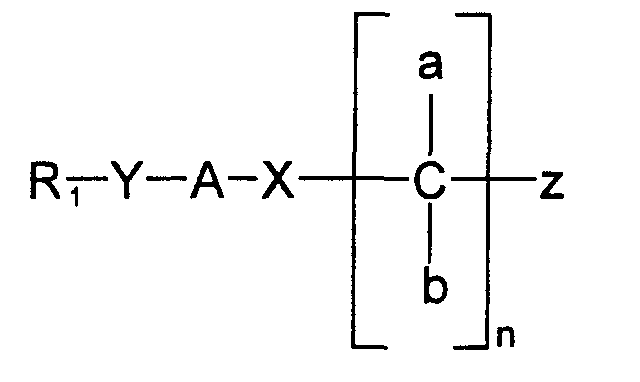 unter Bedingungen der elektrophoretischen Kapillarchromatographie.R1 = C4 - C18 lineare Alkyle, C4 - C18 verzweigte Alkyle, C4 - C18 halogensubstituierte lineare Alkyle, C4 - C18 Polyetherkohlenwasserstoffe, C4 - C18 Alkyle, die ein chirales Zentrum haben, wobei alle Alkylreste ggf. ungesättigt sind, und cholesterolische Kohlenwasserstoffe;Y = O, NH or CH2;A = NH, CO, SO or SO2;X = CO, O or NH;C = Kohlenstoff;für ein chirales Zentrum steht, abstammend von einer chiralen Verbindung, die aus der Gruppe bestehend aus Aminosäuren oder deren Derivaten, Aminoalkoholen und Weinsäuren oder deren Derivaten, ausgewählt ist;
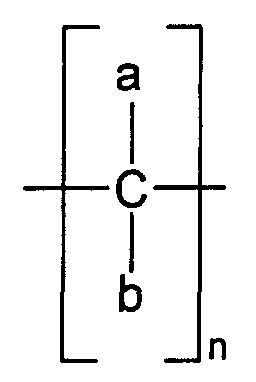 a ≠ b, und n von 1 bis 5 sein kann;Z = COO-, SO4 -, SO3 -, PO3 -, PO4 -, NR'3 +, PR'3 +, -OH, Polyether, Zwitterionen, Polyalkohole;R' = H oder ein C1-C4 linearer oder verzweigter Kohlenwasserstoff, ggf. halogeniert, ggf. ungesättigt; und wenn R1 ein linearer Kohlenwasserstoff ist, und Y = CH2, und A = CO, und X = NH, und Z = COO- und a oder b = H, aber a ≠ b, dann a oder b ≠ ein C1 - C3 niedriges Alkyl ist,
 - Ein Verfahren entsprechend Anspruch 1 wobei:(a)Y = O;A = CO;X = NH;a = eine Aminosäureseitenkette und b = H, oder umgekehrt; undZ = OH, SO4 -, oder COO'; oder(b)Y = NH;A = CO;X = NH;a = eine Aminosäureseitenkette und b = H, oder umgekehrt; undZ = OH; SO4 -, oder COO-; oder(c)Y = CH2;A = SO2;X = NH;a = eine Aminosäureseitenkette und b = H, oder umgekehrt; undZ = OH, SO4 -, oder COO'; oder(d)Y = CH2;A = CO;X = NH;a = eine Aminosäureseitenkette, verschieden von niedrigem Alkyl, und b = H, oder umgekehrt; undZ = OH, SO4 -, oder COO-; oder(e)Y = CH2;A = NH;X = CO;a = eine Aminosäureseitenkette und b = H, oder umgekehrt; undZ = NR'3 +, worin R' = H oder C1- C8 lineare oder verzweigte Kohlenwasserstoffe ist, der ggf. halogeniert, ggf. ungesättigt ist.
- Ein Verfahren zur Trennung einer chiralen Verbindung in ihre Konstituenten-Enantiomere, umfassend in Kontakt bringen der chiralen Verbindung mit einer wirksamen Menge eines chiralen Tensids, das die allgemeine Formel hat:worin bedeuten
 unter Bedingungen der elektrophoretischen Kappilarchromatographie.R1 = C4 - C18 lineare Alkyle, C4 - C18 verzweigte Alkyle, C4 - C18 halogensubstitutierte lineare Alkyle, C4 - C18 Polyetherkohlenwasserstoffe, C4-C18 Alkyle, die ein chirales Zentrum besitzen, wobei alle Alkyle ggf. ungesättigt sind, und cholesterische Kohlenwasserstoffe;R2, R3 = H oder C1-C8 lineare oder verzweigte Alkyl- oder Alkenylkohlenwasserstoffe;Y=CH2;A = NH;X=CO;C = Kohlenstoff;Z = COO-, SO4 -, SO3 -, PO3 -, PO4 -, NR'3 +, PR'3 +, -OH, Polyether, Zwitterionen, Polyalkohole; undR' = H oder ein C1 - C4 linearer oder verzweigter Kohlenwasserstoff ist, der ggf. halogeniert, ggf. ungesättigt ist,
 - Ein Verfahren zur Trennung einer chiralen Verbindungen in ihre Konstituent-Enantiomere, umfassend
in Kontakt bringen der chiralen Verbindung mit einer wirksamen Menge eines chiralen Tensids, das die Fähigkeit zur Mizellbildung hat und das die allgemeine Formel besitzt:worin bedeuten unter Bedingungen der elektrophoretischen Kapillarchromatographie.R1 = C4 - C18 lineare Alkyle, C4 - C18 verzweigte Alkyle, C4 - C18 halogensubstitutierte lineare Alkyle, C4 - C18 Polyetherkohlenwasserstoffe, C4 - C18 Alkyle, die ein bis fünf chirale Zentren besitzen, wobei alle Alkyle ggf. ungesättigt sind, und cholesterische Kohlenwasserstoffe;Y = O, NH oder CH2;A = NH, CO, SO oder SO2;X = O oder NH;C = ein Kohlenstoffatom;für ein chirales Zentrum steht, abstammend von einer chiralen Verbindung, die aus der Gruppe bestehend aus Aminosäuren oder deren Derivaten, Aminoalkoholen und Weinsäuren oder deren Derivaten ausgewählt ist,
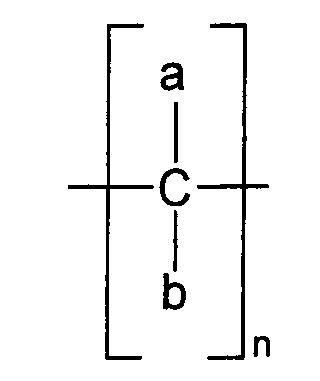 a ≠ b, und n von 1 bis 5 sein kann;Z = COO-, SO4 -, SO3 -, PO3 -, PO4 -, NR'3 +, PR'3 +, -OH, Polyether, Zwitterionen, oder Polyalkohole; undR' = H oder ein C1 - C4 linearer oder verzweigter Kohlenwasserstoff ist, der ggf. halogeniert, ggf. ungesättigt ist,
 - Ein Verfahren zur Trennung einer chiralen Verbindungen in ihre Konstituenten-Enantiomere, umfassend
in Kontakt bringen der chiralen Verbindung mit einer wirksamen Menge eines chiralen Tensids umfassend:unter Bedingungen der elektrophoretischen Kapillarchromatographie.(a) wenigstens ein chirales Zentrum abstammend von einer chiralen Verbindung ausgewählt aus der Gruppe bestehend aus Aminosäuren oder deren Derivativen, Aminoalkoholen und Weinsäuren oder deren Derivativen;(b) eine hydrophile Kopfgruppe gebunden an das/die chiralen Zentrum/en und ausgewählt aus der Gruppe bestehend aus quartären Ammoniumgruppen, Ammoniumsalzen, Carboxylaten, Alkoholen, Sulfaten, Sulfonsäuren, Polyalkoholen, Zwitterionen, und deren entsprechenden Salzen;(c) ein Linker gebunden an das/die chirale(n) Zentrum/en und ausgewählt aus der Gruppe bestehend aus Carbamaten, Sulphonamiden, und Harnstoffen; und(d) einem hydrophoben Schwanz gebunden an den Linker, und ausgewählt aus der Gruppe bestehend aus C4 - C18 lineare Alkyle, C4 - C18 verzweigte Alkyle, C4 - C18 halogensubstitutierte lineare Alkyle, C4 - C18 lineare Alkenyle, C4 - C18 halogensubstituierte Alkenyle, cholestorische und Polyetherkohlenwasserstoffe unter der Bedingung, daß das chirale Tensid nicht eine N-Alkanoyl substituierte aliphatische Aminosäure ist, - Das Verfahren nach Anspruch 1 wobei das chirale Tensid eine der folgenden Formeln hat:

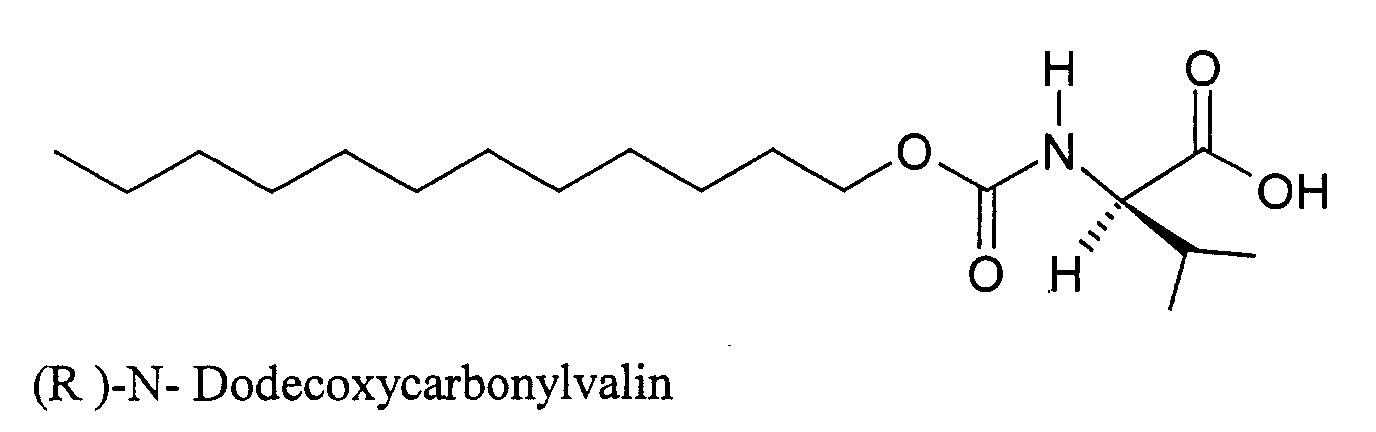
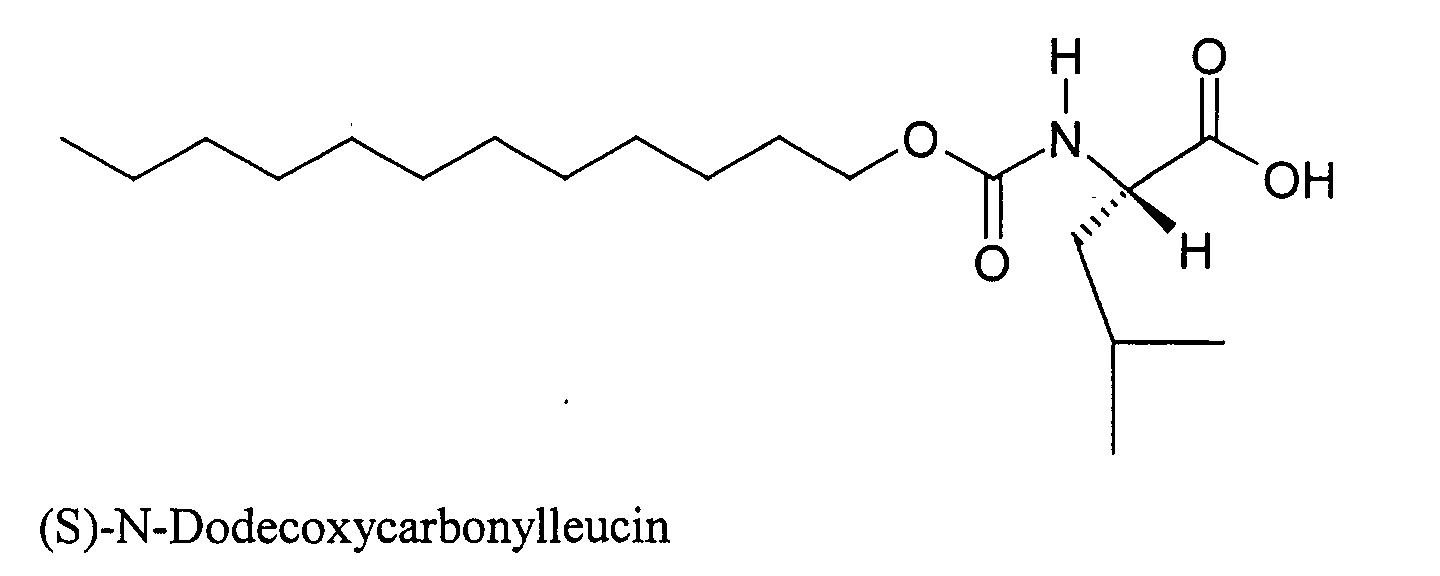
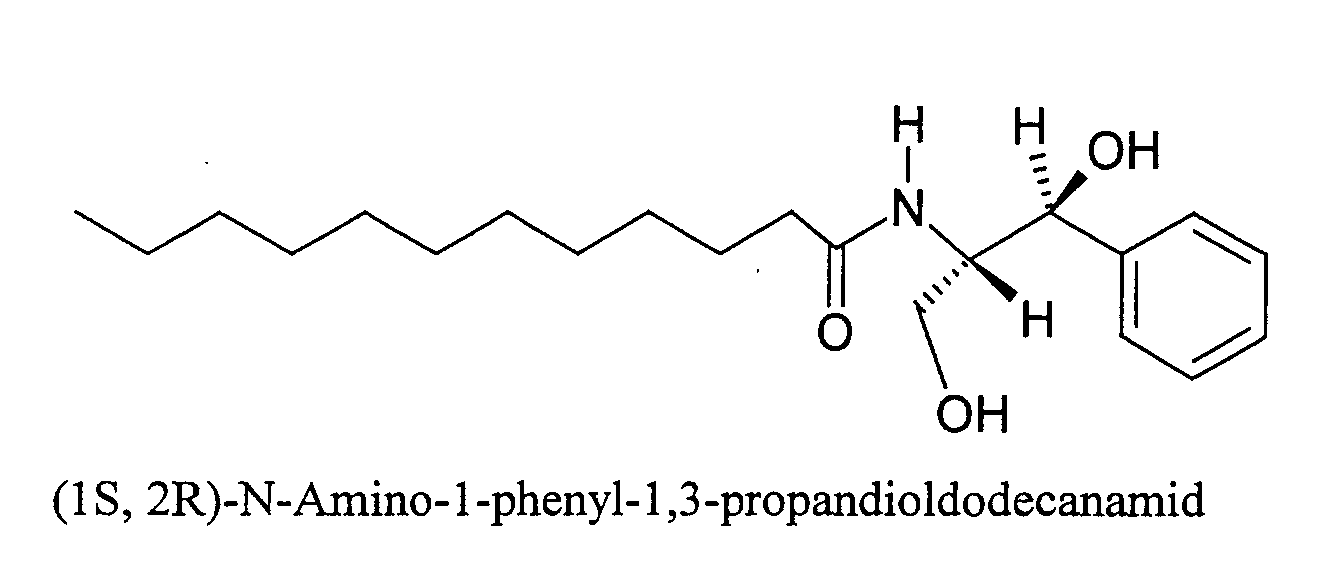
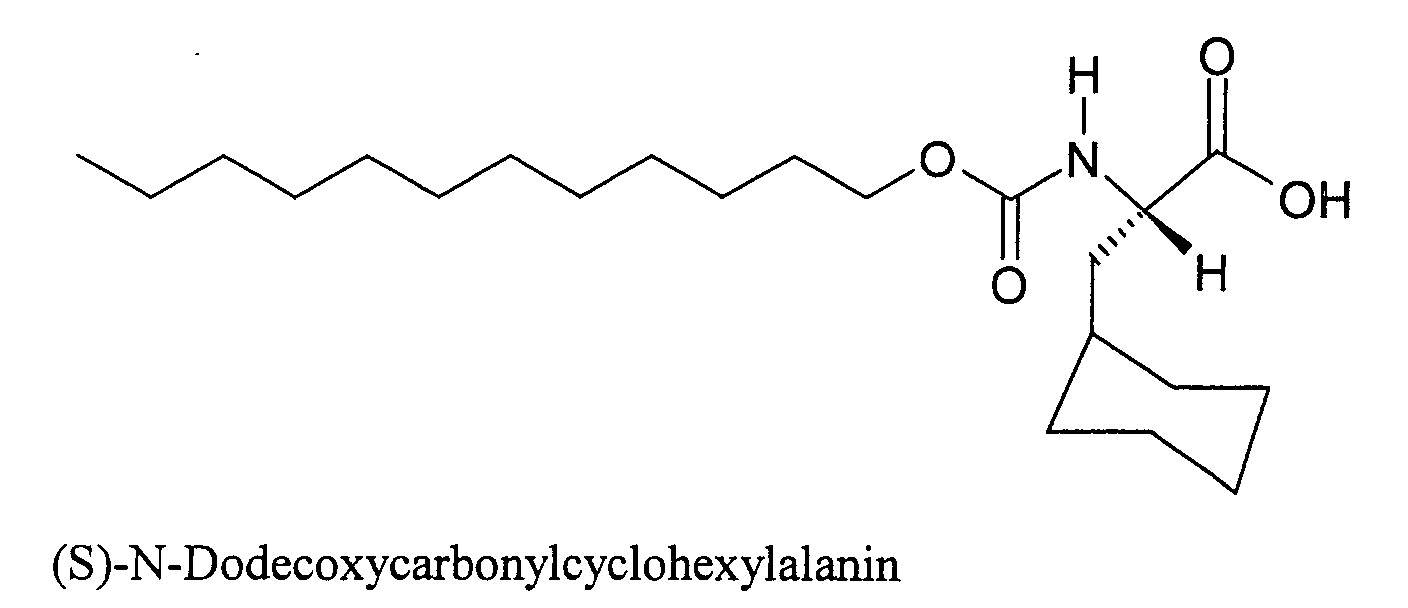

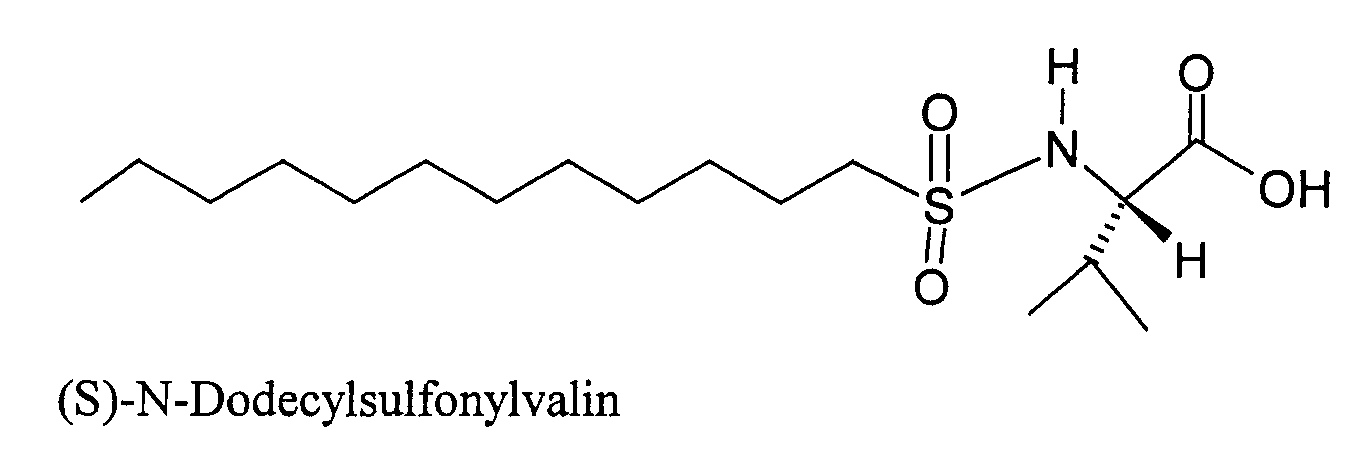
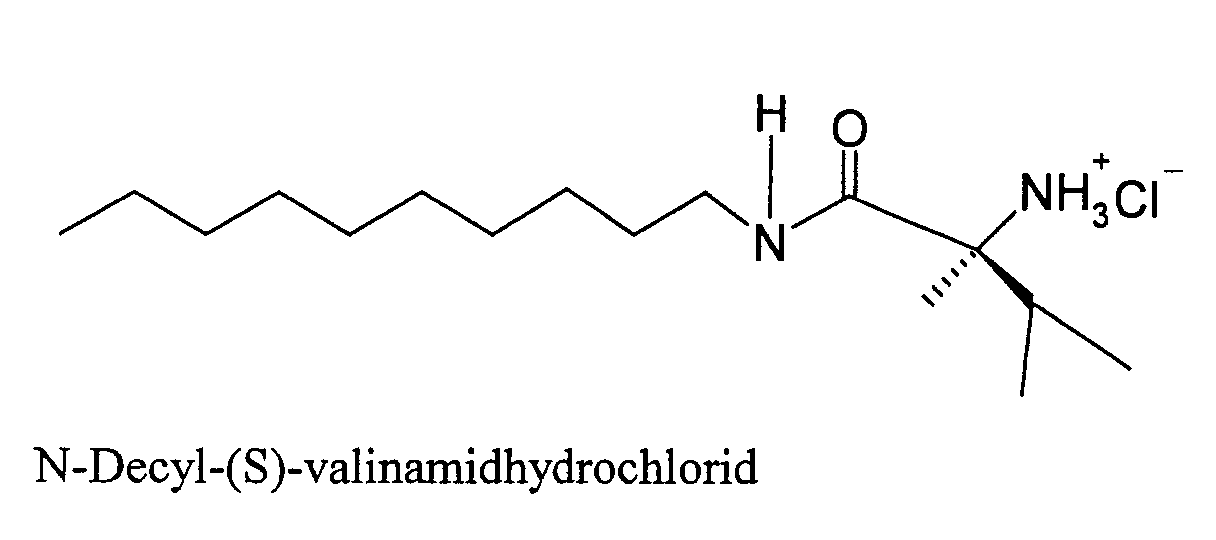
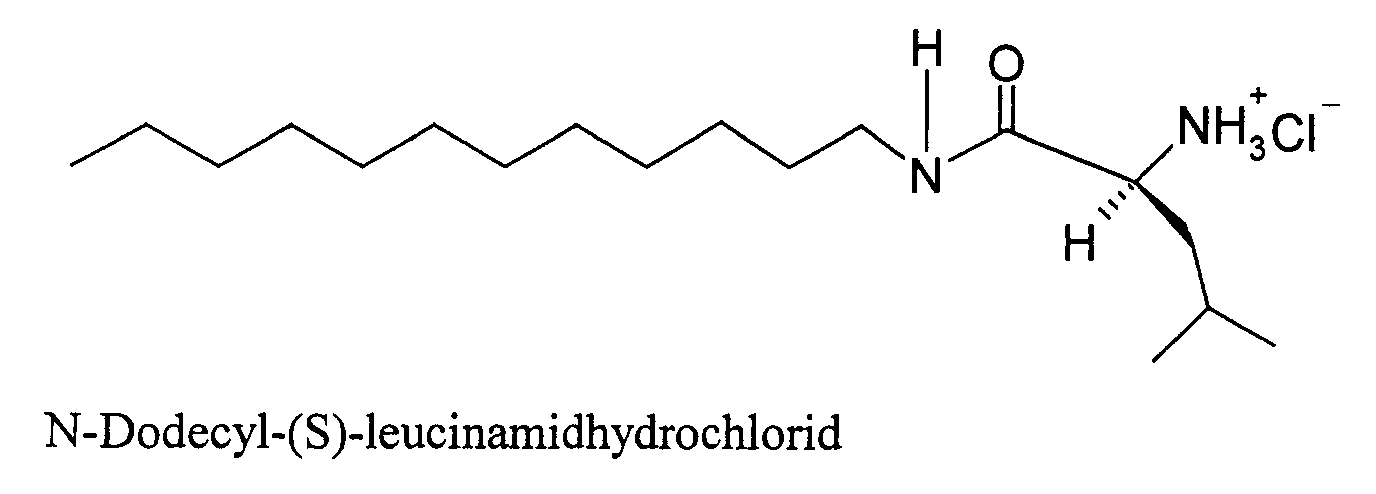
- Ein Verfahren zur Trennung einer chiralen Verbindung in ihre Konstituienten-Enantiomere, umfassend
in Kontakt bringen der chiralen Verbindung mit einer wirksamen Menge eines chiralen Tensids, das eine der folgenden Formeln hat: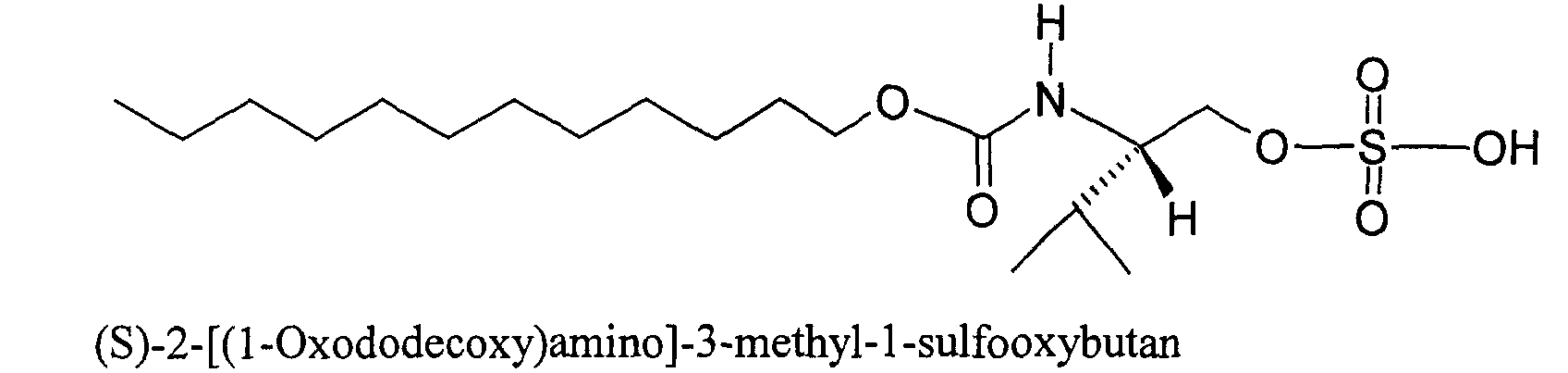
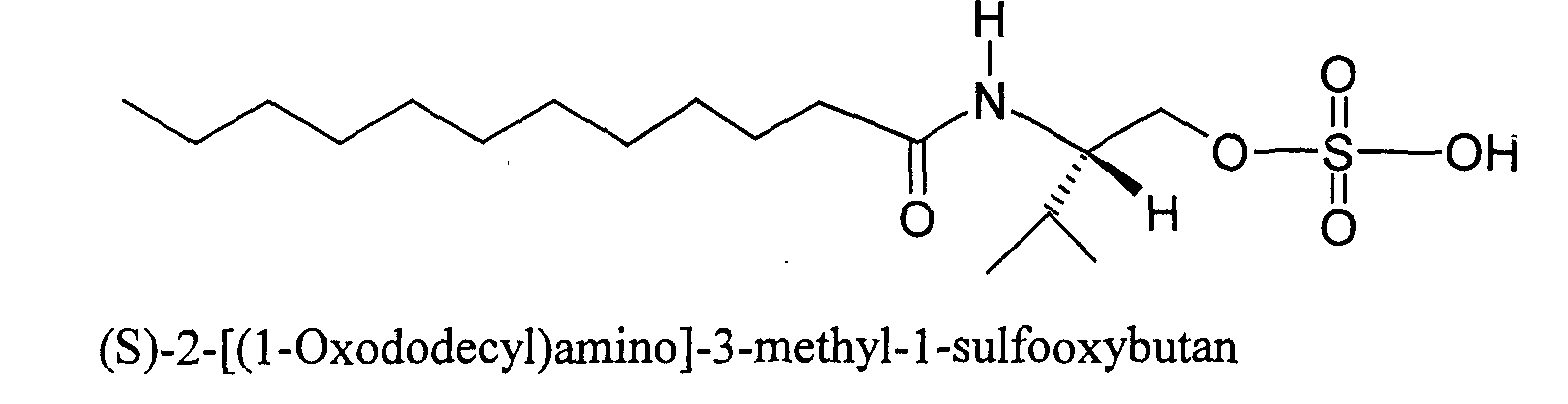
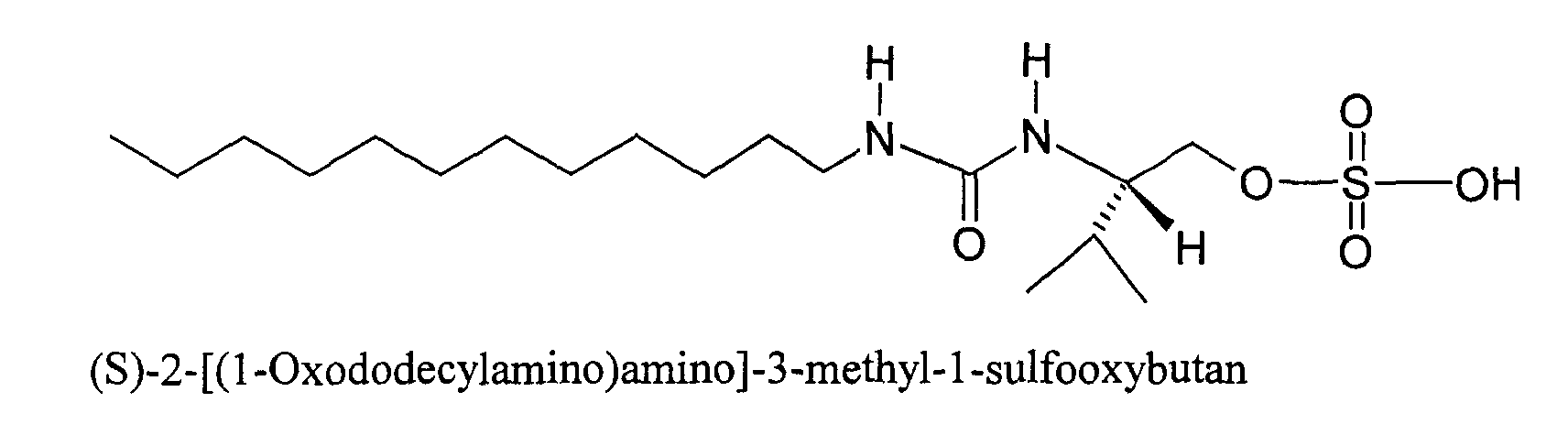
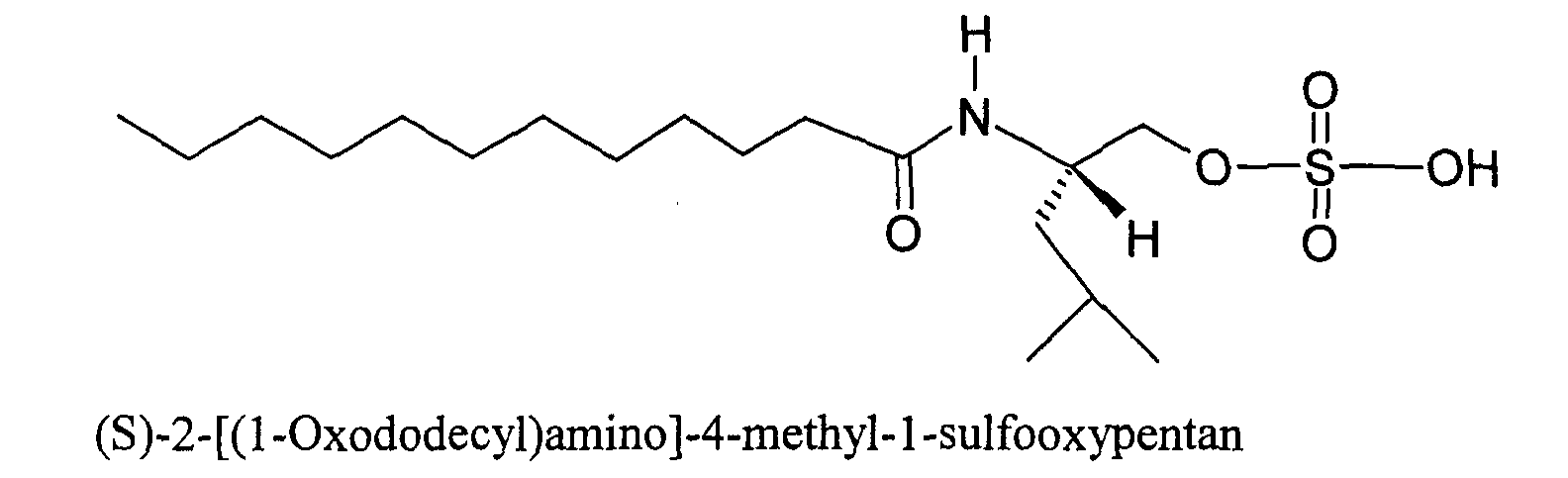 (S)-2-[(1-Oxododecyl)amino]-3-cyclohexyl-1-sulfooxypropan unter Bedingungen der elektrophoretischen Kapillarchromatographie.
- Das Verfahren entsprechend Anspruch 1, welches umfaßt, in Kontakt bringen der chiralen Verbindung mit einem zweiten chiralen Tensid, wobei diese chiralen Tenside beigemischt werden, um eine gemischte chirale Tensid Formulierung zu bilden.
- Das Verfahren entsprechend einem der Ansprüche 1 - 8 wobei(a) das chirale Tensid anwesend ist in oder oberhalb seiner kritischen Mizellkonzentration in einer im wesentlichen wäßrigen Lösung;(b) die elektrophoretischen Bedingungen im wesentlichen elektroosmotischen Fluß beinhalten.
- Das Verfahren nach einem der Ansprüche 1 bis 9 wobei(a) die chirale Verbindung, die getrennt werden soll, Aspartam ist; oder(b) die chirale Verbindung, die getrennt werden soll, in einer biologischen Flüssigkeit, beispielsweise Urin, beigemischt ist.
- Ein Verfahren zur Analyse von Aspartam, umfassend die Schritte des Injizierens einer Probe von Aspartam in ein mizellar elektrokinetisches Kapillarelektrophoresegerät, wobei das Gerät einen Elektrolyten hat, der ein chirales Tensid enthält entsprechend einem der Ansprüche 1 bis 7, Trennen der Enantiomere des Aspartam, und dann Bestimmen der getrennten Enantiomere.
- Ein Gerät zur Trennung chiraler Verbindungen in ihre Konstituenten-Enantiomere, der das chirale Tensid entsprechend einem der Anspruche 1 bis 7 enthält, und außerdem umfaßt:(a) ein Elektrolyt, das wirksam für mizellare chirale Kapillarelektrophorese ist;(b) ein Kanal, der geeignet ist, den Elektrolyt zu enthalten;(c) ein Energieversorgung, die in der Lage ist, eine Feldstärke von wenigstens etwa 10 V/cm bis zu etwa 1 kV/cm zu erzeugen;(d) wenigstens eine Anode und eine Kathode, die elektrisch mit den gegenüberliegenden Enden des Kanals verbunden sind; und(e) ein Detektor zur Erkennung der Anwesenheit der getrennten Enantiomeren.
Applications Claiming Priority (3)
| Application Number | Priority Date | Filing Date | Title |
|---|---|---|---|
| US12468193A | 1993-09-20 | 1993-09-20 | |
| US124681 | 1993-09-20 | ||
| PCT/US1994/010655 WO1995008529A1 (en) | 1993-09-20 | 1994-09-20 | Chiral surfactants and methods for their use in chiral separations |
Publications (2)
| Publication Number | Publication Date |
|---|---|
| EP0721446A1 EP0721446A1 (de) | 1996-07-17 |
| EP0721446B1 true EP0721446B1 (de) | 2001-07-18 |
Family
ID=22416250
Family Applications (1)
| Application Number | Title | Priority Date | Filing Date |
|---|---|---|---|
| EP94930460A Expired - Lifetime EP0721446B1 (de) | 1993-09-20 | 1994-09-20 | Chirale tenside und verfahren zu ihrer verwendung in chiralen trennungen |
Country Status (7)
| Country | Link |
|---|---|
| US (1) | US6090250A (de) |
| EP (1) | EP0721446B1 (de) |
| JP (2) | JP3699115B2 (de) |
| AU (1) | AU7957494A (de) |
| CA (1) | CA2172282C (de) |
| DE (1) | DE69427765T2 (de) |
| WO (1) | WO1995008529A1 (de) |
Families Citing this family (28)
| Publication number | Priority date | Publication date | Assignee | Title |
|---|---|---|---|---|
| DE19544635A1 (de) * | 1995-11-30 | 1997-06-05 | Boehringer Mannheim Gmbh | Neue Aminoalkoholderivate, Verfahren zu deren Herstellung und diese Verbindungen enthaltende Arzneimittel |
| ZA994264B (en) | 1998-07-01 | 2000-01-25 | Warner Lambert Co | Stereoisomers with high affinity for adrenergic receptors. |
| US7232837B2 (en) | 1999-06-29 | 2007-06-19 | Mcneil-Ppc, Inc. | Stereoisomers with high affinity for adrenergic receptors |
| DE10042451A1 (de) * | 2000-08-29 | 2002-03-14 | Studiengesellschaft Kohle Mbh | High-Throughput Verfahren zur Bestimmung der Enantiomereneinheit von chiralen Verbindungen |
| AU2002951216A0 (en) * | 2002-09-05 | 2002-09-19 | Dbl Australia Pty Ltd | Surfactants and lyotropic phases formed therefrom |
| FR2859113B1 (fr) * | 2003-08-29 | 2006-02-17 | Centre Nat Rech Scient | Procede de separation bidimensionnelle par electrophorese capillaire realise dans un seul capillaire |
| DE10348044A1 (de) * | 2003-10-15 | 2005-05-19 | Imtm Gmbh | Duale Alanyl-Aminopeptidase- und Dipeptidylpeptidase IV-Inhibitoren zur funktionellen Beeinflussung unterschiedlicher Zellen und zur Behandlung immunologischer, entzündlicher, neuronaler und anderer Erkrankungen |
| DE112005000772B4 (de) * | 2004-04-07 | 2017-12-28 | Waters Technologies Corp. (N.D.Ges.D. Staates Delaware) | Flüssigchromatographiereagenz und Verfahren zum Auftrennen von Enantiomeren |
| JP2008105945A (ja) * | 2005-02-07 | 2008-05-08 | Ajinomoto Co Inc | アディポネクチンの分泌促進又は誘導作用を有するアシルアミド化合物 |
| US8168440B2 (en) | 2006-03-28 | 2012-05-01 | Georgia State University | Polymeric sulfated surfactants for capillary electrophoresis (CE) and CE-mass spectrometry (CE-MS) |
| JP5105297B2 (ja) * | 2006-05-25 | 2012-12-26 | 味の素株式会社 | Ppar活性調節剤 |
| FR2907028B1 (fr) * | 2006-10-16 | 2009-01-30 | Centre Nat Rech Scient | Electrophorese capillaire bi-ou multidimensionnelle au sein d'un unique capillaire. |
| JP5651471B2 (ja) | 2007-10-11 | 2015-01-14 | プロメガ コーポレイションPromega Corporation | 切断可能な界面活性剤 |
| US20110178151A1 (en) | 2008-03-04 | 2011-07-21 | Yissum Research Development Company Of The Hebrew | Compounds and methods of treating obesity |
| US9095620B2 (en) * | 2008-03-12 | 2015-08-04 | Nektar Therapeutics | Reagents |
| WO2010050918A1 (en) * | 2008-10-31 | 2010-05-06 | Qinghai Zhang | Branched chain detergents for membrane protein structural biology |
| GB2539621B (en) * | 2014-04-30 | 2020-07-29 | Schlumberger Technology Bv | Analysis of components in fluid for injection into a well |
| WO2018183555A1 (en) | 2017-03-28 | 2018-10-04 | Schlumberger Technology Corporation | Indirect diagnosis of multiple fluid mixer unit performance |
| CN110461815A (zh) * | 2017-03-31 | 2019-11-15 | 大金工业株式会社 | 磺酸、羧酸或它们的盐 |
| CN110446695A (zh) * | 2017-03-31 | 2019-11-12 | 大金工业株式会社 | 烷基硫酸酯或其盐 |
| CN113667247A (zh) | 2017-03-31 | 2021-11-19 | 大金工业株式会社 | 包含含氟聚合物的组合物及其成型体 |
| CN111937121B (zh) | 2018-04-04 | 2023-12-08 | 巴斯夫欧洲公司 | 在制造半导体基材的方法中使用的可裂解添加剂 |
| US11566110B2 (en) | 2018-06-04 | 2023-01-31 | Suzhou Oulit Biopharm Co., Ltd | Self-assembled amino acid supramolecular polymer, preparation therefor, and application thereof |
| US11540993B2 (en) | 2018-06-04 | 2023-01-03 | Suzhou Oulit Biopharm Co., Ltd | Self-assembled amino acid supramolecular polymer, preparation method therefor, and application thereof |
| CN109632859B (zh) * | 2019-01-08 | 2022-06-24 | 西安科技大学 | 基于手性胶束nmr的手性小分子化合物光学纯度分析方法 |
| CN114486444B (zh) * | 2022-02-07 | 2024-02-20 | 洛阳师范学院 | 一种阿替洛尔非外消旋体混合物的毛细管电泳分离方法 |
| CN120665607A (zh) * | 2023-04-21 | 2025-09-19 | 中南大学 | 一种用于对映选择性反胶团萃取的手性表面活性剂 |
| CN116573981B (zh) * | 2023-04-21 | 2025-05-06 | 中南大学 | 一种β受体阻滞剂类外消旋体药物的拆分方法 |
Family Cites Families (14)
| Publication number | Priority date | Publication date | Assignee | Title |
|---|---|---|---|---|
| US2871225A (en) * | 1954-06-03 | 1959-01-27 | Rohm & Haas | Method for preparing polypeptides |
| DE1097431B (de) * | 1958-05-24 | 1961-01-19 | Hoechst Ag | Verfahren zur Herstellung von kapillaraktiven Verbindungen |
| FR1396008A (fr) * | 1964-04-22 | 1965-04-16 | Pennsalt Chemicals Corp | Amides substitués d'acides carboxyliques halogénés à chaîne longue |
| DE2234399A1 (de) * | 1972-07-17 | 1974-01-31 | Thomae Gmbh Dr K | Hautschutzmittel |
| JPS59212744A (ja) * | 1983-05-19 | 1984-12-01 | Sumitomo Chem Co Ltd | Nmr用シフト試薬 |
| US4761404A (en) * | 1985-07-01 | 1988-08-02 | Merck & Co., Inc. | Phospholipid analogs useful as PAF synthesis inhibitors |
| US4675300A (en) * | 1985-09-18 | 1987-06-23 | The Board Of Trustees Of The Leland Stanford Junior University | Laser-excitation fluorescence detection electrokinetic separation |
| EP0233101A1 (de) * | 1986-01-13 | 1987-08-19 | Ire-Celltarg S.A. | Vinblastin-Derivate und diese enthaltende Arzneimittel |
| US5084150A (en) * | 1987-03-24 | 1992-01-28 | Northeastern University | Selective high performance electrokinetic separations employing the surface of moving charged colloidal particles |
| JPH07116064B2 (ja) * | 1987-07-21 | 1995-12-13 | 三菱化学株式会社 | 分離剤 |
| DK255889D0 (da) * | 1989-05-25 | 1989-05-25 | Novo Nordisk As | Fremgangsmaade til fremstilling af organiske forbindelser |
| FR2649697A1 (fr) * | 1989-07-11 | 1991-01-18 | Oreal | Nouveaux derives d'urethanne, leur preparation et leur application notamment comme agents hydratants dans des compositions cosmetiques ou pharmaceutiques destinees au traitement des peaux seches |
| JP2558537B2 (ja) * | 1990-03-20 | 1996-11-27 | ジーエルサイエンス株式会社 | 動電クロマトグラフィー用界面活性剤、及びこれをキャリヤーとして使用する光学分割方法及び動電クロマトグラフィー |
| JP2568129B2 (ja) * | 1990-03-20 | 1996-12-25 | ジーエルサイエンス株式会社 | 動電クロマトグラフィー用界面活性剤及びこれをキャリヤーとして使用する光学分割方法及び動電クロマトグラフィー |
-
1994
- 1994-09-20 EP EP94930460A patent/EP0721446B1/de not_active Expired - Lifetime
- 1994-09-20 CA CA2172282A patent/CA2172282C/en not_active Expired - Lifetime
- 1994-09-20 WO PCT/US1994/010655 patent/WO1995008529A1/en not_active Ceased
- 1994-09-20 DE DE69427765T patent/DE69427765T2/de not_active Expired - Lifetime
- 1994-09-20 AU AU79574/94A patent/AU7957494A/en not_active Abandoned
- 1994-09-20 JP JP50989695A patent/JP3699115B2/ja not_active Expired - Lifetime
- 1994-09-20 US US08/617,916 patent/US6090250A/en not_active Expired - Lifetime
-
2004
- 2004-06-24 JP JP2004186516A patent/JP4061293B2/ja not_active Expired - Lifetime
Also Published As
| Publication number | Publication date |
|---|---|
| CA2172282A1 (en) | 1995-03-30 |
| JPH09503295A (ja) | 1997-03-31 |
| JP3699115B2 (ja) | 2005-09-28 |
| JP4061293B2 (ja) | 2008-03-12 |
| WO1995008529A1 (en) | 1995-03-30 |
| CA2172282C (en) | 2011-05-31 |
| JP2005041863A (ja) | 2005-02-17 |
| US6090250A (en) | 2000-07-18 |
| AU7957494A (en) | 1995-04-10 |
| DE69427765T2 (de) | 2002-05-23 |
| DE69427765D1 (de) | 2001-08-23 |
| EP0721446A1 (de) | 1996-07-17 |
Similar Documents
| Publication | Publication Date | Title |
|---|---|---|
| EP0721446B1 (de) | Chirale tenside und verfahren zu ihrer verwendung in chiralen trennungen | |
| Koide et al. | Enantiomeric separations of primary amino compounds by capillary electrochromatography with monolithic chiral stationary phases of chiral crown ether-bonded negatively charged polyacrylamide gels | |
| Smith | Developments in amino acid analysis using capillary electrophoresis | |
| Mazzeo et al. | Novel chiral surfactant for the separation of enantiomers by micellar electrokinetic capillary chromatography | |
| US20080027234A1 (en) | Destructible surfactants and uses thereof | |
| US9598716B2 (en) | Destructible surfactants and uses thereof | |
| Jin et al. | Total resolution of 17 DL-amino acids labelled with a fluorescent chiral reagent, R (−)-4-(3-isothiocyanatopyrrolidin-1-yl)-7-(N, N-dimethylaminosulfonyl)-2, 1, 3-benzoxadiazole, by high-performance liquid chromatography | |
| US8168440B2 (en) | Polymeric sulfated surfactants for capillary electrophoresis (CE) and CE-mass spectrometry (CE-MS) | |
| Dykstra et al. | Chip-based capillary zone electrophoresis mass spectrometry for rapid resolution and quantitation of critical quality attributes in protein biotherapeutics | |
| EP0107149A1 (de) | Napthalinderivate und Verfahren zu deren Herstellung | |
| Li et al. | Recent advances on chiral mobile phase additives: a critical review | |
| Mohanty et al. | Vesicles as pseudostationary phase for enantiomer separation by capillary electrophoresis | |
| Zhao et al. | Degradingdehydroabietylisothiocyanate as a chiral derivatizing reagent for enantiomeric separations by capillary electrophoresis | |
| US4818704A (en) | Method for the separation and determination of enantiomeric amine compounds using an optically active agent | |
| He et al. | Application of polymeric surfactants in chiral micellar electrokinetic chromatography (CMEKC) and CMEKC coupled to mass spectrometry | |
| Wall et al. | Electrically driven microseparation methods for pesticides and metabolites: VI. Surfactant‐mediated electrokinetic capillary chromatography of aniline pesticidic metabolites derivatized with 9‐fluoroenylmethyl chloroformate and their detection by laser‐induced fluorescence | |
| EP0270595B1 (de) | Optisch aktives reagens und verfahren zur determinierung von enantiomeren aminverbindungen | |
| Hinsmann et al. | Separation and on-line distinction of enantiomers: A non-aqueous capillary electrophoresis Fourier transform infrared spectroscopy study | |
| Péter et al. | High-performance liquid chromatographic separation of unusual amino acid enantiomers derivatized with (1 S, 2 S)-1, 3-diacetoxy-1-(4-nitrophenyl)-2-propyl-isothiocyanate | |
| JP2568129B2 (ja) | 動電クロマトグラフィー用界面活性剤及びこれをキャリヤーとして使用する光学分割方法及び動電クロマトグラフィー | |
| WO2009066115A1 (en) | Colorimetric sensors for detection of the fluoride anion in solution and gel | |
| JP2558537B2 (ja) | 動電クロマトグラフィー用界面活性剤、及びこれをキャリヤーとして使用する光学分割方法及び動電クロマトグラフィー | |
| Billiot et al. | Chiral separation of norlaudanosoline, laudanosoline, laudanosine, chlorthalidone, and three benzoin derivatives using amino acid based molecular micelles | |
| JPH02204478A (ja) | 光学異性体の分離方法 | |
| JPH05322849A (ja) | 動電クロマトグラフィー法 |
Legal Events
| Date | Code | Title | Description |
|---|---|---|---|
| PUAI | Public reference made under article 153(3) epc to a published international application that has entered the european phase |
Free format text: ORIGINAL CODE: 0009012 |
|
| 17P | Request for examination filed |
Effective date: 19960330 |
|
| AK | Designated contracting states |
Kind code of ref document: A1 Designated state(s): CH DE FR GB IT LI |
|
| 17Q | First examination report despatched |
Effective date: 19961024 |
|
| RBV | Designated contracting states (corrected) |
Designated state(s): CH DE FR GB IT LI |
|
| GRAG | Despatch of communication of intention to grant |
Free format text: ORIGINAL CODE: EPIDOS AGRA |
|
| GRAG | Despatch of communication of intention to grant |
Free format text: ORIGINAL CODE: EPIDOS AGRA |
|
| GRAH | Despatch of communication of intention to grant a patent |
Free format text: ORIGINAL CODE: EPIDOS IGRA |
|
| GRAH | Despatch of communication of intention to grant a patent |
Free format text: ORIGINAL CODE: EPIDOS IGRA |
|
| GRAA | (expected) grant |
Free format text: ORIGINAL CODE: 0009210 |
|
| AK | Designated contracting states |
Kind code of ref document: B1 Designated state(s): CH DE FR GB IT LI |
|
| PG25 | Lapsed in a contracting state [announced via postgrant information from national office to epo] |
Ref country code: LI Free format text: LAPSE BECAUSE OF FAILURE TO SUBMIT A TRANSLATION OF THE DESCRIPTION OR TO PAY THE FEE WITHIN THE PRESCRIBED TIME-LIMIT Effective date: 20010718 Ref country code: IT Free format text: LAPSE BECAUSE OF FAILURE TO SUBMIT A TRANSLATION OF THE DESCRIPTION OR TO PAY THE FEE WITHIN THE PRESCRIBED TIME-LIMIT;WARNING: LAPSES OF ITALIAN PATENTS WITH EFFECTIVE DATE BEFORE 2007 MAY HAVE OCCURRED AT ANY TIME BEFORE 2007. THE CORRECT EFFECTIVE DATE MAY BE DIFFERENT FROM THE ONE RECORDED. Effective date: 20010718 Ref country code: CH Free format text: LAPSE BECAUSE OF FAILURE TO SUBMIT A TRANSLATION OF THE DESCRIPTION OR TO PAY THE FEE WITHIN THE PRESCRIBED TIME-LIMIT Effective date: 20010718 |
|
| REG | Reference to a national code |
Ref country code: CH Ref legal event code: EP |
|
| REF | Corresponds to: |
Ref document number: 69427765 Country of ref document: DE Date of ref document: 20010823 |
|
| ET | Fr: translation filed | ||
| REG | Reference to a national code |
Ref country code: GB Ref legal event code: IF02 |
|
| REG | Reference to a national code |
Ref country code: CH Ref legal event code: PL |
|
| PLBE | No opposition filed within time limit |
Free format text: ORIGINAL CODE: 0009261 |
|
| STAA | Information on the status of an ep patent application or granted ep patent |
Free format text: STATUS: NO OPPOSITION FILED WITHIN TIME LIMIT |
|
| 26N | No opposition filed | ||
| PGFP | Annual fee paid to national office [announced via postgrant information from national office to epo] |
Ref country code: DE Payment date: 20130927 Year of fee payment: 20 |
|
| PGFP | Annual fee paid to national office [announced via postgrant information from national office to epo] |
Ref country code: GB Payment date: 20130927 Year of fee payment: 20 Ref country code: FR Payment date: 20130919 Year of fee payment: 20 |
|
| REG | Reference to a national code |
Ref country code: DE Ref legal event code: R071 Ref document number: 69427765 Country of ref document: DE |
|
| REG | Reference to a national code |
Ref country code: GB Ref legal event code: PE20 Expiry date: 20140919 |
|
| PG25 | Lapsed in a contracting state [announced via postgrant information from national office to epo] |
Ref country code: DE Free format text: LAPSE BECAUSE OF EXPIRATION OF PROTECTION Effective date: 20140923 |
|
| PG25 | Lapsed in a contracting state [announced via postgrant information from national office to epo] |
Ref country code: GB Free format text: LAPSE BECAUSE OF EXPIRATION OF PROTECTION Effective date: 20140919 |