EP0722259A2 - Méthode de balayage des canaux pour des téléphones portables radio - Google Patents
Méthode de balayage des canaux pour des téléphones portables radio Download PDFInfo
- Publication number
- EP0722259A2 EP0722259A2 EP96300147A EP96300147A EP0722259A2 EP 0722259 A2 EP0722259 A2 EP 0722259A2 EP 96300147 A EP96300147 A EP 96300147A EP 96300147 A EP96300147 A EP 96300147A EP 0722259 A2 EP0722259 A2 EP 0722259A2
- Authority
- EP
- European Patent Office
- Prior art keywords
- radio telephone
- slots
- slot
- channel
- base station
- Prior art date
- Legal status (The legal status is an assumption and is not a legal conclusion. Google has not performed a legal analysis and makes no representation as to the accuracy of the status listed.)
- Granted
Links
- 238000000034 method Methods 0.000 title claims description 14
- 230000005540 biological transmission Effects 0.000 claims abstract description 20
- 230000002123 temporal effect Effects 0.000 claims abstract description 9
- 230000002441 reversible effect Effects 0.000 claims abstract description 6
- 230000001413 cellular effect Effects 0.000 claims description 5
- 238000010586 diagram Methods 0.000 description 6
- 239000000969 carrier Substances 0.000 description 4
- 230000000694 effects Effects 0.000 description 2
- 230000009286 beneficial effect Effects 0.000 description 1
- 230000000903 blocking effect Effects 0.000 description 1
- 230000007423 decrease Effects 0.000 description 1
- 230000002250 progressing effect Effects 0.000 description 1
Images



Classifications
-
- H—ELECTRICITY
- H04—ELECTRIC COMMUNICATION TECHNIQUE
- H04W—WIRELESS COMMUNICATION NETWORKS
- H04W48/00—Access restriction; Network selection; Access point selection
- H04W48/16—Discovering, processing access restriction or access information
-
- H—ELECTRICITY
- H04—ELECTRIC COMMUNICATION TECHNIQUE
- H04J—MULTIPLEX COMMUNICATION
- H04J4/00—Combined time-division and frequency-division multiplex systems
-
- H—ELECTRICITY
- H04—ELECTRIC COMMUNICATION TECHNIQUE
- H04W—WIRELESS COMMUNICATION NETWORKS
- H04W72/00—Local resource management
- H04W72/02—Selection of wireless resources by user or terminal
-
- H—ELECTRICITY
- H04—ELECTRIC COMMUNICATION TECHNIQUE
- H04W—WIRELESS COMMUNICATION NETWORKS
- H04W24/00—Supervisory, monitoring or testing arrangements
-
- H—ELECTRICITY
- H04—ELECTRIC COMMUNICATION TECHNIQUE
- H04W—WIRELESS COMMUNICATION NETWORKS
- H04W36/00—Hand-off or reselection arrangements
- H04W36/08—Reselecting an access point
-
- H—ELECTRICITY
- H04—ELECTRIC COMMUNICATION TECHNIQUE
- H04W—WIRELESS COMMUNICATION NETWORKS
- H04W48/00—Access restriction; Network selection; Access point selection
- H04W48/08—Access restriction or access information delivery, e.g. discovery data delivery
-
- H—ELECTRICITY
- H04—ELECTRIC COMMUNICATION TECHNIQUE
- H04W—WIRELESS COMMUNICATION NETWORKS
- H04W72/00—Local resource management
- H04W72/50—Allocation or scheduling criteria for wireless resources
- H04W72/54—Allocation or scheduling criteria for wireless resources based on quality criteria
Definitions
- This invention relates to portable radio telephones and in particular to such telephones for communication with base stations in a digital cellular radio telephone system employing transmission by a plurality of carrier frequencies in frames, such as TDMA frames, each consisting of a predetermined number of time slots.
- the invention also relates to a method of operation of such radio telephones, frequently called handsets.
- the invention is concerned with the allocation of a channel (that is a combination of a carrier frequency and time slot) to a portable radio telephone when a connection is first required ("call set-up") or when a change in channel is required (“handover") during a call to maintain call quality. Handover can either be to a different channel at the same base station (intracell) or to a different channel at a different base station (intercell).
- DECT base station equipment Most of the currently manufactured DECT base station equipment only contains a single transceiver, and is therefore unable to open more than a single communication channel on different frequency carriers at the same instant. This restricts single transceiver base stations to only using a single time slot at any one time, effectively excluding the other carriers on this time slot and thereby turning them "blind".
- the DECT standards have foreseen this and include the blind slot information message to inform the handset of time slots it should avoid using.
- this information is not totally reliable, particularly on intercell handover when it is very difficult to obtain the blind slot information of any base station other than the one that the handset is connected to.
- a handset will be unable to switch communication channels to a slot immediately adjacent to that which it is using.
- This invention aims to provide a portable radio telephone, and a method of operation, employing a dynamic channel assignment algorithm that gives very robust performance, regardless of the availability and accuracy of the blind slot information. In addition to this, if an identical algorithm is deployed on every portable radio telephone in the system, further improvements in call blocking and call quality are likely.
- a portable radio telephone for communication with base stations in a digital radio telephone system employing transmission by a plurality of carrier frequencies in frames each consisting of a predetermined number of time slots, wherein the portable radio telephone is operative to select for the radio telephone a communication channel, that is a combination of carrier frequency and time slot, by storing information concerning slots excluded by virtue of transmission by the radio telephone or transmission by a communicating base station, and checking the slots in a predetermined sequence, which preferably corresponds to the temporal sequence of the slots or to the reverse of the temporal sequence of the slots, until an available non-excluded slot is found and a channel therein is selected.
- the invention provides a method of communicating between a portable radio telephone and base stations in a digital cellular radio telephone system employing transmission by carrier frequencies in frames each consisting of a predetermined number of time slots, comprising storing information concerning slots excluded by virtue of transmission by the radio telephone or transmission by a communicating base station, and checking the slots in a predetermined sequence, which preferably corresponds to the temporal sequence of the slots or to the reverse of the temporal sequence of the slots, until an available non-excluded slot is found and a channel therein is selected.
- the portion of the radio system depicted comprises two fixed base stations 1 and 2 serving respective cells 3 and 4 representing geographical areas of coverage which may be inside or outside buildings.
- a user or subscriber to the system carries a portable handset 5 which is capable of two-way radio communication with one or other of the base stations 1, 2, and with other base stations (not shown).
- the radio telephone system conforms to the DECT (Digital European Cordless Telecommunications) standard and uses ten carrier frequencies, separated by 1.728 MHz, within a frequency band from 1880 MHz to 1900 MHz.
- This system divides time into TDMA frames, with each frame having a time duration of 10ms.
- Each frame is divided into 24 time slots, numbered from 0 to 23.
- Each frame is divided into two halves, the first half (slots 0 to 11 ) being reserved for the transmission of the base station and the second half (slots 12 to 23) being reserved for the transmission of the handset.
- the handset 5 has processing means programmed with an algorithm which is operative to select for the handset a communication channel, ie a combination of carrier frequency and time slot, taking into account the quietness of each channel, ie the degree of signal interference in that channel.
- a communication channel ie a combination of carrier frequency and time slot
- the quietness of each channel ie the degree of signal interference in that channel.
- the numbered signal strength of all channels is monitored at regular time intervals and the measured signal strengths are stored in the handset in a channel list, an example of which is shown in Figure 3 in which the time axis extends horizontally and the frequency axis extends vertically.
- the twelve slots 1 - 11 of a representative frame are shown as columns, with the ten carrier frequencies being represented by horizontal rows.
- the array of Figure 3 has 120 boxes, each representing a particular channel, ie a particular combination of time slot and carrier frequency.
- Signal strength is allocated a level from 0 to 12 (typically 6dB bands are used), with 0 being the quietest (ie least interference) and 12 being the least quiet (ie most interference).
- Representative quietness levels for each channel are shown in Figure 3 and the channels that satisfy the quietness requirement are shown shaded.
- Figure 3 also shows the base station scan. The base station scans one carrier every time frame and works through all ten carriers in ten frames.
- the algorithm fulfils three theoretical principles that all improve the probability of the portable handset assigning itself an available channel. These are:
- the quality criteria for channel assignment is as follows:
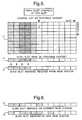
- Figure 4 shows at 6 the blind slot message received by the handset 5 from the base station 1 on call set-up. This indicates that the first three time slots are blind. Since the handset 5 imposes no blind slots, the blind slot mask 7 on the handset corresponds to the blind slot message 6 from the base station. Hence, the first three time slots in the channel list 8 stored in the handset are blind.
- the algorithm is operative to check availability of time slots in a sequence which proceeds from the first time slot allocated for base station transmission to the last time slot allocated for base station transmission, before returning to the first slot.
- quiet channels are checked for availability progressing from left to right in the channel list 8 in Figure 4, so that there is a tendency for channels to be filled in an orderly sequence which, if all handsets operate the same system, will promote efficient channel allocation at the base stations.
- This check could be in reverse order, and could commence with any time slot.
- the algorithm attempts set-up in a channel at "X" in the immediate slot after the blind slots in the mask, if one of these channels is one of the quietest. Since the blind slot information on the portable is correct, set-up succeeds.
- the blind slot message 9 from the base station indicates that the first three slots remain blinded, together with the fourth slot because this is occupied by the transmission of the handset 5.
- the channel currently occupied by the handset, together with a channel either side thereof, is blinded by the handset, so the blind slot mask on the handset is a shown at 10, the resulting channel list being shown at 11.
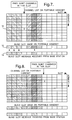
- the current transmission channel and the two immediately adjacent channels are blinded so, referring to Figure 7, the blind slot message from the currently connected base station 1 is shown at 14 and the blind slot mask on the handset at 15, the resulting channel list on the handset being as illustrated at 16.
- the handset tries channels in the fourth time slot but as this is blinded at the new base station (as shown by the blind slot message 12) channel assignment fails.
- the handset fails assignment in a channel it then marks this slot as blind and tries channels in the next slot. As shown in Figure 8, the handset fails in this slot (the eighth) also, marks it as blind and tries the next slot (the ninth), as shown in Figure 9. This time, channel assignment is successful and handover occurs.
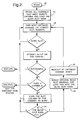
- Figure 2 shows the steps followed by the algorithm in call set-up.
- box 20 the next step, box 22, is to measure signal strengths, accept the blind slot message from a base station (if available) and load into the storage means in the handset the blind slot mask.
- Channel selection (box 23) then proceeds from the first time slot. If an available time slot is found, channel set-up is attempted until all nine channels are attempted, after which set-up with an alternative base station is attempted. Each time set-up in a channel fails, the time slot containing that particular channel is marked blind. If the blind slot mask is full (decision block 24), the original blind slot message is inverted (box 25) and the process repeated (box 26).
Landscapes
- Engineering & Computer Science (AREA)
- Computer Networks & Wireless Communication (AREA)
- Signal Processing (AREA)
- Computer Security & Cryptography (AREA)
- Mobile Radio Communication Systems (AREA)
Applications Claiming Priority (2)
| Application Number | Priority Date | Filing Date | Title |
|---|---|---|---|
| GB9500619 | 1995-01-10 | ||
| GB9500619A GB2297013B (en) | 1995-01-10 | 1995-01-10 | Portable radio telephones and methods of operation |
Publications (3)
| Publication Number | Publication Date |
|---|---|
| EP0722259A2 true EP0722259A2 (fr) | 1996-07-17 |
| EP0722259A3 EP0722259A3 (fr) | 1999-04-14 |
| EP0722259B1 EP0722259B1 (fr) | 2008-11-26 |
Family
ID=10767955
Family Applications (1)
| Application Number | Title | Priority Date | Filing Date |
|---|---|---|---|
| EP96300147A Expired - Lifetime EP0722259B1 (fr) | 1995-01-10 | 1996-01-09 | Méthode de balayage des canaux pour des téléphones portables radio |
Country Status (6)
| Country | Link |
|---|---|
| US (2) | US5862130A (fr) |
| EP (1) | EP0722259B1 (fr) |
| JP (1) | JP3547885B2 (fr) |
| CA (1) | CA2166832C (fr) |
| DE (1) | DE69637759D1 (fr) |
| GB (1) | GB2297013B (fr) |
Cited By (9)
| Publication number | Priority date | Publication date | Assignee | Title |
|---|---|---|---|---|
| WO1998007245A3 (fr) * | 1996-08-09 | 1998-03-26 | Siemens Ag | Procede d'etablissement de liaisons de telecommunication entre des appareils de telecommunication dans des systemes de telecommunication sans fil, en particulier entre des appareils dect d'un systeme dect |
| WO1998023118A1 (fr) * | 1996-11-15 | 1998-05-28 | Nokia Telecommunications Oy | Allocation de canal dynamique |
| EP0827295A3 (fr) * | 1996-08-30 | 1999-12-08 | Siemens Aktiengesellschaft | Procédé pour occuper plusieurs tranches de temps successives dans des réseaux de communication sans fil |
| GB2303999B (en) * | 1995-08-03 | 2000-01-26 | Nokia Mobile Phones Ltd | Radio telephones and methods of operation |
| EP1087634A1 (fr) * | 1999-09-27 | 2001-03-28 | Trt Lucent Technologies | Procédé de gestion de transmission entre un terminal et une station de base |
| EP1087632A1 (fr) * | 1999-09-27 | 2001-03-28 | TRT Lucent Technologies (SA) | Procédé de gestion de la transmission d'un terminal vers une station de base |
| EP0897237A3 (fr) * | 1997-08-14 | 2001-07-11 | Samsung Electronics Co., Ltd. | Appareil et méthode de communication AMRT |
| EP0827294A3 (fr) * | 1996-08-30 | 2002-03-13 | Siemens Aktiengesellschaft | Procédé d'allocation d'intervalles temporels dans des réseaux de communication sans fil |
| CN1102327C (zh) * | 1997-07-28 | 2003-02-26 | 佳能株式会社 | 利用多个通信时隙进行通信的无线通信系统、设备及方法 |
Families Citing this family (33)
| Publication number | Priority date | Publication date | Assignee | Title |
|---|---|---|---|---|
| US6577611B1 (en) * | 1996-01-11 | 2003-06-10 | Nokia Mobile Phones Limited | Methods and apparatus for excluding communication channels in a radio telephone |
| GB2309859B (en) * | 1996-01-31 | 2000-02-16 | Nokia Mobile Phones Ltd | Radio receivers and methods of operation |
| US6738364B1 (en) | 1996-01-31 | 2004-05-18 | Nokia Mobile Phones Limited | Radio receivers and methods of operation |
| FR2754658A1 (fr) * | 1996-10-16 | 1998-04-17 | Philips Electronics Nv | Systeme de transmission radioelectrique comportant des mobiles de telecommunications, procede pour se connecter sur un tel systeme et mobile dans lequel ledit procede est applique |
| GB2318481B (en) * | 1996-10-16 | 2001-05-09 | Motorola Inc | A communication method |
| KR100446515B1 (ko) * | 1997-09-13 | 2004-11-12 | 삼성전자주식회사 | 무선 통신시스템의 접속 방법 |
| US6243371B1 (en) * | 1997-12-16 | 2001-06-05 | At&T Corp. | Method and apparatus for interference avoidance in a wireless communication system |
| GB2332823A (en) * | 1997-12-29 | 1999-06-30 | Samsung Electronics Co Ltd | Sequential selection of control channels for call attempt |
| CN1196366C (zh) * | 1998-03-26 | 2005-04-06 | 皇家菲利浦电子有限公司 | 具有改进的接入协议的通信网 |
| JPH11313357A (ja) * | 1998-04-28 | 1999-11-09 | Matsushita Electric Ind Co Ltd | ハンドオーバー方法及び送受信装置 |
| JP3111992B2 (ja) | 1998-07-07 | 2000-11-27 | 日本電気株式会社 | 自動車通信方法及びシステム |
| KR100272109B1 (ko) * | 1998-08-21 | 2000-11-15 | 윤종용 | 효율적 무선 자원 할당을 위한 무선통신 장치 및 그 운용 방법 |
| GB9904349D0 (en) * | 1999-02-26 | 1999-04-21 | Koninkl Philips Electronics Nv | Cellular communication system handover |
| US6950418B1 (en) * | 1999-04-30 | 2005-09-27 | Rockwell Collins, Inc. | Clique activation multiple access (CAMA) |
| US6504829B1 (en) * | 1999-06-28 | 2003-01-07 | Rockwell Collins, Inc. | Method and apparatus for managing communication resources using channelized neighborhoods |
| US6711177B1 (en) * | 1999-06-28 | 2004-03-23 | Rockwell Collins, Inc. | Method and apparatus for managing communication resources using frame fitting |
| US6487186B1 (en) * | 1999-06-28 | 2002-11-26 | Rockwell Collins, Inc. | Method and apparatus for managing communication resources using bootstrap slots |
| US6791994B1 (en) | 2000-04-19 | 2004-09-14 | Rockwell Collins, Inc. | Method and apparatus for assigning receive slots in a dynamic assignment environment |
| US6781967B1 (en) | 2000-08-29 | 2004-08-24 | Rockwell Collins, Inc. | Scheduling techniques for receiver directed broadcast applications |
| US6885651B1 (en) | 2000-08-29 | 2005-04-26 | Rockwell Collins | Maintaining an adaptive broadcast channel using both transmitter directed and receiver directed broadcasts |
| US6810022B1 (en) | 2000-08-29 | 2004-10-26 | Rockwell Collins | Full duplex communication slot assignment |
| US7385999B1 (en) | 2003-10-20 | 2008-06-10 | Rockwell Collins, Inc. | Heuristics for combining inter-channel and intra-channel communications in a wireless communications environment |
| US7403780B2 (en) * | 2004-02-19 | 2008-07-22 | Rockwell Collins, Inc. | Hybrid open/closed loop filtering for link quality estimation |
| US7826372B1 (en) | 2004-03-26 | 2010-11-02 | Rockwell Collins, Inc. | Network routing process for regulating traffic through advantaged and disadvantaged nodes |
| US7382799B1 (en) | 2004-05-18 | 2008-06-03 | Rockwell Collins, Inc. | On-demand broadcast protocol |
| US7310380B1 (en) | 2004-05-28 | 2007-12-18 | Rockwell Collins, Inc. | Generic transmission parameter configuration |
| US7397810B1 (en) | 2004-06-14 | 2008-07-08 | Rockwell Collins, Inc. | Artery nodes |
| US7606171B1 (en) | 2005-07-28 | 2009-10-20 | Rockwell Collins, Inc. | Skeletal node rules for connected dominating set in ad-hoc networks |
| US8270988B1 (en) * | 2008-03-27 | 2012-09-18 | Sprint Spectrum L.P. | Dynamic addition of carrier frequency to a wireless coverage area in response to low load |
| US9173196B2 (en) * | 2010-10-07 | 2015-10-27 | GM Global Technology Operations LLC | Adaptive multi-channel access for vehicular networks |
| KR102024352B1 (ko) * | 2013-07-31 | 2019-11-04 | 한국전자통신연구원 | 무선 센서 네트워크에서의 채널 관리 방법 및 데이터 전송 방법 |
| US11350349B2 (en) * | 2018-12-10 | 2022-05-31 | Panasonic Intellectual Property Management Co., Ltd. | Base unit and repeater |
| JP2020096237A (ja) * | 2018-12-10 | 2020-06-18 | パナソニックIpマネジメント株式会社 | ベースユニットおよび中継器 |
Family Cites Families (28)
| Publication number | Priority date | Publication date | Assignee | Title |
|---|---|---|---|---|
| JP2580129B2 (ja) * | 1986-07-18 | 1997-02-12 | ソニー株式会社 | 送受信装置 |
| JPS6348926A (ja) * | 1986-08-19 | 1988-03-01 | Fujitsu Ltd | コ−ドレステレホンのマルチチヤネルアクセス方式 |
| SE466279B (sv) * | 1988-10-17 | 1992-01-20 | Ericsson Telefon Ab L M | Radioenhet foer oeverfoering av samtalsinformation i ett mobiltelefonsystem med kort raeckvidd |
| GB2232326A (en) * | 1989-05-26 | 1990-12-05 | Philips Electronic Associated | Data transmission over a tdm duplex frequency channel |
| SE500157C2 (sv) * | 1989-09-13 | 1994-04-25 | Ericsson Telefon Ab L M | Förfarande för att välja basstation, radiokanal och tidslucka vid en mobilstation |
| SE500827C2 (sv) * | 1989-09-13 | 1994-09-12 | Ericsson Telefon Ab L M | Förfarande för kommunikation mellan en mobilstation och en fast radiostation |
| FI894371A7 (fi) * | 1989-09-15 | 1991-03-16 | Nokia Mobile Phones Ltd | Telefonsystem. |
| SE465991B (sv) | 1990-04-10 | 1991-11-25 | Ericsson Telefon Ab L M | Foerfarande foer att i en mottagare vaelja den laempligaste av tvaa eller flera antenner |
| SE466230B (sv) | 1990-05-23 | 1992-01-13 | Ericsson Telefon Ab L M | Foerfarande att i ett mobilradiosystem maeta en egen trafikfoerbindelses oeverfoeringskvalite |
| JP3034281B2 (ja) * | 1990-07-12 | 2000-04-17 | 株式会社東芝 | 無線通信方式 |
| JP3093243B2 (ja) * | 1990-07-12 | 2000-10-03 | 株式会社東芝 | 移動無線通信システム |
| GB2249918A (en) * | 1990-11-14 | 1992-05-20 | Philips Electronic Associated | Channel scanning in tdd cordless telephone system |
| US5134709A (en) | 1990-12-14 | 1992-07-28 | At&T Bell Laboratories | Process and apparatus for flexible channel assignment in cellular radiotelephone systems |
| FI87615C (fi) * | 1991-04-05 | 1993-01-25 | Nokia Mobile Phones Ltd | Styrsystem foer ett paketkopplat cdma-datanaet |
| IT1250515B (it) * | 1991-10-07 | 1995-04-08 | Sixtel Spa | Rete per area locale senza fili. |
| US5287544A (en) | 1991-10-17 | 1994-02-15 | Motorola, Inc. | Method of channel assignment by matching channel interference with channel link loss |
| FI96157C (fi) * | 1992-04-27 | 1996-05-10 | Nokia Mobile Phones Ltd | Digitaalinen, solukkorakenteinen aikajakokanavointiin perustuva radiopuhelinverkko radioyhteyden siirtämiseksi tukiasemalta uudelle tukiasemalle |
| FI91345C (fi) * | 1992-06-24 | 1994-06-10 | Nokia Mobile Phones Ltd | Menetelmä kanavanvaihdon tehostamiseksi |
| US5416778A (en) * | 1992-06-26 | 1995-05-16 | U.S. Philips Corporation | Digital radio communication system and primary and secondary station for use in such a system |
| JP2795072B2 (ja) * | 1992-07-09 | 1998-09-10 | 日本電気株式会社 | 移動通信システムのチャネル割当方法 |
| US5410733A (en) * | 1993-02-11 | 1995-04-25 | Nokia Mobile Phones Ltd. | Received signal strength information measurement useful in a mobile telephone system having mobile assisted handoff capability |
| US6018528A (en) * | 1994-04-28 | 2000-01-25 | At&T Corp | System and method for optimizing spectral efficiency using time-frequency-code slicing |
| US5826189A (en) * | 1994-06-13 | 1998-10-20 | Motorola, Inc. | Cellular communication system with efficient channel assignments and method therefor |
| US5548805A (en) * | 1994-08-23 | 1996-08-20 | Racotek, Inc. | Data communication system using spectral overlay |
| JP3271441B2 (ja) * | 1994-11-01 | 2002-04-02 | 株式会社日立製作所 | 移動通信システムにおける制御信号送信スロット割当て方法および無線基地局 |
| GB2297014B (en) * | 1995-01-10 | 1999-07-28 | Nokia Mobile Phones Ltd | Portable radio telephones and method of operation |
| US5719868A (en) * | 1995-10-05 | 1998-02-17 | Rockwell International | Dynamic distributed, multi-channel time division multiple access slot assignment method for a network of nodes |
| GB2310108B (en) * | 1996-02-06 | 2000-04-26 | Nokia Mobile Phones Ltd | Handoff |
-
1995
- 1995-01-10 GB GB9500619A patent/GB2297013B/en not_active Expired - Fee Related
-
1996
- 1996-01-09 EP EP96300147A patent/EP0722259B1/fr not_active Expired - Lifetime
- 1996-01-09 DE DE69637759T patent/DE69637759D1/de not_active Expired - Lifetime
- 1996-01-09 CA CA002166832A patent/CA2166832C/fr not_active Expired - Fee Related
- 1996-01-09 JP JP00107496A patent/JP3547885B2/ja not_active Expired - Lifetime
- 1996-01-11 US US08/584,054 patent/US5862130A/en not_active Expired - Lifetime
-
1999
- 1999-01-19 US US09/234,170 patent/US6310867B1/en not_active Expired - Lifetime
Non-Patent Citations (1)
| Title |
|---|
| None |
Cited By (12)
| Publication number | Priority date | Publication date | Assignee | Title |
|---|---|---|---|---|
| GB2303999B (en) * | 1995-08-03 | 2000-01-26 | Nokia Mobile Phones Ltd | Radio telephones and methods of operation |
| WO1998007245A3 (fr) * | 1996-08-09 | 1998-03-26 | Siemens Ag | Procede d'etablissement de liaisons de telecommunication entre des appareils de telecommunication dans des systemes de telecommunication sans fil, en particulier entre des appareils dect d'un systeme dect |
| US6400949B1 (en) | 1996-08-09 | 2002-06-04 | Siemens Aktiengesellschaft | Process for establishing telecommunication connections between telecommunication apparatuses in wireless telecommunication systems, in particular between DECT-apparatuses of a DECT-system |
| EP0827295A3 (fr) * | 1996-08-30 | 1999-12-08 | Siemens Aktiengesellschaft | Procédé pour occuper plusieurs tranches de temps successives dans des réseaux de communication sans fil |
| EP0827294A3 (fr) * | 1996-08-30 | 2002-03-13 | Siemens Aktiengesellschaft | Procédé d'allocation d'intervalles temporels dans des réseaux de communication sans fil |
| WO1998023118A1 (fr) * | 1996-11-15 | 1998-05-28 | Nokia Telecommunications Oy | Allocation de canal dynamique |
| AU711875B2 (en) * | 1996-11-15 | 1999-10-21 | Nokia Networks Oy | Dynamic channel allocation |
| CN1102327C (zh) * | 1997-07-28 | 2003-02-26 | 佳能株式会社 | 利用多个通信时隙进行通信的无线通信系统、设备及方法 |
| EP0897237A3 (fr) * | 1997-08-14 | 2001-07-11 | Samsung Electronics Co., Ltd. | Appareil et méthode de communication AMRT |
| EP1087634A1 (fr) * | 1999-09-27 | 2001-03-28 | Trt Lucent Technologies | Procédé de gestion de transmission entre un terminal et une station de base |
| EP1087632A1 (fr) * | 1999-09-27 | 2001-03-28 | TRT Lucent Technologies (SA) | Procédé de gestion de la transmission d'un terminal vers une station de base |
| US6728549B1 (en) | 1999-09-27 | 2004-04-27 | Lucent Technologies Inc | Switching to an improved bearer during a call connection |
Also Published As
| Publication number | Publication date |
|---|---|
| JP3547885B2 (ja) | 2004-07-28 |
| EP0722259B1 (fr) | 2008-11-26 |
| US5862130A (en) | 1999-01-19 |
| US6310867B1 (en) | 2001-10-30 |
| EP0722259A3 (fr) | 1999-04-14 |
| JPH08251651A (ja) | 1996-09-27 |
| CA2166832A1 (fr) | 1996-07-11 |
| GB2297013B (en) | 1999-09-15 |
| CA2166832C (fr) | 2001-12-25 |
| DE69637759D1 (de) | 2009-01-08 |
| GB9500619D0 (en) | 1995-03-01 |
| GB2297013A (en) | 1996-07-17 |
Similar Documents
| Publication | Publication Date | Title |
|---|---|---|
| CA2166832C (fr) | Radiotelephones portatifs et leurs methodes de fonctionnement | |
| CA2166831C (fr) | Radiotelephones portatifs et leurs methodes de fonctionnement | |
| EP0440436B1 (fr) | Système de téléphonie cellulaire mobile | |
| US5864759A (en) | Radio telephones and methods of operation | |
| EP0490509A2 (fr) | Transfert d'appel amélioré entre cellules dans des systèmes de radio-communications avec allocation dynamique de canal | |
| US6577611B1 (en) | Methods and apparatus for excluding communication channels in a radio telephone | |
| EP0819364B1 (fr) | Planification stabilisee de disposition des voies de commande grace a des canaux de trafic reserves a configuration dispersee | |
| CA2174218C (fr) | Procede et dispositif d'acces a un systeme radiotelephonique cellulaire sans comparaison d'identification de systeme | |
| EP0789501B1 (fr) | Portable avec dispositif de surveillance pour le transfert | |
| US6131033A (en) | Methods and systems of performing system channel planning for wireless local loop communication | |
| WO1998048586A2 (fr) | Procede de selection de canal dans un reseau de radiocommunication cellulaire base sur gsm/dcs | |
| US20250097974A1 (en) | Method for resource reselection and terminal device | |
| JP3276772B2 (ja) | 無線電話システムおよび無線チャネル割当方法 | |
| CA2310683C (fr) | Procedes et systemes de planification des canaux systeme pour communication a boucle de raccordement radio | |
| Capone et al. | Packet data access in DECT systems | |
| CA2217192C (fr) | Planification stabilisee de disposition des voies de commande grace a des canaux de trafic reserves a configuration dispersee |
Legal Events
| Date | Code | Title | Description |
|---|---|---|---|
| PUAI | Public reference made under article 153(3) epc to a published international application that has entered the european phase |
Free format text: ORIGINAL CODE: 0009012 |
|
| AK | Designated contracting states |
Kind code of ref document: A2 Designated state(s): DE FR GB NL SE |
|
| PUAL | Search report despatched |
Free format text: ORIGINAL CODE: 0009013 |
|
| AK | Designated contracting states |
Kind code of ref document: A3 Designated state(s): DE FR GB NL SE |
|
| 17P | Request for examination filed |
Effective date: 19991014 |
|
| RAP1 | Party data changed (applicant data changed or rights of an application transferred) |
Owner name: NOKIA CORPORATION |
|
| 17Q | First examination report despatched |
Effective date: 20031223 |
|
| 17Q | First examination report despatched |
Effective date: 20031223 |
|
| GRAP | Despatch of communication of intention to grant a patent |
Free format text: ORIGINAL CODE: EPIDOSNIGR1 |
|
| GRAS | Grant fee paid |
Free format text: ORIGINAL CODE: EPIDOSNIGR3 |
|
| GRAA | (expected) grant |
Free format text: ORIGINAL CODE: 0009210 |
|
| AK | Designated contracting states |
Kind code of ref document: B1 Designated state(s): DE FR GB NL SE |
|
| REG | Reference to a national code |
Ref country code: GB Ref legal event code: FG4D |
|
| REF | Corresponds to: |
Ref document number: 69637759 Country of ref document: DE Date of ref document: 20090108 Kind code of ref document: P |
|
| REG | Reference to a national code |
Ref country code: SE Ref legal event code: TRGR |
|
| PGFP | Annual fee paid to national office [announced via postgrant information from national office to epo] |
Ref country code: NL Payment date: 20090104 Year of fee payment: 14 |
|
| PGFP | Annual fee paid to national office [announced via postgrant information from national office to epo] |
Ref country code: GB Payment date: 20081201 Year of fee payment: 14 |
|
| PLBE | No opposition filed within time limit |
Free format text: ORIGINAL CODE: 0009261 |
|
| STAA | Information on the status of an ep patent application or granted ep patent |
Free format text: STATUS: NO OPPOSITION FILED WITHIN TIME LIMIT |
|
| 26N | No opposition filed |
Effective date: 20090827 |
|
| REG | Reference to a national code |
Ref country code: NL Ref legal event code: V1 Effective date: 20100801 |
|
| GBPC | Gb: european patent ceased through non-payment of renewal fee |
Effective date: 20100109 |
|
| PG25 | Lapsed in a contracting state [announced via postgrant information from national office to epo] |
Ref country code: NL Free format text: LAPSE BECAUSE OF NON-PAYMENT OF DUE FEES Effective date: 20100801 |
|
| PG25 | Lapsed in a contracting state [announced via postgrant information from national office to epo] |
Ref country code: GB Free format text: LAPSE BECAUSE OF NON-PAYMENT OF DUE FEES Effective date: 20100109 |
|
| PGFP | Annual fee paid to national office [announced via postgrant information from national office to epo] |
Ref country code: SE Payment date: 20110111 Year of fee payment: 16 Ref country code: FR Payment date: 20110128 Year of fee payment: 16 |
|
| REG | Reference to a national code |
Ref country code: SE Ref legal event code: EUG |
|
| REG | Reference to a national code |
Ref country code: FR Ref legal event code: ST Effective date: 20120928 |
|
| PG25 | Lapsed in a contracting state [announced via postgrant information from national office to epo] |
Ref country code: SE Free format text: LAPSE BECAUSE OF NON-PAYMENT OF DUE FEES Effective date: 20120110 |
|
| PG25 | Lapsed in a contracting state [announced via postgrant information from national office to epo] |
Ref country code: FR Free format text: LAPSE BECAUSE OF NON-PAYMENT OF DUE FEES Effective date: 20120131 |
|
| PGFP | Annual fee paid to national office [announced via postgrant information from national office to epo] |
Ref country code: DE Payment date: 20150106 Year of fee payment: 20 |
|
| REG | Reference to a national code |
Ref country code: DE Ref legal event code: R082 Ref document number: 69637759 Country of ref document: DE Representative=s name: BECKER, KURIG, STRAUS, DE Ref country code: DE Ref legal event code: R081 Ref document number: 69637759 Country of ref document: DE Owner name: NOKIA TECHNOLOGIES OY, FI Free format text: FORMER OWNER: NOKIA CORP., 02610 ESPOO, FI |
|
| REG | Reference to a national code |
Ref country code: DE Ref legal event code: R071 Ref document number: 69637759 Country of ref document: DE |